

Humanity's Internal Impulses for Development
Goethe and the Crisis of the Nineteenth Century
GA 171
21 October 1916, Dornach
Translated by Steiner Online Library
Thirteenth Lecture
[ 1 ] We have attempted to bring to light the main ideas that, in our fifth post-Atlantean epoch, are striving for form—or, one might say, for existence—striving so intensely for existence that they develop one-sidedly under the influence of the two impulses described above. Under one impulse, everything that can be connected to the fact of birth, the fact of kinship among living beings—indeed, among all beings and forces within our earthly existence—more or less takes shape and develops. Influenced one-sidedly by the other impulse, we see those facts that are connected to death, to what is called suffering, pain, evil, and wickedness. And we have attempted to shed light from various angles on how the series of facts in human thinking that are connected to what has been characterized take shape in a one-sided manner. Now we must be clear that the two most important ideals for this fifth post-Atlantean epoch are: first, the ideal of presenting purely what is present in the sensory world and tracing it back to its original phenomena—as Goethe did, as we have already discussed—who attempted to trace phenomena back to what he called the “primordial phenomena.” On the other hand, the fifth post-Atlantean epoch must strive to attain free imaginations that arise within the human soul. The task of our time lies in the synthesis, so to speak, of the imaginations that human beings receive from the spiritual world—of which, of course, there can be only a few at present, since the fifth post-Atlantean epoch, as we know, did not begin until the 15th century—and the sensory world. With these free imaginations, human beings are to embrace that which presents itself to them in the external sensory world. As you can gather from various remarks of mine—some of which have been presented in lectures and some of which can be found in my books—it was Goethe, in particular, who made a great start on such a view of the world. That is why Goethe can also serve as the genuine, appropriate foundation for a worldview truly required by the fifth post-Atlantean epoch.
[ 2 ] It is a peculiar feature of world development that it must, as it were, unfold in waves—that certain impulses arise, exert a strong influence, then subside, and may only reappear later, and so on. This is felt particularly strongly by those who understand the essence of Goethe’s worldview. Certainly, spiritual science itself cannot yet be found in Goethe’s worldview, but it will be able to emerge more and more precisely under the influence of an understanding of Goethe’s worldview. For it is truly the case that everything that could be given as a worldview even without the actual form of spiritual science is already present in Goethe’s worldview. And this Goethean worldview has, for the time being, cast its light in circles that, while perhaps narrow for the wider world, are nonetheless vast for spiritual life; and much in spiritual life has already been influenced by the Goethean worldview, even if that which has been influenced has, in essence, ebbed away just as Goethe’s worldview itself has ebbed away. For one need not delude oneself about this: Even though Goethe is mentioned by many today, and even though many believe they know his works, that which actually lives and weaves within his worldview is still among the most unknown aspects of human development; and as it increasingly enters into human development—into scientific, social, and all other forms of thought— but will also fundamentally transform the impulses guiding human action. In our time, even outside the anthroposophical movement, there are still forces and impulses at work that are not conducive to an understanding of Goethe’s worldview. For as justified and as magnificent as the so-called democratic principle is for human development—when understood in the proper sense—it has a pernicious effect in our time, when it is often approached and applied in the most misguided way. In our time, there is an intense aversion, antipathy—indeed, more than that: in many souls, an intense hatred and opposition—toward a worldview of the kind that has its sources in Goethe’s way of thinking and Goethe’s spirit. For this worldview requires many, many things that our time dislikes the very most. In our time, everyone wants—without having laid any particular foundations for it—to have, as it were, their own worldview, to construct their own worldview, to be a loner in matters of worldview. And the next feeling everyone has is roughly this: that the various worldviews stand side by side on an equal footing. That which Goethe so uniquely characterizes in the Faustian striving is what every journalistic hack—and everyone who parrots these hacks—talks about today; but as for knowing the innermost essence of this Faustian striving, there can be no question of it whatsoever, especially today. And we will still have much to discuss when we examine what has been outlined here only in broad strokes—namely, what in recent times has been detrimental to a harmonious balance of the aforementioned impulses—so that we may then also discuss how this harmonious balance of the one-sided impulses we have come to know is to be brought about.
[ 3 ] Today I would like to add a few more points, in a sort of episodic manner, to help you understand how it came to be that Goethe’s worldview—which had already reached such heights—dried up in the 19th century, and all sorts of other ideas came to the fore. The 19th century came to regard—if I may put it that way—the world surrounding human beings as increasingly uninteresting—a fact that is often overlooked, but it is indeed the case—because it was precisely in the 19th century that a crisis arose in humanity’s spiritual development, one that caused the perception of the spiritual that lives within things to dry up more and more. People saw only the outer sensory qualities, sensory characteristics, and modes of activity of things, and these became less and less interesting. What, as the spiritual, permeates and interweaves the sensory world was no longer seen. The sensory world as such was found to be increasingly uninteresting. Hence the impulse, within this sensory world itself—which was, after all, the only thing available to the spirit of the age—to seek something hidden within this sensory world itself. People were not aware of the spiritual and hidden aspects within the sensory world. Thus, people sought the hidden within the sensory world itself, and this led them, at first—albeit in a highly fruitful way—to attempt to deepen their perception spatially in another direction through microscopic and telescopic research, through that which can be perceived purely through the senses in the smallest and the largest. Faith in the hidden spiritual realm waned. Thus, people wanted at least to be allowed to believe that the mysteries of the world could be solved by investigating what was initially hidden from the senses, and in this field, tremendous progress was indeed made. One need only think of the great, tremendous advances that microscopic research made regarding living organisms in the 19th century. This gave rise to cell theory. People came to the view that the living organism of plants, animals, and humans consists of the smallest parts—cells—and the refinement of microscopic research made it possible to study the life of these tiniest cellular beings, about which one had previously been able to make only more or less conjectures. In this way, one sought to explain the sensible world through another aspect of the sensible world. And this method of explanation became particularly important for a series of facts that came to the fore in the fifth post-Atlantean epoch—namely, the facts related to birth and the development of living beings. One saw a living being, up to and including the human being, emerge from a single cell; one saw it develop by observing the progression of life and the multiplication of cells, and one finally arrived at forming concepts of how the simple round cell—which multiplies gradually in the course of its life before birth, even in humans—is transformed and ultimately becomes the human form as it enters existence through birth.
[ 4 ] As I said, people formed ideas about how a simple cell develops into what then comes into being as a human being through birth, and these ideas led to what might be called the problem of birth—the mystery of human birth—being closely linked to the processes in the animal world. After all, it was evident that the animal world, in its simplest forms, consists of beings that are themselves initially like a single cell—that is, there are animal beings in the world which, for their entire lives, have the form that a human being possesses only in the very earliest stage within the mother’s womb. Other animals appeared in forms similar to a later stage of human development. At a certain stage of development before birth—that is, during embryonic development—the human form appears such that it looks like, or at least resembles, a small fish; and between the cellular form and the form of a small fish lie the other forms that now live externally as independent beings. Thus, in a sense, the human being gradually passes through, in its embryonic development, the forms that exist externally. As we know, this led to the formulation of the biogenetic law, made so famous by Haeckel, which states that during its prenatal development, the human being, in a condensed form, recapitulates the animal forms. This, in turn, led to the belief that the human being, upon entering earthly existence, must be descended from animal forms. People thought: Well, in ancient times there were simply only single-celled organisms; from these single-celled organisms, through this or that process—which was thought of as more or less random or purely scientifically necessary (which, after all, amounts to the same thing)—more complex beings developed. So that in the next stage of the world’s development, one now has before one the simple cellular organisms and somewhat more complex ones; but the somewhat more complex ones first go through the stage of simple cellular development; then came even more complex ones, which in turn had gone through cellular forms—that is, what had arisen earlier—and then their own form. And so, it was thought, the entire animal kingdom had developed, culminating in humans, who, during their embryonic development, briefly recapitulate all animal forms.
[ 5 ] In this way, a conception arose of the connection between what might be called human birth and the gradual emergence—as it was thought—of organic life forms. This thus directly linked human beings to the various animal forms, and since human beings are easily dazzled by what they see directly, people throughout the 19th century neglected to consider anything other than what appeared in this way as a similarity between human embryonic development and the structures of other organic forms. The thoughts and ideas through which one recognized—or believed one had recognized—the connection revealed by the advanced methods of research—these thoughts were only as narrow as they were, and could only take on the materialistic form that they did, precisely because, in the course of the 19th century, Goethe’s way of thinking, Goethe’s conception, truly dried up completely. One need only recall how Goethe, in the course of his life, arrived at what he called his “theory of metamorphosis.”
[ 6 ] Goethe—as you may well have gathered from the impact “Faust” had on you—had, before he arrived at his theory of metamorphosis, likely engaged with whatever knowledge of the spiritual world was available to him in his time, and he became acquainted with various paths and various means through which a person can attempt to approach the spiritual world. Only after Goethe’s spirit had been deeply, deeply enriched by his experiences and encounters with these means and paths did he set out to grasp scientific ideas. And there we see, first of all, how Goethe—once he had arrived in Weimar and gradually gained access to the resources of the University of Jena—did everything, absolutely everything, to enrich his scientific knowledge and insights, while at the same time doing everything to gain coherent ideas about the various forms of organisms. And then, in turn, we see how Goethe sets out on his Italian journey, how, while on that journey, he takes in everything he encounters in terms of plant and animal forms, in order to study the inner kinship of these forms within the rich diversity that now presented itself to him. And in Sicily, at last, he believed he had found what he later called his “primordial plant.” What did Goethe mean by the “primordial plant”? This primordial plant is not a sensory entity. Goethe himself calls this primordial plant a “sensory-supersensory form.” It is something that can only be perceived in the spiritual realm, but it is perceived there in such a way that when one sees a particular plant, one knows: this particular plant is a specific manifestation of the primordial plant. Every plant is a particular manifestation of the primordial plant, but no sensually real plant is the primordial plant. The primordial plant is a sensually-supersensual being that lives in all plants. This, then, was the idea Goethe arrived at: not merely to trace the various sensory forms, but to seek the one primordial plant in all plants. With this, one might say, he had substantially deepened—very, very deeply—what has always existed as the doctrine of metamorphosis, and it was natural for him to now apply the idea of this doctrine of metamorphosis more broadly to the organic, to the living.
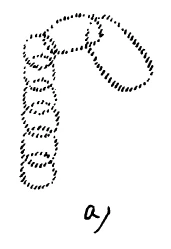
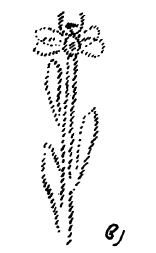
[ 7 ] It is interesting when he goes on to describe how he wanted to conceive of the human form itself in such a way that its individual limbs represent products of transformation—in a sense, the human being is the complication of an idea. He recounts how, in 1790, he found a sheep’s skull at the Jewish cemetery in Venice that had decomposed particularly well, allowing him to see from the individual skull bones how they are formed in such a way that one can recognize transformed vertebral bones within them. He had thus noticed that the spine consists of individual bones—which I will sketch only schematically—but that the skull, in turn, consists of such transformed vertebral bones. Of course, when they are transformed, they take on entirely different forms, but the skull bones are nonetheless merely transformed vertebral bones. The vertebral bones are stacked one on top of the other in a ring-like arrangement. By imagining them as rubber and stretching the rubber in various ways, one can visualize how the shapes of the skull bones arise from the vertebral bones (see drawing a). It was something extraordinarily important for Goethe to be able to say to himself: Within the vertebral bone that encloses the spinal cord lies something like a fundamental element of human development, which need only be transformed to take shape as more complex elements of this human development. Thus, on the one hand, Goethe had recognized in the plant leaf: When a plant grows, it develops leaf after leaf; but then, at a certain point, it ceases leaf development, and through the transformation of the leaf, first the petals emerge (see drawing b), and then also the stamens—organs of a completely different form, which are nothing other than leaves, but transformed leaves. For Goethe, therefore, the entire plant is contained within the leaf.
[ 8 ] So there is much that is invisible and supernatural in a single leaf; the entire plant is contained within a single leaf. Likewise, however, the entire skull is already present in the spine. The spine and the skull together form a whole, and the complex bones of the skull are just as much transformed vertebrae as the petals—indeed, just as the stamens and the pistil are transformed green leaves of the plant. Thus Goethe had the idea that what lies as a supersensible foundation within the leaf undergoes a complex transformation in the most manifold ways and then becomes the entire plant; that what lies within the spine undergoes a complex transformation and becomes the head. This is essentially how far Goethe had progressed in his views.
[ 9 ] The humanities did not yet exist at that time, and it is particularly interesting to see how Goethe is a mind that always remains consciously at the level to which he can advance through his rich observations, and does not entertain any speculative thoughts, or formulate hypotheses, for example, in order to go beyond—in an unwarranted, fanciful way—the point to which he can actually penetrate through his rich experiences.
[ 10 ] Admittedly, there is still a long way to go, but it is a path that we can now begin to walk, more than a hundred years after Goethe formulated these ideas. With regard to the human being, Goethe, so to speak, stopped there: The human being has a spine, one vertebra lies above the other, and then the vertebra transforms into the skull bone. Goethe stopped there. We need not remain stuck where he left off. For from that point to an idea that allows for a broad, far-reaching perspective, there truly is a path—and a path must indeed be forged through spiritual science. If one approaches this with the same spirit with which Goethe—after, as they say, by “chance” — came upon a sheep’s skull at the Jewish cemetery in Venice, if one looks at the human being as he stands before us in his entirety with the same spirit with which one observed the individual bones of that sheep’s skull and, through that spirit, recognized that they are transformed vertebrae, then one notices something today. I have already alluded to this, but I must mention it again in this context and shed light on it from a different perspective. Then one realizes today that the human being is essentially a two-part being: that he consists of his head and the rest of his organism. Just as the petal develops from the stem leaf of the plant—just as the petal is a transformation of the plant’s stem leaf—so, too, is the human head a transformation of the entire rest of the organism. I have indeed said that, in order for this transformation to be fully accomplished, the human being must evolve from one incarnation to the next. What we carry within us today as our remaining organism, I said, will become our head in the next incarnation.
[ 11 ] You see, this view is merely a fully developed impulse that arises when one internally traces what originated in Goethe’s worldview. Thus, when one truly stands on the foundation of this doctrine of metamorphosis, one attempts to depict the individual organism in its parts; but these parts are conceived in such a connection that the connection is only possible if one perceives something that lives there as a spiritual element within the thing itself. For, of course, if a leaf were merely what the senses perceive, it could never become a petal or a stamen; if a vertebra were merely what the senses perceive it to be, it could never become a part of the skull; if the human body were merely what it presents to the external senses, it could never become a human head, no matter how much its forces might transform. Yet even with regard to external observation, Goethe’s worldview is more clearly in line with the demands of the fifth post-Atlantean epoch than the 19th-century natural science, which took such pride in its external observation and experimentation. Goethe truly sees more clearly, and those who seek to draw upon him can perceive more clearly what happens in nature and what exists in nature than, in particular, the biological science of the 19th century.
[ 12 ] I said that the human being first presents itself to us as two parts: the head and the rest of the organism. This fact—that the head is, in a sense, a transformed version of the rest of the organism—must first be understood if one is to proceed further. For only then will one be able to ask: Yes, what, then, is this human head on the one hand, and what is the rest of the human organism on the other? — To answer this question, one must consider matters entirely different from those that contemporary natural science typically considers important.
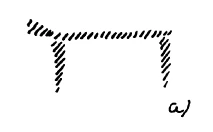
[ 13 ] You see, when you imagine an animal, the essential feature of that animal is that its spinal column—as I have often hinted—runs parallel to the Earth’s surface, and that the animal stands on the Earth’s surface with its front and hind legs (a) and holds its head horizontally in the extension of the spinal column, essentially as an extension of that spinal column. What we know today as the human spinal cord is oriented vertically; it is exactly perpendicular to the direction of the animal’s spinal column (b).
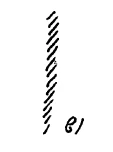
[ 14 ] But let us not consider this spinal cord for the time being, for it is not part of the head; it belongs to the rest of the organism. Let us first consider another spinal cord. Yes, what kind of another one? Let us consider the human brain. You will say: Is that a spinal cord? Yes, it is a spinal cord! For it is nothing other than a transformed spinal cord; it is, so to speak, a “puffed-up” spinal cord. Imagine a horizontal spinal cord, like that of an animal, inflated, transformed, metamorphosed—and you get the human brain (c).
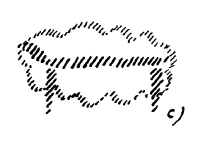
[ 15 ] The true fact is this: during the lunar evolution, what is now the brain looked like a modern animal spinal cord. And it was only during the transition from the lunar evolution to the Earth evolution that this spinal cord—which humans had on the Moon—became more complex, evolving into the modern human brain; but it retained its horizontal position. For essentially, its axis is perpendicular to the spinal cord belonging to the body, and humans did not acquire this spinal cord belonging to the body until the Earth period. This is still at the stage at which that spinal cord—which became the brain—was on the Moon during the Moon phase (d).
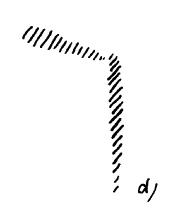
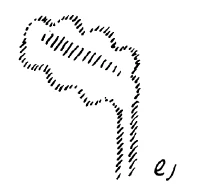
[ 16 ] What appears simpler in humans today—their spinal cord—is something they acquired later in the course of evolution, whereas what appears more complex today—their brain—is something they acquired later. However, the brain that humans have today was once a spinal cord. Thus, we see that humans have a spinal cord that has been transformed into a brain, and only later, during the Earth’s evolution, was an original spinal cord (e) added to it.
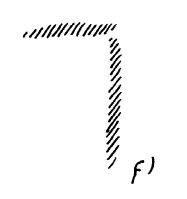
[ 17 ] So when we consider the human head, it does not appear all that different from that of an animal; for its main axis—like the axis of the animal’s spine, which is also the animal’s main axis—is horizontal, parallel to the ground (f).
[ 18 ] And one could point to many other characteristics that would show that the human head, as such—when viewed in the context of its entire development—is a transformed “animality,” and that the rest of the human organism has been added to this transformed animality. This idea is not at all similar to the one reached by scientific development in the 19th century. For scientific development in the 19th century, because it places primary value on the external, sensory realm, will find the human head to be the most different of all from animality. Here (see drawing), the human head does not appear to us to be all that different from the rest of the animal realm, only refined: the brain is a swollen spinal cord, which animals do indeed possess.
[ 19 ] You will now be on the verge of asking: “Yes, do you perhaps believe that the rest of the human organism is even nobler than the head organism in terms of external form, that the rest of the human organism might even resemble an animal less than the head?” And you yourself may still find this paradoxical today, but you will come to accept the view that this must be said. And when you think about it: Doesn’t our head, after all, when viewed externally and taken as a whole among all our limbs, most closely resemble animal forms? We are, at least for a large part of our lives—men even more so than women—hairy on the head. The rest of the body is by no means hairy to the same extent. This in itself already speaks volumes about its kinship with the animal organism. What I am merely hinting at now—and I will leave it at that for the time being—we will elaborate on further in due course. But it will lead us more and more to the realization that something entirely different takes place in nature than what is very often believed. Human beings look down from their own level to the lower animals and see, for example, a turtle, a mussel, or a snail, and—in accordance with modern scientific thought—they believe that the snail, the mussel, and indeed all lower creatures developed gradually first, and that the human head was added to the lower organisms of the animal kingdom. This is nonsense, utter nonsense! If you look at a shellfish or a turtle today, it is a human head at a lower stage, and the rest of our organism has been added to it. After what are lower animal forms—I will schematize them—have gradually transformed into the human head, the rest of the organism has been added to it.
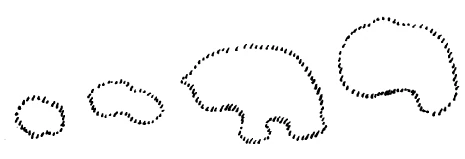
[ 20 ] So we have a process of development that proceeds further and further from the lower forms of animals, and what constitutes animality has taken shape as the human head, while the rest of the organism is attached to this human head as a later addition. It is in our head alone that we carry within us that which connects us to the other animals, not in the rest of our organism. That is why the human head, in its main axis, has the same orientation as an animal: parallel to the Earth’s surface. The rest of the organism is built upright, perpendicular to the Earth’s surface.
[ 21 ] It is indeed very unfortunate that this false idea, characterized by this view, found its way into the scientific development of the 19th century. For this leads one to believe that human beings, as such and as they are, have simply emerged—with their entire organism—as a somewhat more highly developed form from earlier animal forms. The truth is that what could have emerged from earlier animal forms can only be the core, whereas what has been added to this core is something that has emerged entirely anew within the course of Earth’s evolution.
[ 22 ] So there are two aspects to consider here, to begin with. The first is that our head is actually a transformed form of the other animal forms. And yet, from what was first added to the head—and which we have as the rest of the organism in one incarnation—we develop the form of the head in the next incarnation through corresponding forces. This might seem like an apparent contradiction. We will see, as we examine these things closely, that it is not a contradiction.
[ 23 ] By reminding you of the fact that human beings actually carry the animal within themselves—that with their earthly organism they support the animal that has become their head—I simply wanted to show you how mistaken today’s superficial ideas can be. But I would also like to show you something else from a positive perspective. If the human head is merely a transformed animal, how did the human head become what it is today? How can the human head—as it is today—develop into the human head through being prepared by an earthly organism in a previous incarnation? Well, the animal walks on the earth on its two pairs of legs—that is, on four legs. Anyone who believes that this animal simply strides across the earth and that nothing else happens except that this animal strides across the earth is greatly mistaken. Forces are constantly rising from the earth into the animal, passing through the spine, and then—while, so to speak, constantly influencing the brain—returning to the earth (a). The animal belongs to the earth. And the way it stands upon the earth, the way the forces active in the earth flow through its legs into its spine and back again—all of this is part of the animal’s entire life.
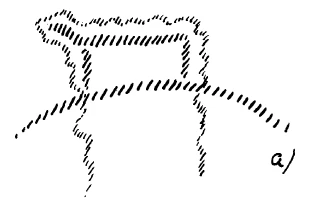
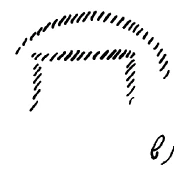
[ 24 ] The relationship that the animal has to the entire earth is the same relationship that the human being—the human head—has to the rest of the human organism. Because the human being has an organism that rises vertically from the earth, this remaining organism becomes to the human head what the earth—the entire earth—is to the animal. We thus have within us, united in the organism attached to our head, the mysteries of the entire earth. And it can easily be demonstrated—though today we can only hint at it—that in fact, when we study the head and the brain within it, we find the rudiments, the accessory organs for the front and rear limbs, through which the human being erects himself upon himself with his head, just as the animal stands upon the earth; just as we have there, only transformed into internal, other organs—we have hind limbs and front limbs. And the entire structure of the head is such that it indeed relates to the rest of the human organism as the animal relates to the earth (b).
[ 25 ] This is so significant that one comes to realize the importance of such an idea, which naturally arises only from the perspectives enriched by spiritual science. For with this idea, one must now return to what the nineteenth century, with its crude methods, observed only inadequately; with this idea, one must now go back and trace the embryonic development. Then something entirely different will emerge from what nineteenth-century natural science was able to discover. Then, in turn, ideas will also emerge that can be fruitful for human life, even beyond mere lifeless technology. But without these ideas, humanity will not be able to escape the dead end into which it has now strayed. For the true progress of humanity rests on the development of ideas—not the general ideas cultivated today in associations with lofty ideals, not those ideas that anyone can grasp by sitting in a coffeehouse for three hours—but on the ideas derived from the study of reality and only then applied to life. Beautiful ideas—the kind with which one can found associations—are easy to come by; but they do not prevent culture from ending up in dead ends like the one it has reached now. Only concrete ideas can prevent this.
[ 26 ] One must truly feel this; only then will one begin to grasp the great tasks of spiritual science, and one will be able to correctly assess the reality that surrounds us. This reality is aimed at preventing spiritual science from emerging, precisely in its most essential aspects. For the spirit that caused Goethe’s worldview to dry up in the 19th century is still very much present, and this spirit manifests itself particularly through a certain mania for persecution: a mania for persecuting everything that strives toward ideas imbued with reality. To this spirit of the present, ideas saturated with reality often seem fantastical, precisely because it is incapable of assimilating them. And it will become increasingly clear what spiritual science—as its strongest adversary—will face more and more: it will become clear that a worldview which seeks genuine spiritual paths and endeavors to investigate realities without prejudice is rejected precisely because people wish to reject this very investigation of realities. It is too inconvenient for people to learn what is necessary to arrive at a truly comprehensive worldview. That is why they will slander this comprehensive worldview and will not let the world see how comprehensive it is, but will lead the world to believe that it is based on concepts and research findings that are just as superficial, narrow-minded, and limited as those of other contemporary worldviews. And there will be an ever-increasing recognition of the dishonesty of a certain kind of striving—namely, that striving which persists in narrow-mindedness—and a rejection of precisely that which, with a consciousness that leads satisfactorily forward, truly seeks to explore the realities and can thereby also arrive at a certain comprehensive standpoint. Arrogance and presumption are traits that have not yet reached their peak today. People today have absolutely no conception of what might yet come to pass under the influence of that presumption—which will not be fostered by the natural sciences themselves, but rather by the worldview that is often derived from them. And what tyranny will arise when materialism is granted ever greater privilege by external powers in the field of medicine and in other so-called scientific disciplines—to even begin to sense what will result from this is something for which modern man is still far too complacent. Rather, they prefer to accept, bit by bit, how day by day the spiritual realm is being sidelined by external forces. And there are few people left who sense what a dreadful future awaits humanity if it does not learn to recognize what is at stake in this very field—and what regression from previously attained positions is taking place precisely in this field.
[ 27 ] I simply wanted to hint at this feeling, which is essential for people today. For this feeling is countered by an immense lethargy, particularly among the idealistically minded people of today. In light of the tasks one is thus called upon to feel, however, it seems to be the gravest sin when those who, imbued precisely with idealistic sentiments, find their way into a newer worldview, then withdraw from the rest of the world’s activity and life and establish all sorts of colonies and the like, whereas what is most necessary is that this new worldview—the spiritual-scientific worldview—be fully integrated into life and not stumble sleepily toward the immense abyss that opens up from what can thus be hinted at, as I have hinted at again today.
[ 28 ] I wanted to present something anecdotal today. Because in order to explain the things that are very important—the things I still need to bring up—I need exactly three consecutive lectures.