

Reflections on Contemporary History II
The Karma of Untruthfulness
GA 173b
25 December 1916, Dornach
Translated by Steiner Online Library
Ninth Lecture
[ 1 ] Yesterday we began our examination of the Baldur myth, which, as we have seen, has its roots in ancient traditions; and it is precisely through such an examination that we can come to understand how Christianity had to—and should—build upon what humanity had previously grasped. If we consider the three great festivals of the year, as they are still celebrated today, we see that these three great festivals are indeed closely connected to developments that have emerged slowly and gradually throughout human evolution. And one can fully understand what still seeks to express itself in the mysteries of Christmas, Easter, and Pentecost only if one does not shy away from connecting these things to the thinking, feeling, and sensibility of humanity as it has developed over the course of time. We have seen how the idea of Christ goes back to very, very early times.
[ 2 ] To examine this more closely, you need only bring to mind what is contained in the book The Spiritual Guidance of the Individual and of Humanity. There you will see how what underlies the Christ Idea can be traced back to the mysteries of the spiritual worlds, and how one can demonstrate the path that the being underlying the Christ Idea has traversed in the spiritual worlds, only to reveal itself, as it were, in physical incarnation at a certain point in Earth’s evolution. It is precisely through an examination of these concepts regarding the spiritual guidance of humanity that one can sense the connection—or lack thereof—between anthroposophically oriented spiritual science and ancient Gnosticism. To depict Christ’s path through the spiritual worlds in the way that has been attempted in the book The Spiritual Guidance of the Individual and of Humanity would not yet have been possible in ancient Gnosticism. Yet this ancient Gnosticism did have a conception of Christ, an idea of Christ. It was able to draw upon atavistic-clairvoyant knowledge to the extent necessary to grasp Christ in a spiritual way, to say: In the spiritual world there is an evolution; the hierarchies—or, as they are called there, the Aeons—follow one another, and one of the Aeons is Christ. And Gnosticism shows how Christ, having evolved from Aeon to Aeon, descends and reveals himself in a human being. This can be demonstrated even more clearly today, and you can read about it in the book The Spiritual Guidance of the Individual and of Humanity.
[ 3 ] It is good, in our spiritual science movement, to sense various deeper connections, so that we may thereby free ourselves from purely personal matters. For it is indeed the case that humanity, in its development during this fifth post-Atlantean epoch, has reached a point where it is very difficult for the individual to detach from his or her personal concerns. The individual is in danger of mixing his or her personal concerns, personal instincts, and passions with that which is common to all of humanity.
[ 4 ] Even the various festivities have, in fact, degenerated into purely personal affairs, because humanity has lost the solemnity and dignity that alone make it possible to approach the spiritual world in the proper way. It is only natural that in our fifth post-Atlantean epoch, in which human beings are, so to speak, meant to come to terms with themselves and stand on their own two feet, a danger such as the one I have just described looms large: that human beings, so to speak, lose their connection with the spiritual world. In the past, humanity was conscious of its connection to the spiritual world, but unconscious of other things—as I alluded to again yesterday. In the present, the things that are primarily unconscious are those to which I have referred in these reflections by saying: People today are not inclined to direct their attention to them. They let them pass by without giving them a second thought.
[ 5 ] It is good, especially on occasions such as Christmas, to remind ourselves: Spiritual impulses play a role in the development of our world, both for good and for evil. And we have seen how the forces at work here can be exploited—even in a negative sense, in some personal, selfish way, or in the interest of group egoism—by people who are, so to speak, initiated into these matters. We must learn to attune our feelings to broader matters, to broader circumstances. Even if we cannot always “shout it from the rooftops,” as the saying goes, we must still be able to cherish these feelings.
[ 6 ] Now I would like to give you the opportunity to, so to speak, tear your soul away from any purely personal interpretation of anthroposophy and direct it toward something universal that is connected to our anthroposophical movement. If you properly take to heart what was said yesterday, you will say to yourselves: That May 20, 1347—that Pentecost Monday on which Cola di Rienzi accomplished his momentous act in Rome—was, in a certain sense, repeated during the Pentecost season of 1915. Anyone who has followed the events will soon be able to see—or would soon be able to see—that this Pentecost was chosen with full intent and with full awareness on the part of those who orchestrated it. They knew full well that the old impulses would be revived there, that the hearts and souls that surrender to spiritual blindness could be swayed when Loki approaches them. But one can only be swayed as long as one lacks the will to accustom oneself to looking at comprehensible, obvious connections and allowing oneself to be influenced by them. One is at the mercy of these connections—which remain unconscious—only as long as one becomes so entangled in the personal that one does not, I might say, look for “proper” connections, connections in the good sense; as long as one has no interest in what is universally human, which always leads into the spiritual.
[ 7 ] I have explained to you that Gnosticism still had an understanding of the concept of Christ, that with the eradication of Gnosticism the concept of Christ became dogmatized, and that, as a result, the true concept of Christ has, so to speak, disappeared in the South. Spiritual science has the task, in connection with spiritual evolution, of grasping this concept of Christ anew—of forming a concept of Christ that is not mere rhetoric but is rich in content, possessing genuine substance.
[ 8 ] In the North, precisely what could have existed there has disappeared: the sense of Jesus. The sense of Jesus was truly developed in the North, as I said the day before yesterday, right up into the 8th, 9th, and 10th centuries following the Mystery of Golgotha. In ancient times, in every home where a birth took place, the Christ Child was welcomed; only the Christ Child—especially among the Ingävo tribe—could be accepted as a worthy member of the tribe, whereas those born at other times—without any pedantry, of course—were considered out of place. But we have shown how what then spread as external Christianity suppressed everything that was still connected—even in myths and processions, that is, in cultic practices—with that ancient sense of Jesus. And we have seen how, since the middle of the Middle Ages, strenuous efforts have been made, so to speak, to obliterate what had spread from Jutland across Europe, particularly Central Europe.
[ 9 ] In the Danish regions, the central mystery was the one that, in a sense, organized and oversaw the conditions that then manifested themselves in the regulation of conceptions and births. It was there that a general consciousness developed regarding a social connection within humanity—a connection that was at the same time sacramental, a true social sacrament. The year itself was organized as a sacrament, and human beings knew they were placed within the sacrament of the year. For the people of that time, the sun did not traverse the vault of heaven in various ways throughout the different seasons in vain; rather, what happened on earth was a reflection of the heavenly events. Where human beings still cannot or do not exert any influence—where elemental and nature spirits still perform the tasks that human beings perform today in relation to social life—there the sacrament still exists. Today, although people are not yet aware of it, quite strong Ahrimanic impulses are at work in certain individuals. I say explicitly: although people are not yet aware of it. These Ahrimanic impulses are directed toward wresting the sacramental influence over Earth’s evolution from certain elemental spirits as well.
[ 10 ] When modern technology has advanced to the point where artificial heat can be generated over certain areas, then people will—and this will certainly happen; I do not condemn it, but merely present it to you as a necessity, as something that will occur in the future—then people will wrest plant growth, especially the growth of grain, from the nature spirits and elemental spirits, not only will people set up greenhouses and heated rooms for small-scale plant cultivation, but also for entire grain fields, in which—ripped away from the laws of the cosmos—grain will be grown in seasons other than those in which it grows, so to speak, on its own, that is, through the nature and elemental spirits. But this will be the same for the crops as what happened when the ancient awareness of the sacramental nature of conception and birth became widespread throughout the entire year. To investigate and explore how spiritual beings can act upon the social-sacramental context just as they act upon the sprouting and growth of plants in spring and their withering in autumn—that was the task of such mystery sites as the one I mentioned, which was located in Denmark and regulated social life sacramentally. From there, then, spread what we may still seek in the third millennium before the Mystery of Golgotha—but which we then see gradually fade away to make room for something else that was bound to come; otherwise, human beings would not have been able to rise to the use of their intellect. These things are necessary, but one must recognize precisely their necessity, and not try to meddle in the work of the gods by asking: Why did the gods not arrange this or that, why did the gods not arrange it differently—always assuming it would be more convenient for human beings?
[ 11 ] So it was from Jutland, from Denmark, that the receptivity to the Jesus experience originated. You see, it’s not just a matter of reflecting on what happens during more or less important occasions, but of thinking about the connections—not, I would say, to think outside the box and speculate, but to think straight ahead and in truth. Many people are quite fond of speculating; but true thinking consists in connecting the actual events and then waiting to see what comes of it, what emerges from it.
[ 12 ] Now that I have laid all this out, you might ask yourselves the following question these days, and those of you who have asked yourselves this question will have sensed something true in your hearts. And if you have not yet asked yourselves this question today, you can strive to ask yourselves precisely such questions in the future; for they are everywhere, provided that we assume the truth lies not only in what is said, but also in what is done. We can only truly understand the Word of the World, whose birth we celebrate in the Christmas Mystery, if we conceive of this Word of the World as broadly as possible—if we realize that this Word of the World truly vibrates and ripples through everything that happens and unfolds. And if one has the humility and devotion to feel oneself woven into the process of the world, one recognizes the interconnections that govern it.
[ 13 ] What question might the soul have asked itself? This is how your soul might be thinking these days: We have now learned that Gnosticism contained a significant conception of Christ; it disappeared in the south—in a sense, it was unable to make its way north. It was met by the conception of Jesus, which, however, is linked in feeling to the Jutish Mysteries. We have now seen this.

[ 14 ] If one recognizes this and considers this connection, wouldn’t it be natural for the need to arise to bring together what has not yet been able to come together? In the evolution of the Western world, the idea of Christ has not been able to come together with the idea of Jesus. This must give rise to the need to link the two together.
[ 15 ] Modern anthroposophy must, in all humility, take on this task. It is its responsibility to try to do what is right and to bring these things together a little within the constellation of the world. So when one attempts to describe how modern anthroposophy, as a kind of gnosis raised up into the modern era, understands Christ anew, one might wish to bring this idea of Christ together with what can come alive in a specific place where it was once lived so intensely as the feeling of Jesus, as I have described to you. Then one would attempt to speak about the Christ idea—as it fits into the spiritual guidance of humanity—precisely at that site, or, to the extent possible, near the site from which the sense of Jesus radiated.
[ 16 ] That is the answer you can give yourself if you ask why, years ago, in response to an invitation from there, I gave a lecture in Copenhagen specifically on the Christ Transformation through spiritual evolutions. Why did the need arise at that particular time to develop the Christ idea—as it could be woven into the theme “The Spiritual Guidance of the Individual and of Humanity”—at that very location? Something is being said there, not through the words that are spoken, but through the constellation! It is then up to people to understand such things. There is no need to shout it from the rooftops, I said; but one can understand that things are expressed not only through what is said, but also through what happens, and that in these things the Word of the World lives in a certain way.
[ 17 ] Today, it seems that humanity quite clearly responds with more feeling and sensitivity to what is wrong and evil—when viewed within the context of the world’s constellations—than it does when attempting to give real, tangible expression to that which, in the truest sense, should be incorporated into human development. But one would like—precisely in connection with something like the Christmas Mystery—to evoke a sense that, as a participant in the anthroposophical movement, one should feel as though living within something that is sublime beyond mere external Maya, and one would like the insight to be taken seriously that what takes place on the physical plane, just as it takes place on the physical plane, is precisely Maya and not reality in the higher sense.
[ 18 ] So if one feels that what happens here on Earth also happens, so to speak—if I may use the Christian expression—in “Heaven,” and that the full truth lies only in the synthesis within the human spirit—that is, now, for our fifth post-Atlantean epoch, within the human intellect—then one is only then contemplating the full reality. It lies in the synthesis of what happens on Earth and in Heaven. Otherwise, however, one remains stuck in Maya. Today there is such a strong need to remain stuck in Maya because, in the fifth post-Atlantean epoch, one is all too exposed to the danger of taking words for the thing itself. Words have, in many cases, lost their meaning—and by “meaning” I mean here the living, soul-based connection between the word and the reality that underlies it. Words have become mere abbreviations, and the intoxication in which many still live today with regard to words is no longer genuine, because only deepening one’s connection to the spiritual world can make what we speak genuine. Words will only regain real content when people fill themselves with knowledge of the spiritual world. The ancient knowledge has been lost, and we speak this way today largely because that ancient knowledge has been lost—we are trapped in Maya and have only words. But we must once again seek a spiritual life that gives words their content. In a sense, we live within a mechanism of words, just as we gradually lose our individuality entirely in the external mechanism of technology and become at the mercy of that external mechanism.
[ 19 ] Our task is to bring together that which lives in the spiritual world with that which lives in the physical world. To do this, however, we must approach the understanding of reality with great seriousness. In our materialistic age, people have become too accustomed to surveying only narrow horizons and viewing everything solely within the confines of those narrow horizons. They have even arranged their religion in such a convenient way that it provides them with a narrow horizon. People today tend to avoid broad horizons and are reluctant to call things by their proper names. As a result, people find it so difficult to understand how a karma such as the one that has now befallen Europe could have come about. At the very least, everyone today tends to view such karma primarily from a narrow national standpoint—as it is called, although there is much untruth in that term. Yet there is a general human karma underlying this, one that concerns every single individual, which can be expressed in a simple phrase—at least with regard to one point, though there are, of course, many points. But people have a tendency to pass right by what really matters: what matters is the flight from the truth into which souls have fallen today! Souls are literally fleeing from the truth; they have a terrible aversion to grasping the truth in all its strength and intensity.
[ 20 ] Consider the following: Over time, we have gradually gained a sort of overview of the development of humanity; we are able to assess that, during a certain period in humanity’s development, wars arose—wars that, in a sense, took hold of humanity. But it was a time when people believed in wars. What does that mean: It was a time when people believed in wars? — What does it mean to “believe in wars”? Well, believing in wars is very similar to believing in duels, in single combat. But when does a duel, a single combat, have true meaning? Only when those who face each other in a duel are fully convinced that it is not chance but the gods who decide. If those who face each other in a duel are fully convinced that the one who is killed or wounded has suffered this death or injury because a god has ruled against him, then there is truth in the duel. There is no truth in a duel if one lacks this conviction; then the duel is, of course, a real lie. But the same is true of war. If the people belonging to the nations can be convinced of—and hold the belief that—the decision brought about by war is a divine one, that the divine reigns in what is happening, then there is truth in what takes place as an act of war. But then those involved must be able to attach meaning to the words: “A divine judgment will be carried out.”
[ 21 ] Well, ask yourself whether there is any truth in such words today! You need only ask the question: Do people believe that God’s judgments are being pronounced through today’s acts of war? Do people believe that? Ask yourself how many believe that the Divine is deciding matters! — but I mean, truly believe in it; for among the various lies that swirl through the world today, there is, of course, this one as well, which lies in the invocation of the gods or of God from all sides. But a genuine belief in the sense that a divine judgment is being carried out cannot, of course, exist in this materialistic age. One must therefore view the matter seriously and with dignity and tell oneself: One is actually carrying out something in which one does not believe in terms of its inner reality. One does not believe in its inner reality, and the farther one goes toward Western Europe, the less one believes in this inner reality—and rightly so, for the farther one goes toward Western Europe, the more this Western Europe has the task of providing materialism precisely for the fifth post-Atlantean period.
[ 22 ] But things are quite different as one travels further east. I am not in the habit of constructing theories about such matters or of speaking lightly about anything; rather, when I do speak, my statements are based on solid facts. You can already make this discovery today—and it is a remarkable one: If you come from the West to Central Europe, you will find that even in Central Europe there are sporadic, verifiable instances of the belief that a divine judgment can take place. You can observe this: In the West, such a belief cannot exist unless it has been imported from Central Europe, but in Central Europe, a certain kind of belief in fate emerges among some individuals, and the term “divine judgment” is used. And if we go all the way to the East, where the future is taking shape, you will of course find numerous people who see divine judgments in the decisions to come. For the Russian people, unlike people in the West today, will not be far from seeing a divine judgment in what is unfolding.
[ 23 ] We must face these things with complete objectivity. Only then are we being truthful; only then do we imbue words with meaning today. But that is humanity’s task: to learn once again to imbue words with meaning.
[ 24 ] Some time ago, I drew your attention to how, today, a lack of thought and feeling is being cultivated in a manner that is, I would say, downright religious—by refusing to acknowledge that modern religions, when they speak of “God,” are actually speaking only of an angelic being, of an Angelos. When modern people say “God,” they mean only their angel—the angel who guides them through life. And they merely convince themselves that they are speaking of a being higher than an angelic being. The illusion is that today’s monotheism speaks of a single God; the reality, viewed from a spiritual perspective, is that, fundamentally, humanity tends to speak of as many gods as there are people on Earth, because everyone speaks only of their own angel. Thus, the most absolute form of polytheism is that which hides under the mask of monotheism; hence, even the most modern religions face the danger of fragmenting, as each person advocates only their own idea of God, their own point of view. Where does this come from? It stems from the fact that today, in the fifth post-Atlantean epoch, we are isolated from the spiritual world. Consciousness exists only within the human sphere.
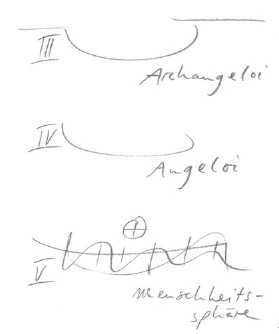
[ 25 ] In the fourth post-Atlantean epoch, human consciousness still extended somewhat into the spiritual sphere, namely into the region of the Angeloi, and in the third post-Atlantean epoch into the region of the Archangeloi. But it was only during this third epoch that what I have told you about the Jutish and Danish mysteries could come into being. What kind of being was it that announced the coming child to each individual mother? The very same being described in the Gospel of Luke—an archangel, a being from the region of the Archangels. Anyone who looks up only as far as the Angels and calls a being from the sphere of the Angels his God—regardless of whether he believes that this is the Universal God; what matters is reality, not belief—can no longer find a connection that extends beyond the time between a human being’s birth and death into that region which is today veiled by outer Maya. In the third post-Atlantean epoch, however, he could still look up into the region of the Archangels; a living connection still existed there. In the second post-Atlantean, Proto-Persian epoch, what was open to human consciousness was still connected to the Archai; at that time, human beings did not feel at all immersed in what we today call nature, but rather in a spiritual world. Light and darkness were not yet external material processes, but spiritual processes, and this was the case in the original Zoroastrian religion during the second post-Atlantean epoch.
[ 26 ] As you can see, humankind has gradually descended. In the second post-Atlantean epoch, human consciousness still soared up into the realm of the Archai; at that time, people could still say to themselves: “I, as a human being, am not merely a puppet made of muscles and flesh, as today’s anatomists, physiologists, and biologists claim, but I am a being who cannot be understood at all unless one considers him in his spiritual context, unless one considers him within the living interplay of light and darkness; for I belong to this interplay of light and darkness.”
[ 27 ] Then came the third post-Atlantic epoch. The natural world had already taken hold of human beings, just as it is in itself; for the processes of birth and death link human soul life to the natural world. These are natural processes pertaining to the outer Maya. Birth, conception, and death are natural processes pertaining to the outer Maya. They become spiritual processes only when one looks upward to where spiritual reality intervenes in these very natural processes—that is, in the region of the Archangels. This connection, however, was recognized in the third post-Atlantean epoch.
[ 28 ] Then, gradually, nature itself became, in a sense, a reality for human beings—beginning with the fourth post-Atlantean epoch. Before that, people did not speak of nature at all in the sense in which we speak of it today. Humanity had to step out of the spiritual world and, in a sense, be separated from it, left alone with nature. But an event had to give humanity the opportunity to reconnect with the spiritual world. The Divine once appeared to humanity in the second post-Atlantean period in the realm of the Archai, in the third in the realm of the Archangeloi, and in the fourth in the realm of the Angeloi. In the fifth period, humanity must recognize it as a human being, after it has prepared itself, since it appeared as a human being in the midst of the fourth post-Atlantean period—in the Christ. This means that Christ must be understood ever more deeply, understood in his connection with humanity. For Christ appeared as a human being precisely so that humanity might find its human connection with Christ. This must be made particularly clear in connection with the Christmas Mystery: Humanity’s connection to the spiritual world must be found, just as it can meet us after humanity has stepped out of the spiritual world to live in nature. This has been prepared as a fact in the fourth post-Atlantean epoch. But it must first be understood in the fifth post-Atlantean epoch; it must truly be understood there!
[ 29 ] And people must come to understand the reality of Christ—to understand it in the context of the entire spiritual world. How much is there that people do not understand about Christ today, and how much is there that they do not understand about Jesus—the two components that together make up our understanding of Christ Jesus! Anyone who considers the historical context can see that, with the eradication of Gnosticism, the understanding of Christ disappeared. Anyone who considers the context of the mysteries, as expressed in the Baldur myth, can understand how the sense of Jesus has been eradicated.
[ 30 ] But even while remaining true to oneself, one can recognize in the context of the present that what is drawn from history is confirmed in external life. For we must point this out again and again: How many representatives of today’s religion believe in their hearts—not merely with their lips, but in their hearts—in the true Resurrection—for they can only believe if they understand it—in the mystery of Easter? How many priests? Modern priests and pastors see their entire enlightenment in the fact that they deny the mystery of Easter, the mystery of the Resurrection, somehow talking it away or rationalizing it away; and if they find any reason not to have to believe in it, they are immensely glad.
[ 31 ] At first, the idea of Christ—which is inseparable from the mystery of the Resurrection—was reduced to dogma; but then it gradually became a subject of debate, and there is now a tendency to abandon the mystery of the Resurrection entirely. Yet people are unwilling to understand the mystery of the Nativity either. People do not want to engage with it because they no longer wish to accept it in all its depth—precisely because of its mysterious nature. People are willing to accept it only in its animal nature; they do not want to be conscious of the fact that something spiritual descends. In the third post-Atlantean epoch, people still saw this spiritual descent, but with a different state of consciousness. What is called modern religion or modern Christianity does not really want to understand either the birth or the death of Christ Jesus. Some still wish to believe in it dogmatically, to hold fast to it; but an understanding of these things that goes beyond the mere sound of words is possible today only through spiritual science. For this, however, it is necessary to broaden the horizon of understanding. Yet there is a flight from the truth; people are literally fleeing from that which can lead to an understanding of these things.
[ 32 ] Only anthroposophically oriented spiritual science is capable, from within itself—and not through a mere historical revival—of recreating certain concepts that will now exist fully consciously and no longer atavistically, concepts that were once atavistic, concepts for which modern people actually no longer have any real sense. And here you will recall something I spoke about yesterday. I told you that the kingship of the ancient European tribes is connected to the entire social structure I discussed in connection with the Jewish mysteries. The child who was born in the third year following the Holy Night was regarded as predestined for the royal office. As I indicated yesterday, this child was prepared in this way for the royal office, and from this child emerged the person who could then reign as king for three years. There he was at the stage I told you about: he grew out of the national, that is, out of his connection with his tribe. — The fifth degree, which the Persians called “Persian” and which bore the name of the respective tribe in every tribe, still stood within the group; the “Sun Hero,” the sixth degree—and the one who was permitted to be king for three years in that era had to be imbued with the mystery of the “Sun Hero”—had to have outgrown the tribal and group contexts and had to stand within the context of humanity. But he could do this only because he did not stand in a merely earthly context, but was embedded in a cosmic context—he was, in fact, the “Sun Hero,” that is, he lived in a realm governed not merely by earthly laws, but by those laws in which the Sun itself is woven. However, a certain process takes place in contact with the earthly realm—a contact that inevitably occurs when a human being is to perform earthly tasks. This process must be acknowledged. For it is through the acknowledgment of this process that one gains an understanding of certain transitions, of certain things that one must comprehend if one wishes to understand reality.
[ 33 ] Let’s suppose there was a person who, in those ancient times, belonged to the Ingävonen tribe; such a person would have been called an Ingävonen. But the “Sun Hero,” who reigned for three years, could not be called an Ingävonen, for he had outgrown his tribe. It would not have been true to call the “Sun Hero” an Ingävon; he had become something else. See what a subtle concept was thus linked to an earthly reality through the sense of the spiritual radiating into it.
[ 34 ] In this day and age, which merely plays with words instead of adhering to concepts, who, for example, would think that the Pope is wrongly called a Christian, because it is paradoxical to call the Pope a Christian, just as it would be paradoxical to call the King of the Ingävi an Ingävi? If the Pope truly wants to be a “Pope”—that is, to be part of the actual spiritual process—then he should not be accepted as a Christian at all. We can only be Christians because the Pope is not a Christian: that would be the truth.
[ 35 ] Who today would even think of seeking the truth about such weighty matters? And who would think of recognizing, in earthly matters—by perceiving them as Maya—the interplay of divine, supernatural forces? That is not at all in the nature of our times. Only when one is compelled to do so does one acknowledge it; one submits to the laws of the cosmos only when compelled to do so. If one were not compelled to acknowledge that the stalk of wheat sprouts from the earth at a certain time of year, grows, develops its ears, and must then emerge anew from the seed—that a cycle is taking place, that what comes into being must also pass into decay, and indeed must pass into decay in accordance with the laws of nature—then one would not acknowledge that either!
[ 36 ] In those ancient times, it was recognized that the “Sun Hero,” who was called upon to be the leader of the Ingävo tribe, had to step down from that role after three years. People sensed the natural order in this, just as in the growth of plants. It is important to try to conceive of everything in harmony and in unison. For only in this way can one arrive at the truth; only in this way can one broaden one’s horizons. For the truth is no child’s play that can be tailored to one’s personal interests; rather, adherence to the truth is a serious, sacred duty. And one must feel this, one must sense it. And the present age, by its very nature, is inclined toward nothing other than absolutizing Maya, declaring it unconditionally to be the truth.
[ 37 ] Go to the historical seminars today: What do they call “historical criticism” there? The meticulous isolation of mere sensory facts—in which one is bound to err. For if one even attempts to isolate the mere sensory fact, one slips into Maya. But Maya is illusion. Therefore, the historical science that strives to eliminate everything spiritual—that seeks to isolate Maya—must inevitably lead straight to Maya. Try, for once, to extract the truth using today’s seminar methods or the methods of today’s historical institutes by rejecting everything spiritual and highlighting only what takes place on the physical plane—the facts apparent to the senses—and you will fall prey to Maya; then you will never be able to grasp history. Pick up a modern history book, one in which any supersensory connection is considered absurd, and where a careful effort is made to acknowledge only physical connections—you will find the endeavor to highlight Maya. But Maya is illusion. You must therefore succumb to illusion, and that is exactly what you do. As soon as you believe this history, which is being written today, you succumb to Maya, to illusion.
[ 38 ] But that is not how history has always been written. The way history was written in the past is now looked down upon. And it is a terrible karmic burden for humanity that, in a sense, the spiritual aspect is to be excluded from the study of history. Let’s go back, say, directly to the time when the mindset of the fourth post-Atlantean period still essentially prevailed. History was told quite differently then; it was told in such a way that today’s “professorially infected” person would turn up their nose and say: “Those guys had no critical sense; they let themselves be taken in by all sorts of myths and legends; they had no sense of sound criticism, which could have presented the facts in their true light.” — That is what today’s historian says, and of course even more so those who parrot him. People back then were childish—that is what people say. By today’s standards, they were indeed childish! Let us, for example, consider how an old story was told—something that countless people, even in the fourth post-Atlantean epoch, regarded as history. Let us examine an example today so that we have a foundation for further reflections we intend to undertake tomorrow:
[ 39 ] It is said that there once lived in Saxony an emperor known as the “Red Emperor,” the emperor with the red beard: Otto the Red-Bearded. This emperor had a wife who came from England, and who, in order to truly fulfill the desires of her heart, wished to establish a special ecclesiastical foundation. So Red Otto decided to establish the Archdiocese of Magdeburg. The Archdiocese of Magdeburg was to have a special mission in Central Europe, in particular to bridge the West and the East in such a way that Christianity would be spread from the Archdiocese of Magdeburg among the Slavs living right on its borders. The Archdiocese of Magdeburg made good progress; it had a highly beneficial impact on a wide surrounding area, and Otto with the red beard saw the charitable effects his foundation was having in the region. He was very pleased about this. “My deeds serve as a blessing in the physical world,” he told himself, and he always hoped that God would reward him for the good deeds he performed for people. That was his aspiration: that he might receive divine reward, since he undertook his endeavors out of piety.
[ 40 ] Once, while kneeling in church, he implored—one might say—in a prayer that had risen to the level of meditation: If he should ever die, may the gods reward him for what he had endowed in the same way that he had been rewarded on the physical plane through the many good deeds that had come about in the vicinity of the Archdiocese of Magdeburg—a spirit being appeared to him, and this spirit being spoke to him: “It is true, you have endowed much good; you have bestowed great benefits upon many people. But you have done so with the expectation that, after death, blessings will come to you from the divine world, just as earthly blessings have come to you now. This is wrong, and in doing so, you are corrupting your foundation.
[ 41 ] Now Otto, with his red beard, was very unhappy, and he spoke with the spirit being—of whom we now know, don’t we, that it was a being from the order of the Angeloi. This is perceived from the perspective of the fourth post-Atlantean epoch. He spoke with that being, and the being made it clear to him: “Go to Cologne; that is where Good Gerhard lives. Ask about Good Gerhard, and if you can improve yourself through what Good Gerhard tells you, then perhaps you can prevent what has just been spoken from happening to you.” — That was roughly the conversation between Otto with the red beard and the spiritual being.
[ 42 ] In a manner that was somewhat baffling to those around him, Emperor Otto quickly arranged a trip to Cologne. In Cologne, he summoned not only the mayor but also all the “wise and benevolent councilors.” As soon as one of them entered, he could tell by his appearance that this was a remarkable man—and, in fact, that was the sole reason he had come. He asked the Archbishop of Cologne, who had brought him there, if this was the so-called “Good Gerhard.” And indeed, it was he. Then the emperor said to the councilors: “I wished to consult with you, but first I want to speak with this man in private, and then, after I have spoken with him, I will discuss with you what I have learned.”
[ 43 ] Perhaps the councilmen—one of whom had been singled out—were a bit suspicious, but let’s not dwell on that; in any case, the emperor took the councilman, whom they called “Good Gerhard” in Cologne, into a private room and asked, “Why do they call you ‘Good Gerhard’?” He had to ask this question, for the angel had pointed out to him that something depended on his understanding why this man was called “Good Gerhard”; for it was through him that he was to be healed. Then Good Gerhard said something to the effect of: “People call me Good Gerhard because they are thoughtless. I haven’t done anything special. But what I have done—and it’s really insignificant, something I don’t want to tell you and won’t tell you—has become somewhat known, and because people just have this need to come up with words for everything, they call me ‘Good Gerhard.’ — “No, no,” said the emperor, “it can’t be that simple, and it’s extremely important for me and my entire government that I know why you’re called Good Gerhard.” — “Good Gerhard” didn’t want to reveal it, but the Emperor became more and more insistent, and so “Good Gerhard” said: “All right, I’ll tell you why they call me ‘Good Gerhard’; but you mustn’t repeat it, because I really don’t see anything special about it:
[ 44 ] I am a simple merchant; I have always been a simple merchant, and one day I set out on a journey. So I first traveled overland through several regions, then by ship, reaching as far as the Orient, where I bought many, many valuable fabrics and precious items—all sorts of things—for a bargain price. I thought I would sell them here or there for double, triple, quadruple, or even five times the price, for that is the way of merchants; that was simply my business, my profession. Then, because it was necessary, I continued the journey by ship. But we were driven off course at sea by an unfavorable wind. We had no idea where we were, and so I found myself adrift on the open sea with a few companions, my precious goods and fabrics at risk. We washed up on a beach, and a mountain range rose up from that beach. We sent out a scout to climb the mountain to see what lay beyond, for we had simply been washed up on the beach. From the mountain, the scout saw a mighty city on the other side—apparently a great trading city. Caravans were approaching from all sides along a series of streets, and a river flowed past. The scout returned, and we were now able to find our way to dock our ship at the city.
[ 45 ] Now we were in a completely unfamiliar city. It soon became clear that, as Christians, we were in the midst of pagans. We saw that there was a lively market. I thought I would be able to sell all sorts of things at the market, too, since trade was brisk in that city; but I wasn’t quite sure what to do. Then a man came toward me on the street; I took a liking to him—he looked trustworthy. I said to the man, “Can’t you help me sell my goods here?”—The man had apparently taken a liking to me as well and said, “Where are you from?” — I told him I was a Christian from Cologne. Then he said: “You seem to me to be a very good man nonetheless. Until now, I’ve had the very worst impressions of Christians, but you don’t seem like a monster to me; I’ll help you, and I’ll be able to find you a place to stay. And now let me take a look at all your goods.”
[ 46 ] While the merchant, Good Gerhard, was staying at the inn, the man from the heath whom he had met arrived a few days later, looked at the goods, found them extraordinarily valuable, and said: “Even though there are plenty of wealthy people in the city, there isn’t a single one who has enough money to buy all of this.” “That’s completely impossible. I’m the only one here who has something of equivalent value to these goods. If you give me all your goods, I can offer you something of equal value in return, but I’m the only one who has it.” — Well, the man from Cologne wanted to take a look at the matter after all—he tells the emperor all of this. — “Yes, then come to me, and I will show you that I have goods that are truly exchangeable for your extraordinarily valuable goods, gathered from all over the world as the most precious items.”
[ 47 ] Gerhard then approached the pagan man and immediately saw that he was dealing with an exceptionally important figure in the pagan city. First, the pagan led him into a room where twelve young men were held captive, bound, emaciated, and in a wretched state. “Do you see,” he said, “these are twelve Christians whom we captured on the high seas after they were drifting aimlessly there. Now I will show you the other part of the cargo.” He then led him into another room and showed him just as many emaciated old men. Gerhard’s heart ached even more for the old men than it had for the young men. And then the pagan also showed him a number of women—I believe fifteen—who had now also been captured. And then he said to him: “If you give me your goods, I will give you these captives; they are very valuable, you may have them.”
[ 48 ] Now Gerhard, the merchant from Cologne, learned that among the women was one who was of very special value because she was a Norwegian princess who, along with her ladies—only a few of them, the others were from elsewhere—had been shipwrecked and taken captive by the pagans. The others were from England. The women were English, the young men and the elderly were English, and they had set out with the Prince of England, William, who was to fetch his Norwegian bride. And when he had fetched the Norwegian bride from Norway, they met with misfortune at sea; the entire party was driven out into the sea. Prince William was completely separated from the others. The others did not know where he had gone; as far as they were concerned, he was lost. But those I have mentioned—the women and the princess of Norway, the twelve noble youths from England, the twelve noble elders, and the other women who had accompanied the princess and William—had suffered shipwreck and fallen into the hands of this pagan prince. The pagan chieftain therefore wanted to sell them to him in exchange for his Eastern goods. Gerhard wept many tears—not for the goods, but on the contrary, because he was to exchange such precious people for the goods—and, true to his nature, agreed to the trade. The pagan chieftain was deeply moved and thought to himself: “These Christians really aren’t such heartless people after all.” — He even equipped a ship for him with all the necessary provisions, so that he could lead his young men and elders, as well as the king’s daughter and the maidens, across the sea, and bid him farewell, deeply moved, saying: “For your sake, from now on I will be very loyal to all Christians who come into my custody.”
[ 49 ] Gerhard, a merchant from Cologne, set sail across the sea, and when they reached the point where the landscape’s configuration made it clear that the roads to London and Utrecht diverged, he said to his traveling companions: “Those who now belong to England may go to England; those who belong to Norway—the king’s daughter and her few ladies—shall come with me to Cologne, and I will see if the man for whom this bride was intended, having perhaps found his way, will come to fetch her.”
[ 50 ] Gerhard in Cologne now treated the Norwegian princess in a manner befitting her station. She was cared for with extraordinary affection by the family—naturally—though the good Gerhard did make one small remark: that when he came home with the princess, his wife initially turned up her nose a little. But then she truly came to love her like a daughter. Well, these things, you know, are quite understandable. So she grew up as the daughter of the house, was very dearly loved; her only great sorrow was that she was always weeping for her beloved, Wilhelm, for she had naturally assumed that, if he were rescued, he would search for her anywhere in the world and would surely find her. He did not come, and he did not come. But she had grown dear to the family of the good Gerhard, and Gerhard had a son, so Gerhard himself thought that this beautiful maiden would become his son’s wife. Of course, according to the customs of the time, this could only happen if the son were elevated to her social standing. The Archbishop of Cologne agreed to knight the son. Everything was arranged accordingly. Gerhard was very wealthy, and everything went very well. Tournaments were held, and after waiting another year to see if Wilhelm would show up—the year the king’s daughter had stipulated—the wedding was arranged.
[ 51 ] During the wedding, a pilgrim appeared who had such a beard that it was clear no razor had touched his face in a long time, and who looked very sad. Good Gerhard was filled with compassion when he saw the pilgrim and asked him what was wrong. It is impossible to say, the pilgrim replied, what was wrong, for he must now carry his sorrow further through the world; from this day forward, he knew that this sorrow could never be alleviated. — For this was none other than Wilhelm, who had lost all his companions, had been cast ashore on a coast, had wandered the world as a pilgrim, and had arrived at the very wrong moment, just as his betrothed was about to be married to Gerhard’s son in Cologne. Gerhard said, “It goes without saying that you shall have your rightful bride; I will speak with my son.” — Since the bride, in a sense, also had the greater love for her long-lost betrothed, Wilhelm, who was rightfully hers, the matter was settled; and after the wedding to Wilhelm had been celebrated in Cologne, Gerhard brought Wilhelm—the heir to the English throne—and his wife to London. He left the others behind for the time being. He was, after all, known as a merchant who often visited London. He went into the city and heard that a large gathering was taking place. Everything was restless, already taking on a revolutionary character even from the outside; he heard that disorder had broken out in the country because there was no heir to the throne. The heir to the throne had disappeared years ago and had not returned; he had supporters in the country, but everyone else was divided, and they now wanted to secure a successor to the throne.
[ 52 ] Gerhard put on his finest robes and went to the assembly. They let him in, since he was wearing his finest robes—which, for this wealthy merchant, were exceptionally splendid. And he found twenty-four people gathered there, discussing who should be the successor to the beloved heir to the throne, Wilhelm. Gerhard saw that these twenty-four people were the very same ones he had rescued from the pagan chieftain—the ones he had sent to London back when their paths had diverged toward London and Utrecht. They did not recognize him at first. They told him that Wilhelm had gone missing—their beloved Wilhelm, dearer to them than anything. But then Gerhard and the others recognized one another. He then explained to them that he would bring their Wilhelm back to them. And so the matter was resolved. I need not tell you of the joy that reigned in England. At first, even in the assembly—when they did not yet know whom Gerhard would bring, but had already recognized him as the one who had saved them—they had wanted to proclaim Gerhard himself king. —Wilhelm now became the King of England. And now William wanted to give the Duchy of Kent to Gerhard, but he did not accept it. He did not even accept the gold treasures that the new queen—who had been his foster daughter for so long—wished to give him; he took only a ring and a few other items—just a few things he wanted to take home as a memento of his wife’s foster daughter. And he set off for home.
[ 53 ] “That is what has unfortunately become known in my circle,” said Good Gerhard to Red Otto, “and that is why people call me Good Gerhard.” But it’s not up to people—not even me—to decide whether what I’ve done is good or not. And that’s why it’s completely nonsensical for people to call me “Good Gerhard” if the words are supposed to have any meaning.
[ 54 ] Otto the Red, the Emperor, listened intently and now realized that there was a different way of thinking than the one he had developed, and that this different way of thinking could even be found in a merchant in Cologne. This made a deep impression on him. He returned to the council meeting and said to the gentlemen, “You may go home; I have already learned everything from Good Gerhard.” — The noses of the wise and magnanimous gentlemen grew even longer, but Red Otto’s state of mind had become completely different.
[ 55 ] That's how a story was told.
[ 56 ] Today, of course, historians—who seek to meticulously isolate the facts that unfold on the physical plane—criticize the way these events are recounted. But not only this event, but also other events were recounted in that historical mindset—which still prevailed in the fourth post-Atlantean epoch—in such a way that one did not merely recount the physical facts, but, in a sense, the meaning connected to the spiritual world. They allowed what happened on the physical plane to intertwine with the meaning that permeates what happens on the physical plane.
[ 57 ] There is a deeper meaning in the story of Red Otto and Good Gerhard.
[ 58 ] I wanted to share this story with you today—a story that was once taken as fact—so that, among other things, we can use it as a foundation tomorrow for reflections that will open up even broader horizons for us.