

Reflections on Contemporary History II
The Karma of Untruthfulness
GA 173b
1 January 1917, Dornach
Translated by Steiner Online Library
Thirteenth Lecture
[ 1 ] If you reflect on what was said yesterday regarding the so-called toxic substances, you will, I would say, feel strongly drawn to the relative nature of all impulses of existence. You will notice that something substantial can be described as a poison, but that, on the other hand, the higher human nature is intimately connected with this poisonous nature, and that, in fact, this higher human nature is not at all possible without the effects of poison. This, of course, touches upon a field of great significance for knowledge, one that has many ramifications, and without an understanding of which many mysteries of life and existence cannot be comprehended at all.
[ 2 ] When we consider the human physical body, we must say: If this physical body were not filled with the higher entities or constituents of existence—the etheric body, the astral body, and the I—it could not be the physical body that it is. At the moment when a person passes through the gate of death and leaves their physical body—that is, when the higher constituents withdraw from the physical body—the physical body is subject to entirely different laws than during the time when the higher constituents are present within it. It is said that it dissolves; that is, when it dies, it follows the physical and chemical forces and laws of the Earth.
[ 3 ] Just as the human physical body stands before us, it cannot be constituted according to the ordinary laws of the earth, for those laws would destroy it. It is only because that which is not earthly in the human being—its higher soul-spiritual members—is active within its body that the body is what it is. Nothing within the entire realm of physical and chemical laws justifies the existence on Earth of a body such as the human body.
[ 4 ] We can therefore say: According to physical, earthly laws, the human body is an impossible entity; it is held together solely by its higher constituents. It follows as a necessary corollary that as soon as the higher aspects of the being—the I, the astral body, and the etheric body—leave the human body, it becomes a corpse.
[ 5 ] Now, as you know from various earlier discussions, what is rightly referred to as a schematic division of the human being is not as simple as some would like it to be. We first divide the human being into the physical, etheric, and astral bodies, and the “I.” I have pointed out before that all of this introduces a further complication. The physical body, of course, stands on its own; it is simply the physical body. But the etheric body as such—as an etheric body—is a supersensible entity, an invisible entity, something not perceptible by the senses. As something not perceptible by the senses, it exists within the human being. But it also has, in a sense, its physical counterpart; it is imprinted in the physical body. In the physical body, we have not only the physical body itself but also an imprint of the etheric body. The etheric body projects itself into the physical body; we can therefore speak of the etheric projection in the physical body.
[ 6 ] This is also the case for the astral body: we can speak of astral projection within the physical body. You are already familiar with some of the details. You know that the “I” projection within the physical body can be found in certain peculiarities of blood circulation; there, the “I” projects itself into the blood. In a similar way, the other members project themselves into the physical body. The physical body itself, insofar as it is physical, is thus a complex being; it is, in and of itself, fourfold. And just as the essential aspects of the physical body cannot exist if the “I” and the astral body are not present within it—for then it becomes a corpse—so it is also, in a certain sense, with these projections, for these are all substantial entities: without the “I,” there can be no human blood; without the astral body, there can be no complete human nervous system. In a sense, we possess these things within us as the correlates of the higher members of the human being.
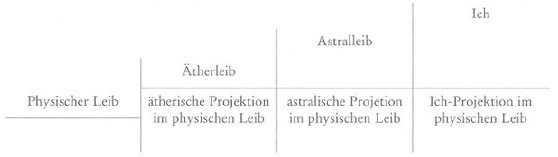
[ 7 ] Just as there can be no true life at all—only the physical body lying as a corpse—once the “I”—let us say, “separated”—has passed through the gate of death, so too, under certain conditions, these projections cannot truly live.
[ 8 ] For example, ego projection—that is, a certain quality of the blood—may be present in the human organism in an incorrect way if the ego is not properly nurtured. To turn the physical body into a corpse, it is necessary—and I would say truly, in reality—that the “I” actually leave this physical body. But you can, so to speak, turn the blood into a “quarter-corpse” by not allowing it to be permeated by what must properly live within the “I,” so that the soul-spiritual can act upon the blood in the right way. From this you can see that it is possible to throw the human soul into such disorder that the proper effects cannot take place in the blood substance. This is the moment when—though not entirely, for otherwise the person would have to die from it, but at least in part—the blood can transform into a toxic substance. Just as the human physical body is, so to speak, left to destruction when the “I” is absent, so too is the blood left to a state of ill health—even if this is not readily apparent—when the “I” is not properly nurtured and permeates the body.
[ 9 ] When, then, is the “I” not properly nurtured and integrated? This is the case under very specific conditions. If we consider only the post-Atlantean era, human evolution proceeds in such a way that, in the successive cultural periods of the post-Atlantean era, certain abilities and certain impulses develop. You cannot imagine that people who are like us in terms of soul development could have lived in the Primordial Indian era. From epoch to epoch, as human beings pass through repeated earthly incarnations, different impulses become necessary for the human soul.
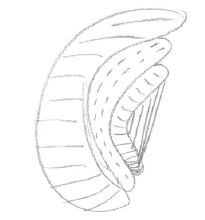
[ 10 ] I want to outline schematically what we have here. Imagine the most fundamental, the actual physical body here; that would be the one that must be filled with all the higher aspects of human nature in order to be this physical body at all.
[ 11 ] Of all these higher aspects of human nature, I wish to consider only the “I”; I could just as well consider all three, but by shading this one, I wish to indicate that this physical body is permeated by the “I.” Thus, the other projections must also be permeated in a certain way. I wish to indicate the projection of the etheric body—which is, after all, essentially anchored in the human glandular system—in this way; this, in turn, must be permeated and interwoven in a certain way. Third, I wish to indicate what is primarily anchored in the nervous system; this, in turn, must be permeated in a specific way by a certain effect of the “I.” And the “I”-body itself must now also be permeated in a corresponding way.
[ 12 ] Now we have just said that as human beings pass through the successive periods of evolution, they must, in each period, take on different developmental impulses. They must, so to speak, accept what their time demands of them. In the first post-Atlantean epoch, the Proto-Indian epoch, human beings had to absorb soul-spiritual impulses that made it possible, particularly at that time, for the etheric body to develop; in the following period, the Proto-Persian epoch, the astral body was developed; in the Egyptian-Chaldean epoch, the feeling soul; in the Greek -Latin period, the intellectual or emotional soul; and in our own time, the consciousness soul. Now, whether a person properly permeates these members of his being—so that they are imbued with what the age demands, just as the physical body is imbued by the higher members—depends on his correctly assimilating what is appropriate to his respective age. Suppose a person were to completely resist absorbing anything in the fifth post-Atlantean epoch that is necessary for this epoch; suppose he were to reject everything that would cultivate his soul in the way the fifth post-Atlantean epoch demands. What would be the consequence?
[ 13 ] Well, one’s physical nature cannot simply be scaled back if it belongs to that part of humanity that is, for the time being, called upon to absorb the impulses of the fifth post-Atlantean epoch. Not everyone is called at the same time; but all white races are now called to take in the culture of the fifth post-Atlantean epoch. Let us now suppose that people were to resist this. Then a certain aspect of their physical nature—above all, the blood—would be deprived of what would enter it if they did not resist. This part of the physical body would then lack what would properly permeate the corresponding substance and its forces. As a result, however—though not to the same degree as when the human body becomes a corpse and the “I” steps out—this substance and the forces inherent in it become diseased and depressed in their life forces, and the human being carries them within, as it were, as a poison. Lagging behind evolution thus means that the human being, so to speak, impregnates himself with a toxic phantom form. If he were to take in what corresponds to his cultural impulses, he would, through this type of soul, dissolve this toxic phantom that he carries within himself. But as it is, he allows it to coagulate within the body.
[ 14 ] Hence the cultural maladies, cultural decadence, all the spiritual emptiness, hypochondria, eccentricities, dissatisfaction, oddities, and so on—as well as all the instincts that attack culture, are aggressive toward it, and rebel against it. For one either embraces the culture of an age and adapts to it, or one develops the corresponding poison, which settles within and would be dissolved only by embracing the culture. But by allowing this poison to settle, one develops instincts against the culture in question. The effects of poison are always, at the same time, aggressive instincts. This is clearly reflected in the vernacular of Central Europe: many dialects do not say that a person is angry, but rather that they are “poisonous,” which corresponds to a deep sense of the actual reality. In Austria, for example, a quick-tempered person is said to be “gachgiftig,” meaning “quickly poisonous”—he becomes angry quickly. And you can see that this is further differentiated by degrees in snake venom, which has a higher degree of toxicity and inherently carries this aggressiveness. But to a lesser degree, a person accumulates such toxicity—which can even become highly concentrated—within themselves when they refuse to accept that which would dissolve the poison. Especially in our age, numerous people refuse to accept the form of spiritual life appropriate to our age—the one we have long sought to characterize and have now also publicly characterized.
[ 15 ] Now, it is the case that this very lotus flower here [on the forehead] makes what arises within such people very visible; for this goes as far as producing a warming effect, and such people, as it were, flare up against the conditions of the outside world whenever those conditions reveal something that would be beneficial for the age. We certainly have Mephistopheles—that is, the devil—walking among us; but even a small beginning—a hint of such resistance—arises simply from refusing to assimilate what is appropriate to the culture of the age; that is, by failing to dissolve the poison but instead turning it into a partial body, allowing it, so to speak, to coagulate within the organism into a phantom form.
[ 16 ] If you think this through, you will be able to understand the cause of many of life’s dissatisfactions. For carrying such a toxic phantom within oneself makes a person unhappy. In our time, such a person is called nervous or neurasthenic; but it can also make them cruel, quarrelsome, monistic, or materialistic, for these traits are often—much more than one might think—linked to the physiological fact that the poison, instead of being absorbed, is deposited in the human organism.
[ 17 ] From all this, you can see that the overall state, the overall constitution of the world in which we are embedded, truly involves a kind of unstable equilibrium between the good, the right, and its counterpart, the toxic effects. In order for the good and the right to arise on the one hand, there must be the possibility of straying from what is right, of the toxic effect arising.
[ 18 ] If we apply this to a broader context, you will say to yourself: There must be a possibility in the world today for people to attain a certain spiritual life, for them to develop within themselves the impulses for a free, inner, spiritual life. — For the individual to attain a spiritual life, the opposite must also exist: the corresponding possibility of straying from it through gray or black magic. It cannot happen without this. Just as you, as a human being, cannot stand if you do not have the earth beneath you to provide a firm foundation, so too the pursuit of a luminous, spiritual life cannot exist without the resistance that must be allowed—and which is inevitable in the higher realms of life.
[ 19 ] We have pointed out the quite contradictory—but no less significant—fact that if someone were to ask, “To whom do we owe the Mystery of Golgotha?” — might answer: “To Judas”; for if Judas had not betrayed Jesus Christ, the Mystery of Golgotha would not have taken place, and therefore one would have to be grateful to Judas, since Christianity—that is, the Mystery of Golgotha—actually stems from him. — But then again, one simply cannot be grateful to Judas and recognize him, for example, as the founder of Christianity! Wherever one ascends to higher realms, one must reckon with living, not dead, truth; and living truth bears its own opposite within itself, just as in physical existence, life bears death within itself.
[ 20 ] Consider this something I would like to impress upon your soul today, because it helps us understand many things. There must be a way to isolate the polar opposite poison alongside the spiritual. But then, if it can be isolated, it can also be used—and it can be used in all areas.
[ 21 ] Many questions may arise from what has been said. But for now, let us address just this one question: How does one cope with this? Are we not exposed to the great danger that, whenever we approach anything in the world, the opposite—the toxic element—is contained within it, or at least that someone could transform it into something toxic? This possibility, of course, always exists. Everything in the world that can be very good can be turned into its opposite. But this must be so that human development can unfold in freedom, in accordance with our cultural era. And it is precisely the most beautiful impulses of development in our age that are most likely to be turned into their opposites.
[ 22 ] Just as this applies to the human organism, so it applies to social life. From earlier lectures given here, we have seen that in our age the potential to develop an imaginative life—to form thoughts that arise freely—is beginning to take shape, albeit in its infancy; yet people with a materialistic mindset still reject this. But it is simply in the nature of our age that imaginative life must gradually develop. What is the opposite of imaginative life? The opposite of imaginative life is fabrication—fabrication in relation to realities—and the associated recklessness in asserting this or that. It is the same thing I have often described in these reflections as inattention to the truth, to the real, to the actual. The most beautiful thing that has been set before humanity in the fifth post-Atlantean epoch—the gradual ascent from a mere one-sided intellectual life into the imaginative life, which is the first step into the spiritual world—can stray into untruthfulness, into fabrication with regard to realities. Of course, I am not saying “poetry”—for that is legitimate—but “fabrication” with regard to reality.
[ 23 ] Furthermore, as we have also learned from our reflections, a particularly conscientious way of thinking—one that is aware of its responsibility—must emerge in our age. If you consider what is offered by anthroposophically oriented spiritual science, you will say to yourself: If one truly wishes to understand what anthroposophically oriented spiritual science offers, one must have sharply defined thoughts in which the will to pursue reality in an appropriate manner is alive. Sharp thinking is already necessary to take in our teaching—if we may call it that—and, above all, a certain steadiness of thought, not a fleeting one. We must now work toward developing such thinking. We must strive unceasingly to demand of ourselves thoughts with sharp contours, and not blindly surrender to sympathies and antipathies when we make claims for ourselves and others. We must seek justification and a solid foundation for what we assert; otherwise, we will never be able to penetrate the field of spiritual science in the proper way. We must demand this of ourselves. And we fulfill our task when we make this demand of ourselves. And when asked: What must we do in these difficult times? — we must formulate the answer based on what has just been said. We must be clearly aware that, in the present, every person who wishes for the evolution of the Earth to continue in a wholesome way must conscientiously and honestly seek objectivity of thought in the manner just described. This is precisely the task of the human soul in the present age. And because this is so, the corresponding poison can also develop: the complete abandonment of clear thoughts—thoughts that connect with reality and do not invent anything, but simply seek to record what is. This abandonment of the longing for objectivity became increasingly intense over the course of the 19th century. The separation of conscience from what we have always characterized as truth reached a certain peak in the 20th century compared to everything that had come before. The effect is worst when people are completely unaware of it; but that, precisely, is a defining feature of our time.
[ 24 ] I’d like to give you a few examples so you can see what I mean. I really want to present these examples sine ira—without any personal sympathies or antipathies. There is a man I know very well who is what one calls a dear, kind person. He is active in public life, rightly holds a very honorable position there, and would not allow himself to deviate even in the slightest from what is called integrity in public conduct. Yet this very man was recently able to write the following, very characteristic passage: “In conclusion,” he says at the end of an essay, “one must not shy away from—even if only a brief—discussion of an issue...” [gap]
[ 25 ] It is understandable that such a thing is said in our time, and I cite it because it was said by a truly serious person of genuine integrity. But on closer inspection, it is as hypocritical as anything can be; for one cannot say anything more hypocritical than: “I will sing along: ‘We come before God the Righteous to pray, “A Mighty Fortress Is Our God,”’ and so on, with the attitude that it is indeed a prayer—a sung prayer—if one even has the faith that the person in question is describing here. It is nothing short of a eulogy to insincerity. Such eulogies to insincerity can be found everywhere today, and they are, I would say, delivered in good faith; they are the toxic counterpart to what must develop as an imaginative, spiritual life. And it is precisely among the best of people that such a toxic effect may be present, more or less unconsciously. However, if one realizes that such a thing, as it pulsates through social life, is exactly like injecting a drop of poison into a human organism, then one can assess all these matters correctly. But once one knows this, one will also feel compelled to bring to life something that has now often been described: one will strive to develop an open eye for the facts and a healthy observation of life; without this, one cannot get by today. And the karma I have spoken of—which is now being fulfilled, and which is not the karma of a single people but rather that of the entire European-American humanity of the 19th century—is precisely the karma of this untruthfulness, the insidious poison of untruthfulness.
[ 26 ] One can experience this insincerity most acutely in movements of a particularly sublime nature. Throughout my life, I have heard many lies here and there; but I must say, I have not found anywhere else where lies were told as magnificently as where the principle is proclaimed: “No religion is higher than the truth.” — I would say that lies of such intensity were actually told only where people simultaneously possessed the deepest awareness that they were striving for nothing but the truth and nothing other than the truth! It is precisely where one strives for the highest that one must be most vigilant. For this must be clearly recognized: In earlier cultural epochs, there were other ways of going astray; in our time, the great danger lies in straying into a form of untruthfulness that arises from a lack of connection with reality. A lack of connection with reality! In people who are as principled as the individual in the example I cited—the person who wrote such falsehoods here would rather have his tongue cut out than consciously tell a lie—these things take effect precisely by seeping into the social organism and becoming a social poison. But of course, since they must now exist, they can also stray in the opposite direction: They can also be picked up by human consciousness and used for all sorts of nonsense, to put it mildly.
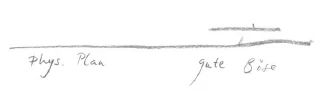
[ 27 ] Perhaps some of you remember how strangely moving it was when, years ago in Munich, I first drew attention to these circumstances in such a radical way—even in a public lecture. I said at the time: In the course of human evolution, the impulses of good and evil develop on the physical plane. How do these impulses develop? Through the misuse, down here in the physical world, of certain forces that actually belong to the higher spiritual world. If thieves were to use their instincts for theft, murderers their instincts for murder, and liars their instincts for lying—instead of acting on them on the physical plane—to develop higher forces, they would cultivate very significant higher forces. The mistake lies solely in the fact that they do not develop the forces they are cultivating on the correct plane. Evil, I said, is good that has been relegated from another plane. This does not, of course, make a person who is a thief, a murderer, or a liar any better; but one must understand these things, otherwise one will not grasp the truth and will unconsciously fall prey to these dangers.
[ 28 ] It is no wonder that in our time there are many people who simply cannot believe that it is now becoming our duty to concern ourselves with spiritual matters. Therefore, they do not do so, but instead give in to their materialistic instincts. But they are developing within themselves the poisons that should be dissolved through spirituality. What is the result? The poisons develop and, in people who reject spirituality, become forces that turn them into outright liars—whether consciously or unconsciously is more a matter of degree. Yet these same forces could be used to understand spiritual science very well.
[ 29 ] Consider what a profound insight we are essentially dealing with here, and how, by grasping such a profound insight, we can comprehend a central nerve in the karma of our time—if we only take into account what I said yesterday: A single detail cannot be torn away from humanity as a whole. Humanity is a whole. — Precisely as the antithesis of spiritual striving, a profound evil must exist in our time. And to truly recognize this evil in its essence—so that one may recognize it even when it confronts one in life and combat it in the right way—this is indeed one of the tasks of humanity in our time.
[ 30 ] By speaking about these things, we directly relate the major perspectives connected with the karma of our time to what is alive in our time and is causing much, much harm on a vast scale. On the surface, we see how, in mighty waves that engulf far more than one might think, falsehood pulses through the world today. Falsehood, after all, possesses an immensely powerful vitality. But through reflections such as those we have undertaken today, you can see how falsehood is merely the correlative counterimage of the spiritual striving that ought to exist but does not. I would like to say that the divine-spiritual wisdom of the world has given human beings the opportunity to strive spiritually. We have the poison within us that we can dissolve; but we must also dissolve it, otherwise it remains within us like a kind of partial corpse.
[ 31 ] Let me give examples of such things from everyday life, whereby we can at the same time pursue the goal of better understanding certain things that we encounter at every turn today—things connected with life and with all the evil and suffering of the present. For gradually arriving at an understanding of the painful events of the present is, after all, what we are striving for in these reflections, insofar as they are granted to us. I say such things really only to characterize, so to speak, in formal terms the way in which these impulses operate—not to characterize a person, but to characterize facts through examples.
[ 32 ] There’s a man here in Switzerland who used to be a lawyer in Berlin many years ago, a second-rate poet who, because of all sorts of things he’s done, was driven to try his luck abroad. He has been wandering abroad for years, and now that the war has broken out, he has written the book J’accuse, which is causing a sensation throughout the periphery. One could say that this whole “J’accuse” affair is one of the saddest phenomena of our time, because it is such a characteristic symptom. “J’accuse” is a thick book, and certain people who are in the know claim—to cite just one example—that there isn’t a single Norwegian cabin where this book cannot be found. It is, therefore, one of the most widely circulated books. In the spring, I read an article in Berlin about this book, written by someone of some standing. He says that “J’accuse” was recommended to him by a person whom he holds in the highest regard. From the manner of the account, one can deduce who this person he holds in high esteem is: it is someone who is regarded as a leading figure in Holland, but who was not even capable of assessing the entire back-staircase-like nature of the J’accuse book—if one looks only at the formal aspects. It is indeed possible today to be regarded as a great man and yet be completely lacking in judgment in such matters.
[ 33 ] Now, once again, this well-known yet anonymous author of “J’accuse” has made himself heard in the newspaper Humanité with the following line of thought—as I said, I am not concerned with the personal, but rather with characterizing everything that is possible in our time:
[ 34 ] A Social Democratic member of parliament delivers a speech in the Berlin Reichstag in which he sets forth his views on various aspects of the events leading up to the war. Whether one agrees or not is irrelevant at this point; I wish to present the facts to you. In his speech, the representative refers to a statement made by Sir Edward Grey on July 30, 1914, and which, in essence, means that if the Austrians were to limit themselves to marching as far as Belgrade, were to be content with the occupation of Belgrade, and then wait to see what might be arranged by a European congress regarding the relationship between Austria and Serbia, then peace might still be preserved. This statement by Sir Edward Grey is well documented, for Grey said this to the German ambassador and also wrote about it to the British ambassador in St. Petersburg. The matter is thus fully documented, leaving no doubt whatsoever that Sir Edward Grey said this. However, by raising this issue again in the German Reichstag, the Social Democratic deputy has aroused the wrath of the author of “J’accuse.” So what does the author of “J’accuse” do? He writes a truly defamatory article—in the most extreme sense of the word—in L’Humanité, in which he accuses that Social Democratic member of parliament of outright dishonesty, misquoting, and so on. But the matter is very well documented, and the MP in question said nothing other than what is substantiated by various books, including the letter from Sir Edward Grey to the British envoy in St. Petersburg. How, then, can the author of “J’accuse” accuse him of lying? Well, he does so by saying: What the Social Democratic representative said cannot refer to a statement by Sir Edward Grey on July 30, but only to a statement by Sazonov on December 31; however, the statement by Sazonov—not by Grey—reads as follows, and I will quote it. So the MP misquoted Sazonov, because Sazonov’s statement is as follows, and on top of that, he even claims that this statement, which Sazonov made, was actually made by Sir Edward Grey.
[ 35 ] The fact is, therefore, that the speaker in question is referring to a statement by Grey. “J’accuse” seeks to refute him and therefore states: What he said does not refer to a statement by Grey, but rather to one by Sasonov, which, however, is misquoted. Sasonov said the following... ; therefore, what he said in the Berlin Reichstag is false. He is thus committing a double falsification: first, he quotes something false, and second, he misplaces the event in London, whereas it actually took place in St. Petersburg. Therefore, the member of parliament is a liar.
[ 36 ] The entire book J’accuse is roughly of this caliber; that is the nature of the argumentation throughout. But you can see how convoluted, how confused, and how unscrupulous the thinking of a person capable of such things is. But what does this accomplish? The many people who now read in L’Humanité what the famous-yet-anonymous author of “J’accuse” has written naturally do not verify the claims; rather, they take what the author of “J’accuse” tells them at face value and believe it. In this way, one can not only prove that the Social Democratic deputy lied, but one can also show—and this emerges incidentally as evidence, which “J’accuse” truly manages to do—that the Central Powers did not respond to what had been suggested by the peripheral powers. For, as “J’accuse” points out, this member of parliament claims that the Central Powers reacted to what came from the periphery; but just take a look at Sazonov! He even quotes a statement by Sazonov! The Central Powers did not react to it at all, so you can see how the Central Powers behaved; they did not even respond to this important matter.
[ 37 ] However, what the representative actually quoted refers to a suggestion made by Grey, which Grey telegraphed to his ambassador before the ambassador relayed it to Sasonov. Sasonov has turned the entire story—which Grey recounted at the time and which would not have been so bad—into its exact opposite. The author of “J’accuse” argues that this reversal by Sasonov should have been taken into account, since Sasonov himself had not done so. It can now be proven, however, that Grey telegraphed his ambassador in St. Petersburg, that this was presented to Sasonov, but was not taken into account. At the same time, however, Grey sent this proposal to Berlin, and from Berlin it was sent to Vienna. It can be proven that negotiations took place between Vienna and Berlin to persuade Austria to actually hold its position in Belgrade and then await some form of European negotiations. This is evident from a telegram that the King of England himself sent to Prince Henry. Thus, the Central Powers did respond to Grey’s proposal. Sasonov did not accept this proposal by Grey! Nevertheless, “J’accuse” states: The Central Powers gave no reply and thereby brought these terrible events upon themselves.
[ 38 ] The matter is not so insignificant, for that same sentence appears in yesterday’s painful document. So there is a curious, I might say, kinship, a family connection between a world-historical, painful document and a man who, because the ground beneath his feet grew too hot for him years ago, wanders about writing all sorts of things under the flashy title “J’accuse, by a German”—things that are, however, protected in this way, as by the latest piece in L’Humanité.
[ 39 ] It’s no wonder, then, that people react the way this German member of parliament has—having been portrayed by J’accuse as a slanderer, a hypocrite, and a liar. The member of parliament said: “Basically, the situation is no different from that of the maid who was sent to Müller’s at Langegasse 35—she was supposed to be back in two hours but didn’t return until very late, even though she was only supposed to run a quick errand. When she came back, she said, ‘I couldn’t find it!’—‘Why not?’ —“Well, I didn’t go to Langegasse 35, but to Kurzestraße 85, and no carpenter named Müller lives there—it’s Schulz; not the carpenter Müller, but a laundress.”—“That’s roughly how the real situation stands,” said this German member of parliament, “also between what ‘J’accuse’ says and what actually lies at the heart of the matter.”
[ 40 ] The author of “J’accuse” is, of course, a particularly bad example. But this way of dealing with reality—that is what today serves as the flip side, the correlative counter-formation to spiritual striving, and flows like a true poison through the veins of society in place of what must be striven for: spiritual knowledge, the permeation of the self with the spiritual. We can find such things—I have cited an example where hypocrisy manifests in a person I know very well—everywhere, and in the most diverse variations. Everywhere we will see that such phenomena appear, in a certain sense, as the antithesis of what is necessary in our time. If one wishes to recognize anything true at all, one must recognize it spiritually, for all other forms of recognition today actually lag behind development. And that is why, if a spirit of peace is to prevail among the nations of Europe, a spiritual feeling toward the nations must be developed—as can happen when one understands the nations in the way I described in my lecture series on national spirits, held in Kristiania long before the war. One must resolve to approach the national spirit spiritually in this way; only through this is it possible today to make the human spirit so active that it can truly form a valid judgment of a collective entity, such as a nation. Just think how nations might be judged today if there were sufficient spiritual preparation for it! But what we see emerging as radically misguided on one side or the other is not confined to the worst among us; it is also present among the best. The point here is not to condemn everything that is described. There is simply a deficiency here, because people are unwilling to create the spiritual conditions necessary to assess large national contexts. They judge them based on sympathies and antipathies, not on genuine insights.
[ 41 ] A very characteristic example of this can be found in a famous contemporary novel, which makes a thoroughly honest attempt to characterize a people—in this case, the German people—through its various representatives within the context of the novel. However, this is done in precisely that flawed manner which, due to a lack of spirituality, cannot arrive at any judgment of reality at all. I would not be able to cite a proper novel here, because such a thing does not come into consideration in a true work of art. But if a novel is tendentious—if the portrayal itself is tendentious—then it can be cited in such a context. I would like to characterize what I mean in more specific terms: If a novel is good, one will never hear the author’s voice through the characters; rather, the characters will express what is characteristic of a people, a social group, a class, and so on. And if, in a novel, Hans Müller or Joachim Eikelhahn say something about the Germans, the French, or the English, that does not mean one could somehow latch onto it. But that is not the case with the novel I am referring to now; rather, one sees that the author always steps forward, as it were, and expresses his opinion, and that, in characterizing his characters, he always seeks to convey his own—the author’s—opinion of the Germans. We see this immediately when the following is said about a protagonist’s family:
“He was a smooth talker, well-built, if a little clumsy, and the very embodiment of what is considered classical beauty in Germany: a broad, expressionless forehead, strong, regular features, and a curly beard—a Jupiter from the banks of the Rhine.”
[ 42 ] Isn't it true that this isn't exactly conducive to forming an objective judgment, even if it may apply to individual cases time and again? A chamber music orchestra in Germany is characterized as follows:
“They played neither very accurately nor very in time; but they never went off track and faithfully followed the indicated expression marks. They possessed that musical lightness that is content with little, and that perfection in mediocrity which is abundantly present in the race that is called the most musical in the world.”
[ 43 ] Another description of the hero's uncle. It says:
“He was a partner in a large trading firm that maintained business ties with Africa and the Far East. He epitomized the very type of those ‘new-style’ Germans who take a delight in mockingly spurning the old idealism of their race and, intoxicated by victory, vigorously and successfully promote a cult that proves they are not accustomed to living under that banner. But since it is impossible to suddenly change the centuries-old nature of a people, the repressed idealism kept resurfacing in their language, their behavior, their moral views, and in the Goethe quotations they offered on even the slightest domestic occasions; and so, through the bizarre effort to reconcile the honorable principles of the old German bourgeoisie with the cynicism of these new shopkeepers, a strange mixture of conscientiousness and self-interest arose—a mixture that carries a rather repulsive stench of hypocrisy—which amounts to fashioning, out of German strength, greed for money, and self-interest, the symbol of all that is right, all justice, and all truth.”
[ 44 ] It is said of the same man:
“...he lacked that complacent Germanic idealism that refuses to see—and indeed does not see—what would be embarrassing for him to discover, for fear of disturbing the comfortable tranquility of his judgments and the comfort of his life.”
[ 45 ] Furthermore, on such an occasion—when the author, so to speak, takes the stage and one hears him speak for himself—the following is said:
“Especially since the German victories, they did everything they could to reach compromises, to bring about a repulsive hodgepodge of new power and old principles. They did not want to give up their old idealism: that would have been an act of boldness of which they were incapable; instead, to make it subservient to German interests, they had contented themselves with distorting it. They followed the example of Hegel, the cheerfully duplicitous Swabian who had waited for Leipzig and Waterloo to adapt the fundamental ideas of his philosophy to the Prussian state...”
[ 46 ] The gentleman has some peculiar ideas about the history of philosophy; anyone who is truly familiar with it knows that the principles of Hegel’s philosophy were set down in Phenomenology of Consciousness in Jena in 1806, amid the thunder of cannon fire, right in the midst of the cannon fire, as Napoleon advanced; yet this is characterized—with a certain “sense of truth”—as Hegel having waited for the Battle of Leipzig in order to align himself with the Prussian state.
“...and now that interests had changed, principles were changed as well. When Germany was defeated, it was said that Germany’s ideal was humanity. Now that Germany was defeating others, it was said that Germany was the ideal of humanity.”
[ 47 ] That's quite a nice sentence!
“As long as other countries were the more powerful ones, people said—echoing Lessing—that patriotism was a heroic weakness that one could very well do without, and they called themselves citizens of the world. Now that they had emerged victorious, they could not muster enough contempt for the ‘French’ utopias—such as world peace, brotherhood, peaceful progress, human rights, and natural equality; they claimed that the strongest nation had an absolute right over the others, while the others, as the weaker ones, had no rights in relation to it.”
[ 48 ] As one can see, many editorials in the periphery could have been based on this sentence now that the war has broken out. The sentences appeared long before the war.
“It seemed to be the living God and the Spirit incarnate, whose progress was achieved through war, violence, and oppression. Power—now that it was on one’s side—had been sanctified. Power had now become the very embodiment of all idealism and all reason.”
[ 49 ] There’s a sentence that’s been left out. As you know, it’s not easy to get things across the border right now, and I have the book in Berlin.
[ 50 ] But I would like to quote a few more passages from the same book, in which the author also, so to speak, takes center stage:
“The Germans are remarkably indulgent when it comes to physical imperfections: they manage not to notice them; they can even go so far as to embellish them with benevolent imagination by discovering unexpected connections between ‘the face they wish to see’ and the most magnificent examples of human beauty. It would not have taken much persuasion to induce old Euler to declare that his granddaughter had the nose of Juno Ludovisi...”
[ 51 ] Well, this nose and this face are actually described as particularly ugly. That needs to be noted. It is said of Schumann:
“But it was precisely his example,”—and here the hero is introduced—“that led Christof to the realization that the worst falsehood in German art did not lie in artists’ attempts to express feelings they did not feel, but rather in their expression of feelings they did feel—feelings that were, however, inherently false.”
[ 52 ] Then, with a certain sense of ease, a remark by Ms. von Stadl is recalled:
“‘You parry neatly. You resort to philosophical reasoning to explain the most unphilosophical thing in the world: respect for power and the habituation to fear that transforms respect into admiration.’ ”
[ 53 ] The author of the novel in question adds: His hero “found this feeling”—that is, that they parry, have respect, and feel fear—
“in everyone in Germany, from the greatest to the least—from Wilhelm Tell, the thoughtful, petty bourgeois with the muscles of a porter who, as the free Jew Börne says, ‘to reconcile honor and fear, walks past the stake of the dear Lord’ passes by Gessler with his eyes downcast, so that he might claim that he who did not see the hat was not disobedient, all the way up to the honorable seventy-year-old Professor Weiße, one of the city’s most respected scholars, who, when a lieutenant passed him, hastily yielded the sidewalk to him and stepped down onto the road. Christof’s blood boiled whenever he witnessed such petty displays of servile subservience, which were an everyday occurrence. He suffered from it as if he himself had humiliated himself. The haughty behavior of the officers he encountered on the street and their defiant stiffness filled him with a dull rage: he made a point of not moving a step to make way for them and returned their presumptuous glances as he passed. More than once, this nearly got him into a fight; it almost looked as if he were seeking it out. And yet he was the first to see through the dangerous futility of such displays of strength; for a few moments, however, his sound judgment was clouded: the constant restraint he imposed on himself, and his robust strength, which was building up without ever being expended, drove him mad. Then he was on the verge of committing any folly; and he had the feeling he would be lost if he stayed here even one more year. He hated the brutal militarism he felt weighing upon him—all those sabers clanging on the pavement, those pyramids of rifles, and the cannons set up in front of the barracks, standing ready to fire with their muzzles pointed toward the city.”
[ 54 ] This matter is interesting in various respects. I’m not bringing these things up for any personal reasons or to characterize anyone in particular. But after this novel was written and caused quite a stir, there were, of course, people who praised it as the greatest work of art in the world. That’s always the way it is. The assessment by a “respected” Austrian critic—and I put “respected” in quotation marks—is quite amusing; he wrote: “This novel is the most important thing that has happened since 1871 to bring France and Germany closer together again.”
[ 55 ] You can see how much truth there is in these things! And yet we are dealing with a man who is now much praised, and against whose public activities during the war, of course, not the slightest objection should be raised. But what is written in this “world-famous” novel can now be used—precisely in the periphery—as catchphrases and in editorials; for what I have read to you, you can truly—with the utmost respect for the scribblings of the periphery—admire at any time in editorials. These things were written long before the war—as the Austrian critic puts it: for the “rapprochement of France and Germany”—and appear in the novel Jean-Christophe by Romain Rolland.
[ 56 ] There you have an example of how someone who excludes the spiritual, who does not want it, is unable to see what is essential when approaching present-day circumstances. For what, after all, can a person who writes about the German character in this way know of it? As I said, one has a right to speak this way, because here the author’s subjective judgments are cloaked in a poor novelistic portrayal. But that is my personal opinion—that the novel is one of the worst; it was considered one of the best, as you can already see from the judgment of the Viennese critic. It was also hailed as one of the best in international criticism, and unless one takes the position—which, in a certain sense, is not entirely unjustified today—that whatever critics praise today must necessarily be trash, one can certainly have a certain respect for something that contemporary critics present as the foremost and greatest achievement of the age. From a cultural-historical perspective, however, we see precisely in such a matter how impossible it is for people of the present to come to terms with what this fifth post-Atlantean epoch of humanity sets as its task. That is why karma must be fulfilled. Our task, however, is to reflect on these matters with an open mind. Above all, we should not uncritically accept and parrot what is said in the materialistic world outside, but rather try to form our own judgment on these matters.
[ 57 ] What I have read to you was written many years ago and has recently provided the most wonderful catchphrases for editorials in the Entente press. In its overall tone, it is a terribly anti-German book, but that is not the point; every point of view can be understood. However, it is surely a strange distortion of judgment to tout a book written years ago as if it had just been published, even if the final volumes did appear only recently. One has peculiar experiences in this regard—for example, with regard to what is repeatedly cited as sayings by Nietzsche, Treitschke, and others. You’ll search for them in Treitschke’s work in vain; in Nietzsche’s, they have an entirely different meaning—they mean the exact opposite of what is said about them today in the Entente press.
[ 58 ] When I was friends with the editor of Nietzsche’s works and discussed many things with him, a man who had translated the entire works of Nietzsche into French would write a letter to that editor from Paris every few days; at that time, he practically saw a god in Nietzsche. Today, he rants and raves about him. One has the most wonderful experiences with such things. One would search in vain for what is cited in that book in Treitschke or Nietzsche if one had not taken the passages out of context; but not only must one take them out of context, one must also—as is done now—tear out the middle, that is, quote the beginning of a sentence, omit the middle, and then quote the rest of the sentence again. Only by doing so can one, at best, quote the writers in question.
[ 59 ] But Romain Rolland can be quoted. I have read you only small excerpts from his novel. You need not judge it, therefore, on the basis of these excerpts, which could be multiplied by countless others. In particular, you can judge him by what he says at the end, where you will see that the entire novel is imbued with the spirit revealed by these quotations. This is by no means meant to be a condemnation of this individual; but it is necessary to point out sharply that which seeps like poison into our present lives.