

Reflections on Contemporary History III
The Reality of Occult Impulses
GA 173c
30 January 1917, Dornach
Translated by Steiner Online Library
Twenty-fourth Lecture
[ 1 ] It seems right to me to share some thoughts today on the significance and nature of our spiritual movement—what we call the anthroposophically oriented spiritual science. Now it will be necessary to refer to one or the other event that has occurred over time, in the course of which this movement has partly been prepared and partly unfolded. If, in doing so—which is, after all, only apparent—one or the other remark of a personal nature is made, this is not done for personal reasons, but because the personal element is, as it were, meant to serve as an anchor for what is expressed objectively. That there is a certain necessity inherent in a spiritual movement which, in a sense, familiarizes humanity more deeply with the sources of being—namely, human being itself—should be evident to everyone simply from the fact that contemporary culture, as it has developed, has in a certain way actually reduced itself to absurdity. For upon deeper reflection, it surely cannot occur to anyone to describe the events unfolding today as anything other than a kind of reduction to absurdity of the very impulses that have animated recent developments.
[ 2 ] By now, based on what you have learned in spiritual science, you will surely have sensed how everything—no matter how outwardly it may appear to unfold—ultimately rests upon people’s ideas and thoughts. What happens in terms of actions, what unfolds in material life—it is, one might say, entirely a result of what people imagine. And the view of the external world, as it takes shape within humanity today, certainly presents a picture that strongly points to inadequate powers of thought. I have used this phrase before: Events have actually become too much for people to handle, because their thinking has become shallow and is no longer sufficient to intervene in reality. Terms such as “Maya”—the outer appearance to which things on the physical plane are subject—should be taken much more seriously by those who are already familiar with them than they often are. And they should be deeply, deeply imprinted upon the collective consciousness of our time. Only therein can the remedy be found for the harms that have befallen humanity with a certain inevitability. Anyone who attempts to look intelligently into the driving force behind actions—that is, into the driving force behind the images of thoughts today—will already recognize the necessity, the inner necessity, of grasping the human soul through stronger, more reality-oriented thoughts.
[ 3 ] Well, essentially, this is the foundation of our entire movement: to provide human souls with thoughts that are more in tune with reality—thoughts more deeply imbued with reality than the abstract conceptual templates of the present. But one cannot emphasize often enough how much humanity today loves the abstract and refuses to develop any awareness that the merely conceptual and shadowy cannot truly penetrate the fabric of being. This was expressed particularly clearly in the fourteen- or fifteen-year history of our anthroposophical movement. It will become increasingly necessary for our friends to immerse themselves in what was specifically unique to this anthroposophical movement. As you know, it has often been emphasized that we would have liked to fully honor the beautiful word “Theosophy,” and that we long resisted giving up this word as the movement’s motto. But you are all also familiar with the circumstances that made this necessary. And it is indeed good to bring the matter as clearly as possible to mind. You know, after all, that with all good will—for this good will was, after all, deeply rooted in many of you yourselves—a connection was made to the so-called “Theosophical Movement,” as it was founded by Blavatsky, and as it then found its continuation in the endeavors of Sinnett, Besant, and so on. It is truly not unnecessary, especially in the face of the many malicious distortions coming from outside, for our members to emphasize time and again that the movement that became anthroposophical originated from an independent center, that what we now have truly had its seeds in the lectures I gave in Berlin, which were then set down in the treatise on medieval mysticism. And it must be emphasized again and again that, through this work, the theosophical movement existing at that time drew closer to us—not we to it. This theosophical movement, in whose wake we found ourselves during the early years, is—and was—not without connection to other occult movements of the nineteenth century, and I have, in lectures given here, pointed out this connection. But one must look at the distinctive characteristics of this movement itself.
[ 4 ] If I am to highlight a truly characteristic feature—and I would say one based on fact—it must be the one to which I have alluded often, or at least frequently, when I first published in the journal Lucifer-Gnosis what later came to be titled “From the Akashic Records.” One of the representatives of the Theosophical Society who read this asked how these things are actually obtained from the spiritual world. And from the subsequent conversation with him, it was very clear that the question was about finding out through what more or less mediumistic means these things are obtained. It was simply inconceivable to them that these things could come about by any means other than through a person with mediumistic predispositions who lowers their level of consciousness and then brings forth something from the subconscious, which is then recorded. What, then, is the underlying basis for this? It was completely beyond the imagination of the man who spoke in this way that these things could be investigated while fully maintaining waking consciousness, even though he is a highly trained and exceptionally well-educated representative of the Theosophical Movement. This was fundamentally foreign to many members of this movement because these very people possess something that is all too prevalent in modern intellectual life: a certain distrust of the inherent power of human cognitive faculties. They do not believe that human cognitive faculties possess the power to truly penetrate to the inner nature of things. They believe that human cognitive faculties are, after all, limited; in fact, they feel that the intellect only gets in the way—so they believe—when one attempts to penetrate the essence of things with it; therefore, it must be curbed. One must penetrate the essence of things without the human intellect being active in the process. — This is indeed the case with mediumship, where distrust of the human intellect is made into a guiding impulse. There, purely experimental attempts are made—excluding rational cognitive activity—to let the spirit speak.
[ 5 ] One could say that, in a certain sense, this atmosphere had deeply permeated the Theosophical Movement, even as it was at the beginning of our century; this atmosphere was very much at home there. And one could sense this atmosphere when one observed with insight certain things that had become established as opinions, views, and perspectives within the Theosophical Movement. As you know, Mrs. Besant played a major role in the Theosophical Movement in the 1890s and then in the 20th century. People listened to what she had to say. Her lectures were at the center of theosophical activity in London and also in India. Nevertheless, it was curious to hear the people in Mrs. Besant’s circle speak about her. As early as 1902, this struck me as very significant. In many respects—particularly to the learned men in her circle—Mrs. Besant was regarded as a thoroughly uneducated woman; but while, on the one hand, people strongly emphasized that they were dealing with an uneducated woman, on the other hand they saw in her—I would say—semi-mediumistic way of working, unclouded by scientific concepts, which they praised in her, a means of arriving at insights. I would say that people did not trust themselves to arrive at insights on their own. Naturally, they also did not trust Mrs. Besant’s alert consciousness to arrive at insights. But because she had not attained complete alertness through scientific training, she was regarded, in a sense, as a medium through which messages from the spiritual world could enter the physical world. This attitude was exceptionally pronounced among her immediate circle. And one can certainly say that the way people spoke gave the impression that, at the beginning of the 20th century, Mrs. Besant was regarded as a kind of modern Sibyl. In this vein, one could hear disparaging judgments about Mrs. Besant’s scientific aptitude, particularly among her immediate circle; one could hear how people did not believe she was capable of any critical assessment of her inner experiences. That was certainly the prevailing mood, which was, of course, carefully concealed—I won’t say kept secret—from the wider circle of Theosophical leaders.
[ 6 ] Apart from what came to light through Mrs. Besant’s sibylline revelations, at the end of the 19th century, alongside Blavatsky’s “Esoteric Doctrine,” Sinnett’s book—or perhaps more accurately, Sinnett’s books—served as a kind of Bible for the Theosophical Movement. Now, the way people first spoke of Sinnett’s books in the inner circle was hardly what one might call an appeal to human beings’ own powers of insight. For great importance was attached within the innermost circle to the fact that Sinnett had not contributed anything from his own experiences to what he had published. The value of a book such as Sinnett’s Esoteric Buddhism was seen precisely in the fact that its content had come about entirely through “magical letters”—letters that had been precipitated, that is, sent onto the physical plane from an unknown source, one might say, had been thrown, and whose content was then simply incorporated into this book, Esoteric Buddhism.
[ 7 ] All these things did indeed create a mood among the broader circles of theosophical leaders that was highly sentimental and reverential. In a sense, people looked up to a wisdom that had fallen from heaven and, as is humanly understandable, transferred their veneration to specific individuals. But this contained the impetus for a strong insincerity, which could be clearly traced in the individual instances.
[ 8 ] For example, as early as 1902, I heard people in the innermost circles in London saying that Sinnett was actually a subordinate spirit. One of the leading figures told me at the time: “Yes, Sinnett—you could compare him to a journalist from, say, the Frankfurter Zeitung who’s been posted to India—a journalistic spirit who simply had the good fortune to receive the Master Letters and to present them in a journalistic manner, in a way that appeals to modern humanity, in the book Esoteric Buddhism!” — But you also know that all of this was already contained within a vast body of literature, a vast body of writings. For it is true—I won’t say a deluge, but a flood of writings appeared in the last decades of the 19th century and the first decades of the 20th century, which were intended, in one way or another, to lead people toward the spiritual world. Among these writings were some that were directly linked to ancient traditions, as they have been preserved in the most diverse occult brotherhoods. It is, in fact, interesting to trace the development of these traditions.
[ 9 ] I have often pointed out how, in the second half of the 18th century, the circle led by Saint-Martin, the “Unknown Philosopher,” gave free rein to ancient traditions in a corresponding manner. And when one reads Saint-Martin’s writings today—particularly Truth and Errors—one finds in them a great deal of the final form that ancient occult traditions had taken. If one traces these traditions further back, one certainly arrives at concepts that dominate the concrete world and intervene in reality. In Saint-Martin’s work, the concepts have already become very shadowy, but they are nonetheless the shadows of concepts that were once fully alive; it was simply the last time that ancient traditions were revived in a shadowy form. And so one finds in Saint-Martin the healthiest concepts, but in a form that is a final flicker. It is particularly interesting, then, to see how Saint-Martin struggles against the concept of matter, which had already emerged by that time. What, then, has this concept of matter gradually become? It has become a view in which one regards the entire world as a mist of atoms that move and collide in some way, and which, through their configuration, bring about everything that takes shape as the world around human beings. Theoretically, materialism proper reached its peak when everything else was denied except for this atomic world. Saint-Martin still held the view that the entire theory of atomism—indeed, the very belief that matter is something real—is nonsense, as is in fact the case. If one gets to the bottom of the things that surround us chemically and physically, one ultimately arrives not at atoms, not at the material, but at spiritual entities. The concept of matter is an auxiliary concept; it corresponds to nothing real. For where, to use Da Bois-Reymond’s expression, “matter haunts space,” there is in fact spirit present; and if one wishes to speak of an atom, one could at most speak of it as a small impulse of the spirit—albeit that of Ahriman. This was a sound concept on Saint-Martin’s part: his rejection of the concept of matter.
[ 10 ] Another remarkably sound concept in Saint-Martin’s thought was that he vividly highlighted the fact that human, concrete, individual languages are based on a universal language. And this was easier to grasp at that time than later on, because people were still more intimately engaged with the language that, among those in use today, is closest to the original universal language—the Hebrew language—and because they could still sense, in the words of the Hebrew language, something of the flow of the Spirit and, through that, something spiritual and ideal, something truly spiritual, within the words themselves. In Saint-Martin, therefore, you will still find the concrete-spiritual reference to what the word “Hebrew” itself means. And in the whole way he conceives of it, one can see how a living awareness of humanity’s relationship to the spiritual world was still present. For the word “Hebrew” is connected with “travel”: a Hebrew is one who embarks on a journey through life, who learns and experiences through that journey. This active engagement with the world is contained in this word, but it also underlies all other words of the Hebrew language when they are truly felt.
[ 11 ] Now, Saint-Martin could not, in his time, find any concepts—these must first be derived anew through spiritual science—that point more precisely and more strongly toward the proto-language. But the proto-language stood before his soul as an intuition. With this, however, he did not have such an abstract concept of the unity of the human race as the 19th century later developed, but rather a concrete concept of it. This concrete concept of the unity of the human race also led him, at least within his own circle, to bring certain spiritual truths fully to life—for example, the truth that human beings, if they so desire, can truly enter into relationships with spiritual beings of higher hierarchies. This is a cardinal tenet of Saint-Martin’s thought: that every human being can enter into relationships with spiritual beings of higher hierarchies. But through this, something of that old, genuine mystical spirit still lived within him, so to speak—a spirit that knew that knowledge cannot be merely grasped in concepts if it is to be true knowledge, but must be received in a certain state of the soul, that is, after a certain preparation of the soul. Then it becomes the spiritual life of the soul. Linked to this, however, was a certain set of requirements—evolutionary demands—placed upon human souls that wished to claim any part in evolution at all. And from this point of view, it is so interesting when Saint-Martin then bridges what he gains from cognition, from science—which for him, however, is spiritual—to politics, that is, when he arrives at political concepts. For there he has the precise requirement: Every ruler must be a kind of Melchizedek, a kind of priest-ruler.
[ 12 ] And just imagine, if this demand—which had been raised in a relatively small circle— before the French Revolution broke out—if this demand had become not a sunset but a sunrise, if something of the Melchizedek-like fundamental character of those who must intervene in human destiny with their ideas and energies had entered the consciousness of the age—how different everything in the 19th century would have had to be from what it actually became! For the nineteenth century was truly as far removed as possible from this view that has just been characterized. One would, of course, have dismissed the requirement that politicians must pass through the school of Melchizedek with nothing more than a smile.
[ 13 ] One must point to Saint-Martin because in him there is something like the final fading of the wisdom that has developed from distant antiquity. This was bound to fade, for the humanity of the future must ascend to spiritual life in a different way. It must ascend in a different way, because the mere preservation, the mere traditional perpetuation of old ideas, would never have corresponded to the budding forces of the human soul. These as yet undeveloped forces of the human soul tend toward the fact that, in the course of the 20th century—as has often been emphasized—a greater number of people will truly be able to glimpse into etheric processes. And one can indeed describe the course of the first third of the 20th century as the critical period when a greater number of people must become aware of how events must be perceived in the ether, which, just like the air, lives in our surroundings. We have, in particular, drawn sharp attention to an event that must be perceived in the ether if humanity is not to fall into decadence: we have pointed to the vision of the etheric Christ. This necessity must come to pass. And humanity must prepare itself so that these forces, which are already sprouting, do not wither away. These forces must not wither away, for if we were to assume that they were to wither away, what would happen then? Then, in the 1940s and 1950s of the 20th century, the human mind would take on quite peculiar forms in the broadest circles. Concepts would arise in the mind that would have an oppressive effect. If materialism were to continue unchecked, such concepts would arise—concepts that, while present in the human mind, would emerge entirely from the subconscious, and for which one would not know the reason why one actually has them. A waking nightmare would occur as a general neurasthenic phenomenon among a large number of people. People would say to themselves: “Yes, I have to think this, but I don’t know why; I have to think that, but I don’t know why.”
[ 14 ] This can only be countered by instilling in the human mind concepts that stem from spiritual science. Otherwise, the powers of insight into the concepts that arise and the ideas that emerge will wane. And not only Christ, but also other manifestations of etheric events—which human beings ought to see—will elude them and pass them by. Not only will they suffer a loss as a result, but they will also be forced to develop powers that are pathological substitutes for those that should have developed as healthy ones.
[ 15 ] The aspiration that gave rise to the flood of literature and writings I have just mentioned sprang from an instinctive need felt by broader circles of humanity. Now, you see, the Central European anthroposophical movement took a peculiar stance toward both what emerged within the actual theosophical movement—namely, in the Theosophical Society—and the other flood of all manner of writings striving toward the spiritual, because a peculiar phenomenon was at hand. Due to the evolutionary conditions of the 19th and early 20th centuries, it was possible for a large number of people to find spiritual nourishment in the literature that emerged at that time; it was also possible for a large number of people to be deeply amazed by what had come to light through Sinnett and Blavatsky. But this did not quite align with the Central European consciousness. For anyone familiar with Central European literature, there is no doubt whatsoever that one cannot, for example, simply follow in the wake of this Central European literature and react—just like so many others—to what was surging forth like a flood, simply because Central European literature contains an infinite wealth —hidden only by a distinctive language that many people are unwilling to engage with—that is what those on a spiritual quest seek.
[ 16 ] We have often spoken of one of those spirits who can truly serve as proof of how easily spiritual life reigns and weaves its way through artistic literature and the literature of the fine arts: Novalis. If we had wanted to evoke a more prosaic mood, we could just as easily have cited Friedrich Schlegel, who wrote about Indian wisdom in a way that reflects not only a mere reproduction of that wisdom but its rebirth from within the Western spirit. We could have referred to many things that have nothing to do with the flood I have spoken of and which, I would say, have been historically characterized by me in outline form in my book The Enigma of Man. In the works of people like Steffens, Schubert, and Troxler, one finds everything presented far more precisely and at a much more modern level than in the flood of literature that suddenly swept in during the last decades of the 19th century and at the beginning of the 20th. It must be said that, compared to the depth found in Goethe, Schlegel, and Schelling, the things that were marveled at as profound wisdom are truly trivial—truly trivial. For ultimately, it is true that for someone who has absorbed the spirit of Goethe, even something like Light on the Path is trivial. I mean, one should not forget this. For anyone who has absorbed the lofty inspiration of Novalis or Friedrich Schlegel, or who has delighted in Schelling’s Bruno, all this theosophical literature, as it has appeared, is nevertheless nothing more than something vulgar and trivial. Hence, one was confronted with the peculiar phenomenon that there were many people who had a serious, sincere desire to attain a spiritual life, but who, due to their spiritual disposition, were ultimately able to find a certain satisfaction precisely in this very trivial literature.
[ 17 ] On the other hand, developments in the 19th century had gradually taken on such a character that, for reasons I have often discussed, scientifically educated people had become materialist thinkers with whom one could not reason. But if one wishes to properly process what came to light at the turn of the 18th to the 19th century through Schelling, Schlegel, Fichte, and others, then one needs at least a few scientific concepts. One cannot do without them. Consequently, one was faced with a very peculiar phenomenon. It was not possible to bring about, at the right time, something that might have seemed desirable—namely, that a number, even if only a small number, of scientifically educated individuals would have been in a position to develop their scientific concepts in such a way that they would have found a connection to spiritual science. Such people were nowhere to be found; they simply weren’t there. This is, after all, a fundamental difficulty that exists, and one must keep this difficulty clearly in mind.
[ 18 ] Suppose one were to present anthroposophy to those who have undergone today’s scientific education. Well, when people have gone through a scientific education and become lawyers, doctors, or philologists—not to mention theologians—they have reached a certain age at which it becomes necessary to truly apply in life what they have—I won’t say “learned,” but rather “absorbed”—in the way that life demands. By then, they no longer have the inclination or the flexibility to work their way out of their concepts toward something else. And that is why, precisely when one approaches scientifically educated people with anthroposophy, one is met with the greatest resistance—even though it would take only a little for today’s scientist to bridge the gap. But he does not want to bridge that gap. It confuses him: “Why does he need that?” He has learned what life demands of him, and he does not want anything else, because it confuses him, because it makes him feel insecure, as he believes. And that is why it will still take some time before men who have absorbed the education of their time—as it is defined—will build that bridge, at least a larger number of men. One must certainly be patient. This will not be easily accomplished, especially in certain fields. But before this bridging is seriously undertaken in certain fields, major obstacles and inhibitions will always arise. Above all, it will be necessary to build this bridge in the fields that today constitute the scope of the various academic disciplines, with the exception of theology.
[ 19 ] Jurisprudence is increasingly reducing itself to mere conceptual templates that are entirely unsuited to governing life. Nevertheless, they do govern life, because life on the physical plane is Maya—if it were not Maya, they could not govern it—but as they are applied, they throw the world into ever greater confusion. In fact, the application of current jurisprudence, particularly in civil law, is nothing but a disruption of relationships. People just don’t see this clearly. How could they? After all, one does not pursue what arises from the application of legal boilerplate concepts to reality; rather, one studies jurisprudence—that is, one becomes a lawyer or a judge, absorbs the concepts, and applies them. One does not concern oneself further with the consequences of that application. Or one sees life as it is, even though there is a body of jurisprudence that is very difficult to learn—not only because law students typically waste their first semesters, but also for other reasons. One sees this life, sees that it is becoming entangled, and at most, one grumbles.
[ 20 ] In medicine, the situation is more serious. If medicine continues to develop along the materialistic path it has been following since the second third of the 19th century, it will truly lead itself completely ad absurdum; it will ultimately result in absolute medical specialization. But the situation is more serious insofar as it was necessary for this trend to emerge, for this trend has had its merits; it must now, however, be overcome. The materialistic direction of medicine has brought surgery to a certain level, and it was only through the one-sidedness of medicine that surgery was able to attain the perfection it has achieved. But medicine itself has suffered as a result and must now, through a radical shift, be driven toward spiritualization—a development against which there is tremendous resistance today. — Spiritual integration is most urgently needed in everything related to education. Well, we have spoken about this on several occasions. Bridges must be built everywhere.
[ 21 ] Above all—even though it may seem the most remote—it is essential that a bridge be built from technology and the immediate practicalities of life to spiritual life. For the fifth post-Atlantean epoch is concerned with the development of the material world, and if human beings are not to degenerate completely—that is, become mere tools of the machine, thereby becoming nothing more than animals—then the path from the machine to spiritual life must be found. For the technical practitioner, it is first and foremost necessary to absorb spiritual impulses into his inner life. This will happen the moment technical students are encouraged to think just a little more than is currently the case, so that they can connect the individual concepts they are taught with one another. They do not do this today. They study mathematics, they study descriptive geometry, and they also study solid geometry from time to time; they study pure mechanics, analytical mechanics, and technical mechanics—they study the various individual branches that are more practice-oriented, but no real connection between the individual subjects is sought at all. The moment people—I would say—are driven to truly apply common sense to these matters, they will—simply because of the stage of development these individual branches I have spoken of have reached—be driven to penetrate into the essence of things and then into the spiritual realm. Indeed, it is precisely through the machine that we will have to find the path into the spiritual world.
[ 22 ] Well, I say all this to hint at the difficulty the spiritual science movement faces today, because, in a sense, it has not yet been able to find those who would be capable of creating the aura of being taken seriously. After all, what this movement suffers from most of all is that it is not taken seriously. And it is remarkable how this becomes apparent in every detail. If certain things that have been published had been released without people knowing, “This was written by someone involved in the Theosophical Movement,” they would have been taken seriously and interpreted quite differently. But simply because the person in question was part of the Theosophical Movement, the matter was labeled in a way that meant it was not taken seriously. It is very important to bear this in mind. This can manifest itself in trivial matters—in truly trivial matters. For example, I’d like to mention a minor detail—one that has come to my attention just in the last few days—not out of any silly vanity, but simply to draw your attention to how things really are.
[ 23 ] In my book The Mystery of Man, I discuss Karl Christian Planck as one of those thinkers who, based on certain principles, worked toward the spiritual realm—albeit still in an abstract form. I have not only written about Karl Christian Planck in this book, but have also spoken quite extensively about him in a number of cities over the past few winters, pointing out how he has been overlooked and misunderstood, and emphasizing one fact above all others. I have strongly emphasized the fact that, in the 1880s, 1870s, 1860s, and 1850s, this man conceived ideas regarding the interrelationships of industrial and social life that needed to be put into practice. If, back then, there had been anyone who, with understanding, had put into practice in social life the great ideas—ideas grounded in reality—that this man had developed, then—and I am not exaggerating—the sufferings that humanity now endures would probably not have befallen humanity; for these sufferings are, after all, largely connected to the fact that humanity lives within a completely flawed social structure. I have pointed out that it is our duty not to let people end up where Karl Christian Planck ended up, who in the end was completely alienated from all love for the world of external physical reality. Planck was a Swabian and lived in Stuttgart; he was rejected in Tübingen for the philosophy lectureship that would have given him the opportunity to make a small impact, and I deliberately pointed out that the man ultimately went so far as to say in the preface to his Testament of a German: “Not even my bones shall lie in this ungrateful fatherland.” That was a sharp remark. It is precisely the kind of remark people today might make in response to the obtuseness of those who refuse to recognize what is truly in harmony with reality. I deliberately quoted this phrase about the bones in Stuttgart, for that was, after all, Planck’s immediate homeland. Essentially, there wasn’t much reaction at the time, even though events had already occurred that showed just how much reason there was to understand these matters.
[ 24 ] Now, however, after about a year and a half, the following note is appearing in the Swabian newspapers:
“Karl Christian Planck. It was not just one individual, but many far-sighted minds who foresaw the current world war. But none of them anticipated its full scope with such certainty, nor grasped its causes and effects with such clarity, as our Swabian compatriot Planck.”
[ 25 ] I said at the time: Karl Christian Planck foresaw this world war so accurately that he even explicitly pointed out that Italy would not side with the Central Powers, even though the alliance had not yet been formed at that time; rather, things were only moving in that direction when he made that statement.
“To him, this war seemed to be the inevitable outcome toward which the political and economic developments of the past half-century had been heading.”
[ 26 ] That's really true!
“But just as he exposed the ills of his time, he also showed the way that can lead us to a different state of affairs.”
[ 27 ] That's the important part! But nobody was listening!
“Through him, we come to understand the deeper causes of war profiteering and other dark spots that appear alongside so much that is beautiful and joyful in the picture of contemporary national life. But he also understands the deeper inner forces of national life and knows how they can be unleashed to bring about the moral and legal renewal for which our best and brightest long. Despite all the painful disappointments his contemporaries inflicted upon him, he believed in these forces and their triumphant emergence.”
[ 28 ] But he went so far as to make a statement like the one I quoted!
“It will therefore be gratefully welcomed by a wider audience that the philosopher’s daughter intends to offer an introduction to Planck’s sociopolitical ideas in a series of public lectures in the near future.”
[ 29 ] It is interesting that the philosopher’s daughter has now come forward after a year and a half. This note appeared in a Stuttgart newspaper. Back then, when I had drawn attention as clearly as possible to the philosopher Karl Christian Planck in Stuttgart, no one took any notice at all, nor did anyone feel compelled to publicize it in any way. A year and a half later, his daughter has come forward—a woman who was presumably already alive at the time of her father’s death in 1880 and who has thus waited until now to speak out on his behalf in public lectures.
[ 30 ] This is an example that can be multiplied not tenfold, but a hundredfold, and which repeatedly demonstrates how difficult it is to give equal weight to both the comprehensive nature of spiritual science and the individual, practical, concrete aspects—even though, of course, there is an absolute necessity for doing so. For it is only through the comprehensive nature of spiritual science—and this must be understood—that a cure is possible for what is alive in the culture of our time.
[ 31 ] And so it was necessary to keep what we call anthroposophically oriented spiritual science, in some way, on the serious course from which the Theosophical Movement had increasingly strayed. The spirit that had been grasped during the era of the Greek philosophers had to permeate things, even if this gave rise to the opinion that the writings were difficult to read. And that was not always easy. For it was precisely within the movement that this encountered the greatest difficulties. And one of the very greatest difficulties was that it actually took well over a decade to overcome a fundamental abstraction. One had to work slowly and patiently to overcome a fundamental abstraction that was among the most harmful in our movement. This fundamental abstraction simply consisted in clinging to the word “Theosophy,” regardless of whether something called itself “theosophical”—whether it was truly imbued with the spirituality of modern life or whether it was Rohmian or some other nonsense. If it was called “theosophical,” then it was considered equal, for that was what “theosophical tolerance” demanded. It was only very slowly and gradually that it became possible to speak out against these things, for one could not say so outright from the very beginning—otherwise it would have appeared presumptuous—and to convey the sense that there is, after all, a difference between these things, and that tolerance, used in this sense, expresses nothing other than the most absolute lack of character in judgment. What really matters is precisely the striving toward such knowledge, toward such insight that is equal to reality, that can measure up to the demands of reality. Only a spiritual science that works with the concepts of our time can meet the demands of reality. And it is not merely a life spent in pleasant theosophical notions, but the struggle for spiritual reality—that is what we must strive for.
[ 32 ] Some people today have absolutely no idea what it actually means to strive toward reality, because they are not yet willing to gain full clarity regarding the obsolescence of the concepts used today. Let me present just a small example from a seemingly remote field—an example of a struggle for reality in ideas. Please bear with me as I present this somewhat abstract concept; I will keep it brief.
[ 33 ] There were, of course, always a few individuals in the 19th century who came to terms with reality as it was about to break into entirely new conceptions of life—conceptions not only in the trivial sense, but conceptions of life as they are needed precisely in practical life. Thus, at a certain point in the 19th century, the concept of parallel lines—which had been accepted since the time of Euclid—began to crumble. When are two lines parallel? Well, who wouldn’t be clear on the fact that two lines are parallel if, no matter how far they are extended, they do not intersect! That is, after all, the definition: Two straight lines are parallel if, no matter how far they are extended, they do not intersect. There were people in the 19th century who devoted their entire lives to clarifying this concept, because it does not hold up to rigorous scrutiny. And I would like to read you a letter written by one of the two Bolyais, Wolfgang Bolyai, to show you what it means to grapple with ideas. The mathematician Gauf had begun to reflect on the fact that the definition—that two straight lines are parallel if they intersect at an infinite distance or not at all—actually says nothing at all; it is merely empty rhetoric. And the elder Bolyai, the father, was a friend and student of Gauss, but he also inspired his son, the younger Bolyai. And the father wrote to his son:
“You must not venture down that path of parallels; I know that path all the way to its end—I, too, have traversed that bottomless night, and every light, every joy of my life has been extinguished within it—I implore you by God! Leave the theory of parallels alone—you should abhor it as much as you would debauchery; it can rob you of all your leisure, your health, your peace of mind, and all the happiness of your life. — This bottomless darkness might devour a thousand of Newton’s giant towers; it will never grow light on earth, and the wretched human race will never possess anything perfectly pure, not even geometry; it is a deep and eternal wound in my soul; may God protect you from ever letting it gnaw so deeply into you. It robs one of the joy of geometry, of earthly life; I had resolved to sacrifice myself for the truth; I would have been ready to become a martyr, if only so that I could hand geometry over to the human race cleansed of this blemish. I have accomplished tremendous, colossal works—achievements far superior to anything done before—yet I have never found complete satisfaction; for here the principle holds: si paullum a summo discessit, vergit ad imum. — I returned when I realized that one cannot reach the depths of this night from the earth, without consolation, lamenting myself and the entire human race. Learn from my example; in seeking to know the parallels, I remained ignorant; they have taken away all the blossoms of my life and my time. Herein lies the very root of all my later errors, and it rained down upon me from the clouds of domestic life. — If I had been able to discover the parallels, I would have become an angel, even if no one had known that I had found them.
... Do not try it; you will never be able to show that the lower straight line is ever intersected by the ceaseless turns of the same measure—there is in this matter an eternally self-reversing circle—a labyrinth that always lures one in—whoever enters it is impoverished, like a treasure hunter, and remains ignorant. Should you stumble upon any absurdity whatsoever, it is all in vain; you cannot present it as an axiom; ....
... The Pillars of Hercules stand in these parts; do not take a single step further, or you are lost.”
[ 34 ] Nevertheless, the younger Bolyai also continued down this path and devoted his entire life—even more so than his father—to arriving at a concrete concept in a field where one seems to have a very real notion, but which is, after all, merely empty talk, He wanted to find out whether there really is such a thing as two straight lines that do not intersect even at an infinite distance; for no one has ever traveled that infinite distance, since it would require an infinite amount of time, and that time has not yet elapsed. It is, after all, mere rhetoric. Hidden within the most far-reaching branches of concepts lie these mere rhetorical constructs, these mere shadows of concepts. I just wanted to draw your attention to something that is often overlooked, so that you can see how the more profound minds of the nineteenth century suffered from the abstract nature of concepts! It is interesting to see that, while all schools teach that “parallel lines are those that do not intersect, no matter how far they are extended,” there have been individual minds for whom working with this concept became a living hell, because they tried to penetrate to a real concept, not a conceptual template.
[ 35 ] Yes, the struggle with reality—that is what matters, what people in our time more or less flee from, do not want, because they “realize”—or at least believe they realize—that they have “lofty ideals”! Yes, it’s not the ideals that matter, but the impulses that engage with reality. Imagine someone standing up and saying these fine words: “There must finally come a time when the most capable receive their due recognition in life.”—That is a very fine program! One could even found societies with the program of reforming society so that the most capable take their rightful place; one could even base political science on this principle. But it is not the statement itself that matters, but rather how deeply it is rooted in reality. For what good is it if this statement is true—no matter how true—and even adopted as the first point of the program by countless societies, if the people who hold the power still regard their own nephew as the most capable! After all, it is not a matter of asserting the abstract principle that the most capable should be placed in the right position, but rather of having the ability to actually find the most capable—not the nephew! One must understand how abstract concepts fall through the cracks of life—that is, slip through the gaps of life—how they mean nothing anywhere, and how our entire age is filled with nothing but beautiful concepts, against which, of course, nothing can be objected to in terms of their conceptual beauty; but what matters is the grasp of reality, the understanding of reality.
[ 36 ] Let’s imagine for a moment that the lion wanted to establish a world order for the animals, to divide up the kingdom of the earth in a way that is just. What will the lion do? I don’t think it would occur to the lion to insist that in the desert, the small animals he normally eats should have the chance to avoid being eaten by him! I don’t think so; rather, he would consider it his lion’s right to simply eat the small animals he encounters. On the other hand, it might occur to the lion to establish, for the sea for example, a just rule that sharks are not to eat small fish. That could very well happen, and it might even happen that the lion would establish a wonderfully good order among animals, so that in the sea and at the North Pole and elsewhere—where the lion himself is not at home—all animals would thrive exceptionally well in accordance with their freedom. But whether he would be willing to introduce exactly the same order in the lion’s territory is highly questionable. For the lion knows very well what a just world order is, and he will apply it very effectively to the sharks.
[ 37 ] Well, let’s not talk about the lion; let’s talk about the Hungaricus instead. I told you the other day that a small pamphlet has been published: “Conditions de Paix de l’Allemagne.” This pamphlet now follows entirely in the wake of that European map, which was first announced in the Entente’s famous note to Wilson regarding the dismemberment of Austria. We’ve discussed this before. Hungaricus is, in essence—with the exception of Switzerland—entirely in agreement with this map. He begins by speaking very wisely—as most people do these days—about the rights of nations, including the rights of small nations, about the principle that the state must correspond to the strength of the nation, and so on. All of this is, of course, very nice, just as the statement that the most capable must take their rightful place is also very nice. As long as one sticks to these abstract concepts, one can certainly enjoy reading Hungaricus if one is an abstract idealist. For the Swiss, the Hungaricus is, after all, more pleasant to read than the map I presented, for the reason that the Hungaricus does not erase Switzerland but actually enlarges it; for he assigns Vorarlberg and Tyrol to it. That is why I advise the Swiss in particular to read the Hungaricus instead of clinging to that map. But now he also divides up the world. One could say that he grants all—all peoples, even the smallest—the most absolute right to free development in his own way—provided he does not believe that he is causing offense to the Entente in any way. In such cases, he softens the wording a bit: for Bohemia, he says “independence”; for Ireland, he naturally says “autonomy.” Well, that’s just how it’s done, isn’t it! You can certainly dress things up a bit. And so the world is tailored, the world of Europe quite neatly divided, so that—with the exception of precisely those things I have just pointed out—in order not to cause offense—a genuine effort has been made to assign the smallest nationalities to those states where the representatives of the Entente believe that the nationalities in question are at home in those small territories. It really matters less whether these small territories actually have these nationalities; what matters is that the other side believes they belong to these nationalities. So he goes to great lengths to divide up the world: the world that lies outside the desert—ah, pardon me—outside Hungary, for in Hungary he exercises his right of the lion! For the sharks, he establishes complete freedom! But the Magyar nation is his nation, and it must encompass not only what it already encompasses today—although it comprises only a Magyar minority anyway, and the majority is a different population—but it must become even larger. So in that regard, he is the lion through and through.
[ 38 ] Here we see how concepts are formed today, how people think today. One really has to consider how necessary it is to make the transition to thinking that is steeped in reality. To do this, concepts such as those I am presenting to you here are necessary. And I also want to show—and must show—how spiritual thinking leads precisely to ideas that correspond to reality. It all comes down to connecting the right thought with a thing; then one recognizes whether the thing corresponds to reality or not.
[ 39 ] Take, for example, Wilson’s current note to the Senate. While this prime example may even be effective in a certain respect, that is not the point; rather, the point is that it contains “conceptual shadows.” If it is effective, it is due to the complexity of the times, over which precisely this complexity can exert some influence. Consider the matter entirely objectively, but try to form a concept by which you can measure the reality—the content of reality—that might be associated with these conceptual shadows. You need only ask yourself a single question: Couldn’t the same piece have been written in 1913 as well? All of these idealisms contained within it could have been written in 1913 exactly as they stand today! You see, this is a way of thinking that is out of touch with reality—one that believes in absolutes. The idea that something “absolute” always emerges is a way of thinking that is out of touch with reality. And there is so little talent in the present day to recognize this way of thinking that is out of touch with reality, because people focus only on what is “right,” whereas what is true to reality is just as important.
[ 40 ] That is why, in my book The Enigma of Man, I emphasized so strongly that it is not only logic that matters, but also what corresponds to reality. Only a decision that takes into account a fact of the present—the immediate present—would be worth more than all the rhetoric. It is perhaps precisely through historical documents that one can see that what is being discussed here is already connected to reality, for little by little, those people have been brought to the surface who wish to govern the world solely through abstractions, and this has led to the current state of affairs, whereas genuine thinking, which engages with things, finds reality everywhere. These realities, I would say, are so close at hand! Just think about it for a moment: Take this real concept, this concept of reality, which I have already mentioned from a different perspective in recent days, when I showed you how, coming up from the south—which then became Italy—the priestly, ritualistic element that has created opposition within Central European Protestantism; how the diplomatic-political element has taken shape from the West, which has in turn created opposition; how the mercantilistic element is taking shape from the northwest, which has again created opposition; and how, in Central Europe, an opposition arising from the universal human must necessarily exist. Let us once again visualize this influence.
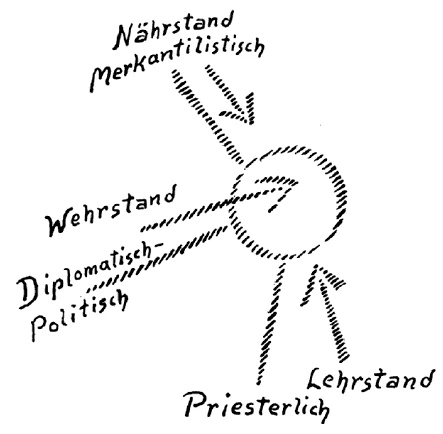
[ 41 ] As early as the fourth post-Atlantean epoch—marking a step forward from the old fourfold social structure, in which one spoke of “castes”—people began to describe this division of humanity somewhat differently. Plato spoke of the “order of teachers”; the teaching class is the one over which Rome—priestly, papal Rome—has established a monopoly. The teaching class has brought things to the point where it alone establishes the dogmatic fixation of truth and permits no one else to establish truths on their own. The supply of doctrine—even regarding the highest matters—was to come solely from this source.
[ 42 ] In another sphere, the political-diplomatic realm is nothing other than the Platonic state of defense. I have already explained to you how, despite so-called Prussian militarism, the state of defense actually took shape in France, after its foundations had even been laid in Switzerland. The military state originates from there and naturally creates its own opposition by seeking to withhold from others what it claims for itself. It wants to rule the world solely through military means, and when something military in nature confronts it from elsewhere, it considers it unjustified—just as Rome considers it unjustified when something concerning the truths of the world confronts it from another quarter. And here we might just as well write “the sustenance class” instead of the “mercantilist class.” What truly corresponds to this third factor in the deepest sense—just think about it, just meditate on it—is the “food class.” What, after all, is being withheld there? Food, of course!
[ 43 ] And if you apply the Platonic concepts correctly—that is, in a way that corresponds to reality—then you will find reality everywhere. For then your concepts are of such a nature that you can immerse yourself in reality through them. You must find your way into reality starting from the concept, and the concept will find its way into the most concrete aspects of reality. The shadows of concepts find no reality anywhere, but it is very easy to chat idly about them—and even to idealize them—while, if you work with real concepts, you will understand things down to such details.
[ 44 ] And here you see the task of the humanities: They lead to concepts through which you can truly discover life—which is, after all, merely a creation of the mind—but through which you will also strive to participate in life in a real way.
[ 45 ] When it comes to a concept, it is especially necessary today—when humanity is so terribly weighed down by fate—to think realistically and in accordance with reality; for in this realm, unrealistic concepts are all too easy to fall into. After all, it is the pastors who speak most unrealistically today whenever they address any subject. Naturally, they also speak most unrealistically about this war, for when they describe how Christianity or the awareness of God is expressed in this war—well, that is, isn’t it, enough to make one want to climb the walls, as they say. It turns into something terrible. Of course, other things often become terrible from this perspective as well, but it is precisely in this area that the absurdity reveals itself.
[ 46 ] Just pick up some writings about the war—the kind that are currently being published by this side as sermons or the like—and take a look at them with common sense. It is, of course, only natural to ask: “Must humanity really be subjected to such a difficult and painful fate?” Can’t the divine-spiritual forces intervene directly for the sake of humanity’s salvation to bring about that salvation? And here it must be said: People speak this way with a high semblance of righteousness, but there is no concept grounded in reality here, because they fail to grasp what is actually founded in reality from this point of view. — I want to clarify what is essential to you through a comparison.
[ 47 ] Human beings are organized in a certain way. They consume food; that food is organized or structured in such a way that they can sustain their lives. Just imagine: if he refused to eat, he would grow thin, become ill, and eventually starve to death. Is it reasonable, then, to say that it is a weakness or an evil on the part of God to let a person starve to death if he absolutely refuses to eat? That is not a weakness on God’s part. God created food; humans need only eat it. God’s wisdom is evident in the fact that food sustains humans; if a person refuses to eat it, he cannot accuse God of letting him starve.
[ 48 ] Well, apply this by analogy to the other: Humanity must regard spiritual life as nourishment. It comes from the gods, but it must be taken in. And to say, “The gods must intervene directly”—that means nothing other than to say: If I don’t want to eat, God should satisfy me in some other way.” — Through the wise order of the universe, what can lead to salvation is always present, but human beings must establish a relationship with it. Therefore, the spiritual life necessary for the 20th century will not come of its own accord; rather, people must strive for it and take it in. If they do not embrace it, ever darker and darker times will come. And what happens outwardly will be nothing but Maya, for the inner connection is that, at present, an old era is wrestling with a new one. At present, the universal human is struggling against the particular everywhere. And if people today believe that nations are fighting one another—and this is Maya, as I have already pointed out from other perspectives—it is only because events are grouping themselves in one way or another, which does not exactly correspond to the inner course of events: in truth, entirely different opposites are at play. There is the contrast between the old and the new. Laws entirely different from those that have traditionally ruled the world are now emerging.
[ 49 ] And once again, it was Maja—that is, something that appears in a false form—that allowed these other laws to rise up as socialist principles. Socialism is not that which is connected to the truth; above all, it is not connected to the spiritual, but rather it is something that seeks to align itself precisely with materialism. What is actually striving to prevail is a universally harmonious humanity in opposition to the one-sidedness of the scholarly, military, and economic classes. The struggle will certainly last a long time, but it can, of course, be waged in a wide variety of ways. Had people in the 19th century turned toward a healthy way of life in the Planckian sense, the bloody events of the first third of the 20th century would at least have been mitigated. Idealism cannot mitigate such things; rather, it is achieved by thinking realistically—and thinking realistically always also means thinking spiritually.
[ 50 ] Similarly, one might say: What must happen will happen. That which strives upward must go through all of this in order to unite spirituality with the soul and to grow within the spiritual realm. The tragic fate of humanity lies in the fact that those who strive upward do not wish to do so under the sign of the spiritual, but under the sign of the material. This initially brought them into conflict with those brotherhoods that, on a large scale, seek to develop the impulses of the mercantilist nature—the industrial-commercial nature—in a materialistic way. For this is the main conflict of the present; the other is merely a side effect, often a terrible one. It is precisely there that one gazes into a terrible Maya. But it is indeed possible that these goals are pursued in different ways. Thus, it would have been necessary for other people to have been in power instead of the agents of the brotherhoods I have spoken of. For then we would be engaged in peace negotiations today, and the Christmas call for peace would not have been shouted down!
[ 51 ] Well, it will certainly be extremely difficult to find clear and realistic concepts and ideas regarding certain things; but everyone must try to find them in their own field. And anyone who delves a little into the essence of spiritual science and compares this essence with other current trends will see that spiritual science is the only path to concepts that are grounded in reality.
[ 52 ] I wanted to address this to you as a serious message at this time, to show, so to speak—even though the task of spiritual science can be understood only from the spirit itself, not in light of what has been discussed today, but solely from knowledge, from the spirit itself—what the significance the essence of spiritual science is for the present, and how necessary it would be for everything that can now be done to make spiritual science known to actually take place. It is indeed necessary that, in these difficult times, we not only take spiritual science into our minds, but that we truly take it into our warm hearts. For only when we take it into the warmth of our hearts will we be able to develop the strength that the present needs. And then no one should think of themselves as if they were not suited to their place or not powerful enough to do what matters. Through their karma, each person will already find the opportunity in their own place to ask destiny the appropriate questions at the right time. Even if that right time is not yet today or tomorrow, it will come in one way or another. That is why it is essential to stand firm and secure within the impulses of this spiritual movement once one has understood it. Today, in particular, it is necessary to set this firmness and security as a goal. For either something significant must happen from some quarter—which is certainly possible, though it cannot be counted on—in the near future, or all circumstances of life are heading toward great difficulties. And it would be nothing short of thoughtlessness not to recognize this. What is now called war could have lasted two and a half years, and conditions remained as bearable as they have been so far; but it will not last another year. And then movements such as ours will also have to face the test. Then one will not be able to say: “When will we meet again?”—or: “Why aren’t we meeting?”—or: “Why isn’t this or that happening?”—but one will have to carry in one’s heart, even through perilous times, the secure feeling of belonging.
[ 53 ] I was just about to say something like that to you, because it is, after all, possible that in the not-too-distant future there won’t even be a way for us to meet again; I don’t mean just a matter of permission, but an actual way to meet. For the elements that constitute the whole of modern cultural life cannot be sustained in the long run if something breaks into this modern cultural life that, while having emerged from it, contradicts it in the most profound sense. Yet this is precisely what constitutes the absurdity: that things are brought forth from life itself which then contradict life itself. Thus, we must be prepared for the fact that difficult times may also come for our movement. But they will not deter us if we have internalized the inner certainty, clarity, and the right sense of the movement’s significance and essence, if we can look beyond the individual and personal in such serious times. This is precisely what our movement is meant to achieve: to lift us above the individual and personal even in our perspective, to direct our gaze toward the great matters of humanity that are at stake. And the greatest of these is surely this: to gain an understanding of thinking in accordance with reality. — At every turn, everywhere, one encounters the impossibility of finding thinking that is in accordance with reality. One must be fully engaged with one’s heart in such a cause; then one will not be led astray by all manner of selfishness in the details.
[ 54 ] That is what I would like to say to you today—as a kind of farewell, now that we must part ways for a while. Strengthen yourselves—even if it should not be necessary—so that your hearts can endure, even in spiritual solitude, what pulsates within spiritual science, and which is, after all, what we wish to engage with here. The very thought that we want to be certain will help in many, many ways; for thoughts are realities. Many of the difficulties that lie ahead can still be overcome by engaging in sincere, earnest seeking in the direction that has now been discussed here more often.
[ 55 ] It will not be our fault—we who must now be away from here for a while; we will certainly make every effort to return, if possible. But even if it should take a long time and be due to other circumstances, let us never allow the thought to fade from our hearts and souls that it is precisely at this place—where our movement has led us to the visible structure—that the most urgent need exists to grasp this movement so positively, so concretely, and so energetically that we truly carry it through together, come what may. Therefore, wherever we may be, let us stand together in thought—faithfully, energetically, and wholeheartedly—and hear one another, even if this cannot happen with physical ears. But we will only truly hear one another if we seek this hearing through strong thoughts, and not through sentimentality. Our time is not well-suited for sentimentality.
[ 56 ] With this in mind, I offer you these parting words, which for many are words of welcome for a life together that is now to follow—one lived more in the spirit than was possible here on the physical plane. Hopefully, the latter, too, can return once again in the not-too-distant future.