

Truths Regarding Humans Development
The Karma of Materialism
GA 176
10 July 1917, Berlin
Translated by Steiner Online Library
Sixth Lecture
[ 1 ] You’ll just have to accept that, in these sessions, I’m exploring—I would say—some more fundamental concepts and ideas, because they’re meant to help us develop some further perspectives that I intend to present both in this discussion and next time.
[ 2 ] I already began last time to engage in what I would call more fundamental discussions—discussions that are necessary to gain a perspective, that prepare the ground for what is to emerge from this perspective, and that lead to what we intend to discuss next time.
[ 3 ] It is, after all, only natural for a person who, in a sense, finds himself consciously within the course of his own life—who, in a sense, is consciously awakening to his “I”—to want to gain clarity about this “I” and its relationship to the world. Now we must note that the very striving for this clarity we have just described is, in fact, an extraordinarily strong longing in our time; that this longing to gain insight into oneself has, in a sense, truly already awakened; and that this longing is, in the present, a far, far-reaching one. But as people today experience this yearning, they simultaneously encounter all the extraordinary pitfalls and chasms one falls into when seeking oneself. One might say that people, in striving for self-knowledge, rightly believe they are on the right path when they assume that the content of this self-knowledge is a more or less simple being within themselves. Yet it is precisely this belief—that the human self, the human “I,” is a rather simple being—that brings severe, severe disappointments to many people today. Armed with this belief, people begin—so to speak—to engage with guides such as those found in Waldo Trine’s works or in other treatises and reflections. There are, after all, many people today who seek along such paths. They believe, in a sense, that they come to know themselves better by delving into their inner selves, and they believe that through this they will gain greater clarity and certainty in life. If one does not come to terms with the fact that, at first, one may experience the profound disappointment that self-knowledge initially takes one further away from oneself than one was before one sought this self-knowledge—if one finds this disappointment difficult to bear, or if one cannot bear it at all—then the cliffs and chasms become all the greater.
[ 4 ] It is now important to clarify—in a sense, to clarify in principle—what this difficulty of self-knowledge actually stems from. Basically, one cannot strive for self-knowledge in a simple, uncomplicated way, just like that. For the self, the “I”—one can find it, or at least one can seek it, through thinking, feeling, and willing. In a sense, one always finds something that one can address as the “I.” Whether one tries to immerse oneself in one’s thoughts and ideas, whether one tries to immerse oneself in one’s feelings, or whether one tries to immerse oneself in one’s impulses of will: one always gets the sense that a path must emerge through which one can come closer to one’s own self.
[ 5 ] The fact is that a person can, at first, indeed follow the path of the life of the imagination; they can try to imagine the “I.” And people of a philosophical bent, in particular, have recently believed they have found a sure path in this, simply by telling themselves: Yes, what we call our true “I” remains one and the same being throughout our entire life, from birth to death. I have always been the same, as far as I can recall. — That is what people say. I have mentioned on several occasions that this is refuted every day for every normal person, for they cannot possibly know, merely through external observation, what happens to this “I,” this concept of the “I,” during the time between falling asleep and waking up. In fact, they can only speak of this “I” in their perceptions for all the waking states they have experienced, and must always conceive of the chain as broken for all the states of sleep. You will easily be able to see this, for it follows from a simple line of reasoning. Anyone who believes, therefore, that the “I” lives in the life of the imagination in such a way that it can be found in one’s mental images should, above all, make it perfectly clear to themselves: Yes, my mental images are actually lost to me every time I fall asleep; at that moment, the “I” of the imagination—at least as far as consciousness is concerned—is also lost to me. Something that can plunge into the night of the imperceptible every day cannot really be described as if it were a secure being, a secure existence. So that when a person seeks their “I” through the process of imagination, they can be quite clear philosophically: this is what the “I”-concept is. But this concept of the “I” will not make him happy. Nor can this concept of the “I” give him any particular sense of security, even if he does not realize this through the simple consideration that this concept of the “I” breaks off every day. The whole inner being of the human being—which is truer than our imagination—already expresses this in the fact that one is initially unsatisfied with the mere concept of the “I” when seeking the “I.” It is too little—I would say, something too insubstantial—what one finds there when one seeks the “I” merely in the realm of imagination. Where does this come from?
[ 6 ] You see, those ideas and insights that shed sharp light on the realities of spiritual life are actually not so easy to find; they are not easy to find for the very simple reason that our language really does pose great difficulties for us in this regard. One can, in fact, always experience the sensation of becoming entangled in the web of linguistic concepts when one ponders and reflects on all sorts of things using those concepts as a guide. That is the fatal flaw of mere intellectual philosophizing: it is so difficult to break free from linguistic concepts. But a feeling lying behind all this intellectual speculation in linguistic concepts leaves one dissatisfied with what these concepts provide. One remains dissatisfied, in particular, when one is specifically seeking the “I” in the realm of concepts. You can already have this experience. Just try, for once, to really engage with philosophers who talk a lot about the “I,” and you will sense that these thoughts are quite shallow, and that you will always have this feeling in the background: “Yes, but can one actually rely on that? Does one have a secure existence?” — There are people who believe that just as one conceives of the “I,” so does this thought guarantee that this “I” passes through the gate of death and enters the spiritual world. But one’s intuition tells us: If the “I” actually ceases to exist every night, could it not also be the case that it ceases to exist with death? And this intuition only serves to heighten a certain sense of uncertainty; it is a pitfall. Where, then, does this very pitfall come from? When one truly comes to know the “I”—through spiritual research—that “I” which does not cease to exist upon falling asleep, even if awareness of it does, then one gradually learns to compare it with the “I” that can be glimpsed in one’s perceptions, and then one comes to know the true nature of this “I.” Then, for a while—mind you, for a while—one cannot entirely disagree with a philosopher like Ernst Mach when he says: The “I” is beyond salvation; it is, in fact, unreal. Throughout our lives, we have experiences that string together like pearls on a thread. And because we feel that they belong together, we abstract the “I” concept from them, but it is not real. — That is the conclusion such philosophers reach. They regard the “I” as a mere thought, and with a thought, a person cannot find peace in seeing it as something real, as something that truly exists. Yet in our imagination we have no other “I” than the “I” that fades away every time we fall asleep. We have no other in our imagination; but it is truly so tenuous—it is merely a figment of the imagination—that we must ask ourselves, from a spiritual scientific perspective: What is the actual nature of this concept of the “I”? What is the reality of this concept of the “I”?
[ 7 ] And from a humanities perspective, this leads to the following conclusion: that the imagined self is not at all the self we currently possess. — This is a very important, significant result: The imagined “I” is not at all the one we have now, but rather this imagined “I” lacks the inner, active being in the present. If we try to form the thought—based solely on the imagined “I”—that “You are in the present,” then, if we think realistically and in accordance with reality, we cannot form this thought at all. For the merely imagined “I” can never guarantee that we are in the present. We are always exposed to the danger that, in some way, an interplay of our ideas is merely deceiving us into believing in the “I” itself, the idea of the “I.” And that is the uncertainty we feel—that we are actually facing a mere image, not reality. Where does this come from? It comes from the fact that this “I” we imagine must be exactly as it is in our imagination, because within this “I”—this imagined “I”—the forces for the next incarnation already lie. So consider this: when we merely imagine the “I,” we do not exist as a force in the present, but we already exist there as a force for the next incarnation. It is just as if a plant, sensing the seed within itself, were to imagine: “This seed—you are not actually you; rather, it is the plant that will grow only next spring.” — Thus, within what we conceive of as the “I,” lives the force that will only unfold in the next incarnation. And this force must play out in this way; for if we were to possess more of it in the present incarnation, what we have would not be in a germinal state but would be a present reality; we would carry no germinal potential within us for the next incarnation. The imagined “I” must therefore be so attenuated that it has no effect on the present, but rather contains the germinal forces for the next incarnation.
[ 8 ] So think about just how important this result actually is. When you put it in such abstract terms, you don’t immediately get the sense that this is a result of immense significance; for what you actually have before you is the shadowy aspect of the next incarnation. And if one does nothing to somehow enrich this shadowy aspect of the next incarnation beyond what it is in ordinary life, it always remains unsatisfying; for it remains, so to speak, a mere point-like conception: I, I, I, I. One cannot move beyond this mere “I”-point. But how can one enrich this “I” beyond a mere point-like concept? That is precisely the question.
[ 9 ] Well, you see, you can’t do that if you just brood over yourself. Because if you’re always brooding over yourself like that, then you’ll discover what you are in this incarnation. But this “I”—this point—is the only thing you have as a seed for the next incarnation, so that no matter how intensely—or, for that matter, how deeply mystically—you brood within yourself, no matter how beautiful the teachings you give yourself may be, you will never come close to your “I,” for this “I,” this imagined “I,” does not actually belong to us at all—insofar as we are beings in this incarnation—but rather it still belongs—within this present incarnation—to the world. The world will take what appears within us as the “image-self,” as the “mental image-self,” and shape it for the next incarnation into whatever will then have a greater effect on our soul. Therefore, this “I” can only be enriched through external life. I have repeatedly tried, whenever some of our friends have asked me to write this or that in a guestbook and I found it appropriate, to write down the words: “If you seek yourself, seek outside in the world; if you seek the world, seek within yourself.” If you are seeking yourself—if you are seeking to have a richer inner life in your imagination than you can have in ordinary life—then you must attain this richness by broadening your observations of the world. But this cannot be mere external sensory observation; for that, too, is connected only to our present incarnation, since it is actually attached only to our body, which is lost at death. We must adopt a different perspective. We must, so to speak, be able to attune ourselves to the finer meaning of life. Only in this way will we truly enrich the “I” as a concept—by allowing ourselves not merely to think, I might say, abstractly and in such a straightforward manner as people tend to prefer in the present day, but by striving, if we wish to enrich this “I,” to seek out, I might say, the more mysterious connections of life than those that present themselves so readily. Please do not misunderstand this remark! Seeking out such mysterious connections in life is something that people today might well regard as a very useless endeavor, because they do not strive at all to enrich the “I.” People today strive to form concepts that either enable them to recognize something external or that are useful to them in their actions. But all of that is for the present incarnation. Seeking out these mysterious connections, which are meant to enrich the “I”—we must allow this to be a kind of end in itself for the soul, an intimate act of the soul, an act so intimate that, I would say, we claim nothing more than to enrich our soul, or rather, the thinking “I.” It is important for what the present demands of us that we take refuge, as it were, in the widely divergent aspects of life that nevertheless actually belong together; that we reflect on connections that do not lie on the surface of existence—that, I would say, lie beneath the surface of existence, and which are therefore, in essence, also startling to those who wish to act and think only at the surface of existence. Now, the further one goes in—I would say—unraveling the mysteries of life’s connections that lie farther away yet speak powerfully to our soul, connections that exist outside of us, the more one will find that this “I” of the imagination becomes richer and richer. One cannot immediately specify a connection in the abstract, just as one specifies a connection between the stone that becomes warm and the sunbeam that warms it. But one experiences this in life; one experiences that the more one seeks out hidden connections in life, the stronger one feels precisely within the “I of imagination,” and the more one grows together with the inner life within the “I of imagination,” which then carries this “I of imagination” over into the next incarnation.
[ 10 ] What kind of connections am I referring to? I mean very real connections—but the kind of connections people don’t usually look for. Let me give you an example. A clergyman was once walking along a path when he came across a Gypsy woman with a rather dirty child. Gypsies—the World War had swept them away, after all—but anyone who knows them knows that they were people who cared little for many things, and among those things, cleanliness was at the very bottom of the list. The Gypsy children were covered in layers of dirt. But there are many other things these children are deprived of besides cleanliness. Well, this clergyman was a good man, and he thought he was doing a good deed by, so to speak, rescuing such a lost child. He approached the Gypsy woman and told her that he would offer a small sum of money if this Gypsy child were properly raised and turned into a decent person. It was a very good intention on the part of this clergyman. The Gypsy woman, who of course would have gladly accepted the gift as a mere alms, replied with something very significant. And I would like to quote to you, word for word, the words the Gypsy woman replied. She said, no, she did not want to do that—to raise her child or have it raised—because her way of life made people happier than knowledge, prestige, mutual esteem, and all the pleasures that so-called culture provides. That is what the Gypsy woman said. — This story was recounted to Fercher von Steinwand by a man who had experienced it firsthand. And in the beautiful, meaningful essay that Fercher von Steinwand—whom you know from my book The Enigma of Man—wrote about the Gypsies, you will find this remark there. Anyone who knows Gypsy life intimately believes this remark. I myself have come to know the Gypsies well enough to know that such a thing is not only possible among them but is, in countless cases, actually true; they share the view expressed by this Gypsy woman—that all culture, all education, all mutual respect among people that exists among other peoples, and everything one can learn at all, makes one less happy than the primal, elemental life that the Gypsy leads precisely in his Gypsy existence, where he is a child of nature. This response from the Gypsy woman speaks volumes. One can accept it at first as a fact; most people will do so. But one can also discern in this very statement by the Gypsy woman a context of life such as those I have just alluded to. For something may occur to one—and it did occur to Fercher von Steinwand—that stands in a very curious relationship to this statement by the Gypsy woman. Just imagine if it were someone else who were asked by a scholarly body whether human culture makes people happier or unhappier in the course of their development, and this man had given an answer—albeit in a long treatise—that is exactly the same as the gypsy woman’s reply to the clergyman. And that man is Rousseau, and the treatise in which Rousseau gave this Gypsy’s answer was, in fact, awarded a prize by the Paris Academy of Sciences. Just think what a remarkable connection in life this is: what is spiritually present in exactly the same way in this Gypsy woman, Rousseau elaborates upon in a treatise, and it is precisely through this view that he became the immensely influential Rousseau. There you have a remarkable connection in life. In Rousseau you find a mindset, a perspective, that is exactly the same as the Gypsy woman’s perspective; the only difference is that the Gypsy woman’s perspective would not have been awarded a prize by the Paris Academy of Sciences. But in both cases, you have exactly the same perspective. The Gypsy woman wouldn’t exactly have written a scientific treatise either; but it is exactly the same.
[ 11 ] You see, it’s something that happens very often in life—something you just don’t pay attention to. If one were to examine things that one usually views from only one perspective and look at them from a different angle, one would find quite remarkable points of connection, such as the connection here between Rousseau and the Gypsy woman. Life is, after all, immensely multifaceted, and only by embracing this multifaceted nature of life can one enrich the “I”—in the sense I have explained—and make it stronger and stronger. For through such connections—which one seeks out in the world but does not find in everyday life—this “I” also grows, so to speak, as a concept. It is very important to bear this in mind. One will then find that, precisely by seeking such connections lying beneath the surface of existence, one does not brood inwardly, but rather, in a sense, broods outward into the world, searching for such connections. One will then find that the imagination linked to the “I” becomes ever more active, ever more agile, and that many, many more things come to mind than would otherwise occur to one. And that is actually what is truly important. For what so easily ails us—the source of so much dissatisfaction in life—consists precisely in the fact that so little comes to mind regarding the things of this world, that our thoughts, so to speak, move in a narrow, narrow circle. If we are able to connect what appears to us in life with many, many other things—to seek broad connections between events, experiences, and occurrences—then our sense of self grows stronger, and ultimately it feels better equipped to cope with life, even as a thinking self. That is why any form of human education that directs people only toward one-sided thoughts about one and the same thing is harmful. I’d like to give you an example that, I might say, stems from the same source as the one just mentioned.
[ 12 ] Many people adhere to what is called pantheism. This pantheism—as you know, I have often rejected it—essentially consists of people saying: We seek the Spirit everywhere. — Spirit, spirit, spirit is everything, and that satisfies them. Pantheism—some people today also call it panpsychism, because they don’t want to acknowledge theism—I usually explain this by saying: A person who applied this to the sensory world wouldn’t get very far. For if he walks into a meadow and says, “Flower, flower, flower,” that is simply an abstraction for everything. He does not want to say: lily, tulip, and so on. But it would be exactly the same if he were to say nothing but “flower, flower, flower, flower” over and over again as if one were to say: “Spirit, Spirit, Spirit, Spirit.” Yet people find it absolutely necessary to keep saying “spirit, spirit, spirit”; and yet they reject it when one speaks of real spirits—of angeloi, archangeloi, archai—that is, of individual spiritual beings who have their own specific, concrete spiritual existence, just as one speaks of individual beings in the sensory world. But there is, in a sense, something in the human spirit that tends toward such pantheistic thinking—toward simplifying everything, everything, and seeking the most abstract ideas everywhere. It is interesting, then, that we can now also cite a Gypsy example that truly shows us just how “Gypsy-like” it actually is to seek these abstract ideas everywhere.
[ 13 ] Then the same gentleman who had witnessed the other incident came across a Gypsy who was devouring a dead animal he had found on the street or in a field with great appetite. That is what Gypsies do; they eat dead animals, don’t think twice about it, and can digest them just fine. So the man in question tried to make it clear to him: “But you don’t eat a dead animal—you only eat slaughtered animals.” — Now the Gypsy proved to be a man of abstractions when he said: “Yes, but the animal I’m eating now—it was slaughtered by God!” — You see, he has a concept of God that he applies to everything, just like the pantheists. Of course, one can think like the pantheists; then one is thinking quite correctly when one says: God has slaughtered a dead animal. How could one not eat, he reasoned, what God has slaughtered?
[ 14 ] One can discover broader connections that enrich the self, and these in turn further enliven the self, insofar as it is a thinking self. Certainly, there will now be some who will say: So what is being asked for here? The ability to make connections! But that is very abstract. What I mean is much more alive than the ability to make connections. Ordinary combinatorial ability really stands in the same relationship to what I mean as a machine does to an organism, to a living being.
[ 15 ] In this way, we become more aware of the power that already lives within us from our next incarnation when we make an effort to think about things that are separate from one another and connect them in order to enrich our sense of self. We simply give in to the illusion that we are enriching our sense of self when we—well, let’s say—brood within ourselves. But we do not enrich our sense of self at all by merely brooding within ourselves; rather, we enrich our sense of self when we find our way into the world that lies beneath the surface of ordinary existence, as indicated, and when we truly cultivate this reflection on life—as opposed to the mere brooding that consists in turning inward. Embracing life with love and not philistinely rejecting connections that have no other meaning than to bring together things that are far apart—simply to enrich the self—that is what gives us strength. Try it once in the most ordinary of lives—you will see that every hour offers you the opportunity—try it in ordinary life: let the things you experience find their resolution in such mysterious connections. Of course, one must not become a dreamer. One becomes a fantasist when one seeks more in such mysterious connections than they actually are, when one wants to gain insight through them. But the point is not to gain insight through them, but to let them take effect within oneself. So that one can truly describe how one can attune oneself to the power that is now present within one in thought, even though its reality corresponds only to our next incarnation.
[ 16 ] However, there is also a way not only to grasp the “I”—which will be the force underlying our life in the next incarnation—not only to grasp this “I” as a conceptual “I,” but there is also a way to grasp how this “I” lives between death and a new birth. To do this, however, we must pay closer attention to how we position ourselves within life—or rather, how human beings position themselves within life in general. But these broad attitudes toward life do not lead to that subtle kind of inner experience that is necessary if one is to gain an understanding of what it is like to exist between death and a new birth, or what it is like after death. Today, people seek only through coarse means; but through coarse means one cannot find the things that are sought as entities in the spiritual world. There, one must engage with more subtle interrelationships. You really shouldn’t be surprised that one must engage with these more subtle connections, for after all, life in the spiritual world is indeed different from the life we lead here in the sensory world. Therefore, you need not be surprised if what we think, feel, and will is not immediately applicable to the spiritual world, if a refinement of our entire life is required there.
[ 17 ] Now, when it comes to nurturing the richness of the life of the imagination, this process of gathering—as I have just described it—is what strengthens us; for the cultivation of the “I,” as it lives between death and a new birth—indeed, for the cultivation of this very state of being in the world, in which we find ourselves between death and a new birth—it is necessary to link this search for connections to human beings themselves. One must say: Life offers enough mystery, provided one does not approach this mystery with the intention of obtaining something tangible from it, but rather—I would say—if one approaches it without philistinism, with a certain delicacy; then one is already on the right track. Certainly, today, when one puts forward such ideas, one is, I would say, taken at one’s word in a materialistic sense. This leads to a certain awkwardness when one is taken at one’s word in this materialistic way. I will illustrate what I mean with an example.
[ 18 ] What I am about to say may be particularly characteristic of people whose entire disposition is marked by what I would like to call a kind of dreamlike inner life—not that they are complete dreamers, but they do possess a kind of dreamlike inner life. Therefore, what I mean will be found to be particularly strongly developed in people who live closer to the East. The further one goes west, the less people live out those connections that point to this mysterious spiritual realm I am referring to. That is why, for example, Western Europe—which relies more on coarse connections—finds it so extraordinarily difficult to understand the spiritual character of the Russian people, even though such understanding would be particularly necessary at the present time. I would say that the Russian people are still, by a slight degree, less awake today than the peoples of Western Europe and even those of Central Europe. Consequently, the things we are now discussing connect more easily to the inner life of a Russian than to that of a Western European. They do relate to the inner life of a Western European as well, but they are simply not as conspicuous; they do not strike one as so noticeable, I would say. A German writer, Eduard Bernstein, has provided a very interesting account of this, which I would like to cite as an example. He would certainly take great offense if I were to regard what he recounts—what he has experienced—as mystical. But that is precisely why what I am about to cite is a good example of a life context that, to the materialistically minded person, is nothing more than an ordinary coincidence. The person in question recounts that he spent a great deal of time in London at the home of Engels, Marx’s friend. Engels’s home was a very hospitable place, where many people gathered and an international circle came together. And there, among the people who frequented the house, Eduard Bernstein also met Sergius Kratschinsky, who wrote under the pen name Stepniak. He is, of course, very well known by that name. Well, Bernstein describes this Stepniak in an extraordinarily interesting way, beginning with Stepniak’s outward life:
[ 19 ] “A strongly built man with a commanding head, he perfectly embodied the image we have here of a Slav. He, who in Russia had been a man of action and had played a prominent role in the liberation of Peter Krapotkin from prison, as well as in the successful assassination attempt on the St. Petersburg police dictator Mesenzov, had a strongly dreamy disposition and was very tender-hearted. He was the driving force behind the Free Russia association, founded in England, which had set itself the task of raising funds to support Russian freedom fighters. On behalf of the association, Stepniak repeatedly undertook lecture tours in England as well as a tour of America, during which the American humorist Mark Twain, in particular, treated him with great friendship. In certain literary circles in England, Stepniak—who had also enjoyed success as a novelist—held a position of respect.”
[ 20 ] “At Engels’s dinner table, as indeed in any social setting, he was usually a quiet guest who spoke almost exclusively when addressed directly. But one could still tell that he enjoyed visiting Engels and placed great value on their friendship. “Between him and me as well”—that is, Eduard Bernstein was referring to himself and Stepniak—“a quite friendly relationship developed.”
[ 21 ] Now, there was once a dispute in the circle where Bernstein and Stepniak were present—the kind of dispute that can easily arise among people who are passionately interested in the grand issues of life. They argued over a question concerning the relationship between Russians and Poles. One might perhaps wager that in such a case, the average Central European would naturally side with the Poles. And so a rather heated argument ensued. Bernstein and others were on the Poles’ side, while Stepniak defended the Russians against the Poles. There was a heated argument, which led to Stepniak no longer appearing in society. For years, Bernstein heard nothing from Stepniak. Stepniak had completely fallen out with the people with whom he had otherwise socialized. One day, after a long time, Bernstein received a letter in which a complete stranger—someone who did not belong to the social circle—wrote asking if he would like to come over one evening in the coming days; but he noted that Bernstein was not on good terms with Stepniak, that they had had a disagreement some time ago, and that he should only come if he wasn’t afraid of running into Stepniak there. Bernstein not only saw this as no obstacle, but actually found it very pleasing that he would be able to meet Stepniak, and so they met there. Now, of course, one might at first see nothing special in the fact that two people who had been quite fond of each other, having been apart for a long time, found each other again after years; one might see nothing more in it than a mere coincidence. Of course, materialistic thinking would see this as a mere coincidence. Well, the way Bernstein describes the situation, one must say that their reunion that evening alone shows that the matter was exceptionally important to Stepniak in particular. The description of the atmosphere makes it clear that it was indeed important to Stepniak that he met up with Bernstein again that evening. They were very cheerful, very happy. And two days later—after Stepniak had said the previous evening that he was very glad they’d found each other again and hoped to do many things together—two days later, Bernstein read in the newspaper that Stepniak was dead. He was walking down the street reading a book or the newspaper, crossed a railroad track, and the train ran him over. It was all so clear that it could not have been suicide, and that one could only think of an accident. Yet another coincidence. But these things cease, you see, to be mere coincidences. I am simply choosing a striking example of how one should look for them in life—for those connections that are not entirely obvious, those somewhat hidden connections in which people are entangled with their inner lives. These things cease to be mere coincidences when one considers that, in fact, our more subtle inner life—which unfolds primarily in images, in images tinged with emotion—points toward the future to a most eminent degree, especially when it is somewhat dreamlike; it is prophetic. In fact, every dream is prophetic. When you dream, you are actually always dreaming of the future; it’s just that you cannot form mental images of the future, and so you cloak what you are actually dreaming about the future in images of the past. You pull these over what is actually being experienced in your soul, like a garment. Because the future is connected to the past—because karma is at work there—there is a deeper connection between what one dreams of for the future and the “garment” one puts on when one becomes aware of the dream. What one knows, one clothes in images of the past, in images that are already familiar to one. After all, one is always dreaming from the moment one falls asleep until one wakes up; one just doesn’t know it—one is aware of only the very least. If one is dreamy in life, then this dreaminess takes effect and influences karma. Therefore, the person who correctly understands such a mysterious connection, as I have described it, will, I might say, be able to grasp karma with their own hands. Certainly, had Stepniak not been this emotionally sensitive and at the same time dreamy person, the connection between his conscious life and the mysterious flow of karma would not have been so powerful that, even on the very last evening—in the final hours, so to speak—this effect, this convergence that I have described to you, would have come about. But the more abstract, everyday imagination is lost to daydreaming, the greater a person’s capacity becomes to bring about karmic connections. I hope you understand this subtle connection correctly. One can also be inattentive in life to things that come one’s way. Had one been attentive, one might perhaps have carried out this or that action under the impression in question. What is happening here is that the person in question, who was more dreamlike—not in full consciousness, but in this dreamlike state of consciousness—is led to bring about the opportunity that brings him together with the other person once more before he passes through the gate of death.
[ 22 ] Such subtle connections in life—which one need not regard as anything other than what they are meant to be: an enrichment of our inner life—should not be overlooked by those who wish to enrich their inner life, as a perspective on life between death and a new birth. One really ought to seek out these threads as well—those that lie beneath the surface of life and weave human existence itself into broader networks. Certainly, no one should, so to speak, take one by the hand in a materialistic way and say: “So you’re claiming that Stepniak brought about this evening meeting with Bernstein through the attractive forces of his soul.” Yes, if one is taken by the hand in such a materialistic way, as if one had wanted to speak of some materialistic-scientific proof, then that is meaningless. For things are not so crude. Things are, in fact, much more subtle. One need not even think of trying to pin these matters down in a materialistic sense, but must be content that one—or someone—is indulging in the description of such connections; one need not feel the need to approach them as crudely as the things of ordinary material life. When one allows oneself to view life in light of such finer interrelationships, the soul is enriched in turn. Fundamentally, all the interrelationships revealed by spiritual science are of this finer nature. That is why life is also enriched by these interrelationships—even if that life is not currently residing in the body of Max Dessoir.
[ 23 ] So, connections that look beyond the human being—as I characterized them earlier—enrich the “I” that we now carry within us, but really only as a seed for the next incarnation, so that we have greater strength in relation to this “shadow-I.” Connections of the kind in which we do not look beyond human beings but rather include them—these enrich life by making the soul richer in its experience and perception of that region we pass through between death and a new birth. It is highly remarkable that one actually fails to properly understand many things in people who are predisposed to seek out such connections if one attempts to approach these matters, I would say, from a materialistic perspective. Goethe’s style, for example—which, in many extraordinarily important passages of his works, must be understood in such a way that Goethe never actually wants to be pinned down to a materialistic view in these passages—can only be properly understood if one interprets it as meaning that Goethe never wishes to speak of anything other than what lies, so to speak, beneath the surface of life; in certain passages of his works, of course.
[ 24 ] You see, one is mistaken if one naively believes—and Waldo Trine’s approach, for example, is naive—that by working inwardly one can find that enrichment of the self which is a self-knowledge that makes one strong. One must try to break free from oneself in order to become stronger. Therefore, those who direct one’s attention back to oneself, who do not lead one away from oneself, who do not bring one into contact with the world and its connections—which are not immediately obvious—are, at heart, poor guides to self-knowledge.
[ 25 ] Just as one can succumb to such errors, pitfalls, and chasms with regard to the imagining self, so too, I would say, can one succumb with regard to the willing self. In fact, in everyday life we pay just as little proper attention to volition—the volitional self, I mean—as we do to the thinking self. You can already infer this from the fact that people like Theodor Ziehen, whom I mentioned some time ago, do not consider volition at all. They, in turn, do not find volition in modern human beings, and—as I have now explained in public lectures in many places—they are not wrong in this regard. Franz Brentano even completely excludes volition from the powers of the soul, distinguishing only between representation, judgment, and the emotional phenomena of love and hate, so that he does not actually consider volition to be part of the soul at all. He excludes it as a psychologist as well. And what is correct about this is that, if one examines human beings—as they are in their present incarnation—with regard to their volition, one does not find volition at all. All one finds of volition in present-day human beings is that it leaves one satisfied or unsatisfied, that it brings joy, causes sorrow, and so on. One finds, so to speak, only the emotional or psychological impression of the will, but the will itself remains shrouded in mystery. You do not even know why you raise a hand; you know why—which feeling led you to do it, which idea—but how you do it, what actually functions as the will: you cannot find it in the present human being. Why? Because it is not within the present human being. The willing “I” is not at all within the present human being; rather, it is the result of the previous incarnation. What existed in the previous incarnation now manifests as will flowing from the “I.” When I say, “I am,” I live within this thought, “I am,” in the seed of the next incarnation. When I say, “I will,” I am living in what is working its way from the previous incarnation into the present one.
[ 26 ] This is extremely interesting because it makes it understandable that disappointments in life can easily arise here. Whether one is satisfied or dissatisfied depends on the present; it is up to the person as they are now, but the will stems from the person of the previous incarnation. Every time I do something that is expressed with the words “I want this or that,” the will from the previous incarnation enters into my present state of mind. Just think what a mysterious connection this is. But in everyday life, people confuse all of this. They believe that this “I” is some kind of mysterious, substantial entity within them, and that at one moment it says, “I think,” at another, “I was,” at another, “I am,” and at yet another, “I want.” But that is not how it is; rather, when I say, “I am,” I develop a force that is now within me like the germinative force in this year’s plant, but which will not unfold until next year. As soon as I say, “I am,” I am in a force that will become human in a future incarnation. When I say, “I will,” I act out of a force that was within me in a previous earthly life.
[ 27 ] Once one has truly grasped this, one realizes that one actually lives only in one’s feelings—as the philosopher says—in the modus praesens, in the present tense. In reality, only the emotional experience is truly in the present tense; and in a sense, we are, temporally speaking, a being composed of three interlocking layers. We are structured in such a way that within us lives what carries over from the previous incarnation, what is currently being felt, and what carries over into the next incarnation. Just as a plant grows out of what was last year’s seed—which withers away—so too is the withering aspect of the previous incarnation, which gradually passes into the rest of the world, the will that springs from the “I.” The seed for the next incarnation is what we think of as the “I.” For this reason—because this is so—I wrote in the essay of mine included in the April 1916 issue, the first issue of Reich, Bernus’s journal: “The path into the spiritual world is thus traversed through the unveiling of what is contained in thinking and willing,” because thinking and willing, as they live within us, do not in fact exist within us merely as present realities, but point, through the spiritual connection, from earlier earthly lives to later earthly lives. One can then truly say: Emotional experience cannot be developed in a similar way through an inner impulse of the soul, because emotional experience is also truly experienced as a spiritual emotional experience. Therefore, that which corresponds to emotion is, over in the spiritual world, something that must itself come to one. One can live out one’s will and thought through meditation and concentration, but one cannot cultivate one’s emotional life. One must allow it to unfold, and it will then arise.
[ 28 ] Many people ask again and again: “Yes, how can I develop a closer relationship with that being we refer to as the Christ?” — There is no simple formula to offer: “Do it this way or that way!” — but certain key aspects of spiritual science today are such that they lead one into the realm of the Christ, just as he exists. Just consider the fact we know so well: As a physical human being, Christ walked the earth only at the time of the Mystery of Golgotha. So experiencing him as a physical human being in physical events was only possible back then. If one wants to draw near to him today, one must seek him as he lives within the earthly sphere. But he does not live within the coarse contexts; rather, he lives within finer contexts. So precisely what I have told you today—the search for finer, more remote contexts, and training oneself in these finer, more remote contexts—can bring people into that region of consciousness where they can truly experience the Christ. Of course, one can then, I might say, be roughly seized by a materialistic hand. Someone might say: “Well then, you’re telling us that Christ simply cannot be grasped through ordinary imagination, as one applies it to natural phenomena!” — People who entertain such a thought in the first place—who are, in fact, speaking from a feeling that only what is conceived according to the pattern of natural phenomena is valid—which is, after all, what all materialists do—cannot be guided in such a way that they perceive the spiritual.
[ 29 ] It may be a bit of a stretch, but just imagine there were a being of such a nature that one could only perceive it in a dream. It does not reveal itself to the eyes or the ears, nor does it reveal itself to ordinary, everyday thinking; but it does reveal itself in a dream. Yes, a person who wants to experience something of this being would simply have to commit to developing the art of dreaming; otherwise, the being cannot be present for them. Now, if someone says, “Dreams don’t give me anything real!”—then it is their own fault that they cannot come close to this being. In this regard, people simply think the wrong way, in that they actually make demands of their own accord; and if anything fails to meet these demands, then it counts for nothing to them. Yes, but if the thing is of such a nature that it does not exist to meet that demand, then it must simply elude the people who make such demands. So one must also be clear that one must develop a special kind of thinking or inner life in order for that which does not lie in external nature to reveal itself. We must go to these beings: they do not come to us. That is the important thing!
[ 30 ] Time and again, I would like to say: One would so dearly like to find more than just words, so that people today might truly find their way from their crude, materialistic sensibilities to such subtle things. For even the best among us today do not easily find their way to such things as I have now explained. They consider this to be fantasy and laugh at you if, for example, you were to say: “Well, fine, let it be fantasy, but these beings are such that you must have the power of imagination; otherwise, they will not appear to you.” — They only allow themselves to appear as real beings if one also possesses the power of imagination. I said that one would need more than just words to make it plausible just how necessary it is, especially in the present, to engage with such subtle concepts. These concepts are subtle, but the soul is strengthened by them—so much so that it gains an understanding of reality, enabling it to look more deeply into the true interconnections than can be achieved by a way of thinking that seeks to train itself solely on the materialistic, scientific concepts of the present. Even among outstanding minds today, one finds that thinking—I would say—has truly forgotten how to engage in the necessary subtlety. Last time, I believe I made it clear to you in very forceful terms that I hold Franz Brentano in the highest regard, precisely because, through his study of Aristotle, he developed his own thinking to a certain subtlety. But I said: he did not come to spiritual science. There were many reasons for this, but above all, he lacked that subtlety of thought which one must possess first and foremost in order to penetrate the true spiritual world; at the very least, one must strive for it. Read the final chapters of my Theosophy or the second part of Occult Science. There, I might say, one can sometimes catch people stumbling over their current way of thinking. One can catch them. One can catch Brentano in the same way. I must say, I would find it puzzling that a man as subtle as Brentano did not find certain paths, if I were unable to pinpoint exactly where the problem lies with such a person. And while one can pinpoint him in many places, I will cite one such instance.
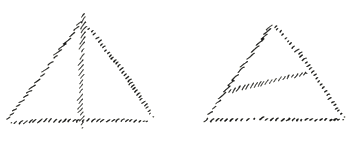
[ 31 ] He says: Spiritual life must be individualized in relation to the matter in which that spiritual life exists, for one can cut up certain lower animals, and each part in turn exhibits the same life as the whole that has been cut into parts. You know, certain lower animals can be cut up; it doesn’t bother them—two simply continue to live. Now he says: Yes, we can form no other conception than that an independent soul now lives in each of the parts. So if I have cut a lower worm into two pieces and each one continues to live, then there is a soul in each part. He concludes from this that the soul, as a wholly unified entity, is connected to the physical body in this way. And he now uses a comparison—just think—he says: “It’s the same with a triangle. If we draw a line through it, it breaks into two triangles; we’ve divided it, and each is a triangle.” I just want to say this: He compares the thought he has when dividing a worm in two with the thought he has when dividing a triangle in two, and uses one to clarify the other. Dividing a triangle in two is a simpler concept than dividing a worm in two; so one can use the one to clarify the other. But is that true? Brentano considers it extraordinarily important. But is that true? It isn’t! For suppose you have a triangle here. Certainly, if you draw a line here, you divide it into two triangles. Each part is, in turn, a triangle, just as with the worm when it is cut into two parts. But if you divide it in this way, you do not get two triangles; rather, one of them is a quadrilateral. That is to say, you only get two triangles under certain conditions; one of them is a quadrilateral here.
[ 32 ] So the comparison does not hold. A very astute person makes a comparison. But the comparison does not hold. His thinking is therefore not flexible enough, not lively enough, to find a valid comparison. He stumbles. But this has consequences. For if he were not misled by such a comparison—that a worm can be divided into two parts just as a triangle can—he would arrive at the correct conclusion. And he does not arrive at the correct conclusion. For when I divide a worm into two parts, this has nothing to do with two souls; rather, the group soul acts upon the two parts just as when I look at my reflection in a mirror and break the mirror in two in the middle—I then have two images, yet I have not divided myself. I have indeed obtained two images, but I have not divided myself; rather, I have divided the mirror, and that is why there are two images. Nor can I divide the worm’s soul; it has remained one, just as I have remained one when I am reflected in two mirrors; thus, the single soul is present in the two pieces of the worm. He could not arrive at this conception, which corresponds to reality, because he allowed himself to be misled by a false comparison due to a lack of flexibility in his thinking. For if he had made the comparison correctly—where there are truly two triangles—he would have said to himself: Yes, but mere division does not make there be two triangles; something else must be added. Once I have divided it, the idea of the triangle must again be applicable to both parts. Mere division from the outside does not produce two triangles. Here I must apply two ideas: the idea of the triangle and the idea of the quadrilateral. Had he realized that he must apply one and the same idea in this division, and that only this one and the same idea guarantees that he has divided it into two triangles, then the comparison would be correct. But he had not realized that the single worm’s soul is inside both parts, yet looks in from the outside, like someone standing in front of a mirror and looking into the two parts of the mirror.
[ 33 ] We truly find ourselves at a point in time when everything cries out for a refinement of thought. We really cannot make any progress unless such a refinement of thought takes place, unless thinking becomes more flexible, unless it ceases to cling to the coarse external. And even if resistance to this refinement of thought is strongest today, we must work all the more diligently in the cause of spiritual science, for it cannot come about anyway unless we take refuge in more refined concepts; yet it is also capable of strengthening the human “I” through what it is. Everything else can, of course, lead people along the path toward which today’s longing is directed; but only spiritual science can provide true strength—precisely through what is most often held against it: that it awakens ideas that are not really applicable and cannot be manifested outwardly in life. But precisely because they cannot be manifested outwardly in life, they make us strong and vigorous inwardly—that is, in harmony with reality.
[ 34 ] We’ll continue discussing this next time, taking a broader look at important aspects of life.