

The Spiritual Backgrounds of the Outer World
The Fall of the Spirits of Darkness
GA 177
14 October 1917, Dornach
Translated by Steiner Online Library
Ninth Lecture
[ 1 ] It is necessary to allow certain fundamental truths of spiritual development to come before one’s soul again and again, once one has taken in new—I would say—material in the form of knowledge and the like, in order to gain a deeper understanding of these fundamental truths. In our recent reflections, we have familiarized ourselves with all sorts of ideas that can explain current events and the reasons behind them—all, of course, to a certain extent. In doing so, we have acquired a series of concepts regarding the development of the present. With these concepts, we can approach fundamental truths that we already know from certain perspectives, but which can be understood even more deeply when we approach them with fresh preparation.
[ 2 ] I have often pointed out how the mid-19th century—especially the 1840s—marked a significant turning point in the intellectual development of European and American humanity. I have pointed out how that period marked, so to speak, the pinnacle of materialistic intellectual development on Earth—the pinnacle of the formation of what one might call an intellectual grasp of external, lifeless facts that refuses to engage with the living.
[ 3 ] Such events—and we are, after all, still experiencing the external aftermath of these events today and will continue to do so for a long time to come—such events have their deeper roots in processes in the spiritual world. And when we investigate the events in the spiritual world that found their external earthly expression in what has just been said, we must point to a struggle, indeed, a kind of war in the spiritual world, which began at that time and which, in a certain sense, came to a kind of conclusion for the spiritual world at the point in time—of which I have, in fact, spoken often—that falls in the fall of 1879. You will therefore gain a proper understanding of these matters if you imagine a struggle in the spiritual worlds that lasted for decades, from the 1840s until the fall of 1879.
[ 4 ] The battle that took place there can be described as a battle between spiritual beings who belong to the retinue of that being from the hierarchy of the Archangels whom we may call Michael—that is, a battle between Michael and his retinue against certain Ahrimanic forces. So please, first imagine this battle as a battle in the spiritual world. And everything I am referring to at this point pertains to this battle between Michael and his retinue and certain Ahrimanic forces. You will gain a clearer understanding of this concept—especially if you wish to apply it fruitfully to life in the present— by bringing to mind that those human souls born in the 1840s experienced the early phases of this struggle between Michael’s followers and the Ahrimanic forces while still in the spiritual world. Thus, those people born in the 1840s witnessed, as souls before their birth, the beginning of this spiritual struggle. When one considers this, one can gain a deep understanding of the external and internal experiences of fate in the lives of such people, and especially of their spiritual dispositions. This battle thus took place in the 1840s, 1850s, 1860s, and 1870s, and came to an end in the fall of 1879 with Michael and his retinue emerging victorious over certain Ahrimanic forces.
[ 5 ] What does this mean, then? If one wishes to understand such things correctly, one can always turn to the image that has been preserved throughout human evolution: the image of Michael’s battle with the dragon. Of course, Michael’s battle with the dragon occurs at various points in human evolution. One often encounters a battle between Michael and the dragon in the course of human development. One can characterize it this way: every time such a battle between Michael and the dragon occurs, it unfolds in a manner similar to that of the 1840s, but concerning different goods and evils, harms, and disadvantages; one could say that certain Ahrimanic forces are constantly trying to incorporate first this, then that aspect of world development, and that they are repeatedly defeated. Thus they were defeated—but, as I said, within the spiritual world—in the fall of 1879.
[ 6 ] But what does it mean, then, that the powers of the dragon—these Ahrimanic hosts—have now been thrust, as it were, from heaven down to earth into the realms of humanity? The loss of this battle means that, to speak in biblical terms, they are no longer to be found in the heavens. Instead, they are to be found in the realms of human beings, and this means: the end of the 1970s was, above all, the time when human souls were seized by Ahrimanic impulses with regard to certain powers of cognition. Because these Ahrimanic impulses were previously able to operate in the spiritual realms, they left human beings more in peace; because they have been cast down from the spiritual realms, they have come upon human beings. And when we ask ourselves: What actually entered human beings from the spiritual realms at that time as Ahrimanic forces? It is precisely the personally colored—note well, the personally colored—Ahrimanic, materialistic worldview.
[ 7 ] Certainly, materialism reached its peak in the 1840s. But at that time, it had sent its impulses into people more instinctively. The Ahrimanic forces were still sending their impulses from the spiritual world into human instincts back then. These Ahrimanic impulses—namely, the powers of cognition and will—became the personal property of human beings beginning in the fall of 1879. What had previously been more of a common heritage was thus transplanted into the possession of human beings. And so we can say that since the year 1879, through the presence of these Ahrimanic forces in the human realm, there has been a personal ambition, a personal tendency to interpret the world materialistically. And if you trace the various events that have occurred since that time as a result of people’s personal tendencies, you will understand them in light of the casting down of the dragon—that is, the Ahrimanic hosts—by the Archangel Michael from the realms of the spirit, from the heavens to the earth.
[ 8 ] This is a process of immense significance, of profound importance. The 19th century—and indeed our own time as well—is not, however, inclined to pay attention to such processes in the spiritual world and their connection to the physical world. But the ultimate causes, the ultimate impulses behind events on Earth, can only be found if one is familiar with these spiritual backgrounds. It must be said that a considerable measure of materialism—albeit tinged with idealism—is involved in asking: What does it matter, in the face of eternity, if so many metric tons of organic matter are lost due to the prolongation of the war! — One must sense how deeply such a view is rooted in Ahrimanism, for it is rooted in the worlds of feeling. This philosophy of the “metric tons of organic substance,” this philosophy of the philosopher Lichtenberger, is essentially one of the numerous examples that can be cited as specific manifestations of Ahrimanic thinking.
[ 9 ] So what has lived as the deepest impulse in the souls of many people since 1879—that which has been cast down into the realms of humanity—previously existed as an Ahrimanic power in the spiritual world. It is helpful to seek out other ideas that can reinforce these concepts, and in doing so, it is good to draw upon—not merely imaginative or symbolic ideas—but ideas from the material world. For what today takes place more on the spiritual and soul levels all had, in primeval times, a character that found its expression more in the material realm. The material is, after all, also spiritual; it is merely another form of the spiritual.
[ 10 ] If you were to go back to very, very ancient times, you would find that a struggle similar to the one I have just described to you for the 19th century took place between Michael and the dragon. I have already hinted at how such battles have repeated themselves time and again, though they always concerned different matters. In ancient times, the Ahrimanic forces had also lost such a battle once, and they were cast down from the spiritual worlds into the earthly realm at that time as well. They simply launched their assaults again and again. For example, there was a battle in which these Ahrimanic hosts, after being cast down to Earth, brought into the earthly realm all those entities that are today referred to in medical science as “bacteria.” Everything that manifests as bacillary forces—in which bacilli play a part—is just as much a consequence of the fact that Ahrimanic hosts were once cast down from heaven to earth, that the dragon was defeated, as it is a consequence of such a victory that the Ahrimanic-Mephistophelean way of thinking has taken hold since the end of the 1970s. Thus one can say: in the material realm, tuberculosis and bacillary diseases have a similar origin to the intellectual materialism currently prevalent in the spiritual-psychic realm; in a higher sense, the two are entirely alike.
[ 11 ] We can compare these events of the last century to something else as well. We can point to something you are already familiar with from *An Outline of Esoteric Science*: the ejection of the Moon from the sphere of Earth’s development. The Moon once belonged to the Earth; it was once cast out of the Earth. This ejection of the Moon from the Earth’s sphere signifies the establishment of certain lunar influences. These influences also came to Earth as a result of Michael’s victory over the dragon. So that one can say once again: Everything connected with certain effects that run parallel to the phases of the Moon—indeed, all the impulses emanating from the Moon to the Earth—all of this has its origin in a similar battle between Michael and the dragon.
[ 12 ] In a sense, these things truly belong together, and it is extremely beneficial to reflect on this connection, for it has a very profound significance. Certain people, in fact, develop an irresistible inclination toward intellectual materialism precisely because this inclination stems from their personal alliance with the fallen Ahriman. They gradually begin to love the impulses that Ahriman stirs up in their souls, even describing them as something particularly sublime, particularly lofty in their way of thinking. One must, in turn, have a completely clear awareness of these things. For without awareness, one cannot find one’s way through these events. Only by looking clearly into these circumstances can one come to terms with these things, with these events.
[ 13 ] The danger that arises from all this must be viewed, so to speak, with a cool head and a cool heart. One must calmly face the issue head-on. But one can only do that if one realizes that a very specific kind of danger threatens humanity from that quarter. And this danger consists in the fact that what should not be preserved is being preserved. For everything that happens in the order of the world, my dear friends, also has its good side. Through the fact that the Ahrimanic forces have been driven out of us by Michael’s victory, we are regaining a piece of human freedom. Everything is connected to this: We are regaining a measure of human freedom—for these hosts of Ahriman have indeed departed from within us—we are regaining a measure of human freedom, but we must be conscious of this. We must, so to speak, not allow the Ahrimanic forces to gain the upper hand over us; we must not fall in love with these Ahrimanic forces.
[ 14 ] This is very important. This danger is very real. The danger exists that people will remain entrenched in materialism, cling to the materialistic-Ahrimanic way of thinking, and carry this Ahrimanic way of thinking forward into times when it is actually destined to be overcome. Then those people who do not turn away from the Ahrimanic-materialistic way of thinking, but wish to remain with it, would form an alliance on Earth with everything that arose in a similar way through Michael’s victory over the dragon. That is to say, they would not align themselves with the spiritual progress of Earth’s development, but rather with material progress. During a certain period of the sixth post-Atlantean epoch, they would take pleasure exclusively in living amidst what will then come about through germs—the tiny microscopic enemies of humankind.
[ 15 ] We must add another point to these matters, one that we must also understand. The scientific way of thinking is in grave danger of drifting into this Ahrimanic way of thinking as a result of its own logic—indeed, precisely because of its grandeur. Not only the moral way of thinking, but also the scientific way of thinking is in great danger of drifting into this Ahrimanic, materialistic way of thinking. Just consider, for example, how certain natural scientists think today in the field of geology. They trace the formation of the Earth’s surface and, based on the remains and so on, determine how certain animals live or have lived in the individual layers. They find empirical evidence for specific time periods. Based on this, natural scientists then form views about what the Earth looked like so many thousands and millions of years ago, and thus develop the Kant-Laplace theory of the primordial nebula. Natural scientists also form certain ideas—which are entirely correct according to physical principles—about the future stages of the Earth’s evolution that are yet to come. Such ideas are sometimes incredibly ingenious—very, very ingenious. But on what are such ideas based? Don’t they rest on the fact that one observes the Earth’s development over a period of time and then draws conclusions: millions of years before, millions of years after.
[ 16 ] But what exactly does one do there? One does the same thing one would do if observing a child of seven, eight, or nine years of age as their organs gradually change—or change in part—and then one would calculate how such human organs change over the course of two or three years. Then you multiply that, and you arrive at how these organs—which have changed in a child of seven, eight, or nine years old—change over the course of centuries. So you can calculate what this child looked like a hundred years ago, and by multiplying in the other direction, you can also calculate what the child will look like in a hundred and fifty years. It is a method that can be quite ingenious. It is exactly the same method that geologists use today to calculate the Earth’s prehistoric past, and which was used to develop the Kant-Laplace theory. It is exactly the same method used when imagining what will become of the Earth according to the physical laws currently observed. But you will all admit: these laws do not mean much when applied to human beings, for example, because the child from a hundred years ago simply did not yet exist as a physical human being and will not exist as a physical human being again in a hundred and fifty years.
[ 17 ] But the same is true of the Earth for the time periods calculated by geology. The Earth simply came into being later than the time periods calculated by Tyndall, Huxley, Haeckel, and others, and by the time we reach the point where one can simply paint egg white on a wall to read by its light, the Earth will be nothing more than a corpse. It’s quite easy to calculate that one day, through physical means, we’ll simply be able to paint egg white on the wall and then, because the egg white will shine like electric light, we’ll be able to read newspapers by its light. That will happen one day as a result of physical changes, won’t it? But that time will never come, just as the time will never come when a child, after one hundred and fifty years, will have undergone the corresponding changes that are calculated from the successive changes in its stomach and liver over two or three years between the ages of seven and nine.
[ 18 ] There you get a glimpse into some very strange aspects of the present. You see how opposites clash. Imagine a true natural scientist listening to what I’ve just said. He’ll say: “That’s nonsense, the purest nonsense!” — But imagine a spiritual researcher who sees through the matter. He would find that what the natural scientist says is sheer nonsense. — For all the hypotheses about the beginning and end of the Earth are real nonsense; they are nothing but nonsense, even though they have been conceived with extraordinary ingenuity.
[ 19 ] You can see from this how unconsciously people are actually guided. But we are now in an era when such things must be recognized, when we must see through them. It is therefore necessary that we connect this concept with the other concepts we have described today. The Earth will have long since become a corpse by the time we have transformed our materialistic conceptions to such an extent that we can ascend to a more spiritual existence. On an Earth that can no longer sustain us, there will no longer be a search for the kind of physical incarnations that we seek today. But those people who have become so bound to the materialistic mind that they do not want to let it go will, in their future form, still crawl down to this Earth and find their occupation in what will then be developing particularly on this Earth through the activities of bacilli, tubercles, and so on, for these entities will then thoroughly ransack the Earth’s corpse. They are now, one might say, merely prophets of what will happen to the entire Earth in the future. And then a time will come when those who cling so tightly to the materialistic mind will unite with the lunar powers and, once the Earth has become slag and a corpse, will surround it together with the Moon. For these beings—these people who are determined to align themselves with the materialistic mind—want nothing more than to hold on to the life of the Earth, to remain connected to the life of the Earth, and not to ascend in the proper way from the Earth’s corpse to what will then become the soul-spiritual essence of the Earth.
[ 20 ] All these things, however, are particularly active in our time in much of what is today especially admired as spiritual ideas, as moral impulses—people today label everything “moral impulses,” after all—and it is within these that the Ahrimanic-materialistic forces I have spoken of are at work; these can develop into the impulses that in the future will anchor human beings to the earth of their own free will, with every fiber of their being. It is therefore necessary to direct our attention to these things. And it is truly essential to pay close attention to what is revered today as a matter of course. Certain laws of nature are simply taken for granted today. Anyone who does not acknowledge them is branded a dilettante and a fool. Certain moral and political aspirations are taken for granted. People declaim grand speeches in the style of Wilson about them. All these things have the potential to develop into what one might characterize, as I have done,
[ 21 ] It was not for nothing that I said those who were involved in the beginning of the struggle in the 1840s found themselves in very special circumstances. They were then sent down to Earth. And one can understand much about the inner life of such people—especially if they were spiritually aspiring individuals—about their doubts and their struggles, when one considers the impulse they carried with them from the spiritual life of the 1840s into the second half of the 19th century and into the beginning of the 20th century.
[ 22 ] There is yet another phenomenon connected with this—one that should not be overlooked today, but is very often overlooked. People today believe that spiritual beings and their influences play no part in the human order. People are reluctant to speak of spiritual causes in the events of human life. But anyone familiar with the actual processes taking place today knows that psychic influences—spiritual effects emanating from the spiritual world—are actually exerted on people here on the physical plane to a particularly strong degree. It is by no means rare today to find people who can tell you—though they usually do not understand the processes involved—that they have been driven by a dream or something dream-like—but it is always a spiritual phenomenon—to this or that activity, to this or that event. Far more than the materialistic view would have us believe, people today are driven by such psychic influences. Anyone who has the opportunity to investigate these matters will find such instances at every turn. If you were to take the poetry of today’s finest poets and compile statistics on how many poems were created through rational means—that is, in a way that can be explained rationally—and how many were created through inspiration, through a distinct spiritual influence from the spiritual world that the poet experienced as a dream or something similar — you would be amazed at the large percentage you would find that resulted from a direct influence from the spiritual world. In fact, people are under the influence of the spiritual world far more than they admit today. And it is precisely significant events carried out by human beings that occur under the influence of the spiritual world.
[ 23 ] Here and there people ask: Why was this or that newspaper founded? — The person in question founded it because he received this or that impulse from the spiritual world. If he has the confidence to speak to you truly and impartially about his impulses, he will describe a dream vision when you ask him about the actual origin. That is why I had to say here some time ago: When historians eventually write about the outbreak of this war and analyze these cultural documents in the manner of the old Rankian or other documentary histories, they will fail to record the very most important thing, because the most important event in 1914 occurred through the influence of the spiritual world.
[ 24 ] Things happen cyclically, that is, in periods. And what happens here on the physical plane is actually always a kind of projection, a kind of reflection of what happens in the spiritual world. It’s just that what happens in the spiritual world happens earlier. Suppose, for a moment, that this line here (see drawing) represented the threshold—that is, the boundary line or plane between the spiritual world and the physical world. In that case, what I have just said could be characterized as follows: Let us assume that something that can be described as a spiritual event—Michael’s battle with the dragon—first occurs as an event in the spiritual world. It ultimately manifests in the dragon being cast down from heaven to earth. Then, on earth, a cycle is completed—that is, approximately at the same point in time after the event in which the dragon was cast down to earth, a point in time that is as far removed from the beginning of the spiritual event as that point is from the beginning of the spiritual event.
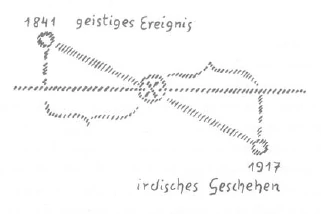
[ 25 ] One might say: The dawn, the very beginning, the first impetus for this battle between Michael and the dragon in the 19th century was 1841. Things then became particularly intense in 1845. There are 34 years from 1845 to 1879; counting 34 years forward from 1879 brings us to the mirror event: the year 1913, which immediately preceded 1914. You see, on the physical plane, the mirror image of the decisive causes of the spiritual struggle is what begins in 1913. And consider the periods from 1841 to 1879 and from 1879 to 1917: The decisive year of the 19th century was 1841; its mirror image is 1917. And no one need be very surprised by many of the things that happen if they bear in mind that those efforts which began in 1841 up in the spiritual world through the Ahrimanic hosts—when the dragon began his battle with Michael—are reflected precisely in 1917. One can truly understand the events on the physical plane only when one knows how they are prepared in the spiritual worlds.
[ 26 ] These things are not meant to alarm people or fill their heads with all sorts of wild ideas; rather, they are meant to be a call to see clearly, to truly look into the spiritual world, and not to sleep through these events. That is why, particularly this year, it has become so necessary in the realm of our anthroposophical development to repeat time and again that vigilance is required—mindfulness of what is happening—and that we must not let events pass us by while we are asleep.
[ 27 ] Sometimes, the things one actually means can only be expressed in relative terms. Yesterday I pointed out the ways in which such events have been interpreted in Eastern Europe. If one here in the West wishes to gain some understanding, based on external observations, of what actually lives in the Eastern European soul, then the best way is to gain insight into the soul of the East through the writings of the philosopher Soloviev; but even this insight will be very limited. True insight can only be gained through the insights that have emerged over the years and decades within our anthroposophical movement in the cycles and lectures on the destiny of the Russian national spirit and on the essence of the Russian national spirit. But if one turns one’s attention to the philosopher Soloviev, then one can express, by way of comparison, what one actually intends to say regarding such matters. As you know, Soloviev died at the turn of the 19th to the 20th century, so he has long since passed away. Westerners have not paid much attention to Soloviev’s philosophy. There was little opportunity to become acquainted with it, and Westerners have not really sought to get to know Soloviev as an interpreter of Eastern Europe. At most, as is well known, a professor once realized a few years ago that it wasn’t good to know absolutely nothing about Soloviev if one is a philosophy professor at a university. So he had a doctoral candidate write a dissertation on the subject, thinking: The doctoral candidate can study Soloviev’s work, and then I’ll read the dissertation!
[ 28 ] But I would like to use the matter at hand merely as a point of comparison; I would like to say: If we hypothetically imagine that Soloviev were still alive today, had witnessed this war, had witnessed the events in Russia—what would he, as a Russian, have done in that situation? Of course, one can only answer such questions hypothetically; but one can safely say that one might believe: As a Russian, Soloviev would probably have somehow done away with all the works he wrote before the war and rewritten everything, because he would have recognized the necessity of revising all of his views. His views were rooted in that era. That is why he would have felt the urge to rewrite all his works. He would simply have drawn a conclusion for himself that the entire Eastern Europe had drawn.
[ 29 ] It seems paradoxical to say something like that. Nevertheless, anyone reading Soloviev today would do best to read him while keeping in mind that Soloviev would now say “yes” with such absolute certainty to very few of the things to which he said “yes” back then. But all of this would be a sign of wakefulness, which could express itself in a fundamental revision of precisely those most weighty ideas that have been shown to be absurd in recent years—ideas that have reduced themselves to absurdity. Certainly, 2 × 2 is 4, and it will indeed remain 2 × 2 equals 4, but other things must be decisively revised. Only when one is aware of the necessity of this revision does one live alertly in the present.
[ 30 ] It was precisely in 1917—thirty-eight years after 1879, since 1879 was thirty-eight years after 1841—that humanity was given an important task. For what is important in current events is not what people did in 1914, but rather that they are finding their way out of it. The problem of how to find one’s way out—that is what truly concerns our time. And if one refuses to recognize that one cannot find one’s way out with old ideas, that one needs new ideas to do so, one will certainly go astray. All those who believe that one can find a way out of these circumstances using old ideas, just as they were before, are on the wrong track. One must be willing to embrace new ideas, which can only be gained through an understanding of the spiritual world.
[ 31 ] Today, I wanted to provide you, so to speak, with some background on much of what I have said over the past few days. You see, if one approaches spiritual life concretely, one cannot make do with the general drivel that pantheism and similar worldviews are so fond of: that there is a spiritual world, that behind everything physical lies the spirit. This general, nebulous talk about the spirit leads nowhere. One must focus on the specific spiritual events and spiritual beings that lie beyond the threshold, for just as events here are not merely general but quite specific, so too are they concrete and specific in the spiritual world. I do not believe that it would simply occur to many people, when they get up in the morning, to say: “I am now stepping out my front door, and there I enter the world”—they will not say that, but rather they will have specific ideas about what they will encounter. Likewise, one can only come to terms with the deeper reasons for the development of humanity and the world if one is also able to imagine the things beyond the threshold in a specific, concrete way—not merely pointing to something generally spiritual—the All, Providence, and the like—but to these specific things.
[ 32 ] We can feel so much when we look at the numbers 1841 and 1917 in the drawing. But such feelings must come alive within us if we are to understand what is actually happening.