

The Spiritual Backgrounds of the Outer World
The Fall of the Spirits of Darkness
GA 177
20 October 1917, Dornach
Translated by Steiner Online Library
Eleventh Lecture
[ 1 ] My dear friends! I am expected to give lectures in Zurich. It is not yet entirely certain, because the venues are currently so exceptionally full and only a few are available, but if the venue can be secured, there will likely be four lectures that will form a series, specifically on October 30 and November 1, and on November 6 and 8. In between, there will always be a branch lecture. So, two sessions over three days in Zurich: on the first and third days, one public lecture each, with a branch lecture in between. The plan is for these public lectures to be structured in such a way that they provide an overview of the relationship between anthroposophy and the various sciences. It remains to be seen whether, particularly in Zurich—a city so central to scientific and cultural endeavors—something can be achieved by holding four such related lectures. As I have just discussed with Professor Gysi, they are to cover the following topics:
1. Anthroposophy and the Science of the Soul. Findings from the Spiritual Sciences on Questions Concerning the Human Soul.
2. Anthroposophy and the Science of History. Findings from the Spiritual Sciences on Humanity and Its Cultural Forms.
3. Anthroposophy and the Natural Sciences. Findings from the Spiritual Sciences on Nature and Human Beings as Natural Beings.
4. Anthroposophy and Social Science. Findings from the spiritual sciences regarding law, morality, and social life forms.
[ 2 ] Now there is a major difficulty, which is that it is very hard to find lodging in Zurich. One has to freeze anyway, of course. But it may be that one cannot even find a place to freeze, since Zurich is extremely overcrowded. Therefore, it will be necessary for those friends coming to Zurich from out of town to make arrangements in good time so that they can find a place to stay there—even if it means freezing. The other issue is that Professor Gysi—or rather, our Zurich friends in general—will be required to secure a venue for the branch lectures if there is a large turnout of visitors from out of town. Those friends who can already say that they will be coming to Zurich when these events take place are asked to raise their hands so that Professor Gysi can assess whether the branch venue currently available is large enough to host the branch lectures or whether it is too small.
[ 3 ] My aim in these reflections has been—and must continue to be—to explain, from a wide variety of perspectives, the extent to which humanity, in the present and in the near future, is entering a cultural epoch that will place special demands on the various aspects of life. I have attempted, drawing on processes that lie in the depths of spiritual life, to make clear what is actually taking place in the supersensible realm—which is no less effective for that, indeed is very effective precisely for our time—and what will increasingly permeate all of life, all forms of culture, and all social interaction among human beings. From these reflections, we have been able to gather that a certain internalization of the nature of the human soul will take place.
[ 8 ] If one asserts that an internalization of the nature of the human soul will take place, one must not overlook the fact that this internalization—conditioned, in a certain sense, by all the circumstances already considered and those yet to be considered—will in many cases proceed in parallel with an externalization in the intellectual realm, in the realm of external science, and so on. We must certainly take into account that, in reality, development never proceeds as uniformly as modern scientific evolutionary theory would like to imagine. Their conception is not incorrect, of course; but conceptions that are correct yet one-sided often cause greater confusion than those that are directly incorrect. This conception simply assumes a linear development from imperfect beings all the way up to human beings. But this is not the case; rather, the development of humanity—and also the development of the non-human world—is such that an external current is always matched by an inner one, so that one can say: If an external current is present for a time, an inner current runs parallel to this external current (see diagram). Externally, this current may be more material or materialistic; internally, it is more spiritual or spiritualistic. Then, in turn, a more spiritualistic current appears on the surface, while the materialistic or material current takes place in the hidden depths of the human being. Then the situation reverses again: the more spiritual direction enters the inner realm, and the material or materialistic one appears on the surface.

[ 4 ] So especially in this time that lies ahead of us, when external life will unfold very much along the red line shown here (see drawing)—in the sense of material events, material sensations, and material perceptions—a spiritualization will take place in the depths of the human soul. And it may well be that people will not want to know anything at all about this spiritualization, but it will take place nonetheless.
[ 5 ] If you truly bring this matter before your soul, you will have the opportunity to properly consider two things that will be of extraordinary importance for the future. Remember that we said yesterday: In the year 1879, Ahrimanic forces of a special kind descended from the spiritual heights into the realm of human development—namely, the development of the human spirit and soul. These forces are here now; they live among us. As we have heard, their primary aim is to take control of our minds—to take control of what we think and what we feel. They are angelic beings, I said, who can no longer find their development in the spiritual world and who wish to use human minds to continue their development in the near future. It will therefore be particularly necessary that this (see diagram, blue line)—this secret, this occult development of the soul, which some people may not even want to consciously consider, preferring instead that it remain hidden and that they need only concern themselves with material things—that this occult development of the soul be taken into account. For if it is not taken into account, then the Ahrimanic forces in question will take hold of precisely this inner life of the human being. That is the one thing that must be taken into account. We must be prepared for the danger in the next phase of cultural development: that it is precisely within what must be our most sacred inner humanity that we must remain vigilant against the influences of Ahrimanic forces.
[ 6 ] In the near future, educational issues will become particularly crucial and significant. In no other stage of human life than that of childhood and adolescence will what is internalized in the human soul become as significant as it may be in the near future. It may be hard to believe today, but the time has long since begun when we can say: Children and young people present themselves to us in such a way that what they show on the outside—what they express outwardly—is not the essential thing. It is the red here (see drawing), but alongside this red runs the blue—a hidden inner life—and this hidden inner life is what we must take very seriously. The educator must not lose sight of this if he does not want to surrender it to the Ahrimanic forces. In many respects, education and instruction will have to become something quite different in the near future than what is imagined today. For what, after all, are the principles of our current educational and instructional systems based on?
[ 7 ] Certain things always lag behind in the order of the world. In the 18th century, what was called the Enlightenment took hold in a particularly significant way. In the 18th century, there was even an attempt to establish a kind of “religion of reason”—a religion based solely on human reasoning, on the “poorest of the sciences,” as I explained in my public lectures in Basel. And the way one seeks to behave toward the growing human being in education and instruction is built entirely upon this current of reason: one must do everything in such a way that the child understands it immediately, so that the child never experiences anything deeper than what it is already capable of understanding.
[ 8 ] One must realize that this is by no means the way to care for a person’s life. In fact, it leads one into a very disastrous extreme of human existence. Just think about it: If one makes such a great effort to expose the child to nothing other than what corresponds to its childlike understanding—what it can grasp—then one is not providing it with sustenance for later life, since later on it is supposed to have a deeper understanding. In a sense, by addressing only the child’s childlike understanding during childhood, one ensures that the child will have nothing but a childlike understanding for the rest of its life. This has already borne fruit, and the results speak for themselves! A large part of our current thinking—among a “cultured” humanity that considers itself so wise and enlightened—is based on the fact that this thinking has remained childish. Of course, in the realm of our newspaper industry, no one will admit that childish thinking prevails there for the most part, but that is indeed the case. And this is essentially connected to the fact that we turn only to the childlike understanding. Then this childlike understanding persists throughout one’s entire life. Something entirely different must take hold: We must fill our souls—especially as educators—with the feeling, with the awareness, that something mysteriously internalized reigns within the child, and that we must bring to the child’s mind much of what is only comprehensible in later life, not yet in childhood—things that one then retrieves from memory in later life and says to oneself: “You heard that there, you took that in there; only now are you wise enough to understand some of it.” Nothing will make people’s lives healthier in the future than their ability to draw upon the messages and revelations of their childhood from memory and only then be able to understand them.
[ 9 ] If people can live with themselves in such a way that they draw from their memories what they could not yet understand at the time, then this will become a source of healthy inner life. That desolation—which so often seizes people’s minds today, emptying them and driving them to sanatoriums so that they might receive something from the outside into souls that have remained empty from within—will stay far away from them, because it is precisely their upbringing that has failed to instill in these souls anything that can be recalled later.
[ 10 ] These reflections must actually be considered in connection with another. Due to all the circumstances I have described recently, our present age has, in fact, completely lost the awareness that there is a connection—an intimate connection—between human beings and the universe. People today believe that they walk across the earth or travel across it by train as nothing more than the piece of flesh that they are. Of course, they will not always admit it, but the real substance of their thoughts is not much different. Yet this is not the case. Human beings are intimately connected with the entire universe. And it is good to make this clear to oneself through a moment of reflection.
[ 11 ] Consider the Earth for a moment. The Moon orbits the Earth; this is the Moon’s orbit (dotted circle). The Earth is truly not this abstract, mineral entity that our modern mineralogy, geology, and physics imagine. It is a very living being, and we could consider many forms of life in relation to the Earth. Let us now simply consider that currents are constantly flowing around the Earth. These currents flow in all possible directions around the Earth. They are of an etheric-spiritual nature, and they contain a real, substantial active factor. There is something constantly present within these currents (dots are drawn into them).
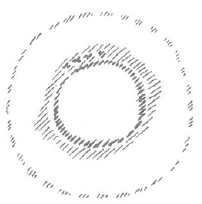
[ 12 ] Now it is good to consider where these currents originate. We will examine these matters in greater detail over time; today I wish only to offer a few preliminary remarks. If you study my Outline of Esoteric Science, you will find there that in very ancient times the Earth and the Sun were a single body. What is now our Earth is, after all, merely a part that has separated from the Sun. These currents are remnants of the Sun’s life; there is still solar life within the Earth. The Earth is thus still permeated by the Sun’s life. But the Moon, too, was once a single body with the Earth. And what today orbits the Earth as the Moon also contains currents within itself. These, in turn, are the currents that have remained from a later period, from the Moon’s development. Thus we have two kinds of currents, which we designate as solar currents and lunar currents. These are two currents that proceed quite differently from one another; they exist as a living reality.
[ 13 ] Imagine a being walking across the Earth, permeated by these entities, by these currents (a drawing is shown). Let us assume that a being who walks across the Earth in a certain way is permeated by such currents of solar life. The currents of solar life that still exist today can easily pass through this being. Let us suppose, however, that another being were constructed differently; it would be constructed in such a way that these solar currents flow through this being from one side, while lunar currents flow through from the other. Since the solar current is not confined to a specific location, it actually flows through everything and can flow through this being in one direction (illustrated). Thus, there may be beings on Earth that are permeated only in one direction—by the solar current—and there may be beings on Earth that are permeated in one direction by the solar current and in the other direction by the lunar current (illustrated).
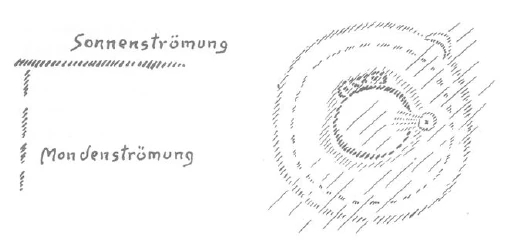
[ 14 ] Beings that can only be permeated by the solar current are animals. Imagine a four-legged animal: it moves across the earth in such a way that its spine is essentially parallel to the earth’s surface. In this way, the solar current—which has now become an earthly current—can flow continuously through this spine. This being is therefore connected to the Earth.
[ 15 ] It is different with human beings. Within their physicality, human beings occupy the same position as animals, but in relation to their head. If you imagine a line running from the back of the head to the forehead, this line runs in the same direction as an animal’s spine; the same solar current flows through the head along this line. In contrast, the human spine is set apart from the currents that run parallel to the Earth—from the Earth-Sun current. Because it is set apart, the human being is placed in a position—which, of course, depends greatly on geographical latitude and so on, but this is also why people differ—where, under certain conditions, the lunar current passes through them, not through their head, but through their spine. This is a tremendous difference between animals and human beings. What passes through the spine from the cosmos in animals passes through the head in humans; what, in animals—as they are today—has no point of entry at all—the ancient lunar current—passes through the spine in humans. That there is a connection between the human spine—even in its structure—and the lunar current should be evident to you from the fact that the human being has approximately—we will return to why this is only approximate at a later time—as many vertebrae as there are days in a month: twenty-eight to thirty-one vertebrae. The entire life of the spinal cord—indeed, the human chest life in general—is intimately connected with the lunar life. And beneath the solar life, which unfolds in sleep and wakefulness on a twenty-four-hour cycle, lies hidden the rhythmic lunar life of the human being.
[ 16 ] This is a fundamental consideration of the connection between human beings and the entire universe. For just as the currents flowing through the human spine are part of the current associated with the life of the Moon, so too are there other currents within the human being that are connected to the other planets of our solar system. All of these are highly real phenomena. But today’s scientific worldview has strayed entirely from these matters and no longer even considers these connections. Consequently, it has no sense of how an essential aspect of the human being consists precisely in the fact that, in addition to the outer, conscious earthly life, there is a subconscious life connected to the life of the breast—a life that rises from the mysterious depths of the soul—but which must be given special consideration in times such as the one now approaching, and which must be given special consideration in education for the very reason that, otherwise, the opposing, Ahrimanic forces will take possession of this life. And it would be very disastrous if human beings did not take care to ensure that a part of their soul life—the part that is precisely becoming internalized, the “blue” life, to use the image (see the “blue” drawing on $. 195), is in danger of falling prey to the Ahrimanic forces if it is not consciously embraced and deepened through such spiritual-scientific insights that have dared to speak even of that which must remain hidden from external science.
[ 17 ] But this must be taken into account in very concrete circumstances. Take external science—which path does it take? It is increasingly moving toward all kinds of abstractions; indeed, it becomes most useful precisely by moving toward all kinds of abstractions. People will need this natural science for their “red,” external life; it must be integrated into human culture. Using it as it now stands—as an external culture of natural science—for educational purposes will be particularly detrimental in the near future. Teaching children what people need to know about natural life, the laws of nature, and the laws of abstract natural science will become an absurdity in the near future. On the other hand, it will become important—and I can only cite examples here and there—to provide a kind of loving contemplation of animal life and the specific living conditions of animals; for example, to describe quite vividly how ants behave within their social context, how these ants live together, and so on. As you know, works such as Brehm’s Animal Life contain the beginnings of such approaches, but they are not fully developed. These symbolic narratives of stories that unfold in the animal world must be developed more and more. Meaningful storytelling of individual, unique stories will have to take center stage, and that is what we will have to teach the children. Instead of that dreadful way in which elementary zoology is crammed into children’s heads, we will have to tell them about the remarkable deeds of the lion, the fox, the ant, the little sun beetle, and so on. Whether these things actually happen or not is, in the details, quite irrelevant; what matters is that they are meaningful. And what is drummed into children today—which is, after all, an extract from the natural sciences—should come only in later years, once the children have been inspired by such stories that deal with the individual aspects of animal life.
[ 18 ] It will be particularly important to view plant life in such a way that one has much to say about the relationship between the rose and the violet, about the relationship between the shrubs and the weeds growing around them, and that one can tell long stories about what is happening in the spirits leaping over the flowers when one walks across a meadow, and the like. This is what must be taught to children as botany. And children must be told how certain green-colored crystals that dwell in the earth relate to colorless crystals, and how a cube-shaped crystal relates to one that crystallizes in octahedrons. Instead of abstract crystallography—as is currently drummed into children at a very early age, to their detriment—we will need a symbolic representation of the life of crystals within the Earth. One will only be able to enrich one’s views on what takes place within the Earth if one enriches them with what you find in our writings—descriptions of the Earth’s interior and so on. Merely listing these things will not suffice; rather, what matters is that they inspire, that they provide such ideas that one is able to tell much about the interplay between diamonds and sapphires and so on. If you think about it, you will understand what I actually mean.
[ 24 ] Similarly, the aim will be not to foist upon children those dreadful abstractions that are taught to them today as “history,” but rather to reintroduce living life into the human historical process, to awaken a sense of what the human soul experiences in the course of human development. We must invent conversations that do not take place at all in the sensory world—conversations, for example, between an ancient Greek and a person from the fifth post-Atlantean epoch. Conjuring up these living figures before the children’s souls in this way will be far more useful than the historical abstractions taught to them today.
[ 19 ] You can see where this is leading. It amounts to truly filling the child’s soul with living content, so that what flows through the child as an occult, mysterious undercurrent can truly be grasped. And you will see how a person’s inner life will become less barren, how they will become less nervous, if they can draw upon such stories—told in accordance with the laws of the worlds—later in life. Then they will also have come to know the laws of nature; then they can create harmony between what was presented to them in living forms and the laws of nature, whereas their spirit only becomes desolate when they are presented with abstract laws of nature. This is what I wish to present as a few thoughts on how the field of education in particular must be enriched.
[ 20 ] Of course, it is more convenient these days to come together in all sorts of associations and repeatedly proclaim: “Education must be individualized”—and all those other abstract slogans. Of course, it is more convenient than if people interested in education were required to familiarize themselves with the spirit of human and natural development and to devise imaginative narratives, so that spiritual life might be grasped in concrete terms precisely in the form it will take in the near future.
[ 21 ] But in all areas, one will need the inspiration of spiritual science for such things. It alone will be able to give birth to something new from the dying forms of present-day spiritual life—something that, in the way I have described, can have a stimulating effect, especially on the child’s mind. Without the inspiration of spiritual science, one will become a dried-up schoolmaster who dries up the children as well. And worst of all, the notion will take hold more and more, especially regarding education for young people, that it is best to forget everything one learns there as quickly as possible. — If, later in life, one does not wish to be without anything—not even the very least—of what one received in childhood, then this is not merely a joy, but a source—a true source—of human life. I ask you to bear this in mind.
[ 22 ] But science itself also needs inspiration. I mentioned yesterday how difficult it is to build a bridge between the humanities in general and specialized activities in scientific life. Yet this, precisely, will be among the very, very most essential things of the future. It must be clear to you from various observations that have also been made here that the impoverishment of concepts—and especially the impoverishment of terminology—has brought about the circumstances that have just arisen today.
[ 23 ] I said this in a public lecture in Basel, and I have repeated it many times: when this war began, people who considered themselves experts believed it could not last longer than four months. These people believed they had studied the social and economic structures; based on that, they formed this idea. Such notions were not grounded in reality, for reality has refuted them. It is very strange how little people are actually inclined to learn from events. If someone believed such a thing based on their own scientific assumptions, they would surely have to say to themselves now: From what inadequate premises did I draw my conclusions! — So they really ought to be inclined to learn something. But they remain asleep, drawing different conclusions from the very same premises—conclusions that merely correspond a little more closely to the necessary experience—because they refuse to engage with the inner connections. Admittedly, if one delves into the inner connections of life, one must overcome that discomfort which is most difficult to surmount today precisely for those who deal with scientific questions. After all, these people mainly do not want to be disturbed in the small field they are cultivating; they do not want to trace the connections to related areas.
[ 24 ] This trend toward specialization was quite beneficial for a while. If it continues to take root, and if, in particular, our university students continue to be corrupted by these one-sided views that arise from this specialization, then the calamities resulting from people holding concepts that are divorced from reality will grow ever greater. We will have people sitting in city, county, and state representative bodies who do not at all grasp the very things they intend to govern or administer through laws, because these concepts are too limited to encompass reality. People have absolutely no idea that these concepts are too limited. Reality is simply much richer than these concepts.
[ 31 ] Above all, the task will be to ensure that we do not develop a tendency to leave specialized knowledge as much as possible to so-called experts, while at the same time satisfying subjective, egoistic needs within anthroposophy; rather, the task will be to know how to properly connect these two poles, so that we truly understand how to enrich one through the other.
[ 25 ] We keep having this experience—and you could have it too if you really took a good, hard look at things—that when we talk about purely specialized topics with those who sincerely profess their belief in anthroposophy, they actually find the whole thing quite boring! One should always speak only of the central questions: the soul, immortality, God, and so on. This may, however, initially satisfy selfish religious needs, but it does not enable us to give souls what they so desperately need for the time ahead: that they position themselves realistically within this real life. That is why we must be so attentive whenever an attempt is made to establish a genuine connection between the impulses for reflection arising from spiritual science and the specialized fields.
[ 26 ] I have previously mentioned here the very important work of our friend Dr. Boos on the collective bargaining agreement. Now that the book is widely available, I would like to draw attention to it once again, because this book is exemplary, particularly in bridging the gap between the general insights of anthroposophy and a specific field—the field of law: The Collective Bargaining Agreement under Swiss Law, by Dr. Roman Boos. — But it is particularly important to bear in mind that our friends should not regard such specialized studies as lying outside their field, but rather that they should engage with them, because life itself must be placed in the service of anthroposophical reflection in the time to come. If you read this book carefully and work through it, you will find that it captures aspects of everyday life in a vivid way, yet in such a way that one sees how, first of all, the most comprehensive impulses of contemplation—which correspond to the laws of the universe—and, secondly, broad historical perspectives come into play in this everyday life. And you will find it infinitely fruitful to understand the difference between the Romanic concept of contract and the Germanic concept of cohesion and social being. The relationship between the Romanic and Germanic conceptions of humanity is presented in a profound manner within a specialized field. It is precisely in this book by Dr. Roman Boos—precisely in such a specialized work—that it is important to rise to an understanding of what, from this perspective, is spiritually significant for the near future: to build a bridge between the life that unfolds before our senses—and upon which we base our social relationships—and the life that flows in from the spiritual world, spiritualizing our forms of life and pulsing through them.
[ 27 ] I also recommend that you not miss the latest issue of Wissen und Leben, in which Dr. Boos has written about “The Core Issues of Swiss Politics.” There you will see that the issues of contemporary politics can be viewed from a different perspective than they are by—with all due respect—run-of-the-mill journalism. This essay beautifully highlights the connection between various forms of culture—art, for example—and political forms: “The Core Issues of Swiss Politics” by Roman Boos, in the October 15, 1917, issue of Wissen und Leben.
[ 28 ] If you have set your sights on a serious examination of these “core issues of Swiss politics”—one conducted in the true spirit of the humanities—then you might also take a look at the first essay in this issue, “The Meaning of the Reformation” by Adolf Keller. Yes, this is, once again, one of those old-style essays that, of course, believes itself to be written in a very new style. So in this issue, you can truly find the most legitimate modern ideas and the most old-fashioned, traditional ones side by side. Naturally, this old-fashioned approach believes that it is quite clever—indeed, exceptionally clever—and that it has developed a particularly clever logic and penetrating thinking. From various perspectives, the meaning of the Reformation is described there in high-flown words, which are, however, nothing more than trite, empty abstractions.
[ 29 ] Once you have read through Adolf Keller’s essay “The Meaning of the Reformation”—which is well-intentioned and sincere and ranks among the best contemporary works in this field—you grow weary of being tossed and tumbled about in the same abstractions over and over again: The Reformation fosters freedom of initiative in the mind; freedom of initiative stems from the Reformation; once the Reformation had taken effect, freedom of initiative was revitalized—and so one is tossed and tumbled about in the manner of all abstract thinkers who accomplish nothing more than revelling in a few meager, pitiful concepts that have nothing to do with the real world. That is, after all, the defining characteristic of what must be overcome: this abstract fussing, this life spent in ideas devoid of thought, in which one particularly relishes the sense of satisfaction because one believes one is saying something particularly lofty when one says something particularly abstract.
[ 30 ] In the last few days, I received a treatise that dealt with profound theosophical matters, but in reality it was just a treatise on the “Something,” and it spoke only of the “Something” within it—of the “unimproved Something” and the “improved Something”—and how the improved Something seizes the unimproved Something, and how the improved Something places itself above the unimproved Something. And so: the conscious and unconscious “Something,” the improved and unimproved “Something”—it rolls on and on and on and on—is ultimately, when transferred to the spiritual realm, nothing other than this peculiar kind of abstract thinking in the present, which takes particular delight in this abstract realm and is, in fact, a flight from reality, having nothing whatsoever to do with any reality at all. This, of course, leads to very specific consequences. Because people are impoverished in their concepts, they cannot use their concepts to navigate their way through the stream of existence. Their concepts are insufficient to grasp life. And so it happens that one reads things such as, for example, in Adolf Keller’s essay on page 51: “But although the deepest springs of the soul come to flow in this experience, it is not merely a surge of emotion within us. Nothing divine and nothing human is mixed together in the process. Conscience ensures this. It maintains the distance and the reverence. Man remains man, and God remains God. While the Reformation shares with mysticism the idea that the relationship with God is established through a personal experience, what distinguishes them is that the Reformation experience does not take place, as in mysticism, in the emotional surging and seething of the depths of the soul, but rather in the distress and moral elevation of the conscience. The strongest power of inwardness is an obligation, an absolute demand. Human beings can only resist it through divine help experienced inwardly.” Nothing but abstractions; one tumbles from one to the next. Then comes: “This is the Gospel, Jesus Christ.”
[ 31 ] So this gentleman has taken things to such an extreme level of abstraction that he identifies the message of Jesus Christ with Jesus Christ himself. That is precisely what one arrives at through extreme abstractions. But then it is very strange: he has rejected mysticism. With his meager concepts, he says: The Reformation has nothing to do with mysticism; rather, the Reformation brings about a healthy life. — As if mysticism were not precisely the experience itself. Isn’t that so? But because the concepts are so limited, they cannot encompass reality, cannot take it in. That is why they always say the same thing about the most opposite things. So consider this: He rejected the “surging and boiling”; a true follower of the Reformation must not have that, for otherwise he would be a mystic if he were to experience such surging and boiling.
[ 32 ] Adolf Keller continues: “This help, however, is not merely presented to people in an external, historical, or sacramental way. It, too, can only become powerful through inner, personal assimilation. It does not act from the outside, magically, but only to the extent that it can be internalized within us through our emotions and will and can set the soul ablaze.”
[ 33 ] So the Reformation must not, at its core, be merely a “simmering and bubbling,” but this Reformation, in turn, has an effect on the soul only if it can set the soul ablaze—that is, if it can make the soul simmer and bubble. One could go through the entire essay and point out its meager intellectual depth, which is nowhere near capable of delving into reality. But such things are read today with particular passion. People find it very witty. People don’t realize that, if they read just two or three lines further, they immediately stumble over the terms, because they naturally have to apply the same terms to the most diverse things—since they are poor in terms.
[ 34 ] So, for example, if you read the wonderful essay “The Core Issues of Swiss Politics” by Roman Boos—which I highly recommend to you, because it will show you how to draw connections between political life and other forms of cultural life, and how to truly set concepts in motion by enriching your conceptual framework, as well as how to find a model for Swiss politics in terms of a vision for the future— you can compare it with the tedious rambling of the first essay in this issue of Wissen und Leben from October 15, 1917, “The Meaning of the Reformation” by Adolf Keller, and thus, by spending a small amount of money just once, you have the opportunity to find the old and the new side by side here and to educate yourself quite well on this subject.
[ 35 ] Sometimes I have to take into account the very opposite of current events, for anthroposophy is not meant to revel in the highest realms, but rather to engage in precisely those reflections that truly lead into the present, into the intentions of the present.