

The Spiritual Backgrounds of the Outer World
The Fall of the Spirits of Darkness
GA 177
21 October 1917, Dornach
Translate the original German text into any language:
Versions Available:
The Spiritual Backgrounds of the Outer World, tr. SOL
Elfter Vortrag
Eleventh Lecture
[ 1 ] Meine lieben Freunde! Es werden voraussichtlich in Zürich von mir Vorträge gehalten werden. Es steht noch nicht ganz fest, weil jetzt die Säle so außerordentlich besetzt sind und nur wenige Säle zur Verfügung stehen, aber wenn der Saal zu haben ist, werden wahr scheinlich vier Vorträge stattfinden, die zusammenhängend sein werden, und zwar am 30. Oktober und 1. November und am 6. und 8. November. Dazwischen wird dann immer ein Zweigvortrag sein. Also zweimal an drei Tagen in Zürich: am ersten und dritten Tag jeweils ein öffentlicher Vortrag und dazwischen ein Zweigvortrag. Es ist in Aussicht genommen, daß diese öffentlichen Vorträge so eingerichtet werden, daß sie ein Bild geben des Verhältnisses von Anthroposophie zu den verschiedenen Wissenschaften. Es wird sich zeigen, ob gerade in dieser für wissenschaftliche und Kulturbestrebungen so vielfach zentral gelegenen Stadt Zürich dadurch etwas zu erreichen ist, daß man vier solche zusammengehörige Vorträge hält. Sie sollen, wie ich eben mit Herrn Professor Gysi besprochen habe, folgende Themen haben:
[ 1 ] My dear friends! I am expected to give lectures in Zurich. It is not yet entirely certain, because the venues are currently so exceptionally full and only a few are available, but if the venue can be secured, there will likely be four lectures that will form a series, specifically on October 30 and November 1, and on November 6 and 8. In between, there will always be a branch lecture. So, two sessions over three days in Zurich: on the first and third days, one public lecture each, with a branch lecture in between. The plan is for these public lectures to be structured in such a way that they provide an overview of the relationship between anthroposophy and the various sciences. It remains to be seen whether, particularly in Zurich—a city so central to scientific and cultural endeavors—something can be achieved by holding four such related lectures. As I have just discussed with Professor Gysi, they are to cover the following topics:
1. Anthroposophie und Seelenwissenschaft. Geisteswissenschaftliche Ergebnisse über die menschlichen Seelenfragen.
2. Anthroposophie und Geschichtswissenschaft. Geisteswissenschaftliche Ergebnisse über die Menschheit und ihre Kulturformen.
3. Anthroposophie und Naturwissenschaft. Geisteswissenschaftliche Ergebnisse über die Natur und den Menschen als Naturwesen.
4. Anthroposophie und Sozialwissenschaft. Geisteswissenschaftliche Ergebnisse über Recht, Moral und soziale Lebensform.
1. Anthroposophy and the Science of the Soul. Findings from the Spiritual Sciences on Questions Concerning the Human Soul.
2. Anthroposophy and the Science of History. Findings from the Spiritual Sciences on Humanity and Its Cultural Forms.
3. Anthroposophy and the Natural Sciences. Findings from the Spiritual Sciences on Nature and Human Beings as Natural Beings.
4. Anthroposophy and Social Science. Findings from the spiritual sciences regarding law, morality, and social life forms.
[ 2 ] Nun ist Jetzt eine große Schwierigkeit vorhanden, die darin besteht, daß man in Zürich sehr schwer unterkommt. Frieren muß man ja doch jedenfalls. Aber es kann sein, daß man nicht einmal eine Stätte für das Frieren bekommt, da Zürich außerordentlich übervölkert ist. Daher wird es notwendig sein, daß diejenigen Freunde, die von auswärts nach Zürich kommen, sich beizeiten darum kümmern, daß sie dort, wenn auch frierend, unterkommen können. Das andere ist, daß Herr Professor Gysi genötigt ist — oder überhaupt unsere Zürcher Freunde —, für die Zweigvorträge für ein Lokal zu sorgen, wenn der Besuch von auswärts ein reger ist. Diejenigen Freunde, die jetzt schon sagen können, daß sie mitkommen nach Zürich, wenn diese Veranstaltungen sein werden, die werden gebeten, die Hand zu erheben, damit Herr Professor Gysi sich ein Bild machen kann, ob in dem jetzt zur Verfügung stehenden Zweiglokal die Zweigvorträge stattfinden können oder ob es zu klein ist.
[ 2 ] Now there is a major difficulty, which is that it is very hard to find lodging in Zurich. One has to freeze anyway, of course. But it may be that one cannot even find a place to freeze, since Zurich is extremely overcrowded. Therefore, it will be necessary for those friends coming to Zurich from out of town to make arrangements in good time so that they can find a place to stay there—even if it means freezing. The other issue is that Professor Gysi—or rather, our Zurich friends in general—will be required to secure a venue for the branch lectures if there is a large turnout of visitors from out of town. Those friends who can already say that they will be coming to Zurich when these events take place are asked to raise their hands so that Professor Gysi can assess whether the branch venue currently available is large enough to host the branch lectures or whether it is too small.
[ 3 ] Mein Bestreben war in diesen Betrachtungen und muß es auch weiterhin sein, nach den verschiedensten Seiten verständlich zu machen, inwiefern der Mensch in der Gegenwart und in der nächsten Zukunft sich in eine Kulturepoche hineinlebt, die besondere Anforderungen an die verschiedenen Zweige des Lebens stellen wird. Ich habe versucht, aus Vorgängen, die in den Tiefen des geistigen Lebens liegen, verständlich zu machen, was eigentlich übersinnlich, aber deshalb nicht minder wirksam — ja gerade für unsere Zeit sehr wirksam — sich vollzieht und was immer deutlicher eingreifen wird in alles Leben, in alle Kulturformen, in alles soziale Zusammensein der Menschen. Wir haben entgegennehmen können aus diesen Betrachtungen, daß eine gewisse Verinnerlichung der menschlichen Seelennatur stattfinden wird.
[ 3 ] My aim in these reflections has been—and must continue to be—to explain, from a wide variety of perspectives, the extent to which humanity, in the present and in the near future, is entering a cultural epoch that will place special demands on the various aspects of life. I have attempted, drawing on processes that lie in the depths of spiritual life, to make clear what is actually taking place in the supersensible realm—which is no less effective for that, indeed is very effective precisely for our time—and what will increasingly permeate all of life, all forms of culture, and all social interaction among human beings. From these reflections, we have been able to gather that a certain internalization of the nature of the human soul will take place.
[ 4 ] Wenn man dieses ausspricht, eine Verinnerlichung der menschlichen Seelennatur werde Platz greifen, so darf nicht verkannt werden, daß diese Verinnerlichung, in gewissem Sinne durch all die schon betrachteten und noch zu betrachtenden Verhältnisse bedingt, vielfach parallelgehen wird mit einer Veräußerlichung auf intellektuellem Gebiete, auf dem Gebiet äußerer Wissenschaft und so weiter. Wir müssen eben durchaus in Betracht ziehen, daß in der Wirklichkeit niemals die Entwickelung so einförmig geschieht, wie es sich die moderne naturwissenschaftliche Evolutionslehre gern vorstellen möchte. Ihre Vorstellung ist ja nicht unrichtig; aber Vorstellungen, die richtig, aber einseitig sind, rufen oftmals größere Verwirrung hervor als direkt unrichtige Vorstellungen. Diese Vorstellung geht dahin, einfach eine gradlinige Entwickelung vom unvollkommenen Wesen bis herauf zum Menschen anzunehmen. So ist es aber nicht, sondern die Entwickelung der Menschheit und auch die Entwickelung der außermenschlichen Welt, sie sind so, daß immer einer mehr äußerlichen Strömung eine innerliche entspricht, so daß man sagen kann: Wenn eine Zeitlang äußerlich vielleicht eine Strömung vorhanden ist, so geht parallel dieser äußerlichen Strömung eine innerliche Strömung (siehe Zeichnung). Äußerlich ist vielleicht diese Strömung mehr materiell oder materialistisch, innerlich ist sie mehr spirituell oder spiritualistisch. Dann wiederum tritt mehr eine spiritualistische an der Oberfläche auf, und die materialistische oder materielle geht in den verborgenen Tiefen des Menschenwesens vor sich. Dann wiederum kehrt sich die Sache um: Es tritt dann in das Innere die spirituellere Richtung und an die Oberfläche die materielle oder materialistische.
[ 8 ] If one asserts that an internalization of the nature of the human soul will take place, one must not overlook the fact that this internalization—conditioned, in a certain sense, by all the circumstances already considered and those yet to be considered—will in many cases proceed in parallel with an externalization in the intellectual realm, in the realm of external science, and so on. We must certainly take into account that, in reality, development never proceeds as uniformly as modern scientific evolutionary theory would like to imagine. Their conception is not incorrect, of course; but conceptions that are correct yet one-sided often cause greater confusion than those that are directly incorrect. This conception simply assumes a linear development from imperfect beings all the way up to human beings. But this is not the case; rather, the development of humanity—and also the development of the non-human world—is such that an external current is always matched by an inner one, so that one can say: If an external current is present for a time, an inner current runs parallel to this external current (see diagram). Externally, this current may be more material or materialistic; internally, it is more spiritual or spiritualistic. Then, in turn, a more spiritualistic current appears on the surface, while the materialistic or material current takes place in the hidden depths of the human being. Then the situation reverses again: the more spiritual direction enters the inner realm, and the material or materialistic one appears on the surface.
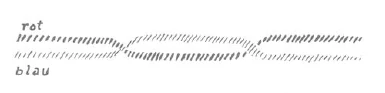
[ 5 ] Also gerade in dieser Zeit, die uns bevorsteht, wo das äußere Leben recht sehr verlaufen wird im Sinne der roten Linie hier (siehe Zeichnung), im Sinne materiellen Geschehens und materieller Empfindungen und Auffassungen, wird in den Tiefen der Menschenseele eine Vergeistigung stattfinden. Und das kann so sein, daß die Menschen vielleicht gar nichts wissen wollen von dieser Vergeistigung, aber stattfinden wird sie doch.
[ 4 ] So especially in this time that lies ahead of us, when external life will unfold very much along the red line shown here (see drawing)—in the sense of material events, material sensations, and material perceptions—a spiritualization will take place in the depths of the human soul. And it may well be that people will not want to know anything at all about this spiritualization, but it will take place nonetheless.
[ 6 ] Wenn Sie so recht diese Sache vor Ihre Seele stellen, dann bekommen Sie die Möglichkeit, zwei Dinge gehörig zu betrachten, die außerordentlich wichtig für die Zukunft sein werden. Bedenken Sie, daß wir gestern gesagt haben: Mit dem Jahre 1879 sind ahrimanische Mächte besonderer Art aus den geistigen Höhen in das Reich der menschlichen Entwickelung hinuntergestiegen, namentlich der menschlichen Geistes- und Seelenentwickelung. Diese Mächte sind einmal da, die leben zwischen uns. Sie haben vorzugsweise, wie wir gehört haben, das Bestreben, sich unserer Köpfe zu bemächtigen, sich desjenigen zu bemächtigen, was wir denken, was wir empfinden. Es sind engelartige Wesen, sagte ich, die ihre Entwickelung nicht mehr in der geistigen Welt finden können und die die Menschenköpfe benützen wollen, um ihre Entwickelung in der nächsten Zeit fortzusetzen. Da wird es ganz besonders notwendig sein, daß diese (siehe Zeichnung, blaue Linie) geheime, diese okkulte Seelenentwickelung, die vielleicht manche Menschen gar nicht bewußt ins Auge fassen wollen, bei der es ihnen am liebsten wäre, wenn sie unten bliebe und sie sich nur mit materiellen Dingen zu beschäftigen brauchten, daß diese okkulte Seelenentwickelung ja ins Auge gefaßt werde. Denn wird sie nicht ins Auge gefaßt, dann bemächtigen sich gerade dieser Verinnerlichung des Menschen die ahrimanischen Mächte, um die es sich handelt. Das ist das eine, was berücksichtigt werden muß. Wir müssen gefaßt sein auf die Gefahr der nächsten Kulturentwickelung, daß gerade in dem, was unser heiligstes inneres Menschliches sein muß, Wache gehalten werden muß gegenüber den Einflüssen ahrimanischer Mächte.
[ 5 ] If you truly bring this matter before your soul, you will have the opportunity to properly consider two things that will be of extraordinary importance for the future. Remember that we said yesterday: In the year 1879, Ahrimanic forces of a special kind descended from the spiritual heights into the realm of human development—namely, the development of the human spirit and soul. These forces are here now; they live among us. As we have heard, their primary aim is to take control of our minds—to take control of what we think and what we feel. They are angelic beings, I said, who can no longer find their development in the spiritual world and who wish to use human minds to continue their development in the near future. It will therefore be particularly necessary that this (see diagram, blue line)—this secret, this occult development of the soul, which some people may not even want to consciously consider, preferring instead that it remain hidden and that they need only concern themselves with material things—that this occult development of the soul be taken into account. For if it is not taken into account, then the Ahrimanic forces in question will take hold of precisely this inner life of the human being. That is the one thing that must be taken into account. We must be prepared for the danger in the next phase of cultural development: that it is precisely within what must be our most sacred inner humanity that we must remain vigilant against the influences of Ahrimanic forces.
[ 7 ] In der nächsten Zeit werden die Erziehungsfragen ganz besonders wesentlich und bedeutungsvoll werden. In keinem andern Menschenalter als in dem der Kindheit und Jugend wird das Verinnerlichte der menschlichen Seele so bedeutungsvoll werden, wie das in der nächsten Zeit eben sein kann. Man kann es vielleicht heute gar noch nicht glauben, aber es hat schon längst die Zeit begonnen, von der man sagen kann: Kinder und jugendliche Menschen stehen uns so gegenüber, daß dasjenige, was sie äußerlich zeigen, was sie darleben, nicht das Wesentliche ist. Es ist das Rote hier (siehe Zeichnung), aber neben diesem Roten verläuft das Blaue, verläuft ein verborgenes Inneres, und dieses verborgene Innere, das müssen wir gar sehr ins Auge fassen. Das darf der Erzieher nicht aus dem Auge lassen, wenn er es nicht an die ahrimanischen Mächte abgeben will. In vieler Beziehung wird Erziehung und Unterricht in der nächsten Zeit etwas ganz anderes werden müssen, als man es sich heute vorstellt. Denn woraus sind denn eigentlich die Grundsätze unseres gegenwärtigen Erziehungs- und Unterrichtswesens geflossen?
[ 6 ] In the near future, educational issues will become particularly crucial and significant. In no other stage of human life than that of childhood and adolescence will what is internalized in the human soul become as significant as it may be in the near future. It may be hard to believe today, but the time has long since begun when we can say: Children and young people present themselves to us in such a way that what they show on the outside—what they express outwardly—is not the essential thing. It is the red here (see drawing), but alongside this red runs the blue—a hidden inner life—and this hidden inner life is what we must take very seriously. The educator must not lose sight of this if he does not want to surrender it to the Ahrimanic forces. In many respects, education and instruction will have to become something quite different in the near future than what is imagined today. For what, after all, are the principles of our current educational and instructional systems based on?
[ 8 ] Gewisse Dinge hinken immer nach in der Weltenordnung. Im 18. Jahrhundert griff ganz besonders Platz, was man die Aufklärung nannte. Man wollte im 18. Jahrhundert sogar eine Art Vernunftreligion begründen, eine Religion, die bloß auf das menschliche Nachdenken, auf den «Hungerleider» unter den Wissenschaften sich stützt, darauf Rücksicht nimmt, wie ich es in den öffentlichen Vorträgen in Basel ausgeführt habe. Und die Art, wie man sich dem heranwachsenden Menschen gegenüber in Erziehung und Unterricht benehmen will, ist ganz aus dieser Vernunftströmung heraus aufgebaut: nur ja alles so machen, daß das Kind es gleich versteht, daß das Kind nirgends etwas Tieferes in dem erlebt, als es schon verstehen kann.
[ 7 ] Certain things always lag behind in the order of the world. In the 18th century, what was called the Enlightenment took hold in a particularly significant way. In the 18th century, there was even an attempt to establish a kind of “religion of reason”—a religion based solely on human reasoning, on the “poorest of the sciences,” as I explained in my public lectures in Basel. And the way one seeks to behave toward the growing human being in education and instruction is built entirely upon this current of reason: one must do everything in such a way that the child understands it immediately, so that the child never experiences anything deeper than what it is already capable of understanding.
[ 9 ] Man wird einsehen müssen, daß man damit am allerwenigsten für das Leben eines Menschen sorgt. Dadurch kommt man nämlich in ein sehr verhängnisvolles Extrem des menschlichen Lebens hinein. Denken Sie doch nur einmal: Wenn man sich nun so recht bemüht, an das Kind nichts anderes heranzubringen, als was seinem kindlichen Verständnis entspricht, was es fassen kann, dann gibt man ihm keine Wegzehrung für das spätere Leben mit, denn später soll es ja ein tieferes Verständnis haben. Man sorgt gewissermaßen dafür, daß es sein ganzes Leben nichts anderes hat als ein kindliches Verständnis, wenn man sich nur an das kindliche Verständnis im Kindheitsalter wendet. Es hat das auch schon seine Früchte getragen, und sie sind auch danach! Ein großer Teil unseres heutigen Denkens der sich so sehr weise und aufgeklärt dünkenden Kulturmenschheit beruht darauf, daß dieses Denken kindsköpfig geblieben ist. Man wird selbstverständlich auf dem Gebiete unseres Zeitungswesens nicht zugeben, daß da zum größten Teil kindsköpfisches Denken waltet, aber es ist doch so. Und das hängt im wesentlichen damit zusammen, daß man sich nur an das kindliche Verständnis wendet. Dann bleibt dieses kindliche Verständnis das ganze Leben hindurch. Ein ganz anderes muß Platz greifen: Erfüllen müssen wir unsere Seelen, namentlich als Erzieher, mit der Empfindung, mit dem Bewußtsein, daß in dem Kinde ein geheimnisvoll Verinnerlichtes waltet und daß man heranbringen muß an das kindliche Gemüt vieles von dem, was erst im späteren Leben, nicht schon im kindlichen Alter, verständlich ist, was man dann im späteren Leben herausholt aus der Erinnerung und sich sagt: Das hast du dort gehört, das hast du da aufgenommen; jetzt bist du erst so gescheit, manches zu verstehen. Durch nichts wird in der Zukunft das Leben der Menschen gesünder werden als dadurch, daß sie viel aus den Mitteilungen, aus den Offenbarungen des Kindheitslebens herausholen können in der Erinnerung und es dann erst verstehen können.
[ 8 ] One must realize that this is by no means the way to care for a person’s life. In fact, it leads one into a very disastrous extreme of human existence. Just think about it: If one makes such a great effort to expose the child to nothing other than what corresponds to its childlike understanding—what it can grasp—then one is not providing it with sustenance for later life, since later on it is supposed to have a deeper understanding. In a sense, by addressing only the child’s childlike understanding during childhood, one ensures that the child will have nothing but a childlike understanding for the rest of its life. This has already borne fruit, and the results speak for themselves! A large part of our current thinking—among a “cultured” humanity that considers itself so wise and enlightened—is based on the fact that this thinking has remained childish. Of course, in the realm of our newspaper industry, no one will admit that childish thinking prevails there for the most part, but that is indeed the case. And this is essentially connected to the fact that we turn only to the childlike understanding. Then this childlike understanding persists throughout one’s entire life. Something entirely different must take hold: We must fill our souls—especially as educators—with the feeling, with the awareness, that something mysteriously internalized reigns within the child, and that we must bring to the child’s mind much of what is only comprehensible in later life, not yet in childhood—things that one then retrieves from memory in later life and says to oneself: “You heard that there, you took that in there; only now are you wise enough to understand some of it.” Nothing will make people’s lives healthier in the future than their ability to draw upon the messages and revelations of their childhood from memory and only then be able to understand them.
[ 10 ] Wenn sie so mit sich leben können, die Menschen, daß sie heraufholen aus der Erinnerung, was sie damals noch nicht verstehen konnten, dann wird das eine Quelle gesunden inneren Lebens werden. Jene Verödung wird von den Menschen fern bleiben, die heute so vielfach die Gemüter ergreift und sie leer macht und in die Sanatorien leitet, damit sie dort von außen irgend etwas in die Seelen hineinbekommen, die von innen leer geblieben sind, weil gerade die Erziehung es daran hat fehlen lassen, irgend etwas in diese Seelen hineinzubringen, an das später erinnert werden kann.
[ 9 ] If people can live with themselves in such a way that they draw from their memories what they could not yet understand at the time, then this will become a source of healthy inner life. That desolation—which so often seizes people’s minds today, emptying them and driving them to sanatoriums so that they might receive something from the outside into souls that have remained empty from within—will stay far away from them, because it is precisely their upbringing that has failed to instill in these souls anything that can be recalled later.
[ 11 ] Diese Betrachtungen muß man eigentlich im Zusammenhang mit einer andern ins Auge fassen. Unsere Gegenwart hat durch all diese Umstände, die ich dargelegt habe in der letzten Zeit, eigentlich ganz das Bewußtsein davon verloren, daß zwischen den Menschen und dem Weltenall ein Zusammenhang, ein inniger Zusammenhang ist. Der Mensch glaubt heute, daß er über die Erde hingeht oder im Eisenbahnzug über die Erde hinfährt als dieses Stück Fleisch, das er einmal ist. Gewiß, er wird es nicht immer zugeben, aber der reale Inhalt seiner Gedanken ist nicht viel anders. Das ist aber nicht so. Der Mensch steht mit dem ganzen Weltenall in inniger Verbindung. Und es ist gut, sich das einmal durch eine Erwägung klarzumachen.
[ 10 ] These reflections must actually be considered in connection with another. Due to all the circumstances I have described recently, our present age has, in fact, completely lost the awareness that there is a connection—an intimate connection—between human beings and the universe. People today believe that they walk across the earth or travel across it by train as nothing more than the piece of flesh that they are. Of course, they will not always admit it, but the real substance of their thoughts is not much different. Yet this is not the case. Human beings are intimately connected with the entire universe. And it is good to make this clear to oneself through a moment of reflection.
[ 12 ] Betrachten Sie einmal die Erde. Um die Erde herum bewegt sich der Mond; das sei die Mondbahn (punktierter Kreis). Die Erde ist wahrhaftig nicht dieses abstrakte mineralische Wesen, von dem unsere heutige Mineralogie, Geologie, Physik träumt. Sie ist ein sehr lebendiges Wesen, und wir könnten viele Lebensformen mit Bezug auf die Erde betrachten. Wir wollen jetzt nur ins Auge fassen, daß um die Erde herum fortwährend Strömungen gehen. Diese Strömungen gehen nach allen möglichen Richtungen um die Erde herum. Sie sind ätherisch-geistiger Art, und sie haben einen realen, substantiellen Wirkensfaktor in sich. Da ist etwas in diesen Strömungen fortwährend darinnen (es werden Punkte hineingezeichnet).
[ 11 ] Consider the Earth for a moment. The Moon orbits the Earth; this is the Moon’s orbit (dotted circle). The Earth is truly not this abstract, mineral entity that our modern mineralogy, geology, and physics imagine. It is a very living being, and we could consider many forms of life in relation to the Earth. Let us now simply consider that currents are constantly flowing around the Earth. These currents flow in all possible directions around the Earth. They are of an etheric-spiritual nature, and they contain a real, substantial active factor. There is something constantly present within these currents (dots are drawn into them).
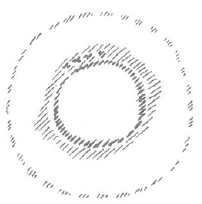
[ 13 ] Nun ist es gut, ins Auge zu fassen, woher diese Strömungen rühren. Wir werden diese Dinge im Laufe der Zeit noch näher betrachten; ich will heute nur einiges präliminarisch angeben. Wenn Sie meine «Geheimwissenschaft im Umriß» studieren, so werden Sie dort finden, daß in sehr alten Zeiten die Erde mit der Sonne ein Körper war. Das, was heute unsere Erde ist, ist ja nur herausgeschieden aus der Sonne. Diese Strömungen sind aus dem Sonnenleben zurückgeblieben; das ist noch Sonnenleben in der Erde. Die Erde wird also noch durchströmt vom Sonnenleben. Aber auch der Mond war mit der Erde ein Körper. Und was heute als Mond die Erde umkreist, das hat auch Strömungen in sich. Das sind wiederum diejenigen Strömungen, die aus einer späteren Zeit, aus der Mondenentwickelung, geblieben sind. Da haben wir zweierlei Strömungen, die wir bezeichnen als Sonnenströmungen und als Mondenströmungen. Dies sind zwei ganz verschieden voneinander verlaufende Strömungen; sie sind da als lebendige Wirklichkeit.
[ 12 ] Now it is good to consider where these currents originate. We will examine these matters in greater detail over time; today I wish only to offer a few preliminary remarks. If you study my Outline of Esoteric Science, you will find there that in very ancient times the Earth and the Sun were a single body. What is now our Earth is, after all, merely a part that has separated from the Sun. These currents are remnants of the Sun’s life; there is still solar life within the Earth. The Earth is thus still permeated by the Sun’s life. But the Moon, too, was once a single body with the Earth. And what today orbits the Earth as the Moon also contains currents within itself. These, in turn, are the currents that have remained from a later period, from the Moon’s development. Thus we have two kinds of currents, which we designate as solar currents and lunar currents. These are two currents that proceed quite differently from one another; they exist as a living reality.
[ 14 ] Denken Sie sich einmal ein Wesen, das auf der Erde herumwandelt, das durchströmt ist von diesen Wesenheiten, von diesen Strömungen (es wird gezeichnet). Nehmen wir an, ein Wesen, das in einer bestimmten Weise über die Erde wandelt, sei durchströmt von solchen Strömungen des Sonnenlebens. Die Strömungen des Sonnenlebens, die heute noch da sind, können leicht durch dieses Wesen hindurch. Nehmen wir an, ein anderes Wesen wäre aber anders konstruiert; es wäre so konstruiert, daß diese Sonnenströmungen von der einen Seite her durch dieses Wesen gehen, von der andern Seite her aber die Mondenströmungen. Die Sonnenströmung geht eigentlich, weil sie nicht an den Ort beschränkt ist, durch alles hindurch und kann dieses Wesen nach der einen Richtung durchströmen (es wird gezeichnet). Es kann also Wesen auf der Erde geben, die nur nach der einen Richtung, von der Sonnenströmung, durchströmt sind, und es kann Wesen auf der Erde geben, die nach der einen Richtung von der Sonnenströmung, nach der andern Richtung von der Mondenströmung durchströmt sind (es wird gezeichnet).
[ 13 ] Imagine a being walking across the Earth, permeated by these entities, by these currents (a drawing is shown). Let us assume that a being who walks across the Earth in a certain way is permeated by such currents of solar life. The currents of solar life that still exist today can easily pass through this being. Let us suppose, however, that another being were constructed differently; it would be constructed in such a way that these solar currents flow through this being from one side, while lunar currents flow through from the other. Since the solar current is not confined to a specific location, it actually flows through everything and can flow through this being in one direction (illustrated). Thus, there may be beings on Earth that are permeated only in one direction—by the solar current—and there may be beings on Earth that are permeated in one direction by the solar current and in the other direction by the lunar current (illustrated).
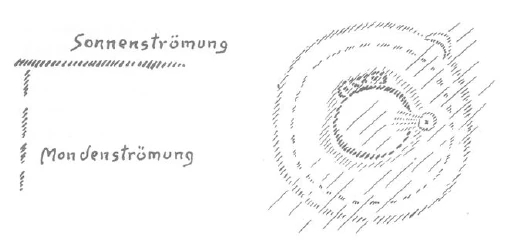
[ 15 ] Wesen, die nur von der Sonnenströmung durchströmt werden können, das sind die Tiere. Stellen Sie sich ein vierfüßiges Tier vor: das geht über die Erde so, daß sein Rückgrat im wesentlichen parallel der Erdenoberfläche ist. Da kann immerfort die Sonnenströmung, die jetzt Erdenströmung geworden ist, durch dieses Rückgrat ziehen. Dieses Wesen ist also erdenverwandt.
[ 14 ] Beings that can only be permeated by the solar current are animals. Imagine a four-legged animal: it moves across the earth in such a way that its spine is essentially parallel to the earth’s surface. In this way, the solar current—which has now become an earthly current—can flow continuously through this spine. This being is therefore connected to the Earth.
[ 16 ] Beim Menschen ist das anders. Der Mensch hat innerhalb seiner Leiblichkeit diejenige Lage, die das Tier hat, nur mit Bezug auf sein Haupt. Wenn Sie sich die Linie denken vom Hinterkopf nach der Stirne, dann ist diese Linie in der Richtung, in der das Tier sein Rückgrat hat; da geht dieselbe Sonnenströmung durch das Haupt hindurch. Dagegen ist das menschliche Rückgrat herausgehoben von den Strömungen, die parallel zur Erde gehen, von der ErdenSonnenströmung. Dadurch, daß es herausgehoben ist, kommt der Mensch in die Lage — das hängt natürlich sehr von der geographischen Breite und so weiter ab, aber dadurch sind die Menschen auch verschieden —, daß unter bestimmten Verhältnissen die Mondenströmung durch ihn hindurchgeht, jetzt aber nicht durch seinen Kopf, sondern durch sein Rückgrat. Das ist ein gewaltiger Unterschied zwischen dem Tier und dem Menschen. Was bei dem Tiere vom Kosmos durchs Rückgrat geht, geht beim Menschen durch den Kopf; was bei dem Tier, so wie die Tiere heute sind, überhaupt zunächst keinen Angriffspunkt hat, die alte Mondenströmung, das geht bei dem Menschen durchs Rückgrat. Daß eine Verwandtschaft ist zwischen dem menschlichen Rückgrat, sogar in seinem Bau, und der Mondenströmung, das möge Ihnen daraus hervorgehen, daß der Mensch ungefähr — warum das nur ungefähr ist, darauf werden wir auch in der späteren Zeit einmal zurückkommen —, so viele Rückenwirbel hat als der Monat Tage: achtundzwanzig bis einunddreißig Rückenwirbel hat er. Das gesamte Rückenmarksleben, überhaupt das Brustleben des Menschen, hängt mit dem Mondenleben innig zusammen. Und unter dem Sonnenleben, das in Schlafen und Wachen abläuft, vierundzwanzigstündig, liegt verborgen das rhythmische Mondenleben für den Menschen.
[ 15 ] It is different with human beings. Within their physicality, human beings occupy the same position as animals, but in relation to their head. If you imagine a line running from the back of the head to the forehead, this line runs in the same direction as an animal’s spine; the same solar current flows through the head along this line. In contrast, the human spine is set apart from the currents that run parallel to the Earth—from the Earth-Sun current. Because it is set apart, the human being is placed in a position—which, of course, depends greatly on geographical latitude and so on, but this is also why people differ—where, under certain conditions, the lunar current passes through them, not through their head, but through their spine. This is a tremendous difference between animals and human beings. What passes through the spine from the cosmos in animals passes through the head in humans; what, in animals—as they are today—has no point of entry at all—the ancient lunar current—passes through the spine in humans. That there is a connection between the human spine—even in its structure—and the lunar current should be evident to you from the fact that the human being has approximately—we will return to why this is only approximate at a later time—as many vertebrae as there are days in a month: twenty-eight to thirty-one vertebrae. The entire life of the spinal cord—indeed, the human chest life in general—is intimately connected with the lunar life. And beneath the solar life, which unfolds in sleep and wakefulness on a twenty-four-hour cycle, lies hidden the rhythmic lunar life of the human being.
[ 17 ] Das ist eine elementarische Betrachtung des Zusammenhanges zwischen dem Menschen und dem gesamten Weltenall. Denn geradeso wie die Strömungen, die durch das menschliche Rückgrat gehen, in der Strömung verlaufen, die mit dem Mondenleben zu tun hat, so verlaufen wiederum andere Strömungen in dem Menschen, die mit den andern Planeten unseres Sonnensystems zu tun haben. Das alles sind höchst reale Dinge. Aber die heutige naturwissenschaftliche Weltanschauung ist ganz von diesen Dingen abgekommen, kommt gar nicht mehr darauf, diese Zusammenhänge zu betrachten. Daher hat sie auch kein Gefühl dafür, wie beim Menschen ein Wesentliches gerade darinnen besteht, daß zu dem äußerlichen, bewußten Erdenleben ein unterbewußtes Leben hinzukommt, das zusammenhängt mit seinem Brustleben, das aus geheimnisvollen Seelentiefen heraufkommt, das aber besonders berücksichtigt werden muß in solchen Zeiten, wie diejenige ist, die jetzt kommt, und das besonders berücksichtigt werden muß im Erziehungswesen aus dem Grunde, weil sonst eben die gegnerischen, die ahrimanischen Mächte sich dieses Lebens bemächtigen. Und es wäre sehr verhängnisvoll, wenn der Mensch nicht achtgeben würde darauf, daß sich ein Teil seines Seelenlebens, das sich gerade verinnerlichende, das «blaue» Leben, um es nach dem Bilde (siehe «blaue» Zeichnung auf $. 195) zu sagen, in der Gefahr befindet, den ahrimanischen Mächten zu verfallen, wenn es nicht vollbewußt aufgenommen und durch solche geisteswissenschaftliche Erkenntnisse vertieft wird, die es gewagt haben, auch über dasjenige etwas zu sagen, was der äußeren Wissenschaft verborgen bleiben muß.
[ 16 ] This is a fundamental consideration of the connection between human beings and the entire universe. For just as the currents flowing through the human spine are part of the current associated with the life of the Moon, so too are there other currents within the human being that are connected to the other planets of our solar system. All of these are highly real phenomena. But today’s scientific worldview has strayed entirely from these matters and no longer even considers these connections. Consequently, it has no sense of how an essential aspect of the human being consists precisely in the fact that, in addition to the outer, conscious earthly life, there is a subconscious life connected to the life of the breast—a life that rises from the mysterious depths of the soul—but which must be given special consideration in times such as the one now approaching, and which must be given special consideration in education for the very reason that, otherwise, the opposing, Ahrimanic forces will take possession of this life. And it would be very disastrous if human beings did not take care to ensure that a part of their soul life—the part that is precisely becoming internalized, the “blue” life, to use the image (see the “blue” drawing on $. 195), is in danger of falling prey to the Ahrimanic forces if it is not consciously embraced and deepened through such spiritual-scientific insights that have dared to speak even of that which must remain hidden from external science.
[ 18 ] Das aber muß in ganz konkreten Verhältnissen berücksichtigt werden. Nehmen Sie die äußere Wissenschaft — welchen Weg nimmt sie? Sie nimmt immer mehr den Weg nach allerlei Abstraktionen hin, sie wird sogar am nützlichsten dadurch, daß sie den Weg nach allerlei Abstraktionen hin nimmt. Diese Naturwissenschaft werden die Menschen brauchen zu dem «roten», äußeren Leben; sie muß übergehen in die menschliche Kultur. Sie so, wie sie nun ist als äußere naturwissenschaftliche Kultur, für die Erziehung zu verwenden, wird in der nächsten Zeit von ganz besonderem Nachteil sein. Kindern beizubringen, was die Menschen vom Naturleben und an Naturgesetzen und an Gesetzen der abstrakten Naturwissenschaft wissen müssen, das wird eine Absurdität in der nächsten Zeit werden. Dagegen wird wichtig werden — ich kann überall nur Beispiele anführen —, daß eine Art liebevoller Betrachtung gegeben wird über das Leben der Tiere, über besondere Lebensverhältnisse der Tiere, zum Beispiel recht bildlich zu schildern, wie sich die Ameisen benehmen in ihrem Zusammenhang, wie diese Ameisen zusammenleben und so weiter. Sie wissen ja, in solchen Werken wie in Brehms «Tierleben» sind Ansätze zu diesen Dingen vorhanden, aber sie werden nicht ausgebaut. Sie müssen immer mehr und mehr ausgebaut werden, diese symbolisierten Erzählungen von Geschichten, die sich im Tierleben abspielen. Recht sinniges Erzählen von einzelnen individuellen Geschichten, das wird Platz greifen müssen, und das werden wir den Kindern beibringen müssen. Statt jener schauderhaften Art, wie elementare Zoologie an die Kinder verzapft wird, werden wir ihnen erzählen müssen von besonderen Taten des Löwen, des Fuchses, der Ameise, des Sonnenkäferchens und so weiter. Ob die Dinge geschehen oder nicht, das ist im einzelnen ganz gleichgültig; daß sie sinnig sind, darauf kommt es an. Und was man heute den Kindern eintrichtert, was ja ein Extrakt ist aus der Naturwissenschaft, das soll erst in späteren Jahren kommen, wenn die Kinder sich erbaut haben an solchen Erzählungen, die von dem Individuellen im Tierleben handeln.
[ 17 ] But this must be taken into account in very concrete circumstances. Take external science—which path does it take? It is increasingly moving toward all kinds of abstractions; indeed, it becomes most useful precisely by moving toward all kinds of abstractions. People will need this natural science for their “red,” external life; it must be integrated into human culture. Using it as it now stands—as an external culture of natural science—for educational purposes will be particularly detrimental in the near future. Teaching children what people need to know about natural life, the laws of nature, and the laws of abstract natural science will become an absurdity in the near future. On the other hand, it will become important—and I can only cite examples here and there—to provide a kind of loving contemplation of animal life and the specific living conditions of animals; for example, to describe quite vividly how ants behave within their social context, how these ants live together, and so on. As you know, works such as Brehm’s Animal Life contain the beginnings of such approaches, but they are not fully developed. These symbolic narratives of stories that unfold in the animal world must be developed more and more. Meaningful storytelling of individual, unique stories will have to take center stage, and that is what we will have to teach the children. Instead of that dreadful way in which elementary zoology is crammed into children’s heads, we will have to tell them about the remarkable deeds of the lion, the fox, the ant, the little sun beetle, and so on. Whether these things actually happen or not is, in the details, quite irrelevant; what matters is that they are meaningful. And what is drummed into children today—which is, after all, an extract from the natural sciences—should come only in later years, once the children have been inspired by such stories that deal with the individual aspects of animal life.
[ 19 ] Besonders wichtig wird es sein, daß man auch das Pflanzenleben in einer solchen Weise betrachtet, daß man viel zu erzählen weiß über das Verhältnis der Rose zum Veilchen, über das Verhältnis der Sträucher zu den Unkräutern, die um sie herum wachsen, daß man ganze lange Geschichten zu erzählen weiß über dasjenige, was da vorgeht in den springenden Geistern über die Blumen hin, wenn man über eine Wiese geht, und dergleichen. Das muß als Botanik den Kindern erzählt werden. Und erzählt werden muß den Kindern, wie da gewisse Kristalle mit grüner Farbe, die in der Erde wohnen, sich zu farblosen Kristallen verhalten, wie sich ein Kristall, der würfelförmig ist, zu einem verhält, der in Oktaedern kristallisiert. Statt einer abstrakten Kristallographie, wie man sie heute schon in sehr früher Jugend zum Unheil der Jugend verzapft, wird man haben müssen eine symbolistische Darstellung des Lebens der Kristalle im Innern der Erde. Man wird seine Anschauungen über dasjenige, was im Innern der Erde vorgeht, nur dann befruchten können, wenn man sie eben befruchtet mit dem, was Sie in unseren Schriften finden an Schilderungen über das Innere der Erde und so weiter. Das bloße Aufzählen wird nicht genügen, sondern darauf kommt es an, daß diese Dinge anregen, daß sie solche Vorstellungen geben, daß man viel zu erzählen vermag über das gegenseitige Leben der Diamanten und Saphire und so weiter. Sie werden, wenn Sie darüber nachdenken, verstehen, was ich eigentlich meine.
[ 18 ] It will be particularly important to view plant life in such a way that one has much to say about the relationship between the rose and the violet, about the relationship between the shrubs and the weeds growing around them, and that one can tell long stories about what is happening in the spirits leaping over the flowers when one walks across a meadow, and the like. This is what must be taught to children as botany. And children must be told how certain green-colored crystals that dwell in the earth relate to colorless crystals, and how a cube-shaped crystal relates to one that crystallizes in octahedrons. Instead of abstract crystallography—as is currently drummed into children at a very early age, to their detriment—we will need a symbolic representation of the life of crystals within the Earth. One will only be able to enrich one’s views on what takes place within the Earth if one enriches them with what you find in our writings—descriptions of the Earth’s interior and so on. Merely listing these things will not suffice; rather, what matters is that they inspire, that they provide such ideas that one is able to tell much about the interplay between diamonds and sapphires and so on. If you think about it, you will understand what I actually mean.
[ 20 ] Ähnlich wird es sich darum handeln, nicht jene schauderhaften Abstraktionen, die heute als Geschichte den Kindern beigebracht werden, an die Kinder zu verzapfen, sondern das lebendige Leben wiederum hineinzustellen in das menschliche geschichtliche Werden, Sinn zu erwecken für das, was das Menschengemüt erlebt im Verlaufe des Menschenwerdens. Erfunden werden müssen Gespräche, die sich gar nicht abspielen in der sinnlichen Welt, Gespräche zum Beispiel zwischen einem alten Griechen und einem Menschen der fünften nachatlantischen Zeit. Das wird viel nützlicher sein, wenn man so die lebendigen Gestalten vor die Seele der Kinder hinzaubert, als das, was man ihnen heute an historischen Abstraktionen beibringt.
[ 24 ] Similarly, the aim will be not to foist upon children those dreadful abstractions that are taught to them today as “history,” but rather to reintroduce living life into the human historical process, to awaken a sense of what the human soul experiences in the course of human development. We must invent conversations that do not take place at all in the sensory world—conversations, for example, between an ancient Greek and a person from the fifth post-Atlantean epoch. Conjuring up these living figures before the children’s souls in this way will be far more useful than the historical abstractions taught to them today.
[ 21 ] Sie sehen, worauf das hinausläuft. Es läuft darauf hinaus, die Seele des Kindes wirklich mit lebendigen Inhalten zu erfüllen, so daß dasjenige, was okkult geheimnisvoll als Unterströmung verläuft im Kinde, wirklich erfaßt werden kann. Und Sie sollen sehen, wie der Mensch weniger dürr werden wird in seinem Seelenleben, wie er weniger nervös werden wird, wenn er solche im Sinne der Weltengesetze gehaltene Erzählungen in seinem späteren Lebensalter herausholen kann. Dann hat er auch die Naturgesetze kennengelernt, dann kann er einen Einklang schaffen zwischen dem, was ihm in lebendigen Lebensformen vorgeführt wurde, und den Naturgesetzen, während sein Geist nur verödet, wenn er die abstrakten Naturgesetze empfängt. Das ist dasjenige, was ich als ein paar Gedanken, wie gerade das Erziehungswesen befruchtet werden muß, anführen will.
[ 19 ] You can see where this is leading. It amounts to truly filling the child’s soul with living content, so that what flows through the child as an occult, mysterious undercurrent can truly be grasped. And you will see how a person’s inner life will become less barren, how they will become less nervous, if they can draw upon such stories—told in accordance with the laws of the worlds—later in life. Then they will also have come to know the laws of nature; then they can create harmony between what was presented to them in living forms and the laws of nature, whereas their spirit only becomes desolate when they are presented with abstract laws of nature. This is what I wish to present as a few thoughts on how the field of education in particular must be enriched.
[ 22 ] Natürlich ist es bequemer, wenn man sich heute in allerlei Vereinen zusammenfindet und immer wieder deklamiert: Die Erziehung muß individualisiert werden —, und wie die abstrakten Formeln alle heißen. Natürlich ist es bequemer, als wenn nun verlangt wird, daß Leute, die sich für das Erziehungswesen interessieren, sich bekanntmachen sollen mit dem Geiste des menschlichen und des natürlichen Werdens und imaginative Erzählungen finden sollen, damit im Konkreten das geistige Leben gerade in der Form erfaßt werde, die es annehmen wird in der nächsten Zeit.
[ 20 ] Of course, it is more convenient these days to come together in all sorts of associations and repeatedly proclaim: “Education must be individualized”—and all those other abstract slogans. Of course, it is more convenient than if people interested in education were required to familiarize themselves with the spirit of human and natural development and to devise imaginative narratives, so that spiritual life might be grasped in concrete terms precisely in the form it will take in the near future.
[ 23 ] Aber man wird zu solchen Dingen überall, auf allen Gebieten die Anregung der Geisteswissenschaft brauchen. Sie allein wird aus den ersterbenden Formen des gegenwärtigen Geisteslebens wiederum Neues gebären können, das in dieser Weise, wie ich es geschildert habe, anregend wirken kann, namentlich auf das kindliche Gemüt. Ohne die Anregung der Geisteswissenschaft wird man ein vertrockneter Schulmeister werden, der die Kinder auch vertrocknet. Und als Schlimmstes wird immer mehr und mehr entstehen, daß sich die Menschen namentlich von dem Jugendunterricht die Vorstellung machen: Das ist ja doch am besten, wenn man alles, was man da lernt, so schnell wie möglich wieder vergißt. — Wenn man in der späteren Zeit nichts, auch nicht das Allergeringste missen möchte von dem, was man in der Kindheit empfangen hat, dann ist das nicht nur eine Freude, sondern dann ist das ein Quell, ein wirklicher Quell des menschlichen Lebens. Das bitte ich Sie zu berücksichtigen.
[ 21 ] But in all areas, one will need the inspiration of spiritual science for such things. It alone will be able to give birth to something new from the dying forms of present-day spiritual life—something that, in the way I have described, can have a stimulating effect, especially on the child’s mind. Without the inspiration of spiritual science, one will become a dried-up schoolmaster who dries up the children as well. And worst of all, the notion will take hold more and more, especially regarding education for young people, that it is best to forget everything one learns there as quickly as possible. — If, later in life, one does not wish to be without anything—not even the very least—of what one received in childhood, then this is not merely a joy, but a source—a true source—of human life. I ask you to bear this in mind.
[ 24 ] Aber die Wissenschaft selber braucht auch ihre Anregungen. Ich habe gestern erwähnt, wie schwer es wird, die Brücke zu schaffen zwischen der Geisteswissenschaft im allgemeinen und den Spezialbetätigungen im wissenschaftlichen Leben. Gerade das aber wird zu dem Allerallernotwendigsten der Zukunft gehören. Es muß Ihnen aus mancherlei Betrachtungen, die auch hier angestellt worden sind, hervorgehen, daß die Verarmung an Begriffen und namentlich die Verarmung in den Begriffen solche Verhältnisse herbeigeführt haben, wie sie eben heute eingetreten sind.
[ 22 ] But science itself also needs inspiration. I mentioned yesterday how difficult it is to build a bridge between the humanities in general and specialized activities in scientific life. Yet this, precisely, will be among the very, very most essential things of the future. It must be clear to you from various observations that have also been made here that the impoverishment of concepts—and especially the impoverishment of terminology—has brought about the circumstances that have just arisen today.
[ 25 ] Ich habe es im öffentlichen Vortrag in Basel gesagt und ich habe es schon wiederholt, daß Leute, die sich kompetent deuchten, geglaubt haben, als dieser Krieg begann, er könne nicht länger als vier Monate dauern. Diese Leute glaubten, die sozialwissenschaftliche, die wirtschaftliche Struktur studiert zu haben; daraus bildeten sie sich dann diese Vorstellung. Solche Vorstellungen sind nicht mit der Wirklichkeit verbunden gewesen, denn die Wirklichkeit hat diese Vorstellungen widerlegt. Es ist sehr merkwürdig, wie wenig die Menschen eigentlich geneigt sind, von den Ereignissen zu lernen. Wenn jemand aus seinen eigenen wissenschaftlichen Vorstellungen heraus so etwas geglaubt hat, so müßte sich der jetzt doch sagen: Aus welch ungenügenden Voraussetzungen heraus habe ich meine Schlüsse gezogen! — Er müßte also doch wirklich geneigt werden, etwas zu lernen. Er bleibt aber schlafend, indem er doch nur aus denselben Voraussetzungen heraus andere Schlüsse zieht — die nur wieder ein bißchen mehr der nötigen Erfahrung entsprechen —, weil er nicht eingehen will auf die inneren Zusammenhänge. Allerdings, wenn man auf die inneren Zusammenhänge des Lebens eingeht, dann muß man jene Unbequemlichkeit überwinden, die heute am schwersten gerade von denen überwunden wird, die sich mit wissenschaftlichen Fragen beschäftigen. Diese Leute wollen ja hauptsächlich nicht gestört werden in dem kleinen Felde, das sie bebauen, nicht die Fäden ziehen zu verwandten Gebieten.
[ 23 ] I said this in a public lecture in Basel, and I have repeated it many times: when this war began, people who considered themselves experts believed it could not last longer than four months. These people believed they had studied the social and economic structures; based on that, they formed this idea. Such notions were not grounded in reality, for reality has refuted them. It is very strange how little people are actually inclined to learn from events. If someone believed such a thing based on their own scientific assumptions, they would surely have to say to themselves now: From what inadequate premises did I draw my conclusions! — So they really ought to be inclined to learn something. But they remain asleep, drawing different conclusions from the very same premises—conclusions that merely correspond a little more closely to the necessary experience—because they refuse to engage with the inner connections. Admittedly, if one delves into the inner connections of life, one must overcome that discomfort which is most difficult to surmount today precisely for those who deal with scientific questions. After all, these people mainly do not want to be disturbed in the small field they are cultivating; they do not want to trace the connections to related areas.
[ 26 ] Dieses Spezialistentum war eine Zeitlang ganz gut. Wenn es fortdauernd weiternistet und wenn namentlich unsere Hochschuljugend fortdauernd weiter mit diesen Einseitigkeiten, die aus dem Spezialistentum hervorgehen, verdorben wird, dann werden die Kalamitäten, die aus dem erfolgen, daß die Menschen wirklichkeitsfremde Begriffe haben, immer größer werden. Wir werden überall in den Stadt-, Land-, Staatsvertretungen Menschen sitzen haben, die durchaus nicht dasjenige umfassen, was sie mit Gesetzen lenken oder verwalten wollen, weil diese Begriffe zu arm sind, um die Wirklichkeit zu umspannen. Die Menschen haben gar keine Ahnung davon, daß diese Begriffe zu arm sind. Die Wirklichkeit ist eben viel reicher als diese Begriffe.
[ 24 ] This trend toward specialization was quite beneficial for a while. If it continues to take root, and if, in particular, our university students continue to be corrupted by these one-sided views that arise from this specialization, then the calamities resulting from people holding concepts that are divorced from reality will grow ever greater. We will have people sitting in city, county, and state representative bodies who do not at all grasp the very things they intend to govern or administer through laws, because these concepts are too limited to encompass reality. People have absolutely no idea that these concepts are too limited. Reality is simply much richer than these concepts.
[ 27 ] Dann wird vor allen Dingen es sich darum handeln, daß nicht die Geneigtheit entsteht, die Spezialwissenschaft möglichst sogenannten Fachmännern zu überlassen, und auf der andern Seite die subjektiven, egoistischen Bedürfnisse zu befriedigen in der Anthroposophie, sondern es wird sich darum handeln, daß man diese beiden Pole richtig zu verbinden weiß, daß man wirklich das eine durch das andere zu befruchten versteht.
[ 31 ] Above all, the task will be to ensure that we do not develop a tendency to leave specialized knowledge as much as possible to so-called experts, while at the same time satisfying subjective, egoistic needs within anthroposophy; rather, the task will be to know how to properly connect these two poles, so that we truly understand how to enrich one through the other.
[ 28 ] Wir machen ja immer wiederum die Erfahrung — Sie könnten sie auch machen, wenn Sie die Dinge ordentlich ins Auge fassen würden —: Redet man über reine Spezialgebiete zu denen, die sich ehrlich zur Anthroposophie bekennen, so wird ihnen die Sache eigentlich doch recht langweilig! Man soll immer nur über die Zentralfragen sprechen: Seele, Unsterblichkeit, Gott und so weiter. Dadurch kann man allerdings zunächst die egoistischen religiösen Bedürfnisse befriedigen, aber man kann nicht dazu kommen, den Seelen das zu geben, was sie für die nächste Zeit so notwendig brauchen: daß sie sich wirklichkeitsgemäß hineinstellen in dieses wirkliche Leben. Deshalb müssen wir so aufmerksam sein, wenn eine wirkliche Verbindung versucht wird zwischen den aus der geisteswissenschaftlichen Betrachtung herausfließenden Betrachtungsimpulsen und den Spezialgebieten.
[ 25 ] We keep having this experience—and you could have it too if you really took a good, hard look at things—that when we talk about purely specialized topics with those who sincerely profess their belief in anthroposophy, they actually find the whole thing quite boring! One should always speak only of the central questions: the soul, immortality, God, and so on. This may, however, initially satisfy selfish religious needs, but it does not enable us to give souls what they so desperately need for the time ahead: that they position themselves realistically within this real life. That is why we must be so attentive whenever an attempt is made to establish a genuine connection between the impulses for reflection arising from spiritual science and the specialized fields.
[ 29 ] Ich habe schon einmal hier hingewiesen auf die sehr wichtige Arbeit unseres Freundes Dr. Boos über den Gesamtarbeitsvertrag. Nachdem das Buch jetzt überall zu haben ist, möchte ich noch einmal darauf aufmerksam machen, weil dieses Buch gerade für das Brückenbauen zwischen den allgemeinen Betrachtungsimpulsen der Anthroposophie und einem vollständigen Spezialgebiete, dem Rechtsgebiete, mustergültig ist: «Der Gesamtarbeitsvertrag nach Schweizerischem Recht», von Dr. Roman Boos. — Aber wichtig ist es gerade, ins Auge zu fassen, daß unsere Freunde solche Spezialuntersuchungen nicht als außerhalb ihres Feldes betrachten möchten, sondern daß sie darauf eingehen, weil das Leben eben für die nächste Zeit in den Dienst der anthroposophischen Betrachtung gestellt werden muß. Sie werden finden, wenn Sie dieses Buch aufmerksam lesen und durcharbeiten, daß in einer lebendigen Weise Dinge des alltäglichen Lebens erfaßt werden, aber so, daß man sieht, daß in dieses alltägliche Leben hereinspielen erstens die umfassendsten Betrachtungsimpulse, die überhaupt Weltengesetzen entsprechen, dann aber auch große historische Perspektiven. Und unendlich fruchtbar werden Sie finden, den Unterschied zwischen romanischem Vertragswesen und germanischem Zusammenhaltswesen, sozialem Wesen zu verstehen. In einer tiefgründigen Weise auf einem Spezialgebiete dargestellt erscheint die Beziehung romanischen Menschenwesens zu germanischem Menschenwesen. Gerade an diesem Buche von Dr. Roman Boos, gerade an einem solchen Spezialwerke ist es wichtig, sich hinaufzuranken zu dem, was von diesem Gesichtspunkte aus geisteswissenschaftlich wichtig ist für die nächste Zukunft: die Brücke zu schlagen zwischen dem Leben, das vor unseren Sinnen sich abspielt und in dem wir unsere sozialen Verhältnisse begründen, und dem Leben, das aus der geistigen Welt hereinströmt und unsere Lebensformen vergeistigt und durchpulst.
[ 26 ] I have previously mentioned here the very important work of our friend Dr. Boos on the collective bargaining agreement. Now that the book is widely available, I would like to draw attention to it once again, because this book is exemplary, particularly in bridging the gap between the general insights of anthroposophy and a specific field—the field of law: The Collective Bargaining Agreement under Swiss Law, by Dr. Roman Boos. — But it is particularly important to bear in mind that our friends should not regard such specialized studies as lying outside their field, but rather that they should engage with them, because life itself must be placed in the service of anthroposophical reflection in the time to come. If you read this book carefully and work through it, you will find that it captures aspects of everyday life in a vivid way, yet in such a way that one sees how, first of all, the most comprehensive impulses of contemplation—which correspond to the laws of the universe—and, secondly, broad historical perspectives come into play in this everyday life. And you will find it infinitely fruitful to understand the difference between the Romanic concept of contract and the Germanic concept of cohesion and social being. The relationship between the Romanic and Germanic conceptions of humanity is presented in a profound manner within a specialized field. It is precisely in this book by Dr. Roman Boos—precisely in such a specialized work—that it is important to rise to an understanding of what, from this perspective, is spiritually significant for the near future: to build a bridge between the life that unfolds before our senses—and upon which we base our social relationships—and the life that flows in from the spiritual world, spiritualizing our forms of life and pulsing through them.
[ 30 ] Ich empfehle Ihnen auch, nicht ungelesen zu lassen das letzte Heft von «Wissen und Leben», worin Dr. Boos geschrieben hat über «Die Kernfragen der Schweizer Politik». Da werden Sie sehen, daß schon von einem andern Gesichtspunkt aus ins Auge gefaßt werden können die Fragen der zeitgenössischen Politik, als sie ins Auge gefaßt werden von der — mit Respekt zu vermelden — alltäglichen Journalistik. Das Bewußtsein von dem Zusammenhang der verschiedenen Kulturformen, Kunstformen zum Beispiel, mit politischen Formen wird in schöner Weise gerade in diesem Aufsatz hervorgehoben: «Die Kernfragen der Schweizer Politik» von Roman Boos, in dem Hefte «Wissen und Leben» vom 15. Oktober 1917.
[ 27 ] I also recommend that you not miss the latest issue of Wissen und Leben, in which Dr. Boos has written about “The Core Issues of Swiss Politics.” There you will see that the issues of contemporary politics can be viewed from a different perspective than they are by—with all due respect—run-of-the-mill journalism. This essay beautifully highlights the connection between various forms of culture—art, for example—and political forms: “The Core Issues of Swiss Politics” by Roman Boos, in the October 15, 1917, issue of Wissen und Leben.
[ 31 ] Sie können ja, wenn Sie die ernste und wirklich im geisteswissenschaftlichen Sinne gehaltene Betrachtung dieser «Kernfragen der Schweizer-Politik» ins Auge gefaßt haben, dann auch einen Blick werfen auf den ersten Aufsatz dieses Heftes, «Der Sinn der Reformation» von Adolf Keller. Ja, das ist nun richtig wiederum so ein Aufsatz im alten Stil, der selbstverständlich glaubt, in sehr neuem Stil zu sein. So daß Sie in diesem Hefte wirklich nebeneinander berechtigstes Modernes und zöpfischstes Altes finden können. Selbstverständlich glaubt dieses zöpfische Alte, daß es ganz gescheit, ganz besonders gescheit ist, daß es ausgebildet hat eine ganz besonders gescheite Logik und ein durchdringendes Denken. Von Gesichtspunkten wird da der Sinn der Reformation geschildert in hochtrabenden Worten, die aber nichts anderes sind als schale, inhaltsleere Abstraktionen.
[ 28 ] If you have set your sights on a serious examination of these “core issues of Swiss politics”—one conducted in the true spirit of the humanities—then you might also take a look at the first essay in this issue, “The Meaning of the Reformation” by Adolf Keller. Yes, this is, once again, one of those old-style essays that, of course, believes itself to be written in a very new style. So in this issue, you can truly find the most legitimate modern ideas and the most old-fashioned, traditional ones side by side. Naturally, this old-fashioned approach believes that it is quite clever—indeed, exceptionally clever—and that it has developed a particularly clever logic and penetrating thinking. From various perspectives, the meaning of the Reformation is described there in high-flown words, which are, however, nothing more than trite, empty abstractions.
[ 32 ] Wenn man den Aufsatz «Der Sinn der Reformation» von Adolf Keller durchgelesen hat — er ist gut und brav gemeint und gehört zu den besten Arbeiten der Gegenwart auf diesem Gebiet —, dann ist man müde durch das Herumgekugelt- und Herumgekollertwerden immer in denselben Abstraktionen: Reformation erzeugt im Gemüte die Freiheit der Initiative; die Freiheit der Initiative kommt aus der Reformation; als die Reformation gewirkt hatte, wurde die Freiheit der Initiative belebt —, und so kugelt und kollert man herum nach dem Muster aller Abstraktlinge, die nichts anderes zustandebringen als zu schwelgen in ein paar armen, armseligen Begriffen, die nichts zu tun haben mit der Wirklichkeitswelt. Das ist ja das Charakteristische überhaupt desjenigen, was überwunden werden muß: dieses abstrakte Treiben, dieses Leben in gedankenarmen Vorstellungen, bei denen man sich besonders die Finger ableckt vor Wohlgefühl, weil man glaubt, etwas besonders Hohes zu sagen, wenn man etwas besonders Abstraktes sagt.
[ 29 ] Once you have read through Adolf Keller’s essay “The Meaning of the Reformation”—which is well-intentioned and sincere and ranks among the best contemporary works in this field—you grow weary of being tossed and tumbled about in the same abstractions over and over again: The Reformation fosters freedom of initiative in the mind; freedom of initiative stems from the Reformation; once the Reformation had taken effect, freedom of initiative was revitalized—and so one is tossed and tumbled about in the manner of all abstract thinkers who accomplish nothing more than revelling in a few meager, pitiful concepts that have nothing to do with the real world. That is, after all, the defining characteristic of what must be overcome: this abstract fussing, this life spent in ideas devoid of thought, in which one particularly relishes the sense of satisfaction because one believes one is saying something particularly lofty when one says something particularly abstract.
[ 33 ] In den letzten Tagen kriegte ich eine Abhandlung, die handelte von tiefsinnigen theosophischen Dingen, aber eigentlich war sie nur eine Abhandlung über das «Etwas», und es war nur über das «Etwas» darinnen die Rede, von dem «unverbesserten Etwas» und von dem «verbesserten Etwas», und wie das verbesserte das unverbesserte Etwas ergreift, und sich das verbesserte Etwas über das unverbesserte Etwas stellt. Und so: bewußtes und unbewußtes Etwas, verbessertes und unverbessertes Etwas, das rollt herum, rollt, rollt, rollt — ist schließlich, auf das geistige Gebiet übertragen, auch nichts anderes als diese sonderbare Art des abstrakten Arbeitens in der Gegenwart, das sich in diesem Abstrakten ganz besonders gefällt und eigentlich Wirklichkeitstlucht ist, das gar nichts mehr zu tun hat mit irgendeiner Wirklichkeit. Das kommt dann allerdings zu ganz besonderen Konsequenzen. Weil die Leute in Begriffen verarmen, können sie sich mit ihren Begriffen auch nicht durch den Strom des Daseins hindurchwinden. Ihre Begriffe reichen nicht aus, das Leben zu erfassen. Und dann kommt es vor, daß man solche Dinge liest wie zum Beispiel in dem Aufsatz von Adolf Keller auf Seite 51: «Aber obschon in diesem Erlebnis die tiefsten Quellen des Gemütes zum Fließen kommen, ist es doch nicht bloß eine Aufwallung des Gefühls in uns. Es wird dabei nichts Göttliches und Menschliches durcheinandergemischt. Dafür sorgt das Gewissen. Es wahrt den Abstand und die Ehrfurcht. Der Mensch bleibt der Mensch, und Gott bleibt Gott. Hat die Reformation mit der Mystik gemein, daß das Gottesverhältnis durch ein persönliches Erlebnis hergestellt wird, so scheidet das sie voneinander, daß das reformatorische Erlebnis sich nicht wie in der Mystik im gefühlsmäßigen Wallen und Sieden des Seelengrundes vollzieht, sondern in der Not und sittlichen Erhebung des Gewissens. Die stärkste Macht der Innerlichkeit ist ein Sollen, eine absolute Forderung. Der Mensch kann sich ihrer nur erwehren durch eine göttliche, innerlich erlebte Hilfe.» Lauter Abstraktionen, man kollert so von einer zur andern. Dann kommt: «Dieses ist das Evangelium, Jesus Christus.»
[ 30 ] In the last few days, I received a treatise that dealt with profound theosophical matters, but in reality it was just a treatise on the “Something,” and it spoke only of the “Something” within it—of the “unimproved Something” and the “improved Something”—and how the improved Something seizes the unimproved Something, and how the improved Something places itself above the unimproved Something. And so: the conscious and unconscious “Something,” the improved and unimproved “Something”—it rolls on and on and on and on—is ultimately, when transferred to the spiritual realm, nothing other than this peculiar kind of abstract thinking in the present, which takes particular delight in this abstract realm and is, in fact, a flight from reality, having nothing whatsoever to do with any reality at all. This, of course, leads to very specific consequences. Because people are impoverished in their concepts, they cannot use their concepts to navigate their way through the stream of existence. Their concepts are insufficient to grasp life. And so it happens that one reads things such as, for example, in Adolf Keller’s essay on page 51: “But although the deepest springs of the soul come to flow in this experience, it is not merely a surge of emotion within us. Nothing divine and nothing human is mixed together in the process. Conscience ensures this. It maintains the distance and the reverence. Man remains man, and God remains God. While the Reformation shares with mysticism the idea that the relationship with God is established through a personal experience, what distinguishes them is that the Reformation experience does not take place, as in mysticism, in the emotional surging and seething of the depths of the soul, but rather in the distress and moral elevation of the conscience. The strongest power of inwardness is an obligation, an absolute demand. Human beings can only resist it through divine help experienced inwardly.” Nothing but abstractions; one tumbles from one to the next. Then comes: “This is the Gospel, Jesus Christ.”
[ 34 ] Also selbst bis zu dieser Abstraktion hat es dieser Herr gebracht, daß er die Botschaft des Jesus Christus mit dem Jesus Christus identifiziert. Dazu kommt man eben durch äußerste Abstraktionen. Dann aber ist es sehr merkwürdig: also die Mystik hat er abgewiesen. Mit seinen armen Begriffen sagt er: Die Reformation hat nichts zu tun mit der Mystik, sondern die Reformation erzeugt ein gesundes Leben. — Als ob die Mystik nicht gerade das Erleben wäre. Nicht wahr, aber weil die Begriffe so arm sind, können sie die Wirklichkeit nicht umspannen, nicht umfassen. Daher sagen sie für die entgegengesetztesten Dinge immer dasselbe. Also denken Sie: Das «Wallen und Sieden» hat er abgelehnt, das darf der richtige Reformationsanhänger nicht haben, denn sonst wäre er ein Mystiker, wenn er ein Wallen und Sieden hätte.
[ 31 ] So this gentleman has taken things to such an extreme level of abstraction that he identifies the message of Jesus Christ with Jesus Christ himself. That is precisely what one arrives at through extreme abstractions. But then it is very strange: he has rejected mysticism. With his meager concepts, he says: The Reformation has nothing to do with mysticism; rather, the Reformation brings about a healthy life. — As if mysticism were not precisely the experience itself. Isn’t that so? But because the concepts are so limited, they cannot encompass reality, cannot take it in. That is why they always say the same thing about the most opposite things. So consider this: He rejected the “surging and boiling”; a true follower of the Reformation must not have that, for otherwise he would be a mystic if he were to experience such surging and boiling.
[ 35 ] Adolf Keller fährt fort: «Diese Hilfe wird aber nicht nur äußerlich, historisch oder sakramental vor den Menschen hingestellt. Auch sie kann nur kräftig werden durch innere persönliche Aneignung. Sie wirkt nicht von außen, magisch, sondern nur soweit sie gefühls- und willensmäßig sich in uns verinnerlichen und die Seele durchglühen kann.»
[ 32 ] Adolf Keller continues: “This help, however, is not merely presented to people in an external, historical, or sacramental way. It, too, can only become powerful through inner, personal assimilation. It does not act from the outside, magically, but only to the extent that it can be internalized within us through our emotions and will and can set the soul ablaze.”
[ 36 ] Also die Reformation darf kein «Wallen und Sieden» im Grunde sein, aber diese Reformation wirkt wiederum nur in der Seele, wenn sie die Seele durchglühen kann, also die Seele wallend und siedend machen kann. So könnte man den ganzen Aufsatz durchnehmen auf seine armselige Geistigkeit hin, die nirgends dem gewachsen ist, in die Wirklichkeit unterzutauchen. Aber solche Dinge werden heute mit besonderer Passion gelesen. Man findet das sehr geistreich. Man merkt nicht, daß, wenn man zwei, drei Zeilen weiterliest, man sogleich mit den Begriffen stolpert, weil man natürlich die verschiedensten Dinge mit denselben Begriffen belegen muß, denn an Begriffen ist man arm.
[ 33 ] So the Reformation must not, at its core, be merely a “simmering and bubbling,” but this Reformation, in turn, has an effect on the soul only if it can set the soul ablaze—that is, if it can make the soul simmer and bubble. One could go through the entire essay and point out its meager intellectual depth, which is nowhere near capable of delving into reality. But such things are read today with particular passion. People find it very witty. People don’t realize that, if they read just two or three lines further, they immediately stumble over the terms, because they naturally have to apply the same terms to the most diverse things—since they are poor in terms.
[ 37 ] So können Sie, wenn Sie auf der einen Seite studieren den schönen Aufsatz über «Die Kernfragen der Schweizer Politik» von Roman Boos — den ich Ihnen sehr empfehle, weil er Ihnen zeigen wird, wie man Fäden ziehen kann zwischen dem politischen Leben und andern Formen des Kulturlebens und wie man wirklich die Begriffe in Fluß bringen kann, wenn man sein Begriffsleben bereichert, wie Sie ein Muster finden können über die Schweizer Politik in bezug auf eine Zukunftsbetrachtung —, so können Sie das vergleichen mit der öden Rederei des ersten Aufsatzes in diesem Heft «Wissen und Leben» vom 15. Oktober 1917, «Der Sinn der Reformation» von Adolf Keller, und Sie haben so, indem Sie ein geringes Geld einmal ausgeben, die Möglichkeit, Altes und Neues hier unmittelbar nebeneinander zu finden und sich recht sehr gut über diese Sache unterrichten zu können.
[ 34 ] So, for example, if you read the wonderful essay “The Core Issues of Swiss Politics” by Roman Boos—which I highly recommend to you, because it will show you how to draw connections between political life and other forms of cultural life, and how to truly set concepts in motion by enriching your conceptual framework, as well as how to find a model for Swiss politics in terms of a vision for the future— you can compare it with the tedious rambling of the first essay in this issue of Wissen und Leben from October 15, 1917, “The Meaning of the Reformation” by Adolf Keller, and thus, by spending a small amount of money just once, you have the opportunity to find the old and the new side by side here and to educate yourself quite well on this subject.
[ 38 ] Ich muß schon manchmal auf das allerentgegengesetzteste Aktuelle Rücksicht nehmen, denn Anthroposophie ist nicht dazu da, um in den höchsten Höhen zu schwelgen, sondern sie soll da sein, gerade diese Betrachtungen anzulegen, die wirklich in die Gegenwart, in die Intentionen der Gegenwart hineinführen.
[ 35 ] Sometimes I have to take into account the very opposite of current events, for anthroposophy is not meant to revel in the highest realms, but rather to engage in precisely those reflections that truly lead into the present, into the intentions of the present.