

Historical Necessity and Freedom
The Influence of Fate from the World of the Dead
GA 179
2 December 1917, Dornach
Translated by Steiner Online Library
First Lecture
[ 1 ] Today we will continue to add to the reflections we have been making. During this time, I was very concerned with making it clear on what conditions human life depends—both in its particular aspects and within the larger context. As you have seen—including in the public lectures I was able to give during this time—it was important to me to to draw attention, especially now, to those problems of spiritual science that are necessary for humanity to understand in order to break free from certain patterns of thought into which humanity has, so to speak, entangled itself across the entire globe—and which, in the final analysis, are among the causes of the current catastrophic events.
[ 2 ] Above all, it will be a matter of people learning to recognize where the boundary lies between the so-called physical and spiritual worlds. This boundary actually lies right within the human being. This very statement is crucial for understanding the world: that we see the boundary between the physical and spiritual worlds within the human being itself. The scientific way of thinking—whose great significance for the present and the future I have often emphasized from the perspective of spiritual science—is, however, now, while it still more or less remains at its starting point, actually capable of spreading, one might even say, initial darkness regarding certain important truths of life.
[ 3 ] Let us simply recognize that historical developments are only now beginning to gradually integrate scientific thinking fully into worldviews and philosophies of life. Today, certain monist and other associations are engaged—often in a shockingly amateurish manner—in bringing a scientific worldview into the public consciousness. Yet this is only one of the ways through which this scientific way of thinking gradually flows into the human soul. The far more effective and far-reaching path is that of journalism.
[ 4 ] It is no coincidence—but rather a matter of intrinsic connection—that the turning point in the development of modern scientific thought and the invention of the art of printing coincide in human history. For what has entered humanity through printing as something original—apart, of course, from what was printed from material that already existed—has essentially emerged from scientific consciousness. I mean, the new has emerged from scientific consciousness, and above all, the way in which thoughts have been captured has emerged from the scientific way of thinking.
[ 5 ] Now, of course, theologians will respond to such a statement by saying: “Yes, haven’t we also printed our theological wisdom and all sorts of pious things in recent years, decades, and centuries?” — Yes, that is certainly true, but what has it led to? This way in which, under the banner of the printed word, intellectual life has taken root in people’s souls has led to the spiritual element gradually disappearing even from the realm of religious consciousness. And even Christ Jesus—as you well know—has, under the influence of scientific thinking, been reduced to the “simple man from Nazareth,” whom people do indeed try to characterize in various ways, but who has in fact already reached the point of being placed on a par with the other great figures of the world, albeit for the time being still on a special pinnacle. The truly spiritual aspect, which is linked to the Mystery of Golgotha, has gradually faded away—at least for those who believe they have progressed with the course of history.
[ 6 ] I said that the scientific way of thinking must initially have contributed directly to a certain darkening of the mind, to a reinforcement of what the spirits of darkness have been seeking to introduce into human thought since 1879. And in the realm of the natural sciences, this manifests itself in a rather subtle way—subtle because not only those who are well-educated in the natural sciences, but also those with specialized training in the natural sciences, when they contribute today to the general education of the age and to the shaping of the worldview, have no choice but—given the state of science today—to act, as it were, “to the best of their knowledge and belief,” to act “to the best of their knowledge and belief” in such a way that, through the popularization of the scientific way of thinking, people are virtually prevented from being able to cast their gaze upon the boundary that lies within themselves between the physical world and the spiritual world. A new era of human thought is about to dawn; it is appalling that this must be said today—appalling for those educated today in a certain direction—for certain ideas that prevail in science today—and which, admittedly, are not very present in popular consciousness, but which nonetheless influence popular consciousness because scientists are today regarded—forgive me—as authorities—certain contemporary notions will seem downright comical to a future sense of time.
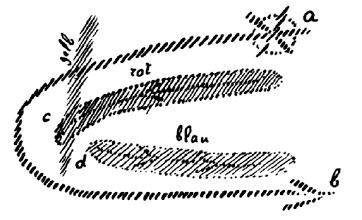
[ 7 ] I have often referred to a concept, and have now also discussed it publicly in my book On the Mysteries of the Soul: It is a widely accepted scientific concept today that within the nervous system—let us stick to humans for now, but the same applies in a similar way to animals—a distinction is made between the so-called sensory nerves—nerves of sensation, nerves of perception—and motor nerves. Schematically, this can only be represented as follows: for example, a nerve—let’s say a tactile nerve—carries the tactile sensation to the central organ, let’s say the spinal cord; there, what is conducted from the periphery of the body enters one of the spinal cord’s horns. And then, from the other horn—the anterior horn—the so-called motor nerve originates, through which the volitional impulse is in turn transmitted (see diagram on p. 12).
[ 8 ] In the case of the brain, this is simply depicted in a more complex way—as if the nerves were a kind of telegraph wire. The sensory impression, the touch sensation, is transmitted to the central organ, where, in a sense, the command is issued to carry out a movement. A fly lands somewhere on a part of the body; this creates a sensation, which is transmitted to the central organ; there, the command is given to raise the hand to that spot, and the fly is shooed away. Schematically speaking, this is a very plausible concept. To future generations, this concept will seem extraordinarily comical, for it is, after all, comical only to those who see through the facts. But it is a concept that dominates a large part of today’s scientific community—even the most specialized fields. You can open any basic textbook that teaches such things, and you will find that a distinction is made between sensory nerves and motor nerves. And you will still find the particularly hilarious image of telegraph lines—how the sensation is transmitted to the central organ, where the command is given for the movement to occur—still very widespread even today in popular works.
[ 9 ] Reality, however, is more difficult to comprehend than the analogies involving telegraph wires, which are reminiscent of the most primitive notions. Reality can only be understood when it is understood through spiritual science. The fact that a volitional impulse occurs has absolutely nothing to do with a process that is childishly described as if a command were being issued somewhere in a material central organ. The nerves are there solely to serve a unified function—both those nerves that are today called sensory nerves and those called motor nerves. And whether the nerve tract is severed in the spinal cord or in the brain, both indicate the same thing; in the brain, it is simply severed in a more complex manner.
[ 10 ] This break is not there so that, through one half—if I may put it that way—of the external world, something might be conveyed to the central organ and then, after being transformed into a will, relayed on by the central organ through the other half. This break exists for an entirely different reason. The reason we have constructed our nervous system in such a way that it is interrupted in this regularity is this: at the point where our nerves are interrupted, there lies—in the human being, though only in the physical image of a complex spiritual reality—the boundary between physical and spiritual experience, between physical and spiritual living. It is, however, contained within the human being in a remarkable way. It is contained in such a way that the human being enters into a relationship with the physical world immediately surrounding him, and that the part of the nerve tract extending up to that interruption is involved in this relationship. But the human being, as a spiritual being, must also have a relationship to his own physical body. This relationship he has to his own physical body is mediated by the other part. When I move a hand, prompted by an external sensory impression, then the impulse to move that hand—united by the soul with the sensory impression—is, schematically speaking, already present here (see diagram, a). And what is transmitted travels along the entire sensory nerve and the so-called motor nerves from a to b. It is not the case that the sensory impression first goes as far as c and then a command is sent from there to cause b to act—no, when a volitional impulse occurs, the soul is already fully present at a and travels through the entire, unbroken nerve pathway.
[ 11 ] There is no question of such a childish notion—as if the soul were situated somewhere between the sensory and motor nerves, receiving impressions from the outside world like a telegraph operator and then sending out commands—and there is certainly no question of this childish notion corresponding to any kind of reality whatsoever. This childish notion, which we hear all the time, seems rather strangely comical when juxtaposed with the demand that one should not be anthropomorphic in the natural sciences! People demand that one should not be anthropomorphic, yet they fail to realize how anthropomorphic they themselves are when they use words like: “An impression is received,” “a command is issued,” and so on. — They go on and on about it without having the slightest idea of all the mythological beings—if they were to take the words seriously—that they are projecting into the human organism.
[ 12 ] But this raises the question: Why is the nerve pathway interrupted? — It is interrupted for the reason that, if it were not interrupted, we would not be involved in the entire process. It is only because the impulse, so to speak, jumps here at the point of interruption—the same impulse, if it is a volitional impulse, already originates from a—that we ourselves are present in the world; it is through this that we are part of this impulse. If it were continuous, if there were no interruption here, the whole thing would be a natural process, without us being part of it.
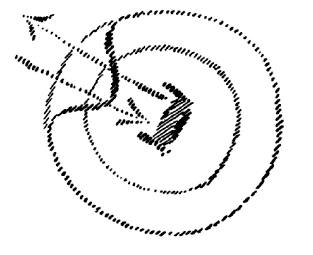
[ 13 ] Imagine the same process that occurs during a so-called reflex action: A fly lands on you somewhere; you are not even fully aware of the entire process, but you swat the fly away. This entire process has its analogue—a perfectly justified analogue—in the realm of physics. Insofar as this process calls for a physical explanation, that explanation must simply be somewhat more complicated than that of another physical process. Suppose you have a rubber ball here; you push into it, deforming the rubber ball: it springs back out and returns to its original shape. You push it again; it springs back out. That is the simple physical process: a reflex movement. However, no sensory organ is involved, and nothing mental is involved. If you introduce a mental element here (inner circle) and interrupt it here (center), then the rubber ball perceives itself as a separate entity. To perceive both the world and itself, however, the rubber ball would then have to activate a nervous system. But the nervous system is always there to perceive the world within itself; it is never there to conduct a sensation on one side of the wire and a motor impulse on the other side of the wire.
[ 14 ] I point this out because, if pursued further, it leads to one of the many points where natural science must be corrected if it is to lead to conceptions that are reasonably in line with reality. The conceptions that prevail today are nothing more than conceptions that serve the impulses of the spirits of darkness. Within human beings themselves lies the boundary between physical experience and spiritual experience.
[ 15 ] This part of the nerve, which I have marked in red (Fig. p. 12), essentially serves to place us within the physical world, to convey sensations to us within the physical world. The other part of the nerve, which I have marked in blue, essentially serves to enable us to perceive ourselves as a body. And there is no essential difference between consciously experiencing an external color through the a-c pathway and internally experiencing an organ, the location of an organ, or something similar through the d-b pathway; it is essentially the same thing. In one case, we experience something physical that does not seem to be within us; in the other, we experience something physical that is within us—that is, inside our skin. This, however, enables us to experience, during an act of will, not only what is outside us but also what is within us. But the strength of perception is conveyed differently through the a-c strand and through the d-b strand. What occurs, however, is a significant weakening of intensity. When we form a mental image together with a volitional impulse in a, this impulse is transmitted from a. As it jumps from c to d, the whole process weakens so much for our consciousness—for our conscious experience—that what we then experience within ourselves—the raising of the hand and so on—we experience only with the low intensity of consciousness that we otherwise have even in sleep. We do not perceive the act of willing again until the hand moves, when we once more have a sensation coming from another direction.
[ 16 ] Sleep does, in fact, continuously extend into waking life, both anatomically and physiologically. We are connected to the external physical world, and in reality we are always awake only with that part of our being that extends up to the point where the nerves end. Whatever lies within us beyond that point is something we sleep through even during the day. However, this is a process that is not yet physical in the current phase of Earth’s evolution, but still takes place at a certain spiritual level, even though it is often connected to the lower qualities of human nature. But I have spoken here many times before of the mystery that what is the lower nature in human beings is precisely connected to the higher manifestations of certain spiritual beings.
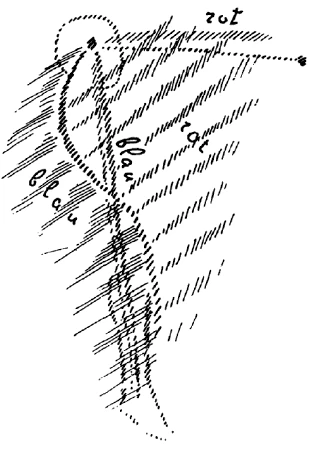
[ 17 ] If one were to gather all the points in the human body where there are breaks in the nervous system and were to map them out, one would obtain, as shown in the diagram, the boundary between experience in the physical world and experience from a higher world. That is why I can also use the following diagram. Suppose—I am drawing all the nerve interruptions schematically here—suppose there were the head and there were a leg. Now let us suppose that a so-called impression were to arise from here, and here the nerve interruption associated with “walking” had occurred. What is real, then, is this: here is everything that a person experiences through the nerves, experienced while awake during the day; here is what a person experiences as a subconscious will, experienced as if asleep even while awake. And everything that lies below the point of nerve interruption is directly formed and created from the spiritual world.
[ 18 ] These ideas may seem a bit difficult to you when you hear them for the first time. Yet they are also meant to convey to you the notion that one cannot truly delve into the more intimate aspects of human understanding without encountering certain difficulties.
[ 19 ] If you look at it this way—with everything here (in red) representing what connects human beings to the physical world, and everything below this line representing what connects human beings to a spiritual world that currently has only a subordinate physical reflection within them—if you keep this in mind, then you can associate another idea with it. This other idea that you should associate with it is as follows: Imagine the plant world for a moment. Plants grow out of the earth; but they would not grow out of the earth if they did not receive forces from the cosmos—forces that are intimately connected with the life of the sun, which receive everything that is radiated from the earth. To understand this better, read once again the essay “Human Life from the Perspective of Spiritual Science.” The life of the plant world encompasses this entire cosmic aspect, which comes from the cosmos through the life of the sun, together with what rises up from the earth.
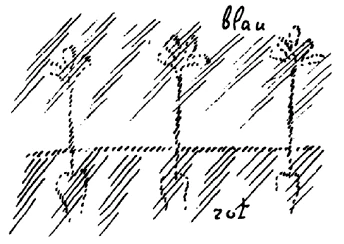
[ 20 ] But this interaction between the cosmic and that which is telluric, that which is earthly, is an integral part of life, of existence within the physical world, as we must understand it. And the very same forces that act from the earth onto the plant below this line (see drawing), together with the plant’s seed force—since the seed is also placed into the earth—this very same mass of forces of the same kind: you must look for them here, where the red lines are. On this side of the boundary that I have schematically indicated, you must, for my sake, look for the forces that you would otherwise seek as coming to the plants from the earth through the roots.
[ 21 ] Through their eyes, ears, and especially their skin, human beings absorb in a refined form from the earth what plants draw up from the soil through their roots. The plant is an earthly being through its roots. Human beings are earthly beings through their nerves and through what they take in as the earthly, the telluric, via their lungs and through the food they receive from the earth. Everything that comes to the plant from the earth—except that the plant sinks its roots into the earth—is absorbed by the human being through his organs, except that he absorbs it in a more refined way, whereas the plant absorbs it in a coarser way through its roots.
[ 22 ] But the plant absorbs other forces as well. The plant absorbs the forces that come to it from the solar realm, from the heavenly realm—the spatial-heavenly realm—and from the cosmos. I have shaded this area in blue: these are the forces that the plant absorbs from the cosmos. These forces are of the same kind as the blue-shaded forces beyond the boundary I have indicated. Human beings draw from their own bodies what the plant draws in from the cosmos. From the earth, human beings draw, in a refined form, those forces and substances that the plant draws from the soil in a coarsened form through its roots. From within their own body, human beings draw out, in a coarser form, the very same forces and substances that plants draw from the cosmos in a refined form. For just as they draw these out of their own body today, these forces are not immediately present in the cosmos in this form; rather, they existed in this form during the ancient Moon era. Human beings have preserved them from that time. Through what lies beyond this boundary—contained in the blue section shown here—human beings do not perceive directly from the present, but from what they have preserved through the legacy of the ancient Lunar Age. They have carried the cosmic essence of an ancient time into the present. Human beings have preserved the conditions of the Moon era within their bodies. And so you see that we are, in a certain sense, cosmic; indeed, we are connected to the cosmos in such a way that we carry within us an image of what the cosmos outside has already overcome.
[ 23 ] Yet another example of what I brought up here last time: that nothing will be of any use if one merely speaks of it from a general, vague, and nebulous standpoint—that human beings must once again take in a cosmic sensibility or cosmic ideas. These things have value only if they are presented to people in a completely concrete way, if one truly knows how things are and how they function. In this way, what is today merely an experiment is placed on a sound—truly sound—foundation. And when one knows how everything that lies beyond the nerve pathways within the human body is connected to the lunar being, then one will be able to discern, through these connections, which disease-causing or healing forces can be found in the cosmos and in earthly life. And when we come to understand how that which lies on this side of the boundary is connected to earthly conditions—in a refined sense, just as a plant is connected to soil conditions through its roots—then we will truly be able to consciously discern the relationship between illness and health and between the nature of certain plants.
[ 24 ] Today, things are a matter of trial and error. Human cognition must first be placed on a sound foundation, and then it will also be possible to place on a sound foundation the concepts and ideas that human beings develop in order to somehow regulate, penetrate, and give structure to social, moral, educational, and political life through their own ideas.
[ 25 ] In many areas, we observe that precisely those who think in a scientifically rigorous and expert manner begin to spin terrible tales and ramble on when they apply their familiar concepts to the realm of social life. But this realm of social life is not, after all, a completely independent sphere. Human beings exist within it with their physical, emotional, and spiritual natures, and these aspects cannot be separated from one another. And we must not simply accept the fact that humanity is being made scientifically ignorant in the social sphere, so that it is capable of nothing but idle chatter in that sphere.
[ 26 ] Today, it is easy to demonstrate how even reputable natural scientists can get caught up in idle chatter when they cross the boundary between the natural sciences and the spiritual realm. Physicians, in particular, are extraordinarily prolific in this area when it comes to producing all sorts of nonsense, especially when attempting to carry concepts derived from the natural sciences into the spiritual realm. One need only pick out any single aspect. Just delve into the fullness of human life—wherever you touch it, it is confused in this regard today.
[ 27 ] For example, I have a brochure here: “The Damage to the Nerves and Mental Life Caused by War,” by an outstanding physician. I don’t want to say just how outstanding he is, so as not to arouse your prejudice. But this outstanding physician examined the nervous system—about which the natural sciences don’t actually have even the faintest glimmer of a correct understanding, as you can see from the few hints I’ve given today—and he examined how this nervous system is being ravaged by the current conditions of war. Indeed, one need only think of the most primitive examples to point out how truly rational thinking ceases when scientific concepts are applied to what has—I’ll just say—something to do with the spiritual realm, without even being the spiritual realm itself. Isn’t it true that when one discusses something like “The Damage to the Nerves and Spiritual Life Caused by War,” one is faced with the necessity of expressing what is supposedly taking place in the nerves through all manner of concepts drawn from spiritual life—naturally, from the spiritual life that unfolds here on the physical plane—through all manner of concepts derived from this spiritual life.
[ 28 ] Now, for example, this gentleman here puts forward the notion—which is said to be justified under certain conditions of abnormal nervous activity—the notion of “overvalued ideas.” Overvalued ideas are a symptom of a diseased nervous system. Overvalued ideas—what is an overvalued idea? When one introduces such a concept, one must be clear that it must be grounded in reality. But what is an overvalued idea? For that man, an overvalued idea is something that arises when the sensory and emotional emphasis of the idea is too strong, when it is one-sided. He simply brings up all sorts of vague notions like this. Of course, I cannot give you a specific example of this. If I do not define it precisely, please do not attribute this to spiritual science, for I am merely presenting a lecture. An overvalued idea arises, for example, when, prompted by war, one hates a foreign nation too much. A “valued idea” is true patriotism. But this true love of one’s country becomes overvalued when the nervous system is irritated. One not only loves one’s country but also hates other peoples: now the idea has become overvalued. The valuable idea is healthy, and one must conclude from the valuable idea that the nerves are also healthy. But if the idea is overvalued, then the nerves are also damaged.
[ 29 ] Does one encounter reality anywhere when, on the one hand, one characterizes such a nervous process and, on the other hand, an idea that is supposed to possess a certain property? It is supposed to be “supervalued” as an idea. On the one hand is the nervous process; on the other hand is the “supervalued” idea. People would do well to always think such things through to the end, for a thought reveals its correctness or incorrectness—or, respectively, its conformity or nonconformity to reality—only when one thinks it through to the end. It would be a superimposed idea if I were to imagine that I were the King of Spain. Wouldn’t it? Without a doubt, that would be a superimposed idea. But that idea would not necessarily be overvalued if I actually were the King of Spain. Then my nervous system would be perfectly healthy, and I would have the same idea. The idea has the same content. The idea as such is therefore certainly not overvalued; otherwise, one would have to regard the King of Spain as having a diseased nervous system because he thinks he is the King of Spain, wouldn’t you agree? So this context is completely irrelevant. Nevertheless, people chatter on about these things. And they don’t just chatter; they also formulate concepts, definitions, and so on, and then they arrive at strange conclusions that are nothing more than idle chatter.
[ 30 ] For now this good gentleman has developed this concept of “overvalued ideas.” The overvaluation of an idea is, then, the symptom of an abnormal nervous life. Well, fine! But his subconscious isn’t quite at ease with this, because subconsciously he senses: while he’s presenting this whole idea of the “overvaluation” of ideas to people, they in turn have all sorts of subconscious notions that something isn’t quite right. For the listeners today, the matter naturally remains subconscious, because this gentleman is an authority—pardon me! —, so these impressions must not penetrate into consciousness. “For the term ‘overvaluation’ is intended to express not only the inherently high regard for the concepts in question, but also their ‘overvaluation’ in relation to the real significance of the facts that actually underlie them. The overvalued idea dominates consciousness to such an extent that there is not enough room alongside it for other ideas that are objectively just as valid. Consequently, the latter are suppressed, lose their effectiveness in consciousness, and their influence on the restriction and restraint of the overvalued ideas. This gives rise to one-sided exaggeration in judgment, a one-sided direction of volitional efforts, and a turning away from all other spheres of thought that are not directly connected to the center of the overvalued ideas.” It’s like saying, “Poverty comes from pauvreté”—that’s roughly how it is!
[ 31 ] “Therefore, to the calm and discerning observer, the nervously agitated state of mind always appears as something irrational, as something intellectually unfounded; and it is therefore entirely in keeping with reality when the calm observer attempts to bring the nervously agitated person back onto the right path of thought and judgment with the words: ‘Come to your senses, be reasonable!’”
[ 32 ] So now he has spoken of the “supervaluance” of ideas, of their connection to the nervous system. But now things are getting a bit murky in his subconscious, because the story is, after all, just talk, and it doesn’t quite fit. Well, so he continues his speech: “But we must not automatically equate the ‘supervalued idea’ with every emotional and unusually vivid mode of imagination. Everything noble and lofty that stirs the human spirit and enables it to perform great deeds—that which awakens devotion and enthusiasm for a great deed and for the mobilization of all one’s powers to achieve a great goal—all this, too, springs solely from great ideas that dominate the spirit and give it the strength and endurance of will without which purposeful action is impossible.”
[ 33 ] Exaggerated ideas destroy the nervous system; they are, at the very least, a symptom of it; but everything lofty and noble is actually just the same. There is no real difference. But he must at least mention that history is actually just the same.
[ 34 ] “Throughout the history of individuals and of nations, we see great deeds accomplished under the influence of a great guiding idea, which kept its ‘bearer’ steadfast on the same path and in the same direction, driving him forward and enabling him to achieve that tireless perseverance which, despite obstacles and resistance, allowed him to reach the goal he had once recognized and strived for. What would have become of Galileo, Richard Wagner, Bismarck, and many other great men without the driving force of a great guiding idea that propelled the spirit forward for years and decades in a specific direction of will, despite all struggles and resistance!”—an idea that was therefore “supervaluable,” that was quite clearly “supervaluable”!
[ 35 ] Sometimes there is a hint of honesty here. There is a school of thought in the natural sciences that declares all geniuses to be somewhat crazy, because, after all, on this ground it is impossible to discern a real difference between genius and madness anyway. And I have told you that there are already works today that portray Jesus Christ as a pathologically ill person, so that, in fact, the whole of Christianity is the result of the fact that once upon a time, someone in Palestine who went by the name of Jesus was not quite right in the head. This is the subject of discussion today among various serious, scientifically respected figures.
[ 36 ] The emptiness of such thinking sometimes becomes strikingly apparent, as when the gentleman in question goes on to say: “But therein lies the tragedy of the human spirit: that the ideas which fill consciousness with the greatest intensity are not always the correct ones”—the tragedy of the human spirit is explained here with great depth, extraordinary depth!—“and do not always fit into the orderly context of the external world.”
[ 37 ] Now we’ve got it! How far is it from such conceptions to the insight that can only be attained on the basis of the kind of considerations we are making here? Certainly, the same body of ideas may be present in two people; only, in one case it is, let us say, Luciferic, in another Ahrimanic, and in a third it corresponds to the normal development of humanity. Instead of coining the empty phrase “supervalued ideas,” the concept of a spirituality—such as Luciferic or Ahrimanic spirituality—must be introduced, so that one knows: what matters is recognizing whether the human being wills of their own accord, or whether something else within them is willing. But, of course, such so-called science still shies away from this today.
[ 38 ] Things get really interesting when you expect something substantial to actually be presented: “First, I’ll mention”—he wants to begin by pointing out the signs that herald certain nervous disorders in humans—“first, I’ll mention the very same notions that often play the greatest role in an individual’s nervousness:” — he means, in today’s mass hysteria as well — “the notions of despondency, worry, timidity, discouragement, and a lack of self-confidence.”
[ 39 ] These, then, are the traits that characterize a disturbed nervous system in a nervous existence dominated by overvalued ideas: despondency, worry, timidity, discouragement, and a lack of self-confidence. Isn’t it true that a lecture like this could, in some way, be useful? After all, the authority in question is unlikely to speak merely to stir up a commotion, but rather to be of some use. One should therefore expect this gentleman to explain how humanity can overcome these issues, since he finds—just as with the individual—that despondency, anxiety, worry, and a lack of self-confidence are symptoms of nervous disorders in humanity today. One would expect him to explain how to remedy these issues—how to overcome this despondency, worry, discouragement, and lack of self-confidence. One would assume this. In fact, he does assume it. He therefore says: “And so, at least temporarily, that despondent, dissatisfied mood can take hold among large segments of the population—a mood we have more reason to fear than anything else. For it leads to a waning of strong impulses of will, to a loosening of firm, unified determination, and to a weakening of energy and endurance.”
[ 40 ] So now you’re expecting something, aren’t you? Then he says: “Not getting nervous, therefore, means first and foremost having courage, confidence, and trust in one’s own strength, and not losing faith in the actions one recognizes as right.”
[ 41 ] Well, all right, now we’ve got it. You get nervous when you’re worried, discouraged, disheartened, or lacking in self-confidence. How do you get rid of it? When you don’t have it! It’s perfectly clear, isn’t it, when you don’t have it!
[ 42 ] This futility of thought carries over into the substantive realm, even in science, and such authorities have all the material at their disposal; they have occupied it, confiscated it, whenever any attempt is made to process the material with reason—but in processing the material, they process it with futile thoughts. The anatomical, physiological, and physical material is lost. Nothing is created, because at the very table where what is useful for humanity is supposed to be created, there stand people with such futile thoughts! Of course, nothing can come of the dissection of a corpse if—forgive me for saying so—an empty-headed person is performing the dissection. Here, things take on a social dimension. This is the perspective from which matters must be viewed. And such a promising treatise, which recounts a lecture, ends in this manner!
[ 43 ] I have given you one example: Not getting nervous, therefore, means first and foremost not losing courage, confidence, and trust. But when the average reader today picks up a treatise like this and reads, “The Damage to the Nerves and Mental Life Caused by War,” he thinks: Here I can learn something, because this is by Professor Dr. So-and-so, director of the medical clinic in So-and-so. — Well, then he’s sure of it: now, of course, he’ll be enlightened.
[ 44 ] Yet, for example, on page 27, where hatred among nations is discussed, it says: “But, of course, similar emotions flared up within us as well, and we felt it was almost a relieving satisfaction to now, for our part, confront our chief enemy with similar sentiments. And yet it takes only a little calm reflection to recognize that this general hatred among peoples is merely the outflow of a pathological, overstimulated state of mind into which the masses have fallen through mutual encouragement, incitement, and imitation.”
[ 45 ] Well, according to this statement, how did this whole business of ethnic hatred actually come about? There are peoples: A, B, C; actually, neither A nor B nor C is in any way inclined to hate of its own accord, for that is not where the whole story originated; rather, this general hatred among peoples arose from a pathologically overstimulated state of mind into which the masses were driven by mutual incitement, agitation, and imitation. So A can’t do it; neither can B; nor can C; but what none of them can do on their own, they now incite one another to do. Just imagine how astute this idea is! I’m explaining something; I have A, B, and C in front of me; none of this is suitable for an explanation—but they do it anyway. So I explain something out of thin air in the most beautiful way. People take these things in hand, read them, and fail to realize that it’s sheer nonsense.
[ 46 ] It is indeed necessary to point out such things, for they show just how twisted, how futile the thinking is that claims authority today. Of course, in science—which draws on what already exists—this does not become so apparent, because there one cannot control history. But just as people think in science, so do they think in social, educational, and political life. And this has been developing for four centuries. That is how it is. And so it has come to pass that this contorted, futile thinking has gradually given rise to the very impulses we now feel confronting us in today’s catastrophic events. One really must look deep into the heart of the matter. And only when people reach the surface of things—where, I would say, the issue becomes immediately relevant to the individual and can also become so for the social structure of entire peoples—is the situation particularly, horribly sad!
[ 47 ] Isn't it true that, on the one hand, our task is to grasp things; we must come to know them in their mutual distinctness if we want to understand them. If one wants to understand an event such as the current war—which is so complicated and, of course, cannot be grasped in its details from a purely physical perspective—one must, as they say, trace it back to its causes, and so on. But everyone believes this: once one has traced a matter back to its cause, once one has understood it in this way, then it must necessarily have happened exactly as it is. Today, for example, people do not even notice in the slightest that one thing has absolutely nothing to do with the other. The fact that one recognizes a matter in its context does not in any way establish that the event had to occur, as they say, or that it could not have been prevented. Anyone who tries, in a more or less intelligent way, to understand why the current war was inevitable—why it is not simply something a few people decided upon, but rather something connected to deeper causes in human development—often walks away satisfied and says: “So I have come to understand that it was simply impossible for this war not to have happened!” — It is, of course, a necessity in the sense that, once one knows its causes, it inevitably developed from these causes, from these concrete conditions. But that does not mean one may conclude from this that things had to happen exactly as they did. No event that occurs in world history is necessary in this latter sense, even though it is necessary in the former sense—no event is necessary in this latter sense. Each could have been different; and each could also not have happened!
[ 48 ] And anyone who then speaks of absolute necessity could just as easily ask himself: I would like to know when I will die. So I go to an insurance company; the people there do the calculations, and based on that, they determine the amount of the insurance policy: how many out of a certain number of people have died after a certain period of time and how many are still alive. The payouts are then calculated accordingly. So I go there, inquire at an insurance company; based on their calculations, it should become clear whether I will have already died by 1920.
[ 49 ] That is, of course, utter nonsense. But it is just as nonsensical to try to deduce the necessity of one event from another—that is, from understanding the cause that must lead to that event. And with this, I am broaching a topic that is certainly not easy, for the reason that it is precisely in this area that the most contorted ideas prevail, and because even today there is still not much willingness in this area to gain clarity on these matters.
[ 50 ] The point is this: if one wants to gain clarity on the question raised here, one must recognize that whenever anything occurs, it occurs under the influence of certain conditions. In the sequence of conditions, one always arrives at a point where there are beginnings in the world—true beginnings. If you see a sapling today that is still small, you know that it will be larger in the future. The sapling’s growth from smallness to greatness is a necessity. And after some time, you can say: It is a necessity that this sapling has developed in this way; I could see how it developed out of necessity from something very small, perhaps just as it was developing its first shoots from the earth. If I were a botanist, I could see that a large tree must necessarily emerge there after some time. But if the seed had not fallen there in that spot, what then? Perhaps a person planted it there. If he hadn’t done so, then there would be a point where necessity would not have been set in motion. But now necessity must begin there. And, let’s say, you have a mighty oak here—it isn’t actually there, of course—you look at it and admire it. This oak was, of course, once a small sapling; it developed out of necessity from a small sapling. But suppose a good-for-nothing boy or—pardon me, so as not to be rude—a good-for-nothing girl had come to the spot where the little sapling stood when it was still very small and had pulled it out: by pulling it out, that entire necessity would not have come about. You can also remove necessity in a negative way.
[ 51 ] The starting points where necessities begin present themselves to thinking that corresponds to reality; that is the essential point. But one cannot arrive at these starting points by merely observing the outward course of events. One can only arrive at them if one can at least sense their spiritual foundation. For just as you have a bouquet of roses here, and just as, when you imagine it, it provides the abstract thinker with a mental image that reflects reality—for the bouquet of roses is real to him, and his mental image reflects reality—so, for the occultist, the bouquet of roses, when he imagines it, is nothing real at all, because the bouquet of roses does not exist; the roses can only exist if they are in the soil together with their roots, and so on. A true mental image is not achieved by merely reproducing something external from the outset, but rather by recreating this experienced mental image from reality itself. However, this experienced mental image arises in relation to external sensory reality only through spiritual scientific observation.
[ 52 ] And so, even for an event in world history, a valid conception can only be arrived at if one is able to survey that event from a humanities perspective. There one finds that, in terms of its necessity, it can indeed be traced. One finds its ramifications and its roots within reality itself. But only by concretely tracing these roots is anything truly achieved; not by merely making a general assertion about an abstract necessity. If, for example, certain events in the 1880s had been different, then the events of 1914 would also have been different. But the crucial point is precisely this: one must not proceed as historians do—something happens now that is the effect of what preceded it, which in turn is the effect of what preceded it, and so on. That way, one does not merely reach the beginning of the world, but descends even further into utter nothingness. One idea rolls along after another. That cannot be the point; rather, it is the concrete pursuit of this matter, the actual taking root. Just as a plant’s root begins somewhere, so too do events begin somewhere. Seeds are sown over the course of time. If the seeds are not sown, then the events do not arise either. I am thus broaching a topic that I obviously cannot exhaust today. Next Sunday, we will continue discussing this topic, which I essentially wish to characterize as follows: Despite all consideration of necessity, not a single event is absolutely necessary — we still have more to say on this.
[ 53 ] It is truly necessary for humanity today to break free—even in its mindset—from this terrible dogmatism that pervades so-called science today, so that things can be taken seriously. I would like to give you a concrete example. With that, I will conclude today’s reflections. In Zurich and Basel, I tried to make it clear that it is nonsense to view world-historical events in sequence as if one were emerging from the other. I said it is absurd to assume that one event follows from another simply by viewing them as emerging one after the other. This is like having a light source here that first illuminates object a, then object b, and finally object c. In my observation, I see a illuminated first, then b, then c, even though I do not perceive the light source at all. Now I would be making a mistake, wouldn’t I, if I saw a illuminated first, then b, and said that b is illuminated by a; and if I then saw c illuminated and said that c is illuminated by b. I would be saying something completely incorrect, because the illumination of b and c has nothing to do with that—rather, they are illuminated by a common light source. I used this example to explain the historical events.
[ 54 ] Now suppose someone were to find this concept—which I have introduced here—and this idea appealing. It could be that even a concept that has grown out of anthroposophical soil might one day be found appealing. In fact, it has even happened here and there recently that opponents, of all people, have taken these terms and used them for their own purposes. Some have even become opponents precisely because such things had to be criticized. So it could well be that an analogy put forward from the anthroposophical side might not be complete nonsense after all. Let’s suppose someone were to take it up, but then present it in a different context than I did; they would present it dogmatically—not symptomatically, as I did—with a different mindset, and I heard a lecture in which they said: The sequence of cause and effect is portrayed entirely incorrectly when one constantly says that effect b is the consequence of cause a, effect c the consequence of cause b, and so on; for in doing so, one commits the same Mistake, as if one were to say: if a is illuminated, b is illuminated, and c is illuminated, then b is illuminated as a result of a and c is illuminated as a result of b. If I were to hear this and it were not presented in the same context as I did in Basel and Zurich, I might be able to object to the man, taking his argument out of context: But if the situation is such that a, b, and c are so-called afterglow materials—such materials do exist, when exposed to a light source, they begin to glow on their own, even after the light source has been removed—if a, because it afterglows, actually illuminates b, and b, in turn, because it afterglows, illuminates c: well, then it could be the case that b is illuminated as a result of a, and c is illuminated as a result of b. So the whole analogy could be a very fragile one if it is put forward by someone who has not made it clear in the course of their lecture that concepts of reality in spiritual life are like photographs. If you take a photograph from one side, it looks different than if you take it from the other side. If one does not assume this, if one does not lead up to concepts that correspond to reality—so that these reality-corresponding concepts are always perspectival concepts—then, under certain circumstances, one can say something nonsensical using the very same statement that is absolutely correct when meant in a perspectival sense, as soon as one states it absolutely.
[ 55 ] That is the difference between starting from reality and starting from concepts. If one starts from concepts, one will always fall into one-sidedness. But if one starts from reality, then—because one can do nothing other than put forward concepts, and every concept is one-sided—one may and must put forward one-sided concepts, for that is only to be expected. So you see, what matters is a complete transformation of the soul life, a profound transformation of the soul life. Therefore, it is of course not at all difficult to criticize the numerous concepts I put forward. I do not know whether anyone would have come up with this criticism on their own, but I myself already address everything that needs to be criticized.
[ 56 ] One must be aware of how ideas relate to reality. Only then is it possible to penetrate reality; otherwise, one is always arguing about ideas. And today the whole world is arguing about ideas in the social sphere, even if this arguing has now translated into outward actions. And very often, the arguing over outward ideas translates into outward actions. These things already lead into great depths of intimacy—intimacies of spiritual life. But one must reflect on such things if one wants to understand existence.
[ 57 ] Now that I have drawn your attention to such matters in a more theoretical way today, next time I will speak about contemporary history from this perspective; I will show to what extent it was necessary for certain events to occur, but also to what extent these events were not necessary at all—and that entirely different events could have occurred instead. Events whose catastrophic nature we all suffer from need not have happened at all. Let’s continue discussing this important question next Sunday.