

Historical Necessity and Freedom
The Influence of Fate from the World of the Dead
GA 179
17 December 1917, Dornach
Translated by Steiner Online Library
Seventh Lecture
[ 1 ] The reflections presented over the past few weeks were based on various considerations that can lead to an understanding of human nature in its connection with the historical development of humanity, such that one can gradually form a conception of necessity and freedom. Such matters can be resolved less through definitions and semantic disputes than by gathering the relevant truths from the spiritual world. In our age, humanity will have to become increasingly accustomed to adopting a different way of understanding reality than the one that is so prevalent and common today—a way that, at its core, clings to very secondary matters and all sorts of nebulous notions tied to verbal definitions and the like. Today, when one considers what some people write or say—people who consider themselves particularly clever—one gets the feeling that they are speaking in terms and concepts that are only seemingly definite, but in reality are as indefinite as if someone were speaking about a certain object made, for example, from a pumpkin. If you’ve reshaped a pumpkin into a bottle and are using it as a bottle, you can talk about this object as if you were talking about a pumpkin, because in reality it is a pumpkin; but you can also talk about it as if it were a bottle, because it is also a bottle—it is being used properly as a bottle. Isn’t it true that the things we talk about only acquire their meaning within the contexts in which we find ourselves? If one speaks not by relying on words but from a certain perspective, then everyone will know whether one means a bottle or a pumpkin. But one must not then limit oneself to the description or definition of the object. For as long as one limits oneself to a description or a definition, it might just as well be a gourd or a bottle. And so today, what many philologists—people who think themselves very clever—talk about may be the human soul, but it may also be the human body; it may be a gourd, and it may be a bottle.
[ 2 ] By this remark, I mean much of what is taken very seriously today, in part to the detriment of humanity. That is precisely why it is necessary—especially on the part of anthroposophically oriented spiritual science, which, among other things, requires clear, precise thinking, to make an effort not to view the world in the way that is customary today—not to confuse the pumpkin with the bottle—but to look for the real in everything, whether it be the outer physical reality or the spiritual reality.
[ 3 ] In any case, one cannot arrive at a true understanding of what is relevant to human beings by relying on definitions and the like, but only by considering the realities of life in their entirety. And one can only gain clarity regarding such important concepts as freedom and necessity in social and moral life by holding together the spiritual facts as presented in these reflections and, in a sense, constantly weighing them against one another in order to form a judgment about reality.
[ 4 ] Please bear in mind that I have repeatedly emphasized—with a certain intensity—in public lectures and here as well, in a wide variety of contexts, that we can only truly understand what we call “ideas” if we relate them to our physical organism in such a way that we do not see in the body something growing, flourishing, but rather, on the contrary, something that is dying, something that is partially dying within the body. I expressed this so clearly in a public lecture that I said: Human beings are, in fact, always dying into their nervous system. The nervous process is such that it must be confined to the nervous system. For if it were to extend throughout the entire organism—if what occurs in the nerves were to occur throughout the entire organism—this would mean the death of the human being at every moment. One might say: Images arise where the organism breaks itself down; we are continually dying into our nervous system. — This compels spiritual science to investigate not only those processes that modern natural science regards as the only authoritative ones—the ascending processes. These ascending processes are processes of growth; they still culminate in the unconscious. Only when the organism begins the descending processes does that activity of the soul emerge within the organism which can be described as imagination—and indeed as sensory perception. This process of breakdown, this process of initial dying, must be present if imagination is to occur at all.
[ 5 ] I have now shown that human free will is based precisely on the fact that human beings are able to seek the impulses for their actions from pure thoughts. These pure thoughts will have the greatest influence on the metabolic processes in the human organism. What actually happens when a person truly performs a free act? Let us clarify what actually happens in the ordinary physical human being when a person acts out of moral imagination—you now know what I mean by that—out of moral imagination, that is, out of a form of thinking that is not dominated by sensory impulses, sensory drives, and emotions. What actually happens to the person then? What happens then is that they surrender themselves to pure thoughts; these thoughts form their impulses. The thoughts cannot impel them by themselves; they must impel themselves, for they are mere mirror images—as we have emphasized. They belong to Maya. Mirror images cannot compel; human beings must compel themselves under the influence of pure ideas.
[ 6 ] What do pure ideas affect? They have the strongest effect on the process of decay in the human organism. On the one hand, the process of decay emanates from the organism, and on the other hand, the pure thought of action—arising from spiritual life—meets this process of decay. By this I mean the thought that underlies the action. Through the union of the two—through the interaction of the process of decay and the thought of action—free action arises.
[ 7 ] I said that the process of decay is not brought about by pure thought; it is there anyway, so it is actually always there. If a person does not counter this process of decay—especially the most significant processes of decay within them—with anything arising from pure thought, then it remains a process of decay; then the process of decay is not transformed into a process of growth; then a dying part remains within the person. Think this through, and you will see that it is possible for a person, precisely by refraining from free actions, to fail to reverse a process of death within themselves. Herein lies one of the most subtle ideas that a person needs to take to heart. Anyone who understands this idea can no longer doubt the existence of human freedom in life. For an action that arises from freedom does not occur through something caused within the organism, but rather where the causes cease—namely, out of a process of decay. There must be something underlying the organism where the causes cease; only then can the pure idea intervene as a motive for action. But such processes of dissolution are always present; they merely remain, so to speak, unused when a person does not perform free actions.
[ 8 ] What underlies this, however, also testifies to what an age must look like that refuses to fully embrace the idea of freedom. The second half of the 19th century, the 20th century, and right up to our own time—this era has made it its very mission to increasingly obscure the idea of freedom in all areas of life, to the point of effectively eliminating it from practical reality. People did not want to understand freedom; they did not want to have freedom. Philosophers have endeavored to prove that everything arises from human nature with a certain necessity. Certainly, human nature is based on a necessity, but this necessity ceases when processes of decay begin, in which the chain of causes comes to an end. If freedom has intervened where necessity ceases within the organism, then one cannot say that human actions arise from inner necessity; they arise from it only when this necessity ceases. The entire error lay in the fact that people did not engage in understanding not only the constructive processes within the human organism, but also the destructive processes. However, in order to recognize what actually underlies human nature, it would indeed be necessary to develop more talent than the present age is inclined to do. We saw yesterday that it is necessary to be able to truly grasp with the eye of the soul what is called the human “I.” But precisely in the present age, there is little talent available to grasp this reality of the “I” in any way. I will provide you with proof.
[ 9 ] I have often mentioned Theodor Ziehen’s excellent scholarly work, Physiological Psychology. On page 205, he also discusses the “I.” However, Ziehen never even comes close to alluding to the true “I”; instead, he speaks only of the concept of the “I.” We know, however, that this is merely a reflection of the real “I.” But it is particularly interesting to hear how an outstanding contemporary thinker—one who believes he can exhaust the subject entirely through scientific concepts—speaks about the “I.” These are transcribed lectures, which is why the material is presented in lecture form. Ziehen says: “You may notice that the concept of the ‘I’—denoted by the short little word ‘I’—is supposed to be such a complex, three-part structure, involving thousands upon thousands of sub-concepts. But I ask you to consider this: although the word is short, the fact that its conceptual content must be very complex is already evident from the fact that each of you will find yourselves at a loss if asked to describe the mental content of your so-called ‘I’ concept.”
[ 10 ] And now Ziehen sets out to say something about the content of thought in the concept of the “I.” Let us see what this distinguished scholar has to say about what one is actually supposed to think of when thinking about one’s “I”: “You will immediately think of your body”—that is, think of your body! — “your relationships to the outside world, your family ties and property relations”—so one will soon start thinking about one’s wallet and counting one’s money! — “your names and titles …”
[ 11 ] Well, the distinguished scholar explicitly points out that one should also think of one’s name and title when attempting to encompass and embrace one’s self in one’s imagination.
[ 12 ] “... your main inclinations and dominant ideas, and finally to your past, thereby demonstrating just how complex this concept of the self is. Of course, the reflective person reduces this complexity of the concept of the self back to a relative simplicity by contrasting his own self—as the subject of his sensations, ideas, and movements—with external objects and other selves. Certainly, this juxtaposition and this simplification of the concept of the self also have their deep epistemological justification, but, viewed purely from a psychological perspective, this simple self is merely a theoretical fiction.”
[ 13 ] So “this simple ‘I’” is merely a “theoretical fiction”—that is, a mere figment of the imagination that takes shape when one lists one’s name, titles, and presumably also one’s medals and other such things that lend one prestige! It is at such points that one can recognize the full weakness of contemporary thinking. And this weakness must be taken into account all the more because what proves to be a decisive weakness for the understanding of spiritual life is, in fact, a strength for the understanding of external scientific facts. Precisely what is unsuitable for understanding spiritual life is very well suited to penetrating the external, sensory fact in its immediate, external necessity.
[ 14 ] We must not delude ourselves: it is a hallmark of our time that people who may excel in one field are proponents of utter nonsense in another. Only by taking a sharp, clear look at this fact—which is so well suited to throwing sand in humanity’s eyes—can one begin to contribute to the restoration of that power humanity needs to gain insights that can intervene fruitfully and healingly in life. For in life as it is today, only ideas drawn deeply from true reality—ideas for which one does not shy away from delving deeply into true reality—will have an impact. Yet it is precisely this that many people today shy away from.
[ 15 ] People today are very often inclined to reform spiritual reality without first looking into the true reality from which they should draw their inspiration. Who today does not reform all manner of things in the world—that is to say, believe they are reforming them? What is not drawn from the pure nothingness of the soul! But in a time such as this, only those things can bear fruit that are drawn from the depths of spiritual reality itself. For this, will must be present.
[ 16 ] The vanity that, based on spiritual nothingness, seeks to embrace all manner of reformist ideas is just as harmful to development in our present age as materialism itself. Yesterday, at the end, I pointed out how the true self of the human being—that self which indeed belongs to the nature of the will and is therefore veiled from ordinary consciousness—must be enriched by guiding people, through public education, toward a concrete understanding of the major issues of our time. In our time, this can be achieved only by making clear which spiritual forces and influences are at work in our events. It is not enough to speak in general, nebulous terms about the spirit; rather, it requires an understanding of the concrete spiritual processes, as we have described them in these reflections, where specific years are cited to show how, here and there, these particular powers and forces from the spiritual world have intervened here in the physical world.
[ 17 ] This, however, gives rise to what I might describe, in the overall development of humanity, as the collaboration of the so-called dead with the so-called living. For in the reality of our emotional and volitional life, we are in the same realm as the dead. One might just as well say that, in the reality of our “I” and our astral body, we are in the same realm as the dead. Both statements mean the same thing. This points to a shared realm in which we are embedded, where the dead and the living work together on that fabric which can be called social, moral, and historical human life in its entirety—a realm that also includes the life courses spent between death and a new birth.
[ 18 ] In these reflections, we have pointed out how the so-called dead, between death and a new birth, have the animal kingdom as their lowest realm, just as we have the mineral kingdom as our lowest realm. We have also pointed out, in a certain sense, how the dead person must work within the essence of the animal kingdom, how they must build, from the laws of animality, that which in turn forms the basis of the organization for the next incarnation. We have pointed out how, as a second realm, the deceased experiences all those connections that were karmically established here in the physical world and that continue into the spiritual world in a correspondingly transformed form. A second realm thus unfolds for the deceased, woven together from all the karmic connections he has ever established in any incarnation on Earth. Through this, however, everything that a human being develops an interest in between death and a new birth gradually expands—one might say—in concrete terms to encompass all of humanity.
[ 19 ] We can understand the realm of the Angeloi as the third realm that human beings then experience. And we have already pointed out, in a certain sense, the role the Angeloi play in the life between death and a new birth. They carry, so to speak, the thoughts from one human soul to another and bring them back again. They are the messengers of the collective life of thought. The Angeloi are, in essence, the beings of the higher hierarchies of whom the deceased has the clearest experience; a clear experience of the animal aspects and a clear experience of the human connections that have shaped his karma through the beings of the higher hierarchies. He has the clearest conception of those beings from the hierarchy of the Angels, who are actually the bearers of thoughts—or rather, of the soul’s contents in general—from one being to another, and who also help the deceased in working through his animal nature. One could say—when speaking of the affairs of the dead as personal affairs—that the beings from the hierarchy of the Angeloi are primarily concerned with attending to the personal affairs of the dead. More general affairs of the dead, which are not personal, are handled more by the beings from the realm of the Archangeloi and the Archai.
[ 20 ] If you recall the lecture series on “The Inner Nature of the Human Being and Life Between Death and Rebirth,” you will remember that part of the life of the so-called dead person involves, in a sense, alternately expanding their being out into the world and drawing it back into their inner self. I explained and described this in greater depth there. The life of the dead proceeds in such a way that, in a sense, a kind of alternation takes place between day and night. But this alternation is such that a vibrant life emerges from within. We know that what emerges there—this vibrant life—is merely the reemergence of what was experienced in the other state, with which this one alternates: the state in which one’s being was extended out into the world, in which one became one with the external world. When one therefore encounters a deceased person, one encounters alternating states: states in which the person extends their being out into the world, in which they, so to speak, grow with their own being into the essence of their surroundings, into the processes of their surroundings. It is then that they are least aware; a kind of sleep-like state prevails for them when they grow with their being into the spiritual world around them. When this emerges again from within them, a kind of waking state prevails for them, and they are aware of all this. For their life flows in time, not in space. Just as we, as possessors of waking daytime consciousness, have—out there in space—that which we take into our consciousness and then, in turn, withdraw from it during sleep, so it is with the dead: they take the experiences from a certain period of time they have lived through into the next period, and these experiences then fill their consciousness. Past time fills their consciousness, just as our waking consciousness fills space. It is a life entirely lived in time. And one must become acquainted with this.
[ 21 ] Through this rhythmic existence in time that the deceased leads, he now enters into a very specific relationship with the beings from the hierarchy of the Archangeloi and the Archai. He does not have as clear a conception of these beings—the Archangels and the Archai—as he does of the Angels, human beings, and the animal kingdom; but above all, he always has the sense that these beings—the Archai and Archangels—are the ones who work together with him in this cycle of waking, sleeping, waking, and sleeping, which unfolds over the course of time. When the deceased is ready to develop an awareness of what he experienced but did not know during the preceding period—he is always aware that a being from the hierarchy of the Archai has awakened him; he is always aware that, with regard to this rhythmic life, he is working together with the Archai and Archangeloi.
[ 22 ] Let us hold fast to this, just as we become aware of it here upon waking: we become conscious of the outer world, of which we are unaware while sleeping; just as we perceive it here: this outer world descends into darkness when we fall asleep—so consciousness lives in the soul of the so-called dead: Archai, Archangeloi—I work together with them so that I may pass through this life of falling asleep, waking up, falling asleep, waking up, and so on. One might say that the dead person interacts with the Archangeloi and Archai just as we here, in waking consciousness, interact with our physical surroundings—the plant and mineral worlds. Human beings cannot look back upon this interplay in which they are woven between death and a new birth. Why not? Well, one might ask: Why not? — but it is precisely this looking back that human beings will have to learn; only, of course, it is difficult for them to learn this from the materialistic conceptions of the present. I would like to illustrate to you why human beings do not look back (see drawing).
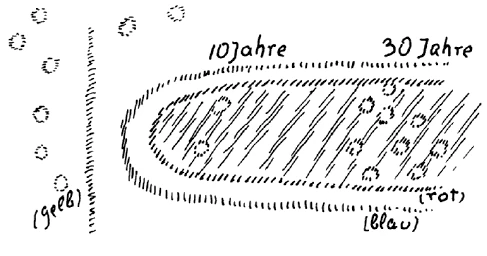
[ 23 ] Suppose for a moment that you are facing the world with your entire sensory and imaginative apparatus. As a result, you have ideas and perceptual contents of the most varied kinds. I represent what is present in consciousness at a given moment by drawing various rings, small circles. That is what is present in consciousness at that moment. Now, as you know, a process of recollection takes place—albeit in a different way than psychologists today believe—when you look back; and the span of time you can look back on through memory—I denote this with this line, which actually represents the space that tapers off here; this point would correspond to the third, fourth, or fifth year, marking the furthest back one can recall in life. Within that span lie all the mental images that arise when one recalls the experiences one has had. Suppose you have these images—let’s say at the age of three—then, as these images appear before you, you are recalling something you experienced ten years ago. If you try to imagine quite vividly and pictorially what this is actually like for the soul, you can think of it this way. You can say to yourself: When we look back to the point in childhood where those memories emerge—as far as our recollection extends—it is like a “soul sack” that has an end; its arc ends at the point up to which we can recall our childhood. That is such a “soul sack”; that is the span of time we can survey. Imagine such a “sack” of the soul into which you look back: here is the boundary of this sack; in reality, this boundary coincides with the boundary between the etheric body and the physical body. This boundary must be there—you can picture it very roughly—otherwise the processes that bring about memory would constantly fall through it. You would not be able to remember anything; the soul would be a sack with no bottom, and everything would fall right through. So there must be a boundary; there must be a real “sack” of the soul. But this “sack” of the soul also prevents you from perceiving, at the same time, what you have experienced as lying outside of it. You are opaque to yourself in your soul life because you have memories. Because you have the capacity for memory, you are opaque.
[ 24 ] You see, what enables us to have a clear awareness of the physical plane is, at the same time, the reason why we cannot perceive, with ordinary consciousness, this realm that must lie beyond memory. For in reality, it does lie beyond memory. However, one can make an effort to gradually reshape one’s memory. One must simply proceed with caution. One can begin by trying to contemplate what one remembers more and more precisely through meditation, until one has the feeling: It is not merely something one grasps in memory, but something that actually remains there. A person who develops an intense, active spiritual life gradually begins to feel that a memory is not something that comes and goes, comes and fades away, but that the content of the memory is something that remains. However, working in this way can only lead to the conviction that what otherwise appears in memory remains there, that it truly persists as the Akashic Records, that it does not go away. What we otherwise survey in memory: it is there in the world; it is actually there. But this method does not actually take you any further, for this method—of recalling only one’s personal experiences, which is easily evoked, along with the realization that the content of memory remains—is, in a higher sense, too egotistical to lead any further than this conviction. On the contrary, if you were to develop this very ability beyond a certain point—to focus on what remains of your own experiences—you would only block your view into the free world of the spirit. For instead of the storehouse of memories being there, only your own life would stand there all the more compactly, preventing you from seeing through it.
[ 25 ] In contrast, one can apply another method that, if I may use the expression, makes the records of the Akashic Records transparent in a most excellent way. And once one sees through the memories that have remained, one can certainly glimpse into the spiritual world with which one was connected between death and a new birth. But to do this, one must not rely solely on what remains as memories from one’s own life—for these become ever more compact, making it all the more difficult to see through them. That is what must become transparent. And it would be transparent if one were to make an ever-stronger effort not so much to remember what one experienced from one’s own perspective, but rather to remember more and more what approached one from the outside. Instead of what one has learned, one remembers the teacher—the way the teacher spoke, the way the teacher came across, what the teacher did with one. One remembers how the book from which one learned this or that came into being. One remembers, above all, what has worked on one from the outside world.
[ 26 ] A very beautiful, wonderful starting point—indeed, a guide to such recollection—is Goethe’s work Poetry and Truth, in which he describes how he, Goethe, was shaped by his time; how various forces worked upon him. The fact that Goethe did something like this in his life—that he looked back in this way, not from the perspective of his own experiences, but from the perspective of others and the events of the time that shaped him—is what enabled him to gain such deep insights into the spiritual world as he did. But this is also, at the same time, the path to coming into contact, on a broader scale, with the time that has elapsed between the last death and our own birth.
[ 27 ] So you see, from a different perspective, I am pointing out to you today the very same thing I have already pointed out: broadening one’s interests beyond the personal, directing one’s interests and attention specifically toward that which is not us, but rather what has shaped us, from which we have emerged. One ideal is to look toward the present and the distant past before us and to seek out all the forces that have shaped the person we have become from within.
[ 28 ] That, however, presents few difficulties when described in this way, but it is not an entirely easy task. It is also a task that, because it requires a high degree of selflessness, is highly successful. It is precisely this method that awakens the powers needed to enter, with one’s own self, into the same sphere that the dead share with the living. To get to know one’s own time more—rather than oneself—will be the task of public education in the not-too-distant future; but to get to know one’s own time in concrete terms, not as it is currently presented in history books, but as this time naturally develops out of spiritual impulses.
[ 29 ] Once again, then, we are led in this way to broaden our perspective on a defining characteristic of our age and its emergence from the general course of world history. Why, then, did Goethe strive so intensely to become acquainted with Greek art, to understand his own time through and through, and to measure it against the preceding era? Why does he have his Faust go back to the Greek era, to the time of Helen, to seek out Chiron and the Sphinx? Because he wants to understand his own era—how it has shaped him—in a way that is only possible by measuring his own era against earlier times. But Goethe does not have his Faust sit down and unroll parchments or documents from the state archives; rather, he leads him back along the paths of the soul to the impulses that shaped him personally. There is much within him that points humanity toward a coming together, on the one hand, with the dead, and on the other—as you can now see from the connection between the dead and the Archangels—with the spirits of the age and the Archangels. Through this coming together with the dead, humanity also comes into contact with the Archangels and the spirits of the age. It is precisely in the impulses to which Goethe alludes in his Faust that lies what enables human beings to expand their interests beyond the spirit of the age; it is precisely this that is necessary in the most eminent sense for our time. However, our time needs to look at works such as Faust in a different way than it has done so far. Most of those who evaluate Faust scarcely grasp where the problems lie. Some do manage to ask the questions. The answers are often given in the most curious ways.
[ 30 ] Take an example where Goethe really does point this out: Think! Is there always reflection? Yet Goethe does everything he can to make it clear that certain things require reflection. For example: You know that Erichtho speaks about the scene that forms the setting for the classic Walpurgis Night; she departs, and the air travelers—the Homunculus, Faust, and Mephistopheles—appear. You recall the first lines spoken by the Homunculus, Mephisto, and Faust. After Faust has touched the ground and asked, “Where is she?”—the Homunculus says:
I couldn’t say,
But you can probably ask here.
In a hurry, you may, before daybreak,
Go from flame to flame, feeling your way:
Whoever dares to approach the mothers,
Has nothing else to endure.
[ 31 ] Homunculus says: “Whoever has dared to go to the Mothers has nothing left to endure...” How does he know that Faust was with the Mothers? This is a question that inevitably arises, for if you turn back the pages, you will see that there is nowhere any hint that Homunkulus—as a being separate from Faust—could have known that Faust was with the Mothers. Now, all of a sudden, Homunkulus blurts out that “whoever dares to approach the Mothers has nothing further to endure.” You see, Goethe is already presenting us with a riddle. It follows with absolute certainty that the Homunculus, if he is anything at all, exists within the realm of Faust’s own consciousness; for only then can he know that which lies within the realm of Faust’s consciousness, if he belongs to the realm of Faust’s own consciousness.
[ 32 ] Do you recall some of the discussions we’ve had about Faust, namely that the homunculus is actually nothing other than what must be prepared as the astral body so that Helena can appear? But as a result, he exists in a different state of consciousness; his consciousness is expanded beyond the astral body. You can then begin to understand the nature of the homunculus when he enters the realm of Faust’s own consciousness. That is why Goethe allows the homunculus to come into being: because through the homunculus’s coming into being, Faust’s consciousness, so to speak, finds the possibility of stepping outside of itself—not merely to be within itself, but to be outside. And he is also where the homunculus is; the homunculus is within Faust’s consciousness.
[ 33 ] As you can see, Goethe takes alchemy very seriously in this sense. There are many such riddles in Faust that are directly connected to the mysteries of the spiritual world. One must allow Faust to take effect on oneself in such a way that one becomes aware of the depths of spiritual reality that actually underlie this Faust. Only in this way can one understand someone like Goethe—by realizing that, on the one hand, he sought to view what had shaped him as if from the outside—as evidenced by his account in Poetry and Truth—and, on the other hand, he also knew that this leads back even to broad, perspective-rich connections with the dead. And Faust enters into the life of human development from a very distant past; he also enters into the life of spiritual beings from a distant past.
[ 34 ] But if one wants to fully understand what is necessary—in a positive sense—for the present, then in many respects one must also have an eye and a sense for the negative; one must develop the right sensitivity toward the negative. One must have an eye for everything that prevents the necessary coming together of living human beings in a shared plan with the work of the dead. You can discover these obstacles everywhere today. You find them at every turn. You find them precisely where education—forgive me for using this ugly word—is being disseminated today.
[ 35 ] How can a person today feel truly wise, deeply wise, and enlightened when he can write something like this: “Swedenborg, whose dark and enigmatic personality even Goethe approached with reverent caution, communicated with the angels beyond Earth. He recounted that these supernatural beings, engaged in intellectual debate, even walk about clothed in robes. The struggle for knowledge and enlightenment is not foreign to them, for they have set up a printing press from which they sometimes send down a few sheets to particularly fortunate people. The newspapers of the afterlife are then covered with Hebrew letters. A peculiar feature of the venerable biblical symbols would be that every stroke in them, every edge, every curve, conceals a mysterious spiritual value. Humans must simply learn to read the angels’ flourishes correctly, so that they may be initiated into the truth of the afterlife—into that life turned away from the world, eternally bathed in sunlight, into the blissful festivity and the exhilarating paradise of the afterlife. Swedenborg, who sometimes succeeded in dying to earthly life while still alive and in making the ascent into the afterlife even before physical death, asked the angels many questions and reported on them. Centuries before him, Babylonians, Egyptians, and Jews practiced the same craft of exploration. Generations after him, right up to the present day, this is done by those on earth who are dissatisfied, who seek God’s counsel regarding their future, who cannot do without the company of their dead, and who ultimately believe that the bridge built from their dream-shrouded bed to the realms of the incomprehensible is a solid path, seraphically cemented, thoroughly fortified and sustained by spirits.”
[ 36 ] And so this particular man, who considers himself very clever, continues his reflections, indulging in cheap mockery of those who are attempting to build a bridge to the afterlife; for this very clever man has read the book of another man who also considers himself very clever, and writes about it: “This realm beyond the senses, inhabited by the soul, is what Max Dessoir’s weighty book On the Afterlife of the Soul seeks to describe anew, after thousands of thinkers have already set out on this path to the afterlife. This time, then, we hear from a philosopher who has devoted more effort to understanding human nature than to sifting through abandoned schools of thought, an art lover who has not shied away from interpreting the mystery-shrouded moment of an artist’s conception, and finally, a man who has occasionally probed human bones and nerves with a scalpel in hand so that he might find his way through the soul’s numerous earthly hiding places.
[ 37 ] “Because Dessoir is so well protected against the rashness of the enthusiastic and the coldness of the haughty rationalists, his judgment on matters of the afterlife—which he has been preparing for more than thirty years—deserves respect and a hearing even from those who cannot follow him on his path,” and so on.
[ 38 ] I had to discuss that very individual, Max Dessoir, in the second chapter of my book, On the Mysteries of the Soul, because this university professor had the audacity to discuss anthroposophy as such. I had to undertake the task of demonstrating that Max Dessoir’s entire approach is the most unscrupulous and superficial one imaginable. This man has the audacity to pass a disparaging judgment based almost exclusively on nonsensically distorted quotations that he extracts from a few of my books—and always in such a way that they are distorted in the most absurd manner. One must present the fact in this light if one is to truly see the scandal that is possible within what is often called “science” today. I have seen Dessoir only once in my life; it was in the early 1890s. At that time, he made a very astute remark to me. My Philosophy of Freedom had not yet been written. Max Dessoir said at the time—it was at a Goethe dinner in Weimar: “Yes, you do indeed have one flaw: you concern yourself with too many different sciences.” That was the great mistake—trying not to be one-sided!
[ 39 ] Among the other absurdities Max Dessoir commits in his book is, for example, that he now refers to my Philosophy of Freedom as my “debut work.” It was written about ten years after my actual debut work; a ten-year writing career preceded the Philosophy of Freedom. All of this and much more is just as false in Dessoir’s book. How many people will read the necessary, objective rebuttals in my book On the Mysteries of the Soul—rebuttals that expose Dessoir’s scholarship as mere hot air! Yet how much journalistic rabble of the sort found in Max Hochdorf in Zurich is gathering to trumpet Max Dessoir’s nonsensical book On the Afterlife of the Soul in such a way that they say, “This realm beyond the senses, inhabited by the soul, is what Max Dessoir’s weighty book seeks to: ‘redescribe the realm beyond the senses, inhabited by the soul, after thousands of thinkers have already embarked on this path to the beyond’ and so on,
[ 40 ] It is necessary to focus our attention on such matters. It is, after all, well known that what is being attempted within the field of anthroposophically oriented spiritual science is being distorted here and there in the most unprecedented ways; sometimes by people who know very well that the opposite of what they say is true. But for the most part, these are just poor wretches who were unable to satisfy their personal interests within society—interests they believed they could satisfy—and for whom one can certainly feel pity, though there is no need to dwell on them further. And they themselves know best what the objective truth is regarding what they say. But poison such as that spread by Max Dessoir must certainly be taken more seriously, and I had to do my part to expose, so to speak, sentence by sentence, the utter philosophical worthlessness of Dessoir’s arguments. Until a sound judgment prevails in the widest circles regarding such so-called scholarship as that of a Max Dessoir—and there are many such Max Dessoirs—and until a sound judgment prevails regarding such followers of Max Dessoirism, such as this article’s author, who naturally cannot help but conclude his article with the words: “Precisely because the path to the afterlife is so completely blocked”—of course, for the closed mind of this Mr. Max Dessoir, the path to the afterlife is blocked!—“people have tried time and again over the millennia to break through these barriers.” Dessoir calls these fighters for the desperately solid yet intangible spirit realm “magical idealists.” He brings them all into the picture: these faith healers, apostles of numbers, Egyptian magicians, African saints, anthroposophists, New Buddhists, Kabbalists, and Hasidim. He is a highly captivating chronicler of all those generations subject to the miraculous, yet all those who nevertheless rebelled against it. A peculiar society comes together when one lists all the men—the wise and the fools—who sought to gather around the pure spirit. Cagliostro and Kant, Hegel, and even the modern sorcerer Svengali encounter one another there as they lose themselves on a leisurely stroll along the path to the afterlife.”
[ 41 ] It is, of course, impossible to prevent people from writing in this manner, but sound judgment must prevail in the broadest circles to ensure that what is made public in this way is not accepted as authoritative. For it goes without saying that thought patterns of this kind, spreading like wildfire throughout our social organism, prevent any possibility of wholesome progress for humanity. For one’s own part, when one has had to grapple with scientific rubbish such as that of Max Dessoir, one can wash one’s hands of it and consider oneself satisfied. But this scientific rubbish flows and flows, and today there are far too many channels through which it can flow. Sometimes one simply has to make an example of someone. It had to be done again in this case, because you can well imagine how many people’s minds—among other things—will once again be filled with a judgment about anthroposophy when a feature article such as the one published on December 14, 1917, in the Neue Zürcher Zeitung, written by someone who, being quite clever himself, relies on someone just as clever—namely, Max Dessoir!
[ 42 ] One must view these things as cultural-historical facts and recognize their cultural-historical significance. Admittedly, there is, unfortunately, only a slim chance today of bringing something like this chapter I have written—“Max Dessoir on Anthroposophy”—to the attention of the public. For even within the Anthroposophical Society, there is only a small circle that truly understands its task: the task of enlightening humanity about the way in which science is often practiced today—enlightening them in the correct and proper manner. And what is practiced as science today is merely a symptom of general thinking. For just as things stand in science—of which Max Dessoir, with all his followers, is a glaring example—so too is it in other fields. And if you ask the question: What deeper forces have led to today’s catastrophe? —you will always remain at the surface level unless you address these deeper causes, namely what lies in the contortion, the contrived contortion, and the contrived superficiality—a charlatanism that seeks to sustain itself by attributing genuine spirituality precisely to charlatanism. This must be seen through in its true form, in a healthy sense. I cite the example of Max Dessoir only because it is so obvious. But it is an example of much of what exists as negative in our time. If anyone in humanity wishes to have a heart for the positive aspect of growing together with the spiritual world, then they must also have a heart for the rejection—the strong, wholehearted rejection, wherever possible—of what is inauthentic, superficial, and useless.
[ 43 ] We are seeing this firsthand in our own time: often, those who are portrayed in the worst light in public life are, in fact, the most decent people. There is no need to view these matters with pessimism, but there is a need to seek out within one’s own soul the forces that generate and nurture sound judgment regarding these matters.