

Mystery Truths and Christmas Impulses
Ancient Myths and Their Significance
GA 180
5 January 1918, Dornach
Translated by Steiner Online Library
Ninth Lecture
[ 1 ] Yesterday, I wanted to draw attention to the fact that the specific form of such mythologies—such as the Osiris myth, Greek mythology, and, in a certain sense (we will return to this later), the teachings of the Old Testament—is connected to changes in the state of consciousness of humanity. We know, of course, how this state of human consciousness has evolved; we know that we must look back to earlier periods of human development in which ancient clairvoyance existed—that is, the ability to perceive supersensible things. We may look back on such things because these retrospectives provide orientation. After all, humanity is to regain a perspective directed toward the supersensible; this is to be achieved through spiritual science, through spiritual-scientific thinking. The will to orient oneself toward what has been in order to understand what the individual can do—regardless of where in the world he or she may be—can help in this regard.
[ 2 ] In a certain sense, the events of subsequent eras unfold as a continuation of processes from earlier times. From our fifth post-Atlantean epoch—the development of which we are currently experiencing—we look back to the fourth post-Atlantean epoch, the Greco-Latin one, and to the third, the Egyptian one; and in doing so we enter the era when it was natural for people to express their reflections and thoughts on the mysteries of the world through certain mythical images and mythical imaginings. We have already mentioned in another context that in our fifth post-Atlantean epoch we must, in a certain sense, repeat—in a sort of reversed manner—what took place in the third post-Atlantean epoch, the Egyptian-Chaldean epoch, so that it emerges once again in a different way. The book *The Spiritual Guidance of the Individual and of Humanity* also points to such things.
[ 3 ] Now, we saw yesterday that during the period of Greco-Roman development—the period beginning in the 7th or 8th century B.C.—there was a kind of looking back on the part of humanity. And it was precisely this looking back at other states of consciousness that found expression in the imaginative myths of the ruling spiritual beings, as we discussed yesterday. People in the fourth post-Atlantean epoch knew: When we look around us, we see only the sensible world; we can think about the other. However, if you have followed closely what is written in my book *The Riddles of Philosophy*, you know that in Greek times and even much later, people—in a sense, just as Goethe did—saw ideas; they could truly say: “We see them.” — Entirely abstract thinking has only emerged in more recent times. But that was precisely a seeing of ideas. A seeing of spiritual realities, a life within spiritual realities—this was no longer present in its full sense during the fourth post-Atlantean epoch; but people remembered that it had existed in the past. They said—and indeed they spoke in accordance with reality—that there are beings who are not human, who dwell in supersensible worlds, and who have preserved life within their imaginations. — The Greeks saw such beings in the entities of the circle of Zeus.
[ 4 ] The Egyptians, for their part, said to themselves: That time when people still lived directly through their imaginations—that was the time when Osiris walked the earth. — Of course, they did not mean a single Osiris, but rather they believed that there had been a time when people on Earth lived in imaginations, and this capacity of human souls to live in imaginations was described precisely by saying: Osiris reigned on Earth. This life in imaginations had been lost, had been destroyed. Osiris was killed by his brother—that is, by that force within the human soul which, although it still reaches toward the supersensible, no longer wishes to develop imaginative faculties—by Typhon. The old clairvoyance no longer exists. The forces that were active in the old clairvoyance are now with the dead. That is why Osiris is the judge of the dead. A person encounters him once they have passed through the gate of death. Along with the mystery of death, the people who placed the Osiris myth at the center of their thinking brought forth the figures of Osiris and Isis. But everything I am saying here is actually contained within the details through which the Osiris myth was elaborated. The legend also specifies the moment when, according to the tale, Osiris was killed by Typhon.
[ 5 ] And just as we were able to point to a very specific celestial constellation, which the magicians of the Orient recognized as the constellation in which the new world era was to dawn —in the Christmas lectures we pointed out that the magicians of the East recognized, based on a certain constellation of “Virgo,” that they were to offer their sacrifices to the new world savior—so too did those who drew inspiration from the Osiris myth refer back to very specific constellations. They said: Osiris was killed—they meant to say: The old life has vanished from the imagination—when the sun, setting in the fall, stood at the seventeenth degree of Scorpio, and at the opposite point the full moon rose in Taurus or in the Pleiades. This constellation—the full moon rising in Taurus at a specific point in a given year in conjunction with the Sun’s position in Scorpio—this moment in the cycle was identified by the followers of Osiris as the time when Osiris disappeared from the earth, that is, when he was no longer there.
[ 6 ] Of course, things unfold in such a way that they leave a legacy. There have always been people—even as late as the past few centuries—who possessed imaginative clairvoyance; but the point now is to point out when imaginative clairvoyance ceased to be a normal characteristic of the human soul on Earth. And people have been aware that in those times when imaginative clairvoyance prevailed on Earth, conditions were quite different from what they were later on. This, too, is very clearly indicated in the Osiris-Isis myth. But among those who interpret the Osiris-Isis myth today, very, very little is understood about this very point.
[ 7 ] Isn’t that right? The story goes: When Isis learned that her husband, Osiris, had been killed, she set out in search of his body. She finally found it in Byblos in Phoenicia and brought Osiris’s body back from Phoenicia to Egypt. — Such a myth expresses a profound wisdom, a wisdom of human physiology. What were the conditions like during the Age of Osiris? During the Age of Osiris, writing had not yet developed into the form it later took. What prevailed in Egypt during the Age of Osiris was pictographic writing, and pictographic writing was held sacred. How, then, did this pictorial writing actually come about? It came about by modeling the most important signs—the most important signs were not those modeled after earthly animals or earthly forms—on the constellations, specifically on what the clairvoyant eye saw in the constellations.
[ 8 ] If I were to draw a comparison from something that comes to mind right now, I would say that you have heard in the “Dream Song of Olaf Åsteson” how he perceives the spirit serpent, the spirit dog, and the spirit bull. He describes what he feels when he encounters them. Imagine such images, but in a much more perfect form as symbols; such symbols are precisely these depicted imaginations. Such signs, as the signs of the oldest writing, were held sacred. These signs contained the wisdom of the worlds for ancient times—this wisdom of the worlds, which was at the same time a heavenly wisdom, in that the secrets of the worlds were read in the writing of the stars, just as only the dead do now. The gift of having a script that is essentially a reproduction of imaginations was possessed by humanity only at a certain point in time, during a certain period, and then faded away. And the ancients knew: In the Age of Osiris, this imaginative way of writing existed. Along with the demise of the world’s ancient life in imaginations, the old pictographic writing vanished, and what emerged was ordinary alphabetic writing—the abstract form of writing that no longer expresses mysteries but, precisely because it has become abstract, gradually serves only to express the sensory. Just as Osiris was regarded in those ancient times as the hero, the divine hero of imaginative writing, so is Typhon, his brother but adversary, the hero of the abstract alphabetic writing that developed from it.
[ 9 ] This is also hinted at in a profound way in the Osiris-Isis myth. Isis must journey to Phoenicia to find the corpse—that is, the pictographic script transformed into alphabetic writing—to find the corpse of Osiris. Alphabetic writing, as they say, was “invented” in Phoenicia. What returned from Phoenicia to Egypt was abstract writing, whereas the Egyptians, in their ancient mysteries during the Osiris era, had a pictographic script that imitated the imagination. Thus, the transition from the ancient concrete conception in imaginative writing to the newer conception in abstract writing has also found expression in the Osiris-Isis myth.
[ 10 ] All these things are part of the course of human development. We look back there to an ancient experience in the realm of the imagination. Myths truly express physiological wisdom. Thinking only gradually moved on to abstractions—not immediately to the completely vague abstractions of today, but to somewhat more substantial abstractions, for example in the 6th and 5th centuries B.C., with Thales, with whom the history of philosophy is usually said to begin. You can read more about this in my *Riddles of Philosophy*. But you can see from this that humanity must look back on earlier epochs of development characterized by entirely different states of mind.
[ 11 ] Certain modern brotherhoods are indeed aware of these entirely different states of consciousness, but they still keep these things—which should no longer be the case today—I might say, under lock and key. To a certain extent, it is also somewhat dangerous to speak of these things. But to a certain extent, these things not only should but must be discussed today, because knowledge of humanity’s ancient states of consciousness serves as a guide for what is to develop as something new. If we carry within us the ideas of what once was, this can help us foster the necessary—albeit entirely different—new stages of development.
[ 12 ] Today, we observe boys undergoing puberty experience a change in their voices. This is, after all, for boys the expression of a process in the organism that takes place differently in females, and which—because it extends more to the immediate physical realm in females—seems to interfere more deeply with the human being in females. But this is not true. The impact on boys—even if it is based on a somewhat different foundation—is just as strong, even if it is expressed outwardly and physically only through the change in voice.
[ 13 ] This process of human maturation is today—one might say, ever since the time when Osiris died to the outer world—almost a physical process. It was not merely a physical process back when Osiris was alive. No, it was a spiritual process. In his fourteenth or fifteenth year—as you know, we have already spoken of other experiences during this period of maturation—the boy experienced not only a change in his voice, but also that which today, so to speak, enters into the pitch of the voice—that which expands into the pitch of the voice from the sexual essences of the organism. Isn’t it true that we must point out such things in accordance with the truth: the vocal apparatus is simply permeated by the sexual essences of the organism; what today is pressed only into the pitch of the voice was, in those bygone days, also pressed into the thoughts, into the imaginative world of the young man. Today the voice is changing; back then, thoughts were changing as well, because the old age of imagination was still with us. In those days, the young boy had certain imaginative visions before reaching maturity. Today, only sparse remnants remain—but these sparse remnants are present in almost all children at a tender age. People simply do not pay attention to them or dismiss them as childish nonsense, but in ancient times this was very much alive, and everyone knew that children have such imaginations until the age of nine or ten—imaginations of spiritual processes in the air.
[ 14 ] Spiritual processes are constantly taking place around us in the air. The air is not merely what physical science describes; spiritual processes are also taking place there. These spiritual processes—which are essentially processes of the etheric world—were perceived by children through vivid imaginations until they reached maturity. And when the age of maturity set in—not only for the voice, but also for the life of the imagination—the person felt something within themselves—it was, of course, that which sprang from the forces commonly referred to physiologically as the sexual forces—the person felt something within themselves about which they said: “What I saw as a child through my imaginations in the air—that is now coming to life within me; that is intuition; that lives within me.”—That is what happened. The person became aware that they had taken something from the air into themselves. Before, they had seen it outside; now they feel it within themselves.
[ 15 ] In those ancient times, it was the case with female beings that, even before reaching maturity, they perceived—even in their imaginations—what was present in the air outside. But after puberty, what appeared in boys merely as a sense of a change in their imaginative life now took the form of an ascent of even more inner imaginings: it was the image of a human being that the female being perceived imaginatively within herself again and again. And then she said to herself once more: What I now perceive imaginatively is the same thing that I experienced as a child before puberty, out in the world, as imaginative images. — Both sexes, though in different ways, experienced that they actually knew—knew in their souls—that something was being born within them that the world had fertilized within them.
[ 16 ] Here you have an even more concrete manifestation of the Osiris-Isis myth: it is the wisdom of the world, insofar as it is derived from the airspace, yet is organically connected to the human being, to the deeper layers of the human spirit. You can get an idea of this if you try to think of it in the following way. Today, people think in an abstract way, seeking through their minds to know the laws and such that exist in the world. In those ancient times, people were clear on this: one cannot know in this way—merely through the mind alone—but rather one knows through the whole human being. — One knows what is happening out there in the air, what is taking place on the etheric plane, by having, as it were, first perceived it out there and then, after a period of maturation, imagining or sensing it inwardly.
[ 17 ] How, then, do you perceive things today with the abstract perception you possess? You approach something you see with your senses; then you reflect on it. This happens in rapid succession. It was different with those mysteries through which people in ancient times penetrated the laws of the air, which were present in imaginations. As a child, up to the age of maturity, they perceived. At that time, they simply perceived; afterward, they processed it inwardly. It is, I would say, simply a process of perception and thought spread out over time. Whereas today it is left to human discretion to view things abstractly, to think abstractly, and to imagine, what we now condense into a few moments in relation to the external physical world was once spread out over the course of human life. Perception and imagination were something that human beings, in their relationship to the world, thought of as extending over the entire span of human life between birth and death. Until reaching maturity, they perceived certain things; afterward, they processed them. Such a time did exist.
[ 18 ] Just think about it: people must have said to themselves, “This perception and thinking are, in a certain way, connected to the day, to the rising and setting of the sun.” — With the rising sun, one awakens, gets up, and begins to perceive and think; with the setting sun, it stops because one goes to sleep. So people associated perception and thinking with a single day; they associated what spanned the entire life between birth and death with broader, more extensive cosmic processes in the heavens. Just as my ability to perceive and think depends on the sun—on the very ordinary rising and setting of the sun—so too does the development of human perception and thought, in the manner I have described, depend on larger, more extensive constellations of stars that occur over the course of centuries and millennia. And just as people in those ancient times linked ordinary sensory perception and imagination to the day, to sunrise and sunset—which is, after all, what people today do as well, even if they no longer think about it, even if they believe they are guided solely by the clock—so too did people associate what pertains to the broader mysteries of the world with the other constellations, with the other phenomena in the sky.
[ 19 ] You see, there is a profound logic, a profound wisdom in these things. Superficial approaches, such as those of Dupuis, do not get to the heart of the matter. But there is something else connected with this as well. You see, all these ancient peoples—and we could name others besides the Egyptians and Greeks—all these ancient peoples knew that what the celestial phenomena and the constellations express is connected with the more inward forces of human nature. That depravity in human beings, which is expressed in the modern attitude toward the sexual problem, and that greatest depravity, which is expressed in the most modern attitude toward the sexual problem—the ancients, in the times we must speak of when discussing these matters, knew nothing of these things. For them, it was still something entirely different when they had the sense that it is the sexual essences that pour into a person when he transforms his voice—and with it his thoughts—or when that other thing occurs of which I have spoken. The ancients were convinced that the divine spreads within the human being at the very same time. Hence what is today viewed only in a perverted sense—and which is found in all ancient religious rites—the sexual symbols, the so-called sexual symbols, which thus pointed to this connection; we can call it the connection between air and air processes and that which takes place within the human being in terms of cognitive processes throughout the entire human life between birth and death.
[ 20 ] Through my eye, through my ear—so these people told themselves—I am connected to what the day brings. Through deeper, inner forces of the human being, I am connected to something entirely different—the mysteries of the air—which, however, can only be perceived through imaginative experience. And this imaginative experience in its concrete form is what I have described to you regarding those ancient times.
[ 21 ] The Old Testament perspective then changed the matter insofar as it replaced experience with doctrine—religious doctrine. The Egyptians of the ancient Osiris era, particularly the earlier Osiris era, said: Only the true human being enters into me with maturity, as I take in that which I had previously seen in imaginations. The air delivers the true human being to me. — In Old Testament teaching, this was then transformed into the following view: The Elohim or Yahweh breathed the living breath, the air, into human beings. — Thus, the essence was extracted from immediate living experience and became doctrine, became theory. This was necessary because only in this way could humanity be guided, and that is, after all, the meaning of the Old Testament—that coexistence with the external world, which still maintained an intimate bond between the microcosm, the human being, and the macrocosm, the external world, for its further development—but I will speak more about that later—because, as this bond gradually faded, it became necessary to resort precisely to a doctrine such as that of the Old Testament.
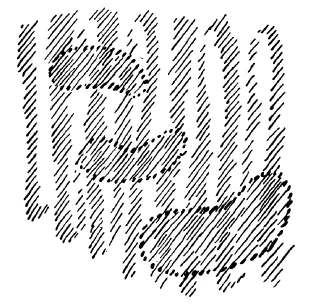
[ 22 ] But then came the time of Osiris’s death, and with it the time when, so to speak, as one aspect became more subtle, the other became coarser. How is this to be understood? Well, you can imagine it this way: If we go back to the ancient time of Osiris, before reaching maturity, human beings saw or perceived the light imaginations within the outer air (see drawing)—to speak of one kind. So they saw the light imaginations in the air around them until they reached maturity. Afterward, they had the feeling that this had entered into them; and the changes we have spoken of had taken place. For the child, the air was filled everywhere with light phenomena. For the adult, for the person who had reached maturity, only the air remained, but they knew: As a child, I saw that there was something else in there. — He knew: The air is at the same time a bearer of light. He knew: It is not true that when I look out into the air, there is nothing there but what the physical world reveals; rather, there are beings living within it that can be perceived in the imagination.
[ 23 ] For the Greeks, these beings are the beings of the circle of Zeus. So people knew that there were beings in the air. But all of this—the fact that states of human consciousness were altered—is connected to the fact that, on a subtler level, objective things also changed. Of course, for today’s intelligent person, it is an abomination to say such a thing. I know it is an abomination, but that does not make it any less true: the air has changed; of course, not in a way that can be tested with chemical reagents; but the air has indeed changed. The air has lost that power to express the light imaginations. The air has, one might say, become coarser.
[ 24 ] Things have indeed changed on Earth since those ancient times. The air has become coarser. But it is not only the air that has become coarser; human beings themselves have become coarser. That which formerly lived spiritually in the essences—which, as I have said, permeated the larynx and the rest of the organism—has also become coarser. So that, in fact, when we speak today of the sexual essences, we are speaking of something different from what was meant in those ancient times. That ancient human being knew: My perception of the day is connected to my personal being; but the other aspect—which I experience from the sphere of the air, which I experience through my entire life—is connected to humanity as such; it transcends the individual human being. — That is why people also sought to fathom the social mysteries governing human coexistence through the bond that connected them to the macrocosm; they sought social wisdom through stellar wisdom. But what lived within them as social wisdom was precisely what connected them to the heavenly realm. This was expressed even in the most ordinary views. In ancient times, before Osiris died, a couple would never have perceived their conception of a child any differently than as having received a child from heaven. This was a living consciousness, and it also corresponds to the truth. And this living consciousness was able to develop because human beings knew that they were receiving from the airspace that which they themselves had experienced.
[ 25 ] One might say that the coarse dregs of all this have remained. Just as the coarse dregs of that vital force—which in earlier times revealed itself to human beings through imaginations—have remained in the air, so too have the dregs remained within human beings themselves. This was inevitable, for otherwise human beings could not have attained freedom and full consciousness of their “I.” But the dregs have remained. As a result, everything the ancients meant by the divine—which, as you can now easily imagine, they associated in a roundabout way with sexual essences—has been coarsened; coarsened not only in perception but also in experience. But it is still there, of course; it exists not only in one way but also in the other. In ancient times, human procreation was conceived as being directly connected to the micro-macrocosmic bond of humanity, as you have seen. But the entire coexistence of human beings on Earth was also conceived in connection with this macro-microcosmic bond. Numa Pompilius went to the nymph Egeria to seek her guidance on how he should organize social conditions in the Roman Empire. But this means nothing other than that he had the wisdom of the stars revealed to him—he was told what the stars say about how social conditions should be organized. What human beings on Earth perpetuate—that which is connected to the succession of generations—should be placed at the service of what the stars say. Just as the individual human being aligns his or her ordinary perception and thinking with the rising and setting of the sun, so too should what later became “states”—that is, human communities—be placed under the constellations as an expression of world conditions.
[ 26 ] In our language—languages often remind us of ancient connections—we still correctly recall this connection in the fact that the relationship between the masculine and the feminine is referred to as “Geschlecht,” but successive generations are also referred to as “Geschlechter.” It is one and the same word: “Geschlecht”—the family that belongs together, those related by blood, and that which is the relationship between the masculine and the feminine. And so it is in other languages as well, where everything points to how human beings sought, for that which lies in their nature—I would say, in the deeper layers of their being—a cognitive connection with the macrocosm.
[ 27 ] These things have become coarser in the direction we have discussed. Among other things, what remains is a passionate and emotional attachment to the national. This attachment to the national, this chauvinistic drive toward the national—that is the remnant of what, in bygone times, could be conceived under entirely different circumstances. But only when one sees through these things does one also know the truth in such matters. What is expressed in national pathos? When a person develops national pathos to a particular degree, what lives within this national pathos, this national sentiment—what lives within it? Exactly the same thing that lives in the sexual realm, only in the sexual realm in one way, and in national pathos in yet another way. It is the sexual human being who expresses himself through these two different poles. Being chauvinistic, one might say, is nothing other than developing sexuality on a group level. One could say that where the sexual essences—in what they have left behind—grip people more strongly, there is more national chauvinism present; for it is the same force that lies in procreation that also expresses itself in national pathos. Therefore, the battle cry for the so-called “freedom of peoples or nations” is something that can only be properly understood in its deeper context if one were to say—with a refined sensibility, of course—that it is a call for the restoration of the national in the light of a sexual problem. — The fact that the sexual problem is being proclaimed across the earth today in a very special form, without people having the slightest inkling of how the sexual, emerging from their subconscious, takes on the form of the words “freedom of peoples”—that is what must be regarded as one of the mysteries of the impulses of our time. And there is far more of sexual impulse present in today’s catastrophic events than people realize—far more than people realize! For the impulses behind what is happening today lie, in part, very, very deep.
[ 28 ] Such truths must no longer be kept under lock and key in our time. Certain brotherhoods have been able to keep them under lock and key by excluding women in the strictest sense of the word. Even if, as is often evident today, working together with women can still lead to all sorts of terrible things, the time has nevertheless come when correct views on these matters—views shared by all of humanity—must spread. After all, dishonest, foolish, and stupid views are spreading because, without any knowledge of the deeper connections, certain quarters are treating all manner of things today as sexual problems. But you can see how, on the one hand, what is pure, genuine, and honest truth comes into contact here with what can be the most dishonest and filthy way of thinking, as it is sometimes evident in the excesses of psychoanalysis or similar fields. But you will always find that what, on the one hand, is deep truth when correctly grasped, does not need to be altered much in terms of words, but only needs to be permeated by a filthy mindset—and it then becomes a filthy, foolish, reprehensible view.
[ 29 ] One could speak of an ancient age of “nations” when nations were conceived in such a way that one nation had its guardian spirit in Orion, another in a different star, and people knew they would govern themselves according to the constellations. In a sense, they appealed to the celestial order. Today, when such a celestial order no longer exists, appealing to the purely national—that is, the chauvinistic appeal to the purely national, and thus the assertion of something that is, in the most eminent sense, psychosexual—is a backward-looking Luciferic impulse.
[ 30 ] If one wants to see clearly and distinctly what exists today, one must not shy away from the true depths of the truth. But one can also see from such things why people are so afraid of the truth. Just imagine if people today, amid all the clamor about the freedom of nations and the like, were to hear that this is driven by sexual impulses. Just imagine that. Just imagine the crowing rooster—I don’t mean just one individual, and I don’t mean just Clemenceau. Imagine all the orators on these topics, and imagine if they had to realize that what they are crowing is, at its core, the mating call of the rooster, no matter how elegantly it is dressed up in nationalist garb!
[ 31 ] These are the things that humanity really ought to learn today but does not want to hear, because, as you know, it is claimed that things that are black are white, and things that are white are black. The point is that the ancient era I have spoken of has entered the fifth post-Atlantean epoch, during which abstraction has gradually taken shape. At the boundary between the fourth and fifth post-Atlantean epochs—you can read about this in my book *The Riddles of Philosophy*—people are gnawing away at and choking on the cognitive value, so to speak, of the abstract; it is precisely the most honest people who are doing this. Look it up in my *The Riddles of Philosophy*, where I discuss the Middle Ages, which had become both nominalist and realist. Abstraction had already advanced so far that people asked themselves: If I have a concept, does it still mean anything for the things out there, or is it just a name in my head? — Today, people no longer think about these things. Why should people care that people in the Middle Ages agonized—when they sensed the abstractive power of thought—over what role the so-called universals, the general concepts, play in the world, to the point of being tormented by the question of what role abstractions play? Today, people no longer think about this, because they have already grown accustomed to abstractions and because they do not strive to move beyond the abstract moment; on the contrary, they strive all the more to delve into the abstract moment.
[ 32 ] The dispute over universals, which most recently took the form of the following argument: Universals, or general concepts, first exist as certain concepts in God—these are universals ante rem; then these concepts exist in things—universals in re; and finally, these concepts exist in our mind, in our soul—post rem, universals post rem. — This was a means of gaining insight into the following question: Is human beings, in thinking—in thinking only of concepts—still connected to reality? One could still sense something of how, in ancient times, human beings were connected to reality. Once they had matured, they had, so to speak, reflected upon what they had previously perceived as children. Then they knew: it was only then that the true human being had entered into them. — With regard to universals, one had to grapple with the question of whether, when thinking, one still retained in one’s thinking something connected to reality, or whether it was completely severed from all reality, whether it no longer had anything to do with reality at all. Since that time, humanity has had to accustom itself to taking universals—abstractions—as mere abstractions, and has indeed been more or less completely severed from reality in its consciousness.
[ 33 ] Such a process is, in fact, constantly taking place on a small scale. Just think about it: originally, words—which are the representatives of ideas—exist in direct connection with perception: a small group of people fighting has one person at its head; they have this one person before them; they call him the “vörsten,” the “first,” the “försten”—prince. Here, the word is directly linked to perception. Later, it is torn away from perception; it becomes a word that designates something without any connection remaining to direct perception. Just think how many words are like this!
[ 34 ] And the next step is that certain words are given privileged status, that language is monopolized, that language is nationalized. Even within language itself, certain things are moving in this direction. Isn’t that right? Take this simple example: Someone has learned a great deal, has become wise—let’s say, without implying anything silly—he is a scholar. Based on this factual context, one might say in a certain naive way that he is a “doctor”; there you have the factual context when you call the person in whom you see this scholarship a “doctor.” Then it takes on a certain significance when this is documented by a recognized professional body—one that specifically acknowledges this very quality. But it loses its significance when it is monopolized; yet humanity today is enthusiastic about such monopolization. All manner of words are to be monopolized. A person is not to be merely an “engineer” by virtue of his genius, but this is to become a title recognized—God knows by whom. And more and more, things are to be torn away from their contexts. Here you can see the process of abstraction on a small scale, but it unfolds on a grand scale with infinite significance. A family has a father; what connection is there between the “Pater” who is the father of the family and the “Pater” who is a clergyman? This severing of what is contained within the word—I wanted to cite it merely as an illustration of the process of abstraction in humanity.
[ 35 ] And when it comes to concepts, the situation is even worse than with language. With concepts, there is often not the slightest connection left to the intuitive image for those who need them. Sometimes people then search for the intuitive image; they become strange in this search—terribly strange, in fact. Just think: there is a whole body of literature today on the sign of the cross, which is indeed a universal symbol, widely used throughout the world. It is amusing to see all the scholarly effort that has been expended on this subject.
[ 36 ] This symbol is traced back to this
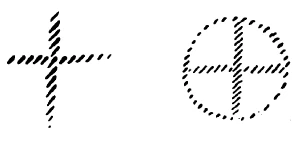
[ 37 ] This is supposedly the former cross.
[ 38 ] Sometimes people explain it by saying: Only certain elements have remained, like the swastika and so on. — Well, what has been written about this is incredibly clever—boundlessly clever, in fact—though the term “cleverness” is generally applied to such things anyway. I certainly don’t want to criticize these things to the ground, but cleverness alone isn’t enough to know what is true. Of course, one must understand that the sign of the cross is, first and foremost, nothing other than a person standing up and stretching out their arms, spreading them wide—and then they are the cross. A stream of existence flows from top to bottom, connecting the human being to the macrocosm, and also through the outstretched hands. The cross is the symbol of the human being.

[ 39 ] If you find awards from Assyrian kings, or awards from Egyptian kings—medals, for example—they are medals bearing the sign of the cross:

[ 40 ] And two other symbols—somehow the cross on the medal, since it is, after all, a decoration that the ancient kings used to have—would be, for example, these: In the case of the third symbol, the star is usually such that one does not always immediately recognize the pentagram within it. Or it might also be a hexagram; well, that doesn’t matter right now.

[ 41 ] Particularly clever people have said: That is the sun, that is the cross, that is the moon, that is the star. But the deeper meaning lies precisely in the fact that it is the human being—the microcosm—who is depicted together with the sun and the moon. You can see from this ordinary sign of the cross how the concept has become separated from the thing itself. The immediate perception is this, and the sign is this: the human being in the form of a cross. People today are so unable to connect the thing with the sign that, as I said, there exists an abundance of highly intelligent literature that seeks to determine how this sign relates to what it is meant to express. And so one could write quite intelligent treatises on the most everyday words without ever realizing how these things—these words—are connected to reality.
[ 42 ] Humanity has had to go through the period of abstractions. We know, after all, that we are no longer in the sign of Aries, where the Sun was at the spring equinox when the transition took place from the old imaginative age—when the aftereffects of that age were still present—to the abstract age. We have entered the Age of Pisces. It is characterized essentially by the fact that human beings receive from the macrocosm the power to form abstract concepts. Human beings receive this power from the macrocosm today. But for the time being, abstract concepts are something that human beings do not yet know how to reconnect with reality. They must be reconnected with reality.
[ 43 ] I assumed that I had said that, in a sense, what occurred in the third, the Egyptian-Chaldean era—when people looked back to the ancient age of Osiris, when imaginations were present—must be repeated in this fifth post-Atlantean era. In a sense, the reverse must take place: humanity must once again find its way back to the imaginations. One could say—albeit in a different form—that Osiris must come back to life. — We must find ways and means to revive Osiris once more. I expressed this in very concrete terms in these reflections when I said that we must find forms of experience that are shared by both the dead and the living. Since he was killed, Osiris has been among the dead. He will remain among the dead, but he must return to the living when there are matters that are common to both the dead and the living in the social life of humanity. This, however, leads you to the realization that we must understand something for our time that is necessary to understand above all else: How is Osiris brought back to life? How does Osiris come to new life? How does the human being once again approach experience through the imaginative?
[ 44 ] We will discuss this tomorrow: How imaginative consciousness is to be resurrected, and how this resurrection is to be brought about.