

Mystery Truths and Christmas Impulses
Ancient Myths and Their Significance
GA 180
8 January 1918, Dornach
Translated by Steiner Online Library
Eleventh Lecture
[ 1 ] Before I have to leave here, we will try to take a closer look at precisely those issues related to the question raised recently: What impulses of human life must enter people’s consciousness—especially in the present—in order to create a counterbalance to the principle of heredity, which reigns almost exclusively in both science and life? — However, we can only approach this extraordinarily important question slowly and gradually. After all, this question is fundamentally and most deeply connected to the contrast I sought to bring before your eyes—before your inner eye—by drawing your attention to how one might contemplate the ancient Egyptian inscription of the Egyptian goddess Isis: “I am the universe; I am the past, the present, and the future”; no mortal has yet lifted my veil—and how, on the other hand, one can take into one’s consciousness that which, from the present onward and into the future, must, so to speak, be the other, the complementary saying: I am the human being. I am the past, I am the present, I am the future. Every mortal should lift my veil.
[ 2 ] First and foremost, one must realize that at the time this saying originated within Egyptian culture, it was still clear and evident that when one spoke of the “Immortal,” one was in fact addressing human beings themselves. Within Egyptian culture alone, the mystery as a principle of mystery was a deeply rooted principle. The Egyptian, who was familiar with his culture, knew that what lives in the soul as the immortal must be awakened. Indeed, contrary to the practice we must follow today, the Egyptians—just as the Greeks did, at least those who thought in Plato’s sense—regarded as truly partaking of immortality only those who had grasped the spiritual world with their consciousness. You can read the evidence for this in my book *Christianity as a Mystical Fact*, where I have cited Plato’s often harsh-sounding statements regarding the difference between those people who attempt to grasp the impulses of the immortal—the spiritual impulses in the soul—and those who spurn them, who do not do so.
[ 3 ] If you consider this, however, you will easily see that the inscription on the portrait at Sais should actually read: He who never wishes to embrace the spiritual life within the soul cannot lift the veil of Isis; but he who embraces this spiritual life—to speak in the terms of the ancient Egyptians, though today it sounds somewhat different—that is, he who as a “mortal” makes himself “immortal”—can lift it. It should not be said that human beings cannot lift the veil of Isis at all, but only this: The person who wishes to connect exclusively with the mortal, who does not wish to approach the immortal, cannot lift the veil of Isis. This, of course, also led to the saying—I might add—being driven into a nonsensical interpretation later on, as Egyptian culture fell further into decline. When the priests transformed the principle of the mysteries into a principle of power, they actually tried to teach the profane—not the priestly—masses that they, the priests, were the immortal ones, and that those who were not priests were the mortal ones; that is, that all those outside the priesthood could not lift the veil of Isis. One could say that during the decline of Egyptian culture, this interpretation already existed: “I am the universe; I am the past, the present, and the future; only a priest can lift my veil.” — And during that period of decline, the priests also called themselves “the Immortals.”
[ 4 ] In its current usage, this term has largely fallen out of use among people living on the physical plane. Only the French Academy still uses it to refer to its members, where—in continuation of the Egyptian priestly principle—particularly significant individuals are designated as “Immortals.” We are reminded of this these days because Bergson—the plagiarist of Schelling and Schopenhauer—is about to be elevated to the rank of “Immortal” by the French Academy. Such things are relics of times when they were understood, and they spill over into eras where words, concepts, and ideas lie far removed from their place of origin.
[ 5 ] One might easily think, when compelled to say some of the things that must be said in the course of these reflections, that these reflections are intended merely to condemn our times. I have often emphasized that this is not the case. What is said here is intended to characterize our times, not to criticize them. However, one cannot demand that, where truth is to be spoken, there should be no reference to that which must be seen through—whether in its groundlessness or in its harmfulness. In this regard, one may certainly ask: Is it really so reprehensible to follow a certain example—admittedly from a sufficiently great distance, an example that, however, cannot be followed enough? After all, the Gospel does not recount that Jesus Christ went into the temple and caressed the merchants; rather, it tells us something else—that he overturned their tables and the like! In order to truly assert what needs to be asserted, it is necessary to point out, in a realistic manner, what must be condemned if progress is to be made. The sentimentality of a completely false, general whitewashing must not take root in the human soul and be trumpeted, for example, as universal love for humanity.
[ 6 ] If one takes this duly into account, then on the one hand it can be said that we simply happen to be living in the materialistic age—this materialistic age that necessarily adds to materialism the abstraction in the sense we have come to know it: detachment from reality, and that everything that was bound to befall our time catastrophically is connected to this detachment from reality. On the other hand, however, it may also be said that, compared to the various periods—namely, if we focus on — the post-Atlantean era, our fifth post-Atlantean era is, in a certain respect and from certain points of view, the greatest era, the one that brings the most to humanity, the one that holds within itself immense possibilities for human development and existence. And it is precisely through what human beings develop in this age in a very special way—I would say as the shadow side of spiritual existence—that they take the path and, if they behave correctly, can find their way into the spiritual world. In particular, they can find the path to their true, highest human goal. The possibilities for development in our time are greater than they were, from a certain point of view, in the past phases of post-Atlantean evolution.
[ 7 ] Something truly immensely significant has, in fact, taken place with the dawn of this fifth post-Atlantean epoch. One must once again place oneself in a new way within the context of humanity’s relationship with the entire universe if one wishes to give the proper tone, the proper emotional nuance, to what we have often emphasized from various perspectives. Certainly, the so-called wise guys among the philistines call it superstition when one speaks of a certain connection between human beings and specific constellations in the universe. One simply has to understand this connection correctly. Superstition—what is superstition? The belief that the physical human being must orient themselves in a certain way according to the universe? We orient ourselves by the clock, which we set according to the position of the sun; every time we look at the clock, we are practicing astrology. We have subconscious aspects of human nature that orient themselves according to constellations other than those by which we set our clocks in physical life. If someone understands things in the right sense, then talking about superstition makes not the slightest sense. Therefore, by way of illustration, a piece of this cosmic clock may now be placed before your soul. We will need it to continue examining the riddle we have just posed.
[ 8 ] When that period had come to an end—the period known as the Atlantean Over-Flooding, the downfall of Atlantis, which separates our post-Atlantean culture from the Atlantean culture— the first post-Atlantean period, the first post-Atlantean cultural epoch, was the one that received its macrocosmic influences through the fact that the force permeating earthly life was the one corresponding to the rising of the sun at the vernal equinox in the sign of Cancer. We can therefore say that when the sun, with its vernal equinox, entered the sign of Cancer, the first post-Atlantean culture began. We can even call it—provided, of course, that the expression is not misunderstood—the “Cancer culture.” If we understand things in their true light, we can say that the Sun stood in the sign of Cancer at the vernal equinox.
[ 9 ] We have discussed in these reflections that there is always something within the human being that corresponds to what exists out there in the macrocosm. Cancer corresponds to the human chest. So, speaking in macrocosmic terms, one can characterize this first, primordial Indian culture by saying that it unfolded while the vernal equinox of the Sun was in Cancer. If one wishes to characterize it microcosmically, one can say that it took place at a time when human beings, in their understanding of the world, their perception of the world, and their worldview, were under the influence of those forces connected with what finds expression in the covering of their chest, in the thoracic cavity of Cancer.
[ 10 ] As physical human beings today, we have no way of entering into a relationship of insight with the world through the forces that are within our chest. We have no such possibilities today. If a person can develop those forces that are intimately connected to their chest—if, I would say, with regard to the forces of their chest, they are sensitive to everything that happens in nature and in human life—then it is as if the person were in direct contact with the external world, with everything that approaches them as the elemental world. If we take just one example—and this touches upon what lay at the foundation of ancient Indian culture—if we take simply the relationship between one person and another, it was the case that in those ancient times, when a person encountered another, they sensed, as it were, through the sensitivity of their chest, what the other person was like. They felt how the other person might be sympathetic or more or less unsympathetic to them. They approached one another and came to know each other. By breathing the air in the other’s presence, they came to know them. Certainly, in many respects, modern humanity knows nothing of this—to the detriment of humanity. But naturally, a person breathes differently in the presence of another, for in the presence of another, one shares the air exhaled by that other person. Modern humans have become very insensitive to these things. During the first post-Atlantean culture, the Cancer culture, this insensitivity did not exist. A person could be likable or unlikable through their breath; the chest moved differently depending on whether the person was likable or unlikable. And the chest was sensitive enough to perceive these movements of its own.
[ 11 ] Just think about what one actually perceives in such a situation! One perceives the other person, but one perceives them through something that is happening within oneself. One perceives the other person’s inner world in a process that one experiences as one’s own inner world, as a physical inner world. That was during the Cancer culture. I have illustrated this to you using the example of an encounter with another person. But this was how the entire world was viewed. This is how the worldview of that first post-Atlantean culture came into being. People breathed differently when they gazed at the sun, when they gazed at the dawn, when they gazed at spring, when they gazed at autumn; and on that basis they formed their concepts. And just as today’s humanity forms its abstract—its straw-like abstract, no longer even straw-like abstract, but paper-like abstract—concepts about the sun, the moon and the stars, about growth and flourishing, about all manner of things—so humanity in the first post-Atlantean era, in the Cancer culture, formed concepts that were felt in this immediate way, like a resonance with one’s own Cancer, one’s own ribcage.
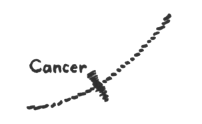
[ 12 ] So one could say: If this represents the sun’s path, for example, and the sun is in Cancer in the spring, then that is the time when human beings are also in the Cancer culture. In a special way, such a zodiac sign is always—for reasons we may mention soon, but which are familiar to most of you—regarded as belonging particularly to a specific planet. Cancer is regarded as belonging particularly to the Moon. It is said that because the Moon’s forces are particularly active when the Moon is in Cancer, the Moon has its home, its house, in Cancer; that is where its forces reside, and they develop there in a very special way.
[ 13 ] Just as the ribcage corresponds to the Moon in the human being, so does the sexual sphere correspond to the planetary Moon. And indeed, one can say that while, on the one hand, human beings were so receptive and sensitive in the early post-Atlantean era, it was precisely during this early post-Atlantean era that everything that had come to light in terms of the intimate concepts of the post-Atlantean worldview was connected to the sexual sphere—and rightly so at that time, for there was a naivety present that was no longer present in later, corrupted times.
[ 14 ] Then the sun, with its vernal equinox, entered the sign of Gemini. And we are then dealing with the second post-Atlantean culture, the proto-Persian culture, while the vernal equinox passes through Gemini. On the microcosmic level, everything in the human being that relates to symmetry—particularly the symmetry expressed in the relationship between the right hand and the left hand—is related to Gemini on the macrocosmic level. Of course, there are other ways in which this symmetry is expressed: we see things simply with two eyes, and so on. This symmetry, this interplay of left and right in human beings—which is expressed particularly in the two arms and hands—is what corresponds to Gemini in the macrocosm.
[ 15 ] That which is now so vividly absorbed by human beings into their worldview through the forces of the twin sphere, through the forces of symmetry—just as, in the first post-Atlantean epoch, what I have previously characterized was absorbed through the chest— is now less intimately connected to the immediate surroundings; rather, this sense of symmetry connects human beings more closely to what lies beyond the Earth—to what is not earthly, but heavenly and cosmic. Therefore, in this second post-Atlantean epoch, the intimate connection with the immediate elemental earthly environment recedes, and the Zarathustrian culture emerges—the turning outward toward the twin-like nature of the world—on the one hand, the nature of light; on the other, the nature of darkness— the dual nature associated with the forces that human beings express and live out through their symmetry, through their symmetrical being.
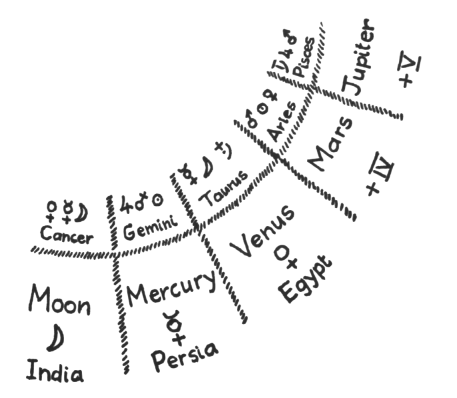
[ 16 ] Just as the Moon has its house in Cancer, so Mercury has its house in Gemini (see illustration on page 201). And just as, in a sense, the power of the sexual sphere helped human beings in the first post-Atlantean epoch to establish that intimate relationship with the environment we have been discussing, so now, in turn, the sphere of Mercury—the sphere actually connected with the forces of the lower abdomen—provides assistance in this second post-Atlantean epoch. On the one hand, the forces of the human being flow out from the Earth into the cosmos, into the extraterrestrial cosmos; but in this process, the human being is aided, so to speak, by that which still strongly resembles atavistic forces—forces connected to the human circulatory and digestive systems. After all, human beings do not have their digestive system merely for digestion; it is at the same time an apparatus of cognition. These things have simply been forgotten. And true acumen—not the intuition I have been speaking of these past few days—true acumen, the true, deeper power of deduction that relates to things, does not come from the head; it comes from the abdomen, and it served this second post-Atlantean epoch.
[ 17 ] Then came the third era, when the vernal equinox entered the sign of Taurus. That which descends from the forces of the universe when the Sun is at the vernal equinox in Taurus is, in a microcosmic sense, connected in human beings to everything pertaining to the laryngeal region and the laryngeal forces. Therefore, in this third post-Atlantean epoch—the Egyptian-Chaldean epoch, I might say—human beings developed as their special organ of cognition everything connected with their laryngeal forces. The sense of kinship between the word and the thing—namely, the things out there in the universe—was particularly strong during this third post-Atlantean epoch. Today, in the age of abstractions, it is difficult to form a clear picture of the intimate kinship between what human beings perceived of the universe through their larynx.
[ 18 ] The force corresponding to Taurus was, in turn, supported by Venus, which has its home in Taurus (see illustration on page 201). In the microcosm—in the human being—this corresponds to forces located between the heart region and the stomach region. As a result, however, what was recognized in this third post-Atlantean epoch as the World Word became intimately connected with the human being, in that he understood it through the forces of Venus that were within him.
[ 19 ] Then came the Greco-Latin period, the fourth post-Atlantean epoch. The Sun entered Aries at the vernal equinox. This corresponds to the head region of the human being—the forehead, the top of the head, the actual head region. This marked the beginning of an era in which human beings primarily placed themselves in a cognitive relationship with the world in such a way that this cognitive relationship gave rise to thoughts. Cognitive activity of the head is entirely different from earlier forms of cognition. Intellectual cognition did indeed emerge particularly in this epoch. But the human head, even though it is almost a faithful replica of the macrocosm—precisely because it is, in a physical sense, a faithful replica of the macrocosm—is, in a spiritual sense, actually not worth very much. Forgive the expression: as a physical head, the human head is not worth very much. And when human beings rely on their heads, they can arrive at nothing other than a culture of thought.
[ 20 ] Gradually, the Greco-Latin era—which, as we have seen from other perspectives, brought intellectual culture to its zenith and thereby, in a sense, brought human beings closer to the world in a special way—also led, in a process of gradual development, to the very essence of intellectual culture, to the culture of thought that subsequently came to an end. So that, as I pointed out yesterday, from the 15th century onward, people no longer knew how to connect thinking with reality. This culture of the head, this Aries culture, was, however, still such that it, so to speak, brought the vision of the universe into the human being. And with regard to the physical world, this culture of the head, this Aries culture, was the most perfect of all. It was only what developed from it as a degeneration that became materialistic. It was precisely within this Aries culture that human beings, through their minds, entered into a special relationship with the environment. And it is particularly difficult to understand Greek culture today—Roman culture, after all, distorted it into something more philistine—if one does not take into account that the Greeks, for example, perceived concepts and ideas differently. I have elaborated on this in particular in my *Riddles of Philosophy*.
[ 21 ] What was significant for this period was that Mars is in the sign of Aries. The forces of Mars are those forces that are, in turn—though in a different way—connected to the human larynx, so that Mars, which at the same time endows humans with aggressive forces, essentially provided the foundation for everything that humans developed in relation to their environment through their heads. And for the fourth post-Atlantean epoch—which thus begins in the 8th century B.C. and ends in the 15th century—conditions emerged that can already be described as a “Mars culture.” The configuration of the various social structures across the Earth during this period essentially arose through a Mars culture, through a warlike culture. Wars are now a thing of the past. Even if they are more terrible than they once were, they are a thing of the past. We will return to this shortly.
[ 22 ] Now, the human head, with all its powers, is—precisely as a physical instrument of thought, as a tool for physical thoughts—a replica of the starry sky. That is why this fourth post-Atlantean epoch still has something macrocosmic about it in terms of thought. Much that is macrocosmic still enters into thoughts; thoughts are not yet bound to the Earth. But consider the great upheaval that is now coming with the 15th century, as the Age of Aries gives way to the Age of Pisces. What those forces have become in the macrocosm are, in the human being, the forces connected with the feet. The flow moves down from the head to the feet. The shift is an immense one. That is why I was able to tell you that if you were to go back—but go back with understanding—to the time before the 14th century and read the alchemical and other writings that are so despised today, you would then see what profound, what immense insights into the mysteries of the world are contained there. But the entire human culture—including human powers—is undergoing a complete transformation. What humanity previously received from the heavens, it now receives from the earth. This is what the celestial signs illustrate to us: the great transformation that has taken place within humanity. And this is connected to the dawn of the material, materialistic age. Thoughts lose their power; in these times, thoughts can easily become mere platitudes.
[ 23 ] But now consider another curious fact. Just as Venus has its home in Taurus and Mars has its home in Aries, so Jupiter has its home in Pisces. And Jupiter is connected to the development of the human forehead and the development of the human forebrain. Humanity can achieve greatness through this earthly culture in this fifth post-Atlantean epoch, because it is precisely in an independent, human way—through the powers of the head—that humanity can refine and grasp what is conveyed to it from the opposite side compared to the earlier post-Atlantean period. Therefore, Jupiter must accomplish for humanity in the fifth post-Atlantean epoch the very same task that Mars had to accomplish for the fourth post-Atlantean epoch. And one could say: In a certain sense, Mars was the rightful king of this world during the fourth post-Atlantean epoch. In the fifth post-Atlantean epoch, he is not the rightful king of this world, because nothing in the fifth post-Atlantean epoch can truly be achieved through his powers—in the sense of this fifth post-Atlantean epoch; rather, whatever can make this epoch great must be brought to bear through the powers of spiritual life, world knowledge, and worldview. Humanity is cut off from the heavenly forces; it is banished to the materialistic age. But in this fifth post-Atlantean age, humanity has the greatest opportunity to become spiritual. No other age has been as conducive to spirituality as this fifth post-Atlantean age. He need only find the courage to drive the merchants out of the temple. He must find the courage to set reality—full reality, and thus spiritual reality—against abstractions and things divorced from reality.
[ 24 ] Those who have understood the constellations of the stars have also always known that special assistance comes from specific planets for the individual phases in the Sun’s course. With some justification, each of these constellations—the Moon in Cancer, Mercury in Gemini, Venus in Taurus, Mars in Aries, and Jupiter in Pisces—has been assigned, as was said, three decans, three decans. These three decans represent the planets whose role is to intervene in a particularly significant way in destiny during the respective constellations, while the others are less influential. Thus, the decans of the first post-Atlantean epoch, the Age of Cancer, are: Venus, Mercury, Moon; the decans during the Age of Gemini are: Jupiter, Mars, Sun; the decans during the Age of Taurus are: Mercury, Moon, Saturn; the decans during the Age of Aries: Mars, Sun, Venus. And the decans during our time, during the Age of Pisces—which is very characteristic—that is, those forces that, so to speak, can once again serve us particularly well according to the celestial clock: Saturn, Jupiter, Mars. Mars here is not in the same service it had when it was in its own sign, as it passes through Aries, but rather Mars now serves as a representative force for human strength. But you see in the outer planets—Saturn, Jupiter, Mars—that which is connected with the human head, with the human face, with the formation of human speech.
[ 25 ] So everything that initially pertains to this earthly life between birth and death—we’ll talk about the other aspect, between death and rebirth, next time—in terms of spirituality is, in turn, particularly useful in this age. Thus, this age is the one that contains the infinitely greatest spiritual possibilities. In no other age have people been granted the opportunity to engage in as much folly as in this one, because in no other age could one sin more grievously against the inner mission of the age than in this one. For if one lives in harmony with the age, one transforms the force coming from the Earth through the power of Jupiter into spiritually free humanity, and one has at one’s disposal the best and most beautiful human forces that a person develops between birth and death: the forces of Saturn, Jupiter, and Mars.
[ 26 ] The World Clock is favorable for this age. This must not be a basis for fatalism. It must not be a reason to say: “So let’s just leave things to the course of world events; everything will turn out all right”—but rather, it should be a reason to believe that, if people are willing—and they must be willing—they will find infinite possibilities, especially in our time. It’s just that, for the time being, people are not yet willing.
[ 27 ] But it is always unfounded to say: “Well, what can I do on my own? The world goes on as it will!” — Certainly, as we are here — the world doesn’t pay much attention to us today. But something else is what matters. What matters is that we should not say what people said thirty-three years ago, when they initially paid no attention to anything within themselves! That is how things have come to be as they are now. For our time, what matters is that each of us begins with ourselves, striving to step out of abstraction, to shed our detachment from reality, and so on; and that each of us tries, within ourselves, to get closer to reality, to move beyond abstractions.
[ 28 ] One must start from such broad concepts if one wishes to develop the important issues that will occupy us right now, in these very days: discussions about—I would say—the aging of human beings, which is just as much a matter of approaching death as it is of originating from birth, of coming into the world. While today pedagogy, education, and the practical upbringing of children focus entirely on simply observing that the child is born and develops as a child, the time must come when the child itself learns what it means to grow older. But these things cannot be developed so easily. We must broaden our conceptual framework. For it can already be said that, in order to overcome that detachment from reality that is the hallmark of our times, it is necessary above all for people to develop the will to be attentive—the will to set Jupiter in motion. Jupiter is, after all, precisely the force that directs the call—the ceaseless call—to our attention. People today are so happy when they don’t have to be attentive, when they can be like the sleeping Isis—I have deliberately spoken of the sleeping Isis! The majority of humanity is sleeping through the present age and feels very, very comfortable doing so; for they construct concepts for themselves and remain stuck in those concepts, unwilling to develop attentiveness. Looking closely at the interconnections of life—that is what matters. And the difficult years in which we live should, above all, teach us to move away from what has for so long softened human culture: inattention, the absence of will—and to look closely at the conditions of the world. It is not enough to merely glance at things.
[ 29 ] It might, for example, easily appear as though I had spoken time and again, from every possible angle, about the harmfulness of Wilsonianism, driven by a subjective impulse. This is not driven by a subjective impulse, but is truly necessary because today it is essential to repeatedly point the way—amidst numerous deceptive concepts and illusions—toward the direction in which our attention must be directed. We learn from current events; if we sharpen our attention, we learn an immense amount—especially today—from current events about what we need to understand the great impulses that alone can lead humanity out of the calamities into which it has brought itself. One must ask oneself certain questions in order to be attentive to these matters. What matters is not simply that one sees something at all, but how one sees it—how one is able to pose questions regarding the external world. Spiritual science also has this practical significance: it gives us the impulse to ask questions.
[ 30 ] We are now reading about the so-called peace negotiations in Brest-Litovsk. You know that various people are involved in them. To single out the most prominent figures from Russia: Lenin, Trotsky, a certain Mr. Joffe, and a certain Mr. Kamenev, whose real name is Rosenfeld. Trotsky’s real name is Bronstein; Joffe is a wealthy merchant from Kherson. These are the principal negotiators. It is not uninteresting—and perhaps even important—to also draw attention to the fact that, in the case of Mr. Rosenfeld-Kamenev, it is really nothing more than what the outer world, the exoteric world, calls pure coincidence that his head is still sitting on his shoulders; for his head could have fallen off his shoulders long ago. You see, in November 1914, all sorts of members of parliament were arrested in Russia. One read about it at the time and heard about it elsewhere as well. These members of parliament were arrested specifically because they were accused of maintaining friendly relations with Lenin, who was abroad, not far from here. Specifically, the prevailing view in Russia at the time was that Lenin had said: “Of all the evils that can befall Russia in this war, the overthrow of the tsarist regime is the least of them.” — So a number of deputies were charged, people known to have been in contact with Lenin through letters and the like. But at that time, they could not yet be brought to justice. All sorts of patriotic, Russian-patriotic words were spoken; words such as these were uttered: “Over the heads and the mangled bodies of our soldiers, such traitors have emerged who are in some way connected to the shameful Lenin in Switzerland”—and the like.
[ 31 ] Another trial took place in February 1915. Once again, a number of people were charged, and among the defendants was a certain Petrovsky, but there was also a certain Kamenev, alias Rosenfeld. Kamenev, in particular, was regarded at the time among those defendants as the quintessential Russian traitor, a particularly despicable fellow. And when the trial began, it was generally believed that it would not be long before his head—well, would be severed from his shoulders. But Kamenev-Rosenfeld was able to prove at the time that he had always taken a different stance from Lenin on all matters of war; likewise, Petrowski was able to prove that they had no truly sincere alliance with Lenin. In particular, Kamenev-Rosenfeld was able to prove at the time that he had never wished for Germany’s victory, that only un-Russian comrades who had fled abroad—such as Lenin—could wish for Germany’s victory, comrades who—because they feel too weak or too lazy themselves—expect the victory of freedom to come from the sword of German generals.
[ 32 ] These are the words that were spoken at that trial back then. And as a lawyer, as a defense attorney, a certain Kerensky was also assigned to Messrs. Petrovsky and Kamenev; he later played yet another role—he was Kamenev’s defense attorney in that trial. And he talked him out of it. The charges at the time were high treason and treason against the state for both Petrovsky and Kamenev-Rosenfeld. But Kerensky was able to talk them out of it, and his speech contains these fine words: The defendants were far from planning to stab those who are ready to die for their country in the back; they resisted no other incitement as much as that which emanated from Lenin’s secret society. Because Kerensky’s eloquence and the other arguments that could be put forward provided proof that Petrovsky and Kamenev had nothing in common with Lenin’s ideas, they got off more or less scot-free at the time. — Petrovsky is now, after all, the Minister of the Interior in Lenin’s government, and Kamenev is, alongside Mr. Joffe, the most important negotiator at Brest-Litovsk.
[ 33 ] I mention this unusual story; I could tell hundreds and hundreds of similar ones today. But it is very important to look at the realities; that is what I wanted to say. And to get to know the realities, one must look at the people who are involved with those realities—if they are indeed realities in which people play a part. It is incredibly convenient to simply stop there and say: “Well, negotiations are taking place between Russia and the Central Powers in Brest-Litovsk!” — Those are abstractions; they are not realities. One can only approach reality if one has the will to pay attention and to truly look into the concrete details. I really just wanted to cite this as an example to show that it is indeed necessary to study contemporary history. Everyone has an opinion today about current events; but how little is actually known about current events, how little people actually know what is going on, how little people have any idea of what is unfolding—that is truly astonishing and can only be understood by the fact that our intelligentsia has been educated in an unbelievable way. Our intellect has been educated in such a way that, in every branch of science, it is led to judge as I have described: If I have one taler, then I have one taler; if I have two talers, then I have none—then I have nothing! If there is only one gravestone of Till Eulenspiegel, he may have lived; but if there are two gravestones, one of which depicts an owl with a mirror, then Till Eulenspiegel never lived! — If I want to conduct an electrical experiment in the physics lab, I must carefully dry all the apparatus with warm cloths so that nothing is damp, for otherwise neither the ordinary electrostatic machine nor the induction machine—nor anything else—will work for me. But then I quickly add: From the cloud—which is, after all, quite wet, and which hardly any professor out there will have wiped down with dry cloths—that’s where the lightning comes from. — And one could go on like this.
[ 34 ] Isn’t that right? I’ve cited examples of this time and again: One person repeats it after another; no one checks the facts. For example, it’s amusing to hear people say that the fundamental principle of modern physics is the conservation of energy, the conservation of force. This goes back to Julius Robert Mayer. Julius Robert Mayer—even though physicists, natural scientists, and other scholars currently hail him as a great hero—was, during his lifetime, locked up in a mental asylum because he published “nonsense” and claimed to have discovered a new principle. He was actually locked up in a mental asylum! This great achievement is attributed, in the case of Julius Robert Mayer, in particular to a university rector and so on. But I don’t want to dwell on that, because it happens quite often. What I want to emphasize is that it is stated time and time again that Julius Robert Mayer discovered the conservation of force. No one checks the sources; instead, people simply repeat what others say. In Julius Robert Mayer’s work, there is nothing of the sort to be found in the vague, indefinite form in which the energy principle is presented today; rather, it is expressed in an entirely different formulation—and indeed, in a rational one!
[ 35 ] This is something close to home, isn’t it—Dr. Schmiedel gave me a booklet advocating for Goethe’s *Theory of Colors*—and we can also consider an example here: Two learned gentlemen claim that Goethe knew nothing about Fraunhofer lines. Dr. Schmiedel has compiled four columns of nothing but passages by Goethe in which he speaks of Fraunhofer lines! But these learned gentlemen speak and pass judgment on the scope of Goethe’s optical insights, incorporating into such judgments the claim that he knew nothing of Fraunhofer lines. They are lying to the people; for, of course, today in this “authority-less” age, what a “scholar” says is just as much gospel to a large number of people as what Mr. Woodrow Wilson says is gospel to many—isn’t that so?—to many politicians. So in our time today, it really means something when someone simply states: Goethe did not know about Fraunhofer lines! It doesn’t help much, either, to prove it to people. Soon enough, a third person will say it, and then a fourth, because the inattention and thoughtlessness with which people live today are so great, since there is no will to look at concrete realities. On top of that, humanity has far too great a tendency to get carried away by abstractions, to be inspired by abstractions.
[ 36 ] With that, I have merely introduced the topic that still lies before us: the important principle that must find its way into our contemporary culture and our pedagogy—the principle of human aging, the aging of the physical body, which is connected to the rejuvenation of the etheric body. We will discuss this in great detail next time.