

Mystery Truths and Christmas Impulses
Ancient Myths and Their Significance
GA 180
11 January 1918, Dornach
Translated by Steiner Online Library
Twelfth Lecture
[ 1 ] In these reflections, we intend to discuss important questions concerning human development, and you have already seen that this requires a great deal of preparatory work drawn from a wide range of sources. Today, so that we may have as broad a foundation as possible, I would like to remind you of certain points that were raised from various perspectives during the discussions held during my current stay here—points that are essential if we are to view these reflections in the proper light tomorrow and the day after.
[ 2 ] I have pointed out to you how, in that phase of human development—which we may regard as the one of primary interest to us since the great Atlantean catastrophe—significant changes have taken place within humanity. Months ago, I already drew attention to how differently humanity as a whole changes compared to the individual human being. As the years pass, the individual human being grows older. In a certain sense, one can say that the opposite is true of humanity as a whole. A human being is first a child, then grows up, and eventually reaches the age we know as the average lifespan. In this process, the physical forces of the human being undergo manifold changes and transformations. We have already described the sense in which a reverse process takes place in humanity. One can say that in that ancient time following the great Atlantean catastrophe—known in geology as the Ice Age and in religious traditions as the Flood— that is, in the period immediately following this great flooding of the Earth, which truly gave rise to a kind of glaciation, humanity was capable of developing in a completely different way over the next 2,160 years than it was later.
[ 3 ] We know that in our present time, we are capable of development up to a certain age—capable of development freely, without any effort on our part, by virtue of our nature and our physical powers. In the early period following the great Atlantean catastrophe, as we have said, human beings were capable of development for much longer. They remained capable of development well into their fifties, so that they always knew: during this time, advancing age is also accompanied by a transformation of the soul and spirit. If we wish to experience further development of our soul and spirit today, after our twenties, then we must seek this development through our willpower. Up until our twenties, we undergo physical changes; and within these physical changes lies something that determines our further spiritual and soul development. Then the physical ceases to make us dependent on it; then, so to speak, our physical nature no longer provides anything, and we must carry ourselves forward through our willpower. This is how it appears at first glance from the outside. We will see shortly how the matter lies from within.
[ 4 ] Things were different during the first approximately 2,160 years following the great Atlantean catastrophe. Although human beings remained dependent on their physical bodies well into old age, they also found joy in that dependence. They had the joy not only of progressing as they grew and developed, but also, even as their life forces waned, of experiencing the fruits of those waning life forces in the soul as a kind of blossoming of the soul—something that is no longer possible today. Yes, the external, physical-cosmic conditions of human existence are changing in a relatively short period of time.
[ 5 ] Then came a time when humans were no longer capable of developing to such an advanced age—up into their fifties. In the second period following the great Atlantean catastrophe—which lasted approximately 2,160 years and which we call the Proto-Persian period—human beings, however, remained capable of development up to their forties. Then, in the next period—the Egyptian-Chaldean period—they remained capable of development from the age of 35 to 42. During the Greek-Latin period, human beings remained capable of development until the age of 35. We are now living in the era that began in the 15th century, in which human beings continue their development only into their twenties.
[ 6 ] All of this is something that external history tells us nothing about and that is not believed by conventional historical scholarship, yet it is connected to an infinite number of mysteries of human development. So one can say that all of humanity moved inward, becoming younger and younger—if we call this change in development “becoming younger.” And we have seen what conclusion must be drawn from this. This conclusion was not yet so pressing in the Greco-Roman era; at that time, human beings naturally remained capable of development until the age of thirty-five. This conclusion is becoming ever more pressing and, from our time onward, particularly significant. For, with regard to humanity as a whole, we are now, so to speak, in the twenty-seventh year, moving into the twenty-sixth, and so on; so that people are dependent on carrying through their entire lives what becomes of them in their early youth through natural development—unless they take it upon themselves, of their own free will, to take charge of their own further development. And the future of humanity will consist in its retreating further and further, so that, unless a spiritual impulse takes hold of humanity, there could come times when only the views of youth prevail.
[ 7 ] In terms of outward symptoms, this maturing of humanity is characterized by the fact—and anyone who observes historical development with a somewhat discerning mind can see this outwardly as well—that, let us say, even in ancient Greece, one had to be of a certain age in order to participate in public affairs in any way. Today we see large segments of humanity demanding that this age be lowered as much as possible, because people believe that by their twenties they already know everything a human being can achieve. And demands will continue to grow ever further in this direction unless insight puts a stop to them: not only to assume that people in their early twenties are wise enough to participate in parliamentary affairs—of whatever kind—around the world, but also that nineteen- and eighteen-year-olds will believe they already possess within themselves everything a human being can comprehend.
[ 8 ] This way of becoming disciples is at the same time a call to humanity to draw from the spiritual realm that which nature no longer provides. Last time, I drew your attention to what an immense turning point the 15th century represents in the history of human development—again, something of which external history gives no account, for this external history is, as I have often said, a fable convenue. A completely new understanding of the human being must emerge, for only when such an understanding arises can the impulse that humanity needs—to take into its own hands, of its own free will, what nature no longer provides—truly be found. We must not believe that the future of humanity will be sufficient with the thoughts and ideas that modern times have brought forth, and of which these modern times are so proud. One cannot do enough to realize how necessary it is to seek new, novel impulses for the development of humanity. Certainly, as I have often said, it is a truism to say that our time is an age of transition, for every age truly is. But it is quite another matter to know what is in transition during a specific time. Certainly, every age is a time of transition; but in every age, one should also look around for what is in the process of transition.
[ 9 ] I want to take up one particular fact. I could take up a hundred others, but I want to focus on this specific fact, which is meant only as an example of many things. As I said, from all corners of Europe, one could draw on similar examples in countless ways. It was still in the first half of the 19th century when Friedrich Schlegel—one of the two Schlegel brothers who rendered such great service to Central European culture—delivered a series of lectures in Vienna in 1828. In these lectures, Friedrich Schlegel sought, from a lofty historical perspective, to explain to people what needs lie at the heart of historical development, and where one should direct one’s gaze in order to determine the right course for the development of the 19th century and the times to come.
[ 10 ] At that time, Friedrich Schlegel was under the influence of two major historical trends. On the one hand, he looked back at the 18th century and how it had gradually developed toward atheism, materialism, and irreligiousness. And Friedrich Schlegel—we do not wish to pass judgment, but merely to present a fact, to consider a human perspective—Friedrich Schlegel saw how what had been taking place in people’s minds throughout the 18th century then exploded in the French Revolution. He saw in this French Revolution a great one-sidedness. Certainly, one might find it reactionary today for someone like Friedrich Schlegel to see a great one-sidedness in the French Revolution, but such a judgment should also be examined from other perspectives. It is generally quite easy to tell oneself that this or that was achieved for humanity through the French Revolution. Certainly, that is quite simple; but the question is whether everyone who speaks with such enthusiasm about the French Revolution is truly sincere in the very depths of their heart. There is, I would say, a litmus test for this sincerity, and this test consists simply of asking oneself: How would one view such a movement if it were to break out around one today? What would one say then? One should actually always ask oneself this question when considering such matters. Only then does one obtain a kind of litmus test for one’s own sincerity. For it is generally not particularly difficult to be enthusiastic about what took place so many decades ago. The question is whether one could also be enthusiastic if one were directly involved in it right now.
[ 11 ] Friedrich Schlegel, as mentioned, viewed the Revolution as an explosion of the so-called Enlightenment, the atheistic Enlightenment of the 18th century. And alongside this event, on which he focused his attention, he placed another: the emergence of the man who succeeded the Revolution, who contributed so immensely to the subsequent shaping of Europe: Napoleon. And Friedrich Schlegel—as I said, he viewed world history from a lofty perspective—Friedrich Schlegel points out on this occasion that such a personality, when he enters the course of world history with such force, must indeed be viewed from a different perspective than the one usually adopted. Friedrich Schlegel makes a very beautiful observation when he speaks of Napoleon. He says that one should not forget: Napoleon had seven years to immerse himself in what he later regarded as his mission; the turmoil he brought across Europe lasted twice seven years, and the time he was granted to live after his downfall lasted another seven years. Four times seven years—that is the course of this man’s life. Friedrich Schlegel draws attention to this in a very beautiful way.
[ 12 ] I have pointed out to you on various occasions the role that such inner regularity plays in people who are truly representative of the history of human development. I have pointed out to you how remarkable it is that Raphael always produces a significant work of art after a certain number of years; I have pointed out to you how, in Goethe’s case, there is always a flare-up of poetic power in seven-year cycles, while in the intervening periods, between these seven-year intervals, there is a lull. And one could cite many, many examples of these phenomena. Friedrich Schlegel, too, did not exactly regard Napoleon as a blessing for European humanity.
[ 13 ] In these lectures, Friedrich Schlegel draws attention to what, in his view, must be the salvation of Europe following the turmoil caused by the Revolution and the turmoil of the Napoleonic era. And Friedrich Schlegel believes that the deeper cause of this confusion lies in the fact that people are unable to elevate their worldview to a more comprehensive perspective—one that can only arise from immersing oneself in the spiritual world. According to Friedrich Schlegel, this has led to a situation where partisan viewpoints have replaced a universal human worldview everywhere—partisan viewpoints that consist in someone regarding whatever arises for them from their own standpoint in life as something absolute, as that which must bring salvation to all; whereas, according to Friedrich Schlegel’s view, the only salvation for humanity lies in the awareness that one stands at a certain standpoint, and others stand at a different standpoint, and that a balance between these standpoints must be found through life. The absolutization of a single standpoint must not take hold.
[ 14 ] Now, Friedrich Schlegel believes that the only thing capable of guiding people to truly realize the kind of tolerance he has in mind—one that does not lead to indifference but rather to a vigorous engagement with life—is, and can only be, true Christianity. Therefore, Friedrich Schlegel—in 1828, I must always emphasize this—draws the conclusion from the reflections he presented to his audience that all of European life, but above all the life of scholarship and the life of the states, must be permeated by Christianity. And in this he sees the great calamity: that scholarship has become unchristian, that the states have become unchristian, that nowhere has that which constitutes the true Christian impulse penetrated scholarly discourse or the life of the states in modern times. He now calls for the Christian impulse to penetrate scientific and political life once again.
[ 15 ] Friedrich Schlegel, of course, spoke about scholarship and political life in his own time—that is, in the year 1828. But for certain reasons—which will become clearer to us shortly than they do now—we can also view today’s scholarship and political life in the same way that Friedrich Schlegel viewed them in 1828. Try today to ask questions of the sciences—which, after all, hold such prominence in public life today—such as physics, chemistry, biology, economics, and even political science; try asking them whether the Christian impulse is seriously present anywhere within them. They do not admit it, but in truth all the sciences are atheistic; and the various churches try to come to terms with these atheistic sciences, because they do not feel strong enough to truly permeate science with the principles of Christianity. Hence the convenient, facile theory that religious life simply requires something different from secular science—that secular science must adhere to what can be observed, while religious life must adhere to feeling. The two are to remain neatly separate; one sphere is not to interfere with the other. In this way, one can certainly coexist—that much is true—but one brings about conditions such as those we see today.
[ 16 ] Now, what Friedrich Schlegel put forward at that time was imbued with a deep, inner warmth—truly imbued with his great personal impulse to serve his time, to call for religion not merely to be confined to Sunday school, but to be carried into all of life, above all into academic and political life. And one can see from the way Friedrich Schlegel spoke in Vienna at that time that he had hope—great hope—that out of the turmoil caused by the Revolution and Napoleon, a Europe would emerge that would be permeated by Christianity in both its academic and political life. The last of these lectures deals in particular with the prevailing spirit of the age and with general restoration. As a motto for this lecture—which is truly imbued with a great spirit—Friedrich Schlegel chose the words from the Bible: “I am coming soon, and I will make all things new,” and he chose this motto because he believed that the people of the 19th century—the young people he was able to address at that time—truly possessed the power to receive that which can make all things new.
[ 17 ] Anyone who reads through these lectures by Friedrich Schlegel comes away with mixed feelings. On the one hand, one says to oneself: From what lofty perspectives, from what enlightened viewpoints did people once speak about scholarship and public life! How one must have wished that such words had ignited the souls of many. And had they ignited them, what would have become of Europe in the course of the 19th century? — I say, one comes away from reading them with mixed feelings. For, first of all: Things did not turn out that way; instead, those catastrophic events have come to pass that now stand before us in such a terrible manner, and these catastrophic events were preceded by a period of development in which one could clearly see that these catastrophic events were bound to come; they were preceded by the age of materialistic scientism, which had grown even stronger than it was in Friedrich Schlegel’s time—preceded by the age of materialistic statecraft across all of Europe. And one can now look upon such a motto only with wistful feelings: “For behold, I am coming soon, and I will make all things new.”
[ 18 ] There must be a mistake somewhere. Friedrich Schlegel certainly spoke out of the most sincere conviction, and he was, to no small degree, a keen observer of his time. He was certainly capable of assessing the circumstances, but something must not have been quite right. Indeed, what does Friedrich Schlegel mean by the “Christianization of Europe”? One could say that he has a sense of the greatness and significance of the Christ impulse. And he also has a sense that the Christ impulse must be grasped in a new way in a new era—that one cannot remain stuck in the way previous centuries grasped the Christ impulse. He knows this; he has a sense of it within him. But with this sense, he nevertheless leans back on the Christianity that already exists—the Christianity that has developed historically up to his time. He believed that a movement could arise from Rome of which one could say: “I am coming soon and will make all things new.” ” After all, he was among those people of the nineteenth century who turned from Protestantism to Catholicism because they believed they felt more strength in the Catholic way of life than in the Protestant one. But he was free-spirited enough not to become a Catholic zealot.
[ 19 ] But there is something Friedrich Schlegel did not tell himself. What he did not tell himself is this: that one of the deepest and most significant truths of Christianity is the one expressed in the words, “I am with you always, even to the end of the age.” Revelation has not ceased; rather, it returns periodically. And while Friedrich Schlegel built upon what was already there, he should have seen and felt that a true permeation of scholarship and public life with the spirit of Christ can only occur when new insights are drawn anew from the spiritual world. He did not see this; he knows nothing of it. And this shows us, through one of the most significant examples of the 19th century, that time and again—even among the most enlightened minds—the illusion arises that one can still build upon something that already exists, that there is no need to draw from the fountain of youth that is the new, and that, while under these illusions they may speak and accomplish great and brilliant things, this brilliance ultimately leads nowhere. For Friedrich Schlegel’s hope was a Europe permeated by the Christ spirit in science and public life in the 19th century. Soon, he believed, there would come a general renewal of the world, a general restoration of the Christ impulse. And what came? A materialistic trend in science during the second half of the 19th century, compared to which what Friedrich Schlegel had experienced in 1828 was truly child’s play in terms of materialism. And a materialization of public life—one need only know history, real history, not that fable convenue taught in schools and universities—a materialization of public life of which Friedrich Schlegel, too, could see no sign around him in 1828. He thus predicted a Christianization of Europe and was such a poor prophet, since a materialization of Europe has come to pass.
[ 20 ] People simply like to live in illusions. And this is connected to the major problem that concerns us now—one I have mentioned repeatedly—and which will become very clear to us in the coming days; it is connected to this major problem: people have forgotten how to truly grow old, and we must learn once again how to grow old. We must learn to grow old in a new way, and we can do so only through spiritual deepening. But as I said, this can only become fully clear to us in the course of contemplation. The times are generally averse to this—still averse—and they must be brought around; they must move beyond this aversion.
[ 21 ] However, the habits of thought and feeling of our time are not inclined to embrace with a certain ease, with a certain facility, what is, for example, the spiritual demand of anthroposophically oriented spiritual science. This can be seen very clearly in examples. I would like to cite an obvious example.
[ 22 ] Just the day before yesterday, I received a letter from a man who is a scholar. He writes to me that he has now read a lecture on the task of the humanities that I gave two years ago, and that, after reading this lecture, he realized that the humanities do, after all, contain something very fruitful for him. The tone of this letter is quite warm—a truly amiable, kind, and affectionate tone. It is clear that the man is moved by what he has read in this lecture on the task of spiritual science. He is a person thoroughly educated in the natural sciences, who lives in the present—even in the difficult realities of today’s world—and who has thus come to see through this lecture that spiritual science is neither foolish nor impractical, but can provide inspiration for our times. But now let us consider the other side of the matter: Five years ago, this same man sought to join this spiritual science, sought to join a branch in which this spiritual science was practiced; at that time, he had also asked to have various conversations with me, and he did have them; he had participated in branch meetings five years ago, and five years ago reacted to the matter in such a way that he found it repulsive, that he rejected it—rejected it so strongly that in the meantime he has become an enthusiastic eulogist of Mr. Freimark, whom you know, of course, from his various writings. Now this same man excuses himself by saying that it might have been better, instead of what he did, to have read something of mine back then—to have read some books and familiarized himself with the subject; but he did not do that; instead, he judged based on what others had told him, and as a result he formed such a daunting impression of spiritual science that he found it quite unsuitable for his own path of development. Now, five years later, he has attended a lecture and has found that this is not the case.
[ 23 ] I cite this example merely to illustrate—and one could multiply such examples—the way one should approach the matter at hand—not in the manner of Friedrich Schlegel, but in the only possible way—namely, the permeation of all scholarship with the spirit of Christ, the permeation of all public life with the spirit of Christ. I cite this as an example of the habits of thought prevalent today, particularly in the sciences of our time. It is therefore by no means proof that someone, upon encountering the anthroposophical movement—having several conversations, participating in branch meetings, and ranting at length about the members of these meetings and what they tell him— draws the conclusion that they must now also rail against anthroposophy as a whole, and subsequently becomes an enthusiastic eulogist of Freimark, who has written the most vile writings about anthroposophically oriented spiritual science—that this person has found something in it that they dislike. After five years, this same individual finally decides to actually read something.
[ 24 ] So the fact that so many people today say the most shameful things or agree with the most shameful ideas is by no means proof that they might not possess the deepest inclinations to embrace anthroposophical spiritual science. If they are as willing as the person in question, it will take them five years; for some it takes ten, for others fifteen, for others fifty years, and for some so long that they will not live to see it in this incarnation. You can see how little people’s behavior is any proof that they are not seeking what can be found in anthroposophically oriented spiritual science.
[ 25 ] I cite this example because it highlights precisely the essential and important point I have mentioned frequently: the lack of openness in addressing the issue, the clinging to time-honored prejudices that one is unwilling to let go of. And that, in turn, is connected to other things. One need only emotionally transport oneself back to those old times of which I have spoken to you before and today. Imagine a young person after the Atlantic catastrophe, living within his social context. He was, let’s say, twenty or twenty-five years old; he saw people around him who were forty, fifty, or sixty years old. He would say to himself: What a blessing it would be to one day be that old, for life is so much richer that way! — There was a completely natural, immense reverence for old age, a looking up to those who had grown old, combined with the awareness that those who had grown old had something different to say about life than the young and impetuous. Merely knowing this in theory isn’t what matters; rather, it’s about feeling it deeply and growing up under this influence—that’s what matters. It makes an infinite difference to grow up not just in a way where one looks back on one’s youth and says to oneself: “Oh, how wonderful it was when I was a child!”—Certainly, no intellectual reflection will ever take this beauty of life away from a person. But it is a one-sided view, which in ancient times was complemented by the other: “How wonderful it is to grow old!” — For as one becomes physically weaker, one grows in spiritual strength; one grows together with the wisdom of the world. That was a principle that people once absorbed through their upbringing.
[ 26 ] Now let us consider, in addition to this, another truth that I have not mentioned over the course of these weeks, but which I have repeatedly shared with our friends here and there over the years: We are growing older, but only our physical body is growing older. For from a spiritual point of view, it is not true that we are growing older. It is a maya; it is an external illusion. It is indeed a reality with regard to physical life, but it is not true with regard to the whole context of human life. Of course, one is only justified in saying: “It is not true”—if one knows that this human being, who lives in the physical world between birth and death, is something entirely different from his physical body; he consists of higher members—first of all, what we have called the etheric body or body of formative forces, and then the astral body and the “I,” if we are to designate only these four parts.
[ 27 ] But even if we focus solely on the etheric body—the invisible, supersensible etheric body or body of formative forces—we see that we carry it within us between birth and death just as we carry our physical body of flesh, blood, and bone; so we carry this body of formative forces, this etheric body, within us, but there is a difference between the two. The physical body grows older and older. The etheric body, or body of formative forces, is already old when we are born; for when we investigate its true nature, it is already old, and it grows younger and younger. So we can say that the first spiritual aspect within us—in contrast to the physical body, which grows weak and feeble—becomes ever stronger, ever younger. And it is true, literally true: When we begin to get wrinkles on our faces, our etheric body blossoms and becomes chubby-cheeked.
[ 28 ] Yes, but—as a materialist might say—this is completely contradicted by the fact that one does not feel it! — In ancient times, it was felt. It is only in more recent times that people fail to take this into account and attach no value to it. In the old days, nature itself brought it about; in more recent times, it is almost an exception. But such exceptions do exist. I know that I once discussed a similar topic with Eduard von Hartmann, the philosopher of the “unconscious,” in the late 1880s. We came to talk about two men who were both professors at the University of Berlin. One was Zeller, who was seventy-two at the time—a Swabian who had just applied for retirement and who said, “I’ve grown so old that I can no longer give my lectures”—he was old and frail at seventy-two. And the other was Michelet; he was nearly ninety years old. And Michelet, who had just been visiting Eduard von Hartmann, said: “Yes, I don’t understand Zeller! When I was as old as Zeller, I was still a young whippersnapper, and now—now I finally feel truly capable of having something to say to people.” ‘I, I will continue to lecture for years to come—many years yet!’ But Michelet possessed something one might call a ‘renewed vigor in old age.’ Of course, it was by no means an inner necessity that he should have lived to be exactly that old; a brick could have killed him at fifty or even earlier, couldn’t it? I’m not talking about such things. But having lived to such an advanced age, he had not grown old in his soul—on the contrary, he had actually become young. Yet this Michelet, in his very being, was by no means a materialist. Even the Hegelianists have in many cases become materialists, though they may not want to admit it, but Michelet—even when he spoke in weighty sentences—was inwardly moved by the Spirit. Admittedly, only a few can be inwardly moved by the Spirit in this way. But that is precisely what anthroposophically oriented spiritual science seeks: to offer something that can mean something to all people, just as religion must be something that can speak to all people. This, however, is connected to our entire educational system.
[ 29 ] Our entire educational system is built—and this must be viewed in a much deeper context than is usually implied—on entirely materialistic impulses. It takes into account only the physical body of the human being, never their development as a disciple. It does not take into account the process of becoming a disciple as one grows older. It is not always immediately apparent at first glance, but it is nevertheless true that everything which, over time, has become the subject of educational science and the subject of instruction is something that, unless a person becomes a professor or an academic writer, can truly only engage them during their youth. It is not very often that one encounters someone who, having absorbed the material covered in school, would still wish to absorb it in the same way later in life, when they no longer need it. I have met physicians who were luminaries in their field—people who had spent their student years and the rest of their youth in such a way that they were able to become luminaries. But there was absolutely no question of them continuing to acquire knowledge in the same way in later years. I knew a very famous man—I won’t even mention his name, so famous was he—who is a leading figure in medical science. He had his assistant handle the later editions of his books because he himself was no longer keeping up with scientific developments; that was no longer appropriate for his later years.
[ 30 ] But this is related to the following: We are gradually becoming more and more aware that what can be absorbed through formal instruction is really only useful during one’s youth—something one outgrows later on. And that is indeed the case. Of course, one can still force oneself to return to certain things later in life, but one must make a conscious effort to do so; it is not usually a natural process. And yet, unless a person continually takes in new things—and not in the way one passively absorbs them, say, in a concert hall, or at the theater, or, with all due respect, through the newspaper or other such sources—their soul grows old. One must take things in differently, in such a way that one truly feels in one’s soul: one is experiencing something new, one is transforming oneself, and one relates to what one takes in, fundamentally, just as a child relates to it. This cannot be achieved artificially; rather, it can only happen when there is something one can approach in later life in exactly the same way that, as a child, one approaches conventional academic learning.
[ 31 ] But now consider our anthroposophically oriented spiritual science. We need not worry right now about what will become of it in later centuries. It will surely find the appropriate forms for those later centuries as well, but for now—albeit still to the displeasure of some—it is such that one need not stop engaging with it for the time being, no matter how advanced in years one may be in the present. One can always discover something new in it that stirs the soul, that makes the soul young again. And all manner of new insights could already be found on the ground of spiritual science, including such new insights that would shed light on the most important problems of the present. Above all, however, the present needs an impulse that directly grips human beings as such. Only in this way can the present emerge from the calamities into which it has fallen and which have such catastrophic effects.
[ 32 ] The impulses in question must reach people directly. And even if one is not Friedrich Schlegel, but rather someone who understands what humanity truly needs, one can still hold fast to certain beautiful thoughts that Friedrich Schlegel had and at least take joy in them. He spoke of how things must not be absolutized from a certain standpoint. At first, he saw only the parties that always regard their own principle as the sole source of happiness for all people. But in our time, far more is treated as absolute. Above all, it is not taken into account that an impulse in life can be harmful in and of itself, yet can be beneficial when interacting with other impulses, because it then becomes something else. Just imagine—if I were to sketch this out schematically—three directions converging.
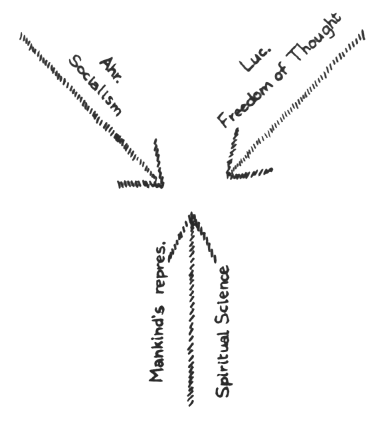
[ 33 ] The first direction is meant to symbolize not the common, trivial understanding of socialism—or the Leninist one—but rather the socialism toward which modern humanity is heading. The second line is meant to symbolize what I have often described to you as freedom of thought, and the third direction, spiritual science. These three things belong together. In life, they must work together.
[ 34 ] If socialism, as it appears today in the form of crude materialistic socialism, were to take hold of humanity, it would bring the greatest misfortune upon humanity. It is symbolized in our group by Ahriman at the bottom, in all his forms. If false freedom of thought—which seeks to dwell on every thought and assert it—attempts to take hold, calamity will again be brought upon humanity. This is symbolized by Lucifer in our group. But you cannot exclude either Ahriman or Lucifer from the present; they must simply be balanced by pneumatology, by spiritual science, which is represented by the Representative of Humanity standing at the center of our group.
[ 35 ] Time and again, it must be emphasized that spiritual science is not merely intended for people who, for one reason or another, have torn themselves away from the context of life, and who simply want to be somewhat inspired by all sorts of things connected with higher matters, but that spiritual science—anthroposophically oriented spiritual science—should be something connected with the deepest needs of our age. For our age is such that its forces can only be grasped by looking into the spiritual realm. This is, after all, something connected to the worst evils of our time: that countless people today have no idea that supersensible forces are at work in social, moral, and historical life—that, just like the air, these supersensible forces are all around us. These forces are there, and they demand that we consciously take them in so that we may consciously direct them; otherwise, they can be steered in the wrong direction by the ignorant or the unwise. However, the matter must not be trivialized. One must not believe that these forces can be pointed out in the same way that one often predicts the future from coffee grounds or other such means. Yet what pertains to the future—to the shaping of the future—is connected in a certain way, and sometimes in a quite obvious way, to these forces; and this can only be recognized if one proceeds from the principles of spiritual science.
[ 36 ] It may take some people even longer than five years to realize this. But it is already the case—you know I don’t say such things out of mere frivolity—that one day it will be possible to prove that, in a certain sense, what is now being sent out into the world as a new war cry from the Wilson camp was clearly predetermined by me earlier for a specific goal, for a specific purpose. And here in this hall, too, there are some people who know very well that the content of this new war cry was foreseen and that its content has been properly considered. It is generally difficult to speak about these things with complete impartiality. But precisely in light of these current events—the signs of the times demand it today— it must be emphasized again and again that the great demand of our time is for people to become aware that certain things happening today can only be understood—and above all, correctly assessed—if one proceeds from those perspectives that can only be gained through anthroposophically oriented spiritual science.