

Mystery Truths and Christmas Impulses
Ancient Myths and Their Significance
GA 180
12 January 1918, Dornach
Translated by Steiner Online Library
Thirteenth Lecture
[ 1 ] The things we are now discussing are connected to a fact that sounds paradoxical when stated so simply, but which nevertheless corresponds to a significant, profound truth: Human beings walk the earth, yet they actually understand themselves very poorly. Now, one might say that this saying applies most directly to our own age. We know, after all, that the great, significant inscription on the Temple of Apollo, “Know thyself,” once served as a call to those seeking spiritual connections in ancient Greece. And this inscription on the Temple at Delphi, “Know thyself,” was—as our various reflections show—not merely a phrase in those days; rather, even in that Greek era, it was already possible to attain a deeper understanding of the human being than is the case today. But the present day also calls upon us to strive once more for a true understanding of humanity—for an understanding of what it actually means to be human on Earth.
[ 2 ] Now it seems as if the things one must say in connection with this question are difficult to understand. In reality, they are not, even though they sound as if they were difficult to understand. They are only difficult to understand at present because people are not accustomed to directing their thinking and feeling along the lines necessary to truly grasp such matters. The point is that everything we currently call “understanding” actually boils down to always trying to understand through abstract concepts. But one cannot understand everything through abstract concepts. Above all, one cannot understand human beings through abstract concepts. One needs something other than abstract concepts to understand human beings. One must put oneself in a position to take human beings—as they walk about on Earth—as a kind of image, an image that expresses something, that reveals something, that seeks to reveal something to us. We must rekindle the awareness that human beings are a mystery that demands to be solved. But we will not solve the mystery of human beings if we continue to be so complacent in our thinking, so theoretical in our thinking, as we are now inclined to be. For human beings are—as we have had to emphasize time and again—complex beings. Human beings are more—far more—than the physical form that walks among us as a human being; human beings are far more than that. Yet this physical form that walks among us as a human being, and everything that belongs to this physical form, is nonetheless an expression of the entire, all-encompassing being of the human being. And one can say: Not only can one recognize in the human form—in the physical human being who walks among us—not only can one recognize in him what a human being is between birth and death here in the physical world, but one can also, if one so wishes, recognize in the human being what he is as an immortal, eternal soul-being. — One need only develop a sense that this human form is something complex. Our science, which is popularized today and thus reaches everyone, is not suited to evoking a sense of what a marvelous structure this human being actually is, walking upon the earth. One must view the human being in an entirely different way.
[ 3 ] Just think back—you’ve surely all seen a human skeleton before—just remember that such a human skeleton is actually twofold, if you disregard everything else. One could speak about this in much greater detail, but if you disregard everything else, this skeleton is a duality. You can very easily separate the skull from the skeleton—it is, after all, merely placed on top of it—and what remains is the rest of the human being without a skull. The skull can be removed very easily. This remaining part of the human being, apart from the skull, is still a rather complex being; but let us now regard it as a single unit and set aside its complexity. But let us first consider this duality, which immediately presents itself to us when we regard the human being—let us say—as a “head-human” and as the “rest of the human being,” as a “torso-human.” Thus, this duality is not limited to the skeleton; although it is less clearly evident, it also exists in the human being as a whole, in the flesh.
[ 4 ] Now, in the realm of the humanities, we need not love comparisons to the extent that we, for example, treat them as absolute or expand them metaphysically. We do not want that, but we do want to clarify all sorts of things by using comparisons. And so it is natural—because it truly corresponds to our perception—to say that, with regard to the head, the human being is primarily characterized by the spherical form. If we want to express in some schematic way what the human head is, we can say that the human being is characterized by the spherical form.
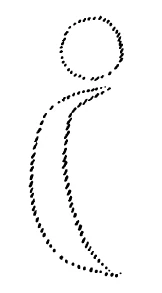
[ 5 ] If we wanted to have a schematic representation of the rest of the human body, we would of course have to take the complexities into account, but that is not what we intend to do today. However, you will easily see that, apart from certain complexities, just as one can schematically represent the human head as a sphere, so too can one represent the rest of the human body as such a shape (see drawing: moon shape), although, of course, the position of these two circles must be adjusted according to the individual’s build.
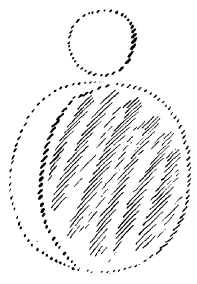
[ 6 ] But in this way we can already conceive of the human being, so to speak, as having the shape of a sphere and the shape of the moon. There is a profound, inner justification for this; but we will not discuss that today. Instead, we will simply bear in mind the fact that the human being is divided into these two parts.
[ 7 ] Now, the human head is, first and foremost, a true apparatus for mental activity. For everything that a human being is capable of producing in the way of human thoughts and human feelings, the head is the apparatus. But if we were to rely solely on what the head, as an apparatus, is capable of in terms of thinking and feeling, we would never be able to truly understand the essence of the human being. If we were to rely solely on the head as the instrument of our spiritual life, we would never be able to truly say “I” to ourselves. For what is this head? This head is, in truth—just as it appears to us in its spherical form—a reflection of the entire cosmos, just as the cosmos first appears to you with all its stars, fixed stars, planets, and comets, even meteorites—for irregularities do indeed haunt some minds. The human head is a reflection of the macrocosm; it is a reflection of the entire world. And only the prejudice of our time—as I have already hinted at in another context—is unaware that the entire world is involved in the formation of a human head.
[ 8 ] But once this human head has been brought onto Earth through heredity and birth, it cannot serve as an instrument for comprehending the very essence of the human being. We are, so to speak, given an apparatus within our head that is like an extract of the entire world, but which is incapable of comprehending the human being. Why? Precisely because the human being is more than everything we can see or think through our head. Today, many people say that human cognition has limits, that one cannot go beyond these limits. But this stems solely from the fact that these people wish to accept only the wisdom of the head, and the wisdom of the head does indeed not go beyond certain limits. Yet this wisdom of the head is also what created what we described a few days ago as the Greek gods. The Greek gods emerged from the wisdom of the mind. They are the higher gods; they are therefore gods only for everything that the human mind, with its wisdom, can encompass.
[ 9 ] I have pointed this out to you on several occasions: in addition to this external doctrine of the gods, the Greeks had their mysteries. In the mysteries, the Greeks worshipped not only the heavenly gods but also other gods—the chthonic gods. And of the one who was initiated into the mysteries, it was rightly said: He comes to know the upper and the lower gods. — The upper gods were those of the circle of Zeus; but they have dominion only over that which is spread out before the senses and which the intellect can grasp. Man is more than this. Man is rooted in his very being in the realm of the lower gods, in the realm of the chthonic gods.
[ 10 ] But one cannot come to terms with this if one focuses only on what I have schematically outlined here regarding human beings. If one wishes to consider the roots of the human being in the realm of the lower gods, then one must complete this diagram and do so as follows: One must also, in a sense, include the unlit moon (see diagram on p. 234). In other words, one must view the human head differently from the rest of the organism. With regard to the rest of the organism, one must focus much more on what is spiritual, what is supersensible, and what is invisible. The human head, as it appears to us externally, is, in a sense, a perfection. Everything that is spiritual has created an image of itself in the head. This is not the case with the rest of the human being. The rest of the human being is only a fragment as a physical human being, and one cannot come to terms with the rest of the human being by taking this physical fragment that visibly walks the earth.
[ 11 ] Well, that already shows us that we have to view human beings as complex beings. But does what I’ve just said come to light in any way in real life? What I’ve just said may seem abstract; it may seem paradoxical and difficult to understand, but the question must surely arise: Does it manifest itself in any way in real life? That is the important point: it does, in fact, manifest itself quite clearly in real life. The head is the organ of our wisdom; it is the organ of our wisdom to such an extent that our initial wisdom is linked to its development. But even an external anatomical and physiological observation shows—just look at how a head develops, how a human being grows up—that the head undergoes a completely different development than the rest of the organism. The head develops rapidly, while the rest of the organism develops slowly. Relatively speaking, the head is already fully formed in a child and develops much less further. The rest of the organism is still underdeveloped and slowly passes through its various stages. This is connected to the fact that we are, in fact, a dual human being even in life. Not only does our skeleton reveal the head and the rest of the human being, but our very life itself reveals this dual nature of our being: our head develops quickly, while the rest of our organism develops slowly. In our time, our head completes its development by about the age of twenty-seven or twenty-eight, while the rest of the organism requires our entire life, right up until death, to do so. For what the head acquires in a relatively short time can only be experienced over the course of a whole lifetime. This is connected to many mysteries.
[ 12 ] The spiritual researcher recognizes these things especially when he turns his attention to an accident. It sounds paradoxical again, but it is the absolute truth. Imagine, for example, that a person is killed; he perishes in an accident. Let us assume that a person is killed in his thirties. From an external, physical perspective, such a sudden death is a kind of coincidence; but from the perspective of spiritual science, it is simply ridiculous to regard such an event as a coincidence. For at the very moment when, due to an external cause—coming from outside—a person suddenly meets their death, an immense amount is rapidly taking place within them. Consider this: under normal circumstances, this same person, who was killed at the age of thirty, might have lived to be seventy, eighty, or ninety years old. Had he lived from the age of thirty to ninety, he would have gradually accumulated a great deal of life experience over the course of those years. The life experience he would have gained over sixty years, he goes through—if he is killed at the age of thirty—in a short time; perhaps in half a minute. When it comes to the spiritual world, the concept of time is simply different from how it appears to us here on the physical plane. A sudden death brought about by external circumstances—and one must be very precise here—can, under certain circumstances, allow a person to rapidly experience—and I say “experience”—the wisdom of an entire lifetime that might otherwise have been yet to come.
[ 13 ] This allows us to study how a person acquires wisdom and life experience throughout their life. And it allows us to study how what the mind is capable of achieving through its brief development compares to what the rest of the person is capable of achieving through their long development in social life. It is indeed true that during their youth, people absorb certain concepts and ideas that they learn; but they learn them only there. These then become intellectual knowledge. The rest of life, which unfolds more slowly, is intended to gradually transform this intellectual knowledge into heart-based knowledge—I will now refer to the other kind of person not as the “intellectual,” but as the “heart-centered person”—to transform intellectual knowledge into heart-based knowledge, into knowledge in which the whole person is involved, not just the intellect.
[ 14 ] It takes us much longer to transform intellectual knowledge into knowledge of the heart than it does to acquire that intellectual knowledge in the first place. To acquire intellectual knowledge—even if it is particularly sophisticated knowledge—one needs to spend time on it well into one’s twenties these days. Isn’t that right? By then, one becomes a very intelligent person, academically very intelligent, but to truly integrate this knowledge with one’s whole being, one must remain flexible throughout one’s life. And to transform intellectual knowledge into heartfelt knowledge, one needs just as much more time as one lives beyond the age of twenty-seven or twenty-six. In this respect, as human beings, we are also dual in nature. We quickly acquire intellectual knowledge and can then transform it into heartfelt knowledge over the course of our lives.
[ 15 ] It is not entirely easy to know what this actually means. And since we are among ourselves, I might perhaps cite an experience from the field of spiritual research that makes it easier to gain some understanding of these matters than through other works in this field. If one familiarizes oneself with the language spoken by human souls who have passed through death—those who live in the spiritual world after death—and if one understands, to some extent, the language of the dead, the so-called dead, then one can experience that the dead express themselves in a very special way regarding certain matters connected with human life. Even today, the dead have a language that we living people cannot yet fully understand. The perspectives of the dead and the living today diverge quite widely. The dead are fully aware that human beings develop rapidly as “head-oriented” beings, but slowly as “heart-oriented” beings. And the dead say—when they wish to express what is actually happening as the rapidly acquired knowledge of the head gradually becomes integrated into the slower-developing knowledge of the heart—that mere wisdom is transformed by the warmth of the heart or love rising from within the human being. Wisdom is fertilized by love within the human being. — So say the dead.
[ 16 ] And this is indeed a profound, significant law of life. One can quickly acquire intellectual knowledge; one can know an immense amount, especially in our time, because natural science—not the natural scientists, but natural science itself—has advanced quite significantly in our time and is rich in content. But this content is such that it has not been transformed into knowledge of the heart; the intellectual knowledge has remained just that—intellectual—because people—as I already pointed out yesterday—no longer pay attention to what then emerges in life after the age of twenty-seven, because people do not understand how to grow old, or rather, I might also say: how to remain young while growing old.
[ 17 ] Because people do not maintain their inner vitality, their hearts grow cold; the warmth of the heart does not flow up to the head, and the love that comes from the rest of the organism does not nourish the head. Intellectual knowledge remains cold theory. But it need not remain cold theory; all intellectual knowledge can be transformed into knowledge of the heart. And that is precisely the task of the future: that intellectual knowledge be gradually transformed into knowledge of the heart. A true miracle will occur when intellectual knowledge is transformed into knowledge of the heart.
[ 18 ] One is entirely correct today in roundly condemning, on every count, materialist natural science—or, more specifically, materialist natural philosophy. One is entirely correct, but nevertheless something else is also true: this natural science, which in Haeckel, Spencer, Huxley, and so on has remained mere intellectual knowledge and is therefore materialism—this science will, when it becomes a science of the heart, when it is embraced by the whole human being, when humanity comes to understand to grow older or to grow younger in old age, as I meant yesterday—then this very science of the present will become the purest spiritualism, the purest affirmation of the spirit and its existence. There is no better foundation than contemporary natural science, if it transforms into that which can flow into the human mind from the rest of the organism—but now from the spiritual part of the rest of the organism. The miracle will come to pass as people learn to feel the rejuvenation of their etheric body as well, so that today’s materialistic natural science will become spiritualism. It will become spiritualism all the more quickly the more people there are who confront it with its current materialism, its materialistic folly.
[ 19 ] This, however, will be linked to a complete transformation that anyone with even a modicum of sensitivity to what is happening in the present can perceive: it will be linked to a complete transformation of the education and school system. Who, with an open eye to the social, moral, and historical conditions of the present, could fail to see that we today—as humanity as a whole, if one wishes to put it grotesquely—are not at all in a position to provide children with an adequate education, and in particular, adequate schooling? Certainly, we can turn children into civil servants; we can turn them into industrialists; we can even turn them into pastors and so on; but we are hardly in a position today to make children into complete human beings, into well-rounded individuals. For it is a profound demand of our time: If a human being is to be a complete, all-around developed spiritual and soul organism, then he must be able to transform—throughout his entire life—what he absorbs as a child, what he takes in quickly and readily. Throughout his entire life, a human being must remain fresh in order to transform what he has absorbed.
[ 20 ] What do we actually do today—we just don’t look at these things with enough objectivity—what do we actually do later in life? We learned something in our youth; some learned a lot, others less. Isn’t that right? We’re proud, after all, that there are no longer any illiterate people in Western Europe. Some learn a lot, others less, but everyone learns something in their youth. And what do we do in later life with what we’ve learned, regardless of whether we learned a lot or a little? It’s all arranged in such a way that we only remember what we’ve learned; it’s inherent in human nature to remember it. What, then, are people actually doing? It’s not instilled in the human soul in such a way that it works within the soul, transforming the contents of the mind into the contents of the heart. It is not predisposed to that at all. Much water will have to flow down the Rhine before what we can give to young people today—let us consider just one field, though it applies to all fields—can become something capable of truly being transformed into knowledge of the heart. What must that be? After all, we have no way today of giving our children anything that could truly become knowledge of the heart. Two conditions are missing for this. Only spiritual science, truly and correctly understood, can bring about these two conditions.
[ 21 ] Two conditions are missing if we are to truly give children something that refreshes their lives today—something that can be a source of joy and a sense of being carried through life throughout their entire existence. Two things are missing. The first is that, by all the conventional concepts we have—the ones that today’s education can impart to people—human beings today cannot form a conception of their place in the universe. Just consider for a moment everything that is taught in school. Even the youngest children are already taught this today; at least, what is said to them is expressed in such terms that it contains what we now wish to articulate. Consider that people today grow up with the following ideas: There is the Earth; it travels through space at such-and-such a speed, and besides the Earth, there are the Sun, the planets, and the fixed stars. And what is said about the Sun, the planets, and the fixed stars is, at most, a kind of cosmic physics—nothing more—cosmic mechanics, cosmic physics.
[ 22 ] Does what astronomers say today—what our current understanding of the structure of the universe tells us—have anything to do with this human being walking here on Earth? Certainly not! Isn’t it true that, according to the scientific worldview, human beings are simply somewhat more highly developed animals who walk around, are born, die, are buried, and then another comes along, is born, dies, is buried, and so on. This continues from generation to generation. Out there in the vast expanse of the universe, events unfold that are calculated purely mathematically, as if within a vast cosmic machinery. But what does all of this—what is happening out there in the vast world—have to do for today’s intelligent human being with the fact that here on Earth this somewhat more highly developed animal is born and dies? Priests and pastors know of no other wisdom to substitute for this bleak wisdom. And because they do not know this, they say they do not concern themselves with this science at all; rather, faith must have an entirely different origin.
[ 23 ] Well, we don’t need to go into that any further. But these are, after all, two quite different things: what atheistic science talks about, and the so-called “faith” of this or that denominational church, which barely maintains the theistic element. It was necessary for the current view of the universe to take hold for a time in human development, in contrast to the earlier view. We need not go far back—people simply don’t think about it today— back then people still had an awareness that they were not merely higher animals wandering here on Earth, being born and buried, but they saw themselves in connection with the world of the stars, in connection with the entire universe; they knew, in their own way—in a different way than we must now strive for—but they knew, in their own way, of this connection with the universe. But back then, one had to imagine the universe differently as well.
[ 24 ] Such a worldview, as it is already taught to children today, was unthinkable in the 12th and 13th centuries; it was simply inconceivable to have such a view of the celestial world. People looked up at the stars, just as we look up at the planets today, but they did not merely calculate the planetary orbits—as the mathematical astronomer does today—and imagine: “Up there is a sphere traveling through space”—rather, medieval science saw in every sphere the body of a spiritual being. It would have been sheer nonsense to imagine a mere material sphere as a planet. Look it up in Thomas Aquinas. You will find everywhere that he sees in every planet the “angelic” intelligence—not the “English” intelligence, but the “angelic” intelligence. And so it was with the other stars. No one imagined a universe as modern astronomy constructs it. But in order to make progress, for a time—I would say—one had to drive the soul out of the universe in order to envision its skeleton, the pure machinery of the universe. The Copernican, Galilean, and Keplerian worldviews had to emerge. But only fools regard them as ultimately valid. They are a beginning—but a beginning that must develop further.
[ 25 ] There are some things that spiritual science already knows today that external astronomy does not yet know. But it is important that precisely these things—which spiritual science knows but external astronomy does not yet know—find their way into the general consciousness of humanity. And even if these concepts still seem difficult today, they will eventually become so accessible that they can be taught to children; they will be an important asset, especially for children, in keeping the soul alive. We must, however, still discuss these matters in complex terms. For as long as spiritual science is viewed by the external world in the way it is now, it has no opportunity to cast these matters into the kinds of concepts and ideas that are needed if they are to become part of children’s education.
[ 26 ] There is one thing, for example, that modern astronomy knows nothing about: it knows nothing of the fact that the Earth, as it races through the universe, is racing too fast. The Earth is racing too fast. And because it is racing too fast—because the Earth moves so quickly—we are also able to develop our minds more rapidly than we would if the Earth moved so slowly that its speed corresponded to the duration of our entire lives. The speed of our mental development is simply related to the fact that the Earth races too fast through space. Our mind keeps pace with the Earth’s speed, but the rest of our organism does not; the rest of our organism remains aloof from cosmic events. Our mind, which is modeled after the celestial structure as a sphere, must also participate in whatever the Earth experiences in outer space.
[ 27 ] The rest of our organism, which is not modeled after the entire structure of the universe, does not keep pace; it develops more slowly. If our entire organism were to keep pace with the Earth’s speed today—if it were to develop in a way that corresponded to the Earth’s speed—then none of us would ever be able to live past the age of twenty-seven. In that case, twenty-seven years would be the average human lifespan. For in fact, our head is fully developed by the age of twenty-seven; if it were up to the head alone, a person could die at twenty-seven. It is only because the rest of the human being is designed for a longer lifespan and continuously supplies the head with its vital forces after the age of twenty-seven that we live as long as we do. This is the spiritual part of the rest of the human being that supplies the head with its vital forces. It is the heart that exchanges its vital forces with the head.
[ 28 ] Once humanity comes to realize that it has a dual nature—a nature of the head and a nature of the heart—it will also realize that the head obeys laws of the world that are entirely different from those governing the rest of the organism. Then the human being will once again stand within the entire macrocosm; then the human being cannot help but form ideas that lead him to say to himself: I do not merely stand here on Earth as a higher animal, born and destined to die, but I am a being fashioned from the entire universe. My head, which has been formed within me, is drawn from the entire universe; the Earth has attached to me the rest of my organism, which does not initially participate in the movements of the universe in the same way that the head participates in a different way.
[ 29 ] So, if one does not view human beings abstractly, as contemporary science does, but rather considers them as a duality—as beings of the head and beings of the heart in connection with the universe—then human beings once again find their place within the universe. And I know—and others who are qualified to judge such matters know it as well—that if we can form heartfelt visions of this: that when we look at the human head, we see in it a reflection of the entire star-studded cosmos with all its wonders, then all the images of humanity’s connection to the vast, vast cosmos will enter the human soul. And these images will take the form of narratives that we do not yet possess; and these narratives will express—not abstractly, but in a way that speaks to the senses—what we can instill in the hearts of the youngest children, so that these hearts of the youngest children may feel: Here on Earth I stand as a human being, but as a human being I am an expression of the entire star-studded universe; the whole world finds its voice within me. Through sensory experience, human beings will be able to be educated to become members of the entire cosmos. That is the one condition.
[ 30 ] The other condition is as follows. If we are able to structure the entire educational process—if we are able to organize all instruction in such a way that the human being becomes aware that, in his head, he is an image of the universe, while with the rest of his organism he withdraws from this universe; and with the rest of his organism, he is able to process that which drips down like a shower of the soul—the entire universe—so that it becomes autonomous here on Earth within the human being—then this will be a special inner experience. Imagine this twofold human being, whom I now wish to sketch in this curious form. When he comes to know: Here, from the entire universe, enters his head unconsciously that which constitutes the mysteries of all the stars; but that, by stimulating the powers of his head, he must process this throughout his entire life with the rest of his organism, so that he may preserve it here on Earth, carry it through death, and carry it back into the spiritual world—if this becomes a living sensation, then the human being will know himself as a dual nature; he will know himself as a being of head and heart. For what I am saying now is connected to the fact that human beings will learn to unravel themselves, to say to themselves: As I become more and more a person of the heart, as I remain young, I see—as I grow older—through what my heart gives me, that which I learned as a child and in my youth through the head. The heart looks up to the head, and the heart will see in the head a reflection of the entire starry sky. The head, however, will look toward the heart, and will find in the heart the mysteries of the human enigma; it will learn to fathom the true essence of the human being in the heart.
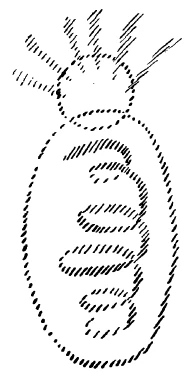
[ 31 ] Human beings will feel so conditioned that they will say to themselves: Certainly, I can learn many things with my mind. But as I live, as I live toward death, which is to carry me into the spiritual world, what I learn with my mind will one day be fertilized by the love rising from the rest of my organism and will become something entirely different. There is something within me as a human being that exists only within me as a human being; I have something to look forward to. — There is much in these words, and it means a great deal when a person is brought up to say: I have something to look forward to. I will live to be thirty, forty, fifty, sixty years old, and as I grow older from decade to decade, something of the mystery of the human being comes to meet me through the process of aging. I have something to look forward to in the very fact that I am alive.
[ 32 ] Just imagine: if this isn’t mere theory, if it’s wisdom about life—social wisdom—then the child is raised to know that: I can learn something; but the one who raises me has something within them that I cannot learn—something for which I must first grow as old as they are so that I can find it within myself. When they tell me this, they give me something that must be a sacred mystery to me, because I hear it from their lips but cannot find it within myself. — Imagine what kind of relationship this in turn creates between children and the elderly—a relationship that has been completely erased in our time—when people come to realize: The different stages of life offer something to look forward to. If I am not yet forty years old, I cannot possess within myself that sum of mysteries that can be found in someone who has already reached the age of forty. And if he shares it with me, I receive it merely as information; I cannot know it through myself. — What a bond of human fellowship is forged when, in this way, a new seriousness, a new depth enters into life!
[ 33 ] It is precisely this seriousness, this depth, that our lives lack—that our lives do not possess—because our lives currently value only intellectual knowledge. As a result, however, true social life will die and head toward dissolution; for then people will walk around here on earth who do not know at all what they are, who actually take seriously only what lasts until the age of twenty-seven, and use the rest of their lives to carry the corpse within themselves for the remainder, but not to transform the whole human being into something that youth can still carry through death.
[ 34 ] Because people do not understand this—because an age has come that was unable to understand it—that is why all matters relating to the spiritual remained so unsatisfactory, as I had to say yesterday regarding Friedrich Schlegel. He was a brilliant mind; he understood many things, but he did not realize that a new spiritual revelation was necessary. He simply believed he could take the old Christianity as it was. Through words, through their literal sound, he was even able to express the truth in many respects. Just consider this: I would like to share with you a passage from Friedrich Schlegel’s last lecture in 1828. He attempted to prove, as he put it, “that in the course of the same” — namely, world history — “a divinely guiding hand and providence can be recognized, that not only earthly, visible forces are at work in this development and in the opposing forces that hinder it, but that the struggle is also, in part, directed against invisible powers with divine assistance; and I hope to have aroused this conviction—even if not mathematically proven, which would be neither appropriate nor applicable here—and to have grounded it in a lasting and living way.”
[ 35 ] He had a vague sense that, in living through history, human beings must immerse themselves in the history of divine forces and, together with these divine forces, fight against opposing spiritual powers—he explicitly says: opposing spiritual powers—but he lacked any living awareness of this. For the true science of the spirit—one tends to shy away from it in a certain sense. Ever since the third century A.D., when the so-called “prejudice” arose in the West as a response to the “objection of false Gnosticism”—that is how it was called—people gradually came to reject everything that human beings can know about the spiritual worlds. And so it has come to pass that even religious impulses have paved the way for materialism, that these religious impulses could not prevent the fact that today we actually have nothing that we can truly give to the youth. Our science does not serve the youth, for one can only recall it in later life; it cannot become wisdom of the heart.
[ 36 ] This is true even in the religious sphere. After all, humanity has, I would say, arrived at only two extremes. Humanity has largely forgotten how to grasp the supersensible Christ. It wants nothing to do with that cosmic power of which spiritual science must once again speak as the power of Christ Jesus. On the one hand, there is a very lovely—truly lovely—conception of all that has developed over the course of the Middle Ages and modern times through poets and musicians: a lovely, poetic conception that has evolved in connection with the infant Jesus; but the ideas associated with the dear little Jesus cannot, after all, provide a person with religious fulfillment throughout their entire life! It is, after all, characteristic that a downright paradoxical love for the dear little Jesus is expressed in countless songs and the like. There is nothing wrong with that, but it cannot remain the only thing.
[ 37 ] That is the one in which man, unable to rise to greatness, has turned to the smallest things in order to have at least something. But it cannot fill a life. And on the other hand, there is the “bon dieu citoyen,” as we came to know him at Christmas through the words of Heinrich Heine—the good civic god Jesus, stripped of all divinity, the god of liberal pastors and liberal priests. Do you believe that he can truly grasp life? Do you believe, in particular, that he can capture the hearts of the youth? From the very beginning, he has been a dead product of theology—not even a product of theology, but a product of the history of theology. But humanity is also far from directing its gaze, in this realm as well, toward that which constitutes spiritual power in history.
[ 38 ] Why is that? Because for a time, humanity simply had to go through the experience of viewing the world from a purely material perspective. The time has also come when the transformation of contemporary natural science—which is capable of spiritual development—into wisdom of the heart must take place. Our natural science is either utterly worthless if it remains as it is, or it is something truly extraordinary if it transforms into wisdom of the heart. For then it becomes spiritual science. The older science, which is bound by various traditions, had already transformed intellectual science into wisdom of the heart. More recent times have lacked the ability to transform what it has newly gained as science up to now into wisdom of the heart. And so it has come to pass that, particularly in the social sphere, intellectual science has done the only real work and has therefore produced the most one-sided result imaginable.
[ 39 ] The human mind can know absolutely nothing about human existence. Therefore, when the human mind reflects on human existence as it manifests itself in a social context, it must produce something entirely foreign to social life, and that is modern socialism, as expressed in the form of social democratic theory. There is nothing that is as purely intellectual as Marxist social democracy, simply because the rest of humanity has failed to engage with global problems at all, and those in these circles have concerned themselves solely with social theories. The rest have merely—well, I’ll put it politely—had the professors’ ideas recited to them, ideas that are merely traditional. But intellectual wisdom has become social theory. That is to say, an attempt has been made to establish a social theory using a tool that is, of all things, the least suited to understanding human existence. This is a fundamental error of contemporary humanity, one that can only be fully uncovered when we come to understand the nature of knowledge derived from the head and the heart. The intellect will never be able to refute socialism—Marxist socialism—because in our age, the intellect must think beyond itself. Only spiritual science can refute it, because spiritual science is intellectual wisdom transformed through the heart.
[ 40 ] It is extremely important to take these things into account. You see why inadequate means were available even to a man like Schlegel, because he wanted to draw on the old, even though he realized that human beings must once again develop an eye for the invisible that is at work among us. But our time calls on us to direct our gaze toward this invisible realm. Invisible forces have always been there, just as Schlegel sensed; invisible forces have worked alongside and contributed to what is unfolding within humanity. Humanity, however, must evolve. This has gone so far that, in recent centuries, people have paid no heed to the supersensible, invisible forces—for example, in social life. In the future, this will no longer be possible. In the future, this will not be sustainable in light of real circumstances. I could cite many examples of this; I will cite just one.
[ 41 ] I have spoken about this from other perspectives over the course of the last decade and a half. Anyone who considers social relations in Europe as they have developed since the 8th, 9th centuries, knows that various factors have shaped the structure of European life—this complex European reality, which in the West has preserved Athanasian Christianity, which, as I said here weeks ago, has pushed back toward the East an older form of Christianity that is intrinsically linked to Asian traditions: Russian Christianity, Orthodox Christianity; which has taken shape in the West—by gradually creating a composite body out of the preserved Roman heritage combined with the newly revived Germanic and Slavic traditions in Europe—the various European components of this European social whole, a complex organism. Until now, it was possible to navigate within it by disregarding what lived invisibly within it; for the configuration of Europe possesses great strength in its structure. But one important, essential force within this structure is, among other things, the relationship that France has maintained with the rest of Europe. I am not referring merely to the political relationship; I mean the entire relationship between France and the rest of Europe, and by this I mean everything that any European might have felt toward anyone who identified with the French spirit over the course of the centuries, beginning in the 8th and 9th centuries. What is peculiar is that, as far as the relationship of the rest of Europe to France is concerned, this relationship is expressed in feelings of sympathy and antipathy. We are dealing with sympathy and antipathy. But this is a phenomenon purely of the physical plane. One can understand what has been at play in Europe between France and the rest of Europe in terms of human relationships by studying what hearts and human souls experience on the physical plane. In any case, what has developed for France outside of France itself can be understood in terms of conditions on the physical plane. Therefore, it did no harm—other circumstances in Europe were similar in recent centuries—if one failed to see what supersensible forces were at work in these events, because the sympathies and antipathies were determined by the conditions of the physical plane.
[ 42 ] Much of what has been the norm for centuries will change. We are facing powerful upheavals, including in the most fundamental aspects that underlie the European social structure. One must not think that I spoke lightly when I have repeatedly drawn attention to the fact that these matters must be taken more seriously than people are inclined to do today. We are facing powerful upheavals, and it will be necessary in the future for people to turn their gaze—the eye of their soul—toward spiritual conditions; for it will no longer be possible to understand what is taking place based solely on conditions of the physical plane. One will be able to understand it only if one is able to take spiritual conditions into account. What took place in March—the fall of the tsarist regime—has a metaphysical character. One can understand it only by focusing on its metaphysical character.
[ 43 ] We’re among ourselves here, so we can discuss such matters freely. Why did the tsarist regime exist in the first place? This question can be understood in a higher sense than in the superficial, trivial-historical sense. Why was there a tsarist regime at all? If one disregards a few pacifist mavericks who saw something serious in the frills of the tsarist peace manifesto, then one must say: Even those who, for all sorts of reasons, were on [good] terms with the Russian Empire—they did not love the tsarist regime! And as for those who did love it, their love was certainly not very genuine. Why did the tsarist regime exist at all? It existed—and I’ll put this paradoxically, somewhat extremely—so that Europe would have something to hate. These forces of hatred had to be mobilized. There was a tsarist regime, and the tsarist regime behaved as it did so that Europe would have something to hate. Europe needed this hatred as a prelude to something else. The tsar had to exist, first and foremost, to serve as the focal point on which the hatred was concentrated; for a wave of hatred was gathering momentum, one that can already be assessed from the outside in the days following these events. What is now unfolding will transform into powerful feelings of hatred that will no longer be comprehensible in the same way that the sympathy and antipathy of the past—as I have explained—can be understood on the physical plane. For it will not merely be people who hate. Central and Eastern Europe will be hated—not by people, but by certain demons that will dwell within people. The time when Eastern Europe will perhaps be hated even more than Central Europe is already coming.
[ 44 ] These things must be understood; they must not be taken lightly. They can only be understood if people rise to the task of seeking a connection with the spiritual world. For what must surely come is what spirits such as Friedrich Schlegel had already sensed to some extent, but for which they simply did not see the foundations and roots. It must come to pass that these things are perceived impartially by the eye of the soul, so that human beings can look back on the past centuries and on what they have brought about—and then they will be able to contribute to what must be established.
[ 45 ] Among the beautiful sentences that are sometimes found in Schlegel’s lectures is the one stating that the development of humanity depends on the inner life of the soul and on the truthfulness within the soul, and that, above all, any form of political idolatry is harmful. That is a beautiful statement by Friedrich Schlegel. This political idolatry—how it has taken hold of our time! How it dominates our time! And political idolatry has created for itself a beautiful symptom by which one can recognize what is happening.
[ 46 ] But one must see through the connections. One must sense what is alive in our time. We do not have the ability—as we understand when we look at the true nature of the head-and-heart human being— we do not have the ability today—unless we deeply internalize this knowledge—to give children what they need to sustain a vibrant, youthful approach to life. We do not yet have this ability. It must be established; it must come to pass. To summarize in a few words: schoolmasterliness is utterly incapable of fulfilling its task today. What “schoolmasterliness” is, is utterly alien to the true nature of the human being. Yet the world is in danger of being dominated by a schoolmaster who is idolized politically. Schoolmasterliness—the most unsuitable means of guiding humanity in the present era—is set to become high politics.
[ 47 ] At least some people should realize these things, for they are deeply connected to the profound insights that one can acquire only by attempting to delve a little into the mysteries of humanity. Today, the world can be neither understood nor governed in any way through drives and instincts, chauvinism, and nationalism—but only through good will that seeks to penetrate true reality. We will continue this discussion tomorrow.