

Mystery Truths and Christmas Impulses
Ancient Myths and Their Significance
GA 180
13 January 1918, Dornach
Translated by Steiner Online Library
Fourteenth Lecture
[ 1 ] We have seen that one can come closer to certain mysteries of the world and of humanity by engaging in the contemplation of human beings themselves—but by contemplating them in such a way that, in their form—which we initially viewed as an ambivalent one—one perceives something of the resolution of the world’s mystery. One can help oneself greatly—meditatively so—with regard to all these things by reflecting more deeply on the following statement: The world as a whole is a mystery, and the human being, again as a whole, is its solution. But of course, one must then refrain from wanting to solve the mystery of the world in a single moment; for human life itself—specifically, the entirety of human life, the life we experience between birth and death and then again between death and a new birth—is actually the solution to the mystery of the world. So the formula is very useful: The world is a mystery, and humanity is its solution.
[ 2 ] We have seen that when we consider the outer physical form of the human being, we can distinguish between the head and the rest of the body. We can regard the head, with its spherical shape, not only comparatively but objectively as a reflection of the entire cosmos. We can even say that the entire starry sky works to bring forth the form, the structure, and the inner balance of forces within the human head. This is, of course, also connected to the fact that—to put it simply—everyone has their own mind. That is indeed what a human being has. For as you know: depending on where one stands on Earth, or depending on when one observes the starry sky, the configuration of the starry sky is always different. If we now consider not the starry sky in general, but the specific configuration of the starry sky at the place and time when a person is born, it follows that, according to this specific configuration of the starry sky, each person must have their own unique head. For it is not the starry sky in general that shapes our heads, but the specific configuration of the starry sky.
[ 3 ] So let us bear this in mind, and from the various considerations we have already made, it becomes clear that a significant part of the task a human being has between death and a new birth is to familiarize themselves with the mysteries—the spiritual mysteries—of the starry sky. For in a certain sense, one can even say: the human mind is not simply given to us in a completely passive state, but rather we shape it ourselves. Between death and a new birth, we become acquainted with all the laws that govern the vast expanse of the universe. The vast cosmos is, after all—when we conceive of it spiritually—our abode after death until a new birth. Just as we here on Earth learn the laws according to which houses are built, and the laws according to which other things are done, so do we familiarize ourselves, in the time between death and a new birth, with the laws of the cosmos, of the universe. And we ourselves contribute to the cosmos, and from within the cosmos we work in collaboration with the pure spiritual beings who inhabit it—beginning with our head—so that when the human head appears here in the physical world, it is only seemingly determined by mere heredity from our ancestors.
[ 4 ] I have said in public lectures—and I repeat it here—that everyone is convinced that the magnetic needle does not point north on its own, nor south at the other pole, but that cosmic forces are at work here, and in particular, the Earth. In the case of the magnetic needle, we therefore acknowledge that the universe as a whole is involved through its forces; yet when it comes to the origin of a living being, people today are still unwilling to acknowledge that the entire universe is involved. In the case of human beings, the entire universe is primarily involved in the formation of the head. This head did not come into being merely through heredity from father, mother, grandfather, grandmother, and so on; rather, the forces of the universe are at work here. And of the limbs, of the parts of the human being, the configuration of forces in the universe acts preeminently upon that which is in the head. In contrast, we have indeed acquired the rest of our organism, insofar as it is physical, through a kind of inheritance from our ancestral line.
[ 5 ] Modern science is very close to discovering this for itself. After all, modern science resists only those aspects of the truth that resonate with spiritual science. In some respects, modern science is already very close to converging with spiritual science. I have already mentioned this in lectures in Berlin and, to some extent, here as well—for example, with regard to something that has always been contested in spiritual science, modern science is very close to discovering it as well. People who read my *Theosophy* often find themselves particularly repelled by the chapter in which I speak of the human aura—of how the soul-spiritual aspect of the human being manifests itself to clairvoyant consciousness as a colorful aura that surrounds the person. Now, in recent times, Professor Moritz Benedikt in Vienna—whom I have mentioned frequently in other contexts—has conducted experiments with people who are particularly skilled at using a divining rod. Professor Benedikt did not, however, conduct clairvoyant experiments, for he is very, very reluctant to admit anything at all regarding clairvoyance; but he did conduct experiments in a darkroom with people who are particularly suited to using the divining rod—which, after all, played such a major role in this war. You may know that the divining rod played a very special role in this war in particular. Since water is needed for the soldiers, people skilled in using the divining rod were employed in various military units to locate springs that could be tapped to supply the soldiers with water. This was carried out on a large scale during this war in southern theaters of war, including the Galician theater. Driven by necessity, of course, they had no choice but to resort to such measures. Now, in true naturalist fashion, Professor Benedikt examined such people—who are particularly suited to finding underground springs or metals using a divining rod—in a darkroom. For example, when he properly treated a very petite woman in the darkroom, he discovered that she exhibited such a powerful aura that she appeared like a giant. He was even able to describe that the right side was bluish, while the left side was yellowish-reddish.
[ 6 ] You can read all of this today in Professor Benedikt’s book on dowsing—he is the one who published this research—as a finding of conventional science. It is the aura that Professor Benedikt observed in this way—as I have already mentioned on previous occasions—not the aura we are speaking of. When we speak of the aura, we mean far more spiritual elements within the human being than this lowest, almost physical aura that Professor Benedikt can, of course, detect in the darkroom. But there is a connection after all, so that precisely that part of my “Theosophy” which has been most contested—the part that has been most vilified—has now already demonstrated its points of contact with external science. Things will move very quickly.
[ 7 ] And the same will be true of what I have just touched upon. Before long, for purely scientific reasons, it will be possible to establish that what a human being carries within themselves derives solely from their ancestors—insofar as it does not concern the form and the inner balance of forces within the head; that the head is in fact imbued in the human being from the cosmos, and that the forces of the cosmos are at work within the human head. If we were to follow our heads alone, we would never be national in character. The head is not at all predisposed to be national, for the heavens are not national, and the head originates from the heavens. Everything that enters our thoughts regarding the division of human beings into groups does not come from the head; it comes from that through which we are connected to the stream of human heredity. This naturally influences the head while the human being lives here between birth and death, for the rest of the organism is constantly exchanging its nervous and blood forces with the head.
[ 8 ] But when we speak of heredity—that is, that the part of the human being outside the head derives its powers from the ancestors—we must actually speak only of the physical aspect, for the situation is somewhat different with the spiritual part of the rest of the human being. And here it is very important to take into account a fact that only spiritual science will be able to discover: namely, that the head is influenced only by the fact that it is superimposed on the rest of the organism through heredity—this is something natural science will discover, just as it has discovered the aura. That human beings are related to their ancestors only in relation to the rest of their organism—this, too, natural science will discover. But the other aspect touches on a realm into which natural science, of course, cannot readily enter. This is the following: When we are born, we carry within our heads the forces of the universe; these forces shape our head. To some extent, this can indeed be observed externally. Anyone who observes children as they develop may know that in the very earliest stages, people often ask: “Who does the child actually resemble?”—and the resemblance often only becomes strongly apparent later in childhood. At least some of you will have observed this already. This stems precisely from the fact that the head—if I may use the expression—is, in relation to earthly conditions, neutral; the rest of the organism must first exert its influence on the head; of course, it can already do so during the embryonic period, but it must first exert its influence on the head—only then does the human being come to resemble their ancestors in terms of facial features and the like.
[ 9 ] So through such things, one can observe the truth that lies in this realm even from the outside, provided one has a reasonably receptive sensibility for such matters. But the matter runs deeper. That which serves as the mediator between the spiritual universe—for the universe is filled with spirit and spiritual beings—and the Earth, where we live, is not at rest; a subtle substance flows from it continuously, one that cannot be produced in a chemical laboratory because it does not belong to the chemical elements. This subtle substance flows continuously from the vast universe onto Earth. So that, if one were to draw this schematically, one could say: If Earth is here in space (see diagram), then cosmic matter—a subtle cosmic substance—flows continuously onto Earth from all sides (arrows pointing inward); this subtle substance even penetrates somewhat beneath the Earth’s surface. So that this is constantly happening: substance from the entire cosmos descends toward the Earth. It is not actually physical substance; it is not a chemical element; it is something spiritual, but it is real auric substance that extends all the way beneath the Earth’s surface. Within this substance lie the forces we use when we descend from the spiritual world to Earth in order to take up residence in a physical human body.
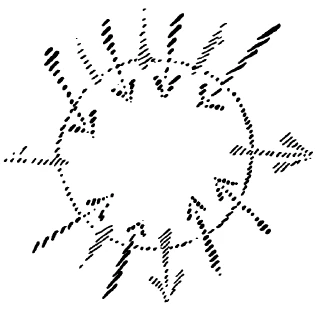
[ 10 ] Now it is significant that this substance, which flows toward the Earth and flows away from it again, is used—when it flows away from human beings as they die—to regain the powers needed to enter the spiritual world. This matter, which I have indicated here as flowing inward toward the Earth, penetrates to a certain depth into the ground and then flows out again (see arrows pointing outward); so that one can continually perceive a kind of inhalation of ether or auric substance into the Earth, and then an exhalation.
[ 11 ] This is one observation that is not so easy to make. But once you have made it—once you have realized that the Earth is in fact constantly inhaling and exhaling spiritual substance—then you know how to apply it to all circumstances and, above all, to human life, just as I have now explained. So, through what I have indicated here in the drawing with arrows pointing inward, we enter into our physical existence; through what I have indicated with arrows pointing outward, we emerge again at death.
[ 12 ] We’re among ourselves here, so I don’t need to hold back on certain things. That’s why, in this case, I’d like to tell you how I first came across this fact years ago. These forces at work—the forces that draw in and push out—are not only related to human life, but to all kinds of earthly circumstances. Now, it was a particular mystery to me how things work with the cockchafers—forgive me—with the cockchafers. May beetles are, in fact, extraordinarily interesting because—as you may know from observation—if there are quite a lot of May beetles in a given year, then in three to five years there will be quite a lot of grubs—that is, the larvae of the May beetles—and these grubs cause extraordinary damage to the potato crop. You get very poor potato harvests when there are many grubs. And anyone involved in potato farming knows that there will be a poor potato harvest in three to five years if there are quite a lot of cockchafers in a given year. I had regarded this as an interesting fact and then discovered that the life of the cockchafers is connected to the substances flowing in, while the life of the grubs is connected to the substances flowing out. I just want to emphasize this as an example that shows how one can arrive at such insights from entirely different angles. The surest way to arrive at such insights is not by examining them in relation to the immediate object itself, but by examining them in relation to a relatively neutral object toward which one can most easily maintain a neutral stance. From this, however, you can see that these substances I have spoken of penetrate the soil and even remain underground for a while. The substance that flows in this year does not flow back out again until some time has passed. This is also related to the fact that, in general, the outflowing substance is more sluggish than the inflowing substance. The inflowing substance is more lively and flows in more quickly; the outflowing substance is more sluggish and flows out more slowly.
[ 13 ] If one observes human life closely, one can see how, in fact, when a human being emerges from the cosmos at birth, they make use of the forces contained in the inflowing substance. Later in life, they lose their connection to this inflowing substance. As you can see from these observations, it is primarily the head that is connected to this inflowing substance. But the human head is a hard sphere. It is, after all, a hard sphere, and it is the part of the body that is most ossified among all our organs. Consequently, it loses its connection with these inflowing forces relatively early—not in childhood, but relatively early. That is also why its formation and development are completed early.
[ 14 ] During childhood, human beings remain in even closer contact with these inflowing forces, but then they cease to influence them; at least that is the case in our present cycle of time. It was not always this way on Earth—I will speak of that shortly—but in our present cycle of time, this is the case. However, while a human being lives here on Earth, the rest of their organism—outside the head—takes hold of the outflowing substances and the forces of these outflowing substances. The rest of the organism is permeated by these; and these are the forces that, if heeded, can rejuvenate the rest of the organism from the outside, as I indicated yesterday. These are the rejuvenating forces that act upon the etheric body, which—as I said yesterday—becomes increasingly chubby-cheeked as we grow physically old on the outside. For those foreign friends who do not understand the word “chubby,” I would like to note that this refers to the cheeks of children, which are as rounded as you see in pictures of angels blowing trumpets. So the human being becomes chubby-cheeked as an etheric human. In this process that the etheric body—which is connected to the rest of the body—undergoes, the forces streaming out from the Earth are at work, and it is these very forces that we use when we pass through the gate of death to return once more to the cosmos, into the spiritual world.
[ 15 ] You see, the Earth is intimately involved in our lives. And everything I have just said is connected to something that can very easily be expressed in a formula—an important, essential formula: For a long time, we live as souls between death and a new birth before we enter physical life through that birth; and once again, we live as souls after we have passed through the gate of death, until our next incarnation in the worlds. The dead live a spiritual life. This spiritual life is connected to the stars, just as we here are connected to physical matter. Since our head is the embodiment of the forces we experience between death and a new birth—since, in a sense, we build our head out of the forces of the worlds—our being, our own being, our soul-spiritual being finds its spiritual grave in our head relatively early on. Consequently, the forces of our head that we possess here on Earth stem from the fact that our head is, in fact, the grave of our soul life, as we lived it before birth or, more precisely, before conception. Our head is the grave of our spiritual existence. But because we have descended to Earth, the rest of our organism is capable of bringing us back to life by absorbing the forces that flow back from the Earth out into the cosmos in order to form its spiritual aspect. And while our physical organism falls away from us, our spiritual being, together with our forces flowing out from the Earth, travels through outer space into spiritual existence.
[ 16 ] This is the wondrous polarity that prevails in the universe with regard to human beings. We become physical from the spirit by burying our spiritual nature within our heads; the head marks the end of our spiritual existence before birth. Here on Earth, it is the reverse: we leave the physical behind; the physical gradually decays during life, and the spiritual arises. So that we can say: birth signifies the resurrection of the physical through the transformation of the spiritual into the physical; death signifies the birth of the spiritual, in that the physical is surrendered to the Earth just as the spiritual is surrendered to the universe. By being born, we surrender our spiritual nature to the Earth; by dying, we surrender our physical nature to the Earth. Because we give our spiritual nature to the Earth through birth, we are physical human beings. Because we surrender our physical nature to the Earth through death, we are spiritual human beings in the time between death and a new birth. This is the polarity, the contrast. And our life here consists in developing our spiritual organism. But we can develop it in the right way for our present earthly cycle only if we take into account what I explained yesterday: if we succeed in bringing the two conflicting aspects of human nature into genuine correspondence with one another—if the life of the head and the life of the heart enter into a relationship with one another—and if the shorter life of the head truly becomes integrated into the whole human being, so that the whole human being can then rejuvenate itself during the life it has to live, even though, fundamentally speaking, its head has long since lost its flexibility and its capacity for inner development.
[ 17 ] This will be the task, in particular, of educational science in the future: to make anthroposophically oriented spiritual science so fruitful that people, through all kinds of stories and all kinds of things that are suitable for young people—but suitable in such a way that one can maintain an interest in them throughout one’s entire life— that a person gains a sense of how they are formed out of the universe, how they truly emerge from the universe, and how, in turn, they give back to the universe what they acquire here on Earth. I ask you to truly—I do not say “think through,” for that is of little use, but rather I say: “feel through,” “sense through”—truly feel through just one thing. Here, too, there is a point where natural science today already intersects with what can be explored through spiritual science. I have already mentioned how discerning geologists have indeed stated that the Earth is already on the path to extinction. The Earth has passed the point where, as an earthly being, it was actually in the middle of its lifespan. In the excellent book *The Face of the Earth* by Eduard Sueß, you can read how Sueß—a geologist, a purely materialistic geologist—explains that when one walks across fields today and looks at clods of earth, one is dealing with something that is dying, something that used to be different. It is dying. The Earth is dying. We know this from spiritual science, because we know that the Earth will transform into another planetary existence, which we call the Jupiter existence. The Earth as such, then, is dying. But humanity—or rather, the human race as the sum of spiritual beings—does not die with the Earth; rather, it lives on beyond the Earth, just as it lived, in the manner I described in my *Outline of Esoteric Science*, before the Earth was the Earth. And so one can—as I said, not intellectually, but intuitively, emotionally—imbued with the idea: I stand here on this earth; but this ground on which I stand, in which I will find my grave, this ground—it is a transitory thing in the cosmos.
[ 18 ] How, then, does this Earth give rise to a new Earth, a new planet that humanity will inhabit in the future? How does this come about? It comes about because we ourselves, bit by bit, contribute to this new planetary existence. We as human beings—the animal kingdom also plays a part in this—prepare here during our physical lives, by always carrying within us what is actually intended for the next life; we are already preparing, even during our physical lives, the next planet that will follow on from the Earth’s existence. In the forces that return lies what constitutes the Earth’s future. We do not merely live in the Earth’s present; we live in the Earth’s future. We must simply return to our incarnation because we still have various tasks to complete on Earth, insofar as it will continue to exist. But we are already living in the Earth’s future. As we have said, the Earth breathes in and out spiritual substance. In the substance it inhales, we carry the past and the laws of the past, the forces of the past. In what it exhales—which the Earth gives back—we carry the future within us. The future of earthly existence rests within the human race itself.
[ 19 ] Imagine this conveyed in a deeply emotional, loving, and inspiring way, instead of all the foolish things that are taught to young people today; imagine it brought to life and taught to young people through hundreds upon hundreds of vivid stories and parables. Then imagine what kind of feeling a person develops toward the universe, and what needs to be done. What needs to be done—in concrete terms—if our culture is to move forward. It is very important to take this into consideration. And it can be taken into account all the more because it is connected to what I have called the rejuvenation of the human being. The fact that humanity today has come to such calamities is connected to the fact that it has lost the secret of transforming the life of the head into the life of the heart. We have almost no real life of the heart at all. What people usually talk about is the life of instincts, the life of desires—purely that, not the spiritual life of which we have spoken. Today, human beings simply let what flows out into the universe flow out, without giving it a second thought. They pay no attention to it.
[ 20 ] Some people notice this instinctively. I have cited this as an example in recent days—how some people instinctively notice this, yet in doing so often differ from others. You may recall—I mentioned the comparison between Zeller and Michelet, the two Berlin professors—that I said I had spoken with Eduard von Hartmann about these two gentlemen at the very moment when Zeller had just retired because, at seventy-two, he no longer felt capable of giving his university lectures. But Michelet was nearly ninety years old. And Hartmann recounted: “Michelet was here just now, and he told me, ‘I don’t understand Zeller—he’s only seventy-two years old, and he says he can no longer lecture.’” “I’m ready to lecture for another ten years!”—And as he said this, he jumped around the room, delighted at all the things he would lecture on next year, and couldn’t understand how that young man Zeller—the seventy-two-year-old Zeller—could claim the right to retire and no longer speak to the students.
[ 21 ] This ability to stay young is precisely something that is connected to a genuine interaction taking place between the head and the heart. Of course, this can happen in an individual person from time to time; but on the whole, it can only truly take place in the individual if it permeates our culture—if our entire culture is imbued with the principle of having not merely a life of the head, but also a life of the heart. Yet cultivating a life of the heart requires more patience—even though it is more fruitful and rejuvenating for life—it demands more patience than simply having a life of the head. Intellectual life—you see, one sits down and plows. After all, in our youth, despite all the talk from educators, we are primarily encouraged to be “oxen.” For certain habits have been preserved from earlier times, when things were still known in an atavistic way, but people no longer associate any real meaning with such habits. I would like to remind you of one such habit.
[ 22 ] Everything that has survived from relatively recent times—before materialism became all-encompassing—has a deeper meaning. It’s just that in recent decades even this has been lost, but when I was still young—it was a long time ago—there was, for example, a curriculum in high school where students took ancient history in the second grade of the lower division; then in the fifth grade, they took ancient history again. Those who administered such policies back then no longer knew what it was actually all about, and the teachers who taught these subjects certainly did not do so in a way that would have fostered an understanding of the rational basis of the subject. For anyone who had been aware of this would have said to themselves: When I teach history to a boy in the second grade, he learns it; but what he absorbs at that stage takes a few years to become ingrained in his being. That is why it is good to revisit the same material in fifth grade, for only then will what went into that poor child’s head three or four years ago bear its good fruit.
[ 23 ] The entire structure of the old gymnasium was actually built around these things. The medieval monastic schools often still had traditions that had emerged from ancient wisdom—not our own, but wisdom that had been preserved atavistically from ancient times and had then found its way into institutions that were reasonable. It simply takes the principle of patience if intellectual life is to merge with emotional life. For intellectual life quickly becomes part of a person, whereas emotional life proceeds more slowly, more sluggishly—one must wait for it. And yet today, people want to understand everything right away. Just think: a person today is supposed to have to surrender to the feeling that they are learning something, and then, in order to fully understand it, they are supposed to wait a few years. Well, in our age, such a principle is hardly compatible with people’s sensibilities.
[ 24 ] At present, there are many other things that can be combined with human feelings. We can indeed see examples of this, and it is good to point out such examples. Plays by two figures closely associated with our Society have now been staged in Zurich, and it has been widely suggested that these figures are connected to the Dornach building, to spiritual science, and so on; and in this case, to be entirely fair, one must say that these Zurich productions by Pulver and Reinhart have actually been very well received within Switzerland. But one can observe some curious things in the correspondence that has come out of Switzerland. The foreign correspondents have behaved, well, let’s say, less interestingly than the Swiss observers themselves in this case. For example, I was given a newspaper in which these two Swiss premieres by Pulver and Reinhart are reviewed, and in which the correspondent in question cannot resist pointing out that the individuals in question are connected to our movement and have drawn much from it. But today people aren’t just afraid—are they?—of the “false influence of Gnosticism,” as I mentioned yesterday, but they’re afraid of spiritual life in general. If anything resembling a worldview plays a role in something, oh, that’s terrible! And this is specifically connected to the fact that people have absolutely no sense of this relationship between intellectual life and emotional life. All life existing in humanity today outside of the head is pure life of drives and desires; it is not spiritual. That is why the life of desire and instinct clashes with mere intellectual life. Intellectual life is, of course, very spiritual today; but it is constantly—I don’t know if one can say this, but it is true nonetheless—it is constantly being tainted by the life of drives and instincts. That is why thoughts emerge in such a curious way. And this correspondent I am referring to—whose mind has been confused by his instincts—you can perhaps best judge for yourselves when I read to you, from a characteristic sentence, his fear that “questions of worldview” play a role in these plays by the two gentlemen. Just think, the man manages to write the following:
[ 25 ] “But if Pulver were to recruit disciples from the stage, his faith in Christ would have to spring from the depths of suffering and doubt. The starflower, which Reinhart’s seeker of paradise plucked from the window of his study in the very first scene, was not to bloom until the end—and from a bleeding heart. ” And now comes the sentence I’m referring to: “Both poets already had their worldview fully formed in their minds when they began to write; it would have been better for their plays if they had had to earn their religion only through the act of writing.”
[ 26 ] Just think about it: People today actually manage to criticize it as a major flaw that someone begins to write based on a worldview! So you’re supposed to sit down like an orphan in the face of the whole world, just start scribbling away, and in the process of scribbling, a worldview is supposed to emerge in the end. Then you take the whole thing to the theater, and people are supposed to like it! Can you believe that such nonsense is actually being spread in the world today? And many people don’t even realize that such nonsense is being spread.
[ 27 ] Such things are simply related to the fact that intellectual life is not integrated into the whole person. For, of course, the author of this article is also a very “intelligent person.” There is no doubt about that—he certainly is a very intelligent person; but it is of no use to be intelligent if that intelligence is merely a life of the mind. That is the crucial point one must keep in mind; it is extraordinarily important.
[ 28 ] Here we are touching on a foundation that is essential to our present-day culture. One can, I would say, make such observations at every turn. Logical lapses today are not committed because people lack logic, but because it is not enough to have logic. You can be a wonderfully logical person, ace your exams, be a brilliant university professor—say, of economics or some other subject—and yet, even though you’re a very smart person with all the logic in the world, still commit one logical blunder after another by failing to achieve anything connected to real life—if one lacks the patience to translate what is grasped by the mind into the whole person, if one lacks the patience to appeal to the rejuvenating forces within human nature. That is what this is all about. Anyone who is truly engaged in genuine science—such as spiritual science—knows that they would be ashamed to present something they discovered or learned today as early as tomorrow, because they know it has no value at all. It only acquires value after years have passed. The conscientious spiritual researcher cannot present material that he has only recently learned; rather, he must keep these things present in his soul again and again so that they may mature. At the very least, when he presents something he has recently discovered, he must specifically point it out so that the listener may take notice of it. But only by taking these demands on human nature into account will one truly be able to see what is necessary for the present. For what is necessary for the present does not lie in what is primarily sought today, but in finer structures that are, however, widespread throughout the world. One really need not touch on political matters when, for example, drawing attention to the following:
[ 29 ] There are many people today—more than is good for the world, in any case—who believe that this war must be continued for as long as possible so that it may lead to a general peace; if it is ended too quickly, they argue, it will not serve the cause of peace! I do not intend to pass any judgment on the merits or demerits of the so-called peace negotiations being conducted between the Central Powers and Russia, but it is nonetheless interesting to see what curious logic can be developed in this context. For example, I was given an article that is truly extraordinarily interesting in this regard; for the gentleman in question—the name is irrelevant in this case—actually opposes a so-called separate peace on the grounds that he believes such a separate peace would not bring about world peace. Straightforward thinking—but the kind of thinking that has already been pushed a bit too far—might say: Well, perhaps we’ll make a little progress if, at least in one place, people stop bashing each other’s heads in. — That might be sound reasoning. But flawed reasoning says: No, we mustn’t stop fighting anywhere, because that won’t bring about “universal world peace.” — And now this gentleman engages in interesting debates—that is, debates that interest him—about how people argue over words. He believes that those people who say one must be enthusiastic about peace—even if it were only a partial peace—are merely hypnotized by words. For one must not cling to words, but must tackle the issue head-on, and the issue is precisely this: that a partial peace is detrimental to universal world peace.
[ 30 ] Among the various reasons cited by the gentleman in question is the one contained in the following sentences. An interesting sentence—such a characteristic one for the present day! Yes, where should one begin so as not to make the matter too personal? Well: “Anyone who is honest will have to admit that this is the motive of many—not all!—among us who take such pleasure in a ‘special peace’ and in Lenin and Trotsky”—he means, in fact, that enthusiasm for the word ‘peace’ is the reason—“while at the same time they tirelessly rail against the ‘anti-militarists’ and show little favor toward our Lenins and Trotsky’s.” The gentleman in question is speaking of Switzerland.
[ 31 ] “But we, who are not fools for mere words but seek the matter itself—and who do not wish for a German peace, but for peace—we want universal peace. For us, the word ‘special’ is contradictory to the word ‘peace.’” If one looks at the matter objectively, one must carefully distinguish between peace and peace! The article is also titled “Peace and Peace.”
[ 32 ] So the author, who throughout the entire article rails against the idolatry of words, then writes the following sentence: “For us, the word ‘separation’ is at odds with the word ‘peace.’ Separation is the principle of strife, not the principle of peace. After this world war, we need a world peace in which all peoples come together at the same time to achieve a great understanding. What we see in Brest-Litovsk—this game played by a caste of diplomats, steeped in every subtlety of sophistication, with the naivety, idealism, and even dogmatism of the representatives of a new order—is a spectacle that cannot please anyone who wants ideals to remain pure. It is to be feared that we will end up with a “devil’s peace” that will only give birth to an even more terrible war, instead of the “peace of God” that will finally put an end to all war.”
[ 33 ] This is certainly logic, for the article is written with great acumen; it is dazzlingly astute. This article, “Peace and Peace,” is even written with boldness and courage in the face of the prejudices of many people; but this logic is devoid of any connection to reality. For the connection to reality is found only through that correspondence we have spoken of: through the maturing of knowledge, through the maturing of reflection—that which the mind can experience—in other people. And this maturing is something that, in the present, one might say, is most lacking even in the wisest of people. This is something connected to the deepest needs and deepest impulses of the present. The present has no inclination whatsoever to engage in the study of these things. Of course, I do not mean that every individual is capable of engaging in such a study of these things; but those people whose profession is study should concern themselves with such matters; then it would gradually find its way into the general consciousness of humanity. For journalists—with all due respect—write whatever presents itself to them as the generally accepted opinion, don’t they? If today, instead of Wilsonianism or similar ideas, Islam were held as the generally accepted opinion, then European journalists would simply write about Islam. And if spiritual science had already become a habitual part of people’s souls, those very same journalists who today rail against spiritual science would, of course, write quite dutifully in the spirit of spiritual science. But people today are averse to this, especially those whose very task it would be to address such matters.
[ 34 ] Human beings, just as they stand here on Earth, are truly interconnected with the entire universe. And as I said earlier, what is true today was, of course, not always true on Earth. We are speaking—or at least I am—about the most important matters, focusing now primarily on the period since the great Atlantean flood, the Deluge, as one might say; geology calls it the Ice Age. We know that changes took place within humanity during this time, but even before this period, humanity already existed on Earth, albeit in a different form. You can read about how humanity lived back then in *Esoteric Science in Outline*. The Atlantean era preceded our present one. For example, the area of the Earth where the Atlantic Ocean is today was once land. A large part of present-day Europe was sea at that time. During the era of Atlantean humanity, conditions on Earth were quite different. The ancient Atlantean culture perished; the post-Atlantean culture took its place. But the Atlantean culture, in turn, followed the so-called Lemurian culture, and that, too, consisted of several phases. So we can say that we now have the post-Atlantean culture—the first, second, third, fourth, and fifth periods, in which we now find ourselves. This is preceded by the Atlantean culture with its seven periods (see diagram); and that, in turn, is preceded by the Lemurian culture, also with its seven periods. Let us consider the seventh period of the Lemurian culture. It occurred approximately 25,900 years before our own period. It was about 25,000 to 26,000 years ago that this seventh period of the Lemurian era came to an end on Earth.
[ 35 ] As strange as it may sound, there is a certain similarity between this seventh Lemurian period and our own period. After all, similarities can always be found between successive epochs—similarities of the most varied kinds. We have found an obvious similarity between our own time and the Egyptian-Chaldean era. Now, however, let us speak of a similarity that goes further. There is also a similarity in the outer cosmos. As you know, our present epoch, which began approximately in the 15th century of the Christian era, is connected to the cosmos in that, since that time, the sun has had its vernal equinox in Pisces, in the constellation of Pisces. Previously, for 2,160 years, the sun’s vernal equinox was in the constellation of Aries. Here, in this seventh Lemurian epoch (left), conditions were similar; twelve epochs ago, the sun was in the same position. Thus, toward the end of the Lemurian era, conditions were similar to those of today.

[ 36 ] This similarity, however, also contains a significant difference. What we acquire today in terms of inner spiritual power and mental experiences—as we have just described in these reflections—was also experienced by the Lemurian human of that time, but he experienced it in a different way. As you can read in my *Outline of Esoteric Science*, the Lemurian human was, after all, of a completely different nature than modern humans. Whatever could penetrate into him from the cosmos truly did penetrate, so that the Lemurian human being received roughly the same wisdom that modern humans acquire through their minds, but it flowed into him from the cosmos; in that respect, it was different. His mind was still open; his mind was still receptive to the conditions of the cosmos. That is why clairvoyant powers existed in ancient times. Human beings did not explain things to themselves logically. They did not learn them, but rather saw them, because they entered their heads from the cosmos, whereas today they can no longer enter. For what enters ceases relatively early in youth; as I have said: the head no longer stands in such an intimate relationship to the cosmos. That is how it is in the present age. Back then it was not so; back then, the human mind was still in a much more intimate relationship with the universe; back then, the mind still received cosmic wisdom; it did not lack that logic which is, after all, lacking in what human beings acquire for themselves today. That primordial wisdom was truly inspired, coming to human beings from outside, originating in the divine worlds. Modern people are averse to considering this, for they believe—forgive me if I again express myself somewhat drastically—that ever since they have been on Earth, they have always had a skull as hard as it is today. But that is not true. The human head only closed off at a relatively late stage; in ancient times, the human head was receptive to cosmic inflows. Now only an atavistic remnant remains. Everyone knows that when they look at a child’s head—a real child’s head, not the kind that adults have—there is still one spot that is soft. This is the last remnant of that openness to the cosmos, where in ancient times cosmic forces acted within the head in a specific way, flowing in from the cosmos and bestowing cosmic wisdom upon human beings. Back then, human beings did not yet need that connection with the heart, for they had a small heart within their head—one that has now atrophied and become rudimentary.
[ 37 ] This is how human beings change. But as conditions across the Earth change, human beings must understand this and change themselves as well, adapting to new circumstances. We would have remained perpetually under the cosmos’s thumb if our skulls had not ossified. As a result, we are sealed off from the universe and can develop an independent self within us. It is important that we take this into account. We can develop an independent “I” within ourselves precisely because we have been given this hard skull. And the last remnant of memories—the living memories of the ancient primordial wisdom—when, exactly, did it actually fade from humanity? It actually only faded during the period that preceded our own, in the fourth post-Atlantean epoch, during Greco-Roman culture. Admittedly, people had already long since developed a closed skull by then, but there was still primordial wisdom preserved in the Mysteries, which originated from very ancient times—from the period that in turn preceded the Lemurian Age of Pisces, from the Lemurian Age of Aries.
[ 38 ] During the Lemurian Age, what human beings could then receive from their “I” was also revealed to them from the cosmos; their innermost soul power was revealed to them from the cosmos. This came to an end precisely during the fourth post-Atlantean epoch, the Greco-Latin period. Heaven closed its final door to humankind. But in return, it sent down its greatest messenger precisely at that time, so that humankind might find on Earth what it had previously received from Heaven: the Christ. In this respect, the Mystery of Golgotha is also a cosmic fact, for humanity would have lost what had previously been revealed to them from heaven—cosmically revealed—as far back as the Lemurian era. It is here that the impulse appears which can reveal this to them from the earth. But human beings must gradually develop what has been revealed from the Earth in the Christ impulse, and they must do so precisely by responding to that rejuvenation of which we have just spoken.
[ 39 ] This development of the human being is connected to the fact that today we actually carry within us something that one might call truly wondrous. As I already mentioned in yesterday’s reflections: the knowledge of our time is the most spiritual that could possibly exist; yet people do not realize this because they do not allow it to mature. What we can know about nature today is far more spiritual than what was known before. What was known before brought down certain realities from the cosmos. In the stars—as I have mentioned—medieval scholasticism still saw angelic intelligences. Modern astronomy, of course, sees no English intelligences, but rather something that can be calculated using mathematics or mechanics; yet it is, I would say, what was seen in the past, sifted through to the very last spiritual element. It certainly took all of Novalis’s charming genius to see this point clearly. In Novalis’s Aphorisms you will find the beautiful saying—I have mentioned it often before—: “Mathematics is, at its core, a great poem.” — But in order to realize how mathematics—through which one also calculates the worlds of the stars and their courses—is a great poem, one must be a poet, not like today’s naturalists, for example, but a poet like Novalis. Then one stands in awe before the poetry of mathematics. For mathematics is imagination. Mathematics is not something observed by the senses; it is imagination. Yet it is the ultimate product of imagination that still has a connection to immediate external reality. For mathematics is, in fact, thoroughly refined maya. And if one comes to know it—not merely with the pedantic mindset that dominates the world today, but if one comes to know mathematics in terms of its substance, if one comes to know mathematics in what it can reveal—then one does indeed come to know something in it that has as little reality as the reflection we see of ourselves in a mirror, yet which nevertheless tells us something, and under certain circumstances tells us a great deal. But of course, if one regards the reflection as the ultimate reality, one is a fool. And if one even begins, for example, to try to converse with the reflection because one confuses it with reality, then one is simply not looking for reality in the right place. Nor can one find reality in what mathematics calculates in astronomy. But reality is already there. Just as a reflection cannot exist without reality, so too is the entire spiritual existence—which is calculated purely mathematically—already present. It has merely been thoroughly sifted through and must, in turn, find its way back to reality.
[ 40 ] Precisely because our age has become so abstract, so purely intellectual in nature, it possesses an immense spiritual content. And there is actually nothing as subtly spiritual as our contemporary science; it’s just that people don’t realize this and don’t appreciate it. Admittedly, it is almost comical to be a materialist based on contemporary science, for one is actually a rather peculiar sort of person if one is a materialist based on contemporary science—yet almost all scholars are such people. If, based on the concepts that modern science can develop, one claims that there is only a material existence, it is actually comical; for if there were only a material existence, one could never claim that there is a material existence. The very act of the soul in making the assertion, “There is a material existence”—this act is, in fact, the most subtle spiritual phenomenon that can possibly exist; it alone is proof that there is not merely a material existence! For no human being could claim that there is a material existence if there were only a material existence. One can assert all sorts of other things, but one can never assert that there is a material existence if one assumes only a material existence. By asserting that there is only a material existence, one actually proves that one is talking nonsense. For if what one claims were true—if there were only a material existence—then nothing could ever arise from this material existence that would give rise, anywhere within a human being, to that very claim, which is a purely mental process: “There is a material existence.”
[ 41 ] From this you can already see: there has actually never been a more logical proof that the world is of the spirit than that provided in our time by science—which does not believe in it, that is, which does not really believe in itself—and by the entire age, which does not believe in itself. It is only because humanity has become more and more spiritualized from epoch to epoch, because we have finally reached the point of having such refined concepts as we do today, that humanity has come to the point where it can now perceive these thoroughly refined concepts clearly and, through its own will, connect them to the powers of the heart. But this is also clearly evident in external life; it is also evident in the great catastrophic events.
[ 42 ] For there is a great difference, when one truly studies history, between what is now called the current world war—which is actually not a war at all, but something else—as I have often spoken of—and earlier wars. People are not yet paying attention to these things; but this difference is already evident in everything that is happening. One could cite many examples to prove that this is the case. But there are now many people who speak in such an unclear manner from the standpoint of a very particular kind of acumen, like the man in the article from which I read you a sentence—there are many such people now. For this current acumen leads one to defend, time and again, the peculiar assertion: “This war must be prolonged as much as possible so that the best possible peace can be established.” — No one would have said such a thing in reference to earlier wars; no one would ever have spoken that way. Nor would people have spoken in the same way today in many other respects. For, as I said, people do not yet take this into account, but it is nevertheless true: if you consider all past wars—I could cite hundreds of examples to prove this, but I will mention just two—you will always find that, in past wars, people were essentially able to articulate, in one way or another, why they were waging war. They wanted something specific, something clearly defined and precisely described. Can people today do this? Do they do it above all else? A large proportion of those who are deeply involved in the war do not. No one knows what is actually behind it all. And when someone says they want this or that, it is usually phrased in such a way that the other person has even less idea of what they actually want.
[ 43 ] That was by no means the case in earlier wars. You can go through the entire history of the world, and you will not find this. No matter how tragic the events of the past may be—I’ll mention the Tartar and Mongol invasions of Europe—you could always find that these were very specific occurrences that could be clearly defined, that were understandable, and from which one could determine what was actually happening. Where today is there a truly clear definition of what is actually happening, a truly clear description?
[ 44 ] That is one thing. But now, to mention something else: What was actually the usual consequence of wars in earlier times? One could cite hundreds of things, but I’ll mention these two: What was the consequence of wars in earlier times? Look wherever you like: certain territorial changes that people then accepted. — How do people view these things today? They all basically say: Yes, there must be no territorial changes. — But then one asks oneself again: What’s the point of it all? Basically, compared to the past, the situation is such that people certainly cannot wage war over what wars were always waged over in the past; for that simply cannot happen. The moment it is supposed to happen in any way, people immediately declare: “That simply cannot happen.” — So, given the prevailing attitudes, there can never actually be peace; for if everything were left as it was, there would have been no need to start in the first place. But since they have started and yet want to leave everything as it was, they obviously cannot stop—otherwise, there would have been no need to start in the first place!
[ 45 ] These things are abstract and paradoxical, but they correspond to profound realities; they truly correspond to conditions that should be taken into account for the time being. So one must say: What is being discussed here as a lack of correspondence between people of the head and people of the heart is, today, an event of world-historical significance. — And on the other hand, one can say: People today are at a very special stage of development; they are unable to master their thoughts in a truly human way. — That is the most significant characteristic of our time. People are unable to master their thoughts in a truly human way. Everything has changed, and people are not yet willing to acknowledge that everything has changed.
[ 46 ] So we are not merely dealing with something that is significant in terms of worldview issues, but with something that truly touches deeply—very deeply—on the broadest and most oppressive event of our time. People can no longer connect their own thoughts to their souls. And this is what can point out to us how not only the individual but also humanity as a whole has, in a certain sense, forgotten how to draw upon the forces of renewal. Humanity will not easily be able to extricate itself from this state. It will only be able to do so when it believes in rejuvenating forces, when much of what can no longer be rejuvenated has been completely eradicated. Whether we look at the individual human being or at what is happening around us, we find the same thing everywhere. We find a superficial intellectual wisdom, a superficial intellectual experience, lacking the will to allow things to mature through the experience of the heart. Yet this is something so deeply connected to the needs of humanity’s overall development that people would do well to direct their greatest attention to it, both in the present and for the near future.
[ 47 ] We have, in fact, mentioned this many times before from a wide variety of perspectives. This, in particular, can point out to us that spiritual science must indeed step out into the world today—on its own, I would say, as something abstract; but it is fruitful; it can transform the world by, above all, sending its impulses into real, concrete living conditions. Humanity would be heading toward sad times if people were to continue having no faith in growing older, if they were to want to remain stuck at what, I would say, the short-sighted mind can experience. For as I have already said: The ultimate extreme of what the short-lived mind can attain is abstract socialism, which does not arise from concrete circumstances. Yet, in the end, this is the only thing people truly believe in. Today, philosophers often claim—because of their refined spirituality—that only matter exists. Yet they would have to abandon this judgment immediately, for it is nonsense. In the general state of world affairs, we have arrived at the driving forces behind the current so-called war, from which there is no way out, any more than there is from the proposition: “There is only matter.” — For the present is precisely spiritual, and this spiritual aspect requires condensation, requires strengthening, so that it can intervene in reality. Otherwise, it remains a mere reflection. Humanity works, as it does today, not as if one wanted to work with real people somewhere in a workshop, but as if one believed one could work with reflections in a workshop.
[ 48 ] This is the case with the most extreme form of intellectual thinking—socialism—which is so compelling to the masses precisely because it is a logical intellectual experience, a purely logical intellectual experience. But if this logical intellectual experience does not come together with the spiritual essence of another human being—with what, then, does it come together? We have mentioned this often, even today: it then converges with blind drives and instincts, resulting in an impure mixture between the intellectual experience—which is actually quite spiritual—and the blindest instincts and drives. This is what they now seek to unite in the East, even on a world-historical scale. A socialist theory—a mere intellectual experience that has absolutely nothing to do with the real, concrete conditions in the East—the kind devised by people like Lenin and Trotsky—has nothing to do with what is actually developing as needs in the East. For if Lenin and Trotsky, instead of going to Russia, had been swept off to Australia by some strange turn of events, they would just as readily believe they were introducing the same conditions there as they wanted to introduce in Russia; they fit just as well—and just as poorly—in Australia and South America as they do in Russia; they would fit just as well on the moon, because they do not fit any concrete, real conditions at all. Why? Because they are products of the mind, and the mind is not of this earth. Perhaps they would fit better on the moon precisely because they are products of the mind alone. The mind is not of this earth. The fact that these ideas seem plausible stems precisely from the fact that they are very closely related to the mind. But here on earth, what is related to the earth must be grounded, and spirituality must also be found that is connected to the earth’s future in the way we have described today.
[ 49 ] This leads into very significant, profound matters. And when one considers them, one will see how little inclined people today actually are to engage with these matters. And they are as necessary as daily bread, for otherwise the development of humanity will either fall into a pitfall or reach a dead end if what leads to renewal is not found.
[ 50 ] It's a broad topic. One can only touch on all these things. I'm afraid I've already spoken for too long today, but I wanted to at least mention a few different points.
[ 51 ] I still have all sorts of—I would say—needs for these few days that we can spend together: First, I would like to talk about illustrative art. Then, because I believe that many things can indeed become very understandable for the present—and even much more understandable—when viewed in the context of the past, I would like to give you two historical lectures: first, I would like to speak about conditions in 9th-century Europe, because there I will be able to touch on many things that might be important for you to know; and then, in a second lecture, I would like to speak about the age of Christian Rosenkreutz.