

Earth-Death and Universal-Life
Anthroposophical Life-Gifts
Essential Aspects of Consciousness for the Present and the Future
GA 181
26 March 1918, Berlin
Translated by Steiner Online Library
Earth-Death and Universal-Life VII
[ 1 ] To maintain the context, let us briefly return to what was discussed here eight days ago. I said: When it comes to considering the relationship between human souls embodied in the physical body and disembodied human souls living between death and rebirth, it is essential to direct the spiritual eye, so to speak, toward the “soul-air” that must connect the living with the so-called dead, so that a relationship between the two can take place. And we have found, to begin with, that certain soul states, which must be present in the living, build a bridge, as it were, to the realms where the so-called dead reside. After all, states of mind always imply the presence of a certain spiritual element, and one could say that precisely when this spiritual element is present—when it manifests itself through the corresponding feelings of the living—then the possibility of such a relationship arises.
[ 2 ] We then had to point out that such a possibility—that is, a kind of spiritual connection—is created in living beings through two emotional orientations. One of these is what one might call a universal sense of gratitude toward all life experiences. I said: The overall way in which the human soul relates to its surroundings can be divided into a subconscious part and a conscious part. Everyone is familiar with the conscious part; it consists of the way a person, through sympathies and antipathies and through their ordinary perceptions, follows what happens to them in life. The subconscious part, however, consists in the fact that, just below the threshold of consciousness, we actually develop a feeling that is better and more sublime than the feelings we can develop in ordinary consciousness—a feeling that can be described only by the fact that, in our innermost being, we always know we must be grateful for every life experience—even the smallest one—that comes our way. The fact that difficult life experiences come our way may certainly cause us pain for the moment; but when viewed from a broader perspective of existence, even painful life experiences appear in such a way that, while we may not feel gratitude in our upper soul, we can nevertheless feel it in our lower soul—gratitude that the universe continually bestows gifts upon our lives. This is something that exists within the human soul as a truly subconscious feeling. The other aspect is that we connect our own self with every being with whom we have had some kind of active interaction in life. Our actions extend to this or that being in life; they may even include inanimate objects. But wherever we have done something—wherever our being has actively connected with another being—something remains behind, and this remnant establishes a lasting kinship between our being and everything with which we have ever connected. I said: This sense of kinship is the foundation for a deeper sense of commonality with the surrounding world—a sense of commonality that usually remains unknown to the higher self.
[ 3 ] Human beings can increasingly and more consciously experience these two feelings—the feeling of gratitude and the feeling of oneness with the environment to which they were somehow karmically connected. In a sense, they can lift what lives within these feelings and sensations up into the soul; and to the extent that they lift precisely these two sensations up into the soul, they make themselves capable of building a bridge to the souls who spend their lives between death and rebirth. For the thoughts of these souls can find their way to us only if they can truly penetrate the realm of the feeling of gratitude we have developed; and we can find our way to them solely by our soul having become at least somewhat accustomed to cultivating genuine communion. The fact that we are capable of feeling gratitude toward the universe also allows such a mood of gratitude to enter our soul at times when we wish to establish some connection with the dead; the fact that we have practiced cultivating such a mood of gratitude—so that we are able to feel it—paves the way for the thoughts of the dead to reach us. And the fact that we can sense that our being lives within an organic community of which it is a part—just as our finger is a part of our body—makes us ready to feel such gratitude even toward the dead, even when they are no longer present in their physical bodies, so that we may reach out to them with our thoughts. Only when one has cultivated within oneself, in a particular sphere, a spirit of gratitude and a sense of community does one have the ability to apply it when the occasion arises.
[ 4 ] Now, these feelings are not the only ones; there are many other such subconscious feelings and subconscious states of mind. Everything we develop within our souls paves the way into the world where the dead dwell between death and rebirth. Thus, alongside gratitude—a feeling that is always present in the subconscious but can gradually be brought into consciousness—there is a very specific sensation: one that eludes people all the more the more they turn toward materialism. Yet in the subconscious, it is always present to a certain degree and cannot actually be eradicated even by the strongest materialism. However, the enrichment, elevation, and ennoblement of life depend on bringing such things up from the subconscious into the conscious mind. The feeling I am referring to is what one might describe as a general trust in the life that flows through us and past us—trust in life! Within a materialistic view of life, this attitude of trust in life is extremely difficult to find. It is even similar to gratitude toward life, yet it is a different feeling that stands alongside this gratitude. For trust in life consists in the presence of an unshakable disposition in the soul—the conviction that life, however it may approach us, has something to give us under all circumstances; that we can never even entertain the thought that life, through this or that which it brings our way, has nothing to give us. Certainly, we go through difficult and painful life experiences, but in the broader context of life, it is precisely these painful and difficult experiences that turn out to be the ones that enrich our lives the most and strengthen us most for life. The point is to lift this enduring mood—which is present once again in the lower soul—up a little into the higher soul, this mood: “You, Life, you lift and carry me; you ensure that I move forward.”
[ 5 ] If the educational system were to take steps to foster such an atmosphere, the benefits would be immense. If education and instruction were designed to demonstrate—through specific examples—how life, precisely because it is often difficult to fathom, deserves trust, it would mean a great deal if this spirit were to permeate the educational and instructional system. For when one views life from precisely this perspective—Do you deserve trust, O life? — it turns out that one discovers many things in life that one would otherwise miss. One must not, however, view such an attitude superficially. It must not lead one to see everything in life as brilliant and good. On the contrary, in individual cases, it is precisely this trust in life that can lead to a sharp critique of terrible, foolish things. And it is precisely when one lacks trust in life that one often avoids criticizing what is bad and foolish, because one wants to overlook that in which one has no trust. After all, it is not a matter of having trust in individual things; that belongs to a different realm. One may have trust in one thing and not in another, depending on how things and entities present themselves. But having trust in life as a whole, in the overall coherence of life—that is what matters. For if one can draw upon some of that trust in life that is always present in the subconscious, it paves the way for truly observing the spiritual, the wise providence and guidance in life. Whoever tells themselves—not theoretically, but intuitively, again and again: “Just as the phenomena of life follow one another, so they mean something to me, in that they take me into themselves and have something to do with me, in which I can have trust”—prepares themselves precisely in this way to truly perceive, little by little, what lives and weaves spiritually within things. Those who lack this trust close themselves off from what lives and weaves spiritually within things.
[ 6 ] Now, let us consider how this applies to the relationship between the living and the dead. By cultivating this spirit of trust, we in turn make it possible for the deceased to find their way to us with their thoughts; for on this foundation of trust, their thoughts can, so to speak, sail from them to us. If we generally have trust in life and faith in life, we will be able to bring the soul into a state in which those inspirations—which are the thoughts sent by the dead—can appear within it. Gratitude toward life and trust in life, in the form described, belong together in a certain way. If we do not have this general trust in the world, we cannot develop such strong trust in a person that extends beyond death; otherwise, it is merely a memory of that trust. You must imagine that the feelings, if they are to reach the dead who are no longer embodied in a physical body, must be transformed in a different way than the sensations and feelings that go out to the person who is present in a physical body. Certainly, we can have trust in a person in a physical body, and this trust will also be of some benefit for the state after death. But it is necessary for this trust to be strengthened by universal, general trust, because the deceased lives in different circumstances after death; not only do we need to remember the trust we already had in them during their lifetime, but we also need to continually rekindle trust in a being who no longer inspires trust through their physical presence. To this end, it is necessary that we, so to speak, radiate something out into the world that has nothing to do with physical things. And the universal trust in life described here has nothing to do with physical things.
[ 7 ] Just as trust stands alongside gratitude, so too does something stand alongside the sense of community—something that is always present in the lower soul but can also be brought up into the higher soul. This, too, is something we should take into account more than we currently do. And this is possible if the element I am about to discuss were taken into account in our educational system in these materialistic times. An immense amount depends on this. If human beings are to position themselves correctly in the world during the present cycle of time, they must necessarily cultivate—or, I might say, bring up from the lower soul—something that came naturally in earlier times of atavistic clairvoyance, something that did not need to be nurtured, of which sparse remnants still exist but which are gradually disappearing, just as everything originating from ancient times disappears—but which must be cultivated today, and indeed must be cultivated out of an understanding of the spiritual world, not out of vague instincts. What a person needs in this regard is the ability to continually rejuvenate and refresh their feelings toward what they encounter in life, drawing strength from life itself. We can live our lives in such a way that, from a certain age onward, we feel more or less weary because we lose our active participation in life, because we can no longer muster enough enthusiasm for life to take joy in its manifestations. One need only compare, by contrasting external extremes: the grasping and embracing of experiences in early youth and the weary acceptance of life’s manifestations in old age. Think of how many disappointments are connected to such things. It makes a difference whether a person is able, so to speak, to allow their soul’s power to participate in a kind of continual resurrection—so that every morning is new for their spiritual experience—or whether, in the course of life, they grow weary of life’s phenomena. |
[ 8 ] Taking this into account is extremely important in our time, because it is significant that it also exerts an influence on the educational system. For it is precisely with regard to such matters that we are heading toward a significant turning point in human development. The assessment of earlier epochs of human history—shaped by our own history, which is, after all, a conventional fable—is truly carried out in an extraordinarily skewed manner. We do not realize how the past few centuries have led people to organize education—and especially schooling—in such a way that, in later life, people do not derive from their education and schooling what they actually ought to. Under the influence of today’s circumstances, the most we can muster in later life for what we invested in our education during our youth is a memory. We remember what we learned, what we were told, and we are generally satisfied simply to recall these things. Yet we completely fail to take into account that human life, while subject to many mysteries, is governed by a significant mystery with regard to these very matters. In an earlier reflection, I have already alluded to this mystery here from a different perspective.
[ 9 ] Human beings are multifaceted creatures. We shall first consider them insofar as they are ambivalent beings. This ambivalence—as I noted in an earlier reflection—is already expressed in the outward form of the body. This form reveals to us the human being as the head and as the rest of the human being. Let us first divide the human being into the head and the rest of the body. If one were to consider this distinction in the human body’s overall structure even just once, one would already be able to make quite significant discoveries from a scientific perspective. For when one considers the structure of the head purely from a physiological and anatomical perspective, it is precisely the head that proves to be the part to which the more materialistically conceived theory of evolution—what is today called the Darwinian theory—can be applied. With regard to the head, the human being is, so to speak, placed within this evolutionary current—but only with regard to the head, not with regard to the rest of the organism. To understand this evolution of the human being, you must imagine the situation as follows: setting aside all proportions, picture the human head and the rest of the body growing out of it. Imagine for a moment that evolution proceeded in such a way that human beings were developing into the future and that certain organs were still acquiring special appendages. The evolution, the transformation, could indeed continue. But that is how it was in the past: In earlier times, human beings actually existed merely as head-like beings, and this head continued to develop further and further, becoming what it is today. And what is attached to the head—even if it is physically larger—was added only later. This is a more recent development. In terms of the head, human beings are descended from the oldest organisms, and everything else besides the head was added only later. This is also why the head is always so important in modern human beings: because it serves as a reminder of the previous incarnation. The rest of the organism—as I have already pointed out—is, by contrast, the prerequisite for the subsequent incarnation. In this respect, the human being is a thoroughly ambivalent creature. The head is constituted quite differently from the rest of the organism. The head is an ossified organ. The fact is that if human beings did not have the rest of the organism, they would indeed be highly spiritualized, but they would be spiritualized animals. The head can never, unless inspired to do so, feel itself to be human. It points back to the ancient Saturn, Sun, and Moon eras. The rest of the organism traces back only to the Lunar Age—specifically, the later Lunar Age; it has grown attached to the head and, in this respect, is truly something like a parasite of the head. You can easily imagine it: The head was once the whole human being; it had excretory and outlet organs extending downward through which it nourished itself. It was a very peculiar being. But as it continued to develop—as the openings toward the lower regions evolved in such a way that they no longer opened into the environment and thus could no longer serve for nourishment or connect the head with the influences radiating from the environment—and as the head itself ossified toward the upper regions, the rest of the body became necessary. This remaining organism only became necessary at that point. This part of the physical organization arose only at a time when there was no longer any possibility for the rest of the animal kingdom to come into being. You will say: Something like what I have just described is hard to conceive. But to that I can only reply, time and again: One simply has to make an effort to conceive of such a thing; for the world is not as simple as people would like it to be, so that they do not have to think much about the world in order to understand it. In this regard, one encounters the most diverse range of demands that people make so that the world may be as easy to understand as possible. In this, people hold quite peculiar views. There is a vast body of literature on Kant written by all those people who, across the board, consider him an extraordinary philosopher. But this stems solely from the fact that people do not understand other philosophers and already have to expend so much mental energy just to understand Kant. And since he is, after all, a great philosopher—people often consider themselves the most brilliant of all—they understand the others even less. And simply because they find Kant so difficult to understand, he is a great philosopher to them. This is also connected to the fact that people are reluctant to accept that the world is complicated and that they must expend energy to understand it. We have already discussed these matters from a wide variety of perspectives. And once my lectures on “Occult Physiology” are published, readers will be able to see in detail how it can also be demonstrated embryologically that it is nonsense to say: “The brain developed from the spinal cord.” The opposite is true: The brain is a transformed version of the spinal cord of the past, and the present-day spinal cord has only recently become attached to the present-day brain as an appendage. One must simply learn to understand that what is simpler in humans arose later than what appears to be more complex; what is more primitive stands on a lower level and arose later.
[ 10 ] I included this discussion of human ambivalence solely so that you might understand the other aspect—namely, the consequence of this ambivalence. And the consequence is that our spiritual life, which develops under the conditions of physical existence, is also caught up in this ambivalence. Not only do we have the organic development of the head and the development of the rest of the organism, but we also have two different tempos, two different speeds in our spiritual development. Our head development proceeds relatively quickly, whereas the development that shapes the rest of the organism—I will call it heart development—proceeds relatively more slowly, about three to four times slower. As far as the head is concerned, its development is generally complete by the time a person reaches their twenties; as far as the head is concerned, we are all already old by the age of twenty. And it is only because we are constantly refreshed by the rest of the organism—which, however, develops three to four times more slowly—that we are able to continue living in a tolerable manner. Our intellectual development proceeds rapidly; our heart development—which is, in fact, the development of the rest of the organism—proceeds three to four times more slowly. And it is within this conflict that we find ourselves in our experience. Our mental development is capable of absorbing a great deal, especially during our childhood and youth. That is why we learn during childhood and youth. But what is absorbed there must be continually renewed and refreshed; it must be continually framed by the slower pace of the rest of our physical development—by the development of the heart.
[ 11 ] Now consider this: if education is as it is today, in our age, where education and instruction focus solely on intellectual development—because, in a sense, we allow only the mind to come into its own in education and instruction— the result is that the mind, like a dead organism, becomes integrated into the slower pace of the rest of development, holding it back, and causing people to grow old emotionally at an early age. This phenomenon—that people in the present age grow old emotionally at an early age—is essentially linked to the system of education and instruction. Of course, you must not think that one can now ask the question: How should instruction be organized so that it is not like this? — This is a very significant matter that cannot be answered in a few words. For almost everything about instruction must be organized differently so that it is not merely something for the memory—something one recalls—but something through which one is refreshed and renewed. One might ask how many people today, when they look back on an experience from their childhood—on everything they experienced then, on what their teachers and caregivers told them—are able to reflect on it in such a way that they do not merely recall, “You’re supposed to do this or that,” but rather that they dive again and again into what they went through in their youth, look fondly upon every gesture, every single remark, the sound of the voice, and the emotional depth of what was presented to them in childhood, and feel it as a source of rejuvenation that constantly renews us. This is connected to the rhythms we experience within ourselves: that a person must follow the faster development of the mind, which is completed in one’s twenties, and the slower pace of the heart’s development—the development of the rest of the human being—which is to be nourished throughout one’s entire life. We must not only give the head what is intended solely for the head, but we must also give it that from which the rest of the organism can draw refreshing strength again and again throughout life. To this end, for example, it is necessary that all individual branches of education be permeated by a certain artistic element. Today, when people shy away from the artistic element because they believe that by nurturing the life of the imagination—and the imagination is, after all, something that carries human beings beyond mere everyday reality—fantasy might be introduced into the classroom, there is absolutely no inclination to take such a mystery of life into account. One need only observe a little of what I mean in individual fields—it is, of course, still present here and there—to see that such a thing can indeed be achieved, but it can be achieved above all by people becoming human beings once again. This requires many things. I would like to draw attention to one aspect in this regard.
[ 12 ] Today, those who want to become teachers are tested to see if they know this or that. But what does this actually determine? As a rule, only that that the person in question has, at some point during the period covered by the exam, crammed information into his head—information that, if he is reasonably skilled, he could piece together from so many books for each individual lesson, information that could be acquired day by day for teaching, but which it is not at all necessary to acquire in the manner currently practiced. But what would be necessary above all else in such an exam is to determine whether the candidate has heart and spirit, whether they have the passion to gradually establish a relationship with the children. The exam should not test knowledge, but rather reveal how strong and how fully the candidate is a human being. — I know: Making such demands of the present day means only two things for the present. Either people say: Anyone who demands such a thing is completely crazy; such a person does not live in the real world! — Or, if they do not want to give such a response, they say: Such things happen all the time; that is what we all want, after all. — For people believe that what happens is enough to fulfill things, because they understand only that part of things which they themselves bring into them.
[ 13 ] I have set this out, of course, first to shed light on life from a certain perspective, but also to highlight precisely that which the lower soul of the human being always feels—that which is so difficult to bring up into the higher soul, especially in today’s world, yet which the human soul longs for and will long for more and more in the future— to place this in the proper light—that we need something in our souls from the power that continually renews the soul’s strength, so that we do not grow weary as life progresses, but always stand hopeful and say: Every new day will be for us just like the first one we consciously experienced. — To this end, however, we must in a certain sense not need to grow old; it is urgently necessary that we not have to grow old. When one sees today how relatively young people—men and women—are in fact already so terribly old in spirit, how little they are inclined to experience life anew each day as something given to them just as it is given to a newborn child, then one realizes what must be accomplished and provided in this realm through a spiritual culture of our time. And ultimately, it is precisely the case that the feeling I am referring to here—this feeling of a hope for life that never, never, never grows weaker—is what enables us to perceive the proper relationship between the living and the so-called dead. Otherwise, the matter that is supposed to establish the relationship with a deceased person remains too firmly stuck in memory. One can recall what one experienced with the deceased during their lifetime. But if, after the deceased has physically departed, one does not have the opportunity to feel in such a way that one continually relives what one went through with them during their lifetime, then one cannot feel as strongly, cannot perceive as deeply as is necessary in this new relationship: for the deceased is now present only as a spiritual being and is meant to work as a spirit. — If one has become so numb that one can no longer find renewal in the hopes of life, then one can no longer feel that a complete transformation has taken place. Before, one could find help in the fact that the person appeared before one in life; but now only the spirit stands ready to help. But one meets the spirit halfway by developing this sense of the ever-renewing life forces, in order to keep one’s hopes for life fresh.
[ 14 ] I would like to make a remark here that may seem strange to you. A healthy life—one that is healthy especially in the ways that have been discussed here—never leads, provided there is no clouding of consciousness, to viewing life as something one has grown weary of; rather, a life lived in a truly healthy way leads, as one grows older, to wanting to begin each day anew, with fresh enthusiasm. What is healthy is not that, when one has grown old, one thinks: “Thank God that life is behind me!”—but rather that one can say to oneself: “I would like to go back right now, even though I am forty or fifty years old, and go through it all over again!” — And that is what is healthy: learning, through wisdom, to take comfort in the fact that one cannot accomplish it in this life, but can do so in a corrected way in another life. That is what is healthy: not wanting to miss out on anything at all of what one has gone through, and—if wisdom requires it—not wanting to have it in this life, but being able to wait for the next one. That is the confidence built on a true trust in life and on the hopes for life that remain alive. |
[ 15 ] Thus we have the feelings that truly animate life and, at the same time, build a bridge between those living here and those living there: gratitude toward the life that comes to us, trust in the experiences of this life, an intimate sense of community, and the ability to revitalize our hopes for life through ever-renewing, fresh life forces. These are inner, ethical impulses which, when felt in the right way, can also give rise to the very best external social ethics, because the ethical, just like the historical, can only be grasped when it is grasped in the subconscious, as I myself have shown in a public lecture.
[ 16 ] Another point I would like to highlight regarding the relationship between the living and the dead is a question that can arise time and time again: What, in fact, is the difference in the relationship between human beings—insofar as they are embodied in physical bodies—and between human beings—insofar as one is embodied in a physical body, the other is not, or neither is embodied in a physical body? — From a particular perspective, I would like to point out something specific here.
[ 17 ] When we view human beings from a spiritual-scientific perspective in relation to their “I” and in relation to their actual soul life—which can also be called the astral body—I have often said that the “I” is the youngest, the “baby” among the members of the human organism, while the astral body is somewhat older, though only since the ancient lunar evolution— then, with regard to these two highest members of the human being, we must say: They are not yet developed to the point where a person would have the power—if relying solely on them—to sustain themselves independently in relation to other people. If we were here together, each of us consisting only of the “I” and the astral body—not also living in our etheric and physical bodies—we would all be together as if in a kind of primordial soup. — Our beings would blur into one another; we would not be separated from one another, nor would we know how to distinguish ourselves from one another. There could be no question of anyone knowing—the situation would be entirely different then, and one cannot simply compare the two conditions—what his hand or leg would be, or what the hand and leg of another would be. But one could not even properly recognize one’s own feelings as one’s own. The fact that we, as human beings, perceive ourselves as separate stems from the fact that each of us has been torn out of the entire fluid mass—which we must imagine as having existed during a specific earlier period—in the form of a drop. But to prevent the individual souls from flowing back together, we must imagine that each drop of soul has entered a piece of sponge, and this is what keeps them apart. Something like this has indeed happened. It is only because we, as human beings, are encased in physical and etheric bodies that we are separated from one another—truly separated. In sleep, we are separated from one another only by the fact that we then have a strong craving for our physical body. This desire, which is entirely and passionately directed toward our physical body, separates us in sleep; otherwise, we would be swimming all mixed up with one another at night, and it would probably be very distasteful to sensitive souls if they knew how strongly they are already coming into contact with the essence of the beings around them. But this is not particularly bad compared to what it would be like if this fervent longing for the physical body did not exist as long as a person is physically embodied.
[ 18 ] Now we can ask the question: What separates our souls from one another in the time between death and rebirth? Just as, between birth and death, we—with our “I” and our astral body—belong to a physical body and an etheric body, so after death—that is, between death and rebirth—we, with our “I” and astral body, belong to a very specific stellar region; not all to the same one, but each to a very specific stellar region. It is out of this intuition that one speaks of the “star of the human being.” You will understand: The stellar region—if you first consider its physical projection—is spherically shaped at the periphery, and you can visualize this in a multitude of ways. The regions overlap, but each belongs to a different one. One could also say, if one wishes to express it in spiritual terms: Each belongs to a different order of Archangels and Angels. Just as human beings come together here through their souls, so between death and new birth each person belongs to a particular star region, a particular order of angels and archangels, and they then come together here with their souls. It is true—though only seemingly so, and I do not wish to delve further into this mystery at present—that on Earth everyone has their own physical body. I say: seemingly—and you will be surprised; but it has been thoroughly researched that just as each person has their own celestial constellation, so too do these constellations overlap. Imagine a specific group of angels and archangels. Thousands of angels and archangels belong to a single soul during the life between death and rebirth. Imagine removing just one of these thousands; that one can, so to speak, be replaced: this then becomes the domain of the next soul. In this diagram, two souls have the same star formation—with the exception of one star, which they have from another domain—but no two souls have their star formations that are absolutely identical. This is how human beings are individualized between death and rebirth: each has their own particular star formation. From this, one can see what the separation between souls is based on between death and rebirth. Here in the physical world, separation operates as we know it through the physical body: a person, so to speak, has his physical body as a shell; he views the world from within it, and everything must approach this physical body. Everything that enters a person’s soul between death and rebirth is connected to a star region in a manner analogous to the relationship between the astral body and the “I”—just as the soul and the “I” are connected to the physical body here. The question, then: “How does this separation come about?”—is answered in the way I have just described.
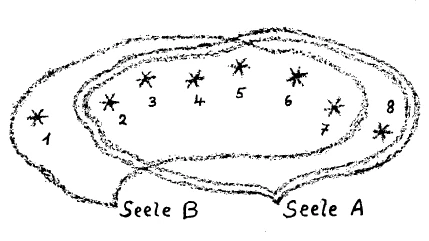
[ 19 ] From these reflections today, you have seen how we can influence our soul in the development of certain feelings and sensations, so that a bridge may be built between the so-called dead and the living. What I said last is also suited to evoking within us thoughts—I might say, feeling thoughts or mental sensations—that in turn can contribute to the creation of this bridge. This happens when, with regard to a specific deceased person, we strive more and more to cultivate that kind of feeling which, when we experience something, gives rise in the soul to the impulse to ask ourselves: How would the deceased be experiencing this very thing you are experiencing at this moment? To do this, create an image as if the deceased were experiencing it alongside us; and make this quite vivid—then, in a certain sense, you are imitating the way in which either the deceased interacts with the living or the deceased interacts with the dead, by relating what the various stellar regions impart to you to the relationship of your soul or to one another. Here, you are already imitating what takes place from soul to soul through the connection to the astral realms. When, through the presence of the deceased, one focuses, as it were, on an immediate concern—when one thus feels the deceased as immediately alive beside oneself—then from the things I have discussed today, an awareness will grow more and more that the deceased truly draws near to us. The soul will also develop an awareness of this. In this regard, one must also have trust in existence, that things will come to pass. For if one has impatience rather than trust in life, then the opposite is true: what trust brings, impatience drives away; what one would recognize through trust is obscured by impatience. Nothing is worse than when impatience conjures a fog before the soul.