

The Science of Human Development
GA 183
18 August 1918, Dornach
Translated by Steiner Online Library
Second Lecture
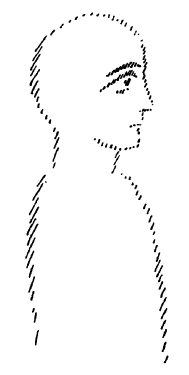
[ 1 ] Today I would like to attempt to provide a sort of sketch of the human soul, as it relates to the world and to itself. I would like to present this sketch in such a way that one might say: We are viewing the human being as a soul being in profile. So, to be clear: It is as if we were looking at the physical human being—not the soul being—not head-on, but in profile, looking to the right, for example. Let us consider him in this way. Of course, when we attempt to sketch something like this, we must always be clear that we are dealing with imaginative insight—that is, the reality underlying such a thing is represented through an image. The image points to the thing itself, and we create the image in such a way that it points to the thing correctly. But of course, one must not think of a drawing or sketch intended to represent something soul-spiritual in the same way one imagines something that copies an external, sensually perceptible reality in a naturalistic manner. One must be constantly aware of what I am saying now. I will therefore omit everything pertaining to the physical and lower etheric organism of the human being and will attempt only to sketch the soul and the soul-spiritual (see drawing).
[ 2 ] As you know from the various descriptions that have been given, this soul-spiritual being is in a more direct connection with the soul-spiritual environment than the physical human being is with the physical environment. The physical human being is, after all, a rather self-contained being in relation to the physical, sensory environment. One might say: This physical, sensory human being is truly and literally enclosed within his own skin. — This is not the case with what can be described as the spiritual-psychic human being; here one must conceive of a continuous transition in the currents that pulse within the human being’s spiritual-psychic inner life, and in all the movements and currents that exist in the general, universal spiritual-psychic world.
[ 3 ] If I were to begin by characterizing, from one perspective, the relationship between the human spiritual-soul aspect and the spiritual-soul aspect of the universal environment, I might do so in the following way. I would first have to depict in this way that which enters from the universe—that is, from the infinity of space—in a spiritual-soul aspect. Actually, I would have to depict the entire space in this way, but that is not necessary; I will only depict that which initially constitutes the human being’s environment. So this is what is to be understood as the environment (see drawing on page 31, blue). Imagine, then, in spiritual-soulful imagery, the setting in which the human being is placed. The human being is not yet there, of course; rather, it is only what borders on the environment that is marked with this blue. Imagine this as a blue sea surging within itself, yet filling the space. When I say “blue sea,” this is of course to be understood as I have often characterized it in the books you have before you—just as colors are to be understood as designations of the auric and the soul-spiritual.
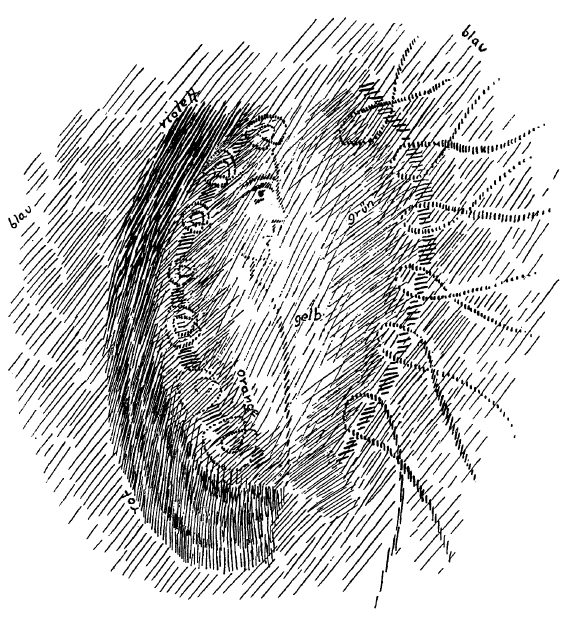
[ 4 ] Floating, I would say, or carried as if floating, carried like a wave—this is now a different spiritual-soul aspect. This is what I would now have to describe in roughly the following way. So, when we move from the universal environment to the human being, we can imagine ourselves and the human spiritual-soul aspect as if floating on this red. There we would have, to begin with, a part of the spiritual-soul aspect; if we wanted to sketch this in a way that corresponds to reality, we would have to depict the upper part in a red that tends slightly toward violet or lilac. This would only be accurately represented if the red were to fade into violet up here.
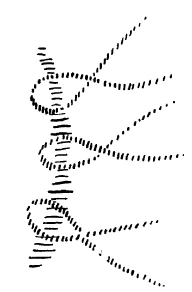
[ 5 ] With this, I have, so to speak, presented you with one pole of the human spiritual-soul aspect. We arrive at the other pole when we incorporate what, here, relates to the universal spiritual-soul aspect—floating and hovering in contrast to the physical human face—in the following manner: yellow, green, orange; green still merges into blue.
[ 6 ] This gives you what I would call a normal human aura in profile—that is, as seen from the right side. I say explicitly: a normal aura as seen from the right side. That which would present itself to the beholder in such a way that the beholder would have precisely this figure before them characterizes the human being’s placement within their spiritual-soul environment. But it also characterizes the human being’s position—the spiritual-soul aspect of the human being—in relation to themselves. It is precisely when one studies what is represented by this figure that one can truly see how the human being is a limited being in two respects. These two aspects in which human beings are limited beings are always noticed in life; yet they are not correctly interpreted, they are not properly grasped, or at least not understood. You know, of course, that in the external natural sciences it is said that when human beings observe the world, when they seek to gain knowledge of the world, they reach certain limits with their science and their understanding. We have often spoken of these limits, of this famous “Ignorabimus”—“we shall never know”—which is invoked by natural scientists and by some philosophers. It is said that human beings simply reach certain limits in their cognition, in their perception of the external world. I have probably also already quoted for you the famous statement made by Du Bois-Reymond at the Leipzig Natural Scientists’ Congress in the 1870s: “Into the regions,” as Du Bois-Reymond put it at the time, “where matter haunts, human cognition will never penetrate.”
[ 6 ] This gives you what I would call a normal human aura in profile—that is, as seen from the right side. I say explicitly: a normal aura as seen from the right side. That which would present itself to the beholder in such a way that the beholder would have precisely this figure before them characterizes the human being’s placement within their spiritual-soul environment. But it also characterizes the human being’s position—the spiritual-soul aspect of the human being—in relation to themselves. It is precisely when one studies what is represented by this figure that one can truly see how the human being is a limited being in two respects. These two aspects in which human beings are limited beings are always noticed in life; yet they are not correctly interpreted, they are not properly grasped, or at least not understood. You know, of course, that in the external natural sciences it is said that when human beings observe the world, when they seek to gain knowledge of the world, they reach certain limits with their science and their understanding. We have often spoken of these limits, of this famous “Ignorabimus”—“we shall never know”—which is invoked by natural scientists and by some philosophers. It is said that human beings simply reach certain limits in their cognition, in their perception of the external world. I have probably also already quoted for you the famous statement made by Du Bois-Reymond at the Leipzig Natural Scientists’ Congress in the 1870s: “Into the regions,” as Du Bois-Reymond put it at the time, “where matter haunts, human cognition will never penetrate.”
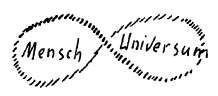
[ 8 ] The fact that such concepts must be defined stems simply from the fact that the inner spiritual and soul-like radiance of the human being extends outward from within into darkness. What is identified here as the limit of knowledge can, I would say, be seen quite clearly through the aura. Here, a boundary presents itself to the human being. The being that he himself is is represented here by what I have depicted aurically as light green fading into blue-violet (see drawing on page 31). But as it fades into blue-violet, it is no longer the human being; there it is the universal aspect of the surroundings. There the human being, with his essence—which is the inner power of his perception of the world—reaches a boundary; there he arrives, so to speak, at nothingness, and there he must define such concepts as matter, atom, substance, and force, which have no content. This lies in the human constitution; it lies in the human being’s connection with the entire universe. There, the human being’s connection with the universe truly takes place. If one were to define this boundary in the sense of spiritual science, one could do so by saying: This boundary allows human beings, in relation to their souls, to come into contact with the universe. — By depicting the direction toward the universe with one loop of a lemniscate, one can depict what belongs to the human being with the other loop; yet what emanates from the human being flows into the universe, into the infinite. One must therefore leave the looped line—the lemniscate—open on one side and closed on the other, and one must then draw this looped line as follows: Here the looped line is closed; here it extends into infinity. It is the same line that I drew there, only here the legs extend into infinity.
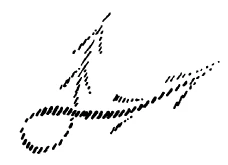
[ 9 ] What I am drawing here as an open lemniscate, as an open loop, is not merely something I have imagined; it is something you can actually see—like flashes of lightning coming and going in a gentle but very slow motion—as an expression of humanity’s relationship to the universe. The currents of the universe are constantly approaching the human being; he attracts them, they intertwine in his vicinity, and then flow out again. So something like this flows toward the human being, intertwines, and then flows out again. The human being is permeated by such currents belonging to the universe, which linger here before him. As a result, as you can imagine, the human being is surrounded by a kind of undulating auric field; these currents from the universe flow in, create a vortex here, and greet the human being, as it were, by forming a vortex before him, so that he is surrounded here by a kind of auric current. This is essentially an expression of the human being’s relationship to the universe, to the spiritual-soul environment.
[ 10 ] Now, however, you can see here what you actually perceive as lying within your consciousness depicted as bluish-greenish-yellowish, fading inward toward orange. But this encounters something here; within the human soul, this yellowish-orange encounters what vibrates on the blue sea as the spiritual-soul aspect of the lower human being, the lower human. What I have depicted here in red and transitioning to orange belongs to the subconscious aspects of the human being; it also corresponds to those physical processes that take place primarily as digestive activity and the like, in which consciousness plays no part. That which is connected to consciousness would be characterized aurically by the light-colored areas I have depicted here (see drawing on page 31). Just as the human being’s spiritual-soul aspect collides here with the spiritual-soul aspect of the environment, so too does the human being’s spiritual-soul aspect collide inwardly with his subconscious—which, strictly speaking, also belongs to the universe. I must depict this collision in the currents in such a way that some currents extend out into infinity; whereas I must depict this collision within the human being differently. There, too, I must draw a looping line, but I must draw it so that it runs inward. Pay close attention: I am indeed drawing a looping line, but I take the lower loop and turn it around, so that the looping line becomes:
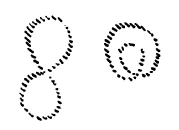
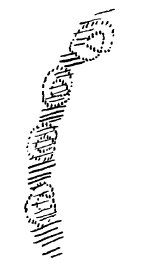
[ 11 ] So, I loop the lower loop around (see drawing, right). In contrast to here (see drawing on page 35), where I let one loop extend into infinity—that is, enlarge it to infinity—I now flip the lower loop. — In this way, I have symbolically represented the blockages that arise where the spiritual-psychic realm here within encounters the subconscious—and thus also the universal—spiritual-psychic realm. I must therefore characterize these blockages, which arise within the human being—when I draw them corresponding to those shown here—in this way (seven lemniscates with a loop turned over). These are the blockages that correspond to an inner wave within the human being.
[ 12 ] If you were to actually trace this inner wave, its main direction—but only its main direction—would run roughly along the intersection of what are, as you know, incorrectly named but so-called sensory and motor nerves in humans. I mention this only in passing, for today I wish to discuss primarily the spiritual-psychic aspect of the matter.
[ 13 ] You can see here the stark contrast that exists in the relationship between the human being and the spiritual-soul environment, and between the human being and his or her own self—specifically, the part that he or she takes in from the spiritual-soul environment as his or her subconscious, which I have sought to sketch here through the reddish wave floating on the general blue sea of the spiritual-soul universe.
[ 14 ] We have said that this wave here (see drawing on page 31, right) corresponds, so to speak, to the barrier that a person encounters when trying to perceive the external world. But there is also a barrier here (left); there is a barrier within the person himself. If this barrier did not exist, you would always look down into your inner self. Every human being would look down into their inner self. Just as, if this barrier (on the right) did not exist, a person would look into the external world, so too, if this barrier (on the left) did not exist, they would look down into their inner self. However, given the state of human beings in the current cycle of development, if they were to look down into their inner selves in this way, they would find little joy in what they saw there, because what they would see is a highly imperfect, chaotic, seething mass of inner human nature—something from which a person could derive little joy; but it is precisely what the fanciful mystics believe they can look into when they speak of mysticism. That which is very often regarded by fanciful mystics as the object of aspiration—and which, as I characterized many such mystics last year, is presented as mysticism—namely, the belief that by looking into their inner selves they can come to know the universe—is, in human beings, precisely concealed by this wave of congestion, truly concealed. Human beings cannot look down into their inner selves. What forms here within this region (on the left) accumulates and reflects; it can at least reflect back upon itself, and the phenomenon of this reflection is what we call memory. Every time a thought or an impression you have grasped returns to your memory, it returns because this accumulation begins to function here. If you did not have this wave of accumulation, every impression you receive from the outside, every thought you grasp, would pass right through you, unable to remain within you, and would enter the rest of the spiritual-psychic universe. It is only through this accumulation that you retain the impressions you receive. But this also enables you, through certain processes that we will describe later, to retrieve those impressions again. And this is expressed in the functioning of memory. So you can imagine that you have within you something like a “board,” as depicted here in profile—for it is drawn in profile, isn’t it? It is a kind of plane that exists within you—and whatever is not meant to pass through is reflected back from it. When you are awake, you remain united with the external world; otherwise, everything would pass right through you while you are awake. You wouldn’t actually be aware of the impressions; you would receive them, but you wouldn’t be able to retain them at all.
[ 15 ] So this is what points to memory. And what, in a sense, brings about our memory—as the surface of this standing wave—conceals that which the fantastical mystic would so dearly like to see within himself. As for what lies down there, one could certainly say: For those who truly know these things, the saying applies: “Let man never, ever desire to behold what they [the gods] graciously veil with night and dread.” — Yet the mystics are fanciful and want to look down there. But they cannot do so anyway, because they would pierce and corrupt normal consciousness to such an extent that the wave of memory would not bounce back. The very thing that constitutes our memory—what we so desperately need for our external life—is what conceals from us that which the fanciful mystics would so much like to see, but which man is not meant to see. Beneath your memory, beneath the source of your memory, beneath the surface of your memory lies something essential to human nature. But just as the back of a mirror, just as the coating of a mirror, reflects back what is in front, so what is in your consciousness does not go back there; it is reflected back and can therefore remain there continuously as memory. In this way, our entire life can be reflected as memory. And essentially, what we call the life of our “I” is the reflection of this memory.
[ 16 ] So you see, we actually live our conscious lives between this wave here (on the right) and this wave (on the left). We would therefore be like tubes that let everything pass through them if we did not have this wave of accumulation, which underlies memory, and we would see into the mysteries beyond the limits of knowledge if we were not compelled to formulate concepts outside the realm of the sensible, for which we no longer have any content. If we were organized in such a way that we could not produce this accumulation here, we would be mere conduits. If we were organized in such a way that we were not compelled to posit these, so to speak, unfilled concepts—these dark concepts—before us, we would be beings devoid of love and affection; we would be stony, dry natures. We could not love anything in the world; we would all be Mephistopheles-like beings.
[ 17 ] The fact that we are organized in such a way that we cannot grasp certain spiritual and emotional aspects of our surroundings with our abstract concepts or with our capacity for understanding—which is what enables us to love. For what we are meant to love, we should not approach by analyzing it in the ordinary sense of the word, by dissecting it, or by treating it as a chemist treats chemical substances in a laboratory. After all, one does not love when one is chemically analyzing or chemically synthesizing. The capacity for memory and the capacity for love—these are the two faculties that correspond to two boundaries of human nature. The capacity for memory corresponds to one boundary, inward; what lies beyond the zone of memory is the subconscious inner self. The other zone corresponds to the power of love; what lies beyond this zone corresponds to the spiritual-soul aspect of the universe. The unconscious aspect of human nature thus lies beyond this zone, as far as the human inner self extends; the spiritual-soul aspect of the universe extends boundlessly into the vastness beyond the other zone.
[ 18 ] We can thus speak of a zone of love and a zone of memory, and we can include what constitutes the human spiritual-soul aspect within these zones; but beyond that zone over there (see drawing on page 31, left), we must seek what remains unconscious—and which, precisely because it remains unconscious, is very strongly connected to human physicality and to physical activities. Of course, in reality, things are not as simple as they must be depicted here, because everything is intertwined. What is shown here in red (see diagram on page 31) interacts with other things and changes; and likewise, what is shown in green and blue also changes. In reality, everything is interconnected. Nevertheless, the schematic diagram is essentially correct and corresponds to the facts.
[ 19 ] From this, however, you can see that there is a strong, conscious spiritual aspect to physical life here on Earth. Here (on the left) is an unconscious spiritual aspect that actually merges with the universe. These two aspects of the human being differ very clearly from one another. This spiritual aspect (in the middle) is therefore, for earthly life, one that is very finely woven. Like finely woven light, I would say—that is what everything here (yellow) is. If I were to point out where this finely woven light is within the human being, the human head would fall within what I am now broadly describing. So what I have described in this way—what I have depicted there as yellow, yellow-green, and yellow-orange on the other side—is, if I may say so, finely woven spiritual light. It has no strong affinity with earthly matter; it has the least possible affinity with earthly matter. Precisely because it has little affinity, it cannot bind well with matter, and so it remains largely unbound from matter; this part is given a kind of matter that actually always originates from the human being’s previous incarnation. The head—that which forms the human head, the formative forces of the human head—is essentially carried over from the previous incarnation, and there is only a loose connection between this finely woven spiritual-soul aspect and the physical body, which is actually held together by elements from the previous incarnation. You actually bear your physiognomy according to your deeds and characteristics in the previous incarnation. And the person who is well versed in interpreting people sees right through the physiognomy of the head—not through that which originates from the Luciferic inner being, but rather through the adaptation to the universe. One must, after all, view physiognomy as if it were imprinted within the person. Not so much as if it were protruding outward, but one must, so to speak, see the negative of the soul; this is what one sees in this negative of the face. If you were to make an impression of every face, you would actually see the physiognomy, which is a terribly strong betrayer of what you did in your previous incarnation. In contrast, everything I have sketched down there as connected only to the surging sea of the world’s spiritual-soul life—which is to be understood as corresponding to the human subconscious or unconscious—is closely related to physicality; it permeates physicality. This physicality is so intertwined with the spiritual that the spiritual cannot appear as spiritual at all. Therefore, if one were to look down, one would see this intermingling of the spiritual and the physical, which lies beyond the threshold of memory. This is what prepares the head for the next incarnation; this is what seeks to metamorphose into that which will only take on a fixed material form in the future, and will only become the head in the next incarnation. For the human head is something that has advanced beyond the measure of the person’s development. Therefore, as you will recall from the earlier lectures I have given here, the head is actually already complete by the time a person reaches the twenty-seventh or twenty-eighth year of their development. There is already a superformation of the human being in the form of the head.
[ 20 ] But the rest of the human being is also a head, as strange as that may seem; it is just not yet as far along as the head. If you imagine a human being without a head, what remains is also a human head, but at a stage that is still very underdeveloped. As it develops further, it, too, becomes a head, whereas what you consider to be the human head was the rest of the organism in a previous incarnation. If you then imagine that part—freed from the body, disembodied—which is not yet a head in your present organism; that is, if you imagine the head removed from your present organism, which will only become a head in the next incarnation—but this organism of yours is, after all, a reflection, everything physical is a reflection of the spiritual—if you instead imagine the spiritual aspect that has not yet advanced to the form of a human being in its outer form: there you can see it in our Luciferic figure in the group over there—there it is!
[ 21 ] And now imagine all that is spiritual and soul-related—which is held back from your head—inserted into the human being; that is, everything that constitutes a boundary for the human being, which he cannot penetrate (on the right, see drawing on page 31), pressed into the human head: then the human being will not only have a head as old and venerable as he already does, but he will have a completely ossified head; indeed, he will become completely ossified, just like the Ahriman figure in our group over there.
[ 22 ] So if you imagine what lies below the threshold of memory here pouring into the inner being of the human being, you get everything Luciferic. If you imagine all that which lies beyond this barrier (on the right) pouring into the human figure, you get the Ahrimanic form. And the human being is situated between the two.
[ 23 ] What I have explained to you here is not only of great significance for understanding human beings, but it is also of great significance for understanding the spiritual processes in human evolution. One cannot understand how Christianity and the Christ impulse entered into human development without a thorough understanding of these matters. Nor can one understand the roles played by the Catholic Church, by Jesuitism and similar movements, or by Eastern and Western traditions, unless one can view them in connection with these matters.
[ 24 ] Tomorrow I will take the liberty of speaking a little about these movements—Eastern and Western thought, Jesuitism, Americanism, and so on—which can only truly be understood once one has clearly visualized these foundations of the spiritual-soul human being.