

The Science of Human Development
GA 183
2 September 1918, Dornach
Translated by Steiner Online Library
Ninth Lecture
[ 1 ] The considerations we are currently making concern matters that are treated as mysteries by many people who know something about them in one form or another. And for certain reasons, knowledge of these matters is kept from the world by many parties, because it is believed that the very things under consideration are part of a comprehensive body of knowledge about supersensible matters that should not yet be revealed to humanity. I do not consider this view to be correct with regard to certain matters discussed here; rather, it seems necessary to me that humanity make the courageous decision to embark on a genuine exploration of the supersensible worlds. And this can only be achieved by directly engaging with the concrete aspects of the issue at hand.
[ 2 ] Today, I would like to begin, so to speak, by addressing a preliminary question. Yesterday we spoke about the structure of the human being between death and a new birth. A very common objection to discussing these matters—not from the initiated, but from the uninitiated—is simply this: “Why is it necessary to know anything about these things? One could just wait until a person passes through the gate of death, and then they will see for themselves what the spiritual world is actually like.” — So this is something that is said very often. Well, the fact is, however, that when we speak of reality, we can never answer such questions from what might be called an absolute standpoint, but rather—from a spiritual-scientific perspective—we must always answer them from the standpoint of the time in which we live. We are living in the fifth post-Atlantean epoch, which began in the 15th century of our era. It brought to a close the fourth post-Atlantean epoch, as we know, which began in the 8th century B.C. and came to an end in the 15th century A.D. There are seven such cultural epochs on record. From this, however, it is evident that we have passed the midpoint of the Earth’s cultural development, which lay within the fourth post-Atlantean epoch, and that simply by virtue of this fact—since we are, after all, in the fifth great Earth epoch—we are entering the time in which the Earth is in a phase of descending development.
[ 3 ] Even the reflections we have made in recent days can draw your attention to the fact that it is essential to look at descending development—at that which, so to speak, is not part of evolution but of devolution, that which is in a state of regression. Our entire earthly evolution is in a state of regression. Certain abilities and powers that were present during the preceding period of ascending evolution are ceasing to exist, and others must take their place. This is particularly true with regard to certain inner spiritual abilities of the human being. One can say: Up until the fourth post-Atlantean epoch, up to the time of the Mystery of Golgotha, human beings still possessed the abilities to maintain a certain connection with the supersensible world. We know that these abilities have disappeared in the most manifold ways. They no longer exist as elemental abilities; they have, so to speak, faded away. Not only has human life on Earth between birth and death changed with regard to such faculties, but in fact—and even more radically—human life between death and a new birth has changed. And it must be said that for this period, from death to a new birth, in the present human cycle—which thus already belongs to the descending cycles— it is the case that when people pass through the gate of death, they must have certain memories of what they have acquired here in the physical body if they are to find the right attitude and the right relationship to the events they face between death and a new birth. It is, in fact, one of the necessary prerequisites for a proper life after death that people acquire, more and more, certain conceptions here before death regarding life after death; for only when they recall these conceptions they have acquired here can they find their bearings in the time between death and a new birth. It is factually incorrect to claim that one can wait until death to form such ideas about life between death and a new birth. If people were to continue living with these prejudices, if they were to persistently refuse to acquire ideas here on earth about life between death and a new birth, then this life—this bodyless life—would become a dark and disorienting one for them; they would not—through all that I described to you yesterday—be able to penetrate their spiritual environment in the proper way. Until close to the Mystery of Golgotha, it was the case that people brought into physical life here abilities that originated in the spiritual world. Hence, they possessed atavistic clairvoyance. This atavistic clairvoyance arose because certain spiritual abilities extended from the pre-birth state into this life. That has ceased. People no longer possess abilities here in physical life that extend from the pre-birth state. You know that, of course. But conversely, the opposite must now take place: People here on Earth must increasingly develop ideas about the post-mortem life—life after death—so that they can remember after death, so that they can carry something through the gate of death.
[ 4 ] That is precisely what I wish to comment on regarding this preliminary question. So the convenient argument that one can wait until death to deal with such ideas does not hold up when one considers, in concrete terms, at what stage of Earth’s evolution we actually find ourselves. And one really must always take this into account in concrete terms. For there are no views that are absolutely valid, that apply at all times; rather, there are only perspectives that can serve as a guide for people during a certain period of time. This is precisely what one must acquire through spiritual science in such an eminent sense.
[ 5 ] And now I would like to address a few points that may bring our reflections to a preliminary, brief conclusion. We started from the premise that modern human beings perceive a gap between what they call ideals—whether moral or otherwise—and what they call ideas, on the one hand, and what they perceive as their views on the purely natural order of the world, on the other. The concepts and views that people form about the natural order of the world do not enable them to accept that what they hold as ideals in their hearts has real power to manifest itself just as a force of nature does.
[ 6 ] The essential point to consider regarding this question is as follows: We now know how the human being is structured here on the physical Earth. We also know the nature of the human constitution in the spiritual world between death and a new birth. Some time ago, I raised a question that actually presents itself to the human soul as a concrete question when a person contemplates life, but which is precisely the kind of question to which one can say nothing at all when faced with the divide between idealism and realism that I have just described. That question is: How is it that, in our world order, some people die very young—as children, as young adults, or in middle age—while others do not die until they have grown old? What aspect of the world order is this connected to? — Neither idealism on the one hand, nor realism on the other—which cannot regard ideals as real forces—can offer any answer to such questions, which are, after all, questions of life itself. One can only begin to approach these questions by focusing on something very specific. And that is when one focuses on the fact that modern human beings, as they stand before us as earthly beings, cope relatively easily with space, but do not cope with time in the same way. In this regard, none of the philosophical views that exist to this day actually offer any significant insight, and the question of the nature of time has, in fact, been addressed so far only within the narrowest of human circles. It is also not entirely easy to speak about time and its nature in layman’s terms, but perhaps I will succeed in conveying to you an idea of what I actually mean when I bring up the topic of time by drawing an analogy with space. I must, however, ask for your patience here, because—though only seemingly so—the brief consideration I intend to offer on this subject has a somewhat abstract character.
[ 7 ] If you simply take in a portion of a space, you know that what you are taking in reveals itself to you with a perspectival quality. You must take the perspective of the space into account when you take in a portion of it. Now, if you transfer the section of space that you are surveying—and to which you quite instinctively attribute a perspectival quality—onto a flat surface, then you are taking perspective into account in the process. Isn’t it true that when you look down an avenue, you see the distant trees as smaller and closer together? You can express this through perspective, and in a certain way, you can convey on a flat surface what you see in space.
[ 8 ] Now it is clear that what you see in space is side by side on a flat surface. In space, it is not side by side; there are these two trees up ahead (see drawing on p. 164), and two trees are far away. But by transferring the limited space onto a two-dimensional plane, you place what is one behind the other side by side. You also have the instinctive ability to translate what you depict in a painting or drawing onto a two-dimensional plane into a three-dimensional space, so to speak. The reason you possess this ability is that human beings, as they currently exist as earthly beings, have detached themselves relatively strongly from space as such.
[ 9 ] Human beings have not detached themselves from time in the same way. And this is something immensely profound and important, but something that, unfortunately, is scarcely noticed—and scarcely noticed by science. Human beings believe that, as they develop over time, they can grasp time, that they possess time. But in reality, they do not possess real time. They do not possess real time at all; rather, what you experience as time is, in relation to real time, something that can be called a reflection. Just as this image (see drawing) on a flat surface relates to three-dimensional space, so does what the ordinary person calls time relate to real time. For the ordinary person does not experience real time, but rather an image of time; he actually experiences an image of time. And that is very difficult to imagine.
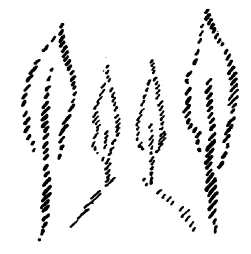
[ 10 ] For example, you find it extremely difficult to imagine that what has an effect today does not necessarily have to exist at the present moment, but is real at a much earlier point in time and is not real at the present moment. You allow, as it were, that which exists in a very early period to have a perspective-based effect on your own time.
[ 11 ] What I have just said has a very significant consequence. Namely, it follows that everything we call nature has a completely different character than everything we must regard as a certain part of the human being itself. In the natural world, for example, Ahriman—or rather, the Ahrimanic forces—are at work; but the Ahrimanic forces are never present in the natural world. When you survey the whole of nature, Ahriman is indeed at work in nature, but he acts from a distant time. Ahriman acts from the past. And whether you survey the mineral, plant, or animal kingdoms, you must never say that in what currently spreads out before your eyes there is anything in which Ahriman is active. And yet Ahriman is active within; but from the past. So if I were to illustrate this, I would have to say: Here is the line of development from the past into the future, and here you are surveying nature.
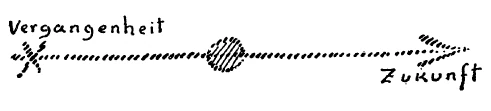
[ 12 ] Yes, now you must think of it this way: that you are looking into it. In what you perceive as the present, there is nothing of the Ahrimanic forces, but from the past—from a specific past—Ahriman exerts his influence on nature.
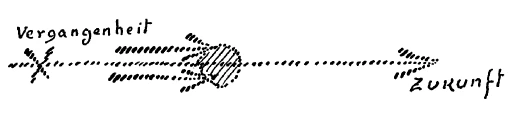
[ 13 ] And when you become aware of Ahriman in nature, he appears to you in perspective. If you were to say, “Ahriman is present”—then you would be making the same mistake with regard to nature as if you were to say: When I look out over a landscape, the distant trees stand next to the nearby trees because they can be placed within the plane of the landscape in perspective (see drawing on page 164).
[ 14 ] A fundamental requirement for true perception in the spiritual world is learning to see from a temporal perspective—that is, learning to place every being at its proper point in time.
[ 15 ] When I said yesterday that after death the “I” is, so to speak, transformed from a fluid state into a kind of solid state—that is not the whole story; there is more to it. Suppose you lived here on Earth with your “I” from 1850 to 1920, and in 1920 you become aware of your “I.” What I mean is: You may well have become aware of it earlier, but now you look back—with your spiritual self, through the hierarchies, you look back upon your “I”; there you see your “I” as having remained stationary from 1850 to 1920. The “I” remains there, standing still. This means: Your experiences do not accompany you shortly after your death; rather, you look back on them—you now view them from a temporally distant perspective, and you look into the expanse of time just as you look into the expanse of space here in the physical world. I can also put it this way: By dying, say, in 1920, you continue to live on with everything I described to you yesterday as the members of your being; but you look back on the span of time during which you lived here on earth with your “I.” And this stretch of time remains there, and as you continue to live on in perspective, you always see it at the point in time where it was. And so you must imagine that Ahriman is active out there in nature, but from an earlier point in time.
[ 16 ] This is very important. It is something that is rarely taken into account. If one wants to understand the world, if one wants to speak of time from a humanities perspective, one must certainly conceive of time in a way similar to space and must take into account this enduring connection between the essential and time. This is very important.
[ 17 ] Now, what I have told you regarding the Ahrimanic forces—that they act from the past—is entirely true for nature. But with human beings, it is precisely the opposite. For human beings, while they live here between birth and death, it is different in that everything that unfolds in time becomes Maya—illusion—for them. While living here, human beings themselves live within the flow of time, and as they live through a certain number of years, they experience the passage of time along with it. As time passes, he himself passes along with it. This is not the case with space. When you walk down an avenue, the trees remain behind and you move forward, and you do not take the trees that have been left behind—and thus your impressions of them—with you in such a way that, with every step you take, you would feel that the image of the trees is moving along with you. You do this with the image of time. Here in the physical body, you actually do this—because you yourself continue to develop within time—in such a way that, with regard to its perspective, you succumb to an illusion. You do not perceive the perspective of time. And the human subconscious, in particular, does not perceive it. The human subconscious is especially unaware of this coexistence with time; it succumbs to a complete illusion regarding the perspective of time. But this has a very specific consequence. It has the consequence that Ahrimanic forces can now act as present forces within what happens within the human being. Ahrimanic forces act within the human soul life as present forces. Thus, the human being faces nature in this way: when looking out into nature, there is nothing Ahrimanic in the present. Within the human being, the Ahrimanic acts as something present—precisely as Maya, as illusion. But human beings are given over to this illusion regarding the things I have explained to you, so that through human beings the Ahrimanic forces gain the opportunity to creep into the present, to transform themselves into the present. We can say: The Ahrimanic forces—and the same is true of the Luciferic forces, albeit from a somewhat different perspective, which we will discuss shortly—act in nature in such a way that they actually have nothing to do with the present, but rather extend their effects from the past. In human beings, these Ahrimanic forces are at work in the present.
[ 18 ] What is the consequence? The consequence is that, in the deepest recesses of his soul, a human being cannot feel a kinship with nature with regard to the point just discussed. He looks at his own being—or rather, feels within his own being—and perceives his natural essence. Because Ahrimanic forces within him are counteracting forces, whereas in nature Ahrimanic forces are forces of the past, everything that is natural appears to him differently from what develops within himself. He does not unravel the difference he perceives between himself and nature in the correct way. If he were to unravel it in the right way, it would be as I have just explained. He would say: Out there in nature, Ahriman acts from the past; within me, Ahriman acts as a present force. — But this is why, even if he does not understand the difference, he behaves in accordance with this difference and perceives nature as spiritless. He does sense that in the present, the Ahrimanic forces are not directly active in nature, but he perceives nature as spiritless because he does not tell himself: “Ahriman acts from the past”—instead, he looks only at present-day nature. Ahriman does not act within it.
[ 19 ] Now, strange as it may sound, Ahriman is the very power that the general creation of the world makes use of to bring forth nature. When one speaks of the spirit of nature—when one speaks of the pure spirit of nature—one should actually be speaking of the Ahrimanic spirit. There, the Ahrimanic spirit is fully justified. The beings of the normal hierarchies make use of the Ahrimanic spirit to bring forth what spreads out around us as nature. The fact that we do not perceive nature as imbued with spirit stems precisely from the fact that the spirit is not contained within nature’s present life, but rather acts from the past. And that, I would say, is the secret of the world-creating powers: that they make use of a spirit they left behind at an earlier stage to exert an effect at a later stage, but allow it to work from the past.
[ 20 ] When we speak of nature, we should not speak of matter, nor of forces; we should speak of Ahrimanic beings; but we would then have to speak in such a way that we place these Ahrimanic beings in the past. This brings out the peculiarity: Suppose some natural philosopher is pondering, reflecting on what lies behind the phenomena of nature. Well, he then devises all sorts of theories and hypotheses about atomic relationships and the like. But that is not how it is. Behind what spreads out around us in a way perceptible to the senses is not actually what natural philosophers usually suppose, but behind all of this lies the sum of the Ahrimanic forces—though not as present forces. So if the natural philosopher is compelled, let us say, to suppose some kind of atomic structures behind the chemical elements, that is wrong; behind the chemical elements lie Ahrimanic forces. But if you could lift away what you see of the chemical elements and look behind them, you would see nothing there in the present: it would be hollow where one seeks the atoms, and what is at work is acting into this hollow space from the past. That is how it really is. Hence the many misguided theories about what the “thing-in-itself” is; for this “thing-in-itself” is not there at all in the present. Rather, there is nothing at the place where the “thing-in-itself” is sought; but the effect is present there, emanating from the past. So one could say that if Kant had sought his “thing-in-itself,” he would have had to say: Where I want to approach the “thing-in-itself,” I cannot approach it. — That is, in fact, what he said. But it did not occur to him that he would have found nothing at all in the present to begin with, and that if he had gone behind the veil of things, he would have had to go far back; then he would have found Ahrimanic forces.
[ 21 ] It is different within the human being. Precisely because the human being is placed alive within time, the Ahrimanic forces have been able to enter our world through the gateway of humanity and work within the human being as such. And the consequence of the Ahrimanic forces acting within the human being is that the human being detaches what he sees in the present from the spiritual, that the human being detaches his present existence from the spiritual. This is the consequence of our carrying the Ahrimanic forces within the Maya within ourselves. So that one can say: Just as we view the world materially, detached from the spirit, as a mere natural order that believes it finds its culmination in the law of conservation of energy and matter—which is an illusion—what we see there as a natural order, is brought about solely by the fact that we carry the Ahrimanic forces within us, and that they do not exist as present forces in nature outside of us. — Therefore, what we think about nature—by conceiving of it merely in material terms—does not correspond to nature itself, but only to present-day nature. Yet this present-day nature is precisely an abstraction, because the Ahriman of the past is always at work within it.
[ 22 ] Now, it is not only the Ahrimanic principle that influences human beings, but also the Luciferic principle. This Luciferic principle, however, has, so to speak, a different tendency in the cosmos than the Ahrimanic principle. Let us consider the tendency of the Ahrimanic, as we have just described it. The tendency of the Ahrimanic within us consists in conceiving the world in materialistic terms. The fact that we conceive the world in materialistic terms, that we imagine a mere natural order, is the consequence of our carrying the Ahrimanic within us. The fact that we carry within us ideals that detach themselves from general nature—ideals by which we wish to guide our mutual conduct, but which must nevertheless appear to us merely as dreams within our present worldview, dreams that will be over when, according to the natural order, the Earth has reached its final state—is the consequence of the fact that the Luciferic forces, which live within us just as the Ahrimanic ones do, constantly strive to tear the part of us that is accessible to them completely out of the natural order and to spiritualize it entirely. For the main tendency of the Luciferic forces, insofar as they dwell within us, is to make us as spiritual as possible, to tear us away, if at all possible, from all material life. That is why they present us with ideals that are not natural forces, but are powerless within the present natural order. And if, in the course of the future Earth period, a human being were to succumb entirely to the Luciferic influence—so that he would believe that ideals are merely conceptual entities by which the mind can orient itself—then that human being would follow the Luciferic forces. The material Earth, to which we belong, would decay, disintegrate into the cosmos, fail to fulfill its purpose, and the Luciferic forces would lead humanity into another spiritual world to which it does not belong. To do this, they need the trick of deceiving us with ideals that are actually mere dreams. Just as Ahriman, on the one hand, presents us with a world that is merely a natural order, so, on the other hand, Lucifer presents us with a world that consists purely of imagined ideals.
[ 23 ] This is something very significant. And at present, I would say, a balance is being brought about only in those areas that still lie within the human unconscious. But people must become more and more aware of this fact; otherwise, they will not be able to escape this dilemma or succeed in building a bridge between idealism and realism—a bridge that is, however, necessary.
[ 24 ] What currently still provides a kind of balance is the following. When very young people die—for example, children—these children—and the same is true of young people—have only just begun to experience the world; they have not fully lived out their existence here on the physical plane. With a life on the physical plane that has not been fully lived, they pass over into the other world—the realm between death and a new birth—which is experienced as I described yesterday. Because they have lived only a part of their earthly life, they bring something of that earthly life with them into the spiritual world—something that cannot be brought over if one has grown old. One arrives in the spiritual world differently when one has grown old than when one dies young. When one dies young, one has lived life in such a way that one still possesses many of the forces from one’s pre-birth existence. As a child and as a young person, one has lived one’s physical life in such a way that one still possesses within oneself much of the strength that one had in the spiritual world before birth. Through this, one has created an intimate connection between the spiritual aspect that one brought with oneself and the physical aspect that one has experienced here. And through this intimate connection, one can carry over into the spiritual world something that one has acquired on Earth. Children or others who die young take something from their earthly life with them into the spiritual world—something that cannot be carried over at all when one dies as an older person. What is taken along is then present in the spiritual world, and what is carried over there by children and young people gives the spiritual world a certain weight that it would otherwise lack—that spiritual world in which people then live together—this imparts a certain weight to the spiritual world and prevents the Luciferic forces from completely separating the spiritual world from the physical.
[ 25 ] Just think, what an immense mystery we are looking at here! When children and young people die, they take something with them from here that prevents the Luciferic forces from achieving their goal of completely severing us from earthly life. It is extremely important to keep this in mind.
[ 26 ] As one grows older here on Earth, one cannot yet thwart the Luciferic forces in the manner described; for from a certain age onward, one no longer has that intimate connection between what one brought with oneself at birth and one’s physical life on Earth. Once one has grown old, this inner connection dissolves, and the exact opposite occurs. From a certain age onward, we infuse our own being, in a certain way, into the spiritual substance within the physical Earth. We make the physical earth more spiritual than it would otherwise be. Thus, from a certain age onward, we spiritualize the physical earth in a certain way that cannot be perceived by the outer senses. We carry the spiritual into the physical earth, just as we carry the physical up into the spiritual world when we die young; we, so to speak, squeeze out the spiritual when we grow old—I cannot put it any other way. In a spiritual sense, from a certain perspective, growing old consists in “squeezing out” the spiritual here on Earth. This, in turn, thwarts Ahriman’s plan. As a result, Ahriman cannot, in the long run, exert such an intense influence on people today that the belief that ideals do, after all, have a certain significance might be completely extinguished. But in the present era, we are already very, very close to a point where people are falling into the most terrible errors precisely with regard to what has been said. Even well-meaning people easily fall into such errors with regard to what has been said. And these errors will become ever greater and greater and, as Earth’s development progresses, may indeed become enormous.
[ 27 ] To give you an example: A rather witty philosopher named Robert Zimmermann wrote a work titled “Anthroposophy” in 1882. I have mentioned this once before in a related context. This “Anthroposophy” is not what we now call Anthroposophy; it is more or less a jumble of concepts. But that is precisely because Robert Zimmermann could not see into the spiritual world; he was merely a Herbartian philosopher. Now, he wrote this “Anthroposophy.” But it is precisely in this *Anthroposophy* that Robert Zimmermann, from his own perspective, addresses the question I have placed at the forefront of our reflections these past few days. On the one hand, he sees ideas—logical ideas, aesthetic ideas, ethical ideas; on the other hand, he sees the order of nature. And he cannot somehow find a bridge between the logical, aesthetic, and ethical ideas and the natural order; rather, he remains stuck there: on the one hand, there is the natural order, and on the other, there are the ideas. And the conclusion he ultimately reaches is extraordinarily interesting, for it is actually typical of a person of our time. He comes to say that it is once and for all denied to human beings to populate nature with ideas and to endow ideas with the power of nature. The two worlds, he says, can actually only be united in the human mind. That is what he says. And so, at a point where he sums up virtually everything he says and thinks, he remarks: “The realization of ideas is neither a fact of the past nor one of the present, but a task whose fulfillment lies in the future and in the hands of humankind.” The dream of a “golden age”—about which a sober rationalist like Kant raved as that of “eternal peace,” and an extreme positivist like Comte as the ‘état positif’—will then be fulfilled when the entire world of ideas has become real and the entire reality has been permeated by ideas, that is to say: when what Schiller called “the master’s secret of art”—the ‘annihilation’ of matter by form—has become apparent, or, as Schleiermacher put it, ‘when ethics has become physics and physics has become ethics.’”
[ 28 ] Yes, but that can never come to pass! The only thing that can come to pass is that people realize these ideas within their social order. But once the earth has reached its end, the entire dream of ideas will have come to an end. According to such a philosophy, nothing else is possible. Therefore, such a philosophy always remains abstract and must ultimately admit: “ A philosophy which, like the one described above, neither adopts—as theosophy does—a theocentric standpoint inaccessible to human knowledge, from which it regards the ‘dream of reason’ as a reality long since created, nor—as anthropology does—takes the anthropocentric but uncritical standpoint of common experience, from which it regards an idea-filled reality as ‘dream of reason’—which thus seeks to be both anthropocentric, that is, based on human experience, and yet philosophical, that is, going beyond that experience by means of logical thought—is anthroposophy.” “Anthroposophy,” then, is here the admission that one can never bridge this chasm between unreal ideas and reality devoid of ideas.
[ 29 ] Now, however, within the human being there is a natural being—which thus belongs to the natural order—united with a spiritual being capable of assimilating the spiritual. Even an anthroposophist like Robert Zimmermann does not deny this. But even from the perspective of contemporary science, human beings cannot be viewed in such a way that the mystery would be solved through the human being, through this microcosm.
[ 30 ] Let us now look back at something we have already mentioned during this visit. We said that we must actually divide the human being into three parts—though, of course, not as conveniently as with a skeleton, as I have already explained. But I also discussed this in the concluding notes to my book *On the Mysteries of the Soul*. We can divide the human being into three parts: the head-human, the torso-human, and the limb-human, whereby the limb-human includes everything located within the limbs—meaning that everything sexual also belongs to the limb-human. If we divide the human being in this way and now apply what we already know—that the formation of the head, the shape of the head, points to forces from the previous incarnation, that the human of the extremities points to the future incarnation, and that, in fact, only the human of the torso belongs to the present—then, based on what I have explained today, you will no longer find it very incomprehensible when I tell you: Insofar as the human being bears a head, that head points back to the previous incarnation, to the past. Forces of the past—Ahrimanic forces—work into the head, and what applies to Ahrimanic forces in general applies to the human head in particular. Everything that constitutes the actual formation of the human head does not strictly speaking belong to the present; rather, the forces of the preceding incarnation work into the head; and the creative powers make use of the Ahrimanic forces to shape our head, to give our head its actual form. If the creative powers did not make use of the Ahrimanic spirits to shape our heads, then we would all—forgive me, but it is so—admittedly have much softer heads, but we would all have animal-like heads: the one whose character is like that of a bull would have a bull’s head, the other, whose character is like that of a lamb, would have a lamb’s head, and so on. It is due to the influence of the Ahrimanic forces, which the creative powers make use of to shape us, that this animal head, which we would otherwise bear, does not actually sit upon us, as the Egyptians depicted in some of their figures; that we do not walk about like these Egyptian figures, who have their good reasons—for in the Egyptian mysteries, too, albeit from an atavistic standpoint, such things were taught as they can now be taught again; that we also do not go about as depicted in Rosicrucian paintings, for example, where every woman is painted with a lion’s head and every man with an ox’s head. Such is the Rosicrucian depiction of humanity. The Rosicrucians chose more of an average animal and therefore placed on women what most resembles them—the lion’s head—and on men what most resembles them—the ox’s head, the bull’s head. That is why, in Rosicrucian depictions, you see a man and a woman placed side by side: the woman with the most beautiful lion’s head, the man with a bull’s head. But this is entirely correct. The fact that the metamorphosis—to use Goethean terminology—can take place, that our head, which in its form tends toward animality, is shaped into a human head, stems from the influence of the Ahrimanic forces. If the deities did not make use of Ahriman to shape our bony head, we would walk around with animal heads.
[ 31 ] But the divine powers also make use of the Luciferic spirits. If they did not make use of these Luciferic spirits, our “human of the extremities” would not be able to transform itself from the present incarnation to the next. The Luciferic beings are necessary for this. We owe it to the Luciferic beings, in turn, that as we die, the form that the “human of the extremities” still possesses is gradually transformed into the form it is to take in the next incarnation. Then, halfway between death and a new birth, Ahriman must intervene to take on the other task: to reshape the head in the appropriate manner. Just as we would walk around with animal heads if it were not for Ahriman, who grants us a human head, so too would our nature of the limbs fail to metamorphose into the human form by the next incarnation; instead, it would pass over into the demonic. We lose our head, as we now have it, in any case through death—not only as matter that unites with the earth, but also as form; into the next incarnation, we carry over from the human being of the limbs that which becomes the head. But this would become a demonic being if it were not for the Luciferic forces connected to us, which enable the transformation to take place from a demon—which would be merely a spiritual-soul being—into the human form of the next incarnation.
[ 32 ] Thus, Ahrimanic and Luciferic forces must be at work in our becoming human, and the human cannot be understood without calling upon the Ahrimanic and the Luciferic. Looking toward the future, humanity cannot avoid having to truly understand the workings of Ahriman and Lucifer. The Bible rightly states that the deity mentioned at the beginning of the Bible breathed the living breath into human beings. But the living breath is active in the “trunk-human.” Insofar as we are dealing with divine beings acting in a normal way, we are dealing only with the “trunk-human.” Insofar as we are dealing with the “head-human,” we are dealing with an adversary of the powers of Yahweh, and thereby also with an adversary of Christ. And insofar as we are dealing with the “limb-human,” we are dealing with the Luciferic adversary.
[ 33 ] Therefore, one can only understand human beings by considering them from these three perspectives. In our central group for our construction, you therefore have precisely this trinity: the representative of humanity, who is, however, formed in such a way that the forces of respiration, the torso, the activity of the heart, and so on—that is, the middle figure—are primarily at work within him; then the figure in whom everything pertaining to the head is at work: Ahriman; and the figure in whom everything pertaining to the extremities is at work: Lucifer.
[ 34 ] One must analyze the human nature in this way if one wishes to understand human beings, for within the human being, humanity as such is united with Ahriman and Lucifer. This also seems to indicate that everything more or less connected with human thinking—which, after all, in relation to
[ 35 ] its physical connection is bound to the head—human thinking flows from perceptions as something external and sensually perceptible—that all of this has an Ahrimanic character. After all, it is primarily through the senses of the head that we perceive nature, and we construct a picture of nature with the Ahrimanic character just described, because we ourselves carry the Ahrimanic within us in the formation and shaping of our head.
[ 36 ] Ideals, on the other hand, have—internally, psychologically—and I will return to this in the near future—a great deal to do with love, with everything that pertains to the “human being of the extremities.” That is why the Luciferic power has special access to ideals. Ahriman seizes us through our head; Lucifer seizes us through our extremities. Through our head, Ahriman tempts us to conceive of nature as spiritless; through our “human being of the extremities,” Lucifer tempts us to conceive of ideals as devoid of natural power.
[ 37 ] But it is the task of modern humanity to gain a clear overview by taking a broader view of these matters. For you see: Within us there is a certain dividing line, precisely in our chest-human, in our torso-human, by which the forces of the head—which are Ahrimanic forces—are separated from the Luciferic forces that belong to the limb-human. If, by looking mystically within ourselves, we were able to see right through ourselves, then we would indeed comprehend the natural order through the head, but we would also look into ourselves through the natural order. And if the Luciferic forces were to prevail within us, then the Luciferic forces would also enlighten us about the Ahrimanic forces, and in this way we would arrive at a connection between the natural order and the spiritual order. But for a certain reason we cannot do this—namely, because we have a memory. What we take in from nature in the form of ideas and concepts, of impressions, we store in our memory. And if we were to depict this here (see drawing on page 179) schematically—the head-human, the chest-and-torso-human, and the limb-human—then within the torso-human there is a partition that causes what we take in through the head regarding the natural order to return to us as material for memory. As a result, we do not see down into the Luciferic realm, and consequently we do not perceive the Ahrimanic, just as we do not see what lies behind a mirror, but rather what is reflected. Here, the natural order is reflected in that which simultaneously separates our Ahrimanic from our Luciferic, and which forms the foundation for the developing memory, for the developing power of recollection. If we could not remember the things we have experienced, if this partition were not there, if we were to see right through ourselves when looking within, we would look down into ourselves all the way to the Luciferic. Then we would also perceive the Ahrimanic.
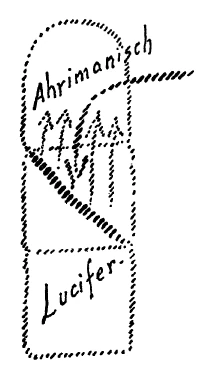
[ 38 ] But now consider this: precisely what appears to us through this mirror is what we experience in the course of our lives; it is what we look back on after death; it is what transforms a fluid “I” into a fixed “I.” That is what we look back on. That is what we live with. And Ahriman and Lucifer work with us—they work with us in such a way that Ahriman leads us to bear a human head, while Lucifer leads us not to become a demon, but to have the possibility of moving on to a next incarnation.
[ 39 ] I have taken up some of your patience with matters that may indeed be somewhat difficult to understand, but I wanted first of all to at least evoke a sense of what actually causes the divide between idealism and realism. It arises because the Luciferic principle within us stirs up idealism, which is powerless in nature, while the Ahrimanic principle within us evokes the mere order of nature, which appears spiritless to us. Thus, the idealists—the abstract idealists—are actually under Luciferic influence, while the materialists are under Ahrimanic influence. It is indeed necessary to engage with these matters, not merely to practice so-called theosophy in a schematic way, but to delve into these more precise aspects. For it is necessary for human beings to become aware that they must do something to remain united with the spirit for the remainder of Earth’s evolution. It is an uncomfortable truth—one might even say a hated truth, indeed a hated truth—for it contradicts so much of what appeals to people, what appeals to them out of convenience. Nothing is more difficult for people today than being told: If you want to maintain your connection with the Spirit in the future, you must do something to achieve it. — Most people would prefer that the Mystery of Golgotha had simply faded into the past, so that they would have absolutely nothing to do with it, so that they might be redeemed from their sins through Christ and enter heaven without any effort on their part. And that is precisely why most theologians are so furious with anthroposophy—because, of course, the anthroposophical side can never admit that human beings have nothing to do to maintain their connection with the Spirit, that this could continue to happen entirely without their own effort, even in the future of Earth’s evolution. The connection between the physical and the spiritual—between what constitutes the human body between birth and death, and what constitutes the human body between death and a new birth—this connection is called into question by the future development of the Earth, and it will remain intact only if people truly engage with the spiritual as they look toward the future. There is already evidence for this in spiritual science today. This evidence from spiritual science consists of truths that are extremely, extremely uncomfortable, but they shed light on what is important and significant.
[ 40 ] The connection between the soul-spiritual and the physical-etheric in modern human beings, I would say, has already become very tenuous, and human beings need to remain ever more vigilant within themselves so that nothing happens in the connection between their physical-etheric and soul-spiritual aspects that could, so to speak, drain them—that could drain them soul-spiritually. For when such prejudices become increasingly prevalent—the idea that one need not know anything in life about what lies beyond death—or when the gulf between so-called idealism and the purely natural order grows ever wider, the danger facing people is that they could lose their souls more and more. Today, I would say, a barrier still stands against this loss, provided by the fact that when young people die, a certain weight is imparted to the spiritual world and Lucifer’s plans are thwarted; and when old people die, so much spirituality is poured into the physical world that Ahriman’s plans are thwarted. But we must not forget that as people turn away from the spiritual realm, the Ahrimanic and Luciferic forces become ever more powerful, and that little by little, as the devolution of the Earth progresses further and further, this barrier will no longer be able to function fully.
[ 41 ] This is what I would like to see emerge as a kind of residue from our reflections—like a feeling—and feelings are always the most important thing that can arise from spiritual scientific life—regarding the necessity of engaging with the spiritual starting with the present Earth cycle. From a wide variety of perspectives, I have emphasized that it is necessary, starting from the present, for people to engage with the spiritual. And in the future, people will not be able to engage with the spiritual in any other way than by acquiring understanding and not resisting truly taking such—even more difficult—considerations to heart, as we have been doing these days and especially today. People must come to understand the perspectivity of time. When this understanding of the perspectivity of time takes hold among people, they will no longer say: “Here is idealism, which is, however, merely a dream with no power in nature, and on the other side lies the natural order”—but rather, people will come to recognize that what lives within us as ideals is the seed of the future, and that what is the natural order is the fruit of the past.
[ 42 ] This sentence is a golden rule: Every ideal is the seed of future natural events; every natural event is the fruit of past spiritual events. — Only through this rule can one find the bridge between idealism and realism. But one thing is necessary for this: No ideal could ever, under any circumstances, become the seed of a future natural event if that future natural event were prevented by the present natural event. We can consider any hypothesis. Let us assume the possibility—which is currently accepted—that, due to the so-called law of entropy, the Earth’s development will eventually transition into a state of general warming, and that all other natural forces will cease; in this final state, naturally, all ideals would have perished. This final state follows quite logically if one assumes that, according to pure causality, the present physical conditions will simply continue. If one thinks, as contemporary physics does, that according to the laws of conservation of energy and matter such a final state will eventually come to pass, then there is no room in this final state for an ideal to emerge as the future course of nature, for the future will simply be the consequence of the present course of nature. But that is not the case; this is not how it appears to current scientific observation of nature, but rather it presents itself differently. Whatever exists today in terms of matter and forces—all of that will not be present at a certain point in the future. There is no law of the conservation of matter and force. Where one seeks matter, there is nothing at all but the influence of a past Ahrimanic force, and what surrounds us in the sensory world will no longer be there at some point in the future. And then, when nothing remains of all that is now physical—when it has been completely dissolved—the time will come when the present ideals will, as natural phenomena, follow on from what is now about to perish.
[ 43 ] That is how it is in the vast universe. And for the individual human being, it is the case that he will be reincarnated in the next world when he has partially overcome everything into which he has grown during his present incarnation—that is, when an environment can be created for him that is different from his present one, when everything in his present environment that is currently keeping him here on Earth can be removed. When all this has changed to such an extent that they can experience something new, then they will be reincarnated. The present ideals that can take shape within human beings will become nature when everything that is now nature is no longer present, but something new has come into being. But the new that arises is nothing other than the spiritual that has become nature.
[ 44 ] Behind the phenomena and behind the ideals, we must seek that which forms the bridge over the abyss. But one must, of course, get to the bottom of this. Today, one can only get to the bottom of it if one does not shy away from developing concepts so powerfully that they themselves can penetrate reality. That is why our time truly needs to engage deeply with everything that can be experienced spiritually. Only—and let me add this as an afterthought—only then will it be necessary for an ever-greater and greater openness to prevail in the face of spiritual contemplation. The day before yesterday, I concluded—as it might seem to some—by pointing out, quite unnecessarily, as it were—though even though I do not like to do so, it is never unnecessary—various factors that stand in the way of fruitful spiritual scientific work, including on the part of the Anthroposophical Society. Above all, in this context, genuine impartiality must be demanded again and again. Time and again, we experience how the destructive force—which actually gave rise to materialism and ruined the old spirituality—penetrates human thinking, particularly into the spiritual realm, into what is consciously pursued as spiritual. I have, after all, drawn attention to how materialistic some theosophical views are. Of course, when discussing spiritual-scientific matters, it is not easy to find the right words, because our language today is no longer suited to the spiritual; we must first seek once again to establish a connection between language and the subject matter that is appropriate for the spiritual. But this is necessary so that the spiritual-scientific movement is not constantly corrupted by what is most harmful. One must describe impartially what is taking place in the spirit. Time and again I find myself being asked: “There is someone here, there is someone there, who has spiritual experiences.” — The meaning behind questions frequently posed in this way is that what is actually being asked is: “May one now, with blind faith in the truth of it, devote oneself to what this or that person perceives?” — And if one answers this question in the affirmative, then blind following arises; if one answers in the negative, then the person in question is immediately condemned as a heretic, and it is said: “Well, that’s atavistic clairvoyance; it’s not worth anything.” — Yes, this either/or must be approached quite differently in this field. We must truly approach statements about the spiritual realm with all sound reason. But if we want to become dogmatists, we cannot become spiritual scientists. If we want to either idolize or condemn, we cannot become spiritual scientists. Infinitely valuable contributions to the characterization of the spiritual world will also come from sources one does not necessarily wish to swear by.
[ 45 ] One also sees the other scenario: for a while, people swear by some clairvoyant figure. Then it can be proven that at some point—well, perhaps even—this clairvoyant figure embellished the truth a little, or embellished it greatly; then that figure is finished. Before that, the very same people who later write them off had sworn by them.
[ 46 ] Yes, that is not the way to make progress within humanity. The either/or choice between deification and heresy does not lead to progress within humanity; rather, progress comes only by facing things with common sense. For example, it may also happen that something entirely true, important, and essential emerges from the spiritual world through someone about whom one even knows: “Well, this person doesn’t shy away from telling quite a few tall tales now and then.”
[ 47 ] One would not arrive at the either/or situation I am referring to here if one were not trying to introduce dogmatism, but rather if one were to approach matters with common sense, particularly within this anthroposophical movement. That is one point. The other is this: it is extremely difficult, given the way things are often handled within our circle, to situate the Anthroposophical Society within the cultural movement of the present. This requires discernment on the part of those who are already members of this Society. Once you are already a member, you develop a certain obligation to exercise this discernment. For we will go completely astray with this Anthroposophical Society if we do not seek to connect with the general spiritual culture of the present, if we repeatedly fall into the error of engaging in sectarianism. That will be the death of our movement if we become sectarian. Just consider that matters such as those we have discussed these past few days will not seem particularly strange to anyone who is deeply immersed in contemporary scientific and cultural life, provided they cultivate the necessary open-mindedness. But to achieve anything in this way, there must be a will to discern. It often happens among us that people ask only for something schematic when the question is: Should someone attend anthroposophical lectures, or should they be given a lecture series? Thus, the question is posed schematically, without taking into account the person’s level of education or their overall worldview. But this schematism is what is absolutely harmful among us. This schematic approach leads to a situation where a person like the one in Holland—around whom a whole host of nonsense has crystallized—can drift into the Anthroposophical Society and find patrons there, while people who are capable of sound judgment are often repelled precisely by such behavior.
[ 48 ] To give a specific example: You see, some time ago, Mr. von Bernus emerged within the Anthroposophical Society with the clear intention—which one might find a little better or a little worse, depending on one’s common sense—to build a bridge between general cultural life, the literary and scientific life of the present, and our anthroposophical life. Well, in his own way, Mr. von Bernus has, for example, poetically reworked a number of things—some of which are found in my books, others in lecture cycles—and brought them out into the world. He showed me the evidence himself: he received a flood of letters—abusive letters—simply for having made a truly contemporary attempt! It would come as no surprise if someone who is perhaps risking a great deal were to be put off by such behavior as was directed toward him at the time by the Anthroposophical Society. Nevertheless, the journal he founded will be of immense service to the anthroposophical movement. After all, he had also managed to ensure that the anthroposophical movement could be represented in Munich at his Kunsthaus. But one could sense a certain resistance everywhere to something that was as justified as could be! And when one looks back on Bernus’s experiences in particular, they truly paint a picture of how the anthroposophical movement—and the Anthroposophical Society—should learn to be a true society.
[ 49 ] Insofar as the Dornach building has been completed, is it a society? But many other things—namely—are being neglected, which clearly shows that the Anthroposophical Society does not view itself as a society at all, but rather as a collection of individual, sectarian small circles. But we must move beyond this stage of sectarianism. And we will not move beyond it unless we reflect on the matter in some way.
[ 50 ] It is so difficult, isn’t it? One is very reluctant to say such things, but ultimately, there are some things I simply must say because I am so deeply involved in this anthroposophical movement. If the Anthroposophical Society were to gradually develop more and more into an organization with a pronounced tendency to silence me—which is, in fact, the direction it is taking and a tendency it has always had—then it is not out of personal vanity that I emphasize this. It is very unpleasant for me to have to emphasize this, but within the Anthroposophical Society there is, in many cases, precisely this tendency to silence me, and here the personal is intertwined with the objective. As a result—because the Society fails to do all that a society normally does—the only things that rise to the surface like poisonous bubbles are the tirades that the former members spew into the world.
[ 51 ] Yes, these are things I sometimes have to point out and that must not go unaddressed. I have brought them up for discussion in the places where I have been able to speak recently, because I truly believe that in these catastrophic times, much depends on anthroposophy being represented in the world in the right way. But it is so difficult to get people to think more deeply about this: How should we actually go about it in the field of anthroposophy to make this Anthroposophical Society a true society? — Individual people have indeed made some initial efforts, but as a rule, everything gets stuck at the initial stage. Well, I think that perhaps, by drawing attention to the matter a second time, people will give it a little thought. I am not saying this for personal reasons, but out of certain necessities of the times; as you will also be able to glean from what I have just presented in recent days, there are various seeds that may be of some help to you in understanding our catastrophic times.
[Plaque inscription] September 2, 1918
Every ideal is the seed of future natural events.
Every natural event is the fruit of past spiritual events.