

The Science of Human Development
GA 183
2 September 1918, Dornach
Translate the original German text into any language:
Versions Available:
The Science of Human Development, tr. SOL
Neunter Vortrag
Ninth Lecture
[ 1 ] Die Betrachtungen, die wir gegenwärtig anstellen, betreffen Dinge, welche von vielen Menschen, die etwas in der einen oder andern Form davon wissen, als Mysterien behandelt werden. Und es wird aus gewissen Gründen das Wissen von diesen Dingen der Welt von vielen Seiten her ferngehalten, weil man der Ansicht ist, daß eben die Dinge, die in Betracht kommen, Teile sind von einem umfassenden Wissen über übersinnliche Angelegenheiten, das der Menschheit heute noch nicht mitgeteilt werden solle. Ich halte diese Anschauung mit Bezug auf gewisse Dinge, von denen hier die Rede ist, nicht für richtig, sondern mir erscheint es notwendig, daß die Menschheit den mutigen Entschluß fasse, einzutreten in eine wirkliche Betrachtung der übersinnlichen Welten. Und das kann man doch nicht anders, als wenn man das, was konkret über die betreffende Frage in Betracht kommt, unmittelbar anfaßt.
[ 1 ] The considerations we are currently making concern matters that are treated as mysteries by many people who know something about them in one form or another. And for certain reasons, knowledge of these matters is kept from the world by many parties, because it is believed that the very things under consideration are part of a comprehensive body of knowledge about supersensible matters that should not yet be revealed to humanity. I do not consider this view to be correct with regard to certain matters discussed here; rather, it seems necessary to me that humanity make the courageous decision to embark on a genuine exploration of the supersensible worlds. And this can only be achieved by directly engaging with the concrete aspects of the issue at hand.
[ 2 ] Nun möchte ich heute gewissermaßen zuerst eine Art von Vorfrage erledigen. Wir haben gestern gesprochen über die Gliederung des Menschen zwischen dem Tode und einer neuen Geburt. Ein sehr verbreiteter Einwand gegen das Besprechen dieser Dinge, jetzt nicht von seiten der Eingeweihten, sondern von seiten der Uneingeweihten, ist der, daß man einfach sagt: Ja, wozu ist es nötig, über diese Dinge etwas zu wissen? Man könnte ja warten, bis der Mensch durch die Pforte des Todes durchgeht, und dann werde er schon schen, wie es da in der geistigen Welt eigentlich aussieht. — Es ist also etwas, das sehr häufig gesagt wird. Nun, die Sache ist aber so, daß wir solche Fragen niemals von einem gewissermaßen absoluten Standpunkte aus beantworten können, wenn wir über das Wirkliche sprechen, sondern daß wir sie, geisteswissenschaftlich betrachtet, immer beantworten müssen von dem Gesichtspunkte der Zeit, in der wir leben. Wir leben im fünften nachatlantischen Zeitraum, der begonnen hat im 15. Jahrhundert unserer Zeitrechnung. Er schloß den vierten nachatlantischen Zeitraum ab, wie wir wissen, der im 8. vorchristlichen Jahrhundert begonnen und im 15. nachchristlichen Jahrhundert seinen Abschluß gefunden hat. Man hat sieben solcher Kulturzeiträume zu verzeichnen. Daraus aber ist ersichtlich, daß wir die Mitte der Kulturentwickelung der Erde überschritten haben, die im vierten nachatlantischen Zeitraum lag, und daß wir einfach durch diesen Umstand eintreten — wir sind ja auch in der fünften großen Erdenperiode — in die Zeit, in der die Erde in absteigender Entwickelung ist.
[ 2 ] Today, I would like to begin, so to speak, by addressing a preliminary question. Yesterday we spoke about the structure of the human being between death and a new birth. A very common objection to discussing these matters—not from the initiated, but from the uninitiated—is simply this: “Why is it necessary to know anything about these things? One could just wait until a person passes through the gate of death, and then they will see for themselves what the spiritual world is actually like.” — So this is something that is said very often. Well, the fact is, however, that when we speak of reality, we can never answer such questions from what might be called an absolute standpoint, but rather—from a spiritual-scientific perspective—we must always answer them from the standpoint of the time in which we live. We are living in the fifth post-Atlantean epoch, which began in the 15th century of our era. It brought to a close the fourth post-Atlantean epoch, as we know, which began in the 8th century B.C. and came to an end in the 15th century A.D. There are seven such cultural epochs on record. From this, however, it is evident that we have passed the midpoint of the Earth’s cultural development, which lay within the fourth post-Atlantean epoch, and that simply by virtue of this fact—since we are, after all, in the fifth great Earth epoch—we are entering the time in which the Earth is in a phase of descending development.
[ 3 ] Schon die Betrachtungen, die wir in diesen Tagen angestellt haben, können Sie darauf aufmerksam machen, daß es darauf ankommt, hinzuschauen auf die absteigende Entwickelung, auf dasjenige, was gewissermaßen nicht in der Evolution, sondern in der Devolution ist, was in der Rückentwickelung ist. Unsere ganze Erdenentwickelung ist in der Rückentwickelung. Da hören gewisse Fähigkeiten, gewisse Kräfte auf, die in der vorhergehenden Zeit der aufsteigenden Entwickelung da waren, und andere müssen für diese aufhörenden Kräfte und Fähigkeiten eintreten. Und so ist es insbesondere mit Bezug auf gewisse innere seelische Fähigkeiten des Menschen. Man kann sagen: Bis zum vierten nachatlantischen Zeitraum, bis gegen die Zeit des Mysteriums von Golgatha hin, waren in den Menschen noch die Fähigkeiten vorhanden, mit der übersinnlichen Welt einen gewissen Zusammenhang zu haben. Wir wissen, daß in der mannigfaltigsten Weise diese Fähigkeiten verschwunden sind. Sie sind nicht mehr als elementarische Fähigkeiten vorhanden, sie sind gewissermaßen dahingeschwunden. Nicht nur hat sich das Leben des Menschen auf der Erde zwischen der Geburt und dem Tode geändert mit Bezug auf solche Fähigkeiten, sondern eigentlich, und noch radikaler, hat sich das Leben der Menschen zwischen dem Tod und einer neuen Geburt geändert. Und da muß gesagt werden, daß für diesen Zeitraum, vom Tode bis zur neuen Geburt, es im gegenwärtigen Menschheitszyklus, der also schon zu den absteigenden gehört, so ist, daß die Menschen, wenn sie durch die Pforte des Todes treten, gewisse Erinnerungen haben müssen an dasjenige, was sie sich erworben haben hier im physischen Leibe, wenn sie die richtige Stellung und das richtige Verhältniszu den Ereignissen, denen sie ausgesetzt sind zwischen dem Tod und einer neuen Geburt, finden wollen. Es gehört geradezu zu den notwendigen Vorbedingungen eines rechten Lebens nach dem Tode, daß die Menschen immer mehr und mehr hier vor dem Tode gewisse Vorstellungen sich erwerben über das Leben nach dem Tode, denn nur, wenn sie sich erinnern an diese Vorstellungen, die sie sich hier erworben haben, können sie sich orientieren in der Zeit zwischen dem Tod und einer neuen Geburt. Es ist sachlich unrichtig, wenn behauptet wird, man könne warten bis zum Tode mit solchen Vorstellungen über das Leben zwischen dem Tod und einer neuen Geburt. Würden die Menschen fortfahren, in diesen Vorurteilen zu leben, würden sie es fortdauernd ablehnen, Vorstellungen schon hier gewinnen zu wollen über das Leben zwischen dem Tod und einer neuen Geburt, so würde dieses Leben, dieses leibfreie Leben für sie ein finsteres werden, ein unorientiertes werden; sie würden nicht — durch alles dasjenige, was ich Ihnen gestern geschildert habe — in der richtigen Weise in ihre geistige Umgebung eindringen können. Bis nahe zum Mysterium von Golgatha war es so, daß die Menschen sich hier ins physische Leben Fähigkeiten hereingebracht haben, die aus der geistigen Welt stammten. Daher hatten sie atavistisches Hellsehen. Dieses atavistische Hellsehen kam davon, daß gewisse geistige Fähigkeiten sich aus dem Zustand vor der Geburt hereinerstreckten in dieses Leben. Das hörte auf. Die Menschen haben keine Fähigkeiten mehr hier im physischen Leben, die sich hereinerstrecken aus dem vorgeburtlichen Leben. Das wissen Sie ja. Aber dafür muß umgekehrt das andere eintreten: Die Menschen müssen sich immer mehr und mehr hier auf der Erde Vorstellungen über das Post-mortem-Leben, das Leben nach dem Tode, erwerben, damit sie sich erinnern können nach dem Tode, damit sie durch des Todes Pforte etwas durchtragen können.
[ 3 ] Even the reflections we have made in recent days can draw your attention to the fact that it is essential to look at descending development—at that which, so to speak, is not part of evolution but of devolution, that which is in a state of regression. Our entire earthly evolution is in a state of regression. Certain abilities and powers that were present during the preceding period of ascending evolution are ceasing to exist, and others must take their place. This is particularly true with regard to certain inner spiritual abilities of the human being. One can say: Up until the fourth post-Atlantean epoch, up to the time of the Mystery of Golgotha, human beings still possessed the abilities to maintain a certain connection with the supersensible world. We know that these abilities have disappeared in the most manifold ways. They no longer exist as elemental abilities; they have, so to speak, faded away. Not only has human life on Earth between birth and death changed with regard to such faculties, but in fact—and even more radically—human life between death and a new birth has changed. And it must be said that for this period, from death to a new birth, in the present human cycle—which thus already belongs to the descending cycles— it is the case that when people pass through the gate of death, they must have certain memories of what they have acquired here in the physical body if they are to find the right attitude and the right relationship to the events they face between death and a new birth. It is, in fact, one of the necessary prerequisites for a proper life after death that people acquire, more and more, certain conceptions here before death regarding life after death; for only when they recall these conceptions they have acquired here can they find their bearings in the time between death and a new birth. It is factually incorrect to claim that one can wait until death to form such ideas about life between death and a new birth. If people were to continue living with these prejudices, if they were to persistently refuse to acquire ideas here on earth about life between death and a new birth, then this life—this bodyless life—would become a dark and disorienting one for them; they would not—through all that I described to you yesterday—be able to penetrate their spiritual environment in the proper way. Until close to the Mystery of Golgotha, it was the case that people brought into physical life here abilities that originated in the spiritual world. Hence, they possessed atavistic clairvoyance. This atavistic clairvoyance arose because certain spiritual abilities extended from the pre-birth state into this life. That has ceased. People no longer possess abilities here in physical life that extend from the pre-birth state. You know that, of course. But conversely, the opposite must now take place: People here on Earth must increasingly develop ideas about the post-mortem life—life after death—so that they can remember after death, so that they can carry something through the gate of death.
[ 4 ] Das ist dasjenige, was ich zu dieser Vorfrage insbesondere bemerken will. Also die bequeme Rede, daß man warten könne bis zum Tode mit solchen Vorstellungen, die gilt nicht, wenn man im Konkreten ins Auge faßt, in welchem Zeitpunkt der Erdenentwickelung wir uns eigentlich befinden. Und das muß man wirklich immer im Konkreten ins Auge fassen. Denn Ansichten, die absolut gelten, die zu allen Zeiten gelten, die gibt es nicht, sondern es gibt immer nur Anschauungen, welche für einen gewissen Zeitraum den Menschen orientieren können. Das ist dasjenige, was man gerade dutch Geisteswissenschaft sich in so eminentem Sinne aneignen muß.
[ 4 ] That is precisely what I wish to comment on regarding this preliminary question. So the convenient argument that one can wait until death to deal with such ideas does not hold up when one considers, in concrete terms, at what stage of Earth’s evolution we actually find ourselves. And one really must always take this into account in concrete terms. For there are no views that are absolutely valid, that apply at all times; rather, there are only perspectives that can serve as a guide for people during a certain period of time. This is precisely what one must acquire through spiritual science in such an eminent sense.
[ 5 ] Und nun möchte ich auf einiges eingehen, das unsere Betrachtungen zu einem vorläufigen kleinen Abschluß bringen kann. Wir sind ausgegangen davon, daß der gegenwärtige Mensch eine Kluft empfindet zwischen dem, was er Ideale nennt, seien es moralische oder sonstige Ideale, was er auch Ideen nennt, und dem, was er als seine Anschauungen empfindet über die rein natürliche Weltenordnung. Die Begriffe und Anschauungen, die sich der Mensch macht über die natürliche Weltenordnung, die befähigen ihn nicht, anzunehmen, daß dasjenige, was er als Ideale in seinem Herzen trägt, reale Macht hat, sich wirklich so wie eine Naturkraft realisieren kann.
[ 5 ] And now I would like to address a few points that may bring our reflections to a preliminary, brief conclusion. We started from the premise that modern human beings perceive a gap between what they call ideals—whether moral or otherwise—and what they call ideas, on the one hand, and what they perceive as their views on the purely natural order of the world, on the other. The concepts and views that people form about the natural order of the world do not enable them to accept that what they hold as ideals in their hearts has real power to manifest itself just as a force of nature does.
[ 6 ] Das Wesentliche, was für diese Frage in Betracht kommt, ist nun das Folgende: Wir wissen jetzt, wie es mit der Gliederung des Menschen hier auf der physischen Erde steht. Wir wissen auch, wie es steht mit der Gliederung des Menschen in der geistigen Welt zwischen dem Tod und einer neuen Geburt. Ich habe vor einiger Zeit eine Frage aufgeworfen, welche eigentlich schon als eine konkrete Frage vor die menschliche Seele tritt, wenn der Mensch das Leben betrachtet, welche aber gerade eine Frage ist, der gegenüber man gar nichts sagen kann, wenn man vor der eben charakterisierten Kluft zwischen Idealismus und Realismus steht, das ist die Frage: Wie kommt es, daß in unserer Weltenordnung manche Menschen ganz jung sterben, schon als Kinder oder als junge Leute oder im mittleren Lebensalter, andere erst sterben, wenn sie alt geworden sind? Mit was in der Weltenordnung hängt dieses zusammen? — Weder der Idealismus auf der einen Seite, noch der Realismus auf der andern Seite, der die Ideale nicht als reale Mächte ansehen kann, können irgend etwas über solche Fragen, die aber Lebensfragen sind, ausmachen. Diesen Fragen kann man auch nur dann nahetreten, wenn man etwas ganz Bestimmtes ins Auge faßt. Und das ist, wenn man ins Auge faßt, daß der gegenwärtige Mensch, so wie er einmal als Erdenmensch vor uns steht, verhältnismäßig leicht fertig wird mit dem Raume, aber er wird nicht in gleicher Weise fertig mit der Zeit. In dieser Beziehung bieten die sämtlichen philosophischen Anschauungen, die es bis heute gibt, eigentlich keinen irgendwie nennenswerten Aufschluß, und die Frage nach dem Wesen der Zeit ist eigentlich bisher nur in engsten menschlichen Kreisen behandelt worden. Es ist auch nicht so ganz leicht, über die Zeit und ihr Wesen populär zu sprechen, aber vielleicht gelingt es doch, bei Ihnen eine Vorstellung hervorzurufen von dem, was ich eigentlich meine, wenn ich die Zeit in Analogie mit dem Raume einmal zur Erörterung bringe. Ich muß da allerdings Ihre Geduld etwas in Anspruch nehmen, weil scheinbar, aber eben nur scheinbar, die kurze Betrachtung, die ich darüber anstellen will, einen etwas abstrakten Charakter hat.
[ 6 ] The essential point to consider regarding this question is as follows: We now know how the human being is structured here on the physical Earth. We also know the nature of the human constitution in the spiritual world between death and a new birth. Some time ago, I raised a question that actually presents itself to the human soul as a concrete question when a person contemplates life, but which is precisely the kind of question to which one can say nothing at all when faced with the divide between idealism and realism that I have just described. That question is: How is it that, in our world order, some people die very young—as children, as young adults, or in middle age—while others do not die until they have grown old? What aspect of the world order is this connected to? — Neither idealism on the one hand, nor realism on the other—which cannot regard ideals as real forces—can offer any answer to such questions, which are, after all, questions of life itself. One can only begin to approach these questions by focusing on something very specific. And that is when one focuses on the fact that modern human beings, as they stand before us as earthly beings, cope relatively easily with space, but do not cope with time in the same way. In this regard, none of the philosophical views that exist to this day actually offer any significant insight, and the question of the nature of time has, in fact, been addressed so far only within the narrowest of human circles. It is also not entirely easy to speak about time and its nature in layman’s terms, but perhaps I will succeed in conveying to you an idea of what I actually mean when I bring up the topic of time by drawing an analogy with space. I must, however, ask for your patience here, because—though only seemingly so—the brief consideration I intend to offer on this subject has a somewhat abstract character.
[ 7 ] Wenn Sie einfach ein Stück der Räumlichkeit überschauen, so wissen Sie, daß dasjenige, was Sie da überschauen, sich Ihnen offenbart in einem perspektivischen Charakter. Sie müssen mit der Perspektive des Raumes rechnen, wenn Sie ein Stück Raum überschauen. Wenn Sie nun das Stück Raum, das Sie überschauen und dem Sie ganz instinktiv einen perspektivischen Charakter zuschreiben, auf eine Fläche bringen, dann berücksichtigen Sie die Perspektive dabei. Nicht wahr, wenn Sie in eine Allee hineinschauen, so sehen Sie die entfernten Bäume der Allee kleiner und näher aneinandergerückt. Das können Sie in der Perspektive ausdrücken, und Sie können in einer gewissen Weise perspektivisch auf einer Fläche zum Ausdruck bringen, was Sie im Raume sehen.
[ 7 ] If you simply take in a portion of a space, you know that what you are taking in reveals itself to you with a perspectival quality. You must take the perspective of the space into account when you take in a portion of it. Now, if you transfer the section of space that you are surveying—and to which you quite instinctively attribute a perspectival quality—onto a flat surface, then you are taking perspective into account in the process. Isn’t it true that when you look down an avenue, you see the distant trees as smaller and closer together? You can express this through perspective, and in a certain way, you can convey on a flat surface what you see in space.
[ 8 ] Nun ist es klar, daß dasjenige, was Sie im Raume sehen, in der Fläche nebeneinander ist. Im Raume ist es nicht nebeneinander; da sind diese zwei Bäume da vorne (siehe Zeichnung S. 164), und zwei Bäume sind weit entfernt. Aber indem Sie den überschaubaren Raum in die Fläche bringen, setzen Sie dasjenige, was hintereinander ist, nebeneinander. Sie haben wiederum instinktiv die Fähigkeit, das, was Sie so malerisch oder zeichnerisch auf einer Fläche schen, gewissermaßen in das Räumliche umzusetzen. Daß Sie diese Fähigkeit haben, das rührt davon her, daß der Mensch, so wie er jetzt einmal als Erdenmensch ist, sich von dem Raume als solchem verhältnismäßig stark losgelöst hat.
[ 8 ] Now it is clear that what you see in space is side by side on a flat surface. In space, it is not side by side; there are these two trees up ahead (see drawing on p. 164), and two trees are far away. But by transferring the limited space onto a two-dimensional plane, you place what is one behind the other side by side. You also have the instinctive ability to translate what you depict in a painting or drawing onto a two-dimensional plane into a three-dimensional space, so to speak. The reason you possess this ability is that human beings, as they currently exist as earthly beings, have detached themselves relatively strongly from space as such.
[ 9 ] Nicht in gleicher Weise hat sich der Mensch von der Zeit losgelöst. Und das ist etwas ungeheuer Eingreifendes und Wichtiges, aber etwas leider kaum Bemerktes, kaum von der Wissenschaft Bemerktes. Der Mensch glaubt, wenn er sich in der Zeit entwickelt, die Zeit zu überschauen, die Zeit zu haben. Aber er hat in Wirklichkeit nicht die reale Zeit. Er hat gar nicht die reale Zeit, sondern das, was Sie als Zeit erleben, das ist eigentlich im Verhältnis zu der wirklichen Zeit etwas, was man ein Abbild nennen kann. So wie dieses Bild (siehe Zeichnung) in der Fläche sich zu dem Raume verhält, so verhält sich das, was der gewöhnliche Mensch Zeit nennt, zu der wirklichen Zeit. Der gewöhnliche Mensch erlebt nämlich nicht die wirkliche Zeit, sondern er erlebt ein Abbild der Zeit, er erlebt tatsächlich ein Abbild der Zeit. Und das kann man sich so sehr schwer vorstellen.
[ 9 ] Human beings have not detached themselves from time in the same way. And this is something immensely profound and important, but something that, unfortunately, is scarcely noticed—and scarcely noticed by science. Human beings believe that, as they develop over time, they can grasp time, that they possess time. But in reality, they do not possess real time. They do not possess real time at all; rather, what you experience as time is, in relation to real time, something that can be called a reflection. Just as this image (see drawing) on a flat surface relates to three-dimensional space, so does what the ordinary person calls time relate to real time. For the ordinary person does not experience real time, but rather an image of time; he actually experiences an image of time. And that is very difficult to imagine.
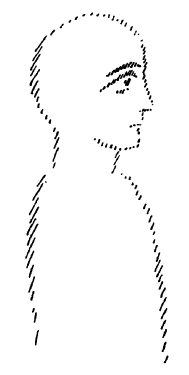
[ 10 ] Sie können sich zum Beispiel außerordentlich schwer vorstellen, daß dasjenige, was heute wirkt, gar nicht im jetzigen Zeitpunkt vorhanden zu sein braucht, sondern in einem viel früheren Zeitpunkte real ist und im heutigen Zeitpunkte nicht real ist. Sie schen gleichsam dasjenige, was in sehr frühem Zeitraume vorhanden ist, perspektivisch in Ihre eigene Zeit hereinwirken.
[ 10 ] For example, you find it extremely difficult to imagine that what has an effect today does not necessarily have to exist at the present moment, but is real at a much earlier point in time and is not real at the present moment. You allow, as it were, that which exists in a very early period to have a perspective-based effect on your own time.
[ 11 ] Das, was ich jetzt gesagt habe, hat eine sehr bedeutsame Folge. Das hat nämlich die Folge, daß alles das, was wir Natur nennen, einen ganz andern Charakter trägt als alles dasjenige, was wir als einen gewissen Teil des Menschen selbst betrachten müssen. In der Natur draußen wirkt zum Beispiel auch Ahriman, beziehungsweise es wirken die ahrimanischen Mächte; aber die ahrimanischen Mächte wirken in der Natur draußen niemals gegenwärtig. Wenn Sie die gesamte Natur überschauen, so wirkt schon Ahriman in der Natur, aber er wirkt von einer entfernten Zeit her. Von der Vergangenheit her wirkt Ahriman. Und ob Sie das mineralische, das pflanzliche, das tierische Reich überblicken, Sie dürfen niemals sagen, in dem, was gegenwärtig vor Ihren Augen sich ausbreitet, liege etwas, worin Ahriman tätig ist. Und doch ist Ahriman drinnen tätig; aber von der Vergangenheit her. Wenn ich also die Sache zeichnen wollte, so müßte ich sagen: Hier ist die Entwickelungslinie von der Vergangenheit in die Zukunft hin, und hier überblicken Sie die Natur.
[ 11 ] What I have just said has a very significant consequence. Namely, it follows that everything we call nature has a completely different character than everything we must regard as a certain part of the human being itself. In the natural world, for example, Ahriman—or rather, the Ahrimanic forces—are at work; but the Ahrimanic forces are never present in the natural world. When you survey the whole of nature, Ahriman is indeed at work in nature, but he acts from a distant time. Ahriman acts from the past. And whether you survey the mineral, plant, or animal kingdoms, you must never say that in what currently spreads out before your eyes there is anything in which Ahriman is active. And yet Ahriman is active within; but from the past. So if I were to illustrate this, I would have to say: Here is the line of development from the past into the future, and here you are surveying nature.
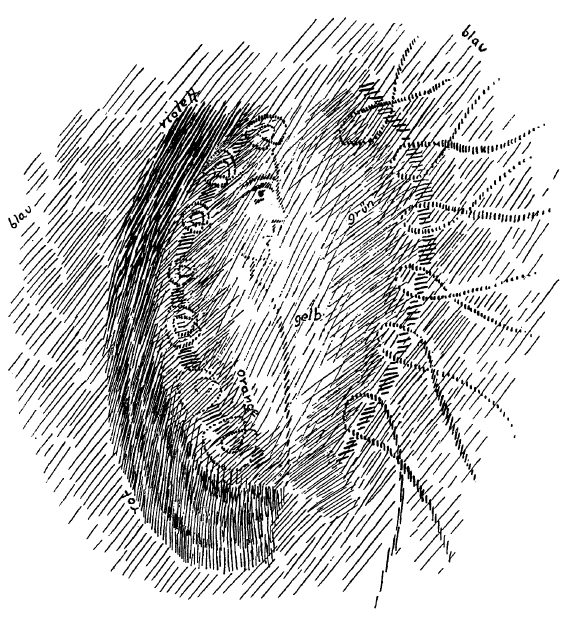
[ 12 ] Ja, nun müssen Sie es sich so denken, daß Sie da hineinschauen. In dem, was Sie als Gegenwärtiges überschauen, ist nichts von ahrimanischen Mächten enthalten, aber aus der Vergangenheit, aus einer bestimmten Vergangenheit wirkt Ahriman herüber in die Natur.
[ 12 ] Yes, now you must think of it this way: that you are looking into it. In what you perceive as the present, there is nothing of the Ahrimanic forces, but from the past—from a specific past—Ahriman exerts his influence on nature.
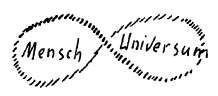
[ 13 ] Und Ihnen erscheint Ahriman in der Natur, wenn Sie ihn da gewahr werden, perspektivisch. Würden Sie sagen: Ahriman wirkt gegenwärtig — dann begehen Sie der Natur gegenüber denselben Fehler, wie wenn Sie sagen würden: Überschaue ich einen Raum, so stehen die entfernten Bäume, weil sie sich perspektivisch in die Fläche hineinstellen lassen, so neben den nahen Bäumen (siehe Zeichnung Seite 164).
[ 13 ] And when you become aware of Ahriman in nature, he appears to you in perspective. If you were to say, “Ahriman is present”—then you would be making the same mistake with regard to nature as if you were to say: When I look out over a landscape, the distant trees stand next to the nearby trees because they can be placed within the plane of the landscape in perspective (see drawing on page 164).
[ 14 ] Eine Grundforderung für ein reales Schauen in der geistigen Welt ist dieses, daß man zeitlich perspektivisch sehen lernt, daß man lernt, zeitlich jegliches Wesen an seinen richtigen Zeitpunkt zu setzen.
[ 14 ] A fundamental requirement for true perception in the spiritual world is learning to see from a temporal perspective—that is, learning to place every being at its proper point in time.
[ 15 ] Wenn ich nun gestern gesagt habe: Das Ich wird nach dem Tode gewissermaßen aus dem flüssigen Zustand heraus in eine Art festen Zustandes versetzt —, so ist das noch nicht alles, sondern es kommt noch das andere dazu. Nehmen Sie an, Sie lebten hier auf der Erde mit Ihrem Ich vom Jahre 1850 bis zum Jahre 1920, und im Jahre 1920 werden Sie Ihr Ich gewahr. Ich meine also: Wohl werden Sie es schon früher gewahr, aber nun blicken Sie zurück, mit dem Geistselbst durch die Hierarchien blicken Sie auf Ihr Ich zurück; da sehen Sie Ihr Ich immer als stehengeblieben vom Jahre 1850 bis 1920. Das Ich bleibt da, bleibt stehen. Das heißt: Ihre Erlebnisse gehen bald nach Ihrem Tode nicht mit Ihnen, sondern Sie sehen auf sie zurück, Sie schauen nun von einer zeitlich entfernten Perspektive auf das zurück, und Sie sehen in die Zeitenlänge hinein, wie Sie hier in der physischen Welt in die Raumeslänge hineinsehen. Ich kann es auch so ausdrücken: Indem Sie, sagen wir, 1920 sterben, leben Sie mit alldem, was ich Ihnen gestern als die Glieder Ihres Wesens geschildert habe, dann weiter; aber Sie sehen zurück auf die Zeitstrecke, in der Sie hier auf Erden mit Ihrem Ich gelebt haben. Und diese Zeitstrecke bleibt dort, und Sie sehen sie immer, indem Sie perspektivisch weiterleben, an der Zeitstelle, wo sie war. Und so müssen Sie sich vorstellen, daß Ahriman wirksam ist draußen in der Natur, aber von einer früheren Zeitstelle aus.
[ 15 ] When I said yesterday that after death the “I” is, so to speak, transformed from a fluid state into a kind of solid state—that is not the whole story; there is more to it. Suppose you lived here on Earth with your “I” from 1850 to 1920, and in 1920 you become aware of your “I.” What I mean is: You may well have become aware of it earlier, but now you look back—with your spiritual self, through the hierarchies, you look back upon your “I”; there you see your “I” as having remained stationary from 1850 to 1920. The “I” remains there, standing still. This means: Your experiences do not accompany you shortly after your death; rather, you look back on them—you now view them from a temporally distant perspective, and you look into the expanse of time just as you look into the expanse of space here in the physical world. I can also put it this way: By dying, say, in 1920, you continue to live on with everything I described to you yesterday as the members of your being; but you look back on the span of time during which you lived here on earth with your “I.” And this stretch of time remains there, and as you continue to live on in perspective, you always see it at the point in time where it was. And so you must imagine that Ahriman is active out there in nature, but from an earlier point in time.
[ 16 ] Das ist sehr wichtig. Das ist etwas, was sehr wenig berücksichtigt wird. Wenn man die Welt verstehen will, wenn man geisteswissenschaftlich von der Zeit sprechen will, so muß man durchaus die Zeit raumähnlich vorstellen und muß dieses Verbundenbleiben des Wesenhaften mit der Zeit ins Auge fassen. Das ist sehr wichtig.
[ 16 ] This is very important. It is something that is rarely taken into account. If one wants to understand the world, if one wants to speak of time from a humanities perspective, one must certainly conceive of time in a way similar to space and must take into account this enduring connection between the essential and time. This is very important.
[ 17 ] Nun ist das, was ich Ihnen mit Bezug auf die ahrimanischen Mächte gesagt habe, daß sie von der Vergangenheit her wirken, für die Natur so richtig. Aber beim Menschen wird es gerade anders. Beim Menschen wird es eben, während er hier zwischen Geburt und Tod lebt, dadurch anders, daß für ihn alles in der Zeit Ablaufende eben zur Maja, zur Täuschung wird. Der Mensch lebt, während er hier lebt, selber im Laufe der Zeit drinnen, und indem er eine gewisse Anzahl von Jahren durchlebt, durchlebt er den Zeitenlauf mit. Indem die Zeit abläuft, läuft er selber mit der Zeit ab. Das ist mit dem Raume nicht der Fall. Wenn Sie eine Allee entlanggehen, bleiben die Bäume zurück und Sie schreiten vorwärts, und Sie nehmen die Bäume, die zurückgeblieben sind, also auch Ihre Eindrücke, nicht so mit, daß Sie, indem Sie einen Schritt machen würden, die Meinung hätten, es ginge das Baumbild mit Ihnen mit. Mit dem Zeitbilde machen Sie das. Hier im physischen Leibe machen Sie das tatsächlich so — weil Sie selbst in der Zeit sich weiterentwickeln —, daß Sie sich über die Zeit in bezug auf ihre Perspektive einer Täuschung hingeben. Sie merken die Perspektive der Zeit nicht. Und insbesondere merkt es nicht das Unterbewußtsein des Menschen. Das Unterbewußtsein des Menschen merkt erst recht dieses Mitleben mit der Zeit nicht, gibt sich einer vollständigen Täuschung mit Bezug auf die Perspektive der Zeit hin. Das aber hat eine ganz bestimmte Folge. Das hat die Folge, daß nun in demjenigen, was im Menschen geschieht, ahrimanische Mächte als gegenwärtige Mächte wirken können. Ins menschliche Seelenleben herein wirken ahrimanische Mächte als gegenwärtige Mächte. So daß der Mensch der Natur so gegenübersteht: Indem er in die Natur hinaussieht, ist im Gegenwärtigen nichts Ahrimanisches. In ihm wirkt das Ahrimanische als Gegenwärtiges, eben gerade als Maja, als Täuschung. Aber der Mensch ist dieser Täuschung über die Dinge, die ich Ihnen auseinandergesetzt habe, hingegeben, so daß durch den Menschen die ahrimanischen Mächte die Möglichkeit gewinnen, in die Gegenwart hereinzukriechen, in die Gegenwart hereinzuwandeln. Wir können sagen: Die ahrimanischen Mächte — und so ist es nun auch mit den luziferischen Mächten, wenn auch von einem gewissen andern Gesichtspunkte aus, wovon wir gleich sprechen werden — wirken in der Natur so, daß sie eigentlich mit der Gegenwart nichts zu tun haben, sondern von der Vorzeit herein ihre Wirkungen erstrecken. Im Menschen wirken diese ahrimanischen Mächte gegenwärtig.
[ 17 ] Now, what I have told you regarding the Ahrimanic forces—that they act from the past—is entirely true for nature. But with human beings, it is precisely the opposite. For human beings, while they live here between birth and death, it is different in that everything that unfolds in time becomes Maya—illusion—for them. While living here, human beings themselves live within the flow of time, and as they live through a certain number of years, they experience the passage of time along with it. As time passes, he himself passes along with it. This is not the case with space. When you walk down an avenue, the trees remain behind and you move forward, and you do not take the trees that have been left behind—and thus your impressions of them—with you in such a way that, with every step you take, you would feel that the image of the trees is moving along with you. You do this with the image of time. Here in the physical body, you actually do this—because you yourself continue to develop within time—in such a way that, with regard to its perspective, you succumb to an illusion. You do not perceive the perspective of time. And the human subconscious, in particular, does not perceive it. The human subconscious is especially unaware of this coexistence with time; it succumbs to a complete illusion regarding the perspective of time. But this has a very specific consequence. It has the consequence that Ahrimanic forces can now act as present forces within what happens within the human being. Ahrimanic forces act within the human soul life as present forces. Thus, the human being faces nature in this way: when looking out into nature, there is nothing Ahrimanic in the present. Within the human being, the Ahrimanic acts as something present—precisely as Maya, as illusion. But human beings are given over to this illusion regarding the things I have explained to you, so that through human beings the Ahrimanic forces gain the opportunity to creep into the present, to transform themselves into the present. We can say: The Ahrimanic forces—and the same is true of the Luciferic forces, albeit from a somewhat different perspective, which we will discuss shortly—act in nature in such a way that they actually have nothing to do with the present, but rather extend their effects from the past. In human beings, these Ahrimanic forces are at work in the present.
[ 18 ] Was ist die Folge? Die Folge davon ist, daß der Mensch in seinem tiefsten Seelischen in bezug auf den eben auseinandergesetzten Punkt sich nicht verwandt mit der Natur fühlen kann. Er sieht auf sein Wesen, beziehungsweise fühlt sich in seinem Wesen, empfindet das naturgemäße Wesen. Weil in ihm ahrimanische Mächte Gegenwattsmächte sind, in der Natur ahrimanische Mächte Vergangenheitsmächte sind, erscheint ihm alles dasjenige, was naturgemäß ist, anders als dasjenige, was sich in ihm selbst entwickelt. Den Unterschied, den der Mensch zwischen sich und der Natur merkt, den enträtselt er sich nicht in der richtigen Weise. Würde er sich ihn in der richtigen Weise enträtseln, so wäre es so, wie ich es eben auseinandergesetzt habe. Er würde sagen: Draußen in der Natur wirkt Ahriman von der Vergangenheit aus; in mir wirkt Ahriman als eine gegenwärtige Macht. — Dadurch aber kommt es, wenn er auch den Unterschied nicht weiß, daß er sich im Sinne dieses Unterschiedes verhält, und die Natur als geistlos empfindet. Er empfindet es schon, daß in der Gegenwart die ahrimanischen Mächte nicht in der Natur unmittelbar wirksam sind, aber er empfindet die Natur als geistlos, weil er sich nicht sagt: Ahriman wirkt von der Vergangenheit her —, sondern er sieht nur auf die gegenwärtige Natur. Darinnen wirkt nicht Ahriman.
[ 18 ] What is the consequence? The consequence is that, in the deepest recesses of his soul, a human being cannot feel a kinship with nature with regard to the point just discussed. He looks at his own being—or rather, feels within his own being—and perceives his natural essence. Because Ahrimanic forces within him are counteracting forces, whereas in nature Ahrimanic forces are forces of the past, everything that is natural appears to him differently from what develops within himself. He does not unravel the difference he perceives between himself and nature in the correct way. If he were to unravel it in the right way, it would be as I have just explained. He would say: Out there in nature, Ahriman acts from the past; within me, Ahriman acts as a present force. — But this is why, even if he does not understand the difference, he behaves in accordance with this difference and perceives nature as spiritless. He does sense that in the present, the Ahrimanic forces are not directly active in nature, but he perceives nature as spiritless because he does not tell himself: “Ahriman acts from the past”—instead, he looks only at present-day nature. Ahriman does not act within it.
[ 19 ] Nun ist aber Ahriman, so sonderbar das klingen mag, diejenige Macht, deren sich die allgemeine Weltenschöpfung bedient, um die Natur hervorzubringen. Wenn man von dem Geist der Natur spricht, wenn man vom reinen Geist der Natur spricht, müßte man eigentlich von dem ahrimanischen Geiste sprechen. Da ist er vollberechtigt, der ahrimanische Geist. Die Wesenheiten der normalen Hierarchien, die bedienen sich des ahrimanischen Geistes, um das hervorzubringen, was sich als Natur um uns herum ausbreitet. Daß wir die Natur nicht durchgeistigt empfinden, das rührt eben davon her, daß im gegenwärtigen Leben der Natur der Geist nicht enthalten ist, sondern daß er von der Vergangenheit her wirkt. Und das ist das Geheimnis, möchte ich sagen, der weltschöpferischen Mächte, daß sie sich eines Geistes, den sie stehengelassen haben auf einer früheren Stufe, bedienen zur Wirkung auf einer späteren Stufe, aber ihn von der Vergangenheit herein wirken lassen.
[ 19 ] Now, strange as it may sound, Ahriman is the very power that the general creation of the world makes use of to bring forth nature. When one speaks of the spirit of nature—when one speaks of the pure spirit of nature—one should actually be speaking of the Ahrimanic spirit. There, the Ahrimanic spirit is fully justified. The beings of the normal hierarchies make use of the Ahrimanic spirit to bring forth what spreads out around us as nature. The fact that we do not perceive nature as imbued with spirit stems precisely from the fact that the spirit is not contained within nature’s present life, but rather acts from the past. And that, I would say, is the secret of the world-creating powers: that they make use of a spirit they left behind at an earlier stage to exert an effect at a later stage, but allow it to work from the past.
[ 20 ] Wir müßten, wenn wir von der Natur sprechen, nicht von Stoff sprechen, auch nicht von Kräften sprechen, wir müßten von ahrimanischen Wesenheiten sprechen; aber wir müßten dann so sprechen, daß wir diese ahrimanischen Wesenheiten in die Vergangenheit setzten. So daß das Sonderbare herauskommt: Nehmen Sie an, irgendein Naturphilosoph sinnt, sinnt nach, was hinter den Erscheinungen der Natur ist. Nun, da macht er sich allerlei Theorien und Hypothesen über Atomzusammenhänge und dergleichen. So ist aber die Sache nicht. Hinter dem, was sich da sinnenfällig um uns herum ausbreitet, ist eigentlich nicht das, was die Naturphilosophen gewöhnlich vermuten, sondern hinter alldem ist die Summe der ahrimanischen Mächte, aber nicht als gegenwärtige. Ist also der Naturphilosoph genötigt, sagen wir, hinter den chemischen Elementen irgendwelche Atomstrukturen zu vermuten, so ist das falsch; hinter den chemischen Elementen stehen ahrimanische Mächte. Aber wenn Sie das, was Sie sehen von den chemischen Elementen, abheben könnten und dahinterschauen, so würden Sie in der Gegenwart nichts dahinter sehen: da wäre es hohl, wo man die Atome sucht, und das, was wirkt, wirkt in diesen Hohlraum aus der Vergangenheit herein. So ist es in Wirklichkeit. Daher diese vielen verunglückten Theorien über dasjenige, was das «Ding an sich» ist; denn dieses «Ding an sich» ist in der Gegenwart überhaupt nicht da. Sondern es ist an der Stelle, wo das «Ding an sich» gesucht wird, nichts; aber die Wirkung ist dort aus der Vergangenheit herein. So daß man sagen könnte, wenn Kart sein «Ding an sich» gesucht hat, so hätte er sagen müssen: Da, wo ich an das «Ding an sich» heran will, da kann ich nicht heran. — Das hat er ja auch gesagt. Aber er ist nicht darauf gekommen, daß er da überhaupt zunächst gegenwärtig nichts gefunden hätte, und daß er, wenn er hinter den Schleier der Dinge gegangen wäre, hätte weit zurückgehen müssen; dann hätte er ahrimanische Mächte gefunden.
[ 20 ] When we speak of nature, we should not speak of matter, nor of forces; we should speak of Ahrimanic beings; but we would then have to speak in such a way that we place these Ahrimanic beings in the past. This brings out the peculiarity: Suppose some natural philosopher is pondering, reflecting on what lies behind the phenomena of nature. Well, he then devises all sorts of theories and hypotheses about atomic relationships and the like. But that is not how it is. Behind what spreads out around us in a way perceptible to the senses is not actually what natural philosophers usually suppose, but behind all of this lies the sum of the Ahrimanic forces—though not as present forces. So if the natural philosopher is compelled, let us say, to suppose some kind of atomic structures behind the chemical elements, that is wrong; behind the chemical elements lie Ahrimanic forces. But if you could lift away what you see of the chemical elements and look behind them, you would see nothing there in the present: it would be hollow where one seeks the atoms, and what is at work is acting into this hollow space from the past. That is how it really is. Hence the many misguided theories about what the “thing-in-itself” is; for this “thing-in-itself” is not there at all in the present. Rather, there is nothing at the place where the “thing-in-itself” is sought; but the effect is present there, emanating from the past. So one could say that if Kant had sought his “thing-in-itself,” he would have had to say: Where I want to approach the “thing-in-itself,” I cannot approach it. — That is, in fact, what he said. But it did not occur to him that he would have found nothing at all in the present to begin with, and that if he had gone behind the veil of things, he would have had to go far back; then he would have found Ahrimanic forces.
[ 21 ] Im Menschen selbst ist es anders. Gerade dadurch, daß der Mensch lebendig in die Zeit versetzt wird, dadurch ist es den ahrimanischen Mächten möglich gewesen, durch die Pforte der Menschheit in unsere Welt einzudringen und innerhalb des Menschen als solchem zu wirken. Und die Folge davon, daß die ahrimanischen Mächte im Menschen wirken, ist die, daß der Mensch loslöst dasjenige, was er in der Gegenwart sieht, von dem Geistigen, daß der Mensch sein Gegenwartsdasein löst von dem Geistigen. Das ist die Folge dessen, daß wir die ahrimanischen Mächte innerhalb der Maja in uns tragen. So daß man sagen kann: So wie wir die Welt materiell ansehen, losgelöst vom Geiste, als bloße Naturordnung, die ihren Gipfel zu finden glaubt in dem Gesetz der Erhaltung der Kraft und des Stoffes — was eine Illusion ist —, was wir da als eine Naturordnung sehen, es ist lediglich durch den Umstand herbeigeführt, daß wir die ahrimanischen Mächte in uns tragen, und daß sie in der Natur draußen als gegenwärtige Mächte nicht sind. — Es stimmt deshalb dasjenige, was wir über die Natur denken, indem wir sie bloß materiell denken, nicht mit der Natur überein, stimmt nur mit der gegenwärtigen Natur überein. Aber diese gegenwärtige Natur ist eben ein Abstraktum, weil in ihr der vergangene Ahriman immer hereinwirkt.
[ 21 ] It is different within the human being. Precisely because the human being is placed alive within time, the Ahrimanic forces have been able to enter our world through the gateway of humanity and work within the human being as such. And the consequence of the Ahrimanic forces acting within the human being is that the human being detaches what he sees in the present from the spiritual, that the human being detaches his present existence from the spiritual. This is the consequence of our carrying the Ahrimanic forces within the Maya within ourselves. So that one can say: Just as we view the world materially, detached from the spirit, as a mere natural order that believes it finds its culmination in the law of conservation of energy and matter—which is an illusion—what we see there as a natural order, is brought about solely by the fact that we carry the Ahrimanic forces within us, and that they do not exist as present forces in nature outside of us. — Therefore, what we think about nature—by conceiving of it merely in material terms—does not correspond to nature itself, but only to present-day nature. Yet this present-day nature is precisely an abstraction, because the Ahriman of the past is always at work within it.
[ 22 ] Nun wirkt in den Menschen nicht nur das Ahrimanische, sondern auch das Luziferische herein. Dieses Luziferische aber, das hat gewissermaßen eine andere Tendenz im Weltenall als das Ahrimanische. Vergegenwärtigen wir uns die Tendenz des Ahrimanischen, so wie wir die Sache jetzt ausgesprochen haben. Die Tendenz des Ahrimanischen in uns besteht darin, die Welt materialistisch vorzustellen. Daß wir die Welt materialistisch vorstellen, daß wir uns eine bloße Naturordnung denken, ist die Folge davon, daß wir Ahrimanisches in uns tragen. Daß wir Ideale in uns tragen, welche sich loslösen von der allgemeinen Natur, nach denen wir uns in unserem gegenseitigen Verhalten richten wollen, die uns aber doch nur wie Träume erscheinen müssen innerhalb der gegenwärtigen Weltanschauung, die ausgeträumt sind, wenn nach der Naturordnung die Erde an ihrem Endzustand angekommen ist, das ist die Folge davon, daß die luziferischen Mächte, die ebenso wie die ahrimanischen in uns leben, immerfort das Bestreben haben, den Teil von uns, der ihnen zugänglich ist, ganz aus der Naturordnung herauszureißen und vollständig zu vergeistigen. Die luziferischen Mächte haben nämlich zu ihrer Haupttendenz, insofern sie in uns wohnen, uns so geistig wie möglich zu machen, uns womöglich loszureißen von allem materiellen Leben. Daher gaukeln sie uns solche Ideale vor, die keine Naturmächte sind, sondern die machtlos sind in der gegenwärtigen Naturordnung. Und verfiele der Mensch ganz und gar im Laufe der zukünftigen Erdenperiode dem luziferischen Einfluß, so daß er glauben würde, Ideale seien eben nur gedachte Dinge, nach denen sich das Gemüt richten kann, so würde dieser Mensch den luziferischen Mächten folgen. Die materielle Erde, zu der wir gehören, würde verfallen, zerstieben im Weltenall, würde ihren Zweck nicht erfüllen, und die luziferischen Mächte würden den Menschen in eine andere geistige Welt führen, in die er nicht gehört. Dazu brauchen sie den Kniff, uns Ideale vorzugaukeln, die eigentlich bloße Träume sind. Wie uns Ahriman nach der einen Seite eine Welt vormacht, welche eine bloße Naturordnung ist, so macht uns Luzifer auf der andern Seite eine Welt vor, die rein nur in gedachten Idealen besteht.
[ 22 ] Now, it is not only the Ahrimanic principle that influences human beings, but also the Luciferic principle. This Luciferic principle, however, has, so to speak, a different tendency in the cosmos than the Ahrimanic principle. Let us consider the tendency of the Ahrimanic, as we have just described it. The tendency of the Ahrimanic within us consists in conceiving the world in materialistic terms. The fact that we conceive the world in materialistic terms, that we imagine a mere natural order, is the consequence of our carrying the Ahrimanic within us. The fact that we carry within us ideals that detach themselves from general nature—ideals by which we wish to guide our mutual conduct, but which must nevertheless appear to us merely as dreams within our present worldview, dreams that will be over when, according to the natural order, the Earth has reached its final state—is the consequence of the fact that the Luciferic forces, which live within us just as the Ahrimanic ones do, constantly strive to tear the part of us that is accessible to them completely out of the natural order and to spiritualize it entirely. For the main tendency of the Luciferic forces, insofar as they dwell within us, is to make us as spiritual as possible, to tear us away, if at all possible, from all material life. That is why they present us with ideals that are not natural forces, but are powerless within the present natural order. And if, in the course of the future Earth period, a human being were to succumb entirely to the Luciferic influence—so that he would believe that ideals are merely conceptual entities by which the mind can orient itself—then that human being would follow the Luciferic forces. The material Earth, to which we belong, would decay, disintegrate into the cosmos, fail to fulfill its purpose, and the Luciferic forces would lead humanity into another spiritual world to which it does not belong. To do this, they need the trick of deceiving us with ideals that are actually mere dreams. Just as Ahriman, on the one hand, presents us with a world that is merely a natural order, so, on the other hand, Lucifer presents us with a world that consists purely of imagined ideals.
[ 23 ] Das ist etwas sehr Bedeutungsvolles. Und gegenwärtig wird nur ein Ausgleich, möchte ich sagen, in den Gebieten herbeigeführt, die noch im menschlichen Unbewußten liegen. Aber die Menschen müssen sich dieser Sache immer mehr und mehr bewußt werden, sonst kommen sie aus diesem Dilemma nicht heraus, kommen nicht dazu, eine Brücke zwischen dem Idealismus und dem Realismus zu bauen, welche Brücke aber notwendig ist.
[ 23 ] This is something very significant. And at present, I would say, a balance is being brought about only in those areas that still lie within the human unconscious. But people must become more and more aware of this fact; otherwise, they will not be able to escape this dilemma or succeed in building a bridge between idealism and realism—a bridge that is, however, necessary.
[ 24 ] Dasjenige, was gegenwärtig noch eine Art Ausgleich schafft, das ist das Folgende. Wenn gegenwärtig ganz junge Menschen sterben, zum Beispiel Kinder, so haben diese Kinder — bei jungen Menschen ist es ebenso — eben in die Welt hereingeschaut; sie haben nicht voll das Dasein hier auf dem physischen Plane ausgelebt. Mit einem auf dem physischen Plane unausgelebten Leben kommen sie hinüber in die andere Welt, die zwischen dem Tode und einer neuen Geburt verlebt wird, so verlebt wird, wie ich es gestern geschildert habe. Dadurch, daß sie einen Teil nur des Erdenlebens gelebt haben, bringen sie etwas vom Erdenleben mit hinüber in die geistige Welt, das man nicht hinüberbringen kann, wenn man alt geworden ist. Man kommt anders in der geistigen Welt an, wenn man alt geworden ist, als wenn man jung stirbt. Wenn man jung stirbt, so hat man das Leben so durchlebt, daß man noch viele Kräfte in sich hat vom vorgeburtlichen Leben. Man hat als Kind und als junger Mensch das leibliche Leben so durchlebt, daß man darinnen noch viel von den Kräften in sich hat, die man vor der Geburt in der geistigen Welt hatte. Dadurch hat man eine innige Verbindung geschaffen zwischen dem Geistigen, das man mitgebracht hat, und dem Physischen, das man hier erlebt hat. Und durch diese innige Verbindung kann man etwas, was man auf der Erde erwirbt, in die geistige Welt mit hinübernehmen. Kinder oder sonst jung gestorbene Leute nehmen von dem Erdenleben etwas in die geistige Welt mit hinüber, was gar nicht mit hinübergenommen werden kann, wenn man als älterer Mensch stirbt. Das, was da mitgenommen wird, ist dann drüben in der geistigen Welt, und was da hinübergetragen wird durch Kinder und junge Leute, das gibt der geistigen Welt eine gewisse Schwere, die sie sonst nicht haben würde, derjenigen geistigen Welt, in der dann die Menschen gemeinsam drinnen leben, das gibt eine gewisse Schwere der geistigen Welt und verhindert die luziferischen Mächte, die geistige Welt ganz loszutrennen von der physischen.
[ 24 ] What currently still provides a kind of balance is the following. When very young people die—for example, children—these children—and the same is true of young people—have only just begun to experience the world; they have not fully lived out their existence here on the physical plane. With a life on the physical plane that has not been fully lived, they pass over into the other world—the realm between death and a new birth—which is experienced as I described yesterday. Because they have lived only a part of their earthly life, they bring something of that earthly life with them into the spiritual world—something that cannot be brought over if one has grown old. One arrives in the spiritual world differently when one has grown old than when one dies young. When one dies young, one has lived life in such a way that one still possesses many of the forces from one’s pre-birth existence. As a child and as a young person, one has lived one’s physical life in such a way that one still possesses within oneself much of the strength that one had in the spiritual world before birth. Through this, one has created an intimate connection between the spiritual aspect that one brought with oneself and the physical aspect that one has experienced here. And through this intimate connection, one can carry over into the spiritual world something that one has acquired on Earth. Children or others who die young take something from their earthly life with them into the spiritual world—something that cannot be carried over at all when one dies as an older person. What is taken along is then present in the spiritual world, and what is carried over there by children and young people gives the spiritual world a certain weight that it would otherwise lack—that spiritual world in which people then live together—this imparts a certain weight to the spiritual world and prevents the Luciferic forces from completely separating the spiritual world from the physical.
[ 25 ] Also denken Sie, auf welches riesige Geheimnis wir da blicken! Wenn Kinder und junge Leute sterben, so nehmen sie von hier etwas mit, wodurch sie die luziferischen Mächte verhindern an deren Bestreben, uns ganz loszulösen von dem Erdenleben. Das ist außerordentlich wichtig, daß man dies ins Auge faßt.
[ 25 ] Just think, what an immense mystery we are looking at here! When children and young people die, they take something with them from here that prevents the Luciferic forces from achieving their goal of completely severing us from earthly life. It is extremely important to keep this in mind.
[ 26 ] Wird man älter hier auf der Erde, so kann man in der geschilderten Weise den luziferischen Mächten die Rechnung noch nicht verderben; denn von einem gewissen Alter an hat man nicht mehr jene innige Verbindung zwischen dem, was man mitgebracht hat bei der Geburt, und dem physischen Erdenleben. Ist man alt geworden, so löst sich diese innerliche Verbindung, und es tritt gerade das Umgekehtte ein. Von einem gewissen Lebensalter an träufeln wir in einer gewissen Weise dem innerhalb der physischen Erde befindlichen Geistigen unser eigenes Wesen ein. Wir machen die physische Erde geistiger als sie sonst wäre. Also von einem bestimmten Alter an vergeistigen wir in einer gewissen Weise, die man nicht mit äußeren Sinnen wahrnehmen kann, die physische Erde. Wir tragen Geistiges in die physische Erde hinein, wie wir Physisches in die geistige Welt hinauftragen, wenn wir jung sterben; wir pressen gewissetmaßen Geistiges aus, wenn wir alt werden, ich kann es nicht anders sagen. Das Altwerden besteht im geistigen Sinne von einem gewissen Aspekt aus darinnen, daß man Geistiges hier auf der Erde auspreßt. Dadurch wird wiederum die Rechnung des Ahriman verhindert. Dadurch kann Ahriman nicht auf die Dauer heute schon so intensiv auf die Menschen wirken, daß völlig erlöschen könnte die Meinung, Ideale hätten doch eine gewisse Bedeutung. Aber wir sind im heutigen Zeitraume schon sehr, sehr nahe daran, daß die Menschen in die furchtbarsten Irrtümer gerade mit Bezug auf das Gesagte verfallen. Auch Gutmeinende verfallen leicht in bezug auf das Gesagte in solche Irrtümer. Und diese Irrtümer werden immer größer und größer werden und mit zunehmender Erdenentwickelung eben riesig werden können.
[ 26 ] As one grows older here on Earth, one cannot yet thwart the Luciferic forces in the manner described; for from a certain age onward, one no longer has that intimate connection between what one brought with oneself at birth and one’s physical life on Earth. Once one has grown old, this inner connection dissolves, and the exact opposite occurs. From a certain age onward, we infuse our own being, in a certain way, into the spiritual substance within the physical Earth. We make the physical earth more spiritual than it would otherwise be. Thus, from a certain age onward, we spiritualize the physical earth in a certain way that cannot be perceived by the outer senses. We carry the spiritual into the physical earth, just as we carry the physical up into the spiritual world when we die young; we, so to speak, squeeze out the spiritual when we grow old—I cannot put it any other way. In a spiritual sense, from a certain perspective, growing old consists in “squeezing out” the spiritual here on Earth. This, in turn, thwarts Ahriman’s plan. As a result, Ahriman cannot, in the long run, exert such an intense influence on people today that the belief that ideals do, after all, have a certain significance might be completely extinguished. But in the present era, we are already very, very close to a point where people are falling into the most terrible errors precisely with regard to what has been said. Even well-meaning people easily fall into such errors with regard to what has been said. And these errors will become ever greater and greater and, as Earth’s development progresses, may indeed become enormous.
[ 27 ] Um Ihnen ein Beispiel anzuführen: Ein recht geistvoller Philosoph hat 1882 eine «Anthroposophie» geschrieben, Robert Zimmermann. Ich habe das schon einmal in einem Zusammenhange erwähnt. Diese «Anthroposophie» ist nicht dasjenige, was wir Anthroposophie jetzt nennen, sie ist mehr oder weniger ein Begriffisgestrüpp. Aber das ist ja aus dem Grunde, weil eben Robert Zimmermann nicht in die geistige Welt hineinsehen konnte, sondern nur Herbartianischer Philosoph war. Nun hat er diese «Anthroposophie» geschrieben. Aber gerade in dieser «Anthroposophie» beschäftigt sich Robert Zimmermann von seinem Gesichtspunkte aus mit der Frage, die ich in diesen Tagen an die Spitze unserer Betrachtungen gestellt habe. Er sieht auf der einen Seite die Ideen, logische Ideen, ästhetische Ideen, ethische Ideen; er sieht auf der andern Seite die Naturordnung. Und er kann nicht irgendwie eine Brücke finden zwischen den logischen, den ästhetischen, den ethischen Ideen und der Naturordnung, sondern er bleibt doch dabei stehen: Da ist auf der einen Seite die Naturordnung, und auf der andern Seite sind die Ideen. Und wozu er zuletzt kommt, das ist doch außerordentlich interessant, denn es ist eigentlich typisch für einen Menschen der Gegenwart. Er kommt dahin, zu sagen, es sei ein für allemal dem Menschen versagt, die Natur mit Ideen zu bevölkern und den Ideen Naturgewalt beizulegen. Die beiden Welten seien eigentlich nur im Kopfe des Menschen miteinander zu verbinden. So sagt er. Und daher meint er an einer Stelle, wo er geradezu alles zusammenfaßt, was er sagt und was er denkt: «Die Verwirklichung der Ideen ist weder eine Tatsache, die in der Vergangenheit, noch eine solche, die in der Gegenwart, sondern eine Aufgabe, deren Erfüllung in der Zukunft und in den Händen des Menschen liegt. Der Traum eines «goldenen Zeitalters», von welchem ein nüchterner Rationalist wie Kant als von jenem des «ewigen Friedens, wie ein extremer Positivist wie Comte als dem ‹état positif› schwärmte, wird dann erfüllt sein, wenn die gesamte Ideenwelt real geworden und die gesamte Wirklichkeit von den Ideen durchdrungen, das heißt: wenn dasjenige, was Schiller «das Kunstgeheimnis des Meisters» nannte, die ‹Vertilgung› des Stoffes durch die Form» offenbar, oder, wie Schleiermacher es ausdrückte «wenn die Ethik Physik und die Physik Ethik» geworden sein wird.»
[ 27 ] To give you an example: A rather witty philosopher named Robert Zimmermann wrote a work titled “Anthroposophy” in 1882. I have mentioned this once before in a related context. This “Anthroposophy” is not what we now call Anthroposophy; it is more or less a jumble of concepts. But that is precisely because Robert Zimmermann could not see into the spiritual world; he was merely a Herbartian philosopher. Now, he wrote this “Anthroposophy.” But it is precisely in this *Anthroposophy* that Robert Zimmermann, from his own perspective, addresses the question I have placed at the forefront of our reflections these past few days. On the one hand, he sees ideas—logical ideas, aesthetic ideas, ethical ideas; on the other hand, he sees the order of nature. And he cannot somehow find a bridge between the logical, aesthetic, and ethical ideas and the natural order; rather, he remains stuck there: on the one hand, there is the natural order, and on the other, there are the ideas. And the conclusion he ultimately reaches is extraordinarily interesting, for it is actually typical of a person of our time. He comes to say that it is once and for all denied to human beings to populate nature with ideas and to endow ideas with the power of nature. The two worlds, he says, can actually only be united in the human mind. That is what he says. And so, at a point where he sums up virtually everything he says and thinks, he remarks: “The realization of ideas is neither a fact of the past nor one of the present, but a task whose fulfillment lies in the future and in the hands of humankind.” The dream of a “golden age”—about which a sober rationalist like Kant raved as that of “eternal peace,” and an extreme positivist like Comte as the ‘état positif’—will then be fulfilled when the entire world of ideas has become real and the entire reality has been permeated by ideas, that is to say: when what Schiller called “the master’s secret of art”—the ‘annihilation’ of matter by form—has become apparent, or, as Schleiermacher put it, ‘when ethics has become physics and physics has become ethics.’”
[ 28 ] Ja, aber das kann nie werden! Es kann nur das werden, daß die Menschen in ihrer sozialen Ordnung die Ideen realisieren. Wenn aber die Erde einmal an ihrem Ende angelangt sein wird, so wird der ganze Ideentraum ausgeträumt sein. Ein anderes ist nach einer solchen Philosophie nicht möglich. Daher bleibt eine solche Philosophie immer abstrakt und muß zuletzt gestehen: «Eine Philosophie, welche, wie die vorstehende, sich weder wie die Theosophie auf einen menschlichem Wissen unzugänglichen theozentrischen Standpunkt versetzt, um von ihm aus den ‹Vernunfttraum› als längst geschaffene Wirklichkeit, noch wie die Anthropologie auf den zwar anthropozentrischen aber unkritischen Standpunkt gemeiner Erfahrung stellt, um von ihm aus eine ideenerfüllte Wirklichkeit als ‹Traum der Vernunft›, anzusehen, welche so nach zugleich anthropozentrisch, das ist von menschlicher Erfahrung ausgehend und doch Philosophie, das ist, an der Hand des logischen Denkens über dieselbe hinausgehend sein will, ist Anthroposophie.» «Anthroposophie» ist also hier das Eingeständnis, daß man niemals über diese Kluft hinüberkommen könne zwischen unrealen Ideen und ideenloser Realität.
[ 28 ] Yes, but that can never come to pass! The only thing that can come to pass is that people realize these ideas within their social order. But once the earth has reached its end, the entire dream of ideas will have come to an end. According to such a philosophy, nothing else is possible. Therefore, such a philosophy always remains abstract and must ultimately admit: “ A philosophy which, like the one described above, neither adopts—as theosophy does—a theocentric standpoint inaccessible to human knowledge, from which it regards the ‘dream of reason’ as a reality long since created, nor—as anthropology does—takes the anthropocentric but uncritical standpoint of common experience, from which it regards an idea-filled reality as ‘dream of reason’—which thus seeks to be both anthropocentric, that is, based on human experience, and yet philosophical, that is, going beyond that experience by means of logical thought—is anthroposophy.” “Anthroposophy,” then, is here the admission that one can never bridge this chasm between unreal ideas and reality devoid of ideas.
[ 29 ] Nun ist aber im Menschen selbst ein Naturwesen, das also der Naturordnung angehört, verbunden mit einem Geistwesen, das in sich aufnehmen kann das Geistige. Das leugnet ja auch nicht ein solcher Anthroposoph wie Robert Zimmermann. Aber von der gegenwätrtigen Wissenschaft kann auch der Mensch nicht so betrachtet werden, daß sich durch den Menschen, durch diesen Mikrokosmos, das Rätsel lösen würde.
[ 29 ] Now, however, within the human being there is a natural being—which thus belongs to the natural order—united with a spiritual being capable of assimilating the spiritual. Even an anthroposophist like Robert Zimmermann does not deny this. But even from the perspective of contemporary science, human beings cannot be viewed in such a way that the mystery would be solved through the human being, through this microcosm.
[ 30 ] Blicken wir jetzt zurück auf etwas, was wir auch schon während des diesmaligen Aufenthaltes erwähnt haben. Wir haben gesagt, daß wir eigentlich den Menschen gliedern müssen in drei Teile, natürlich nicht so bequem, wie es am Skelett ist, das habe ich schon ausgeführt. Aber ich habe mich ja darüber auch ausgesprochen in den Schlußnotizen zu meinem Buche «Von Seelenrätseln». Wir können den Menschen gliedern in drei Teile: den Hauptesmenschen, den Rumpfmenschen und den Extremitätenmenschen, indem zum Extremitätenmenschen alles dasjenige gehört, was inwärts der Extremitäten gelegen ist, also auch alles Sexuelle zum Extremitätenmenschen gehört. Wenn wir den Menschen so gliedern und jetzt anwenden dasjenige, was wir schon wissen: daß die Kopfbildung, die Kopfform auf Kräfte hinweist der vorigen Inkarnation, der Extremitätenmensch hinweist auf die zukünftige Inkarnation und eigentlich nur der Rumpfmensch der Gegenwart angehört, so werden Sie nach dem, was ich heute ausgeführt habe, es nicht mehr sehr unbegreiflich finden, wenn ich Ihnen sage: Insofern der Mensch sein Haupt trägt, weist dieses Haupt auf die frühere Inkarnation zurück, in die Vergangenheit. Ins Haupt herein wirken Kräfte der Vergangenheit, ahrimanische Kräfte, und dasjenige, was für die ahrimanischen Kräfte im allgemeinen gilt, gilt für das menschliche Haupt im besonderen. Alles, was eigentliche Hauptesbildung im Menschen ist, gehört nicht eigentlich der Gegenwart an, sondern in das Haupt wirken hinein die Kräfte der vorgehenden Inkarnation; und die schöpferischen Mächte bedienen sich der ahrimanischen Mächte, um unser Haupt zu formen, um unserem Haupte die eigentliche Formung zu geben. Würden nicht die schöpferischen Mächte sich der ahrimanischen Geister bedienen, um unser Haupt zu formen, dann würden wir alle — verzeihen Sie, aber es ist so — zwar ein viel weicheres Haupt tragen, aber wir würden alle ein tierisches Haupt tragen: der eine, welcher in seinem Charakter stiermäßig ist, würde ein Stierhaupt, der andere, der in seinem Charakter lammäfßig ist, würde ein Lämmerhaupt tragen und so weiter. Von dem Einfluß der ahrimanischen Mächte, deren sich die schöpferischen Gewalten bedienen, um uns zu formen, rührt es her, daß dieses tierische Haupt, das wir sonst tragen würden, nicht wirklich uns aufsitzt, so wie es die Ägypter gezeichnet haben an manchen ihrer Figuren; daß wir nicht so herumgehen wie diese ägyptischen Gestalten, die ihre guten Gründe haben, weil in den ägyptischen Mysterien auch, wenn auch von einem atavistischen Standpunkte aus, solche Dinge gelehrt worden sind, wie sie jetzt wieder gelehrt werden können; daß wir auch nicht so noch herumgehen wie in den Rosenkreuzerbildern etwa, wo jede Frau mit einem Löwenkopf, jeder Mann mit einem Ochsenkopf gemalt wird. So ist ja das Rosenkreuzergemälde des Menschen. Die Rosenkreuzer haben mehr ein Durchschnitts-Tier gewählt und haben daher das, was für die Frauen am meisten ähnlich ist, den Löwenkopf, den Frauen aufgesetzt, und dem Manne, was ihm am meisten ähnlich ist, den Ochsenkopf, den Stierkopf. Sie sehen daher auf rosenkreuzerischen Figuren Mann und Frau nebeneinandergestellt: die Frau mit dem schönsten Löwenkopf, den Mann mit einem Stierkopfe. Dies ist aber durchaus richtig. Daß die Metamorphose — jetzt goethisch gesprochen — sich vollziehen kann, daß unser in seiner Form nach der Tierheit tendierendes Haupt so gestaltet wird, daß es Menschenhaupt ist, rührt von dem Einfluß der ahrimanischen Mächte her. Würden sich nicht die Gottheiten Ahrimans bedienen, um unser knöchernes Haupt zu formen, dann würden wir mit Tierhäuptern herumgehen.
[ 30 ] Let us now look back at something we have already mentioned during this visit. We said that we must actually divide the human being into three parts—though, of course, not as conveniently as with a skeleton, as I have already explained. But I also discussed this in the concluding notes to my book *On the Mysteries of the Soul*. We can divide the human being into three parts: the head-human, the torso-human, and the limb-human, whereby the limb-human includes everything located within the limbs—meaning that everything sexual also belongs to the limb-human. If we divide the human being in this way and now apply what we already know—that the formation of the head, the shape of the head, points to forces from the previous incarnation, that the human of the extremities points to the future incarnation, and that, in fact, only the human of the torso belongs to the present—then, based on what I have explained today, you will no longer find it very incomprehensible when I tell you: Insofar as the human being bears a head, that head points back to the previous incarnation, to the past. Forces of the past—Ahrimanic forces—work into the head, and what applies to Ahrimanic forces in general applies to the human head in particular. Everything that constitutes the actual formation of the human head does not strictly speaking belong to the present; rather, the forces of the preceding incarnation work into the head; and the creative powers make use of the Ahrimanic forces to shape our head, to give our head its actual form. If the creative powers did not make use of the Ahrimanic spirits to shape our heads, then we would all—forgive me, but it is so—admittedly have much softer heads, but we would all have animal-like heads: the one whose character is like that of a bull would have a bull’s head, the other, whose character is like that of a lamb, would have a lamb’s head, and so on. It is due to the influence of the Ahrimanic forces, which the creative powers make use of to shape us, that this animal head, which we would otherwise bear, does not actually sit upon us, as the Egyptians depicted in some of their figures; that we do not walk about like these Egyptian figures, who have their good reasons—for in the Egyptian mysteries, too, albeit from an atavistic standpoint, such things were taught as they can now be taught again; that we also do not go about as depicted in Rosicrucian paintings, for example, where every woman is painted with a lion’s head and every man with an ox’s head. Such is the Rosicrucian depiction of humanity. The Rosicrucians chose more of an average animal and therefore placed on women what most resembles them—the lion’s head—and on men what most resembles them—the ox’s head, the bull’s head. That is why, in Rosicrucian depictions, you see a man and a woman placed side by side: the woman with the most beautiful lion’s head, the man with a bull’s head. But this is entirely correct. The fact that the metamorphosis—to use Goethean terminology—can take place, that our head, which in its form tends toward animality, is shaped into a human head, stems from the influence of the Ahrimanic forces. If the deities did not make use of Ahriman to shape our bony head, we would walk around with animal heads.
[ 31 ] Aber die göttlichen Mächte bedienen sich auch der luziferischen Geister. Würden sie sich dieser luziferischen Geister nicht bedienen, so würde wiederum unser Extremitätenmensch von der jetzigen zu der nächsten Inkarnation sich nicht umwandeln können. Dazu sind die luziferischen Wesenheiten notwendig. Den luziferischen Wesenheiten verdanken wir es wiederum, daß, indem wir sterben, umgewandelt wird nach und nach die Form, die jetzt noch der Extremitätenmensch hat, in die weitere Form, die sie in der nächsten Inkarnation haben soll. Da muß dann in der Mitte des Weges zwischen dem Tod und einer neuen Geburt Ahriman eintreten, um die andere Aufgabe zu übernehmen: um das Haupt wiederum in der entsprechenden Weise umzuformen. Wie wir mit Tierhäuptern herumgehen würden, wenn wir es Ahriman nicht zu verdanken hätten, daß wir einen Menschenkopf bekommen, so würde unsere Extremitätennatur sich nicht ins Menschliche metamorphosieren bis zur nächsten Inkarnation, sondern sie würde ins Dämonische übergehen. Unseren Kopf, wie wir ihn jetzt haben, verlieren wir ja unter allen Umständen durch den Tod, nicht nur als Materie, die sich mit der Erde vereinigt, sondern auch als Form; in die nächste Inkarnation tragen wir ja das, was Kopf wird, vom Extremitätenmenschen hinüber. Aber das würde ein dämonisches Wesen werden, wenn wir es nicht den luziferischen Mächten, die mit uns verbunden sind, zu verdanken hätten, daß die Umgestaltung stattfinden könne vom Dämon, der ein bloß Geistig-Seelisches wäre, in die Menschengestalt der nächsten Inkarnation.
[ 31 ] But the divine powers also make use of the Luciferic spirits. If they did not make use of these Luciferic spirits, our “human of the extremities” would not be able to transform itself from the present incarnation to the next. The Luciferic beings are necessary for this. We owe it to the Luciferic beings, in turn, that as we die, the form that the “human of the extremities” still possesses is gradually transformed into the form it is to take in the next incarnation. Then, halfway between death and a new birth, Ahriman must intervene to take on the other task: to reshape the head in the appropriate manner. Just as we would walk around with animal heads if it were not for Ahriman, who grants us a human head, so too would our nature of the limbs fail to metamorphose into the human form by the next incarnation; instead, it would pass over into the demonic. We lose our head, as we now have it, in any case through death—not only as matter that unites with the earth, but also as form; into the next incarnation, we carry over from the human being of the limbs that which becomes the head. But this would become a demonic being if it were not for the Luciferic forces connected to us, which enable the transformation to take place from a demon—which would be merely a spiritual-soul being—into the human form of the next incarnation.
[ 32 ] So müssen bei unserem Menschenwerden ahrimanische und luziferische Mächte mitwirken, und es kann das Menschliche nicht begriffen werden, ohne daß das Ahrimanische und das Luziferische zu Hilfe gerufen wird. Der Menschheit kann es gegen die Zukunft hin nicht erspart werden, die Wirksamkeit Ahrimans und Luzifers wirklich zu verstehen. Mit vollem Rechte sagt die Bibel, daß jene Gottheit, von der im Anfange der Bibel die Rede ist, dem Menschen den lebendigen Odem einhauchte. Aber der lebendige Odem wirkt im Rumpfmenschen. Insofern wir es also zu tun haben mit den normal wirkenden göttlichen Wesenheiten, haben wir es nur mit dem Rumpfmenschen zu tun. Insofern wir es mit dem Kopfmenschen zu tun haben, haben wir es mit einem Gegner der Jahvemächte zu tun, dadurch auch mit einem Gegner des Christus. Und auch insofern wir es mit dem Extremitätenmenschen zu tun haben, haben wir es mit dem luziferischen Gegner zu tun.
[ 32 ] Thus, Ahrimanic and Luciferic forces must be at work in our becoming human, and the human cannot be understood without calling upon the Ahrimanic and the Luciferic. Looking toward the future, humanity cannot avoid having to truly understand the workings of Ahriman and Lucifer. The Bible rightly states that the deity mentioned at the beginning of the Bible breathed the living breath into human beings. But the living breath is active in the “trunk-human.” Insofar as we are dealing with divine beings acting in a normal way, we are dealing only with the “trunk-human.” Insofar as we are dealing with the “head-human,” we are dealing with an adversary of the powers of Yahweh, and thereby also with an adversary of Christ. And insofar as we are dealing with the “limb-human,” we are dealing with the Luciferic adversary.
[ 33 ] Daher wird man den Menschen nur verstehen, wenn man ihn unter diesen drei Aspekten vorstellt. Sie haben daher in unserer Mittelpunktsgruppe für unseren Bau eben diese Trinität: den Menschheitsrepräsentanten, der aber so ausgebildet ist, daß in ihm vorzugsweise die Kräfte der Atmung, des Rumpfes wirken, die Herztätigkeit und so weiter — das ist die mittlere Figur —, dann diejenige Figur, in der alles Hauptmäßige, Kopfmäßige wirkt: Ahriman; diejenige Figur, in der alles Extremitätenmäßige wirkt: Luzifer.
[ 33 ] Therefore, one can only understand human beings by considering them from these three perspectives. In our central group for our construction, you therefore have precisely this trinity: the representative of humanity, who is, however, formed in such a way that the forces of respiration, the torso, the activity of the heart, and so on—that is, the middle figure—are primarily at work within him; then the figure in whom everything pertaining to the head is at work: Ahriman; and the figure in whom everything pertaining to the extremities is at work: Lucifer.
[ 34 ] Man muß das Menschliche in dieser Weise auseinandernehmen, wenn man den Menschen verstehen will, denn im Menschen ist der Mensch als solcher mit Ahriman und Luzifer vereint. Das ist gleichzeitig wohl darauf hinweisend, daß alles, was mehr oder weniger mit dem menschlichen Denken zusammenhängt, welches ja in bezug auf
[ 34 ] One must analyze the human nature in this way if one wishes to understand human beings, for within the human being, humanity as such is united with Ahriman and Lucifer. This also seems to indicate that everything more or less connected with human thinking—which, after all, in relation to
[ 35 ] seinen physischen Zusammenhang an den Kopf gebunden ist — das menschliche Denken verfließt auf Grund der Wahrnehmungen als eines Äußerlich-Sinnenfälligen —, daß alles das einen ahrimanischen Charakter hat. Durch die Sinne des Kopfes nehmen wir ja vorzugsweise die Natur wahr, und wir bauen uns ein Naturbild auf mit dem eben vorhin geschilderten ahrimanischen Charakter, weil wir selbst das Ahrimanische in der Bildung, in der Formung unseres Kopfes an uns tragen.
[ 35 ] its physical connection is bound to the head—human thinking flows from perceptions as something external and sensually perceptible—that all of this has an Ahrimanic character. After all, it is primarily through the senses of the head that we perceive nature, and we construct a picture of nature with the Ahrimanic character just described, because we ourselves carry the Ahrimanic within us in the formation and shaping of our head.
[ 36 ] Die Ideale wiederum haben innerlich, psychologisch- darauf komme ich dann in der nächsten Zeit noch zurück —, sehr viel mit der Liebe zu tun, mit alldem, was dem Extremitätenmenschen angehört. Daher hat zu den Idealen die luziferische Macht den besonderen Zutritt. Durch unser Haupt faßt uns Ahriman, durch unsere Extremitäten faßt uns Luzifer. Durch unser Haupt verführt uns Ahriman dazu, die Natur geistlos vorzustellen; durch unseren Extremitätenmenschen verführt uns Luzifer dazu, die Ideale ohne Naturgewalt vorzustellen.
[ 36 ] Ideals, on the other hand, have—internally, psychologically—and I will return to this in the near future—a great deal to do with love, with everything that pertains to the “human being of the extremities.” That is why the Luciferic power has special access to ideals. Ahriman seizes us through our head; Lucifer seizes us through our extremities. Through our head, Ahriman tempts us to conceive of nature as spiritless; through our “human being of the extremities,” Lucifer tempts us to conceive of ideals as devoid of natural power.
[ 37 ] Das aber ist die Aufgabe des gegenwärtigen Menschen, dadurch, daß er solches überschaut, zu einer richtigen Übersicht zu kommen. Denn sehen Sie: In uns ist eine gewisse Grenzscheide, gerade in unserem Brustmenschen, in unserem Rumpfmenschen, wodurch die Gewalten des Hauptes, welche ahrimanische Gewalten sind, abgetrennt werden von den luziferischen Gewalten, die dem Extremitätenmenschen angehören. Würden wir, indem wir mystisch in uns hineinschauen, uns ganz durchschauen können, dann würden wir zwar durch das Haupt die Naturordnung begreifen, aber wir würden auch durch die Naturordnung in uns selbst hineinschauen. Und würden in uns die luziferischen Mächte entscheiden, dann würden die luziferischen Mächte uns auch über die ahrimanischen Mächte aufklären, und wir würden auf diese Weise zu einer Verbindung zwischen Naturordnung und Geistordnung kommen. Aber das können wir aus einem gewissen Grunde nicht, und zwar aus dem Grunde, weil wir ein Gedächtnis haben. Dasjenige, was wir aus der Natur aufnehmen an Vorstellungen und Begriffen, an Eindrücken, das speichern wit in unserem Gedächtnisse auf. Und wenn das da hier (siehe Zeichnung Seite 179) schematisch nur gezeichnet — der Hauptesmensch, das der Brust- und Rumpfmensch, das der Extremitätenmensch ist, so ist im Rumpfmenschen die Scheidewand, die dazu führt, daß dasjenige, was wir durch das Haupt aufnehmen an Naturordnung, uns wiederum als Gedächtnisstoff zurückkommt. Dadurch sehen wir nicht bis zum Luziferischen hinunter, und dadurch bemerken wir das Ahrimanische nicht, wie wir das nicht sehen, was hinter einem Spiegel ist, sondern dasjenige, was sich spiegelt. Hier spiegelt sich die Naturordnung in dem, was zu gleicher Zeit unser Ahrimanisches von unserem Luziferischen abtrennt, und was die Grundlage ist für das sich bildende Gedächtnis, für die sich bildende Erinnerungskraft. Wenn wir uns nicht an die erlebten Dinge erinnern könnten, wenn diese Scheidewand nicht da wäre, wenn wir uns, in uns blickend, durchschauen würden, so würden wir bis zum Luziferischen hinunterblicken in uns. Dann würden wir auch das Ahrimanische wahrnehmen.
[ 37 ] But it is the task of modern humanity to gain a clear overview by taking a broader view of these matters. For you see: Within us there is a certain dividing line, precisely in our chest-human, in our torso-human, by which the forces of the head—which are Ahrimanic forces—are separated from the Luciferic forces that belong to the limb-human. If, by looking mystically within ourselves, we were able to see right through ourselves, then we would indeed comprehend the natural order through the head, but we would also look into ourselves through the natural order. And if the Luciferic forces were to prevail within us, then the Luciferic forces would also enlighten us about the Ahrimanic forces, and in this way we would arrive at a connection between the natural order and the spiritual order. But for a certain reason we cannot do this—namely, because we have a memory. What we take in from nature in the form of ideas and concepts, of impressions, we store in our memory. And if we were to depict this here (see drawing on page 179) schematically—the head-human, the chest-and-torso-human, and the limb-human—then within the torso-human there is a partition that causes what we take in through the head regarding the natural order to return to us as material for memory. As a result, we do not see down into the Luciferic realm, and consequently we do not perceive the Ahrimanic, just as we do not see what lies behind a mirror, but rather what is reflected. Here, the natural order is reflected in that which simultaneously separates our Ahrimanic from our Luciferic, and which forms the foundation for the developing memory, for the developing power of recollection. If we could not remember the things we have experienced, if this partition were not there, if we were to see right through ourselves when looking within, we would look down into ourselves all the way to the Luciferic. Then we would also perceive the Ahrimanic.
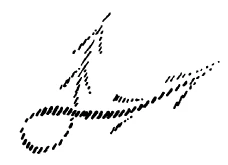
[ 38 ] Aber jetzt bedenken Sie: Dasjenige gerade, was uns durch diesen Spiegel erscheint, das ist ja dasjenige, was wir im Lebenslauf durchleben, das ist, worauf wir nach dem Tode zurückblicken, das ist, was aus einem flüssigen Ich zu einem festen Ich wird. Darauf blicken wir zurück. Das ist dasjenige, womit wir leben. Und Ahriman und Luzifer wirken mit uns, wirken mit uns so, daß Ahriman uns dahin bringt, ein Menschenhaupt zu tragen, Luzifer uns dahin bringt, nicht zum Dämon zu werden, sondern die Möglichkeit zu haben, zu einer nächsten Inkarnation zu kommen.
[ 38 ] But now consider this: precisely what appears to us through this mirror is what we experience in the course of our lives; it is what we look back on after death; it is what transforms a fluid “I” into a fixed “I.” That is what we look back on. That is what we live with. And Ahriman and Lucifer work with us—they work with us in such a way that Ahriman leads us to bear a human head, while Lucifer leads us not to become a demon, but to have the possibility of moving on to a next incarnation.
[ 39 ] Ich habe Ihre Geduld etwas in Anspruch genommen mit Dingen, die ja vielleicht etwas schwieriger verständlich sind, allein ich wollte zunächst wenigstens ein Gefühl dafür hervorrufen, wodurch eigentlich die Kluft entsteht zwischen Idealismus und Realismus. Sie entsteht dadurch, daß das Luziferische in uns den Idealismus erregt, der machtlos ist in der Natur, daß das Ahrimanische in uns die bloße Naturordnung hervorruft, welche uns geistlos erscheint. So stehen eigentlich die Idealisten, die abstrakten Idealisten unter luziferischem Einfluß, die Materialisten unter ahrimanischem Einfluß. Es ist schon notwendig, daß man auf diese Dinge sich einläßt, daß man nicht bloß schematisch die sogenannte Theosophie treibt, sondern auf diese genaueren Dinge sich einläßt. Denn es ist notwendig, daß der Mensch sich bewußt werde, er müsse etwas dazu tun, um mit dem Geiste für den Rest der Erdenentwickelung vereint bleiben zu können. Es ist eine unbequeme Wahrheit, man könnte sagen, sogar auch eine gehaßte Wahrheit, richtig eine gehaßte Wahrheit, denn sie widerspricht ja so vielem, was den Menschen sympathisch ist, aus Bequemlichkeit sympathisch ist. Nichts wird dem Menschen heute schwieriger, als wenn man ihm sagt: Wenn du dir in Zukunft deine Verbindung mit dem Geiste erhalten willst, so mußt du etwas dazu tun. — Es möchten ja die meisten Menschen, daß das Mysterium von Golgatha aus dem Grunde verflossen wäre, damit sie nur ja nichts zu tun haben zu ihrer Angelegenheit, damit sie durch Christus von ihren Sünden erlöst werden und ohne ihr Zutun in den Himmel kommen können. Und deshalb werden ja die meisten Theologen so wütend auf die Anthroposophie, weil das selbstverständlich von anthroposophischer Seite niemals zugegeben werden kann, daß der Mensch nichts zu tun habe, um seine Verbindung mit dem Geiste aufrechtzuerhalten, daß das ganz ohne sein Zutun auch in der Zukunft der Erdenentwickelung vor sich gehen könne. Die Verbindung zwischen dem Physischen und dem Geistigen, zwischen dem, was die Glieder des Menschen sind zwischen Geburt und Tod, und dem, was die Glieder des Menschen sind zwischen Tod und neuer Geburt, diese Verbindung wird in Frage gestellt durch die zukünftige Erdenentwickelung, und sie wird nur dann nicht in Unordnung kommen, wenn sich die Menschen mit dem Geistigen gegen die Zukunft hin wirklich befassen werden. Dafür gibt es heute schon geisteswissenschaftliche Beweise. Diese geisteswissenschaftlichen Beweise, sie sind höchst, höchst unbequeme Wahrheiten, aber sie werfen Licht auf Wichtiges, auf Bedeutungsvolles.
[ 39 ] I have taken up some of your patience with matters that may indeed be somewhat difficult to understand, but I wanted first of all to at least evoke a sense of what actually causes the divide between idealism and realism. It arises because the Luciferic principle within us stirs up idealism, which is powerless in nature, while the Ahrimanic principle within us evokes the mere order of nature, which appears spiritless to us. Thus, the idealists—the abstract idealists—are actually under Luciferic influence, while the materialists are under Ahrimanic influence. It is indeed necessary to engage with these matters, not merely to practice so-called theosophy in a schematic way, but to delve into these more precise aspects. For it is necessary for human beings to become aware that they must do something to remain united with the spirit for the remainder of Earth’s evolution. It is an uncomfortable truth—one might even say a hated truth, indeed a hated truth—for it contradicts so much of what appeals to people, what appeals to them out of convenience. Nothing is more difficult for people today than being told: If you want to maintain your connection with the Spirit in the future, you must do something to achieve it. — Most people would prefer that the Mystery of Golgotha had simply faded into the past, so that they would have absolutely nothing to do with it, so that they might be redeemed from their sins through Christ and enter heaven without any effort on their part. And that is precisely why most theologians are so furious with anthroposophy—because, of course, the anthroposophical side can never admit that human beings have nothing to do to maintain their connection with the Spirit, that this could continue to happen entirely without their own effort, even in the future of Earth’s evolution. The connection between the physical and the spiritual—between what constitutes the human body between birth and death, and what constitutes the human body between death and a new birth—this connection is called into question by the future development of the Earth, and it will remain intact only if people truly engage with the spiritual as they look toward the future. There is already evidence for this in spiritual science today. This evidence from spiritual science consists of truths that are extremely, extremely uncomfortable, but they shed light on what is important and significant.
[ 40 ] Der Zusammenhang zwischen dem Seelisch-Geistigen und dem Physisch-Ätherischen im Menschen der Gegenwatt ist, möchte ich sagen, schon sehr locker geworden, und der Mensch hat es notwendig, immer mehr und mehr bei sich Wache zu stehen, damit nicht in dem Zusammenhang zwischen seinem Physisch-Ätherischen und Seelisch-Geistigen etwas geschieht, was ihn gewissermaßen aussaugen könnte, was ihn seelisch-geistig aussaugen könnte. Denn wenn solche Vorurteile immer reger werden, man brauche im Leben nichts zu wissen über die Art, wie es nach dem Tode aussieht, oder wenn die Kluft immer größer wird zwischen sogenanntem Idealismus und rein natürlicher Ordnung, ist die Gefahr, der die Menschen entgegengehen, daß sie immer mehr und mehr ihre Seele verlieren könnten. Heute ist noch, ich möchte sagen, diesem Verlieren der Damm vorgesetzt, der dadurch gegeben ist, daß, wenn junge Leute sterben, der geistigen Welt eine gewisse Schwere verliehen wird und Luzifer die Rechnung verdorben wird, und wenn alte Leute sterben, so viel ausgepreßt wird an Geistigkeit in die physische Welt herein, daß Ahriman die Rechnung verdorben wird. Aber man darf nicht vergessen, daß dadurch, daß die Menschen sich lossagen vom geistigen Gebiet, die ahrimanischen und die luziferischen Mächte immer mächtiger und mächtiger werden, und daß nach und nach, indem die Devolution der Erde immer weiter und weiter geht, dieser Damm nicht mehr voll wirken könnte.
[ 40 ] The connection between the soul-spiritual and the physical-etheric in modern human beings, I would say, has already become very tenuous, and human beings need to remain ever more vigilant within themselves so that nothing happens in the connection between their physical-etheric and soul-spiritual aspects that could, so to speak, drain them—that could drain them soul-spiritually. For when such prejudices become increasingly prevalent—the idea that one need not know anything in life about what lies beyond death—or when the gulf between so-called idealism and the purely natural order grows ever wider, the danger facing people is that they could lose their souls more and more. Today, I would say, a barrier still stands against this loss, provided by the fact that when young people die, a certain weight is imparted to the spiritual world and Lucifer’s plans are thwarted; and when old people die, so much spirituality is poured into the physical world that Ahriman’s plans are thwarted. But we must not forget that as people turn away from the spiritual realm, the Ahrimanic and Luciferic forces become ever more powerful, and that little by little, as the devolution of the Earth progresses further and further, this barrier will no longer be able to function fully.
[ 41 ] Das ist dasjenige, was ich gern möchte, daß es sich als eine Art Bodensatz aus unseren Betrachtungen ergäbe wie ein Gefühl — und Gefühle sind immer das Wichtigste, was aus dem geisteswissenschaftlichen Leben hervorgehen kann — von der Notwendigkeit, sich vom gegenwärtigen Erdenzyklus ab mit dem Geistigen zu befassen. Von den verschiedensten Gesichtspunkten aus habe ich dieses betont, daß es von der Gegenwart aus notwendig ist, daß die Menschen sich mit dem Geistigen befassen. Und anders wird man sich nicht mit dem Geistigen befassen können in der Zukunft als dadurch, daß man sich Verständnis erwirbt und sich nicht sträubt, solche auch schwierigere Betrachtungen wirklich in sich aufzunehmen, wie wir sie in diesen Tagen und insbesondere auch heute gepflogen haben. Es muß unter die Menschen kommen das Verständnis von der Perspektivität der Zeit. Wenn dieses Verständnis von der Perspektivität der Zeit unter die Menschen kommt, dann werden sie nicht mehr sagen: Hier ist der Idealismus, der aber nur ein bloßer Traum ist, der keine Naturgewalt hat, und auf der andern Seite liegt die Naturordnung —, sondern die Menschen werden darauf kommen, anzuerkennen, daß, was als Ideale in uns lebt, Keim ist für die Zukunft, und daß, was Naturordnung ist, Frucht ist der Vergangenheit.
[ 41 ] This is what I would like to see emerge as a kind of residue from our reflections—like a feeling—and feelings are always the most important thing that can arise from spiritual scientific life—regarding the necessity of engaging with the spiritual starting with the present Earth cycle. From a wide variety of perspectives, I have emphasized that it is necessary, starting from the present, for people to engage with the spiritual. And in the future, people will not be able to engage with the spiritual in any other way than by acquiring understanding and not resisting truly taking such—even more difficult—considerations to heart, as we have been doing these days and especially today. People must come to understand the perspectivity of time. When this understanding of the perspectivity of time takes hold among people, they will no longer say: “Here is idealism, which is, however, merely a dream with no power in nature, and on the other side lies the natural order”—but rather, people will come to recognize that what lives within us as ideals is the seed of the future, and that what is the natural order is the fruit of the past.
[ 42 ] Dieser Satz ist eine goldene Regel: Jedes Ideal ist Keim für zukünftiges Naturgeschehen; jedes Naturgeschehen ist Frucht vergangenen Geistgeschehens. — Nur durch diese Regel findet man die Brücke zwischen Idealismus und Realismus. Aber dazu ist eines notwendig: Irgendein Ideal könnte nie und nimmermehr Keim für ein zukünftiges Naturgeschehen werden, wenn dieses zukünftige Naturgeschehen durch das gegenwärtige Naturgeschehen verhindert würde. Wir können uns irgendeine Hypothese vor die Augen führen. Nehmen wir die Möglichkeit an, die heute gilt, daß einmal durch das sogenannte Gesetz der Entropie die Erdenentwickelung in eine Art von allgemeiner Durchwärmung übergehe, und daß alle andern Naturkräfte aufhören, so würde innerhalb dieses Endzustandes natürlich alles Ideale erstorben sein. Dieser Endzustand, der folgt ganz gut, wenn man annimmt, daß sich nach reiner Kausalität die gegenwärtigen physikalischen Zustände eben weiter fortsetzen werden. Denkt man so, wie die gegenwärtige Physik denkt, daß nach dem Gesetze der Erhaltung der Kraft und des Stoffes einmal ein solcher Endzustand da sein wird, dann ist in diesem Endzustand kein Platz dafür, daß in ihm einmal ein Ideal als das zukünftige Naturgeschehen aufgehe, denn das zukünftige wird einfach die Folge des gegenwärtigen Naturgeschehens sein. Aber so ist es nicht, so stellt es sich nicht der gegenwärtigen Naturbetrachtung dar, sondern es stellt sich dieses anders dar. Dasjenige, was heute an Stoffen, an Kräften existiert, alles das wird in einer bestimmten Zukunft nicht da sein. Das Gesetz der Erhaltung des Stoffes und der Kraft gibt es nicht. Da, wo man den Stoff sucht, ist überhaupt nichts als ein Hereinwirken eines vergangenen Ahrimanischen, und dasjenige, was uns umgibt im Sinnenfälligen, wird in einer gewissen Zukunft nicht mehr da sein. Und dann, wenn von alledem, was jetzt physisch ist, nichts mehr da ist, wenn das ganz aufgelöst ist, dann ist die Zeit da, wo sich die gegenwärtigen Ideale als Naturgeschehen anreihen werden an das, was jetzt zugrunde gehen wird.
[ 42 ] This sentence is a golden rule: Every ideal is the seed of future natural events; every natural event is the fruit of past spiritual events. — Only through this rule can one find the bridge between idealism and realism. But one thing is necessary for this: No ideal could ever, under any circumstances, become the seed of a future natural event if that future natural event were prevented by the present natural event. We can consider any hypothesis. Let us assume the possibility—which is currently accepted—that, due to the so-called law of entropy, the Earth’s development will eventually transition into a state of general warming, and that all other natural forces will cease; in this final state, naturally, all ideals would have perished. This final state follows quite logically if one assumes that, according to pure causality, the present physical conditions will simply continue. If one thinks, as contemporary physics does, that according to the laws of conservation of energy and matter such a final state will eventually come to pass, then there is no room in this final state for an ideal to emerge as the future course of nature, for the future will simply be the consequence of the present course of nature. But that is not the case; this is not how it appears to current scientific observation of nature, but rather it presents itself differently. Whatever exists today in terms of matter and forces—all of that will not be present at a certain point in the future. There is no law of the conservation of matter and force. Where one seeks matter, there is nothing at all but the influence of a past Ahrimanic force, and what surrounds us in the sensory world will no longer be there at some point in the future. And then, when nothing remains of all that is now physical—when it has been completely dissolved—the time will come when the present ideals will, as natural phenomena, follow on from what is now about to perish.
[ 43 ] So ist es im großen Weltenall. Und für den einzelnen Menschen ist es so, daß er in der nächsten Welteninkarnation wieder inkarniert wird, wenn partiell alles dasjenige überwunden ist, in das er mit der gegenwärtigen Inkarnation hineingewachsen ist, wenn also für ihn eine Umgebung hergestellt werden kann, die anders ist als die gegenwärtige Umgebung, wenn aus der gegenwärtigen Umgebung all das heraus sein kann, was ihn jetzt hier auf der Erde hält. Wenn sich das alles so geändert hat, daß er Neues erleben kann, dann wird er wieder inkarniert. Die gegenwärtigen Ideale, die im Menschen sich bilden können, werden Natur sein, wenn alles dasjenige, was jetzt Natur ist, nicht mehr da sein wird, sondern Neues entstanden sein wird. Aber das Neue, das entsteht, ist eben nichts anderes als das Natur gewordene Geistige.
[ 43 ] That is how it is in the vast universe. And for the individual human being, it is the case that he will be reincarnated in the next world when he has partially overcome everything into which he has grown during his present incarnation—that is, when an environment can be created for him that is different from his present one, when everything in his present environment that is currently keeping him here on Earth can be removed. When all this has changed to such an extent that they can experience something new, then they will be reincarnated. The present ideals that can take shape within human beings will become nature when everything that is now nature is no longer present, but something new has come into being. But the new that arises is nothing other than the spiritual that has become nature.
[ 44 ] Hinter den Erscheinungen und hinter den Idealen müssen wir dasjenige suchen, was die Brücke über dem Abgrunde bildet. Aber zu dem muß man eben dahinterkommen. Man kommt heute nur dahinter, wenn man sich nicht scheut, die Begriffe so kräftig zu entwickeln, daß sie selbst in die Realität eindringen können. Daher hat die heutige Zeit wirklich die Notwendigkeit, sich gar sehr einzulassen auf alles dasjenige, was geistig erfahren werden kann. Nur — lassen Sie mich das noch anhänglich hinzufügen —, nur wird eben notwendig sein, daß gegenüber geistigen Betrachtungen immer größere und größere Unbefangenheit walten könnte. Vorgestern habe ich zum Schlusse, wie es manchen vielleicht erscheinen könnte, recht unnötig — aber trotzdem ich es nicht gerne tue, ist es nie unnötig — auf mancherlei hingewiesen, was dem gedeihlichen geisteswissenschaftlichen Wirken auch von seiten der Anthroposophischen Gesellschaft entgegensteht. Da ist vor allen Dingen auf diesem Boden immer wieder und wiederum zu fordern wirkliche Unbefangenheit. Immer wieder und wiederum erleben wir ja, daß das Auflösende, das eigentlich den Materialismus hervorgebracht hat, das die alte Geistigkeit zugrundegerichtet hat, im menschlichen Denken gerade auch in das Spirituelle, in das gewollte Spirituelle hereindringt. Ich habe ja darauf aufmerksam gemacht, wie materialistisch manche theosophische Anschauung ist. Man hat es natürlich nicht leicht, wenn man geisteswissenschaftliche Dinge auseinandersetzt, die bezeichnenden Worte zu finden, weil ja unsere Sprache heute nicht mehr für das Geistige geeignet ist, weil wir erst wieder suchen müssen eine solche Verbindung zwischen der Sprache und der Sache, welche für das Geistige geeignet ist. Aber das ist notwendig, daß nicht immer mit dem, was das Schädlichste ist, die geisteswissenschaftliche Bewegung verdorben wird. Man muß unbefangen charakterisieren dasjenige, was im Geiste vorgeht. Immer wiederum erlebe ich, daß ich gefragt werde: Da ist jemand, dort ist jemand, der hat geistige Erlebnisse. — Der Sinn der Fragen, die häufig so gestellt werden, ist der, daß eigentlich gefragt wird: Darf man nun mit blindem Glauben an die Wahrheit dessen sich hingeben, was der oder jener schaut? — Und wenn man diese Frage bejaht, ja, dann entsteht blinde Anhängerschaft; wenn man sie verneint, dann entsteht das, daß der Betreffende gleich verketzert wird und gesagt wird: Nun ja, das ist atavistisches Hellsehen, auf das gibt man nichts. — Ja, dieses Entweder-Oder muß doch auf diesem Gebiete ganz anders genommen werden. Wir müssen uns wirklich mit aller gesunden Vernunft auch den Aussagen über das Geistige gegenüberstellen. Wenn wir aber Dogmatiker werden wollen, können wir nicht Geisteswissenschafter werden. Wenn wir entweder vergöttern oder verketzern wollen, können wir nicht Geisteswissenschafter werden. Es werden unendlich wertvolle Beiträge zur Charakteristik der geistigen Welt auch von Seiten kommen, auf die man nicht unbedingt schwören will.
[ 44 ] Behind the phenomena and behind the ideals, we must seek that which forms the bridge over the abyss. But one must, of course, get to the bottom of this. Today, one can only get to the bottom of it if one does not shy away from developing concepts so powerfully that they themselves can penetrate reality. That is why our time truly needs to engage deeply with everything that can be experienced spiritually. Only—and let me add this as an afterthought—only then will it be necessary for an ever-greater and greater openness to prevail in the face of spiritual contemplation. The day before yesterday, I concluded—as it might seem to some—by pointing out, quite unnecessarily, as it were—though even though I do not like to do so, it is never unnecessary—various factors that stand in the way of fruitful spiritual scientific work, including on the part of the Anthroposophical Society. Above all, in this context, genuine impartiality must be demanded again and again. Time and again, we experience how the destructive force—which actually gave rise to materialism and ruined the old spirituality—penetrates human thinking, particularly into the spiritual realm, into what is consciously pursued as spiritual. I have, after all, drawn attention to how materialistic some theosophical views are. Of course, when discussing spiritual-scientific matters, it is not easy to find the right words, because our language today is no longer suited to the spiritual; we must first seek once again to establish a connection between language and the subject matter that is appropriate for the spiritual. But this is necessary so that the spiritual-scientific movement is not constantly corrupted by what is most harmful. One must describe impartially what is taking place in the spirit. Time and again I find myself being asked: “There is someone here, there is someone there, who has spiritual experiences.” — The meaning behind questions frequently posed in this way is that what is actually being asked is: “May one now, with blind faith in the truth of it, devote oneself to what this or that person perceives?” — And if one answers this question in the affirmative, then blind following arises; if one answers in the negative, then the person in question is immediately condemned as a heretic, and it is said: “Well, that’s atavistic clairvoyance; it’s not worth anything.” — Yes, this either/or must be approached quite differently in this field. We must truly approach statements about the spiritual realm with all sound reason. But if we want to become dogmatists, we cannot become spiritual scientists. If we want to either idolize or condemn, we cannot become spiritual scientists. Infinitely valuable contributions to the characterization of the spiritual world will also come from sources one does not necessarily wish to swear by.
[ 45 ] Auch das andere erlebt man, daß eine Zeitlang auf irgendeine seherische Persönlichkeit geschworen wird. Dann kann man nachweisen, daß diese seherische Persönlichkeit irgendwann — nun, vielleicht sogar — einmal ein wenig retuschiert hat, oder stark retuschiert hat; dann ist die Persönlichkeit unten durch. Vorher haben dieselben Leute auf sie geschworen, bei denen sie nachher unten durch ist.
[ 45 ] One also sees the other scenario: for a while, people swear by some clairvoyant figure. Then it can be proven that at some point—well, perhaps even—this clairvoyant figure embellished the truth a little, or embellished it greatly; then that figure is finished. Before that, the very same people who later write them off had sworn by them.
[ 46 ] Ja, in dieser Weise kommt man nicht vorwärts innerhalb der Menschheit. Mit dem Entweder-Oder der Vergöttlichung oder Verketzerung kommt man nicht vorwärts innerhalb der Menschheit, sondern nur dadurch, daß man sich mit seinem gesunden Menschenverstand den Dingen gegenüberstellt. Es kann zum Beispiel auch der Fall eintreten, daß durch jemanden, von dem man sogar weiß: Nun, der verschmäht es nicht, ab und zu recht stark zu schwindeln — einmal etwas ganz Wahres, Wichtiges, Wesentliches aus der geistigen Welt herauskommt.
[ 46 ] Yes, that is not the way to make progress within humanity. The either/or choice between deification and heresy does not lead to progress within humanity; rather, progress comes only by facing things with common sense. For example, it may also happen that something entirely true, important, and essential emerges from the spiritual world through someone about whom one even knows: “Well, this person doesn’t shy away from telling quite a few tall tales now and then.”
[ 47 ] Man würde nicht zu dem Entweder-Oder kommen, das ich hier meine, wenn man nicht Dogmatik einführen wollte, sondern wenn man sich mit dem gesunden Menschenverstand gerade innerhalb dieser anthroposophischen Bewegung hineinstellen wollte. Das ist das eine. Das andere ist dieses, daß es außerordentlich schwierig ist, durch die Art und Weise, wie die Dinge oftmals innerhalb unseres Kreises gehandhabt werden, die Anthroposophische Gesellschaft in die Kulturbewegung der Gegenwart hineinzustellen. Dazu gehört Unterscheidungsvermögen bei denjenigen Menschen, die schon drinnen sind in dieser Gesellschaft. Es erwächst einem eine gewisse Verpflichtung für diese Unterscheidungskraft, wenn man schon drinnen ist. Denn wir werden ganz fehlgehen mit dieser Anthroposophischen Gesellschaft, wenn wir nicht die Anknüpfung an die allgemeine Geisteskultur der Gegenwart suchen, wenn wir immer wieder und wiederum in den Fehler verfallen, Sektiererisches zu treiben. Das wird der Tod sein unserer Bewegung, wenn wir sektiererisch werden. Bedenken Sie doch nut, daß solche Dinge, wie wir sie in diesen Tagen jetzt erörtert haben, sich gar nicht besonders sonderbar ausnehmen werden für denjenigen, der gerade in Wissenschaftlichem und im Kulturleben der Gegenwart drinnensteht, wenn er sich nur die nötige Vorurteilslosigkeit erwerben wird. Aber um auf diesem Wege etwas zu erreichen, ist es notwendig, daß der Wille besteht zur Unterscheidung. Bei uns kommt es leicht vor, daß nur um irgend etwas Schematisches gefragt wird, wenn es sich darum handelt: Soll irgend jemand bei anthroposophischen Vorträgen zuhören, oder soll er einenZyklus bekommen ?So wird schematisch gefragt, ohne daß man Rücksicht nimmt auf den Bildungsgrad, auf die ganze Weltstellung des betreffenden Menschen. Aber das Schematische ist das absolut Schädliche bei uns. Das Schematische bringt es dahin, daß solch ein Mensch, wie jetzt wiederum der in Holland, um den sich eine ganze Summe von Unfug kristallisiert, in die Anthroposophische Gesellschaft hineinschwimmen und dort Protektoren finden kann, währenddem Leute, die urteilsfähig sind, gerade durch das Gebaren oftmals abgestoßen werden.
[ 47 ] One would not arrive at the either/or situation I am referring to here if one were not trying to introduce dogmatism, but rather if one were to approach matters with common sense, particularly within this anthroposophical movement. That is one point. The other is this: it is extremely difficult, given the way things are often handled within our circle, to situate the Anthroposophical Society within the cultural movement of the present. This requires discernment on the part of those who are already members of this Society. Once you are already a member, you develop a certain obligation to exercise this discernment. For we will go completely astray with this Anthroposophical Society if we do not seek to connect with the general spiritual culture of the present, if we repeatedly fall into the error of engaging in sectarianism. That will be the death of our movement if we become sectarian. Just consider that matters such as those we have discussed these past few days will not seem particularly strange to anyone who is deeply immersed in contemporary scientific and cultural life, provided they cultivate the necessary open-mindedness. But to achieve anything in this way, there must be a will to discern. It often happens among us that people ask only for something schematic when the question is: Should someone attend anthroposophical lectures, or should they be given a lecture series? Thus, the question is posed schematically, without taking into account the person’s level of education or their overall worldview. But this schematism is what is absolutely harmful among us. This schematic approach leads to a situation where a person like the one in Holland—around whom a whole host of nonsense has crystallized—can drift into the Anthroposophical Society and find patrons there, while people who are capable of sound judgment are often repelled precisely by such behavior.
[ 48 ] Um auf ein Konkretes hinzuweisen: Sehen Sie, vor einiger Zeit trat Herr von Bernus auf innerhalb der Anthroposophischen Gesellschaft, mit dem deutlichen Bestreben — das man ja ein bißchen besser, ein bißchen schlechter finden kann, dafür mag der gesunde Menschenverstand sprechen —, eine Brücke zu ziehen zwischen dem allgemeinen Kulturleben, dem literarischen und wissenschaftlichen Leben der Gegenwart, und unserem anthroposophischen Leben. Nun, Herr von Bernus hat in seiner Art zum Beispiel eine Anzahl von Dingen, die zum Teil in meinen Büchern stehen, zum Teil in Zyklen, in seiner Art dichterisch umgegossen und in die Welt gebracht. Er hat mir es selbst gezeigt: einen Stoß von Briefen, von schimpfenden Briefen hat er dafür erhalten, daß da einmal ein wirklich zeitgemäßer Versuch gemacht worden ist! Man würde sich gar nicht wundern, wenn jemand, der vielleicht viel aufs Spiel setzt, abgestoßen werden könnte durch ein solches Gebaren, wie es dazumal aus der Anthroposophischen Gesellschaft ihm gegenüber verübt worden ist. Dennoch, die Zeitschrift, die er gegründet hat, sie wird ungeheuer dienlich sein können der anthroposophischen Bewegung. Er hatte es ja auch zuwege gebracht, daß die anthroposophische Bewegung in München vertreten werden konnte in seinem Kunsthaus. Aber man konnte überall gewisse Widerstände bemerken gegen etwas, was so berechtigt wie möglich war! Und wenn man gerade Bernus’ Erlebnisse überschaut, so hat man an ihnen so recht ein Bild von dem, wie die anthroposophische Bewegung, die Anthroposophische Gesellschaft lernen sollte, wirklich eine Gesellschaft zu sein.
[ 48 ] To give a specific example: You see, some time ago, Mr. von Bernus emerged within the Anthroposophical Society with the clear intention—which one might find a little better or a little worse, depending on one’s common sense—to build a bridge between general cultural life, the literary and scientific life of the present, and our anthroposophical life. Well, in his own way, Mr. von Bernus has, for example, poetically reworked a number of things—some of which are found in my books, others in lecture cycles—and brought them out into the world. He showed me the evidence himself: he received a flood of letters—abusive letters—simply for having made a truly contemporary attempt! It would come as no surprise if someone who is perhaps risking a great deal were to be put off by such behavior as was directed toward him at the time by the Anthroposophical Society. Nevertheless, the journal he founded will be of immense service to the anthroposophical movement. After all, he had also managed to ensure that the anthroposophical movement could be represented in Munich at his Kunsthaus. But one could sense a certain resistance everywhere to something that was as justified as could be! And when one looks back on Bernus’s experiences in particular, they truly paint a picture of how the anthroposophical movement—and the Anthroposophical Society—should learn to be a true society.
[ 49 ] Insofern der Dornacher Bau zustandegekommen ist, is? sie eine Gesellschaft. Aber vieles andere namentlich wird unterlassen, wodurch deutlich gezeigt wird, daß die Anthroposophische Gesellschaft sich gar nicht als Gesellschaft auffaßt, sondern als eine Summe von einzelnen sektiererischen kleinen Kreisen. Aber über dieses Stadium des Sektiererischen müssen wir hinauskommen. Und wir kommen nicht hinaus, wenn nicht über die Sache irgendwie nachgedacht wird.
[ 49 ] Insofar as the Dornach building has been completed, is it a society? But many other things—namely—are being neglected, which clearly shows that the Anthroposophical Society does not view itself as a society at all, but rather as a collection of individual, sectarian small circles. But we must move beyond this stage of sectarianism. And we will not move beyond it unless we reflect on the matter in some way.
[ 50 ] Es ist ja so schwierig, und nicht wahr, man sagt solche Dinge sehr ungern, aber schließlich, manches wird mir ja dadurch notwendig zu sagen, da ich persönlich so stark verquickt bin mit dieser anthroposophischen Bewegung. Wenn nun die Anthroposophische Gesellschaft sich nach und nach immer mehr und mehr dazu entwickeln sollte, daß sie eigentlich eine Gesellschaft ist mit der ausgesprochenen Tendenz, mich totzuschweigen — wozu sie sich eigentlich entwickelt, und was sie immer als Tendenz gehabt hat —, so ist es nicht eine persönliche Eitelkeit, wenn ich dieses betone. Es ist mir sehr unangenehm, daß ich es betonen muß, aber es ist in der Anthroposophischen Gesellschaft vielfach gerade die Tendenz vorhanden, mich totzuschweigen, und da ist das Persönliche mit dem Sachlichen eben verknüpft. Dadurch — weil alles dasjenige nicht getan wird, was sonst eine Gesellschaft tut — kommt es, daß nur das als Giftblasen an die Oberfläche kommt, was die abgefallenen Mitglieder an Geschimpfe in die Welt setzen.
[ 50 ] It is so difficult, isn’t it? One is very reluctant to say such things, but ultimately, there are some things I simply must say because I am so deeply involved in this anthroposophical movement. If the Anthroposophical Society were to gradually develop more and more into an organization with a pronounced tendency to silence me—which is, in fact, the direction it is taking and a tendency it has always had—then it is not out of personal vanity that I emphasize this. It is very unpleasant for me to have to emphasize this, but within the Anthroposophical Society there is, in many cases, precisely this tendency to silence me, and here the personal is intertwined with the objective. As a result—because the Society fails to do all that a society normally does—the only things that rise to the surface like poisonous bubbles are the tirades that the former members spew into the world.
[ 51 ] Ja, das sind Dinge, auf die ich schon manchmal eben hinweisen muß und die nicht unbesprochen bleiben dürfen. Ich habe siean den Orten, wo ich in der letzten Zeit sprechen konnte, zur Besprechung gebracht, weil ich ja wirklich glaube, daß in dieser katastrophalen Zeit vieles darauf ankäme, daß Anthroposophie in der richtigen Weise in der Welt vertreten wird. Aber es ist so schwer, es dahin zu bringen, daß tiefer nachgedacht würde: Wie soll man es eigentlich auf dem anthroposophischen Felde tun, um diese Anthroposophische Gesellschaft zu einer wirklichen Gesellschaft zu machen? — Die Ansätze sind wirklich gemacht von einzelnen Menschen, aber es bleibt in der Regel in den Ansätzen alles stecken. Nun, ich denke, daß vielleicht, indem ich noch ein zweites Mal auf die Sache aufmerksam gemacht habe, ein bißchen darüber nachgedacht werden wird. Ich sage es nicht aus persönlichen Gründen, sondern aus gewissen Notwendigkeiten der Zeit heraus, wie Sie ja auch aus dem, was ich gerade in diesen Tagen vorgebracht habe, mancherlei Keime entnehmen werden, die Ihnen zum Verständnisse unserer katastrophalen Zeit einige Dienste werden leisten können.
[ 51 ] Yes, these are things I sometimes have to point out and that must not go unaddressed. I have brought them up for discussion in the places where I have been able to speak recently, because I truly believe that in these catastrophic times, much depends on anthroposophy being represented in the world in the right way. But it is so difficult to get people to think more deeply about this: How should we actually go about it in the field of anthroposophy to make this Anthroposophical Society a true society? — Individual people have indeed made some initial efforts, but as a rule, everything gets stuck at the initial stage. Well, I think that perhaps, by drawing attention to the matter a second time, people will give it a little thought. I am not saying this for personal reasons, but out of certain necessities of the times; as you will also be able to glean from what I have just presented in recent days, there are various seeds that may be of some help to you in understanding our catastrophic times.
[Tafelanschrift] 2. September 1918
[Plaque inscription] September 2, 1918
Jedes Ideal ist Keim für künftiges Naturgeschehen.
Jedes Naturgeschehen ist Frucht vergangenen Geistgeschehens.
Every ideal is the seed of future natural events.
Every natural event is the fruit of past spiritual events.