

The Polarity of Duration and Development in Human Life
GA 184
8 September 1918, Dornach
Translated by Steiner Online Library
Third Lecture
[ 1 ] First, I will have to remind you of something I explained yesterday, to which we can then add our further considerations. Yesterday I essentially explained that one cannot gain any insight into the relationship of the ideal or spiritual to the material in the world—to the purely causal order of nature—unless one takes into account what the true nature of human sleep actually is.
[ 2 ] We started, after all, with Augustine’s idea that one could experience true certainty about the world through inner experience. We can no longer adopt this view today, I said, for the simple reason that we must now recognize that every time a person falls asleep, this idea is refuted. For we could never in any way hold fast to the idea that what a person experiences within themselves persists post mortem, after death—that is, that this inner experience is truly eternal—if we were to view the period from falling asleep to waking up in the same way that ordinary modern consciousness views it. Ordinary modern consciousness observes how, during sleep, what is experienced within a person gradually fades away. But as we said, as soon as a person has completed even the first stage of looking into the spiritual world, they realize that from falling asleep to waking up, what we call the human ego and its astral body—that is, the actual spirit-soul being of the human being—is connected from within to the beings of the Angeloi, the Archangels, and the Archai—just as a person is otherwise connected here during wakefulness to the animal, plant, and mineral kingdoms. It is only because the human being’s consciousness is dampened during sleep by the forces opposed to the world that he cannot perceive that during sleep he is connected to the hierarchy of the Angeloi, Archangeloi, and Archai; that they permeate his “I” and his astral body with their own being; and that they hold and sustain his astral body and his “I.” And we have explained how three things arise from this connection between human beings and the spiritual beings: First, that even in ordinary consciousness we have, more or less clearly, a sense of personality. We know ourselves as an “I.” We would never know ourselves as an “I” based solely on what is available to us while awake. The feeling of free personality that persists during the day, while we are awake, is a lingering effect of what we experience during sleep. This stems from the fact that, from the moment we fall asleep until we wake up, the angelic being from the spiritual world—to which we belong—is connected to us. But the archangelic being—or, more precisely, a series of archangelic beings—is also connected to our spirit-soul being. And this gives rise, as an aftereffect in wakefulness, to our awareness that we belong to the whole of humanity, that we recognize ourselves as human beings on Earth at all.
[ 3 ] Every human being actually possesses an awareness of their own free personality, even if it is not entirely clear. Lurking more faintly in the background is the awareness that one is a human being in general. Indeed, certain philosophers, such as Feuerbach or even Auguste Comte himself, have argued that it is already a significant discovery for a person to come to feel that they are a human being in general, a member of the whole of humanity. And yesterday we heard Auguste Comte speak of the “Great Being”; by this he means nothing other than the human being. But Comte speaks from the standpoint of ordinary materialistic science; he does not know what spiritual foundation underlies this awareness—lying in the background of our soul life—that one is a human being. One would have no inkling whatsoever that one is a human being if that which is separated from our physical and etheric bodies during sleep were not imbued with the Archangelic Being.
[ 4 ] And once again, we are imbued with the so-called Zeitgeist, with the essence from the hierarchy of the Archai. What stems from this, however, remains a rather dark, shadowy consciousness. Indeed, humanity today lacks it entirely unless it feels placed within history, within historical life. The Eastern worldview has not at all penetrated to this consciousness of living as an earthly human being. It has been the particular task of Western culture to feel itself as a historical being, as a being—let us say, for our own sake—that belongs to the 19th and 20th centuries. But apart from the year and a few other external historical facts—we will hear shortly just how little significance these actually have for real life—the current materialistic human consciousness knows little more than that. For it is only spiritual science that leads us to recognize how the human soul’s constitution changes from millennium to millennium, how human beings become different, and how we now look back on ancient times and know that the people of the third post-Atlantean epoch—the Egyptian-Chaldean peoples—had a completely different soul and human constitution than we do today. This feeling of being immersed in the entire development of humanity—we experience this as an echo of our connection with the Ark Being, with the Ark, during the time from falling asleep to waking up. So that from falling asleep to waking up, we should know that we are connected to this third spiritual hierarchy. Now, how does our life from falling asleep to waking up—that is, every day—differ from the life between death and a new birth? Every evening when we fall asleep, we lay aside—I would say provisionally, subject to revocation—our physical and etheric bodies. These remain with us. We are connected to the beings of the third hierarchy mentioned above; upon waking, we return once more to our physical and etheric bodies. It is different when we can no longer return, when we have died. Then our physical and etheric bodies are seemingly handed over to the forces of earthly becoming. We know that this is only apparent—we spoke of this recently—but as far as our experience is concerned, our physical and etheric bodies are handed over to the earthly and heavenly realms. But during this time between death and new birth, we come into contact not only—as if in sleep—with these beings of the third hierarchy, but also into equally intimate contact with the beings of the second hierarchy: with the Exusiai, that is, the spirits of form; with the Dynameis, the spirits of movement; with the spirits of wisdom, the Kyriotetes; and also with the beings of the first hierarchy: the Seraphim, Cherubim, and Thrones. Just as we here direct our human being toward the world, and within the sphere of the world everything contained in the realms of nature appears to us, so do we—now not externally but internally—become aware of the interplay of the higher hierarchies between death and a new birth. Essentially, from a certain point of view, this is the difference between human sleep and death: that we are actually connected directly—and indirectly as well—with the beings of the third hierarchy only during sleep, but after death we are connected with the beings of all three hierarchies, up to the highest spiritual beings.
[ 5 ] Well, if you keep this in mind, you will be able to see more clearly how human beings position themselves within the entire universe, how human beings, as a microcosm, are connected to the entire universe—to the macrocosm. Let us visualize what I have said in schematic terms. Let us say, then: After death, our spiritual being is inwardly connected to the beings of the third hierarchy, to the beings of the second hierarchy, and to the beings of the first hierarchy, just as it is outwardly connected here to the animal kingdom, the plant kingdom, and the mineral kingdom, from which it builds itself up. But there is another connection. When you come to know all that the beings of the third hierarchy initially bring about—they have other tasks as well, but we always speak of things only in part, don’t we? for the beings of the third hierarchy are individual beings who act both separately and collectively through their effects, bringing something forth, creating something—if you consider what these beings of the third hierarchy do, it is, first and foremost, everything that takes place in the historical life of humanity (see drawing on page 57). You can also grasp the idea this way: No one knows anything about the reality of humanity’s historical life who does not have some inkling that what is actually history is, in reality, not made by human beings, but by the beings of the third hierarchy. The beings of the third hierarchy—Angels, Archangels, Archai—actually shape history, and human beings participate in the work of this third hierarchy by deriving from it, in the manner described, their consciousness as personalities, their consciousness as human beings, as historical beings on Earth. So the fact that human beings are at the very heart of the world is because these beings shape historical life, and what human beings are inwardly—and through which they are inwardly connected to historical life—they in turn derive from these beings. The external historical life recorded by conventional history—which is, in essence, nothing more than a “fable convenue”—is merely a reflection of the inner historical life that is created in its development by the beings of the third hierarchy.
[ 6 ] Now we may ask: What, then, is the task of the beings of the second and first hierarchies—that is, the Exusiai, Dynameis, Kyriotetes, the Spirits of Form, the Spirits of Movement, and the Spirits of Wisdom? Indeed, they have a much more comprehensive task. Let us first set aside their relationship to human beings. You can best bring this task to mind by directing your attention to your etheric body. Isn’t it true that when you set out from your “I” and first take the path inward, you arrive at your astral body? Through your astral body, you are connected to the historical life of humanity. In turn, the beings of the third hierarchy—who shape the historical life of humanity—act upon this historical life. But if you go further, if you descend all the way to the etheric body, you will find that this etheric body is a very complex entity. In today’s consciousness, human beings know very little of the full complexity that underlies the human etheric body. But you do gain a certain understanding of all that must be at work in this etheric body when you study Outline of Esoteric Science; there, in the succession of the Saturn, Sun, and Moon eras—that is, the successive incarnations of our Earth—you are shown how this etheric body develops out of the entire cosmos, and how the beings of the higher hierarchies contribute to this process. If we express this in a vivid formula, we can say from a certain point of view: Everything in the evolution of the worlds—that is, everything that is now more comprehensive, with which our etheric body is just as closely connected as our astral body is to the historical life of humanity—is created and formed by the beings of the second hierarchy: the Exusiai, Dynameis, and Kyriotetes. So, to illustrate this, I will say: The beings of the second hierarchy create everything that acts within the human etheric body.
[ 7 ] But this, in turn, reveals something else. When you wake up in the morning and immerse yourself in your etheric body, you are actually immersing yourself in the creation of the beings of the second hierarchy. And you are also immersing yourself in your physical body. Of this physical body—which the Mystery Being therefore calls the temple of the human being—what external anatomy and physiology reveal is truly only the very, very outermost shell. One can only begin to grasp this immense, wondrous structure of the human physical body when one knows that it is the creation of the interplay of the Beings of the First Hierarchy. When you sink into your physical body upon waking in the morning, you are actually sinking into the work of the highest hierarchies. So consider how things are arranged in life: here, between birth and death, when we are awake, we first sink into our astral body, in which the historical life of humanity is at work. But we also immerse ourselves in our etheric body—the creation of the second hierarchy—in which much of the cosmos is at work: the etheric life of the cosmos. And we immerse ourselves in our physical body, which is the creation of the beings of the first hierarchy. And when we live between death and a new birth, we do not live with the creation, but with the creators themselves.
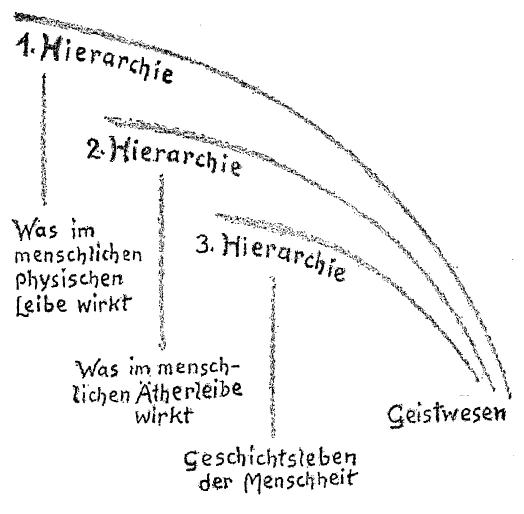
[ 8 ] Now you have one of the significant differences between life from birth to death and life from death to a new birth. Here you submerge yourself by immersing yourself in your physicality, in everything that is a creature of the higher hierarchies. When you die, you plunge into the Hierarchies themselves. You pass from the created to the Creators. This is how things are connected.
[ 9 ] And now, as we take stock of what we have just discussed, let us ask: What, exactly, is our Earth? What geology and other sciences usually investigate about our Earth is, after all, only its outer shell. What is our Earth, really? As you know, we share our physical body with the entire mineral kingdom. Because we share our physical body with the entire mineral kingdom, we stand within a part of the Earth during our waking state. We share our etheric body with the entire plant kingdom, standing within a second part of our Earth. We share our astral body with the animal kingdom. The “I” we have for ourselves. Thus we stand within the three kingdoms of the Earth, and our entire Earth actually consists of these three kingdoms. This is, so to speak, the ground on which we stand—not physically, but with our human being. But this cannot be seen; it remains supersensible. As we stand on this ground, its lowest member is the mineral kingdom.
[ 10 ] Now, as you will recall from Occult Science, the mineral kingdom did not exist during the earlier incarnations of our Earth; the Moon did not yet have a mineral kingdom, nor did the ancient Sun, nor did Saturn. You need only look this up in Occult Science. It was only on Earth, during the fourth incarnation of our Earth, that the mineral kingdom first came into being. I ask you to take careful note of this. It is a difficult concept, but it is an extraordinarily important one. In a sense, three stages of formation had to precede the emergence of the mineral Earth. We call these three stages the three elemental kingdoms; the mineral kingdom is the fourth. We could also put it this way with regard to the earlier incarnations: during the Saturn incarnation of our Earth—the first elemental kingdom; during the Sun incarnation of our Earth—the second elemental kingdom—the beings that were part of the mineral kingdom at that time had previously belonged to the elemental kingdom—; during the Lunar period—not the present-day Lunar period, but the ancient Lunar period—the third elemental kingdom. As the process progresses toward the Earth, the mineral kingdom emerges as the fourth kingdom. This is what the human being carries within themselves.
[ 11 ] To be in the mineral kingdom means to be in the fourth form of existence. We carry this mineral kingdom within us; it is only through this that we are truly visible beings. However, this mineral kingdom is also the only one within us that is complete. Only when the Earth has reached its end, when it has entered into a new incarnation, will humanity be just as complete within the plant kingdom as it is today within the mineral kingdom. Then humanity would be in the fifth stage of development. Thus, the Earth will reach a final state and will emerge anew: the Jupiter era; humanity will then have the same relationship to the plant kingdom as it has today to the mineral kingdom. It will be in the fifth stage of development. To be in the plant kingdom means to be in the fifth stage of development.
[ 12 ] A new incarnation of our Earth is to come; we call it the Venus incarnation, the Venus era. Humanity will then stand within the animal kingdom—not as animals, but standing within the animal kingdom; as you know, this is different from being an animal. But to stand within the animal kingdom means to be in the sixth stage of development. And then comes the conclusion—I would say, the seventh stage of the entire process of becoming. We call it the volcanic incarnation of the Earth. Humanity will then have reached the highest stage of its evolution; only then will it have become fully human. To stand in the human kingdom means to be in the seventh stage of evolution, to stand in the seventh stage of evolution. And the life of humanity comes to a close after seven stages of evolution.
[ 13 ] Let us look at human beings today. As we see, they belong to the mineral kingdom; they do not yet belong to the plant kingdom. When human beings come to belong to the plant kingdom, their entire life will be different. They will no longer feel like a personality; rather, just as they feel like a personality today, they will feel like a human being—they will feel like a member of the whole of humanity. For example, once they have entered the plant kingdom, they will find it unbearable to enjoy a certain degree of happiness while someone else nearby is suffering. Today, human beings feel separated from others by a dividing wall. It must be this way; otherwise, human beings would never be able to develop their individuality. But in the future Jupiter realm, where human beings will be in the fifth stage of evolution, it will be different; there, it will be a completely unbearable thought that one person could be happy while another right next to them is unhappy, because human beings do not feel themselves to be a single organism, as one says in the abstract. Now, of course, they do not feel themselves to be part of an organism: but that is a falsehood, an illusion, a Maya. Yet the time will come when human beings will be in the plant kingdom, when they will find individual happiness intolerable if there is unhappiness beside them.
[ 14 ] This idea underlies the spiritualists I spoke to you about yesterday. I told you: In the future, the English spiritualists will have to wage a great struggle against the entire English popular culture. The pinnacle of this popular culture is utilitarianism; and what this utilitarianism brought to the fore in Bentham is essentially the principle known as the maximization of happiness. This utilitarianism will increasingly permeate people’s thinking. Therefore, this way of thinking will only be able to achieve spiritualization through the opposition of the spiritually minded. This is the prospect for the future: the spiritually minded will have to overcome popular culture there—overcome it to the point of annihilation. That is why I was able to point out to you that Bentham, who arrived at the principle—derived from popular culture—that the good on earth consists in the happiness of the greatest number of people, finds his fiercest opponents among the spiritually minded in his own country, who say to him: “That is a purely diabolical definition, for one can only arrive at this definition if one considers nothing but the mere present. If one thinks even a little about the future of development, one knows that the idea is utterly intolerable: the happiness of the greatest number, because the opposite would be the happiness of the smallest number, and that would have to be evil.” But evil and happiness have nothing to do with one another; for in the future, because human beings will feel themselves to be part of the plant kingdom and members of the whole of humanity, this contradiction will be an impossibility. Just as today an important organic part of the human body cannot simply be cut out without the entire human organism perishing, so in the future, when the Earth is part of the plant kingdom, no particular group of people will be able to suffer without the whole suffering as well. This is a specific stage of development that is yet to come. And because Bentham offers a definition of happiness that has no future at all—that exists only in the present—it must be opposed precisely by those who strive for spirituality.
[ 15 ] Yes, why should that be a contradiction when it is said: Good, as defined by Bentham, is the happiness of the greatest number; evil is defined as the happiness of the least number? It is not an abstract contradiction for the intellect, but the spiritualist does not think abstractly; the spiritualist thinks concretely. He does not think: “What is the opposite of the other?”—but rather he thinks of reality as it unfolds, and this usually does not correspond to people’s mere thoughts.
[ 16 ] And to an even greater degree, the individual will participate in the Whole when he is in the sixth stage of development. And this is especially true when he is a fully realized human being, a completely spiritualized human being, in the seventh stage of development.
[ 17 ] Yes, but we have seen from this that, just as we now stand on the solid ground of the Earth, we as human beings—insofar as we are creatures—actually only reach as far as the fourth kingdom. We have the mineral kingdom—that is complete. The other kingdoms, as they exist today, will partly perish, and humankind will develop them in a different way: the plant kingdom, as I have described it. We will not describe the animal and human kingdoms today, but we will do so another time.
[ 18 ] Thus, when human beings today view themselves as creatures standing among other creatures, they are in the fourth stage of development. But he extends into the other stages of development, for as we have seen, even in sleep, human beings are under the influence of the third hierarchy. This hierarchy is further along than they are; it already stands in the fifth stage of development today, and the other beings are even further along. Thus, human beings extend into the higher stages of development. I ask you to have the patience to truly think these subtle ideas through; for you must now distinguish between conceiving of yourself as a creature and conceiving of yourself as an independent spiritual being—which you are, for example, during sleep or between death and rebirth. To the extent that you conceive of yourself here in your physical body, your etheric body, your astral body, and your “I,” to that extent you conceive of yourself as a creature on Earth and are in the fourth stage of evolution; but you extend into the fifth, sixth, and seventh stages. Since you do not merely live within your body but also outside of it—in sleep or in death—you extend into the other hierarchies, and these other hierarchies are more advanced. We can therefore say: If we regard the Earth, with everything on and within it, as a created being, then as a created being it has advanced to the fourth stage, and we, too, have advanced with it to the fourth stage. Yet we extend into the other spheres—into the other elements of formation—precisely because we feel ourselves to be independent personalities, because we feel ourselves to be human beings, because we feel ourselves to be part of Earth’s evolution, and because we know that our etheric body is a creation of the second hierarchy and our physical body is a creation of the first hierarchy.
[ 19 ] But it does not end with the seventh form of education. Evolution continues, and as we move into the higher forms of education, we also move into an eighth form of education, the famous eighth sphere. We can safely say: In a certain sense, as we reach up toward the highly developed stages of higher beings—by standing within the divine realm or the spirit realm, as you will—we reach into the eighth form of formation. But we reach into this eighth form of formation with the finest components of our spiritual being. This reaching into the eighth form of formation is a great mystery, but we can still form an idea of what I would call a very slight, not very intense reaching into the eighth form of formation if we consider the following:
[ 20 ] We know that the Mystery of Golgotha stands at the center of the Earth. If we look back at this Mystery of Golgotha, as it unfolded from the year 1 to 33 of our era—the 747th year since the founding of Rome—we see that it falls within the first third of the fourth post-Atlantean epoch. We speak of that phase of human cultural development into which the Mystery of Golgotha was embedded as the fourth post-Atlantean cultural epoch. We know that the third post-Atlantean cultural stage preceded the Greco-Latin cultural epoch. We are now in the fifth, for the fourth—into which the Mystery of Golgotha fell—ended in the 15th century A.D. Thus, we are in the first third of the fifth post-Atlantean cultural period. Now, human beings develop through the cultural periods, but when we describe these cultural periods, we are actually describing something that human beings do not fully experience. You were all certainly embodied in the ancient Egyptian-Chaldean period, which is the third post-Atlantean era, then again in the Greco-Latin cultural period, and in the present one; but you only ever experience—if all goes well, right, even if you live to be eighty—just eighty years of each successive era, and in between lies the much longer period that elapses between death and a new birth. So of what we describe—as we describe the successive periods of the Earth’s development—human beings actually experience only a part.
[ 21 ] Of course, you might say: Well, yes, here in the physical body, a person experiences only a part of it; but he truly does not live in the physical body in vain: he experiences the world from the perspective of the physical body because he could not experience what he experiences through the physical body between death and a new birth. — Whether what a person experiences between death and a new birth in the purely spiritual realm is to be regarded as higher or less significant is not something we wish to discuss today, but it is different from what a person experiences here through their body, and it is very important to take this into account. And human beings are truly not placed in the world through their bodies for no reason; for what they can experience in the world through their bodies—always within the episodes of humanity’s overall development—they simply could not experience if they did not have physical development. It is a thoroughly mistaken notion to view earthly physical development in an ascetic light, to regard it, for example, merely as the enemy of the higher human being. In truth, it is not that at all, but rather that which gives human beings something they could not attain by any other means. And the person who despises life in the body, who regards the body as something base, is greatly mistaken, for it represents the highest, the most important, and the most significant aspect of a person’s entire life. And spiritual science can least of all align itself with that mysticism or that distorted branch of Christianity—not the true one, but the distorted one—which despises what it calls the earthly world. Between death and a new birth, the human being experiences the world from a different perspective; he experiences it as he is able to: it is no longer the creatures that act upon him as they do through the physical body and the etheric body, but the Creators themselves. There he experiences something different.
[ 22 ] This is why, during our earthly journey, we have the task of coming to know not only the sensible world but also the supersensible world. For the historical life of humanity—which is a result of the third hierarchy—cannot be understood from the perspective of earthly life. And for our time—please note that I say “for our time,” for this was not the case in pre-Christian times—for our time, it is absolutely essential that human beings become aware that: while living here on earth between birth and death, if they wish to come to know themselves as historical beings, they must also come to know what angels, archangels, and archai bring about as historical life. To know the world only as natural scientists today seek to know it, to know the world as history describes it—as if history were made by human beings alone, not by the beings of the third hierarchy—that is, to know only the outermost layers of historical development. Only the one who is conscious of the following comes to know history: he must, so to speak, observe here in the physical body what the beings do on Earth—beings whom he comes to know between death and a new birth in a completely different way—if I may use that expression, which is, of course, only used comparatively—beings whom he comes to know there personally and individually through their heavenly deeds. He must come to know these beings through their effects on Earth in historical life.
[ 23 ] “But it was not always like this; this is how it is in the age in which we now live. Above all, it was not like this in the third post-Atlantean epoch, before the year 747, during the Egyptian-Chaldean era. We know that back then, the entire spiritual life—the entire spiritual state of human beings—was different. Back then, the supermundane life shone into ordinary human life; back then, human beings knew—even if they interpreted it differently than we do now in our mythologies—that the beings of the third hierarchy were working into their I and their astral body. — He meant the beings of the third hierarchy; he called them Osiris or Zeus or Apollo or Minerva or whatever, but he knew: these beings, whom he merely poeticized and interpreted in this way—though the poeticization and interpretation referred to these beings—were at work within him. Even if he had not seen them with his eyes, he would have seen them inwardly, for in those ancient times there was not the illusion of consciousness that exists today; rather, there was only the illusion of life, which, as one says, anthropomorphized these figures. But people knew of these figures.
[ 24 ] This, too, is one of those points that has transformed the entire course of human life. Today, in their ordinary state of consciousness, people do not realize what is at work in their lives. Human beings were born as soul beings in this third post-Atlantean epoch, were reborn in the fourth post-Atlantean epoch, and were reborn again in our own time. They do not perceive what the beings of the third hierarchy are bringing about as historical life, but they should come to know it—they should truly come to know it! Ancient humanity came to know it not in its true form, but in its mythological form.
[ 25 ] Now put yourself in the place of such a human soul—there are more incarnations, as you know, but let us consider three consecutive ones: one Egyptian, one Greek, and one from the fifth post-Atlantean cultural epoch—let us put ourselves in the place of such a human soul. During the third, the Egyptian-Chaldean cultural epoch, it experienced what it was able to experience precisely because the beings of the third hierarchy were active in its life. This had gradually faded away. Some had still experienced it during the fourth, the Greco-Latin epoch; many people had experienced it in a proper way, particularly up until the year 333 after the Mystery of Golgotha, but then it gradually disappeared; and so people had to limit themselves more and more to what is present in the outer sensory world, unless they developed inwardly to such an extent that they could once again come to know the spiritual world by another path and thus ascend to the beings of the third hierarchy.
[ 26 ] And now, when we consider such a soul that is returning, it comes with everything it has absorbed during the third post-Atlantean epoch, the Egyptian-Chaldean cultural period—it comes with all of that—but let us suppose that such a soul resists the idea of contemplating, in its present incarnation, the deeds of the third hierarchy in the historical life of humanity, and that it says to itself: “What does it matter to me what the angels, archangels, and Archai have done? For me, history is what human beings here on Earth have ever accomplished.” — Such a soul fails to take into account that the deeds of the third hierarchy play a part in everything that human beings have accomplished on Earth. Let us now assume, for the sake of clarity—and for some souls this also applies to the fourth, the Greco-Latin period, up to the year 333—but let us assume, for the sake of clarity, that such a soul comes over from the Egyptian-Chaldean, from the third post-Atlantean period: there it did not need to make an effort to know anything about the deeds of the third hierarchy, for that entered human life of its own accord; this soul still carries that within itself. So we say that whatever this soul was able to assimilate within itself at that time, it carries within itself. One could not have told an ancient Egyptian—he had no real concept of historical life, though he did look toward it—that “people make history.” He would only have laughed, for he saw that the beings of the third hierarchy made history, even if he depicted them in his own, symbolized way.
[ 27 ] People today carry all of this within themselves, though unconsciously, of course; it has been drawn down into the subconscious. Now they have come to believe that history is something that human beings on Earth have created. This gives rise to a peculiar state of mind, which I ask you to allow to take full effect upon yourselves. If we were to look at such a soul in the present, we would say that this soul refuses to truly place itself within the historical life of humanity; it says: I want nothing to do with the deeds of the Archai, the archangels, and the angels; I want to know only from external evidence what people have done since those ancient times. — But in this way, such a soul cannot develop further; in reality, such a soul remains stuck at the stage it was at in ancient Egyptian times; it possesses only the maturity of a soul from ancient Egyptian times, and it refuses to engage with reality. The angels, archangels, and Archai have continued to develop; they have accomplished what humanity has been able to experience since then. Such a soul says: “I will not concern myself with what the hierarchies have already accomplished up there in the spiritual world; I will rely solely on my own abilities.” — Yet these abilities are none other than those it already possessed during the ancient Egyptian era.
[ 28 ] Numerous such souls live in the present, and just think of the peculiar situation such a soul finds itself in! Until the year 333, a soul could not yet find itself in this situation, for at that time the spiritual world still extended into the physical world of its own accord; but now, since that time, souls can find themselves in a remarkable situation: They cannot, of course, resist reality; in reality, they are naturally immersed in what the angels, archangels, and archai do, but they deny this with their consciousness; they take into their consciousness only that which has been brought about here on Earth by human beings themselves.
[ 29 ] This is a case where human beings, as creatures, are at the fourth stage of formation, for the fourth stage of formation encompasses everything that occurs in the realm of creation. So what human beings have done on Earth since Egyptian times belongs to the fourth stage of evolution, but the human being himself extends beyond that; and because, since the year 333, he has been unable to consciously extend his entire being into that which he in reality extends into, he stands with his being even above the seventh stage of evolution—he is within the eighth stage of evolution. Thus, the possibility exists today that souls are in truth situated within the eighth stage of development, but do not recognize it, because they do not acknowledge the activity of human historical life in the eighth stage—which is carried out by the angels, archangels, and archai—but recognize only the fourth stage, so that the eighth sphere remains unconscious within them. This is an extraordinarily important fact.
[ 30 ] When a worldview arises from this state of the soul, what results from it? Human beings ignore their own reality; they do not admit that they reach up into a higher spiritual realm—even though they truly do reach up—but admit only that they are situated within the realm of human beings. This state of mind has only become clearly evident in what I have been calling the Industrial Age in recent days. It is only because people are so deeply immersed in the whole of industrial life that they have come to ignore, within the framework of their worldview, the fact that human beings reach up into the spiritual world, and to take into account only people’s outward actions. This is something significant. One cannot understand the present unless one knows that there are numerous people today whose worldview extends into the eighth sphere, and who ignore this fact—that is to say, they bring upon the earth all the harm that results from extending into a world sphere while denying its existence. For by denying that they extend into the eighth sphere—into the eighth stage of evolution—human beings cut themselves off from the good beings of that stage and surrender themselves to the Ahrimanic spirit of that stage. Their thinking becomes Ahrimanic rather than divine or spiritual.
[ 31 ] When speaking from a humanities perspective, one must point to the facts of this world in their truth. And the truth is, for example, that something like the materialist conception of history held by Karl Marx—who lived from 1818 to 1883—is a purely Ahrimanic worldview. Its secret lies in the fact that it acknowledges only what has occurred materially within the earthly realm, ignores the human spirit’s reaching upward into the supersensible worlds, and that, as a result of this ignorance, human beings fall prey to the Ahrimanic forces. For as soon as a human being excludes his consciousness from the worlds toward which he reaches, he falls prey to the Ahrimanic or Luciferic forces—in this case, the Ahrimanic forces.
[ 32 ] Well, we are faced today with the fact that numerous people hold a purely Ahrimanic worldview, fight for this purely Ahrimanic worldview, and thereby also summon upon the earth everything that must come to pass when the Ahrimanic order spreads across the earth in place of the divine order. Bentham’s philosophy, which I spoke to you about yesterday, is first and foremost an external, theoretical expression of this Ahrimanic worldview. Marxism is such an expression—one that is already creative, that shapes reality, and that exerts an immense influence. And the inertia of bourgeois life is oblivious to this and has, for decades, paid no heed to the elements of such worldviews that have developed within the fabric of social life. Marxism is an extreme expression of this. It will continue to exert its influence. What was initially meant to be merely knowledge will become an event; it will actually become reality. Only insight into these matters—which in turn shapes the will—can be of help in these matters.
[ 33 ] Such truths are profound; such truths are truly not suited for mere Sunday sensationalism; such truths are what are most intimately connected with the entire cultural life of the present. And much will depend on people being willing to recognize that which lives in their thoughts in connection with the entire world order. For in our day we have entered a cycle of time in which we cannot move forward without falling into terrible catastrophes unless we recognize how what takes place within the human being itself relates to the unfolding of the entire cosmos.
[ 34 ] Such truths—when one discovers them through the search for truth—you can take my word for it—such truths are initially unsettling. If one has a sense of the profound impact of the great truths in the world, then one also knows the feeling of being unsettled by these great truths. Living a life of truth is not comfortable. Only someone who is superficial could think it is not unsettling to have to admit: People whom a great many others believed—and this is indeed true!—were honestly striving for the truth are, in fact, permeated by the Ahrimanic spirit! It weighs heavily on the heart, my dear friends! That is why, when such truths emerge, one tries to come to terms with them. These truths are not meant to be heard with one ear and let out the other. Nor are they meant to be discovered during solitary meditation and accepted merely as sensations. None of these truths are meant for that. One must come to terms with them; one must be able to see how what we know as the development of the world—what surrounds us, including human judgments—corroborates the fact that such a thing exists.
[ 35 ] Anyone who, like me, has seen just how large the number of people is today—and people can now see this for themselves based on external facts—who live by Marxism or Marxist-like views, will surely recognize the need to examine these matters more closely. One often finds oneself thinking: Perhaps you are an illusionist after all! — That doesn’t mean one has to immediately doubt the entire spiritual world, of course not, but when it comes to such concrete truths, one often says to oneself: Perhaps you are succumbing to some kind of illusion after all! — That deep sense of responsibility toward the truth must arise precisely in relation to spiritual truths. Then one seeks to delve deeper and deeper. But in fact, there is not just a little, but a great deal—quite a great deal—that provides strong confirmation of what I have just explained to you, such as the Ahrimanic character of Marxism or similar worldviews.
[ 36 ] When I spoke here some time ago, I made a certain demand of you. I spoke of how time, as we experience it, is actually an illusion; that time is, in reality, something entirely different from what humans experience, because humans do not perceive time from a perspective—that is what I said at the time. Humans do perceive space in terms of perspective; they see trees farther away as smaller than those nearby. In reality, time must also be viewed in the same way—through perspective. Events distant in time must be viewed differently from those close in time. But this is merely the basis for the fact that time really is what researchers of all ages have regarded it as: time is the most important medium of human illusion. We imagine, for example, that the beings of the higher hierarchies also flow through time just as our own soul life flows through time: there is no truth in this. In truth, the beings of the higher hierarchies dwell in times long past, but they exert their influence from those past times—just as one can exert an influence from a distant place in space, say, through light signals or something similar, upon beings located in a nearby place in space. Time is not what people regard it as; nor is time what philosophers such as Kant regard it as; rather, time is, in its reality, something entirely different. And what human beings regard as reality is, in fact, also a Maya—a great illusion. Above all, whatever we believe—as we live in time as an illusion—to have passed away remains. But it remains there; time truly becomes something like space. And one views past events just as one views distant objects in space, when one truly sees. Time is an illusion.
[ 37 ] Furthermore, spiritual science knows that the sources of other great illusions in human worldviews stem from the fact that human beings are subject to illusion with regard to time. If there were many physicists among you, I could explain this myself in purely physical terms. I could show you, using physical formulas, that just as the physicist introduces time—the “t,” as he simply calls it—into the physical formulas, this time is merely a number, that is, something entirely unknown; it is not reality, but a mere illusion. The only thing that is real is always velocity, but the physicist regards precisely that as a consequence of time. Since you are not physicists and will probably not engage with an understanding of the matter, I, too, do not wish to delve further into it.
[ 38 ] Time is an illusion; this is a profound truth, because time, as an illusion, underlies many other illusions of life. For example, one perceives all things incorrectly if one applies time incorrectly in historical life. For instance, people tend to think that certain things took place during the first three centuries of Christianity and are now over. — In reality, they should think: The archangel or the being from the hierarchy of the Archai who guided those events back then is still here; that influence continues to work in a different way. — The past is merely an illusion. Much depends on coming to understand, in relation to spiritual reality, the perspectival nature of time—on realizing that one is just as likely to be misled about events in the course of time—even though one may not believe it—as one is about events in space when one fails to acknowledge perspective. Just think how great the illusion would be if you did not acknowledge perspective, if you regarded distant objects in space as having just as much effect on you as nearby ones. You look at a distant mountain. Your health depends largely on the air that surrounds you; it does not depend on the air on that distant mountain, for if you want it to be beneficial to your health, you must go there. Reality—as far as reality in life is concerned—is essentially linked to perspective. The same is true, however, with regard to time. We live truly in the present when we do not believe that distant events of the past can be weighed just as heavily as nearby events. If, in the third post-Atlantean epoch, we consider the Egyptian-Chaldean period and focus only on what the documents provide, recording them as they are recorded in the so-called “official history”—the established fable that today calls itself history—then we are making a mistake of perspective. For what people did outwardly during the Egyptian period has absolutely no significance for life today; but what the angels, archangels, and archai did does have significance—and this only becomes apparent in a perspective-based view. Therefore, it is a fundamental principle and not only today, when we must rediscover all these things on the basis of anthroposophy, but in all ages it has been a fundamental principle for all spiritual researchers that time as such is an illusion; and no true connoisseur of reality has ever reckoned with time in such a way that it was regarded as a truth, that it itself was regarded as a true reality.
[ 39 ] Now the peculiar thing came to light: this Karl Marx, whom I have told you about, whom millions swear by today—albeit in varying degrees and in varying ways—but that is not the point; anyone familiar with the subject knows that thousands of people swear by him, or if they do not consciously swear by him outwardly, they do so subconsciously—this Karl Marx attempted to answer the question: What are the true goods of humanity? What is it, really, that is accomplished within humanity? — The way he answered the question is extraordinarily original, for it has never been answered this way before; what constitutes human goods has always been considered in some other way than Karl Marx considers it. What constitutes human goods has been considered, let’s say for example, in terms of whether it must be carried far, whether a great deal of intellect is necessary to discover it, or the like. I once tried to make this clear to you by saying: Human labor must also be considered qualitatively; one must engage fully with the concrete. Let us consider the ingeniously engineered Gotthard Tunnel. No one today can build something like the Gotthard Tunnel without knowing differential and integral calculus, and differential and integral calculus is a Leibnizian—or, if that’s more to England’s liking, a Newtonian—invention—the two, after all, quarreled over the credit. So one can say that Newton or Leibniz contributed to the Gotthard Tunnel. Yes, without them, it certainly could not have been built! Now, one must evaluate the work of Newton or Leibniz in a completely different way than one evaluates the work of a person who lays one stone upon another in the Gotthard Tunnel. This is one such perspective from which to evaluate human goods and human labor. The theory of value regarding human labor and human life has taken various forms. Labor and the goods of life have been evaluated from a wide variety of perspectives, but never in the way Marx evaluated them. Karl Marx incorporates a single element into his theory of value. For him, everything that has value in human life derives its value solely from the fact that it is condensed time—namely, condensed labor time. Whether something can be produced in three hours, six hours, or twelve hours determines its economic value—both nationally and globally. A large part of Marx’s theory is based on this, and it is so commonplace today that one can witness the following: whenever someone from the so-called upper classes speaks about labor from their perspective, a worker—a true socialist—stands up and says: “Please, look it up in Karl Marx—he doesn’t have the book with him, of course—please, page 374; there you’ll find this or that.”
[ 40 ] One must truly understand life in order to judge it; otherwise, one will be surprised everywhere by the fact that this or that happens here or there. What happens arises from the impulses of the human soul. But if one pays as little attention—as the people of the earth have done in recent decades—to what has actually been going on at the very core of the human soul, then one should not be at all surprised when, in the end, the whole system collapses catastrophically. However, I have elaborated on this for a specific reason. It is the first time that something truly novel has occurred: that which is merely the source of deception has been made the standard for all economic values—time, in the form of working time.
[ 41 ] So consider this from a higher perspective. People who have insight into reality have always known: Time is an illusion. — Now someone comes along and says: But whatever has value in the world is only worth as much as the condensed labor time it contains. — Doesn’t that mean, in other words: So your reality is an illusion, and only that which is condensed time has real value? The illusion is turned into reality—even in the form of time—precisely by those who want to be entirely materialistic, who want to stand solely on the ground of reality, and reality is overlooked.
[ 42 ] This is just one example. I could give you numerous examples of things that offer comfort when one is dismayed by truths that—if one has a heart for the life of humanity—strike the soul like thunder. But when one then studies these things in concrete terms, when one looks closely at someone like Karl Marx—whose spirit, as we know, has an Ahrimanic influence—and asks him, “How do you proceed in specific cases?”—then it is indeed the case that one encounters the Ahrimanic, and one feels: You may admit such truths to yourself. — I just wanted to give you one example here. After all, it is not easy to have to tell oneself: Everything that seems to intrude into the world today as an anachronism does so because people are withdrawing from the spiritual world—which thereby becomes the eighth sphere for them—and because they perceive the world solely in material terms. — If you take this to heart, then you will already feel with all its weight what it means when I emphasize again and again: What matters today is not at all that a person says something beautiful in substance—something one can agree with—but rather what actually comes of what one says or does. I must tell you again and again how I have repeatedly made the effort—you know I am not saying this out of some silly vanity—to draw attention to the fact that what matters is not that one holds this or that thought, but that one observes how this or that thought takes effect. You may have a thought that is absolutely beautiful. But if you have no idea how that thought actually works in reality, it can have the opposite effect. I have been trying to clarify such things using various examples for years now. For example, at the beginning of the 20th century, I once gave a lecture in which I said—I’m now summarizing much of what was discussed back then in a few words, because I only want to illustrate the point—: There are more people today than there have ever been who are programmatic pacifists, speaking very eloquently about the leadership of humanity from their pacifist standpoint. Never before has pacifism actually reached such proportions as it has in this era—that is, I was speaking at the beginning of the century. And that, I said, is the clear sign that we are on the brink of humanity’s greatest war. — For people were not, in the past, as unrealistic in their thinking about human relationships as they have been within these circles; they did not focus so solely on the content of ideas, nor were they so unaware of the real impact of what lives in the soul—an awareness that can only be gained through a global perspective. This is something that only happens in an age in which all the things we have just discussed have come to the fore.
[ 43 ] How is it that, for many people, something that is nothing more than a concept—but a completely unreal one that can never have anything to do with what is actually happening—can set the tone: the content of Woodrow Wilson’s thoughts—which is nothing other than Egyptian-Chaldean thought, unconcerned with the existence of a spiritual reality in history, but merely stringing together abstract ideas—where does it come from? It comes from all these peculiarities of our age. Future historians will have to attribute to the name Woodrow Wilson all the unrealistic ideas that our time has produced—ideas that bring about the opposite of their intended effect.
[ 44 ] This is what has a profound impact on our worldview—and must have such an impact—and it is something that must not be viewed from the perspective of the here and now, but rather from the perspective of the entire cosmos, from the perspective of being situated within it. Anyone who answers such questions from the perspective that arises from a comprehensive worldview judges people such as Woodrow Wilson not on the basis of sympathies or antipathies, but rather judges them as one would objectively judge anything. But this is the anachronism: that very many people today cannot bring themselves to do this, because it is uncomfortable to look things squarely in the face. One cannot look things squarely in the face unless one delves deeper into them. This must be said of such souls who today have no connection to historical life: they are souls who ignore what has actually happened in history through the third hierarchy, and who therefore, when they speak, have nothing to do with the real impulses, but are essentially concerned only with empty phrases.
[ 45 ] It is a fundamental requirement of our time that we familiarize ourselves with this and realize that, even if we possess the most beautiful concepts that the human mind can grasp—concepts that are quite sufficient for exploring the nature that surrounds us—we will still never understand anything about history. For history does not unfold in the same way that natural life does; history unfolds as the deeds of spiritual beings. This is what must be reconciled with other worldviews. People emerged from theocracy—as I described to you yesterday—while still, during the time of theocracy, remembering the old influence of the theocratic order; then came the metaphysical era, which essentially shaped the administrative bureaucracy of the entire world; then came the purely materialistic era, the era of the industrialists. This would lead entirely into the unreal as opposed to the spiritual, were it not for the counterbalance of working one’s way back into the real, into the actual—which, however, can only be perceived if one is able to ascend to that which remains veiled from human beings in ordinary life within the current cycle of time. We must learn once again to speak of supersensible things if we wish to speak of history. In the nineteenth century, people often spoke of historical ideas—well, everyone knows that you cannot chop down a tree with ideas alone; but that the historical life of humanity is shaped by ideas is a belief held, for example, by the followers of Ranke and similar historians. We must come to realize that this era, too—mere metaphysical time—must be overcome; otherwise, the worldview that is confined purely to the sensory realm will take over. Humanity must strive toward the spiritual. It can do so only if it first works its way—at least in the realm of history—from the illusory history of temporal succession to the real events that lie behind external sensory reality, which are so tangible, I would say, especially in the case of history. Then, however, people will no longer devise social or similar programs based on ideas that relate merely to external life; instead, they will once again proclaim their social programs based on revelations from the spiritual world. The programs that people devise today, however, are very, very different from these revelations from the spiritual world.
[ 46 ] We'll talk about that next time. Next Friday, I'll continue these reflections; they can't be wrapped up so quickly.