

The Polarity of Duration and Development in Human Life
GA 184
15 September 1918, Dornach
Translated by Steiner Online Library
Sixth Lecture
[ 1 ] Anyone who considers the spiritual and soul life of human beings can do without certain concepts that are particularly commonplace in contemporary life and current views. One such concept that is of no use when dealing with the spiritual and soul life of human beings is, for example, the concept of “development”—the idea that one thing arises from another, or, more precisely, that one state emerges from another. To avoid being misunderstood, I expressly emphasize that I do not intend to say anything here about the uselessness of a concept such as “development.” Yesterday, for example, we made extensive use of the concept of development; but when speaking of the spiritual-soul life—not the soul-physical life—of the human being, then the concept of development is of no use. Yesterday we spoke about the psychological-physical life as it unfolds between birth and death; there we needed the concept of development. The situation is different when one speaks of the spiritual-psychological life of the human being. There, if one speaks in accordance with reality, other concepts and ideas come into play than, for example, the idea of development.
[ 2 ] As we know, human spiritual and soul life, as it is experienced within the outer, sensory reality, unfolds through thinking, feeling, and willing. Now, if one wishes to understand the spiritual and psychological course of life in terms of thinking, feeling, and willing in a way that corresponds to reality, then one must take the following into account. As a human being lives through thinking, feeling, and willing—that is, by feeling something and expressing that feeling through thoughts, or by perceiving something from the external world and then expressing that perception in thoughts, or by acting, that is, by putting one’s will into action— in short, by living their life spiritually and psychologically, circumstances always come into play that unfold between spiritual beings. If one wishes to describe the spiritual-psychological realm in which a human being stands with their soul, one must not shy away from speaking of the relationships that take place between spiritual-psychological beings.
[ 3 ] Let us assume, for example, that human beings are more inclined to think. Well, in reality, the activities of thinking, feeling, and willing are never completely separate. When one is thinking—and thus forming thoughts—the will is already at work through that very act of thinking; the will is at work within the process, within the act of thinking itself. And likewise, when one wills something or carries out an action, thought is at work within what is willed or carried out. It is the case that a person is more inclined to think and less inclined to will when he is thinking or pondering; that he is more inclined to will and less inclined to think when he is acting, or even when he is giving himself over to some emotional experience. But everything we are discussing in this way, as I have just done, is, after all, only a very superficial characterization of the matter. If one wishes to grasp the reality of these things we are just touching upon, one must speak in a completely, completely different way. One must, for example, focus one’s attention on the following: I perceive something in the external world; this prompts me to form ideas about it. I am not acting; my volition is limited to directing my physical being toward the external world, perceiving the world, and stringing thoughts together. So I am engaged more in contemplation and perception, but in reality this means: I am placing myself in a spiritual region in which certain spiritual beings, who are more inclined toward the Ahrimanic nature, have the upper hand. In a sense, I am sticking my head—figuratively speaking—into a region in which beings of a more Ahrimanic nature have the upper hand. So instead of saying what is merely an appearance—I am pondering something—I would have to say, in accordance with reality: I am active in a spiritual region in which certain beings, who are more inclined toward the Ahrimanic nature, have the upper hand over other spiritual beings—in a sense, suppressing them—and in this dominance, they are counterbalanced by those who are more inclined toward the Ahrimanic nature.
[ 4 ] When one speaks of such a thing, it initially makes a vague, indefinite impression. But one cannot express these things in any other way than vaguely, for they lie precisely in the realm of the spiritual, and our language is designed for the tangible and concrete. However, one can express such things figuratively by, so to speak, taking the process out of the human being and shifting it more into the cosmic realm. Therefore, the science of the initiates will express the fact—which is outwardly characterized by saying, “I am reflecting on something that has inspired me”—figuratively in the following manner, for example:
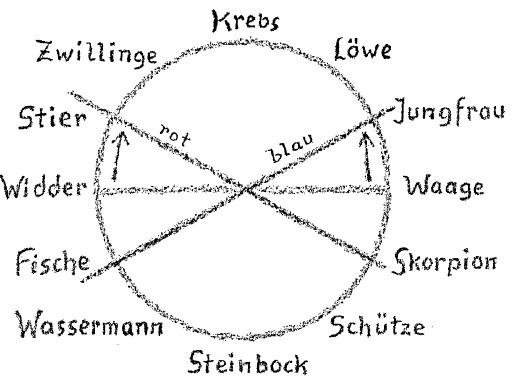
[ 5 ] Human beings live—as I have described in recent days using the image of the magnetic needle, which points cosmically toward north and south, and thus does not determine its direction from within—cosmically within the cosmos, and they are oriented within the cosmos. They live in such a way that, in a certain sense, we can grasp their orientation when we say: He is cosmically oriented in such a way that, in a sense alternating and oscillating, his directions of orientation can follow the signs of the zodiac (see diagram, zodiac). He is alternately oriented toward Aries, Taurus, Gemini, Cancer, Leo, Virgo, Libra, Scorpio, Sagittarius, Capricorn, Aquarius, and Pisces. But he is also oriented in such a way that a primary alignment takes place: based on this zodiacal orientation, he is oriented upward with regard to his head nature and downward with regard to his limb nature. Therefore, one can say: There is something in this orientation akin to a balance beam that separates the upper from the lower (see drawing). And what would the cosmic orientation of the human being be—if we were to view him in the way I do not wish for you at this moment—if we were to view him as someone who neither thinks nor acts, but simply lets himself drift along with the general mood of life, half asleep and half awake; if he is neither passive nor active, but passively active; if he drifts along like this through life: Of course, a great deal is going on within him, but he is unaware of it. But if we were to characterize this state—as I said, one in which I do not wish you to be at this moment—then we would say that the balance beam lies horizontally (see diagram). — But if we were to characterize a person as being in a state of mind such as I would now like to see you in, for example: pensive, engaged, and receptive to what is currently being discussed, then we would have to draw the balance beam differently; we would have to say: All the souls sitting here—or at least a number of the souls sitting here—place themselves in a region where certain beings lift the balance beam on one side. — In physical life, if the scales were set in motion by some kind of excess weight, one would say: the balance beam lowers. But we are now speaking of the spiritual realm; there one must say: the balance beam rises. Thus, when a person is in the “senses,” certain beings in the region to which the person then transports themselves will lift the scale beam in the direction from Libra toward Virgo (see drawing, blue); so that I must then draw the scale beam in such a way that certain beings, who are inclined toward the Ahrimanic nature, lift the scale beam as follows: This, then, would be the human being in the state of “thinking” (see drawing, arrow, blue, balance beam from Virgo to Pisces). One might therefore ask: What does it mean for a human being to be in the realm of the senses? It means that they make use of their position as a human being within the entire cosmos in such a way that they utilize the forces in which they vibrate to enter a cosmic region in which this state of equilibrium prevails. So you think of yourself as being in a state of contemplation; and as you think of yourself in this way, you must imagine that your—if I may put it this way—spiritual space, into which you then place yourself, is situated within a region where a struggle that has come to rest is taking place: the beings on the left would be fighting the beings on the right, and vice versa. But as long as you are in the act of thinking, the struggle is not present; rather, it has come to rest. Yet this stillness means that certain beings inclined toward the Ahrimanic entity have the upper hand, just as when a balance beam comes to rest in a tilted position and no longer sways because something is pulling it down. That would be the reality corresponding to the act of thinking.
[ 6 ] What human beings call “thinking” in their ordinary, sensory existence is merely a figment of the mind; it is nothing but an illusion. To describe what thinking really is in cosmic terms, you must consider the entire situation of the human being as he stands within the cosmos. And this position of the human being—how he stands within the cosmos—provides you with the answer to what certain beings of the spiritual world do; it also answers the question of what thinking activity is, and what the senses are. So, fundamentally speaking, it is an illusion when we describe thinking the way we do in ordinary life. If we wanted to describe it in accordance with reality, we would have to say: We find ourselves in a region where, within our sphere of thought, thoughts arise because certain beings inclined toward the Ahrimanic have tipped the scales to one side. That is the actual process.
[ 7 ] Let us consider another process in the life of the human mind and soul: the fact that we act—not in a frenzied manner, but deliberately—that is, that our actions are permeated by intentions, or thoughts. The way this is described and imagined in everyday life is, once again, a mere illusion. For even when we are acting, we place ourselves in a certain cosmic region. But in this cosmic region, certain beings who are inclined toward the Luciferic being cause the scale to tip in the opposite direction, so that we must then depict the cosmic balance beam as shown (see drawing, red), and the direction in which these beings lift the balance beam—deviating from the state of rest—would be indicated by this arrow. When we act intentionally—that is, willingly, truly willingly—we are then oriented toward a certain region of the cosmos in which the balance beam is held in this way by certain Luciferic beings. However, the situation is now such that a state of equilibrium has preceded this, and precisely as we place ourselves in the realm of action, these Luciferic beings begin to make the balance beam tremble; we then find ourselves in a kind of struggle taking place in the cosmos. The Luciferic beings begin to fight against Ahrimanic beings, and the struggle—which actually takes place within our will between Ahrimanic and Luciferic beings—is expressed in the unstable state, in the wavering of the scales. So what we describe in ordinary speech and in our ordinary imagination as “will” is merely a maya; it is merely an outer illusion. We speak correctly of the will when we say: As willing human beings, we are in a region in which a lifting of the world’s scales has taken place through the Luciferic beings (see diagram, moving from Taurus to Scorpio); but this lifting has taken place without us. We place ourselves in such a region where such a lifting has taken place without us. We seek out such a region—and precisely such a region—where stillness begins to give way to movement, where stillness begins to give way to a rhythmic interplay.
[ 8 ] In the first of our Mystery Dramas, I hinted—and of course it had to be hinted at through dramatic imagery—that we should not imagine that when a human being thinks or feels something on a soul-spiritual level, it is merely a process taking place within them; rather, cosmic forces are set in motion. And this is expressed figuratively in a single scene in such a way that, while Capesius and Strader behave in a certain way, great cosmic processes are taking place. These processes are truly taking place, albeit not in the sensory world but in the supersensory world; in the sensory world, they can only be sensed in the way they are depicted in the drama. But this is made quite clear in the drama: that human behavior here, as we describe it, is actually only a reflection of reality; that significant events take place in the cosmos whenever a person wills or thinks even the smallest thing in their soul. We can never will or think anything in our soul without transporting ourselves into realms where spiritual struggles are taking place, or where spiritual struggles are coming to a rest, or where spiritual struggles have already been fought out and we find ourselves in the aftermath of that struggle, and so on.
[ 9 ] What I have just described to you is present in the human soul and spirit. It is simply hidden from the life that a person lives between birth and death; but it is the truth in the spiritual realm. I have spoken about this in another context in recent days: that by approaching the world in a more intellectualistic way—as is customary in the modern world—human beings are actually living in a state of hallucination. Essentially, the ideas we form about our thinking, feeling, and willing are hallucinations, and the reality that lies behind them is the one we can illustrate in this way. In reality, what has just been described lies behind our mental and soul processes; it reveals itself to human beings in a reflected form such that it appears to them as thinking, feeling, and willing. And as soon as we consider human beings in terms of their mental and soul nature, the concept of development—of evolution—no longer applies. It would be utter nonsense to say, for example, that a human being only becomes capable of meaningful thought at a certain age, that before that he is more given over to a raging will, and that one develops out of the other. Nothing develops in this way in the spiritual realm; rather, we can only say that when we observe a child thinking, feeling, and willing differently from an elderly person, the child is simply situated in a different spiritual realm, where the struggles between the various beings unfold differently. In this spiritual realm, development does not take place in the same way as the kind we spoke of yesterday. In this spiritual region, we understand the past only when we say that the picture of struggle, the picture of relationships, the picture of the interrelationships among the beings we seek behind the higher hierarchies—this picture is different from the picture we have in the interplay of the hierarchies when we speak of the present. And yet another picture emerges when we speak of the future. We perceive different images in the relationships between the various beings of the hierarchies, depending on whether we are considering the past, the present, or the future. And it would be absurd to say that the image of struggle in the future develops from the image of struggle in the past. In the spiritual realm, these things coexist in a certain relationship, not one after the other. Therefore, one cannot speak of “development” here, but only of a spiritual perspective—a point I have already brought to your attention in another context. So one can say: When we regard the human being as a spiritual-soul being, it makes no sense to say of him that he is first a child, goes through the change of teeth, then reaches sexual maturity, and so on. What appears as evolution or development in the physical-soul realm is bound to a spiritual-soul realm in which one cannot speak of development, but only of a transition—in the interplay between the beings of the higher hierarchies—from one form to another; that is, in this interplay between the beings of the higher hierarchies.
[ 10 ] You will not gain a true understanding of the relationship between the temporal and the eternal unless you take into account what I explained in the context of yesterday and today. For in that context—from yesterday to today—I explained how human beings, as physical-soul beings, are so deeply embedded in the course of time that they can only understand, even as elderly people, what is taking place within them while they are children: here we are fully dealing with the concept of development. We must, however, acknowledge that human beings, as spiritual-soul beings, are not subject to any kind of development at all; that the concept of time, in the form in which we know it in external, sensory life, is not applicable at all when we speak of the spiritual-soul nature of human beings; and that we are mistaken if we introduce the concept of time into the sphere of the higher hierarchies. In the sphere of the higher hierarchies, everything endures. There, things do not unfold in time; there we are dealing only with perspectives through which we must view the struggles and interrelationships. The concept of time is not applicable to the interrelationships in the higher hierarchies, and we are merely creating a misrepresentation of the nature of the higher hierarchies when we apply the concept of time. Therefore, in my Outline of Esoteric Science, you can see how carefully I indicate that certain things must naturally be depicted in terms of time—namely, when I speak of Saturn time and solar time—where this is described in such a way that I actually draw very sharp attention to the fact that the concept of time is applied only figuratively to what preceded solar time, and also to half of solar time itself. You can read about this in my Occult Science. Such seemingly incidental remarks in this book on spiritual science are of the utmost importance, for it is precisely in this incidental remark that the foundation lies for understanding the difference between the temporal and transitory and the eternal and enduring.
[ 11 ] If you consider what I have just said, you might say that yesterday I tried to describe the human being to you purely in terms of time, and the concept of time played a very, very significant role in yesterday’s description of the human being—such a significant role, in fact, that it depends on time whether one has a certain understanding, namely, on the time one has lived through up to old age, or the time one has not yet lived through, when one is still in a childlike state. Everything we discussed yesterday was, in the strictest sense, based on the concept of time. There, in the light of the spiritual, we described what underlies the human being physically and psychically. Today I have described what underlies the human being spiritually and psychically. And this can only be described if one describes it in the realm of duration, if one describes it in such a way that—though this is difficult—it ultimately leads to the realization that the concept of time does not apply at all to this realm in which we exist as spiritual and psychic human beings.
[ 12 ] We are, in fact, ambivalent beings in this regard, and as we develop throughout our lives, we evolve in such a way that, on the one hand, we must wait calmly and patiently until our physical and spiritual nature matures enough to understand anything. On the other hand, we remain constantly, without development, in the realm of eternity, where, so to speak, we gaze only once in childhood at one point in the realm of eternity, and during old age at another point in the realm of eternity. Here on Earth, human beings live in such a way that what takes place in the realm of eternity radiates down into what takes place in the realm of time; the two intermingle.
[ 13 ] The science of the initiate has the task of distinguishing between that which is mixed together, for only through such distinction can it become understandable. The science of the initiate has always referred to that which is in the realm of the enduring as the “higher,” and that which is in the realm of the transitory as the “lower.” But because human beings live here on Earth, their perception is a mixture of the Upper and the Lower, and they can never arrive at any understanding of their own nature by observing what has become mixed here; they can only arrive at an understanding of their nature if they know how to distinguish between the two things that are mixed together. Therefore, you will find it understandable that, in light of the aspect presented by earthly life, you cannot, in normal consciousness, hold fast to the view that things are as I described them yesterday; nor can you, with ordinary consciousness, hold fast to the view that things are as I have described them today. And anyone who wishes to rely solely on ordinary consciousness might say: “You described something about human beings yesterday that we do not see, that is not reality at all, for human beings do not develop the way you described yesterday; some are already very mature in their youth—and so on.” But this is an objection based on the perspective of illusion. Reality is as I have described it to you yesterday and today, and human beings in the present day fall into dualism because they do not perceive the lower realm as fluidly as I depicted it yesterday. The initiate must remove the rigidity inherent in the lower realm and set it in motion. The ordinary observer looks at the person standing before him; the initiate must observe the process that unfolds between birth and death: he must see the human being in a state of flux.
[ 14 ] And again, as the initiate observes thinking, feeling, and willing in their flow, he must bring that flow to a standstill, and he must perceive that which, because it is bound to the body, appears to unfold in time, within the realm of duration, within the realm of coexistence—but of spiritual coexistence. People do indeed strive for the science of the initiates, and they are also happy to admit outwardly: The environment as observed by human beings—the sensory environment—is a Maya, a great deception, an illusion. But when it comes down to it, people do not really engage with this; rather, they wish to describe both the higher region and the lower region using the concept of Maya. One is expected to provide neatly schematized drawings, made entirely according to the pattern of Maya concepts, and to use them to move up or down into the spiritual world, above or below consciousness. People say to you: “Yes, but you’re not describing it in a way I can understand.” — But behind this—“You’re not describing it in a way I can understand”—lies only this: “You are urging me to arrive at ideas and concepts other than those found in Maya; you are urging me to arrive at concepts that lie in the realm of the real.”
[ 15 ] There may also be another objection. Someone might say: Well, what does all that going on down there have to do with me, anyway! As long as the concept of time is seriously applied to human development, or if one looks at the realm of duration in life, one gets by just fine. — People can say this if they remain in Maya, if they form concepts derived from the mixed realm and remain in Maya. Yes, if need be, you can still live—live in a state of slumber—by simply remaining in the realm of duration. But first of all: With these concepts that you form here—and no matter how astute they may be, no matter how well they might stand up to the scholars of the present—you can live with these concepts if you must, but only if you must; yet you cannot die with these concepts. No one can die with these concepts that are formed here. And as soon as one touches upon this mystery, the great seriousness of spiritual scientific knowledge begins. Those concepts that are formed without the science of the initiates—these ideas—lead after death into an illegitimate, Ahrimanic region. They do not enter the region of the human, for which they are actually destined, if you spurn the formation of concepts as provided by the science of the initiates.
[ 16 ] In earlier times, higher spiritual beings taught the concepts of initiation to people with atavistic clairvoyant dispositions through supersensory means. Therefore—essentially until the year 333 after the Mystery of Golgotha—a kind of supersensory instruction was available to human beings, which prepared them not only for life but also for death. Since that time, it has become necessary for human beings here on Earth to prepare their souls—through their own efforts and understanding—so that they may pass through the gate of death in the proper way. In the science of the initiates, there is scarcely a more frivolous statement than the one that says: “One could simply wait until one enters the realm beyond death to see what is there.”—The science of the initiates tells us: Whoever waits in this way sins against life. — For you would be terribly frightened if some initiate — per impossibile — were to describe to you what monstrosities you would be had you held the same attitude throughout your life between death and this birth, had you said to yourself between death and this birth: I will wait until I am born onto the earth; then I will see what the being is like that is then clothed in flesh, that lives in blood. — Then, even through the admittedly beneficial influence, you cannot avoid preparing yourself with those forces that will protect you from being born as a monstrosity. There, higher beings protect you. This spiritual life between death and a new birth—so say the beings who teach on the other side—is not merely for our region; it exists so that the lower region may be prepared in the proper way, so that no deformities arise there, but rather truly nobly formed human beings come into being.
[ 17 ] But life here on Earth, too, is not meant solely for the Earth; rather, it exists so that human beings may also die in a truly human way. By taking in concepts from the higher region, human beings must prepare their lower nature here in such a way that they do not enter an Ahrimanic region, which is an unjustified one. Of course, there are also legitimate Ahrimanic regions, but this would be an illegitimate one that would not correspond to their humanity. That is the first point.
[ 18 ] The second point, however, is this: you can, if necessary, live as an individual—though in reality, of course, no one lives as an individual—if you disregard the realm of permanence; but you cannot live within the human social order. The human social order is guided and directed by the beings of the higher hierarchies. And if you enter into even the slightest relationship from person to person—and our entire life consists of relationships between people—and what flows into these relationships does not spring from the awareness of being immersed in the spiritual realm, the region of permanence—then you corrupt social coexistence; then you contribute to the catastrophic phenomena, to the phenomena of destruction and annihilation on the globe. And a social or political view that does not originate in the spiritual has a devastating, destructive effect. Only a view that takes the realm of permanence into account—in political, social, and indeed all human coexistence—has a living effect on what is to come. This is the great, solemn truth that must be brought ever more closely to people through the science of the Initiates. And the signs of the times today indicate that the era in which, up until the year 333, higher beings imparted supersensible instruction—in which human beings did not need to participate consciously, because this instruction was largely imparted to them during sleep or in a twilight state—has now come to an end. Now human beings must experience, as human beings among human beings, what they need to receive in this way. They must simply cast off that arrogance that leads them to say that they can always form their own convictions. In the realm of transience, they must grasp, for example, that the older person has something to say to the younger one—something that only the older person can say to the younger one. And once one understands this, why should one not also understand that there is indeed a science of the initiated, which is received from person to person? This is, after all, a catalyst for social life as it must develop into the future: that human beings receive from their fellow human beings that which they cannot recognize for themselves at any given moment—if we are now speaking of the realm of time. And as I told you yesterday: Through the course of development over time, things have been arranged in such a way that one need not accept things merely on the basis of blind faith in authority, but that in the ideas one forms, one can already have a kind of conviction that also springs from within oneself. — I have emphasized this in a whole series of my books: belief in authority should not flourish on the foundation of spiritual science. But this must be clear to all those who truly stand on the foundation of spiritual science: one is not initiated simply by standing, in the spirit of the present age, like a rooster on a dung heap and beginning to crow one’s own convictions at any age! With that approach, one can devise all manner of programs that one believes can rule the world, but one can never provide a science that truly permeates the life and workings of the world. More and more, the science of the initiated will be necessary for the life and workings of the world.
[ 19 ] While in ancient times initiation existed as a way of thinking that was given to human beings, as we look toward the future, people must turn toward what comes into the world through initiation with their full, independent will. Various desires—including subconscious ones—stand in the way of this. For it is not easy for a person to muster the great seriousness required to truly immerse themselves in all that is demanded by what has been said.
[ 20 ] It is actually quite difficult to tell humanity today just how much goodwill it must have, because it often mistakes this goodwill for a heartless will. Anyone who truly delves into the essence of spiritual science knows that, as we look toward the future, there is no other way to create a soul substance capable of passing through the gate of death in the right way—and of entering into the social life of humanity in the right way—than through the study of spiritual science and initiation. One can immerse oneself in this, and then the counter-thought arises: There is someone living this life who has people he loves for whatever reason, and who want nothing to do with this great demand of our time—the turning toward spiritual life. A desire arises within him that these people, too, should find salvation, and it seems heartless to him when, in contrast, the full truth is emphasized. But the one who is of good will in this area knows that it is not truly good will to close one’s eyes and say, “Well, they may not want to know anything about spiritual life, but they can still find salvation without it”—rather, it is good will to say: Every effort must be made so that spiritual life may come to earth. — In the positive sense, what we should strive for lies not so much in pursuing thoughts that are so intimately connected with desires, thoughts about the situation of those who want nothing to do with the spiritual life, but rather in the willing devotion to the spiritual life, in the attempt to carry this spiritual life out into the world in order to bring people—if I may use the expression—to bliss.
[ 21 ] Behind what is often “affectionately” called […], there lies not only superficiality, but also a misunderstanding of the true circumstances. And the one who speaks today from the science of the initiate does not speak merely to bring theoretical knowledge to the human soul, but speaks from a warm heart, out of love for humanity, because he knows how strongly the signs of the times point to the fact that the next great task is to bring this spiritual life to the human soul and to work into people’s lives in such a way that this spiritual life reaches the human soul. To this end, it is of course necessary to face the development of humanity over time with a certain courage. The views of the Higher and the Lower—which must come to light today and must be clearly understood—must also be brought as close as possible to the human soul.
[ 22 ] If you view life the way it is viewed today—with prejudice and illusion—well, then you’re not speaking of life as a whole; you’re actually speaking only of a very small part of life. I’ve put this to the test. For example, I am familiar with the various biographies of Goethe that exist. What is written in these biographies certainly provides insight into many things Goethe did, pursued, thought, and imagined between his birth and his death. But as soon as this Goethe soul has passed through the gate of death, what is described in biographies from the standpoint of the present-day illusionistic worldview has not the slightest significance for the region into which the human soul enters after death—a region that constitutes a different blend between the realm of permanence and the realm of transience. For this, too, is transitory: the human being re-enters existence through a new birth. As for the realm into which the human being enters through the gate of death, one cannot make sense of anything through the illusory worldview or the illusory biography that records life between birth and death. There, the sole decisive question is: How has the soul spoken to the cosmos? — What a person has communicated to his fellow human beings—even if they were the most beautiful things here on earth—has not been spoken to the cosmos unless it flowed from spiritual insight itself. But what Goethe lived through has been spoken to the cosmos, if one views his life in such a way as to describe the seven-year periods specifically in relation to Goethe’s life. How Goethe changed from one seven-year period to the next! How remarkably the great turning point in his life coincided with the course of a seven-year period, when he went to Italy—or at least resolved to go to Italy! That which unfolds from one seven-year period to the next within the realm that constitutes biographies in the ordinary sense speaks into the cosmos; and this too has significance once a person has passed through the gate of death. And what Goethe expressed—as he was influenced by the beings from the realm of duration, which can be described as I have described it today—this, in turn, has a connection to the realm one enters after death. Describe Goethe’s life from the perspective that emerges from yesterday’s approach of seven-year cycles: what Goethe felt when he wrote such a motto over individual chapters of his works, such as: “What one desires in youth, one has in abundance in old age.” Anyone who considers Goethe’s life from the standpoint of transience, from the standpoint of development, and comes across a phrase such as the one Goethe wrote as a motto above a chapter of his works: “What one desires in youth, one has in abundance in old age”—anyone who encounters such a phrase with spiritual-scientific insight encounters, in a sense, the eternal Goethe. And whoever, in turn, encounters anything in Goethe with a spiritual-scientific mindset—where what flows from the realm of permanence, where the hierarchies play out their interplay, resonates within what Goethe says—encounters, in turn, that which is the eternal Goethe. To come to know not merely the temporal in the world, but the eternal—which can only be known through the detour of spiritual science—this is the task that arises for people today through the acceptance of the science of initiation. What earlier times have to offer must be viewed by people of the present in the light that can come to them from the contemporary science of initiation.
[ 23 ] Within the Catholic Church, there is something that can be compared to the effect of a red rag on a certain creature. If a Catholic—who today often considers himself a true believer—were to dare to espouse any worldview, say a worldview of “emanation,” presenting the world from the perspective of emanation, then that worldview is doomed—perhaps less so for himself, but certainly for the faithful flock for whom he writes or speaks. One need only be able to attach the label “emanationist” to a worldview! To this emanationist worldview, the person who today believes himself to be a true-blue Catholic opposes the creationist worldview—the worldview of creation ex nihilo, of creation out of nothing. And—again in a dualistic manner—one places the emanationist worldview, which acts like a red rag, on one side, and the creationist worldview—creation out of nothing—on the other. The creationist worldview is accepted, while the emanationist one is rejected. Emanationism, in particular, is what became known in the West via the detour of Gnosticism. As it became known in the West—since the literature on which it is based has, for the most part, been destroyed—this emanationism is already a kind of distorted image; and because, fundamentally speaking, only this distorted image is known on the Catholic side, a great misunderstanding arises. For what is known there as the doctrine of emanation—the emergence of one Aeon from another, where the less perfect or less exalted Aeon always emerges from the more perfect Aeon—that which is usually described in an external, exoteric sense as Gnosticism is, in fact, already a corrupted concept. This points back to a worldview that was of an entirely different nature, and which was possible especially in ancient times, when spiritual teachers from the supersensible realm themselves still instructed humanity; emanationism—which, as I said, is already a corruption—points back to a science that, in its ancient form, related to the realm of duration, to the Higher. And with regard to this Higher Realm, one can, in a certain sense, defend emanationism—not in the corrupted form in which it is commonly known, but in the form where, within the doctrine of emanation, one speaks only of a perspective in time, not of actual development. But precisely because it does not speak of an actual development, it could not speak of an emergence from nothing either, for that would also be a development, albeit one at the most radically extreme point; therefore one cannot speak of one thing emerging from another; rather, just as we—in speaking today about the realm of duration—did not speak of an emergence, but of an interrelationship among beings to whom duration is inherent.
[ 24 ] But when we speak of the realm of transience, we can indeed speak of development; and in that case, we can also speak of the extreme case of development, which we have, in fact, been discussing implicitly quite a lot these days. For is it not a continuous coming into being from that which is nothing in relation to the world when we say: the present ideals are the seeds of the future, and the present realities are the fruits of the past? Viewed correctly, this in turn yields true—not corrupted—creationism. The demand being made of people today is this: To see in the proper light what was meant by emanationism and to apply it to the spiritual-soul world; to see in the proper light what is presented in true—not corrupted—creationism and to apply it not to the creators, but to creation, to the physical-soul realm. Salvation—the redemption of our worldview—lies in the recognition of duality, in seeing through duality, not in the nebulous blurring of dualistic concepts; it lies in seeing the realm of permanence correctly, seeing the realm of transience correctly, and being able to distinguish between them. Then one can say: When I contemplate the reality that stands before me, it is a reflection, but at the same time an effect—a reflection in that it belongs to the realm of transience and is governed by evolution; an effect in that it belongs to the realm of permanence and is governed by what one obtains precisely when one correctly perceives what we have today characterized as spiritual-soul life. The one who speaks correctly does not say that creationism is right and emanation is wrong, or that emanation is right and creationism is wrong; rather, he knows that both are necessary factors for understanding life. The overcoming of dualism cannot be brought about in theory, but only in life itself. Anyone who theoretically seeks a way out between the realm of the Above and the realm of the Below, the realm of transience and the realm of permanence—who theoretically seeks a balance through concepts, notions, and ideas—will not succeed; they will always end up in a confused worldview, because they are seeking through the intellect what should be sought in life itself. In life, however, one seeks the truth only when one knows: One must direct one’s gaze, on the one hand, toward the realm of permanence and there recognize that which, admittedly, does not manifest itself in external reality, and then also toward the realm of transience, and there view all people and all beings in a way that actually contradicts external reality. But when one is equipped with both and encounters any reality, then—as one experiences this reality, perceiving it through experience—it coalesces from the elements from which it itself arose: from the effect of the realm of permanence and the reflection of the realm of transience. In this way, one grasps it in life—not by seeking a theoretical worldview that plays out in concepts and ideas, but by seeking two worldviews: one for the realm of the spiritual-soul, the other for the realm of the physical-soul, and in the living coexistence of these two worldviews—rather than in a theory—one seeks that which nourishes and enriches life. Only then does one emerge from dualism,
[ 25 ] This is what stands as a challenge to humanity today. It is not a matter of religious founders appearing who teach people spiritualism, nor is it a matter of some scientific sect leaders appearing on the other side who teach people materialism; rather, what matters is that one understands matter as material within evolution and the spiritual as immaterial and spiritual within the realm of eternity, and views reality from this combined perspective. Allowing the material to be illuminated by the spiritual, and the spiritual to be substantiated by the material—that is what must flow into the worldview of the future. What matters is not that philosophers emerge who give people definitions of truth, or, on the other hand, also provide definitions of what science teaches, in order to establish a so-called monistic harmony in a theoretical sense; rather, what matters is that the dualism between truth and science be recognized, and that the relationship between truth and science be sought in living reality, in order to arrive at a living—not a theoretical—theory of knowledge. Not truth or science, but both truth and science: science supported by the weight of truth, the weight of truth illuminated by the light of science, acknowledging that human beings exist in the world in a dualistic manner and can only overcome—in their lives, in their becoming—that which, as dualism, must be overcome. Not Kantianism, which believes that what exists in the external world is not the “thing-in-itself,” but rather truth and science—this is the task of humanity in the future, even in the realm of thought; that is, the recognition that, while what surrounds us is Maya, but Maya exists because we, as human beings, position ourselves in the world in this way, and because, as long as we position ourselves thus, we are positioned dualistically. Through this positioning of ourselves, we create Maya, and by becoming alive ourselves, we overcome this Maya in life, not in idea, not in theory.
[ 26 ] That is, after all, the content of my little booklet Truth and Science and my book The Philosophy of Freedom. The latter will likely be available here in a new edition in the coming days. I have made a few additions; the text itself has not been altered from the previous version, but it has been significantly expanded to include many new points on a wide variety of topics.
[ 27 ] It is therefore a matter of understanding the signs of the times and, based on them, cultivating spiritual life in the most diverse areas of human activity.