

The Polarity of Duration and Development in Human Life
GA 184
20 September 1918, Dornach
Translated by Steiner Online Library
Seventh Lecture
[ 1 ] There is certainly no need to mark today specifically as the fifth anniversary of the laying of the cornerstone for our building. It is especially unnecessary among those who, over the course of these five years, have been more or less physically connected to the construction site. Nor is this catastrophic era truly a time for special celebrations, and commemorating anniversaries should not become a customary practice within our movement. Let me just say a few words to you today.
[ 2 ] The building could not be completed within the time frame that some might have imagined—those who attended the laying of the cornerstone back then, or who were somehow involved in the ceremony, whether in spirit or otherwise. But that is not the essential point, at least not at first. The essential thing about this building—even though it stands before us today as unfinished—is that it is there at all. Even if it were even more unfinished, the essential thing would still be that it is there, and that its forms reveal the spirit from which it is meant to exist. We have, of course, spoken often about its inner structure, about its essence. But the fact that the building is there—that is what we want to thoroughly take note of for ourselves as a fact, as a fact that, in a certain way, also imposes an obligation upon us. It is simply not the same thing whether the Anthroposophical Society or our spiritual scientific movement would have existed over the past five years without this building, or whether it exists with this building. It is not the same; it is by no means the same. Above all, this building is a landmark for this movement. This building is what, in a certain sense, makes it visible to people far and wide that such a movement must exist in the world. The fact that the building imposes an obligation on us is also evident from the outside world’s attitude toward it. The outside world would have paid far less attention to our entire movement if this building were not there. In this day and age, apart from everything else, it is simply the case that visible symbols mean a great deal to people today. Given that a significant part of the work for the spiritual science movement in the near future will likely involve a struggle against hostile movements, it must be carefully considered that the building, as a tangible reality, contributes in no small measure to the vigorous presence of these hostile movements. People would pay less attention to us if this building were not there. Therefore, it is not enough for us to take a certain satisfaction in the fact that the building was able to be constructed; rather, it is necessary to combine this satisfaction with the awareness that—just as the South Pole relates to the North Pole or the North Pole to the South Pole—looking upon this building as our own is part of our commitment to the anthroposophical cause in the right way. I would like to say that we should not actually derive any joy or satisfaction from the building unless we simultaneously devote all our energy to championing the anthroposophical cause. For the building would be the cause of our cause’s destruction if there were not sufficient defensive strength to be found. I would like to say that if we did not have a building, we could afford the luxury of simply belonging to the anthroposophical cause, for it would simply lack the visible sign that also draws the attention of those people who need visible signs. But if we take joy in the building, if we derive satisfaction from it, then we must also associate with that a certain obligation to stand up for the anthroposophical cause.
[ 3 ] Certainly, the most significant misunderstandings are connected to the anthroposophical cause itself, but even today one still hears countless gross misunderstandings about the building. One need only repeatedly come into contact with this or that person who visits this building or speaks about it to see what misunderstandings prevail. We should strive to correct such misunderstandings. Many other things also show how the positive works, and this building is indeed a positive force. We will truly not get very far by trying to correct every negative aspect of malicious attacks; but we will get far if we strive to present the positive to the world in its proper light. People who have visited the building—and there is evidence of this—who have allowed the building to make an impression on them, have indeed seen the positive aspects, and—at least some of them—have not formed a negative opinion about the matter associated with this building. We must simply be careful not to attach all sorts of mysticism to this particular building when people visit it. The building can have an effect if we interpret it objectively as an artistic expression of the fundamental facts and observations of spiritual science. Trying to foist all sorts of mystical ideas on people will most certainly compromise the building and our entire cause.
[ 4 ] Today I would like to pick up on a few such practical thoughts. The most important thing is that we commemorate the laying of the cornerstone five years ago and the essential significance of this building, which, arising from the inner nature of the anthroposophical cause, should stand before our souls as the most vivid of feelings. We have often expressed thoughts about the building, and we will continue to do so on a wide variety of occasions in the future. Today, we envelop in a feeling of loyalty to the building the thoughts that arise in our souls when we look back on the time five years ago when we laid the cornerstone here on this hill.
[ 5 ] I have often spoken to you about how the human soul has transformed over the course of human evolution, and how short-sighted it is to believe that today’s state of the soul can be understood without looking back at the various forms of transformation that the human soul has undergone. We look back—I need not repeat this—at the most diverse epochs of Earth’s development; in particular, we have frequently characterized the post-Atlantean epoch to point out how the state of the human soul has continually changed during this post-Atlantean epoch. Precisely when speaking of these things, one must proceed from the abstract to the concrete. We must strive to answer the question with ever greater intensity: What was the human soul actually like in prehistoric epochs? We look back, after all, to a primeval epoch in which—and this can be said of it in more than just a figurative sense—divine teachers themselves instructed human beings in the sacred mysteries of existence. And we know that from this primordial epoch onward, human beings have become acquainted with these mysteries of existence in the most diverse ways. From epoch to epoch, the concepts within the human soul have indeed become ever different. Concepts that we also have today—in the sense that we name them with words at every moment—live within us; they also lived in earlier states of our soul; but they lived quite, quite differently in those earlier states. Many of our most common concepts existed in a very different way. And today I want to speak of seemingly quite common concepts—two concepts that live in the human soul today. At the very least, people constantly express them through words drawn from their vocabulary—words that also lived in the human soul in the past, but in a completely, completely different way. I want to speak of the two concepts of space and time.
[ 6 ] Space is the most abstract concept imaginable for people today. People today have so many different ideas about what space is! Three mutually perpendicular dimensions, or—if one reads philosophy textbooks—the extension of physical objects, or yet other definitions of space. But all of that—just think how dry, cold, and abstract it all is! Three mutually perpendicular dimensions, or everything that geometry teaches us about space: how terribly abstract, how dryly conceptual! So conceptual, in fact, that for Kant, space as a whole—along with time, incidentally—has become a subjective shadow, a mere form of intuition of sensory phenomena. This abstract concept of space, about which modern people know little more than that it has length, width, and height—this abstract concept of space was a completely, completely different notion in the distant past, a notion of which, admittedly, some traces still remain today among particularly sensitive people; yet only a trace of it remains today. But one need not go back all that far—to the 6th, 7th, or 8th centuries B.C.—to be able to say: In those times, space—as it was experienced—was something entirely different for the human soul than this sober abstraction that space is for the human soul today. Even in early Greek times, by experiencing space, the human soul still experienced something with which it felt a living connection. It felt placed within a living entity when it perceived itself as situated within space.
[ 7 ] Today, people have at most only a trace of this sensation left; some people have traces of sensations—I will speak of this shortly—of this sense of being situated in space, which is connected to the personality itself, to the human being within. But the people of antiquity expressed something by which they meant a significant relationship between themselves and the universe when they distinguished between up and down, right and left, front and back. As for our abstract three dimensions, which concern themselves with nothing else but being perpendicular to one another—which would be a very monotonous occupation throughout eternity if one did nothing else but stand perpendicular to one another like the three dimensions of geometry—these three dimensions had, in fact, very little to do with the living reality that people had in mind when, in ancient times, they spoke of above and below, of right and left, front and back—actually has very little to do.
[ 8 ] Above and below: it was a living experience when, in ancient times, human beings sensed how they had first been small children and had raised themselves up from below, when they sensed how the course of life consists of an unfolding in the direction of above and below. The course of life consists in experiencing the direction of up and down. In normal life, one travels only a short distance away from the earth—upward as one grows—unless one lives in the Ahrimanic age of airships or in the Atlantean age—but even then it was not very high above the earth, as you know from my description of Atlantis—and in doing so one experiences oneself in the above and below, in the contrast between above and below. But this contrast between above and below was perceived in ancient times as the contrast between the world of consciousness and the objective world, between the conscious and the unconscious world. The relationship between subject and object was deeply felt when one perceived above and below. Above—and ever higher and higher—lie the worlds of the gods; below lie the worlds that are opposed to the gods; and human beings are placed within this above and below.
[ 9 ] Even in figures such as Goethe—you need only study his Faust—you can still find remnants of an awareness of up and down. And in addition to this up and down, human beings then came to perceive right and left. We must resort to abstractions when we speak of right and left today. For people of ancient times, experiencing right and left was a real experience—one might say, a real world of observation. Up and down is the line from infinity to infinity, or from the conscious to the unconscious. Right and left: by perceiving right and left, people sensed the connection in the world between meaning and form, between wisdom and shape. You need only draw an axis of symmetry once; what lies to the right and to the left of it together constitute the form, and you cannot connect right and left without connecting them meaningfully, without relating them to one another.
[ 10 ] While “up” and “down” point to humanity’s mysterious relationship to the spiritual and material worlds, the experience of “right” and “left” represents humanity’s relationship to the world as it unfolds in form. And by relating the forms on the right and left to one another, by applying wisdom to the forms arranged symmetrically on the right and left, he perceives himself within this second element of space. This experience of meaning in shape, of wisdom in form, in all possible variations—this feeling of being immersed in this harmony of meaning and shape, of wisdom and form—is what ancient humanity experienced as what we today call the abstract second dimension. And the above and below, the right and left, merged into what the plane is, what the surface is—something that cannot yet exist in the realm of the sensible, something that requires thickness, requires front and back, if it is to exist in the realm of the sensible.
[ 11 ] And in this third stage—in which the front and the back—the old man sensed the material intruding into the spiritual.
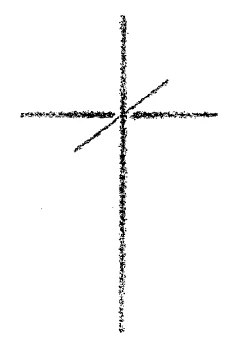
[ 12 ] He still perceived up and down, left and right as spiritual concepts. Something that is merely up and down, or left and right, cannot have a material existence; it is merely an image, must be merely an image in space. Only through thickness does it become material. And in ancient times, people vividly perceived this: As you grow, you take a few steps upward from the ground in the direction of up and down. As you walk, you can move freely; you are in the realm of your will: forward and backward. In between lies the ability to move completely freely to the right and left while standing still.
[ 13 ] Ancient man perceived this threefold opposition as inherent in the nature of the universe: this standing still in relation to right and left, this stepping into the world in relation to front and back, this slow movement from bottom to top along the up-down axis. This is how ancient man perceived it. And as he experienced the above and below, he sensed, weaving throughout the universe, all that which we today call the intelligence, the reason of the universe. To him, everything that reigns as intelligence in the universe was interwoven with space and with up and down; and because he could participate in this intelligence of the universe as he grew from below to above, humanity felt itself to be intelligent. Participation in up and down was, at the same time, participation in the intelligence of the universe. And participation in right and left—in the interweaving of meaning and form, of wisdom and shape—was for him the feeling that weaves through the world. And his posture of standing calmly, surveying the world, was for him his connection, in terms of his own feeling, with the feeling of the universe. And his walking through space in the directions of front and back was, for him, the unfolding of his will, the placing of himself within the universe, within the will of the world, with his own will. Thus he perceived his aliveness as interwoven with above and below, with right and left, with front and back. Conscious and unconscious—above and below; wisdom and form—right and left; spirit and matter—front and back. This is how the ancient human being perceived things.
[ 14 ] But at the same time he felt, in a vague way—to put it bluntly—that if you stand on your head, what is below becomes above, and what is above becomes below. But this is also true for those who walk on their feet: if you include yourself as part of the earth, what is below becomes above, and what is above becomes below. And so one can also imagine that, through some other influence, what is normally on the right might be in front, and what is normally on the left might be behind. These directions are just as interwoven and alive in space as they are, in a certain sense, indistinguishable—just as they are interwoven with one another. The ancient human, experiencing himself within this tripartite space, sensed that the Divine reigns within this tripartite division. The Divine reigning in space pointed humanity toward the Divine in duration.
[ 15 ] And he experienced—and what I am about to say, that person truly experienced—the Divine reigning in space, divided into three parts in its manifestation. And to him, it was the image of the Triune God: Father, Son, and Holy Spirit, or whatever else the triune God was called. The Trinity is truly not a figment of the imagination; it was not invented by the mind. The Trinity, with all its characteristics, was experienced in this image when the ancient human being vividly perceived the threefold space.
[ 16 ] And just as ambiguity can prevail in a certain sense regarding up and down—just as right and left can also become front and back—so, under certain circumstances, ambiguity can also creep into the interrelationships between God, the Son, and the Holy Spirit. But in the realm of transience, in the realm of space—where human beings, in the three dimensions, experienced—not abstractly, not geometrically as we do, but concretely—how the Divine manifests itself in space, and as he experienced this, he also experienced the transitory; thus he related this transitory to the element of permanence, and the tripartite space became for him the image of the tripartite spirituality.
[ 17 ] When I live here on Earth, I live within the Trinity of space; but this Trinity of space is the symbolic proof of the Trinity of the divine origin of the world. That is, roughly speaking, the idea of the ancient man. Today, space has become an abstraction, and only a few people perceive the dimensions of depth and thickness as they arise: up and down, front and back; right and left—the plane dimension. Even among philosophers today, there is little experience of this. But that is why some people—those who reflect on these things, who are not entirely asleep—come to realize that the dimension of depth actually arises only in unconscious observation, which lies not very far below the level of consciousness. People still experience this “deep seeing,” but it is the last, shadowy remnant of the experience of space.
[ 18 ] In developed religions, the understanding of the unity of God has preceded the true understanding of the Trinity. The understanding of the unity of God has a similar origin to the understanding of the Trinity of God as it relates to space.
[ 19 ] The humanities draw their insights directly from divine realities themselves. Foolish people then come along and say that this or that external evidence does not exist. Well, we’ve already discussed this at length; I could say much more, but that’s not what we’re here to address today. I just want to point out that in many cases, the inability to find evidence is simply a result of the unscientific nature of today’s so-called science. I want to mention just one thing to you—in a sense, also as external evidence that people in ancient times perceived things as I have described to you today. Why, then, did the ancient rabbis also call God “Space”? Because in earlier times—even within Judaism—they perceived what I have just described to you regarding humanity. If science were truly capable of thinking in various fields, it would find countless mysteries—which are, at the same time, genuine proofs, external proofs of what spiritual science must discover, albeit based on spiritual facts. One of the names of God among the rabbis is also “space”; space and God are one and the same.
[ 20 ] The unity of the divine has a similar origin to that of the Trinity of the divine. It is connected to the living experience of time. Time, too, was not perceived by the ancients as the abstract concept we perceive it to be today; it was simply that the concrete experience of time was lost even earlier than the concrete experience of space. If someone today reads Plato or Aristotle with true understanding—not the way some schoolteacher reads them—I have, after all, often cited for you that note Hebbel wrote in his diary, in which a schoolteacher is confronted with the fact that the reincarnated Plato is sitting in his classroom as a student, and lo and behold, the schoolteacher is in the very process of reading a Platonic dialogue with his class, and the reincarnated Plato receives a rather poor grade from this schoolteacher; Hebbel noted this in his diary—so whoever reads Plato and Aristotle today with a genuine, deeper understanding will still find throughout their works, just as in the 6th, 7th, 8th centuries of the pre-Christian era, when a genuine sense of it was still fully present. Even though it was already fading in Plato and Aristotle, this sense of space—of which I have spoken—is still clearly perceptible. But the sense of the living experience of time was lost even earlier. It was still fully alive in the second post-Atlantean epoch, the Proto-Persian period, where, of course, it would have sent a shiver down the spines of Zarathustra’s disciples if someone had told them that time is a line running quite uniformly from the past into the future.
[ 21 ] Once again, there was a more elusive sense present in Gnosticism—but one that is barely recognizable — of the living nature of time, in that one did not speak of a line running from the past into the future, but rather of eons, of the creators who were there before and from whom the later ones emerged, with one eon always passing on the impulses of creation to the next. In a sense, time was conceived in the imagination such that, in the sequence of the Hierarchy, the preceding being always passed on the impulses to the next, and the next was, in a sense, always brought forth by the preceding one; the preceding one encompassed the next. One looked up to the preceding as to the more divine in contrast to the subsequent. “Later” was experienced as less divine, “earlier” as more divine. This looking toward the turn that development takes from the divine to the non-divine was contained within the living experience and perception of time. Everything would fall apart if the divine and the undivine—which are identical to our present-day abstractions of the past and the future—did not strive to weave themselves into unity.
[ 22 ] But in this image of time—looking back and encompassing ever more and more, all the way to the “Ancient of Days”—in this imagination, one perceived the image of the One God. Just as three-part space—the triune space—was experienced as the image of the Trinity of God, so was time perceived as the image of the unity of God. The basis of monotheism lies in the ancient experience of time; the basis for perceiving the Trinity lies in the ancient experience of space. Thus the human soul’s constitution has changed; what was once alive has, in a sense, become abstract and detached. As paradoxical as it may sound: modern man certainly imagines something abstract when he speaks of space, and he imagines, I believe, a living relationship when he speaks of a friend. But that concreteness, that elemental experience that today speaks from friend to friend—that, for example, is still abstract compared to the intense experience of the world that ancient people had, in which they experienced space and time as images of the unity and trinity of the Divine.
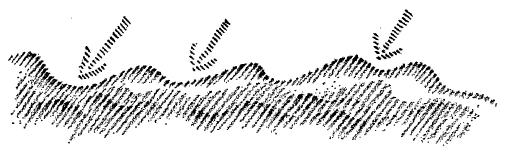
[ 23 ] Thus we have become detached and abstract in relation to space and time, and something else must take the place of space and time—something we must in turn experience, something that must become more internalized, that must be more internalized. We must learn to perceive that dualism, that contrast in the world, of which I spoke last week. Imagine, for a moment, that someone were to see only the rippling surface of the water. This rippling surface of the water is, in essence, an abstract line. What is the concrete reality? Down below is the water, and up above is the air. And from the duality of air and water, through the interplay of their forces, arises Maya—the rippling surface. But our world is this rippling surface, and so are we as human beings when we view ourselves only as we see ourselves within Maya. If we look at reality, we must see ourselves here as well: water below, air above. Water below—we see it by observing the transitory development, as I demonstrated to you last week, where a person develops in such a way that what they can imagine as a child they would only come to understand as an old person. What a person imagines during puberty, they come to know somewhat earlier, but still only as they approach old age, and so on, as I have described the course of human life, where it is only in old age that one comprehends in oneself what one was in childhood and youth. Life does not merely appear to unfold this way on the surface; it actually does. I have said: Perhaps one does not need such an overview for life even today on the surface, but one needs it for dying. — That is the concept of the lower; this includes the concept of the real upper, the realm of duration, of which I spoke to you last Sunday, where the human being does not develop, but rather possesses that which belongs to duration throughout his entire life, from birth to death. But today we cannot contemplate how the Lower and the Upper interweave unless we grasp the Lower where it threatens to become rigid, where it threatens to harden; and unless we grasp the Upper where it threatens to evaporate, to become spiritualized; unless we develop a sense of the contrast: the Divine, the Luciferic, and the Ahrimanic. The ancient human being had something alive in his soul when he spoke of his experience of space and time; the human being of the Earth’s future must develop inner concepts, inner impulses of imagination: the Divine, the Ahrimanic, and the Luciferic.