

Historical Symptomatology
GA 185
25 October 1918, Berlin
Translated by Steiner Online Library
Fourth Lecture
[ 1 ] Before moving on to other topics, I must still address certain broader ideas that arise from what we have considered regarding modern human historical development. We have attempted to examine this modern human historical development from the perspective of symptomatology; that is to say, we have deliberately undertaken the attempt to regard what is commonly called historical facts not as the essence of historical reality, but to present these historical facts in such a way that they serve as pictorial revelations of what actually lies behind them as the true reality. This true reality is thus, at least in the realm of humanity’s historical development, distinguished from what can be perceived merely externally in the sensory world. For what can be perceived externally in the sensory world are precisely the so-called historical facts. And if one does not recognize the so-called historical facts as true reality, but instead seeks in them—as symptoms of true reality—revelations of what lies behind them, then one naturally arrives at a supersensible element.
[ 2 ] All in all, especially when considering history, it may not be so easy to speak of the supersensible in its true nature, because many believe that if they find any thoughts or ideas in history, or simply if they note historical events, then they have already encountered something supersensible. We must be absolutely clear that we cannot count as supernatural anything that confronts us within the sensory world—whether through the senses, the intellect, or the power of feeling. Therefore, everything that is actually recounted as history in the ordinary sense must belong to the realm of the sensory. Of course, when engaging in historical symptomatology in this way, one must not treat all symptoms as equally significant; rather, one will recognize from the analysis itself that one symptom is of particular importance for getting beyond the events to the reality; other symptoms may be entirely insignificant if one wishes to embark on the path toward true supersensible reality.
[ 3 ] Now, after I have listed for you a large number of more or less significant symptoms from the period that has elapsed since humanity entered the culture of the consciousness-soul, I would like to try, step by step, to describe some aspects of the supersensible reality underlying them. We have, of course, already characterized some of it. For naturally, an essential feature pulsating within the supersensible realm is humanity’s entry into the culture of the conscious soul itself—that is, the acquisition of the organs necessary for the development of the conscious soul. That is the essential point. But we have already recognized recently that, in a sense, the other pole—the complement to this inner development of the soul of consciousness—must be the inclination toward a revelation from the spiritual-supernatural world. This attitude must permeate people, so that from now on they will not be able to make any further progress without reaching out toward this new kind of revelation from the supernatural world.
[ 4 ] We must first recognize these two poles of human development. To a certain extent, they have already emerged over the centuries since 1413, when humanity entered the age of consciousness. They will have to continue developing as two powerful impulses; they will take on the most diverse forms throughout the various epochs up to the fourth millennium, and will bring about the most varied destinies for human beings. All of this will gradually be revealed to individual human souls. But it is precisely by considering these two impulses that we will then be taught how essential developments have unfolded since the 15th century. And we can say: We are already able today to draw attention to how these essential developments have unfolded. You see, in the 18th century, for example, and even at the beginning of the 19th century, it would not yet have been possible to point strictly to the effects of the two impulses mentioned based on external phenomena. They had not been active long enough to manifest themselves intensely enough. They have now been active intensely enough to manifest themselves even in external phenomena.
[ 5 ] Let us first bring to mind a fundamental fact that is already standing out significantly today. One could say: While earlier events revealed what I now mean only to those who were more or less initiated—the Russian Revolution in its final phase, specifically from October 1917 through the so-called peace negotiations at Brest-Litovsk, this immensely interesting development, which is, after all, easy to grasp because it spans only a few months, it holds immense significance for anyone who truly wishes to learn seriously from historical symptoms—for this development, too, is of course merely a historical symptom. Everything that happened there ultimately stemmed from the impulses we have referred to as the deeper impulses of modern development. One can say that this revolution, in particular, is about new ideas. For today, when we speak of the true development of humanity, it can only be about new ideas. Everything else, as we shall hear later and as we hinted at recently, is subject, so to speak, to ‘symptoms of death.’ What is at stake is the realization of new ideas. These new ideas—as you will be able to gather from the various remarks I have made on this very topic over the course of decades now—must be able to permeate the entire broad population of the Eastern European peasantry. Of course, we are dealing here with a group that is essentially passive in spiritual terms, but one that is receptive precisely to the most modern ideas, for the simple reason that, as you know, the seed for the development of the spiritual self lies within this segment of the population. While the rest of the world’s population essentially carries within itself the impulse for the development of the consciousness soul, the broad mass of the Russian population—along with a few remaining vestiges—carries within itself the seed for the development of the spiritual self in the sixth post-Atlantean cultural epoch. This naturally gives rise to very special circumstances. But for the purpose of what we now wish to consider, this is nothing more than significant.
[ 6 ] Well, wasn’t it true that the idea—whether more or less correct, more or less incorrect, or entirely incorrect—but as a modern idea, as an idea of something that had not yet existed, was to permeate this broad mass of the population; such an idea could only have come from those who have the opportunity in life to absorb ideas—from the ruling classes.
[ 7 ] After Tsarism was overthrown, what first emerged was an element essentially linked to a completely unproductive class—the big bourgeoisie—which further west is referred to as “heavy industry” and so on—a completely unproductive class. That could only be an episode. It went without saying, of course, that this could only be an episode. There is really no need to talk about it at all, because what emerges from this class—I would say—naturally has no ideas; it cannot have any, as a class, of course. When I speak of these things, I am never referring to individual human personalities or individuals.
[ 8 ] Now, on the left were, first and foremost, those elements that had risen from the bourgeoisie, more or less mixed with working-class elements. This was the leading contingent of the so-called Social Revolutionaries, whom the Mensheviks gradually joined. These were the people who, essentially—and purely in terms of their numbers—could very easily have played a leading role in the further development of the Russian Revolution. As you know, that is not how things turned out. It was the radical, left-leaning elements who came to power. And once they had come to power, the Social Revolutionaries, the Mensheviks, and their like-minded allies in the West were, of course, convinced that all this glory would last only eight days, after which everything would fall apart. Well, it has now lasted longer than eight days, and you can be absolutely certain, my dear friends: If some prophets are bad prophets—those people who today prophesy historical events based on the old worldviews of certain middle classes are most certainly the worst prophets of all! — Well, what is actually underlying this? Physically speaking, I would say: This problem of the Russian October Revolution, throughout the following months and up to the present day, is not a pressure problem, physically speaking, but a suction problem. And it is important that one can truly deduce from the historical symptoms that this is not a pressure problem, but a suction problem. What is meant by a suction problem? You know (it’s being drawn), when you have the receiver of an air pump here, and air has been sucked out, creating a vacuum in the receiver, and you open the stopper, the air rushes in with a whistling sound. It rushes in, not because the air wants to go in there of its own accord, but because a vacuum has been created. The air flows into this vacuum. It whistles in where there is a vacuum.
[ 9 ] The same was true of those elements who, in a sense, stood in the middle between the peasantry and the Social Revolutionaries—the Mensheviks—and those further to the left—the radical elements, the Bolsheviks. What actually happened there? Well, what happened was that the Social Revolutionary Mensheviks were completely devoid of ideas. They were in the overwhelming majority, but they were completely devoid of ideas; they had absolutely nothing to say about what should happen to humanity in the future. They certainly had all sorts of ethical and other sentimental notions in their heads, but as I have often explained to you, ethical sentimentality cannot provide the real impulses that can drive humanity forward. Thus, a vacuum—that is, a space devoid of ideas—came into being, and naturally, the elements further to the left, the radicals, moved in to fill it. One must not believe that it was, as it were, predestined by their very nature for the most radical socialist elements in Russia—who have little to do with Russia itself—to gain a foothold there in particular. They would never have been able to do so if the Social Revolutionaries and others associated with them—there are, after all, a wide variety of groups—had had any ideas that would have enabled them to become leaders. Of course, you may ask: What ideas should they have had? — And today, only those who are no longer frightened or cowardly when told that there are no other fruitful ideas for these social strata other than those derived from the findings of the humanities can find a fruitful answer. There is no other help.
[ 10 ] But the essential point is, after all—certainly, these people have become more or less radical and will deny today that they emerged from the old bourgeoisie, at least many of them, but they are indeed part of it—the most essential point is that the segment of the population from which these people, who have rendered space void of air, that is, devoid of ideas—has, up to now, in the age of the development of the soul of consciousness, simply been absolutely incapable of being persuaded to have any ideas at all. This is, of course, not merely the case in Russia; rather, this Russian Revolution, in its final—for the time being, final—phase, can demonstrate this with particular clarity to anyone who wishes to study the matter: Day after day, you see how these people, who have emptied space of all substance, are being pushed back, and how the others are rushing in—that is, taking their place. But this phenomenon is widespread throughout the entire world today. It is indeed widespread throughout the entire world today. For this is the essential point: that the segment of the population which, so to speak, stands today between the right and the left has for a long time adopted a dismissive attitude whenever it came to striving in any way for a fruitful worldview. In our age of the development of the conscious soul, a fruitful worldview cannot be anything other than one that also provides impetus for human coexistence.
[ 11 ] Yes, that was what had pulsed through our humanities movement from the very beginning: it was not meant to be just any sectarian movement, but the aim was for it to truly take into account the spirit of our time—everything that is important and essential to humanity in our time, in every respect. This became an ever-greater aspiration. That, however, is precisely what is most difficult for people to understand today, for the simple reason that—again and again, though of course not among everyone, but among many—the attitude prevails that even in what they call anthroposophy, they want nothing more than a slightly better Sunday afternoon sermon for their own private, personal edification—something they keep separate from all the serious matters decided in Parliament, the Federal Council, or this or that public body, or even just at the bar. The fact that all of life must truly be permeated by ideas that can only be drawn from spiritual science—that is precisely what must be recognized.
[ 12 ] The apathy of this segment of the population has been—and continues to be—countered by the lively interest of the proletariat. Naturally, simply due to the historical development of modern times, this proletariat does not have the ability to go beyond what is merely sensory. Thus, it knows only sensory impulses and seeks to introduce only sensory impulses into human development. But while what the bourgeois population—if we may put it that way—often calls its worldview is often merely words, phrases—most often because they are not actually rooted in the immediate life of the present, but because they have been handed down from earlier times—while the bourgeois population lives in phrases, the proletariat lives, because it is caught up in a truly new economic impulse, in realities, but only in realities of a sensory nature.
[ 13 ] This is a crucial turning point. You see, human life has already changed quite significantly over the past few centuries. In the past few centuries, we have entered the Machine Age within this era of the conscious soul. The living conditions of the middle class and those above it have been little affected by this entry into the Machine Age. For the particularly significant new influences that the middle class has absorbed in recent times predate the actual Machine Age—such as the introduction of coffee and so on for coffee-hour gatherings—and the new banking practices and the like that the middle class has adopted are as ill-suited to modern impulses as is conceivable. It is, in fact, nothing more than a complication of the most ancient customs that have existed in commercial life.
[ 14 ] The caste or class of people, on the other hand, that is truly and directly affected by a modern impulse in its outward, sensory life—that which, in a sense, has been created by these modern impulses themselves—is the modern proletariat. Since the invention of the spinning machine and the mechanical loom in the 18th century, the entire economy of humanity has been transformed, and it is essentially only through these impulses of the mechanical loom and the spinning machine that the modern proletariat has come into being. It is, therefore, a creation of the modern era, and that is the essential point. The bourgeois is not a product of the modern era, but the proletarian is a product of the modern era. For what existed in the past and could be compared to the proletariat of the modern era was not a proletariat at all; it was merely a member of the old patriarchal order, which is fundamentally different from the order of the machine age. But this also placed the proletarian within that which is completely torn away from living nature: the purely mechanical. He was entirely focused on sensory activity, yet he thirsted for a worldview, and he tried to construct the entire world in the same way that the world in which he stood, body and soul, was constructed. For people ultimately see, first and foremost, that part of the structure of the world in which they themselves are situated. Isn’t it true that the theologian and the military belong together, as I hinted to you the other day? The theologian and the military—in many respects, they see the structure of the world as a struggle, a struggle between the forces of good and evil, and so on, without delving further into the matter. The lawyer and the civil servant—they, too, belong together—and the metaphysician; they see in the structure of the world a realization of abstract ideas. And no wonder: the modern proletarian sees in the structure of the world a great machine into which he himself is placed. And so he also wants to shape the social order as a great machine.
[ 15 ] But there was, after all, a tremendous difference—and there still is today—between, for example, the modern proletarian and the modern citizen, the modern bourgeois way of life. There’s no need to even mention the declining class. It is, after all, a considerable difference that the modern bourgeois has absolutely no interest in any deeper questions of worldview, whereas the proletarian has a burning interest in such questions. Isn’t that right? The modern bourgeois does, of course, engage in discussions at numerous gatherings—mostly with words. The proletarian, on the other hand, discusses what he is actively immersed in—what the culture of machinery produces on a daily basis. As soon as one moves from a bourgeois gathering to a proletarian one today, one immediately gets the following feeling: In the bourgeois gathering, people discuss how wonderful it would be if people lived in peace, if they were all pacifists, for example, or how wonderful some other thing might be. But all of this is mostly mere verbal dialectic, albeit laced with a bit of sentimentality, yet not driven by the impulse to truly look into the fabric of the world, to realize what one desires from within the mysteries of that fabric. Then, if you go to a proletarian assembly, you’ll notice: People talk about realities, even if these are the realities of the physical plane. People know history—that is, their own history; they know it precisely, they can recount it on their fingers, starting with the invention of the mechanical loom and the spinning machine. Everyone is drilled on what began there, what developed there, and how the proletariat became what it is today. Anyone who is not entirely obtuse but participates in life knows exactly how this came to be—and there are only a few such people; in fact, there is little obtuseness in this class of the population.
[ 16 ] One could list many, many telling examples of the indifference toward ideological issues among today’s middle class. One need only recall how people react when a poet—and certainly not someone who isn’t a poet, for then he’d be called a fantasist or something of the sort—when any poet brings figures from the supernatural world onto the stage, for example, or places them elsewhere. People tolerate this to a certain extent because they don’t have to believe in it, because there’s not a whiff of reality to it, because they can tell themselves: It’s just fiction! — This is how it has come to be in the course of the development of the Age of the Conscious Soul. So it is, I would say, when viewed spatially, that a class of people has emerged which, if it does not come to its senses, runs the risk of becoming more and more completely ensnared in empty rhetoric. But one can also view the same matter temporally, and I have repeatedly pointed out certain important points in time from a wide variety of perspectives.
[ 17 ] You see, of this period of the Age of Consciousness, which began approximately in 1413, the first fifth had elapsed by the 1840s, around the year 1840 or 1845. The 1840s were a significant period, for at that time the forces driving world development had, so to speak, foreseen a kind of momentous crisis. Externally, in public life, this crisis manifested itself primarily in the fact that the so-called liberal ideas of the modern era were reaching their peak precisely during those years. In the 1840s, it seemed as though the impulse of the Age of Consciousness might also burst into the outer political world of civilized humanity in the form of political views. Two things coincided in these 1840s. The proletariat had not yet been completely freed from its historical foundations; it did not yet exist with full self-awareness. It was not until the 1860s that the proletariat was mature enough to consciously enter into historical development. What preceded this cannot be called proletarian consciousness in the modern sense of the word. The social question, of course, existed earlier. But the middle class did not even notice that the social question existed. An Austrian minister who achieved great fame made the famous remark as late as the late 1860s: “The social question ends at Bodenbach.” — Bodenbach, as you may know, lies on the border between Saxony and Bohemia. That is a famous remark by a bourgeois minister!
[ 18 ] Proletarian consciousness, then, did not yet exist in the 1940s. The driving force behind the political civilization of that time was essentially the bourgeoisie—that is, the middle class I just mentioned. Now, the distinctive feature of the ideas that could have become political back in the 1840s was their intense abstractness. You are all familiar, I hope, at least to a certain extent, with all the—what are called revolutionary ideas, though they were really only liberal—with all the liberal ideas that flooded into humanity back in the 1840s and came to a head in 1848. You are familiar with this, and you surely also know that the bearers of these ideas were the bourgeoisie, whom I have just described to you. But all these ideas that were alive back then, which sought so earnestly to penetrate the historical development of humanity, were thoroughly and intensely abstract ideas. They were the most abstract of ideas, sometimes mere empty phrases. But that did no harm, for in the age of the conscious soul, one had to pass through this abstractness. One had to grasp humanity’s guiding ideas in this abstract form at least once.
[ 19 ] Well, an individual doesn’t learn to write in a single day, nor to read in a single day—you know that, don’t you, from your own experience and that of others. Humanity, too, needs a certain amount of time if it is to undergo any kind of development; it always needs a certain amount of time. —We will go into these matters in greater detail later—humanity was given time until the end of the 1870s. If you take 1845 and add 33 years, you get 1878; that is roughly the year by which humanity was given time to come to terms with the reality of the ideas of the 1840s. It is something extraordinarily important in the historical development of modern humanity to be able to take a close look at these decades that lie between the 1840s and the 1870s. For modern humanity must gain complete clarity about these decades. It must realize that during these decades—the 1840s—what are called liberal ideas began to flow into human development in abstract form, and that humanity was given time until the end of the 1870s to grasp these ideas and apply them to reality.
[ 20 ] The bourgeoisie was the bearer of these ideas. But it failed to keep pace. There is something immensely tragic about the development of the 19th century. Indeed, for those who, in the 1840s—and such people were scattered throughout the entire civilized world—heard outstanding individuals from the bourgeoisie speak about what was to be brought to humanity in all fields, there was sometimes, in the 1840s and even into the early 1850s, a sense of something like a coming “spring of the nations.” But because of the characteristics I have described to you regarding the middle class, the opportunity was missed. By the end of the 1870s, the middle class had failed to grasp liberal ideas. This class slept through that era, from the 1940s through the 1970s. And the consequence of this is something we must take a close look at. For things must, after all, move in rising and falling waves, and a fruitful development of humanity into the future can only take place if we look unreservedly at what has unfolded in the very recent past. One can only awaken in the age of the conscious soul if one knows that one was asleep before. If one does not know when and for how long one was asleep, then one will simply not awaken, but will continue to sleep.
[ 21 ] When the bourgeoisie, with the appearance of the Archangel Michael as the spirit of the age in the late 1870s, failed to grasp the impetus of liberal ideas in the political sphere, it became apparent that those forces—which I have also characterized—that intervened in human affairs during this period initially cast a shadow over these ideas. And you can study this very clearly, if you are truly willing to do so. How differently did people envision the shaping of political life in the 1840s, when this wave swept across the entire civilized world at the end of the 19th century! There is no greater contrast than that between the admittedly abstract—yet, in their abstractness, luminous—ideas of the years 1840 to 1848, and what was called “lofty ideals of humanity” in the 19th century in the most diverse regions of the world—what has continued to be called lofty ideals of humanity right up to the present day, until everything has slid into catastrophe because of these lofty ideals of humanity.
[ 22 ] So this is what must be added as a temporal complement to the spatial context: that from the 1940s through the end of the 1970s—the most productive and fruitful periods for the bourgeois population—a kind of dormant state prevailed. Afterward, it was, in a sense, too late. For afterward, nothing more can be achieved by the same means that would have been possible during the period mentioned. Afterward, something can only be achieved through a complete awakening in the experience of the spiritual sciences. This is how things are historically interconnected in recent history.
[ 23 ] During this period, from the 1940s through the 1970s, the ideas—though abstract—were, in a very specific way, such that they tended toward the active recognition of one person alongside another. And if—let us assume this as a hypothesis—what lay within these ideas had come to fruition, then one would already see that the beginning—it would, after all, be only the beginning, but it would nonetheless mark a start toward this tolerant, actively tolerant acceptance of one person alongside another, something that is entirely lacking in our time, particularly with regard to ideas and feelings. And so, especially in social life, a much more profound and intense idea must take root in people, one that springs from the spiritual realm. I would first like—I might say, from a purely external, historical, and future-oriented perspective—to present this idea to you, in order to then elaborate on its foundations.
[ 24 ] The only thing that can bring salvation to humanity in the future—and by that I mean humanity, that is, social coexistence—must be a sincere interest of one person in another. What is particularly characteristic of the age of consciousness is the separation of one person from another. Individuality and personality, after all, require that people also separate themselves from one another internally. But this separation must have a counterbalance, and this counterbalance must consist in fostering a lively interest from person to person.
[ 25 ] This—what I now mean by the addition of a lively interest from person to person—must be taken up with ever greater and greater awareness in the age of the consciousness soul. All self-interest between human beings must be brought more and more into consciousness. Among the—I would say—most elementary impulses described in my book *How Does One Attain Knowledge of the Higher Worlds?*, you will find the impulse that, when put into practice in social life, aims precisely at increasing interest in fellow human beings. You will find, indeed, references everywhere to what is called “positivity”—the development of a positive attitude. Most people today will have to make a complete about-face in their souls if they wish to develop this positivity, for most people today do not even have a concept of this positivity. Their attitude toward one another is such that, if they notice something in another person that simply doesn’t suit them—I don’t even mean that they look at it more deeply, but rather that, viewed from above, viewed entirely superficially, it doesn’t suit them—they begin to pass judgment, but without developing any interest in the matter. It is, to the highest degree, antisocial—perhaps it sounds paradoxical, but it is nonetheless true—for the future development of humanity to possess such traits, to approach other people with immediate sympathy or antipathy. In contrast, the most beautiful and significant social quality for future development will be to cultivate a scientific, objective interest in the faults of others—to be far more interested in the faults of others than in attempting to criticize them. For little by little, in these last three epochs that are yet to come—the fifth, sixth, and seventh cultural epochs—each person will have to concern themselves more and more lovingly with the mistakes of others. In the Greek era, the inscription “Know thyself” stood above the famous Temple of Apollo. At that time, self-knowledge could still be attained in the most profound sense by delving deeply into one’s own soul. This is becoming increasingly impossible. Today, people hardly get to know themselves in any meaningful way by turning inward. Because people only turn inward, they actually know so little about themselves, and because they pay so little attention to other people—namely, to what they call the faults of others.
[ 26 ] A purely scientific fact can draw our attention—I would say, conclusively draw our attention—to the fact that this is how things are. You see, the natural scientist today does two things—I may have already mentioned this, but it is extremely important—when he seeks to uncover the mysteries of human, animal, and plant nature. The first is that he experiments; just as he experiments in inorganic, lifeless nature, so too does he experiment in organic nature. Now, through experimentation, one distances oneself from living nature, and anyone who can observe with a true sense of insight what experimentation offers the world knows that it offers nothing but death. Experimentation yields only death, and what modern science can offer through the art of experimentation—even through such a refined art of experimentation as that developed, for example, by Oscar Hertwig—is nothing but the death of the matter. Through experimentation, you cannot explain how any living being is conceived and born; rather, you can only explain death through experimentation, and thus you will never learn anything about the mysteries of life through the art of experimentation. That is one side of the matter.
[ 27 ] But there is something today—which, admittedly, operates with very inadequate means, which is still only in its very, very early stages, but which is capable of providing very profound insights into human nature—and that is the study of the pathological human being. The observation of a person who, in some respect, is not quite—as the philistines would say—“normal” evokes in us the feeling: You can become one with this person; you can immerse yourself in this person with self-awareness; you will make progress if you immerse yourself in them. — Thus, experimentation drives one away from reality; contemplating what is today called “pathological”—what Goethe so beautifully termed “malformations”—brings one directly into reality. But one must cultivate a sense for this kind of contemplation. One must not be repelled by such observation. One must truly tell oneself: It is precisely the tragic that can sometimes—without one ever wishing it—be infinitely enlightening regarding the deepest mysteries of life. — One can only come to understand what the brain means for the life of the soul by becoming more and more familiar with diseased brains. This is the school of interest in other human beings. I would like to say: The world comes to us with the crude means of illness to capture our interest. But it is precisely this interest in other people that can move humanity forward socially in the near future, whereas humanity is held back socially by the opposite of positivity—by being either overly enthusiastic about or repelled by other people from a position of superiority. Yet all these things are connected to the entire mystery of the Age of Consciousness.
[ 28 ] In every such age, historically speaking, something quite specific develops within humanity—and what develops there then plays a major role in true historical development. Recall the words I spoke here at the end of our last lecture. I said: People must resolve to be able to see birth and death more and more even in external historical reality—birth through fertilization by the new spiritual revelation, death through everything one creates. Death through everything one creates! For this is the essence of the Age of Consciousness: on the physical plane, one cannot create otherwise than with the awareness that what one creates perishes. Death is inherent in what one creates. Precisely the most important things of recent times with regard to the physical plane are death-dealing institutions. And the mistake lies not in the fact that one creates what is death-dealing, but in the fact that one does not want to bring oneself to the awareness that it is death-dealing.
[ 29 ] Even today, after the first fifth of the Age of Consciousness, people say that a human being is born and dies; and don’t they avoid saying—because they consider it nonsensical—‘Yes, why is a human being born if he is going to die anyway?’ It is, after all, completely nonsensical for them to be born! There is no need to give birth to them, since we know they will die! — Well, people do not say that, do they, because in this realm of external nature, under the compulsion of nature’s instructive forces, they accept birth and death as a given. In the realm of historical life, people have not yet progressed far enough to accept birth and death there as well; rather, everything that is born is supposed to be absolutely good and able to endure for all eternity. In the Age of Consciousness, we must develop the understanding that birth and death are inherent in external historical events, and that whenever we bring something into being—be it a child’s toy or a world empire—we do so with the awareness that it, too, must one day come to an end. And if one does not bring it into being with the awareness that it must one day die, then one is doing something senseless; one is doing the same thing as one would do if one believed one could give birth to a little offspring who would have a claim to an earthly eternity.
[ 30 ] But this must be woven into the very fabric of the human soul in the Age of the Consciousness Soul. In the Greco-Latin period, it was not yet necessary to have this within the soul, for in those days, historical life unfolded of its own accord through birth and death. Things came into being and passed away of their own accord. In the age of the consciousness soul, it must be the human being who weaves birth and death into his or her social life. This is what must be woven into social life: birth and death. And in this age of the consciousness soul, human beings can acquire the sense of how to weave birth and death into the social fabric, precisely because, under very specific circumstances during the Greco-Latin cultural epoch, this was incorporated into their human nature.
[ 31 ] The most important stage in a person’s personal development during the Middle Greek-Latin period was, in fact, around the beginning of their thirties. That was the point at which, so to speak, two forces at work within every human being came together. Isn’t it true that a person is born and dies? But the forces at work in the symptoms of birth continue to act within the person from birth until death; they simply manifest themselves in a particularly characteristic way at birth. Birth is merely a significant symptom, and the other symptoms—in which the same forces are at work throughout the entire physical life—are less significant. Likewise, the forces of death begin to operate right at birth; when a person dies, they simply become particularly evident. These two kinds of forces are always present in a kind of balance, we might say: the forces of birth and the forces of death. And they were most in balance during the Greco-Roman era, specifically in the early thirties; so that until the early thirties, a person developed the soul of feeling, and thereafter developed the intellect through their own efforts, for previously they could acquire the intellect only by having it awakened through instruction, education, and so on. And that is why, in the Greco-Latin era, we speak of the soul of feeling and the soul of intellect, because these two aspects came together; the soul of feeling until the age of thirty, then the soul of reason. But now, in the age of the conscious soul, it is not like that. Now the process comes to an abrupt halt before the middle of human life. Most people you encounter today, especially in the middle class, hardly live past the age of 27; then they trudge on with what they have learned and so on. You can see very easily from an external sign what I mean. Just think how few people there are today who, after the age of 27, still change significantly in any area—other than, at most, growing physically older, going gray, becoming frail—no, one shouldn’t say that—and the like, isn’t that so; but by the age of 27, a person is essentially set in their ways today. Just think: If a person has learned something substantial by the age of 27—let’s take someone from the so-called intelligent or intellectual class—then they naturally want to become something; for if they have learned something, they want to apply it for the rest of their life. Just imagine if you were to expect an average intelligent person today to become someone like Faust—that is, to study not just one field of study, but four in succession, all the way up to the age of 50! I don’t mean that they should necessarily go to university; perhaps there are better ways than studying four fields of study. To continue studying today—to keep learning, to remain a person capable of transformation—is something you find extremely rarely. Among the Greeks, it was much more common—at least among the segment of the population known as the intellectuals—for the simple reason that the thread of learning did not break in one’s early thirties; the energies inherited at birth were still very active then. And then the forces tending toward death began to meet those from birth; there was a balance in the middle. Now the story breaks off; by the age of twenty-seven, most people want to be “made men,” as they say! And at the end of one’s thirties, one could pick up where one left off in youth and continue learning from that foundation, if only one were willing! But now I would like to know how many people today are willing—how many people are willing to grasp what is most essential for the future of humanity on Earth: perpetual learning, the perpetual state of being in motion. And this cannot be achieved without the interest from person to person that I have just described. Being able to look upon people with love, taking an interest in their individuality—that is what humanity must embrace. And precisely because humanity must embrace it, that is why it is so scarce in today’s world. What I have just said sheds light on an important fact of inner soul development. In a sense, the thread connecting birth and death breaks between the ages of 26 or 27 and 37 or 38. There is a decade in human development when the forces of birth and death do not quite align. The constitution that human beings need—and which they were still able to possess in the Greco-Roman era because these forces came together—must be developed in the age of the conscious soul by contemplating birth and death in external historical life. In short, our view of external life must become such that we can look at our surroundings boldly, without cowardice, so that we say to ourselves: Growth and withering—that is what must be consciously brought about in all life. The social order cannot be built to last forever. Anyone who builds for society must have the courage to keep building something new, over and over again, and not to stand still—because what has been built grows old, withers, and must die; because something new must be built.
[ 32 ] Well, one could say this: In a characteristic way, birth and death lived within the human being precisely during the fourth post-Atlantean epoch, the epoch of the soul of feeling and the soul of reason. He did not yet need to see them externally. Now, in the age of the consciousness soul, they must see it externally. To do so, they must in turn develop something else within themselves. It is very important that they develop something else in turn.
[ 33 ] You see, one can say that if one views human beings schematically in this way (see diagram): Fourth Greek-Latin Age, Fifth Age — In this fourth age, human beings consciously perceived birth and death when they looked into their inner selves; now they must perceive birth and death externally in historical life and, from there, seek them within as well. That is why it is so infinitely important that in this age of the conscious soul, human beings educate themselves about birth and death in the true sense—that is, in the sense of repeated earthly lives—otherwise they will never come to gain an understanding of birth and death within the course of historical development.
[ 34 ] But just as birth and death have moved from the inside out in the human perspective, so too must human beings develop something within themselves during the fifth post-Atlantean epoch, which will in turn move outward in the sixth epoch—that is, beginning in the fourth millennium. And that is evil. Evil is developed within the human being during the fifth post-Atlantean epoch; it must radiate outward and be experienced externally in the sixth epoch, just as birth and death were experienced in the fifth epoch. Evil is to develop inwardly within the human being.
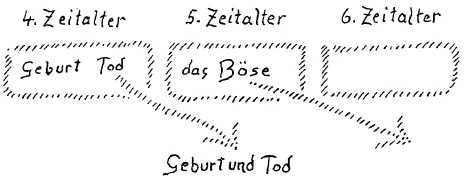
[ 35 ] Just think what an unpleasant truth that is! One might say: It is still acceptable that what is important in the fourth post-Atlantean epoch is for the human being to become thoroughly acquainted inwardly with birth and death, and then to grasp birth and death in a cosmic sense, just as I have described to you in the Conceptio immaculata and in the Resurrection, in the Mystery of Golgotha. That is why the birth and death of Christ Jesus stand before humanity in the fourth post-Atlantean epoch, because birth and death were what was particularly important in the fourth post-Atlantean epoch.
[ 36 ] Now that the Christ is to appear once more in the Earthly realm, now that a kind of Mystery of Golgotha is to be experienced once more, evil will take on a significance similar to that of birth and death for the fourth post-Atlantean epoch. In the fourth post-Atlantean epoch, Christ Jesus developed his impulse for humanity on Earth out of death. And one may say: Out of that death came what flowed into humanity. — Thus, in a strange, paradoxical way, the humanity of the fifth post-Atlantean epoch is led, through the experience of evil, toward the renewal of the Mystery of Golgotha. Through the experience of evil, the conditions are created for the Christ to appear again, just as he appeared through death in the fourth post-Atlantean epoch.
[ 37 ] To understand this—since we have already touched on the mystery of evil here and there—we must now speak a little about the mystery of evil in connection with the mystery of Golgotha. The next historical topic will be our discussion of the connection between the mystery of evil and the mystery of Golgotha.