

Historical Symptomatology
GA 185
3 November 1918, Berlin
Translated by Steiner Online Library
Ninth Lecture
[ 1 ] We would like to pick up where we left off yesterday. We essentially pointed out how, as a result of the facts I mentioned, the so-called “People of Christ” were, so to speak, pushed eastward, and how other facts revealed that from the heart of Europe—extending far to the west, incidentally—the true people of the Church, or one might say the peoples of the Church, developed. I then pointed out how the various struggles that arose precisely at the turn of the fifth post-Atlantean epoch—and immediately thereafter—were connected to this fundamental fact. But I also pointed out how, within the very region where the true church peoples had formed, because the Christ impulse was, so to speak, not allowed to continue working but was held in time—to be perpetuated through tradition and scriptural transmission—a fusion, a conflation, arose between Christianity and the politically and statically organized Roman papacy, the papal Church; and how individual other churches then positioned themselves within this papal Church. One can say that the other churches that have aligned themselves with it certainly exhibit major differences from the papal church, but that they also, in turn, have much in common with this papal church—at least in regard to matters that interest us in this context. These matters are such that they make even the Protestant state church appear, at least to us, closer to Roman Catholicism—the Roman Catholic Church—at least in this context. This is in contrast to, for example, the Orthodox-Catholic Papal State, the so-called Russian state church, in which, however, the status of a state church was never the essential point, but rather the way in which the Christ impulse, continually at work, asserted itself through the Russian people. I then showed you how this bringing down of the Christ impulse into purely worldly affairs, into the affairs of sensory reality, resulted, in the extreme, in the Jesuit Constitution. And I then showed you how, as the opposite of the Jesuit Constitution, there emerges what one might call Goetheanism.
[ 2 ] This Goetheanism, as I told you, seeks to bring about the opposite movement, one that is somewhat similar to Russian Christianity, namely: to elevate that which is here on the physical plane into the spiritual worlds. So that, despite all the circumstances on the physical plane here, the soul connects with the impulses that are held within the spiritual world itself—impulses that, unlike in Jesuitism, are not directly brought down into sensory reality, but are brought down only through the soul. Goethe, true to his nature, rarely spoke of his most intimate thoughts on these matters. But if one wishes to get to know him in this regard—Goethe himself—one may always refer back to that passage in *Wilhelm Meister* to which I have already alluded in another context: the passage where Wilhelm Meister arrives at the castle of a nobleman and is shown, among other things, the picture gallery. The arrangement is such that this picture gallery actually depicts world history, and, fundamentally, within world history, it depicts the religious development of humanity. So Goethe actually intends to portray—it is a poetic representation of a great idea—how Wilhelm Meister is guided through a picture gallery that illustrates the religious development of humanity. The guide leads Wilhelm Meister up to a certain point: the narrative had reached the destruction of Jerusalem, and Wilhelm Meister then noticed—and pointed out to the guide—that the depiction of the life, as he put it, of the divine man who had worked in Palestine immediately before the destruction of Jerusalem was missing. Wilhelm Meister was then led into a separate second room, where what was not shown in the first room could be displayed. The first room depicted the development of humanity through the various religions up to the destruction of Jerusalem. Thus, the entire life—as it is called there—of the divine man, Jesus Christ, had been omitted. In the second room, he is shown the life of Jesus Christ up to the Last Supper. And now it is explained to him: “Yes, look—all those various religious impulses up to the destruction of Jerusalem, which you saw in the first room, concern people insofar as they are members of the people to which they belong. That was folk religion, ethnic religion. But what you saw in the second room concerns the individual; it speaks to the individual human being.” In a sense, this is a private matter for the individual. It can only be related to the individuality of the single person. It cannot be a national religion; it speaks to humanity as a whole.
[ 3 ] Then Wilhelm Meister was still missing the story of Jesus Christ, from the Last Supper through his death and beyond. He was then led into a third, completely secret chamber, where this, too, was shown to him. But at the same time, it was pointed out to him that this was such an intimate matter that one actually had no right to portray it as it is usually profaned and presented to the outside world. It must speak to the very innermost being of man.
[ 4 ] Now one might rightly observe: What was still the case in Goethe’s time—that the actual story of the suffering of Christ Jesus should not be depicted externally—no longer applies today. We have gone through many other phases of development since that time. But I would like to say: Goethe’s entire attitude toward this matter is evident from what has just been stated. — Goethe makes it quite clear that he wishes to carry the Christ impulse into the innermost depths of the soul; that he does not wish to blend it with what is outwardly popular, and certainly not with the external structure that unfolds on the physical plane; rather, he seeks a direct relationship between the individual human soul and the Christ impulse. Goethe tends toward seeking a spiritual relationship between the individual human soul and the Christ impulse. This is of great significance for understanding not only Goethe but also Goetheanism. For if one can speak, as I have spoken to you these past few days, in such a way that Goethe and the whole of Goetheanism actually stand isolated from external culture, one cannot say the same with regard to ongoing evolution when one considers the more intimate religious progress of civilized humanity. In a certain sense, Goethe himself represents the continuation of something else. But we will only understand this—how Goethe, in a certain sense, stands in contrast to everything else that appears in Central European church life—when we now consider a third impulse.
[ 5 ] Such a third impulse lies further to the west. So: the People of Christ, the Church’s people, and now a third impulse that also, in a certain way, impels the nations—one cannot quite say “inspires,” but rather “impels.” That is how it is, my dear friends. One must say: How exactly that which eventually emerged—in its most extreme form as Jesuitism, as this military call to arms of the Generalissimo Jesus Christ—came about has deep roots in the very essence of the civilized world. One cannot understand this essence without looking at something that lies further back in the historical development of humanity but has continued to exert an influence. You are well aware from secular history and the history of religion that, among the various forms in which Christianity made its triumphal march—if I may put it that way—from East to West, there were those of Arianism and Athanasianism. Those peoples—the Goths, the Lombards, and even the Franks—who initially participated in various ways in what is incorrectly, yet nonetheless, called the Migration Period, were originally Arians.
[ 6 ] Well, the doctrinal difference between the Arians and the adherents of the Athanasian Creed is of little interest to you today, but it did play a certain role, and we must nevertheless address it. The dogmatic difference is precisely this: based on a certain worldview, Arius opposed Athanasius in particular in Alexandria. Specifically, Athanasius held the view that Christ is a God like the Father-God—that is, that the Father-God exists and that the Christ-God is of the same nature and essence as the Father-God, having been of the same nature and essence as Him from eternity. This view was subsequently adopted by Roman Catholicism, for Roman Catholicism still professes the faith of Athanasius today. Thus, with regard to Roman Catholicism, it can be said that it is founded on the belief that the Son is eternal and of the same nature and essence as the Father.
[ 7 ] Arius opposed this view. Arius believed that one could only say that there was a supreme God, the Father, and that the Son—that is, Christ—was indeed from the Father before time began, but was nonetheless created. Thus, he was not of the same nature and essence, but rather something that had first developed out of God the Father—something that had emerged from God the Father as a being closer to humanity than God the Father Himself, as a being that, in a sense, serves as a mediator between God the Father, who dwells on high and is initially beyond the reach of human cognitive faculties, and that which human beings find within themselves.
[ 8 ] Yes, as strange as it may sound, this seems at first glance to be a dogmatic difference. It is a dogmatic difference only for people today; it was not merely a dogmatic difference in the first centuries of Christian development. For Arian Christianity—which was entirely based, entirely built upon the foundation I have just explained to you, namely, the relationship of the Son to the Father—this Arian Christianity instinctively struck the people I have mentioned—the Goths, the Lombards, all those peoples who, after all, initially succeeded Roman rule following the decline and fall of the Roman Empire. They were instinctively Arians. As you know, Ulfilas translated the Bible; his translation clearly shows that he himself was an Arian. The Goths, the Lombards, and so on—when they came to Italy—were Arians, and it was only when Clovis converted to Christianity that the Franks converted to Christianity. In a certain sense, they outwardly adopted—though this was not in keeping with their inner convictions, for inwardly they had also been Arians in the past—the Nicene Creed. And when Christianity then came under that banner—whose principal champion was Charlemagne—everything was brought into line with the Athanasian Creed, thereby facilitating the transition to the Roman Papal Church. And a large portion of the original peoples—the barbarian peoples, the Goths, the Lombards, and so on—were, in fact, wiped out; whatever did not perish as a people was then driven out and eradicated by the Athanasianists. Arianism itself continued to exist as a sect, but it disappeared as a popular religion in its immediate, practical form.
[ 9 ] Now one must raise the question—actually, one must raise two questions. First: What exactly is this Arianism, as opposed to the Athanasian Creed? — And the second question is this: Why did Arianism disappear within the course of European development, at least as far as is outwardly visible in the historical manifestations? — This is an extraordinarily interesting development. In response to the question, “What exactly is Arianism?” one can only say: — : It is, in a sense, the final offshoot, the last tendril of those worldviews which, when they sought to look up toward the divine, still attempted to find a connection between the outer, sensory world and the spiritual-divine, and which still felt a need to truly link the sensory realm upward to the spiritual-divine. One could say: In Arianism, the same impulse still lives on in a somewhat more abstract form—but only as an impulse, not as sacramentalism and not as a cult—as it does in the Russian Christ-impulse. This particular form of the Christ-impulse had to be rejected precisely because it was not intended for the peoples of Europe. And it was also eradicated by those who became Athanasians, precisely because it was not intended for the peoples of Europe.
[ 10 ] If one wishes to examine these matters more closely, one must first take into account the original mental dispositions of the various segments of the European population. You see, this original state of mind of those segments of the population that succeeded the Roman Empire—who, as is often said (though this is not true, but I cannot correct the history at this moment)—are said to have entered the Roman Empire and so on, —that is, those about whom we know only that they succeeded the Roman Empire—this mental disposition of the so-called Germanic peoples is actually rooted in a different foundation. These peoples came from a wide variety of directions and intermingled with another indigenous population of Europe, a certain population that is not incorrectly referred to as the Celtic population. Traces of this Celtic population still exist here and there in certain ethnic groups today. Nowadays, when there is a desire to preserve everything in terms of ethnic identity, people also seek to preserve what is Celtic—wherever it is found, or at least wherever they imagine it to be found—in some way or another. But one can only truly conceive of the ethnic fabric of Europe by imagining a primordial European culture that is Celtic, into which the other cultures—Germanic, Romance, Anglo-Saxon, and so on—then turn and develop.
[ 11 ] Well, in its most original form, the Celtic culture has survived the longest in the British Isles, particularly in Wales. There, too, it has preserved its distinct character the longest. And just as a certain kind of religious sentiment—I would say—was pushed eastward, so that the Russian people became a Christian people, so it came about through certain events, which you can read about in any history book, or at least in some history books, that a certain impulse in the West—originating specifically from the British Isles—manifests itself as an aftereffect of ancient Celtic culture. Well, it is this aftereffect of ancient Celtic culture that ultimately shaped the structure of religious life in the West just as much as the factors I have described for the East and for Central Europe.
[ 12 ] If one wishes to understand these things, one must consider the following: What kind of people were the Celts, actually? — They differed in many ways, but they shared a certain common trait. And this common trait was that, in their spiritual life, they had little interest in the connection between nature and humanity. In a certain sense, they conceived of human beings as isolated from nature and standing before their own souls. They were interested in everything human, but not in how human beings are united with nature, or how they are connected to nature. Whereas, for example, in the East—where the complete opposite of Celtic culture has developed—one always feels, through and through, the connection between human beings and the entire world, including nature; one feels, as it were, that human beings emerge from nature, as I have also described in Goethe’s work—the Celts had little sense of the connection between human nature and the rest of nature, that is, cosmic nature. On the other hand, they had a certain strong sense of coexistence within the social community, but in such a way that all this coexistence among the ancient Celts was based on the existence of those who commanded and those who were commanded, of leaders and those led. That is the essential point—the anti-democratic, the aristocratic element. This is something that actually traces back in Europe to the ancient Celtic era. And the organized aristocratic element—that is the essential point—the organized aristocratic element.
[ 13 ] Now there is, I would say, a certain resurgence of this aristocratic Celtic kingship element. The king, who is the leader, organizes his subordinate leaders and so on around him—this grows out of Celtic culture. And in a sense, the last of such leaders—who, in his own intentions, still drew upon the original impulses—is considered to be King Arthur with his Round Table in Wales, with his twelve knights, of whom it is said—though this, of course, must not be taken literally—that they had to slay monsters and defeat demons. All of this still points to the time of ancient coexistence with the spiritual world.
[ 14 ] The entire way in which the Arthurian legend took shape—everything that has become part of the legend surrounding King Arthur—shows how the Celtic element lived on in the monarchy even in this continuation of it. And from this perspective, there was an understanding of the commanding, directing, and organizing aspects of the royal element.
[ 15 ] Now the following process took place: The Christ—who was the Christ of Ulfila, the Christ of the Goths, and who was deeply felt in the spirit of Arianism—was a Christ for all people; for people who, in a certain sense, felt themselves to be equal, for people who did not make aristocratic or aristocratizing distinctions. At the same time, he was an aftereffect—a final aftereffect—of what was felt in the East as the interplay between what human beings on Earth experience with the entire cosmos and also with nature. Nature had, so to speak, been cast out of that constitution which lived within the social structure of the Celtic monarchy.
[ 16 ] These two things—I cannot discuss them in detail, but in principle—first came together in Europe and merged with a third. They converged in such a way that Arianism initially gained ground; but because it was still an aftereffect of that which links nature and humanity, it was not understood by those who were under the influence of purely Celtic impulses—as well as in the continuation of the Germanic and Frankish peoples, and so on; they did not understand it; they understood only that which was part of their royal structure. And thus arose, at first, the impulse that continued to resonate in the Old Saxon Gospel poem *Heliand*: to reinterpret Christ himself as a warrior king, a royal leader, a prince who has his men. Out of a lack of understanding of what was still coming over from the East, and out of the compulsion to venerate that which is to be revered as a king—as a secular king at the same time—this reinterpretation of Christ in the form of a military king arose.
[ 17 ] Now a third factor came into play. It came from the south, from the Roman Empire. The Roman Empire had, after all, already been infected by these—what one might perhaps call today “state-like” elements. The Roman Empire—it was not a state, it was an empire, but perhaps it is easier to understand today if one says “state-like entity”—this Roman Empire is, in a certain respect, very similar—yet just as different as the various territories are geographically separated, with different conditions giving rise to the social structure— it is, though arising from different foundations, nevertheless in a certain sense quite similar to what emerged from the royal system. It did, after all, evolve from the republic into the imperial system, but it is precisely an empire similar to what grew out of the various kingdoms in Celtic culture—only with a Germanic flavor.
[ 18 ] Now, what emerged from the south of the Roman Empire—in terms of the way of thinking and the way of feeling toward social life—could never truly connect internally with anything that still came over from the East as an old, instinctive impulse, such as Arianism, precisely because it focused on a structure located externally on the physical plane. That required something—forgive the paradoxical term—that is incomprehensible, something that is decreed. Just as decrees are issued in a monarchy or an empire, so too were they issued in the papacy. What Arius taught can be brought close to people by appealing to certain feelings that were, after all, most strongly present in the peoples I have spoken of; after all, aspects of it are present in all people. What is contained in the Athanasian Creed speaks very little to human understanding and feeling; it must be decreed if one wishes to incorporate it into the community of the people—it must be made into law. Just as secular laws are made, so too must the Athanasian Creed be made into law. And that is indeed how it turned out. The utterly incomprehensible, peculiar notion of the equality of the Son with the Father—that both have existed from eternity, both are equal to God, and so on—was later interpreted in such a way that people said one need not understand it, but must simply believe it. It is, after all, something that can be decreed. The Athanasian Creed could be decreed. And—by being articulated and by being directly dependent on decree—it could also be incorporated into a political church organization. Arianism spoke to the individual, to the single person. It could not be integrated into a church organization. Arianism could not be decreed. But decree was what mattered, based on those documents I have spoken to you about.
[ 19 ] Thus, the movement that emerged from the south—rooted in Athanasianism—grew, driven by a tendency toward decree-making and an instinct for organization, with a leader at its head and twelve deputy leaders... [gap].
[ 20 ] In Central Europe, these elements became intertwined. In British Western Europe, however—and later in America as well—a certain remnant of the old mindset remained, as seen in the principality, where aristocratic elements were present, and where the social order was organized in such a way that the spiritual was drawn into the social realm. You can see that the spiritual was conceived as an integral part of social life in the Arthurian legend, which tells how the knights of the Round Table had to defeat monsters, wage war against demons, and so on. The spiritual realm thus played a role there—it played such a role that one can only cultivate it not by decree, but by making it a part of nature, by organizing it. And so it came to pass that, while the church-going people developed throughout Central Europe, toward the west—namely toward the English-speaking population—there arose what we might now call, to provide a third designation for this current, the “Lodge people,” or “Lodge peoples,” among whom a certain inclination toward this had originally existed: to form societies and to foster within those societies a spirit of organization. Ultimately, organization has value only if it is achieved through spiritual means, without the other party noticing it; otherwise, one must simply issue decrees. Decrees were issued in Central Europe; lodge-based rule was attempted to a greater extent in what then developed as a continuation of Celtic culture among the English-speaking population. Thus arose the lodge people or lodge peoples, who essentially embody within themselves that which does not organize all of humanity, but rather unites it socially and through orders. This order-based synthesis lies in this continuation of what is linked to the Arthurian legend. The fact is that in the course of world history, things are always intertwined. One can never understand a development if one merely imagines that what follows arises from what preceded it in a linear fashion. In the course of development, things intertwine. And so it is a remarkable fact that, with regard to the human mode of thought, with regard to everything that works within the human soul, this “Logen” principle—which, as you know, went on to produce its monkey-like caricature in Freemasonry—is in turn intrinsically related to Jesuitism. So that, however hostile, however bitterly hostile—if I may use that trite expression—Jesuitism may be to this Masonic movement, you know full well that, in terms of the form of imagination, there is an immense similarity. And in Ignatius of Loyola, a Celtic element of blood flowing through his veins certainly contributed to what he accomplished, to the magnificent things he created.
[ 21 ] Now you see: In the East, the People of Christ has arisen; it possesses the ongoing Christ impulse. For people in the East, it is entirely natural—as they go about their lives—that something continually flows into their souls, and that is the Christ impulse. For the churchgoers of the central European countries, this has become dulled or numbed, because the Christ impulse was shifted to the beginning of our calendar, and later it was followed by decrees—state decrees—and a traditional, principle-based perpetuation. In the West, within the lodge system, the Christ impulse became questionable—at first quite questionable—and was further dulled there. And so, from the forms of thought that originally truly stemmed from this lodge impulse—which comes from Celtic culture and is the last remnant of that culture—there emerged what is called the modern Enlightenment, along with deism. And it is extraordinarily interesting to observe just how vast the difference is between the way a member of a Central European church community relates to the Christ impulse and the way a member of the British Empire does. But I ask you not to judge this by individual cases, for of course the church impulse has also spread to England, and one must take things as they truly are: one must consider those people who are connected to what I have just described as the “Lodge impulse,” which has, however, also permeated state life throughout the West. From this, a different relationship to Christ has developed,
[ 22 ] You may ask: What is the relationship of a member of the Body of Christ to Christ? — Well, he knows: When I truly experience myself in my soul, I find the Christ impulse—for it is there within, and it is constantly at work there. The member of the church community, who speaks much like Augustine, who in his later years, when asked, “How do I find Christ?”—replied: “Just as the Church presents Christ to me. The Church tells me who Christ is. I can learn this from the Church, for the Church has preserved through its tradition what was said about Christ in the beginning.” — The one who belongs to the “people of the lodge”—and these are truly the members of the “people of the lodge”—asks about Christ in an entirely different way, neither like the “people of the Church” nor like the “people of Christ,” but says: “Yes, world history speaks of a Christ who once existed. Is it reasonable to accept such a Christ?” How does the influence of Christ in world history justify itself before reason? — This is, in essence, the Christology of the Enlightenment, the Enlightenment that demands that Christ justify himself before reason.
[ 23 ] Now, in order to understand what is at stake here, one must realize that it is possible to come to God at any time without having the Christ impulse. One need only be lacking in some way—after all, an atheist is a person who also has some kind of physical illness within them—; but one can, through speculation, through mysticism, or whatever means, come to God, come to the point of accepting a God in the world. This, then, is what is known as “primitive deism,” the faith of the Enlightenment. One arrives at this, initially, by a direct path: to the Enlightenment belief that there is a God.
[ 24 ] But now the issue at hand concerns those who have emerged from the ranks of the Lodge: to find it reasonable to accept Christ alongside the universal God. One can choose various figures who are characteristic of these matters. I have chosen Herbert Cherbury, who died in 1648, the very year of the Peace of Westphalia. He sought to come to terms with the Christ impulse in a rational way. A true member of the Russian people, for example, cannot conceive of finding the Christ impulse reasonable at all. For him, this is roughly equivalent to someone demanding that he find the presence of the head on both shoulders reasonable. One has a head; likewise, one has the Christ impulse. But what is demanded by people like Cherbury is so different that the question arises: Is it reasonable to accept a Christ in addition to the God to whom enlightened thinking leads? One must first study human beings, rationally, in order to actually find all of this justified.
[ 25 ] Now you might say: “But of course not every member of this ‘lodge people’ does that!” — Of course not every member of the “lodge people” does that. Philosophers do this in explicit terms; other people don’t think that much, but in their instincts, in their feelings, and in their subconscious conclusions, everyone who is in any way connected to the impulse of the “Logenvolk” does this. The man I am speaking of here initially said to himself: “Let us examine all the individual religions to see what they have in common.” — That is, in fact, a typical trick of the Enlightenment. Because one does not wish to reach the spiritual—at least as far as the Christ impulse is concerned—but only an abstract God of deism, one asks: Is it natural for human beings to discover this or that? — So Cherbury, who had traveled extensively, first sought to learn about what the various religions have in common. He found a great deal in common. But then he attempted to summarize what he had found to be common to the religions into five propositions. We must pay particular attention to these five propositions, for they are quite important.
[ 26 ] The first sentence is: There is one God. — Because the various peoples of the most diverse religions instinctively arrive at the conclusion that there is one God, he finds it in keeping with nature to accept that there is one God.
[ 27 ] Second: God demands worship. — Yet another common feature of religions.
[ 28 ] Third: This devotion must consist of virtue and piety.
[ 29 ] Fourth: Sins must be repented of and atoned for.
[ 30 ] Fifth: There is a justice that rewards and punishes in the Hereafter.
[ 31 ] As you can see, there is nothing in there of any “Christ impulse.” At the same time, however, these five sentences contain everything one arrives at when one builds solely on what one had just sought to build upon out of the religious impulse, out of the Masonic impulse. This way of thinking continued to develop as the Enlightenment. We then find in Hobbes, Locke, and others that they repeatedly attempted to ask themselves: Yes, but there is a tradition concerning Jesus Christ. Is it reasonable to accept such a Jesus Christ? — And finally, they bring themselves to say, in fact: If one considers what is written in the Gospels, what has been handed down about Jesus Christ, it corresponds to what, fundamentally speaking, all religions have in common as their core principles. Therefore, it gives the impression that Christ simply wanted to summarize what all religions have in common—as if there had been a God-filled—one can imagine this to a greater or lesser extent—personality who taught the best of all religions. — That was ultimately considered reasonable. And certain individuals, such as Tindal, who lived from 1657 to 1733, wrote a book titled *Christianity as Old as Creation*. This book, *Christianity as Old as Creation*, is, in a sense, very important for understanding the essence of the Enlightenment—which was later trivialized by Voltaireanism and so on. It was important to Tindal to show that, fundamentally speaking, all people—the better people, at least—have always been Christians, and that Christ simply synthesized the best of the religions.
[ 32 ] As you can see: Christ is brought down from his lofty position and made into a teacher. Christ becomes a teacher—whether you call him the Messiah, the Master, or whatever you like—he becomes a teacher. Christ becomes a teacher. What matters is not so much the fact of Christ himself, but rather that he stands there and teaches a certain religious doctrine—one that represents the most precious and universal aspect of the religious beliefs shared by the rest of humanity.
[ 33 ] What I have presented here can, of course, take on a wide variety of nuances, but the basic tone remains the same: Christ is a teacher. And now, when we consider the characteristic types—which, of course, are then attenuated in the most diverse ways—of the people of Christ, the people of the Church, and the people of the Lodge, and when we seek the reality behind what is often very, very superficial, then we can say of the people of Christ: Christ is the Spirit; thus, fundamentally, He has nothing to do with any institutions on the physical plane. The only mystery is that He once existed in human form. — For the Church people: Christ is the King. This can be nuanced to a greater or lesser extent: Christ is the King. — This also lives on among the members of the Lodge, but as it develops further, as it drives something out of itself: Christ is the Teacher.
[ 34 ] You see, one must take this nuance into account as it permeates European consciousness, for this nuance is deeply, deeply rooted—not merely in individual people, but deeply, deeply in what has developed spiritually in Europe during the fifth post-Atlantean epoch, and also in much of what has developed socially. These are the most fundamental nuances of the Christ impulse. One could say much more about these things, but due to time constraints, I can only offer you a brief outline today.
[ 35 ] Now, when we look at the three previous stages of human evolution, we can say, first of all: Humanity as a whole is developing in such a way that it now lives in the feeling soul from the 28th to the 21st year. Each individual human being develops in such a way that humanity, in the fifth post-Atlantean epoch, now expresses the consciousness soul. And then there is a third evolution within the national souls, which I told you about yesterday. Now, in connection with the national souls, the very things I have just described are unfolding. On the one hand, you have the historical facts, which are at work; and on the other hand, you have the national souls with their religious nuances. This interplay causes the Christ-people to develop with the impulse “Christ is the Spirit,” the church-people with the impulse “Christ is the King,” and the lodge-people with the impulse “Christ is the Teacher.” This depends on the nuances of the people. That is the third evolution.
[ 36 ] Now, in actual external development, one thing always flows into the other. Of course, in reality, one thing influences the other through the others; one thing always flows into the other. Isn’t that so? For example, if you were to ask me right now: Who belongs to the “Logenvolk,” who adheres to this Enlightenment deism? — Well, strangely enough, it has turned out that Harnack in Berlin is the purest example of this Enlightenment deism! He is a much purer “type” than anyone you might find across the Channel. All of this gets mixed up in modern life. But if one wants to understand these things, if one wants to trace them back to their origins, then one must not stop at outward appearances; rather, one must be clear that it is all interconnected in such a way that the third evolutionary current—which is linked to ‘the folk’—is precisely what I have just described to you here. But it is always present—because the other evolutionary currents are also there—the reaction, the surge of the conscious soul against this folk element. And this manifests itself in the most diverse ways. It surges, I might say, from this or that center. And such an upsurge is also Goetheanism, which actually has nothing to do with all that I have just described, and yet, when viewed from one side or the other, has a great deal to do with everything. For it develops early on as a parallel current to what I have described to you as the Arthurian current—the Grail current; the Grail current, which is the exact opposite of the Arthurian current. The Grail current develops in such a way that whoever wishes to visit the Temple of the Grail must travel along inaccessible paths, sixty miles long; that the temple lies completely hidden; and that one learns absolutely nothing there unless one asks. In short, this entire Grail atmosphere is one of establishing a connection between the innermost part of the human soul—where the conscious soul awakens—and the spiritual worlds. It is, if I may say so, an artificial attempt to direct the sensory world upward toward the spiritual world, something that is sought instinctively among the followers of Christ.
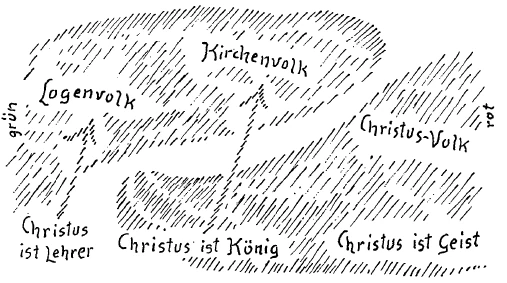
[ 37 ] If we therefore wish to trace this remarkable interplay of European religious impulses in the form of a diagram, we can say: We have an impulse—it is the one that lives instinctively, still in its embryonic and undeveloped state, within the people of Christ (see diagram, red). Then the thinkers—when they become philosophers like Soloviev—come along to take this Christ impulse for granted.
[ 38 ] Central Europe, due to its ethnographic and ethnic conditions, is not naturally inclined to accept this; it must be brought about artificially. It is the case, then, that what acts upon Europe through the Grail current is what one might describe—I would say—as a bending of the vortex (see drawing, red at the bottom), acting as a Grail current. This radiates throughout Europe, but it must be a Grail current; therefore, it is not limited to any particular people. Goethe lived in this Grail mood, albeit very strongly in the deepest recesses of his consciousness. Seek out this Grail mood; you will find it everywhere. In a certain sense, he does not stand alone; through this, he connects with what came before. He has nothing to do with Luther, with German mysticism, or with anything that preceded him. This influences him, to a greater or lesser extent, in such a way that it shapes him, that it makes him a citizen of the world. That which leads him to distinguish three stages—the stage of folk religion, the stage of the religion of the sages, which is presented to the individual in the second chamber, and the most intimate religion, which is only intimate, in the third chamber, speaks to the soul and contains the mysteries of death and resurrection—that which leads him to elevate in this way, not to lower in a Jesuitical manner, but to lift the religious element active in the sensory world up to the spiritual heights: that is the Grail mood. And the Grail mood—as paradoxical as that may sound, especially today—is present in Russism; the Grail mood is very much present in Russism. And it is precisely this invincible Grail mood, present in Russism, that forms the basis for the very future of Russian culture in the sixth post-Atlantean epoch, of which I have spoken so often.
[ 39 ] This is what one must now take into account when considering one side of the issue. And if we consider the other side, we find there everything that neither accepts the Christ impulse—as in the East, in a sense like an invasion—nor regards it as something that lives on through tradition and scripture, but rather accepts it as something rational. This is what manifests itself within Freemasonry and, in particular, within all its branches and offshoots. I will denote it with a different color (green). This is what then becomes “Peolized” in the West—the outermost offshoot of Arthurianism, that which is embodied in King Arthur. And just as the Christ impulse of Russism continues in Grailism and, I would say, radiates into all good, aspiring people of the West, so too does that other impulse continue and flow into all people, within the church community, taking on the hue of Jesuitism. Even if Jesuitism, as I said, is diametrically opposed to it, that is irrelevant; something can be diametrically opposed to the very form of conception that gives rise to it. It is a historical fact that the Jesuits have not only infiltrated all the lodges, and that high-ranking Jesuits are connected with high-ranking members of the lodges, but it is also true that both—even if among different peoples—have the same roots, even though one has developed toward the papacy and the other toward freedom, rationality, and the Enlightenment. This now gives you a kind of picture of what I might call the workings of the evolution of the consciousness-souls. For when I previously described to you the three stages from East to West, that was based on folk traditions and ethnic characteristics. The fact that, through their interaction, these processes take on such forms—that in the West they led to the Enlightenment—is brought about by the fact that the evolutionary current of the consciousness soul lives within the individual human being.
[ 40 ] But then we have a third current. This is the one that is inherent in all of humanity, by virtue of which all of humanity is in its developmental age, becoming younger and younger, and is now in the age of the feeling soul, from the age of 28 to 21. This applies to all of humanity. When we describe the first current—the ethnic one—in which folk religions arise: the religion of Christ, the religion of the church, the religion of the lodge—we are taking the perspective of folk development, which I usually classify as follows: Italian peoples = the feeling soul; French peoples = the intellectual or emotional soul; and so on. When we describe what has been developing as the “conscious soul” within each individual since the fifth post-Atlantean epoch, we are primarily dealing with that which flows into the religious sphere in this way. But from there, interaction also begins with the other aspect—with what constitutes evolution in all human beings: the evolution of the soul of feeling, which runs parallel to and is far more unconscious than the evolution of the soul of consciousness.
[ 41 ] If you study how a person like Goethe—albeit often guided by impulses from the subconscious, yet still very consciously—chose his religious path, you will come to understand the workings of the conscious soul. Yet alongside this, another element prevails in modern humanity—one that exerts a very strong influence through instincts and subconscious impulses, but is intimately linked to the development of the feeling soul, and that is what must be called the development toward socialism, which is now at the beginning of its course and which, in a certain sense, will find its conclusion in the way I have described. Certainly, the impulses are always provided, as I have already said, by the consciousness soul; but the fact that socialism is the mission of the fifth post-Atlantean epoch and will come to a conclusion by the fourth millennium stems, for all of humanity, in a sense, from the fact that it lives in the age of the feeling soul from the 28th to the 21st year. That is inherent in it. Socialism is not a party ideology, although there are many parties within social organizations; yet these are parties within the social current. Socialism is not a party matter as such; rather, socialism is something that will inevitably develop gradually within humanity during the fifth post-Atlantean epoch. So that when this fifth post-Atlantean epoch is essentially complete—insofar as it pertains to the civilized world—the instincts for socialism will be present in human beings.
[ 42 ] Now you can imagine: Everything I have told you is at work together in this fifth post-Atlantean epoch. All the things I have described are at work here. But there is also something else at work, something that lies essentially in the depths of the subconscious: the tendency to find the proper socialist organization of the entire world right up into the fourth millennium. From a deeper perspective, one really need not be surprised that socialism gives rise to all sorts of bubbles, which can also be very harmful, when one considers how its impulses arise from the depths of the subconscious; when one considers how all of this is seething and churning, and how the time is still far, far removed from the epoch when it will find its proper course. But it is rumbling—and not even in human souls at this point, but rather in human natures, and above all in human temperaments. And for what is rumbling within human temperaments, for that one finds theories. These theories—if they are not expressions, as we have them in spiritual science, of what exists in the depths of reality—these theories, whether they be Bakuninism, Marxism, Lassallism, or whatever—it doesn’t matter at all; they are all masks, embellishments, things that people superficially superimpose upon reality. One can only see the realities, after all, when one looks as deeply into human development as we are attempting to do through these reflections.
[ 43 ] And even what is happening on the surface right now is merely a tumultuous prelude to what ultimately lurks within everyone—and indeed, one might say, not so much in their souls as in their temperaments. They are all socialists. You often don’t realize how strongly socialist you are, because it lurks in your temperament, deep in the subconscious. But it is only by knowing such things that one can rise above that nebulous, ridiculous search for self-knowledge that peers into the human interior and finds there—I won’t describe it—a formless caput mortuum, an abstraction. The human being is a complex creature. You can only come to know them by coming to know the whole world. That is what must be taken into account.
[ 44 ] Consider, from this perspective, the world and humanity as they have developed during the fifth post-Atlantean epoch. Now ask yourself: In the East, we have the Christ-people with the most essential impulse: Christ is Spirit. — It is inherent in the nature of this people that what could only have occurred as a precursor through other European cultural influences now enters the world through Russicism—with instinctive, elemental force and historical necessity. This mission has been entrusted to the Russian people as a nation: to develop the Grail entity as a religious system up to the sixth post-Atlantean epoch in such a way that it can then become a cultural catalyst for the entire Earth. It is no wonder that when this impulse intersects with the other existing impulses, those other impulses take on strange forms.
[ 45 ] What are the other impulses? Well: Christ is King, Christ is Teacher—yes, one can hardly go as far as “Christ is Teacher,” because, as I have already said, the Russian mind does not really understand what that means—that Christianity can be taught, that it is not experienced as something within one’s own soul. But “Christ is King”—the Russian people have, after all, grown up with the idea that “Christ is King.” And here we see the clash of what has ever least belonged together in the world: the clash with tsarism, the Eastern caricature of the principle of establishing earthly rule in the realm of religion. “Christ the King”—and the Tsar is his representative: this coupling of that which is Western, expressed in Tsarism, with that which has absolutely nothing to do with it—with that which lives in the Russian national soul and in the Russian spirit!
[ 46 ] In external physical reality, the very defining characteristic is that those things which often have the least to do with one another internally are bound to clash externally. Tsarism and Russianness have always been worlds apart; they did not belong together. Anyone who understands the Russian essence—especially in religious terms—will therefore have to regard the stance toward the elimination of tsarism as something self-evident for the moment when it is truly necessary. But consider that this “Christ is the Spirit” is the innermost reality, that it is connected with the noblest culture of the conscious soul, and now, while socialism is rumbling, it clashes with what lives in the feeling soul, just as I have described it. No wonder that the spread of socialism in this eastern part of Europe is taking on forms that are utterly incomprehensible—an inorganic interplay between the culture of the conscious soul and the culture of the feeling soul.
[ 47 ] Much of what happens in external reality will become clear and understandable to you once you consider these inner connections. And it is essential, first and foremost, for humanity today and for its future development, that humanity not, out of convenience and laziness, overlook what is, after all, part of its very nature: to understand the contexts in which we now find ourselves. People have not understood this, nor have they wanted to understand it. This has led to the European chaos—now linked to that in America—and to the terrible catastrophe. We will not emerge from this catastrophe until people are willing to understand themselves as they are—but precisely as they are within the current course of historical development, within the present historical epoch. This is what must be recognized.
[ 48 ] That is why it is so important to me that people understand how what I envision as the anthroposophical movement should truly be linked to an understanding of the great evolutionary impulses of humanity, and to what the present time is demanding of people right now. Of course, it is deeply painful to see how little the present day is actually inclined to understand and take seriously the anthroposophical worldview from this particular perspective. |
[ 49 ] From what I have said, you will see how what is emerging as socialism—and I would now like to supplement what I said last week in connection with the *Philosophy of Freedom* with some general considerations—is a phenomenon in humanity that is rooted in human nature in the most general sense and is spreading ever farther and farther. The reactions taking place today against it are, for anyone who sees through these things, simply appalling. To anyone who sees through these things, it is clear that, no matter how tumultuous it may be, no matter how much it makes itself felt amid the clamour—this international element that is socialism, spreading across the entire earth—this is what holds the promise of the future, and that what is now emerging—the formation of all manner of national, tiny nation-states—and that this is what works against the evolution of humanity. It is a terrible resistance to the spirit of development of the fifth post-Atlantean epoch, as expressed in the words: “A state for every single nation.” — Of course, no one really knows where this is supposed to end, but it is simply said; well, it is simply said! At the same time, this is completely steeped in what leads back to the Arthurian impulse: completely steeped in organizational principles. The opposite of this is the Grail aspiration, which is so intimately related to the Goethean principles as I have described them to you—this Grail aspiration, which everywhere, in ethics, in science—everywhere toward the individual, which seeks above all to focus on the individual in his or her development, not on groups, which no longer have any significance today and which must be eliminated by the international socialist element, because that is the direction of development.
[ 50 ] It is also for this reason that one must say: In Goetheanism, in Goetheanism with all its individualism—as I have drawn out this individualism from Goethe’s worldview, as you can see in my early writings on Goethe, you can also observe it in my book *Goethe’s Worldview*—this individualism, which is, after all, a natural consequence of Goetheanism—in this individualism, which can only culminate in a philosophy of freedom, therein lies what must necessarily point toward what is taking shape as socialism, so that, in a certain sense, one can recognize two poles: on the one hand, individualism; on the other, socialism—toward which humanity is tending in the fifth post-Atlantean epoch. But these things must be properly understood. And this correct understanding is necessarily linked to gaining insight into what must accompany socialism if it is to truly proceed in the direction of human evolution. Today’s socialists, after all, still have no idea what is necessarily connected to true socialism—which will only reach a certain conclusion in the fourth millennium—and what must be connected to it if its development is to proceed correctly. Above all, this means that socialism must develop in tandem with a proper understanding of the nature of the whole human being—the physical, the soul, and the spiritual aspects of the human being. The nuances will be provided by the various ethnic and religious impulses; they will make their contributions so that the human being is understood according to this threefold structure: body, soul, and spirit. The East, together with Russia, will ensure that the spirit is understood. The West will ensure that the body is understood. The Middle will ensure that the soul is understood. But all of this, of course, is intertwined. It must not be schematized or categorized, but within all of this, the true principle, the true impulse of socialism, must first develop.
[ 51 ] What is this socialism? The true impetus of socialism lies in the fact that it truly leads people—as I described it recently—to realize brotherhood in the broadest sense of the word within the external social structure. True brotherhood has nothing to do with equality, of course. Just consider brotherhood within a family: if one brother is seven years old and the other has just been born, one cannot, of course, speak of equality. Brotherhood must first be understood. But that is also all that needs to be realized on the physical plane: in place of today’s state systems, organizations throughout the entire world that are imbued with brotherhood. In contrast, everything ecclesiastical and everything religious must be removed from external organization, from state organization, and from all state-like organizations. That must become a matter of the soul. It must develop through the completely free coexistence of souls. The development of socialism must go hand in hand with the most absolute freedom of thought regarding all religious matters.
[ 52 ] That is precisely what socialism to date, in the form of social democracy, has so blithely thrown out there that one can already say: “Religion is a private matter.” — But it upholds this about as much as a raging bull upholds brotherhood when it charges at someone. Naturally, there is not the slightest understanding of this, for socialism in its present form is itself a religion; it is practiced in a thoroughly sectarian manner and displays tremendous intolerance. Thus, parallel to this socialism, there must be a true flourishing of religious life, one based on the understanding that the religious life of humanity is a free matter for the souls working together on Earth.
[ 53 ] Now just think how infinitely much this has worked against evolution. There must always be a counterforce at first, so that progress can then be made in the direction of evolution for a time; then the counterforce strikes again, and so on. I have already discussed this with you in the context of the general principles of history: that everything exists only to die again. Just think how much opposition there has been to this parallel development of freedom of thought in the realm of religion and of outward, fraternal social life—which, if we are to speak of the state at all, can only develop within the state community! Within the state organization, religious life must not play any role at all, but only within the community of people living together as souls, in complete independence from any organization, if socialism is to prevail. How grievously this has been violated! “Christ is the Spirit”—and alongside this, that dreadful church organization of Tsarism! “Christ is the King” — an absolute entanglement of tsarism with religious convictions! And not only has the Church—the Roman Catholic Church itself—constituted itself as a political empire, but it has also found a way, particularly in recent centuries through the detour of Jesuitism, to infiltrate other empires and to help organize and permeate them. Or consider: how did Lutheranism ultimately develop? Certainly, Luther emerged from that impulse—as I once described him—and he is truly a spirit who looks with one face toward the fourth era and with the other toward the fifth, and in that sense embodies a contemporary impulse. He appears, but what happens then? Then what Luther intended in the religious sphere becomes intertwined with the princely interests of the individual German courts. A prince becomes a synod member, a bishop, and so on; thus, here too, that which must never be intertwined becomes intertwined. Or the permeation of the state principle, which permeates the external organization of the state, with the Catholic religious principle, as was the case in Austria—in the Austria that is now collapsing—to which, in essence, all of Austria’s misfortune can ultimately be traced. Under other auspices, notably under the auspices of Goetheanism, it would have been quite possible to establish order in Austria.
[ 54 ] That is one side of the coin. On the other hand, in the West, among the English-speaking population, there is a pervasive intermingling of Freemasonry with the monarchy. This is precisely what is characteristic: that the state organization in the West cannot be understood at all—and France and Italy are, after all, completely infected by it—without also taking into account its intertwining with Freemasonry, just as one must take into account its intertwining with Jesuitism or other influences in Central Europe. Thus, a terrible sin has been committed against that which must necessarily run parallel to socialism, and this must be taken into account.
[ 55 ] Another development that must proceed in parallel with the transition to socialism is, in the realm of intellectual life, the emancipation of all intellectual pursuits from dependence on the state apparatus. The absolute abolition of all institutionalization of science and everything connected with it. That is what is necessary. Those institutions of science scattered throughout the world, which are called universities, are the very things that stand most in the way of what is seeking to develop in the fifth post-Atlantean epoch. For just as freedom must prevail in the religious sphere, so too must the possibility arise in the realm of knowledge for a completely equal collaboration to emerge, so that everyone can have a share in the further development of humanity. If the socialist movement is to develop healthily, there must not be the slightest trace of privileges, patents, or monopolies in any branch of knowledge. Since we are still very far removed today from what I actually mean, it is probably not necessary for me to show you, in any particular way, how it is possible to abolish the militarization of science, and how it is possible to enable every person to play their part in evolution in this direction. For this will be linked to profound impulses that will develop within the educational system—indeed, in the entire relationship between human beings. But it will be the case that all monopolies, privileges, and patents relating to the possession of spiritual knowledge will fade away, and the only possibility that will remain is for each person to be able to bring the content of spiritual life to bear in every direction and in every field—just as it lies within them, just as strongly as it lies within them, and just as strongly as it finds expression within them. At a time when there is an ever-increasing tendency to monopolize fields such as medicine, for example, through university scholars, and when there is a desire to thoroughly organize everything—absolutely everything—in a wide variety of other fields as well, at such a time there is, of course, no need to discuss the details of spiritual equality, — for we are, of course, still very far from that, and most of us have plenty of time to wait until our next incarnation if we seek a complete understanding of what needs to be said regarding this third point. But of course, beginnings could be made everywhere.
[ 56 ] This is only possible if, as part of modern humanity and our times, one is aware of the prevailing trends; if one can specifically take a close look at this prevailing socialism and reconcile it with what must go hand in hand with it: freedom of religious thought and equality in the realm of knowledge. Knowledge must become as equal for all people as, according to the proverb, death makes everyone equal; for it leads in the future precisely into the supersensible world, into which death also leads. Just as one cannot monopolize or patent death, so too one cannot, in reality, monopolize or patent knowledge. And if one does so anyway, one does not produce bearers of knowledge, but rather those who have become precisely what today’s so-called bearers of knowledge are. Of course, this does not concern the individual in any way, just as the other does not concern the individual, but rather it concerns that which is significant for the age: the shaping, the social shaping of the age. Our era in particular—which witnessed the bourgeoisie gradually descending into decadence—has shown just how increasingly ineffective any rebellion against that which actually runs counter to evolution has become today. The papacy is decidedly opposed to evolution. When Old Catholicism rebelled against it in the 1870s, following the establishment of the dogma of infallibility—that crowning achievement of papal monarchism—it faced great difficulties and continues to face them to this day, even though it could render valuable service precisely in this rebellion against papal monarchism.
[ 57 ] If you look back on what I have said, you will find that there is currently something here on the physical plane that actually belongs within the souls and within the spiritual human being, whereas on the outer physical plane, brotherhood is actually striving to emerge. Something has asserted itself on the physical plane—it has organized this physical plane—that does not directly belong to the physical plane. Of course, it belongs to the physical plane insofar as human beings exist on the physical plane and it lives within their souls, but it does not belong there simply because people are organized on the physical plane. On the physical plane, for example, religions must be able to be solely communities of souls, not externally organized; schools, as such, must be organized quite differently; above all, they must not be state schools, and so on. All of this must be able to arise from the freedom of thought, from the individuality of the human being. Because, in reality, things intertwine, this can lead to situations such as the fact that, for example, socialism today is in many ways the opposite of what I have described to you today as its principle. It is tyrannical; it is power-hungry; it is that which would most like to take control of everything else as well. Inwardly, it is in reality the struggle against the unlawful prince of this world, for the unlawful prince of this world appears when the Christ impulse or the spiritual is organized externally according to state principles, when the external organization is not limited to mere social brotherhood.
[ 58 ] You see, when one addresses the most important, most fundamental questions of the present, one inevitably touches on matters that are still uncomfortable for humanity today. But it is necessary that such matters be understood, that they be thoroughly grasped intellectually. For only by incorporating such matters into one’s understanding—only in this way—can one emerge from the current catastrophe. I must repeat this again and again. Only in this way will it be possible to contribute to the true evolution of humanity: by familiarizing oneself with the impulses that can be discovered in the manner we have just considered.
[ 59 ] When I discussed my *Philosophy of Freedom* here eight days ago, I tried to explain to you how my work has actually led to my being thrust into the spotlight everywhere. You probably still remember this thrusting into the spotlight in a wide variety of fields. Yes, I can safely say: Even with regard to Goetheanism, I may consider myself to have been thrust into the spotlight from all sorts of angles, in those areas where I have tried, during these past difficult years, to draw humanity’s attention to it. Goetheanism is certainly not merely about saying something about Goethe; rather, it can also be Goetheanism when one asks oneself: What is the best thing to do somewhere in the world right now, when all the peoples of the world are at odds with one another? — But even there, I felt propelled forward everywhere. I am not saying this out of pessimism, for I know the nature of karma far too well for that. Nor do I say this because I wouldn’t do the same thing tomorrow that I did yesterday, if the opportunity presented itself. But I must say it because it is necessary to bring certain things to humanity’s attention, for only by looking into reality can humanity come to find for itself the impulses that are appropriate to the present age.
[ 60 ] Must it really be the case that people are completely unable to find their way to the light by giving voice to what lies in their hearts and deepest souls? Must it really be through external coercion? Must it happen only after everything has collapsed for people to begin to think? Shouldn’t we raise this question every day, anew each day? I do not demand that the individual do this or that, for I know very well how little can be done at present. But what is necessary is to have insight—not to always hold onto this false judgment and this lack of effort to look into things as they truly are.
[ 61 ] A remark I read this morning made a strange impression on me. I read in the *Frankfurter Zeitung*—that is, in a German newspaper—an essay by a man I knew well eighteen or twenty years ago, with whom I discussed many different things. I read a feature article by him in the *Frankfurter Zeitung*. I haven’t seen him in sixteen or eighteen years. He is a poet and playwright; his plays have been staged. His name is Paul Ernst; I got to know him very well back then. Today I read a short article by him about moral courage, and in it a sentence—yes, it’s certainly very nice when someone writes such a sentence today, but one must ask again and again: Must something like what has now come to pass first occur for such a sentence to become possible? — Here is a native German, a highly educated German, writing: “People have always claimed here that they hate the Germans. I would like to know,” he said, “who in the whole world has truly hated the German spirit? Ah yes, now he remembers: In recent years, it is the Germans themselves who have hated the German spirit the most!”
[ 62 ] And above all, there is already a genuine inner hatred toward Goetheanism. But I am not saying this to criticize any particular side, and certainly not to say something nice about any particular side—you are all unaccustomed to that from me—in order, for example, to make concessions to Wilson. But it makes a melancholy impression when things come about only under compulsion, whereas they can truly be healing only when they spring from a free human being. For even today it is already necessary that those things which must be the object of freedom arise from free thoughts. But I must always emphasize this: I say these things not to stir up pessimism, but to speak to your souls, to your hearts, so that you in turn may speak to other souls, to other hearts, and try to awaken insight, so that sound judgment may arise. For what has deteriorated most in recent times is, after all, the judgment that has become so clouded throughout the entire world under the worship of authority. How glad the world is today—one might say across the entire globe—that it can worship a schoolmaster as an idol; how glad the world is that it need not think for itself!
[ 63 ] This is not a national virtue or vice; it is something that exists in the world today and that must be combated by people striving to establish a basis for their judgments. But one cannot arrive at a judgment if one merely—forgive the harsh expression—stands on one’s hind legs and passes judgment after judgment under all circumstances. One needs the will to penetrate reality. Those people who are often the leaders today—I have said here in another context: It is the selection of the worst, brought about by the special circumstances of recent times.—One must see through this. It does not matter at all to cling to catchphrases like “democracy,” “socialism,” and so on; what matters is that one looks at the realities behind the words. That is what comes to mind and even to one’s lips in the present, when one sees so clearly that the few who feel stirred today do so only under compulsion, driven to it by that compulsion. That is what tells us: What matters is judgment and insight. — But one can only gain insight into the development of peoples by taking these deeper connections into account. To do so, however, one must have the courage to say to oneself: All scholarship on peoples and all that plays a role in social organization is incompetent without an understanding of these things. — One must summon this courage, and it is precisely this courage—which one must possess—that I wanted to speak about today. I have spoken long enough today, but it seemed important to me to highlight deeper European impulses in direct connection with the impulses of the present.
[ 64 ] As you know, these days one never knows—from one day to the next, so to speak—how long one will remain in one place; one can be forced to move here or there at any moment. But however things may turn out—perhaps we’ll continue talking here for a very long time, perhaps only a short while—in any case, even if I were to leave very soon, today’s lecture will not be the last one I give here. I’ll make sure that I can still speak to you from this very place.