

Historical Symptomatology
GA 185
3 November 1918, Dornach
Translate the original German text into any language:
Versions Available:
Historical Symptomatology, tr. SOL
Neunter Vortrag
Ninth Lecture
[ 1 ] Wir wollen anknüpfen an die Betrachtungen, die wir gestern gepflogen haben. Wir haben im wesentlichen darauf hingewiesen, wie durch Tatsachen, die ich ja erwähnt habe, das sogenannte Christus-Volk nach dem Osten gewissermaßen hingeschoben worden ist, und wie sich aus anderen Tatsachen heraus ergeben hat, daß aus Europas Mitte, weit übrigens nach Westen hinüber, das eigentliche Kirchenvolk, man könnte auch sagen, die Kirchenvölker sich entwickelt haben. Ich habe dann darauf hingewiesen, wie mit dieser Grundtatsache zusammenhingen die verschiedenen Kämpfe, die sich entwickelt haben gerade um die Wende zu dem fünften nachatlantischen Zeitraum hin, unmittelbar danach. Ich habe aber auch darauf hingewiesen, wie innerhalb desjenigen Gebietes, in dem sich die eigentlichen Kirchenvölker ausgebildet haben, dadurch, daß der Christus-Impuls gewissermaßen nicht fortwirkend, sondern in der Zeit gehalten worden ist, durch Tradition und Schriftüberlieferung fortgepflanzt werden sollte, die Zusammenkoppelung, die Konfundierung gekommen ist zwischen dem Christentum und dem politisch-staatlich organisierten römischen Papsttum, der päpstlichen Kirche; wie dann sich hineingestellt haben einzelne andere Kirchen in diese Papstkirche. Man kann sagen, daß die anderen Kirchen, die sich hineingestellt haben, gewiß große Unterschiede von dem Papstkirchentum aufweisen, daß sie aber auch wiederum vieles gemeinsam haben mit diesem Papstkirchentum, jedenfalls doch Dinge, die uns jetzt in diesem Zusammenhang interessieren. Diese Dinge, die sind so, daß sie uns selbst die protestantische Staatskirche näher dem römischen Katholizismus, der römisch-katholischen Kirche wenigstens erscheinen lassen, als etwa der orthodox-katholische Kirchenstaat, die russische sogenannte Staatskirche, bei der aber das Staatskirchentum nie das Wesentliche war, sondern die Art und Weise, wie durch das russische Volk der Christus-Impuls, fortwährend sich betätigend, sich geltend machte. Ich habe Ihnen dann gezeigt, wie durch dieses Herunterholen des Christus-Impulses in die rein weltlichen Angelegenheiten, in die Angelegenheiten der sinnenfälligen Wirklichkeit, im Extrem herausgekommen ist die jesuitische Konstitution. Und ich habe Ihnen dann gezeigt, wie als das Gegenteil der jesuitischen Konstitution dasjenige auftritt, was man den Goetheanismus nennen kann.
[ 1 ] We would like to pick up where we left off yesterday. We essentially pointed out how, as a result of the facts I mentioned, the so-called “People of Christ” were, so to speak, pushed eastward, and how other facts revealed that from the heart of Europe—extending far to the west, incidentally—the true people of the Church, or one might say the peoples of the Church, developed. I then pointed out how the various struggles that arose precisely at the turn of the fifth post-Atlantean epoch—and immediately thereafter—were connected to this fundamental fact. But I also pointed out how, within the very region where the true church peoples had formed, because the Christ impulse was, so to speak, not allowed to continue working but was held in time—to be perpetuated through tradition and scriptural transmission—a fusion, a conflation, arose between Christianity and the politically and statically organized Roman papacy, the papal Church; and how individual other churches then positioned themselves within this papal Church. One can say that the other churches that have aligned themselves with it certainly exhibit major differences from the papal church, but that they also, in turn, have much in common with this papal church—at least in regard to matters that interest us in this context. These matters are such that they make even the Protestant state church appear, at least to us, closer to Roman Catholicism—the Roman Catholic Church—at least in this context. This is in contrast to, for example, the Orthodox-Catholic Papal State, the so-called Russian state church, in which, however, the status of a state church was never the essential point, but rather the way in which the Christ impulse, continually at work, asserted itself through the Russian people. I then showed you how this bringing down of the Christ impulse into purely worldly affairs, into the affairs of sensory reality, resulted, in the extreme, in the Jesuit Constitution. And I then showed you how, as the opposite of the Jesuit Constitution, there emerges what one might call Goetheanism.
[ 2 ] Dieser Goetheanismus, sagte ich Ihnen, er versucht die gegenteilige Bewegung hervorzurufen, die etwas ähnlich ist dem russischen Christentum, nämlich: hinaufzuheben dasjenige, was hier auf dem physischen Plane ist, in die geistigen Welten. So daß sich trotz aller Verhältnisse auf dem physischen Plane hier die Seele mit den Impulsen verbindet, die in der geistigen Welt selber gehalten werden, die nicht, so wie innerhalb des Jesuitismus, unmittelbar in die sinnenfällige Wirklichkeit heruntergetragen werden, sondern nur durch die Seele heruntergetragen werden. Goethe hat sich seiner ganzen Art nach wenig oft über seine intimsten Gedanken in diesen Angelegenheiten ausgesprochen. Aber wenn man ihn nach dieser Richtung kennenlernen will, ihn selbst, dann darf man immer wiederum auf jene Stelle im «Wilhelm Meister» verweisen, auf die ich schon in anderem Zusammenhange hingewiesen habe, jene Stelle, wo Wilhelm Meister in das Schloß eines vornehmen Mannes kommt und ihm unter anderen Dingen auch die Bildergalerie gezeigt wird. Die Sache ist so eingerichtet, daß eigentlich diese Bildergalerie darstellt die Welthistorie, und im Grunde genommen innerhalb der Weltgeschichte, der Welthistorie darstellt die religiöse EntwickeJung der Menschheit. Also Goethe will eigentlich darstellen — es ist dichterische Darstellung einer großen Idee —, wie Wilhelm Meister durch eine Bildergalerie geführt wird, in welcher gezeigt wird der religiöse Entwickelungsgang der Menschheit. Wilhelm Meister wird durch den Führer bis zu einem gewissen Punkte gebracht: da war die Geschichte gegangen bis zu der Zerstörung Jerusalems, und es vermißte dann Wilhelm Meister, was er dem Führer bemerklich machte, die Darstellung des Lebens, wie er sagt, des göttlichen Mannes, der in Palästina unmittelbar vor der Zerstörung Jerusalems gewirkt hat. Da wurde Wilhelm Meister in ein abgesondertes zweites Gemach geführt, in dem dann gezeigt werden konnte, was im ersten Gemach nicht gezeigt wird. Im ersten Gemach war die Entwickelung der Menschheit durch die Religionen hindurch bis zu der Zerstörung Jerusalems gezeigt. Es war also ausgelassen das ganze Leben, wie es dort heißt, des göttlichen Mannes, des Christus Jesus. Im zweiten Gemach wird ihm gezeigt das Leben des Christus Jesus bis zum Abendmahl. Und nun wird ihm auseinandergesetzt: Ja, sieh einmal, alle die verschiedenen Religionsimpulse bis zu der Zerstörung Jerusalems, welche du im ersten Gemach gesehen hast, die gehen den Menschen an, insofern der Mensch ein Mitglied des Volkes ist, zu dem er gehört. Das ist Volksreligion gewesen, ethnische Religion. Dasjenige aber, was du im zweiten Gemach gesehen hast, das geht den einzelnen an, das spricht zum einzelnen Menschen. Das ist gewissermaßen des Einzelmenschen Privatsache. Das kann man nicht anders als an die Individualität des einzelnen Menschen heranbringen. Das kann nicht Volksreligion sein, das spricht zum Menschen überhaupt.
[ 2 ] This Goetheanism, as I told you, seeks to bring about the opposite movement, one that is somewhat similar to Russian Christianity, namely: to elevate that which is here on the physical plane into the spiritual worlds. So that, despite all the circumstances on the physical plane here, the soul connects with the impulses that are held within the spiritual world itself—impulses that, unlike in Jesuitism, are not directly brought down into sensory reality, but are brought down only through the soul. Goethe, true to his nature, rarely spoke of his most intimate thoughts on these matters. But if one wishes to get to know him in this regard—Goethe himself—one may always refer back to that passage in *Wilhelm Meister* to which I have already alluded in another context: the passage where Wilhelm Meister arrives at the castle of a nobleman and is shown, among other things, the picture gallery. The arrangement is such that this picture gallery actually depicts world history, and, fundamentally, within world history, it depicts the religious development of humanity. So Goethe actually intends to portray—it is a poetic representation of a great idea—how Wilhelm Meister is guided through a picture gallery that illustrates the religious development of humanity. The guide leads Wilhelm Meister up to a certain point: the narrative had reached the destruction of Jerusalem, and Wilhelm Meister then noticed—and pointed out to the guide—that the depiction of the life, as he put it, of the divine man who had worked in Palestine immediately before the destruction of Jerusalem was missing. Wilhelm Meister was then led into a separate second room, where what was not shown in the first room could be displayed. The first room depicted the development of humanity through the various religions up to the destruction of Jerusalem. Thus, the entire life—as it is called there—of the divine man, Jesus Christ, had been omitted. In the second room, he is shown the life of Jesus Christ up to the Last Supper. And now it is explained to him: “Yes, look—all those various religious impulses up to the destruction of Jerusalem, which you saw in the first room, concern people insofar as they are members of the people to which they belong. That was folk religion, ethnic religion. But what you saw in the second room concerns the individual; it speaks to the individual human being.” In a sense, this is a private matter for the individual. It can only be related to the individuality of the single person. It cannot be a national religion; it speaks to humanity as a whole.
[ 3 ] Dann vermißte Wilhelm Meister noch die Geschichte des Christus Jesus vom Abendmahl bis zum Tode und über den Tod hinaus. Da wurde er in ein drittes, ganz geheimes Gemach geführt, wo ihm auch dieses gezeigt wurde. Aber zu gleicher Zeit wurde ihm bemerklich gemacht, daß dies eine so intime Angelegenheit sei, daß man eigentlich kein Recht habe, das so darzustellen, wie es gewöhnlich profaniert dargestellt wird für die äußere Welt. Das müsse zum Allerinnersten des Menschen sprechen.
[ 3 ] Then Wilhelm Meister was still missing the story of Jesus Christ, from the Last Supper through his death and beyond. He was then led into a third, completely secret chamber, where this, too, was shown to him. But at the same time, it was pointed out to him that this was such an intimate matter that one actually had no right to portray it as it is usually profaned and presented to the outside world. It must speak to the very innermost being of man.
[ 4 ] Nun kann man mit Recht bemerken: Was zu Goethes Zeiten noch so ist, daß man die eigentliche Leidensgeschichte des Christus Jesus nicht äußerlich darstellen sollte, es gilt heute nicht mehr. Wir sind seit jener Zeit durch manche andere Entwickelungsphase gegangen. Aber ich möchte sagen: Die ganze Gesinnung Goethes mit Bezug auf diese Sache geht aus dem eben Angeführten hervor. — Er zeigt ganz klar, dieser Goethe, daß er dasjenige, was Christus-Impuls ist, in das Intimste der Seele hereintragen will, daß er es nicht verquicken will mit demjenigen, was äußerlich volksmäßig ist, jedenfalls nicht verquicken will mit der äußeren Struktur, die sich auf dem physischen Plane vollzieht, sondern daß er ein unmittelbares Verhältnis suchen will zwischen der einzelnen individuellen Menschenseele und dem Christus-Impuls. Goethe tendiert darauf hin, ein spirituelles Verhältnis zwischen der einzelnen Menschenseele und dem Christus-Impuls zu suchen. Das ist von einer großen Bedeutung für das Verständnis nicht nur Goethes, sondern auch des Goetheanismus. Denn wenn man so sprechen kann, wie ich in diesen Tagen zu Ihnen gesprochen habe: daß Goethe und der ganze Goetheanismus gegenüber der äußeren Kultur eigentlich isoliert dasteht, so kann man nicht dasselbe sagen mit Bezug auf die fortschreitende Evolution, wenn man die intimeren religiösen Fortschritte der zivilisierten Menschheit ins Auge faßt. Da stellt Goethe doch in einer gewissen Beziehung auch für seine Person dar die Fortsetzung von etwas anderem. Aber wir werden das erst verstehen, wie Goethe in einer gewissen Beziehung kontrastiert ist mit all dem, was sonst im mitteleuropäischen Kirchentum auftritt, wenn wir nun ins Auge fassen einen dritten Impuls.
[ 4 ] Now one might rightly observe: What was still the case in Goethe’s time—that the actual story of the suffering of Christ Jesus should not be depicted externally—no longer applies today. We have gone through many other phases of development since that time. But I would like to say: Goethe’s entire attitude toward this matter is evident from what has just been stated. — Goethe makes it quite clear that he wishes to carry the Christ impulse into the innermost depths of the soul; that he does not wish to blend it with what is outwardly popular, and certainly not with the external structure that unfolds on the physical plane; rather, he seeks a direct relationship between the individual human soul and the Christ impulse. Goethe tends toward seeking a spiritual relationship between the individual human soul and the Christ impulse. This is of great significance for understanding not only Goethe but also Goetheanism. For if one can speak, as I have spoken to you these past few days, in such a way that Goethe and the whole of Goetheanism actually stand isolated from external culture, one cannot say the same with regard to ongoing evolution when one considers the more intimate religious progress of civilized humanity. In a certain sense, Goethe himself represents the continuation of something else. But we will only understand this—how Goethe, in a certain sense, stands in contrast to everything else that appears in Central European church life—when we now consider a third impulse.
[ 5 ] Ein solcher dritter Impuls liegt mehr nach Westen zu. Also ChristusVolk, Kirchenvolk, und nun ein dritter Impuls, der auch die Völker in einer gewissen Weise eben impulsiert — man kann nicht gut sagen inspiriert, aber impulsiert. Das ist so, meine lieben Freunde. Man muß sagen: Wie eigentlich dasjenige zustandegekommen ist, was dann in seiner äußersten Konsequenz als Jesuitismus, als dieser Heerbann des Generalissimus Jesus Christus zutage getreten ist, das hat eine tiefe Begründung im ganzen Wesen der zivilisierten Welt. Man kann dieses Wesen nicht verstehen, wenn man nicht auf etwas blickt, was weiter zurückliegt in der geschichtlichen Entwickelung der Menschheit, aber dann nachgewirkt hat. Sie wissen ja wohl aus der äußeren Geschichte und Religionsgeschichte, daß ursprünglich unter den verschiedenen Formen, in denen das Christentum seinen Siegeszug, wenn ich so sagen darf, gemacht hat vom Osten nach dem Westen, diejenigen des Arianismus und des Athanasianismus waren. Jene Völker, die als gotische, auch langobardische, sogar als fränkische Völker, zunächst in der verschiedensten Weise an dem teilgenommen haben, was man mit Unrecht, aber doch eben die Völkerwanderung nennt, diese Völker waren ursprünglich Arianer.
[ 5 ] Such a third impulse lies further to the west. So: the People of Christ, the Church’s people, and now a third impulse that also, in a certain way, impels the nations—one cannot quite say “inspires,” but rather “impels.” That is how it is, my dear friends. One must say: How exactly that which eventually emerged—in its most extreme form as Jesuitism, as this military call to arms of the Generalissimo Jesus Christ—came about has deep roots in the very essence of the civilized world. One cannot understand this essence without looking at something that lies further back in the historical development of humanity but has continued to exert an influence. You are well aware from secular history and the history of religion that, among the various forms in which Christianity made its triumphal march—if I may put it that way—from East to West, there were those of Arianism and Athanasianism. Those peoples—the Goths, the Lombards, and even the Franks—who initially participated in various ways in what is incorrectly, yet nonetheless, called the Migration Period, were originally Arians.
[ 6 ] Nun, der dogmatische Unterschied zwischen den Arianern und den Bekennern des Glaubens des Athanasius wird Sie heute ja wenig interessieren, aber er hat eine gewisse Rolle gespielt und man muß doch auf ihn zurückgehen. Der dogmatische Unterschied ist eben dieser, daß aus einer bestimmten Weltanschauungsrichtung heraus Arius entgegengetreten ist in Alexandrien im besonderen dem Athanasius. Und zwar war Athanasius der Anschauung, daß der Christus ein Gott ist wie der Vater-Gott, daß es also den Vater-Gott gäbe und vollständig gleicher Natur und Wesenheit mit dem Vater-Gott der Christus-Gott sei, von Ewigkeit mit ihm gleicher Natur und Wesenheit. Diese Anschauung ist dann übergegangen in den römischen Katholizismus, denn der römische Katholizismus bekennt sich heute noch zu dem Glauben des Athanasius. So daß also zu sagen ist mit Bezug auf den römischen Katholizismus, daß dem zugrunde liegt der Glaube, daß der Sohn ewig und gleicher Natur und Wesenheit mit dem Vater ist.
[ 6 ] Well, the doctrinal difference between the Arians and the adherents of the Athanasian Creed is of little interest to you today, but it did play a certain role, and we must nevertheless address it. The dogmatic difference is precisely this: based on a certain worldview, Arius opposed Athanasius in particular in Alexandria. Specifically, Athanasius held the view that Christ is a God like the Father-God—that is, that the Father-God exists and that the Christ-God is of the same nature and essence as the Father-God, having been of the same nature and essence as Him from eternity. This view was subsequently adopted by Roman Catholicism, for Roman Catholicism still professes the faith of Athanasius today. Thus, with regard to Roman Catholicism, it can be said that it is founded on the belief that the Son is eternal and of the same nature and essence as the Father.
[ 7 ] Arius trat dieser Anschauung entgegen. Arius war der Meinung, daß man nur sagen könne, es gäbe einen überragenden Gott, den VaterGott, und der Sohn-Gott, also der Christus, sei von dem Vater zwar vor der Zeit, aber doch eben geschaffen. Also er sei nicht gleicher Natur und Wesenheit, sondern etwas, was sich aus dem Vater-Gott erst entwickelt hat, was sich entwickelt hat aus dem Vater-Gott als etwas, das der Menschheit näher steht als der Vater-Gott, als etwas, das gewissermaßen die Vermittlung bildet zwischen dem in Höhen schwebenden Vater-Gotte, der zunächst für die menschlichen Erkenntniskräfte nicht zu erreichen ist, und dem, was der Mensch in sich selber findet.
[ 7 ] Arius opposed this view. Arius believed that one could only say that there was a supreme God, the Father, and that the Son—that is, Christ—was indeed from the Father before time began, but was nonetheless created. Thus, he was not of the same nature and essence, but rather something that had first developed out of God the Father—something that had emerged from God the Father as a being closer to humanity than God the Father Himself, as a being that, in a sense, serves as a mediator between God the Father, who dwells on high and is initially beyond the reach of human cognitive faculties, and that which human beings find within themselves.
[ 8 ] Ja, so sonderbar das klingt, das scheint zunächst ein dogmatischer Unterschied zu sein. Es ist ein dogmatischer Unterschied nur für den heutigen Menschen, es war kein bloßer dogmatischer Unterschied in den ersten Jahrhunderten der christlichen Entwickelung. Denn das arianische Christentum, das ganz fußte, ganz gebaut war auf der Grundlage, die ich Ihnen eben jetzt auseinandergesetzt habe, von dem Verhältnis des Sohnes zum Vater, dieses arianische Christentum leuchtete instinktiv als etwas Selbstverständliches den Menschen ein, die ich genannt habe, den gotischen, den langobardischen, all den Völkern, die ja zunächst die römische Herrschaft ablösten nach dem Untergange und beim Untergange des römischen Reiches. Sie waren instinktiv Arianer. Sie wissen ja, daß Ulfilas die Bibel übersetzt hat; seine Übersetzung zeigt klar, daß er selber Arianer war. Die Goten noch, die Langobarden und so weiter, als sie nach Italien gekommen waren, sie waren Arianer, und erst als Chlodwig zum Christentum gekommen ist, traten die Franken zum Christentum über. Sie nahmen in einer gewissen Beziehung äußerlich — was ihnen innerlich nicht lag, denn sie waren innerlich früher auch Arianer gewesen —, das Glaubensbekenntnis des Athanasius an. Und als dann das Christentum namentlich unter jene Flagge gekommen ist, deren hauptsächlicher Träger Karl der Große war, da wurde alles zum Glaubensbekenntnis des Athanasius gebracht und damit die Hinüberleitung besorgt zu der römischen Papstkirche. Und ein großer Teil der ursprünglichen Völker, Barbarenvölker, Goten, Langobarden und so weiter, ging ja unter; dasjenige, was nicht volksmäßig unterging, wurde dann durch die Athanasianer vertrieben, ausgerottet. Der eigentliche Arianismus lebte sektenmäßig weiter fort, aber er verschwand in unmittelbarer Wirksamkeit als Volksreligion.
[ 8 ] Yes, as strange as it may sound, this seems at first glance to be a dogmatic difference. It is a dogmatic difference only for people today; it was not merely a dogmatic difference in the first centuries of Christian development. For Arian Christianity—which was entirely based, entirely built upon the foundation I have just explained to you, namely, the relationship of the Son to the Father—this Arian Christianity instinctively struck the people I have mentioned—the Goths, the Lombards, all those peoples who, after all, initially succeeded Roman rule following the decline and fall of the Roman Empire. They were instinctively Arians. As you know, Ulfilas translated the Bible; his translation clearly shows that he himself was an Arian. The Goths, the Lombards, and so on—when they came to Italy—were Arians, and it was only when Clovis converted to Christianity that the Franks converted to Christianity. In a certain sense, they outwardly adopted—though this was not in keeping with their inner convictions, for inwardly they had also been Arians in the past—the Nicene Creed. And when Christianity then came under that banner—whose principal champion was Charlemagne—everything was brought into line with the Athanasian Creed, thereby facilitating the transition to the Roman Papal Church. And a large portion of the original peoples—the barbarian peoples, the Goths, the Lombards, and so on—were, in fact, wiped out; whatever did not perish as a people was then driven out and eradicated by the Athanasianists. Arianism itself continued to exist as a sect, but it disappeared as a popular religion in its immediate, practical form.
[ 9 ] Nun muß man doch die Frage aufwerfen — zwei Fragen muß man eigentlich aufwerfen. Erstens: Was ist denn das eigentlich, dieser Arianismus, gegenüber dem Glaubensbekenntnis des Athanasius? — Und die zweite Frage ist diese: Warum ist er denn innerhalb der europäischen Entwickelung verschwunden, dieser Arianismus, wenigstens für dasjenige, was äußerlich sichtbar in den geschichtlichen Symptomen ist? — Das ist eine außerordentlich interessante Entwickelung. Da kann man nur sagen, auf die Frage, was ist eigentlich der Arianismus? — : er ist gewissermaßen der letzte Ausläufer, die letzte Ranke derjenigen Weltanschauungen, die, wenn sie hinaufblicken wollten zum Göttlichen, noch versuchten, einen Zusammenhang zu finden zwischen der äußeren sinnenfälligen Welt und dem Spirituell-Göttlichen, die noch ein Bedürfnis hatten, wirklich das Sinnenfällige nach oben anzuknüpfen an das Spirituell-Göttliche. Man kann sagen: Im Arianismus lebt in etwas abstrakterer Form noch derselbe Impuls — aber nur als Impuls, nicht als Sakramentalismus und nicht als Kultus —, der im russischen Christus-Impuls lebt. Diese Art des Christus-Impulses, die mußte eben gerade aus dem Grunde zurückgeschoben werden, weil sie nicht für die Völker Europas war. Und sie wurde auch ausgerottet von denen, die Athanasianer wurden, aus dem Grunde, weil sie für die Völker Europas nicht war.
[ 9 ] Now one must raise the question—actually, one must raise two questions. First: What exactly is this Arianism, as opposed to the Athanasian Creed? — And the second question is this: Why did Arianism disappear within the course of European development, at least as far as is outwardly visible in the historical manifestations? — This is an extraordinarily interesting development. In response to the question, “What exactly is Arianism?” one can only say: — : It is, in a sense, the final offshoot, the last tendril of those worldviews which, when they sought to look up toward the divine, still attempted to find a connection between the outer, sensory world and the spiritual-divine, and which still felt a need to truly link the sensory realm upward to the spiritual-divine. One could say: In Arianism, the same impulse still lives on in a somewhat more abstract form—but only as an impulse, not as sacramentalism and not as a cult—as it does in the Russian Christ-impulse. This particular form of the Christ-impulse had to be rejected precisely because it was not intended for the peoples of Europe. And it was also eradicated by those who became Athanasians, precisely because it was not intended for the peoples of Europe.
[ 10 ] Wenn man diesen Dingen nähertreten will, muß man schon einmal Rücksicht nehmen auf die ursprünglichen Seelenverfassungen der europäischen Bevölkerungsteile. Sehen Sie, diese ursprüngliche Seelenverfassung derjenigen Bevölkerungsteile, die das römische Reich abgelöst haben, die, wie man sagt — was nicht wahr ist, aber ich kann jetzt nicht die Geschichte rektifizieren —, ins römische Reich eingetreten sind und so weiter, also von denen man nur weiß, daß sie eben das römische Reich abgelöst haben, diese Seelenverfassung der sogenannten germanischen Völker ruht eigentlich ursprünglich auf einem anderen Grunde. Sie kommen von den verschiedensten Seiten her, diese Völker, und vermischen sich mit einer anderen ursprünglichen Bevölkerung Europas, mit einer gewissen Bevölkerung, welche man nicht unrichtig benennt, wenn man sie keltische Bevölkerung nennt. Diese keltische Bevölkerung ist ja da und dort in gewissen Volksteilen heute noch in Resten vorhanden. Heute, wo man alles volksmäßig konservieren will, geht man ja auch darauf aus, das Keltische, wo man es antrifft oder wenigstens anzutreffen sich einbildet, zu konservieren in irgendeiner Weise. Aber man stellt sich das Volksmäßige in Europa nur dann richtig vor, wenn man sich eine Urkultur Europas denkt, die keltisch ist und in die sich dann hineinwenden, hineinentwickeln die anderen Kulturen, germanische, romanische, angelsächsische Kultur und so weiter.
[ 10 ] If one wishes to examine these matters more closely, one must first take into account the original mental dispositions of the various segments of the European population. You see, this original state of mind of those segments of the population that succeeded the Roman Empire—who, as is often said (though this is not true, but I cannot correct the history at this moment)—are said to have entered the Roman Empire and so on, —that is, those about whom we know only that they succeeded the Roman Empire—this mental disposition of the so-called Germanic peoples is actually rooted in a different foundation. These peoples came from a wide variety of directions and intermingled with another indigenous population of Europe, a certain population that is not incorrectly referred to as the Celtic population. Traces of this Celtic population still exist here and there in certain ethnic groups today. Nowadays, when there is a desire to preserve everything in terms of ethnic identity, people also seek to preserve what is Celtic—wherever it is found, or at least wherever they imagine it to be found—in some way or another. But one can only truly conceive of the ethnic fabric of Europe by imagining a primordial European culture that is Celtic, into which the other cultures—Germanic, Romance, Anglo-Saxon, and so on—then turn and develop.
[ 11 ] Nun, in seiner Ureigenart hat sich das Keltische am längsten erhalten auf den britischen Inseln, namentlich in Wales. Da hat es auch seine Eigentümlichkeit am längsten bewahrt. Und geradeso wie eine gewisse Art der religiösen Empfindung, möchte ich sagen, nach Osten hinüber abgeschoben worden ist, daß das russische Volk zum Christus-Volk wurde, so geschah es durch gewisse Tatsachen, die Sie in jedem Geschichtsbuch ja nachlesen können, wenigstens in manchen Geschichtsbüchern, daß ein gewisser Impuls im Westen, der namentlich von den britischen Inseln ausging, als eine Nachwirkung sich darstellt des alten Keltentums. Nun, diese Nachwirkung des alten Keltentums, die ist es, welche im Westen letzten Endes ebenso die Struktur des religiösen Lebens angegeben hat, wie diejenigen Dinge, die ich für den Osten und für Mitteleuropa angegeben habe.
[ 11 ] Well, in its most original form, the Celtic culture has survived the longest in the British Isles, particularly in Wales. There, too, it has preserved its distinct character the longest. And just as a certain kind of religious sentiment—I would say—was pushed eastward, so that the Russian people became a Christian people, so it came about through certain events, which you can read about in any history book, or at least in some history books, that a certain impulse in the West—originating specifically from the British Isles—manifests itself as an aftereffect of ancient Celtic culture. Well, it is this aftereffect of ancient Celtic culture that ultimately shaped the structure of religious life in the West just as much as the factors I have described for the East and for Central Europe.
[ 12 ] Man muß, wenn man diese Dinge einsehen will, darauf Rücksicht nehmen: Was waren eigentlich die Kelten für ein Volk? — Sie differenzierten sich in vieler Richtung, aber sie hatten einen gewissen gemeinsamen Zug. Und dieser gemeinsame Zug war der, daß sie in ihrem Seelenleben wenig Interesse hatten für den Zusammenhang zwischen Natur und Menschheit. Sie stellten den Menschen in einer gewissen Weise isoliert von der Natur vor ihre Seele hin. Sie interessierten sich für alles Menschliche, aber nicht, wie der Mensch nun vereinigt ist mit der Natur, wie der Mensch zusammen ist mit der Natur. Während man zum Beispiel im Orient, wo der volle Gegensatz sich entwickelt hat gegenüber dem Keltentum, den Zusammenhang des Menschen mit der ganzen Welt, also auch mit der Natur, durch und durch immer fühlt, den Menschen gewissermaßen herauskommen fühlt aus der Natur, wie ich das bei Goethe auch dargestellt habe, hatte der Kelte wenig Sinn für den Zusammenhang der menschlichen Natur mit der übrigen, mit der kosmischen Natur. Dagegen hatte er einen gewissen starken Sinn für das Zusammenleben in der sozialen Gemeinschaft, aber so, daß alles dieses Zusammenleben bei den alten Kelten darauf gestellt war, daß Befehlende und Beherrschte da waren, daß Führer und Geführte da waren. Das ist das Wesentliche, das antidemokratische, das aristokratische Element. Das ist etwas, was eigentlich zurückgeht für Europa bis auf die alte Keltenzeit. Und organisiertes aristokratisches Element, das ist da das Wesentliche, organisiertes aristokratisches Element.
[ 12 ] If one wishes to understand these things, one must consider the following: What kind of people were the Celts, actually? — They differed in many ways, but they shared a certain common trait. And this common trait was that, in their spiritual life, they had little interest in the connection between nature and humanity. In a certain sense, they conceived of human beings as isolated from nature and standing before their own souls. They were interested in everything human, but not in how human beings are united with nature, or how they are connected to nature. Whereas, for example, in the East—where the complete opposite of Celtic culture has developed—one always feels, through and through, the connection between human beings and the entire world, including nature; one feels, as it were, that human beings emerge from nature, as I have also described in Goethe’s work—the Celts had little sense of the connection between human nature and the rest of nature, that is, cosmic nature. On the other hand, they had a certain strong sense of coexistence within the social community, but in such a way that all this coexistence among the ancient Celts was based on the existence of those who commanded and those who were commanded, of leaders and those led. That is the essential point—the anti-democratic, the aristocratic element. This is something that actually traces back in Europe to the ancient Celtic era. And the organized aristocratic element—that is the essential point—the organized aristocratic element.
[ 13 ] Nun gibt es, ich möchte sagen, eine gewisse Blüte dieses aristokratischen keltischen Königstum-Elementes. Der König, der der Führer ist, der um sich herum organisiert seine Hilfsführer und so weiter, das wächst aus dem Keltentum heraus. Und gewissermaßen als der letzte solcher Führer, der in seinen eigenen Intentionen noch auf die ursprünglichen Impulse baute, als der letzte gilt dann der König Artus mit seiner Tafelrunde in Wales, mit seinen zwölf Rittern, von denen erzählt wird — was ja natürlich nicht buchstäblich genommen werden darf —, daß sie Ungeheuer zu erlegen, Dämonen zu besiegen hatten. All das weist noch hin auf die Zeit alten Zusammenlebens mit der geistigen Welt.
[ 13 ] Now there is, I would say, a certain resurgence of this aristocratic Celtic kingship element. The king, who is the leader, organizes his subordinate leaders and so on around him—this grows out of Celtic culture. And in a sense, the last of such leaders—who, in his own intentions, still drew upon the original impulses—is considered to be King Arthur with his Round Table in Wales, with his twelve knights, of whom it is said—though this, of course, must not be taken literally—that they had to slay monsters and defeat demons. All of this still points to the time of ancient coexistence with the spiritual world.
[ 14 ] Die ganze Art und Weise, wie man sich die Artus-Sage gebildet hat, alles das, was sich legendarisch um den König Artus herumgruppiert hat, das zeigt, wie das Keltenelement auch in dieser seiner Fortsetzung lebte in dem Königtum. Und von dieser Seite aus gab es Verständnis für das Befehlsmäßige, das Anordnende, das Organisierende des Königselementes.
[ 14 ] The entire way in which the Arthurian legend took shape—everything that has become part of the legend surrounding King Arthur—shows how the Celtic element lived on in the monarchy even in this continuation of it. And from this perspective, there was an understanding of the commanding, directing, and organizing aspects of the royal element.
[ 15 ] Nun geschah folgender Vorgang: Der Christus, welcher der Christus des Ulfila, der Christus der Goten war, der intensiv gefühlt wurde im Sinne des Arianismus, der war ein Christus für alle Menschen; für Menschen, die sich in einer gewissen Beziehung gleich fühlten, für Menschen, die nicht aristokratische und aristokratisierende Unterschiede machen. Er war zugleich eine Nachwirkung, eine letzte Nachwirkung desjenigen, was man im Oriente gefühlt hat als Zusammenwirkung dessen, was der Mensch auf der Erde mit dem ganzen Kosmos und auch mit der Natur erlebt. Die Natur war gewissermaßen herausgeworfen aus jener Konstitution, welche in der sozialen Einrichtung des keltischen Königtums lebte.
[ 15 ] Now the following process took place: The Christ—who was the Christ of Ulfila, the Christ of the Goths, and who was deeply felt in the spirit of Arianism—was a Christ for all people; for people who, in a certain sense, felt themselves to be equal, for people who did not make aristocratic or aristocratizing distinctions. At the same time, he was an aftereffect—a final aftereffect—of what was felt in the East as the interplay between what human beings on Earth experience with the entire cosmos and also with nature. Nature had, so to speak, been cast out of that constitution which lived within the social structure of the Celtic monarchy.
[ 16 ] Diese zwei Dinge — in den Einzelheiten kann ich das nicht erörtern, aber im Prinzipe — kamen in Europa zunächst zusammen und trafen sich mit einem dritten. Sie stießen so zusammen, daß zunächst der Arianismus vordrang; aber weil er noch eine Nachwirkung war desjenigen, was Natur und Mensch zusammenkoppelt, verstanden ihn jene nicht, die unter den rein keltischen Impulsen standen auch in der Fortsetzung der germanischen, der fränkischen Völker und so weiter; sie verstanden ihn nicht, sie verstanden nur dasjenige, was in ihrer Königsstruktur war. Und daher entstand zunächst der Drang, der noch nachwirkte in der altsächsischen Evangelien-Dichtung «Heliand»: den Christus selber umzudeuten in einen Heerkönig, in einen königlichen Anführer, in einen Fürsten, der seine Mannen hat. Aus Unverstand gegenüber dem, was vom Orient noch herüberkam, und aus der Sucht, das, was man verehren soll, als König zu verehren, als weltlichen König zu gleicher Zeit, entstand diese Umdeutung des Christus in der Form des Heerkönigs.
[ 16 ] These two things—I cannot discuss them in detail, but in principle—first came together in Europe and merged with a third. They converged in such a way that Arianism initially gained ground; but because it was still an aftereffect of that which links nature and humanity, it was not understood by those who were under the influence of purely Celtic impulses—as well as in the continuation of the Germanic and Frankish peoples, and so on; they did not understand it; they understood only that which was part of their royal structure. And thus arose, at first, the impulse that continued to resonate in the Old Saxon Gospel poem *Heliand*: to reinterpret Christ himself as a warrior king, a royal leader, a prince who has his men. Out of a lack of understanding of what was still coming over from the East, and out of the compulsion to venerate that which is to be revered as a king—as a secular king at the same time—this reinterpretation of Christ in the form of a military king arose.
[ 17 ] Nun kam ein Drittes dazu. Das kam vom Süden, das kam aus dem römischen Reich. Das römische Reich, das war ja schon früher infiziert von diesem, man könnte es vielleicht heute nennen staatsmäßigen Elemente. Das römische Reich — es war kein Staat, es war ein Reich, aber man versteht sich vielleicht heute besser, wenn man sagt «staatsähnliches Gebilde» —, dieses römische Reich, es ist ja in gewisser Beziehung sehr ähnlich — nur eben so verschieden, wie die verschiedenen Territorien geographisch auseinanderliegen, verschiedene Bedingungen die soziale Struktur erzeugen —, es ist, nur aus anderen Grundlagen hervorgehend, doch gewissermaßen recht ähnlich dem, was aus der KönigsOrganisation hervorging. Es hat ja dann hingedrängt zur KaiserOrganisation aus der Republik heraus, ist aber eben ein Reich ähnlich dem, was im Keltentum, nur mit germanischer Färbung dann, aus den verschiedenen Königstümern herausgewachsen ist.
[ 17 ] Now a third factor came into play. It came from the south, from the Roman Empire. The Roman Empire had, after all, already been infected by these—what one might perhaps call today “state-like” elements. The Roman Empire—it was not a state, it was an empire, but perhaps it is easier to understand today if one says “state-like entity”—this Roman Empire is, in a certain respect, very similar—yet just as different as the various territories are geographically separated, with different conditions giving rise to the social structure— it is, though arising from different foundations, nevertheless in a certain sense quite similar to what emerged from the royal system. It did, after all, evolve from the republic into the imperial system, but it is precisely an empire similar to what grew out of the various kingdoms in Celtic culture—only with a Germanic flavor.
[ 18 ] Nun konnte dasjenige, was vom Süden aus dem romanischen Reich als die Denkweise, die Empfindungsweise gegenüber dem sozialen Leben heraufkam — weil es eben eine äußerlich auf dem physischen Plane befindliche Struktur ins Auge faßte —, sich niemals wirklich innerlich mit irgend etwas verbinden, was noch als alter instinktiver Impuls aus dem Oriente herüberkam, wie der Arianismus. Das brauchte etwas — verzeihen Sie das paradoxe Wort —, was unverständlich ist, was man dekretiert. Wie überhaupt im Königtum oder im Kaisertum dekretiert wird, so wurde auch im Papsttum dekretiert. Was Arius gelehrt hat, das läßt sich an den Menschen heranbringen, indem man an gewisse Gefühle appelliert, die ja am besten in den Völkern waren, von denen ich gesprochen habe; verwandte Seiten davon sind schließlich in allen Menschen. Dasjenige, was im Athanasianischen Glaubensbekenntnis liegt, das spricht zu dem menschlichen Verständnis-Empfinden recht wenig; das muß man dekretieren, wenn man es einfügen will der Volksgemeinschaft, das muß man zum Gesetze machen. Wie man weltliche Gesetze macht, so muß man auch das Athanasianische Glaubensbekenntnis zum Gesetze machen. So ist es ja auch geworden. Das völlig Unverständliche, Sonderbare von der Gleichheit des Sohnes mit dem Vater, die beide von Ewigkeit her, beide gleich Gott sind und so weiter, das wurde ja auch später so aufgefaßt, daß man sagte, zu verstehen brauche man es nicht, man müsse es glauben. Es ist eben etwas, das sich dekretieren läßt. Der Athanasianische Glaube ließ sich dekretieren. Und er ließ sich — indem er ausgesprochen, indem er unmittelbar angewiesen war auf das Dekretieren — auch einführen in eine politische Kirchenorganisation. Der Arianismus sprach zum einzelnen Menschen, zum individuellen Menschen. Der ließ sich nicht einfügen in eine Kirchenorganisation. Der Arianismus ließ sich nicht dekretieren. Aber auf das Dekretieren kam es an aus jenen Unterlagen heraus, von denen ich Ihnen gesprochen habe.
[ 18 ] Now, what emerged from the south of the Roman Empire—in terms of the way of thinking and the way of feeling toward social life—could never truly connect internally with anything that still came over from the East as an old, instinctive impulse, such as Arianism, precisely because it focused on a structure located externally on the physical plane. That required something—forgive the paradoxical term—that is incomprehensible, something that is decreed. Just as decrees are issued in a monarchy or an empire, so too were they issued in the papacy. What Arius taught can be brought close to people by appealing to certain feelings that were, after all, most strongly present in the peoples I have spoken of; after all, aspects of it are present in all people. What is contained in the Athanasian Creed speaks very little to human understanding and feeling; it must be decreed if one wishes to incorporate it into the community of the people—it must be made into law. Just as secular laws are made, so too must the Athanasian Creed be made into law. And that is indeed how it turned out. The utterly incomprehensible, peculiar notion of the equality of the Son with the Father—that both have existed from eternity, both are equal to God, and so on—was later interpreted in such a way that people said one need not understand it, but must simply believe it. It is, after all, something that can be decreed. The Athanasian Creed could be decreed. And—by being articulated and by being directly dependent on decree—it could also be incorporated into a political church organization. Arianism spoke to the individual, to the single person. It could not be integrated into a church organization. Arianism could not be decreed. But decree was what mattered, based on those documents I have spoken to you about.
[ 19 ] So wuchs dasjenige, was aus dem Süden heraufkam, aus dem Athanasianismus, mit der Tendenz zu dekretieren, zusammen mit dem Instinkt nach einer Organisation, an deren Spitze ein Führer mit zwölf Unterführern stand... [Lücke].
[ 19 ] Thus, the movement that emerged from the south—rooted in Athanasianism—grew, driven by a tendency toward decree-making and an instinct for organization, with a leader at its head and twelve deputy leaders... [gap].
[ 20 ] Für Mitteleuropa hat sich das ineinandergeschoben. Für das britische Westeuropa und später auch für Amerika blieb aber ein gewisser Rest der alten Gesinnung, wie sie in dem Fürstentume, in dem aristokratischen Elemente war, in dem, was das Gesellschaftliche organisiert, das Geistige hineinzieht in das Gesellschaftliche. Daß das Geistige hineinbezogen gedacht wurde im Gesellschaftlichen, das sehen Sie ja dann an der Artus-Sage, indem erzählt wird, daß die Ritter der Artus-Tafelrunde Ungeheuer zu besiegen, Dämonen zu bekriegen hatten und so weiter. Das Geistige also spielte da hinein, spielte so hinein, daß man das nur pflegen kann, wenn man nicht dekretiert, sondern wenn man es zur Natur macht, wenn man es organisiert. Und so kam es, daß, währenddem durch Mitteleuropa das Kirchenvolk sich entwickelte, gegen Westen hin, namentlich gegen die englischsprechende Bevölkerung hin dasjenige entstand, was man nun nennen kann, um eine dritte Benennung für diesen Strom zu haben, das Logenvolk, oder die Logenvölker, wo ein gewisser Zug dazu ursprünglich vorhanden war, Gesellschaften zu bilden, in den Gesellschaften zu erzeugen die Gesinnung der Organisation. Die Organisation hat letzten Endes nur einen Wert, wenn sie durch geistige Mittel gemacht wird, ohne daß der andere sie bemerkt; sonst muß man eben dekretieren. Dekretiert wurde in Mitteleuropa; logenmäßige Herrschaft wurde mehr in dem versucht, was sich dann als Fortsetzung des Keltentums in der englischsprechenden Bevölkerung ausbildete. So daß das Logenvolk oder die Logenvölker entstanden, die im wesentlichen eigentlich in sich bemerkbar dasjenige haben, was nicht die ganze Menschheit organisiert, sondern gesellschaftsmäßig zusammenfaßt, ordensmäßig zusammenfaßt. Das ordensmäßige Zusammenfassen liegt in dieser Fortsetzung desjenigen, was sich an die Artus-Sage anknüpft. Es ist so, daß im weltgeschichtlichen Leben immer die Dinge sich ineinanderschieben. Niemals kann man eine Entwickelung verstehen, wenn man nur sich vorstellt, daß das Folgende aus dem Vorhergehenden auf geradlinigem Wege entsteht. Die Dinge schieben sich in der Entwickelung ineinander. Und so ist es eine merkwürdige Tatsache, daß in bezug auf die menschliche Vorstellungsart, in bezug auf alles dasjenige, was wirkt in der menschlichen Seele, dieses Logenprinzip — das ja dann in den Freimaurern seine affenartige Karikatur erzeugt hat —, dieses Logenartige nun wiederum innerlich verwandt ist mit dem Jesuitismus. So daß, wie feindlich auch, wie spinnefeind, wenn ich mich des trivialen Ausdrucks bedienen darf, der Jesuitismus diesem Logentum ist — das wissen Sie ja, es da doch, in bezug auf die Form des Vorstellens, eine ungeheure Ähnlichkeit gibt. Und in Ignatius von Loyola hat ganz gewiß zu dem, was er gewirkt hat, was er als Großartiges geschaffen hat, ein keltisches Blutelement mitgewirkt, das in seinen Adern floß.
[ 20 ] In Central Europe, these elements became intertwined. In British Western Europe, however—and later in America as well—a certain remnant of the old mindset remained, as seen in the principality, where aristocratic elements were present, and where the social order was organized in such a way that the spiritual was drawn into the social realm. You can see that the spiritual was conceived as an integral part of social life in the Arthurian legend, which tells how the knights of the Round Table had to defeat monsters, wage war against demons, and so on. The spiritual realm thus played a role there—it played such a role that one can only cultivate it not by decree, but by making it a part of nature, by organizing it. And so it came to pass that, while the church-going people developed throughout Central Europe, toward the west—namely toward the English-speaking population—there arose what we might now call, to provide a third designation for this current, the “Lodge people,” or “Lodge peoples,” among whom a certain inclination toward this had originally existed: to form societies and to foster within those societies a spirit of organization. Ultimately, organization has value only if it is achieved through spiritual means, without the other party noticing it; otherwise, one must simply issue decrees. Decrees were issued in Central Europe; lodge-based rule was attempted to a greater extent in what then developed as a continuation of Celtic culture among the English-speaking population. Thus arose the lodge people or lodge peoples, who essentially embody within themselves that which does not organize all of humanity, but rather unites it socially and through orders. This order-based synthesis lies in this continuation of what is linked to the Arthurian legend. The fact is that in the course of world history, things are always intertwined. One can never understand a development if one merely imagines that what follows arises from what preceded it in a linear fashion. In the course of development, things intertwine. And so it is a remarkable fact that, with regard to the human mode of thought, with regard to everything that works within the human soul, this “Logen” principle—which, as you know, went on to produce its monkey-like caricature in Freemasonry—is in turn intrinsically related to Jesuitism. So that, however hostile, however bitterly hostile—if I may use that trite expression—Jesuitism may be to this Masonic movement, you know full well that, in terms of the form of imagination, there is an immense similarity. And in Ignatius of Loyola, a Celtic element of blood flowing through his veins certainly contributed to what he accomplished, to the magnificent things he created.
[ 21 ] Nun sehen Sie: Im Osten ist das Christus-Volk entstanden; das hat den fortlaufenden Christus-Impuls. Für den östlichen Menschen ist es ganz selbstverständlich, indem er lebt, daß in seine Seele fortwährend etwas einfließt, was der Christus-Impuls ist. Für das Kirchenvolk der mittleren Länder hat sich das abgestumpft oder abgelähmt, indem der Christus-Impuls an den Anfang unserer Zeitrechnung verlegt worden ist und später an ihn angeschlossen wurde Dekretierung, staatliche Dekretierung und traditionelle und prinzipiengemäße Fortpflanzung. Im Westen, im Logensystem, wurde der Christus-Impuls überhaupt fraglich, zunächst ganz fraglich; da wurde er noch weiter abgelähmt. Und so entwickelte sich dann aus den Vorstellungsformen, die ursprünglich wirklich auf diesen Logenimpuls zurückgehen, der aus dem Keltentum kommt, der der letzte Nachzügler des Keltentums ist, das heraus, was man die moderne Aufklärung nennt mit dem Deismus. Und es ist außerordentlich interessant zu verfolgen, wie himmelgroß der Unterschied ist zwischen der Art und Weise, wie sich ein Angehöriger eines mitteleuropäischen Kirchenvolkes zu dem Christus-Impuls verhält, und ein Angehöriger des britischen Reiches. Aber ich bitte Sie, das nicht nach dem einzelnen Menschen zu nehmen, denn natürlich hat sich der Kirchenimpuls auch nach England ausgebreitet, und die Dinge muß man nehmen, wie sie in Wahrheit sind: man muß diejenigen Menschen nehmen, die zusammenhängen mit dem, was ich jetzt als Logenimpuls geschildert habe, was aber namentlich auch in das staatliche Leben hinein im ganzen Westen gegangen ist. Aus diesem hat sich ein anderes Verhältnis zu Christus herausentwickelt,
[ 21 ] Now you see: In the East, the People of Christ has arisen; it possesses the ongoing Christ impulse. For people in the East, it is entirely natural—as they go about their lives—that something continually flows into their souls, and that is the Christ impulse. For the churchgoers of the central European countries, this has become dulled or numbed, because the Christ impulse was shifted to the beginning of our calendar, and later it was followed by decrees—state decrees—and a traditional, principle-based perpetuation. In the West, within the lodge system, the Christ impulse became questionable—at first quite questionable—and was further dulled there. And so, from the forms of thought that originally truly stemmed from this lodge impulse—which comes from Celtic culture and is the last remnant of that culture—there emerged what is called the modern Enlightenment, along with deism. And it is extraordinarily interesting to observe just how vast the difference is between the way a member of a Central European church community relates to the Christ impulse and the way a member of the British Empire does. But I ask you not to judge this by individual cases, for of course the church impulse has also spread to England, and one must take things as they truly are: one must consider those people who are connected to what I have just described as the “Lodge impulse,” which has, however, also permeated state life throughout the West. From this, a different relationship to Christ has developed,
[ 22 ] Sie können fragen: Wie steht der Angehörige des Christus-Volkes zu Christus? — Nun, er weiß: Wenn ich mich richtig in meiner Seele erlebe, so finde ich den Christus-Impuls — denn er ist da drinnen, er wirkt immerfort da drinnen. Der Angehörige des Kirchenvolkes, der sagt etwa wie Augustinus, der in seiner Reifezeit auf diese Frage: Wie finde ich den Christus? — gesagt hat: So wie die Kirche mir den Christus darbietet. Die Kirche sagt mir, wer der Christus ist. Von der Kirche kann ich es lernen, denn die Kirche hat aufbewahrt durch ihre Tradition, was im Anfange über den Christus gesagt war. — Derjenige, der Angehöriger des Logenvolkes ist — und es sind wirklich die Angehörigen des Logenvolkes —, der frägt in einer ganz anderen Weise nach dem Christus, weder wie das Kirchenvolk noch wie das Christus-Volk, sondern er sagt: Ja, die Weltgeschichte spricht von einem Christus, der einmal da war. Ist es vernünftig, einen solchen Christus anzunehmen? Wie rechtfertigt sich der Einfluß des Christus in der Weltgeschichte vor der Vernunft? — Das ist ja im wesentlichen die Christologie der Aufklärung, der Aufklärung, die da verlangt für den Christus, daß er sich vor der Vernunft rechtfertige.
[ 22 ] You may ask: What is the relationship of a member of the Body of Christ to Christ? — Well, he knows: When I truly experience myself in my soul, I find the Christ impulse—for it is there within, and it is constantly at work there. The member of the church community, who speaks much like Augustine, who in his later years, when asked, “How do I find Christ?”—replied: “Just as the Church presents Christ to me. The Church tells me who Christ is. I can learn this from the Church, for the Church has preserved through its tradition what was said about Christ in the beginning.” — The one who belongs to the “people of the lodge”—and these are truly the members of the “people of the lodge”—asks about Christ in an entirely different way, neither like the “people of the Church” nor like the “people of Christ,” but says: “Yes, world history speaks of a Christ who once existed. Is it reasonable to accept such a Christ?” How does the influence of Christ in world history justify itself before reason? — This is, in essence, the Christology of the Enlightenment, the Enlightenment that demands that Christ justify himself before reason.
[ 23 ] Nun muß man, um das, was da in Betracht kommt, zu verstehen, sich klar sein, daß man jederzeit, ohne den Christus-Impuls zu haben, zu Gott kommen kann. Man braucht bloß irgend etwas nicht richtig zu haben — der Atheist ist ja ein Mensch, der irgend etwas auch physisch Krankes an sich hat —; aber man kann auf dem Wege der Spekulation, auf dem Wege der Mystik, was immer, zu dem Gotte kommen, dazu kommen, daß man einen Gott in der Welt annimmt. Das ist denn auch das Urdeistische, der Aufklärungsglaube. Dazu kommt man zunächst auf geradem Wege: zu dem Aufklärungsglauben, daß ein Gott ist.
[ 23 ] Now, in order to understand what is at stake here, one must realize that it is possible to come to God at any time without having the Christ impulse. One need only be lacking in some way—after all, an atheist is a person who also has some kind of physical illness within them—; but one can, through speculation, through mysticism, or whatever means, come to God, come to the point of accepting a God in the world. This, then, is what is known as “primitive deism,” the faith of the Enlightenment. One arrives at this, initially, by a direct path: to the Enlightenment belief that there is a God.
[ 24 ] Nun aber handelt es sich darum bei denjenigen, die sich aus dem Logenvolk heraus entwickelt haben: vernünftig zu finden, neben dem allgemeinen Gott auch den Christus anzunehmen. Da kann man verschiedene Persönlichkeiten wählen, die charakteristisch sind für diese Dinge. Ich habe gewählt den im Jahre 1648, gerade im Jahre des Westfälischen Friedens verstorbenen Herbert Cherbury. Er versuchte, dazu zu kommen, den Christus-Impuls vernünftig zu finden. Ein richtiger Angehöriger zum Beispiel des russischen Volkes kann sich überhaupt nichts dabei denken, den Christus-Impuls vernünftig zu finden. Das ist für ihn ungefähr so, wie wenn einer von ihm verlangen würde, er soll die Anwesenheit des Kopfes auf den beiden Schultern vernünftig finden. Man hat den Kopf, so hat man den Christus-Impuls. Aber so verschieden ist dasjenige, was durch Leute wie Cherbury verlangt wird, daß da gefragt wird: Ist es vernünftig, neben dem Gott, zu dem also das aufgeklärte Nachdenken führt, auch einen Christus anzunehmen? Man muß ja erst die Menschen studieren, vernünfligerweise, um eigentlich das alles berechtigt zu finden.
[ 24 ] But now the issue at hand concerns those who have emerged from the ranks of the Lodge: to find it reasonable to accept Christ alongside the universal God. One can choose various figures who are characteristic of these matters. I have chosen Herbert Cherbury, who died in 1648, the very year of the Peace of Westphalia. He sought to come to terms with the Christ impulse in a rational way. A true member of the Russian people, for example, cannot conceive of finding the Christ impulse reasonable at all. For him, this is roughly equivalent to someone demanding that he find the presence of the head on both shoulders reasonable. One has a head; likewise, one has the Christ impulse. But what is demanded by people like Cherbury is so different that the question arises: Is it reasonable to accept a Christ in addition to the God to whom enlightened thinking leads? One must first study human beings, rationally, in order to actually find all of this justified.
[ 25 ] Nun können Sie sagen: Das macht doch aber natürlich nicht jeder Angehörige dieses Logenvolkes! — Selbstverständlich macht das nicht jeder Angehörige des Logenvolkes. In ausgesprochenen Begriffen machen es die Philosophen; die anderen Leute denken ja nicht so viel, aber in ihren Instinkten, in ihren Empfindungen, in den unterbewußten Schlüssen machen es schon alle Leute, die in irgendeiner Weise im Zusammenhange stehen mit dem Impulse des Logenvolkes. Der Mann, von dem ich hier rede, der sagte sich zunächst: Betrachten wir alle einzelnen Religionen, was sie Gemeinsames haben. — Das ist nun überhaupt so ein Trick der Aufklärung. Weil man selber nicht zum Geistigen, wenigstens insoferne es den Christus-Impuls betrifft, kommen will, sondern nur zu einem abstrakten Gotte des Deismus, so frägt man: Ist es dem Menschen natürlich, das oder jenes aufzufinden? — Da suchte zunächst Cherbury, der viel gereist war, sich zu unterrichten über das, was die verschiedenen Religionen Gemeinsames haben. Er fand da sehr vieles Gemeinsame. Dann aber versuchte er das, was er da als Gemeinsames der Religionen gefunden hatte, in fünf Sätze zusammenzufassen. Diese fünf Sätze, wir müssen sie besonders ins Auge fassen, denn es ist recht wichtig.
[ 25 ] Now you might say: “But of course not every member of this ‘lodge people’ does that!” — Of course not every member of the “lodge people” does that. Philosophers do this in explicit terms; other people don’t think that much, but in their instincts, in their feelings, and in their subconscious conclusions, everyone who is in any way connected to the impulse of the “Logenvolk” does this. The man I am speaking of here initially said to himself: “Let us examine all the individual religions to see what they have in common.” — That is, in fact, a typical trick of the Enlightenment. Because one does not wish to reach the spiritual—at least as far as the Christ impulse is concerned—but only an abstract God of deism, one asks: Is it natural for human beings to discover this or that? — So Cherbury, who had traveled extensively, first sought to learn about what the various religions have in common. He found a great deal in common. But then he attempted to summarize what he had found to be common to the religions into five propositions. We must pay particular attention to these five propositions, for they are quite important.
[ 26 ] Der erste Satz ist: Es ist ein Gott. — Weil instinktiv die verschiedenen Völker der verschiedensten Religionen darauf kommen, einen Gott anzunehmen, findet er es im Sinne der Natur, anzunehmen: Es ist ein Gott.
[ 26 ] The first sentence is: There is one God. — Because the various peoples of the most diverse religions instinctively arrive at the conclusion that there is one God, he finds it in keeping with nature to accept that there is one God.
[ 27 ] Zweitens: Der Gott verlangt Verehrung. — Wiederum ein gemeinsamer Zug der Religionen.
[ 27 ] Second: God demands worship. — Yet another common feature of religions.
[ 28 ] Drittens: Diese Verehrung muß in Tugend und Frömmigkeit bestehen.
[ 28 ] Third: This devotion must consist of virtue and piety.
[ 29 ] Viertens: Sünden müssen bereut und gesühnt werden.
[ 29 ] Fourth: Sins must be repented of and atoned for.
[ 30 ] Fünftens: Es gibt eine belohnende und bestrafende Gerechtigkeit im Jenseits.
[ 30 ] Fifth: There is a justice that rewards and punishes in the Hereafter.
[ 31 ] Sie sehen, da ist nichts drinnen von irgendeinem Christus-Impuls. Es ist aber zu gleicher Zeit in diesen fünf Sätzen alles dasjenige drinnen, wozu man gelangt, wenn man nur auf das baut, worauf man da eben aus dem religiösen Impuls, aus dem Logenimpulse heraus bauen wollte. Diese Anschauungsform, die bildete sich immer weiter aus als Aufklärung. Wir finden dann in Hobbes, Locke, in anderen, daß sie versuchten, immer wieder den Versuch machten, sich zu sagen: Ja, aber von Jesus Christus gibt es eine Überlieferung. Ist es nun vernünftig, einen solchen Jesus Christus anzunehmen? — Und schließlich bequemen sie sich dazu, in der Tat zu sagen: Wenn man ins Auge faßt, was in den Evangelien steht, was von dem Christus Jesus überliefert ist, so stimmt es überein mit dem, was im Grunde genommen als Hauptsätze alle Religionen gemeinsam haben. Daher macht es den Eindruck, als ob der Christus eben zusammenfassen wollte, was alle Religionen gemeinsam haben, als ob also da gewesen ist eine gotterfüllte — das kann man sich nun mehr oder weniger vorstellen — Persönlichkeit, welche gelehrt hat das Beste aus allen Religionen. — Das fand man zuletzt vernünftig. Und einzelne Leute, zum Beispiel Tindal, der 1657 bis 1733 gelebt hat, er hat ein Buch geschrieben: «Das Christentum so alt als die Schöpfung.» Dieses Buch «Das Christentum so alt als die Schöpfung», das ist gewissermaßen sehr wichtig, um das Wesen der Aufklärung, das ja dann verflacht worden ist durch den Voltairismus und so weiter, kennenzulernen. Es kam Tindal darauf an zu zeigen, daß immer im Grunde genommen alle Menschen, die besseren Menschen immer Christen waren, daß der Christus eben nur das Beste der Religionen zusammengefaßt hat.
[ 31 ] As you can see, there is nothing in there of any “Christ impulse.” At the same time, however, these five sentences contain everything one arrives at when one builds solely on what one had just sought to build upon out of the religious impulse, out of the Masonic impulse. This way of thinking continued to develop as the Enlightenment. We then find in Hobbes, Locke, and others that they repeatedly attempted to ask themselves: Yes, but there is a tradition concerning Jesus Christ. Is it reasonable to accept such a Jesus Christ? — And finally, they bring themselves to say, in fact: If one considers what is written in the Gospels, what has been handed down about Jesus Christ, it corresponds to what, fundamentally speaking, all religions have in common as their core principles. Therefore, it gives the impression that Christ simply wanted to summarize what all religions have in common—as if there had been a God-filled—one can imagine this to a greater or lesser extent—personality who taught the best of all religions. — That was ultimately considered reasonable. And certain individuals, such as Tindal, who lived from 1657 to 1733, wrote a book titled *Christianity as Old as Creation*. This book, *Christianity as Old as Creation*, is, in a sense, very important for understanding the essence of the Enlightenment—which was later trivialized by Voltaireanism and so on. It was important to Tindal to show that, fundamentally speaking, all people—the better people, at least—have always been Christians, and that Christ simply synthesized the best of the religions.
[ 32 ] Sie sehen schon: Der Christus wird da heruntergeholt und zum Lehrer gemacht. Der Christus wird Lehrer, ob Sie ihn nun Messias nennen oder Meister oder wie Sie wollen: er wird Lehrer. Der Christus wird Lehrer. Es kommt nicht auf die Tatsache des Christus so sehr an, sondern darauf, daß er dasteht, und daß er einen gewissen Religionsinhalt lehrt, der das Teuerste, das Gemeinsame an Religionsinhalt der übrigen Menschheit ist.
[ 32 ] As you can see: Christ is brought down from his lofty position and made into a teacher. Christ becomes a teacher—whether you call him the Messiah, the Master, or whatever you like—he becomes a teacher. Christ becomes a teacher. What matters is not so much the fact of Christ himself, but rather that he stands there and teaches a certain religious doctrine—one that represents the most precious and universal aspect of the religious beliefs shared by the rest of humanity.
[ 33 ] Das, was da von mir gezeigt wurde, kann selbstverständlich die verschiedensten Nuancen annehmen, aber es bleibt die Grundfärbung: der Christus ist Lehrer. Und nun können wir, wenn wir die charakteristischen Typen — die natürlich in der mannigfaltigsten Weise dann abgeschwächt werden — des Christus-Volkes, des Kirchenvolkes und des Logenvolkes ins Auge fassen, wenn wir das Wirkliche hinter dem oft sehr, sehr Scheinbaren suchen, dann können wir für das ChristusVolk sagen: Christus ist der Geist, hat also im Grunde genommen nichts zu tun mit irgendwelchen Einrichtungen auf dem physischen Plane. Es ist nur das Mysterium vorhanden, daß er einmal in einer menschlichen Gestalt vorhanden war. — Für das Kirchenvolk: Christus ist der König. Das kann mehr oder weniger nuanciert werden: Christus ist der König. — Das lebt zwar auch im Logenvolk weiter, aber indem es sich weiterentwickelt, indem es etwas aus sich heraustreibt: Christus ist der Lehrer.
[ 33 ] What I have presented here can, of course, take on a wide variety of nuances, but the basic tone remains the same: Christ is a teacher. And now, when we consider the characteristic types—which, of course, are then attenuated in the most diverse ways—of the people of Christ, the people of the Church, and the people of the Lodge, and when we seek the reality behind what is often very, very superficial, then we can say of the people of Christ: Christ is the Spirit; thus, fundamentally, He has nothing to do with any institutions on the physical plane. The only mystery is that He once existed in human form. — For the Church people: Christ is the King. This can be nuanced to a greater or lesser extent: Christ is the King. — This also lives on among the members of the Lodge, but as it develops further, as it drives something out of itself: Christ is the Teacher.
[ 34 ] Sehen Sie, diese Nuancierung durch das europäische Bewußtsein hindurch muß man ins Auge fassen, denn diese Nuancierung lebt tief, tief nicht etwa nur in einzelnen Menschen, sondern sie lebt tief, tief in demjenigen, was sich in Europa überhaupt im fünften nachatlantischen Zeitraum seelisch entwickelt hat, und auch in vielem, was sich sozial entwickelt hat. Es sind die hauptsächlichsten Nuancen des Christus-Impulses. Man könnte noch viel über diese Dinge reden, aber ich kann Ihnen ja heute zunächst nur eine Skizze geben wegen der Kürze der Zeit.
[ 34 ] You see, one must take this nuance into account as it permeates European consciousness, for this nuance is deeply, deeply rooted—not merely in individual people, but deeply, deeply in what has developed spiritually in Europe during the fifth post-Atlantean epoch, and also in much of what has developed socially. These are the most fundamental nuances of the Christ impulse. One could say much more about these things, but due to time constraints, I can only offer you a brief outline today.
[ 35 ] Nun können wir, wenn wir hinsehen auf die gestrigen drei Formen der Evolution der Menschheit, uns erstens sagen: Die ganze Menschheit entwickelt sich so, daß sie jetzt in der Empfindungsseele lebt, 28. bis 21. Jahr. Jeder einzelne Mensch als Individuum entwickelt sich so, daß jetzt die Menschheit in der fünften nachatlantischen Zeit die Bewußtseinsseele zum Ausdrucke bringt. Und dann ist noch eine dritte Evolution innerhalb der Volksseelen, von der ich Ihnen gestern gesagt habe. Nun, im Zusammenhang mit den Volksseelen entwickeln sich gerade die eben geschilderten Dinge. Sie haben auf der einen Seite die historischen Tatsachen, die aber wirken, und auf der anderen Seite die Volksseelen mit ihren Religionsnuancen. Dieses Zusammenwirken macht, daß das Christus-Volk mit dem Impuls: Christus ist der Geist, daß das Kirchenvolk mit dem Impuls: Christus ist der König, und daß die Logenvölker mit dem Impuls: Christus ist der Lehrer sich entwikkeln. Das hängt von der Volksnuancierung ab. Das ist die dritte Evolution.
[ 35 ] Now, when we look at the three previous stages of human evolution, we can say, first of all: Humanity as a whole is developing in such a way that it now lives in the feeling soul from the 28th to the 21st year. Each individual human being develops in such a way that humanity, in the fifth post-Atlantean epoch, now expresses the consciousness soul. And then there is a third evolution within the national souls, which I told you about yesterday. Now, in connection with the national souls, the very things I have just described are unfolding. On the one hand, you have the historical facts, which are at work; and on the other hand, you have the national souls with their religious nuances. This interplay causes the Christ-people to develop with the impulse “Christ is the Spirit,” the church-people with the impulse “Christ is the King,” and the lodge-people with the impulse “Christ is the Teacher.” This depends on the nuances of the people. That is the third evolution.
[ 36 ] Nun schlägt in der wirklichen äußeren Entwickelung immer das eine in das andere hinein. Natürlich, in der Wirklichkeit wirkt das eine auf das andere, durch die anderen; es schlägt immer das eine in das andere hinein. Nicht wahr, wenn Sie mich zum Beispiel jetzt fragen: Wer gehört ins Logenvolk hinein, wer gehört diesem AufklärungsDeismus an? — ja, da ist es merkwürdigerweise so gekommen, daß ein reinster Typ dieses Aufklärungs-Deismus der Harnack in Berlin ist! Der ist ein viel reinerer 'Typ als irgendeiner, den man jenseits des Kanals finden kann. Das mischt sich alles durcheinander im modernen Leben. Aber will man die Dinge verstehen, will man sie in ihren Ursprüngen verfolgen, dann darf man eben nicht bei ÄAußerlichkeiten stehenbleiben, sondern dann muß man sich klar sein darüber, daß es so zusammenhängt, daß die dritte Evolutionsströmung, die sich mit ‘dem Volkstümlichen zusammenkoppelt, eben hineingeht in das, was ich Ihnen jetzt hier dargestellt habe. Aber es ist immer vorhanden, weil ja die anderen Evolutionsströmungen auch da sind, die Reaktion, das Anstürmen der Bewußtseinsseele gegen dieses Volksmäßige. Und das tritt in den verschiedensten Punkten zutage. Das stürmt, ich möchte sagen, von diesem oder jenem Zentrum auf. Und ein solches Aufstürmen, das ist auch der Goetheanismus, der eigentlich mit all dem, was ich jetzt geschildert habe, nichts zu tun hat, und doch wiederum mit allem sehr viel zu tun hat, von der einen oder von der anderen Seite betrachtet. Denn es entwickelt sich früh als eine Parallelströmung zu dem, was ich Ihnen als Artus-Strömung geschildert habe, die GralsStrömung; die Grals-Strömung, die der genaue Gegensatz der ArtusStrömung ist. Die Grals-Strömung entwickelt sich so, daß derjenige, der den Tempel des Gral besuchen will, unzugängliche Wege zu gehen hat, sechzig Meilen lang, daß der Tempel ganz im Verborgenen liegt, daß man dort überhaupt nichts erfährt, wenn man nicht frägt. Kurz, diese ganze Grals-Stimmung ist die des Verbindung-Herstellens zwischen dem Intimsten der menschlichen Seele, wo die Bewußtseinsseele erwacht, mit den spirituellen Welten. Es ist, wenn ich so sagen darf, auf künstliche Weise angestrebt das Hinauflenken der sinnenfälligen Welt in die spirituelle Welt, das auf instinktive Weise im ChristusVolk angestrebt ist.
[ 36 ] Now, in actual external development, one thing always flows into the other. Of course, in reality, one thing influences the other through the others; one thing always flows into the other. Isn’t that so? For example, if you were to ask me right now: Who belongs to the “Logenvolk,” who adheres to this Enlightenment deism? — Well, strangely enough, it has turned out that Harnack in Berlin is the purest example of this Enlightenment deism! He is a much purer “type” than anyone you might find across the Channel. All of this gets mixed up in modern life. But if one wants to understand these things, if one wants to trace them back to their origins, then one must not stop at outward appearances; rather, one must be clear that it is all interconnected in such a way that the third evolutionary current—which is linked to ‘the folk’—is precisely what I have just described to you here. But it is always present—because the other evolutionary currents are also there—the reaction, the surge of the conscious soul against this folk element. And this manifests itself in the most diverse ways. It surges, I might say, from this or that center. And such an upsurge is also Goetheanism, which actually has nothing to do with all that I have just described, and yet, when viewed from one side or the other, has a great deal to do with everything. For it develops early on as a parallel current to what I have described to you as the Arthurian current—the Grail current; the Grail current, which is the exact opposite of the Arthurian current. The Grail current develops in such a way that whoever wishes to visit the Temple of the Grail must travel along inaccessible paths, sixty miles long; that the temple lies completely hidden; and that one learns absolutely nothing there unless one asks. In short, this entire Grail atmosphere is one of establishing a connection between the innermost part of the human soul—where the conscious soul awakens—and the spiritual worlds. It is, if I may say so, an artificial attempt to direct the sensory world upward toward the spiritual world, something that is sought instinctively among the followers of Christ.
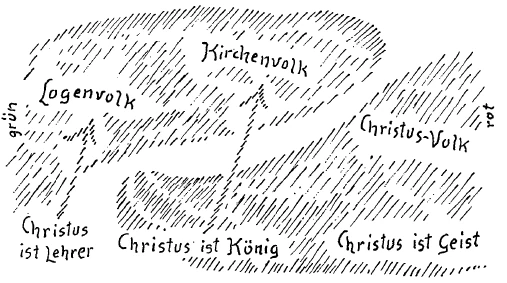
[ 37 ] Wollen wir daher in Form einer Zeichnung dieses merkwürdige Ineinanderwirken der europäischen Religionsimpulse verfolgen, so können wir sagen: Wir haben einen Impuls, es ist derjenige, der instinktiv, heute noch keimhaft und unausgebildet, in dem Christus-Volk lebt (siehe Zeichnung, rot). Da kommen dann die Geister, wenn sie Philosophen werden wie Solowjow, dazu, diesen Christus-Impuls als etwas Selbstverständliches zu nehmen.
[ 37 ] If we therefore wish to trace this remarkable interplay of European religious impulses in the form of a diagram, we can say: We have an impulse—it is the one that lives instinctively, still in its embryonic and undeveloped state, within the people of Christ (see diagram, red). Then the thinkers—when they become philosophers like Soloviev—come along to take this Christ impulse for granted.
[ 38 ] Mitteleuropa ist durch seine ethnographischen und durch seine ethnischen Verhältnisse nicht dazu angelegt, das so zu nehmen; da muß es auf künstliche Weise gemacht werden. Da ist es dann so, daß in der Grals-Strömung nach Europa hereinwirkt dasjenige, was man, ich möchte sagen, wie eine Beugung des Wirbels (siehe Zeichnung, rot unten), als Grals-Strömung hereinwirkend haben kann. Das strahlt überall nach Europa hin, aber es muß dann eben Grals-Strömung sein, ist deshalb auch nicht volksmäßig beschränkt. In dieser Grals-Stimmung, wenn auch sehr stark in den untersten Kräften seines Bewußtseins, lebte Goethe. Suchen Sie sich diese Grals-Stimmung auf; Sie werden sie überall finden. Da steht er in gewisser Beziehung nicht isoliert da; dadurch schließt er sich an Vorhergehendes an. Mit Luther, mit der deutschen Mystik, mit alledem, was da vorangegangen war, hat er nichts zu tun. Das wirkt mehr oder weniger auf ihn so, daß es ihn bildet, daß es ihn zum Weltmenschen macht. Dasjenige, was ihn dazu führt, drei Stufen zu unterscheiden — die Stufe der volksmäßigen Religion, die Stufe der Religion der Weisen, die dem Einzelnen vorgeführt wird im zweiten Gemach, die intimste Religion, die nur intim, im dritten Gemach, zu der Seele spricht und die Mysterien von Tod und Auferstehung enthält — das, was ihn dazu führt in dieser Weise hinaufzuheben, nicht jesuitisch herunterzuführen, sondern hinaufzuheben das in der Sinnenwelt wirksame Religiöse in die spiriruellen Höhen: das ist die Grals-Stimmung. Und Grals-Stimmung, so paradox das besonders heute klingt, ist im Russizismus, Grals-Stimmung ist durchaus im Russizismus. Und auf dieser im Russizismus vorhandenen unbesieglichen Grals-Stimmung beruht eben jene Zukunft des Russentums für die sechste nachatlantische Zeit, von der ich so oft habe zu sprechen gehabt.
[ 38 ] Central Europe, due to its ethnographic and ethnic conditions, is not naturally inclined to accept this; it must be brought about artificially. It is the case, then, that what acts upon Europe through the Grail current is what one might describe—I would say—as a bending of the vortex (see drawing, red at the bottom), acting as a Grail current. This radiates throughout Europe, but it must be a Grail current; therefore, it is not limited to any particular people. Goethe lived in this Grail mood, albeit very strongly in the deepest recesses of his consciousness. Seek out this Grail mood; you will find it everywhere. In a certain sense, he does not stand alone; through this, he connects with what came before. He has nothing to do with Luther, with German mysticism, or with anything that preceded him. This influences him, to a greater or lesser extent, in such a way that it shapes him, that it makes him a citizen of the world. That which leads him to distinguish three stages—the stage of folk religion, the stage of the religion of the sages, which is presented to the individual in the second chamber, and the most intimate religion, which is only intimate, in the third chamber, speaks to the soul and contains the mysteries of death and resurrection—that which leads him to elevate in this way, not to lower in a Jesuitical manner, but to lift the religious element active in the sensory world up to the spiritual heights: that is the Grail mood. And the Grail mood—as paradoxical as that may sound, especially today—is present in Russism; the Grail mood is very much present in Russism. And it is precisely this invincible Grail mood, present in Russism, that forms the basis for the very future of Russian culture in the sixth post-Atlantean epoch, of which I have spoken so often.
[ 39 ] Das ist es, was man jetzt ins Auge fassen muß, wenn man die eine Seite betrachtet. Und fassen wir die andere Seite ins Auge, so haben wir da alles das, was weder den Christus-Impuls so nimmt, nun, wie im Osten, gewissermaßen wie eine Invasion, noch nimmt als etwas, was ein durch Tradition und Schrift in Fortpflanzung Lebendes ist, sondern ihn als das Vernünftige nimmt. Das ist dasjenige, was sich innerhalb des Logentums und namentlich innerhalb aller seiner Verzweigungen, seiner Fortsetzungen zeigt. Ich will es mit einer anderen Farbe bezeichnen (grün). Das ist dasjenige, was sich dann verpeolitisiert im Westen, was der äußerste Ausläufer ist des Artustums, desjenigen, was im König Artus verkörpert ist. Und ebenso wie der ChristusImpuls des Russizismus sich im Gralstum fortsetzt und, ich möchte sagen, in alle guten strebsamen Menschen des Westens einstrahlt, so setzt sich auch jenes andere fort und strömt in alle Menschen hinein, innerhalb des Kirchenvolkes, und bekommt die Färbung des Jesuitismus. Wenn auch der Jesuitismus, wie gesagt, dem spinnefeind ist, darauf kommt es nicht an; etwas kann gerade spinnefeind sein dem, was eben jene Vorstellungsform gibt. Es ist geschehen, es ist historisch, daß die Jesuiten nicht nur sich in alle Logen eingeschlichen haben, daß hochgraduierte Jesuiten im Zusammenhange stehen mit Hochgraduierten der Logen, sondern es ist auch so, daß beide, wenn auch bei verschiedenen Völkern, aus dem selben wurzeln, wenn sich auch das eine zum Papsttum, das andere zur Freiheit, zur Vernünftigkeit, zur Aufklärung entwickelt hat. Das gibt Ihnen nun eine Art Bild von dem, was ich nennen kann das Wirken der Bewußtseinsseelen-Evolution. Denn indem ich Ihnen früher geschildert habe die drei Stufen vom Osten nach dem Westen, war das auf Volkstümliches, auf Ethnisches begründet. Daß es ineinanderwirkend solche Formen annimmt, daß es im Westen zur Aufklärung wurde, das ist dadurch bewirkt, daß die Evolutionsströmung der Bewußtseinsseele im einzelnen Menschen, im Individuum lebt.
[ 39 ] This is what one must now take into account when considering one side of the issue. And if we consider the other side, we find there everything that neither accepts the Christ impulse—as in the East, in a sense like an invasion—nor regards it as something that lives on through tradition and scripture, but rather accepts it as something rational. This is what manifests itself within Freemasonry and, in particular, within all its branches and offshoots. I will denote it with a different color (green). This is what then becomes “Peolized” in the West—the outermost offshoot of Arthurianism, that which is embodied in King Arthur. And just as the Christ impulse of Russism continues in Grailism and, I would say, radiates into all good, aspiring people of the West, so too does that other impulse continue and flow into all people, within the church community, taking on the hue of Jesuitism. Even if Jesuitism, as I said, is diametrically opposed to it, that is irrelevant; something can be diametrically opposed to the very form of conception that gives rise to it. It is a historical fact that the Jesuits have not only infiltrated all the lodges, and that high-ranking Jesuits are connected with high-ranking members of the lodges, but it is also true that both—even if among different peoples—have the same roots, even though one has developed toward the papacy and the other toward freedom, rationality, and the Enlightenment. This now gives you a kind of picture of what I might call the workings of the evolution of the consciousness-souls. For when I previously described to you the three stages from East to West, that was based on folk traditions and ethnic characteristics. The fact that, through their interaction, these processes take on such forms—that in the West they led to the Enlightenment—is brought about by the fact that the evolutionary current of the consciousness soul lives within the individual human being.
[ 40 ] Dann aber haben wir eine dritte Strömung. Das ist diejenige, welche der ganzen Menschheit eigen ist, vermöge welcher die ganze Menschheit in ihrem Entwickelungsalter ist, indem sie immer jünger und jünger wird, und jetzt in dem Zeitalter der Empfindungsseele ist, vom 28. bis zum 21. Jahre. Das geht durch die ganze Menschheit. Wenn wir die erste Strömung, die ethnische, schildern, wo Volksreligionen entstehen: Christus-Religion, Kirchenreligion, Logenreligion, dann stehen wir auf dem Standpunkt der volkstümlichen Entwickelung, die ich gewöhnlich so einteile: italienische Völker = Empfindungsseele, französische = Verstandes- oder Gemütsseele und so weiter. Wenn wir dasjenige schildern, was als Bewußtseinsseele in jedem einzelnen Menschen seit dem fünften nachatlantischen Zeitraum sich entwickelt, so haben wir da vorzugsweise dasjenige, was in dieser Weise ins Religiöse einströmt. Aber von da aus geht dann auch das Zusammenwirken mit dem anderen, mit dem, was Evolution in allen Menschen ist: Empfindungsseelen-Evolution, die ja parallel läuft und viel unbewußter ist als die Bewußtseinsseelen-Evolution.
[ 40 ] But then we have a third current. This is the one that is inherent in all of humanity, by virtue of which all of humanity is in its developmental age, becoming younger and younger, and is now in the age of the feeling soul, from the age of 28 to 21. This applies to all of humanity. When we describe the first current—the ethnic one—in which folk religions arise: the religion of Christ, the religion of the church, the religion of the lodge—we are taking the perspective of folk development, which I usually classify as follows: Italian peoples = the feeling soul; French peoples = the intellectual or emotional soul; and so on. When we describe what has been developing as the “conscious soul” within each individual since the fifth post-Atlantean epoch, we are primarily dealing with that which flows into the religious sphere in this way. But from there, interaction also begins with the other aspect—with what constitutes evolution in all human beings: the evolution of the soul of feeling, which runs parallel to and is far more unconscious than the evolution of the soul of consciousness.
[ 41 ] Studieren Sie, wie solch ein Mensch wie Goethe, wenn auch vielfach durch Impulse im Unterbewußten, aber doch sehr bewußt sich seine religiöse Richtung gibt, so kommen Sie auf das Walten der Bewußtseinsseele. Doch daneben waltet in der modernen Menschheit ein anderes Element, welches sehr stark in Instinkten, in unterbewußten Impulsen durch diese moderne Menschheit wirkt, aber innig verknüpft ist mit der Empfindungsseelen-Entwickelung, und das ist dasjenige, was man nennen muß die Entwickelung zum Sozialismus hin, die jetzt im Beginne ihres Verlaufes ist, und die in einer gewissen Weise ihren Abschluß finden wird von der Seite, wie ich es erzählt habe. Gewiß, die Anstöße werden immer gegeben, wie ich schon gesagt habe, von der Bewußtseinsseele aus; aber daß der Sozialismus die Mission des fünften nachatlantischen Zeitraums ist und bis zum vierten Jahrtausend hin zu einem Abschlusse kommen wird, das rührt für die ganze Menschheit gewissermaßen davon her, daß sie im Empfindungsseelen-Zeitalter lebt vom 28. bis 21. Jahre. Das liegt da drinnen. Der Sozialismus ist nicht etwas, was eine Parteirichtung ist, obwohl es innerhalb der sozialen Körperschaften viele Parteien gibt, aber das sind Parteien innerhalb der sozialen Strömung. Der Sozialismus ist nicht eine Parteisache als solche, sondern der Sozialismus ist etwas, was sich ganz notwendig nach und nach im fünften nachatlantischen Zeitraum in der Menschheit ausbildet. So daß, wenn dieser fünfte nachatlantische Zeitraum abgeschlossen sein wird, im wesentlichen, soweit sie für die zivilisierte Welt in Betracht kommen, in den Menschen die Instinkte für den Sozialismus vorhanden sein werden.
[ 41 ] If you study how a person like Goethe—albeit often guided by impulses from the subconscious, yet still very consciously—chose his religious path, you will come to understand the workings of the conscious soul. Yet alongside this, another element prevails in modern humanity—one that exerts a very strong influence through instincts and subconscious impulses, but is intimately linked to the development of the feeling soul, and that is what must be called the development toward socialism, which is now at the beginning of its course and which, in a certain sense, will find its conclusion in the way I have described. Certainly, the impulses are always provided, as I have already said, by the consciousness soul; but the fact that socialism is the mission of the fifth post-Atlantean epoch and will come to a conclusion by the fourth millennium stems, for all of humanity, in a sense, from the fact that it lives in the age of the feeling soul from the 28th to the 21st year. That is inherent in it. Socialism is not a party ideology, although there are many parties within social organizations; yet these are parties within the social current. Socialism is not a party matter as such; rather, socialism is something that will inevitably develop gradually within humanity during the fifth post-Atlantean epoch. So that when this fifth post-Atlantean epoch is essentially complete—insofar as it pertains to the civilized world—the instincts for socialism will be present in human beings.
[ 42 ] Nun können Sie sich denken: Das alles, was ich Ihnen gesagt habe, wirkt zusammen in diesem fünften nachatlantischen Zeitraum. Da wirken alle die Dinge zusammen, die ich geschildert habe. Da wirkt aber auch noch das, was im wesentlichen in unterbewußten Tiefen ist: die Tendenz, bis ins vierte Jahrtausend hinein die richtige sozialistische Gestaltung der ganzen Erdenwelt zu finden. Man braucht sich von einem tieferen Gesichtspunkte aus wahrhaftig nicht zu wundern, daß der Sozialismus alle möglichen Blasen aufwirft, die auch sehr schlimm sein können, wenn man bedenkt, wie er aus unterbewußten Tiefen herauf seine Impulse hat; wenn man bedenkt, wie das alles brodelt und kraftet und der Zeitpunkt noch weit, weit entfernt ist von derjenigen Epoche, wo es in sein richtiges Fahrwasser kommen wird. Aber es rumort, und zwar jetzt nicht einmal in den menschlichen Seelen, sondern es rumort in den menschlichen Naturen, in den menschlichen Temperamenten vor allen Dingen. Und für dasjenige, was in menschlichen Temperamenten rumort, für das findet man Theorien. Diese Theorien — wenn sie nicht Ausdrücke sind, so wie wir es in der Geisteswissenschaft haben, für dasjenige, was in den Tiefen der Wirklichkeit vorhanden ist —, diese Theorien, ob es Bakuninismus, Marxismus, Lassallismus ist, was weiß ich, das ist ganz einerlei, das sind alles Masken, Verbrämungen, alles Dinge, die sich der Mensch oberflächlich über die Wirklichkeit zieht. Die Wirklichkeiten sieht man doch erst, wenn man so tief hineinschaut in die Menschheitsentwickelung, wie wir es durch diese Betrachtungen zu tun versuchen.
[ 42 ] Now you can imagine: Everything I have told you is at work together in this fifth post-Atlantean epoch. All the things I have described are at work here. But there is also something else at work, something that lies essentially in the depths of the subconscious: the tendency to find the proper socialist organization of the entire world right up into the fourth millennium. From a deeper perspective, one really need not be surprised that socialism gives rise to all sorts of bubbles, which can also be very harmful, when one considers how its impulses arise from the depths of the subconscious; when one considers how all of this is seething and churning, and how the time is still far, far removed from the epoch when it will find its proper course. But it is rumbling—and not even in human souls at this point, but rather in human natures, and above all in human temperaments. And for what is rumbling within human temperaments, for that one finds theories. These theories—if they are not expressions, as we have them in spiritual science, of what exists in the depths of reality—these theories, whether they be Bakuninism, Marxism, Lassallism, or whatever—it doesn’t matter at all; they are all masks, embellishments, things that people superficially superimpose upon reality. One can only see the realities, after all, when one looks as deeply into human development as we are attempting to do through these reflections.
[ 43 ] Und auch dasjenige, was jetzt äußerlich geschieht, das sind ja nur tumultuarische Vorbereitungen zu dem, was schließlich in allen — und zwar jetzt wirklich, man kann sagen, eben nicht Seelen, sondern in den Temperamenten lauert. Sie alle sind sozialistisch. Sie wissen es oftmals nicht, wie stark Sie sozialistisch sind, weil es im Temperamente, ganz im Unterbewußten lauert. Aber nur dadurch, daß man so etwas weiß, kommt man hinaus über jenes nebulose, lächerliche Suchen nach Selbsterkenntnis, die hineinschaut in das menschliche Innere und da, ich will es nicht schildern, was man da für ein wesenloses Caput mortuum, für ein Abstraktum findet. Der Mensch ist ein kompliziertes Wesen. Man lernt ihn nur kennen, wenn man die ganze Welt kennenlernt. Das ist es, was dabei berücksichtigt werden muß.
[ 43 ] And even what is happening on the surface right now is merely a tumultuous prelude to what ultimately lurks within everyone—and indeed, one might say, not so much in their souls as in their temperaments. They are all socialists. You often don’t realize how strongly socialist you are, because it lurks in your temperament, deep in the subconscious. But it is only by knowing such things that one can rise above that nebulous, ridiculous search for self-knowledge that peers into the human interior and finds there—I won’t describe it—a formless caput mortuum, an abstraction. The human being is a complex creature. You can only come to know them by coming to know the whole world. That is what must be taken into account.
[ 44 ] Betrachten Sie einmal von diesem Gesichtspunkte aus die Welt, die Menschheit, wie sie sich im fünften nachatlantischen Zeitraum heranentwickelt hat. Sagen Sie sich nun selbst: Da haben wir im Osten das Christus-Volk mit dem wesentlichsten Impuls: Christus ist Geist. — Es lebt in der Natur dieses Volkes, daß dasjenige, was nur als Vorläufer hat geschehen können durch die andere europäische Bildung, wie mit instinktiver, mit elementarer Gewalt, mit historischer Notwendigkeit durch den Russizismus in die Welt kommt. Es ist dem russischen Volke als Volk diese Mission übertragen, das Gralswesen als religiöses System bis zum sechsten nachatlantischen Zeitraum so auszubilden, daß es dann ein Kulturferment der ganzen Erde werden kann. Kein Wunder, wenn sich dieser Impuls kreuzt mit den anderen Impulsen, die vorhanden sind, daß die anderen Impulse sonderbare Formen annehmen.
[ 44 ] Consider, from this perspective, the world and humanity as they have developed during the fifth post-Atlantean epoch. Now ask yourself: In the East, we have the Christ-people with the most essential impulse: Christ is Spirit. — It is inherent in the nature of this people that what could only have occurred as a precursor through other European cultural influences now enters the world through Russicism—with instinctive, elemental force and historical necessity. This mission has been entrusted to the Russian people as a nation: to develop the Grail entity as a religious system up to the sixth post-Atlantean epoch in such a way that it can then become a cultural catalyst for the entire Earth. It is no wonder that when this impulse intersects with the other existing impulses, those other impulses take on strange forms.
[ 45 ] Welches sind die anderen Impulse? Nun: Der Christus ist König, Christus ist Lehrer, Ja, bis zu dem «der Christus ist Lehrer» kann man kaum gehen, denn das versteht eigentlich das russische Gemüt, wie ich schon sagte, doch eigentlich nicht, was das heißen soll, daß man das Christentum lehren kann, daß man das nicht erlebt als etwas, was in der eigenen Seele ist. Aber «Christus ist König» — so ist doch das Russentum mit dem «Christus ist König» zusammengewachsen. Und da sehen wir das Zusammenstoßen desjenigen, was am allerwenigsten jemals in der Welt zusammengehört hat: das Zusammenstoßen mit dem Zarismus, die östliche Karikatur des Prinzips, irdische Herrschaft einzuführen auf dem Gebiete des Religionswesens. «Christus ist König» — und der Zar ist sein Stellvertreter: diese Zusammenkoppelung dieses Westlichen, das im Zarismus sich ausspricht, mit dem, was gar nichts damit zu tun hat, mit dem, was durch die russische Volksseele im russischen Gemüte lebt!
[ 45 ] What are the other impulses? Well: Christ is King, Christ is Teacher—yes, one can hardly go as far as “Christ is Teacher,” because, as I have already said, the Russian mind does not really understand what that means—that Christianity can be taught, that it is not experienced as something within one’s own soul. But “Christ is King”—the Russian people have, after all, grown up with the idea that “Christ is King.” And here we see the clash of what has ever least belonged together in the world: the clash with tsarism, the Eastern caricature of the principle of establishing earthly rule in the realm of religion. “Christ the King”—and the Tsar is his representative: this coupling of that which is Western, expressed in Tsarism, with that which has absolutely nothing to do with it—with that which lives in the Russian national soul and in the Russian spirit!
[ 46 ] In der äußeren physischen Wirklichkeit ist eben gerade das Charakteristische, daß diejenigen Dinge, die oftmals innerlich am wenigsten miteinander zu tun haben, sich äußerlich aneinander abreiben müssen. Fremdest waren von jeher Zarismus und Russentum, gehörten nicht zusammen. Wer das russische Wesen versteht, namentlich religiös, der wird daher die Einstellung auf die Ausscheidung des Zarismus immer als etwas Selbstverständliches für den wirklichen nötigen Zeitpunkt haben finden müssen. Aber bedenken Sie, daß dieses «Christus ist der Geist» Innerlichstes ist, daß es zusammenhängt mit der edelsten Kultur der Bewußtseinsseele, und nun zusammenstößt, während der Sozialismus rumort, mit dem, was in der Empfindungsseele lebt, so wie ich es dargestellt habe. Kein Wunder, daß die Ausbreitung des Sozialismus in diesem östlichen Teile von Europa Formen annimmt, die überhaupt unbegreiflich sind, ein unorganisches Ineinanderspielen der Bewußtseinsseelenkultur und der Empfindungsseelenkultur.
[ 46 ] In external physical reality, the very defining characteristic is that those things which often have the least to do with one another internally are bound to clash externally. Tsarism and Russianness have always been worlds apart; they did not belong together. Anyone who understands the Russian essence—especially in religious terms—will therefore have to regard the stance toward the elimination of tsarism as something self-evident for the moment when it is truly necessary. But consider that this “Christ is the Spirit” is the innermost reality, that it is connected with the noblest culture of the conscious soul, and now, while socialism is rumbling, it clashes with what lives in the feeling soul, just as I have described it. No wonder that the spread of socialism in this eastern part of Europe is taking on forms that are utterly incomprehensible—an inorganic interplay between the culture of the conscious soul and the culture of the feeling soul.
[ 47 ] Vieles, was in der äußeren Wirklichkeit geschieht, es wird Ihnen klar und verständlich sein, wenn Sie diese innerlichen Zusammenhänge ins Auge fassen. Und notwendig ist es schon einmal für die gegenwärtige Menschheit und für ihre Entwickelung in die Zukunft hinein, daß die Menschheit nicht aus Bequemlichkeit und Faulheit vorbeigeht an dem, was ja zu ihrem Wesen gehört: Verständnis zu haben dafür, in welchen Zusammenhängen wir jetzt drinnen stehen. Man hat es nicht verstanden, hat es nicht verstehen wollen. Dadurch ist das europäische, jetzt mit dem amerikanischen verknüpfte Chaos gekommen, die furchtbare Katastrophe, Nicht eher wird man aus der Katastrophe herauskommen, bis die Menschen sich geneigt zeigen werden, so sich zu verstehen wie sie sind, aber eben wie sie sind innerhalb der gegenwärtigen Zeitenentwickelung, innerhalb der gegenwärtigen Zeitepoche. Das ist es, was man einsehen muß.
[ 47 ] Much of what happens in external reality will become clear and understandable to you once you consider these inner connections. And it is essential, first and foremost, for humanity today and for its future development, that humanity not, out of convenience and laziness, overlook what is, after all, part of its very nature: to understand the contexts in which we now find ourselves. People have not understood this, nor have they wanted to understand it. This has led to the European chaos—now linked to that in America—and to the terrible catastrophe. We will not emerge from this catastrophe until people are willing to understand themselves as they are—but precisely as they are within the current course of historical development, within the present historical epoch. This is what must be recognized.
[ 48 ] Daher ist es mir so wichtig, daß man einsieht, wie das, was ich mir denke als anthroposophische Bewegung, wirklich angeknüpft werden soll an die Erkenntnis der großen Evolutionsimpulse der Menschheit, angeknüpft werden soll an dasjenige, was die Zeit unmittelbar jetzt von den Menschen fordert. Natürlich ist es dann ein großer Schmerz, wenn man sieht, wie wenig eigentlich die Gegenwart geneigt ist, anthroposophische Weltanschauung gerade von dieser Seite her zu begreifen und ins Auge zu fassen. |
[ 48 ] That is why it is so important to me that people understand how what I envision as the anthroposophical movement should truly be linked to an understanding of the great evolutionary impulses of humanity, and to what the present time is demanding of people right now. Of course, it is deeply painful to see how little the present day is actually inclined to understand and take seriously the anthroposophical worldview from this particular perspective. |
[ 49 ] Sie werden aus dem, was ich gesagt habe, einsehen, wie das, was als Sozialismus heraufsteigt — durch allgemeine Gesichtspunkte möchte ich nun ergänzen, was ich in der vorigen Woche in Anknüpfung an die «Philosophie der Freiheit» gesagt habe —, eine in der Menschennatur ganz allgemein begründete, immer weiter und weiter greifende Erscheinung in der Menschheit ist. Die heutigen Reaktionen, die dagegen stattfinden, sind für den, der die Dinge durchschaut, einfach furchtbar. Für den, der die Dinge durchschaut, ist es klar, daß, wenn es auch noch so tumultuarisch, noch so im Rumoren darinnen sich geltend macht, was Sozialismus ist über die ganze Erde hin, dieses internationale Element, daß das dasjenige ist, was zukunftsträchtig ist, und daß das, was jetzt auftritt, die Konstituierung von allen möglichen National-, Natiönchen-Staaten, dasjenige ist, was der Menschheitsevolution entgegenarbeitet. Es ist ein furchtbares Entgegenstemmen gegen den Sinn der Entwickelung des fünften nachatlantischen Zeitraums, was in den Worten liegt: Jeder einzelnen Nation einen Staat. — Wo das enden soll, weiß man ja ohnedies natürlich gar nicht, aber es wird halt gesagt; nun, es wird halt gesagt! Das ist zu gleicher Zeit ganz durchtränkt von dem, was in den Artus-Impuls zurückführt: ganz durchtränkt von Organisationsprinzipien. Der Gegensatz dazu ist die Grals-Bestrebung, die so innig verwandt ist mit den Goetheschen Prinzipien, wie ich sie Ihnen dargestellt habe, diese Grals-Bestrebung, die überall auf das Individuelle, im Ethischen, im Wissenschaftlichen überall auf das Individuelle hintendiert, die vor allen Dingen das Individuum in seiner Entwickelung ins Auge fassen will, nicht Gruppen, die heute keine Bedeutung mehr haben und die durch das internationale sozialistische Element aus der Welt geschafft werden müssen, weil da die Richtung der Entwickelung liegt.
[ 49 ] From what I have said, you will see how what is emerging as socialism—and I would now like to supplement what I said last week in connection with the *Philosophy of Freedom* with some general considerations—is a phenomenon in humanity that is rooted in human nature in the most general sense and is spreading ever farther and farther. The reactions taking place today against it are, for anyone who sees through these things, simply appalling. To anyone who sees through these things, it is clear that, no matter how tumultuous it may be, no matter how much it makes itself felt amid the clamour—this international element that is socialism, spreading across the entire earth—this is what holds the promise of the future, and that what is now emerging—the formation of all manner of national, tiny nation-states—and that this is what works against the evolution of humanity. It is a terrible resistance to the spirit of development of the fifth post-Atlantean epoch, as expressed in the words: “A state for every single nation.” — Of course, no one really knows where this is supposed to end, but it is simply said; well, it is simply said! At the same time, this is completely steeped in what leads back to the Arthurian impulse: completely steeped in organizational principles. The opposite of this is the Grail aspiration, which is so intimately related to the Goethean principles as I have described them to you—this Grail aspiration, which everywhere, in ethics, in science—everywhere toward the individual, which seeks above all to focus on the individual in his or her development, not on groups, which no longer have any significance today and which must be eliminated by the international socialist element, because that is the direction of development.
[ 50 ] Auch aus diesem Grunde ist es, daß man sagen muß: Im Goetheanismus, im Goetheanismus mit all seinem Individualismus — wie ich den Individualismus hervorgeholt habe aus der Goetheschen Weltanschauung, sehen Sie in meinen ersten Goethe-Schriften, Sie können es auch bemerken in meinem Buche «Goethes Weltanschauung», diesen Individualismus, der schon einmal eine naturgemäße Folge des Goetheanismus ist —, in diesem Individualismus, der nur in einer Philosophie der Freiheit gipfeln kann, da liegt dasjenige, was notwendigerweise hinzielen muß zu dem, was als Sozialismus sich bildet, so daß man in einem gewissen Sinne zwei Pole anerkennen kann, auf der einen Seite den Individualismus, auf der andern Seite den Sozialismus, nach denen die Menschheit hintendiert im fünften nachatlantischen Zeitraum. Aber diese Dinge müssen richtig verstanden werden. Und das richtige Verstehen, das ist notwendig damit verbunden, daß man sich einen Einblick verschafft, was zum Sozialismus hinzukommen muß, wenn er wirklich in der Richtung der Menschheitsevolution laufen soll. Die heutigen Sozialisten haben ja noch keine Ahnung, was notwendigerweise mit dem wahren, erst im vierten Jahrtausende einen gewissen Abschluß bekommenden Sozialismus zusammenhängt, zusammenhängen muß, wenn er in seiner Entwickelung richtig geht. Da handelt es sich vor allen Dingen darum, daß dieser Sozialismus sich zusammenentwickeln muß mit einer richtigen Empfindung über das Wesen des ganzen Menschen, des leiblichen, des seelischen, des geistigen Menschen. Die Nuancen, die werden schon die einzelnen ethnischen Religionsimpulse dazubringen, die werden schon ihre Beiträge liefern, daß verstanden wird der Mensch nach dieser dreifachen Gliederung, nach Leib, Seele und Geist. Der Orient mit dem Russischen wird dafür sorgen, daß der Geist begriffen wird. Der Westen wird dafür sorgen, daß der Leib begriffen wird. Die Mitte wird dafür sorgen, daß die Seele begriffen wird. Aber das alles geht natürlich durcheinander. Das darf nicht schematisiert und nicht kategorisiert werden, aber in all das hinein muß sich eben erst entwickeln das wirkliche Prinzip, der wirkliche Impuls des Sozialismus.
[ 50 ] It is also for this reason that one must say: In Goetheanism, in Goetheanism with all its individualism—as I have drawn out this individualism from Goethe’s worldview, as you can see in my early writings on Goethe, you can also observe it in my book *Goethe’s Worldview*—this individualism, which is, after all, a natural consequence of Goetheanism—in this individualism, which can only culminate in a philosophy of freedom, therein lies what must necessarily point toward what is taking shape as socialism, so that, in a certain sense, one can recognize two poles: on the one hand, individualism; on the other, socialism—toward which humanity is tending in the fifth post-Atlantean epoch. But these things must be properly understood. And this correct understanding is necessarily linked to gaining insight into what must accompany socialism if it is to truly proceed in the direction of human evolution. Today’s socialists, after all, still have no idea what is necessarily connected to true socialism—which will only reach a certain conclusion in the fourth millennium—and what must be connected to it if its development is to proceed correctly. Above all, this means that socialism must develop in tandem with a proper understanding of the nature of the whole human being—the physical, the soul, and the spiritual aspects of the human being. The nuances will be provided by the various ethnic and religious impulses; they will make their contributions so that the human being is understood according to this threefold structure: body, soul, and spirit. The East, together with Russia, will ensure that the spirit is understood. The West will ensure that the body is understood. The Middle will ensure that the soul is understood. But all of this, of course, is intertwined. It must not be schematized or categorized, but within all of this, the true principle, the true impulse of socialism, must first develop.
[ 51 ] Was ist dieser Sozialismus? Der wirkliche Impuls des Sozialismus besteht nämlich darinnen, daß die Menschen es, so wie ich es neulich einmal geschildert habe, wirklich dazu bringen, in der äußeren sozialen Struktur die Brüderlichkeit zu verwirklichen im weitesten Sinne des Wortes. Die wirkliche Brüderlichkeit hat nichts zu tun mit Gleichheit, selbstverständlich. Denn nehmen Sie schon in der Familie Brüderlichkeit an: wenn der eine Bruder sieben Jahre alt ist, der andere erst geboren ist, so kann man natürlich nicht von Gleichheit sprechen. Brüderlichkeit wird erst verstanden werden müssen. Aber das ist auch alles, was auf dem physischen Plan zu verwirklichen ist: an Stelle der heutigen Staatssysteme Organisationen über die ganze Erde hin, die durchtränkt sind von Brüderlichkeit. Dagegen muß aus der äußerlichen Organisation, aus der Staatsorganisation und aus allen staatsähnlichen Organisationen heraus alles Kirchliche und alles Religiöse. Das muß seelische Angelegenheit werden. Das muß in völlig freiem Nebeneinanderleben der Seelen sich entwickeln. Parallel mit der Entwickelung des Sozialismus muß absoluteste Gedankenfreiheit in bezug auf alle religiösen Dinge gehen.
[ 51 ] What is this socialism? The true impetus of socialism lies in the fact that it truly leads people—as I described it recently—to realize brotherhood in the broadest sense of the word within the external social structure. True brotherhood has nothing to do with equality, of course. Just consider brotherhood within a family: if one brother is seven years old and the other has just been born, one cannot, of course, speak of equality. Brotherhood must first be understood. But that is also all that needs to be realized on the physical plane: in place of today’s state systems, organizations throughout the entire world that are imbued with brotherhood. In contrast, everything ecclesiastical and everything religious must be removed from external organization, from state organization, and from all state-like organizations. That must become a matter of the soul. It must develop through the completely free coexistence of souls. The development of socialism must go hand in hand with the most absolute freedom of thought regarding all religious matters.
[ 52 ] Das hat ja der bisherige Sozialismus in Form der Sozialdemokratie, nun, nur so hervorgeschmissen, daß man schon sagen kann: «Religion ist Privatsache.» — Aber das hält er ungefähr so ein, wie der wütende Stier die Brüderlichkeit einhält, wenn er auf irgend jemand losgeht. Da ist natürlich nicht das geringste Verständnis dafür, denn der Sozialismus in seiner heutigen Gestalt ist selber Religion; er wird in ganz sektenmäßiger Weise betrieben und tritt mit ungeheurer Intoleranz auf. Also parallel diesem Sozialismus muß gehen eine wirkliche Blüte des religiösen Lebens, das darauf gebaut ist, daß das religiöse Leben der Menschheit eine freie Angelegenheit der miteinander auf der Erde wirksamen Seelen ist.
[ 52 ] That is precisely what socialism to date, in the form of social democracy, has so blithely thrown out there that one can already say: “Religion is a private matter.” — But it upholds this about as much as a raging bull upholds brotherhood when it charges at someone. Naturally, there is not the slightest understanding of this, for socialism in its present form is itself a religion; it is practiced in a thoroughly sectarian manner and displays tremendous intolerance. Thus, parallel to this socialism, there must be a true flourishing of religious life, one based on the understanding that the religious life of humanity is a free matter for the souls working together on Earth.
[ 53 ] Nun denken Sie einmal, wie unendlich viel dadurch entgegengearbeitet worden ist der Evolution. Es muß immer zuerst entgegengearbeitet werden, damit dann wieder eine Zeitlang im Sinne der Evolution gearbeitet werden kann; dann kommt wiederum der Gegenschlag, und so weiter. Das habe ich Ihnen ja bei den allgemeinen Geschichtsprinzipien erörtert, daß alles da ist, damit es wiederum stirbt. Denken $ie nur, wie gegengearbeitet worden ist diesem Parallelgehen der Gedankenfreiheit auf dem Gebiete der Religion und des äußerlichen brüderlichen sozialen Lebens, das sich, wenn man schon vom Staate spricht, nur innerhalb der Staatsgemeinschaft ausbilden kann! Innerhalb der Staatsorganisation darf das religiöse Leben überhaupt gar keine Rolle spielen, sondern nur innerhalb der als Seelen zusammenlebenden Menschen in völligster Unabhängigkeit von irgendeiner Organisation, wenn Sozialismus herrschen soll. Was ist dagegen gesündigt worden! «Christus ist der Geist» — daneben diese furchtbare Kirchenorganisation des Zarismus! «Christus ist der König» — absolute Zusammenkoppelung von Zarismus mit religiösen Überzeugungen! Und nicht nur, daß die Kirche, die römisch-katholische Kirche selber sich konstituiert hat als politisches Reich, sie hat auch den Weg gefunden, namentlich in den letzten Jahrhunderten mit dem Umwege über den Jesuitismus, in die anderen Reiche sich einzuschleichen und die mitzuorganisieren, die mitzudurchtränken. Oder denken Sie, wie hat sich schließlich das Luthertum entwickelt? Gewiß, Luther ging hervor aus jenem Impulse — so habe ich ihn auch einmal dargestellt —, und er ist so recht ein Geist, der mit dem einen Gesicht nach dem vierten, mit dem anderen Gesicht nach dem fünften Zeitraum weist und insofern einen zeitgemäßen Impuls hat. Er tritt auf, aber was geschieht dann? Dann koppelt sich dasjenige, was Luther auf religiösem Gebiete gewollt hat, mit den Fürsteninteressen der einzelnen deutschen Höfe zusammen. Ein Fürst wird Synodale, Episkop, und so weiter; also auch da zusammengekoppelt dasjenige, was niemals zusammengekoppelt werden darf. Oder Durchtränkung des die äußere Staatsorganisation durchsetzenden Staatsprinzips mit dem katholischen religiösen Prinzip, wie es in Österreich war, in dem jetzt zugrunde gehenden Österreich, worauf das ganze Unglück Österreichs im Grunde genommen doch zurückgeht. Unter anderen Ägiden, namentlich unter der Ägide des Goetheanismus, würde es möglich gewesen sein, in Österreich sehr gut Ordnung zu schaffen.
[ 53 ] Now just think how infinitely much this has worked against evolution. There must always be a counterforce at first, so that progress can then be made in the direction of evolution for a time; then the counterforce strikes again, and so on. I have already discussed this with you in the context of the general principles of history: that everything exists only to die again. Just think how much opposition there has been to this parallel development of freedom of thought in the realm of religion and of outward, fraternal social life—which, if we are to speak of the state at all, can only develop within the state community! Within the state organization, religious life must not play any role at all, but only within the community of people living together as souls, in complete independence from any organization, if socialism is to prevail. How grievously this has been violated! “Christ is the Spirit”—and alongside this, that dreadful church organization of Tsarism! “Christ is the King” — an absolute entanglement of tsarism with religious convictions! And not only has the Church—the Roman Catholic Church itself—constituted itself as a political empire, but it has also found a way, particularly in recent centuries through the detour of Jesuitism, to infiltrate other empires and to help organize and permeate them. Or consider: how did Lutheranism ultimately develop? Certainly, Luther emerged from that impulse—as I once described him—and he is truly a spirit who looks with one face toward the fourth era and with the other toward the fifth, and in that sense embodies a contemporary impulse. He appears, but what happens then? Then what Luther intended in the religious sphere becomes intertwined with the princely interests of the individual German courts. A prince becomes a synod member, a bishop, and so on; thus, here too, that which must never be intertwined becomes intertwined. Or the permeation of the state principle, which permeates the external organization of the state, with the Catholic religious principle, as was the case in Austria—in the Austria that is now collapsing—to which, in essence, all of Austria’s misfortune can ultimately be traced. Under other auspices, notably under the auspices of Goetheanism, it would have been quite possible to establish order in Austria.
[ 54 ] Das ist auf der einen Seite. Auf der anderen Seite im Westen in der englischsprechenden Bevölkerung überall Durchdringung von Logentum mit Fürstentum. Das ist gerade das Charakteristische, daß die staatliche Organisation im Westen überhaupt nicht zu verstehen ist — und Frankreich und Italien sind ja ganz infiziert davon —, ohne daß man da die Durchsetzung mit dem Logentum ebenso ins Auge faßt, wie man in Mitteleuropa die Durchsetzung mit dem Jesuitismus oder mit anderem ins Auge fassen muß. Also gegen dasjenige, was notwendig parallelgehen muß dem Sozialismus, ist furchtbar gesündigt worden, und das muß ins Auge gefaßt werden.
[ 54 ] That is one side of the coin. On the other hand, in the West, among the English-speaking population, there is a pervasive intermingling of Freemasonry with the monarchy. This is precisely what is characteristic: that the state organization in the West cannot be understood at all—and France and Italy are, after all, completely infected by it—without also taking into account its intertwining with Freemasonry, just as one must take into account its intertwining with Jesuitism or other influences in Central Europe. Thus, a terrible sin has been committed against that which must necessarily run parallel to socialism, and this must be taken into account.
[ 55 ] Ein Weiteres, was mit der Entwickelung nach dem Sozialismus parallel gehen muß, ist auf dem Gebiete des geistigen Lebens die Emanzipation alles Strebens nach dem Geiste unabhängig von der Staatsorganisation. Die absolute Aufhebung aller Kasernierung der Wissenschaft und dessen, was mit Wissenschaft zusammenhängt. Das ist das Notwendige. Jene über die Welt zerstreuten Kasernen der Wissenschaft, die man Universitäten nennt, das sind Dinge, welche am allermeisten entgegenstreben dem, was sich im fünften nachatlantischen Zeitraum entwickeln will. Denn so wie Freiheit herein muß auf religiösem Gebiete, so muß auf dem Gebiete der Erkenntnis die Möglichkeit entstehen, daß ein vollständig gleiches Zusammengehen entsteht, daß jeder seinen Anteil haben kann an der Fortentwickelung der Menschheit. Nicht im geringsten dürfen, wenn die sozialistische Bewegung gesund sich entwickeln will, Privilegien, Patente, Monopole auf irgendeinem Zweig der Erkenntnis liegen. Da wir heute noch sehr weit entfernt sind von dem, was ich eigentlich meine, so ist es wohl nicht nötig, daß ich nach irgendeiner Seite Ihnen zeige, wie es möglich ist, die Kasernierung der Wissenschaft aufzuheben, und wie es möglich ist, jeden Menschen zu seinem Anteil an der Evolution nach dieser Richtung zu bringen. Denn das wird zusammenhängen mit tiefgreifenden Impulsen, die im Erziehungswesen, ja in dem ganzen Verhältnis von Mensch zu Mensch sich entwickeln werden. Aber so wird es sein, daß alle Monopole, Privilegien, Patente, die sich auf den Besitz geistiger Erkenntnisse beziehen, schwinden werden, und nur die Möglichkeit vorhanden sein wird, daß der Mensch den Inhalt des geistigen Lebens nach allen Richtungen hin, auf allen Gebieten so geltend machen kann, wie er in ihm liegt, wie stark er in ihm liegt, wie stark er in ihm zum Ausdrucke kommt. In einer Zeit, in der man immer mehr und mehr dahin strebt, solche Dinge wie die Medizin zum Beispiel zu monopolisieren durch die Universitätsleute, in der man auch auf den verschiedensten anderen Gebieten alles, alles durchorganisieren will, in einer solchen Zeit hat man es ja nicht nötig, über Einzelheiten der geistigen Gleichheit zu sprechen, — denn wir sind ja natürlich noch sehr weit davon entfernt, und die meisten von uns haben genügend Zeit, zu warten bis zu ihrer nächsten Inkarnation, wenn sie ein vollständiges Verständnis anstreben dessen, was mit Bezug auf diesen dritten Punkt zu sagen ist. Aber natürlich, Anfänge könnten überall gebildet werden.
[ 55 ] Another development that must proceed in parallel with the transition to socialism is, in the realm of intellectual life, the emancipation of all intellectual pursuits from dependence on the state apparatus. The absolute abolition of all institutionalization of science and everything connected with it. That is what is necessary. Those institutions of science scattered throughout the world, which are called universities, are the very things that stand most in the way of what is seeking to develop in the fifth post-Atlantean epoch. For just as freedom must prevail in the religious sphere, so too must the possibility arise in the realm of knowledge for a completely equal collaboration to emerge, so that everyone can have a share in the further development of humanity. If the socialist movement is to develop healthily, there must not be the slightest trace of privileges, patents, or monopolies in any branch of knowledge. Since we are still very far removed today from what I actually mean, it is probably not necessary for me to show you, in any particular way, how it is possible to abolish the militarization of science, and how it is possible to enable every person to play their part in evolution in this direction. For this will be linked to profound impulses that will develop within the educational system—indeed, in the entire relationship between human beings. But it will be the case that all monopolies, privileges, and patents relating to the possession of spiritual knowledge will fade away, and the only possibility that will remain is for each person to be able to bring the content of spiritual life to bear in every direction and in every field—just as it lies within them, just as strongly as it lies within them, and just as strongly as it finds expression within them. At a time when there is an ever-increasing tendency to monopolize fields such as medicine, for example, through university scholars, and when there is a desire to thoroughly organize everything—absolutely everything—in a wide variety of other fields as well, at such a time there is, of course, no need to discuss the details of spiritual equality, — for we are, of course, still very far from that, and most of us have plenty of time to wait until our next incarnation if we seek a complete understanding of what needs to be said regarding this third point. But of course, beginnings could be made everywhere.
[ 56 ] So ist es nur möglich, wenn man, Anteil nehmend an der modernen Menschheit und an unserer Zeit, im Kopfe hat, welche Impulse walten, wenn man namentlich diesen Sozialismus, der da waltet, ins Auge fassen und ihn zusammenhalten kann mit dem, was parallel gehen muß: Freiheit des religiösen Denkens, Gleichheit auf dem Gebiete der Erkenntnis. Die Erkenntnis muß für die Menschen so gleich werden, wie nach dem Sprichworte der Tod alle gleich macht, denn sie führt in der Zukunft eben in die übersinnliche Welt hinein, in die der Tod auch hineinführt. So wenig man nämlich den Tod monopolisieren und patentieren kann, so wenig kann man in der Wirklichkeit die Erkenntnis monopolisieren und patentieren. Und wenn man es doch tut, erzeugt man eben nicht Träger der Erkenntnis, sondern diejenigen, die eben das geworden sind, was heutige sogenannte Träger der Erkenntnis sind. Es betrifft ja natürlich nirgendwo wiederum den einzelnen, geradesowenig wie das andere den einzelnen betrifft, sondern es betrifft dasjenige, was ja für die Zeit bedeutsam ist: die Gestaltung, die soziale Gestaltung der Zeit. Unsere Zeit insbesondere, die das allmählich in die Dekadenz kommende Bourgeoistum darlebte, die hat ja gezeigt, wie heute immer unwirksamer und unwirksamer ein Aufbäumen wird gegen dasjenige, was eigentlich gegen die Evolution geht. Das Papsttum geht ganz entschieden gegen die Evolution. Als der Altkatholizismus sich in den siebziger Jahren dagegen aufgebäumt hat, nach der Aufstellung des Infallibilitätsdogmas, dieser Krönung des päpstlichen Monarchismus, da wurde es ihm ja schwer und wird ihm bis heute schwer gemacht, während er gute Dienste leisten könnte gerade in bezug auf dieses Aufbäumen gegen den päpstlichen Monarchismus.
[ 56 ] This is only possible if, as part of modern humanity and our times, one is aware of the prevailing trends; if one can specifically take a close look at this prevailing socialism and reconcile it with what must go hand in hand with it: freedom of religious thought and equality in the realm of knowledge. Knowledge must become as equal for all people as, according to the proverb, death makes everyone equal; for it leads in the future precisely into the supersensible world, into which death also leads. Just as one cannot monopolize or patent death, so too one cannot, in reality, monopolize or patent knowledge. And if one does so anyway, one does not produce bearers of knowledge, but rather those who have become precisely what today’s so-called bearers of knowledge are. Of course, this does not concern the individual in any way, just as the other does not concern the individual, but rather it concerns that which is significant for the age: the shaping, the social shaping of the age. Our era in particular—which witnessed the bourgeoisie gradually descending into decadence—has shown just how increasingly ineffective any rebellion against that which actually runs counter to evolution has become today. The papacy is decidedly opposed to evolution. When Old Catholicism rebelled against it in the 1870s, following the establishment of the dogma of infallibility—that crowning achievement of papal monarchism—it faced great difficulties and continues to face them to this day, even though it could render valuable service precisely in this rebellion against papal monarchism.
[ 57 ] Wenn Sie rückblicken auf dasjenige, was ich gesagt habe, dann werden Sie doch finden, daß gegenwärtig hier außen auf dem physischen Plane etwas ist, was eigentlich in die Seelen hineingehört und in den Geistesmenschen hineingehört, während auf dem äußeren physischen Plane eigentlich die Brüderlichkeit heraus will. Es hat sich auf dem physischen Plane dasjenige geltend gemacht, hat ihn organisiert, diesen physischen Plan, was auf den physischen Plan unmittelbar nicht gehört. Natürlich gehört es auf den physischen Plan, insofern die Menschen auf dem physischen Plane stehen und es in den Seelen lebt, aber es gehört nicht hinein dadurch, daß man auf dem physischen Plane die Leute organisiert. Auf dem physischen Plane müssen zum Beispiel die Religionen absolut nur Seelengemeinschaften sein können, nicht äußerlich organisiert sein, müssen die Schulen als solche ganz anders organisiert sein; vor allen Dingen dürfen nicht Staatsschulen sein und so weiter. Das alles muß aus der Freiheit des Gedankens, aus der Individualität des menschlichen Wesens herausgehen können. Dadurch, daß sich in der Wirklichkeit die Dinge ineinanderschieben, dadurch kann so etwas kommen, wie zum Beispiel, daß heute der Sozialismus vielfach das Gegenteil dessen ist, was ich Ihnen heute als sein Prinzip dargestellt habe. Er ist tyrannisch, er ist machtlüstern, er ist dasjenige, was am liebsten alles andere auch in die Hand nehmen möchte. Innerlich ist er in Wirklichkeit die Bekämpfung des widerrechtlichen Fürsten dieser Welt, denn der widerrechtliche Fürst dieser Welt tritt dann auf, wenn man den ChristusImpuls oder das Geistige äußerlich nach Staatsprinzipien organisiert, wenn man die äußere Organisation nicht bei der bloßen sozialen Brüderlichkeit läßt.
[ 57 ] If you look back on what I have said, you will find that there is currently something here on the physical plane that actually belongs within the souls and within the spiritual human being, whereas on the outer physical plane, brotherhood is actually striving to emerge. Something has asserted itself on the physical plane—it has organized this physical plane—that does not directly belong to the physical plane. Of course, it belongs to the physical plane insofar as human beings exist on the physical plane and it lives within their souls, but it does not belong there simply because people are organized on the physical plane. On the physical plane, for example, religions must be able to be solely communities of souls, not externally organized; schools, as such, must be organized quite differently; above all, they must not be state schools, and so on. All of this must be able to arise from the freedom of thought, from the individuality of the human being. Because, in reality, things intertwine, this can lead to situations such as the fact that, for example, socialism today is in many ways the opposite of what I have described to you today as its principle. It is tyrannical; it is power-hungry; it is that which would most like to take control of everything else as well. Inwardly, it is in reality the struggle against the unlawful prince of this world, for the unlawful prince of this world appears when the Christ impulse or the spiritual is organized externally according to state principles, when the external organization is not limited to mere social brotherhood.
[ 58 ] Sie sehen, man tippt gar sehr an Dinge, die heute der Menschheit noch unbequem sind, wenn man an wichtigste, wesentlichste Fragen der Gegenwart tippt. Es ist aber notwendig, daß solche Dinge eingesehen werden, daß solche Dinge erkenntnismäßig durchdrungen werden. Denn nur dadurch, daß man solche Dinge seiner Einsicht einverleibt, nur dadurch kann man herauskommen aus der gegenwärtigen Katastrophe. Das muß ich immer wieder und wiederum wiederholen. Nur dadurch wird es möglich sein, mitzuarbeiten an der wirklichen Evolution der Menschheit, daß man sich bekannt macht mit den Impulsen, die auf die Weise, wie wir es ja betrachtet haben, gefunden werden können.
[ 58 ] You see, when one addresses the most important, most fundamental questions of the present, one inevitably touches on matters that are still uncomfortable for humanity today. But it is necessary that such matters be understood, that they be thoroughly grasped intellectually. For only by incorporating such matters into one’s understanding—only in this way—can one emerge from the current catastrophe. I must repeat this again and again. Only in this way will it be possible to contribute to the true evolution of humanity: by familiarizing oneself with the impulses that can be discovered in the manner we have just considered.
[ 59 ] Als ich meine «Philosophie der Freiheit» hier vor acht Tagen besprochen habe, da habe ich versucht, Ihnen darzustellen, wie ich mit meinem Wirken eigentlich es dahin gebracht habe, überall herauslanciert zu werden. Sie erinnern sich wohl noch an dieses Herauslancieren auf den verschiedensten Gebieten. Ja, ich darf wohl sagen: Auch mit dem Goetheanismus darf ich mich von den verschiedensten Seiten her als herauslanciert betrachten, da, wo ich versucht habe in den letzten schweren Jahren, die Menschheit auf ihn hinzuweisen. Goetheanismus ist ja nun wirklich nicht, daß etwas über Goethe gesagt wird, sondern Goetheanismus kann es auch sein, wenn man sich die Frage aufwirft: Was geschieht am besten irgendwo an irgendeiner Stelle der Welt, jetzt, wo alle Völker der Welt miteinander raufen? — Aber auch da fühlte ich mich überall herauslanciert. Das sage ich nicht aus Pessimismus, denn dazu kenne ich die Konstitution des Karma viel zu gut. Das sage ich auch nicht, weil ich nicht morgen doch dasselbe machen würde, was ich gestern gemacht habe, wenn sich mir die Gelegenheit dazu bieten würde. Aber ich muß es sagen, weil es notwendig ist, manches zur Kenntnis der Menschheit zu bringen, weil die Menschheit nur dadurch, daß sie in die Wirklichkeit hineinschaut, dazu kommen kann, ihrerseits selbst die Impulse zu finden, die dem gegenwärtigen Zeitalter angemessen sind.
[ 59 ] When I discussed my *Philosophy of Freedom* here eight days ago, I tried to explain to you how my work has actually led to my being thrust into the spotlight everywhere. You probably still remember this thrusting into the spotlight in a wide variety of fields. Yes, I can safely say: Even with regard to Goetheanism, I may consider myself to have been thrust into the spotlight from all sorts of angles, in those areas where I have tried, during these past difficult years, to draw humanity’s attention to it. Goetheanism is certainly not merely about saying something about Goethe; rather, it can also be Goetheanism when one asks oneself: What is the best thing to do somewhere in the world right now, when all the peoples of the world are at odds with one another? — But even there, I felt propelled forward everywhere. I am not saying this out of pessimism, for I know the nature of karma far too well for that. Nor do I say this because I wouldn’t do the same thing tomorrow that I did yesterday, if the opportunity presented itself. But I must say it because it is necessary to bring certain things to humanity’s attention, for only by looking into reality can humanity come to find for itself the impulses that are appropriate to the present age.
[ 60 ] Muß es denn durchaus sein, daß die Menschen gar nicht dazu kommen können, durch das Regemachen desjenigen, was in ihren Herzen und ihren innersten Seelen sitzt, den Weg zu finden zum Lichte? Muß es denn auf dem Wege des äußeren Zwanges sein? Muß es denn auf dem Wege geschehen, daß erst alles zusammenbricht, damit die Menschen anfangen zu denken? Soll man nicht diese Frage doch jeden Tag, jeden Tag aufs neue aufwerfen? Nicht verlange ich, daß der einzelne dies oder jenes tut, denn ich weiß sehr gut, wie wenig man in der Gegenwart tun kann. Aber was notwendig ist, ist Einsicht zu haben, nicht immer dieses falsche Urteil und dieses Nichtbemühen zu haben, in die Dinge hineinzuschauen, wie sie ihrer Wirklichkeit nach sind.
[ 60 ] Must it really be the case that people are completely unable to find their way to the light by giving voice to what lies in their hearts and deepest souls? Must it really be through external coercion? Must it happen only after everything has collapsed for people to begin to think? Shouldn’t we raise this question every day, anew each day? I do not demand that the individual do this or that, for I know very well how little can be done at present. But what is necessary is to have insight—not to always hold onto this false judgment and this lack of effort to look into things as they truly are.
[ 61 ] Einen merkwürdigen Eindruck hat mir eine Bemerkung gemacht, die ich heute morgen lesen konnte. Ich las in der «Frankfurter Zeitung», also in einer deutschen Zeitung, die Betrachtung eines Mannes, den ich vor achtzehn, zwanzig Jahren gut gekannt habe, mit dem ich viele einzelne Dinge besprochen habe. Ich las in der «Frankfurter Zeitung» ein Feuilleton von ihm. Ich habe ihn seit sechzehn, achtzehn Jahren nicht mehr gesehen. Er ist Dichter und Dramatiker, seine Stücke sind aufgeführt worden. Paul Ernst heißt er; ich habe ihn seinerzeit einmal sehr gut kennengelernt. Heute las ich einen kleinen Artikel von ihm über den sittlichen Mut, darinnen einen Satz — ja, es ist ja sehr schön, wenn einer heute einen solchen Satz schreibt, aber man muß immer wieder und wiederum fragen: Muß denn erst so etwas hereinbrechen, wie es jetzt hereingebrochen ist, damit solch ein Satz möglich geworden ist? — Da schreibt ein Urdeutscher, ein sehr gebildeter Deutscher: Man hat immer bei uns behauptet, man hasse die Deutschen. Ich möchte wissen, sagte er, wer in aller Welt den deutschen Geist wirklich gehaßt hat? Ja doch, da erinnert er sich: In den letzten Jahren haben den deutschen Geist die Deutschen am allermeisten gehaßt!
[ 61 ] A remark I read this morning made a strange impression on me. I read in the *Frankfurter Zeitung*—that is, in a German newspaper—an essay by a man I knew well eighteen or twenty years ago, with whom I discussed many different things. I read a feature article by him in the *Frankfurter Zeitung*. I haven’t seen him in sixteen or eighteen years. He is a poet and playwright; his plays have been staged. His name is Paul Ernst; I got to know him very well back then. Today I read a short article by him about moral courage, and in it a sentence—yes, it’s certainly very nice when someone writes such a sentence today, but one must ask again and again: Must something like what has now come to pass first occur for such a sentence to become possible? — Here is a native German, a highly educated German, writing: “People have always claimed here that they hate the Germans. I would like to know,” he said, “who in the whole world has truly hated the German spirit? Ah yes, now he remembers: In recent years, it is the Germans themselves who have hated the German spirit the most!”
[ 62 ] Und vor allen Dingen, ein wirklicher innerer Haß ist schon vorhanden in bezug auf den Goetheanismus. Aber das sage ich nicht, um nach irgendeiner Seite hin eine Kritik zu üben, und schon gar nicht, um nach irgendeiner Seite hin — das sind Sie alle von mir nicht gewöhnt — etwas Schönes zu sagen, um etwa dem Wilson Konzessionen zu machen. Aber es macht einen wehmütigen Eindruck, wenn die Dinge nur unter Zwang kommen, während sie wahrhaft heilsam doch nur sein können, wenn sie aus dem freien Menschen heraus kommen. Denn es ist auch heute schon notwendig, daß aus den freien Gedanken heraus diejenigen Dinge kommen, die Gegenstand der Freiheit sein müssen. Immer muß ich es aber betonen: Nicht um Pessimismus zu erregen, sage ich diese Dinge, sondern um zu Ihren Seelen, zu Ihren Herzen zu sprechen, damit Sie wiederum zu anderen Seelen, zu anderen Herzen sprechen und versuchen, Einsicht zu erwecken, damit Urteil entsteht. Denn dasjenige, was am meisten ins Schlimme gekommen ist in der letzten Zeit, das ist ja das Urteil, das sich so trüben läßt über die ganze Welt hin unter der Anbetung von Autorität. Wie ist die Welt heute froh — man möchte sagen, über den ganzen Erdkreis hin —, daß sie einen Schulmeister als einen Götzen anbeten kann; wie ist die Welt darüber froh, daß sie nicht selbst zu denken braucht!
[ 62 ] And above all, there is already a genuine inner hatred toward Goetheanism. But I am not saying this to criticize any particular side, and certainly not to say something nice about any particular side—you are all unaccustomed to that from me—in order, for example, to make concessions to Wilson. But it makes a melancholy impression when things come about only under compulsion, whereas they can truly be healing only when they spring from a free human being. For even today it is already necessary that those things which must be the object of freedom arise from free thoughts. But I must always emphasize this: I say these things not to stir up pessimism, but to speak to your souls, to your hearts, so that you in turn may speak to other souls, to other hearts, and try to awaken insight, so that sound judgment may arise. For what has deteriorated most in recent times is, after all, the judgment that has become so clouded throughout the entire world under the worship of authority. How glad the world is today—one might say across the entire globe—that it can worship a schoolmaster as an idol; how glad the world is that it need not think for itself!
[ 63 ] Das ist keine nationale Tugend oder Untugend, das ist etwas, was jetzt in der Welt liegt und was bekämpft werden muß dadurch, daß der Mensch versucht, sich die Unterlage zu einem Urteil zu geben. Aber man kommt nicht zu einem Urteil, wenn man sich bloß — verzeihen Sie den harten Ausdruck — auf seine Hinterbeine stellt und unter allen Umständen Urteile, Urteile fällt. Man braucht den Willen, einzudringen in die Wirklichkeit. Diejenigen Menschen, die heute oft die führenden Menschen sind, ich habe in anderem Zusammenhange hier gesagt: Es ist die Auslese der Schlechtesten, durch die besonderen Verhältnisse der letzten Zeit herbeigeführt. — Dies muß man durchschauen. Es kommt gar nicht darauf an, sich an Schlagworte: Demokratie, Sozialismus und so weiter zu klammern, sondern darauf kommt es an, daß man die Wirklichkeiten hinter den Worten schaut. Das ist es, was einem schon einmal über die Seele und auch über die Lippen kommt in der Gegenwart, wo man so deutlich sieht, daß die wenigen, die sich heute aufgerüttelt fühlen, es auch nur unter Zwang tun, durch den Zwang es dazu kommen lassen. Das ist es, was einem sagt: Auf das Urteil, auf die Einsicht kommt es an. — Einsicht bekommt man aber in die Völkerentwickelung nur, wenn man diese tieferen Zusammenhänge ins Auge faßt. Da muß man aber den Mut haben, sich zu sagen: All diejenige Wissenschaft über Völker und all dasjenige, was mitspricht in der sozialen Organisation, ohne diese Dinge zu wissen, ist inkompetent. — Diesen Mut muß man aufbringen, und über diesen Mut, den man haben muß, habe ich eben auch einmal gern sprechen wollen. Ich habe heute lange genug gesprochen, aber es schien mir wichtig, einmal tiefere europäische Impulse in unmittelbarem Zusammenhange mit Impulsen der Gegenwart zu zeigen.
[ 63 ] This is not a national virtue or vice; it is something that exists in the world today and that must be combated by people striving to establish a basis for their judgments. But one cannot arrive at a judgment if one merely—forgive the harsh expression—stands on one’s hind legs and passes judgment after judgment under all circumstances. One needs the will to penetrate reality. Those people who are often the leaders today—I have said here in another context: It is the selection of the worst, brought about by the special circumstances of recent times.—One must see through this. It does not matter at all to cling to catchphrases like “democracy,” “socialism,” and so on; what matters is that one looks at the realities behind the words. That is what comes to mind and even to one’s lips in the present, when one sees so clearly that the few who feel stirred today do so only under compulsion, driven to it by that compulsion. That is what tells us: What matters is judgment and insight. — But one can only gain insight into the development of peoples by taking these deeper connections into account. To do so, however, one must have the courage to say to oneself: All scholarship on peoples and all that plays a role in social organization is incompetent without an understanding of these things. — One must summon this courage, and it is precisely this courage—which one must possess—that I wanted to speak about today. I have spoken long enough today, but it seemed important to me to highlight deeper European impulses in direct connection with the impulses of the present.
[ 64 ] Sie wissen ja, daß man jetzt sozusagen von heute auf morgen nicht weiß, wie lange man noch an einem Orte ist, daß man heute zwangsmäßig hierhin oder dorthin geschoben werden kann. Doch wie die Sachen auch kommen werden — vielleicht sprechen wir noch sehr lange hier miteinander, vielleicht kurze Zeit —, aber jedenfalls, wenn ich auch noch so bald abreisen sollte, der letzte Vortrag, den ich hier halte, ist der heutige nicht. Ich werde es einrichten, daß ich von diesem Orte hier noch zu Ihnen sprechen kann.
[ 64 ] As you know, these days one never knows—from one day to the next, so to speak—how long one will remain in one place; one can be forced to move here or there at any moment. But however things may turn out—perhaps we’ll continue talking here for a very long time, perhaps only a short while—in any case, even if I were to leave very soon, today’s lecture will not be the last one I give here. I’ll make sure that I can still speak to you from this very place.