

The Developmental-Historical Basis
of Social Judgment
GA 185a
15 November 1918, Dornach
Translated by Steiner Online Library
Third Lecture
[ 1 ] You recently saw a eurythmic performance of Fercher von Steinwand’s “Chor der Urträume” (Chorus of Primordial Dreams). Work is now underway to prepare another of Fercher von Steinwand’s poems for a eurythmic performance, one that follows on from “Chor der Urträume”: “Chor der Urtriebe” (Chorus of Primordial Instincts). With this poem, it might be quite beneficial for you to familiarize yourselves with its ideas first, because during the eurythmic performance, your attention will be very heavily engaged by having to take in both the eurythmy and the poem at the same time. To enable you to familiarize yourselves with the poem before the eurythmic performance, Dr. Steiner will recite the first and second stanzas of the “Chorus of Primordial Instincts” today before the lecture and will continue with them tomorrow.
[ 2 ] In these reflections, I have attempted to tie in, in an episodic manner, some of the significant developments of the present, which should then offer the opportunity to provide further insights specifically from our spiritual-scientific perspective. Today, too, I would like to present one or two more anecdotes to you in relation to current events, so that within these three lectures—today, tomorrow, and the day after tomorrow—we may perhaps arrive at some perspectives that must be important to everyone in the present. I would like to begin today with a general remark. Among the many things that these terrible, catastrophic events of recent years have brought upon humanity, two things in particular should be noted. The first is this: observing what we have experienced should lead to a kind of strengthening of humanity’s sense of actual truth. And the second should be this: From the tragedies that have occurred and will continue to occur, a certain ability to learn from world events—and indeed from the world itself—should spring forth.
[ 3 ] These two things should be incorporated into human life based on observations from the past four and a half years. A sense, I said, should spring up in humanity for actual truth, for the truth within the world of facts. We have seen—if we were willing to see, if it were our concern to see—that over the years—by which I do not mean to say that it _ was not to some extent the case before, only it was not so conspicuous —that for well over four years, humanity throughout the entire civilized world has gradually become desensitized to the observation of actual reality, of the truth that lives within events. How often, in fact, is it necessary, within the circle of those who have joined together in our movement, to speak of the significance—the actual significance—of truth? How difficult it is, on the other hand, to awaken some understanding of the true picture of truth—insofar as truth is not merely an abstraction, but insofar as truth is a reality. And how great are the temptations to turn away from the sight of the real truth. Humanity will surely want to be informed someday about the last four years and what preceded them, because out of the chaos, at any rate, something like an urge to learn about these events will develop. Today—and this is what I have specifically sought to point out in my most recent reflections here—today, few people truly feel a need to learn the truth about the past few years. But that is not my main point; rather, when I speak of truth here, I mean devotion to reality. People love to live in illusions. But there is only a very narrow gap between illusions and untruths, across which one can very easily find a bridge leading from illusions into the realm of actual lies. Whether this lie is conscious or unconscious is of little consequence when it comes to realities. The temptations are simply very great to introduce, into one’s worldview—precisely where one should be practicing devotion to the truth—first the illusion, and then very soon the untruth itself.
[ 4 ] It should now be clear to the scholar of the humanities that only a life lived in truth can be formative, developmental, constructive, and conducive to growth; conversely, everything that constitutes a life lived in untruth destroys and isolates. Moreover, a life lived in untruth is always linked to selfishness. What stands in the way of penetrating the truth that reigns in facts is the act of wrapping oneself up in subjective comfort—namely, in the life of the imagination, but also in the life of feeling. One is reluctant to rise above the illusions that everything, absolutely everything, is just as it is, so that one is relieved of the need to think—to think naturally.
[ 5 ] The individual is then placed within this atmosphere—which very easily becomes the prevailing mood—and, if he must resort to a certain form of expression at a time when the truth is not particularly well received, he becomes extremely difficult to understand. Anyone who, over the past four years, was compelled to examine one thing or another in light of the actual circumstances, and who was compelled to take brutal realities into account, was, of course, difficult to understand. But just how difficult it is to develop this inclination toward truth in the facts can be seen from the fact that it would truly have been quite uncomfortable for many people to adjust their thinking to something like what, for example, I presented in that series of lectures in Vienna—to which I recently referred again here; which spoke of what had been prevailing within humanity for decades as a carcinogenic disease, a cancer that is at work in people’s social lives. And I said at the time: Truly, only the obligation to say such a thing can prompt one to speak it aloud. — But I also said at the same time: One would like to shout out to the whole world what lies within this. — But it is uncomfortable to hear this, and it was uncomfortable for people to hear, before this catastrophe struck, that it was about to strike. It was, of course, uncomfortable for a large number of people—let’s say, two years ago—to be made aware that events could take no other course than the one they have now taken. That this course of events is a very significantly uncomfortable one for the so-called Central Powers is already obvious today. That it will become quite unpleasant for the Entente will become apparent over the course of a few years, but it is not yet so obvious today; therefore, it remains an uncomfortable truth even now. Of course, just about anywhere in the world today, anyone who were to state even more clearly than has already been done here what this is all about could face quite unpleasant consequences—just as, in another context, someone would have faced highly unpleasant consequences two years ago had they cast the worship of Hindenburg and Ludendorff in its proper light.
[ 6 ] These are things that play out on a grand scale. But there are things that occur in everyday human life; they manifest themselves everywhere, from person to person. And ultimately, what takes place on a grand scale—what are known as the “great events”—is nothing other than the accumulation of what happens on a small scale, from person to person, every day, in everyday life. There is, for one thing, a certain tendency among people not to look for the truth, not to want to look for it. Certainly, people talk a lot about truth. But nowhere have I seen a greater love of illusion than among those people who have the word “truth” on their lips at every moment, just as I have never discovered stronger selfishness than among those people who constantly say that they really only want this or that impersonal thing.
[ 7 ] That is one thing: the need to develop a sense of truth, insofar as truth lies in the facts. The other is to learn from world events. It can break one’s heart to realize the necessity of learning precisely from the events of recent years, and to see how relatively little people have actually learned from them. When one looks at things, it often feels as if centuries lay between the year 1914 and the present day, and one can still meet people today who judge matters exactly as they did in 1914. Certainly, a certain foundation of things remains untouched, but we surely understand each other when I say: One must have learned to judge certain things differently. — One can certainly understand that I am referring precisely to those things that have come to light precisely through events such as those of the last four years.
[ 8 ] What many people could already learn is the necessity of turning toward a spiritual view of the world. From everything that is happening, particularly in the realm of social life—the social entanglements that have most recently developed out of this global catastrophe, and what will emerge from the social chaos that will develop out of this global catastrophe—the primary result will be the necessity for humanity to turn toward a spiritual, intellectual view of the world. This is evident today, first and foremost, in the fact that those people who, in this whirlwind of turmoil that has indeed set in, are now coming out on top for a time, are the very ones who are most vehemently opposed to all spiritual life and to any spiritual view of the world. But it is precisely in this vehement opposition that the real seed lies for the awakening of a longing for a spiritual view of the world. It will not be possible to achieve a luminous social order in the future without turning one’s gaze toward what the present order—the present chaos—has brought about. But to see through what has happened—and the present chaos is merely the result of what has occurred in the course of human development—to gain insight into what has happened, one will only be able to do so if one has spiritual science as a source of spiritual light.
[ 9 ] In order to gain even a modicum of mastery over the major proletarian issues that arise—let alone solve them—one must ask oneself: What significance, after all, do the classes actually have to which, for example, the proletariat—by identifying itself as a class—looks back: the class of the old nobility, the bourgeoisie, and finally the class of the proletariat itself? — Definitions do not get to the heart of the matter. Nor does one get to the heart of the matter by observing how the aristocratic class has behaved over the centuries, what it has become, how the bourgeoisie has behaved, or how the proletariat came into being. Nor does this lead to an understanding of what has flowed into the human social order by drawing its tributaries from other classes, namely from these three.
[ 10 ] The nobility in its various forms—indeed, ultimately, one can only understand what is connected with the nobility as a class if one is able to examine it from a humanities perspective. Only in this way does one have the opportunity to say to oneself: Those people who have developed within the aristocratic caste are, of course, not merely these human individuals who descend from certain ancestors through the continuity of blood and have thereby secured certain privileges in the world on the basis of specific events—which are, after all, more or less known to you—but the members of this aristocratic caste are also souls, at least for the most part, souls who have sought to incarnate precisely in bodies that were born into the aristocratic caste. This is something we will have to internalize as we look toward the future: not to regard human beings merely as physical beings, but to view them in their connection to the spiritual world behind them, in which they find the source of their soul life. We will gradually have to come to realize that we do not truly know a person unless we perceive, with the eye of the soul, their connection to the spiritual world that lies behind them.
[ 11 ] One can certainly make a genuine effort, from a humanities perspective, to answer the question: Where does what has entered humanity through the nobility actually come from? — After all, even in the present day, there is quite a lot of opportunity to address such questions from a humanities perspective; at least, there used to be such an opportunity. That will now come to an end. The world has railed a great deal against so-called Prussian-German militarism; now Prussian-Germany itself is railing against Prussian-German militarism. This criticism may be justified from one perspective or another; the reasons put forward by one side or the other—for and against—have for the most part been rather unsavory and, in any case, rather untrue, and they remain so even today. And for the seeker of truth, the reasons matter far more than abstract agreement or disagreement. But far more important than these pros and cons is the fact that eighty percent—actually more than eighty percent—of the commanding officer positions in the Prussian-German army are held by members of the nobility, by good old nobility; in the highest leadership positions, eighty percent, over eighty percent; so that, without letting sympathies and antipathies come into play, one can, for example, answer the question of where that which has entered humanity through the nobility actually comes from. Whether this gives humanity cause to argue for or against it, I do not wish to address—as I said above—but what has happened can be brought back to the question: How does this actually relate to the entire becoming, to the entire development of humanity? — For one can, for example, take this militarism as a case in point and ask what it has brought about over the course of the last few decades and the last four and a half years, since it is led, for the most part, by aristocrats. This allows us to answer the question I raised above: How are the impulses of the nobility connected to the overall development of humanity? — And everywhere one finds—even spiritually, even when attempting to explore the connection between the human soul and the spiritual worlds—everywhere one finds: What humanity has experienced somewhere and at some point through its nobility is the effect of an ancient human karma; it is the effect of impulses that were once brought into human development through one thing or another. The nobility in this or that region essentially existed—viewed from a spiritual perspective—so that certain things could befall people as a result of earlier collective human entanglements; one might say it served to work off old debts. One must go back into the past in every case if one wishes to understand the impulses that operate socially within the nobility in relation to their significance for humanity.
[ 12 ] Once one has, so to speak, begun to examine things more deeply from the perspective I have just indicated to you, one is compelled to consider the other pole as well. And that other pole is the proletariat. Here, the situation is reversed. Everything difficult for humanity that is caused by the proletariat, all the entanglements brought into humanity by the proletariat—all of this points to the future, creates future karma, and will have to be worked through by humanity in the future.
[ 13 ] The first point—that the nobility is, in a sense, the executive power in relation to past guilt—is a realization that can lead to a sense of responsibility toward what must be accomplished today by the proletariat. After all, what is brought about by the proletariat is, to a large extent, caused—indirectly, through intellectual life—by the bourgeoisie. To understand the latter thoroughly, one must attempt to grasp the bourgeoisie’s intermediate position between the nobility and the proletariat.
[ 14 ] You see, the nobility is generally averse to a truly scientific approach to world events. It is not averse to knowing something about world events, but it does not wish to arrive at an understanding of them through scientific research or scientific thinking. Rather, it wishes—without the effort of thinking (I say all this without sympathy or antipathy, merely to characterize the situation)—to penetrate the mysteries of the world through authority, not through knowledge. There is no doubt that the convenient methods—such as spiritualism—through which people attempt to gain insight into the mysteries of the world find a large following in aristocratic circles. Well, you might say: of course, it’s not only aristocrats who are spiritualists. — That is indeed true, but in the other social classes, the spiritualists are counterbalanced by just as many people who at least have a certain aspiration to enter the spiritual world by applying their own thinking, to pursue science. Within the aristocratic class, people with scientific aspirations do not stand alongside those who wish to enter the spiritual world through spiritualist or mystical means—well, there are various paths, not all of which need to be characterized. In contrast, whatever a noble class claims to represent in the world must always be supported in a military manner, in some military form. A noble class is inconceivable without military support. These would be, so to speak—there are, of course, many other characteristic features of the noble class—but these are the ones of radical significance.
[ 15 ] As for the bourgeoisie, which stands right in the middle between the nobility and the proletariat, it must be said that it is precisely among the bourgeoisie that a certain striving arises to make knowledge scientific, to give scientific form to the ideas that seek to enter the intellectual world. At the same time, the power of the bourgeoisie rests on its ownership of the means of production, tools, and the like. In the points I will make to lay the groundwork for certain perspectives for tomorrow or the day after, I will select specific examples, but you will see that what I select has a certain significance.
[ 16 ] What is particularly characteristic is what each class inherits from the one that preceded it. For example, the bourgeoisie inherits militarism from the nobility. But what is interesting is that the bourgeoisie everywhere tends to democratize militarism. The aristocrat needs an army at his disposal to maintain his position. How he achieves this is of no concern to him. The bourgeois, by the very nature of his relationship to his means of livelihood and the basis of his existence, is also dependent on relying on an army, but he must draw this army from the very same people whom he employs to operate his means of production. That is why he becomes an ardent advocate of universal conscription. And, isn’t it true, that during the period when the bourgeoisie gradually rose to prominence and developed, you were naturally considered a fool if you could not enthuse about universal conscription, for that was simply the greatest progress of the time—universal conscription, the so-called democratization of militarism, and so on.
[ 17 ] What the proletariat, in turn, took from the preceding class is the science of the bourgeoisie—bourgeois science. Today, the proletarian—at least to the extent that he is scientifically educated, and there are indeed very many such people—knows how to assess certain subconscious or unconscious aspects of human nature. He knows well how a person’s class or caste gives rise to a certain way of thinking and a certain pattern of thought. For example, the proletarian knows very well that if one is a member of the nobility, one thinks differently—precisely because one belongs to the noble caste—than if one is a bourgeois or a proletarian. The entire structure of thought is different; the instincts that flow into the thought forms and shape them are different. Bourgeois science takes the position that truth is truth—there can be only one truth—and believes in the absoluteness of its judgments. The proletarian does not do this, for he knows that what a person thinks depends on his caste and his class.
[ 18 ] Now, certainly, there is a certain foundation of truths that do not depend on the caste—for my part, certain elementary mathematical concepts and the like. Certainly, purely mathematical-mechanical astronomy, too, does not depend on the caste. But everything that relates to social and historical life—and especially the formation and application of individual scientific concepts—is dependent on the caste system. Proletarian science has seen through this. Proletarian science looks into many aspects of people’s subconscious. Yet this proletarian science adopts bourgeois thinking; it adopts, so to speak, lock, stock, and barrel, what bourgeois education and the bourgeois intelligentsia have achieved, and popularizes it. Just as the bourgeoisie democratized the militarism of the nobility, so the proletariat, in a state of blind faith, popularizes bourgeois science—or rather, bourgeois scientific method.
[ 19 ] From this you can already see that, in terms of its entire way of thinking, the proletariat is the heir to what the bourgeoisie has accomplished precisely with regard to human thought and human scientific achievements. This will prove to be an extraordinarily important fact in the near future, and it will be absolutely essential that we learn to pay attention to precisely such matters. Otherwise, we will once again want to live in comfortable illusions—illusions separated from lies by only a narrow gap—regarding the most important developments that are creeping up on us.
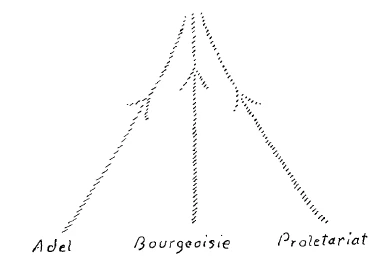
[ 20 ] For example, there is nothing more detrimental to the truth—in the sense in which I spoke of this truth earlier—than nationalism. But nationalism is precisely part of the program that will be regarded as a particularly beneficial one for the near future. It is part of the program for the near future. Therefore, when this nationalism seeks to build—though in reality it can only destroy—we will have to witness that the illusions, which are separated from lies by a narrow gap, will simply continue. For as much nationalism as arises in the world, so much untruth will exist in the world, especially as we look toward the future. And thus there will be many sources of new untruths. Untruth has ruled the world in many respects. But it will not be able to rule, for humanity has taken into itself those impulses, those currents, which are now emerging chaotically among the proletarian masses and which, as you have seen—I demonstrated this to you recently using material from the spiritual sciences—correspond to one of the three great currents in human development.
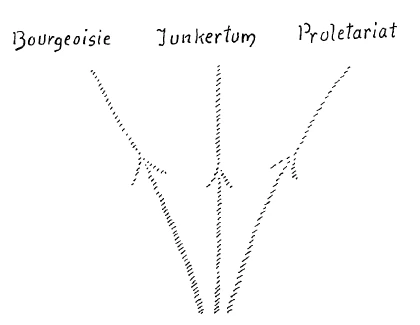
[ 21 ] The actual events are very much connected to these things. But people have been reluctant—especially in recent decades—to look at the world in a way that would allow them to truly see reality. It was simply impossible to look into the world without looking at the spirit, if one did not want to miss the reality. You see, everything that has happened in recent years can, at its core, be traced back to spiritually discernible forces at work in the civilized world. There was actually nothing more appalling in the course of these sad events than the discourse coming from this or that so-called national or other standpoint. For the most part, people spoke of things that had not the slightest connection to the course of events. The peculiar thing was that even the leading statesmen spoke in such a way that their speeches had little to do with the course of events. One should not treat the matters at hand so insensitively—what one might call the fate of human beings, insofar as these people are gathered together in groups, such as nations. For here one is, in essence, touching upon circumstances deeply, deeply connected to the spiritual realm, and one should not speak of them as superficially as is often done.
[ 22 ] Above all, one should not overlook the fact that certain terms can have very different meanings in different parts of the world. Just consider that people everywhere speak, let’s say, of the “state.” But what matters is not that one has a certain concept of the state, but that one at least associates with this concept some of the various emotional nuances that are attached to this state here or there, and that, above all, one must break free from the unfortunate conflation of state, nation, and people—that unfortunate conflation which is a fundamental characteristic of Wilsonianism, which always lumps together state, nation, and people, and even seeks to establish states based on nations, thereby perpetuating the lie only within certain currents, at least if that were possible.
[ 23 ] One must focus on the concrete, the real things everywhere. In the course of these reflections, I have shown you how a certain configuration of Central Europe is connected to those ancient suggestions—which relied on group instincts—that emanated from Roman Catholicism, from Rome. You see, as spiritual science tells us, the old idea of the Central European empire—which died in 1806—was intimately connected with this specter of the old Roman Empire. Until then, there existed—more or less, truly more or less nominally—the Holy Roman Empire of the German Nation, which did not disappear until 1806. It did not actually disappear, but was merely set aside. For this Holy Roman Empire—which, for better or worse, had held the various German tribes together or driven them apart over the long course of history—this imperial impulse of the Holy Roman Empire of the German Nation actually passed, little by little, to the Habsburg dynasty, and thus it was the Austro-Hungarian state that benefited from it. But a state that stood in the shadow of Habsburg power is something different from a state that, let us say, has developed since the fifteenth and sixteenth centuries—a state that, actually more closely tied to national identity, took shape in England or France. Where the state had no real substance—in what was the Habsburg Empire, where various peoples were held together under the banner of Habsburg power, and this Habsburg power served as a cloak, as an ancient treasure—there was something deeply medieval: namely, the imperial system of the old Holy Roman Empire of the German Nation. What the Habsburgs represented was the earliest Middle Ages, and unfortunately also thoroughly intertwined with the earliest Middle Ages in terms of Romanism, with regard to that Catholicism which, through the Counter-Reformation, had been revived—or at least made to resemble life—and which had brought about all those conditions of which I have already spoken to you here, and which contributed so much to the lulling, to the stifling, but also to other harmful effects within the Central European world.
[ 24 ] This Habsburg Empire of the oldest medieval variety stood in contrast to a most modern one, which gradually became entirely modern—something of the very most modern character: the Prussian-Habsburg Empire, that Prussian-Habsburg Empire which embodied Americanism within the German essence, Wilsonianism before Wilson. That is the great, immense difference: this most modern character of Prussian-Hohenzollern Americanism, masked as an empire, and the medieval Habsburg Empire, which was forged from the outside. It is necessary to study these things if one wishes to understand what has happened and what is yet to come.
[ 25 ] What emerged there as a form of High-Zollern-Prussian Americanism had a very specific characteristic: it developed exactly the same impulses that had emerged, for example, in the British Empire, but it developed all these impulses in the opposite way. You see, there are three currents—brought down from ancient times and emerging in the present: the aristocratic, the bourgeois, and the proletarian. Nowhere else—I would say in their purest form, side by side and separate—did these three currents—the aristocratic, the bourgeois, and the proletarian—develop as they did in the British Empire and also within so-called Germany—which, of course, is not an official name; there is no “Germany” in terms of constitutional law, nor has there ever been—that is, in the so-called German Empire. So in both regions, but in exactly opposite ways, these three currents developed. In the British Empire, all of this developed in such a way that the nobility, the bourgeoisie, and the proletariat came together, always striving toward a common goal. There is a good old nobility there, but it knew how to reconcile itself with the demands of bourgeois life, namely with the material and financial demands of bourgeois life. One is not only a member of the nobility; one also becomes a wealthy noble, a rich person in the modern sense. One can simultaneously derive one’s income from industry and be, in the best sense, an old, respected noble. But one manages the whole situation in such a way that the proletarian does not deviate too much in his undertakings from what the others want. It all works out together in one way or another.
[ 26 ] Within the new German state structure, everything began to diverge. There were also the three movements, but they developed in such a way that they diverged: There was industry, which had grown into big industry and had its own current; there was the old nobility in the Prussian Junker class—the two may have converged at times, but that was a thing of the past!—and there was the proletariat, which increasingly became the opponent of the bourgeoisie and set itself the task of waging the class struggle against the bourgeoisie in the most profound sense. All of this diverged. Anyone who has studied the historical events in this regard will find precisely this to be extraordinarily interesting. And all of this took place within a framework that was bound to be shattered. For what had been constructed there as so-called Germany—as I said, something that never existed in terms of constitutional law—bore the stamp of Bismarck, the stamp of a man for whom modern large-scale industry had never become a concrete reality, who never knew it, who never reckoned with it, and who constructed the framework—excluding the emergence of large-scale industry—within the framework he had devised. Now, the entire American-style model of large-scale industry developed within that framework and shattered it. It had already been shattered from within long before this war-torn catastrophe struck.
[ 27 ] In the frenzied turmoil into which humanity had fallen in every conceivable area, it truly had no peace to study these circumstances with an unbiased eye and with scientific objectivity. For people are not very inclined to engage with realities. One must actually strive to seek out realities. One must have a sense for realities—perhaps not just a sense, but also an instinct for them—for the trend of the times is to deny realities, to refuse to engage with them at all. You see, the people who looked toward where the Inn flows, where the Vltava flows, where the Danube flows, where the Leitha flows—they didn’t distinguish much between two fundamentally different things: between the German-Austrian people and the Habsburg Empire. The two merged. And again, when people visited Austria, where the German-Austrian people lived—who are now facing such a tragic fate—how did they ever have the opportunity to get to know what actually lives within that people? One simply learned—as a writer once observed—when arriving in Austria as a traveler, to recognize the “state-centric” mindset, which was very closely linked to sloppiness. When one arrived at a train station, well, one was told to go there, where one would then catch a connecting train. You went there, and even if you were supposed to arrive on time, you certainly didn’t arrive on time. After all, you could never be sure, when relying on the trains, that you’d get there on time, but, as the person in question said, wherever you ended up, you could be sure of getting a good cup of coffee. But that is, of course, merely a superficial aspect. What existed in this region of Central Europe—and which a certain brutality was meant to halt—was precisely the possibility of developing strong intellectual individualities from a certain underground current within the national character.
[ 28 ] You see, very little of Fercher von Steinwand’s work had been published in the 1880s. I was living in Vienna with a few friends, some younger writers. The conversation once turned to Fercher von Steinwand, and I was familiar with some of his poems. It was right around the time I was editing the *Deutsche Wochenschrift* in Vienna. Hamerling, after all, had spoken of Fercher von Steinwand with great understanding and deep goodwill. Then some friends said to me: “Yes, Fercher—we can find him.”—I was, of course, quick to agree to find Fercher von Steinwand. There was only one way to find him: you had to go to a secluded tavern on Singerstraße in Vienna. That’s a street that runs from the Opera House toward Stephansplatz. Yes, you see, there he was—right in the midst of all sorts of fellow men, whom one might well call “brothers”—that refined, spiritual face of Fercher. This German from the Carinthian region, entirely rooted—in terms of the way he forms his thoughts—in this German-Austrian territory, and at the same time connected to the world of ideas in a way that is precisely a spiritual connection and that actually exists only there in this form. Fercher von Steinwand also had grand political ideas, but he was not suited, according to the customs prevailing in such spheres, to translate these political ideas into reality in any way. He was certainly not. There are people like this everywhere—even if they are not as gifted as Fercher von Steinwand—who, precisely in this realm, are connected to the spiritual world and who have long carried within themselves a certain sense of the impulses that live there. But it was inconvenient to listen to such people.
[ 29 ] I must say, I often spent time with Fercher von Steinwand after that. He always struck me as one of those Gypsies who wander the world—but the aristocrat among Gypsies, like their leader, with grand ideas in his head, and who spoke of grand ideas as if he were one of them himself. One evening, as we were sitting together—I was editing the *Deutsche Wochenschrift* at the time—I said to him, “Tell me, Mr. Fercher, couldn’t you also contribute something of yours that hasn’t been published yet? Surely you have all sorts of poems, still unpublished; I’d love to publish them in the *Wochenschrift* now.” — “Yes,” he said, “I’ve got all sorts of things lying around—funny little pieces like that—I’ve still got them.” And so he gave me this “Chor der Urtriebe,” which he’d had in his desk for a long time and which I published back then.
[ 30 ] This Fercher von Steinwand is precisely one of those unique figures who truly emerged from the folk culture of Central Europe. I would like to share a brief note with you about the way Fercher von Steinwand was connected to his folk culture.
[ 31 ] On April 4, 1859, Fercher von Steinwand gave a lecture at the Dresden Antiquities Society in the presence of the then Crown Prince Georg—this book still refers to him as “the current King of Saxony”—all the ministers, and many high-ranking officers—I ask that you take special note of the latter—in front of all these people, Fercher von Steinwand, so please note: on April 4, 1859, delivered a lecture on the Gypsies. This lecture on the Gypsies contains an extraordinary amount of information, not so much because of the subtle observations Fercher von Steinwand makes about the Gypsies, but because of the broad insights into ethnic psychology that he offers in connection with the Gypsy question. He considers the Gypsies to be Indo-Europeans. And now his gaze turns—as I said, he delivered this speech, from which I will now read you an excerpt, before Crown Prince Georg of Saxony, before all the ministers, and before high-ranking military officials—to the Germans, and he said in the course of this speech:
[ 32 ] “We Germans, who for so long did not believe such a dark genius possible on earth, had to atone for our bright faith in the world and the world order, one after another, on inglorious battlefields. We Germans have the unfortunate virtue of respecting a foreign people to the point of foolishly neglecting ourselves, even if that people has little or nothing praiseworthy to its credit as a distinguishing characteristic.”
[ 33 ] Now I want to skip over what he says next.
[ 34 ] “Yet our virtue suddenly turns to vice as soon as a great event, arrayed in armor, steps before our threshold—without shaking our suffering and wretched nature or overcoming our deep-rooted, unnatural fear of history’s divine gesture, which has already led us so often under the executioner’s axe of fate. The gods are more hostile toward no one than the Philistine, and nowhere under the sun are there small shopkeepers who are not tyrannized by a big shopkeeper. Like any future, our German future may be a mystery to us. Yet this mystery is not as impenetrable as we usually suppose. We are already encountering real solutions to this German enigma—solutions that, in relation to our homeland, we may prophetically call our own.”
[ 35 ] All of this in a speech about the Gypsies. Fercher von Steinwand ties his reflections to the experience of being a Gypsy.
[ 36 ] “Let us look out a little over the Atlantic Ocean! Let us turn our gaze toward São Jorge dos Ilhéus, or let us wander in our minds up the Rio Contas, where we encounter German settlements. “With quiet contempt”—so says Emperor Max, a man of spirit and creative genius, and thus far better than the Emperor of Mexico—“with quiet contempt, the new offspring gaze upon the old mainland. — The gaunt children with their pale, sallow faces, their forget-me-not-blue eyes, and their straw-yellow, spiky hair particularly caught my attention and vividly reminded me of the offspring of our German villages. I approached two older boys and spoke to them in German; they looked up at me shyly and could not answer me; they could only manage to utter their own German names with difficulty, mangling them in the process. They were the children of German emigrants, of whom there are many in Ilheos. Not without a sense of indignation, however, I found in them the very picture of Brazilians—children who were unable to speak their mother tongue even with their own parents. And then the Germans wonder why they hold no independent position anywhere, why, instead of dominating, they come across as a sort of hybrid between slaves and free people. What a disgrace for German parents to communicate with their children in foreign sounds! How must family relationships suffer when the frail mother has to struggle with her own flesh and blood using foreign expressions! — This fact, which can be found everywhere, may be a major cause of the gloomy melancholy that weighs heavily and ominously on the faces and dispositions of all German colonists. During my journey, I did not see a single German emigrant who was entirely cheerful; a secret sorrow weighed upon them all. Only the children occasionally benefit from their parents’ fragmented existence, whose lack of character almost always leaves them at the mercy of foreign and insular nationalities. That is the sorrow that weighs upon the minds of these strangers. — Two pale men walked along the path, their features haggard; a few German words revealed their transatlantic origins to us. They replied in the language of their homeland, but the sound was no longer full and pure; the faint tone had something weary and sad about it; their figures, too, lacked energy and elasticity, as if they were people who had missed their calling, who did not feel at home—for whom the French expression dépaysé applies in the fullest sense. Most German emigrants present such a picture of melancholy; a secret worm gnaws at them all.” — —
[ 37 ] Isn’t that a gypsy tune wafting over from the banks of the Rio Contas? And that dreadful Melusine—what is she whispering in our ears? A word about our German future, an ice-cold greeting from her, promising a soon-to-come reunion. Yes, that future is already looming ominously on our horizon... .”
[ 38 ] That was said in 1859!
[ 39 ] “Yes, this future is already looming menacingly on our horizon, peering over banks and mountains into the depths of our lands, gaunt enough, like the spirit of death with the pallor of a corpse on its face. We have no right to expect anything else.
[ 40 ] What we say has no substance; what we do has no substance; what we create artistically lacks the resonance and nobility of the grandeur of nature. It seems as though we have set ourselves the task of mocking art through barren peculiarities, through sober folksiness, through forced naturalism. As for what else we think or contribute to history, there is enough room for it in the hollow cone of a nightcap.”
[ 41 ] Thus spoke that which truly spoke from within this folk tradition. And that exists; it lives on even today. It can only be brutalized. It has already been brutalized enough over the course of recent years. It will have to be acknowledged at some point what national self-awareness is in exceptional individuals; perhaps it did not thrive best under the aegis of men like Clemenceau, but rather under a different aegis.
[ 42 ] Sometimes one must look at things apart from the clichés that dominate the world, and in moments of world-historical significance, that may well be necessary. When Fercher von Steinwand speaks of his people in connection with the characterization of Gypsies, there may be something melancholic and pessimistic in it—if it comes across exactly as it does in this speech—but that is not what is meant; that is truly not what is meant. Something of these “Gypsies” must surely find its way into the world mission. Admittedly, this is rejected today; it is denied today. This denial is closely linked to Wilsonianism, but the facts will teach the world otherwise. And so that there may already be a protest today—from whatever quarter—against that which will most certainly be connected with a certain worldly infallibility and a certain belief in worldly authority in the near future—perhaps the world will say: “Let there be a Gypsy protest”—I have expressed my wish and articulated my thoughts that this building here, as a protest against what will happen in the coming years to all of so-called civilized humanity, should be called the Goetheanum. This is not merely to make some superficial, facile connection to Goethe, but rather it springs from the impulse of our time.
[ 43 ] Well, we'll continue this conversation tomorrow.