

How Can Humanity Rediscover the Christ?
The Threefold Shadow of Our Time and the New Light of Christ
GA 187
25 December 1918, Dornach
Translated by Steiner Online Library
Third Lecture
[ 1 ] When I made a few remarks last Sunday about the renewal of the Christmas spirit, I spoke of how the human being—I meant the true inner human being, who, emerging from the spiritual world, connects with what is handed down to him through the stream of heredity—how this human being, upon entering the existence he lives between birth and death, arrives with a certain impulse toward equality. I said that, through careful observation, one can notice this manifestation of the impulse of equality in the child: the child does not yet know the distinctions that arise within humanity in the social structure due to the circumstances into which karma introduces human beings. I then said: Viewed clearly and impartially, certain abilities, talents, and even genius present themselves in such a way that we must often attribute the forces living within these abilities, talents, and even genius to the impulses that act upon human beings through the hereditary stream, the current of heredity, and that such impulses—as they occur purely within the natural course of the current of heredity—must first be addressed as Luciferic impulses; that in our present epoch, these impulses are only properly integrated into the social structure by human beings when they regard them as Luciferic impulses and when they are educated to to cast off the Luciferic, to offer up, as it were, on the altar of Christ that which nature has imparted to him, to transform it, to metamorphose it.
[ 2 ] We are thus distinguishing between two points of view. The first point of view concerns what is to be done about the distinctions within humanity that arise from blood ties and circumstances of birth. And the other: that the very essence of the human being, at the beginning of earthly life, essentially carries within itself the impulse toward equality. This points to the fact that a human being is only properly understood when viewed over the course of their entire life, when the temporal development between birth and death is truly taken into account. We have just pointed out here, in a different context, how the driving forces of development change over the course of life between birth and death. And you will find these driving forces of development addressed in another way in my essay, which I wrote in the last issue of *Reich*, on the Ahrimanic and Luciferic forces in human life. There, I pointed out how the Luciferic plays a certain role in the first half of life, the Ahrimanic in the second half, and how these impulses of Ahriman and Lucifer are at work throughout the entire life, but in different ways.
[ 3 ] Alongside the idea of equality, other ideas have, as I said that Sunday, surged forward in a tumultuous manner in recent times, in a sense anticipating the peaceful development of the future—anticipating, first and foremost, that which must gradually unfold in the course of human development if it is to lead to salvation rather than ruin. Other ideas have emerged alongside the idea of equality; but these other ideas, too, can only be properly understood and appreciated in terms of their significance for life if they are correctly situated within the course of human physical existence.
[ 4 ] Alongside the idea of equality, the idea of freedom resonates, in a sense, throughout the modern world. I spoke to you some time ago about the idea of freedom, drawing on the new edition of my *Philosophy of Freedom*. We are thus in a position to appreciate the full importance and significance of this idea of freedom in connection with the innermost essence of the human being. Perhaps some of you also know, however, that questions raised here and there have often made it necessary to point out the very distinctive nature of the conception of freedom as it prevails in my *Philosophy of Freedom*. I have always felt it necessary to emphasize one particular aspect of the idea of freedom, namely that throughout modern times, the various philosophical views on freedom have actually made the mistake—if one wishes to call it a mistake—of posing the question in this way: Is the human being free or unfree? Can one attribute free will to human beings, or can one only attribute to them the fact that they are caught up in a kind of absolute natural necessity and carry out their actions and volitional decisions out of this necessity? — The question is incorrect. There is no such either/or. One cannot say that human beings are either free or unfree; rather, they are caught up in the process of development from unfreedom to freedom. And the way in which you find the impulse toward freedom presented in my *Philosophy of Freedom* shows you that human beings are becoming freer and freer, that they are extricating themselves from necessity, and that within them the impulses are growing more and more, enabling them to be free beings within the rest of the world order.
[ 5 ] Thus, the impulse of equality reaches its culmination at birth—though not in consciousness, since consciousness is not yet sufficiently developed at that point—and then it declines. The impulse of equality, therefore, follows a descending trajectory. Schematically, we can illustrate this as follows:
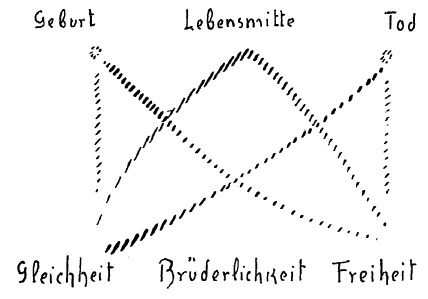
[ 6 ] At birth, the idea of equality reaches its peak, and equality follows a downward curve. The opposite is true for the idea of freedom. Freedom follows an ascending curve and reaches its culmination in death. I do not mean to say that, by passing through the gate of death, a person reaches the highest peak of a free being. But relatively speaking, in relation to human life, human beings develop the impulse toward freedom more and more as they approach the moment of death, and relatively speaking, they have most fully acquired the capacity to be free beings at the very moment they enter the spiritual world through the gate of death. Thus, while entering physical existence through birth, they carry with them from the spiritual world a state of equality that then declines as physical life unfolds; yet it is precisely in the course of physical life that they develop the impulse toward freedom, and with the highest degree of this impulse attainable in physical life, they pass through the gate of death into the spiritual world.
[ 7 ] This shows once again how one-sided the view of the human being often is. Time is not taken into account in this view of the human being. People speak of the human being in general, in the abstract, because today they are not inclined to engage with realities. But the human being is not a static being; he is a being in the process of becoming. And the more he becomes, the more he opens himself up to the possibility of becoming, the more he fulfills, so to speak, his true purpose already here in the course of physical life. Those people who remain rigid, who are averse to undergoing development, develop little of what is actually their earthly mission. What you were yesterday, you are no longer today, and what you are today, you will no longer be tomorrow. These are, admittedly, small nuances. Blessed is the one for whom there are nuances at all, for standing still is Ahrimanic. Nuances should be present. At the very least, in a human being’s life, no day should pass without their taking in at least one thought that alters their being a little; that places them, to a certain extent, in the position of being a becoming being, not merely a being that simply is. And so one can truly regard human beings according to their actual nature only if one does not say, in an absolute sense, “Human beings have a claim to freedom and equality in the world”—but rather if one knows how the impulse toward equality reaches its culmination at the beginning of life, and how the impulse toward freedom reaches its culmination at the end of life. Only then does one truly look into the complexity of human becoming—even in the course of life here on Earth—when one takes such things into account, rather than simply looking abstractly at the whole human being and saying: “He has a right to see freedom, equality, and so on realized in the social structure.” — These are the things that must once again be brought close to the human soul through spiritual science, things that have been neglected by more recent developments striving toward abstraction and, thereby, toward materialism.
[ 8 ] Now for the third of these impulses: brotherhood. It is characteristic of brotherhood that, in a certain sense, it reaches its peak in the middle of life. Its curve rises (see diagram on page 44) and then falls again. However, the only way to express this is to say: In the middle of life, when a person is in their most unstable—that is, fluctuating—state with regard to the relationship between the soul and the body, that is when a person has the strongest predisposition to develop brotherhood. They do not always develop it, but they have the predisposition to do so. The strongest prerequisites for the development of brotherhood, so to speak, are present in midlife.
[ 9 ] These three impulses are thus distributed throughout the entire course of human life. In the era we are moving toward, it will become necessary for our understanding of human beings—and, of course, for what is called self-knowledge—that such factors be taken into account. We will not be able to arrive at sound ideas about human coexistence if we do not know how these impulses are distributed throughout the course of a person’s life. In a sense, one will not be able to live concretely unless one is willing to acquire this insight; for one will not know how a young person relates to an old person, or an older person to someone of middle age, unless one takes into account the specific configuration of these inner impulses of the human being.
[ 10 ] But consider what we have just discussed in light of the observations we made earlier here regarding the gradual transformation of the entire human race into disciples. Remember how I explained that the peculiar dependence that human beings today have on the physical aspect with regard to soul development—a dependence that is limited to the very earliest years of life—was felt and experienced in ancient times—we are now speaking only of post-Atlantean times—right up into old age. I said that, in ancient Indian culture, people remained dependent on their physical—so-called physical—development well into their fifties, just as they are today only in their earliest years. In the first years of life, human beings are dependent on their physical development. We know what a turning point the change of teeth represents in physical development, followed by sexual maturity, and so on. In the early years of development, we see a clear parallel between soul development and physical development. This then ceases; it then fades away. And I have pointed out how this was not the case in earlier cultural epochs of the post-Atlantean era. That possibility of attaining natural wisdom simply by virtue of being human—of attaining that high wisdom which was revered among the ancient Indians, which could still be revered among the ancient Persians, and so on—that possibility existed because things were not as they are now, when a person becomes a fully formed being by their twenties and is no longer dependent on their physical constitution. The physical body then no longer provides anything. That was not the case in ancient times, as I said. Back then, the physical body itself imparted wisdom into people’s souls right up until their fifties. In the second half of life, even without any special occult development, people were thus enabled to draw forces from their physical development in an elemental way, in order to attain a certain level of wisdom and development of the will. I have pointed out to you what this meant for ancient Indian or Persian times, and even for the Egyptian-Chaldean era, when—if one was young, a boy or girl, a young man or young woman—one could be told: As you grow old, you can expect that simply through the process of aging, what has been bestowed upon you—by virtue of the development you undergo right up to death—will enter your human life. — It was also the case that people looked up to old age with reverence, because they told themselves: With old age, something enters one’s life that one cannot yet know or will when one is still a young person. — This gave the entire social life a certain structure that actually only ceased when, during the Greco-Roman period, this process receded to the middle years of a person’s life. In ancient Indian culture, a person remained capable of development until their fifties. Then the human being became “younger”; that is, the age of the human race—that is, this capacity for development—declined to the end of one’s forties during the ancient Persian period, and during the Egyptian-Chaldean period it was active only between the ages of thirty-five and forty-two. During the Greco-Latin period, human beings were capable of development only between the ages of twenty-eight and thirty-five. At the time of the Mystery of Golgotha, human beings were capable of development precisely up to the age of thirty-three. This is the marvel one discovers in the history of human development: that the age of Christ Jesus, who went to his death on Golgotha, coincides with the age to which humanity had regressed at that time. And then we have also pointed out how humanity is becoming younger and younger, that is, remains capable of development only up to an ever-smaller number of years; and how significant it is when a person today enters public life precisely at the characteristic age at which humanity currently stands—at the age of twenty-seven, as I told you—having absorbed nothing other than what was taken in from the outside world up to the age of twenty-seven. I pointed out how Lloyd George is, precisely in this regard, the representative figure of our time, because he entered public life at the age of twenty-seven. An immense number of consequences follow from this. You can read about this in Lloyd George’s biography. But these things make it possible to gain insight into the conditions of the world from within.
[ 11 ] Now, what is the most important thing for you when you combine this perspective—which we have considered here in relation to the ever-youthful nature of the human race—with the perspectives we have recently brought to mind in connection with the spirit of Christmas? This is what characterizes our present-day development following the Mystery of Golgotha: that, from our thirties onward, we can actually gain nothing from our own organism through what is naturally given to human beings. Had the Mystery of Golgotha not taken place, we would, so to speak, go about here on earth from our thirties onward and then say to ourselves: “Actually, we only really live properly up to about the age of thirty-two, thirty-three at most. That is when our organism gives us the possibility of life. After that, we might as well die. For through the course of nature, through elemental natural phenomena, we can no longer gain anything for our soul’s development through the impulses of our organism.” — That is what we would have to say if the Mystery of Golgotha had not taken place. If this Mystery of Golgotha had not taken place, the earth would be filled with the lamentations of people saying: “What do I actually gain from my life after the age of thirty-three?” Up to that point, it is possible that my organism gives me something. From then on, I might as well be dead; I am actually walking around here on Earth as a living corpse. — Many people would feel that they were walking around on Earth like living corpses if this Mystery of Golgotha had not taken place. But this Mystery of Golgotha is also meant to bear fruit. We should not merely absorb the impulse of Golgotha unconsciously, as is the case with most people, but we should absorb it consciously. We are to consciously take it in in such a way that, through the impulse of Golgotha, we remain, as it were, youthful and fresh well into old age. And it can keep us healthy and youthful if we consciously take it in the right way. And we will then also become aware of this refreshing power of the Mystery of Golgotha in our lives. And that is important, my dear friends!
[ 12 ] So you see, this mystery of Golgotha can be understood as something very, very alive within the course of our earthly lives. I said earlier that people are most predisposed to brotherhood in midlife, around the age of thirty-three. But they do not always develop this brotherhood. The reason for this lies in what I just said. Those who do not develop brotherhood—those who lack a certain degree of brotherhood—are simply not sufficiently “Dutch-Christianized.” Because human beings, so to speak, wither away in midlife due to the forces of the natural course of life, they cannot properly develop either the impulse or the instinct for brotherhood—and especially the impulse for freedom, which people today so rarely embrace—unless they bring to life within themselves thoughts that come directly from the Christ impulse. Therefore, the Christ impulse, when we turn toward it, is the direct inspiration for brotherhood. To the extent that one feels the necessity of brotherhood, one becomes more deeply imbued with the spirit of Christ. But on its own, humanity would not, during the remainder of its earthly existence—though things will be different in future developments—be able to develop the full strength of the impulse toward freedom. This is where that which flowed forth at the death of Christ Jesus and united with the earthly development of humanity enters into our earthly evolution as human beings. Therefore, Christ is essentially also the guide of today’s humanity toward freedom. We become free in Christ when we understand the Christ impulse in such a way that we fully grasp that Christ could not actually grow older in his physical body, nor could he live in his physical body beyond the age of thirty-three. Let us hypothetically assume that he had lived longer; he would then have lived in a physical human body into the time when, according to the current development of the Earth, that physical body is actually destined to die. There he would have absorbed the forces of death precisely as the Christ. Had he reached the age of forty, he would have experienced the forces of death within the body. He could not have wanted to experience that. He could only have wanted to experience what are still the refreshing forces of humanity. He works until then—until the age of thirty-three, until the middle of life—stirring up brotherhood as the Christ, and then hands over that which is to lie within the power of humanity by allowing the Spirit—the Holy Spirit—to flow into human development. Through this Holy Spirit, this healing Spirit, the human being develops toward freedom as life draws to a close. This is how the Christ impulse is integrated into this concrete human life.
[ 13 ] Such an inner permeation of the human being with the Christ principle—that is what must be embraced by human knowledge as a new Christmas idea. One must know how the human being emerges from the spiritual world with this sense of equality. This is something that is bestowed upon the human being, something that, in a sense, comes from God the Father. Only then, however, can the culmination of brotherhood, in the proper sense, enter into human evolution as the impulse toward freedom—a force against death—through the help of the Son and through Christ united with the Spirit.
[ 14 ] This contribution of the Christ impulse to the concrete shaping of humanity—that is what must now be taken into the consciousness of souls. That alone will be truly healing as people’s demands become ever more urgent and pressing regarding how the social structure should be shaped. But within this social structure live children, young people, middle-aged people, and the elderly, and a social structure that encompasses them all can only be found if we recognize that not all human beings are simply the same. The five-year-old child is a human being; the twenty-year-old young man and the twenty-year-old young woman are human beings; the forty-year-old is a human being—all are human beings. But this chaotic jumble does not lead to the kind of understanding of human beings that is necessary to meet the demands of the future—and of the present as well. At best, this chaotic jumble leads one to believe: A human being is a human being, so he must be elected to parliament at around the age of twenty. — These things are destructive to the real social structure. They stem from the fact that people today do not wish to engage in the observation of human beings and the resulting consciousness of humanity, which takes the human being concretely as he or she is. But taken concretely, the abstraction “human being, human being, human being” does not exist at all; rather, there is always a concrete human being of a certain age with specific impulses. Knowledge of the human being must be acquired; but it must be acquired by taking into account the development of that which lives as the core of the human being’s being from birth to death. This is something that must come to pass! And people will likely only be inclined to incorporate such things into their consciousness of humanity when they are once again able to look back on the development of humanity.
[ 15 ] Yesterday I pointed out to you something that occurred in the development of humanity with the advent of Christianity, namely that Christianity was, so to speak, born out of the Jewish soul, the Greek spirit, and the Roman body. These have, in a sense, become the outer shells of Christianity. But within Christianity lies the living “I,” and this, in turn, can be considered separately by looking back at the birth of Christianity. For external historiography, this birth of Christianity has become quite chaotic. What is commonly written today—whether from the Catholic or Protestant side—about the first centuries of Christianity is a rather chaotic body of knowledge. Much of what was lived in the first centuries of Christianity has, in terms of its very essence, either been completely forgotten or has become, one might say, a horror—especially for contemporary theologians. Just read for yourself about the strange intellectual convulsions—convulsions so intense that people almost, I would say, reach a kind of intellectual epilepsy—when they are asked to characterize what was lived as Gnosis in the first centuries of Christianity. This Gnosis is really a kind of devil, something demonic—something that one must absolutely not allow to enter human life! And if a theologian or other official representative of this or that denomination were to accuse Anthroposophy of having anything in common with Gnosis, he would believe he had said the very worst thing imaginable.
[ 16 ] However, underlying all of this is the fact that, in the early centuries of Christianity’s development, this Gnosis did indeed play a much more significant role in the spiritual life of European humanity—insofar as it was relevant to civilization at that time—than is generally believed today. On the one hand, people have no idea at all what this Gnosis actually was, and on the other hand, I would say, they harbor a mysterious fear of it. For most of today’s official representatives of this or that religious denomination, this Gnosis is something horrible. But one can indeed view it without any particular sympathy or antipathy, purely as a factual reality. In that case, one must study the matter from a spiritual-scientific perspective, because external history offers little. The development of the Western Church ensured that virtually all historical monuments of this Gnosticism were thoroughly eradicated, root and branch. As you know, very little remains—and what does remain, such as the *Pistis Sophia* and the like, conveys only a vague picture of Gnosticism. Otherwise, all we know of Gnosticism comes from the statements that were refuted by the Church Fathers. So, essentially, we know Gnosticism only from the writings of its opponents, while whatever might have provided an external, historical understanding of it has been virtually eradicated.
[ 17 ] However, a thoughtful examination of the theological development of the Western world—though such a thoughtful examination generally does not take place—would make people more reflective on this point as well. For example, if one were to examine the development of Christian dogma with discernment, one would conclude that this Christian dogma must surely be rooted in something other than mere arbitrariness or the like. Fundamentally, all these dogmas are rooted in Gnosis. However, the living essence of Gnosis has been stripped away, and only the abstract ideas and empty conceptual shells remain, so that one no longer recognizes this living origin in the dogmas. Yet this living origin actually lies in Gnosis. If you truly pursue Gnosis—to the extent that it can be studied through spiritual science—it also sheds a certain light on the few things that have been historically preserved by the opponents of Gnosis. And then you will probably say to yourself: This Gnosis points to the widespread, very concrete, atavistic clairvoyant worldview of ancient times, remnants of which were still quite present during the first post-Atlantean cultural epoch, though less so in the second; then, when in the third period the last remnants of the ancient clairvoyant tradition were lost to the world, they came to light in Gnosticism within a marvelous conceptual system—one that is, however, exceptionally figurative. Anyone who views Gnosticism from this perspective, anyone who is able to trace back—even if only historically—to the sparse remnants that can be uncovered more abundantly in pagan Gnosticism than in Christian literature, will find that this Gnosticism indeed already contained marvelous treasures of wisdom—a wisdom that referred to a world about which people today do not wish to know anything at all. So it is hardly surprising that even well-meaning people do not know what to make of the ancient Gnosticism—people such as Professor Jeremias in Leipzig, who would indeed be willing to engage with these matters; but he cannot grasp what these ancient concepts actually refer to—what is meant when they speak of a spiritual being named Jaldabaoth who, in a certain arrogance, is said to have set himself up as lord of the world, only to be rebuked by his mother, and so on. Such powerful images shine forth even from what has been historically preserved—powerful images such as this one, where Jaldabaoth actually says: “I am God the Father; there is no one above me.” — And the Mother replies: “Do not lie; above you is the Father of all, the first man and the Son of Man.” — Then—so the story continues—Jaldabaoth called his six associates, and they said: “Let us make man in our image.”
[ 18 ] There is a strange dialogue between Jaldabaoth and his mother, followed by the summoning of the six other collaborators, who come to the decision: “Let us make man in our image.” — But such images, such imaginings—which are actually quite vivid—were numerous and extensive in what was known as Gnosticism. In the Old Testament, we really have only fragments: those fragments that Jewish tradition has preserved from a vast body of symbolic wisdom that was contained in ancient Gnosticism, which flourished primarily in the East, but whose influence extended into the West, and which had more or less faded away in the West by the 3rd, 4th centuries; it continued to exert an influence among the Waldensians and Cathars, but ultimately faded away.
[ 19 ] People today have little concept of what it was like in the early Christian centuries in the souls of those who did not merely hold the beliefs that Catholics hold today, but in whom echoes of that powerful imagery of Gnosticism were very much alive. It looks vastly different when one looks back at what lived in the souls of people in the early centuries within the civilized countries of Europe—vastly different from what one sees when looking into the books that ecclesiastical and secular theologians and other scholars wrote about those early centuries. For in these books, everything that was alive in such powerful, awe-inspiring images—images that, as I said, referred to a world of which people today have no conception—is lost. Therefore, a person educated in the spirit of modern education does not know what to make of these concepts that come across to him. Jaldabaoth, his mother, the six co-workers, other things that appear: he does not know how to apply them to anything. They are words, empty phrases; he does not know what they refer to. And he knows even less how people once came to form such ideas. Consequently, modern people can’t help but say to themselves: “Well, the ancient Orientals had a vivid imagination; they conjured all this up in a fantastical way!” One is always very surprised that these people have absolutely no idea how little imagination a person living in the elemental realm actually possesses, or how this imagination plays an incredibly minor role among farmers, for example. In this regard, mythologists, too, have made tremendous contributions. They have, in fact, theorized about how ordinary people transformed the passing clouds—the clouds driven by the wind—into all sorts of fantastical beings, and so on. People have no idea what the people to whom they attribute this are actually like in their souls—that they are as far removed as possible from being able to give such poetic form to these things. Imagination reigns only in the circles of mythologists, the scholars who come up with such things. That is true imagination.
[ 20 ] What people have come up with as the origin of mythology and so on is simply a mistake. And people today do not know what the words and concepts that were spoken of actually refer to. Certain—I would say clear—indications of how these things are meant can therefore no longer be properly taken into account. Plato drew people’s attention very precisely to the fact that, by living here in the physical body, a human being remembers something they experienced in the spiritual world before this physical life. But today’s philosophers do not know what to make of this Platonic memory. They regard it as yet another thing Plato imagined—whereas Plato knew full well that the Greek soul was still predisposed in this way, though it retained only the last remnants of this predisposition to develop within itself what had been experienced in the spiritual world before birth. Anyone who, between birth and death, perceives only through the physical body and processes these perceptions with the modern mind cannot make any rational sense of the reflections that were not conceived at all in the physical body between birth and death, but were conceived between death and a new birth—experiences that were lived through before one was born. Back then, people lived in a world where they could speak of Jaldabaoth, who rebels in pride, whom his mother admonishes, and who summons the six helpers. For the human being between death and a new birth, this is as much a reality as the world of plants, animals, minerals, and other human beings is for the person confined within a physical body—the world of which he speaks. And Gnosis encompassed that which was brought into the physical world at birth. And to a certain extent, it was possible for people up until the Egyptian-Chaldean period—that is, up to the 8th century B.C.—to bring much with them from the time lived through between death and rebirth. What was brought with them and clothed in concepts and ideas—that is Gnosis. It then lived on during the Greco-Latin period, where it was no longer directly perceived, where it still existed as a legacy in ideas, and where only select minds knew its origin—such as Plato, and to a lesser extent, Aristotle as well. Socrates also knew of it; in fact, Socrates paid for this very knowledge with his life. It is there that one must seek the origin of Gnosis.
[ 21 ] Well, what is the situation, actually, with this fourth post-Atlantean, the Greco-Latin period? You see, people could only bring a faint memory of the pre-birth period into their lives. But people did carry something with them—and quite clearly so in the Greek era—of what they had experienced before birth. People today are immensely proud of their power of thought, but in reality they can comprehend very little with this power of thought. For today’s power of thought is, in fact, something one cannot be particularly proud of, since very little is understood through it. The power of thought that the Greeks, for example, developed was of a different nature. It was such that, as one passed through birth, the images of pre-birth experiences were, so to speak, lost; but that power of thought remained—the power one needed before birth to attach a rational meaning to these images. This is what is distinctive about Greek thought: namely, that it is quite different from our so-called normal thinking. For this Greek thinking is what one can learn by processing the imaginations one had before birth. One remembered little of the pre-birth imaginations, but the essential element that remained was the acumen one needed before birth to find one’s way in the world about which one formed imaginations. And this is precisely the development of the fourth post-Atlantean epoch, which, as you know, lasted until the 15th century A.D.—the essential point is that this power of thought is waning. And now, in the fifth epoch, we must develop it anew from within Earth culture. We must develop it slowly, haltingly, out of the scientific worldview. We are at the very beginning of this process today. During the fourth post-Atlantean epoch—that is, from 747 B.C. onward, through 1413 (with the event at Golgotha in between)—there was a continuous decline in the power of thought. Only then will the power of thought slowly rise again and reach a respectable level by the third millennium. Humanity need not be particularly proud of its current capacity for thought. So the capacity for thought is declining. The legacy of thought, which was still relatively highly developed at that time, still possessed the ideas with which one organized and penetrated the Gnostic images. It no longer possessed the images with the same clarity as, for example, the Egyptians or Babylonians, but it still possessed intellectual capacity; this then gradually declined. This is the peculiar interplay that took place in the early Christian centuries.
[ 22 ] The Mystery of Golgotha breaks upon the world; Christianity is born. The waning power of thought—which is still very much alive in the East but is also spreading to Greece—seeks to understand this event. The Romans have little understanding of it. This power of thought, however, seeks, so to speak, to grasp the event of Golgotha from the standpoint of thinking prior to birth, from the standpoint of thinking within the spiritual world. But now something peculiar occurs: this Gnostic thinking now also confronts the Mystery of Golgotha. Consider the Gnostic teachings on the Mystery of Golgotha—those teachings that are so horrifying to today’s theologians, particularly Christian ones: there, drawing on ancient atavistic teachings or on teachings imbued with this very power of thought, much that is grand and mighty is said about Christ—things that today are heretical, terribly heretical. Slowly and gradually, this capacity for Gnostic thought diminishes. We still see it in Manes in the 3rd century, and we see it carry over to the Cathars—all of them heretics in the Catholic sense—: there is a great, mighty, grandiose conception of the Mystery of Golgotha. Strangely enough, this melts away in the first centuries, and people limit themselves to applying as little intellectual acuity as possible to the Mystery of Golgotha and its understanding. And these two things are in conflict: on the one hand, the Gnostic teaching, seeking to grasp the mystery of Golgotha with powerful spiritual thinking; and on the other, the approach that anticipates what is to come, reckoning with the loss of intellectual power and with dull-witted thinking—hence striving to be as abstract as possible, offering as little as possible to understand the mystery of Golgotha. The mystery of Golgotha, as a cosmic mystery, shrinks almost entirely into the few sentences that form the beginning of the Gospel of John: about the Logos and its entry into the world and its fate in the world—as few concepts as possible, for one is to reckon with what is a declining power of thought.
[ 23 ] And so we see how the Gnostic conception of Christianity fades away, and how another conception of Christianity emerges, one that seeks to rely on as few concepts as possible. But of course, one transitions into the other. Concepts such as the doctrine of the Trinity or other dogmas are adopted from Gnostic views and, precisely here, abstracted and reduced to conceptual shells. But what is truly alive is this: in the struggle lies an immensely ingenious Gnostic conception of the mystery of Golgotha and that other conception, which works with as few concepts as possible, which anticipates what people would be like up until the 15th century and how the old, inherited power of sharp thinking would continue to decline and would have to be reacquired in a primitive way through the observation of natural objects in the natural sciences. You can study it step by step; you can study it even in an inner spiritual struggle when you look at Augustine, who in his youth became acquainted with Gnostic Manichaeism but could not come to terms with it and then turned to so-called simplicity, forming primitive concepts. The concepts become more and more primitive. Yet in Augustine, the first dawn of what must now be regained begins to break: knowledge starting from the human being, from the concrete human being. In the ancient Gnostic era, people attempted to proceed from the world and move toward the human being. Now, however, one must proceed from the human being and, through knowledge of the human being, regain knowledge of the world. In the future, one will have to proceed from the human being to the cosmos; in ancient times, one proceeded from the cosmos to the human being. I discussed this here some time ago, attempting to grasp this first dawn within the human being. You can find this, for example, in Augustine’s *Confessions*, but it is still quite chaotic. The main point is that humanity is proving itself increasingly incapable of receiving what radiates from the spiritual worlds—that which was present in the ancients in the form of imaginative wisdom, that which was active in Gnosticism, and from which a keen power of thought remained, still present among the Greeks. Thus, in Greek wisdom, much of it—even if confined to abstract concepts—still functions in such a way that one still, in a sense, possessed the ideas that are actually capable of comprehending the spiritual world. This then comes to an end; one can no longer understand anything of the spiritual world with the ideas that are now fading away.
[ 24 ] What is remarkable about Greek culture is that modern readers can very easily get the feeling, when encountering Greek ideas, that they are actually applicable to something entirely different from what they are applied to. The Greeks still have the ideas, but no longer the imaginations. This is particularly striking in the case of Aristotle. It is very curious: you know, there are entire libraries devoted to Aristotle. Everything in Aristotle is interpreted one way or another; people even argue among themselves about whether Aristotle believed in reincarnation or pre-existence. All of this stems from the fact that his words can be interpreted in various ways, because Aristotle worked with a conceptual system applicable to a supersensible world, yet no longer had any direct perception of it. Plato had a much deeper understanding of this and was therefore able to develop his conceptual system further in that sense; but Aristotle is already trapped within abstract concepts and can therefore no longer look toward that to which the forms of thought he develops refer. What is peculiar is that, in the early centuries, there was a struggle between a conception of the Mystery of Golgotha—one that illuminates this Mystery with the light of the supersensible world—and the necessity that emerged, which turned into fanaticism, to reject it. Not everyone saw through these things, but some did. Those who did see through them did not deal with them honestly. A primitive conception of the Mystery of Golgotha—one that was fiercely intent on using only a few concepts—led to fanaticism.
[ 25 ] Thus we see that, in a sense, more and more is being cast out of the Christian worldview—indeed, out of the worldview altogether—namely, supersensible thinking, which is fading away and coming to an end. We can observe, from century to century, I would say, how the Mystery of Golgotha stands before people as something of immense significance that intervenes in the development of the Earth, yet how the possibility of grasping this Mystery of Golgotha—or indeed of comprehending the world cosmically—is slipping away from them. Consider the 9th-century work *The Division of Nature* by Scotus Eriugena. There are still many images there—albeit highly abstracted—of the becoming of the world. Scotus Eriugena beautifully outlines four stages of this cosmic becoming, but his concepts fall short throughout. One sees that he is unable to stretch out the web of his concepts and make what he actually intends to summarize understandable and plausible. Everywhere, I would say, the threads of his concepts snap. It is very interesting how this becomes increasingly apparent from century to century, and how a low point in the weaving of conceptual threads finally occurs in the 15th century. Then an ascent begins again, but it gets stuck at the most elementary level. That is interesting. On the one hand, there is the mystery of Golgotha—which one actually possesses, toward which one turns one’s heart—but of which one declares: it cannot be understood. Gradually, the feeling takes hold that it cannot be understood at all. On the other hand, the observation of nature emerges; it emerges precisely in the age when concepts are fading. The observation of nature enters into life, but there are no concepts available to truly grasp the natural phenomena that enter into the observation of life.
[ 26 ] What is common to this era—at the turn of the fourth to the fifth post-Atlantean epoch in the middle of the Middle Ages—is that one has no adequate concepts, nor can one apply adequate concepts, either in the burgeoning observation of nature or in the revelation of the truths of salvation. Consider the state of Scholasticism at that time: on the one hand, it had religious revelation, but it could not derive concepts from the thought of its own era to process this religious revelation. Scholasticism was forced to rely on Aristotelianism, which needed to be renewed. One falls back on Greek thought, on Aristotle, in order to obtain these concepts and thereby penetrate the religious revelations. And religious revelations are processed using the Greek intellect, because the contemporary intellectual framework—if I may use this paradoxical expression—lacks intellect. And it is precisely those who appear most sincere in this era—the Scholastics—who do not make use of the contemporary intellect, because it did not exist at that time, because it was not part of the culture of the age. They draw on ancient Aristotelian concepts both for explaining nature—this is the essential point in the 10th, 11th, 12th, 13th, 14th, and 15th centuries, namely that it was precisely the most sincere of the scholastics who used these concepts to explain nature—and likewise for elaborating religious revelations. Only then does independent thought emerge, as if from the depths of the mind—though it has not yet been developed very far even to this day: Copernican and Galilean thought, which must continue to develop in order to rise once more into supersensible realms.
[ 27 ] In this way, one can look into the soul—so to speak, into the “I” of Christianity—which has merely cloaked itself in the Jewish soul, the Greek spirit, and the Roman body. But Christianity itself, in keeping with its true nature, had to take into account the fading of the supersensory understanding and thus, in a sense, allow the comprehensive Gnostic wisdom to shrink—one might even say—to the few words that form the beginning of the Gospel of John. For, in essence, the development of Christianity consists in the victory of the words of the Gospel of John over Gnosticism. Then, of course, everything degenerated into fanaticism, and Gnosticism was eradicated root and branch.
[ 28 ] These are also elements that are part of the birth of Christianity. This is something one must take into account if one truly wishes to absorb within oneself the impulse for the consciousness of humanity that must develop anew, for the new Christmas ideal. We must once again arrive at a kind of insight that relates to the supersensible. To do this, we must penetrate the supersensible forces at work within the human being so that we can expand them out into the cosmic realm. We must attain anthroposophy—human wisdom—that can in turn generate a cosmic sensibility. And that is the path. In ancient times, “human beings could survey the world by entering into existence through birth with memories of the experiences they had had before birth. For them, this world—which is a reflection of the spiritual world—was an answer to questions they had brought with them into existence through birth. Now human beings face this world empty-handed; they must work with concepts as primitive as those used, for example, by today’s view of nature. But they must work their way up again; they must now start from the human being in order to ascend from the human being to the cosmos. The knowledge of the cosmos must be born within the human being. This is also part of the Christmas message, as it is to be developed in the present so that it may bear fruit in the future.