

How Can Humanity Rediscover the Christ?
The Fall of the Spirits of Darkness
GA 187
25 December 1918, Dornach
Translate the original German text into any language:
Versions Available:
How Can Humanity Rediscover the Christ?, tr. SOL
Dritter Vortrag
Third Lecture
[ 1 ] Als ich am letzten Sonntag einige Andeutungen machte über die Erneuerung des Weihnachtsgedankens, da sprach ich davon, wie der Mensch — ich meinte den wirklichen inneren Menschen, der sich, herauskommend aus der geistigen Welt, verbindet mit dem, was ihm übergeben wird aus der Vererbungsströmung heraus —, wie dieser Mensch beim Eintritt in das Dasein, das er verlebt zwischen der Geburt und dem Tod, hereinkommt mit einem gewissen Impulse der Gleichheit. Ich sagte, man könne, verständig beobachtend, dieses Geltendmachen des Gleichheitsimpulses beim Kinde bemerken: das Kind kennt noch nicht die Differenzierungen, die innerhalb der Menschheit in der sozialen Struktur auftreten durch die Verhältnisse, in die das Karma den Menschen einführt. Ich sagte dann: Klar und unbefangen besehen, stellten sich gewisse Fähigkeiten, Begabungen, selbst das Genie so dar, daß wir die Kräfte, die in diesen Fähigkeiten, Begabungen, selbst im Genie leben, vielfach zuzuschreiben haben den Impulsen, die in der Vererbungslinie, Vererbungsströmung auf den Menschen wirken und daß man solche Impulse zunächst, wie sie rein im Naturlauf der Vererbungsströmung auftreten, als luziferische Impulse anzusprechen habe, daß in unserer gegenwärtigen Zeitepoche diese Impulse nur dann von dem Menschen in der rechten Weise in die soziale Struktur hereingestellt werden, wenn er sie ansieht als luziferische Impulse und wenn er dazu erzogen wird, das Luziferische abzustreifen, gewissermaßen darzubringen am Altar des Christus dasjenige, was die Natur ihm übermittelt hat, es umzuwandeln, zu metamorphosieren.
[ 1 ] When I made a few remarks last Sunday about the renewal of the Christmas spirit, I spoke of how the human being—I meant the true inner human being, who, emerging from the spiritual world, connects with what is handed down to him through the stream of heredity—how this human being, upon entering the existence he lives between birth and death, arrives with a certain impulse toward equality. I said that, through careful observation, one can notice this manifestation of the impulse of equality in the child: the child does not yet know the distinctions that arise within humanity in the social structure due to the circumstances into which karma introduces human beings. I then said: Viewed clearly and impartially, certain abilities, talents, and even genius present themselves in such a way that we must often attribute the forces living within these abilities, talents, and even genius to the impulses that act upon human beings through the hereditary stream, the current of heredity, and that such impulses—as they occur purely within the natural course of the current of heredity—must first be addressed as Luciferic impulses; that in our present epoch, these impulses are only properly integrated into the social structure by human beings when they regard them as Luciferic impulses and when they are educated to to cast off the Luciferic, to offer up, as it were, on the altar of Christ that which nature has imparted to him, to transform it, to metamorphose it.
[ 2 ] Zwei Gesichtspunkte halten wir also auseinander. Den einen Gesichtspunkt: was zu tun ist mit den durch die Blutsverhältnisse, durch die Geburtsverhältnisse auftretenden Differenzierungen der Menschheit. Und den andern: daß der eigentliche Wesenskern des Menschen beim Anfang des irdischen Lebens wesentlich den Impuls der Gleichheit in sich trägt. Damit ist hingewiesen darauf, daß der Mensch nur richtig betrachtet wird, wenn er in seinem ganzen Lebenslauf betrachtet wird, wenn die zeitliche Entwickelung zwischen Geburt und Tod wirklich ins Auge gefaßt wird. Wir haben gerade hier in einer andern Beziehung hingewiesen darauf, wie Entwickelungsmotive sich verändern im Laufe des Lebens zwischen Geburt und Tod. Und in anderer Weise finden Sie hingewiesen auf diese Entwickelungsmotive in meinem Aufsatz, den ich in der letzten Nummer des «Reiches» geschrieben habe über das Ahrimanische und Luziferische im menschlichen Leben. Da ist darauf hingewiesen, wie das Luziferische in der ersten Lebenshälfte eine gewisse Rolle spielt, das Ahrimanische in der zweiten Lebenshälfte, wie diese Impulse des Ahriman und Luzifer durch das ganze Leben hindurch wirken, aber in verschiedener Art.
[ 2 ] We are thus distinguishing between two points of view. The first point of view concerns what is to be done about the distinctions within humanity that arise from blood ties and circumstances of birth. And the other: that the very essence of the human being, at the beginning of earthly life, essentially carries within itself the impulse toward equality. This points to the fact that a human being is only properly understood when viewed over the course of their entire life, when the temporal development between birth and death is truly taken into account. We have just pointed out here, in a different context, how the driving forces of development change over the course of life between birth and death. And you will find these driving forces of development addressed in another way in my essay, which I wrote in the last issue of *Reich*, on the Ahrimanic and Luciferic forces in human life. There, I pointed out how the Luciferic plays a certain role in the first half of life, the Ahrimanic in the second half, and how these impulses of Ahriman and Lucifer are at work throughout the entire life, but in different ways.
[ 3 ] Neben der Idee der Gleichheit haben sich in der neueren Zeit andere Ideen, wie ich dazumal am Sonntag sagte, in tumultuarischer Weise vorgedrängt, gewissermaßen vorausnehmend die ruhige Entwickelung der Zukunft, zunächst in der Idee vorausnehmend dasjenige, was langsam in der Menschheitsentwickelung sich ausleben muß, wenn es zum Heile und nicht zum Unheil gereichen soll. Es haben sich andere Ideen neben die Idee der Gleichheit hingestellt; aber auch diese andern Ideen kann man hinsichtlich ihrer Bedeutung für das Leben nur dann richtig verstehen und würdigen, wenn man sie in den Zeitenlauf des menschlichen physischen Daseins richtig hineinstellt.
[ 3 ] Alongside the idea of equality, other ideas have, as I said that Sunday, surged forward in a tumultuous manner in recent times, in a sense anticipating the peaceful development of the future—anticipating, first and foremost, that which must gradually unfold in the course of human development if it is to lead to salvation rather than ruin. Other ideas have emerged alongside the idea of equality; but these other ideas, too, can only be properly understood and appreciated in terms of their significance for life if they are correctly situated within the course of human physical existence.
[ 4 ] Neben der Idee der Gleichheit tönt gewissermaßen durch die moderne Welt die Idee der Freiheit. Ich habe über die Idee der Freiheit vor einiger Zeit zu Ihnen in Anlehnung an die Neuauflage meiner «Philosophie der Freiheit» gesprochen. Wir sind also in der Lage, die ganze Wichtigkeit und Tragweite dieser Idee der Freiheit im Zusammenhang mit dem innersten Wesenskern des Menschen zu würdigen. Vielleicht wissen aber auch einige von Ihnen, daß öfters durch Fragen da und dort notwendig geworden ist, auf das ganz Besondere der Freiheitsauffassung hinzuweisen, wie sie in meiner «Philosophie der Freiheit» herrscht. Ich habe immer nötig gehabt, einen Gesichtspunkt mit Bezug auf die Freiheitsidee besonders hervorzuheben, nämlich den, daß die ganze neuere Zeit, die verschiedenen philosophischen Anschauungen über die Freiheit eigentlich den Fehler gemacht haben — wenn man es Fehler nennen will —, die Frage so zu stellen: Ist der Mensch frei oder unfrei? Kann man dem Menschen freien Willen zuschreiben oder darf man ihm nur zuschreiben, daß er in einer wie absoluten Naturnotwendigkeit drinnensteht und auch aus dieser Notwendigkeit heraus seine Handlungen, seine Willensentschlüsse vollführt? — Die Fragestellung ist unrichtig. Es gibt kein solches Entweder-Oder. Man kann nicht sagen, der Mensch ist entweder frei oder unfrei, sondern er ist begriffen in der Entwickelung von der Unfreiheit zur Freiheit. Und die Art und Weise, wie Sie aufgefaßt finden den Freiheitsimpuls in meiner «Philosophie der Freiheit», zeigt Ihnen, daß der Mensch immer freier und freier wird, daß er sich herauswindet aus der Notwendigkeit und immer mehr und mehr in ihm die Impulse wachsen, die ihm möglich machen, ein freies Wesen innerhalb der sonstigen Weltenordnung zu sein.
[ 4 ] Alongside the idea of equality, the idea of freedom resonates, in a sense, throughout the modern world. I spoke to you some time ago about the idea of freedom, drawing on the new edition of my *Philosophy of Freedom*. We are thus in a position to appreciate the full importance and significance of this idea of freedom in connection with the innermost essence of the human being. Perhaps some of you also know, however, that questions raised here and there have often made it necessary to point out the very distinctive nature of the conception of freedom as it prevails in my *Philosophy of Freedom*. I have always felt it necessary to emphasize one particular aspect of the idea of freedom, namely that throughout modern times, the various philosophical views on freedom have actually made the mistake—if one wishes to call it a mistake—of posing the question in this way: Is the human being free or unfree? Can one attribute free will to human beings, or can one only attribute to them the fact that they are caught up in a kind of absolute natural necessity and carry out their actions and volitional decisions out of this necessity? — The question is incorrect. There is no such either/or. One cannot say that human beings are either free or unfree; rather, they are caught up in the process of development from unfreedom to freedom. And the way in which you find the impulse toward freedom presented in my *Philosophy of Freedom* shows you that human beings are becoming freer and freer, that they are extricating themselves from necessity, and that within them the impulses are growing more and more, enabling them to be free beings within the rest of the world order.
[ 5 ] So hat denn der Impuls der Gleichheit seine Kulmination beim Geborenwerden — wenn auch nicht im Bewußtsein, da das noch nicht so entwickelt da schon leben kann —, dann fällt er ab. Der Impuls der Gleichheit hat also eine absteigende Entwickelung. Schematisch können wir das so zeichnen:
[ 5 ] Thus, the impulse of equality reaches its culmination at birth—though not in consciousness, since consciousness is not yet sufficiently developed at that point—and then it declines. The impulse of equality, therefore, follows a descending trajectory. Schematically, we can illustrate this as follows:
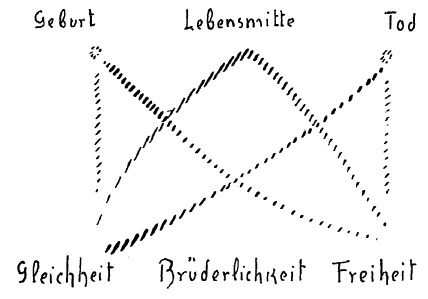
[ 6 ] Bei der Geburt ist eine Kulmination der Gleichheitsidee da, und die Gleichheit bewegt sich in einer absteigenden Kurve. Umgekehrt ist es nun bei der Freiheitsidee. Die Freiheit bewegt sich in einer aufsteigenden Kurve und hat ihre Kulmination im Tode. Ich will damit nicht sagen, daß der Mensch, indem er durch die Pforte des Todes geht, den höchsten Gipfel eines freitätigen Wesens erreicht. Aber relativ, mit Bezug auf das Menschenleben entwickelt der Mensch den Impuls der Freiheit gegen den Moment des Todes hin immer mehr und mehr, und relativ hat er sich am meisten die Möglichkeit, ein freies Wesen zu sein, in dem Augenblick erworben, wo er durch des Todes Pforte in die geistige Welt eintritt. Während er also, indem er durch die Geburt in das physische Dasein eintritt, aus der geistigen Welt herausträgt die Gleichheit, die dann absteigt in der Entwickelung des physischen Lebenslaufes, entwickelt er gerade im physischen Lebenslaufe den Freiheitsimpuls und steigt mit dem ihm im physischen Lebenslauf erreichbaren Höchstmaß des Freiheitsimpulses durch die Pforte des Todes in die geistige Welt hinein.
[ 6 ] At birth, the idea of equality reaches its peak, and equality follows a downward curve. The opposite is true for the idea of freedom. Freedom follows an ascending curve and reaches its culmination in death. I do not mean to say that, by passing through the gate of death, a person reaches the highest peak of a free being. But relatively speaking, in relation to human life, human beings develop the impulse toward freedom more and more as they approach the moment of death, and relatively speaking, they have most fully acquired the capacity to be free beings at the very moment they enter the spiritual world through the gate of death. Thus, while entering physical existence through birth, they carry with them from the spiritual world a state of equality that then declines as physical life unfolds; yet it is precisely in the course of physical life that they develop the impulse toward freedom, and with the highest degree of this impulse attainable in physical life, they pass through the gate of death into the spiritual world.
[ 7 ] Sie sehen daraus wiederum, wie einseitig oftmals das Menschenwesen betrachtet wird. Man bezieht nicht die Zeit in dieses Menschenwesen ein. Man redet vom Menschen im allgemeinen, in abstracto, weil man heute nicht geneigt ist, auf Wirklichkeiten einzugehen. Aber der Mensch ist nicht ein stehenbleibendes Wesen, er ist ein Wesen im Werden. Und je mehr er wird, je mehr er sich selbst in die Möglichkeit versetzt, zu werden, desto mehr erfüllt er gewissermaßen hier im physischen Lebenslaufe schon seine wirkliche Aufgabe. Diejenigen Menschen, die starr bleiben, die abgeneigt sind, eine Entwickelung durchzumachen, entwickeln wenig von dem, was eigentlich ihre irdische Mission ist. Was Sie gestern waren, sind Sie heute nicht mehr, und was Sie heute sind, werden Sie morgen nicht mehr sein. Es sind das allerdings kleine Nuancen. Wohl dem, bei dem es überhaupt Nuancen sind, denn das Stehenbleiben ist ahrimanisch. Nuancen sollten da sein. Es sollte wenigstens gewissermaßen im Leben des Menschen kein Tag vor sich gehen, ohne daß er wenigstens einen Gedanken in sich aufnimmt, der ein wenig sein Wesen ändert; der ein wenig ihn in die Möglichkeit versetzt, ein werdendes Wesen, nicht bloß ein seiendes Wesen zu sein. Und so kann man den Menschen wirklich nur betrachten seiner eigentlichen Natur nach, wenn man nun nicht sagt im absoluten Sinn: Der Mensch hat in der Welt die Prätention auf Freiheit, Gleichheit —, sondern wenn man weiß, wie der Impuls der Gleichheit seine Kulmination erlangt im Lebensbeginn, wie der Impuls der Freiheit seine Kulmination erlangt am Lebensende. Man schaut erst dann in dieses Komplizierte des menschlichen Werdens auch im Lebenslauf hier auf der Erde hinein, wenn man solche Dinge in Betracht zieht, wenn man nicht abstrakt einfach hinsieht auf den ganzen Menschen und sagt: Er hat Anspruch, verwirklicht zu sehen in der sozialen Struktur Freiheit, Gleichheit und so weiter. — Das sind die Dinge, die durch Geisteswissenschaft wiederum dem menschlichen Gemüt nahekommen müssen, die außer acht gelassen worden sind von der nach Abstraktion und dadurch nach Materialismus hinstrebenden neueren Entwickelung.
[ 7 ] This shows once again how one-sided the view of the human being often is. Time is not taken into account in this view of the human being. People speak of the human being in general, in the abstract, because today they are not inclined to engage with realities. But the human being is not a static being; he is a being in the process of becoming. And the more he becomes, the more he opens himself up to the possibility of becoming, the more he fulfills, so to speak, his true purpose already here in the course of physical life. Those people who remain rigid, who are averse to undergoing development, develop little of what is actually their earthly mission. What you were yesterday, you are no longer today, and what you are today, you will no longer be tomorrow. These are, admittedly, small nuances. Blessed is the one for whom there are nuances at all, for standing still is Ahrimanic. Nuances should be present. At the very least, in a human being’s life, no day should pass without their taking in at least one thought that alters their being a little; that places them, to a certain extent, in the position of being a becoming being, not merely a being that simply is. And so one can truly regard human beings according to their actual nature only if one does not say, in an absolute sense, “Human beings have a claim to freedom and equality in the world”—but rather if one knows how the impulse toward equality reaches its culmination at the beginning of life, and how the impulse toward freedom reaches its culmination at the end of life. Only then does one truly look into the complexity of human becoming—even in the course of life here on Earth—when one takes such things into account, rather than simply looking abstractly at the whole human being and saying: “He has a right to see freedom, equality, and so on realized in the social structure.” — These are the things that must once again be brought close to the human soul through spiritual science, things that have been neglected by more recent developments striving toward abstraction and, thereby, toward materialism.
[ 8 ] Nun der dritte der Impulse: die Brüderlichkeit. Ihr ist eigen, daß sie die Kulmination in einem gewissen Sinne in der Mitte des Lebens hat. Ihre Kurve steigt an (siehe Zeichnung Seite 44) und fällt wiederum. Man kann allerdings dafür die Sache nur so aussprechen, daß man sagt: In der Mitte des Lebens, wenn der Mensch in seinem labilsten, das heißt schwankenden Zustand ist mit Bezug auf das Verhältnis des Seelischen zum Leiblichen, da hat der Mensch die stärkste Veranlagung, die Brüderlichkeit zu entwickeln. Er entwickelt sie nicht immer, aber er hat Veranlagung dazu. Es sind sozusagen für die Entwickelung der Brüderlichkeit die stärksten Vorbedingungen gegeben in der Lebensmitte.
[ 8 ] Now for the third of these impulses: brotherhood. It is characteristic of brotherhood that, in a certain sense, it reaches its peak in the middle of life. Its curve rises (see diagram on page 44) and then falls again. However, the only way to express this is to say: In the middle of life, when a person is in their most unstable—that is, fluctuating—state with regard to the relationship between the soul and the body, that is when a person has the strongest predisposition to develop brotherhood. They do not always develop it, but they have the predisposition to do so. The strongest prerequisites for the development of brotherhood, so to speak, are present in midlife.
[ 9 ] So verteilen sich diese drei Impulse über das ganze menschliche Leben hin. In der Zeit, der wir entgegenleben, wird es notwendig für das Verständnis des Menschen und dann selbstverständlich auch für die sogenannte Selbsterkenntnis des Menschen, daß so etwas berücksichtigt werde. Man wird nicht zu richtigen Ideen über das Zusammenleben der Menschen kommen können, wenn man nicht wissen wird, wie sich die Impulse auf den Lebenslauf des Menschen verteilen. Man wird gewissermaßen nicht konkret leben können, wenn man diese Erkenntnis sich nicht wird erwerben wollen; denn man wird nicht wissen, wie konkret ein junger Mensch zu einem alten, ein älterer zu einem in mittleren Lebensjahren stehenden Menschen steht, wenn man nicht die besondere Konfiguration dieser inneren Impulse des menschlichen Wesens ins Auge faßt.
[ 9 ] These three impulses are thus distributed throughout the entire course of human life. In the era we are moving toward, it will become necessary for our understanding of human beings—and, of course, for what is called self-knowledge—that such factors be taken into account. We will not be able to arrive at sound ideas about human coexistence if we do not know how these impulses are distributed throughout the course of a person’s life. In a sense, one will not be able to live concretely unless one is willing to acquire this insight; for one will not know how a young person relates to an old person, or an older person to someone of middle age, unless one takes into account the specific configuration of these inner impulses of the human being.
[ 10 ] Fassen Sie aber das, was wir jetzt auseinandergesetzt haben, zusammen mit Betrachtungen, die wir früher hier angestellt haben über das allmähliche Jüngerwerden des ganzen Menschengeschlechtes. Erinnern Sie sich, wie ich auseinandergesetzt habe, daß die eigentümliche Abhängigkeit, welche der Mensch vom Körperlichen mit Bezug auf die seelische Entwickelung heute nur in seinen allerjüngsten Lebensjahren hat, gefühlt wurde, erlebt wurde in alten Zeiten — wir sprechen jetzt nur von nachatlantischen Zeiten — bis ins hohe Alter hinauf. Bis in die Fünfzigerjahre hinauf war der Mensch, sagte ich, in der urindischen Kultur so abhängig von seiner physischen, sogenannten physischen Entwickelung, wie er es heute nur in den jüngsten Jahren ist. Der Mensch ist in den ersten Lebensjahren abhängig von seiner physischen Entwickelung. Wir wissen, was für einen Einschnitt in der physischen Entwickelung der Zahnwechsel bildet, dann wiederum die Geschlechtsreife und so weiter. In den ersten Entwickelungsjahren sehen wir einen deutlichen Parallelismus zwischen seelischer und körperlicher Entwickelung. Das hört dann auf, das schwindet dann. Und ich habe darauf aufmerksam gemacht, wie das in älteren Kulturepochen der nachatlantischen Zeit nicht der Fall war. Jene Möglichkeit, zu naturgegebener Weisheit zu kommen einfach dadurch, daß man Mensch war, zu jener hohen Weisheit zu kommen, die man verehrte bei den alten Indern, die man noch verehren konnte bei den alten Persern und so weiter, jene Möglichkeit war dadurch gegeben, daß die Sache nicht so war wie jetzt, wo der Mensch in den Zwanzigerjahren ein fertiges Wesen wird, wo er nicht mehr abhängig bleibt von seiner physischen Organisation. Die physische Organisation gibt ihm dann nichts mehr. Das war nicht der Fall in alten Zeiten, sagte ich. Da gab die physische Organisation selbst die Weisheit den Menschen in die Seelen herein bis in die Fünfzigerjahre hinauf. Da war man in der zweiten Lebenshälfte auch ohne besondere okkulte Entwickelung in die Möglichkeit versetzt, auf elementare Art aus der körperlichen Entwickelung die Kräfte herauszusaugen, um zu einer gewissen Weisheit und Willensentwickelung zu kommen. Ich habe Sie aufmerksam gemacht, was das bedeutete für die alten indischen oder für die persischen Zeiten, selbst noch für die ägyptisch-chaldäischen Zeiten, wo dann, wenn man jung war, ein Knabe oder Mädchen oder Jüngling oder Jungfrau war, man hingewiesen werden konnte darauf: Wenn du alt wirst, hast du zu erwarten, daß einfach durch das Altwerden hereinbricht in dein Menschenleben dasjenige, was dir beschert ist dadurch, daß du eben eine Entwickelung durchmachst bis zum Tode hin. — Auch das war gegeben, daß man mit Ehrfurcht zum Alter hinaufsah, weil man sich sagte: Es wirkt mit dem Alter etwas herein in das Leben, was man noch nicht wissen kann, nicht wollen kann, wenn man noch ein junger Mensch ist. — Das gab dem ganzen sozialen Leben eine gewisse Struktur, die eigentlich erst aufhörte, als das während der griechisch-lateinischen Zeit zurückging bis in die mittleren Lebensjahre des Menschen. Bis in die Fünfzigerjahre war in der urindischen Kultur der Mensch entwickelungsfähig. Dann verjüngte sich der Mensch, also ging das Alter des Menschengeschlechtes, das heißt, diese Entwikkelungsfähigkeit zurück bis zum Ende der Vierzigerjahre während der urpersischen Zeit, und nur noch zwischen dem fünfunddreißigsten bis zweiundvierzigsten Jahre wirkte sie während der ägyptisch-chaldäischen Zeit. Während der griechisch-lateinischen Zeit war der Mensch nur entwickelungsfähig zwischen dem achtundzwanzigsten und fünfunddreißigsten Jahre. In der Zeit, als das Mysterium von Golgatha geschah, war der Mensch entwickelungsfähig eben bis zum dreiunddreißigsten Jahre. Das ist das Wunderbare, das man in der Entwickelungsgeschichte der Menschheit entdeckt: daß das Alter des durch den Tod auf Golgatha gehenden Christus Jesus zusammenfällt mit jenem Alter, bis zu dem die Menschheit dazumal zurückgegangen war. Und dann haben wir noch darauf hingewiesen, wie die Menschheit immer jünger und jünger wird, das heißt, bis zu einer immer geringeren Anzahl von Jahren entwickelungsfähig bleibt, wie es etwas Besonderes bedeutet, wenn der Mensch heute gerade im charakteristischen Jahre, in dem die Menschheit heute steht — im siebenundzwanzigsten Jahre sagte ich Ihnen —, eintritt in das öffentliche Leben und nichts anderes mitbekommen hat als dasjenige, was von außen bis zum siebenundzwanzigsten Jahre aufgenommen wurde. Ich führte an, wie ZL/oyd George gerade in dieser Beziehung der repräsentative Mensch unserer Zeit ist, weil er mit siebenundzwanzig Jahren in das öffentliche Leben eingetreten ist. Ungeheuer vieles folgt daraus. Sie können das in der Biographie von Lloyd George nachlesen. Diese Dinge machen aber möglich, die Verhältnisse der Welt von innen heraus zu durchschauen.
[ 10 ] But consider what we have just discussed in light of the observations we made earlier here regarding the gradual transformation of the entire human race into disciples. Remember how I explained that the peculiar dependence that human beings today have on the physical aspect with regard to soul development—a dependence that is limited to the very earliest years of life—was felt and experienced in ancient times—we are now speaking only of post-Atlantean times—right up into old age. I said that, in ancient Indian culture, people remained dependent on their physical—so-called physical—development well into their fifties, just as they are today only in their earliest years. In the first years of life, human beings are dependent on their physical development. We know what a turning point the change of teeth represents in physical development, followed by sexual maturity, and so on. In the early years of development, we see a clear parallel between soul development and physical development. This then ceases; it then fades away. And I have pointed out how this was not the case in earlier cultural epochs of the post-Atlantean era. That possibility of attaining natural wisdom simply by virtue of being human—of attaining that high wisdom which was revered among the ancient Indians, which could still be revered among the ancient Persians, and so on—that possibility existed because things were not as they are now, when a person becomes a fully formed being by their twenties and is no longer dependent on their physical constitution. The physical body then no longer provides anything. That was not the case in ancient times, as I said. Back then, the physical body itself imparted wisdom into people’s souls right up until their fifties. In the second half of life, even without any special occult development, people were thus enabled to draw forces from their physical development in an elemental way, in order to attain a certain level of wisdom and development of the will. I have pointed out to you what this meant for ancient Indian or Persian times, and even for the Egyptian-Chaldean era, when—if one was young, a boy or girl, a young man or young woman—one could be told: As you grow old, you can expect that simply through the process of aging, what has been bestowed upon you—by virtue of the development you undergo right up to death—will enter your human life. — It was also the case that people looked up to old age with reverence, because they told themselves: With old age, something enters one’s life that one cannot yet know or will when one is still a young person. — This gave the entire social life a certain structure that actually only ceased when, during the Greco-Roman period, this process receded to the middle years of a person’s life. In ancient Indian culture, a person remained capable of development until their fifties. Then the human being became “younger”; that is, the age of the human race—that is, this capacity for development—declined to the end of one’s forties during the ancient Persian period, and during the Egyptian-Chaldean period it was active only between the ages of thirty-five and forty-two. During the Greco-Latin period, human beings were capable of development only between the ages of twenty-eight and thirty-five. At the time of the Mystery of Golgotha, human beings were capable of development precisely up to the age of thirty-three. This is the marvel one discovers in the history of human development: that the age of Christ Jesus, who went to his death on Golgotha, coincides with the age to which humanity had regressed at that time. And then we have also pointed out how humanity is becoming younger and younger, that is, remains capable of development only up to an ever-smaller number of years; and how significant it is when a person today enters public life precisely at the characteristic age at which humanity currently stands—at the age of twenty-seven, as I told you—having absorbed nothing other than what was taken in from the outside world up to the age of twenty-seven. I pointed out how Lloyd George is, precisely in this regard, the representative figure of our time, because he entered public life at the age of twenty-seven. An immense number of consequences follow from this. You can read about this in Lloyd George’s biography. But these things make it possible to gain insight into the conditions of the world from within.
[ 11 ] Nun, was ist Ihnen aber die Hauptsache, wenn Sie diesen Gesichtspunkt, den wir da für das Immer-Jüngerwerden des Menschengeschlechtes ins Auge gefaßt haben, verbinden mit den Gesichtspunkten, die wir gerade in diesen Tagen im Zusammenhang mit dem Weihnachtsgedanken uns vor die Seele geführt haben? Das ist das Charakteristische für unsere Gegenwartsentwickelung nach dem Mysterium von Golgatha, daß wir eigentlich durch das, was dem Menschen von Natur zugeteilt ist, aus unserem Organismus heraus nichts gewinnen können von den Dreißigerjahren an. Würde nicht das Mysterium von Golgatha eingetreten sein, wir würden gewissermaßen von unseren Dreißigerjahren an hier auf der Erde herumgehen und würden uns dann sagen: Eigentlich leben wir ja nur richtig bis so zum zweiunddreißigsten, dreiunddreißigsten Jahre höchstens. Da gibt uns unser Organismus die Möglichkeit des Lebens. Dann könnten wir ebensogut sterben. Denn durch den Naturlauf, durch die elementarischen Naturereignisse können wir nichts mehr durch die Impulse unseres Organismus für unsere seelische Entwickelung gewinnen. — Das würden wir sagen müssen, wenn das Mysterium von Golgatha nicht eingetreten wäre. Voll müßte die Erde sein, wenn dieses Mysterium von Golgatha nicht eingetreten wäre, von den Klagen der Menschen, die dahingingen, daß die Menschen sagten: Was habe ich eigentlich von meinem Leben vom dreiunddreißigsten Lebensjahre an! Bis dahin ist es möglich, daß mir mein Organismus etwas gibt. Von da ab könnte ich ebensogut tot sein, ich gehe eigentlich als ein lebendiger Leichnam hier auf der Erde herum. — Das würden viele Menschen empfinden, daß sie wie ein lebendiger Leichnam auf der Erde herumgehen würden, wenn dieses Mysterium von Golgatha nicht eingetreten wäre. Aber dieses Mysterium von Golgatha soll eben auch noch fruchtbar gemacht werden. Wir sollen nicht bloß unbewußt, wie es für die Menschen der Fall ist, in uns den Impuls von Golgatha aufnehmen, sondern wir sollen ihn bewußt aufnehmen. Wir sollen bewußt ihn so aufnehmen, daß wir gewissermaßen durch den Impuls von Golgatha jugendfrisch bleiben bis in das Alter hinein. Und er kann uns gesund und jugendfrisch erhalten, wenn wir ihn in der richtigen Weise bewußt aufnehmen. Und wir werden uns dann auch dieses Erfrischenden des Mysteriums von Golgatha für unser Leben bewußt werden. Und das ist wichtig, meine lieben Freunde!
[ 11 ] Now, what is the most important thing for you when you combine this perspective—which we have considered here in relation to the ever-youthful nature of the human race—with the perspectives we have recently brought to mind in connection with the spirit of Christmas? This is what characterizes our present-day development following the Mystery of Golgotha: that, from our thirties onward, we can actually gain nothing from our own organism through what is naturally given to human beings. Had the Mystery of Golgotha not taken place, we would, so to speak, go about here on earth from our thirties onward and then say to ourselves: “Actually, we only really live properly up to about the age of thirty-two, thirty-three at most. That is when our organism gives us the possibility of life. After that, we might as well die. For through the course of nature, through elemental natural phenomena, we can no longer gain anything for our soul’s development through the impulses of our organism.” — That is what we would have to say if the Mystery of Golgotha had not taken place. If this Mystery of Golgotha had not taken place, the earth would be filled with the lamentations of people saying: “What do I actually gain from my life after the age of thirty-three?” Up to that point, it is possible that my organism gives me something. From then on, I might as well be dead; I am actually walking around here on Earth as a living corpse. — Many people would feel that they were walking around on Earth like living corpses if this Mystery of Golgotha had not taken place. But this Mystery of Golgotha is also meant to bear fruit. We should not merely absorb the impulse of Golgotha unconsciously, as is the case with most people, but we should absorb it consciously. We are to consciously take it in in such a way that, through the impulse of Golgotha, we remain, as it were, youthful and fresh well into old age. And it can keep us healthy and youthful if we consciously take it in the right way. And we will then also become aware of this refreshing power of the Mystery of Golgotha in our lives. And that is important, my dear friends!
[ 12 ] Sie sehen also, dieses Mysterium von Golgatha kann als etwas sehr, sehr Lebendiges innerhalb unseres irdischen Lebenslaufes aufgefaßt werden. Ich sagte vorhin, die Menschen sind am meisten veranlagt in der Lebensmitte, so um das dreiunddreißigste Jahr herum, für die Brüderlichkeit. Aber sie bilden nicht immer diese Brüderlichkeit aus. Hier haben Sie den Grund in dem, was ich eben gesagt habe. Diejenigen, die die Brüderlichkeit nicht ausbilden, bei denen es etwas mangelt an der Brüderlichkeit, die sind eben zu wenig dutchchristet. Weil der Mensch gewissermaßen in der Lebensmitte erstirbt durch die Kräfte des Naturlaufes, kann er sowohl den Impuls, den Instinkt der Brüderlichkeit wie namentlich den Impuls der Freiheit, den die Menschen heute so wenig aufnehmen, nicht ordentlich entwickeln, wenn er nicht lebendig macht in sich Gedanken, die unmittelbar von dem Christus-Impuls herkommen. Daher ist der Christus-Impuls unmittelbar, indem wir zu ihm uns hinwenden, die Anfeuerung zur Brüderlichkeit. In dem Maße, in dem man empfindet die Notwendigkeit der Brüderlichkeit, durchchristet man sich. Aber der Mensch würde allein während des Restes der Erdenzeit — in künftigen Entwickelungen wird es anders sein — nicht dahin kommen, die ganze Stärke des Freiheitsimpulses zu entwickeln. Da tritt dasjenige in unsere Erdenentwickelung als Menschen ein, was beim Tode des Christus Jesus ausgeflossen ist und sich mit der Erdenentwickelung der Menschheit vereinigt hat. Daher ist Christus im wesentlichen auch der Führer der heutigen Menschheit zur Freiheit. Wir werden in Christo frei, wenn wir den Christus-Impuls so verstehen, daß wir ganz darauf einzugehen wissen, daß der Christus eigentlich nicht älter werden konnte im physischen Leib, oder nicht länger leben konnte im physischen Leibe als bis zum dreiunddreißigsten Jahre hin. Nehmen wit hypothetisch an, er hätte länger gelebt, so würde er in einem physischen Menschenleibe in die Zeit hineingelebt haben, wo dieser physische Leib eigentlich nach der gegenwärtigen Erdenentwickelung zum Ersterben bestimmt ist. Da würde er die Ersterbekräfte gerade als der Christus aufgenommen haben. Wäre er vierzig Jahre alt geworden, so hätte er im Leibe erlebt die Ersterbekräfte. Die konnte er nicht erleben wollen. Er konnte nur dasjenige erleben wollen, was noch die erfrischenden Kräfte des Menschen sind. Bis dahin wirkt er, bis zum dreiunddreißigsten Jahre, bis zur Lebensmitte, regt als der Christus die Brüderlichkeit an, übergibt dann dasjenige, was in des Menschen Kraft liegen soll, indem er ausfließen läßt in die Entwickelung der Menschen den Geist, dem Heiligen Geiste. Durch diesen Heiligen Geist, diesen gesundenden Geist entwickelt sich der Mensch gegen sein Lebensende hin zur Freiheit. So gliedert sich der ChristusImpuls ein in dieses konkrete menschliche Leben.
[ 12 ] So you see, this mystery of Golgotha can be understood as something very, very alive within the course of our earthly lives. I said earlier that people are most predisposed to brotherhood in midlife, around the age of thirty-three. But they do not always develop this brotherhood. The reason for this lies in what I just said. Those who do not develop brotherhood—those who lack a certain degree of brotherhood—are simply not sufficiently “Dutch-Christianized.” Because human beings, so to speak, wither away in midlife due to the forces of the natural course of life, they cannot properly develop either the impulse or the instinct for brotherhood—and especially the impulse for freedom, which people today so rarely embrace—unless they bring to life within themselves thoughts that come directly from the Christ impulse. Therefore, the Christ impulse, when we turn toward it, is the direct inspiration for brotherhood. To the extent that one feels the necessity of brotherhood, one becomes more deeply imbued with the spirit of Christ. But on its own, humanity would not, during the remainder of its earthly existence—though things will be different in future developments—be able to develop the full strength of the impulse toward freedom. This is where that which flowed forth at the death of Christ Jesus and united with the earthly development of humanity enters into our earthly evolution as human beings. Therefore, Christ is essentially also the guide of today’s humanity toward freedom. We become free in Christ when we understand the Christ impulse in such a way that we fully grasp that Christ could not actually grow older in his physical body, nor could he live in his physical body beyond the age of thirty-three. Let us hypothetically assume that he had lived longer; he would then have lived in a physical human body into the time when, according to the current development of the Earth, that physical body is actually destined to die. There he would have absorbed the forces of death precisely as the Christ. Had he reached the age of forty, he would have experienced the forces of death within the body. He could not have wanted to experience that. He could only have wanted to experience what are still the refreshing forces of humanity. He works until then—until the age of thirty-three, until the middle of life—stirring up brotherhood as the Christ, and then hands over that which is to lie within the power of humanity by allowing the Spirit—the Holy Spirit—to flow into human development. Through this Holy Spirit, this healing Spirit, the human being develops toward freedom as life draws to a close. This is how the Christ impulse is integrated into this concrete human life.
[ 13 ] Solch eine innerliche Durchdringung des Menschenwesens mit dem Christus-Prinzip, das ist es, was als ein neuer Weihnachtsgedanke aufgenommen werden muß vom Menschenwissen. Wissen muß man, wie der Mensch mit der Gleichheit aus der geistigen Welt herauskommt. Das ist etwas, was ihm mitgegeben wird, was gewissermaßen aus dem Vatergott ist. Dann kann aber die Kulmination der Brüderlichkeit in der richtigen Weise nur durch des Sohnes Hilfe und durch den mit dem Geist vereinigten Christus die Entwickelung zum Freiheitsimpuls gegen den Tod hin in die Menschheitsentwickelung eintreten.
[ 13 ] Such an inner permeation of the human being with the Christ principle—that is what must be embraced by human knowledge as a new Christmas idea. One must know how the human being emerges from the spiritual world with this sense of equality. This is something that is bestowed upon the human being, something that, in a sense, comes from God the Father. Only then, however, can the culmination of brotherhood, in the proper sense, enter into human evolution as the impulse toward freedom—a force against death—through the help of the Son and through Christ united with the Spirit.
[ 14 ] Dieses Mitwirken des Christus-Impulses in der konkreten Menschheitsausgestaltung, das ist dasjenige, was von jetzt ab in das Bewußtsein der Seelen aufgenommen werden muß. Das allein wird richtig heilsam sein, wenn die Forderungen der Menschen immer drängender und brennender werden in bezug darauf, wie man gestalten soll die soziale Struktur. Aber in dieser sozialen Struktur leben Kinder, junge, mittlere und alte Leute, und eine soziale Struktur, die alle umfaßt, wird man nur finden können, wenn man weiß, daß Mensch nicht einfach gleich Mensch ist. Das fünfjährige Kind ist Mensch, der zwanzigjährige Jüngling, die zwanzigjährige Jungfrau ist Mensch, der vierzigjährige Mensch ist Mensch, alles ist Mensch. Aber dieses chaotische Durcheinanderwerfen, das bringt es nicht zu einer solchen Erkenntnis des Menschen, wie sie notwendig ist, um die Forderungen der Zukunft, der Gegenwart auch, zu erfüllen. Das chaotische Durcheinanderwerfen bringt es höchstens dazu, daß man meint: Mensch ist Mensch, also muß er mit zwanzig Jahren ungefähr ins Parlament gewählt werden. — Diese Dinge sind zerstörend für die wirkliche soziale Struktur. Sie beruhen darauf, daß der Mensch in der Gegenwart nicht eintreten will in die Menschenbeobachtung und das daraus hervorgehende Menschheitsbewußtsein, welches den Menschen konkret so nimmt, wie er ist. Aber konkret genommen ist die Abstraktion Mensch, Mensch, Mensch, gar nicht vorhanden, sondern es ist immer ein konkreter Mensch eines bestimmten Lebensalters mit bestimmten Impulsen. Menschenerkenntnis muß erworben werden; aber sie muß erworben werden, wenn man die Entwickelung desjenigen, was als Wesenskern im Menschen von der Geburt bis zum Tode lebt, ins Auge faßt. Das ist etwas, was auftreten muß! Und man wird wahrscheinlich nur geneigt sein, solche Dinge aufzunehmen in das Menschheitsbewußtsein, wenn man wiederum in der Lage ist, Rückblicke auf die Menschheitsentwickelung zu machen.
[ 14 ] This contribution of the Christ impulse to the concrete shaping of humanity—that is what must now be taken into the consciousness of souls. That alone will be truly healing as people’s demands become ever more urgent and pressing regarding how the social structure should be shaped. But within this social structure live children, young people, middle-aged people, and the elderly, and a social structure that encompasses them all can only be found if we recognize that not all human beings are simply the same. The five-year-old child is a human being; the twenty-year-old young man and the twenty-year-old young woman are human beings; the forty-year-old is a human being—all are human beings. But this chaotic jumble does not lead to the kind of understanding of human beings that is necessary to meet the demands of the future—and of the present as well. At best, this chaotic jumble leads one to believe: A human being is a human being, so he must be elected to parliament at around the age of twenty. — These things are destructive to the real social structure. They stem from the fact that people today do not wish to engage in the observation of human beings and the resulting consciousness of humanity, which takes the human being concretely as he or she is. But taken concretely, the abstraction “human being, human being, human being” does not exist at all; rather, there is always a concrete human being of a certain age with specific impulses. Knowledge of the human being must be acquired; but it must be acquired by taking into account the development of that which lives as the core of the human being’s being from birth to death. This is something that must come to pass! And people will likely only be inclined to incorporate such things into their consciousness of humanity when they are once again able to look back on the development of humanity.
[ 15 ] Gestern habe ich Sie hingewiesen auf etwas, was in die Menschheitsentwickelung eingetreten ist mit dem Christentum, indem das Christentum gewissermaßen herausgeboren ist aus der jüdischen Seele, aus dem griechischen Geist, aus dem römischen Leib. Das sind gewissermaßen die Hüllen des Christentums geworden. Aber im Christentum ist das lebendige Ich darinnen, und das kann wiederum abgesondert betrachtet werden, indem man zurückblickt auf diese Geburt des Christentums. Für die äußere Geschichtsschreibung ist diese Geburt des Christentums ziemlich chaotisch geworden. Dasjenige, was heute gewöhnlich — sei es von katholischer, sei es von protestantischer Seite — geschrieben wird über die ersten Jahrhunderte des Christentums, ist eine ziemlich chaotische Weisheit. Manches, was gelebt hat in den ersten Jahrhunderten des Christentums, ist überhaupt gerade für die Theologen der Gegenwart seiner eigentlichen Wesenheit nach entweder ganz vergessen oder zu einem Horror, könnte man sagen, geworden. Denn lesen Sie nur nach, in welche sonderbaren Konvulsionen des Intellektuellen, Konvulsionen, daß die Leute fast schon, möchte ich sagen, bis zu einer Art intellektueller Epilepsie kommen, wenn sie charakterisieren sollen dasjenige, was in den ersten Jahrhunderten des Christentums als Gnosis gelebt hat. Das ist schon so eine Art Teufel, so etwas Dämonisches, etwas, das man nur ja nicht ordentlich hereinlassen soll in das menschliche Leben, diese Gnosis! Und wenn nun gar solch ein Theologe oder sonstiger offizieller Vertreter dieses oder jenes Bekenntnisses die Anthroposophie anschuldigen kann, daß sie etwas gemein hätte mit der Gnosis, dann glaubt er schon, das Allerschlimmste gesagt zu haben.
[ 15 ] Yesterday I pointed out to you something that occurred in the development of humanity with the advent of Christianity, namely that Christianity was, so to speak, born out of the Jewish soul, the Greek spirit, and the Roman body. These have, in a sense, become the outer shells of Christianity. But within Christianity lies the living “I,” and this, in turn, can be considered separately by looking back at the birth of Christianity. For external historiography, this birth of Christianity has become quite chaotic. What is commonly written today—whether from the Catholic or Protestant side—about the first centuries of Christianity is a rather chaotic body of knowledge. Much of what was lived in the first centuries of Christianity has, in terms of its very essence, either been completely forgotten or has become, one might say, a horror—especially for contemporary theologians. Just read for yourself about the strange intellectual convulsions—convulsions so intense that people almost, I would say, reach a kind of intellectual epilepsy—when they are asked to characterize what was lived as Gnosis in the first centuries of Christianity. This Gnosis is really a kind of devil, something demonic—something that one must absolutely not allow to enter human life! And if a theologian or other official representative of this or that denomination were to accuse Anthroposophy of having anything in common with Gnosis, he would believe he had said the very worst thing imaginable.
[ 16 ] Nun, alldem liegt aber zugrunde, daß in den ersten Jahrhunderten der Entwickelung des Christentums diese Gnosis in der Tat viel bedeutsamer in das geistige Leben der europäischen Menschheit eingriff, soweit sie dazumal für die Zivilisation in Betracht kam, als man heute glaubt. Man hat auf der einen Seite gar keine Vorstellung davon, was diese Gnosis eigentlich war, und hat auf der andern Seite, ich möchte sagen, eine geheimnisvolle Furcht. Es ist diese Gnosis für die meisten gegenwärtigen offiziellen Vertreter dieses oder jenes Religionsbekenntnisses etwas Horribles. Man kann sie aber nun wirklich betrachten ohne besondere Sympathie und Antipathie, rein als etwas Tatsächliches. Dann muß man die Sache wohl geisteswissenschaftlich studieren, weil die äußere Geschichte nicht viel bietet. Die kirchliche Entwickelung des Abendlandes hat dafür gesorgt, daß eigentlich alle historischen Denkmäler dieser Gnosis mit Stumpf und Stiel ziemlich ausgerottet wurden. Es ist nur weniges, wie Sie wissen, und was nur ein unklares Bild von der Gnosis wiedergibt, wie die «Pistis Sophia» und dergleichen, übriggeblieben. Sonst weiß man aus der Gnosis nur die Sätze, die von den Kirchenvätern widerlegt werden. Also im Grunde genommen kennt man die Gnosis nur aus der Schriftstellerei der Gegner; während das, was äußerlich historisch eine Vorstellung von ihr geben könnte, ziemlich mit Stumpf und Stiel ausgerottet worden ist.
[ 16 ] However, underlying all of this is the fact that, in the early centuries of Christianity’s development, this Gnosis did indeed play a much more significant role in the spiritual life of European humanity—insofar as it was relevant to civilization at that time—than is generally believed today. On the one hand, people have no idea at all what this Gnosis actually was, and on the other hand, I would say, they harbor a mysterious fear of it. For most of today’s official representatives of this or that religious denomination, this Gnosis is something horrible. But one can indeed view it without any particular sympathy or antipathy, purely as a factual reality. In that case, one must study the matter from a spiritual-scientific perspective, because external history offers little. The development of the Western Church ensured that virtually all historical monuments of this Gnosticism were thoroughly eradicated, root and branch. As you know, very little remains—and what does remain, such as the *Pistis Sophia* and the like, conveys only a vague picture of Gnosticism. Otherwise, all we know of Gnosticism comes from the statements that were refuted by the Church Fathers. So, essentially, we know Gnosticism only from the writings of its opponents, while whatever might have provided an external, historical understanding of it has been virtually eradicated.
[ 17 ] Nun würde aber ein verständiges Betrachten der theologischen Entwickelung des Abendlandes — nur findet ein solches verständiges Betrachten in der Regel nicht statt — die Menschen auch auf diesem Punkte nachdenklicher machen. Man würde zum Beispiel, wenn man verständig die Entwickelung der christlichen Dogmatik betrachtete, darauf kommen, daß diese christliche Dogmatik doch noch in etwas anderem wurzeln müsse als in irgendeiner bloßen Willkür oder dergleichen. Im Grunde wurzeln diese Dogmen alle in der Gnosis. Nur ist das Lebendige der Gnosis abgestreift worden und die abstrakten Gedanken und Begriffshülsen sind geblieben, so daß man in den Dogmen diesen lebendigen Ursprung nicht mehr erkennt. Dieser lebendige Ursprung liegt aber eigentlich in der Gnosis. Wenn Sie die Gnosis, soweit sie geisteswissenschaftlich studiert werden kann, wirklich verfolgen, dann wirft das einem auch ein gewisses Licht auf die wenigen Dinge, die historisch übriggelassen worden sind von den Gegnern der Gnosis. Und dann sagen Sie sich wahrscheinlich: Diese Gnosis weist hin auf die ganz ausgebreitete, sehr konkrete atavistische Hellseherweltanschauung der alten Zeiten, die in ihren Resten noch ziemlich vorhanden war in der Zeit des ersten nachatlantischen Kulturzeitraumes, im zweiten schon weniger; dann, als im dritten die letzten Reste des alten Hellsehertums über die Welt verloren worden sind, sind sie eben in der Gnosis in einem wunderbaren Begriffssystem, das aber ganz außerordentlich bildlich ist, zutage getreten. Wer von diesem Punkte aus die Gnosis ansieht, wer in der Lage ist, auch nur historisch zurückzugehen zu den spärlichen Resten, die dann in der heidnischen Gnosis reichlicher als in der christlichen Literatur zutage gefördert werden können, der findet, daß in dieser Gnosis tatsächlich wunderbare Weisheitsschätze schon da waren, eine Weisheit, die sich auf eine Welt bezog, von der die Menschen gegenwärtig überhaupt nichts wissen wollen. So daß es gar nicht zu verwundern ist, daß selbst gutmeinende Menschen mit der alten Gnosis nicht viel anzufangen wissen, etwa solche Menschen wie der Professor Jeremias in Leipzig, der ja willig wäre, auf die Dinge einzugehen; aber er kann keine Vorstellung erwerben, auf was sich eigentlich diese alten Begriffe beziehen, auf was es sich bezieht, wenn da gesprochen wird von einem geistigen Wesen Jaldabaoth, das in einem gewissen Hochmut sich aufgeworfen hätte zum Herrn der Welt, dann von seiner Mutter zurechtgewiesen worden wäre und so weiter. Solche mächtigen Bilder strahlen herein selbst aus dem historisch Aufbewahrten, solche mächtige Bilder wie dieses, wo wirklich Jaldabaoth sagt: Ich bin Vatergott, über mir ist niemand. — Und die Mutter erwidert: Lüge nicht, über dir ist der Vater von allem, der erste Mensch und des Menschen Sohn. — Da rief — so wird weiter erzählt — Jaldabaoth seine sechs Mitarbeiter, und sie sprachen: Laßt uns den Menschen machen nach unserem Bilde.
[ 17 ] However, a thoughtful examination of the theological development of the Western world—though such a thoughtful examination generally does not take place—would make people more reflective on this point as well. For example, if one were to examine the development of Christian dogma with discernment, one would conclude that this Christian dogma must surely be rooted in something other than mere arbitrariness or the like. Fundamentally, all these dogmas are rooted in Gnosis. However, the living essence of Gnosis has been stripped away, and only the abstract ideas and empty conceptual shells remain, so that one no longer recognizes this living origin in the dogmas. Yet this living origin actually lies in Gnosis. If you truly pursue Gnosis—to the extent that it can be studied through spiritual science—it also sheds a certain light on the few things that have been historically preserved by the opponents of Gnosis. And then you will probably say to yourself: This Gnosis points to the widespread, very concrete, atavistic clairvoyant worldview of ancient times, remnants of which were still quite present during the first post-Atlantean cultural epoch, though less so in the second; then, when in the third period the last remnants of the ancient clairvoyant tradition were lost to the world, they came to light in Gnosticism within a marvelous conceptual system—one that is, however, exceptionally figurative. Anyone who views Gnosticism from this perspective, anyone who is able to trace back—even if only historically—to the sparse remnants that can be uncovered more abundantly in pagan Gnosticism than in Christian literature, will find that this Gnosticism indeed already contained marvelous treasures of wisdom—a wisdom that referred to a world about which people today do not wish to know anything at all. So it is hardly surprising that even well-meaning people do not know what to make of the ancient Gnosticism—people such as Professor Jeremias in Leipzig, who would indeed be willing to engage with these matters; but he cannot grasp what these ancient concepts actually refer to—what is meant when they speak of a spiritual being named Jaldabaoth who, in a certain arrogance, is said to have set himself up as lord of the world, only to be rebuked by his mother, and so on. Such powerful images shine forth even from what has been historically preserved—powerful images such as this one, where Jaldabaoth actually says: “I am God the Father; there is no one above me.” — And the Mother replies: “Do not lie; above you is the Father of all, the first man and the Son of Man.” — Then—so the story continues—Jaldabaoth called his six associates, and they said: “Let us make man in our image.”
[ 18 ] Da haben Sie einen merkwürdigen Dialog zwischen Jaldabaoth und seiner Mutter, und dann das Heranrufen der sechs andern Mitarbeiter, die zu dem Entschluß kommen: Laßt uns den Menschen machen nach unserem Bilde. — Aber solche Bilder, solche Imaginationen, die eigentlich ganz anschaulich sind, sie waren zahlreich und umfangreich vorhanden in dem, was als Gnosis herrschte. Man hat im Alten Testament eigentlich nur Reste: diejenigen Reste, die die jüdische Überlieferung behalten hat, von einer umfangreichen Bilderweisheit, die in der alten Gnosis enthalten war, vorzugsweise im Oriente lebte, deren Strahlen aber herüberwirkten ins Abendland, und die eigentlich erst im 3., 4. Jahrhundert für das Abendland mehr oder weniger verglommen sind, dann noch nachgewirkt haben bei den Waldensern und Katharern, aber doch verglommen sind.
[ 18 ] There is a strange dialogue between Jaldabaoth and his mother, followed by the summoning of the six other collaborators, who come to the decision: “Let us make man in our image.” — But such images, such imaginings—which are actually quite vivid—were numerous and extensive in what was known as Gnosticism. In the Old Testament, we really have only fragments: those fragments that Jewish tradition has preserved from a vast body of symbolic wisdom that was contained in ancient Gnosticism, which flourished primarily in the East, but whose influence extended into the West, and which had more or less faded away in the West by the 3rd, 4th centuries; it continued to exert an influence among the Waldensians and Cathars, but ultimately faded away.
[ 19 ] Wie es ausgeschaut hat in den ersten christlichen Jahrhunderten in den Seelen der Menschen, in denen nicht etwa bloß die Vorstellungen lebten, die heute bei den Katholiken leben, sondern in denen durchaus Nachklänge dieser mächtigen Bilderwelt der Gnosis lebendig waren, davon machen sich die heutigen Menschen nicht viele Begriffe. Es sieht ungeheuer anders aus, wenn man zurückschaut in das, was in den Seelen der ersten Jahrhunderte innerhalb der europäischen zivilisierten Länder lebte, ungeheuer anders, als wenn man in die Bücher hineinsieht, welche die kirchlichen und weltlichen Theologen und sonstigen Gelehrten über diese ersten Jahrhunderte schrieben. Denn für diese Bücher fällt all das fort, was lebendig war in solchen mächtigen, gewaltigen Bildern, die sich, wie gesagt, auf eine Welt bezogen, von der sich die heutigen Menschen keine Vorstellung machen. Daher weiß ein im Sinne der heutigen Bildung ausgebildeter Mensch nichts anzufangen mit diesen Begriffen, die da zu ihm herüberkommen. Den Jaldabaoth, dessen Mutter, die sechs Mitarbeiter, andere Dinge, die auftreten: er weiß sie auf nichts anzuwenden. Sie sind Worte, sind Worthülsen; er weiß nicht, worauf sie sich beziehen. Und noch weniger weiß er, wie die Menschen einmal dazu gekommen sind, solche Vorstellungen sich zu bilden. Daher kann der moderne Mensch nicht anders als sich sagen: Nun, die alten Orientalen haben eine starke Phantasie gehabt, die haben das alles phantastisch ausgebildet! Man ist immer nur sehr verwundert darüber, daß diese Herren gar keine Ahnung davon haben, wie eigentlich der elementarisch lebende Mensch wenig Phantasie hat, wie diese Phantasie zum Beispiel bei den Bauern eine ungeheuer geringe Rolle spielt. In dieser Beziehung haben auch die Mythenforscher Ungeheures geleistet. Sie haben nämlich ausgedacht, wie die einfachen Leute die ziehenden Wolken, die vom Winde getriebenen Wolken phantastisch zu allen möglichen Wesen umgestaltet haben und so weiter. Die Leute haben keine Ahnung davon, wie eigentlich die Menschen, denen sie das zuschreiben, in ihrer Seele beschaffen sind, daß diese so weit wie nur irgend möglich entfernt sind, in solcher Weise poetisch das auszugestalten. Die Phantasie herrscht nur in den Kreisen der Mythologen, der Gelehrten, die so etwas ausdenken. Das ist wirkliche Phantasie.
[ 19 ] People today have little concept of what it was like in the early Christian centuries in the souls of those who did not merely hold the beliefs that Catholics hold today, but in whom echoes of that powerful imagery of Gnosticism were very much alive. It looks vastly different when one looks back at what lived in the souls of people in the early centuries within the civilized countries of Europe—vastly different from what one sees when looking into the books that ecclesiastical and secular theologians and other scholars wrote about those early centuries. For in these books, everything that was alive in such powerful, awe-inspiring images—images that, as I said, referred to a world of which people today have no conception—is lost. Therefore, a person educated in the spirit of modern education does not know what to make of these concepts that come across to him. Jaldabaoth, his mother, the six co-workers, other things that appear: he does not know how to apply them to anything. They are words, empty phrases; he does not know what they refer to. And he knows even less how people once came to form such ideas. Consequently, modern people can’t help but say to themselves: “Well, the ancient Orientals had a vivid imagination; they conjured all this up in a fantastical way!” One is always very surprised that these people have absolutely no idea how little imagination a person living in the elemental realm actually possesses, or how this imagination plays an incredibly minor role among farmers, for example. In this regard, mythologists, too, have made tremendous contributions. They have, in fact, theorized about how ordinary people transformed the passing clouds—the clouds driven by the wind—into all sorts of fantastical beings, and so on. People have no idea what the people to whom they attribute this are actually like in their souls—that they are as far removed as possible from being able to give such poetic form to these things. Imagination reigns only in the circles of mythologists, the scholars who come up with such things. That is true imagination.
[ 20 ] Das, was die Leute sich so ausgedacht haben als den Ursprung der Mythologie und so weiter, ist eben bloßer Irrtum. Und es wissen die Menschen heute nicht, auf was eigentlich sich die Worte, die Begriffe beziehen, von denen da gesprochen wurde. Gewisse, ich möchte sagen, deutliche Hinweise, wie die Dinge gemeint sind, können daher auch gar nicht mehr richtig berücksichtigt werden. P/ato hat die Leute noch sehr genau darauf aufmerksam gemacht, daß der Mensch, indem er hier im physischen Leibe lebt, sich an etwas erinnert, was er vor diesem physischen Leben in der geistigen Welt erlebt hat. Aber mit diesem platonischen Gedächtniswissen wissen die heutigen Philosophen nichts anzufangen. Das sei auch so etwas, was Plato phantasiert habe — während Plato eben noch wußte, daß die griechische Seele schon so veranlagt war, aber nur die letzten Reste dieser Veranlagung noch hatte, etwas in sich zu entwickeln, was vor der Geburt in der geistigen Welt erlebt war. Wer zwischen Geburt und Tod nur wahrnimmt im physischen Leibe und die Wahrnehmung mit dem heutigen Verstande verarbeitet, der kann keinen vernünftigen Sinn verbinden mit den Betrachtungen, die gar nicht gefaßt worden sind im physischen Leibe zwischen Geburt und Tod, sondern die gefaßt worden sind zwischen dem Tod und einer neuen Geburt, die da durchlebt worden sind, bevor man geboren wurde. Da waren die Menschen in einer Welt, in der sie reden konnten von Jaldabaoth, der sich in Hochmut auflehnt, den seine Mutter ermahnt, der die sechs Mitarbeiter herbeiholt. Das ist für den Menschen zwischen Tod und neuer Geburt eine solche Wahrheit, wie hier für den in den Leib eingebannten Menschen Pflanzen, Tiere, Mineralien und andere Menschen die Welt sind, von der er redet. Und die Gnosis enthielt dasjenige, was bei der Geburt mitgebracht wurde in die physische Welt herein. Und bis zu einem gewissen Grade war es den Menschen möglich bis zum ägyptisch-chaldäischen Zeitraum hin, also bis in das 8. Jahrhundert der vorchristlichen Zeitrechnung, vieles mitzubringen aus der Zeit, die zwischen Tod und neuer Geburt durchlebt wurde. Was da mitgebracht wurde und in Begriffe, in Ideen gekleidet wurde, das ist Gnosis. Das lebte dann fort im griechisch-lateinischen Zeitraum, wo es nicht mehr unmittelbar wahrgenommen wurde, wo es als ein Erbgut in Ideen noch vorhanden war, wo nur auserlesene Geister den Ursprung wußten, wie Plato, in einem geringen Grade auch Aristoteles. Sokrates wußte auch davon, Sokrates büßte in Wirklichkeit gerade dieses Wissen mit dem Tode. Da muß man den Ursprung der Gnosis suchen.
[ 20 ] What people have come up with as the origin of mythology and so on is simply a mistake. And people today do not know what the words and concepts that were spoken of actually refer to. Certain—I would say clear—indications of how these things are meant can therefore no longer be properly taken into account. Plato drew people’s attention very precisely to the fact that, by living here in the physical body, a human being remembers something they experienced in the spiritual world before this physical life. But today’s philosophers do not know what to make of this Platonic memory. They regard it as yet another thing Plato imagined—whereas Plato knew full well that the Greek soul was still predisposed in this way, though it retained only the last remnants of this predisposition to develop within itself what had been experienced in the spiritual world before birth. Anyone who, between birth and death, perceives only through the physical body and processes these perceptions with the modern mind cannot make any rational sense of the reflections that were not conceived at all in the physical body between birth and death, but were conceived between death and a new birth—experiences that were lived through before one was born. Back then, people lived in a world where they could speak of Jaldabaoth, who rebels in pride, whom his mother admonishes, and who summons the six helpers. For the human being between death and a new birth, this is as much a reality as the world of plants, animals, minerals, and other human beings is for the person confined within a physical body—the world of which he speaks. And Gnosis encompassed that which was brought into the physical world at birth. And to a certain extent, it was possible for people up until the Egyptian-Chaldean period—that is, up to the 8th century B.C.—to bring much with them from the time lived through between death and rebirth. What was brought with them and clothed in concepts and ideas—that is Gnosis. It then lived on during the Greco-Latin period, where it was no longer directly perceived, where it still existed as a legacy in ideas, and where only select minds knew its origin—such as Plato, and to a lesser extent, Aristotle as well. Socrates also knew of it; in fact, Socrates paid for this very knowledge with his life. It is there that one must seek the origin of Gnosis.
[ 21 ] Nun, wie ist es eigentlich mit diesem vierten nachatlantischen, dem griechisch-lateinischen Zeitraume? Sehen Sie, nur spärlich konnte man die Erinnerung an vorgeburtliche Zeit noch in das Leben herein mitnehmen. Aber man nahm doch, und zwar in der griechischen Zeit noch deutlich, etwas mit von dem, was man da durchlebte vor der Geburt. Die Menschen sind heute ungeheuer stolz auf ihre Denkkraft, aber sie können eigentlich mit dieser Denkkraft furchtbar wenig begreifen. Die heutige Denkkraft ist nämlich ein Gegenstand, auf den man nicht besonders stolz sein kann, denn es wird sehr wenig damit begriffen. Die Denkkraft, die zum Beispiel die Griechen entwickelten, war anderer Natur. Die war so, daß, indem man durch die Geburt durchging, die Bilder der Erlebnisse vor der Geburt gewissermaßen verlorengingen; aber jene Denkkraft blieb noch, die man vor der Geburt brauchte, um mit diesen Bildern einen vernünftigen Sinn zu verbinden. Das ist das Eigentümliche bei dem griechischen Denken, daß es nämlich ganz verschieden ist von unserem sogenannten normalen Denken. Denn dieses griechische Denken ist das, was man lernen kann an dem Verarbeiten der Imaginationen, die man gehabt hat vor der Geburt. An die Imaginationen vor der Geburt erinnerte man sich wenig, aber das Wesentliche, was da blieb, war der Scharfsinn, den man brauchte vor der Geburt, um sich zurechtzufinden in der Welt, über die man sich Imaginationen machte. Und das ist gerade die Entwickelung des vierten nachatlantischen Zeitraumes, der, wie Sie wissen, bis in das 15. nachchristliche Jahrhundert hereinging, das ist gerade das Wesentliche, daß diese Denkkraft abnimmt. Und jetzt im fünften Zeitraum müssen wir sie aus der Erdenkultur heraus wieder entwickeln. Wir müssen sie langsam, stammelnd aus der naturwissenschaftlichen Weltanschauung heraus entwickeln. Wir sind heute im Anfang davon. Während des vierten nachatlantischen Zeitraumes, also von 747 v.Chr. an, dann bis 1413 — dazwischen liegt das Ereignis von Golgatha —, ist eine fortwährende Abnahme der Denkkraft. Dann erst wiederum steigt langsam die Denkkraft an und wird bis ins 3. Jahrtausend wiederum eine anständige Höhe haben. Auf die heutige Denkkraft braucht die Menschheit nicht besonders stolz zu sein. Also die Denkkraft geht herunter. Die allerdings noch verhältnismäßig hoch entwickelte Denkkraft-Erbschaft hatte noch die Gedanken, mit denen man die gnostischen Bilder ordnete und durchdrang. Sie hatte nicht mehr in derselben Schärfe, wie zum Beispiel die Ägypter oder Babylonier, die Bilder, aber sie hatte noch die Denkkraft; diese nahm dann allmählich ab. Das ist das eigentümliche Zusammenwirken in den ersten christlichen Jahrhunderten.
[ 21 ] Well, what is the situation, actually, with this fourth post-Atlantean, the Greco-Latin period? You see, people could only bring a faint memory of the pre-birth period into their lives. But people did carry something with them—and quite clearly so in the Greek era—of what they had experienced before birth. People today are immensely proud of their power of thought, but in reality they can comprehend very little with this power of thought. For today’s power of thought is, in fact, something one cannot be particularly proud of, since very little is understood through it. The power of thought that the Greeks, for example, developed was of a different nature. It was such that, as one passed through birth, the images of pre-birth experiences were, so to speak, lost; but that power of thought remained—the power one needed before birth to attach a rational meaning to these images. This is what is distinctive about Greek thought: namely, that it is quite different from our so-called normal thinking. For this Greek thinking is what one can learn by processing the imaginations one had before birth. One remembered little of the pre-birth imaginations, but the essential element that remained was the acumen one needed before birth to find one’s way in the world about which one formed imaginations. And this is precisely the development of the fourth post-Atlantean epoch, which, as you know, lasted until the 15th century A.D.—the essential point is that this power of thought is waning. And now, in the fifth epoch, we must develop it anew from within Earth culture. We must develop it slowly, haltingly, out of the scientific worldview. We are at the very beginning of this process today. During the fourth post-Atlantean epoch—that is, from 747 B.C. onward, through 1413 (with the event at Golgotha in between)—there was a continuous decline in the power of thought. Only then will the power of thought slowly rise again and reach a respectable level by the third millennium. Humanity need not be particularly proud of its current capacity for thought. So the capacity for thought is declining. The legacy of thought, which was still relatively highly developed at that time, still possessed the ideas with which one organized and penetrated the Gnostic images. It no longer possessed the images with the same clarity as, for example, the Egyptians or Babylonians, but it still possessed intellectual capacity; this then gradually declined. This is the peculiar interplay that took place in the early Christian centuries.
[ 22 ] Das Mysterium von Golgatha bricht herein, es wird das Christentum geboren. Die abnehmende Denkkraft, die im Orient noch sehr lebendig ist, aber auch nach Griechenland herübergreift, sucht dieses Ereignis zu verstehen. Die Römer haben wenig Verständnis dafür. Diese Denkkraft aber sucht gewissermaßen das Ereignis von Golgatha zu begreifen vom Standpunkt des Denkens vor der Geburt, vom Standpunkt des Denkens in der geistigen Welt drinnen. Aber jetzt tritt etwas Eigentümliches ein: Dieses gnostische Denken, das steht nun auch dem Mysterium von Golgatha gegenüber. Sehen Sie sich die gnostischen Lehren über das Mysterium von Golgatha an, jene Lehren, die so horribel sind für den heutigen, namentlich christlichen Theologen: da wird vieles aus den alten atavistischen Lehren oder aus solchen Lehren, die eben mit dieser Denkkraft durchsetzt sind, viel Großes und Gewaltiges über den Christus gesagt, das heute ketzerisch, furchtbar ketzerisch ist. Langsam und allmählich nimmt diese Fähigkeit der gnostischen Denkkraft ab. Wir sehen sie noch bei Manes im 3. Jahrhundert, und wir sehen sie noch übergehen auf die Katharer — lauter ketzerische Leute im katholischen Sinne —: da ist eine große, gewaltige, grandiose Auffassung des Mysteriums von Golgatha. Das schmilzt merkwürdigerweise zusammen in den ersten Jahrhunderten, und man beschränkt sich darauf, möglichst wenig Denkscharfsinn auf das Mysterium von Golgatha und sein Verständnis zu verwenden. Und diese zwei Dinge liegen im Kampfe: auf der einen Seite die gnostische Lehre, mit einem mächtigen spirituellen Denken das Mysterium von Golgatha begreifen wollend, und dann das andere, rechnend mit dem, was kommen soll, rechnend mit der nicht mehr vorhandenen Denkkraft, mit dem unscharfsinnigen Denken — daher möglichst abstrakt, so wenig wie möglich gebend, um das Mysterium von Golgatha zu verstehen. Es schrumpft das Geheimnis von Golgatha als kosmisches Geheimnis fast in die paar Sätze zusammen, die den Anfang des Johannes-Evangeliums bilden: vom Logos und seinem Eintritt in die Welt und seinem Schicksal in der Welt- möglichst wenig Begriffe, denn es soll gerechnet werden mit dem, was abfallende Denkkraft ist.
[ 22 ] The Mystery of Golgotha breaks upon the world; Christianity is born. The waning power of thought—which is still very much alive in the East but is also spreading to Greece—seeks to understand this event. The Romans have little understanding of it. This power of thought, however, seeks, so to speak, to grasp the event of Golgotha from the standpoint of thinking prior to birth, from the standpoint of thinking within the spiritual world. But now something peculiar occurs: this Gnostic thinking now also confronts the Mystery of Golgotha. Consider the Gnostic teachings on the Mystery of Golgotha—those teachings that are so horrifying to today’s theologians, particularly Christian ones: there, drawing on ancient atavistic teachings or on teachings imbued with this very power of thought, much that is grand and mighty is said about Christ—things that today are heretical, terribly heretical. Slowly and gradually, this capacity for Gnostic thought diminishes. We still see it in Manes in the 3rd century, and we see it carry over to the Cathars—all of them heretics in the Catholic sense—: there is a great, mighty, grandiose conception of the Mystery of Golgotha. Strangely enough, this melts away in the first centuries, and people limit themselves to applying as little intellectual acuity as possible to the Mystery of Golgotha and its understanding. And these two things are in conflict: on the one hand, the Gnostic teaching, seeking to grasp the mystery of Golgotha with powerful spiritual thinking; and on the other, the approach that anticipates what is to come, reckoning with the loss of intellectual power and with dull-witted thinking—hence striving to be as abstract as possible, offering as little as possible to understand the mystery of Golgotha. The mystery of Golgotha, as a cosmic mystery, shrinks almost entirely into the few sentences that form the beginning of the Gospel of John: about the Logos and its entry into the world and its fate in the world—as few concepts as possible, for one is to reckon with what is a declining power of thought.
[ 23 ] Und so sehen wir, wie die gnostische Auffassung des Christentums verglimmt, wie aufkommt eine andere Auffassung des Christentums, die wenig, möglichst wenige Begriffe geltend machen will. Aber natürlich geht eines in das andere über. Solche Begriffe wie das Trinitätsdogma oder andere Dogmen werden herübergenommen aus gnostischen Anschauungen und eben hier verabstrahiert, in Begriffshülsen gebracht. Aber das eigentlich Lebendige ist das, daß im Kampfe liegt eine ungeheuer geniale gnostische Auffassung des Mysteriums von Golgatha und jene andere, die mit möglichst wenig Begriffen arbeitet, die damit rechnet, wie die Leute sein werden bis zum 15. Jahrhundert hin und wie die alte, vererbte scharfsinnige Denkkraft immer weiter herunterkommt und eben primitiv wieder erworben werden muß an der Betrachtung der Naturobjekte in der Naturwissenschaft. Sie können es studieren von Etappe zu Etappe, Sie können es studieren selbst in einem inneren Seelenkampfe, wenn Sie hinschauen auf Augustinus, der in seiner Jugend bekannt wird mit dem gnostischen Manichäertum, aber das nicht verdauen kann und dann sich zur sogenannten Einfachheit wendet, primitive Begriffe bildet. Die Begriffe werden immer primitiver und primitiver. Nur geht bei Augustinus schon der erste Morgenstrahl desjenigen auf, was nun wiederum erworben werden muß: die Erkenntnis vom Menschen aus, vom konkreten Menschen aus. In den alten gnostischen Zeiten hat man versucht, von der Welt auszugehen und zum Menschen hinzugehen. Nunmehr muß vom Menschen ausgegangen werden und durch Menschenerkenntnis wiederum Welterkenntnis erworben werden. Vom Menschen zum Kosmos wird man künftig gehen müssen; in alten Zeiten ist man vom Kosmos zum Menschen gegangen. Ich habe das vor einiger Zeit hier auseinandergesetzt, habe versucht diesen ersten Morgenstrahl im Menschen zu fassen. Sie finden das zum Beispiel in den Bekenntnissen des Augustinus, aber es ist durchaus noch chaotisch. Die Hauptsache, worauf es ankommt, ist, daß immer unfähiger und unfähiger die Menschheit sich erweist, aufzunehmen dasjenige, was aus den geistigen Welten hereinstrahlt, was in Form einer imaginativen Weisheit bei den Alten vorhanden war, was in der Gnosis wirkte, von der dann zurückblieb scharfsinnige Denkkraft, die noch bei den Griechen vorhanden war. So daß in der griechischen Weisheit vieles, wenn es auch in abstrakte Begriffe gebannt ist, so wirkt, daß man noch gewissermaßen die Ideen hatte, die eigentlich etwas verstehen können von der geistigen Welt. Das hört dann auf, man kann nichts mehr verstehen von der geistigen Welt mit den Ideen, die eben verglimmen.
[ 23 ] And so we see how the Gnostic conception of Christianity fades away, and how another conception of Christianity emerges, one that seeks to rely on as few concepts as possible. But of course, one transitions into the other. Concepts such as the doctrine of the Trinity or other dogmas are adopted from Gnostic views and, precisely here, abstracted and reduced to conceptual shells. But what is truly alive is this: in the struggle lies an immensely ingenious Gnostic conception of the mystery of Golgotha and that other conception, which works with as few concepts as possible, which anticipates what people would be like up until the 15th century and how the old, inherited power of sharp thinking would continue to decline and would have to be reacquired in a primitive way through the observation of natural objects in the natural sciences. You can study it step by step; you can study it even in an inner spiritual struggle when you look at Augustine, who in his youth became acquainted with Gnostic Manichaeism but could not come to terms with it and then turned to so-called simplicity, forming primitive concepts. The concepts become more and more primitive. Yet in Augustine, the first dawn of what must now be regained begins to break: knowledge starting from the human being, from the concrete human being. In the ancient Gnostic era, people attempted to proceed from the world and move toward the human being. Now, however, one must proceed from the human being and, through knowledge of the human being, regain knowledge of the world. In the future, one will have to proceed from the human being to the cosmos; in ancient times, one proceeded from the cosmos to the human being. I discussed this here some time ago, attempting to grasp this first dawn within the human being. You can find this, for example, in Augustine’s *Confessions*, but it is still quite chaotic. The main point is that humanity is proving itself increasingly incapable of receiving what radiates from the spiritual worlds—that which was present in the ancients in the form of imaginative wisdom, that which was active in Gnosticism, and from which a keen power of thought remained, still present among the Greeks. Thus, in Greek wisdom, much of it—even if confined to abstract concepts—still functions in such a way that one still, in a sense, possessed the ideas that are actually capable of comprehending the spiritual world. This then comes to an end; one can no longer understand anything of the spiritual world with the ideas that are now fading away.
[ 24 ] Es ist das merkwürdig im Griechentum, daß der heutige Mensch sehr leicht bei den griechischen Ideen das Gefühl haben kann: sie sind eigentlich auf etwas ganz anderes anwendbar, als worauf sie angewendet werden. Die Griechen haben noch die Ideen, aber nicht mehr die Imaginationen. Besonders bei Aristoteles ist das so unendlich auffällig. Es ist sehr merkwürdig: Sie wissen, es gibt ganze Bibliotheken über Aristoteles. Alles bei Aristoteles wird so oder so ausgelegt, die Leute streiten sich selbst darüber, ob Aristoteles ein wiederholtes Erdenleben oder die Präexistenz angenommen habe. Das rührt alles davon her, weil seine Worte so oder so ausgelegt werden können, weil Aristoteles mit einem Begriffssystem arbeitete, das auf eine übersinnliche Welt anwendbar ist, aber keine Anschauung mehr von ihr hatte. Plato hatte noch viel mehr Verständnis dafür, kann daher sein Begriffssystem in jenem Sinne mehr ausarbeiten; aber Aristoteles ist schon in abstrakten Begriffen befangen und kann daher nicht mehr hinblicken auf dasjenige, worauf sich die Gedankenformen beziehen, die er ausbildet. Das ist das Eigentümliche, daß in den ersten Jahrhunderten im Kampfe liegt eine Auffassung des Mysteriums von Golgatha, die dieses Mysterium von Golgatha beleuchtet mit dem Lichte der übersinnlichen Welt, und daß dann die Notwendigkeit sich herausbildet, die zum Fanatismus wird, dieses zurückzuweisen. Nicht alle durchschauen diese Dinge, aber manche. Die sie durchschauten, behandelten sie nicht ehrlich. Zum Fanatismus führte eine primitive Auffassung des Mysteriums von Golgatha, eine Auffassung, die wütig darauf aus war, nur wenige Begriffe zu verwenden.
[ 24 ] What is remarkable about Greek culture is that modern readers can very easily get the feeling, when encountering Greek ideas, that they are actually applicable to something entirely different from what they are applied to. The Greeks still have the ideas, but no longer the imaginations. This is particularly striking in the case of Aristotle. It is very curious: you know, there are entire libraries devoted to Aristotle. Everything in Aristotle is interpreted one way or another; people even argue among themselves about whether Aristotle believed in reincarnation or pre-existence. All of this stems from the fact that his words can be interpreted in various ways, because Aristotle worked with a conceptual system applicable to a supersensible world, yet no longer had any direct perception of it. Plato had a much deeper understanding of this and was therefore able to develop his conceptual system further in that sense; but Aristotle is already trapped within abstract concepts and can therefore no longer look toward that to which the forms of thought he develops refer. What is peculiar is that, in the early centuries, there was a struggle between a conception of the Mystery of Golgotha—one that illuminates this Mystery with the light of the supersensible world—and the necessity that emerged, which turned into fanaticism, to reject it. Not everyone saw through these things, but some did. Those who did see through them did not deal with them honestly. A primitive conception of the Mystery of Golgotha—one that was fiercely intent on using only a few concepts—led to fanaticism.
[ 25 ] So sehen wir, daß gewissermaßen immer mehr und mehr herausgeworfen wird aus der christlichen Weltanschauung, überhaupt aus der Weltanschauung herausgeworfen wird das übersinnliche Denken, das verglimmt, das aufhört. Wir können von Jahrhundert zu Jahrhundert, möchte ich sagen, verfolgen, wie den Leuten vorliegt das Mysterium von Golgatha als ein ungeheuer Bedeutsames, das in die Erdenentwickelung eingreift, wie ihnen aber entschwindet die Möglichkeit, mit irgendwelchen Begriffssystemen dieses Mysterium von Golgatha zu begreifen, oder überhaupt die Welt kosmisch zu begreifen. Sehen Sie auf das Werk aus dem 9. Jahrhundert, «Die Einteilung der Natur» von Scotus Eriugena. Da ist noch viel vorhanden an Bildern, wenn sie auch verabstrahiert sind, diese Bilder eines Weltenwerdens. Vier Etappen eines Weltenwerdens führt Scotus Erigena sehr schön an, aber überall ungenügende Begriffe. Man sieht, er ist nicht imstande, das Netz seiner Begriffe auszuspannen und verständlich, plausibel zu machen dasjenige, was er eigentlich zusammenfassen will. Überall reißen, möchte ich sagen, die Fäden der Begriffe ab. Das ist sehr interessant, wie sich dieses von Jahrhundert zu Jahrhundert mehr zeigt, wie endlich ein Tiefstand im Spinnen von Begriffsfäden im 15. Jahrhundert eintritt. Da beginnt dann wiederum ein Aufstieg, der aber im Allerelementarsten steckenbleibt. Das ist interessant. Auf der einen Seite ist das Mysterium von Golgatha da, das man eigentlich hat, auf das man sich hinwendet mit dem Gemüt, von dem man aber erklärt: es ist nicht zu verstehen. Es wird allmählich überhaupt die Empfindung Platz greifen, daß es nicht zu verstehen ist. Auf der andern Seite kommt die Beobachtung der Natur herauf; gerade in dem Zeitalter kommt sie herauf, wo die Begriffe schwinden. Die Beobachtung der Natur tritt ein in das Leben, aber es sind keine Begriffe da, um die Naturerscheinungen, die in die Beobachtung des Lebens eintreten, wirklich zu fassen.
[ 25 ] Thus we see that, in a sense, more and more is being cast out of the Christian worldview—indeed, out of the worldview altogether—namely, supersensible thinking, which is fading away and coming to an end. We can observe, from century to century, I would say, how the Mystery of Golgotha stands before people as something of immense significance that intervenes in the development of the Earth, yet how the possibility of grasping this Mystery of Golgotha—or indeed of comprehending the world cosmically—is slipping away from them. Consider the 9th-century work *The Division of Nature* by Scotus Eriugena. There are still many images there—albeit highly abstracted—of the becoming of the world. Scotus Eriugena beautifully outlines four stages of this cosmic becoming, but his concepts fall short throughout. One sees that he is unable to stretch out the web of his concepts and make what he actually intends to summarize understandable and plausible. Everywhere, I would say, the threads of his concepts snap. It is very interesting how this becomes increasingly apparent from century to century, and how a low point in the weaving of conceptual threads finally occurs in the 15th century. Then an ascent begins again, but it gets stuck at the most elementary level. That is interesting. On the one hand, there is the mystery of Golgotha—which one actually possesses, toward which one turns one’s heart—but of which one declares: it cannot be understood. Gradually, the feeling takes hold that it cannot be understood at all. On the other hand, the observation of nature emerges; it emerges precisely in the age when concepts are fading. The observation of nature enters into life, but there are no concepts available to truly grasp the natural phenomena that enter into the observation of life.
[ 26 ] Das ist das Gemeinsame dieses Zeitalters in der Wende des vierten zum fünften nachatlantischen Zeitraum in der Mitte des Mittelalters, daß man weder in der aufkeimenden Naturbeobachtung, noch in dem Geoffenbarten der Heilswahrheiten genügende Begriffe hat, genügende Begriffe anwenden kann. Sehen Sie, wie die damals wirkende Scholastik in diesem Falle ist: Sie hat auf der einen Seite die religiöse Offenbarung, aber sie kann keine Begriffe aus der Zeitbildung heraus gewinnen, um diese religiöse Offenbarung zu verarbeiten. Anwenden muß diese Scholastik den Aristotelismus; der muß erneuert werden. Man greift zurück zum Griechentum, zu Aristoteles, um diese Begriffe zu haben, um damit die religiösen Offenbarungen zu durchdringen. Und mit dem griechischen Verstande verarbeitet man die religiösen Offenbarungen, weil die Zeitbildung, wenn ich mich des paradoxen Ausdruckes bedienen soll, keinen Verstand hat. Und gerade diejenigen, die am ehrlichsten wirken in dieser Zeit, die Scholastiker, die bedienen sich nicht des Zeitverstandes, weil er nicht da ist in jener Zeit, weil er nicht zur Zeitkultur gehört. Sie nehmen sowohl zur Naturerklärung — das ist das Wesentliche im 10., 11., 12., 13., 14., 15. Jahrhundert, daß gerade die ehrlichsten der Scholastiker dies zur Naturerklärung nehmen — und ebenso zur Ausgestaltung religiöser Offenbarungen alte aristotelische Begriffe. Dann erst kommt, wie aus grauer Geistestiefe herauf, wiederum bis heute noch nicht sehr weit entwickelt, ein selbständiges Denken: das kopernikanische, galileische Denken, das sich weiter ausbilden muß, um sich nun wiederum zu erheben in übersinnliche Regionen.
[ 26 ] What is common to this era—at the turn of the fourth to the fifth post-Atlantean epoch in the middle of the Middle Ages—is that one has no adequate concepts, nor can one apply adequate concepts, either in the burgeoning observation of nature or in the revelation of the truths of salvation. Consider the state of Scholasticism at that time: on the one hand, it had religious revelation, but it could not derive concepts from the thought of its own era to process this religious revelation. Scholasticism was forced to rely on Aristotelianism, which needed to be renewed. One falls back on Greek thought, on Aristotle, in order to obtain these concepts and thereby penetrate the religious revelations. And religious revelations are processed using the Greek intellect, because the contemporary intellectual framework—if I may use this paradoxical expression—lacks intellect. And it is precisely those who appear most sincere in this era—the Scholastics—who do not make use of the contemporary intellect, because it did not exist at that time, because it was not part of the culture of the age. They draw on ancient Aristotelian concepts both for explaining nature—this is the essential point in the 10th, 11th, 12th, 13th, 14th, and 15th centuries, namely that it was precisely the most sincere of the scholastics who used these concepts to explain nature—and likewise for elaborating religious revelations. Only then does independent thought emerge, as if from the depths of the mind—though it has not yet been developed very far even to this day: Copernican and Galilean thought, which must continue to develop in order to rise once more into supersensible realms.
[ 27 ] So kann man in die Seele, gewissermaßen in das Ich des Christentums hineinblicken, das sich nur umhüllt hat mit der jüdischen Seele, dem griechischen Geist, dem römischen Leib. Aber dieses Christentum selbst mußte seinem Ich nach Rechnung tragen dem Verglimmen des übersinnlichen Verständnisses und daher gewissermaßen zusammenschrumpfen lassen die umfassende gnostische Weisheit, man kann schon sagen, zu dem wenigen, was den Anfang des JohannesEvangeliums bildet. Denn im wesentlichen besteht die Entwickelung des Christentums in dem Sieg der Johannes-Evangeliumworte über die Gnosis. Dann ist natürlich alles in Fanatismus übergegangen und die Gnosis ist mit Stumpf und Stiel ausgerottet worden.
[ 27 ] In this way, one can look into the soul—so to speak, into the “I” of Christianity—which has merely cloaked itself in the Jewish soul, the Greek spirit, and the Roman body. But Christianity itself, in keeping with its true nature, had to take into account the fading of the supersensory understanding and thus, in a sense, allow the comprehensive Gnostic wisdom to shrink—one might even say—to the few words that form the beginning of the Gospel of John. For, in essence, the development of Christianity consists in the victory of the words of the Gospel of John over Gnosticism. Then, of course, everything degenerated into fanaticism, and Gnosticism was eradicated root and branch.
[ 28 ] Das sind auch Dinge, die zu der Geburt des Christentums gehören. Das ist etwas, was man berücksichtigen muß, wenn man so recht den Impuls in sich aufnehmen will für das neu sich entwickeln müssende Menschheitsbewußtsein, für den neuen Weihnachtsgedanken. Wir müssen wiederum zu einer Art von Erkenntnis kommen, die sich auf das Übersinnliche bezieht. Dazu müssen wir das in das Menschenwesen hereinwirkende Übersinnliche durchschauen, damit wir es erweitern können in das Kosmische hinaus. Wir müssen Anthroposophie, Menschenweisheit erringen, die kosmisches Empfinden wiederum erzeugen kann. Und das ist der Weg. In alten Zeiten konnte ‘der Mensch die Welt überschauen, indem er durch die Geburt mit den Erinnerungen an die Erlebnisse ins Dasein hereintrat, die er vor der Geburt gehabt hat. Da war ihm diese Welt, die ein Abbild ist der Geisteswelt, eine Antwort auf Fragen, die er mitgebracht hat durch die Geburt ins Dasein. Jetzt steht der Mensch dieser Welt gegenüber, bringt nichts mit, muß mit so primitiven Begriffen arbeiten wie denen, mit welchen etwa die heutige Naturanschauung arbeitet. Aber er muß sich wiederum hinaufarbeiten, er muß jetzt vom Menschen ausgehen, um vom Menschen zum Kosmos aufzusteigen. Im Menschen muß die Erkenntnis des Kosmos geboren werden. Dies ist auch etwas vom Weihnachtsgedanken, wie er sich in der Gegenwart ausbilden soll, damit er in die Zukunft hinein fruchtbar werden kann.
[ 28 ] These are also elements that are part of the birth of Christianity. This is something one must take into account if one truly wishes to absorb within oneself the impulse for the consciousness of humanity that must develop anew, for the new Christmas ideal. We must once again arrive at a kind of insight that relates to the supersensible. To do this, we must penetrate the supersensible forces at work within the human being so that we can expand them out into the cosmic realm. We must attain anthroposophy—human wisdom—that can in turn generate a cosmic sensibility. And that is the path. In ancient times, “human beings could survey the world by entering into existence through birth with memories of the experiences they had had before birth. For them, this world—which is a reflection of the spiritual world—was an answer to questions they had brought with them into existence through birth. Now human beings face this world empty-handed; they must work with concepts as primitive as those used, for example, by today’s view of nature. But they must work their way up again; they must now start from the human being in order to ascend from the human being to the cosmos. The knowledge of the cosmos must be born within the human being. This is also part of the Christmas message, as it is to be developed in the present so that it may bear fruit in the future.