

How Can Humanity Rediscover the Christ?
The Threefold Shadow of Our Time and the New Light of Christ
GA 187
29 December 1918, Dornach
Translated by Steiner Online Library
Sixth Lecture
[ 1 ] One might perhaps get the impression that the processes described when speaking of initiation are, in a sense, brought about by this initiation itself. This impression would be particularly incorrect in our time. What can be described as the process of initiation—especially in our time—takes place within—or in the relationship between the inner self and the world—for the vast majority of people today; they are simply unaware of it, and it unfolds unconsciously. And what is at stake when we speak of initiation is that one becomes attentive to this, that one gains an awareness of what is taking place unconsciously within the human being. Thus, the difference between the one who recognizes and the one who does not lies precisely in the recognition of processes that people—at least the vast majority of people—experience in the present as if of their own accord, even if unconsciously. Therefore, when speaking of these things, one is essentially speaking of something that concerns every human being to a greater or lesser extent, especially in the present.
[ 2 ] Now I have said: It is precisely through the description of these processes—that is, through the description of what one perceives when one follows these processes with insight through the science of initiation—that one recognizes the transformations human beings have undergone in the course of their development, even in historical times. And we have pointed out some aspects of these transformations, particularly with regard to the development of Christianity. In outward daily life, one perceives, as it were, only the outward reflection of these developments—this outward reflection, which is actually, at its core, so difficult to understand for the person who truly wants to understand, who develops the impulses of understanding within themselves.
[ 3 ] To bring this into focus, consider this external reflection in the development of the concept of Christ over the course of the past nearly two millennia since the Mystery of Golgotha. If you delve deeper in your quest for understanding, you will find many things incomprehensible, and many points where you must thoroughly examine the issues—unless you wish to remain superficial or blindly accept some dogma. Consider—as one can actually already gather from external history—how, at the time of the Christ impulse’s entry into the world, a certain brightly shining remnant of Gnosticism still existed, and how, in the first centuries, attempts were made to understand the Christ impulse and its passage through the Mystery of Golgotha with the help of concepts derived from Gnosticism. Much was said in these terms, which referred to things quite different from the concepts one can derive from the external world today; much was said about how the world has developed, how Christ was present in this world development, how his descent to humanity came about, and how his union with the human being came about. Much was also said about Christ’s return to the spiritual world, which is then the spiritual world of the Earth. In short, these were luminous, far-reaching, and comprehensive concepts—the legacy of humanity’s primordial wisdom—into which was woven everything that was to be said about the Mystery of Golgotha. In the early centuries, the Church took great care to ensure that, apart from a few sparse and insignificant remnants, the concepts of ancient Gnosticism were lost. And I have hinted to you how people today go out of their way, wherever they can, to denounce a worldview that has become inconvenient by claiming that it seeks to rehash an ancient Gnosticism—a charge they believe to be something terribly bad.
[ 4 ] Then this conception of the Mystery of Golgotha was replaced by another, one that relied on increasingly primitive human concepts—concepts that assumed people could no longer bring to life within themselves any of the all-encompassing, radiant Gnostic ideas. And I told you, what remained was the passage that forms the beginning of the Gospel of John; this is actually nothing more than an indication that Christ has something to do with the supersensibly perceptible Logos, the World Word, and that as such, Christ is the Creator of everything that surrounds human beings and everything they experience. But apart from that, nothing remained but the Gospel narratives, which, admittedly, when penetrated by the methods of spiritual science, contain much that is Gnostic; yet they were not interpreted in a Gnostic sense. In the first centuries, they were withheld from the faithful altogether and reserved solely for the priesthood. From them, however, a kind of worldview was derived that encompassed the Mystery of Golgotha, a worldview tailored to the increasingly abstract ideas of the so-called educated world, which were not particularly inclined toward the spiritual. People wanted, I might say, more and more simple concepts that did not require much effort to grasp. Hence, too, the peculiar path that the interpretation of the Gospels took. While in the early centuries there was still a clear awareness that the Gospels must be explained from spiritual depths, people increasingly sought to understand the Gospels as mere narratives of the earthly life of that Being, regarding whose cosmic context they no longer wished to make any claim—at least through human knowledge — than the beginning of the Gospel of John and certain abstractions such as the concept of the Trinity and the like. These were distilled in abstract form from the ancient Gnostic ideas, which were, however, stripped of their Gnostic impulse and presented to the faithful in the form of dogmas. But the interpretations of the Gospels became increasingly primitive. They were meant to become more and more merely a narrative about the being whose essence was not much of a concern from higher, supersensory perspectives—about the being who lived here on earth and who is called Christ Jesus.
[ 5 ] Then the need to make the Gospels accessible to the general public became increasingly apparent, and with it, Protestantism emerged. At first, it still held fast to the Gospels. And as long as there was a connection—a connection of insight—with the Gospel of John, it was still possible, in a certain sense, to find a kind of bond that connects individual souls with the cosmic heights to which one must look if one wishes to speak of the true Christ.
[ 6 ] But more and more was lost—one might say not only an understanding of, but also an affinity for, the Gospel of John. The result was that a true connection with the Christ impulse—with that being who lived in the body of Jesus—was lost to modern Protestantism and to thinking Christianity in general. The concept of Christ gradually faded away as people first restricted its interpretation to the earthly destinies—told in human terms—of Jesus Christ. It faded because people steered the matter more and more into materialistic waters, completely eliminating the possibility of retaining the concept of Christ: the human Jesus was left behind. And so the Gospels came to be regarded more and more as a mere description of the human life of Jesus. And linked to this description, in a very abstract form, was the belief in immortality, in the divine essence, and the like—I spoke about the concept of faith yesterday. It is no wonder that, little by little, people had little left to say when the idea of Christ Jesus was brought up. In a sense, Christ on one side and Jesus on the other were treated as synonyms, as terms denoting the same thing. And what was the consequence—a consequence that could not have been otherwise? The consequence was that, ultimately, this account of the mere earthly life of a Jesus—from which the awareness of the connection with the Christ had vanished—also lost the essence of Jesus himself and, in general, lost all connection with the beginnings of Christianity. For as people gradually reverted to the mere material Gospels—and to nothing but these material Gospels—they arrived at so-called Gospel criticism itself. And this could lead to no other conclusion than that the fact of the Mystery of Golgotha and all that is connected with it cannot be historically proven, because the Gospels are not historical documents. Ultimately, the connection to Jesus himself was lost. Given the way evidence is viewed in modern scholarship, it could not be proven there. But since people wanted to adhere to modern scholarship—even if they were or are theologians—they gradually lost the very concept of Jesus as well, since there are no external, historically verifiable documents.
[ 7 ] Harnack, who is a Christian theologian—indeed, one of the leading figures of our time—has said: “Everything that can be written down historically about Jesus, apart from the Gospels—which are not historical documents—can be written on a single sheet of quarto-sized paper.” — But what can be written on a quarto sheet—the passage from Josephus and so on—does not hold up to modern historical scrutiny either, so that in fact nothing remains to prove the origin of Christianity. For those who have followed the development of Christianity with a modern mindset, this is actually something that was inevitable; it is the path that has ultimately led humanity away from Christ Jesus—even from Jesus himself—and which all the more clearly demonstrates the necessity of seeking a different path, a path of supersensible knowledge of the kind that can be pursued solely through modern spiritual life. For all other paths to Christ Jesus today can simply be countered by modern Gospel criticism and modern historical research, which are in harmony with the scientific consciousness of our time and which cannot uphold any historical fact as the starting point of the development of Christianity. After all, we have witnessed in our own time the strange and grotesque fact that Christian—albeit Protestant—pastors have seen it as their duty to deny the Mystery of Golgotha as a historical fact altogether and to trace the origins of Christianity back to certain ideas that arose from the social conditions of humanity as a whole at the time with which our calendar begins. Take, for example, Pastor Kalthoff in Bremen, who—despite being a Christian pastor—preached in such a way that his worldview and his conception of life were not grounded in a historical Christ. He believed that an idea of such a figure had simply emerged in people’s minds from the conditions that existed at the time—the time when our calendar begins—precisely as they were in people’s minds then. Christian pastors who do not believe in a real Jesus Christ are the inevitable result of modern Gospel criticism. It could not have turned out any other way, for this is connected to all the developmental impulses I have been speaking about these past few days, especially yesterday.
[ 8 ] It is certainly worth noting that the path to Christ Jesus in our time must be a supersensory one, and that it can only be taken by that branch of science which itself seeks supersensory methods, yet takes into account the scientific conscience of the modern view of nature.
[ 9 ] It will always be beneficial for this modern approach—which seeks a spiritual path to Christ—to understand how the transformations in the science and knowledge of initiation have unfolded right up to the present day. And for this reason, I would like to draw attention once again today to something I have already mentioned here some time ago, though from a different perspective.
[ 10 ] We know that, with regard to these matters, one must understand the great turning point—which external history fails to mention—that took place in recent history around the 15th century and was primarily carried out during the 15th century itself. But it had already been in the making beforehand. We know that this turning point marks for us the emergence of the fifth post-Atlantean cultural epoch, which succeeds the fourth, the Greco-Latin cultural epoch.
[ 11 ] Now it has become a question even for external scholarship—though only for a few of the more discerning scholars—how to explain what is commonly referred to simply as the “rise of the Renaissance”—though this term describes the matter only in the most superficial terms—that is, the phenomenon that, from the 12th, 13th, 14th, and well into the 15th centuries, unfolding with elemental force across the educated world. A strange urge, a strange longing—as external scholars have already pointed out—also lived within people and cannot be explained by external reasons. It becomes apparent that something elemental surges and swells within people, leading them to a particular state of mind.
[ 12 ] Now it is interesting and significant to bear the following in mind: In the 12th, 13th, and 14th centuries, we are still dealing with the waning Greek-Latin era. Then comes the turning point. So something special must manifest itself at this point. And what external science has explored is precisely what manifests there. External science has paid less attention to the turning point itself; but it has focused very strongly on various mysteries that presented themselves there—the gradual fading of the spiritual disposition that was characteristic of the fourth post-Atlantean epoch, the fading in the 12th, 13th, 14th centuries. While the Renaissance was emerging—a period whose conventional descriptions tend to focus solely on external appearances—something extraordinarily important was unfolding in the soul states of the European people, if one looks more closely. One senses that something must fade away. One still experiences certain things in the soul that, after some time, one will have to experience differently. One must, so to speak, hurry—if one wishes to keep pace with development—to experience these things while one still can, for humanity will no longer be able to experience them after the turning point. This is what I referred to at the beginning of today’s reflection. What is taking place in the subconscious—which, when recognized, is the process of initiation—is something that, as I said, is constantly occurring in the vast majority of people. Some then, through the practice of “Know thyself,” come to truly bring these things into their consciousness. There is a great difference between this process and what took place in human souls during the fourth post-Atlantean epoch as a mystery experience—a greater difference than there is, for example, from what took place in the third post-Atlantean cultural epoch. A few days ago, I gave you a rough description of what took place in the third post-Atlantean epoch, in which a person passed through the Gate of Man, then through the second degree, then through the Gate of Death, and onward until they became a Christophorus. And just as I have described these things to you, so they took place in the subconscious and could then be brought up into consciousness through initiation for the vast majority of people in the third post-Atlantean cultural period. But the entire process had already changed for the people of the fourth post-Atlantean cultural period. It had not yet changed all that much during the first third of this fourth post-Atlantean cultural epoch, which preceded the Mystery of Golgotha—the fourth post-Atlantean cultural epoch begins in 747 B.C., and the Mystery of Golgotha brings the first third to a close. And then a time began in which the Mystery of Golgotha was already present, and in which a more significant change also took place regarding what occurs in the human subconscious and can then be brought into consciousness through the science of initiation. Up until the Mystery of Golgotha—with only a few rare exceptions—one could say that the necessary path to initiation was to be chosen by a priest-sage belonging to the mysteries, who, based on certain insights, selected the people he deemed fit for initiation and for progressing through the degrees. This necessity gradually faded away after the Mystery of Golgotha had taken place, although initiation—based on the ancient mysteries—was adapted to the new circumstances. Such mysteries have always existed; they then passed into the newer secret societies and, now merely imitate, in abstract symbols, mostly ancient initiation ceremonies and processes that no longer speak to people, while true initiation is attained less and less frequently in such secret societies, because people do not penetrate to the experience of what is symbolically unfolding before their eyes. However, to an ever-increasing extent—and characteristically just at the end of the fourth post-Atlantean cultural period—initiations took place that, I would say, were guided by the spiritual world itself; that is, it was not the initiation priest who selected the candidates, but rather the selection was made by the spiritual world itself. Outwardly, of course, it then appears as if it were a self-initiation, because the guide is a spirit and not a human being; a human being is, after all, also a spirit, but you know what I mean. In particular, toward the end of the fourth post-Atlantean cultural period, it was already very common for initiations to take place under such direct spiritual guidance. And, as I said, I pointed out some time ago how the initiation experienced in this way by Dante’s teacher and master, Brunetto Latini, should be understood as a true initiation.
[ 13 ] Told from an external perspective, what Brunetto Latini describes as something of the utmost importance takes the form of a kind of novella—a novella that, however, has a legendary character. Brunetto Latini seeks to describe his initiation. He describes it roughly as follows, and from this account you will see how the experiences of Brunetto Latini’s initiation subsequently influenced the entire composition and imaginative structure of Dante’s great poem, the *Divina Commedia*. Brunetto Latini, who had served as an envoy to the King of Castile on behalf of his hometown of Florence, recounts how he had to make the return journey from his post as envoy and how, when he was already near his hometown of Florence, he learned that his faction, the Guelph faction, had been defeated; that everything connecting him to Florence had, so to speak, been undermined, and that, in light of the external circumstances, he suddenly felt as if the ground had been pulled out from under his feet. When such an event is described by a person from Dante’s era, one must not think of today’s circumstances or today’s perspectives. In this regard, the state of the human spirit has changed quite dramatically. Isn’t it true that if someone in Switzerland today learns, for example, that the city of Cologne—with which he has long been connected—has entered a completely different world structure and is now governed from an entirely different direction, he, as a person of today, does not feel as though the ground has been pulled out from under his feet—at least not inwardly. But one must not apply the mental state of today to that era. For a man like Brunetto Latini, it was like a kind of apocalypse. His sense of belonging in the world was tied to the social conditions of his hometown. That was gone, and he realized it as he approached his hometown of Florence: the world in which he had been working was simply no longer there. Now, after drawing attention to these circumstances, to this fact, he continues his story, describing how he was led into a forest and, through spiritual guidance, out of the forest and up a mountain surrounded by all of creation, as far as he knew it.
[ 14 ] One immediately recognizes what Brunetto Latini is actually trying to convey. He had been led through life in such a way that, at a certain moment, an event so shocking presented itself to his soul that it liberated his spiritual and soul aspects from his physical body, causing him to emerge from his physical body. He experienced the spiritual. Here we see the intervention of a spiritual guide who, in accordance with this man’s karma, at the very moment when he is so struck, so spiritually shaken that this shock can separate his spiritual-soul aspect from his physical-bodily aspect, leads him into the spiritual world. Brunetto Latini then describes how creation spreads out around the mountain, how a gigantic female figure appears to him on the mountain, and how, in response to her words and her instructions, this creation surrounding the mountain transforms and changes, taking on other forms. And as Brunetto Latini speaks, one realizes: he speaks of this female figure in the same way that Proserpina was spoken of in the ancient initiation mysteries. Only the conception of Proserpina had undergone a transformation from the time of the ancient Greeks to the end of the Greco-Latin era. Brunetto Latini does not depict Proserpina as the ancient Greek poets did; rather, he depicts her exactly as she lived in human souls at the end of the Greco-Latin era. And yet: what the ancient Egyptian heard when the description of Isis was conveyed to him, and what the Greek heard when the description of Proserpina was brought to him through initiation, can be compared to what Brunetto Latini recounts about this female figure, at whose command and by whose words the forms of creation are transformed. And one will find that there are strong similarities. Anyone who looks only superficially will say: It is actually the same thing that Brunetto Latini says about his female figure and what the ancients said about their Proserpina. It is not the same, for if one looks more closely, one notices: For the ancient Greeks, when they spoke of Proserpina, or for the Egyptians, when they spoke of Isis, it was more a matter of describing what lives in all that is at rest, in all that remains, what runs through all that endures. For Brunetto Latini, it is a matter of depicting how a certain impulse of power—the Isis impulse, the Proserpina impulse, as the impulse of “Natura,” as the figure is called by Brunetto Latini—passes through everything, yet sets everything in motion and continually transforms it. That is the great difference.
[ 15 ] This, however, provides him with the impetus—as he observes how everything changes, as he observes this creation transforming itself at the behest of the goddess Natura—to now practice self-knowledge in this new way. Of course, he does not practice this in the way that today’s mystical slackers describe it, but rather in concrete details. Brunetto Latini describes how, having now observed this ever-changing creation, he observes the world of the human senses. He gradually comes to know human beings from the outside. There is a difference between observing and describing the external world—which the senses simply perceive in ordinary consciousness—and describing what is taking place within the senses, that is, already internally within the human being. For ordinary consciousness cannot penetrate into the inner realm of the senses: one would not see the external world. For when one sees the senses from within, one cannot describe the external world; one does not then see the external world.
[ 16 ] In keeping with the present time—we’ll talk about this in a moment—I have tried to incorporate this insight into the inner life of the human being, as experienced within the realm of the sensory world, into the painting of the great dome here in the building. This will give you a rough idea of what is meant by “Know thyself,” insofar as one is in the realm of the senses. For example, when you look at the great dome, you will clearly perceive how the inner eye—the microcosm that reveals itself within the eye—is sought to be captured on one side, the western side. Not what the eye sees on the outside, nor the physical aspect of the eye, but rather what is experienced inwardly when one is inside the eye with soul-gazing—which, of course, is possible only when one has, in the ordinary sense, separated oneself from the use of the eyes as tools for external sensory perception, and when one gazes into the interior of the eye just as one otherwise gazes at the exterior with the eye.
[ 17 ] Brunetto Latini experienced it not quite as it must be portrayed today, but somewhat differently—he merely briefly draws attention to this. He then proceeds to delve deeper into the human nature, moving from the outside in: he eventually arrives at the four temperaments. There one begins to recognize how the human being is not located within the region of the senses, but rather how the melancholic, choleric, phlegmatic, and sanguine impulses interact within one another, and how people then differentiate themselves externally as one of these four impulses gains the upper hand. One then proceeds through the region of the senses further into the human interior, to the region of the temperaments. The difference between observing the region of the senses and observing the temperaments is that, when one considers the region of the senses, the individual regions of the senses differ greatly from one another. With the temperaments, one descends even deeper into the human being; there, more of the universal nature of the human being is revealed.
[ 18 ] At least, I would say, one aspect of this vision—but only one aspect of it, oriented toward certain directions, yet grounded in today’s perspective—was then attempted to be captured in the painting of the small dome.
[ 19 ] This is how a person must proceed. As you can see, Brunetto Latini describes his initiation step by step. It is based on spiritual guidance. Then he reaches a realm in which a person can no longer really distinguish himself from the external world. When a person observes the realm of the senses and the realm of the temperaments, they can still very clearly distinguish themselves from the external world; but then they enter a realm in which they can hardly distinguish themselves anymore, in which, so to speak, their being merges with the external world: they enter the realm of the four elements. There, a person experiences their interweaving within earth, water, fire, and air, and how they live with these in the universe. In terms of their subjectivity, they no longer differ very strongly from external objectivity. At most, one still strongly experiences the difference in relation to the earthly, but in relation to the watery, the liquid element, one already feels oneself floating in a kind of universe. There is still a difference between the subjective and the objective, but—as one can see when considering the ‘temperaments’—it is much less pronounced than with the solid sense organs, about which we know: they exist only within the human being in the physical world; they do not exist outside of it.
[ 20 ] He then describes how he proceeds further into the region of the planets, how he passes through the planetary region, and how, after passing through the planetary region, he wanders through the ocean, reaching a place in the ocean that various mystics refer to as the Pillars of Hercules. He then goes beyond the Pillars of Hercules and is now prepared—having been driven by this “Know thyself” to the Pillars of Hercules—to receive knowledge and insight into the supersensible world. For mystics—especially for the mystics of the era I am now speaking of—the Pillars of Hercules represent the experience through which one emerges entirely from within the human being, even more so than is the case with the four elements or the planets, and enters the outer spiritual world, which only reveals itself in its concrete entities in the third stage of initiation. But one enters it like an expanding ocean, like a universal spirituality, in the first stage that Brunetto Latini describes here. He goes on to describe how—as was bound to happen once he had come this far—a powerful temptation approaches him. He describes this temptation very objectively. He describes how he is compelled to form new concepts of good and evil, precisely because what had enlightened him about good and evil while he was in the sensory world is now lost to him. He then describes how he truly acquires these new concepts of good and evil, and how, by having gone through all of this, he has, in a sense, become a different person—a participant in the spiritual world. Brunetto Latini’s account shows very clearly how someone who is guided by a spiritual being himself enters the supersensible world from the sensory world during this period at the end of the Greco-Roman era.
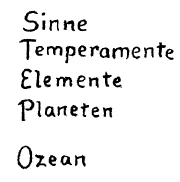
[ 21 ] Let us note this description, which also had such an immensely fruitful effect on the outward course of human development that it inspired Dante, the student of Brunetto Latini, to write the *Divine Comedy*, the *Divina Commedia*. If we note that what Brunetto Latini describes was a typical, representative initiation—that he truly depicts what was taking place in the subconscious of people at that very time, and what can be attained and recognized through such a genuine initiation— then we have before us precisely what existed as a state of the soul during the waning fourth post-Atlantean epoch.
[ 22 ] Now, the question itself may be of interest to us: How did this change over short periods of time? Not long—just a few centuries—have passed since what I have described. How does what a person experiences in the subconscious, and what emerges into consciousness during initiation, change over short periods of time? Of course, the higher the levels of initiation a person attains, the more—I would say—what is of great importance at the first levels disappears from their spiritual vision. But at the first levels, one really must look closely at what is actually significant. For these first stages represent precisely what is actually taking place in the vast majority of human souls, even if they are unaware of it, even if they are unwilling to allow spiritual science—or even initiation—to bring to light what is actually always taking place unconsciously in their deeper being. It is very important, then, to consider the following example. I have said: Brunetto Latini describes how he is led before the goddess Natura. Then he proceeds through certain stages: the senses, the temperaments, the elements, the planets, the ocean—where he is already outside, where he has crossed over from the boundary of the human realm, at the Pillars of Hercules, into the realm that extends outward, where not even what is already the case with the elements—that he cannot distinguish—comes into consideration anymore; where, in a sense, he has lost himself and is swimming in the sea of existence.
[ 23 ] These Pillars of Hercules then play a major role in symbolism as the Pillars of Jakim and Boas; it should be noted, however, that in today’s secret societies these pillars can no longer be set up in the correct manner, nor should they be set up at all, because this correct arrangement only becomes apparent during the actual, inwardly experienced initiation. Furthermore, they cannot be arranged in a room in the same way that they actually appear to be arranged when a person leaves their body.
[ 24 ] Well, with that, one has, so to speak—if I may use such a dry expression—laid out the pattern that was lived through at the turn of the 12th to the 13th century, a pattern also experienced by a man such as Brunetto Latini, who underwent initiation in the same way as Dante’s teacher. Now one can compare this to what is happening today in the depths of the human soul. It is not all that different, after all. But if today a person, at the very first stage of initiation and under the guidance of that immense female figure who still exists today—the goddess Natura—were to step forward before the creation she has shown him, then the supersensible path for him would only just begin within that creation.
[ 25 ] If a person were to step directly in front of the senses today, or were to try to enter into the senses, they would run the risk of being quite in the dark within the sensory realm. They would, so to speak, have to remain in the sensory realm without proper illumination and would then be unable to distinguish anything clearly within that realm. For today it is necessary to undergo another experience before entering this realm of the senses. It is only by undergoing this other experience that one is properly prepared to penetrate this realm of the senses. And I already mentioned this experience to you yesterday. It is simply the ability to perceive the spiritual-ideal as an external reality in the metamorphosis of the world’s form. So before one wishes to enter the sensory realm, one should strive to observe the metamorphosis of forms in the external world. Goethe provided only the elements, but the method can already be found in his work. I have said: What Goethe discovered regarding plants and the animal skeleton is revealed in metamorphosis in such a way that our head points to our earlier earthly life, and our limb system points to our later earthly life. So this being placed within the realm of possibility—not accepting the world as a finished, static form, but seeing in the immediately present form a reference to another form—this being placed within this possibility is already a necessary preliminary stage of the present initiation.
[ 26 ] You will also find guidance on this view—specifically, on how it can best be put into practice by people today—right at the beginning of my book *How to Gain Insight into the Higher Worlds*. This is already achieved when the instructions in this book are followed correctly, so that when you stand before a person, something seems to leap out at you from their head—such as the image of their previous incarnation. You cannot help but sense something of their form in their previous incarnation emanating from their head. If you watch them—how they position their feet, how they swing their arms—or if you stand before them and observe their other gestures with arms and hands, then you will get a sense of what their form will be like in their next incarnation. That is why I have often said in public lectures—having already elaborated on this many years ago— Repeated earthly lives are actually not so bad that materialism would need to oppose them entirely. If materialism understood even a little about the human form, then repeated earthly lives would not be something against which it needs to resist, for they are tangible. And if, for example, you are a phrenologist—someone who studies skulls—not based on a book but on insight gained through experience, then by examining the skull you are actually examining the form of a previous incarnation; that is, the previous incarnation is tangible! So, of course, one must extend this view of life as a series of metamorphoses into this realm. One must, so to speak, make one’s own — I have spoken of this appropriation from a social standpoint — such a strong interest in the human being that something of the sensation of their past incarnation constantly leaps out at you from their skull, because the skull is, in a certain sense—namely with regard to physiognomy and the shape of the head—the transformed human being from a past incarnation. And in this way one gains a view of the world that does not stop at a single form—just as Goethe does not stop at the petal or the green leaf—but relates one thing to another. Thus one gains a view that does not stop at the individual form, but moves from form to form, taking in the transformation of forms.
[ 27 ] I have tried to evoke a sense of such a transformation of form by seeking to capture this transformation myself in our wooden architecture—in the transition from one capital to the next and to the subsequent capitals, and in the further development of the architraves, where everything is constructed according to this principle of metamorphosis. So that whoever one day sees our colonnade and its accompanying elements here at our Goetheanum will have an idea of how to relate to the external world in a flexible manner, in accordance with one’s state of mind. If one wishes to complete this preliminary stage—which is necessary for people today and will remain necessary for people of the future for a long time to come—and to find one’s way into the inner understanding of how the second column emerges from the first, with its base, capital, and architrave, the third from the second column, and so on, then one finds in this true understanding a point of reference for penetrating, in accordance with today’s possibilities, into the inner region of the senses. Thus, something is established down in the column region that is already connected to the present principle of initiation. And further on, in the dome region, you will find something else connected to the present principle of initiation; there, things proceed somewhat differently.
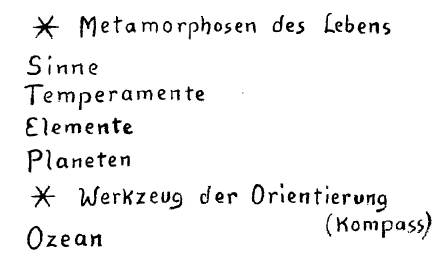
[ 28 ] Thus, in the age of Brunetto Latini, people were still spared what might be called here the metamorphoses of life (see diagram on page 134), through which one then enters the realm of the senses. If we were to visualize this schematically, we could say: In the age of Brunetto Latini, it was still possible—if we take the eye as a representative—to enter directly into the eye and perceive it as the first region. Today, one must first observe that which envelops human beings. In this enveloping layer—which lies externally before the realm of the senses—the metamorphoses of life take shape. It lies before the senses. One must consciously pass through it.
[ 29 ] Even today, we pass through the regions of the senses, the temperaments, the elements, and the planets. But before we cross the Pillars of Hercules into the open ocean of spirituality, another interlude must take place. So here (see diagram on page 134) something interposes itself; here an interposition occurs. This interposition did not yet need to be experienced in Brunetto Latini’s time. It will not be easy to describe, because these things naturally belong to the innermost and most subtle regions of human experience. But perhaps a description can be offered in the following way, precisely by referring to Brunetto Latini. Brunetto Latini experienced—as, so to speak, the first sign of his guidance by a spiritual being—the message that his hometown had been undermined for him. This is an event that resonated within Brunetto Latini as a human being, yet in terms of its factual content, it was external—it came from the outside world and resonated within him. He described this event—which shook him so deeply that his spiritual and soul aspects stepped out of his physical body—as something that entered his life, something that took place within his life. One could say that he does not describe this event consciously, but rather as something that approaches him like an act of fate.
[ 30 ] Such an event—or rather, a similar one—which you will also find mentioned in a passage from my book *How Does One Attain Knowledge of the Higher Worlds?*—must be consciously experienced by those being initiated today. But it must be an inner experience for him, one that he does not undergo in connection with the external world, as Brunetto Latini did, but rather one he experiences inwardly: something that has a profoundly transformative effect on the human being from within. Such events already occur in the lives of the vast majority of people; it is just that people hardly pay much attention to them. Anyone who looks back on their life will be able to see that events—if I may put it that way, even though it sounds trivial—of the very highest order, and in particular one event of the very highest order, come into play in their life. Just try, for once, to look back on such an event in your life, focusing not so much on its external significance but on the inner transformation it brings about in you. One will then become aware of something to which one really ought to pay close attention: one will realize that precisely such events are not taken deeply enough in people’s lives. They can be experienced infinitely more deeply—that is, more profoundly and more tangibly—than is the case today. One can indeed feel many things in life more deeply through a certain general human inwardness, but compared to what one can experience—particularly in events of the very highest order—one will not be able to move beyond a certain superficiality if one remains only within the realm of the ordinary human experience. For such events, as I mean them, cannot actually be recognized in their full significance within ordinary consciousness. One must first pass through the other stages. Then it becomes apparent—once one has passed through the metamorphoses of life, once one has passed through the realm of the senses, the temperaments, the elements, and the planets, and has arrived here (see page 134), that one can observe precisely such an experience again in a new form, and that one now—having already become a profoundly transformed human being—penetrates to its true depth by recognizing oneself as a member not only of the Earth but also of the heavenly worlds, the planetary region. Only then does one truly recognize the significance of such experiences of the very highest order. Only then does it become clear what such an experience can mean for oneself and for the world. And when one goes through this, one must inevitably arrive at the most important event of one’s life.
[ 31 ] If one arrives here before stepping out into the vast ocean of spirituality, it is inevitable—unless one is a thoroughly selfish person who knows nothing else in the world but oneself—that, while passing through the earlier stages, one will become aware of this event. Even before one sets out into the ocean of spirituality, this event already presents itself to the soul in all its full force. But it is precisely there that it makes its way in. And this event holds extraordinary significance at this point in one’s inner experience. It means that one can now, in fact, set out into the immeasurable ocean of spirituality; it means that through this experience one can attain a certain center of gravity. I would like to say: If, under today’s spiritual conditions, one were simply to set sail onto the ocean of spirituality after recognizing oneself as a citizen of the planetary world, one would enter a sea of waves, would feel secure nowhere, would be tossed back and forth among all manner of spiritual experiences, and would lack an inner center of gravity. One must find this inner center of gravity precisely by truly and deeply experiencing such an event of the very highest order—one that, as a rule, will never take place in the mere realms of egoism, but will have a universal human significance—and by deeply experiencing oneself within it. Today one can say, by stating the facts quite precisely: At the Pillars of Hercules, before a person sails through them, their most significant experience must come to the fore and become their most profound experience. There, at this point in the experience, the person feels a very special deepening of their being. Something comes over them that one might say carries the objective world into their inner being. Something does indeed approach the person as they pass through here—in the manner I have just described—through the Pillars of Hercules, which can be described roughly as follows: Of course, even though a person may always fall back, on this or that occasion, into what takes place in the light of their ordinary consciousness—even when they have these experiences, even if they cannot, so to speak, maintain this mood of the soul that is generated here at every step of their life—once this mood of the soul has been experienced, there will still be moments, and moments that recur again and again, which are connected to this state of mind. For it would not be good at all if, after experiencing this state of mind, a person were to emerge from it entirely. What is meant by this state of mind can be characterized roughly as follows:
[ 32 ] One is always tempted to say—hand on heart, my dear friends—that for ordinary consciousness, the fact remains that, no matter how selfless a person may be, what happens inside their own skin is still the most important thing—or at least, relatively speaking, the most important thing—to them. As a rule, what happens inside one’s skin is simply more important to ordinary consciousness than what happens outside it. But this is precisely the state of mind that is meant to be evoked here, upon entering the ocean, so that it can be maintained at least during important moments in life: that there can be external things for a person that, subjectively speaking, have nothing to do with them, yet which they experience just as intensely as those things that do concern them subjectively. Today, if they so choose, people have ample opportunity to prepare themselves well for this state of mind, which is experienced at the point described. For if they engage not in subjective knowledge of nature or the like, but in true knowledge of nature—namely, if people try to proceed from such knowledge of nature—then much of this mood is already generated; but it must be cultivated at that stage in the manner I have described. Then, when a person can attain this state of mind—when they can experience, as happens here, the most important event of their life in such a profound way—then they acquire, at least for many moments of their life, this state of objectivity that I have described, in which the external can be as important to them as the internal, where it is true that the external can be as important to them as the internal. Many people may claim this or that; but that is not true—they are deceiving themselves about the matter. Yet at the same time, the person has attained a center of gravity—or perhaps I should say a direction—a compass through which they now have the possibility of truly setting out onto the ocean of spiritual life. Here (x, see diagram on page 134), therefore, what one might call the “equipping oneself with the tool of direction” must take place. One thus enters the Pillars of Hercules and is equipped with the tool of orientation—the compass. Only then—that is, after having experienced more—can modern man set out into the spiritual realm.
[ 33 ] You can see from the examples I have just described to you—the initiation of Brunetto Latini and the transformation of this initiation right up to the present day—and this will remain true for a long time to come—that human nature can be depicted as undergoing a transformation even over shorter periods of time when one attempts to describe it using the science of initiation. But everything that is described in this way is truly carried within the human being. This characterizes the transformation that the human soul’s disposition undergoes over the course of the centuries. People usually simply do not pay attention to these things, and they are then expressed in outer life as a reflection of them. In the age of Brunetto Latini, of whom Dante was a student, one is as Christian as Dante is. In that age, the entire heavenly world still passes through the human soul, in that one truly feels Christian. In our age, this step backward has been taken; we step out only a little, so that we must pass through a region beyond the senses before stepping out again—not so that we may now enter the region we have already known from the outside in the same way, but so that, before we detach ourselves further from the body, we may enter it transformed, guided by a new instrument. In our time, this has been transformed outwardly in its reflection to such an extent that the most thoughtful people—who are equipping themselves precisely with the scientific conscience of our time, which, however, lacks this compass—it truly does not have it—have lost Christ Jesus. He can no longer be proven by the means that are today called scientific, and religion itself—the Christian religion—has fallen into materialism. It also strives very strongly toward materialism. One of the strongest examples of this striving toward materialism in Catholicism was the establishment of the dogma of infallibility, a purely materialistic measure. I spoke about this some time ago.
[ 34 ] Now you might say: And despite all that, when you look into the innermost being of a human being, this jolt becomes apparent! — In his very nature, the human being is somewhat outside the realm of the senses; but in return, he has a kind of cavity where, unconsciously, the most important event of his entire life exerts an influence on his whole organism, so that he can then experience it as I have described. For this already has an influence on the person, even if they are unaware of it, but it can manifest itself in the most varied ways when it takes place in the unconscious. One person might, perhaps seven years after going through this most significant event, become an insufferable fellow or commit all sorts of misdeeds; another might fall in love—he doesn’t have to do so immediately; falling in love itself can represent this most significant event—; a third might develop gallstones, and so on. If the event remains in the unconscious, it can manifest itself in human existence in the most diverse ways. This is what it looks like within a person when it enters consciousness as I have described it. Externally, it manifests itself in such a way that, among many other things—I have, after all, mentioned only this one thing—one loses the Christ Jesus.
[ 34 ] Now you might say: And despite all that, when you look into the innermost being of a human being, this jolt becomes apparent! — In his very nature, the human being is somewhat outside the realm of the senses; but in return, he has a kind of cavity where, unconsciously, the most important event of his entire life exerts an influence on his whole organism, so that he can then experience it as I have described. For this already has an influence on the person, even if they are unaware of it, but it can manifest itself in the most varied ways when it takes place in the unconscious. One person might, perhaps seven years after going through this most significant event, become an insufferable fellow or commit all sorts of misdeeds; another might fall in love—he doesn’t have to do so immediately; falling in love itself can represent this most significant event—; a third might develop gallstones, and so on. If the event remains in the unconscious, it can manifest itself in human existence in the most diverse ways. This is what it looks like within a person when it enters consciousness as I have described it. Externally, it manifests itself in such a way that, among many other things—I have, after all, mentioned only this one thing—one loses the Christ Jesus.
[ 36 ] If one can do that, something remarkable becomes apparent. It turns out that the way of thinking people have developed is the seed of a very profound spirituality. Thoughts, in their very essence—since they are, after all, merely reflections, as I explained the day before yesterday—are so incredibly thin, they are even thinner than thin, because they are, after all, only images; they are so thin that they require a person to apply an immense amount of spiritual power just to think at all, to prevent them from sinking down and being overwhelmed by the purely material aspects of existence. Very often today, they are overwhelmed by the material aspects of existence and sink down, and I am even convinced that most people who still think materialistically today—if they hadn’t been drilled in school, if they hadn’t struggled through university just to pass their exams, if they hadn’t absorbed materialism because the professor demanded it as the correct worldview—would have spared themselves the thinking that must be expended on a materialistic worldview! They would prefer not to think at all! Most would also rather go to the cramming room or the fraternity bar than put their minds to work, or they simply parrot what they’ve heard. If you were to attempt to study the actual, recognized insights—those that relate solely to matter—among all the individuals who, as members of monistic societies (as materialists now call themselves, somewhat more nobly), roam the world delivering long speeches, if you were to study what they actually thought: you would find terribly little! Most of the time, they’re just parroting others. In fact, only a few authorities have actually founded materialism; the others are merely parroting them. For, in order to cultivate modern scientific thought, a tremendous mental effort is actually required! This effort—it is an intellectual effort—is truly not something that is simply sweated out of the brain like bile from the liver. It is an intellectual effort, a good preparation for ascending precisely to the spiritual realm. To have thought honestly in a materialistic way, but to have thought it honestly for oneself—that is a good preparation for entering the spiritual world.
[ 37 ] I once expressed this in a lecture in Berlin by saying: Anyone who merely reads Haeckel’s books will, of course, easily recognize Haeckel as a materialist of the purest kind—unless they take into account certain things that are nevertheless discernible between the lines. But it is precisely when one speaks with Haeckel that one realizes that, in fact, his entire way of thinking—insofar as it is materialistic—takes on this form only because of the prejudices of the times, and that it already tends—even as he is now, this Haeckel—toward the spiritual. That is why I said in that lecture in Berlin: One truly understands Haeckel when one realizes that, theoretically speaking, he has, as it were, this materialistic soul, but that he also has another soul that tends toward the spiritual. — For us, I can say: one that will most certainly be reborn in the next incarnation with a strong spirituality. The stenographer, who was officially employed by us at the time—a true professional stenographer—wrote that I had said Haeckel, despite his materialism, had a spiritualist soul.
[ 38 ] So I wanted to point out that what appears here as a materialistic way of thinking can certainly be combated—indeed, it cannot be combated strongly enough—for it is precisely in this struggle that the path toward the spiritual lies; yet within it lies the inner power for spirituality. And in the souls who today, under the influence of external theology alone, have arrived at a wholly external—or even already false—concept of Christ, spiritual paths are developing abilities that will lead them to seek this concept of Christ in the future. This is not meant to be an invitation to complacency; one should not say: “Well, then the spiritual perspective will just come on its own, since Dick Vogt, Clifford, and so on have prepared the ground so well!” — Those who know what darkness materialism entails must actively fight against it! For it is the power at work in these struggles that is necessary to develop the predisposition toward spirituality in theoretical materialists.
[ 39 ] But you see how complicated things are, how they have different sides. Then, when one tries to penetrate the depths of the world through the science of initiation, only then does one gain a deeper understanding of human nature and penetrate to what is at work in the depths of human nature.