Goetheanism
An Impulse for Transformation and a Concept of Resurrection
Human and Social Science
GA 188
3 January 1919, Dornach
Translated by Steiner Online Library
First Lecture
[ 1 ] How often have we actually had to emphasize here that the truths of the humanities, when they are expressed, are easily misunderstood in one way or another. And I have also spoken to you about the various reasons why it is certainly easy to misjudge or misunderstand these spiritual-scientific views and insights. It must be said time and again that it is, of course, extremely easy—if one has had little opportunity to delve into spiritual matters—to find here and there that the things revealed by spiritual science are not fully substantiated, or something to that effect. It is also incredibly easy to say: “How does this or that person, who shares something from the perspective of spiritual science, know that?”—if one is unwilling to take the time to understand what the person themselves has often explained about where they get this knowledge from, and one simply forms a judgment based on what one knows oneself. It’s not hard to say: “How can they know that?” I don’t know it, after all!”—and then to declare with authority: “What I don’t know, no one else knows either; at most, someone else can only believe it!”—But such a judgment arises only because one simply refuses to engage with the sources from which, especially in the present day, spiritual scientific insights must be drawn.
[ 2 ] Among the misunderstandings that have arisen in this way is the belief that spiritual science seeks to pass a sweeping judgment of condemnation and destruction on the entire striving of our time, insofar as this striving originates from individuals who stand outside of spiritual science. But this, too, is merely a misunderstanding. It is precisely the spiritual scientist who views the current state of the world with seriousness and dignity who will surely take into account the state of mind, the spiritual mood of his contemporaries, and ask himself the question: What is going on in the souls of serious contemporaries today, in the very direction in which an improvement must be sought for many things that are in need of or require improvement? — But what must be recognized here above all else as a fact that is particularly striking in the present is that it is precisely this is sometimes rejected—even by the most ambitious of our contemporaries—the concrete engagement with knowledge of the spiritual world, with the understanding of the spiritual world, which can appear before human beings as a reality and not merely as something grasped through a sum of concepts. Most people today simply wish to limit their experiences to the sensory world and, at most, acknowledge a spiritual world as accessible only through concepts and ideas. They do not wish to engage in research that speaks of means by which one can truly penetrate the spiritual world through direct experience. This rejection of true spirituality is indeed a characteristic feature of our time; it is a feature of our time that we, in particular—who are attempting to stand on the ground of spiritual science—must take into account. Otherwise, we will remain outside of this spiritual science, engaging with it only as something that, alongside other things coming to light in the present, should nevertheless also be taken into consideration.
[ 3 ] I recently demonstrated here—by presenting Walther Rathenau’s ideas to you—that the scholar of the spiritual sciences is already in a position to truly appreciate current schools of thought within the limits within which they should be appreciated. But what is striking is precisely this rejection of the true spiritual impulse that is to come in our time. One can experience this rejection at every turn if one pays attention to what people are thinking today. Certainly, the shocking reality of the current world situation has become apparent to many people today; there are people who understand how to appreciate the full gravity of the present time and have been able to do so for some time now. Here, too, I ask you not to adopt the haughtiness of some anthroposophists and to think that anthroposophy as such already provides a guide for appreciating the gravity of the times better than do people who stand outside the anthroposophical movement. For one would also hope that, within this anthroposophical movement, many more would be deeply moved in their hearts by the crucial aspects of our current global situation. All too often, however, one finds people even within our own ranks who, despite the gravity of the times, refuse to acknowledge this gravity and prefer to concern themselves with their own esteemed personalities rather than arouse within themselves some interest in the great questions that pulse through humanity.
[ 4 ] In today’s discussion, I would like to begin with an example that—one might say by chance, if the word is not misunderstood, and we have no reason to misunderstand it—came into my hands; an essay that is, admittedly, outdated today insofar as it was written while the so-called war was still in full swing. So the essay is outdated today. Nor is it particularly compelling in other respects, since it treats most of the issues it discusses in a very one-sided manner. Yet it does come from a person—as one can see from his overall attitude and style of writing—who is deeply concerned about what is actually supposed to happen next and what the world can expect from these events. This essay describes how the Western Powers, the Central Powers, and the Eastern Powers have gradually behaved amid the catastrophe of recent years. It outlines—albeit one-sidedly, but still—the great dangers that lurk today as a result of this catastrophe and will continue to lurk into the future. The author possesses a certain worldview. He does not view the world solely from the perspective of national borders; after all, it still happens among people today that they view the world only from the perspective of their national borders, and once they can reassure themselves that this or that has not yet occurred within their own country, they are at ease. The author of this essay, however, does not see only the immediate surroundings of the “kitsch tower”; he does, after all, see something of the global perspective. And summarizing his thoughts, he arrives at a very remarkable statement. He says: “That a terrible fate awaits white humanity; this seems certain to me under all circumstances, unless a period of supreme wisdom very soon replaces that of passion and delusions. We have, in fact, been living for a long time now in a period that bears a strong resemblance to the Migration Period. The pace is being tremendously accelerated by the World War. What corresponds to the Germanic tribes that migrated from outside into the old cultural heartland at that time are the substantial, rising lower classes, who differ greatly from the previous ruling classes in terms of both blood and cultural heritage. That this ‘migration of peoples’ — it is indeed much better to speak of a “migration of peoples” than of a war — “is taking place at all is good insofar as it leads to diffusion—a diffusion of the cultural foundation and a raising of the overall standard. It is, however, very dangerous if it proceeds too rapidly. And this danger increases the longer the World War lasts.”
[ 5 ] The essay is now outdated. The danger has not diminished, but since it derives all its arguments from the still-raging war, its arguments are outdated. But we must be particularly interested here in the first sentence, which I read aloud: “That a terrible fate awaits white humanity seems to me certain under all circumstances, unless a period of supreme wisdom very soon replaces that of passion and delusions.” — For that is, in fact, absolutely true as an abstract truth. And if someone were to state that humanity’s only salvation lies in turning toward a reign of supreme wisdom, and not toward any other political or social quackery, then we must acknowledge such a fact, such a line of thought. But in doing so, we must by no means forget that it is precisely those people—whom we must admit are gripped to the very depths of their being by the gravity of the situation—that, when it comes to articulating what these concepts of wisdom consist of, which are supposed to replace the old delusions, they immediately fall back on some old delusions that have been transformed into fine-sounding words. For that is precisely the tragedy, that is the terrible fate of our time: that while people do become aware that It is necessary to turn to the spirit—but that they are always overcome by fear and anxiety when they are to turn to the spirit; that they are then immediately ready to resort to the old delusions that have driven humanity into its present terrible fate. We need only take the example of a very widespread school of thought.
[ 6 ] Do you think that if you were to ask a genuine—let’s say trivial— representative of the Roman Catholic creed whether he would be inclined to believe that the old ideas led us into this catastrophic era, that they must be replaced by new ones—do you think he would really be inclined to believe in the necessity of renewing those very ideas that could not have saved humanity from this terrible catastrophe? No, he would say: If only people would become truly Roman Catholic again, then they will surely be happy. — And it would never occur to him to say to himself that they had, after all, had nineteen hundred years to be Roman Catholic and yet still ended up in catastrophe; that, therefore, the catastrophe must at least teach us that we need new impulses. That is just one example among many. It is absolutely necessary, particularly with regard to this point, to unreservedly highlight the connections that exist here.
[ 7 ] Today, it is easy—even for someone considered a true follower of this or that church—to say: “Haeckelism or materialism is the work of the devil; it must be eradicated root and branch.” — That is the opposite of what can lead people into a wholesome state of mind. Yes, one can certainly speak that way, but if one sticks to this statement and does not examine the contexts that come into play, then one will be unable to arrive at anything that could be wholesome for the present, much less for the near future. For if you take up any worldview tinged with materialism and ask yourself: Where does it come from historically? — then, if you truly wish to gain insight, you will ultimately have no choice but to conclude: it stems, in essence, precisely from the way Christianity has been represented by the various denominations over the course of nineteen hundred years. The discerning observer knows that Haeckelism would not have been possible at all without the preceding Christianity of the Church. There are people who have remained stuck at the Church’s standpoint—let’s say, as it was in the Middle Ages; they still hold today the ideas that the Church held in the Middle Ages. Others have developed these ideas further. And among those who have developed them further is, for example, Ernst Haeckel. He is a direct descendant of the ideas cultivated by the various churches over the centuries. This did not arise outside the Church; in a deeper sense, it is a truth that arose entirely within the teachings of the Church. However, one can only truly recognize the connections when one draws a little inspiration from insights in the spiritual sciences in order to grasp these matters.
[ 8 ] So today I would like to—even though some of you may say the subject is too difficult, but nothing should be too difficult for us; we must gain insight—I would like to begin by explaining one point in particular to you today.
[ 9 ] If you read philosophically oriented writings by well-educated scholars—Catholic scholars, for example—you will find that, with regard to a certain point, a very specific view has been developed throughout. And one can say: You will find this view developed among the very best of these Catholic-trained scholars. — I would like to note right away that I am by no means inclined to underestimate the formal training of the Catholic clergy, for example. I am well aware—and I have also stated this in my book The Riddle of Man—that certain Catholic theologians, when they write philosophically, possess a superior education compared to the writings of philosophical scholars who have not been trained in Catholic theology, for example. In this regard, it must be said that the scholarly literature—the theological literature—of Protestant and Reformed clergy lags far behind the sound philosophical training of Catholic theologians. Through their rigorous training, these people possess a certain ability to develop their concepts in a truly vivid way; they have—something that people who are famous today in non-Catholic philosophical literature, for example, do not even have the faintest inkling of—a certain ability to understand what a concept is, what an idea is, and so on; in short, these people have a certain level of training. One does not even need to pick up a book by Haeckel; one can take a book by Eucken to observe this conceptual muddle, this dreadful, purely sensationalist rambling about the most important concepts, or one can, for example, take a book by Bergson, where one always has the feeling: he grasps at the concepts without being able to handle them, like the well-known Chinese man who wants to turn around and always catches his own braid. This utter stumbling through the world of concepts, which is the case with these untrained people, you will not find if you engage with the philosophical literature emanating from the Catholic clergy; so in this regard, for example, a book like the three-volume History of Idealism by Otto Willmann—a true-blue Catholic who flaunts his Catholicism on every page—stands far above most of what is being written today in the field of philosophy by non-Catholics. One can certainly be aware of all this and still adopt the standpoint that one, as a scholar of the humanities, simply must adopt. An inferior intellect might reach a different conclusion in this area; it might, for example, hold the opinion that because there is good training there, it is inherently more valuable. Well, that may be so; but one can certainly strive for objectivity even when compelled to adopt a particular perspective in life.
[ 10 ] There is one point that will always come up in this well-developed Catholic philosophical literature—a point that also holds an immense amount of allure for today’s thinkers; it is the one that always comes into play when people begin to discuss the difference between humans and animals. Isn’t that right? The typical readers and adherents of Haeckel will always seek to blur the distinction between humans and animals as much as possible, to foster the belief that humans are, on the whole, merely a sort of more highly developed animal. Catholic scholars do not do this; rather, they always emphasize what appears to them to be a radical difference between humans and animals. They emphasize that the animal remains confined to the immediate perception it gains of the object it is currently smelling, of the next object it then smells or observes, and so on; that the animal, so to speak, always remains within individual, concrete perceptions, whereas humans have the ability to form abstract concepts and to generalize about things. This is indeed a radical difference, because, if one views the matter in this way, human beings are thereby truly and radically distinct from animals. The animal, which perceives only the details, cannot develop spirituality within itself, because abstract concepts must live within spirituality. And this leads one to acknowledge that within human beings lives this particular soul, which forms precisely these abstract concepts, whereas the animal, with its particular kind of inner life, cannot form these abstract concepts.
[ 11 ] Anyone who considers the relevant Catholic debates in light of this point will say to themselves: It is something of immense significance that, through sound philosophical training, one can correctly point to this decisive—radically decisive—point in the distinction between humans and animals. People today do not at all appreciate the far-reaching implications of such a matter. For example, when the commotion organized by Drews broke out back then—that debate over whether Jesus lived or not—when a large gathering was held in Berlin where all sorts of people, both plausible and implausible, spoke on the question: “Did Jesus live?” — the Catholic theologian Wasmann also spoke on the subject, and of course he could only say things that the others considered very backward. But even though the leading authorities of the time—namely those in Berlin Protestant theology—were speaking, two statements, or rather the basis for those statements, struck me as being, fundamentally speaking, on a somewhat higher level—not at today’s level, but on a somewhat higher level—among the speeches of that time. One was a remark made by a—and I mean this in no derogatory sense, but rather as a compliment—scholarly idler of the very highest order at the time. I don’t think I can praise him any better than by calling him a learned idler of the very highest order. For the man could have achieved a great deal through his acumen and his unique knowledge in a wide variety of fields, through his vast learning. Even back then, when I was associating with him—that was eighteen or nineteen years ago—he had already been working on a revision of logic for fifteen years, I believe, and I suspect he must still be working on it, for I have not yet come across this revision of logic. He said back then—and quite rightly so—that people are actually quite dreadful in the present; they are, in fact, quite dreadful when they begin to think, for one need only hear two or three sentences—whether in a scientific or a nonscientific conversation today—to observe how the most appalling illogicality immediately sets in. What people need to observe, he said, in order to avoid falling into the most horrific delusions that are commonplace today, could be written down on a quarter-page; one need only truly take this quarter-page to heart. I don’t know whether he intends to use this quarter-page to bring about a revision of logic; as I said, fifteen years had already passed by then, and eighteen or nineteen more have elapsed since—I don’t know how far he’s gotten with this revision of logic. But I want to praise him by calling him a witty, spirited idler, because by doing so I mean to suggest that, if he weren’t a witty idler, he could accomplish an awful lot. He said something very beautiful back then; namely, he said: “Yes, the Catholic Church had to hear one day that comets—which, after all, consist of a nucleus and a tail—are celestial bodies like the others and move according to laws, just like the other celestial bodies.” When it could no longer be denied—based on the evidence that had come to light—that comets were celestial bodies just like the others, the Catholic Church decided to admit that the other laws of celestial motion also applied to comets; but at first it conceded this only with regard to the nucleus, not yet with regard to the tail. — Well, he simply wanted to symbolically express that the Catholic Church is, as a rule, inclined to admit only what is absolutely necessary—just as it did not permit its adherents to embrace the Copernican worldview until 1827—but that even when it must admit the bare minimum, it still holds back at least the “tail” of the matter! That’s a remark which I thought actually characterized the situation quite well.
[ 12 ] The other remark, however, was made by the Catholic ant researcher Wasmann—he is an excellent ant researcher, but he is also a well-trained philosopher—who said: “Actually, gentlemen, you can’t possibly understand me, because in reality none of you know how to think philosophically; someone who thinks philosophically simply doesn’t speak the way you do!” — And indeed, he was right; there is no doubt that he hit the nail on the head. Now there happens to be a short, charming essay by Wasmann on the difference between humans and animals, which sharply highlights what I have just alluded to: this ability of humans to truly think in abstract terms, which animals are said not to possess. This is something extraordinarily dazzling, because—in a certain sense—it is convincing to those who have trained their minds to the extent that they can grasp the full significance of such a claim.
[ 13 ] But now let us look at the matter from the perspective of spiritual science; only then will the full significance of the whole story become clear to you. If, from a spiritual scientific perspective, we start with the insights and experiences that can be gained in the spiritual world, then we come to understand, on the one hand, that without spiritual scientific considerations, the dazzling assertion I just mentioned can arise—and that it must actually apply to anyone who does not wish to become a spiritual scientist, especially if they are well-versed in philosophy; one recognizes this on the one hand. On the other hand, however, one sees the following—one sees it simply by observing things in the world: When one compares human beings with animals from the perspective of spiritual science, it becomes apparent that while human beings do indeed encounter the things of the world through individual observations and then form abstract concepts through various mental operations in which they synthesize what they see in isolation, One can also admit that animals do not possess this capacity for abstraction, that they do not engage in this activity of abstraction. But the curious thing is that animals do not lack abstract concepts; rather, with their souls, they live precisely within the most abstract concepts that we humans laboriously form, and animals do not perceive individual phenomena in the same way we do. What gives us an advantage is precisely that we have a much freer use of the senses, a very specific kind of interaction between the senses, inner emotions, and impulses of the will. This is what sets us apart from animals. But the certainty of instinct that animals possess rests precisely on the fact that animals live from the outset with such abstract concepts, which we must first form for ourselves. What distinguishes us from animals is that our senses emancipate themselves and become freer in their engagement with the external world, and that we can also infuse our senses with the will, which animals cannot do. But what we humans do not possess—and must first acquire—namely, abstract concepts—is precisely what animals possess, however strange that may seem to us. Certainly, every animal has only a specific domain, but within that domain, the animal possesses such abstract concepts, however strange that may seem to us. Humans must see one, two, or three dogs; from this, they form the abstract concept of “dog.” In this regard, the animal possesses—and quite precisely—the same abstract concept of “dog” that we have; it does not need to form it for itself. We must first form it for ourselves; the animal does not need to do so. But the animal lacks the ability to precisely distinguish one dog from another, to precisely individualize them through sensory perceptions.
[ 14 ] If we do not acquire the ability, through spiritual science, to grasp the true nature of reality, we are, in a certain sense, deceiving ourselves about what is most essential. We believe that because we humans must develop the ability to form abstract concepts, we are distinguished from animals—which lack this ability—by these abstract concepts. But animals do not need this ability at all, because they possess abstract concepts from the very beginning. Animals have a completely different kind of sensory perception than we humans do. Their external sensory perception, in particular, is entirely different.
[ 15 ] In this regard, a very profound transformation in human thinking is necessary. For people have already become familiar with all sorts of scientific concepts that have become popular today. Either they have learned them in school through direct instruction, or they have acquired them through that “dishwater”—I meant to say, through reading newspapers—by which scientific ideas are now flooding out into the whole world. But people are dominated by these scientific ideas. With regard to what I have just hinted at, people are deeply dominated by what one might almost call an instinctive tendency to believe that animals really see the same things in their surroundings as humans do. When he goes for a walk with his dog, he has the instinctive belief that the dog sees the world just as he does, that the dog sees the grass, the wheat, and the stones in color just as he does. And then, if he is capable of thinking to any degree, he also holds the belief that he himself can think abstractly and therefore has abstract concepts, whereas his dog does not think abstractly, and so on. And yet this is not the case. This dog walking beside us lives just as much in abstract concepts as we do. Yes, he even lives more intensely within them than we do. He doesn’t even need to acquire them; rather, he lives intensely within them from the very beginning. But he doesn’t perceive the external world in the same way—it presents him with a completely different picture. You need only pay close attention to certain observations that can be made in life. Admittedly, people don’t always take these things seriously enough. I could give you a whole number of examples that would show you how people, purely instinctively, think incorrectly in this regard. For example, I was once walking—it was in Zurich, I believe—out onto the street after a lecture that had been held at a branch meeting. A coachman was waiting there, and the horse wouldn’t quite move; it seemed a little skittish. Then the coachman said, “It’s afraid of its own shadow.”—He naturally saw the horse’s shadow, which the streetlight cast onto the wall, and therefore assumed that the horse saw this shadow exactly as he did. He naturally had no idea of what, if I may say so, is going on in the horse’s soul and what is happening within it. He sees the horse’s shadow, but the horse has a living sense of its existence in that part of the etheric body where the shadow is formed. This is an entirely different process—an entirely different process in terms of inner perception.
[ 16 ] Here you have the clash between the existing way of thinking—extending even into the most elementary, instinctive views of naive people—and what must now enter into people’s consciousness through the humanities. You will, however, first have to take seriously what actually underlies this. For with regard to such matters, the most extreme materialism of a Vog, Moleschoft, Clifford, Spencer, and so on differs far less from the traditional doctrinal concepts of the various denominations than does that which, as a new way of thinking grounded in the humanities, must differ from these doctrines. For in truth, certain materialists today do think: Human beings do not differ greatly from animals. They, too, have once heard a hint of this—even if they have not heard the bells ringing in unison—that human beings can form abstract concepts, which are, after all, something other than the ordinary, merely sensory perceptions; but they tell themselves: Abstract concepts—perhaps that is not such an important thing, such an essential thing; so, fundamentally speaking, human beings do not differ from animals. — All of contemporary materialism is actually a creation of the church creeds. One need only consider this very seriously to see that a renewal of the way human souls conceive things is at stake here; if one does not want to stop there and say, “Now, back to the old ideas—then everything will be fine!”
[ 17 ] But one cannot simply say that people could just refrain from turning toward a true spiritual life, and that things could just go on as they are! No, those who say, “...that a terrible fate awaits white humanity seems to me certain under all circumstances, unless a period of supreme wisdom very soon replaces that of passion and delusions,” are indeed correct. But such people should also realize that the vast majority of scientific conceptions about the world today belong to the realm of delusions. This is something that must be fully understood. Humanity, in the course of its development, has reached the point that we often characterize by saying: Since the 15th century, humanity has been in the age of the consciousness soul. And this development of the consciousness soul takes place in the way I have just described on several occasions. Let us now consider a very important characteristic feature in relation to the development of the consciousness soul.
[ 18 ] I already hinted at this last time: Everything that the spiritual researcher recognizes—that is, brings into consciousness—precisely from those aspects that lie within the development of humanity, is taking place in people’s subconscious, even if it is not recognized. As humanity develops toward the future, it passes through certain experiences. It passes through these experiences unconsciously unless it chooses to bring them into consciousness—which is precisely what should happen in the age of the development of the consciousness soul. But precisely in this age of the development of the conscious soul, many things that approach human beings in the subconscious are still being rejected today.
[ 19 ] Among other things, a certain aspect of that experience—which can be called the encounter with the “Keeper of the Threshold”—is increasingly coming to the fore for people. Certainly, if one truly wishes to enter the spiritual world with full consciousness and to develop imaginations, inspirations, and intuitions, one must enter the realm of the supersensible world to a much greater degree and with far richer—indeed, entirely different—experiences. One must pass by the Keeper of the Threshold more thoroughly—if I may use that expression—than all of humanity must do so in the course of the Age of the Consciousness Soul. But to a certain degree, a person must simply have passed by the Keeper of the Threshold by the end of the development of the Consciousness Soul. They may now have the luxury of allowing this passing to take place entirely in the subconscious. But spiritual science exists precisely to ensure that this does not happen. It is meant to draw attention to the fact that this is precisely one of the events currently unfolding in human evolution. And anyone who discourages people from studying spiritual science today actually wants nothing less than to force people to pass the Guardian of the Threshold—not consciously, but unconsciously—as the Guardian simply enters the horizon of human consciousness in this very age.
[ 20 ] In other words: during the 2,160 years that the age of the development of the souls of consciousness lasts—beginning approximately in 1413—humanity must, in some incarnation, pass by the Keeper of the Threshold and partially experience the events that one can encounter with the Keeper of the Threshold. A person may allow themselves to be compelled by materialistically minded people to pass by unconsciously; or they may freely resolve to be attentive to spiritual science and, whether through self-observation or through common sense, learn something about this passing by the Guardian of the Threshold. And in this passing by the Guardian of the Threshold, one perceives precisely what enables a person to form correct, accurate conceptions of the concrete supersensible world—conceptions that are initially capable, above all, of steering the act of imagining itself, that is, thinking, in a certain free, unbiased, and reality-affirming direction.
[ 21 ] I have often described this as the greatest achievement of the humanities: that thinking becomes more attuned to reality, that it can truly respond to the impulses inherent in events, rather than merely knowing something about these processes in an abstract, external way, as the natural sciences do. To know certain things about the spiritual world—that is what becomes necessary for human beings. This must enable people to learn to assess their place in the world from the perspective of a spiritual horizon, whereas today they are able to assess their place in the world only from the standpoint of the sensory horizon. You are already assessing things in a new and correct way when, for example, you allow a thought such as this to take root within you: that animals do not lack abstract concepts, but rather that they live precisely within the most abstract concepts, and that human beings differ from animals through a certain development of their senses, which emancipate themselves from their close connection to physical life. It is only through this that you actually arrive at accurate conceptions of the difference between human beings and animals. Externally, this is expressed in the fact that the organization of the senses in animals is in a very pronounced vital connection with the entire organization of the body. In animals, the organization of the body extends very significantly into the senses as well.
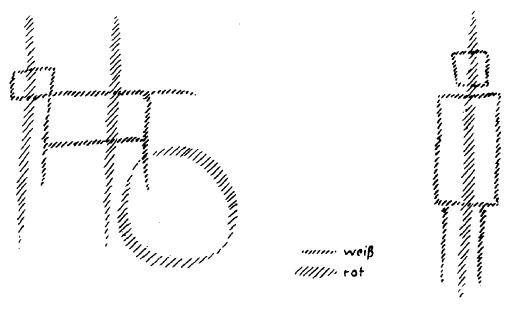
[ 22 ] Take the eye, for example. It is well known to natural scientists that the eyes of lower animals contain organs—such as the fan or the sword-like process—that are filled with blood and establish a living connection between the interior of the eye and the entire organism, whereas the human eye lacks this structure and is much more independent. This increasing independence of the senses, this emancipation of the senses from the overall organism—this is something that occurs only in human beings. As a result, however, the entire sensory world in human beings is much more closely connected to the will than in animals. I once expressed this differently from a morphological perspective. I drew your attention to the same thing from a different perspective by saying: If you take the threefold organism—limb organs, chest, head—then, if I draw a schematic diagram, it looks like this in animals: this is the head organism (drawing on the left, p. 32), this is the chest organism, and this is the limb organism. The head stands directly above the earth. The earth lies beneath the head organism—approximately, of course, but essentially—in all animals. The spine stands perpendicular to the earth’s axis or radius. In humans, the head rests upon their own chest organism and limb organism. In humans, the thoracic organism is situated beneath the head organism in the same way that, in animals, the earth is situated beneath the head organism. The human stands with the head resting on its own earth. Consequently, in animals there is a separation between the will organism—namely, the limb organism, the hind limbs—and the head. In humans, the will—the will organism—is directly integrated into the head organism, and the whole is situated within the earth’s radius. As a result, the senses are, so to speak, permeated by the will, and this is what characterizes human beings. This is what truly distinguishes humans from animals: that the senses are permeated by the will. In animals, the senses are permeated not by the will but by a deeper element; hence the more intimate connection between the organization of the senses and the organism as a whole. Human beings live much more in the external world, while animals live much more in their own inner world. By making use of their sensory faculties, human beings live much more in the external world.
[ 23 ] Now consider this: we are currently living in the age of the conscious soul. What does that mean? It means, as I have explained to you several times now, that we are currently moving toward a state in which only reflections, only mirror images, exist in consciousness, since the age of the conscious soul is also the age of intellectualism. It is only in the age of intellectualism that one actually cultivates the capacity for abstraction as a pure art form. In this age of intellectualism and materialism, the most abstract concepts were developed.
[ 24 ] Now let’s imagine two people; one is a well-trained philosopher, as well-trained as Catholic theologians are. From his point of view, this person would actually have to say something, but he will not say it because he sees the reality that materialism has emerged from the centuries-long development of Christianity, and that is unpleasant to him; but he would actually have to say: “This human being in the age of the consciousness soul is best able to form abstract concepts; he has therefore risen highest above the animal.”
[ 25 ] But a scholar of the humanities might also come along and say: In this age of the development of the conscious soul, what is characteristic of human beings is precisely that they can develop the ability to form abstract concepts to a particularly high degree. Where does this lead him? It leads him right back into animality! And that explains an awful lot. It explains why the human tendency to draw as close as possible to the animal realm arises precisely from delving into abstract concepts. But it also explains something that occurs frequently in everyday life and conduct today. The sciences are becoming more and more abstract, and in social life, people are increasingly inclined to want to live as our beloved animals do—namely, to concern themselves only with the most mundane needs, such as hunger and other basic necessities. Spiritual science reveals the inner connection between the capacity for abstraction and animality. Human beings experience this inner connection under all circumstances during the age of the development of the conscious soul. If they are hindered in the manner described above, they experience it unconsciously. Numerous people experience what a voice in the depths of their souls tells them: “You are becoming more and more like an animal; precisely as you progress, you become more and more like an animal.” — This is the fear that people feel when advancing along the path. This is also what causes people to be so eager to cling conservatively to old concepts.
[ 26 ] Is this permissible? Can this unconscious manifestation of animality in the Guardian of the Threshold prevent people from pressing forward? No, that must not happen; but something else must take its place. While taking a step back in the midst of apparent forward progress, this retreat must occur in such a way that it does not—as would inevitably be the case if one were to develop only the capacity for abstraction—simply oscillate back and forth: for then one would arrive at earlier stages of human development; indeed, one would end up at the level of the animal kingdom altogether. No, one must step backward, but in such a way—back and forth (drawing on the right, p. 32)—that an elevation takes place, and this elevation must lead into the spiritual realm.
[ 27 ] What we lose as we step into abstraction, we must counteract by filling our abstract reflections with the spiritual, by incorporating the spiritual into abstraction. This is how we move forward. Before the Guardian of the Threshold, whether consciously or unconsciously, human beings are faced with a terrible decision: either to become, through abstract concepts, merely “more animal than the animal” and to “bury one’s nose in every bit of nonsense,” to quote Goethe’s Faust, or, at the very moment one enters into abstraction, to pour into these abstract concepts that which flows forth from spiritual worlds, just as we have characterized it in recent days. Only then does humanity truly begin to appreciate its place within the world, for only then does it recognize itself as being in the process of development; only then does it understand why, at a certain point in this development, it faces the danger of sinking into animality precisely through abstractions. When humanity stood at the animal level during primitive cultural periods, it distinguished itself from animals through its senses, not through its abstract concepts. The animals were better at abstract concepts. Only today can humans develop these abstract concepts when necessary. The animals are much better at them. I once illustrated this with another example when I asked you: How long has it been since, in the course of historical development, humans first attempted to make paper? The wasp builds its nest out of paper—it has been able to do so for millions of years! And just look at the wisdom, intellectuality, and capacity for abstraction that animals reveal through their active, governing intellect—even if this manifests in a one-sided way among different species. People foolishly call it instinct. But if one sees through this, one knows: By far the fewest people today have developed their capacity for abstraction to the point where they could transcend the one-sidedness of today’s animal classes through what they create with that capacity.
[ 28 ] Human beings are thus faced with this important decision: either to return to animality to a very great degree, to be more animal than any animal, to use the Mephistophelean expression from Faust—for Ahriman-Mephistopheles would like to achieve this in human beings, through human beings—or to embrace the spiritual.
[ 29 ] A certain intensity of imagination is indeed necessary if one wishes to know today what is actually laid out for humanity in the unfolding of time and in temporal necessities. One must delve very, very deeply into the unfolding of the world; one must also not shy away from using concepts from spiritual science to prepare oneself for the more difficult concepts that underpin reality. For, of course, when someone hears something like what I have said today for the first time, they will say: “That’s pure madness!” — That is understandable. But one could also imagine that someone might regard much of what the “wise” have been doing for years as utter madness, and might consider very large majorities to be mad; yet then he might also find it understandable why these very large majorities, regarding him as a deviant, consider him to be mad. For in a society of madmen, it is usually not the madman but the sane person who is considered mad.
[ 30 ] Through this, however, human beings learn to enrich their entire view of the world. And they learn to enrich precisely that which has, in reality, always distinguished them from animals. After all, human beings are, at heart, quite inattentive to their own abilities, and they will become increasingly inattentive if, in the age of the conscious soul, they develop only their intellectual faculties. If one looks back to earlier times, one still very often finds that people of keen perception also had a certain sense of their surroundings. If we consider the ideas that people in the past formed about certain animals, for example, these are often full of insight. The ideas presented in today’s zoology textbooks are sometimes quite sound and commendable from the standpoint of abstract thinking, but they lack insight. Above all, I would like to ask you whether, among the ideas you absorb in school today, there are really any that can meaningfully introduce you—let’s say—to the lives of animals? Do people today, when looking at a large number of animals, still see the fearful gaze with which whole herds, whole groups of animals look out at the world—that timid, anxious gaze? Oh, we will learn to see it again when our capacity for abstraction has taken us so far that it has driven us to become guardians of the threshold, so that we can once again develop compassion for animals! Not the kind of compassion that is often artificially instilled today, but one that corresponds to an elemental inner experience. One might say: A peculiar sense of fear, a fearful gaze out into the world, pervades all higher animals, all warm-blooded animals. I once walked with a man who was academically educated, and from a certain point along the path we saw roe deer and stags running away from everything in sight. Then this man said to me: “There must surely be some underlying reason for this—that in ancient times, people tormented the animals, shot them, or did similar things, and as a result, the animal souls have become accustomed to fearing humans.” — “But the animals are also afraid of other things, not just humans.”
[ 31 ] So people are trying to figure out why certain animals are afraid. There’s no need to investigate that. Fear is, in fact, a very general, universal characteristic of animals. If some animals aren’t afraid, it’s precisely because they’ve been trained or conditioned in some way. Fear is entirely inherent to animals because animals possess a high degree of the capacity for abstraction—for abstract concepts. The animal lives within these concepts. The world you come to know through long study and prolonged abstraction—that is the world in which the animal lives; and the world in which human beings live here on Earth through their senses—that world is, despite the animal’s own senses, far more unknown to the animal than it is to humans, and one fears the unknown. This corresponds entirely to a profound truth. The animal looks upon the world with fear. This has certain implications. I recently expressed this in an essay I wrote about the Ahrimanic and Luciferic aspects of human life in the latest issue of the journal Das Reich: People are afraid of spiritual life. — How is it, then, that they fall into such fear? It stems from the fact that they must now approach the Guardian of the Threshold in their subconscious. There they stand before this decision I have spoken of. There they draw closer to the animal. The animal is afraid. Animals pass through the realm of fear. That is how these connections work. And this state of fear will grow ever greater unless people make a serious effort to truly get to know and truly take into themselves the world that must approach them—the spiritual world.
[ 32 ] In more recent times, there are only a very few people in whom, through general delusions, something of earlier, atavistic conceptions of the reality of the world has broken through. If one considers the animal within the overall context of natural evolution, and then examines its organization within the context of the natural order, what is the animal actually all about? During the ancient lunar phase of evolution, no differentiation had yet occurred in terms of external organization between higher animals and modern humans. That is only a result of Earth’s evolution. Human beings have undergone normal Earth evolution; animals have not. Animals, so to speak, have withered away during the lunar phase of evolution. Their organization is not in harmony with Earth evolution. Anyone who sees through this—and in recent times only a few have instinctively grasped it, Hegel among them—answers the question: “What, then, is the animal in terms of its form of organization?” by saying: Nature is becoming ill, and the illness of nature is the animal, specifically the higher animal. In the animal’s organization, the illness of nature—the illness of the entire Earth—reigns. The Earth’s descent into illness, its sickly regression into the old lunar stage of development, is higher animality; not so much the lower animals, but higher animality. Yet this is also something that confronts the human being unconsciously at the decisive moment when he passes the Guardian of the Threshold, unless he consciously wills it.
[ 33 ] And if you consider what I have just told you in conjunction with what I explained to you some time ago regarding the distribution of encounters with the Keeper of the Threshold—and how these differ across the American West, the European heartland, and the East—if you consider these things together, then you will see how one can gain a sense of direction regarding what is happening to humanity on Earth, provided one is willing to engage with these matters. And if one engages with these things, one comes to understand that humanity would truly be able to finally begin to think differently about itself and also about its relationship to its fellow human beings. All serious-minded people today should raise this question—the question that follows from a statement such as the one mentioned: “That a terrible fate awaits white humanity seems certain to me under all circumstances, unless a period of supreme wisdom very soon replaces that of passion and delusion.” Where these concepts of wisdom are to be found, and how they are to be attained—this is precisely what spiritual science seeks to answer. In doing so, it aims to provide answers to the most crucial questions of our time. And when someone comes along who feels as deeply as such a man does what is necessary for the present, one can say to him: If you no longer wish to fear that a terrible fate awaits white humanity, then open yourself to an anthroposophical view of the world and its phenomena! We will talk more about this tomorrow.