

Goetheanism
An Impulse for Transformation and a Concept of Resurrection
Human and Social Science
GA 188
24 January 1919, Dornach
Translated by Steiner Online Library
Seventh Lecture
[ 1 ] With regard to everything that is, in a deeper sense, connected to the conception of social life in the present, it seems useful to offer a reflection that can build upon our recent discussions of Goethe, which we have presented in connection with our analysis of the “Faust” scene. Such a discussion seems useful to me because, precisely with regard to contemporary social life, the nineteenth century marks an extraordinarily significant turning point in the development of humanity. People’s ways of thinking changed very, very significantly in the middle of the 19th century—far more than is generally realized. Now, if one wished to point to this turning point, one could certainly take figures other than specifically German thinkers as a starting point; one might perhaps take Shaftesbury or Hemsterhuis. However, if one were to take the English or Dutch spirit as a starting point—Shaftesbury or Hemsterhuis—one would—and this can be said quite objectively—hardly be able to delve as deeply into all that leads to an understanding of the subject at hand as one can by drawing on Goetheanism. And in our present time, when so much—more and more thoroughly than people realize today—is moving toward the destruction of precisely that which was born of this Central European spirit, it may not be useless to take up these things, which will surely have to live on in humanity in a very different way than most Germans today, for example, can imagine.
[ 2 ] If one looks at the present honestly and impartially, one cannot help but feel a sense of gloom today when encountering a statement like that of Herman Grimm—an outstanding mind whose time was not so long ago—and one truly need not be German to feel this way, provided one has some sense of Central European culture. Herman Grimm once said that there are four spirits, four figures to whom Germans look up when they wish, so to speak, to find the direction of their lives, and he names these four spirits as Luther, Frederick the Great, Goethe, and Bismarck. Grimm says: If Germans can no longer look up to the guiding power of these four spirits, then they feel, as it were, adrift and abandoned among the nations of the world. — One can hear this statement today with a certain sense of melancholy, even though many—I was not among them—had absolutely no doubt about its truth in the 1890s. Yet one must admit the following, especially in the face of such a statement: Luther does not, in essence, live on in the traditions of the German spirit. Goethe, for the most part, never truly came to life—as we have had to emphasize time and again—and Frederick the Great and Bismarck belong to an era that has now been consigned to history. So the time would have come when the Central European German—indeed, the German in general—would have to feel adrift and abandoned among the nations of the world. People today do not feel deeply enough to truly grasp the full significance of such a thing in their souls. People are too superficial. Yet such a fact should at least give people pause for thought: the fact that something which, less than three decades ago, was a matter of course for an enlightened mind is now an impossibility. If humanity today were not so superficial, many things would indeed be felt much more deeply than they are now, when one’s heart sometimes feels like breaking over the failure to feel what pulses through the world.
[ 3 ] When one looks back at the development of humanity from the 19th century into the 18th century, one’s gaze falls upon a momentous occasion. It was that moment which inspired Schiller when he wrote his “Letters on the Aesthetic Education of Man,” that moment when Goethe was inspired by what had been discussed between Schiller and Goethe at the time Schiller was writing the “Letters on the Aesthetic Education of Man.” This prompted Goethe, in turn, to develop in his own way the impulse that lives in Schiller’s Aesthetic Letters in his “Fairy Tale of the Green Snake and the Beautiful Lily.” You can read about the connection between Schiller’s “Letters on Aesthetic Education” and Goethe’s “Fairy Tale of the Green Snake and the Beautiful Lily” in one of the essays in my latest little book on Goethe. Today I will mention only as much of it as is necessary for our discussion.
[ 4 ] With his “Letters on the Aesthetic Education of Man,” Schiller did not merely intend to write a literary essay; rather, he essentially sought to carry out a political act through it. The beginning of the “Letters on the Aesthetic Education of Man” reveals this right away. It ties in with the French Revolution, and Schiller, so to speak, seeks—in his own way, from his educational and philosophical perspectives—to articulate what might go through a person’s mind as a result of the aspirations arising from the French Revolution, and indeed from the revolution of the late 18th century in general. Schiller initially expected nothing special from the great political upheaval in which the French revolutionaries had placed all their hopes. Rather, he expected much more from a thorough self-education of humanity. And it was this necessary—historically necessary—self-education of humanity that he sought to address in his “Letters on the Aesthetic Education of Man.”
[ 5 ] Let us once again reflect on the fundamental idea of these “Letters on the Aesthetic Education of Man.” We have, after all, done so many times before. Schiller seeks to answer the question in his own way: How does a person attain true freedom in social coexistence with others? Schiller would never have expected that merely shaping the social institutions in which human beings live in some way would lead them to freedom. Rather, Schiller demanded that human beings themselves attain this state of freedom within the social order through inner work on themselves, through self-education. Schiller believed, in a sense, that human beings must first become inwardly free before they can realize freedom outwardly. And so Schiller said to himself: Human beings are actually caught between two drives. On the one hand, they are confronted with the drive that arises from physical nature—Schiller calls it the drive of necessity—that is, everything that human beings’ sensual nature itself produces in terms of desires and so on. Schiller counts this among the sensual drives, among those to which human beings are driven by a certain purely physical necessity. And he said to himself: If a person follows this drive, he can never be free, for he follows this sensual drive solely out of physical necessity.
[ 6 ] The sensual impulse is counterbalanced by another: the impulse of rational necessity, of logical necessity, of intellectual necessity. To a certain extent, a person can now also allow themselves to be guided by this impulse of rational necessity as the other pole of their being. But even this does not make him a truly free human being. For if he logically follows rational necessity, he is, after all, following a necessity. And even if this rational necessity is consolidated and established in an external state law or similar legislation, when a person follows this law, he is still following a necessity. Thus, by following his reason, he is by no means a free being. Human beings are thus caught between reason and sensuality. If they follow sensuality, they follow necessity, not freedom. If he follows reason, he also follows necessity—albeit a spiritual necessity, but still a necessity nonetheless. He is not a free human being; in Schiller’s sense, a human being can be free only if he follows neither the sensual impulse nor the rational impulse one-sidedly, but rather if he manages to bring his rational impulse closer to his humanity, if he succeeds in making the content of the law—the content of rational necessity—part of his own being.
[ 7 ] In this regard, Schiller is indeed a much freer spirit than Kant, for example, whom he otherwise followed in many respects—one might say, to Schiller’s detriment. For Kant regarded obedience to the dictates of reason, devotion to the dictates of reason, as precisely the highest goal to which a human being can aspire; absolute submission to what Kant calls duty—that is, to the necessity of reason—is precisely what Kant regards as the highest good in man. Schiller says: “I gladly serve my friend, but alas, I do so out of inclination, and so I fear that I am not virtuous,” for Kant, Schiller believes, would demand that it is a duty to serve one’s friend. “Duty, you sublime and great name,” says Kant—the only time, so to speak, that he becomes poetic—“you who carry within you nothing that is called flattery or the like…” Schiller says: “I gladly serve my friends, but alas, I do so out of inclination. And so it often gnaws at me that I am not virtuous.” He says this satirically in reference to Kant. Thus, one must develop one’s humanity to the point where one does—out of inclination, out of love, out of an inner sense of self-evidence—what the unfree person accomplishes precisely in opposition to duty, to the categorical imperative. That is one thing.
[ 8 ] Schiller thus seeks to bring rational necessity down to the human level, so that human beings need not submit to it, but can instead develop this rational necessity as the law of their own being. He wants to bring rational necessity down to the level of human beings. He wants to elevate sensual necessity—the sensual drive—and imbue it with spirit, so that human beings no longer merely follow what sensuality urges them to do, but rather beautify and ennoble this sensuality, and may follow it because they have elevated it to its pinnacle. Schiller believes that when sensibility and reason meet in a middle state, man becomes a free being.
[ 9 ] It seems as though humanity today is no longer quite capable of feeling what Schiller felt when he presented this middle state as what humans should truly strive for. He then, in a sense, described the ideal state in which this interpenetration of rational necessity and sensual necessity is always fulfilled, and found that ideal state in artistic creation and artistic enjoyment.
[ 10 ] It is truly characteristic of the Schiller-Goethe era that art sought something by which all other human activity should be guided. This is what distinguishes Goetheanism from all philistinism: that in true, genuine art, one seeks something that is an ideal state to be striven for. For the artist creates with sensory material. Even when he creates with words, he creates with sensory material. And he would produce beautiful things—at most symbolic, abstract things—if he were to surrender to a rational necessity in his creative process. He must listen to the material and its shaping to discern what he wishes to create. He must spiritualize the very sensuality by shaping the material. But in shaping the material, he must give it a form that ensures the material no longer appears merely as material, but rather acts in the same way that the spiritual acts. Thus, the artist interweaves the spiritual and the sensual in his creation. When all human activity in the external world becomes such that people perform everything that is a duty or in accordance with the law out of their own inclination—just as one creates artistically—and when everything that is sensual is carried out in such a way that the spirit lives within it, then freedom in Schiller’s sense is achieved for the individual, but also for the state and social structure.
[ 11 ] In other words, Schiller asks: How must the various powers of the soul in human beings—the rational state, the sensory state, and the aesthetic state—interact if human beings are to exist as free beings within the social structure? Schiller sought in a certain interplay of the powers of the soul that which should be strived for. And he believed that if such people—in whom the necessity of reason permeates the necessity of the senses, and the necessity of the senses is spiritualized by the necessity of reason—were to form a social order, then a sound state of that social order would be the necessary consequence.
[ 12 ] Goethe spoke at length with Schiller and corresponded extensively with him during the time Schiller was writing the *Aesthetic Letters*. Goethe was a very different person from Schiller. Schiller possessed a tremendous inner poetic passion, yet at the same time was a sharp thinker. Goethe was not a sharp, abstract thinker in the same sense as Schiller; he even had less poetic passion, but he was endowed with precisely what Schiller lacked, what Schiller did not have: penetrating, fully human, harmonious instincts—spiritualized instincts. Schiller was the reflective man, the rationalist; Goethe was the man of instinct—but the man of spiritualized instinct. The way they stood in contrast to one another—Schiller and Goethe—became a problem for Schiller himself. If you read the beautiful essay Schiller wrote on “Naive and Sentimental Poetry,” you will always have the feeling that Schiller could just as well have written—had he wanted to get personal—“On Goethe and Me” or “On Goethe and Schiller.” — For the naive poet is Goethe, and the sentimental poet is Schiller. In this essay on naive and sentimental poetry, he is actually describing only himself and Goethe.
[ 13 ] Goethe, who was a man of instinct, did not find the matter so straightforward. As I just mentioned, he discussed this problem at length with Schiller while the latter was writing the *Aesthetic Letters*. Any abstract philosophical discourse—even one concerning rational necessity, sensory necessity, and the aesthetic state—which are, after all, also abstractions when these things are contrasted—any such “philosophizing” was, deep down, actually repugnant to Goethe. He indulged in it because he was receptive to everything human, and because he told himself: So many people are engaged in philosophizing, so one must engage with such things. — He was never entirely convinced. This is best illustrated when he was compelled to speak about Kant. There, Goethe found himself in a very special situation. Schiller and a whole host of other people regarded Kant as the greatest man of his century. Goethe simply could not understand why Kant was supposed to be considered the greatest man of his century. But he was by no means intolerant; he was not the kind of person who stubbornly clung only to his own judgment. Goethe told himself: If so many people find so much in Kant, then one must simply let them be; indeed, one must even make an effort to explore what one does not find very significant, perhaps in search of a hidden meaning. — I have held in my hands the copy of the *Critique of Judgment* that Goethe read; he had underlined significant passages in it. One can see how Goethe strove to delve into the very reading of Kant’s “Critique of Judgment.” However, well before the middle, the underlines become less frequent, and eventually they cease altogether. It is clear that he did not reach the end.
[ 14 ] And when the conversation turned to Kant, he didn’t really engage with the actual substance of such a discussion. He found it unpleasant to speak in philosophical abstractions about the world and its mysteries. And so it was also clear to him that one cannot simply get away with viewing human beings in their development from necessity to freedom, as Schiller had done. You see, there is something extraordinarily great in these Aesthetic Letters. Goethe recognized this greatness. But it was too simple for him. It was simply too simplistic for him to reduce this complex human being—especially the complex spiritual being—to three categories: rational necessity, aesthetic state, and sensual necessity. For him, there was much, much more to the human soul, and even he could not place these things side by side in such a straightforward manner.
[ 15 ] This inspired him to write “The Fairy Tale of the Green Snake and the Beautiful Lily,” in which there are not three, but about twenty spiritual powers—not expressed in abstract concepts, but in ambiguous, vividly evocative figures—culminating in the Golden King, who represents wisdom — not symbolized, but represented —, the Silver King, who represents appearance, the Bronze King, who represents power, and the Love that crowns them all. But everything else is also a spiritual force; you need only read about it in my essay.
[ 16 ] This inspired Goethe to present this human journey from necessity to freedom to his own soul as well. For him, the problem became immensely more complicated. He was the spiritualized man of instinct. Schiller was the—let me use this expression; you will not misunderstand it—sensualized man of reason; not an ordinary man of reason, but the sensualized man of reason.
[ 17 ] Well, if one honestly considers the course of history, one can say: Such a way of looking at things—as each of them, in their own way, has practiced: Schiller, on the one hand, in an abstract-philosophical manner, and Goethe, in an imaginative-artistic manner—such a way of looking at things, quite apart from its form, is of little interest to people today in terms of its content as well. A very close older friend of mine, Karl Julius Schröer, who once served as an examiner for candidates for the secondary school teaching certification, wanted to test these people—who were then to teach children aged ten to eighteen—on Schiller’s Aesthetic Letters. Well, they caused quite a commotion! People who would have found it perfectly natural to be asked about Plato, to be expected to interpret the Platonic dialogues—for such people, knowing anything at all about Schiller’s *Letters on Aesthetic Education*, which represent a high point of modern intellectual development, was a completely foreign concept.
[ 18 ] Well, the fact is that the mid-19th century represents a far more profound turning point in the history of human thought than one can even imagine today. Beyond that, looking forward, lies what is still represented in Schiller and Goethe, and behind the mid-19th century, extending all the way to our time, lies something entirely different, which can understand what came before only to a very limited extent. It would be much better if people today would simply admit to themselves that we have crossed a kind of abyss, which makes the recent past prior to the mid-19th century comprehensible to us only when we employ very specific means of understanding. And one may say: What we today call the social question—not in the narrow sense, but understood in the broadest sense, as it is not yet actually understood by humanity, but as it ought to be understood and must gradually come to be understood—was not even known before the mid-19th century. It was only born in the second half of the 19th century, as it entered the consciousness of humanity. And one can only gain an understanding of this fact by asking oneself: Why is it that in such representative, significant reflections—such as those Schiller sought to achieve in his *Aesthetic Letters*, and such as Goethe vividly presented to the soul in his “Fairy Tale of the Green Snake and the Beautiful Lily”— why is there, despite the fact that Goethe also clearly alludes to political structures in his fairy tale, absolutely nothing of that distinctive way in which we today must think about the social structure of humanity? And why are we today compelled to give serious thought to this social structure in the sense that I have often discussed here? We simply can no longer be quite the way Schiller and Goethe were. We are least engaged in true Goetheanism when we do not seek to develop Goethe’s ideas further, but merely wish to imitate him. If one engages with deep understanding in both Schiller’s Aesthetic Letters and Goethe’s “Fairy Tale of the Green Snake and the Beautiful Lily,” one realizes that there is something of an immense spirituality within them that has since departed from humanity, that has since ceased to exist. There is something at work there for which very few people today actually have a true sense. Anyone who reads Schiller’s Aesthetic Letters should have the sense that there is still another, Schillerian-spiritual element at work in the style of writing itself than is found today even among the most outstanding minds; and to believe that anyone today could write something as directly as Goethe’s “Fairy Tale of the Green Snake and the Beautiful Lily” is sheer folly. For this spiritual quality has not existed in this form since the mid-19th century. It does not speak directly to people today; it can truly speak only through the medium of spiritual science, which broadens one’s horizons and is also capable of genuinely engaging with the past. And it would actually be best if people would admit to themselves: Without spiritual science, they do not understand Schiller and Goethe at all. Every scene in *Faust* can prove this to you.
[ 19 ] And if one examines what prevails there—not so much in the assertions themselves, but in the way these assertions are put forward—one finds that at that time there was still the very last remnant, the final echo, of the old spirituality within human beings. People were still speaking from within that old spirituality. That old spirituality ultimately faded away and dissipated only around the middle of the 19th century, and around the middle of the 19th century, people all over the world began to think in such a way that, when left to their own devices, it was no longer the spirit as such that prevailed in their thinking, but only the human element. Of course, this is only true in general terms. In Schiller and Goethe, as well as in their contemporaries, there were still echoes of the old—one might say atavistic—spirituality. This is, after all, lost only slowly and gradually. When people repeatedly claim that the old spirituality came to an end with the emergence of Christianity, this represents only one stage; its final vestige lies in what lived on at the turn of the 18th to the 19th century in works such as the two mentioned today. It lived within people in such a way that those who thought abstractly, like Schiller, had this spirituality embedded within their abstract thinking, and in those who possessed spiritualized instincts, like Goethe, it lived within those spiritualized instincts. But it lived there in some way. Now it must be sought through the path of the spiritual sciences; now human beings must bring themselves to embrace spirituality out of their own free will. That is what matters. And without an understanding of this turning point in the mid-19th century, one cannot truly grasp what is of particular importance today. For just consider this fact: Schiller looks toward the social structure. In light of the French Revolution, he then writes his *Aesthetic Letters*; but he looks at human beings in an effort to answer the question: How should the social order be shaped? — That is not the social question in today’s sense. It is merely a humanistic conception that Schiller applies to humanity as a whole, a purely humanistic conception.
[ 20 ] Since the mid-19th century, attention has shifted away from the individual and toward the non-human. And today, when discussing social issues, it is common practice to effectively set aside the individual human being—with his inner struggles and what he makes of himself through self-education—and to focus instead on the conditions, on what lies within the social structure itself. People today expect from the transformation of external conditions what Schiller expected from self-education. Schiller said: If people become what they are capable of becoming in the middle class, then they will create a proper social structure of their own accord. Today, people say: If we establish a genuine, proper social structure, then people within it will become what they are meant to be.
[ 21 ] Thus, in the course of a short time, the entire way of feeling—the very form of that way of feeling—has truly been turned on its head. It is very important to keep this in mind. A Schiller, a Goethe—they could not have believed that the self-educated individual would lead to a proper social structure in communal life if they had not still sensed within the individual himself the universal human qualities inherent in communal life. In a sense, they empathized with human society as embodied in the individual. But it was no longer effective. In a sense, during the time of Schiller and Goethe, one could still engage in spirited, beautiful reflections on the best form of self-education—it was merely an echo of the old atavistic way of life, a reflection of that old atavistic way of life, so to speak, but it no longer contained any genuine impulsiveness.
[ 22 ] Nor is there anything today in what people imagine to be the best social conditions in which people should live that possesses any social impulsiveness. For Schiller, human society was still present within the individual human being for contemplation, but no longer active. Today, in the hypothesis—in the imagined social structure—the human being is present but not active. The human being must first be rediscovered in the contemplation of the external world, in relation to the external world. And indeed, the human being must be found in a profound sense. Schiller still believed that human society could be found within the individual human being. We must look at human society as a whole, at the world, and be able to find ourselves—the human being—out there.
[ 23 ] Only true spiritual science does this in a thoroughgoing sense. Take my *Outline of Esoteric Science*; take what still causes the greatest offense today—the doctrine of evolution, the evolution of Saturn, the Sun, the Moon, and the Earth: human beings are at the heart of it all. Consider how the other approach—the cosmological perspective—has lost sight of the human being. Think of the grotesque—as Herman Grimm rightly says—insane Kant-Laplacean theory! Just think: there is a general cosmic nebula in slow motion; what is in rotational motion within it develops further; and finally, humanity appears as if shot from a pistol. Consider evolution as spiritual science must teach it; consider the earliest state that can be described—the Saturn state. You have the earliest seeds of humanity within it; nowhere do you find the mere abstract world, the mere abstract cosmos—everywhere, in one way or another, humanity is embedded within the process. Humanity is not at all separate from the world. This is the beginning of what time instinctively seeks, emerging from utterly dark, utterly gloomy impulses. The era before the mid-19th century looked to humanity and believed it could find the world within humanity. The era after the mid-19th century wants only to look to the world. But that is fruitless. Ultimately, it leads to theories that are virtually devoid of humanity, unless humanity is already found in all things worldly. That is why this spiritual science truly serves the otherwise darkest, yet justified, instincts. It is—if I may use that repulsive journalistic expression—truly in keeping with the times, for it serves the impulses that the times drive forth from within themselves. What people want without knowing what they want is fulfilled by spiritual science: to look out into the external world and find the human being there. But that is what matters. And that is what is still frowned upon today, even abhorred, but which must necessarily be cultivated if any salvation in this regard is truly to come about in the future.
[ 24 ] People today should engage with works such as Schiller’s *Aesthetic Letters*—I would say—to free their minds, which are otherwise firmly entrenched in material, physical existence. One becomes freer in spirit when one allows these things to take effect upon oneself. But one must then move on to a new understanding of the world. One cannot remain stuck at this point. Today, one may understand Schiller and Goethe in the spirit of Goetheanism, but not in such a way that one remains stuck with Schiller and Goethe; rather, one must recognize what is fruitful in them precisely with the help of what spiritual science offers today.
[ 25 ] And so an expansion of the study of humanity must also take place if one now wishes to find the human being within external circumstances, within the external world. What will matter most is truly understanding the external social organism in which the human being lives. But one will only understand it when one looks at the human being within the social organism. The human being is a threefold being. Throughout all ages, human beings have acted in a threefold manner, with the exception of our own age, in which human beings—because they are supposed to focus precisely on themselves, on the single point of their own self in the age of consciousness—concentrate everything, so to speak, into a single force within themselves; otherwise, they have also acted in a threefold manner throughout human development. For today, everyone actually has the feeling that, as a human being, everything flows to them from a single source. They think: Well, when I am presented with any question, when life sets any task before me, then I, as a human being, judge from within myself. — But that is not actually the whole human being from which such judgments are made; rather, the human being has, first of all, the human being at the center, then something above it and something below it. What is in the center is the respective judgment, acting upon judgments. What is above that is inspiration—that which is regarded through religion or other spiritual inspiration as something higher, something supersensory. And what lies beneath the respective judgment is experience, the sum of one’s lived experiences: inspiration—respective judgment—experience.
[ 26 ] People today pay little attention to either of these. Intuition: an old superstition that must be overcome! People today also pay little attention to experience; otherwise, they would give more consideration to the difference between the youthful ignorance of youth and the wisdom gained through experience in later life. However, people do not take it into account not only in their consciousness but also in practice; for modern people will learn nothing precisely because they do not believe in experience. Most people today, even when they have gray hair and wrinkles, are not much wiser than when they were twenty years old, because people do not believe in experience. For one does indeed become wiser and wiser in life, and yet one remains foolish; but one gathers experience, and experience is the other pole of inspiration. Inspiration can come at any age; experience can only come by living through the time between birth and death. In between lies one’s judgment.
[ 27 ] I’ve said it many times: these days, you read judgments—critical judgments—from the youngest people, who haven’t even taken a good look at the world around them. It even happens that older people produce works—write thick books—and the youngest of the young pass critical judgment on them. That is not the way to truly make progress as a human being. The way to make progress as a human being is to look up to older people, to aspire to be like them, and to regard them as more capable of judgment because of their experience.
[ 28 ] Thus, even in practical activity, the human being is a threefold being, and in every respect, the human being is a threefold being. If you read my book *On the Riddles of the Soul*, you will find that, in accordance with intuition, there are head-oriented people and sensory-nervous people; in accordance with judgment, there are breast-oriented people; and in accordance with experience, there are limb-oriented people. I could also say: the human being of sensory-nervous life, the human being of rhythmic life, and the human being of metabolism. This threefold nature of the human being is not taken into account today. That is why one does not arrive at the corresponding cosmic correlate. One cannot arrive at the corresponding cosmic correlate because one does not want to ascend from the sensory to the supersensory at all. People today eat—that is, they take in external food and incorporate it into their organism—and they think: Well, the organism is in there, it processes the food, takes out what it needs; the rest, right, it lets go unused, and so the story goes on. That is one side of it.
[ 29 ] On the other hand: I look out into the world with my senses. I take in what is perceptible and process it intellectually, and I then bring this into my soul, just as food is brought into the body. What is out there—what the eyes see, what the ears hear—I then carry within me as an idea; what is out there in the form of wheat, fish, meat, or whatever—I carry that within me by digesting it, cooking it, and so on.
[ 30 ] Yes, but this fails to take into account that everything that constitutes food also has an inner aspect. What we see and experience with our external senses when it comes to food has no connection to our deeper nature. You can maintain your daily metabolism through what your tongue tastes and what your stomach digests—in a way that can be verified by conventional modern science—but you can never maintain the other kind of metabolism that, for example, causes you to lose your first teeth and grow new ones around the age of seven. What constitutes this metabolism does not lie in what is perceived by the ordinary senses regarding food, but rather in the deeper forces of food, which no branch of chemistry today can bring to the surface in any way. What a person consumes as food contains a profound spiritual aspect—that spiritual aspect which is also very active within the human being, but only when he is asleep. For within your food live the spirits of the highest hierarchies: the Seraphim, the Cherubim, and the Thrones. Your food has an outer aspect when you taste it, when you break it down with pepsin or ptyalin; but within this food lives something that shapes the world—so world-shaping, in fact, that the forces living there in a sub-sensory way—or rather, within the food itself—contain the impulses for the change of teeth, for sexual maturity, and for the later metamorphosis of human nature. That lives within them. Only the daily metabolism is governed by what human beings know through external science. This metabolism, which flows through life, is governed by the highest hierarchies, which are present within the foodstuffs as a foundation. And behind what the senses perceive, the beings of the third hierarchy—Angels, Archangels, and Archai—actually unfold. — So that you can say: sensory perception: Third Hierarchy; foodstuffs: First Hierarchy; and in between is the Second Hierarchy, which lives in breathing and, in general, in all of humanity’s rhythmic activity.
[ 31 ] The Bible described this quite correctly. Those spirits who are the Elohim, together with Yahweh, are breathed into human beings. Ancient science still knew these things quite correctly, through atavism. If you delve into a true understanding of human nature, you will also be led to a correct cosmology.
[ 32 ] This perspective, in turn, inaugurates spiritual science once more. It seeks out the human being once again in the external world, making the whole world human. But this is not possible unless one takes the threefold human being into account, unless one knows that the human being is truly a trinity. Today, inspiration and experience are suppressed. Human beings do not do justice to inspiration and experience. Nor do they do justice to what enters the senses, nor to what enters their food, for in the course of life, food is for them merely what the external senses present. But this is merely an Ahrimanic distortion of food; it is not a gaze toward what lives more deeply within all created things, such as in food. Spiritual science does not lead to contempt for matter, but to the spiritualization of matter. And if anyone were to look upon food with contempt, they would have to experience that spiritual science would then, in a grotesque way, tell them: The highest hierarchies—the Seraphim, Cherubim, and Thrones—live precisely within food itself.
[ 33 ] Thus, our age reduces the threefold human being to a monon in an unclear, chaotic way. In practical terms, for the social structure, the antithesis [of the threefold human being] is present in that everything is reduced to a monon governed by state legislation. That is the exact antithesis. Everything is to be subsumed into state legality. We thus see a trinity that is to be composed of three elements: First, the natural foundation of life, encompassing all economic aspects of life—the economy. Second, ‘legal regulation,’ which also corresponds to the middle aspect of the human being—rhythm. And third, spiritual life. And we see how this threefold structure seeks to unify itself. The economy is to be gradually subsumed under the state; the state is to become the sole entrepreneur. Spiritual life, after all, was already subsumed under the state long ago. The very thing that, on the one hand, represents the human being who no longer understands himself is to represent, on the other hand, the state that is no longer understood, because the human being can no longer be found within the social structure. These three members of the social structure—the economy, legal regulation, and spiritual life—are as radically different from one another as the head, the chest, and the abdomen. If you want to burden the state with the economy, it is the same as if you wanted to eat with your lungs and heart instead of your stomach. Human beings thrive only when their three systems are separate from one another and interact in their separateness. Likewise, the social organism can only thrive if the three components truly function side by side as independent entities and are not crammed together into a single entity. For all legal regulation—which in human beings corresponds to the rhythm of the respiratory system, which in turn regulates only between the abdomen and the head—corresponds to an absolutely impersonal element before which all human beings are equal. This is also expressed in the saying, “All people are equal before the law”—there is nothing human in it. That is why all people must concern themselves with it, why there is universal representation in this area, and why there is also a certain reluctance to move beyond these matters; but it is also why something has remained sterile on both sides. We must breathe. But if, on the one hand, the process of breathing is not supplied with nourishment and, on the other hand, with sensory perception, then we are not human beings. We must have a state that governs through impersonal laws. But if the semi-personal aspect of the economy—in which human beings participate—and the wholly personal aspect—namely, the spiritual life that is entirely personal to the state’s external existence—do not influence this state, then the state organism is just as impossible as if a human being were to live solely as a breathing being. Just as the stomach in modern humans cannot do what the heart and lungs do, and the head cannot carry out its functions if it were to become nothing but heart and lungs, so too is it impossible—if a healthy social structure is to emerge—for the other two systems to support the state: the economic system, in which human beings must be involved—whose undertakings cannot be entirely detached from human beings—and the spiritual life, which must come to the state, just as it does to human beings, in the same way that the food one eats enters the human body from the outside by nature. This must become a new doctrine that is regarded as fundamental: that the social structure is a threefold one. You cannot stand in the world as a human being and eat nothing; rather, you must obtain food from the outside. You cannot place the state in the world and fail to provide it with its nourishment—here it is the other way around, which is why I have also written it in reverse—from the spiritual production of human beings. People’s spiritual production is to the state what external physical nourishment is to the individual human being. And you cannot establish a state without, on the other hand, providing it with a certain natural foundation in the economy. For the economy is to the state exactly what, for the individual human being, is the element supplied to the respiratory process from the other side—that which is supplied to the human being through sensory perception.
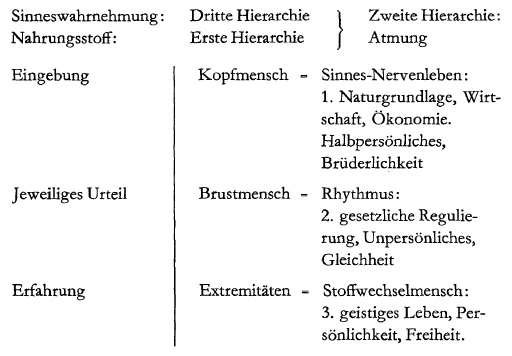
[ 34 ] You can see from this that a true understanding of human nature and a true understanding of social structure are mutually dependent; one cannot attain the one without the other. Just as human beings are head-oriented, chest-oriented, and metabolic beings—that is, sensory and nervous beings, rhythmic beings, and metabolic beings—so the state is not a single organism, but rather the social structure consists of the state, the economy, and intellectual life.
[ 35 ] This must become the very foundation of social insight into the future. And the sin committed against humanity by eliminating inspiration and experience is being committed today by socialist thought, which, on the one hand, ignores the semi-personal aspect in that social thinking where brotherhood must reign in and of itself; and on the other hand, by ignoring the spiritual life, in which freedom must reign, while equality must prevail in the impersonal elements of the law.
[ 36 ] You cannot instill brotherhood into the state; yet you cannot establish an economic organization without brotherhood. This is the great error of contemporary socialism: that it believes it can somehow create a healthy social structure through state regulation—above all, through the socialization of the means of production. All the forces of the social organism must be called upon if a healthy social structure is to be created. Alongside equality—which is the sole goal pursued today, and which is quite rightly sought for all that is lawful—brotherhood and freedom must also prevail. But they cannot prevail unless a threefold social order is established. To say that freedom, equality, and brotherhood must prevail in the state—while the state is omnipotent—is the same as saying: You need neither a head nor a stomach; you need only have a heart and lungs, for the heart must think, and the lungs must eat or drink. Just as it is nonsensical to demand that the heart and lungs think and eat, so it is nonsensical to demand that an omnipotent state manage the economy and provide for spiritual life. Spiritual life must be self-reliant and interact only in the same way that the stomach interacts with the head and with the heart. Things in life do interact, but they function properly only when they are allowed to develop individually, not when they are crammed together in the abstract. This is what must be understood above all else, and without this understanding, one will certainly not make any progress. And the very facts of the present day prove that this understanding must be attained. It is highly remarkable how people today fail to see this connection between materialism on the one hand and abstract thinking on the other, particularly with regard to the social question.
[ 37 ] A major reason for the rise of materialism is that the state has gradually taken control of all free-corporate, school-like institutions. If you go back to the times when things were founded out of an atavistic sense that sprang from clairvoyance, you will see how people still felt the necessity for the threefold social order to work together. It was only from the 16th century onward that these elements gradually merged, coinciding with the rise of materialism. Look at the universities of earlier times: they were free corporations, and they positioned themselves entirely independently within the human social structure. In earlier times, if a person wanted to become a prominent lawyer, they would go to a prominent law school—let’s say, to Padua; if they wanted to become a prominent physician, to Montpellier or Naples; if they wanted to become a prominent theologian, to the University of Paris. These institutions did not belong to any particular state; they belonged to humanity, for they functioned as an independent component within the social organism. Today, it does a person living in Switzerland no good to become a prominent physician in some other country, for in Switzerland he counts for nothing in the field of medicine; for today, that which was supposed to serve only as a regulatory body has absorbed both economic productivity and intellectual productivity. And with that, an unhealthy element has crept in. Isn’t it true that people can forget they have a head and a stomach? They have forgotten this in modern science, for they treat themselves as if they were merely breathing beings. But in the realm of reality, this leads not only to false theories, but also to false institutions and false structures. Any school that is directly under the control of the state is an untenable institution. You don’t have to see through this if you’re short-sighted, but nevertheless, it is an untenable institution that gradually leads to disaster. Any undertaking that goes beyond mere regulation—that aims to be productive—is disastrous when operated by the state. That is what matters. You cannot pour anything into your lungs, not even water when you are thirsty. If it ever happens, you will see what disaster it causes.
[ 38 ] But today, people are pouring all kinds of economic ventures—and even those pertaining to intellectual life—into what is supposed to be merely the legal regulation of existing conditions. Today, one is even considered rather eccentric if one clarifies what is fundamentally and fundamentally correct in this area. Well, the radical parties—they still go that far: separation of church and state—they’re still willing to go along with that. They want to separate this part of spiritual life—the church—from the state under certain circumstances, because they hope that people are, after all, only interested in matters of the state. In this way, through a clever detour, the church will eventually die out entirely. But if one were to expect these same people to do what is necessary—namely, that above all else, schools be left to their own devices so that intellectual life may regain its productivity—they would object very strongly. Any institution that intervenes in spiritual life through regulation must necessarily lead to barrenness and sterility. And likewise, it must be detrimental to the initiative necessary for economic life when mere regulation intervenes there. The police, security services, and everything that constitutes social law—not private law and not criminal law, which belong to the third sphere, intellectual life—belong to the regulatory system. Everything that constitutes the economic system is a system in its own right; it must have a corporate structure, one that is semi-personal. And everything that constitutes spiritual life must be grounded in human individuality and can never, ever flourish unless it is grounded in human individuality. Human individuality in its spiritual production is to the state exactly what food is to the lungs and heart—food that must pass through the stomach and not go directly into the lungs and heart.
[ 39 ] This is how you see the other pole. Schiller arrives at the utmost humanity—the middle state—and even connects to the next state, to art. We are, so to speak, compelled to begin with the most robust, the coarsest, the roughest, and to seek the human being within; but we must take this path, otherwise there is no hope for the development of humanity in the present and the near future. Schiller boldly stated the following in his Aesthetic Letters: Man is fully human only when he plays, and man plays only when he is human in the fullest sense of the word. — Schiller regards play as the true ideal state, provided one conceives of play in the same way Schiller does: that the necessity of reason has been brought down to the level of inclination, and inclination has been raised up so that it has become just as spiritualized as the necessity of reason. He then calls the seriousness of life a game, because one behaves like a child at play, who obeys no duty but rather gives in to his “instincts”—yet in a certain sense gives in to them freely, because the necessities of life do not yet extend into the child’s life. Thus, a pinnacle of human existence is captured in Schiller’s Aesthetic Letters: Man is fully human only when he plays, and man plays only when he is human in the fullest sense of the word. — And so, on the other hand, it is necessary that now, when we must begin with the robustness of the cosmos to find man within it, with the ruggedness of the entire cosmos to find man in the entire cosmos, we must say to ourselves: Humanity will truly advance only when it understands how to elevate even the smallest thing in everyday life—even the most mundane play—to the great seriousness of cosmic existence. That is why we must say: A turning point for humanity has arrived in the present, where seriousness is knocking terribly at our door. This must simply be recognized. More on this tomorrow.