

Goetheanism
An Impulse for Transformation and a Concept of Resurrection
Human and Social Science
GA 188
25 January 1919, Dornach
Translated by Steiner Online Library
Eighth Lecture
[ 1 ] What was particularly important to me yesterday was, on the one hand, to use the example of Schiller’s “Letters on Aesthetic Education,” and Goethe’s “Fairy Tale of the Green Snake and the Beautiful Lily,” how, before the mid-19th century, the entire way of conceiving and perceiving the world—especially among outstanding minds—was different from what it was after the mid-19th century. It is precisely through such examples that one can truly see what a considerable and significant turning point occurred in the mid-19th century. We have, after all, spoken of this turning point in the entire development of humanity from various perspectives, pointing out that the mid-19th century represents, in a sense, a crisis of materialism—a crisis insofar as the materialistic mode of perception gains the upper hand in all human thought and feeling, worldview, outlook on life, and so on.
[ 2 ] Now, anyone who wishes to examine these things closely—who has the courage and interest to do so—will notice in all sorts of ways what a radical change has actually taken place. Take the scene with the Cabiri out of today’s conception; try to read through this “Faust” scene to find everything that refers to the Cabiri; try to follow every single line with genuine, deeper interest, and you will see how Goethe, through his spiritualized instincts, was still very much immersed in that intuitive insight. Through such performances and mystery rites, such as those the Greeks practiced in connection with the Cabiri, for example, the highest aspects of human existence—including the quest for knowledge and the like—are expressed. Goethe rightly associated these Cabiri with the path that is to lead from the homunculus to the homo. He rightly associated these Cabiri with the mystery of human becoming.
[ 3 ] Three Kabirs are brought forth. Let us first speak of the three human members. Before we turn to the true inner being of the human being, let us speak of the three human members: the physical body, the etheric body, and the astral body. When one speaks of these human members, one immediately provokes criticism from those people who today consider themselves particularly clever, who today consider themselves particularly scientific. For example, such people object: Why divide and categorize the unified human being? The human being is, after all, a unity; it is schematic to break the human being down into such components. — Yes, but that is not how it is; it is not that simple. Certainly, if this were merely a schematic division of the human being, there would be no need to place special emphasis on these components. But these individual components, which are seemingly abstracted from the whole human being, are all connected to entirely different spheres of the universe. Because the human being has a physical body—as it exists today, having developed from its Saturnian origins up to the present day—the human being belongs to space, to the sphere of space. And through his etheric body, the human being belongs to the sphere of time. Thus, because the human being belongs to these two entirely distinct spheres—because, one might say, he has crystallized out of the world of time and space—he consists of a physical body and an etheric body. This is not some arbitrary, schematic classification that is presented here as a division or structure of the human being. It is in fact based on the human being’s entire relationship to the universe. And through their astral body, human beings already belong to the extra-spatial and extra-temporal realms.
[ 4 ] This trinity—the human trinity of sheaths, so to speak—is embodied in the three Kabirs. The fourth “did not want to come.” And it is he who thinks for them all! If we ascend from the three sheaths to the human “I,” we find in this human “I” first and foremost that which transcends space and time, and even the timeless, spaceless realm of the astral. But this human “I” only came into consciousness precisely during the period that followed the Samothracian worship of the Cabiri. The Greeks did, of course, derive their belief in the immortal from the ancient, sacred Samothracian teaching; but it was not until the Greco-Latin period that consciousness of the “I” was to be born. That is why the fourth one did not want to come—he who represents the relationship that exists between the “I” and the cosmos. And how far removed was that from the mystery of the Kabiri, which first points to what was present in the process of becoming human. The three highest—the fifth, sixth, and seventh—are still “to be sought on Olympus”: the Spiritual Self, the Life Spirit, and the Spiritual Man. These, as we know, will come in the sixth and seventh epochs. And no one has even thought of the eighth yet!
[ 5 ] We do indeed see in the ancient form a vivid expression of the mystery of humanity, as it was veiled in Samothrace within those mysteries from which the Greeks drew the very best for their knowledge of the soul, for their wisdom of the soul, and indeed the very best for their poetry, insofar as it related to human beings. The important thing is to recognize this: as soon as one turns one’s gaze back to those ancient times—which Goethe, in turn, sought to revive—one glimpses a knowledge of the connection between the human being and the universe. Human beings felt a kinship with all the mysteries of existence. They knew that they were not merely confined within the limits of their skin; they belonged to the entire, vast universe. And what is enclosed within their skin is merely the image of their particular being.
[ 6 ] One might say: A reflection, a final echo of this view of the connection between human beings and the universe can still be found in writings such as Schiller’s “Letters on Aesthetic Education,” and is present, I would say, as the pervasive spiritual breath of life in poetry such as Goethe’s “Fairy Tale of the Green Snake and the Beautiful Lily.” Here, Goethe has indeed attempted, in his own way, to depict vividly what places human beings within the human community. Goethe presents twenty soul forces in the form of fairy-tale characters. But by bringing these twenty soul forces to life, Goethe shows how they bridge the gap from one person to another in social life. In this fairy tale, Goethe created imaginative depictions of the course of social development throughout humanity. These imaginative depictions, as Goethe created them—the way he juxtaposed the King of Wisdom, the King of Appearance, and the King of Violence, and the way he allowed the king who chaotically combines all three — wisdom, appearance, and power — chaotically combines all three within himself; this way of depicting it reveals, in its own way, what must be consciously grasped today with great intensity and from different perspectives.
[ 7 ] But today we cannot stop at Goethe’s fairy tale. Anyone who wants to stop at Goethe’s fairy tale and its portrayal today is really just playing around. As you know, the same theme and the same impulses that Goethe depicted in the fairy tale are portrayed in my first mystery play, *The Portal of Initiation*. But they are portrayed with the awareness that something emerged in the mid-19th century that makes it necessary for such things to be depicted today from entirely different, more compelling impulses. Yesterday I drew your attention to how the transition must take place from looking back at the earlier age to the age at the end of which we now stand. But what we must regain—what existed in ancient times as the last echo of atavistic clairvoyance regarding these matters—is the awareness of the connection between the human being and the entire universe, the awareness of that mystery which you will find expressed at the beginning of my second Mystery Play, where Capesius describes how the workings of all the gods ultimately aim to bring forth the human being. Why is an awareness of this cosmic significance of the human being—of the human being’s place within the entire cosmos—so particularly important for our time? Precisely because we are faced with the need to grasp spiritually the most mundane, the immediately external life. And this external social life cannot be grasped unless one can base one’s understanding on a genuine insight into the nature of the human being. The moment one begins—as some economists do today and as is even reflected in the trivial consciousness of most people—the moment one begins to place human beings themselves, in their entirety, within the social structure, one is bound to fail with regard to the social question, because human beings, by their very nature, transcend what the social question actually represents.
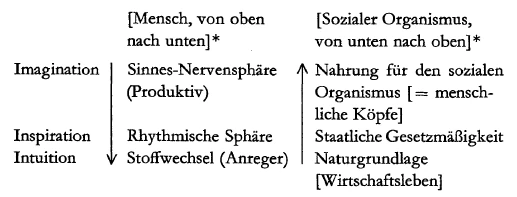
[ 8 ] I told you yesterday: There are three aspects to human nature that must be distinguished. How one names them is a matter in itself. Today we call them the nervous-sensory human being, the human being of rhythm, and the human being of metabolism. We must distinguish three aspects with regard to a truly organically ordered social structure: the spiritual, the purely regulatory state, and the economic. Human beings come into contact with this social life; they are part of it. But in a sense, they already stand there in their threefold division in reverse, as compared to the threefold division of the social organism. Please note this: It is always necessary to point out that one must not construct, seek analogies, or interpret such things in abstract terms, but rather engage in genuine spiritual research. Thus, one achieves nothing by comparing, for example, the Earth’s winter to night or sleep, and summer to waking, whereas for the Earth, summer actually represents sleep, and winter represents waking. One achieves nothing by conceiving of the development of humanity as analogous to the development of the individual. While the individual progresses from childhood to old age, humanity moves backward from old age into childhood. True research reveals something entirely different from what people fantasize about. By all means, do not spin analogies, but look at things as they are! When we consider the threefold human being, we first have the spiritual aspect of the human being in the sensory-nervous sphere. Then we have the middle aspect in the rhythmic sphere, and the lower aspect in metabolism. You can read more details in my book *The Mysteries of the Soul*. But I have pointed out: Metabolism actually bears the imprint of the highest, the spiritual. Metabolism therefore corresponds, when we perceive the spiritual, to intuition; the rhythmic sphere corresponds to inspiration; and the sensory-nervous life corresponds to imagination. The human being is a threefold being. But the true social organism, toward which present-day humanity is striving in the fifth post-Atlantean epoch, is also threefold. However, when observing this threefold structure, we must not overlook the following:
[ 9 ] Where, exactly, is that aspect of the human being that the human organism is aimed at—not the whole person, but the human organism? Yes, the world happens to have a very convoluted view on this, and the real view, the true view, seems convoluted to people. Today’s so-called genuine physiologist thinks, as I already said yesterday: People eat, stuffing food into themselves; then the organism selects from this food what it needs and expels the rest. It transforms it within itself, and that’s how it goes, doesn’t it, day after day. Well, I told you yesterday that this metabolism refers only to the day-to-day metabolism, and that the other metabolism—the one that carries a person from their first teeth to their permanent teeth, then on to sexual maturity, and so on—does not depend directly on this metabolism at all. This metabolism, which spans the long periods between birth and death, is not connected to the process of consuming and transforming food and so on; rather, it is based on different laws and different processes of substance transformation. I already pointed this out yesterday. But what, after all, does this daily food that we take into ourselves actually mean? This brings us to a topic where we must once again enter into the most intense conflict with conventional modern science.
[ 10 ] Please, I don’t want to persuade you not to eat; I’m just asking that you not draw any convoluted, nonsensical conclusions from things that are said for the sake of knowledge and understanding—not so that someone might draw all sorts of absurd conclusions from them! But why do we actually eat? Do we eat so that we can have within us what is outside of us? No, rather, we eat so that the various substances that enter our bodies can carry out specific manifestations of energy, and our organism resists these manifestations of energy—and we must be prompted to this resistance through eating. You can imagine it figuratively: As you take in food, it causes small explosions within you; you need these explosions because you must in turn destroy them, subdue them, and annihilate them—and it is in this process of destruction that your inner strength actually develops. Human beings need impetus, stimulation, and essentially, what food is to us is stimulation. For what we are as human beings, we actually receive in a mysterious way from somewhere else entirely.
[ 11 ] You may recall that I have said on several occasions: The head is actually hollow. This allows it to absorb from the universe that which is productive within the human being. And this production is, so to speak, simply coaxed out of the head. In this way, the head once again comes into its own. The head is, in many respects, actually the least important part; it is the last remnant of the previous incarnation. It is that which, for example, could not think without rhythmic activity. People always believe that the head thinks. In reality, it does not think, but merely reflects thoughts. But it regains its honor through the fact that it is actually the productive force. And in order to unfold this production, a person must rely not only on the rhythm within but also on metabolism, which serves as the constant stimulus. Metabolism is thus the constant stimulus through which a person enters into a relationship with the outside world.
[ 12 ] How does this apply to the social organism? In fact, the situation is actually the opposite. What is internal to the human being—what the human being carries within, which gives rise to the hollow head and requires external stimulation through metabolism—serves as the foundation for the social organism, just as food does for us. What food is to us is to the social organism what human beings produce from their nervous and sensory life. Thus, the state—or rather, the social organism—is an organic being which, if I may use the expression, “eats” what human beings conceive, what human beings invent, what arises from human spirituality.
[ 13 ] If you remove the very fundamental force, the very fundamental quality, from human spirituality—namely, freedom, individual freedom—it is exactly as if you wanted to let a person grow up without giving them food. Free, individual human beings who place themselves within a coercive social structure and render their free spirituality sterile cause the social structure to wither away just as a person must wither away if you do not give them food. What human minds bring into the world is the nourishment for the social organism.
[ 14 ] So one can say: What is productive in the nervous and sensory spheres is the nourishment for the social organism. — What constitutes the rhythmic system in human beings corresponds, however, in the social organism to everything that is actually to be entrusted to the state, as I already said yesterday: everything that relates to regulation, to external legality—that is, state legality. And what, then, is the productive aspect of the state? That which arises from the natural foundation in the broader sense: economic life. This is, so to speak, the head of the state. Economic life, the natural foundation, everything that is produced—this is, so to speak, the head. It is the reverse of what happens in the individual human being. So we might just as well say: Just as the human being is productive through his nerves and senses, so the social organism is productive through its natural foundation. And just as the human being derives his metabolism from nature, so the social organism derives its nourishment from the human mind.
[ 15 ] You can only truly understand the social organism in relation to the human being if you turn the human being upside down. Here, in the human head, lies the very foundation of the human being. The human being grows from top to bottom, while the state organism grows from bottom to top. If one wishes to compare it to a human being, it has its head at the bottom, stands on its head, and has its legs at the top. It draws its nourishment from the individual human being. This is how one must inwardly understand what the social organism is. Playing with analogies is of no consequence; but the perspective on true reality, on genuine reality—that is what matters.
[ 16 ] Isn’t it true that, over the course of the 19th century—precisely as this important turning point in the mid-19th century took hold—we saw a genuine tendency toward materialism, a turning away from the spiritual? It was the high tide of materialism. What actually happened there with regard to the human worldview? Well, with regard to the human worldview, what happened was that people lost the spirit of the supersensible. They lost precisely what was meant to be achieved through their “hollow head” of production; what was meant to enter the “hollow head”—that is what people have lost. They want to rely solely on the chance outcomes of experimentation when it comes to all inventions and discoveries. No matter how proud, how arrogant one may be about the achievements of the second half of the 19th century, if you study the history of thought, you will see how even the greatest of these achievements are based not on the direct initiative of the mind, but on constellations that arose in the course of experimentation. We have lost God, we have lost the Spirit, by no longer striving with the mind toward the Spirit.
[ 17 ] What, then, would be the opposite of this in the social organism? There, one would lose touch with the foundations of nature; there, people would simply argue back and forth without taking those foundations into account. This is, in fact, the character of social debate in the second half of the 19th century and up to the present day—and it is most intense today. For today people talk about social institutions, about the socialization of the human economy, and the like: in this debate, they omit precisely the actual natural foundation—the way in which production should take place—just as the materialists omit what the human mind is meant to do. If the materialist era loses the spirit from its worldview, then the corresponding social organism loses the actual substance from the economy, from the social context. And in social development, there lies the great danger that corresponds to the loss of spirit in the materialist worldview: the loss of a mode of production that satisfies humanity as fully as possible, and the loss of the deepest possible insight into the productive process.
[ 18 ] Well, one cannot arrive at an understanding of social structure unless one trains oneself in the threefold constitution of the human being and thereby learns how to shape the relationship between the science of the human being and the social sciences. Otherwise, one will misjudge everything. Our learned economists—who have brought so much misery into the world because others think the same way, since they accept only experimental evidence—our learned economists, in fact, know absolutely nothing about this relationship between the human being and the social structure. For this can only be gained through the spiritual sciences. In all seriousness, our economic scholars, our professors of economics, argue over whether a piglet or a human being has greater economic value. Isn’t it true that, from the perspective of the arguments people currently hold, a great deal can be said in favor of both? Some claim that a piglet is more valuable to the economy than a human being, because the piglet represents something that can be eaten—that is, something suitable for consumption, something that has economic value. A human being cannot be eaten; in fact, he even consumes other things himself; for some people, he represents no economic value. Others, however, think differently; they say: Well, but humans produce economic value, and that value will be there! So, indirectly, they help bring so many piglets into existence, and so on. Well, as I said, these are matters of debate! It is indeed a question discussed among economists: whether a piglet or a human represents the greater economic value.
[ 19 ] Well, that’s just a grotesque example. But for those with deeper insight, it is precisely such grotesque things that embody what is alive in our catastrophic present. For one can certainly say: The knowledge that is sufficient to make magnificent strides in the natural sciences—the knowledge that yields magnificent scientific results, that wonderfully enables us to compare the embryo of a piglet with that of a dog, with that of a human, with that of a bat, and so on— and from this to formulate the kind of thinking that suffices to produce all manner of physiological, biological, mineralogical, and geological findings in the spirit of our time—this thinking, this way of connecting ideas, is not sufficient to distinguish, in economic terms, which is more important: a pig or a human being. And until one realizes that one can be a great natural scientist without being able to distinguish, in economic terms, between a pig and a human being, there will be no solution to the social question. People must ruthlessly admit that what today constitutes the greatness of thought in the field of natural science does not allow one to distinguish the economic value of a piglet from the so-called economic value of a human being. We will continue discussing this tomorrow.