

The Social Question as a Question of Consciousness
GA 189
21 February 1919, Dornach
Translated by Steiner Online Library
Third Lecture
[ 1 ] It will be clear to you how what I have presented here and elsewhere—particularly regarding the social problem of our time—stems entirely from the foundations of the spiritual sciences, and how an attempt has been made to incorporate into the appeal I spoke to you about here recently what must now be practically conceived regarding the social problem based on a deeper understanding of the current world situation. We should never grow weary of bringing the main point to mind again and again. And this main point today is that we must find ways and means to raise awareness—to foster understanding of what must take shape as initiatives and actions within humanity if we think correctly about the nature of the social organism. Surely you have realized that humanity’s thinking, feeling, and thus also its willing have changed radically since the middle of the 15th century, and that the entire course of history will have to be revised if it is to be made fruitful for humanity from the perspective that arises from this radical metamorphosis in the spiritual constitution of humanity for the fifth post-Atlantean epoch. One must be clear about the fact that, precisely because of the peculiar nature of development in this, our fifth post-Atlantean epoch, among people who are endowed with a certain will—whether we ourselves consider this will to be right or wrong, good or bad—the underlying thinking in these people takes on certain forms. And our entire social movement today is essentially shaped by this underlying thinking, which takes on specific forms. After all, it is based on the thoughts that people can have in accordance with the fundamental character of our age.
[ 2 ] Now, please recall that in the threefold social order—which we have discussed frequently and which is also expressed in the appeal brought to your attention—the actual political state, which most people today believe encompasses the entire social organism—or which most people today confuse with the social organism—is, so to speak, merely one department, one member of the threefold social organism. If, on the one hand, you understand correctly what the entire threefold structure of the social organism amounts to, and if, on the other hand, you try to understand how the one-sidedness in modern life has developed—the tendency to completely centralize the social organism, to let the state, as it were, swallow everything up—then, by bringing these two things together, you have provided something essential for understanding the matter. And understanding the social movement from a serious perspective today is the most essential thing for people of the present. With regard to what actions need to be taken, people will continue to grope in the dark for a long time to come, as is the case today. It cannot be any other way. But what we must focus on, what we must work toward, is this: to spread social understanding; to spread the possibility of truly understanding the social organism. It is precisely from this perspective that it is extraordinarily interesting to observe the nature of the thinking of contemporary people who direct their social will in a certain direction. Isn’t it true that we must focus more on observing the nature, the shaping, and the form of people’s thinking, and less on the content; for we have had to emphasize on various occasions: what people ultimately think matters far, far less than how they think, how their thinking is oriented. Ultimately, when it comes to the decisive and far-reaching nature of the current global movement, it is not at all that significant whether someone is reactionary in the most ancient sense, whether they are liberal, democratic, socialist, or Bolshevik. If one looks only at what people say, that is not particularly important; what is particularly important is how people think, the manner in which their thoughts take shape. That is what matters. For you will find today that here and there you discover a personality who thinks in a radically socialist way in terms of content and program, but whose thought patterns are actually no different from those of the people who have today been overthrown across a vast expanse of the earth.
[ 3 ] So we really have to look at the deeper forces that are making themselves felt. Because very, very little in the course of history will depend on the ideologies that, as I said recently in Basel, are wandering among us today like mummified judgments. Much will depend on people learning to think differently, to shape their thoughts differently, to form them differently. At present, there is still nothing that truly directs people’s thinking in a different direction other than spiritual scientific thinking, which is why most people regard it as fanciful. Yet the people who say it is fanciful are themselves fantasists—albeit often materialistic fantasists; but they are fantasists, they are theorists, and they cannot engage with reality. What is taking shape, however, will develop out of the very nature of thinking. It is precisely in relation to what this implies that I would like to discuss a few points with you today.
[ 4 ] Anyone who looks at the way in which views within the proletarian movement have gradually taken shape, and how they have developed to this day, will see all manner of views within the proletarian world. We should be particularly interested today in the fact that, alongside the many other socialist proletarians who think one way or another, by far the largest number among these proletarians profess a radical commitment to original or further-developed Marxism. What is remarkable is that this Karl Marx—after having assimilated Hegel’s German dialectic, after having become acquainted with French social positivism, and then having observed the social world and social development from London—developed from there his extraordinarily far-reaching socialist theories, which then gradually took hold of the entire proletarian world. So it was actually the Marxist idea that spread, that—fueled by the spark of the catastrophe of recent years—has grown to the extent it has today, and will continue to grow. Even among socialists themselves, there are a great many who simply invoke Karl Marx in such a way that they claim to be Marxists. Well, one claims to hold an entirely orthodox Marxist position, another claims to represent an advanced form of Marxism, and so on. But it all goes back to Marx.
[ 5 ] Now, there is a statement by Karl Marx himself that sheds quite a deep light on certain aspects of this matter. Karl Marx once emphasized, when speaking about Marxism itself, that he—Karl Marx—was certainly no Marxist. That, my dear friends, is something we should not lose sight of, especially in this day and age. For only by paying attention to such things can one truly grasp what matters: namely, how ideas take shape, not what is actually said. Especially in these difficult times, humanity cannot afford the easy way out of relying on programs. And one path—however long it may be—is that from Karl Marx to Vladimir Lenin, who now also considers himself a true, genuine Marxist. And when one speaks of Lenin today, one is not speaking of a single individual, but of a movement that—for all I care—can of course be criticized to the ground, but which, as an impulse, is already having a far-reaching impact, not only through certain methods it has adopted, but also because its adherents are convinced that these methods actually represent true Marxism.
[ 6 ] The easiest way to address the problem I am pointing out here is to focus precisely on the fact that a one-sided tendency has taken hold—namely, the desire to subordinate everything, as it were, to the state—even though the social organism is, in fact, tripartite. It is indeed interesting to trace the development of thought as it unfolded in Karl Marx himself; setting aside for the moment what Marx actually said in terms of content, and focusing more on the development of his thought. You see, anyone who, for example, approaches Karl Marx and reads his writings with the expectation that they will provide a vision of how the social organism will take shape will be sorely mistaken. You will search in vain in Karl Marx’s works for the kinds of insights regarding the social organism that you find in the contributions of spiritual science—insights I have presented here and elsewhere. That is because, according to his way of thinking, this was not really a concern of his at all. If you examine the economic views on social organization—insofar as Karl Marx himself wrote them down—you can conclude that Karl Marx actually had no thoughts about the social organism other than those that already existed. Karl Marx does not, in fact, formulate original ideas about how the world should be. He examines: How did the people who ushered in the modern capitalist era think? How did the issues of wages, capital, ground rent, and so on develop under capitalist rule? — And he dissects the political economy of capitalist rule. Essentially, the most important ideas that Karl Marx passed on to the proletariat can already be found in Ricardo and others. What does Karl Marx do? Karl Marx says: In the capitalist economic order, which has gradually taken shape in recent times, people held views from which modern wage relations, modern capital relations, modern ground rent relations, and so on, were formed. And now he tries to take this thinking further. He does not say what should replace this social structure, as it has developed under capitalism; he merely shows that, under this capitalist rule, the proletariat has emerged as a distinct class of people. It is there; it is a reality. He now shows where capitalist rule leads. He shows that it reduces itself to absurdity, that once it has reached its zenith, it must turn into its opposite. Capital accumulates more and more in the hands of individuals until it passes over to the “most individual,” who then simultaneously becomes the collective; no matter how much Marx and the Marxists resist acknowledging this in words, they merge into the state order, so that the state actually becomes the sole big capitalist. But it then has, as its representatives, all the people who participate in the state.
[ 7 ] Well, it is precisely from this debate that the wide variety of socialist views have emerged in recent times. Karl Marx and his friend Engels were active for a long time; over the course of decades, they contributed greatly to modifying, expanding, and refining the ideas they had originally expressed—as is inevitable for anyone who does not stand still but continues to develop by observing both themselves and the world. Now, on the basis of Marxism—because Karl Marx’s ideas, as I have repeatedly shown you, truly spoke to the very soul of the proletariat—a great movement arose that has taken on a wide variety of forms in different countries. One can certainly say: Socialism, which developed on the basis of Marxism, has a different nuance in England and France; it took on its most radical nuance in Germany, which then spread to Russia. It is all true that it has taken on various nuances. But what is a very fundamental question of principle—the relationship of the proletarian world to the state—has actually more or less become shrouded in a kind of nebulous atmosphere. Precisely because of this, people formed many parties within socialism that fought each other tooth and nail, because in one way or another they interpreted the relationship of the proletariat to the state—as it has historically taken shape in the course of recent developments—in a wide variety of ways. Now, of course, a wide variety of currents come into play here, which we do not wish to address today. But let us briefly outline the path that stretches from Karl Marx to Lenin. For Lenin specifically claims to be the truest Marxist, the one who best understands Karl Marx himself, while numerous other socialists, who also call themselves Marxists, are labeled by Lenin as renegades and traitors and given all sorts of names; some are called social-chauvinists because of their behavior during the so-called World War, and so on.
[ 8 ] If we look back once more at Karl Marx, we must be interested in the structure of his thought, and you can already glean something essential from what I have said: there is no positive idea of how things should be; there is something subversive in the structure of his thought. Karl Marx simply says: You capitalist thinkers have said and done it this way; your own downfall must follow from this, and then the proletariat will rise to power. What the proletariat will do, I do not know; neither do others; that remains to be seen. The only certainty is that, through your own actions and what you have made of the world, you are bringing about your own downfall; as for what it will be like when the proletariat is in power, and what it will do—I do not know, nor do others; that remains to be seen.
[ 9 ] If you take this matter as I have just described it, then you have the thought-form. It simply takes in what is manifesting in the external world all around and thinks it through. But once you’ve finished with the thought, the thought destroys itself; it comes to nothing; it fizzles out, so to speak. That is what strikes those who are sensitive to such things so strongly. When one studies Karl Marx, one always finds that he starts from certain ideas; but these are not actually his own ideas, rather they are the ideas of modern times. And then one is drawn into something that actually swirls the thought around, confuses it, and causes it to run its course into something destructive, to which nothing can be attached.
[ 10 ] It is extraordinarily interesting to see how this mode of thought—which was already taking shape in Karl Marx—manifests itself in Lenin to the highest degree, one might say elevated to the level of genius. Lenin interprets Karl Marx as an absolute opponent of the state, arguing that Marx proceeded from the idea that if the oppression of the proletariat is to end, then the state—as it has historically developed—must be abolished; it must cease to exist. This is interesting because precisely those whom Lenin regards as opponents actually want to kowtow to the state as it has historically developed. So we have these two opposites within social circles today: on the one hand, the very same state fanatics who want to nationalize everything, and on the other hand, Lenin, the absolute opponent of the state, who actually sees the salvation of humanity not in the abolition of the state—which he considers nonsense, a utopia—but in the gradual withering away of the state. And precisely when one considers how he thinks, one arrives at the form of thought that lives within him; that is interesting.
[ 11 ] Lenin reasons as follows: The proletariat is the only class that, after the others have reduced themselves to absurdity and brought about their own downfall, can rise to the top. This proletarian class, Lenin argues, will drive what has developed into the bourgeois state to its highest perfection. — Please pay close attention to the line of reasoning. — So Lenin does not say, as the anarchists do: “Let’s abolish the state”; that would never occur to him. He is an opponent of anarchism; he does not say, “Let’s abolish the state”—he would consider that utter nonsense—but rather he says: If development continues as the bourgeoisie has set it in motion, then the bourgeoisie is ripe for ruin. The proletariat will, as he says, seize the state apparatus; what the bourgeoisie established as a state—as a tool for the oppression of the proletariat—the proletariat will perfect, thus creating precisely the most perfect state. But what is the distinctive feature of the most perfect state?—Lenin now asks. And he believes himself to be a true Marxist when he says: The distinctive feature of the perfect state, when it comes into being—and it will come into being through the proletariat, will arise as the ultimate consequence of the bourgeoisie—the distinctive feature of the perfect state is that it will wither away. The present state can exist only as a state created by the bourgeoisie because it is imperfect; when the proletariat brings it to perfection, completing what the bourgeoisie began, then the state acquires its true dynamism, which consists in its dying, in its ceasing to exist of its own accord.
[ 12 ] This is merely the most characteristic form of thought in Lenin’s thinking. You see, in an amplified form, what is already present in Marx: the idea that is formed and then fades into nothingness. Except that Lenin is a very realistic thinker who deduces from the course of history that the state must be perfected; it is not dying right now because it is imperfect; that is the source of its vitality. If the proletariat perfects it, then it will have laid the groundwork for its gradual demise.
[ 13 ] You see, an idea is formed out of reality, and this idea, in much of Eastern Europe today, tends to expand into reality. It is not merely an idea; it becomes reality; it amounts to saying: You bourgeois have brought this modern state into being; you have used it only as an instrument for the oppression of the proletariat; you have left it imperfect; it is the state of the privileged class. It serves you to oppress the proletarian class; that is what gives it its viability. Now the proletariat will come, will abolish class rule, will make the state a perfect entity: then it will die; then it cannot survive. And then what is meant to emerge will emerge—something of which, as Lenin says, no one today can know what it is. The social “Ignorabimus”—that is what flows from this socialism. This is very interesting. For the mode of thinking that has taken hold of social imagination today is derived from the natural sciences, and just as the natural sciences have rightly arrived at “Ignorabimus”—“We can know nothing”—from their one-sided standpoint, so too does socialist thinking arrive at the socialist “Ignorabimus.”
[ 14 ] We must truly understand this connection, my dear friends. Without everything that has been taught by the scientific worldviews at the respectable middle-class universities, without that, there would be no socialism. Socialism is a child of the bourgeoisie. Bolshevism, too, is a child of the bourgeoisie. That is indeed the deeper connection. This is what must be understood above all else.
[ 15 ] Now, once one has grasped this line of thought, one can point out a few important points specifically regarding the perspective of a man like Lenin. For example, he places particular emphasis on the fact that bureaucratism—the “military machinery,” as he calls it—has developed within the bourgeois state. This bureaucratic, military machinery has arisen because it is needed by the ruling classes to oppress the very classes they subjugate. Therefore, the most radical wing of socialism—Bolshevism—is well aware that what it seeks can only be realized through the armed proletariat. Without weapons, what this side seeks is hopeless. And this is substantiated by historical examples. The French Communes were able to function only as long as those who had risen to power there were armed. The moment they were disarmed, it was no longer possible. This is one of the points that must be kept in mind: the proletariat must be an armed workers’ force. Now, what should happen then? What should be accomplished by this proletariat, acting as an armed workers’ force? It is already happening to some extent today. It is happening in a way that might lead one to believe that some people could be roused from the deep social slumber in which humanity has been immersed for so long. What should happen? Above all, the state as a class state must cease to exist. What the bourgeoisie established as a class state must be taken over by the armed working class.
[ 16 ] And now it is interesting that, in clear and unambiguous terms, it is precisely among those people who have developed, to a certain degree, the mindset of modern socialist thought that what has actually been instilled in the souls of the proletariat by circumstances and by historical development comes to the surface. Lenin points out, for example, that the bureaucracy and military hierarchy must be replaced by a form of administration consisting solely of elected officials, and he notes that, given the current state of affairs, one needs nothing more than the general school education that is common today to manage the matters that need to be managed. And he himself uses a remarkable expression that speaks volumes. Lenin says that what is called the state today should be transformed in such a way that it essentially becomes a large factory with a general accounting system. To achieve this and to exercise control and other functions, one can get by quite well with the four basic types of arithmetic—that is, with what general public education can provide.
[ 17 ] Well, my dear friends, one should not simply scoff at such things, but should realize that this view, too, is nothing other than the ultimate consequence of bourgeois development. Just as the modern social structure has emerged from a purely economic perspective, it must be said that it is precisely those with capital—those who direct capital—who, for the most part, have nothing else in mind but what Lenin demands that future labor overseers should have.
[ 18 ] If it were possible for the proletarian—as he has emerged in recent history—to look up to someone whose special abilities or the like he could believe in, to whom he could look as to a certain legitimate authority, then the entire course of history would have unfolded differently. But he cannot look up to such people. He can only look up to those who are, in essence, his intellectual equals—those who merely have a head start on him in terms of capital. He finds no difference between himself and those in charge. This becomes apparent in Lenin’s work, albeit expressed in strictly theoretical terms.
[ 19 ] So it is precisely from Lenin’s radical formulations that one can understand how things turned out. Now, of course, I imagine the question is on all of your lips: Yes, but so many terrible things come out of this; it’s all so awful. — Nevertheless, the point is to look things squarely in the face, to go to the trouble of engaging with people’s thoughts. Isn’t it true that when what the radical socialists are doing here and there is described in such simplistic, tabloid terms, one can feel bourgeois indignation—which today often turns into bourgeois fearmongering—but the urge to understand these things isn’t particularly strong yet.
[ 20 ] Now, in order to understand what is already happening—and, in particular, what is yet to come—it is absolutely necessary to consider the following: Lenin himself, who considers himself a true Marxist, points out—as Marx had already begun to do—a certain conception of the development of the social order into the modern era and into the future. In fact, these people believe that social transformation must take place in two phases, not all at once. The first phase is simply the proletariat’s entry into the bourgeois form of government, which Lenin believes will, once perfected, wither away of its own accord. The proletariat will enter this system and bring to completion what, according to the proletariat’s own views and impulses, the bourgeois state can become. Marx himself has already pointed out that this cannot yet lead to any desirable conditions. What will this first phase of socialization in the Marxist-Leninist sense lead to? It will lead—to put it simply, though people themselves often put it this simply—to the fact that those who do not work will not be able to eat; that everyone must perform a specific task; and that through this work, they will be entitled to the necessities of life—let’s say, from the state apparatus and the like. But people are well aware of this: this does not bring about any kind of equality among people; rather, it merely perpetuates inequality. Nor does it actually enable people to truly possess the fruits of their labor. Karl Marx emphasizes this, and so does Lenin. After all, everything necessary for the education system, for helping certain enterprises get off the ground, and so on, must be deducted from the common fund—that is, from the state, or whatever one wishes to call what will remain of the bourgeois world order. The old Lassallean idea of the right to the full product of one’s labor must, of course, be abandoned in the context of this socialism. But even there, no equality emerges. For, after all, people as such—even if they perform equal work—will have different demands on life, due to their living conditions themselves. This socialism, of course, fully acknowledges this. This immediately gives rise to inequality once again. In short, it is the view of these socialists that the bourgeois order simply continues into the first phase of the socialist order, and that the proletariat maintains this bourgeois order.
[ 21 ] It is very interesting to see how Lenin speaks directly about this matter; for example, at one point in his work *State and Revolution*, he says that something like a bourgeois order, a bourgeois state, would come into being without the bourgeoisie. There, in these very words that Lenin himself uses—the bourgeois state will exist without the bourgeoisie—you see what I always emphasize and what I consider extraordinarily important: that people who think socialist today have merely inherited the legacy of the bourgeoisie. The ideas are bourgeois ideas. For a man like Lenin, who developed this form of thought to the point of genius, says that the next phase is this: a bourgeois state without the bourgeoisie, which will either be crushed or reduced to a servile caste. There will be no equality there; only the proletariat will be in power; instead of being appointed and decorated by monarchs or other similar entities, it will be elected. The proletariat will be both the governing and the law-making body. But it is the bourgeois state, only without the bourgeoisie. Everyone will be paid according to their work, but inequality naturally exists there.
[ 22 ] All of this by no means constitutes an ideal state of affairs. So if someone asks, “What have these people done to the human social order?”—Lenin will simply reply: “We promised you nothing else in the first phase than that we would carry through to its logical conclusion what you established as the bourgeois state; only now it is up to us to carry it through, and as proletarians we will carry it through. You did it before; now we are doing it. But we are doing the same thing you did: a bourgeois state, only without the bourgeoisie.”
[ 23 ] For example, Lenin says: “This bourgeois state without the bourgeoisie will lead to the withering away of the state.” The state will be able to wither away completely when society has realized the rule it regards as its ideal, and when the narrow bourgeois legal horizon—which, with the hard-heartedness of a Shylock, makes one calculate whether one ended up working half an hour longer or was paid slightly less than another—has ceased to exist. This narrow horizon will not be transcended until the end of the first phase. Until the end of the first phase, the bourgeois constitutional state—which compels one, with the hard-heartedness of a Shylock, to calculate whether one has ultimately worked half an hour longer or been paid slightly less than another—will still exist, and will, of course, be intensified at that point. This bourgeois Shylock perspective will thus extend into the first phase of socialism.
[ 24 ] There you have it—that is the only thing these people promise at first: You did it; you did it, at first, for your own caste; we are doing it for the proletariat. Talking about democracy is nonsense, because democracy would only lead to the oppression of the minority. The proletariat will do everything just as you did. But in doing so, it will bring about the demise of what you have brought to a semblance of life. Only then will the second phase begin.
[ 25 ] Karl Marx also points to this second phase of socialism, as does Lenin—but in a very peculiar way; and I consider it extraordinarily important that this be taken into account. So imagine: Marx in the form of Lenin—they will drive the bourgeois order to its ultimate consequences; then the state will wither away, and then people will have grown accustomed to no longer needing a constitutional state, to no longer needing a state at all; the state will cease to exist. It will gradually become completely unnecessary to have a state, because everything the state is supposed to do will no longer need to be done. For the time when everyone is remunerated according to the principle: “He who does not work shall not eat”—that time will indeed come to an end. It is the first phase of socialism. Then the time will come when everyone will be able to live according to their abilities and needs, not according to their work. And that will be the higher stage, toward which everything that is currently being strived for is merely a transition. Then people will no longer ask whether someone has worked half an hour longer or shorter. Only then will the time have come when the equal value of intellectual and artistic work will be properly recognized. Then everyone will be assigned to their post by the natural social order, and everyone will not only be able to work according to their abilities but will also want to, because, having become civilized in the first phase, people will have grown accustomed to viewing work not as something they do out of necessity, but will instead strive to do it. And thus it will follow that everyone will also find their livelihood according to their needs. People will no longer have a Shylock-like legal system based on bourgeois law and ask whether someone has worked half an hour longer or shorter; rather, they will realize that the person who has a specific job may also work two hours less, and that everyone can live and work according to their abilities and needs. That is the higher order. Everything that must constitute the transitional stages—because the bourgeois state must, after all, be developed to its very end so that it may die out—all of this will then lead to what, on the one hand, is described as “Ignorabimus”—we do not know it—but which, on the other hand, is said to develop into a second, higher phase of socialism.
[ 26 ] But what Lenin says about this higher phase of socialism is particularly interesting. He calls it ignorance when people claim to be able to imagine that human beings, as they are today, could be brought to live in a social order where everyone can fulfill themselves according to their abilities and needs—ignorance. For it would never occur to any socialist to promise that the higher stage of communism is bound to come about. The great socialists’ foresight regarding such an age also presupposes a level of labor productivity and a type of people far removed from those of today—from these people of today who are capable of looting department stores and clothing shops without a second thought and demanding the moon. That is what is extraordinarily interesting and significant—the first phase: socialization with the people of today; the ultimate consequence of the bourgeois world order: a state that dies out due to its own qualities; a higher phase with people who have become entirely different from those of today, with a new breed of people.
[ 27 ] You see, this is the abstract ideal: to bring the bourgeois order to its self-defeating conclusion; to bring about the withering away of the state; through this process to foster a new breed of people, whose members will be accustomed to working according to their abilities and will therefore be able to live according to their needs; where it will be impossible for anyone to steal, because—just as when a lady is insulted somewhere today, decent people rise up against it—the decent people will rise up of their own accord. There will be no need for a military or bureaucratic caste to intervene—but rather a different kind of people. And on what belief is this based, my dear friends? It is based on superstition regarding the economic order. One must bear this in mind. On the one hand, capitalism has created an economic order that is not counterbalanced by any spiritual life, but only by an ideology. Socialism wants to take this situation to its extreme: everything gone, except economic life! But it believes that this will bring forth a different kind of people.
[ 28 ] You see, it is of the utmost importance to recognize this superstition regarding economic life, to realize how a vast number of people today simply believe that if economic life is organized according to their wishes, not only will a desirable social order emerge, but a new breed of human beings will even be bred—one that fits only into such a desirable social order.
[ 29 ] All of this is a modern form of superstition—a failure to recognize that behind all external economic and material reality, the spiritual realm, with its impulses, reigns supreme and must be received by human beings as something spiritual—a failure to recognize the spiritual. If humanity is to be healed, this is possible only through spiritual means; it is possible only if people take spiritual impulses into themselves as spiritual knowledge and as social thinking and social feeling built upon the foundations of spiritual science. Economic evolution will never bring forth the new human being; this can come solely from within. But then spiritual life must be left to develop freely on its own. Such a spiritual life, as it has developed over the course of the last few centuries—which was formerly bound by the purely cameralistic state and is now bound by the economic state—will never be capable of truly giving birth to the new human being. Therefore, on the one hand, the freedom of spiritual life must be sought by ensuring that spiritual life has its own sphere. On the other hand, we must strive to ensure that people conduct economic life purely as economic life, and that the state—which is concerned only with relationships between people—is not an economic actor. For economic life is aimed at consuming everything that intrudes into its sphere. To the extent that human beings are themselves caught up in economic life, they are consumed, and they must continually save themselves from being consumed. They do so by establishing an appropriate relationship between human beings. And this is then realized in the regulatory state proper.
[ 30 ] If one looks at such things impartially, as we have done again today, one sees that the very essence of the impulses that have emerged through the modern social movement is that they are imbued with a way of thinking that actually leads into nothingness. Just imagine, for a moment, if someone were to propose the following as the best educational maxim, following the same line of thought, and say: “I want to devise the most perfect form of today’s educational method; I will shape it in such a way that people are educated to absorb as much as possible of the principle of death, so that, once educated, they begin to die as much as possible.” That would be a thought that, as a thought grasped as real, destroys itself. But now consider Lenin’s idea of the state: precisely when the state is perfect, it prepares to wither away. You can already see from this that modern thinking cannot actually arrive at a productive, fruitful conception of anything. Not in the realm of intellectual life, because intellectual life has become a mere ideology, encompassing mere thoughts or laws of nature that are also merely thoughts, and because this intellectual life is, moreover, shackled by economic life or political life. This was demonstrated particularly by the catastrophe of the war. Just imagine how much depended on this spiritual life. There, this bondage manifested itself in the most terrible way, everywhere, across the entire earth. — Then, in the realm of political life, you saw it yourselves: the socialists, who carry the bourgeoisie’s half-formed ideas to their logical conclusion, conceive of a state that has the very characteristic of bringing about its own demise. And in the realm of economic life, everyone succumbs to the superstition that this economic life—which in reality consumes us and against whose consumption we must have precisely the other two spheres—will bring forth a new breed of humanity.
[ 31 ] In no field has modern thinking succeeded in achieving anything that can bring about viable conditions. So one can say: what is sought in this field on the basis of spiritual science is precisely to transform conditions that are unworthy of life into ones that are worthy of life. But this is certainly not a matter of—as many hope today and as is already happening here and there—those who were previously at the bottom now being at the top, and those who were previously at the top now being at the bottom. Those who are now at the bottom used to think in reactionary or bourgeois terms when they were at the top; those who are now at the top think in socialist terms. But the forms of thought are, at their core, exactly the same. For what matters is not what one thinks, but how one thinks. And as soon as one understands this, one already has the fundamental impulse to understand precisely this threefold division of the social organism—which is rooted in reality—and what must develop as the health of the social organism.
[ 32 ] In our field, we can truly say: it is our task to draw out what is most important for our time from spiritual scientific knowledge, and we must be careful not to misunderstand this deeply, deeply serious and significant aspect of our spiritual scientific movement. But we misunderstand it, my dear friends, when we allow ourselves to be swept away—precisely in the realm of anthroposophically oriented spiritual knowledge—into falling into any kind of sectarianism. Everyone should take a good look within themselves regarding the question: How much of a sectarian mindset still remains within me? For the modern human movement is aimed at driving out all sectarianism from human development—not to be sectarian, not to be abstract, but to be philanthropic, to gain broad perspectives, not narrow, sectarian ones. Insofar as, from a certain perspective, our movement has grown out of the Theosophical Society, it contains the seeds of sectarianism. But these seeds must be stifled. Sectarianism must be eradicated. And above all, we need broad horizons—an unbiased view of reality.
[ 33 ] I said the other day: Anyone who cuts out coupons should be aware that human labor is embodied in those coupons, and to the extent that human labor is enslaved within the capitalist economic system, that person is at the very least participating in that enslavement. One must not respond to this by saying, “That’s appalling!”—or anything of the sort; for this response—“That’s appalling!”—is the most dreadful theory, something that can very easily lead one right into today’s modern sectarian activities. I have said the same thing many times in a different form. People hear about Lucifer and Ahriman and say to themselves: “For heaven’s sake, yes, far, far away—I have nothing to do with Lucifer and Ahriman; I have nothing to do with them, I am only with the good God!”—The more people approach the matter in this abstract way, the deeper they fall prey to Lucifer and Ahriman. One must have the sincerity and honesty to recognize that one is caught up in the current social process and that one cannot extricate oneself from it merely through self-deception, but must do one’s utmost to ensure that the social process as a whole can recover. The individual cannot help himself, given the state of humanity today; rather, he must do his part to help poor humanity. What matters is not that we say to ourselves today, “I want to be a good person,” sit down, send out thoughts that all people love, and so on; rather, what matters, my dear friends, is that we understand ourselves as being part of this social process, that we develop the ability to be bad alongside a bad humanity—not because it is good to to be bad, but because a social order that must be overcome—that must be transformed into something else—compels us to live this way. We should not want to live under the illusion of how well-behaved or good we are, nor should we gloat over how we ourselves are better than others; rather, we must know where we stand—that is what we must do—and not give in to illusions. For the less we succumb to illusions, the more the impulse within us will take hold to contribute to what leads to the healing of the social organism—to master our abilities and awaken from the state of slumber that has so deeply gripped people today. And nothing else can help here but the ability to grasp the more energetic, more compelling thoughts found in spiritual science, as opposed to the weak, lackadaisical, paralyzed thoughts that prevail today in official science and the official scientific establishment.
[ 34 ] I am reminded of how, perhaps eighteen or nineteen years ago today, I once spoke at the Berlin Trade Union House about how today’s science—the science of the present—is a bourgeois science, and how its development must ultimately lead to the liberation of thought itself, of science itself, from bourgeois elements. Yes, the leaders of the proletariat today do not understand this at all, for they are convinced that the bourgeois science they have adopted is something absolute. What is true is true. Nor do the socialists reflect on how this relates to bourgeois development. They speak of the impulses and emotions of the proletariat, but they think in a thoroughly bourgeois, thoroughly middle-class way. — Now, many of you will surely say: Yes, but what is true is simply true. — Yes, my dear friends, certainly, a certain body of, let’s say, chemical, physical, and mathematical truths is, of course, true. It cannot be true in a bourgeois way and true in a proletarian way. Certainly, the Pythagorean theorem is not true in a bourgeois way or true in a proletarian way, and so on—that goes without saying. But that is not the point; the point is that these truths encompass a certain field.
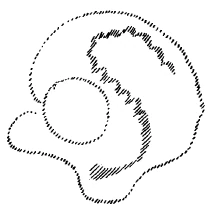
[ 35 ] If one confines oneself to this field, what is contained within it may certainly be true, but these are truths that are precisely useful, convenient, and appropriate for bourgeois circles, whereas outside of it (see illustration) there are many other things that one can also know, but which are simply ignored by the bourgeoisie. So what matters is not that the chemical and mathematical truths are true, but that, in addition to these truths, there are others that shed the proper light on them, thereby revealing an entirely different nuance and placing science on a broader scientific horizon—one that simply cannot be bourgeois. It is not whether things are true or not, but what one wants to gain from the truth—that is what matters. And this even affects the very nature of truth itself. Certainly, chemistry professors at universities will not be able to make any great leaps, because in the laboratory, the chemistry professor is the one who knows the facts, who knows that he himself thinks the least: there, the methods and so on do the thinking; they won’t be able to make any great leaps. But as soon as that same way of thinking crosses over into history, into literary history, into that which sets people apart from economic life in the first place and brings them into a sphere worthy of human dignity, that’s when things really take off. And history, as it stands, is nothing more than a bourgeois fable convenue; the same goes for philosophy and other sciences. People simply don’t suspect this; they accept it as objective science.
[ 36 ] A healthy way of life can only take root if scientific activity is returned to self-governance—in short, if that threefold structure I have spoken of so often is put into practice.
[ 37 ] I need to make one small correction. I said the other day, when I mentioned that the German committee had been formed in Stuttgart in response to our appeal, that Dr. Boos, Molt, and Kühn make up this committee; it was brought to my attention that Dr. Unger, our friend, is also playing a significant role in Stuttgart, and that this must not be forgotten.
[ 38 ] Well, my dear friends, today I have once again tried to shed light on these matters for you from the perspective of contemporary history. It is truly very close to my heart that our friends, particularly from the standpoint of the spiritual sciences, strive to delve ever deeper and deeper into the social problem. You have the foundation to understand this, and understanding is what matters most at first. Anyone who looks at contemporary history—as I have already emphasized—does not expect that such a call, and everything that follows from it, will lead to success overnight. The lectures given in Zurich—expanded and supplemented with specific individual questions—will soon be published as a book, so that what is contained in the appeal in a few concise sentences will be presented in full detail. — What is to come is that the movements that are currently engaging in exploitative practices must first truly drive themselves to absurdity, must first develop to the point of complete helplessness and misfortune. But we must create something at the right time that can then be drawn upon once the old order has reduced itself to absurdity. That is why it is so infinitely necessary that the impulses once planted in your hearts not be abandoned again, but that you, for your part—each of you, wherever you can—contribute to what must happen.