

The Social Question as a
Question of Consciousness
GA 191
5 October 1919, Dornach
Translated by Steiner Online Library
Third Lecture
[ 1 ] I have been speaking these past few days about how humanity can progress from its present Earth consciousness to a world consciousness, just as it progressed from ancient Greece and Rome to the Middle Ages and the end of the Middle Ages, through the transformation of its national consciousness into an Earth consciousness. We do not approach these things abstractly, but rather we try to truly penetrate them so that they become concrete elements of our consciousness.
[ 2 ] In connection with this idea of the expansion of consciousness, I told you that during the first three epochs of life, human beings are under the influence of forces that we can actually describe as subsensible forces. From birth until the age of seven, human beings are connected to forces of the Earth itself. The formative forces at work in the human organism are essentially those anchored in the Earth itself, within the very core of the Earth. And what then acts to organize the human being—permeating the human being from the seventh to the fourteenth year of life—are the forces of the air realm, which then, specifically through the medium of breathing, flow through and permeate the human being, and through which the human being lives out the forms and structures laid down during the first seven years of life. Then begins the period in which the human being—without this fact rising to consciousness—is exposed to the forces that act upon him from the planetary system indirectly through the Earth.
[ 3 ] Human beings are thus indeed organized in such a way that the forces organizing them are not merely those they carry within their bodies or within the limits of their bodies, but are forces that draw their influence from the Earth and, later, from the entire planetary system. And through such considerations, we must gradually come to realize that human beings form a unity with the entire Earth.
[ 4 ] In the past, I have often used a comparison to characterize this consciousness from a different perspective. I have said: A human finger is a human finger only as long as it is connected to the human body. The moment we cut it off, it withers. — Just as the finger, I have often said, relates to our body, so does the human being relate to the entire Earth—indeed, to our entire planetary system. If you were to remove the human being from the Earth and from the entire planetary system, he would wither away; he would die just as the finger does when it is removed from the human body. The point is that in human life we gradually progress from perceiving the part to perceiving a greater whole. Human beings, as they can view themselves, are truly partial beings, insofar as they are physical organisms and also insofar as they are etheric bodies. They are regarded as organisms only when they are in connection with the Earth and even with the entire planetary system. But when one takes this fully to heart, one realizes that one belongs more to the world than to the Earth alone, for the Earth derives its forces from the universe, and while we are initially dependent only on the Earth, we gradually transition to dependence on the universe.
[ 5 ] But we can explore these things in greater depth. Among the celestial bodies that surround the Earth as part of the planetary system, the most prominent, as you know, are the Sun and the Moon. And as we gradually grow, beginning at the age of fourteen—that is, during the third stage of human life—into a state in which we become dependent on the planetary system, we do indeed become dependent on the other members of the planetary system—Mercury, Mars, and so on—but we become primarily dependent on the Sun and the Moon. However, one can only properly assess human dependence on the Sun and the Moon if one knows more than just what the Sun and the Moon appear to be based on external observation. External observation shows humanity the Moon—the full moon, the new moon, the first and last quarters—as a disk, which they assume is dark in itself, illuminated by the Sun, and thus turns a part of its being toward them in the form of light. But that does not exhaust the essence of the Moon. One can truly come to recognize what exists in the universe only by always viewing it as a sum of forces, a interplay of forces. And one must ask: What kind of forces are actually concentrated in the Moon? — The Moon primarily concentrates human forces of will—or rather, forces related to human forces of will—forces related to everything that acts upon human beings from the sub-sensory realm. Thus, the forces radiating from the Moon are those related to the sub-sensory aspect of the human being. The physicist explains very nicely that the Moon is a kind of slag, that the Sun is something like a glowing, burning celestial body that has a corona and sends out the rays of its fire into the world; so that a person might imagine that if they could wander there—slowly or quickly—and approach the Sun, they would enter a body of intense heat. I have told you many times before that this is not the case; rather, the truth is that where the Sun is, there is a void, a nothingness, and that light radiates only from the Sun’s surface. In truth, there is nothing there where one might expect to find something physical; for the solar being is entirely supersensible, just as the lunar being is subsensible. These supersensible and subsensible aspects of the planetary system, as they are concentrated in the Sun and the Moon, thus begin to influence the human constitution from about the age of fourteen. First, they influence the human constitution insofar as the lunar aspect is more closely related to the feminine element—to all that is feminine in the world—while the solar aspect is more closely related to the masculine in the world. But they also act in such a way that in everything a person develops through knowledge—in everything they develop through thinking—they possess a solar quality, and in everything they “feel,” in all impulses of the will, they possess a lunar quality. The sun and the moon are not only out there in cosmic space; the sun and the moon are within us. And to the extent that we think, we are solar beings; to the extent that we will, we are lunar beings. To put it better: To the extent that we develop within ourselves organs that mediate thought, the solar forces—the supersensible—work toward the development of these organs from the age of fourteen onward; to the extent that we develop organs that mediate volition, the lunar forces—the subsensible—work within us from the age of fourteen onward.
[ 6 ] Thus, when we transform such an insight into a living being, we can feel within ourselves: You, human being, are such that within you lives not only what is here on Earth, but also what constitutes the sun and the moon. The sun and the moon are within you. You are a citizen of the world. You would not be what you are as a human being if the universe were not at work within you.
[ 7 ] Knowing such things in the abstract is of little value; but to feel within oneself that one is such a being in whom the sun and moon are at work—that gives inner life. To feel everything one can conceive of supersensually and will sub-sensually—that comes from the sun and moon; it allows a person to say to themselves: “I may walk upon the earth, but with every step I take upon the earth, it is not only that which sprouts and grows on the earth, and that which rejoices and suffers on the earth, that lives within me; but with every step I take upon the earth, the sun and the moon live within me. I am not merely a citizen of the earth; I am a citizen of the world.” — When this surges and pulsates as living life within a person, a certain power descends upon their thinking—a power they would not possess without this awareness. People should learn to feel—especially in the present moment, as they walk upon the earth—that the entire universe lives within them. This should become a feeling, a sensation. As it were, when a person looks up at the sun, they should say to themselves: I, too, am of your essence, O Sun! — And when they look up at the moon, they should say: I, too, am of your essence, O Moon!
[ 8 ] When a person carries this within themselves as a sensation, as a feeling, only then do they become mature enough to grasp social ideas. Otherwise, their thinking is weighed down by a certain earthly heaviness. Certainly, one can grasp certain ideas in the abstract, but one cannot bring them to life internally in concrete terms. The social realm is something in which a person acts as a human being. Natural science comprehends only that in which the human being is not involved. Social forces and social activities can never be understood according to the model of scientific concepts. Social activity can only be understood with that lightness of thought which arises from a feeling that allows us to experience ourselves as citizens of the world. It is simply the case that such a consciousness of being a citizen of the world must spring from a kinship with the sun and the moon. Only when a person no longer feels that he is, so to speak, dependent on the Earth—when he feels as though he were a temporary inhabitant of the Earth who brings the forces of the sun and moon into this earthly existence—only then does his thinking become so powerful and at the same time so light that he can truly grasp social concepts as they live in social existence. For you see, quite a few economists believe they can grasp social concepts using the same conventional mode of thought modeled on the natural sciences. Today, in works on economics, you can read many concepts and interpretations regarding the concept of a commodity, the concept of labor—I have already made some remarks on this—and the concept of capital. But all these concepts are, in fact, generally of no use. They do not capture what truly lives in social life. If you want to try to create a concept of what circulates as a commodity in economic life, and you create this concept in the same way you would create the concept of a crystal, a plant, an animal, or even a physical human being, nothing will come of it. You cannot grasp the concept of a commodity according to the model of scientific thought. If you want to capture it in living reality, as it exists within social life, then you fundamentally need imagination; for there is something inherent in a commodity that is inseparable from human beings. Every commodity is imbued with something human, whether the commodity consists of a sewn skirt or a painting—for in economic terms, a painting is also merely a commodity—or whether it consists of a class period. Even a lesson is, from an economic standpoint, merely a commodity. But what defines the concept of a commodity is linked to human labor. And it is not ordinary, fully conscious life that goes into the commodity, but rather, in many cases, something of the subconscious life. Therefore, you need imagination to grasp the concept of a commodity correctly. And you need inspiration to grasp the concept of labor, and you need intuition to grasp the concept of capital. For the concept of capital is a very spiritual concept—only a concept that is spiritual in reverse. That is why the Bible quite correctly refers to what is associated with capitalism as Mammon—as something related to the spiritual; only it is not exactly the very best kind of spirit that is involved. But one ascends to the highest realms of spiritual understanding when one seeks to grasp what capital actually does in economic life.
[ 9 ] Here we encounter something quite curious—we are confronted with a necessity: In order to grasp correct economic concepts, one must have an idea of supersensible knowledge. That is why all economic concepts put forward today are so amateurish—because people lack supersensible insights and therefore misunderstand these concepts.
[ 10 ] Well, don’t get me wrong. If you read my “Key Points of the Social Question,” you’ll say: That’s not exactly imagination you’re offering when you talk about commodities; it’s not inspiration you’re offering when you talk about labor, and it’s not intuition you’re offering when you talk about capital.”—Certainly not. You don’t need to ascend to the higher worlds to see commodities, labor, and capital, although it is also very interesting to see the reflections of commodities, labor, and capital in the higher worlds. But one need not ascend. One need only be familiar with what imagination, inspiration, and intuition are in order to speak correctly about capital. That is what this is all about. Anyone who is not familiar with imagination, inspiration, and intuition simply does not speak correctly about commodities, labor, and capital. This is how spiritual science and contemporary social science are intrinsically connected, and there is no other path for people today than to ascend from earthly consciousness to world consciousness, so that they may attain the lightness and also the power of thought that enables them to grasp social life. As long as human beings merely crawl along on the earth and, deep down, believe they are nothing more than what they absorb from plants, animals, and minerals—merely arranged a little differently within them—they will not recognize themselves as the true beings they are. Only when a person says to himself, “The sun and moon are at work within me”—only then does he recognize himself as the true being that he is. World consciousness must be attained in a spiritual way; in a spiritual way, a person must recognize how he belongs to a part of the world greater than the Earth itself.
[ 11 ] The point is to truly grasp how one must move beyond ordinary, everyday concepts in order to arrive at the kind of thinking referred to here. As you know, there are materialist thinkers in the world. Today, the number of materialist thinkers is very large, and all of you are probably, in your innermost being, convinced that one should not be a materialist thinker. At least you were convinced to a certain degree and have therefore come to a more spiritual way of thinking; you have felt drawn to the spiritual thinking cultivated in this anthroposophical movement. So let us set ourselves aside for the moment. But there are also other people who represent the spirit, and numerous such people in the world who say: “Well, there are all these people running around who regard everything as merely material processes and material entities.” Opposite these materialistically thinking and feeling people stand the spiritually thinking and feeling people. — The latter believe in the spirit and are often despised as dreamers by the materialists. They accept this contempt, however, because they believe that the materialists fail to realize how right they—the dreamers—are when they hold fast to the spiritual. People make this distinction and observe this difference in the world between materialistic thinking and spiritual thinking, and they argue a great deal among themselves about who is right—the materialist or the spiritualist. From much of what has been discussed here, you should recognize that, fundamentally, those who argue about such things have not yet truly grasped the essence of spiritual science; rather, only those who say, “You are a materialist; that’s fine, that works just fine. You are a spiritualist; that’s fine too, that works very well as well,” have truly grasped the essence of spiritual science. — Just as one can photograph a tree from one side and photograph it from the other: it looks different from the various sides, but it is always the same tree. When one perceives the world materially, that is merely a photograph from one side. When one perceives the world spiritually, that is a photograph from another side. Materialism looks quite different from spiritualism. But the secret lies in the fact that the world is found neither in materialism nor in spiritualism; rather, these are actually just two photographs taken from different vantage points. Basically, the materialist is just as right as the spiritualist, and the spiritualist just as right as the materialist. For these concepts—spirituality and materiality—are valid only on the physical plane. As soon as one goes beyond the physical plane, these concepts are transcended. There, one no longer argues about whether the world is material or spiritual, because one knows that these are two different aspects. But why, in fact, do people argue about whether human beings are material or spiritual? Why do people argue about whether a person is merely a physical being or merely a spiritual being? Why do some people see in human beings merely—I would say—physical corporeality, while others see, in addition to physical corporeality, a soul-spiritual aspect as well? Because human beings are both! And the mystery of life actually lies in the fact that human beings are both. If you say, “A thought is merely a spiritual entity; it is merely something spiritual”—then you are right, for a thought is merely something spiritual. But a thought is never present within you as a spiritual-soul aspect without also having a physical imprint, so that you can actually always detect that physical imprint as well; it is there. Thus, every thought is also something material. One might say: The universe has impartially ensured that one can be both a spiritualist and a materialist. For one is, in fact, spiritual and soulful; if one grasps this, one can be a spiritualist. But one is also, without a doubt, a material imprint of the spiritual and soulful; if one grasps this and loses sight of the other, one can be a materialist, because human beings are both, and because one is merely an imprint of the other, because one is equal to the other. Therefore, it really comes down to whether a person identifies more with their physical being—in which case they become a materialist—or whether they identify more with their soul-spiritual being—in which case they become a spiritualist.
[ 12 ] One cannot really escape what is presented here as long as one remains within the concepts of ordinary everyday life or even within the concepts of conventional science. One can come up with all sorts of theories. There are all kinds of theories about the relationship between the soul and the body, about their interdependence or parallelism, and so on! But these are all contrived notions; they are not rooted in reality. For people have forgotten—as I have often emphasized—how to conceive of these things correctly, because, as I have said, they were forbidden to do so in the course of historical development. In the year 869, the Eighth Ecumenical Council was held in Constantinople, and that council abolished the concept of the spirit; it established the dogma that human beings do not consist—as Gnostic science had previously held—of body, soul, and spirit, but rather the Eighth Ecumenical Council determined that human beings consist only of body and soul, and that the soul possesses certain spiritual qualities, which is why the medieval scholastics were terribly reluctant to speak of the so-called trichotomy—of body, soul, and spirit—for that was forbidden. Today’s philosophy professors, however, have no such reluctance, for they have outgrown it; yet they have not yet overcome the Roman edict. They, too, speak only of body and soul—of a duality—and believe they are imparting unbiased, unprejudiced science, whereas in reality they are merely teaching Roman Catholic dogma as defined by the Eighth Ecumenical Council of Constantinople. They believe this follows from their unbiased research, but they say this only because they are mired in history.
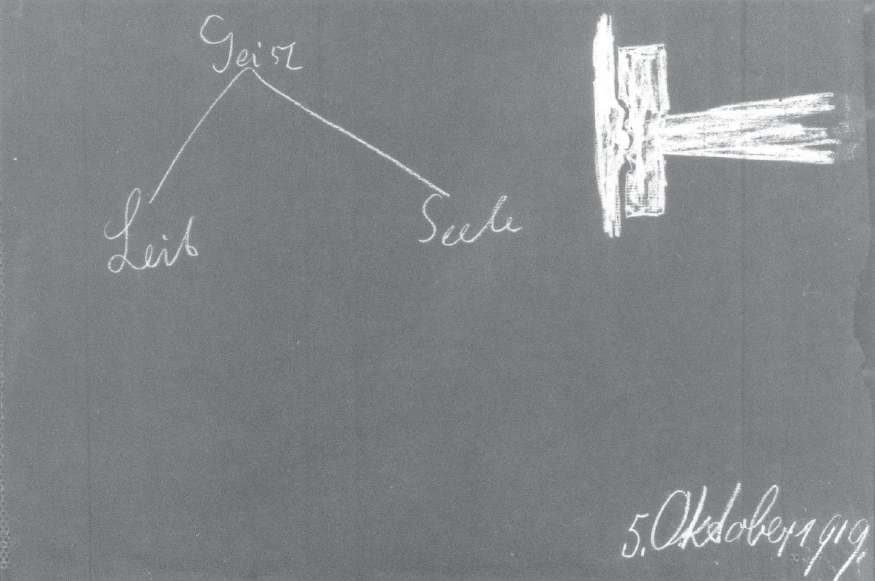
[ 13 ] Today, our task is to return once again to the recognition of body, soul, and spirit. For when we observe the external world and our human constitution—insofar as it is perceived in the same way as the external world—we perceive something physical. When we then look within ourselves—whether we observe our thinking, willing, and feeling through an external, superficial self-knowledge, or whether we descend mystically into the depths—we experience the soul: physical on the outside, soul on the inside. But the connection, the interpenetration of the two—the constant interpenetration of the spiritual-soul and the physical-bodily—is brought about by the third—we don’t even have a proper word for it; we have to borrow the word from one side—it is brought about by the spirit. So that we can say: Body and soul are two different aspects, but the connection is formed by the spirit. We must return once again to the healthy conception of body, soul, and spirit; otherwise, body and soul will always fall apart for us. One cannot find anything physical in the soul, nor anything soulful in the body, as long as one does not have the spirit within them, at their center.
[ 14 ] Many years ago, to make this clear to you, I used an analogy. Suppose there is a seal here, and engraved on it—let’s say, to make it a rather “rare” one—is the name Müller. And now I take some sealing wax, say for a letter, and I can press the name Müller into the sealing wax.
[ 15 ] Now the Kantians and the physiologists might come along and say: There is no relationship between the seal, which may be made of bronze, and that which is made of sealing wax. — Certainly, one is entirely bronze, the other is entirely sealing wax. Nothing ever passes from the bronze into the sealing wax, and nothing ever passes from the sealing wax into the bronze. The two are entirely distinct. So it is with the body and the soul. One leaves an impression on the other, but nothing passes from one into the other; each has its own substance, and nothing—absolutely nothing—passes from one into the other. And yet, once you have made the impression, you will see “Müller” written in the sealing wax and “Müller” on the seal itself—one and the same. But the transfer did not occur because some very fine substance seeped or dripped from the seal into the sealing wax; that did not happen; rather, something happened that is neither sealing wax nor bronze, but which is the same in both. And the fact that it is precisely “Müller” has truly nothing to do with the bronze or with anything contained within the bronze, but it lies in the living. The fact that someone has been given the name Müller has to do with life; it points to the full breadth of life. Thus we have the spiritual-soul aspect, and thus we have the physical aspect. The spiritual-soul aspect is imprinted in the physical. But that which is the same in both—the spirit—is a whole, vast world. Yet we do not grasp the spirit if we merely look at the soul aspect, any more than we come to recognize the miller if we look only at the seal. Nor do we grasp the spirit if we look only into the material world, any more than we can recognize the miller by looking at the seal.
[ 16 ] The point is that the spirit conveys to us what constitutes the relationship between the soul and the body. And in our time, we are living in a phase of human development in which we must gain a clear understanding of precisely this fact.
[ 17 ] If you look at modern natural science, you will find that it conveys all sorts of physical, indeed purely physical, aspects to you. If you take certain psychological concepts from earlier times, they convey psychological aspects to you. We can only come to terms with both if we rise to the spiritual level, for only through a spiritual understanding of our nature do we become citizens of the world—in contrast to the citizens of the earth that we have been up until the present day. As you can see from this, we must not merely grasp what is physical in the human being—as we can grasp external physicality—but we must view the human being in broader contexts. I will describe such a case to you so that it may serve as an example.
[ 18 ] Conventional natural science views human beings only up to the moment of their death. Then it observes what remains—what is left here on Earth, the body—and follows it as it is cremated or returned to the earth, turning to dust. Now you could examine what components are in this human dust that remains after a human organism has passed away. Then natural science will say: There, the human substance decays and is returned to the earth. — Yes, that is not even a quarter, not even an eighth of the truth; it is no truth at all when you put it that way. For what is returned to the earth—whether through cremation or burial—once had a human form; it had a human form precisely because, before birth or rather before conception, a spiritual-soul being descended from the spiritual worlds and worked within this physical body until death. Then this physical body is imparted to the Earth. What is human in form continues to work within the Earth, regardless of whether it was cremated or buried; it contributes to the Earth. The Earth continually receives what it would not have if human bodies were not bestowed upon it after people’s deaths. It is beneficial for the Earth that human bodies are bestowed upon it after death. Otherwise, the Earth would have only earthly substances if human bodies were not bestowed upon it.
[ 19 ] But this human body is inhabited by a soul-spiritual being that descended from the soul-spiritual worlds before birth—or rather, before conception—and imparted its structure to this human body. This structure remains as an essential element in every speck of dust; it passes into the earth or into the atmosphere upon burning—regardless of how—and the earth receives, through this human body, that which has descended from the spiritual worlds. This is not without significance. This is not merely an ordinary truth; rather, it has a very, very great significance. For our Earth is no longer evolving, and it would have long since reached a point where no human—and perhaps no animals either, though animals might still be able to—could inhabit it today if it were not continually receiving revitalizing forces of a spiritual-soul nature through human bodies. The fact that the Earth is still a place habitable for human beings today is due to the fact that human bodies are continually bestowed upon it. These bodies constantly renew the Earth’s forces. Since the middle of the Atlantean epoch, the Earth has already been withering away. It no longer possesses any ascending forces; it had these in the ancient Polar, Lemurian, and subsequent epochs. But since the middle of the Atlantean epoch, the Earth has possessed only withering forces of its own and is sustained for its continued existence solely through the imparting of the formative forces of human bodies. These forces continue to work within the Earth. They alone make the Earth habitable for human beings.
[ 20 ] From this you can see that, on the one hand—as I have told you—human beings have within them the inner forces of the planet, the forces of the atmosphere. But in turn, they give spiritual-soul forces back to the Earth; they also supply the Earth with spiritual-soul forces. By being born, human beings bring spiritual-soul forces from the spiritual universe into the Earth; they draw upon these forces for as long as they need them—until their death—and then hand them over to the Earth in the form of formative forces, thus becoming co-builders of the future Earth. If asked what human beings mean for the Earth, the external, scientific worldview would say something like this: Well, if human beings had never come into being on Earth, everything would still have turned out as it is; human beings simply would not be here. Houses, of course, would not be here either. Cities would not be here, and so on—in other words, the things that human beings bring forth through their culture would not be here; but otherwise, everything would be here, only human beings would not be here. — Spiritual science teaches us that human beings are not merely spectators here on Earth, but that through their very existence they are co-builders and co-creators of the Earth, and that through the body they surrender to the Earth, they become mediators between the spiritual world and this physical earthly world.
[ 21 ] This, too, is part of the process of gradually coming to realize that one is not merely a citizen of the Earth, but a citizen of the universe. The citizen of the Earth, born of a mother and father, carries within himself hereditary traits, acquires certain things that he leaves as an inheritance to his physical heirs, has children, and so on. The person who knows himself to be a citizen of the world says to himself: By entering into existence through birth, I bring into this world something soul-spiritual. In this way, I help to build the future existence of the Earth, even after I have departed from this Earth through death. — By being a citizen of the world, a person becomes all the more aware of how their existence is connected to earthly existence, how they are one with the Earth—but a being who, in essence, is what gives the Earth its spirituality.
[ 22 ] All these concepts that one acquires through the humanities should not be treated as ordinary knowledge. I would like to say—though this may sound a bit paradoxical—that knowledge is not particularly valuable at all. What is truly valuable is what we become through that knowledge. This also applies to education. Teaching a child geography has, outwardly, a certain significance, but not really a spiritual one. Outwardly, it means that later, if the child wants to travel from Dornach to Zurich, for example, they won’t confuse Zurich with Bern or anything like that. Outwardly, then, learning geography has a certain significance. But what has inner significance is what the soul becomes as it learns geography. One becomes, in one’s soul, capable of orienting oneself in the world. One releases certain spiritual forces from the depths, from the roots of the soul, and it is the release of these spiritual forces that matters.
[ 23 ] If we consider the period since the mid-15th century, this is the time when people were least inclined to unleash their spiritual and soul forces within themselves. They clung more to the imprint, to the sealing wax. People have indeed entered the material age since the mid-15th century. But now we have reached the point at which we must become aware of this and at which we must return to the spiritual and connect the spiritual with the material.
[ 24 ] Why did all this actually happen? Superficial thinkers might say: Yes, God could have made things easier for Himself. He could simply have given people spiritual life right back in the 15th century; then they wouldn’t have had to go through the whole detour of materialistic struggle. — Perhaps He could have. It is an insult to the Protestant consciousness to say that He could not have done so. But that is something that concerns us less here. Yet He did not do it; instead, He allowed people to struggle their way through materialism. And so, by the 19th century, they had reached the nadir of materialism. If they were now to force their way toward spirituality, they would need a powerful inner jolt; this powerful inner jolt is the liberator of freedom—it is what enables human beings to turn toward spirituality of their own accord, not through divine indoctrination. Had human beings not become immersed in the material, they would not be able to force their way toward the spiritual out of their own free will. In order to call humanity on Earth to independence, this struggle—this struggle through the material world—was so intense that even religions and theology have become materialistic. You see, even today’s theologians find it difficult to grasp anything spiritual—sometimes extremely difficult, truly the most difficult thing of all. I recently had the opportunity to test this by discussing something with a Catholic theologian, and it so happened that I had this discussion with him beneath the famous Raphael painting, the so-called “Disputa.” The conversation led me to try to illustrate a point using the “Disputa” as an example. I said: We must once again come to understand—all of us who wish to strive for the spiritual life—why Raphael actually painted this “Disputa” out of his sense of the times. Up above are the heavenly realms with the Trinity; below, the Most Holy Sacrament on the altar and the Church Fathers and theologians. But all of that is not the essential point of the painting; rather, the essential point is that a theologian—who was not a frivolous person (though there were certainly many of those at the time)—who was still serious about his theology and from whose soul Raphael painted, had this awareness: When the Host, the Most Holy Sacrament, is consecrated and one looks through it, one gazes upon the world that Raphael painted in the upper part of the “Disputa.” — It is truly the consecrated Host that serves as the means to see through it and into the spiritual world. That is why Raphael painted this scene. That is what I wanted to illustrate. I wanted to say: We must once again find our way back to understanding such a painting—which was painted from a different state of consciousness—with its true meaning. — I cannot at this very moment paint a picture for you of the expression on this theologian’s face when he was expected to view his Most Holy in such a spiritual sense. Theology, too, has become thoroughly materialized—theology, perhaps, more than anything else. It no longer connects to what is truly spiritual; hence, Christology itself has become materialistic. For the theologian of the fifteenth century, turning one’s primary attention to the “simple man from Nazareth” would still have been an impossibility. In their minds, the indwelling of Christ in Jesus of Nazareth was still alive. It has vanished from consciousness. The simple man from Nazareth is merely a person of somewhat higher stature than Socrates, Plato, or Aristotle. Yet even theologians define and regard him as the simple man from Nazareth. Theology itself has become materialized.
[ 25 ] We need to make the leap from the innermost grasp of our own humanity—even in freedom—to the spiritual. We cannot do this by spinning spiritual platitudes or by talking about the spirit; we can only do it by thinking spiritually. And it is spiritual thinking when we say: Knowledge is connected with the forces of the Sun, and will with the forces of the Moon. As human bodies are formed here on Earth through the currents of heredity, it is not an earthly force at work—a solar force is at work in the male principle, and a lunar force is at work in the female principle. The Earth is permeated and covered by solar-lunar forces even in human procreation, and this human procreation is in turn related to the forces of knowledge and will. The spiritual permeates the physical; the physical expresses itself spiritually. The synthesis—the unification of the soul and the body—is precisely what must be sought today, what must be sought at all costs. This does not include those shadow concepts that modern times have developed since the mid-15th century—for they are, after all, merely thoughts that modern times have developed since the 15th century—nor does it include concepts conceived internally; rather, it includes a spiritual life experienced from within. But a spiritual life that is experienced is only that which can also have a practical effect at the same time. We have had a spiritual life that is, at its core, impractical for long enough. As I have already told you, people have, over long periods of time, spoken at length about how to be good, how to be brotherly, and how to practice love for one’s neighbor. But these were concepts that remained within a certain sphere and lacked the momentum to penetrate practical life. Just think about it: a typical modern businessman, a typical modern industrialist, or, let’s say, a government official—so we have all three types—he may even be a devout man; after all, that does happen. But there is, after all, a considerable difference between what a businessman may experience inwardly in his soul as his religious conviction, and the way he conducts his life, which finds its expression in his ledgers! What lives in his religious life has no momentum to penetrate into the ledgers. And the government official—he is trained not to be a human being, but precisely to be an official. What he has learned as a civil servant—what does that have to do with what he may inwardly profess as his religious belief? — Religious life is one current; so-called “practical life” is the second current. Because concepts and ideas have grown weak and cannot penetrate into practical life, we cannot find such vivid, such powerful concepts today that lead into social life. This requires revitalization through spiritual science, so that the concepts become strong enough—so that they do not merely penetrate as far as the sermons of a Sunday afternoon preacher, which evoke warm feelings in the heart and stir inner spiritual delight, but which do not penetrate into the activity that finds its expression in the checkbook. The concepts drawn from the most spiritual realm must penetrate deeper into practical life. For concepts are not spiritual unless they penetrate, through their inner power, down into the deepest essence of matter. This is precisely the spirituality of concepts: that they are strong and penetrate down into the deepest essence of matter.
[ 26 ] This is what we need if we are to bridge the gap that has arisen between today’s humanity—which still possesses all manner of legacies from earlier times—and the humanity of the future, which must truly achieve the synthesis, the unification, between the material and the spiritual. It is certainly a regression to earlier ways of human perception to be a materialist on the one hand and a spiritualist on the other. And only when one can be both—so that the two intertwine—can one truly meet the demands of humanity today.