

The Social Question as a
Question of Consciousness
GA 191
4 October 1919, Dornach
Translated by Steiner Online Library
Second Lecture
[ 1 ] In this middle of the three lectures, I would like to explore some anthroposophical truths in particular. We will then see how these very anthroposophical truths have a profound impact on people’s everyday lives; we will discuss that tomorrow. Today, I would simply like to draw your attention to some deeper aspects of the human being.
[ 2 ] Very often, the question is not asked as to which powers of human nature enable us to gain knowledge of the supersensible worlds. People simply try to answer the question by saying: It is possible to perceive the supersensible through certain powers of human nature. But the nature of the relationship—the specific relationship—between these powers and human nature is not always examined. Consequently, little attention is paid to making the insights into the supersensible worlds truly fruitful for everyday life. One can say: Especially in our age, knowledge of the supersensible will become increasingly necessary for people. But then it must also be understood in relation to ordinary, everyday life.
[ 3 ] You know, the first faculty that leads a person up into the supersensible realm is the power of imagination; the second is the power of inspiration; and the third is the power of intuition. Now the question arises: Are these faculties that one need only take into account when speaking of the knowledge of the supersensible worlds, or are they faculties that also play a role in other aspects of human life? — The latter, you see, is the case. As you can see from the short treatise *The Education of the Child from the Point of View of Spiritual Science*, we divide human life into three epochs: from birth to the loss of baby teeth, from the loss of baby teeth to sexual maturity, and from sexual maturity to about the age of twenty-one. Anyone who does not view human nature superficially will come to realize that the entire nature of human development is different in the first seven years, different in the second seven years, and different in the third seven years of childhood and adolescence. The emergence of the permanent teeth—a topic I have also discussed on several occasions—is connected not only to the unfolding of forces located, say, in the jaws or their neighboring organs, but the forces that drive the teeth forth are present throughout the entire physical human being. Something takes place within this physical human being between birth and the age of seven that reaches its conclusion—its culmination, so to speak—when the permanent teeth are pushed forth from human nature.
[ 4 ] These forces that are at work on the human physical being are—one might say, of course—of a supersensible nature. The physical is merely the material in which they work. These supersensible forces, which are active throughout the entire human organism during the first seven years of life, are, so to speak, set aside once their goal is achieved—that is, once the permanent teeth have appeared. After the seventh year, these forces, I might say, go to sleep. They are hidden within human nature; they sleep within human nature. And they can be brought forth from human nature through exercises such as those I have described in *How to Attain Knowledge of the Higher Worlds*, which lead to intuition. For the forces employed in intuition—in intuitive knowledge—are the very same forces by which one grows until the age of seven, a growth that finds its expression in the change of teeth. These dormant forces, which are active in human nature until the age of seven, are utilized in supersensible knowledge to attain intuition.
[ 5 ] The forces, in turn, that are active from the seventh to the fourteenth year, until sexual maturity, and then go to sleep—resting deep within human nature—are brought to the surface and form the power of inspiration. And those forces which in earlier times instilled youthful ideals in people from the age of fourteen to twenty-one—it would be an exaggeration to claim that they still do so today—and created organs in the physical body for these youthful ideals, are the very same forces that are then roused from their dormant state and can give rise to imagination.
[ 6 ] You can see from this that the powers of imagination, the powers of inspiration, and the powers of intuition are not arbitrary forces drawn from some unknown source, but rather the very same powers with which we grow from birth until the age of twenty-one. Therefore, the forces that live in imagination, inspiration, and intuition are very healthy forces. They are the forces that human beings need for their healthy growth, and once the corresponding phases of growth are complete, they lie dormant within human nature.
[ 7 ] I have thus drawn your attention to the aspects of the supersensible powers of cognition that relate to ordinary human nature. But the same can be said of the powers of normal human nature—that is, the human nature that exists in ordinary life. It is just not as pronounced there. A very important faculty for ordinary life—as we have often discussed—is the power of memory, the ability to recall. We exercise this ability to recall in our souls when we remember something we have experienced, just as we say. But you all know: there is something peculiar about this power of memory. We control it, and yet we do not control it entirely. Many a person struggles at one moment or another in their life with the fact that they want to remember something, but cannot. This desire to remember and this inability to remember fully stem from the fact that the very same force we use psychically as the power of memory also serves to transform the nutrients we have ingested into substances that our body can utilize. So when you eat a piece of bread and this bread is transformed in your body into a substance that serves your life, this appears to be a physical process. But this physical process is governed by supersensible forces. These supersensible forces are the same ones you use when you remember. So the same kind of force is used, on the one hand, for memory, and on the other hand, for the processing of nutrients in human life. And you actually always have to oscillate a little back and forth between your soul and your body if you want to engage your power of memory. If your body digests too well, then, you see, you may not be able to draw enough energy from that body to remember certain things clearly. You must always wage an inner struggle—one that takes place in the unconscious between the soul and the body—if you want to remember anything. When you look at the power of memory in this way, you have the best way to understand how nonsensical it is, from a higher point of view, for some people to be idealists and others to be materialists. The processing of nutrients in the human body is undoubtedly a material process. The forces that govern it are the same ones that are at work in an ideal process: the forces of memory, the powers of recollection. One sees the world correctly only when one views it neither materialistically nor idealistically, but rather when one is able to perceive that which appears materialistic in an ideal sense, and to trace that which appears ideal in a wholly material sense. The spiritual aspect of a worldview does not rest on saying: “Here is lower materialism, which is for the ‘outcasts’ of humanity; here is idealism, which is for the elect”—among whom the person uttering these words usually counts himself— but the essence of a truly spiritual worldview lies in its ability to immerse itself, with what it grasps in the spiritual realm, into material existence—precisely in order to comprehend that material existence, so that it may be understood rather than despised. This is the great error of many religious creeds: that they despise material existence instead of understanding it, instead of seeking the spirit within it.
[ 8 ] The point, then, is to engage with things—not, as is still so often the case today, to dwell in mystical realms of empty phrases; to truly engage with things—that is what matters. Now that I have, so to speak, shown you how one might engage with these things, I would like to mention something particularly important. When people speak of material existence and supersensible existence, they usually speak as if material existence were spread out in the world, and then somewhere behind or above it were the supersensible existence, which cannot be perceived by the senses. If one conceives of the matter in this way—simply having, on the one hand, sensory-physical existence and, on the other, supersensory existence—one will never understand human beings. There is no way to truly grasp human beings if one proceeds solely from the opposition between the sensory and the supersensory. Rather, the situation is as follows. All around us lies the sensory world and the world in which we work—the world in which our social life also takes place; these extend all around us. Let us represent this expansive world schematically with this line (see drawing: horizontal line). You can only obtain a complete picture of what actually exists in the world if you imagine that above this line there are forces—super-sensory forces (red arrows). These super-sensory forces cannot be perceived by the ordinary senses, nor by the intellect, which is bound to the ordinary senses. One perceives only that which lies within the realm of this line.
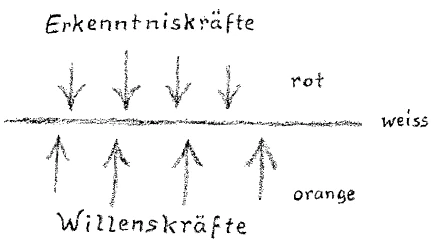
[ 9 ] But there are also forces below this line. We can only truly speak of the non-sensory, of the spiritual, when we speak of supersensory and subsensory forces. So we must imagine that the subsensory forces lie here as well (orange arrows).
[ 10 ] So, we have the sensory world, the supersensory powers, and the subsensory powers. The human being himself—when he stands physically before you—where does he belong? That which stands physically before you belongs entirely within this line. But within what falls into this line in the human being, supersensible forces act on the one hand and subsensible forces on the other. The human being is the resultant of supersensible and subsensible forces. Which forces of human nature are supersensible, and which are subsensible? All forces connected with cognition are supersensible; everything we bring to bear for the sake of cognition is supersensible. And these are the very same forces that also shape our head. So we can say: The supersensible forces are the forces of cognition.
[ 11 ] Now, the sub-sensory forces also act within human beings. What, then, are these forces? They are the forces of the will. All forces of the will, everything of a volitional nature in human nature, is sub-sensory.
[ 12 ] Now, you will naturally ask: Yes, where do these sub-sensory forces, these forces of the will, come from? — They are the same forces as the forces of the planet—in our case, the forces of the Earth. In fact, the forces of the Earth are constantly at work within us as human beings. And what is connected with these planetary forces—with these forces of the Earth—are the forces of a volitional nature. The forces of a cognitive nature, on the other hand, come to us from the periphery of the world; they pour down upon us, as it were, from outside, from beyond the planet. The forces of a volitional nature penetrate us from the planet itself. Thus, the forces of our own Earth live within us. From the moment we enter existence at birth, the forces of the Earth are at work within us.
[ 13 ] The question arises: How are they distributed within us? Here, too, there is a considerable difference between the first stage of life, the first epoch of life, and the second and third, up to the age of seven, up to the age of fourteen, and up to the age of twenty-one. That which acts within us in a volitional manner up to the age of seven acts entirely from the very core of the planet. It is very interesting, from the perspective of spiritual science, to observe how the forces of the Earth’s innermost core are at work in everything that is active within the child up to the age of seven. If you wish to come to know the forces of the Earth’s interior as they manifest, then study everything that takes place within the child up to the age of seven, for these are the forces of the Earth’s interior. It is an entirely wrong method to dig into the Earth in order to find the forces of the Earth’s interior. There you will find only the substances of the Earth. The forces at work within the Earth reveal themselves in what they accomplish in the human being up to the age of seven. And again, from the age of seven to fourteen, the forces of the air realm are at work in the human being—that is, the forces of the atmosphere, which also belong to the Earth. But these are primarily active in everything that develops within a human being between the ages of seven and fourteen. Then the most important period is from the age of fourteen to twenty-one. There, I would say, the sub-sensory transitions into the supersensory. A kind of balance forms between the sub-sensory and the supersensory. There, the forces of the entire solar system—the solar system belonging to the Earth—act in an organizing way upon the human being.
[ 14 ] Thus, the Earth’s interior during the first epoch of life; the atmospheric sphere during the second epoch of life—that which envelops the Earth itself. The forces that flow down from outer space, insofar as this outer space is filled by our own planetary system: up to the age of twenty-one. It is only at the age of twenty-one that the human being, so to speak, breaks free from the influences of what is brought about within them from the outside through the planet and the associated planetary system.
[ 15 ] You see, in everything I have just told you about how it affects human beings, there is certainly also a physical effect. These are physical processes brought about by forces from within the planet up to the age of seven. These are physical processes formed by the circulation of air in connection with breathing between the ages of seven and fourteen, and so on. These are entirely physical processes; they are transformations of the physical organs that are brought about there; everything is connected with the human being’s growth and development. The human being thus grows out of what the Earth shapes in him; this ceases at the age of twenty-one.
[ 16 ] But what then? What comes after the twenty-first year of life? Until the age of twenty-one, we have drawn sustenance from the Earth and its planetary system in the manner described. We have drawn sustenance from what the Earth has organized within us. Now, once we have reached the age of twenty-one, we must sustain ourselves from within. We must gradually draw up again what we have drawn down into our organism from the forces of the planet and the planetary system.
[ 17 ] The fact that this always happened this way in the past was due to the forces of human blood at work. As you well know, human beings have not learned to draw the forces of the planet from within themselves after the age of twenty-one. Yet they did so nonetheless. They carried it out as an unconscious process. It was in their blood. It was ingrained in them to do it that way. Our significant shift in the present—where “present,” of course, refers to a long period spanning centuries—lies in the fact that human blood is losing the power to draw out what has been incorporated into the organism in this way up to the age of twenty-one.
[ 18 ] The crucial factor underlying what is happening in humanity’s present era is that the blood’s powers are waning. These things cannot be ascertained through external anatomy or external physiology; to do so, one would have to examine bodies from the 10th, 9th centuries; only then would they realize that the blood was different back then. We wouldn’t even have the chemical reagents to arrive at that conclusion. But from the perspective of spiritual science, we can know with certainty: human blood has become weaker. And the major turning point leading to the weakening of human blood occurred in the middle of the 15th century.
[ 19 ] What is the consequence? The consequence is that what we are no longer able to accomplish unconsciously through our blood, we must now accomplish through our consciousness. We must train ourselves so that we can consciously accomplish what was once unconsciously brought about simply through human blood. For the power of the blood has been lost and is being lost more and more. And what would ultimately happen if we found no remedy, in an age in which people would completely lose their youth, in which they could not harness the powers of their youth for themselves—if what the blood once did unconsciously could not be accomplished consciously?
[ 20 ] Of course, these things must not be taken merely in a theoretical sense. If taken theoretically, they may be interesting truths. But taking them merely theoretically is not enough. These things must be taken practically today, for they are connected with the practical process of human development. In practice, they must be approached in such a way that we become aware that the entire system of human education must change. We must lead people to develop a strong, conscious power to relive in later life—as if through an elemental memory—what they have absorbed within themselves during their youth.
[ 21 ] For the time being, people everywhere are still acting contrary to this requirement. For example, people take pride in conducting what they call “visual instruction” in elementary schools—teaching children everything in a very vivid way— and they place great importance on making sure not to expose children in class to things that, as they say, exceed the child’s capacity for understanding; rather, the teacher or educator should, as far as possible, adapt to the child’s level of understanding. Yes, they set up abacuses on which all kinds of arithmetic are taught visually using counted beads. Nothing is to exceed the child’s capacity. This visual instruction becomes a dreadful triviality and banality. After all, it must ultimately lead to teaching the child only banal concepts if one is to lower oneself entirely to the child’s own level of comprehension. Anyone who strives for this completely disregards an important—though, I would say, intimate—experience of human life.
[ 22 ] Let us imagine a child being taught in such a way that he or she absorbs something, not because it is already fully within his or her capacity to understand, but because the teacher’s inspiring warmth is transmitted to the child, and the child absorbs it because the teacher conveys it through his or her enthusiasm in teaching. The child absorbs this precisely because it is immersed in the warmth radiating from the teacher. It absorbs something that goes beyond its understanding, solely through the teacher’s infectious enthusiasm; at that point, the child does not yet understand what it has absorbed, as we say in everyday life. But what it has absorbed remains in the child’s mind. The adult, at the age of thirty, recalls what the child may have absorbed at the age of ten. He experiences it anew. Now he has matured and understands what he can draw from the depths of his soul—what he once absorbed solely through enthusiasm, but which he can now draw upon from his mature mind. You see, these are the most fruitful moments of life—moments in which one does not merely grasp what comes at one from the outside, but rather what one had previously absorbed with insufficient or limited understanding; one relives it by bringing it to the surface and can only truly absorb it then, with a deeper understanding. The more one can ensure in the classroom that the child does not merely take in in a superficial way what he or she understands—for that disappears with childhood, and later in life one can develop neither joy nor enthusiasm for it—the more one contributes to the person’s later development; for what is absorbed solely out of the warmth of the teacher is what, when relived, gives vitality.
[ 23 ] This is something that should be given special attention in today’s teaching. In the past, it was not necessary to pay particular attention to this, because the upward force was inherent in the blood; now it must be brought into consciousness. It is not a matter of indifference whether one understands such things as those that are now bearing fruit through spiritual science. If one understands them correctly, one will find, at some point in practical life, the opportunity to put these things to use for the benefit of humanity. Thus, one finds the opportunity to use the fact that our blood has grown weak—if one truly understands it—in such a way that one places all the more value on the teacher’s capacity for enthusiasm.
[ 24 ] But in our time, there is little awareness that this is what it is all about. For in our time, “norm-based pedagogy”—the pedagogy that operates according to numerous norms—still plays a major role. One studies pedagogy; one learns how to teach a child, how to go about teaching. In light of our current understanding of humanity, this should actually strike us as if we were learning: Human beings consist of carbohydrates, proteins, and so on—that is what we are made of, and they are transformed in the body in such and such a way; and until we have grasped this, we cannot eat; for only when we understand this do we eat in accordance with physiology. — I once told you—and you may know this from your own experience—that one can already have this experience today: You visit someone, and lo and behold, they have a scale next to their plate and carefully place a piece of meat on it to weigh how much it weighs, because they are allowed to eat only a piece of meat of a very specific weight. In that case, physiology is already dictating their appetite. But thankfully, not everyone does that yet. It is important to realize that physiology is not part of eating, but rather that it serves a purpose separate from eating; that one can eat without having studied physiology, without knowing the physiology of the digestive process. But one does not assume that one should also teach—teach in a lively way—without having internalized standard pedagogy. For the teacher today—in the most favorable sense of the word—this standard pedagogy is exactly what the aesthetics of color is to the painter. He may well have studied the aesthetics of color, but that does not mean he can paint. One can paint through means entirely different from studying the aesthetics of color. One can teach through means entirely different from studying pedagogy. The point today is not to impart some kind of normative pedagogy—which dogmatically prescribes this or that method of teaching—in a seminar-style manner to those who are to teach, but rather to impart to those who teach what makes an educator and instructor similar to how one becomes a painter or a botanist. In other words: The educator must be born from within the person; pedagogy must not be merely learned.
[ 25 ] The fact that pedagogy must be a true art is something that must be understood precisely in light of this transformation of human nature. In the transitional era, people weren’t quite sure what to do with education. That is why all sorts of abstract pedagogical theories were devised. But now the point is to impart a genuine understanding of human nature, preferably to the one who is teaching. For you see, when one has a genuine understanding of human nature and applies it to a child, the following peculiar phenomenon occurs: Suppose you are a teacher; you have your students in school. If you are a proponent of standard pedagogy—the kind of pedagogy that operates according to fixed rules—then you know how to teach, because you have, after all, learned these standards. You teach according to these standards today, taught according to them yesterday, and will teach according to them tomorrow and the day after tomorrow. If, as an educator, you are an artist, then you are not so well off; you cannot teach according to the same standards yesterday, today, tomorrow, and the day after tomorrow, but instead you must learn anew each time from the child itself how to teach it; then what one must do must arise each time from human nature itself, and it is best of all for the educator if he can teach in this way—because the child dictates to him how to teach—and if he then repeatedly forgets what pedagogy actually is, if he has no idea about pedagogical rules. For the moment the child stands before him again, he is once more completely electrified by the emerging human being and knows exactly what he must do with the child.
[ 26 ] You must pay attention to the way in which such things must be said today, the way in which these matters must be discussed today. Today, one cannot speak of these things in a way that allows people to find comfort in all sorts of principles; rather, one can only speak in a way that points to something that is alive—something that cannot be reduced to abstract principles, but that is alive and stirs life through life itself. That is what matters. That is why spiritual science is necessary for immediate life today, because spiritual science is not merely for the intellect, but is there for the whole human being and releases impulses of will from within the person. But this must permeate many areas of life, so that ultimately all human activity may become such that impulses of will are infused into the life of the human being.
[ 27 ] I have explained this to you in relation to a specific area of life—education—and how we can make the education we provide to people up to the age of twenty-one fruitful for their later lives as well. However, people are not educated only until the age of twenty-one; education continues throughout one’s entire life. But it is only healthy when people educate one another.
[ 28 ] This, too, was provided by the blood in earlier times, in earlier historical epochs. People did this unconsciously: when they interacted with one another in social life, they shaped one another—one person more so by another, another less so by another; the blood conveyed all of this. But the blood has grown weak; the blood has lost its power. This, too, must be replaced by greater consciousness. People must come to the point where they gain relatively more from others for themselves than they do through themselves. In earlier times, it was enough, I might say, to simply surrender to life. Blood did it all. Now, however, the task is for people to truly begin to develop a sense of the essence of their fellow human beings. This is naturally stimulated by directing one’s thoughts in the direction inspired by spiritual science. Spiritual science inspires thoughts that are different from those inspired without it.
[ 29 ] You will not doubt this, for the very way in which spiritual science is received by those who do not want to know anything about their own thoughts shows that the thoughts of spiritual science are different from those that come to a person without spiritual science. One must develop a completely different way of thinking. This way of thinking, which one develops by accustoming oneself to engaging with the supersensible as well—this way of thinking is at the same time the one that has a reciprocal effect on our organism. And if I have told you today that memory—the power of recollection—is the same as the power to transform food into the substances the human being needs in his organism, then you will no longer find it surprising that other forces can also be transformed within the human being—that is, that the power through which we perceive the supersensible leads us to understand human beings more precisely than we do without a healthy inclination toward supersensible knowledge.
[ 30 ] You are studying what is written in my *Outline of Esoteric Science*. In doing so, you must develop certain concepts that most people today still dismiss as sheer nonsense. — Just a few days ago, I received another letter in which someone was working their way through *The Outline of Esoteric Science* and said of almost every chapter that it was sheer madness. It’s understandable that people say it’s sheer madness. Why? It’s only natural that many people say that today. But those people who cannot bring themselves to embrace such concepts—which lead us in this way to Saturn, the Sun, the Moon, Jupiter, Venus, and Vulcan—who, in other words, do not concern themselves with developing ideas in a world that cannot be grasped by the senses—these people also fail to gain any insight into human nature; these people pass others by, noticing at most that one has a slightly more pointed nose, another a slightly blunter one, that one has blue eyes, another brown eyes; but they notice nothing of what, within the human being and revealing itself as the soul, organizes the entire body. The very same power that enables us to take an interest—I am not speaking now of possessing supersensible, occult powers, but rather of the power that enables us to take an interest in supersensible knowledge—is the very power that has handed down to us the knowledge of human nature as we need it today.
[ 31 ] You can devise the most magnificent social programs; you can develop the most beautiful social ideas: If people stop short of developing an understanding of one another—so that they stand face to face without truly recognizing one another—they cannot bring about social conditions. You cannot bring about social conditions without first establishing the possibility that social human beings exist. But social human beings do not exist if people pass each other by and each lives only within themselves. Social human beings exist only when people encounter one another in life, and something passes from one person to another. It is here that the question—which we today call the “social question”—first takes shape. Most people today think of the social question in such a way that they say: Certain things must be organized in such and such a way, and then people will be able to live socially within that framework. — That is not the case. You can create these institutions; with these institutions, social people will be good people in the social sense, and antisocial people will remain antisocial regardless of the type of institution.
[ 32 ] The point is that we must establish institutions within which people can truly develop social instincts. And one of these social instincts is cognition. But as long as, for example, you educate people in such a way that you focus solely on this: that they should become a postal clerk or a lieutenant, or some other functionary for the state—as long as you do that, you will not be educating them to recognize other human beings. For this kind of education, which is suitable for a postal clerk or a lieutenant, allows them to recognize only a postal clerk or a lieutenant in another person. The kind of education that makes a person truly human also enables them to recognize the human being in another person. But there is no way to recognize the human being in another person unless one develops a sense for supersensible knowledge. And the most important area in which supersensible knowledge must be at work is precisely the art of education. Therefore, the greatest harm that has been done in the course of modern development is that the scientific-materialistic way of thinking has also taken hold of the science of education. In this regard, one experiences some very, very strange things.
[ 33 ] Today, in every field, there are—one might say—people with the best of intentions, well-meaning people, too, who want to reform everything, even revolutionize it; but when you talk to people today about these things, something quite strange comes out. People quite honestly profess a certain mindset that wants to reshape things. Yet one person asks: “Well, you see, I’m a tailor—if conditions are restructured, what will my life as a tailor look like?” — Another person—let’s say he’s a railroad official—says: “How will my life as a railroad official turn out if conditions are restructured?” — This is just an example, and it all boils down to the fact that people are perfectly fine with everything changing, but they don’t want anything to actually change as a result; instead, they want everything to stay the same. For that is precisely the mindset that animates an extraordinary number of people today: Everything should stay the same, even if things change. One should by no means fail to recognize that people’s longings today are an extraordinarily abstract factor in social life: People want many things, but nothing must change that affects their comfort.
[ 34 ] And this is particularly true when it comes to people having to adapt, even inwardly, to truly new circumstances. And yet, this is precisely what matters: that people find the means to bring about the transition to what must be thought of in an entirely new way—a transition that requires a profound inner change.
[ 35 ] Now, from everything we have considered, a wide variety of questions arise—questions, however, that point directly to the immediacy of life. We had to approach these questions in such a way that we created a certain deeper foundation for them by discussing how certain forces—which at first glance appear to be of a spiritual-psychic nature—also express themselves in the physical realm. For today we are sorely lacking the ability to bring what we conceive of spiritually into material life. But until we are once again able to bring the things we conceive of spiritually into material life, we cannot even begin to grasp the very heart of the social question.
[ 36 ] And so the point is to strive for a spiritual life that truly fosters an understanding of humanity and, through that, develops social “instincts.” Yes, a spiritual life shaped by entirely different life circumstances is not sufficient for this. Precisely the kind of spiritual life shaped by the state or economic life produces postal clerks or lieutenants. But the spiritual life we need is the one that shapes human beings. And that can be nothing other than a spiritual life that detaches itself from economic life and from state life. That is why what was achieved through our “Threefold Social Order” had to happen. It had to be pointed out in no uncertain terms: Every form of dependence of spiritual life on economic life and on state life must cease, and spiritual life must be placed on its own foundations. Then spiritual life will be able to give to economic and state life what state life and economic life cannot give to spiritual life.
[ 37 ] That is the essence, that is what matters! A fully developed human being will only emerge again when we work from an independent spiritual life.