

The Social Question as a
Question of Consciousness
GA 191
3 October 1919, Dornach
Translated by Steiner Online Library
First Lecture
[ 1 ] Recently, attention has been drawn from a wide variety of quarters—including various quarters here in Switzerland—to the nature of the relationship with what has for years been cultivated in our circles as an anthroposophically oriented spiritual science, —a pursuit that led to the construction of this building here, the Goetheanum, and ultimately to what we are now called upon to bring forth into the world, in connection with the social movements and aspirations of the present day. The fact that we have had to add this social endeavor to our anthroposophical striving has been met with a wide variety of assessments, both negative and positive. Of course, this cannot be decisive for the way in which we must pursue our path; but it is nevertheless necessary to draw attention to various facts that have come to light in this regard.
[ 2 ] Anthroposophists often say that the anthroposophical movement should not have burdened itself with the idea of the threefold social order. And some of those who have taken an interest in the social movement aimed at achieving this threefold social order, in turn, find it troubling that the idea of threefold social order originated precisely from anthroposophical knowledge, which is often perceived as mystical, obscure, and unclear. Thus, the advocates of social threefolding are often criticized by the anthroposophists, and the anthroposophists by the advocates of social threefolding. And on both sides, the other group is sometimes viewed with suspicion.
[ 3 ] As I said, this cannot mislead us; but it is nevertheless important to fully bring such a fact to mind and, in doing so, to recall the inner connection that we have, after all, had to repeatedly bring to the forefront of our minds in the reflections that have been carried out here.
[ 4 ] But something else has also become increasingly apparent, and that is, I would say, something that perhaps warrants more careful consideration in our work; for after all, if those with a social perspective criticize our association with anthroposophy, there is nothing we can do about it—just as there is nothing we can do when anthroposophists insist it would be better if we had not burdened ourselves with social thought. We cannot do anything in particular about that either, but must continue unwaveringly on our path, as we have recognized it to be the right one. But what is perhaps more urgent to consider is that those who say it is necessary to create an anthroposophical foundation specifically for the personal understanding of the “idea of threefolding” are also making their voices heard more and more. The idea of social threefolding would be much better understood if an anthroposophical foundation were established. And, for example, especially in proletarian circles, there is an ever-increasing demand for such an anthroposophical foundation. This is something that may come as a surprise to some, although it is not really all that surprising.
[ 5 ] Just as the anthroposophical endeavor was often viewed in the past—and this was indeed due to class differences—our friends already held the view that very little anthroposophy could be brought into proletarian circles. And now it is inevitable that every person who comes into contact with the threefold social order will, in some way, also hear about anthroposophy and become acquainted with it, at least superficially. And it is very remarkable that a lively need for anthroposophy arises.
[ 6 ] For example, in Stuttgart, after the idea of the threefold social order had been discussed for some time without any mention of anthroposophy, we found it necessary to hold lecture series on purely anthroposophical topics. This had become necessary for good reasons, and these series will continue.
[ 7 ] This is a matter that should really be given special consideration here, and that is really the only thought I would like to present to you today by way of introduction. Here in Switzerland, we find ourselves in a very special situation with regard to these two movements: the social movement and the anthroposophical movement, which—at least for us—is closely connected to it. The question of the social endeavor born of anthroposophical thought is, in fact, quite different for Central Europe than it is here in Switzerland. For Central Europe, the situation is such that it is a matter of life and death—the life and death of national culture. There may be many people today who do not fully grasp the gravity of the situation; but it is a matter of the life and death of national culture. People think far too superficially about such matters. When one says “the death of a people,” they think: “You can’t possibly kill eighty million people in a short time, so it can’t be a matter of the death of a people.”
[ 8 ] Anyone who thinks this way simply does not understand at all what this is really about. It is, of course, only natural that eighty or ninety million people cannot be physically killed in a short period of time. But the death of a people means something entirely different. One need only recall that when Jerusalem was destroyed, it was not a matter of the death of the individual Jews living in Jerusalem at that time. Nevertheless, in a certain sense, it was the death of a people, and this death of a people can occur in a very different way than it did back then. It is truly a matter of life or death! And life can truly—one might otherwise think many other things about the threefold social order—be saved in no other way than through the establishment of the threefold social order. Here, it is first and foremost—and truly first and foremost for the very near future—a matter of either/or: either an understanding of the threefold social order or the death of the national spirit. That may seem presumptuous and perhaps even silly to people today. But it is so. So that one can say: There is ample reason, out of a certain compulsion, to gradually turn to the threefold social order. Whether it takes longer or shorter, there is reason for this compulsion. This compulsion also extends toward the East of Europe, toward this East that has been indescribably trampled underfoot by its karma.
[ 9 ] Things are different here. Here there is—or rather, there still would be—the possibility of turning to something like the threefold social order of one’s own free will; for here, just as in the West, it is not a matter of life and death, but rather of the course of events in a more or less spiritual or non-spiritual sense. Of course, one can continue to live in a materialistic sense—without any spiritual impulse—for long periods of time in Switzerland and in the West; or one can, of one’s own free will, come to see, within an eminently spiritual movement such as the threefold social order, that which must provide a new impulse. There is no need to think that this is a matter of life or death.
[ 10 ] But it is quite another thing to carry out an action out of free will or out of compulsion, out of a lack of freedom. And one could also say: For the overall development of the world, it would mean something entirely different to arrive at the movement toward threefolding—precisely in a place like Switzerland—out of free insight. It is extraordinarily difficult today, even for me, to formulate and express these things objectively. It would, I believe, be a great blessing if someone—whether from the West or, in particular, from a neutral country—were to muster the courage to speak this out plainly; for it would have a very different external significance. In particular, the following must be taken into account: What would come from the few countries that have remained neutral would also be, viewed from within, of the utmost significance. If, therefore, something like the impulse for the threefold social order were to emerge from a country or region that had remained neutral with regard to the earlier warlike conditions, then something truly significant would actually be accomplished for the course of world history. To recognize this is, in itself, already an anthroposophical question. For only from an anthroposophical perspective can the question be answered: What does the introduction of such an impulse mean for the overall development of humanity? — And it is not irrelevant that this impulse is simply formulated in abstract terms; rather, it is significant from which facts it arises: whether it arises from the fact of free knowledge or whether it arises from the fact of necessity—as it can indeed only arise in Central Europe, because nothing else can emerge there now except that which arises from the most bitter necessity.
[ 11 ] So I believe that here in Switzerland, in particular, we should consider what might inspire enthusiasm for the idea of the threefold social order. And the question then naturally arises: How can we overcome a certain dilemma? — Among you are quite a few who have been participating in our anthroposophical movement for quite some time now, and who have also been able to observe how slowly or how quickly—mostly how slowly—what is meant in this anthroposophical movement permeates people’s souls. It is a slow process. And if it were a matter of people first becoming anthroposophists in order to then be able to think socially in the right way, then under certain circumstances it might well be much, much too late. Therefore, it was necessary to consider presenting the idea of the threefold social order—even if it appears to have less solid foundations—to the world on its own terms, precisely because we cannot wait until it emerges as a matter of course from anthroposophically oriented thinking. However, it will likely be necessary for this idea of the threefold social order to receive a certain amount of support. Since it will not be able to receive this support quickly enough from the actual spread of anthroposophy—which, after all, proceeds slowly—it should in fact be able to receive this support from the very existence of the members of the anthroposophical movement; that is to say: the members of the anthroposophical movement should, by engaging in social activities, try to inspire trust through their conduct.
[ 12 ] In any case, this is a question that cannot be answered theoretically, but only practically, in a way that reflects real life, because it is a question of how one behaves. We must try to present the social realm in such a way that people can see something that inspires trust in the way it is presented, even if the anthroposophical foundation cannot be established quickly enough.
[ 13 ] Now you will ask me: Yes, how is it possible, so to speak, to find the right approach when it comes to the social movement? — Of course, there can be no catechism-like instruction on this either. But one thing can be said that, if given sufficient consideration, is of great help: Each and every one of us must strive more and more to truly get to know, in a way that is true to life, what is called the social movement. That this was not the case was indeed evident when a socially oriented movement began in our circles. Among the most well-meaning and benevolent collaborators in our anthroposophically oriented spiritual science movement, there were indeed quite a few who had completely overlooked the fact that, from the second half of the 19th century right up to the present day, there has been—and continues to be—what is called the modern social movement. By this I do not mean that not all members were aware that a social movement exists. But merely knowing that a social movement exists accomplishes nothing; nor does simply following what newspapers report about the social movement. Rather, the point is to truly understand the concrete manifestations and aspirations of this movement. I have met people from our own ranks—not long ago—who, when the Threefold Social Order initiative began, did not know that trade unions existed or what they were. We have become too accustomed to passing people by in life and not caring about what people are actually doing and engaged in. We must learn to truly care for people’s souls, to take a genuine interest in them. There is a major obstacle to this, which—without wishing to offend anyone—I would like to call “bourgeois benevolence” toward the working population. This bourgeois benevolence toward the working class—which is often simply dripping with social zeal—is, in essence, a serious obstacle to social effectiveness in the present day. We have seen what I actually mean by this in a wide variety of areas. Just think for a moment about how we have come to know the so-called “people.” We have encountered historical novels, folk novels, and folk short stories in which people who understood nothing about the “people”—for example, Berthold Auerbach or similar authors—depicted what the people were or are like; and what emerged from this perspective was then accepted as a form of engagement, a quest for understanding the people. It was even perceived as something pertaining to the social question when one looked at Gerhart Hauptmann’s *The Weaver*. Certainly, in Gerhart Hauptmann’s *The Weaver*, one sees the misery of the proletarian masses in such a way that one is shown on stage how a poor family must subsist on a dead dog. But it is, after all, a peculiar conception of understanding social life when people sit in the stalls or the balcony of a theater in some large city, watching how the poor family must feed itself on a dead dog, and then go home to enjoy, let’s say, one of their usual soups. I do not mean to say that it might be possible in our present age to bridge class divisions overnight. But the point is that we really need to develop a sense of what is happening; that we need to break the habit of passing people by without knowing the circumstances of their lives. What really matters today is that each individual be able to visualize a broad context of world history in their mind’s eye—a context that only reveals itself when we look back at earlier times, which have left behind much of what lives on in our present, and when we look toward the new, which in this present bursts to the surface of life as if from primeval depths.
[ 14 ] One question that arises time and again when discussing modern public life is the question of organization. Our living conditions have become complicated. Work has become increasingly compartmentalized. The individual operates within a narrowly defined sphere of activity and work. As modern people, we can only work and act through organizations. Organizations have always existed. But people fail to realize that organizations of an older nature were something entirely different from the organizations that must now emerge. Today we live almost exclusively within such organizations, which in part carry on the old, but in part already contain the new, and are constantly undergoing internal upheavals. Yet the realization has not yet taken hold that something truly radical and new must rise to the surface from the primal depths of human development.
[ 15 ] When we consider older forms of organization, we can actually identify one thing as the driving force behind them: human blood, the bond of kinship. When we look back to earlier times, we see tribes and extended families bound together by kinship. That which belongs together is actually organized from the depths of the human being through blood. This means that the organizing principle is often subconscious; it does not fully rise to consciousness. People are involved in the organizing process, but it does not rise to consciousness. Higher spirits than human beings are at work in this organizing process.
[ 16 ] Today we are faced with the necessity of carrying out—on our own, outside of human consciousness—what used to happen unconsciously, that is, in many cases through spirits higher than human beings. Let us consciously unite in associations and organizations to promote social work. That which once bound people together through blood ties is gradually losing its significance.
[ 17 ] The observed, the recognized—the objective—must provide the grounds for synthesis. Subconscious or unconscious organization must give way to conscious organization. We live right in the midst of this interplay between these two currents—conscious organization and unconscious organization—and the upheavals of the present are often linked to the convergence of these two currents. Just consider, for example, what we encounter in public today as the aspirations of socialist parties of the most diverse shades. Within these socialist parties, a certain drive toward conscious organization is very much alive, even if it remains instinctive for now. People want to organize. But on the other hand, they have not yet managed to find the object of that conscious organization.
[ 18 ] If you want to understand this, you can simply—I would say—look at the fundamental phenomenon of today’s social striving. Suppose someone were to step forward here—let’s speak quite candidly—and say: “We must strive for social progress!”—What would he mean by that? He would mean: “We must strive for social progress in Switzerland.” If one were now to expect him to think otherwise, he would naturally find that unreasonable. Or imagine if someone in France were to make such a statement: he would naturally assume that social progress should take place within France’s borders. It has, after all, been stated in theory that socialist programs should use the old national borders as a framework for large socialist cooperatives. The state is to be transformed into a large socialist cooperative. But the state is, after all, what remains of the old associations that arose from blood kinship—the old blood ties. So something is simply to be superimposed upon what has emerged from those old blood ties.
[ 19 ] We expect far too much of people today when we expect them to think clearly about this matter. And people will not be able to think clearly about these things at all unless they become anthroposophists. As strange as what I am about to say may sound, it is true: People will not be able to think clearly about this at all. For what kind of call is resounding through this world? A call is resounding through our world: “Liberation of the peoples”—that is, the old blood ties dating back to ancient times are to be reorganized in some way. Liberation of the peoples! — As this call resounds through the world, it completely ignores what organization, arising from consciousness, should be. Things clash so fiercely in our present time. Therefore, only a truly anthroposophical, universal understanding of humanity will be able to lead us to where we are meant to go.
[ 20 ] But this has its own merits. For the anthroposophical understanding—and especially the earlier, so-called theosophical understanding—has always focused precisely on this question. It is true that people have spoken of brotherly understanding among human beings, without distinction of race, color, and so on. — But has that become a reality anywhere in our recent times? It has become theory—abstract theory; it has not become a reality in our time. And it is least of all a reality now.
[ 21 ] In this way, this very anthroposophical-theosophical striving has shared in the general love for the abstract—of which so much has been spoken here—that general love for the abstract which lives in the intellectual and emotional existences that separate themselves from life. As modern people, as people of the present, we live the life we are not allowed to live—a double life: on the one hand, the life of outward work, where we have our profession, where we have many other things besides our profession; and on the other hand, the life where we reflect and feel. A life of the weekday, a life of Sunday. We do not want to hear, when the Spirit is spoken of, anything that interferes with life on Monday, Tuesday, Wednesday, Thursday, Friday, and Saturday; when the Spirit is spoken of, we want a life in which we feel at ease when it is proclaimed from the pulpit on Sunday morning or afternoon, without having to think about what happens on Monday, Tuesday, Wednesday, and Thursday, but rather feeling a certain pleasure at the words: brotherhood, love of neighbor, and so on. This extends into the realm of scholarship. And there, in particular, it becomes evident how this has come about; this historical process must be taken into account.
[ 22 ] You see, our secular sciences no longer allow themselves to know anything at all about the spirit, or even about the soul. It is taken for granted that the secular sciences do not allow themselves to know anything about the spirit or the soul. Scholars today proclaim that science must be free from what constitutes faith, and in doing so they believe they are serving unbiased science. They think one is biased if one still has anything to say about the soul and the spirit in the realm of science, for only subjective faith determines such matters—or so people believe. But where does this really come from? In reality, it stems from the fact that the age has developed in such a way that religious denominations have monopolized the inclination toward the soul and the spirit. Religious denominations have established a monopoly over the soul and the spirit. And today it is taken for granted that when something like anthroposophy is judged from this perspective, people simply say: This must not be encouraged; science must remain free from these things; science has no business interfering in matters of the soul and the spirit, because the relationship to the soul and the spirit is supposed to be a monopoly of the denominations, of the religious confessions. — That is why it is so “humotristic”—forgive me for using this term in connection with a very serious matter, but just as there is the tragicomic, so there can also be the “serious-humotristic,” and the tragicomic is sometimes more significant for the development of the world than the merely tragic or comic— it is humorous to hear people declaim from the pulpits today that science must be objective in such-and-such a way, without engaging with matters of the soul or the spirit, because doing so would undermine the precision of science. It is therefore humorous to hear such things because it stems from the fact that people who do not profess the faith were forbidden for such-and-such a long time to speak about the spirit and the soul. And those who believe today, as scientific scholars, that they must keep science pure for the sake of its precision—in truth, they want to keep it pure because they have been forbidden by dogma to think about the soul and the spirit. It is the dregs, the residue, the remnant of the old ecclesiastical prohibitions that are proclaimed to us today from the pulpits as exact scientific demands. People simply have no idea how, historically, what they proclaim today as a self-evident and—in their view—sometimes lofty truth came to be. And in the face of these things, people should not remain in a state of spiritual slumber; rather, they should awaken to them. But unless we awaken to these things, we will not make any progress. No matter how many beautiful ideas we pass down regarding the social question, we will not make any progress if we succumb to any illusion about the greatest lie that actually exists—the scientific lie of the present. We do not yet perceive this scientific lie at all, but we must learn to perceive it.
[ 23 ] What I just said is not meant emotionally; it is meant entirely theoretically, and can only be properly understood if it is accepted as being meant in this theoretical sense. You see, I feel compelled to use the term “scientific lie” only because, just as I use this term and unreservedly criticize contemporary science from this perspective, I defend it just as strongly; for it has grown great through all that it was able to achieve by the fact that, for a time, people investigated only the physical and corporeal through science, without turning their attention particularly to the soul and spirit. But this must be regarded solely as a principle of utility and as a pedagogical principle of human development, not as anything epistemological.
[ 24 ] Thus, even today, we must recognize the need to once again infuse secular science with genuine insights into the soul and the spirit. For only from this will the strength arise to address social problems with sufficient depth. In our time, humanity is now faced with the necessity of perceiving things differently than is currently taught in our schools. Today, I would say, there is a need to understand things that for a long time did not need to be understood. For a long time, the Copernican worldview was entirely sufficient. It was useful for people to imagine things so neatly: Here is the Sun—the Earth moves in an ellipse around it; the Moon, in turn, moves around the Earth; between the Sun and the Earth are Mercury and Venus; farther away is Mars, and so on. — It was a lovely way to present this whole picture of the planets’ movement around the Sun in ellipses to humanity. This picture has sufficed up to the present day.
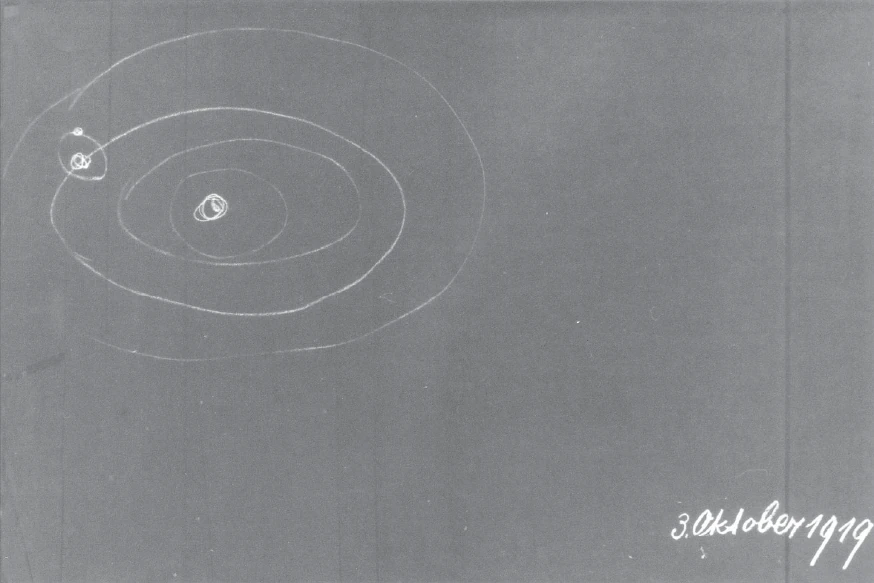
[ 25 ] But how did this image come about historically? I have mentioned this several times before. Historically, this image arose because the great Copernicus once wrote his book on the revolution of the celestial bodies. Right at the beginning of that book are three propositions. If all three are taken into account, then all is well. But not all three were taken into account—only the first two. The third was disregarded. If one considers only the first two Copernican propositions, then the Copernican system—carried forward in the Keplerian and Newtonian sense—emerges. Only this system is incorrect. If, according to the calculations of this system, a planet should be at a certain location and you point the telescope in that direction—it isn’t there! But it should be there according to this system. That is why the so-called “Besselian reductions” have been used for quite some time; the position is always corrected. Before setting up the telescope, one does not point it toward the point where it should be aimed according to this system, but rather toward the point for which one has first applied the Bessel corrections. What do these Bessel corrections actually mean? They mean that one must continually reapply what one would apply all at once if one were to observe all three Copernican laws—that is, if one had not disregarded the third. But if one takes this third Copernican law into account, then the story once again does not align with the beautiful orbits of the planets around the sun. Then one must consider a different world system. But people will not even consider this _ other world system until they have been properly prepared for such a shift in thinking through anthroposophically oriented spiritual science. For how do people view the world today? People view it today as if they were sitting inside a train, never looking out the window and never getting off, but always sitting inside and living only with the other passengers on the train. But a person could also travel through the world by train in such a way that they ride a certain distance, then stop the train, get off, and experience what a city has to offer; it could even be a different train—it doesn’t matter which one they board again. They travel on once more, experiencing something in another city. These are the stages one goes through. That is what one then carries with them.
[ 26 ] Modern astronomy experiences the Earth’s journey through space as if one were sitting in a train, experiencing nothing but the shared experiences with one’s fellow passengers, never getting off. Now you will say: How can one possibly step off the Earth? Is it even possible to step off the Earth? — It is possible, but stepping off the Earth is something different from stepping off a train. Stepping off a train means walking out the train car door and then going somewhere. Stepping off the Earth means penetrating into the human inner being, into the soul. If you truly penetrate the soul and reach what lies within it, then you have stepped off the Earth; then, in relation to the Earth, you have gone through the same process that you go through when you get off a train and get back on again. But now the peculiar thing is that when one steps off—that is, when one truly delves inward, delves concretely, not through illusions but concretely—one then experiences something different with every step off, truly experiences something different with every step off. To merely recite mysticism—which delves into the human inner being, which experiences God in the soul—is nothing more than mere recitation. Truly experiencing something within oneself turns out to be different in different eras; it is always a renewed experience. If someone truly experienced something inwardly in 1870, and again experienced something inwardly in 1919, then these two experiences are different in their inner nature. Why are they different? Because the human being experiences the cosmos, always experiencing it in a different place.
[ 27 ] It was through such inner experience that the ancients discovered their celestial system, not through purely external experience. The Copernican system arose from an experience like that on a train. The system of the future, in turn, will have to be experienced inwardly, as human beings traverse the world through inner experiences. Then something different will emerge. Above all, what will emerge is that we will learn to experience the world concretely, not—as is so popular today—to experience it abstractly.
[ 28 ] Something rather special happened to me recently in Berlin, which, all things considered, actually made me quite happy. Some time ago, a scathing article appeared in the German magazine *Die Hilfe*; the article is titled “False Prophet.” Well, articles like that are read, then forgotten. But when I was in Berlin a few weeks ago, an American came to visit me and said he was actually visiting me because he had read the article in “Die Hilfe,” which contained such terrible ranting—and in such a way that one couldn’t help but take an interest. I just want to mention that by way of introduction. What actually pleased me was a question this man asked, one that was extremely objective. He said he had very quickly grasped what the threefold social order was all about, but he now wanted to ask: Do you consider this threefold structure of the social organism to be an eternal truth which, once discovered, creates social conditions that must now remain forever, or is it a truth for a certain time that merely replaces old things; is it a truth that will in turn be replaced by something else? — I was truly struck that there are still such sensible people today who do not believe in millenarianism, in the “Millennial Kingdom,” where an Absolute is found once and for all, a single Truth throughout the entire earth and for all eternity. If someone thinks like a socialist today, they think: Tomorrow, the socialist state must be realized; once it exists, it will never need to change.
[ 29 ] I then phrased my answer as follows: Of course, the past few centuries have strived for a unified state; now, in our concrete reality, we have reached the point where we must divide it into three parts. After some time, the other—the synthesis—will come again; then the opposite will have to emerge once more. — You see, it’s not so convenient to always have to follow concrete circumstances; it’s not as convenient as devising an absolute system. But today it is necessary to follow concrete circumstances, to be aware that what we have to create, we must create for the current state of the world. But this can already be understood “astronomically” today, in that we see, first of all, that mystical experiences differ depending on whether they are gained in this decade or that decade, in this century or that century, and that one can follow the movements of the Earth itself and experience them mystically within oneself. But today, the “great astronomical” must be viewed and felt in conjunction with the social. We must gain the ability to proceed in such a way that we transcend a stage today that can only be paralleled with stages of earlier times, which were likewise not merely transitions but jolts in the course of development.
[ 30 ] Take the ancient Greeks. They had their own territory. Up to the Pillars of Hercules, the earth was still something concrete to them. Then came the indefinite, the utterly indefinite. They had a sense of the land. The modern era dawned—the discovery of America, voyages to the East Indies, and similar events. A sense of the Earth emerged. The Greeks’ sense of the land gave way to the modern sense of the Earth. Just as what lay beyond the Pillars of Hercules was indeterminate for the Greeks, so today what lies beyond Earth-consciousness is indeterminate for human beings—mere mathematical imagination, Galilean and Newtonian imagination, and so on. This imagination must be replaced by real facts. We must transform Earth consciousness into world consciousness, just as the Greeks’ land consciousness was transformed into Earth consciousness. We stand at this point today, and we will not make progress socially either unless we find a way—just as the land consciousness of the Greeks was transformed into the Earth consciousness of modern times—to develop the world consciousness of the future out of the Earth consciousness of recent times.
[ 31 ] If we do not cultivate, through the teachings of anthroposophically oriented spiritual science, the grand astronomical worldview of what lies outside as outer space, then we do not grasp the truth of outer space. But if we do not grasp the truth of outer space, we cannot become citizens of the cosmos. Yet we will not become social citizens until we have first become citizens of the cosmos in our consciousness.