

The Social Question as a
Question of Consciousness
GA 191
9 November 1919, Dornach
Translated by Steiner Online Library
Thirteenth Lecture
[ 1 ] A lecture such as the one I will give tomorrow in Basel should, of course, be understandable to everyone on its own. However, I would say that those who are connected to the cause within the anthroposophical movement may still gain a deeper understanding. And so today I would like to explore a few points that may serve not so much to provide a necessary foundation, but rather to delve more deeply into the very circle of truths that must now be addressed to humanity from the anthroposophical perspective. I would like to remind you that we have often discussed how the forces within the human being are, so to speak, organized around two poles. One understands the human being best—and arrives at a kind of self-knowledge of the human being—when one takes these two poles, the pole of the will and the pole of intelligence, into the eye of the soul.
[ 2 ] Human beings are beings of will and intelligent beings. Between these two, however, lies the element of mood and feeling for the period between birth and death. This element of mood and feeling is the connecting bridge between intelligence and will. You also know how these forces are more or less distributed when a person reaches what is called the threshold into the spiritual world.
[ 3 ] But what we want to consider in particular today is, on the one hand, the relationship in which human beings, as intelligent beings, stand in relation to the surrounding world—to the world in general—and, on the other hand, the relationship that human beings have to the world by virtue of being beings of will. Let us first address the latter. As you know, in the course of life between birth and death, human beings develop the power of the will as the driving force behind their actions and their entire activity. This power of the will is, of course, something very complex in its manifestations through the human organism. Yet everything in human beings that is of a volitional nature bears, in a certain sense, a resemblance—a strong resemblance that borders on identity—to very specific natural forces. Thus, one can indeed speak of an intimate relationship between the human forces of the will and the forces of nature.
[ 4 ] But you also know from earlier discussions that, with regard to everything that concerns his will, a person is in a kind of sleeping state even while he is awake. It is true that a person has in his consciousness the ideas of what he wants. However, human beings have no idea how it comes about that a particular mental image is expressed through the will. They do not know the connection between the mental image “I am moving my arm” and the entire process that then leads to the movement of the arm. This takes place entirely in the subconscious, and we can say: The actual process of volition is no more conscious to a person than anything that occurs during sleep. But in raising the question of the connection between human will and the world around us, we must immediately address something that is actually somewhat paradoxical for the contemporary consciousness that has gradually taken shape over the course of the last three, four, or five centuries. People generally think—as I have mentioned here before—that the course of the Earth would be the same even if human beings were not here at all. A true contemporary natural scientist—say, a geologist—describes the course of the Earth’s existence based on geological and physical processes; and although he may not say so explicitly, he actually has in mind that from the beginning of the Earth’s existence to its hypothetical end, everything could unfold exactly as it would even if the Earth were not populated by human beings. Why do people who think today in terms of the scientific worldview think this way? They think this way because they believe that if, for example, something is taking place—say, in the mineral or plant kingdoms on Earth on November 9, 1919—it is causally determined by what preceded this event on November 9, 1919, in the mineral kingdom. People think: There is the mineral kingdom, which unfolds (see drawing), and whatever happens here in the mineral kingdom is the effect of whatever somehow preceded it. The mineral effect arises from the mineral cause.

[ 5 ] That is how people think. You realize that people think this way when you open any geology textbook. There, what is happening in our present time is described—let’s say—as the result of the Ice Age or some previous epoch. But among the causes, they summarize only what has also taken place in the mineral realm. They disregard the fact that human beings inhabit the Earth. They imagine that even if human beings were not there, everything would have unfolded in the same way outside of human existence as it appears in external reality—even though human beings have, in fact, always been present. You see, there is something underlying here that truly points to the Earth as a whole—that is, as such a whole that nothing can happen in the course of Earth’s history without human beings themselves being among the active causes. Let me give you an example.
[ 6 ] As you all know, our present age—if we define the present as encompassing everything that has taken place since the great Atlantean catastrophe—was preceded by an era we call the Atlantean. The continents of Europe and Africa, in their present form, did not exist at that time, nor did present-day America in its present form. There was a single major continent on Earth at that time, known as Atlantis, a region that stretched across what is now the Atlantic Ocean. You also know that at a certain point in this Atlantean development, a particular kind of immorality began to spread throughout the entire civilized world of that time. People were able to make use of the forces of nature to a greater extent than was later the case. And they used them across vast areas in an immoral way. So that we can look back on an age of immorality. Then the Atlantean catastrophe occurred. A true geologist will, quite naturally, attribute this Atlantean catastrophe to geological processes: one part of the Earth’s crust simply subsided, while another rose. It would not occur to a person who thinks in terms of modern natural science to say that what human beings did was one of the contributing causes to be considered. — And yet it did contribute. It contributed in such a way that, in fact, the Atlantic catastrophe was the result of what human beings had done on the globe.
[ 7 ] One does not find merely external, mineral-based, natural causes; rather, for such major events—which descend upon earthly existence like catastrophes—one must seek causes that lie within human activity and endeavor itself. Human beings are indeed among the forces that must be included in the chain of causes governing earthly existence. But this is not only true of such major events; it is also true of everything that happens continuously. It is just that the actual connection between the cosmic events that have an effect on Earth—that is, the telluric, earthly events—and what takes place within human beings remains hidden at first. And in this regard, our entire natural science is, in essence, nothing more than a vast, all-encompassing illusion. For if you wish to trace things back to their true causes, you cannot study what is happening, for example, in the external mineral, plant, and animal worlds if you limit yourself to finding causes within those same worlds.
[ 8 ] I would like to present to you what is at stake here in the following way. Let us, so to speak, approach what we want to consider today from the opposite direction. If something happens within the sphere of the Earth—which I will sketch schematically (see drawing)—here would be the center of the Earth—in the mineral, plant, or animal kingdoms, then one can look for the cause. I would like to hint at the cause by saying: For whatever is taking place, there are points where the causes are located. — These are points everywhere where the causes are located (see drawing). You can visualize what I mean if you consider the following example. When you visit Italy, in the area around Naples, you’ll find that over long stretches of land, if you light a piece of paper, the ground begins to smoke. Vapors are driven out of the earth simply by setting a piece of paper on fire. The ground beneath you begins to smoke. You must tell yourself: The physical process taking place as a result of the burning paper is what drives the vapors upward. — The physical process in this case is that, by setting the paper on fire, you rarefy the air. Because a less dense mass of air is created, the vapors contained in the earth are forced upward. They are held down only by the usual normal atmospheric pressure, which is reduced by setting the paper on fire. If I wanted to illustrate only such effects—these vapors rising from the earth—which are thus of a purely mineral nature, I could therefore say: Here a piece of paper was set on fire, here and here and so on (see the dots); I mention this only as an illustration. This shows you that the cause of the vapors’ ascent lies not below the earth’s surface, but above it. Now, these points a, b, c, d, e, f are not meant to represent such lit pieces of paper; rather, in our present case, they are meant to represent something else. First, imagine that the dots have no meaning in and of themselves, but that the entire system of dots has a meaning. Do not imagine pieces of paper on fire, but something else, which I do not yet wish to name; I will name it shortly. Let there be something else acting as a cause above the ground. And these various causes do not act individually, but work together. And now imagine that there are not merely six points, but—let me say—one thousand five hundred million points, all acting together. So I would have drawn there one thousand five hundred million points, all acting together, producing a combined effect. These one thousand five hundred million points are truly there. For you all have within you what might be called the center of gravity of your own physical being. In a waking person, this center of gravity is located slightly higher—it lies below the diaphragm; in a sleeping person, it is located slightly lower, but it is there. So let there be one thousand five hundred million such centers of gravity spread across the Earth. These produce a combined effect. And what emanates from this overall effect is the true cause of what takes place, for the most part, in the mineral, plant, and animal kingdoms on Earth. So what you see around you in terms of atmospheric and aquatic phenomena, and what you observe in other mineral occurrences, is attributed to mineral causes only when based on a false science; in reality, its true cause lies within human beings.
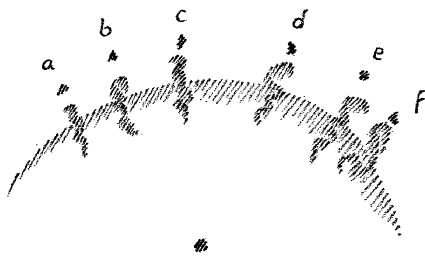
[ 9 ] You see, this is a truth that very few people today even suspect. Very few people know that processes are taking place in the mineral, animal, and plant kingdoms because, in truth, the causes of these processes lie within human organisms—not for all the activity in the mineral, animal, and plant kingdoms, but for a large part of it. Humanity, walking the earth, actually carries within itself the cause of what is happening. Thus, mineralogy, botany, and zoology cannot truly be pursued without anthropology, without turning to the human being for insight. Science speaks to you of chemical, physical, and mechanical forces. These physical, chemical, and mechanical forces are intimately connected with the human will—with that human will which is actually concentrated at the very center of the human being. When speaking of the Earth and seeking the truth, one must not speak of some abstract Earth, as geologists do, but must speak of the Earth in such a way that humanity is included within it. These are the truths that reveal themselves beyond the threshold. Everything that can be known on this side of the threshold actually belongs to the realm of illusions of knowledge; it does not belong to the realm of truths of knowledge.
[ 10 ] This raises the question: What connection actually exists for humanity today—and we are speaking primarily of humanity—between the forces of the human will, which are concentrated in the human center of gravity, and the external physical and chemical forces? — In normal life, this relationship manifests itself only in human metabolic processes. When a person takes in substances from the external world, it is actually their will that digests and processes these substances. And if nothing else were at work but this will, then whatever is taken in from the outside would simply be broken down within the person. The human will has the power to decompose and dissolve all other substances and forces, and the relationship between human beings and the rest of mineral, plant, and animal nature is such today that the human will is connected to the dissolving forces of our planet, to the destructive forces of our planet.
[ 11 ] We do, however, live off this destruction; but destruction it is! We could not live if we did not bring about this destruction. This must be clearly stated. And what is described to you by some as unjustified magical effects is essentially based on the fact that certain people also learn to use their will unlawfully in such a way that the destruction they cause does not normally remain confined to human nature, but is abnormally extended beyond human beings, and they consciously apply the destructive forces anchored in the will. This is, of course, something that should never actually be taught!
[ 12 ] Through our will, we are indeed closely connected to the forces of destruction on our planet Earth. And if we, as people of the present, had nothing but the power of our will, then our Earth would be doomed—through us humans, through humanity—to nothing but destruction. We would then have to face a future for the Earth that would truly present a disheartening picture—one in which the Earth would gradually disintegrate and be scattered into outer space. This is how we are constituted with regard to one pole.
[ 13 ] Human beings are dual beings. One aspect of their nature is connected to the destructive forces of the planet; the other aspect, as we have mentioned, is their intelligent part, which is linked to the will through the bridge of the mind. But this human intelligence plays a very minor role in relation to our Earth, at least while we are in the waking state. We are not actually able to establish a proper relationship to earthly existence through our intelligence while we are awake. What I have shown you here regarding the will is certainly something that—even if people are not conscious of it—takes place through humanity while people are awake. If you go out and look at a weathered rock somewhere and ask yourself about the true causes of rock weathering, then you must look inward, into the organic inner being of human beings themselves. As paradoxical as this may sound to humanity today, it is true! But the Earth, as I have already said, would face a bleak future were it not for the other pole within human beings—the constructive one. Just as the causes of all that is destructive lie in the human will, which is concentrated in the center of the human being, so do the constructive forces lie in the sphere that human beings enter during their sleep. From the moment of falling asleep until waking, the human being, with their I and their astral body, is in a state that we usually describe figuratively by saying: The I and the astral body are outside the physical body. But the human being is, after all, a spiritual-soul being, and it is there that they develop the forces that become active precisely between falling asleep and waking. And during this time, through these forces, they are connected to everything that builds up the Earth, bringing constructive forces to counter the destructive ones. If you never walked around on Earth, the destructive forces—which actually emanate from your will—would not be at work within the mineral, plant, and animal kingdoms on Earth. If you were never to sleep on Earth, then what continually rebuilds the Earth would not emanate from your intelligence. The truly constructive forces of our Earth also lie within humanity itself. I am not saying: within the individual human being. — I have explicitly stated before how these individual causes are interconnected. But the forces for reconstruction also lie within humanity as a whole, specifically in the intelligent pole of the human being; but not in the waking intelligence. The waking intelligence is something that inserts itself into the Earth’s development as if it were dead. The human intelligence that works unconsciously for the person during sleep is actually the very same force that continually rebuilds the Earth. I simply want to help you understand that you are mistaken if you seek the destructive and constructive forces of our Earth outside of human beings; you must look for them precisely within human beings. If you grasp this correctly, you will not find what follows incomprehensible either.
[ 14 ] You turn your gaze upward toward the stars. You say to yourself: Certain effects emanate from the stars that are perceptible here on Earth to human sensory organs. — But what you are looking into when you gaze at the stars is not equivalent to what you perceive here on Earth in the mineral, plant, and animal kingdoms; rather, it originates from the intelligent and volitional beings whose lives are connected to these stars. It is only because the stars are distant that it appears to be a physical phenomenon. It is not a physical phenomenon! It is what is actually taking place within the volitional and intelligent beings there. I’ve told you before: Astrophysicists describe our Sun; you’ll find very beautiful, lovely descriptions of it. But if someone were able to travel to the Sun using some kind of Jules Verne-like invention, they would be very surprised to find that, where they expect to find the Sun, they would not find at all what they assume based on the physical descriptions. It only appears that way here on Earth. It is merely a combination of what the Sun reveals. In truth, what we see is the effect of will and intelligence, which appears as light from a distance. And a—let’s say— a lunar inhabitant—if such beings existed in this sense—who were to observe the Earth would not discover the grassy areas or the mineral surfaces on Earth; rather, he would discover on Earth—though he would also perceive it as effects of light and the like—what is taking place around the center of gravity of human bodies, and what is taking place as an effect of the sleeping state, while people are in that state of life between falling asleep and waking up. That is what would actually be seen from the outside. The chairs on which you are sitting here—no instrument, no matter how perfect, could see them from the outside. But what is happening around your center of gravity, and what would happen here if you were all to suddenly fall asleep—though hopefully this will never be the case for everyone, only for a few—that would be visible from the outside.
[ 15 ] So that, for the outer cosmos, what happens through human beings here on Earth—precisely the visible—is the essential, not what surrounds human beings. You see, it has become—I might say—a common belief among people, and is often repeated, that everything we perceive externally with our senses is Maya, the great illusion, a mere phenomenon, not reality. Such an abstract truth actually has little value. A truth like this becomes valuable only when one delves into the concrete, just as we have just done. After all, it has no value if you tell yourself: the animal world, the plant world, and the mineral world are Maya; it only has value when you become aware that what you experience—what you perceive externally—fundamentally depends on you yourself, that you—though not at every moment, but over the entire course of human history—bring this about yourselves, that you are at the heart of the relationship between cause and effect.
[ 16 ] I would like to say: Even if one expresses such a shocking truth—for I think it could be shocking—as a deeper truth of nature, it still does not take on that aspect which is actually particularly important for human life. — Such a truth only becomes important when we draw certain conclusions from it. After all, we are truly not merely physical human beings here on Earth, nor are we human beings perceivable only through the external senses. On Earth, we are moral beings—or, conversely, immoral ones. We are, therefore, moral beings on Earth. What we do is determined by moral impulses.
[ 17 ] Now just consider how the contemporary worldview is plagued by the most bitter, the most acute doubts precisely on this point; how the natural sciences provide you with knowledge of the earthly realm that is entirely limited to the interplay of purely external natural causes and natural effects. And human beings, too, would be placed within this cycle of purely natural causes and purely natural effects. That is what external, abstract natural science tells us. It takes into account, I might say, only one aspect of earthly existence.
[ 18 ] And one then becomes aware that moral impulses do indeed arise within human beings; but one sees no connection between these moral impulses and what is happening externally in the cycle of nature. That is, after all, the crux of the matter, the burden of modern philosophy: on the one hand, philosophers hear from natural scientists that everything is connected through natural causes and effects—and on the other hand, they must admit: Human beings feel moral impulses within themselves—Kant wrote two “Critiques” for this reason: the “Critique of Pure Reason,” which deals with how human beings relate to the purely natural course of things, and the “Critique of Practical Reason,” in which he sets forth his moral postulates, which—if I may speak figuratively—actually float in the air, come from somewhere, and at first have no connection whatsoever with natural causes. Yes, you see, as long as humans believe that what is happening externally in natural phenomena can in turn be traced back solely to those natural phenomena—as long as humans are dealing with this Maya—the intervention of moral impulses remains something that stands apart from the course of nature. Almost everything that is said today actually suffers from this dichotomy; it stands entirely in the shadow of this dichotomy. People cannot conceive of the course of the Earth as such together with what takes place morally within humanity. But as soon as you know something like what I have tried to outline for you today in a few broad strokes, you will be able to say to yourself: As a human being, I am a unity, and the moral impulses live within me. And these moral impulses live in unity with what I am as a physical human being. But as a physical human being, I am, after all, the cause—together with humanity, of course—of everything that happens physically as well. Then what people accomplish morally on the Earth’s cycle is the real cause of the course of events taking place in the Earth’s cycle.
[ 19 ] Here on Earth, as human beings, we have natural history and the natural sciences, which describe the Earth’s history as we find it in physics, geology, and botany textbooks, and so on. What is written there about the Earth’s course is, at first glance, quite satisfying for people today, given the assumptions ingrained in them through contemporary education. But let’s imagine that a Martian were to come down to Earth and observe the Earth through his own framework of understanding; if, after walking around silently for a while as an Earthling—I’m not saying this could actually happen, but I just want to use this to illustrate my point— learned some human language, read through their geology books, and see what ideas these Earthlings have about earthly processes—he would say: “Yes, but that doesn’t contain everything; the most important thing is missing!” For example, I have seen that so many students hang around in bars, drinking constantly and indulging their passions. Yes, something is constantly happening there: the human will is interacting with metabolism. These are processes that you have omitted from your physics and geology textbooks. It doesn’t say there that the course of Earth’s history also depends on whether the students drink or don’t drink!
[ 20 ] Anyone who is not completely taken in by earthly notions—as they currently exist as prejudices among people—would find this missing in the descriptions that humans themselves make of the course of the Earth. For a Martian, there would be no question at all that what runs through human actions as moral impulses—and runs through all of human life—is part of the course of nature. For us, according to today’s prejudices, the course of nature has something extraordinarily compelling about it—for some, even something pleasantly compelling—especially for people who think in a thoroughly materialistic way. They imagine that the course of earthly life would be exactly the same even if there were no human beings. So whether I am a decent person or an indecent one makes no particular difference to the course of earthly life; I do not affect the course of earthly life by doing so. But this is incorrect; the causes of the course of earthly life do not lie outside of human beings. Most importantly, the course of earthly events does not lie outside of human beings, but within humanity itself. And if world consciousness is to emerge among human beings as a further development of mere earthly consciousness, the awareness must take hold within humanity that humanity itself shapes the Earth—not over short periods of time, but over vast spans of time—in a way that reflects who humanity itself is. The best way to lull humanity into complacency is to make it believe that it has no part in the course of earthly events. This narrows human responsibility down to the mere human individual, to the single human personality.
[ 21 ] In truth, however, humanity bears responsibility for what the Earth is going through in cosmic times. And one feels truly human only when, within humanity, one feels that the Earth itself is the body of all humankind. And this includes the fact that, if one has a feeling similar to what an individual human being might have when he says, “I have indulged my passions for ten years and thereby ruined my body”—one must then also say: If humanity lives according to immoral impulses, the Earth’s body becomes something different than if it lives according to morally upright impulses. — The mayfly also has a different worldview than humans, of course, because it lives for only one day. Human beings fail to grasp how that which manifests outwardly in the course of nature is not dependent on merely natural causes. Far more important for the current configuration of Europe—far more important than examining what the Earth’s external mineral and plant structure was like two thousand years ago—is to ask: How did people live here, or indeed within human civilization as a whole, two thousand years ago? — And the fate of the Earth as a planet, two thousand years from now, will not depend on the state of our mineral world today, but rather on what we do and do not do—that is what will determine the planet’s fate! With world consciousness, human responsibility expands into global responsibility. When we look up at the starry sky with the kind of consciousness I have described to you, we feel something within us: that we are responsible toward the realms of the universe, which are permeated and stirred by the Spirit; that we are responsible toward this world for how we shape the Earth. We grow together with the world, with the cosmos, in the concrete and in the particular, when we seek the truth behind appearances.
[ 22 ] This is part—a chapter—of what I often say: We must learn to view the things that are frequently taught today as abstract concepts in concrete terms. Simply adopting ideas from certain Eastern traditions—such as “The external sensory world is Maya”—does not get us very far. One must delve deeper to arrive at the truth. Such abstractions do not take us very far, for these abstractions, as they have been handed down, are nothing more than the expression of an ancient wisdom—a wisdom that did not exist in abstraction, but lived in concrete realities, which must now be rediscovered through intuitive spiritual research. Do not believe, when you read in Eastern writings about Maya and the truth that stands opposed to it, that what you read there today is something you can truly comprehend. After all, it is merely a summary of things that were known in concrete terms in the primordial wisdom and then summarized. We must return to the concrete facts. Today, many people believe they understand something of the processes of the world when they tell themselves things like: “The outer sensory world is Maya.” — One can truly understand something only when one penetrates to the concrete facts. The moment one realizes: You must not ask why the mineral world is this way or that way based on mere mineral processes from another point in time, but rather you must ask about the processes taking place within the human being himself—at that moment, one understands what this actually means; one sees only Maya in the external world. Then one begins to see a much more intense reality in human beings than one usually does. Then the great sense of responsibility toward existence begins.
[ 23 ] If you try to truly grasp these things inwardly—for they can only be contemplated inwardly, not proven using the ordinary external tools of the intellect according to the model of modern science—then you will gradually come to understand how humanity truly consists of free human beings. Nature is actually not something that contradicts our freedom. For as human beings, we shape the nature that surrounds us most closely. Nature contradicts our freedom only in its partial manifestations. Comparatively speaking, nature does not act against our freedom any more than when you reach out a hand and another person grasps it and holds it back. You do not deny your free will simply because another person restrains one of your movements. In the same way, we as people of the present are also held back in various respects by the fact that people of the past did something whose effects are only becoming apparent today. But people did it. What kind of people? Not those against whom we can turn and level accusations, for it was we ourselves in earlier earthly lives who brought about the present state of affairs.
[ 24 ] We need not limit ourselves to speaking merely of repeated earthly lives, but should conceive of the connection in such a way that we perceive, even in the external natural world, the effects of what we have established as causes in earlier earthly lives. However, when we speak in reference to the individual human being, we do so in a way that refers only to contributing causes. For, as I have explained to you, all these things involve the interaction of human beings with one another on Earth. No one, however, need exclude themselves individually from this; rather, everyone contributes their share to what all of humanity brings about—and what is then expressed in what constitutes the body of all humanity on Earth in its ongoing life, and what is described externally.
[ 25 ] I wanted to give you an idea of how a scholar of the humanities must view what is described in external books. In fact, this is not much different from if I were to draw a series of figures for you here:
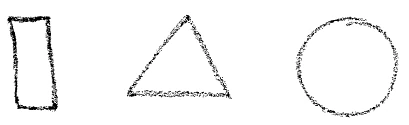
[ 26 ] Let’s suppose some creature crawled out of the ground that had never lived in the human world, saw these figures, and—for the sake of argument—had some knowledge of arithmetic, and said: First figure, second figure, third figure: “The third is the effect of the second; the second is the effect of the first figure. The first produces a triangle; the second produces a circle.” — This is how this creature, having crawled out of the earth, would summarize cause and effect. But that is not the case; rather, I have drawn one figure after the other. In truth, each is entirely independent of the other. It only appears that way to this being, which—based on a certain maxim—summarizes what precedes with what follows, as if one were the effect of the other. But this is roughly how the geologist describes the Earth’s processes—what arises, let’s say, in the Diluvial Period, the Tertiary Period, the Quaternary Period, and so on back in time. But this is not the case, any more than this circle is the effect of the triangle and this triangle the effect of the square; rather, each is brought about and established independently, just as everything that the deeds of earthly human beings have brought about in the course of the Earth’s existence though we must also include everything that humanity brings about in sleep through the mysterious workings of the intelligence, which unfolds particular effects precisely when the human being is, as they say, outside the body.
[ 27 ] You see, to a very high degree, what is described externally by so-called science is mere maya, mere illusion. And merely speaking about maya is not enough. It is indeed necessary that, in reaching this critical judgment—that the external world is a maya—one be able to identify the actual causes. But the actual causes are concealed. They are, after all, hardly apparent to human external cognition. For the way in which humanity structures its earthly existence cannot be ascertained through external knowledge; this can only be explored by moving from external science to inner science. As you can see from my book *How Does One Attain Knowledge of the Higher Worlds?*, it is possible to know what a person undergoes from falling asleep to waking up. This can be explored through the science that penetrates down to the will. For how the will is connected to the external world is not revealed to human beings, because the process of the will is hidden from them. A person does not know what it actually means at every moment when they raise their hand, when they bring about an act of the will; they do not know that this act of the will continues and has significance for the entire course of earthly existence.
[ 28 ] That is what I meant when I depicted the scene with Capesius and Strader in *The Gate of Initiation*, where I have Strader and Capesius do all sorts of things that then lead to cosmic events involving thunder and lightning. Of course, this is depicted figuratively, but the figurative imagery conveys a deeper truth. It is not something fancied up, but rather represents a real truth. For a rather long period of human development, such truths have, in essence, been expressed only by true poets, whose imagination must always be connected to supersensible processes.
[ 29 ] People today have little understanding of this. People today want to present poetry—and art in general—as something invented, standing alongside external reality. They feel greatly relieved when they are not confronted with the claim that poetry should be taken as something more than a figment of the imagination. True poetry, true art, is indeed only a reflection of the supersensible truth—but precisely a reflection of the supersensible truth. Even if the poet is not consciously aware of what takes place in the supersensible realm, if he is connected in his soul to the cosmos, if he has not detached himself through a purely materialistic education, then he expresses what are indeed supersensible truths, even if he must express them through images of sensory existence.
[ 30 ] Such things are frequently found in the second part of Goethe’s *Faust*. There, the outward visual truths are indeed—as I have explained to you with regard to individual passages—to be understood in relation to supersensible processes. We can even corroborate what I have just said by referring to the development of art in the most recent epochs of human history. If you take a work of art from a relatively recent artistic epoch, you will find that, as a rule, the landscape is treated as a very secondary element. The treatment of landscape really only came to the fore in the last three, four, or five centuries; only then did it come to be respected. If you go further back, you will find that landscape is scarcely depicted—the focus is more on the human world itself—because there was still an awareness that, for objective processes, the human world is far more important than the landscape. For the landscape is merely an effect of the human world. It is precisely in the emergence of a preference for landscape in the realm of art that we find a development running parallel to the rise of materialistic thinking. And materialistic thinking consists solely in the belief that what is separate from humanity has an intrinsic value. It has no intrinsic value; it has absolutely no intrinsic value! A Martian who were to come down to Earth would at any time be able to attach meaning to Leonardo’s painting *The Last Supper*. As for landscape paintings—assuming he could even perceive the landscape as such at all (after all, with his sensory organs he would see it quite differently, even painted landscapes)—he would be unable to ascribe any real meaning to them, because he would perceive the entire configuration of the Earth differently. I say these things, of course, only to use hypotheses to illustrate what I mean.
[ 31 ] So you can see from this that the statement: “The external world is a maya —” can only be fully understood by considering the concrete. But then, as human beings, we must include ourselves in the totality of earthly existence. Then we must indeed rise to the realization that there can be realities—external realities, apparent realities—that are not truth, that are not true realities. If you have a rose in the room, it is an apparent reality, but not a true reality, for a rose, just as it appears before you, cannot exist. It can only exist if it is on the rosebush, connected to the roots of the rosebush, which in turn are connected to the earth. Nor can that which the geologist describes as “earth” truly exist. For anyone who wishes to be a true connoisseur of reality, what the geologist describes as “earth” is just as much a false reality as a rose is a false reality.
[ 32 ] The humanities strive never to remain stuck at the level of false reality, but always—when faced with a false reality—to seek what must be added in order to attain wholeness, to attain a complete, true reality, This is where the unreal nature of our present civilization manifests itself: in the fact that people simply regard everything that appears to them externally as reality. But reality exists only as a coherent whole. The Earth taken on its own, with humanity removed from it, is no longer a true reality; it is just as little a true reality as a rose is a true reality when it has been cut from the rosebush. You see, these things must be internalized; they must not remain mere theory, but must become part of our mindset. We must feel ourselves to be a part of the whole Earth. And it is important that we repeatedly bring this idea to mind: The finger that has grown here on me is its true reality only as long as it is part of my organism. If I cut it off, then it is no longer its true reality. In the same way, a human being is no longer their true reality when they are separated from the Earth. But the Earth, too, is not its true reality when humanity is gone from it. It is merely an unrealistic notion when today’s natural scientist, based on his assumptions, imagines that the Earth’s development would proceed in exactly the same way if humanity were not there. I recently explained to you from another perspective that this would not be the case, by showing you that the bodies humans shed at death form an ingredient of the Earth’s development that must be present just as leaven is, and that if no human bodies were bound to the earth, the entire physical process of the earth’s development would also be different from what it is when human bodies—regardless of whether they are cremated or buried—are bound to the earth.
[ 33 ] Today I wanted to explain to you in more detail the connection between the human poles of will and intelligence and the cosmic environment.