

The Social Question as a
Question of Consciousness
GA 191
15 November 1919, Dornach
Translated by Steiner Online Library
Fifteenth Lecture
[ 1 ] Yesterday I drew your attention to how a kind of primordial knowledge, of primordial wisdom, was once possessed by the human soul, and how this primordial wisdom has, so to speak, seeped away down to our own times, gradually being depleted, so that people throughout the civilized world feel increasingly dependent, in their knowledge and understanding, on what comes to them from physical existence. By “knowledge” and “insight,” I do not mean here merely what is “science,” but rather what is present in the consciousness of the soul even in everyday life.
[ 2 ] Now, within the field of spiritual science, the question naturally arises: How did this primordial knowledge of humanity actually come about? — Here I must point out, from new perspectives, certain things that we have already discussed at length from other angles.
[ 3 ] Let us look back to the time when human beings began to become true inhabitants of the Earth—when, in terms of their spiritual and soul nature, they descended to the Earth itself, clothed themselves in the forces of the Earth, and became earthly beings in the earthly sphere. If it had been merely the case that human beings had descended to Earth with the prerequisites inherent in their own nature, then humanity would have had to develop quite differently than it actually has throughout the various cultural epochs. Even back then, human beings would have had to start from a certain relationship with their environment. They would have had to acquire knowledge of the Earth based on—I wouldn’t exactly call them clairvoyant, but somewhat clairvoyant—instincts. They would have been able to acquire this knowledge of the Earth very slowly. They would have remained clumsy, childlike beings for a long time. They would, of course, have worked their way up to a certain human state of soul and body by our time, but they would by no means have reached the spiritual heights to which they have actually arrived. The fact that they were able to develop in a way other than through the various stages of childhood is due to the fact that those beings we have always called the Luciferic beings have become interwoven into Earth’s evolution. Now, as we have come to know in recent times, a Luciferic individuality itself incarnated in Asia at a certain point in pre-Christian history, and it was from this Luciferic being that the pagan primordial wisdom—namely, that which can still be discerned on the basis of historical facts—originated. But, I would say, the Luciferic entities have always been present in the course of human evolution. Now I would like to ask you quite earnestly—although I know how little such requests actually help—that when speaking of the Luciferic entity, you not approach this concept of the Luciferic entity with utter narrow-mindedness and philistinism. For even today, there is still a widespread tendency—even among those who identify with the anthroposophical movement—to say—and I have spoken of this tendency often—: “Yes, that is Luciferic, for heaven’s sake; just don’t go near it, just reject it outright!” — The point is that all these things must be judged from the most diverse points of view, and that we must strictly bear in mind that the entire pagan primordial wisdom originated from a Luciferic source. But we must study how this actually took place. And the further back we go in human evolution, the more we find certain individuals who, due to the preconditions established in their reincarnations, were ripe to become acquainted with the wisdom possessed by the Luciferic beings. We speak, for example, of the seven holy Rishis of the Indians. Just as the Indian himself, whenever he spoke from his own wisdom, understood the wisdom of the seven holy Rishis, he knew—insofar as he was an initiate into these matters—that the actual teachers of the Rishis were Luciferic beings. For what the Luciferic entities brought into the development of the Earth—into which, as I said, they have interwoven themselves—is, above all, everything that has always constituted the world of thought permeating human culture: the intellectual world of thought, the rational world in the best sense of the word, the world of wisdom. Precisely when one goes back to the origins of humanity, one finds that the sources of pagan wisdom are always to be sought in Luciferic beings.
[ 4 ] One might ask: Yes, how is something like that actually possible? — One must realize that human beings would indeed have had to remain childlike if they had not been able to continually receive the teachings—arising from the Mysteries—from all manner of Luciferic beings. The essential point is that those who needed the necessary knowledge and wisdom for the progress and development of humanity—namely, the and primordial wisdom—did not shy away, like a modern philistine, from receiving this wisdom from the Luciferic element, but that they also took upon themselves everything that a human being must take upon themselves when receiving such instruction from the spiritual spheres by Luciferic beings. Above all, human beings had to take upon themselves—one might call it an obligation, although of course such words cannot always express the essence of the matter precisely—this Luciferic wisdom, which is, after all, world wisdom, [to use it as good wisdom in the service of Earth’s evolution]. The difference between good wisdom and Luciferic wisdom lies in the fact that good wisdom is in other hands, and Luciferic wisdom—which is identical in content—is in Luciferic hands; the content is exactly the same. That is what is at stake. It is not a matter of there being a wisdom that one can so neatly tuck away in the chamber of one’s soul so that one might thereby become a good person; rather, it is a matter of the fact that, while wisdom is indeed one and the same in the world, the only difference is that it may, for example, be in the hands of wise human beings who manage it well, or in the hands of the Angeloi, archangels, and so on, or in the hands of Lucifer. From another perspective, in ancient times, wisdom was unattainable for the progress of humanity. Thus, the initiates of ancient times had to receive it from Luciferic hands, and they had to undertake the obligation not to succumb to the other aspirations of the Luciferic beings.
[ 5 ] It was Lucifer’s intention to pass on the wisdom of humanity in order to thereby lead them not to follow the path of earthly evolution, but to undergo the process of evolution in a superterrestrial sphere, in a sphere removed from the Earth. So if I were to draw a diagram, I would say: If this is the Earth’s surface (see diagram, white), then human beings on the Earth’s surface would have to follow this path (red) when they set foot on Earth here.
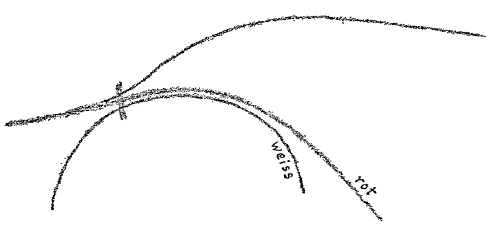
[ 6 ] The Luciferic beings instill their wisdom in human beings, but they want them to turn away from the Earth as a result and not undergo Earth’s evolution. Lucifer wants to leave the Earth to its fate, to leave it uninhabited by human beings; he wants to win humanity over to a special kingdom that is alien to the Kingdom of Christ.
[ 7 ] The sages of ancient times, who received primordial wisdom from Lucifer’s hands, were thus obliged not to yield to Lucifer, but to receive his wisdom and use it in the service of Earth’s evolution. This is essentially what was accomplished through the mysteries of pre-Christian times. And if one asks what humanity actually gained through these mysteries of pre-Christian times—through the influence of the Luciferic beings, who, first, that is, still during the post-Atlantean era, inspired certain individuals—the Rishis of India—and then even sent their own messengers to Earth, as I have indicated to you—then it is all that which human beings have developed since the beginning of their evolution: the ability to speak and the ability to think. For speech and thought are originally of a thoroughly Luciferic nature, except that these arts were, so to speak, wrested from Lucifer by the sages of primeval times. If you wish to flee from Lucifer, then you must resolve to be silent and not to think in the future!
[ 8 ] These things are part of that science of initiation which humanity must gradually come to know, even though the centuries-old philistine education of the civilized world causes people to recoil from these truths. After all, people have been presented with this caricatured image of Lucifer and Ahriman—who is also the medieval devil—for so long. People have been raised in such a philistine atmosphere for so long that even today they still can only accept these teachings—which are, however, intimately connected with the evolution of humanity—with a shudder, for it is so terribly comforting for people to be able to say: “I guard myself against the devil; to Christ I surrender myself in childlike simplicity; then I will be saved; then my soul will be saved under all circumstances.” — Human life is simply not that straightforward at its core. The point is precisely that, for the future of human development, these things we are now discussing must not be withheld from humanity. For it must be understood that the very art of speech and the art of thinking are something that could only have entered into this earthly evolution because human beings received them indirectly through Lucifer’s mediation. I would say: You can still discern the Luciferic element in your thinking today. Ahriman has already descended upon the languages—which have long been differentiated to suit the Earth—and it is he who brought about this differentiation, who reduced the unified language to the differentiated earthly language. While Lucifer always has a tendency toward unification, the Ahrimanic principle is permeated by a tendency to differentiate. What would thinking be like if it were not Luciferic?
[ 9 ] Yes, you see, if thinking were not Luciferic, then most people on Earth—all those who do not think Luciferically—would think like the person who thought the least Luciferically; that is, Goethe. Goethe is among those who thought the least Luciferically, who, in a certain sense, set out to boldly look the Luciferic powers in the face. But that makes it necessary to stick as closely as possible to the concrete particular. The moment one generalizes, the moment one unifies, one is already approaching Luciferic thinking. If you were to consider every single human being, every single animal, every single plant, every single stone on its own—if your thinking focused solely on the individual object, without forming genera and species, without generalizing, without unifying things in your thinking—then you would indeed absorb very little of Luciferic thinking. But anyone who did that as a child would fail in the very first grade in every school today! So that cannot be the issue at all. The point today is to realize that general thinking—the kind of thinking that was particularly at home in the pagan mindset—is gradually drying up altogether. Human beings are no longer disposed in such a way that this Luciferic element of standardization can be of much use to them on Earth. This is precisely due to the fact that human nature, created by God, has gradually caught up in its development and become related to the Earth and to earthly matters. Because human beings have become related to the earthly, they are now less closely connected—by their very nature—to the Luciferic element, which actually seeks to turn them away from the Earth.
[ 10 ] But it would be terrible if human beings were to be separated only from the Luciferic element and nothing else were to take its place. It would be very, very terrible. For then human beings would become completely intertwined with the Earth—that is, with the specific territory on which they are born. They would become completely specialized and differentiated within their own culture. We can indeed see this tendency developing today. The groundwork for this had already been laid since the beginning of the 19th century; but today we see how, out of the catastrophe of the World War, the tendency to split into ever smaller and smaller groups is emerging. National chauvinism is gaining more and more ground, until it will lead to people splitting into ever smaller and smaller groups, so that eventually a group might consist of just a single person. It could then come to the point where individual people would also split into left and right, and could end up at war with themselves, with the “right” person at loggerheads with the “left.” Many signs of this are already evident today in the development of humanity. A counterbalance to this must be created. And this counterbalance can only be created by ensuring that, just as an ancient wisdom permeated and shaped pagan culture, a new wisdom—but now arising from free human will—is attained and handed down to earthly culture. This new wisdom must, in turn, be a wisdom of initiation. This new wisdom must, in turn, go beyond what can be attained only on an individual level.
[ 11 ] And here we come to the chapter that must not be withheld from people today either. If humanity were to do nothing in the future to attain a new wisdom on its own, then the processes I have already described to you in part—namely, the Ahrimanization of the entire culture of humanity—would take place in the subconscious depths of human nature. Human culture would become Ahrimanized, and it would then be easy for that incarnation of Ahriman, of which I have spoken to you, to permeate earthly culture with its own essence. That is precisely why we must take preventive measures against all the currents that promote Ahrimanic culture.
[ 12 ] But what would happen, for example, if people remained as they tend to be today—that is, if they did not perceive and see through the currents leading to Ahriman, and thereby steer them onto the right track, as we discussed recently? Then, as soon as Ahriman incarnates in the Western world at that specific point in time, human culture would become completely Ahrimanized. What would Ahriman bring? Through the most magnificent arts, Ahriman would bring to humanity all that clairvoyant knowledge—as meant here—which until then could only be acquired with great effort and struggle. Just imagine how infinitely convenient that would be! People would not have to do anything at all. They could live a materialistic life; they could eat and drink as much as was available after the catastrophe of war, and would not have to concern themselves with any spiritual striving. The Ahrimanic currents would take their “beautiful, good” course. If, at the right moment, Ahriman were to incarnate in the Western world, he would found a great secret school; in this secret school, the most magnificent magical arts would be practiced, and everything that can otherwise only be acquired with great effort would be poured out upon humanity.
[ 13 ] One must not, however, imagine in a philistine way that Ahriman, when he comes down, is some kind of “Krampus” who plays all sorts of pranks on people. Oh no, all those who are content with the status quo and say today: ‘We want nothing to do with spiritual science’—they would fall under his spell, for he would be able, in the most magnificent way, to turn large numbers of people into clairvoyants through the arts of magic. However, he would turn people into clairvoyants in such a way that each individual would become terribly clairvoyant, but in a completely differentiated manner: what one person would see, another would not see, nor would a third! People would all become confused, and even though they would receive a foundation of clairvoyant wisdom, they would only be able to engage in strife and discord, for the visions of different people would be the most diverse. Ultimately, however, people would be very satisfied with their visions, for each of them would indeed be able to look into the spiritual world. The consequence of this, however, would in turn be that everything that constitutes earthly culture would fall prey to Ahriman! Humanity would fall prey to Ahriman simply because it has not made its own what Ahriman would then give it. That would be the very worst advice one could give to people if one were to say to them: Just stay as you are! Ahriman will make you all clairvoyant, if you so desire. And you will desire it, for Ahriman will have great power! — But the consequence of this would be that the realm of Ahriman would be established on Earth, that the entire Earth would become Ahrimanized, and that, so to speak, everything that human culture has achieved thus far would be destroyed. Everything that present-day humanity, in an unconscious tendency, actually desires so desperately would come to pass.
[ 14 ] The point at issue is this: It is precisely that kind of foresight—the clairvoyant kind—that must be taken away from Ahriman. One might say: It is only one book, not two kinds of wisdom—one book. — The only question is whether Ahriman has the book or Christ does. Christ cannot have it unless humanity fights for it. And humanity can only fight for it by telling itself that, by the time Ahriman appears on Earth, it must have attained this content of spiritual science through its own efforts.
[ 15 ] You see, this is the cosmic work of spiritual science. The cosmic work of spiritual science consists, after all, in ensuring that the knowledge of the future does not become—or remain—Ahrimanic. It is a sure way to play into Ahriman’s hands if one excludes all knowledge from confessional religion, if one emphasizes time and again that simple faith alone accomplishes everything. If one remains stuck at this level of simple faith, then one simply condemns oneself to spiritual dullness and numbness, and then the wisdom that is, so to speak, to be wrested from Ahriman cannot penetrate. So it is not a matter of humanity simply receiving the wisdom of the future, but rather of humanity working to attain this wisdom of the future, and of those who attain it taking on the obligation to save earthly culture; to save Earth’s culture for Christ, just as the ancient Rishis and initiates had taken upon themselves the obligation not to yield to Lucifer’s demand to lead humanity away from Earth..
[ 16 ] What, then, is actually the most essential aspect of this matter as it relates to human perception? The essential aspect of this matter is that a struggle similar to the one waged by the ancient initiates—who imparted language and the ability to think to humankind—and to the one that had to be waged against Lucifer will also be necessary for the wisdom of the future. Just as these initiates of primordial wisdom had to wrest from Lucifer that which has become human intellect, so too must that which is to be insight into the inner nature of things in the future be wrested from the Ahrimanic forces. These forces are at work between the lines of life, and they are already influencing life itself.
[ 17 ] I recently read an account written by a friend of the anthroposophical movement shortly before his death. He had been wounded in the war and spent a long time in a military hospital, where, during the operations he underwent, he gained many insights into the spiritual world. The last lines he left behind, however, contain a remarkable passage. They describe a vision in which he recounts what he experienced shortly before his death. And among the final things he experienced was that everything surrounding him—which, as he puts it, spreads around him like the atmosphere—became “granite,” turning completely dense and stony; became “granite-like,” as if heavy granite were settling upon the soul. One must understand such an impression. And one can understand it if one knows that one must struggle for what is future-wisdom; for the Ahrimanic forces do not allow this future-wisdom to be wrested from them so easily. One must not believe that one can hope for wisdom in voluptuous visions. True wisdom must, as I also said recently in a public lecture, “be acquired through suffering.” And what I have just told you about a dying person is actually a very good illustration of that suffering. For in the struggle for future wisdom, one of the most common experiences is precisely this: that the world around you presses down, as if the air were suddenly to solidify into granite. One can understand why these things are so. One need only consider that it is the aim of the Ahrimanic forces to bring the Earth to a complete standstill. They would have won their game as soon as they succeeded in bringing everything—Earth, water, and air—to a complete standstill. Then the Earth would not be able to evolve back to that warmth from which it has been developing since the Saturnic Age. It is meant to reach that warmth again during the Volcanic Age. Preventing this is the aim of the Ahrimanic forces. And a crucial factor would already be at play if, in the present, human souls were unable to be inspired by the spiritual content of spiritual science. For the initial impetus for the Earth’s solidification would then be provided by human souls—by their indifference, laziness, and complacency. If you consider that this solidification is the actual goal of the Ahrimanic forces, then it will not strike you as odd that this compression, this turning of life into granite, is among the experiences that must be endured in the struggle for future wisdom.
[ 18 ] Just consider that people can prepare themselves in the present to look into the spiritual world by first grasping, through their common sense, what spiritual science seeks to convey. The effort devoted to this study, guided by common sense, can be part of the struggle that then leads to receiving visions from the spiritual world. In this process, many obstacles will have to be overcome. For people today, the matter is so difficult at first simply because, if they want to understand spiritual science, they must fight against their own granite-hard skulls. If this granite-like hardness of the human skull were not present, spiritual science would be accepted much more widely today. Far wiser than all the philistine condemnation of the Ahrimanic forces would be a struggle against Ahriman—one that, however, cannot be philistine—and that consists of a sincere, honest study of the content of spiritual science. Then, little by little, people would spiritually perceive and feel what would otherwise have to descend physically upon the earth: the hardening, the turning to granite.
[ 19 ] It must therefore be pointed out that it is truly and profoundly true that wisdom regarding the future can only be attained through deprivation, suffering, and pain; yet, for the sake of humanity’s development, it must be attained by enduring the corresponding physical and mental suffering. Therefore, everyone should actually make it a principle that the attainment of wisdom through suffering should never deter them from pursuing this wisdom. What humanity needs for its outer life is that, in the future, the danger of the Earth’s solidification—of its growing cold, a process that would first occur in the moral world—be removed from the Earth. But this can only be achieved if people, in spirit, gradually imagine and inwardly feel all that would otherwise become outer physical reality, and counteract it with their will.
[ 20 ] This is why, when it comes down to it, it is really only cowardice in the present that is to blame for the fact that people do not want to engage with spiritual science. They do not, however, bring this to their consciousness; but the fact is that they must endure the fear and cowardice they feel in the face of what stands in the way of their striving as something difficult. How often does one hear, time and again, that people who join an anthroposophical branch are seeking spiritual uplift. By “elevation,” people often mean a kind of inner, psychological pleasure. This cannot be offered, for it would only envelop people in dullness and distance them from the light they need. The essential point is that, looking toward the near future—starting from the present—people must not be deprived of knowledge of what the actual driving forces of human evolution are. People must know how the human being is in fact in a kind of state of equilibrium between the Luciferic and Ahrimanic forces, and how the Christ-Being has truly become a kind of companion to humanity: first emerging from the Luciferic struggle, then entering into the Ahrimanic struggle.
[ 21 ] Human evolution must be viewed in the light of these facts. Anyone who today presents the mysteries of the world as they must be presented in spiritual science is sometimes severely mocked, precisely because of essential matters. In particular, when one is compelled today—as I, for example, had to do in my book *Theosophy*—to describe things again and again according to the number seven, people mock this description based on the number seven. I intend to speak tomorrow about such mockery, which has once again been directed at me. But when one divides the rainbow into seven colors, or the octave and the musical scales into the prime, second, third, and so on—and the octave is then the repetition of the prime—people no longer mock it! In the physical realm, people accept these things, but in the spiritual realm, this must not be the case! What must be regained here was once a component of primordial pagan wisdom. And we see a final glimmer of this primordial pagan wisdom regarding something like the number seven in the Pythagorean school, which was actually a mystery school. You can read about Pythagoras everywhere in school textbooks today, but you will find no explanation anywhere as to why Pythagoras based the order of the world on numbers. This was because primordial wisdom based everything on numbers. But the last spark of insight, particularly into the wisdom of numbers, was still present when Pythagoras founded his school. Other elements of primordial wisdom endured longer; some even survived into the 16th and 17th centuries. For example, we still hear accounts from the 15th and 16th centuries of this or that physically plausible phenomenon in connection with the higher worlds. Then, if I may say so, humanity’s primordial understanding gradually dried up.
[ 22 ] Let’s imagine for a moment that a true representative of contemporary education were lurking in a corner somewhere and were to say: “Well, what kind of nonsense are these anthroposophists spouting?” We have such magnificent achievements in recent times! What is that supposed to mean, that people are saying primordial wisdom has dried up? We have, after all, received all sorts of great and mighty things, especially in the last few centuries and right up to the present day; perhaps people draw the line at 1914, but in any case, up until 1914 we have received such wonderful things. — But if you take an unbiased look at what we have gained in recent times, you will come to the following conclusion. Certainly, people have collected all sorts of scientific, descriptive, and historical records. Collecting has, after all, become particularly fashionable. They have also conducted various experiments and described them. But if you now ask: Is there actually anything new in terms of ideas or concepts in all of this—which, after all, has come about precisely in recent times? — Individual mavericks like Goethe have introduced something new in terms of ideas and concepts; but Goethe, of course, was not understood. Go through what is happening, for example, in the natural sciences or even in the latest historical scholarship, and you will find: The ideas at play there are not new. Certainly, Darwin traveled, described much of what he saw on his journeys, then summarized what he had observed and distilled it into an idea. But if you consider the idea of evolution—down to its smallest details—as an idea, you will find it already in the Greek philosopher Anaxagoras. And so you will find the most important ideas that natural science possesses today in Aristotle—that is, as early as the pre-Christian era. And these ideas are a treasure of primordial wisdom, a Luciferic source. But little by little, that which constitutes this primordial wisdom must dry up, and something new—in the form of insights into the spiritual world—must be attained. This requires a certain willingness on the part of people to accept those things that directly give rise to truly new ideas. And present-day humanity needs new ideas, particularly with regard to the soul. What is presented to people today in a scientific manner concerning the soul is, after all, really nothing more than words. When people speak in a scholarly manner about will, thought, and feeling in ordinary classrooms, they are really dealing only with words that people toss around as if in a kaleidoscope. But these are, in essence, mere empty words—the sound of words. People do not set out at all to take seriously that which is working toward something new today.
[ 23 ] In this regard, one really does have some peculiar experiences. For example, some time ago I was invited to speak at a Schopenhauer Society in Dresden. A Schopenhauer Society—I thought to myself, there must be something very special about that. And so I tried to explain how the contrast between sleeping and waking, waking up and falling asleep, should be understood psychologically and emotionally. I pointed out—as I also mentioned to you recently—that the zero point initially exists only in the acts of waking up and falling asleep, and that sleep is not merely a cessation of wakefulness, but rather relates to wakefulness as debt does to assets.
[ 24 ] If you were to look for something like this in contemporary psychology, you wouldn’t even find the slightest hint of an attempt to address these far-reaching issues. Then, in a so-called discussion, a few people spoke up—people who were educated, that is, a few philosophers. One of them, among other things, came up with a beautiful line of reasoning that I could characterize something like this: He said, “What we’ve heard here—all of that—is not really something one would want to achieve through serious science.” Serious science must deal with entirely different matters. This has nothing to do with what we want to know, for when one considers the matter in the light of reason, these were by no means new truths, but rather something we have known for a long time. — In other words: That which we do not want to know at all and which is not at all the subject matter of our science—that is something well-known!
[ 25 ] Well, there are contradictions in reality, but contradictions of this kind exist only in the minds of contemporary scholars. If someone says: “One cannot know these things; they are not the subject of human knowledge”—fine. But if someone says at the same time that these things have long been known to him, then that is a blatant contradiction! Such a combination of two judgments is often quite common in the mind of a modern scholar.
[ 26 ] But this way of thinking is also connected to what is at stake in the present. For there is a long, long way between the individual—who, after all, is not entirely foolish thanks to the divine powers and, if you’ll forgive me, thanks to Lucifer and Ahriman—and actually advocating these things before the world. The individual understands some of these things and sometimes forms a judgment for himself that is by no means unhealthy; but from this point to actually addressing the matter appropriately before the world, the path is long—very, very long. And for many, the situation is such that, on the one hand, they are quite happy to immerse themselves in spiritual science when a society of a more sect-like nature forms in which they can immerse themselves. But when they are then faced with the world again and are supposed to present to the world something for which the world provides its documents and evidence, the whole thing fizzles out; then they are once more respectable citizens of the respectable land of the philistines. And that most certainly promotes the advance of Ahriman.