

Michael's Message
The True Mysteries of Human Nature
GA 194
21 November 1919, Dornach
Translated by Steiner Online Library
First Lecture
[ 1 ] In the coming days, I would like to speak a little about the way in which we, as people of the present, are able to relate to that spiritual power which we can say intervenes—as the power of Michael—in spiritual life and, consequently, in the rest of what happens on Earth. It will be necessary for us to lay the groundwork today for what is at stake here. For various perspectives are needed to enable human understanding to truly reflect the various interventions of the power just described, based on the signs we constantly observe in our surroundings. We must, after all, bear in mind that when we wish to speak seriously about the spiritual world, we can always look to what manifests here in the physical world as revelations of the spiritual powers. In a sense, we seek to penetrate the veil of the physical world to reach that which is at work in the spiritual world. What exists in the physical world can, of course, be observed by anyone; what is at work in the spiritual world then serves to solve the mysteries presented by the physical world from within the spiritual world. One need only perceive the mysteries of physical life in the right way. Precisely with regard to these important matters, it is essential that certain things I have said here—especially in the period leading up to these lectures—be taken in all seriousness. One simply cannot combine the most personal views of the world with a genuine understanding of that which profoundly concerns not only all of humanity, but the world itself. One must free oneself from merely personal interests. After all, one will best understand what the personality has to do in the world and what it must recognize as its own value precisely when one has freed oneself from the personal in the narrower sense.
[ 2 ] Now you know that our evolution—which we must understand as our earthly evolution—is preceded by another evolution, and that we are therefore part of a comprehensive cosmic evolution. But you know, first of all, that this evolution is continuing, that it has reached a point beyond which it will move on to further, more advanced stages. Secondly, however, you also know that when we consider the world as such, we are dealing not only with those beings we initially encounter in the earthly realm—that is, in the mineral, plant, and animal kingdoms, as well as the human kingdom—but also with beings that are superior to these kingdoms, whom we have collectively referred to as the beings of the higher hierarchies. Whenever we speak of full development, we must always take these beings of the higher hierarchies into account as well.
[ 3 ] These beings, for their part, are also undergoing a process of development that we can understand if we draw analogies to our own human development and to that which exists in the various kingdoms of the Earth. I ask you to simply consider the following. As you know, we humans have passed through a Saturn, Sun, and Moon phase of development and have arrived on Earth, so that when we consider our cosmic evolution, we can say that we, as humans—as we now experience ourselves in the earthly environment—have reached the fourth stage of our development.
[ 4 ] Let us consider the beings that stand immediately above our human level, whom we refer to as the Angeloi. If we simply apply the analogy, we can say: These beings, even though they have forms entirely different from that of human existence and are initially invisible to the physical human senses, have reached the stage of development corresponding to Jupiter.
[ 5 ] If we then turn to the Archangels, they have reached the stage of development that humanity will have attained on Venus. And if we turn to the Archai, the spirits of the ages—that is, those beings who play a particularly significant role in our earthly evolution—they are already at the volcanic stage of development.
[ 6 ] This raises an important question: There is, after all, the next higher class of beings, which belongs to the hierarchy of the so-called Form Spirits. If we ask ourselves at what level these Form Spirits stand, we must conclude: They have already moved beyond what we humans initially perceive as our future development—the volcanic development. They have thus reached a level about which we must say: If we designate the levels that are initially sufficient for our considerations as seven levels, then these beings, whom we call the Form Spirits, have reached the eighth level. We can therefore say: We humans stand on the fourth level of development; if we take the eighth level, we find the Form Spirits there.
[ 7 ] However, we cannot simply imagine this sequence of developmental stages as occurring one after the other; rather, we must imagine that all of this is intertwined. Just as the atmosphere surrounds and permeates the Earth, so too does this eighth sphere of development—to which the form spirits belong—permeate the sphere in which we initially find ourselves as human beings. Let us first take a close look at these two stages of development.
[ 8 ] Let us say to ourselves: We humans, as such, find ourselves in a sphere that has reached a fourth stage of development. But now, if we set aside everything else for the moment, we also find ourselves in the realm that the spirits of form must regard as their own, around us and through us. Let us now consider the human being in his development specifically. We have, after all, often distinguished the stages of this human being’s development. We have distinguished the head development from the rest of the human being’s development. We, in turn, divide the rest of the development into two parts: the chest development and the limb development. Let us set these aside for now. Let us simply adopt the standpoint that in the human being we have everything that belongs to the development of the head, and everything that is assigned to the rest of the human being.
[ 9 ] Now try to visualize the situation like this (a drawing is provided): imagine the surface of the sea, with a person wading through it, moving forward in the water so that only his head is above the surface; through this image—which is, of course, just an image—you would have a picture of the condition of modern humanity. Everything in which the head is rooted we would have to count as the fourth stage of development, and that in which the human being wades—in which he moves forward by walking, or, we might say, by swimming—we would have to designate as the eighth stage of development. For it is a distinctive feature that human beings have, in a certain sense, outgrown—with their heads—the element in which the Spirits of Form unfold their distinctive nature. Human beings are, so to speak, emancipated—with regard to the formation of their heads—from that which is permeated by the beings of the Spirits of Form.
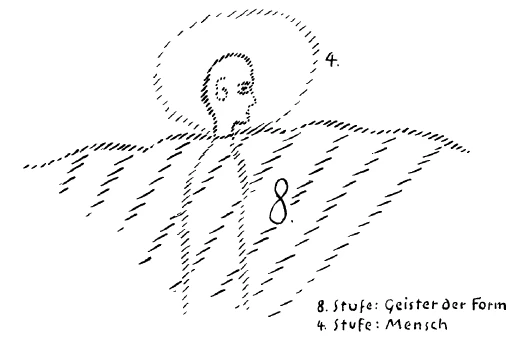
[ 10 ] Only by thoroughly understanding this can one truly arrive at an understanding of the human being. For only in this way can one properly grasp the special place that the human being occupies in the world. For it is only through this that one will correctly grasp that, insofar as a human being feels a certain creative influence upon themselves from the spirits of form, they do not perceive this creative influence directly through the faculties of their head, but rather through what is exerted by the rest of their organism as an effect upon the head. As you know, we breathe, and breathing is connected to our blood circulation—if we speak in purely physiological terms. But blood is also pumped into the head. As a result, the head is in an organic, life-giving connection with the rest of the organism. It is nourished and enlivened by the rest of the organism.
[ 11 ] You must make a clear distinction between two things. The first is that the head is directly connected to the outside world. When you see something, you perceive it through your eyes. There is a direct connection between the external world and your head. But when you consider the life of your head—how it is sustained by the processes of respiration and blood circulation—you see blood rushing up from the rest of the organism into the head, and you can say that in this case there is no direct connection between your head and the environment, but rather an indirect one.
[ 12 ] Of course, you don’t have to make a pedantic distinction by saying, “Well, since the air we breathe is drawn in through the mouth, breathing is therefore part of the head.” That is why I said this is just a metaphor. Organically speaking, what is drawn in through the mouth does not actually belong to the head, but rather to the rest of the organism.
[ 13 ] If you would first take a moment to consider these basic concepts we have just introduced, if you would hold fast to the idea that we are situated within two spheres—the sphere into which we have been brought by having undergone the Saturn, Sun, and Moon stages of development and now stand within the Earth’s development, meaning that we are thus at the fourth stage of our evolution— and if you further consider that we are also situated within a life, within a sphere that belongs to the Form Spirits just as the Earth belongs to us—a sphere that permeates our Earth but excludes only our head—so that with our entire remaining organism, with everything that is not sensory perception, we stand within this eighth sphere: if you bear this in mind, you have laid a certain foundation for what follows.
[ 14 ] But I would like to lay a certain foundation using other concepts as well. If we wish to consider our lives in the light of such influences, we cannot do so without taking into account those beings involved in world events whom we have already mentioned on several occasions: the Luciferic and Ahrimanic beings. Let us first consider, so to speak, the very outermost aspect of these beings—the Luciferic and Ahrimanic entities. Just like us humans, they inhabit the spheres in which we ourselves are currently situated. If we consider their outermost aspect, we can say: We can imagine all Luciferic beings as possessing those forces that we, as human beings, experience when we want to become fantastical, when we give ourselves over one-sidedly to fantasy, when we give ourselves over one-sidedly to daydreaming, when we—to put it figuratively—want to take our being beyond our heads. When we, as human beings, seek to reach beyond our heads with our being, these are forces that play a certain role in our human constitution, but which are the universal forces of those beings we call Luciferic beings. Imagine beings formed entirely from that which within us strives to reach beyond our heads, and you have the Luciferic beings, who stand in a certain relationship to our human world. Conversely, imagine everything that presses us down to earth, everything that turns us into sober philistines, that leads us to develop materialistic attitudes, that permeates us with what we might call dry intellect, and so on—then you have the Ahrimanic forces.
[ 15 ] Everything I have just described in more spiritual terms can also be expressed in more physical terms. One could say: Human beings are actually always in a kind of central position between what their blood wants them to do and what their bones want them to do. The bones constantly seek to make us stiffen; in other words, the bones also seek to make us physically Ahrimanic, to harden us. The blood seeks to drive us beyond ourselves. Pathologically speaking: The blood can become feverish, and then the human being is driven into fantasy even on an organic level; the bones can extend their nature over the rest of the organism, and then the human being ossifies, becoming sclerotic—as almost every person does to a certain degree in old age. Then they carry the killing element within their organism: that is the Ahrimanic. One can say: Everything that lies in the blood has a tendency toward the Luciferic; everything that lies in the bones has a tendency toward the Ahrimanic; and the human being is the point of balance between the two, just as he must be the point of balance, in a psychological sense, between fanaticism and sober philistinism.
[ 16 ] But we can also, in a certain sense, characterize these two entities more deeply. Let us first consider the Luciferic beings and what, so to speak, their interests are within cosmic existence. And there we find that the Luciferic beings are primarily interested in causing the cosmos—the world, specifically the human world—to turn away from those spiritual beings whom we must regard as the actual creators of humanity. The Luciferic entities desire nothing more than to turn the world—one might say—away from the divine entities. It is not so much that the Luciferic entities primarily intend to appropriate the world for themselves. From various things I have already said about the Luciferic beings, you will be able to gather that this is not the main concern of the Luciferic beings; rather, their main concern is to turn the world away from what human beings can perceive as their true divine beings—to free the world from them.
[ 17 ] The Ahrimanic beings have a different intention. They are determined to bring the human realm—and with it, the rest of the Earth—into their sphere of influence, to make it dependent on them, and, first and foremost, to dominate human beings as such. Thus, while the Luciferic beings have always worked—and continue to work—toward turning human beings away from what humanity can perceive as its divine essence, the Ahrimanic beings tend to gradually draw humanity and everything associated with it into their sphere of influence.
[ 18 ] Thus, in our cosmos—into which we are woven as human beings—there is actually a struggle between the Luciferic beings, who are constantly striving for freedom, for universal freedom, and the Ahrimanic beings, who are striving for everlasting power and strength. This struggle, in which we are immersed, permeates everything. I ask you to keep this in mind as the second key idea for our further consideration. The world in which we live is permeated by Luciferic and Ahrimanic beings, and there is this tremendous contrast between the liberating tendency of the Luciferic beings and the power-seeking tendency of the Ahrimanic beings.
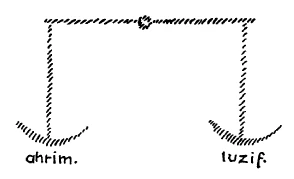
[ 19 ] When you consider this whole matter, you will say to yourself: I can really only understand the world if I view it in relation to the number three. For on the one hand we have everything that is Luciferic, on the other hand everything that is Ahrimanic, and placed right in the middle is the human being, who, as a third element—as if in a state of balance between the two—must perceive his or her divine nature. The only way to come to terms with an understanding of the world is to take this triad as the foundation, to be clear about the fact that: This human life is like a balance beam (see drawing on p. 19). Here is the hypomochlion; there is one pan of the scale—the Luciferic—which, in reality, pulls upward. On the other side is the Ahrimanic, which, in reality, pulls downward. To keep the balance beam in equilibrium—that is the essence of the human being. Those who were initiated into such mysteries have always emphasized in the spiritual development of humanity that one can understand the world existence in which the human being is placed only in terms of the number three; that one cannot understand the world if one seeks, so to speak, to grasp its fundamental structure in terms of numbers other than three. So we may say, in our own language: In our existence in the world, we are dealing with the Luciferic, which represents one side of the scales; the Ahrimanic, which represents the other side; and the state of balance, which represents the Christ impulse.
[ 20 ] Now you can imagine that it is very much in the interest of the Ahrimanic and Luciferic forces to conceal this mystery of the number three. For a proper understanding of this mystery of the number three enables humanity to establish a state of balance between the Ahrimanic and Luciferic forces. This means, on the one hand, using every tendency toward freedom—the Luciferic—to achieve a beneficial world goal, and on the other hand, doing the same with the Ahrimanic. The most normal state of mind for a human being consists in properly immersing oneself in this trinity of the world, in this structure of the world, insofar as it is based on the number three.
[ 21 ] There has been—and still is—a strong tendency, as we will discuss in greater detail tomorrow and the day after tomorrow, to confuse people regarding the significance of the number three in relation to human spiritual and cultural life. There is a strong tendency to confuse people with regard to this—we may say—sacred number three. And we can see very clearly in modern human culture how this structure based on the number three is almost entirely obscured by a structure based on the number two. Just consider for a moment that, as I have often explained here, in order to properly understand Goethe’s Faust, one must realize that confusion regarding this number three plays a role even within this monumental epic. Had Goethe been able to fully grasp the true nature of these things in his own time, he would not have merely portrayed the Mephistophelean power—which we know to be identical with the Ahrimanic power—as Faust’s adversary, as the force that drags Faust down; rather, he would have set the Luciferic power against this Mephistophelean power, and Lucifer and Mephistopheles would appear as two opposing forces in Faust. I have already explained this repeatedly here. One can also see clearly, when studying Goethe’s character of Mephistopheles, how Goethe has thoroughly mixed up the Luciferic and Ahrimanic elements in Mephistopheles’s characterization. In Goethe’s work, the figure of Mephistopheles is, in a sense, a mixture of two elements. It is not a unified figure. The Luciferic and Ahrimanic elements are jumbled together in a colorful mix. I have discussed this in more detail in my little book Goethe’s Spirit.
[ 22 ] This confusion, which thus finds its way even into Goethe’s Faust, is entirely based on the fact that, in a certain direction—though it was different in earlier times—in the more recent development of humanity, the delusion has taken hold that, when looking at the structure of the world, the number two should be substituted for the number three: the good principle on one side, the evil principle on the other, God and the Devil.
[ 23 ] Just consider that we must therefore conclude: If anyone wishes to gain a proper insight into the structure of the world, they must recognize the triad; they must recognize that the Luciferic and the Ahrimanic elements stand in opposition to one another, and that the Divine consists in maintaining the balance between the two. We must contrast this with the delusion that has crept into humanity’s spiritual development through dualism—with God and the Devil, with the spiritual-divine powers above and the devilish powers below. It is as if one were, so to speak, to push or squeeze a person out of this state of equilibrium by concealing from them that the true salvation of our understanding of the world lies in the correct grasp of the number three, and by leading them to believe that the structure of the world is somehow determined by the number two. Yet even the finest human endeavors have fallen prey to this error.
[ 24 ] If one wishes to address this point, one must do so entirely without prejudice; one must truly place oneself in a sphere free of prejudice. Then one must make a very clear distinction between things and names. Then one must not be led to believe that simply by giving an entity a certain name, that entity is already perceived by humans in the correct way.
[ 25 ] If we consider the concept of those entities that human beings are meant to perceive as their divine entities, we must acknowledge that human beings can only perceive these entities correctly if they conceive of them as bringing about a balance between the Luciferic and the Ahrimanic principles. He can never perceive what he is meant to perceive as his divine nature correctly if he does not take this threefold division into account. From this perspective, consider a work of poetry such as Milton’s Paradise Lost, or consider a work such as Klopstock’s Messiah, which was written under the influence of Milton’s Paradise Lost. There, you essentially find no real understanding of a threefold world structure; instead, you find a struggle between what is supposedly good and what is supposedly evil—the struggle between heaven and hell. There, the delusion of duality has been carried right into the development of the human spirit. There, what is often rooted in popular consciousness as the delusional opposition between heaven and hell has been carried into two more recent world epics.
[ 26 ] It is of no use for Milton or Klopstock to describe the beings of heaven as divine beings. They would only be divine beings—as humans are meant to perceive them—if they were based on the threefold structure of worldly existence. Then one could say: A struggle is taking place there between the good principle and the evil principle. But as things stand, a duality is assumed; the good is attributed to one pole of this duality, names are assigned to the beings—names that are actually derived from the divine—and on the other side, the diabolical, the anti-divine element is placed. What has actually been accomplished by this? In reality, nothing less has been done than to remove the truly divine from consciousness, to bestow the divine name upon the Luciferic, to present us in truth with a struggle between Lucifer and Ahriman, and to ascribe Luciferic qualities only to Ahriman, while the divine qualities are ascribed to the realm of Lucifer.
[ 27 ] You can see just how immense the implications of such a perspective actually are. While people believe that a juxtaposition such as that found in Milton’s Paradise Lost or Klopstock’s Messiah deals with the divine and hellish elements, in truth it deals with the Luciferic and Ahrimanic elements. There is no awareness of the truly divine element, whereas divine names are attributed to the Luciferic element.
[ 28 ] Now, Milton’s Paradise Lost and Klopstock’s Messiah are merely the intellectual creations that stand out from humanity’s more recent consciousness. For what finds expression in these works is the general consciousness of humanity. The delusion of the number two has indeed taken root in this newer consciousness of humanity, and the truth of the number three has been held back. The deepest thing that humanity has produced in modern times—which, from a certain point of view, it rightly regards as one of the greatest achievements of modern times—is a cultural illusion, a great delusion, and has sprung from the great delusion of modern humanity. Everything that is at work in this delusion is, in essence, the creation of Ahrimanic influences—those influences that will one day be concentrated in the incarnation of Ahriman, of which I have already spoken to you. For this delusion in which we find ourselves is nothing other than the result of that false worldview which, for people of modern culture and civilization, springs up everywhere from the world by setting heaven and hell in opposition to one another. Heaven is regarded as divine, just as they describe it, and hell is regarded as diabolical, whereas in truth we are dealing, on the one hand, with what is called the heavenly Luciferic and, on the other hand, with what is called the hellish Ahrimanic.
[ 29 ] We need only consider what interests are at work in recent intellectual history. Even the threefold division of the human organism—or of the human being as a whole—has, in a certain sense, as I have often mentioned to you, been eliminated for Western civilization by the Eighth Ecumenical Council of Constantinople in the year 869. It has been elevated to dogma that a Christian is not to believe in a threefold human being, but only in a twofold human being. Believing in body, soul, and spirit is considered frowned upon, and the medieval theologians and philosophers—who still knew much of the truth—had great difficulty circumventing this truth, for the so-called trichotomy—the division of the human being into body, soul, and spirit—had been declared heretical. They had to teach the duality: that human beings consist of body and soul, not of body, soul, and spirit. And this is precisely what certain beings—certain people—know very well: what an immense significance it has for human spiritual life to replace the threefold division with a twofold one.
[ 30 ] One must look to such depths if one wishes to understand correctly why, in the November issue of “Stimmen der Zeit,” Jesuit Father Zimmermann points out that one of the more recent decrees of the Holy Office in Rome forbids Catholics, on pain of not receiving absolution in confession, from reading or possessing theosophical writings or participating in anything theosophical. Jesuit Father Zimmermann interprets this in Stimmen der Zeit—formerly known as Stimmen aus Maria-Laach—to mean that it applies above all to my anthroposophy; that is, he argues, it is essential to ensure that those Catholics who wish to be regarded by Rome as true Catholics do not engage with anthroposophical literature. One of the main reasons cited was that the human being is distinguished into body, soul, and spirit; thus, a heretical doctrine is taught in contrast to the orthodox belief, which consists in distinguishing the human being into body and soul.
[ 31 ] I have also mentioned to you that this distinction between body and soul has, without their realizing it, been adopted by modern philosophers, who believe they are practicing unbiased, presupposition-free science, who believe they are truly observing in order to arrive at the insight that human beings consist of body and soul. In truth, they, too, are merely following what has entered into recent intellectual development through that dogma. What is regarded as science today is, in essence, entirely dependent on such things as have been introduced into the world in the course of recent human development. Do not believe that by uttering any fine words—which you often feel compelled to offer to people who denounce anthroposophy from such quarters—you can convert these people, or that you can win them over to a certain degree of goodwill toward anthroposophy. Anthroposophy must gain a foothold in the world through its own merits, not through the patronage of any powers—no matter how Christian they may be regarded. Only through its own inner strength can anthroposophy achieve what it is meant to achieve in the world.
[ 32 ] Bear in mind that the Christ impulse can only be understood if one regards it as the balancing impulse between the Ahrimanic and the Luciferic, if one knows how to place it correctly within the Trinity. What must one do—one might ask—if one wishes to mislead people about the true Christ impulse? One must distract people from the true threefold structure of the world and lead them into the delusion of the duality, which is justified only when dealing with the manifest, not when it comes to going beyond the manifest to what lies in the sphere of the True.
[ 33 ] We must be clear that in such matters we must go far beyond mere names. Simply calling something “Christ” does not mean one has grasped the Christ. And one can prevent the Christ from being grasped through the name “Christ” by substituting the number two for the number three. If anyone wanted to reliably prevent people from gaining a true understanding of the Christ, all they would need to do is replace the number three with the number two. And if one is to point back to the Christ impulse in a true sense, then it is necessary to set the number three in opposition to the number two. There is no need to become another heresy-hunter alongside the heresy-hunters. From now on, you need not declare Milton’s Paradise Lost or Klopstock’s Messiah to be accursed devilish writings; you can, of course, continue to delight in their beauty and grandeur. But you must realize that in such writings—insofar as they are the very blossoms of modern popular human civilization—there is no mention of Christ at all; rather, such writings arise from the delusion that everything which does not belong to human development may, on the one hand, be counted among the devilish, and that, on the other hand, one obtains the divine. No, one merely ends up with the Luciferic. And when one then writes a “Paradise Lost,” one is in reality describing the expulsion of human beings from the realm of Lucifer into the realm of Ahriman; and one is not depicting humanity’s longing for the Divine, but rather humanity’s longing for the lost paradise—that is to say, for the realm of Lucifer. You may find beautiful descriptions of humanity’s longing for the Luciferic realm in Milton’s Paradise Lost or in Klopstock’s Messiah; but that is precisely what you should see in them, for that is what they are.
[ 34 ] Certain ideas that have taken root in modern humanity really do need to be reevaluated. Today, as we earnestly set out to think and feel in an anthroposophical way, we are not faced with minor decisions; we are faced with major decisions. We are faced with the task of taking a phrase that Nietzsche often used very seriously. The phrase about the “revaluation” of certain values must be taken very, very seriously. The achievements of humanity in modern times must indeed be thoroughly reevaluated.
[ 35 ] That is no reason to become a condemner of heretics. We continually perform scenes from Goethe’s Faust, and I have devoted decades to the study of Goethe. But as you can see from my short essay “Goethe’s Spirit,” this has not blinded me to the false characterization embodied in Goethe’s figure of Mephistopheles. It would be thoroughly philistine to say: Goethe’s Mephistopheles is false, so let’s do away with him. That would be acting just like certain inquisitors. As modern people, we must not put ourselves in that position. But neither should we complacently settle for what has become second nature to the broadest masses of people in recent intellectual life. Humanity will have to learn an immense amount. In many respects, it will have to reevaluate its views.
[ 36 ] All of this is connected to Michael’s mission toward those beings of the higher hierarchies with whom he, in turn, is connected. And tomorrow and the day after tomorrow, we will discuss how we can come to understand the impulses that radiate from the Michael Being into our earthly human existence.