

Spiritual and Social Transformations
in Human Evolution
GA 196
18 January 1920, Dornach
Translated by Steiner Online Library
Sixth Lecture
[ 1 ] It is impossible for human beings to move from the present into the future toward true self-knowledge—toward a sense of self that includes an understanding of their very nature—without engaging with the science of initiation, for the reason that in everything human beings can experience here in this world without taking the science of initiation into account, the forces from which the human being is truly formed are not present. To gain a proper understanding of what I actually mean by this, you need only think of certain things that are familiar to you from our anthroposophical reflections. You must remember that, in addition to living out his life here between birth and death, the human being also repeatedly experiences life between death and a new birth. Just as we have experiences here through the instruments of our physical being, so do we have experiences between death and a new birth, and these experiences are by no means without significance for what we do here while we spend our earthly existence in the physical body. Nor, however, are these experiences without significance for what happens on Earth in general. For only a part—and indeed, the smaller part—of what happens here on Earth originates from those living in physical bodies. The dead, after all, continually influence our physical world. And the forces that people today, in this materialistic age, do not even want to speak of are nevertheless present. Not only are there forces constantly emanating from the spiritual world—not just from beings of the higher hierarchies—that are present here in the physical world, shaping and permeating our physical environment; but there are also forces imbued within what surrounds us and affects us that emanate from the dead. Thus, a complete understanding of human life can only be attained by looking beyond what the
[ 2 ] sensory experience and also historical experience here on Earth. Ultimately, however, the extent of such forces is the very thing that makes the whole human being—and the entire course of human development on Earth—understandable at all. A year will come in the physical evolution of the Earth—this year will be, let us say, around the year 5700 and a few—and in that year, or around that year, human beings, if they complete their proper evolution on Earth, will no longer come to Earth in such a way that they incarnate in bodies descended from physical parents. I have often said that women will become infertile in this age. Human children will then no longer be born in the manner they are today, provided that development on Earth proceeds normally.
[ 3 ] One must not allow oneself to be misled by such a fact. For example, the following could also occur: The Ahrimanic forces, which are growing very strong under the influence of present-day human impulses, could reverse the course of Earth’s evolution; they could, in a certain sense, pervert it. As a result—and certainly not for the benefit of humanity—humanity could be preserved in the same physical life beyond these years into the sixth millennium. It would become increasingly animal-like; but it could be preserved in this physical life. This is one of the aims of the Ahrimanic forces: to bind humanity to the Earth for longer, thereby diverting it from its normal development. But if humanity truly seizes upon what lies within its best possibilities for development, then in the sixth millennium this humanity will simply enter into a relationship with the earthly realm that, for the next two and a half millennia, will be such that human beings will still have a relationship with the Earth, but one that is no longer expressed through the birth of physical children. Human beings will, so to speak, as spirit-soul beings—to put it vividly, I would say: in the clouds, in the rain, in lightning and thunder—stir up earthly affairs. They will, so to speak, vibrate through natural phenomena; and at an even later time, the relationship to the earthly realm will become even more spiritual.
[ 4 ] Today, one can speak of all these things only if one has an understanding of what happens between death and a new birth. Although there is not complete equivalence between the way a person relates to earthly conditions today between death and a new birth, and the way they will relate to them when they are no longer physically incarnated, there is nevertheless a similarity. In a sense, if we understand how to give earthly development its true meaning, we will then enter into a lasting relationship with earthly affairs—the same kind of relationship we now have to them only when we live between death and a new birth. The present life between death and a new birth is, I would say, merely somewhat more spiritual than it will be when the human being is permanently in these circumstances.
[ 5 ] But one is still far from being able to rise to an understanding of these things without the science of initiation. Most people today still believe that the essence of mastering the science of initiation lies in gathering all kinds of spiritual experiences, but not in the way that is destined for us in the physical body. Even today, people value experiences gained through spiritualism more highly than what can be understood through common sense. This stems solely from the fact that, today, common sense is simply not being used in any healthy way. Everything that is explored by an initiate and can be communicated can, if one only makes the necessary effort, be understood through ordinary, properly applied common sense. The initiate, too, has the task, above all, of translating what he can explore from the spiritual world into the language of common sense. It depends far more on this translation into the language of common sense being correct than on having experiences in the spiritual world. Of course, one cannot convey anything to common sense without having these experiences. But unprocessed experiences—those simply gained without using common sense as an interpreter—are actually worthless; they do not hold the proper significance for human life. Even if countless extrasensory experiences could be gained, and people were to refuse to apply common sense correctly, these experiences would be of no use whatsoever to humanity in the future. On the contrary, these experiences would cause considerable harm to humanity. For a supersensible experience is useful only when it has been translated into the language of common sense. And the real evil of our time does not lie in the fact that people do not have supersensible experiences. People could have plenty of supersensible experiences if they wanted them; they are there. People simply fail to apply common sense to make sense of them. What is lacking today is precisely the application of common sense.
[ 6 ] Of course, it is not easy to have to say this to an age and generation that currently prides itself so much on its use of this common sense. But what is in the worst state today is not, by any means, supersensible experience; what is in the worst state today is sound logic, truly sound thinking, and above all, the power of truthfulness. The moment untruthfulness asserts itself, supersensible experiences fade away; people are then unable to come to an understanding of them. People simply refuse to believe this. Yet it is indeed the case. The first requirement for coming to terms with the supersensible world at all is to apply the most scrupulous truthfulness with regard to sensory experiences. Anyone who is not meticulous with sensory experiences can never arrive at a true understanding of the supersensible world. No matter how much one hears about the supersensible world, it remains empty rhetoric if there is not the utmost conscientiousness in describing what is taking place here in the physical world. But anyone who observes humanity today and how it deals with sensory truth will naturally arrive at the bleakest of pictures. For in reality, most people today are not at all concerned with formulating anything they have experienced in such a way that the formulation is a true reflection of what they have experienced; rather, people are concerned with formulating things as they wish them to be, as it is convenient for them, and people are completely unaware of the impulses that cause them to stray in one direction or another from a faithful description of what they have physically experienced. If we set aside minor details, we need only look today at all the impulses arising from ordinary human contexts, out of which people wish to distort this or that in relation to the truth. Furthermore, we need only observe that today, regarding certain matters, most people do not speak the truth at all because they are somehow committed to a national cause or the like. Anyone who is nationally committed in one direction or another cannot think or speak the truth about certain things at all in the sense in which it is to be understood today. Consequently, almost nothing true is being said about the events of the last four to five years, because people everywhere speak of them from this or that standpoint of national interest. It is essential to realize that an infinite amount depends on such matters if one wishes to approach the supersensible world. In an age in which such a thing is possible—as I described to you at the end of yesterday’s talk—do you believe that many paths to the truth lie open? They do not. For those people who are mired in such swamps of untruth, as we observed yesterday, spread a haze and fog that never allows through what, as supersensible truth, is meant to be grasped by common sense. Nor do people truly and genuinely want to recognize that a proper relationship between one person and another is necessary if supersensible truths are to influence social life in an appropriate way. One cannot, on the one hand, “doctored” the truth and, on the other hand, claim to want to understand supersensible matters.
[ 7 ] When these things are put into words, they seem almost self-evident, but in fact they are so far from self-evident that everyone should actually be repeating them to themselves constantly today. For only in this way can we gradually achieve what must be achieved in this field. One need only bear in mind that what I have said here in recent days about the main principle of social coexistence must be taken entirely seriously: it must be based on trust in the sense that I have characterized it here. In many respects, this trust will also be necessary in the future with regard to the paths of knowledge, and with regard to ensuring that those who are actually able to speak about the science of initiation are treated in such a way that their statements are truly examined only with common sense—not with sympathy or antipathy or the like, nor through the lens of one personal feeling or another. Time and again, it should be absolutely clear that this Anthroposophical Society is meant to become a true bearer of supersensible truths into the world. In this way, it could have an extraordinarily necessary and extraordinarily significant impact on human development.
[ 8 ] However, it must be borne in mind that gaining experience in the supernatural realms is clearly a serious matter. Some time ago, I spoke to you here about how a friend of our cause, shortly before his death—which occurred as a result of a war wound—wrote a few lines in which, in the face of death, he describes how the air turns to granite, becomes hard. At that time, I pointed out how this is a thoroughly true experience. For if you consider even the most elementary things that come into play when crossing the threshold into the spiritual world, you can gauge the full gravity of the matter. When we are here in our daily life—or, for that matter, in our nighttime life, since there is electric light then—the sun, the sunlight, illuminates the things around us. Things are visible to us through the sunlight. The other senses perceive the things around us in a similar way. The moment the threshold is crossed—to stick with the example of sunlight—a person must, in their inner being, become one with the light. They cannot see things through the light, because they must, after all, enter into the light itself. One can see things with the help of light only as long as the light remains outside. When one moves with the light itself, one can no longer see the things that the light illuminates. But it is only then—when one moves with one’s soul within the light—that one realizes that our thinking is, in fact, one with the light weaving through the world.
[ 9 ] It is true, at first, only for physical life that we have a form of thinking bound to our body. The moment we leave this body, we no longer have a complete form of thinking; rather, what thinking is becomes interwoven with the light, lives in the light, and is one with the light. But the moment the light thus absorbs our thinking, the possibility ceases of having a “self” in such a convenient way as a human being has this “self” between birth and death. He does absolutely nothing to bring this about. His body is arranged in such a way that his being is reflected through this body, and he calls this reflection his “self.” It is a true reflection of the true “I,” but it is, after all, a reflection; it is merely an image. It is an image-thought, a thought-image. And that flows out into the light the moment the threshold is crossed. If one were not to find another anchor for the “I” at that point, one would have no “I” at all. For this “I” that one possesses here between birth and death has been prepared through the body. One loses it the moment one leaves the body, and one can then experience an “I” only by becoming one with what one might call the forces of the planet—namely, with the various variations of the planet’s gravitational force. One must then truly become so one with the planet, with the Earth, that one feels oneself to be a limb of the Earth, just as a finger feels itself to be a limb of our organism. Then, together with the Earth, one finds the possibility of having a “self” once again. And then one realizes that just as one now makes use of thought in the physical body, one can subsequently make use of light. So that, from the point of view of initiation, one would have to say: One lives with the Earth’s gravity and engages with the world in a luminous way. — That would be the same reality for the experience beyond the threshold as when we say here: One lives in one’s body and thinks about things. — In the life between birth and death, one says: One lives in the body and engages with things through thought. As soon as one leaves the body, one must say: One lives with gravity or with its variations—electricity, the Earth’s magnetism—and engages with the things of the world in a luminous way, living in the light.
[ 10 ] But when one expresses what one has come to understand in this way—just as one normally conceives of things in life—it becomes entirely comprehensible and understandable to common sense. And even the initiate gains nothing from his supersensory experiences if he has not properly developed his common sense. If someone today thinks—please take what I am about to say very seriously—that he should satisfy as well as possible the requirements placed on people in our school exams today, if he adopts habits of thought that allow him to pass exams set by today’s professors in the most satisfactory way, then his common sense is so warped that even if millions of experiences from the supersensible world were served up to him on a silver platter, he would be just as unable to perceive them as you are physically unable to see what is in a dark room. For through the very thing that makes people fit for today’s materialistic age, they darken the space in which the supersensible worlds meet them. People today are accustomed to thinking in a way that is limited to the functions of the body. This is instilled in them from childhood onward. But common sense is not what develops on the basis of the body. Common sense is what develops through free spirituality. Yet free spirituality is already being weaned away from people today, even in our lowest schools. Even the teaching materials are designed in such a way that people are prevented from developing a truly free spirit. What good would it do if these important truths of our time were simply concealed from people? People would not understand, after all, why such great effort is being made to actually bring something like the Stuttgart Waldorf School into being. But through this Stuttgart Waldorf School, at least some of the children of humanity are to be offered the opportunity to break free from the eccentricity of the age and truly gain the ability to move within a realm of free thought. Until things are viewed from the perspective of this seriousness, we will not make any progress.
[ 11 ] The trend today is still far too widespread, and it consists, for example, of the following. People want anthroposophy or something similar because they are weary of the conventional forms of the past. So they want something new. But this new thing is, if possible, to be “smoothed over” in some way and fitted back into all of humanity’s old prejudices. I have met many people—and it is by no means out of place to be under no illusions about these things—who have realized that anthroposophically oriented spiritual science seeks to convey something true about Christianity and the Mystery of Golgotha. But among them were some who accepted this only because it made them less of a nuisance in the church; they therefore found anthroposophical spiritual science more expedient than any other kind of spiritual science that takes a different stance toward Christianity. For it, however, it is solely a matter of the truth; but for the people who accepted it, it was not always a matter of the truth, but often merely a matter of expediency. It is, of course, uncomfortable in the present day to have to admit how the representatives of the confessional churches outwardly regard the truth—and, ultimately, their own confessional identity all the more so. This also rubs off on non-believers. This cultural-historical phenomenon must certainly be taken into account.
[ 12 ] For example, if one wishes to approach the supersensible worlds in the right way, one must have an interest in all things, but no curiosity about anything. Yet it is so easy for people to confuse their curiosity with interest. One must, in fact, accustom oneself not only to thinking differently about all things, but also to feeling differently about them. If, ultimately, anthroposophically oriented spiritual science is given a veneer that allows it to appear within the atmosphere of a coffee-house gossip session—or whatever in our time is similar to such gatherings—then this does not serve to promote this anthroposophically oriented spiritual science so that it can truly fulfill its task. For this task is a thoroughly serious one.
[ 13 ] The antagonisms that are making themselves felt in such a sordid way in our time stem solely from the realization that: This is not a sect, nor is it the kind of “better family society” that many people would like to have; rather, it is about something that truly seeks to rise to the level of the impulses that our time necessarily requires. But what do most people today care about the impulses that our time needs? — As long as they can feel the pleasure of having even a little something of a new religion! — This spiritual selfishness, which drives so many toward anthroposophically oriented spiritual science, must be overcome. If one wishes to truly understand this anthroposophically oriented spiritual science today, one must have a genuine interest in the great affairs of humanity. One must be interested in the great concerns of humanity. These great concerns and interconnections of human life certainly manifest themselves even in the seemingly smallest matters of daily life. But the entire structure of our human sensibility must shift in a certain direction if we are to orient our common sense in such a way that it, I might say, flows within the right current of spiritual science. I would just like to say this once more: The entire structure of our soul life must change in a certain direction if our common sense is to be oriented in such a way that it flows within the current that is to come to humanity through anthroposophically oriented spiritual science. For how are we initially oriented here by the very culture of humanity that has become mired in materialism?
[ 14 ] We are oriented in such a way that we feel ourselves to be physical human beings. There we stand, with our bones, our muscles, and our nerves. We feel ourselves to be physical human beings. And the way our body functions is like a mirror, reflecting our “I” back to us, as illustrated schematically:
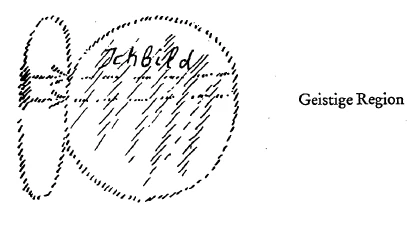
[ 15 ] Yes, you see, your true nature lies somewhere in the spiritual realms. There is your body. This body becomes a mirror and, of its own accord, reflects the image of the “I” back to you (see drawing). The “I” is there, but the image of the “I” is reflected back to you by the body. You become aware of this image of the “I” when you look there [at the body], looking with the human being of whom most people today know nothing, yet within whom they live. Thus, your “I” is reflected back to you by the body, as are your thoughts, feelings, and impulses of will. All of this is reflected back. And behind this image of the “I,” there is the body (see drawing), and the human being calls these images, which are reflected back to him, his soul, and behind the soul he perceives the body. He relies on it. But this image—with the body beneath it and the “I” emerging from it—must change completely. It is an image perceived entirely passively, one that is perceived in this way only because the body lies behind it. One must learn to perceive differently. One must learn to perceive oneself: There you are in a spiritual world; there are not plants, minerals, or animals, but rather angels, archangels, archai, and the other beings of the hierarchies—within them one lives. And because they permeate one, one radiates the “I” (see drawing on p. 100).
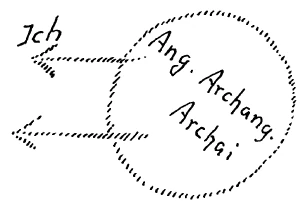
[ 16 ] One radiates this “I” out from the spiritual world. One must learn to feel this “I”; one must learn to feel that one has that “I” within oneself, behind which the hierarchies stand just as the body—which is composed of the three kingdoms of nature—stands behind this “I,” which is merely an image. One must move from the passivity of experience into complete activity. One must learn to feel: You create your true “I” from within the spiritual world. — Then one also learns to feel: Your “I” is reflected back to you through the body, which belongs to physical existence.
[ 17 ] This is a reversal of inner feeling, and one must become attuned to this reversal of inner feeling. That is what is important, not collecting data. The data will come in abundance once one has first experienced this reversal of feeling. Then, when one thinks in this active way, thoughts arise that can also enrich social thinking. If one merely allows the “I” to be reflected, the only social matters that come into consideration are those that, as I said yesterday, arise through the rearrangement of language. Only when one seeks to be active within one’s “I” does one also conceive of free thoughts.
[ 18 ] In earlier centuries—which are not so far behind us—this free thinking was still present in people, albeit stemming from atavistic, ancient dispositions of the soul. People simply regarded it as an ideal, driven by instinct, to rise to this level of free thinking. In the future, we must do so consciously. There is external evidence for this. Just take a look at the doctoral diplomas from Central European universities. People are usually not merely awarded doctoral degrees; rather, they are awarded degrees as “Doctors” and “Masters of the Seven Liberal Arts”—arithmetic, dialectic, rhetoric, and so on. This no longer makes any sense today, for nowhere in university life today do the seven liberal arts still exist. This is a remnant, a legacy from ancient times, when university life sought to liberate thought and to cultivate a spiritual life capable of rising to truly free thinking. People no longer understand what the liberal arts are. They are called “arts” precisely because they were cultivated in a sphere beyond mere sensory life, just as one develops the artistic life of the imagination freely and independently of sensuality. What still appears on these university diplomas once existed—just as many other things that still exist today in the formal structures of university life once did. This “Magister artium liberalium” is a very characteristic example.
[ 19 ] And so you must realize that this sense of self-awareness in aliveness must be regained. But it is uncomfortable, because people today do not want to walk on their own two feet, but rather on crutches. That, however, is what people today regard as an ideal; they want the external sensory reality to constantly present them with exactly what they are supposed to think. People find it uncomfortable that what is actually meant to be thought must be experienced in free spirituality, because it truly requires a breaking away from the comforts of life—a breaking away from everything that serves as a support, as a crutch, guiding us through our soul life. And when one speaks from the standpoint of a kind of thinking that truly has nothing to do with the sensory world, but rather draws entirely freely from intuitions, then people do not understand it. That is why my Philosophy of Freedom was not understood, because it can only be grasped by a person who truly wants to develop free thoughts, who is truly, in a new sense, a “Master of the Liberal Arts.”
[ 20 ] These are the things that must be understood today with the right sentiment and the right sense of gravity. In particular, I would like to say to our English friends, who are here only for a short time: It is necessary to view this landmark of our building, which has been erected here on this hill, precisely as an outward symbol of the defining characteristics of our time. Let this building stand so that through it a message may be sent to the world: You may think in the old way, as you have been accustomed to doing for four centuries in your sciences, but in doing so you will bring about the ruin of humanity. You may seek socialism in a comfortable way, relying on crutches, but in doing so you will only perceive that which already contains death within itself. What is necessary today is to find a way of thinking for the life of the soul that is as free as the forms from which—whether architectural, sculptural, or painterly—an attempt has been made to shape this building. That this be said at a single point on Earth—not merely through words, but also through forms—that is what is at stake here! And one should sense that through these forms something different is to be expressed here than what is otherwise heard in the world today—but that what is said here belongs first and foremost to what is eminently necessary for the further development of humanity, both in terms of knowledge and in social relations, with regard to all sciences and all branches of social life.
[ 21 ] Now I would like to say the following—to everyone, of course, but first and foremost to our English friends: You see, there is a possibility that the interest that existed when construction began here might wane, that this interest will not be present to the necessary extent in the future—in the very near future. What would happen then? This building would remain unfinished, for it still requires great sacrifices. Without great sacrifices, it cannot be completed. This building would remain unfinished; it would stand as a torso. It is entirely possible that this building would have to remain standing as a torso. Whether it does not remain a torso will depend on whether people bring the right understanding to the purpose this building is intended to serve—a purpose I have sought to express in various ways precisely in these reflections here before you.
[ 22 ] Do not regard it as a departure from idealism or spirituality when it is said that it is necessary for this building to be constructed with external funding, and when attention is drawn to the fact that this external funding must indeed be available. Certainly, you might say that this is materialism, and that true spirituality consists in not concerning oneself with material matters. But if, for example, you were to return to England now, it would be a mistaken stance if, upon arriving there, you were to speak only of this at the present moment—when so much depends, first of all, on this building being completed, yet there is such a strong possibility that it might remain an unfinished structure—it would be completely wrong for you to say: “Yes, after all, what matters is promoting the spiritual!” — No, when it comes to idealism and spirituality, it is not a matter of then becoming stingy with regard to material sacrifices. Stinginess regarding material sacrifices is not yet a sign of spirituality. And even if one doesn’t quite admit to what I’m getting at now—many people have this idea lurking in the background: Since this is a spiritual matter, there’s no need to make material sacrifices for it! One can certainly allow oneself to admire spirituality, to revere it, to be devoted to it, but keep one’s purse strings tight. — It simply won’t do to practice our spirituality by keeping our wallets tightly closed! On the contrary, we will show that we truly understand what is supposed to happen here when we express our idealism and spirituality not by saying, “We can be spiritual and idealistic even with our wallets tightly closed,” but by opening those wallets. For a great deal actually depends on those open pockets: after all, the material aspect is really, isn’t it, the insignificant part here. So let’s not regard it as all that significant—let’s just say, let’s allow for the pocket. If we regard it with the necessary sense of its insignificance, then things will fall into place. But we need a little strength for this, because, of course, we have to go to the people and encourage them to develop a willingness to make sacrifices. They don’t want to do that right away. Nor is it enough simply to teach people about this matter in a way they already understand. People are now making many demands on us: we should do this or that for these or those people who might then open their wallets—though I don’t believe they’d open them very widely—but who might then open their wallets; we should, as much as possible—yes, just as one sets up glue traps when birds are to be caught in them—we should, as much as possible, so that people understand, do this and that. — But that is precisely the point: that we are to instill a new understanding in people and that they are to be inspired to open their wallets—which requires a very strong sense of inspiration in many people! The point is that they should open their wallets for something new that they do not yet understand, and that they should truly open their wallets for the spiritual as well.
[ 23 ] You see, I seem to be speaking in material terms as well. But, my dear friends, I haven’t said what I’m saying today for years, and I can assure you: remaining silent has, for the most part, helped far less than I hope that speaking up will help now. I would gladly refrain from speaking about such things if my silence had helped! And that is what matters, after all—that it helps. And it is very necessary today, my dear friends. But do not think that I am trying to claim: Go to England now and simply tell the people that those in Dornach want money first and foremost; that is not what I mean at all. Rather, the point is that money is completely meaningless and worthless if it is not used in the service of the most spiritual of all, if it is not used to ensure that precisely what is spiritually intended here resonates throughout the world. If that were not the case—if it were not possible for the very spirit that is to be embodied here to vibrate through the world—then we have no need for the building; let it remain a torso!
[ 24 ] So, on the one hand, serve the spiritual—which is what is intended here—with complete devotion; on the other hand, however, make it possible for this spiritual aspect to exist in the world as well. I can assure you: I would not have addressed this appeal to you today if it were not necessary. Have at least enough trust in me to believe that I have decided to make this appeal out of a certain necessity, because I realize that it is necessary for you, as you cross the Channel, not to think merely: ‘We are now spreading the spiritual teachings; as for the rest, let those in Dornach figure out how to finish their building, since that is, after all, just something material’—it would be nice if I could speak that way, but it is not possible today, for it is urgently necessary; I must say this once again in a very matter-of-fact, realistic way: it is urgently necessary, my dear friends—please forgive me for stating this so bluntly—that in the near future we receive a great deal of money for everything that needs to be done, quite a lot. I truly am not saying this out of greed, but rather because only by clearly stating what I just had to state clearly will we prevent what is being begun here from becoming a half-finished project. So I would like to address my English friends in particular: when you return from the Emerald Isle, please do not forget to work among your friends and so on—even in that direction which is somewhat uncomfortable for me, the one I have now set forth in a certain tone. It is very, very necessary. Next Friday at seven o’clock we will have the next lecture. — I would just like to add that I have also spoken on behalf of those who will not be crossing the Channel in the near future.