

Contrasts in Human Development
GA 197
24 June 1920, Stuttgart
Translated by Steiner Online Library
Fifth Lecture
[ 1 ] Since I have another opportunity today to speak to you—precisely as friends of the anthroposophical movement—before I depart, I would like to fulfill what is, in a certain sense, a heartfelt desire of mine: to discuss a few things that need to be discussed now. Perhaps most of what I have to say today will be a sort of repetition of things that have been mentioned frequently from a wide variety of perspectives—things that are already playing a role in the reflections presented in public lectures. But for certain reasons, it is nevertheless necessary that we discuss some of these matters once again today.
[ 2 ] As I have often emphasized, it must be understood by a sufficiently large number of people—if the decline into which we, as the present civilized world, have plunged is not to lead to complete ruin—that present-day civilization must be imbued with certain impulses that can come only from an understanding of the world through the spiritual sciences in the broadest sense.
[ 3 ] Materialism, which has been on the rise in the European world for the past three to four centuries, reached its peak in the 19th century and ran rampant in the 20th century; this materialism has a peculiarity that appears particularly paradoxical if one does not know how to properly address the underlying reasons at play. Namely, this materialism is characterized by its complete inability to recognize the material world in its true reality. I may have already given you an example of this here. Everywhere, based on modern materialistic thinking, one finds the view—which has taken hold among the general public—that our heart is a kind of pump within our organism that pumps blood through the body. This view of the human heart as a pump is elaborated today in a wide variety of forms. But that is not the case; rather, reality must be understood in such a way that we say: Our entire rhythmic circulatory system is a living entity, and not something that can be compared to channels or the like through which water flows, driven into its cycle by a pump. Our rhythmic circulatory system, our blood system, is a living entity. Its vitality is sustained by various factors, the most basic of which are: breathing, hunger, thirst, and the like—that is, things that are entirely of a spiritual-soul nature. Entirely primary sources set our living blood system in rhythmic motion, and what constitutes the movement of the heart stems from the fact that this spiritual element intervenes in this blood rhythm. The blood rhythm is the primary, living force, and the heart is carried along by this blood rhythm. The facts are therefore completely contrary to what is proclaimed today by conventional physiology from every pulpit and is thus also drummed into people in school and from earliest childhood.
[ 4 ] We must therefore say: Materialism has not even been able to recognize, in reality, what the material processes in the human organism are that relate to the heart. It has completely misunderstood the material aspect. But this is just one example among many. It is precisely the material aspect that has remained completely unexplained under the influence of materialism. The heart is not a pump; rather, it is something that can be regarded more as a sensory organ integrated into the human organism, so that a person, in their subconscious, has a kind of subconscious perception of their circulation through the heart—just as one has a perception of the colors of the external world through the eye. The heart is, in essence, a sensory organ integrated into the blood circulation. Today, however, the exact opposite of all this is taught.
[ 5 ] Well, this seems to be a rather obscure example. I can imagine that some philistines today might be inclined to say: What harm could it possibly do if people have a completely wrong view of the nature of the human heart! Rather, one must admit that it has a generally alarming significance if all doctors have a false view of the nature of the human heart. For whether doctors have a correct or false view of the heart, much in human life depends on it. — But that’s how it is with other things as well. And because everything in life is interconnected, humanity today is downright filled with nothing but inverted thoughts, with completely reversed ideas. And one could believe, if one only wanted to, that this fixation on inverted thoughts is now ruining our entire way of thinking. For that is indeed what it does. Our thinking is thoroughly ruined by the fact that, in the most diverse fields, we become accustomed—because it is drummed into us from childhood onward—to thinking the opposite of what is real. As a result, we never develop a confident, purposeful way of thinking. For how can purposeful thinking emerge—for example, in social life—if, in matters where the truth must be sought above all else, we are following the opposite path?
[ 6 ] But you see, even today, certain things that are important to know remain completely hidden from people. When the human organism is examined today in standard institutions—in physiological and biological laboratories, clinics, or other facilities—one examines, say, the brain by analyzing it piece by piece, just as it appears at first glance, and one examines the liver by analyzing it in exactly the same way. But in doing so, one never looks at anything that is specifically relevant to understanding the human being. Our entire central nervous system today—and everything governed by it—is something fundamentally different from the rest of our human organism.
[ 7 ] I’d like to show you what underlies this in the following way: It’s something you can draw as shown below. I want to gradually lead up to what I actually want to say. You could say: Human beings have two organs of perception, whose directions of perception are roughly these (see drawing, a). And in a certain relationship to these directions of perception are two other directions of perception, which, if I were to draw them schematically, would look like this (b):
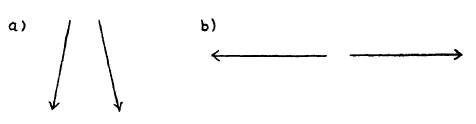
[ 8 ] These are the four directions of perception that humans have, the lines of which run as I have depicted them here.
[ 9 ] I deliberately did not specify where in the human organism these directions of perception are located. If I draw here nothing more than two directions (a)—which one extends, so to speak, and through which one perceives—and there two others (b)—through which one perceives laterally—then it is completely irrelevant whether these are the directions of sensation or feeling that run through my two legs, and whether those are the directions of sensation that run through my arms. There you have something that corresponds. I perceive, so to speak, my own weight by standing on the ground with my two legs. There I am truly perceiving something. And I perceive something every time I extend my hand or arm, even if I’m not touching anything. I can draw that like this (a). But I can also mean something entirely different with the same drawing. Imagine I have the horizontal line; then I can use these two directions to represent the two eye axes, and I’ll draw the two eye axes like this. And with this direction (b), I can refer to the direction of the ears, and I can use the same pattern for perceptions involving the eyes and ears. In one case, I have the entire organism—merely rotated at a right angle—in my mind; in the other, it is located within the rest of the organism. From a certain higher perspective, both are the same. Our two legs are merely directions of perception made flesh, which we also possess in a more spiritual sense, as they extend from the brain through the eyes and perceive colors there, while otherwise we perceive gravity and everything associated with it. We see our weight and we step on the colors, we might say, if we wanted to confuse the two things—but in a completely organic way. I hear the chalk; I touch the C or C-sharp. That is only a gradual difference. What is up there in the head is turned at a right angle, more spiritual; the other is in the vertical plane and is material. But in the end, both boil down to the same thing. I am aware only of the one—of the colors my eyes perceive, of the sounds my ears hear—that is within my ordinary consciousness. As for what my legs perceive regarding the relationships of gravity, and what my arms perceive regarding all other relationships that come into play, all of that is in the subconscious. And what is in the subconscious are the relationships of the cosmic. Through this entire subconscious, I know the cosmic; I know the relationship of the Earth to the other celestial bodies; I know that which is universally connected to gravity. With my arms I hear the music of the spheres—not, of course, with my ears. So we can say: We consist of our so-called lower organism, which possesses a subconscious cosmic consciousness, and of our head, which possesses an earthly consciousness—but specifically a “conscious” consciousness. The entire human organization is shaped around this distinction. How we are physically formed depends entirely on these opposites. And as you know: what we carry today as our head is the transformed body from our previous incarnation, our previous earthly life, while the rest of our current organism will become the head in our next earthly life. We undergo this metamorphosis from one earthly life to the next. The head is therefore the remaining, transformed organism. It is, so to speak, more perfect, more complete. And because it is so, the legs have become so delicate that they extend from the eyes as threads of sight and feeling, in order to step with the utmost agility upon the colors. The arms of the previous life have become so ethereal that they now extend from the ears and touch the sounds.
[ 10 ] Consider, for a moment, these concrete insights gained by human beings. After all, it accomplishes nothing if people simply know that there are repeated earthly lives and so on. These are, after all, dogmas—and it makes no difference whether one holds to the dogmas of the Catholic or Protestant Church, or whether one holds to the dogma of repeated earthly lives. True thinking begins only when one delves into concrete events, only when one can grasp: You look at the human head, and there you see it as the transformation of your body from your previous earthly life—which you must, of course, imagine as headless, for that previous head is itself the transformation of a body from an even earlier earthly life. But in what you now see as the head, you see the transformed organism of the previous earthly life. And in what you now see as the rest of the organism, you see what will become the head in the next life—where the arms will have metamorphosed into ears, and the legs will have metamorphosed into eyes. Only when one looks into the material world in this way and comprehends it in its spiritual transformation—when one possesses a spirit capable of shedding light upon the material world—only then is what humanity needs today truly present. And only when the human spirit has been organized in such a way that it no longer proclaims such follies as were proclaimed—particularly in the second half of the 19th century—as possible social views, only then is one truly ready to gain social views that can be brought into the world as realities. It is necessary today that this be thoroughly understood. It is a serious matter that people today are saying to themselves: What is revered as the science that has developed, what is proclaimed everywhere—that must be replaced by something else. There is simply no other way.
[ 11 ] It is nonsense—as I also said recently in a public lecture—to talk about establishing adult education centers and to believe that what is being done today in our regular universities can be transplanted into those centers. What is being done at our universities is precisely what has driven us into these catastrophes, because it has been the fundamental materialistic mindset of a few leading figures; now it is to be carried out among the masses—that is, millions are to be led into the catastrophes into which they were led by the false intellectual guidance of a few. What is of no use to a few is now to be spread among the many. The dissemination of public education is not as simple as just carrying out what exists at universities, for in doing so, one is spreading what is fundamentally unsuitable for human beings. This may sound radical today, but it is absolutely essential to see through this if one even remotely considers that the decline should not be allowed to continue, but that a process of rebuilding must take place.
[ 12 ] That is what we would like to be able to talk about in words that truly touch people’s hearts. As many hearts as possible must be moved by these concrete truths. That is why I felt such a strong need to point out in public lectures how we have already managed, in our Waldorf school, to positively incorporate anthroposophy into history lessons in certain subjects. I could just as well have mentioned the anthropology lessons in the fifth grade, where anthroposophy also had an effect—not by teaching anthroposophy to the children—that would never occur to us—but by enlivening the lessons with what comes from anthroposophy, by allowing anthroposophy to flow into the curriculum. This has a stimulating effect on the children’s souls; they are transformed by these influences. It would be too easy simply to teach anthroposophy in schools. That is truly not the point; rather, the point is to know how to bring to life what is being taught to the children through anthroposophy. To do this, however, anthroposophy must become fully alive within oneself, and that is something that is so infinitely difficult: for anthroposophy to come alive in people. For it would already be possible today, in a certain sense, for the most diverse branches—not merely of science, but, I would go so far as to say, the most diverse branches of life—to be permeated by what can come through life in anthroposophy.
[ 13 ] That is a general observation. I would like to follow up with a specific analysis from which you will be able to see how the various factors under consideration here are connected.
[ 14 ] You know, in the Marxist worldview and philosophy of life that is widespread today—and which finds its most radical expression in the world-destroying ideologies of Leninism and Trotskyism—the so-called “materialist conception of history” plays a major role, particularly the dogma of the fundamental influence of the relations of production. It is a dogma to which millions of people from the proletariat subscribe today—the dogma that what constitutes customs, law, science, religion, and so on is something that, like smoke, like an ideology — you can read more about this in the “Key Points” — while the relations of production are the only reality, the basis upon which one must ground one’s view of history.
[ 15 ] At the time, I considered it of particular importance—and this is actually connected to my overall belief that I was able to accomplish something at the Berlin Workers’ Educational School that could have served as a starting point—to speak in an enlightening manner in proletarian circles about this view of the sole influence of relations of production on human development, and I therefore sought to proclaim not a materialist conception of history, but the truth. That was, in fact, the reason why I was expelled—because at that time it was just as repugnant to the leaders as the idea of the threefold social order is today—since, in fact, within the socialist movement back then and even today, there was and is a much more blind sense of authority and belief in authority than there is in the Catholic Church.
[ 16 ] But you see, what this is really about is seeing through—truly seeing through—how things are interconnected in the world, even in a social sense. Anyone who gains a true insight into what I have indicated in my book The Mysteries of the Soul as the natural threefold structure of the human organism—anyone who understands this division of the human being into the nervous-sensory organism, the rhythmic organism, and the metabolic organism—thinks in such a way that they can then apply this way of thinking to social life as well. When one does something like this, the fools of today come along and say: “You’re drawing analogies; because the human body is tripartite, you’re also dividing the social organism.” — That’s nonsense! The “Key Points” certainly do not do that; they do not work with analogies. They merely state that if a person can free their thinking from the straitjacket into which it has been constrained by contemporary scholarship and, in particular, by contemporary public life, he frees that thinking—by grounding it in what corresponds to reality within the human organism—to such an extent that he can also think properly in the social sphere, whereas thinking that places the human brain alongside the liver and examines everything as identical substances can never arrive at a reasonable understanding.
[ 17 ] If one were to draw such external analogies, one would say: We have the threefold structure of the social organism and the threefold structure of the human organism. The head is the spiritual organ, so it must be compared to the spiritual life of the threefold organism; the rhythmic system, which brings harmony between the various functions such as heart activity and respiratory activity—that is, the right side of the social organism; metabolism, the coarsest and most material aspect, the very thing upon which the mystic looks down with a certain disdain, even though he, too, acknowledges that he must eat and drink—this is compared to the economic life.
[ 18 ] But that is not the case! I have often pointed out on other occasions that, in reality, things are different from what one might believe based on mere analogies—for example, one cannot say that summertime can be compared to the Earth’s waking state and wintertime to its sleeping state. The truth is different. In summer, the Earth sleeps; in winter, it is awake. I have, in fact, explained this in detail.
[ 19 ] But this is also true when one focuses on reality rather than on analogies when comparing the social organism to the human organism. There, one must compare economic life in the social organism with human mental activity; as for legal life, one must—because it occupies the middle ground, which is why people were not mistaken in drawing the analogy—compare it with rhythmic activity. But spiritual life must be compared to metabolism. Thus, economic life is to be compared to the spiritual organs, and spiritual life in the social organism to the metabolic organs. There’s no getting around it. Economic life is the head of the social organism, and spiritual life is the stomach, liver, and spleen of the social organism—not of the individual human being. Of course, this is once again far too inconvenient when one is stuck in Spanish boots—that one must distinguish between social life and the life of the individual human being.
[ 20 ] Here, once again, it is essential to look at reality with a mind prepared by spiritual science, rather than resorting to analogies and convoluted symbolism. Then one can discover all sorts of important things. For example, one comes to realize that one can say: Yes, but if economic life is truly the head of the social organism, then it must, just as the human head does, draw sustenance from the rest of the organism. Then one cannot say that morality, knowledge, and religious life are an ideology that arises from economic life. No, quite the opposite! Economic life is something that depends on spiritual life, on the metabolism of the social organism, just as the human head depends on breathing, on the stomach, liver, and spleen. Then one comes to realize that economic life is what arises from spiritual and religious life. If a person had no stomach, he could have no head. Of course, they could not have a stomach either if they had no head, but ultimately the head is nourished by the stomach, and in the same way, economic life is sustained by spiritual life—and not the other way around. Therefore, it is a delusion—a terrible superstition—that today threatens to spread throughout the entire civilized world as socialist theory, because no one in recent centuries has been concerned with seeking out the truth; rather, everyone has simply proclaimed as truth, out of emotion, whatever suited them according to their class and their point of view. Only now do people realize what a delusion it is to regard the relations of production as the foundation of historical events. For people are now beginning to truly compare the facts, rather than propagate analogies. People are now looking at things in the right way and realizing that when metabolism is undermined in the human organism, the mind suffers; that is, whenever the ethical, the religious, and the life of knowledge are undermined, a healthy metabolism does not function in the social organism, and economic life must then collapse. Nothing depends on economic life at all; rather, everything depends primarily on worldviews, on ideas, on the spiritual life of human beings.
[ 21 ] And just as our mind is, in fact, constantly dying—as I have explained in other lectures—just as we sustain our mental organism only because it is in a state of constant dying, against which the rest of the organism rebels, so it is with economic life. Economic life is that which continually brings about the withering away of humanity’s historical progress; it does not drive the rest out of itself, but merely brings about the death of everything. And this death must continually be counterbalanced by that which is brought forth within the spiritual organism. Thus, the exact opposite is true. Anyone who claims, in a materialistic sense, that economic life is the foundation of what progresses is not speaking the truth. The truth is that economic life is the foundation of that which repeatedly dies in stages, and whose death must be counterbalanced by the spirit. To proceed as is currently being done in Russia means to help the world die. If one continues to work in this manner, there is no other possibility than to help the world die, for the simple reason that the law of decay is inherent in what is being done there.
[ 22 ] You can see what socially significant issues are at stake here. This is what I have been trying to convey time and again, in a variety of ways, for the past two decades, since anthroposophy has been practiced among us, to shed light on this through various lectures and to make it clear that for us it is truly not a matter of cultivating an inner, spiritually self-indulgent worldview and outlook on life—a kind of spiritual snobbery—but rather of addressing what the age needs as its most important impulse.
[ 23 ] I wanted to speak about this once again today in a slightly different way, in connection with various matters that can shed light on the nature of the human being, because it is now important that those who profess to be friends of our anthroposophical movement understand the connection between this anthroposophical movement and what else is currently taking place among us.
[ 24 ] Since everything that comes from me or other friends is often discussed in a rather distorted way these days, it is indeed difficult to speak quite freely to a large gathering—even an anthroposophical one—but because we have no other opportunity to speak so freely in a smaller circle, and because these matters must be discussed, certain points must be brought to your attention. We must be aware—especially here in Stuttgart—that what we have held dear for two decades as the anthroposophical movement has indeed entered a new stage, and that, if we are sincere about this movement, we have thereby taken upon ourselves the obligation to go along with this shift and adapt to it. You simply need to grasp this clearly: the fact that our friends Molt, Kühn, Unger, Leinhas, and a few others here have attempted to draw the practical consequences of the anthroposophical view of life means that something has happened that concerns us all—so deeply that we must take it into account in our entire conduct. The fact is that up until then—let’s just take a very clear look at this—the anthroposophical movement was a world current. A spiritual world movement is, after all, something spiritual. Something spiritual goes its own way. Cliques may form; even the most reprehensible little cliques may form, with their personal and who-knows-what other interests; a spiritual movement can even rise above such a “misguided” figure as Max Seiling. Of course, one must deal with it properly in one way or another, but as long as it is merely a spiritual movement, it can be overlooked. But now we have, after all, distilled three things from this spiritual movement.
[ 25 ] The first was the one that followed my appeal from last year. This evolved into the Threefold Social Order Movement—which is still questionable today—and the League for the Threefold Social Order, which, in fact, has not yet been able to come even close to achieving what was originally intended. For what was intended by the appeal has, in a certain sense, been rejected, and it would be good if there were a full awareness that it has been rejected, that not even the slightest part of what was intended by this appeal has been fulfilled.
[ 26 ] This naturally compels me to do certain things. For example, when the idea arose in Dornach that we should issue another appeal to make clear to the international community what Dornach means to the world, I had to explain to my friends: Yes, out there in ordinary life—which is now heading toward collapse—people are accustomed to issuing appeal after appeal, program after program. But that cannot be done from within the anthroposophical movement. The point here is to realize that, in a certain sense, it is extremely unhealthy to do anything that is not likely to succeed. The point is to assess the chances of success in the most precise way possible—not merely to do whatever happens to come to mind, but to do only what can succeed. That is why I said at the time—and this is important, and I ask you to consider it—that it will not occur to me to issue another appeal in a similar manner, for what happened with the first appeal must not happen a second time. — I could still allow the Cultural Council’s appeal—which I did not initiate myself—to take place here, but one must be clear that things are beginning to be far more serious than people today are inclined to perceive them when something like the anthroposophical movement is in the background.
[ 27 ] We have now, so to speak, identified three aspects of the anthroposophical movement, each of which represents something entirely different:
[ 28 ] The three-part structure outlined in that appeal—we must work on it, because it is partly rejected; the second part is the Waldorf School; the third is the financial, commercial, and industrial enterprise “Der Kommende Tag.”
[ 29 ] Back in the day, when we only had the anthroposophical movement—I’m speaking only of Stuttgart today—I came here to Stuttgart; I was there for perhaps three or four days, but you know how many people I was always able to speak with individually. All of these were things that, as success now shows, were of a certain significance. It was not insignificant that what had happened in the meantime—people will understand me if they want to—could be put back into perspective in such conversations with individual people. Then the work could continue until the next time. Well, as things stand at the moment, now that these external circumstances have taken shape, we are actually dealing with meetings from morning until evening, even into the night, and there can be no question of continuing those old habits that existed when we were still an anthroposophical movement. Many people perceive all of this as nothing more than an inconvenience—that things are no longer as they used to be. But it is necessary to look at the entire shift and truly say to oneself: Things have changed somewhat since last spring, and that must be taken into account.
[ 30 ] Things certainly cannot remain as they are now, but for them not to remain that way, we must work toward that end. It cannot remain this way for the simple reason that everything that happens—whether for the Waldorf School, the Threefold Society, or The Coming Day—arises precisely on the basis of spiritual work. Without the spiritual work that has been done and must continue to be done, none of this makes any sense. This spiritual work must give the whole its form, its strength, and its substance. If we were to reach the point we would reach if things continued this way, the result would be that the current institutions would devour the original spiritual movement; in doing so, we would strip the movement of its original foundations. That which grows out of the anthroposophical movement must not devour the anthroposophical movement itself.
[ 31 ] As you can see, I have to discuss some very serious matters today, and at least some of you will understand me. But the situation cannot change unless we acknowledge the reality that, from an anthroposophical perspective, work has indeed been going on for many years—for decades. This work must be recognized as a reality.
[ 32 ] Now I ask you to consider one more thing: There is much struggle in the world, but where, in fact, is the struggle greatest? It takes place only in a certain form; one does not notice it, but it is most prevalent in spiritual life. And, for example, in what is called the anthroposophical movement, there is indeed no end to the struggle. As our movement took shape out of the old customs—we had to build upon them, you know why—our movement took shape, that is, many people with the old theosophical habits joined our movement, I had the feeling that a gentleman who at that time was a particularly fierce defender of our very direction would very soon be arguing with all sorts of other people; for conflict is something that emerges there in a truly terrible way. Yes, I have even always emphasized: The gentleman who is such a genuine Theosophist will not only quarrel with other people, but his left and right halves will engage in a terrible struggle. We will see that the left side of this personality will quarrel with the right in the most terrible way.
[ 33 ] It goes without saying that the other pole must be developed—the pole that must overcome the constantly present struggles arising from the very nature of every spiritual movement, since every spiritual movement works toward individuality. The other pole must be present—the pole of human understanding, the pole that consists in being able to penetrate into people, to immerse oneself in the life impulses of another human being, and so on. It must be possible for what we now do as the Threefold Social Order initiative, what we do as “The Coming Day,” and what we do as the Waldorf School to be supported by a sound moral foundation of our anthroposophical movement here in Stuttgart—the moral foundation that has been developed over decades, or at least should have been developed. It must be grounded in this, for only in this way can we move forward and regain a balance between our life in meetings and the necessary spiritual work, which must, after all, form the foundation. But of course we cannot get to that point if such things are constantly happening here—such as being told: “Something terrible has happened again; there is a person who is constantly stirring up trouble, who is harmful to everyone else.”—That may be the case; it may be true. But so far—even though I’ve encountered such things countless times during my current stay—I haven’t managed to follow up on any such matter to the point where, when I spoke to the second person, they would have told me the same thing as the first. And by the fifth or sixth person, it had already become the opposite of what the first had told me. Yes, I am merely stating facts. I do not wish to criticize; I do not wish to reproach or praise—truly, not even the former—but that is how it is. What is necessary, however, for this to develop precisely on anthroposophical ground—as I have often explained—is an absolute, unerring sense of truth. It is very difficult to continue working on all these matters if the foundation of truth—of immediately real truth—is not there. If this foundation of real truth is present, then it must be the case that when something comes to you and you follow it through to the fifth or sixth instance, it still presents itself in the same way. But I find that when I’m told something that is “terrible,” everyone I ask says something different. Of course, I cannot apply in my outer life the things I know from other sources; I have often pointed this out. That is not the point—whether I know the matter or not, whether it is correct or not—but rather the point is whether the first person says the same thing as the sixth or seventh; it is not about my knowledge. As a rule, I do not allow myself to be led into illusions, nor do I ask anyone about it at all, but for entirely different reasons. I’m usually not very interested in what I’m told, but the point now is that I can look at what the first person says and what the seventh says, and very often it turns out that one says one thing, while the seventh says exactly the opposite. Now I believe that something follows from this with a certain degree of evidence: that one of them is not true. That seems to me to follow from this.
[ 34 ] Yes, in outer physical life—which is now heading toward decline precisely for this reason—people have consistently refused to acknowledge the function and the far-reaching significance of untruth. Even when it is unintentional, untruth still has a destructive effect. From the perspective of anthroposophically oriented spiritual science, one must recognize under all circumstances: What is a destructive bomb in physical life is untruth in the spiritual realm. It is a destructive force, a destructive instrument—and indeed, a very real destructive instrument. It would indeed be possible, despite the many foundations that have been laid, to achieve great and fruitful work in the spiritual realm as well, if one were to give these matters some attention—but an objective attention, not a personal one.
[ 35 ] You know it’s not my style to deliver scathing tirades; lecturing on morality isn’t my style, after all. But I really must address some facts that have struck me particularly hard right now, because we find ourselves in a serious situation. We are facing undertakings that must not fail, that must succeed—undertakings where there can be no question whatsoever of them failing in any way, and about which we must say today: they will succeed. But whether they will devour the original anthroposophical movement depends on each and every one of us truly contributing to ensuring that what should have emerged morally from decades of work is actually present. Everyone must contribute to this. It is absolutely necessary that everyone contribute to this.
[ 36 ] It pains me deeply that I can fulfill almost none of the requests that are now coming my way in such great numbers. But I must always turn my friends away, because time simply cannot be doubled—and meetings go on not just from morning to evening, but well into the night. Of course, one cannot speak with individual people all at the same time. But if not—things are interconnected — through a process of self-reflection among the broadest circle of our collaborators, these things that play such a role in all life here and are characterized precisely by what I have just described—if these things are not eliminated through each individual’s introspection right here and now, then it is simply impossible to find the time to carry out the truly fundamental spiritual work. What anthroposophy has led to will succeed. But if changes do not occur in certain areas, then it will consume the original spiritual movement, and then—through the will of the so-called bearers of this spiritual movement—we would end up with a new materialism, in that the spiritual movement that underlies it would have been allowed to die out. The spirit must be nurtured if it is not to die out. And materialism does not exist by itself, so to speak; materialism cannot be established any more than one can create a corpse. A corpse comes into being when the soul leaves the organism. In the same way, everything that is created here on spiritual foundations, out of the animated, can become merely material if there is no inclination to truly nurture the spiritual. For this, however, it is necessary, above all, to carefully consider the moral foundation—the ethical foundation—that has been developed. Above all, one must carefully bear in mind not to succumb to illusions, not to be satisfied with judgments that are convenient, but to look at life without compromise.
[ 37 ] It is truly very bad when, for example, one says: “Threefolding is a wonderful thing; one must adhere to it,” and because one then feels so good, one says: “I am now founding something that is entirely in the spirit of threefolding; then I am a good person.” I can feel like such a good person when I establish something that is at the heart of the threefold order. — You can morally lick your fingers out of sheer inner delight when you do something like that, but you don’t need to have a sense of reality because of it. For the idea of the threefold social order is precisely such a realistic idea because one must strive with all one’s might to translate it into reality. But because of the unrealistic spirit in many people, it is so repulsive that, above all, it must first take root in a sufficiently large number of minds. One must possess the necessary sense of reality and practical sense.
[ 38 ] Eight days ago, I had to speak here about the consequences of the threefold social order for land management. I said that the threefold social order naturally works toward a situation in which social exchange and social relations regarding land are such that land cannot be bought and sold like a commodity. This is something that arises entirely from reality, and the opposite situation is an illusion. I had to explain this on the very day I even arrived here late because we had spent the entire day driving around the countryside buying estates. If one has a sense of reality, one cannot adopt a position regarding the threefold social order that leads one to say: “I must surely be a good person; I form a core of the threefold order.” — No, one must accept without illusions that it is impossible today to work for the threefold order in a certain sense—to work precisely on what is most important—unless one draws it out of the immediate present.
[ 39 ] It is not a matter of morally licking one’s fingers just to say that one is a follower of an idea. That renders the idea sterile and abstract. Rather, it is a matter of seeing through reality, of recognizing what is necessary. That is the difference between utopians, dogmatists, and practitioners: the practitioner does indeed take the idea as far as it can possibly go, but he does not live in some unworldly realm merely out of inner self-indulgence; rather, he engages with reality. We truly indulge in illusions only out of inner self-indulgence. This must be understood. And there is much more that needs to be recognized along these lines. And I could not help but use this hour—even though there were many other things that could have been discussed—to point out precisely some of the things that have been shown to me in the most varied ways, just in passing, but which cut right to the heart of fruitful activity. This activity suffers above all because it actually always becomes necessary to engage in endless debates about matters that could be settled in half an hour, since things that really shouldn’t be there always get mixed in. If one is accustomed today to sound thinking—and one must become accustomed to this if one wishes to bring about the spiritual science that is being presented here—and if one is then placed and I’m not talking about theories here—into the midst of what goes on today in business life in so-called “practice,” then the best way to characterize it is that people kill time as much as possible; they waste time. For there are practitioners today who boast of being busy all day long. If they weren’t wasting time, their perhaps ten hours of work could easily be done in an hour. Time is being wasted precisely in today’s so-called practical life. And by wasting time, one causes the thoughts to become scattered. In fact, when one enters into this machinery of so-called practical life today, one has the feeling of being constantly in a pasta factory, where thoughts—which ought to be concentrated—are stretched out like strudel dough or pasta dough, where everything is pulled wide apart. It is appalling to encounter these stretched-out thoughts, which are cultivated today as a way of life. If one were to try to see through the world with these thoughts—to see through the very things I have spoken of today as an introduction—one would never arrive at anything. For this entire strudel-dough-like way of thinking has arisen precisely from the squandering of time, in which that which ought to be concentrated—and could only then function as thought—is stretched out and becomes nothing. For that which performs its functions with a certain density is, of course, no longer of any use when it becomes thin and insubstantial. And so much of what features in the modern economy is completely unsuitable for advancing the world in any way. It would be precisely our task to return to a more concise way of thinking, even with regard to practical life, and not to kill time. But today, time must still be wasted if the anthroposophical movement—which stands behind our very undertakings—is not what it ought to be: a thoroughly true movement in which that which is false is weeded out on its own, because it has no place within it, because it will immediately reveal itself.
[ 40 ] That is what I wanted to tell you today—without referring to anyone in particular; please do not repeat that I meant to single out this or that person. I wanted to describe general circumstances; I had to describe them, because we are facing serious global situations today, and, fundamentally speaking, what is happening here among us in Stuttgart truly reflects the gravity of the situation facing all of civilization. And from what is haunting us here, we could learn a great deal about what is haunting the entire world.
[ 41 ] It was not meant maliciously. Nor was it intended to be a philistine tirade, nor a pulpit sermon, but rather a discussion of what has, in fact, only indirectly come to my mind and touched my soul time and again over the past fourteen days.