

Spiritual Scientific Insight into the
Fundamental Impulses of Social Organization
GA 199
11 September 1920, Dornach
Translated by Steiner Online Library
Sixteenth Lecture
[ 1 ] I have now spoken in a whole series of lectures about the transformation that must necessarily take place throughout our entire civilization. And above all, what has been said in this regard has been said in a way that appeals to people’s will. We are living today in a cycle of human development in which people must find the inner initiative to contribute their own part to this necessary transformation. For it will be the substance of the human soul that must flow into objectivity, into outer life, and it will be up to human beings themselves to bring about what is to appear there. And in the current cycle of human development, one can no longer passively wait for some divine powers—entirely remote from human beings—to intervene in human development without human involvement.
[ 2 ] The point is that one must be able to understand such things in the context of individual phenomena of social life—and indeed of natural life as well—but today we are talking about individual phenomena of social life. I would like to start with a very specific fact. Let’s suppose that somewhere, someone introduces themselves—for the sake of argument, let’s say they send their business card first; on which it says: Edmund Müller. But what kind of person would you be if, after receiving this card reading “Edmund Müller,” you thought, “Here comes a Müller who grinds grain into flour!” For perhaps the person named Edmund Müller who has announced his arrival is, let’s say, a master builder or a professor or a court councilor or something else entirely. Isn’t it true that in such a case, no one is entitled to draw any conclusions from the name Müller? Rather, the point is that one might not even form any thoughts yet, but instead wait to see what lies behind the name Müller—or, if one knows from some other context in life, what essence, what real life entity lies behind this name Müller.
[ 3 ] In such a case, one realizes how wrong it would be to draw conclusions about the character of the person in question based on the name “Müller.” Or if someone introduces themselves as “Schmied,” for example, one would not assume that they are a blacksmith or anything of the sort. In other words, when faced with words that we perceive as proper names, we feel the need to use information not derived from the name itself to figure out what or who we are actually dealing with.
[ 4 ] Well, proper names, too, have gone through a certain evolution in this regard. Someone named “Schmied” today has nothing to do with a blacksmith anymore. Someone named “Müller” no longer has anything to do with a miller. But these names originally stem from the fact that in some village, back when naming conventions weren’t like they are today, people would say, “The blacksmith said it”—and by that they meant the actual blacksmith. Or “The miller said it or did it,” or “I saw the miller.” — Anyone who has lived in villages knows that people there often aren’t referred to by their proper names, but rather that one says: “We saw the blacksmith” or “the master builder” or “someone like that.” So originally, the name provided the basis for inferring, from the name itself—from the word—what lay behind the words.
[ 5 ] The same path that proper names take—a path we can already see with complete clarity today—will be followed by every word, indeed by the entire language, as we move forward into the fifth and sixth post-Atlantean epochs. Nevertheless, as human beings today, we are still, across almost the entire scope of language, in the process of deriving all our wisdom essentially from language itself. Essentially, our approach to the vast majority of language is to infer the thing itself from the words. One may find it convenient to infer the thing itself from the words; but the course of human development is precisely different, and one must approach such matters in the same way as—I would say—one approaches natural phenomena. In such matters, there are objective necessities. Objective necessities also exist with regard to natural causality in that realm of life which many people perceive and experience merely as a vague abstraction. After all—as I have often mentioned—it happens very frequently that people say: “Yes, I didn’t want this or that, I didn’t mean it that way; I meant something else; I had this or that intention regarding this or that.”—But no matter how strongly a child intends not to burn itself and reaches into the fire, it will still burn itself. The course of life is not determined by intentions that do not become part of life, but only—at most—by those intentions that truly become part of life, or indeed by the facts and the lawful interrelationships of these facts.
[ 6 ] Getting used to this way of thinking is, above all, necessary in the most profound sense from the perspective of the humanities. And so one must also get used to thinking: As nice as it would be to be able to stick comfortably to words, the fact is that the objective course and the objective laws of human development speak otherwise—they speak in such a way that the entire human conception, the entire life of the human soul, emancipates itself from words, and that words are increasingly becoming mere gestures, that they are increasingly becoming something that points to the entity in question, to the thing in question, but no longer fully designates or fully explains that thing. If one takes, for example, spiritual scientific descriptions seriously, then what people so often hold against me must inevitably happen: that one can no longer use words in the same way that it is customary to use words and sentences today. For when one advocates spiritual science, one is, in the most eminent sense, advocating a matter of the future; one is advocating something that must become the property of humanity in the future. One must therefore, in a certain sense, anticipate what is to come to pass in the future. One must take into one’s will that which is to come to pass in the future. And so spiritual science must be presented in such a way that the very words, in a certain sense, gesture toward the actual reality that lies behind them. And since what we think today in terms of social structure—as I explained yesterday—must be born out of spiritual science, it is also necessary that, particularly when it comes to matters serving social structure, we speak from such a perspective. That, for example, was what people absolutely refused to understand in my “Key Points of the Social Question.” People wanted to find, in the old style, something that simply cannot be presented in the old style, because it belongs to the future. And, fundamentally speaking, what we have here is best illustrated by the fact that virtually all the questions raised so far—from one side or the other—regarding the arguments in “The Key Points of the Social Question” are always based entirely on the old way of thinking, with no attempt whatsoever to engage with the transformed, new way of thinking.
[ 7 ] And so we can say: Above all, any depiction of future social relationships must first demonstrate that we must immerse ourselves in this emancipation of a spiritual life that no longer clings to words. Anyone who has followed my presentations in the various fields of spiritual science—and recently also in the social sphere—will find that I always strive to explain a subject from a wide variety of angles; that I generally use two sentences instead of one, because one sentence, so to speak, points to the subject from one side, and the other from the other side, and this evokes a sense in the listener or reader that they should, as it were, go beyond the words and sentences to approach the matter itself. This is what must be said regarding the transformation of the meaning of human language for human soul life. And this is an important matter. It is important because a large part of what occurs today amid the confusion of ways of thinking and concepts actually stems from nothing other than the fact that the objective, law-governed impulses of human development already demand that we free ourselves from language, yet people, out of comfortable habits of thought, simply do not want to let go of their attachment to language. And such a phenomenon, clearly understood, then leads to a deeper understanding of the entire course of human history. We can literally build a bridge to highly spiritual realities through this transformation of our language or our languages. Of course, this is more the case with one language than with another. But that is then a matter of the specific treatment of language and linguistic meanings in the individual, as I have described, differentiated territories of human civilization.
[ 8 ] We are now in the fifth post-Atlantean stage of human development, and we are approaching the sixth post-Atlantean stage. These stages of development are not such that one can draw sharp boundaries between one and the other; rather, one merges with its distinctive characteristics into the next, and the next stage casts its shadow—or, one might say, its light—far in advance of its emergence. One must grasp this light if one wishes to participate with one’s soul in the development of humanity. Let us connect the one, so to speak, supra-historical fact—that we are working toward the sixth post-Atlantean epoch—with the other fact, familiar to us all, that the human being, with his spiritual-soul nature, descends from a spiritual world into earthly incarnation through birth or conception, that he then lives out his life here on Earth between birth and death, that he then passes through the gate of death, and in passing through the gate of death, carries his spiritual-soul nature back into that realm of existence which is indeed of a purely spiritual and soul-like nature.
[ 9 ] Now we must be clear about this—and just how significant this is, for example, for the art of education, as has also been explained here recently—that we bring down from the spiritual world, at least in terms of its effects, what we have experienced in that spiritual world. Just as one normally, when leaving one place and perhaps going to another, carries not only one’s clothes but also one’s spiritual and soul aspects from the old place into the new, so too does one bring with one from the spiritual and soul world—through conception and birth—into this world the consequences, the effects, of what one has experienced in the spiritual world. And during the period that humanity has just lived through—and which we know began around the middle of the 15th century A.D.—during this period, human beings brought their spiritual-soul nature with them, along with formless forces of soul life, formless forces. That is why intellectual life arose and flourished particularly during this period. Thus, in a sense, something formless, something without image, was imprinted upon the human being during this period, before he descended into physical life through conception or birth. Hence, too, the limited capacity of humanity—which has developed since the middle of the 15th century—for original creations of the imagination. For in truth, the imagination is merely an earthly reflection of the super-earthly imagination. The Renaissance is no counterexample, for the very fact that one had to resort not to a “naissance” but to a “Renaissance” proves that an original imagination was not present, but rather an imagination that required fertilization from earlier times. In short, the soul was, in a certain sense, permeated by forces that are formless. And now begins—and herein lies, in many ways, the reason for the turbulence of our time—now begins the era in which souls from the spiritual world, as they descend into earthly life through conception and birth, bring images with them. When images are brought from spiritual life into this physical life, they must—under all circumstances, if salvation is to arise for the human being and for his social life—necessarily connect with the astral body, whereas the imaginal only connects with the “I.” And it was primarily the expression of the “I” that has flourished in humanity since the middle of the 15th century. But now the time is beginning when human beings must realize: Within you live images from your pre-birth life; you must bring these to life within yourself during your lifetime. You cannot do this with the ego alone; it must work deeper within you; it must work its way into the astral body.
[ 10 ] Now, it is generally the case with human beings that they are initially resistant to these images experienced before conception being incorporated into the astral body. People, so to speak, push back against what is meant to flow from the depths of their being into the astral body. The sobriety and prosaic nature of modern times are, after all, fundamental characteristics, and today there are even widespread movements that resist the idea that education should ensure that what rises from the soul and seeks to assert itself in the astral body is actually given free rein. There are dry, sober-minded people who would actually like to exclude education through fairy tales, legends, and anything imbued with imagination. In our Waldorf school system, we have specifically emphasized that instruction and education for children entering elementary school should be based on pictorial representation, on the vivid presentation of images, on the legendary, and on the fairy-tale-like. And even what children are to learn initially about the beings and processes in the animal, plant, and mineral kingdoms should not be presented in a dry, matter-of-fact way, but should be clothed in imagery, in legends, and in fairy tales. For what lies deep within the child’s soul are the imaginations received from the spiritual world. These want to rise up. And when the teacher or educator relates to the child in the right way, he presents the child with images. And as the teacher places images before the child’s mind, those images—or rather, the powers of imaginative representation—that were received before birth or, let us say, before conception, spring forth from the child’s mind.
[ 111 ] If this is suppressed—if the dry, sober-minded educator of today is the one who educates and teaches—then from an early age he introduces to the child something that is, in fact, completely foreign to it: letters. For the letters as we have them today have nothing to do with the old pictorial letters; they are, in essence, something foreign to the child, something that should first be drawn out of the picture, just as we try to do in the Waldorf school. We introduce the non-pictorial to the child; but the child has forces within its body—I mean, of course, the soul when I speak of the body; we also refer to it as the “astral body”—the child has forces within its body that will burst forth if they are not brought up into pictorial representation. And what is the result? These forces are not lost; they spread out, they come into being, they do enter into thoughts, feelings, and impulses of the will. And what kind of people does this produce? Rebels, revolutionaries, dissatisfied people—people who do not know what they want, because they want something that cannot be known, because they want something that is incompatible with any possible social organism—something they merely imagine, something that should have entered their imagination but did not, and instead entered their social antics.
[ 12 ] And so one can say that those people who, in an occult sense, are not sincere toward their fellow human beings simply do not dare to say: When the world revolts today, it is heaven that is revolting—that is, the heaven that is held back within people’s souls, and which then manifests not in its own form but in its opposite, manifesting in strife and blood instead of in imaginings, It is therefore no wonder at all that those people who participate in such destructive work against the social order actually feel they are doing something good. For what do they feel within themselves? They feel Heaven within themselves; but it takes on only a caricatured form in their souls. So serious are the truths we are to recognize today. To profess the truths at stake today should not be child’s play; it should be imbued with the very, very greatest seriousness. It is generally not easy to describe such things, for, first of all, one does not love them, and second, people cling to words. And anyone who says that “heaven revolts within the human soul” is, of course, interpreted according to the words themselves, and people fail to notice how he is first striving to show that there is something else one must know—something that causes one to associate the word “heaven” with something other than what one is accustomed to associating with it—just as when Mr. Müller announces himself, one does not automatically assume he is a miller who grinds grain. This emancipation from language is absolutely necessary in each specific case if we now truly wish to move forward in the sense demanded by the laws of human development.
[ 13 ] Here we see how elements that actually originate in prenatal life burst into social life. And anyone who understands these connections knows that what appears here on Earth as a caricature is, in fact, a reflection of what is truly heavenly. This applies to the social realm. But there is something else to consider as well.
[ 14 ] During the era of intellectualism—which has developed primarily since the mid-15th century—people drew extraordinarily little inspiration from their dream life for their waking life. Even those who have somewhat more vivid dreams tend to explain them in a completely rationalistic, intellectualistic way. The Theosophists, for example, are rationalistic and intellectualistic in this regard. The number of people who have come to me over the years seeking rationalistic explanations for their dreams could not be described in a small book—only in a large one! The point here is that even those images that unfold in dreams point to a deeper spiritual life. I have often said that in dreams, the external aspects are completely irrelevant; they have already become detached from the actual content. And what we receive there as content and then translate into the words of language—from which we actually already need to free ourselves—is not the true course of the dream; it actually has very little to do with the true course of the dream. What constitutes the content of the dream is the drama of the dream itself—how one image follows another, how knots tighten and loosen—so that one can experience the same spiritual content in various ways as a dream. One person comes and describes how he climbed a mountain; he was able to climb quite well up to a certain point, then suddenly he stands before an abyss and cannot go any further. — Another person recounts: He was walking along a path, and everything around him brought him joy. Then suddenly, when he reached a certain point on the path, a person approached him with a dagger and killed him. — Two completely different “dream images”! Yet the mental process underlying them may be exactly the same; in one instance it may manifest as climbing a mountain and feeling as if standing before a precipice; in another, as walking a path in joy until one stands before a person who wants to kill them. What matters is not the content of the images, but the dramatic progression—that one is going through something that stands in one’s way. It is this dynamic, which lies behind these images, that is what matters. The same course of forces can be wrapped in one set of images or another and clothed in a hundred different forms. We will understand the spiritual world only when we know how what manifests here in the physical world as dreams—or what emerges from the spiritual world and takes on a form so similar to the physical world—is, in fact, merely an image. But as long as one is inclined to interpret these images rationalistically, purely according to reason, one will continue to view the dream life of sleep from an intellectualistic standpoint. And what is at stake is precisely this: understanding this dream life of sleep as the expression of a deeper spiritual life. Only then is it grasped imaginatively; only then do we perceive the images as representing the content. And then we do not turn against what is beginning for human beings today: to make inner, soul-related demands emerging from sleep in a manner similar to that of the imagination before birth or before conception. For today we are also beginning to sleep differently than we have slept in the regular life of the intellectualist era since the mid-15th century. Back then, people brought little inclination with them upon waking for that which the images wish to experience rather than interpret. Now we have reached the point in human development where, even as we emerge from sleep, we receive the imaginations that seek to take root not merely in our ego—where reason reigns—but where the images wish to take root in our astral body. If we work against this, we are once again pushing back something that seeks to rise from the depths of the human soul into consciousness, and we are working against the entire course of human development. And the point here is also that we should not work against the course of human development, but rather that we should work in accordance with this course of human development. We do this, first of all, by infusing our culture once again with as much as possible that is connected in some way to the spiritual world. Of course, as far as our outer life is concerned, this means that we must imbue ourselves with what has been grasped from the spiritual world—that is, we must imbue ourselves with genuine spiritual knowledge, with something that cannot be understood in this physical world from within the physical world itself. The entire past period of human life was, in fact, contrary to this. Take a case that I have, in fact, cited on several occasions.
[ 15 ] Isn't it true that Christianity approached people in such a way that they can truly understand its essence—namely, that they can only grasp the mystery of Golgotha in its essence—if they are willing to open themselves to an understanding of the supersensible? For one must conceive that a being who was not previously connected to earthly evolution—such as the Christ—united himself with the human being Jesus of Nazareth, and that supersensible processes took place; one must conceive that even the birth and conception were different for this event at Golgotha than for ordinary human processes. In short, Christology demands that the Mystery of Golgotha be understood in a supersensible sense. There is an interesting passage by a recent natural scientist in which he rails against the “conceptio immaculata,” stating that to assert the existence of an immaculate conception is a brazen mockery of human reason.
[ 16 ] Well, that is bound to be the view of the modern rationalist, the purely intellectual person. In a certain sense, what is sought from spiritual life is indeed a brazen mockery of human reason. But the point is that we are living in an age where we must learn to bring what we experience spiritually between falling asleep and waking up into our waking life in such a way that our astral body—not merely our “I,” which is the seat of reason and intellectualism—can be figuratively permeated and infused. And it is interesting that even nineteenth-century theology developed in such a way that it set rationalism—pure intellectualism—in opposition to Christology. Modern theology has felt increasingly compelled to deny Christ as such altogether and to portray the simple man from Nazareth—the mere Jesus—as a human personality who was merely somewhat superior to other people. People were unwilling to bring themselves to comprehend anything supersensible. They wanted to grasp precisely that which is meant to approach human beings from the supernatural realm—that which is meant to awaken them to the supernatural—using concepts derived from the sensory world.
[ 17 ] A Protestant theologian with whom I once discussed this matter told me, after we had talked about it at length: “Yes, we modern theologians really shouldn’t call ourselves Christians anymore, because we don’t really have a Christ anymore; if the name ‘Jesuit’ weren’t already taken, we would have to claim it for ourselves.” — This is not something I am saying, but rather what a Protestant theologian of a more modern persuasion once told me as a confession of his own soul.
[ 18 ] But anyone who truly understands the nature of our times will realize that we must advance toward an understanding of the Mystery of Golgotha that—precisely because it is the central event in the development of humanity—tears us away from earthly concepts and draws us with all our strength to grasp something that, precisely because it lies beyond the scope of the earthly-sensory realm, cannot be grasped within that scope. Anyone who insists on remaining confined to the scope of the earthly-sensory realm will say: The conceptio immaculata is a brazen mockery of human reason.
[ 19 ] Anyone who understands the task facing people today will say: I must make these ideas my own. But then I must emancipate myself from the way words are used today; I must not merely assume, when someone named Schmied or Müller introduces themselves, that one comes with a hammer and the other with a flour-sprinkled grinding bowl, but I must assume something entirely different from what I can deduce from the words. In the same way, I must also accustom myself to freeing myself from what has been imprinted on words by mere sensory-physical life.
[ 20 ] For us today, the Mystery of Golgotha is indeed the first test of whether we are willing to embark on the path toward understanding something that transcends the physical-sensory realm. Therefore, even today we can no longer be content with a mere traditional-historical account of Christianity; rather, we need a creative grasp of the Mystery of Golgotha. We need, through spiritual science, an inner strength of the soul that approaches the Mystery of Golgotha in a new way and is capable of comprehending this Mystery of Golgotha as a supersensible reality. And then, when we place the Mystery of Golgotha in this way at the center of human thought, feeling, and emotion, we must begin, once again, particularly with education and prepare the child from an early age so that it does not suppress—or feel compelled to suppress—the imaginations that seek to rise from the depths of the soul. We must meet the child halfway with vivid, pictorial representations.
[ 21 ] This is the deeper reason why, in the latest issue of *Soziale Zukunft*—which is a journal on education—I presented education and teaching in the truest sense as an art. Teachers and educators must proceed in the same way that artists truly do, indeed, must proceed in an even higher style—where it is not possible to lay down abstract principles in an abstract pedagogy, but where what matters is penetrating the essence of the human being and, through this penetration into the essence of the human being, arriving at an understanding of what must be done in each individual case. When creating anything, the artist cannot proceed according to abstract rules. Aesthetics has a completely different task than that of formulating rules for the artist. The artist cannot even, in what he creates today, base himself on what he created yesterday: he must strive at every moment to be creative and original. So must the teacher be—in an even higher style. One must not say, out of a certain mindset: “Yes, if we want such teachers, we’ll have to wait another three or four hundred years.” — The fact that we cannot have them stems, in truth, only from saying such things. We can have them the very moment we possess the strong power of commitment to that end; but it is precisely this strong—and not the passive—power of commitment that is necessary for this. The point, then, is that what the astral body experiences from falling asleep to waking up—when we return upon waking—we must now truly experience within the astral body itself and imprint it upon the etheric body. This can only be achieved through a visualization of the entire cultural life.
[ 22 ] This embodiment of the entire cultural life—this embodiment demanded by the laws of human development—will only come about if the entire spiritual life is left to the free decision of those who participate in it, if no instructions or school regulations are issued by the state, which necessarily stands outside of spiritual life. For one can proclaim all manner of beauty and goodness. The issue is not that the state, in the abstract, issues educational regulations, draws up curricula, and the like; rather, the issue is that within an emancipated spiritual life there are people acting out of their own free personalities, and that together with them one accomplishes what one wishes or is able to accomplish with these people.
[ 23 ] The fact that human beings are now beginning to bring something different with them through conception and birth than they have brought with them since the mid-14th century, and that they also bring something different with them upon waking from sleep—both of these require that we pay close attention to such things, that we truly imbue ourselves with the knowledge of such a momentous fact. Where else can one gain such knowledge of such a far-reaching fact than from spiritual science? After all, external education and external science today do not deal with the matters at hand at all. They pass them by, and according to their methods, they must pass them by. And I would like to say that the matter becomes most bitter when one sees how strangely at odds the inner demands of human development often are with what is offered in response to these demands from the human side. In recent times, this demand arose to take into account what flows into the human being from the spiritual world. And when people were intellectualistic—when they did not take into account what flows in from the spiritual world—they hypothesized about atoms, molecules, and so on. People imagined that bodies, which are volumes, point back to atomistic structures and so on. Out of the causes of human development arose the need to grasp the spiritual. And this instinct to grasp the spiritual also found expression, for example, in something like the Theosophical Society. But one of the leading figures of this “Theosophical Society,” for example, is a Mr. Leadbeater; he wrote a book on occult chemistry. What did he do in doing so? He committed a terrible act: he presented the spiritual world in atomistic terms—that is, he carried the materialistic way of thinking into the spiritual world.
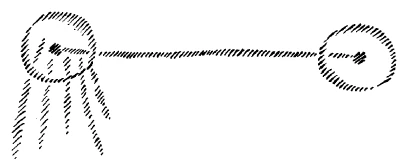
[ 24 ] I recently highlighted something truly grotesque: Namely, something particularly clever once occurred in the Theosophical Society. They wanted to prove: There is this life, and there is the next life (see drawing). Well, don’t you think something must pass over from the previous life into the next? You see the body decaying. The true materialist says, the body decays, and then that’s the end of the person. Yes, but the theosophist wants there to be a next earthly life; so something must pass over! The true materialist says, all the atoms merge with the earth. The theosophist didn’t think any differently than a materialist, but at the same time he wanted to think “theosophically”; he wanted something to carry over. And so he said: Yes, the atoms—they do indeed all fall back into the Earth; but one atom remains, and it passes through all of time in the life between death and a new birth. There it appears again: that is the permanent atom. — One atom! The Theosophists were particularly proud when they discovered this “permanent” atom! They had no idea that, in doing so, they were actually introducing materialism into their spiritual worldview! This materialism led them to believe that something—they never specified what—among the many atoms sinking into the earth would be saved; and that this happily saved permanent atom would then be what reappears in the next earthly life. Much has been written about this permanent atom. It is nothing other than proof that what could not be overcome was to be introduced into spiritual science: materialism, which, incidentally, is already embedded in the entire conception of the human being when it is presented as it often is in the literature of the Theosophical Society—where, as I have often said, the physical body is dense, the etheric body thinner, and the astral body even thinner still. And then it progresses into such subtleties that even thinking and imagination become quite subtle; but one still has something material, something mist-like; so that while Buddhi and Atma are indeed mists, they are still, after all, mists. One lacks the will to truly cast off materialism even in the life of the imagination and to move from imagining the material to imagining the spiritual.
[ 25 ] All of these things demonstrate how closely people are tied to old ways of thinking. And in fact, anyone who honestly wishes to commit to spiritual science should draw from such observations an inner impulse to examine to what extent they have broken free from old materialistic ideas, or to what extent—even while holding some spiritual concept in mind—they imagine this spiritual concept in materialistic images and are unaware that these are, in fact, merely images.
[ 26 ] It is always a matter of being aware of this. For if, say, I were to draw one of you here on this board, I could certainly derive a great deal from the image even if the person in question were no longer here. But if I were to imagine that he were shaking my hand, or that he were speaking to me—in other words, that he were the essence itself—then I would be a fantasist. So, of course, one may conceptualize the spiritual in images, but one must always be clear that one is dealing with sensory images. When it comes to words, however, people must become increasingly aware that language is on the path to turning the word into a gesture, and that we should not go further than allowing the word to point us toward something that no longer lies within the word itself. All other words must follow the same path that proper names have taken.
[ 27 ] For philosophers, I could even say something very beautiful here. Modern philosophers have put forward many theories. When I say, “The child is small”—they have an idea of “small,” they have an idea of “child”; but the “is,” the copula that conveys what it actually means—? Oh, much has been written about this copula, even in a philosophical sense, not merely in a grammatical or philological sense. And everything that has been written suffers from one thing: that, in fact, this “is” no longer has the meaning that people talk about today; that it has emancipated itself from its meaning; that its spiritual content has already become something else. And so one actually philosophizes about that which no longer lives vividly in the soul.
[ 28 ] This is merely a philosophical aside, which may be of little significance, but is intended to draw your attention to the fact that what goes unnoticed in the external world is not necessarily noticed by philosophers right away. On the contrary, it is often the case that philosophers are the last to notice the things that are actually happening in the world. And many of our philosophical systems actually lag considerably behind other things that exist outside of them!
[ 29 ] Today I wanted to show you—primarily using the example of language—how the development of humanity is currently unfolding in very concrete terms. One can only see what is actually happening in terms of human development by looking at the supersensible. Anthropology can no longer uncover what is actually taking place; only anthroposophy can. Therefore, anthroposophical cultural thinking must form the very foundation of the work being done today to advance humanity.