

The New Spirituality and the
Christ Experience of the Twentieth Century
GA 200
17 October 1920, Dornach
Translated by Steiner Online Library
First Lecture
[ 1 ] Several points have been mentioned in the lectures given here during the course on history that may be of particular importance to consider, especially at the present time. First of all, with regard to the historical course of human development, the often-discussed question has been raised as to whether the principal driving forces in this development are individual outstanding, influential personalities, or whether the essential changes are brought about not by these individual personalities, but by the masses. This has always been a contentious issue in many circles, and decisions on it have been made more out of sympathy and antipathy than out of genuine insight. That is the one fact I would like to mention as important, so to speak. The other fact that I would like to note here as important, based specifically on historical considerations, is the following: At the beginning of the 19th century, Wilhelm von Humboldt made a clear statement by insisting that history should be viewed in such a way that one considers not only the individual facts observable externally in the physical world, but—through a synthesizing, synthesizing power—that which is at work in historical development, but which can actually be discovered only by someone who, in a certain sense, is poetic—yet in reality composes the truth—and knows how to synthesize the historical facts. Attention has also been drawn to how, in the course of the nineteenth century, the very opposite historical way of thinking and mindset underwent a particular development—how ideas were by no means pursued in history, but rather only a sense for the external world of facts was cultivated. And it has been pointed out that clarity regarding this latter question can actually be attained only through the science of the spirit, because it is the science of the spirit alone that can reveal the true driving forces behind the historical development of humanity. Such a spiritual science was not yet accessible to Humboldt. He spoke of ideas, but ideas have no driving force. Ideas as such are simply abstractions, as I already mentioned here yesterday. And anyone who would like to find ideas as the driving forces of history could never prove that these ideas actually do anything, for they are not essential, and only what is essential can do anything. Spiritual science points to real spiritual forces that lie behind the sensory-physical facts, and in such real spiritual forces lie the driving forces of history, even if these spiritual forces must then be expressed to human beings through ideas.
[ 2 ] But we can only gain clarity about all these things if we take a deeper look at the historical development of humanity—precisely from the perspective of the humanities—and today we will do just that, so that our reflections may reveal certain facts that may be particularly important for assessing the current situation of humanity. I have mentioned on several occasions that when spiritual science engages in historical reflection, it must in fact practice a form of symptomatology—a symptomatology that consists in being aware that behind the stream of physical and sensory facts lie the driving spiritual forces. But there are points throughout the course of history where the true essence emerges symptomatically to the surface and where it can be assessed on the basis of the phenomena, provided one has the opportunity to penetrate more deeply into the depths of historical development through one’s understanding of these phenomena.
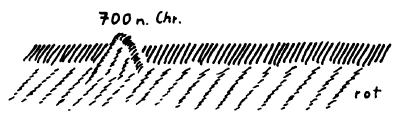
[ 3 ] I would like to illustrate this with a simple, visual drawing. Let’s assume this is a stream of historical facts (see drawing). The driving forces actually lie beneath the stream of these facts, hidden from ordinary observation. If, for example, an inner eye were to observe this stream of facts, the actual workings of the driving forces would lie beneath the stream of facts (red). But there are significant points within the stream of facts. And these significant points are characterized precisely by the fact that what is otherwise hidden comes to the surface at them. So that we can say: Here, through a particular phenomenon—which one need only assess correctly—it could become clear what is otherwise at work everywhere, but which does not manifest itself in such striking phenomena. Let us assume (see illustration) that this took place in some year of world history—what is depicted here occurred around 800 A.D. What was significant for Europe—let us say, for Western Europe—naturally also had an effect before and after; but it did not manifest itself in such a striking manner in the preceding or subsequent periods as it did at that particular moment. When one points to such a view of history—one that focuses on defining moments—it is entirely in the spirit of Goetheanism. For Goethe wanted to structure the entire view of the world in such a way that attention would be directed toward certain defining moments, and that from what can be perceived in such defining moments, the rest of the content of world events could then be recognized. Goethe says quite explicitly that, within the abundance of facts, what matters is to find a focal point everywhere from which the surrounding areas can be surveyed, and from which much can be unraveled.
[ 4 ] Well, let’s say about 800 this year. Here we can point to a fact in the development of humanity in Western Europe that might seem insignificant in the context of conventional historical analysis—one that might not even be considered noteworthy for what is otherwise called history—but which is, in fact, a pivotal point for a deeper examination of the evolution of humanity. Around this year, there was a kind of theological-scholarly dispute between Alcuin—who served as a sort of court philosopher of the Frankish Empire—and a Greek living in the Frankish Empire at the time. The Greek, who was well-versed precisely in the particular spiritual disposition of the Greek people—a disposition that had been passed down to him—had sought to evaluate the principles of Christianity and arrived at the concept of redemption. He posed the question: To whom, exactly, was the ransom paid in this redemption through Christ Jesus? — He, the Greek thinker, arrived at the conclusion that the ransom had been paid to Death. So it was, in a sense, a kind of theory of redemption that this Greek developed from this entirely Greek way of thinking, which was just becoming acquainted with Christianity. The ransom had been paid to Death by the powers of the world.
[ 5 ] Alcuin, who at that time was part of the theological movement that would later become decisive for the development of the Roman Catholic Church in the West, discussed what this Greek had put forward in the following manner. He said: The ransom can only be paid to a being that truly exists; but death has no reality—death merely brings reality to an end; death is not a real thing; therefore, the ransom could not have been paid to death.
[ 6 ] Well, the point here is not to criticize Alcuin’s way of thinking; for anyone who can see through the connections between the facts, the whole view that death is not real is somewhat similar to the view that says: “Cold is not really real, but is merely a reduction of heat, merely a lower degree of heat; since cold is not really real, I will not put on a winter coat in winter, for I am not going to protect myself against something unreal.” — But let us set that aside entirely; rather, let us approach the dispute between Alcuin and the Greek from a purely positive perspective and ask ourselves what actually happened there; for it is indeed highly striking that the discussion is not about the concept of salvation itself—that is, not in such a way that, so to speak, the two figures, the Greek and the Roman Catholic theologian, take the same standpoint—but rather that the Roman Catholic theologian completely shifts his standpoint before he even addresses the issue. He does not continue along the line of thought he has just embarked upon, but rather steers the entire problem in a completely different direction. He asks: Is death something real or not? — and objects that death is, in fact, not something real.
[ 7 ] This indicates to us from the outset that two worldviews are clashing here, both stemming from entirely different states of mind. And that is indeed the case. The Greeks, in a sense, were still thinking along the lines that had, in essence, only just begun to fade in Greek culture between Plato and Aristotle. In Plato, something of the ancient wisdom of humanity was still alive—that wisdom which leads us back to the ancient Orient, where, albeit in ancient times, a primordial wisdom once flourished, which then gradually fell into decline. We find the last vestiges, I would say, of this primordial Eastern wisdom in Plato, if we can understand him correctly. Then, as if through a rapidly unfolding metamorphosis, Aristotelianism sets in, which essentially presents a completely different state of mind than the Platonic one. Aristotelianism represents a completely different element in human development than Platonism. And if we then trace Aristotelianism further, it, too, takes on various forms, various metamorphoses, but they can all be recognized in their similarity. We then see how Platonism lives on as an ancient legacy in the Greek who has to contend with Alcuin, while Aristotelianism is already present in Alcuin. And as these two figures come into view, we are made aware of the interplay that took place on European soil between two— one cannot even properly call worldviews, but rather states of the human soul—one that still has its origins in the ancient times of the Orient across the sea, and the other that emerged later, which we do not yet find in the Orient, but which arose in the central regions of civilization and was first embraced by Aristotle. It is only faintly hinted at in Aristotle, however, for much of Greek culture still lives on in him; yet it then develops with particular vehemence in Roman culture, within which it had been preparing itself long before Aristotle, indeed even before Plato. Thus we also see how, on the Italian Peninsula as early as the 8th century B.C., a distinct culture—albeit in a nuanced form—was taking shape alongside what continued to exist on the Greek Peninsula as a sort of final offshoot of the Oriental mindset. And when we examine the differences between these two modes of human thought, we find important historical impulses. For what is expressed in these modes of thought then found its way into people’s emotional lives, into the structure of human actions, and so on.
[ 8 ] Now let us ask ourselves: What was the essence of the worldview that developed in ancient times in the East, and which then found its offshoots in Platonism, and indeed even in Neoplatonism as a later offshoot? It is a highly spiritual culture that arose from an inner vision that lived primarily in images and imaginations—but in images that were not yet permeated by full consciousness, nor yet by the full sense of self in human beings. In the ancient Eastern spiritual life—of which the Vedas and Vedanta are echoes—what lives within human beings as the spiritual was expressed through powerful images. But it existed in a—please do not misunderstand the word or confuse it with ordinary dreaming—it existed in a dreamlike, a dull manner, so that this inner life was not permeated and illuminated by what lives within a human being when he becomes clearly conscious of his “I” and his own being. The Eastern person was well aware that his being existed before birth, that through death it returns to the same spiritual world in which it existed before birth or before conception. The Eastern person looked upon that which passes through births and deaths. But that inner feeling that lives in the “I am”—the Eastern person did not regard that as such. It was, so to speak, vague, as if diffused within a holistic view of the soul that does not concentrate to the degree that the experience of the “I” does. What, then, did the Eastern thinker actually perceive when he engaged in his instinctive contemplation?
[ 9 ] One can still sense how very different this Eastern state of mind was from that of later humanity when, perhaps having been prepared for this understanding through spiritual science, one delves into those remarkable writings attributed to—I do not wish to investigate the question of authorship further here; I have spoken about it on several occasions—Dionysius the Areopagite. There, “Nothingness” is still spoken of as a reality, to which only the existence of the external world—as it is perceived in ordinary consciousness—is set in opposition as another reality. This discourse on Nothingness continues to resonate. Echoes of it can still be found in Scotus Erigena, who lived at the court of Charles the Bald, and the final echo appears in the 15th century in the work of Nicholas of Cusa. But then what was meant by the “Nothing” found in Dionysius the Areopagite—which the Easterners, however, spoke of as something self-evident to them—fades away completely. What was this “nothingness” for the Oriental? It was a reality for him. He turned his gaze to the surrounding sensory world and said to himself: This sensory world is extended in space, flows in time, and in everyday life we say that what is extended in space and flows in time is a “something.”
[ 10 ] But what the Oriental saw—what for him was a reality that transcends birth and death—was not contained within this space, where minerals are found, plants grow, animals move, and human beings, as physical beings, move and act; nor was it contained within that time in which our thoughts, feelings, and impulses of will unfold. The Eastern thinker was quite clear: one must step out of this space in which physical things are extended and move, and one must step out of this time in which the soul forces of our ordinary life are active. One must enter a completely different world—the world that is nothingness for external, temporal-spatial existence, yet is nonetheless a reality. The Easterners perceived something in relation to worldly phenomena that Europeans, at most, still perceive only in the realm of real numbers. If a European has fifty francs, he has something. If he spends twenty-five francs of that, he has only twenty-five francs left; if he spends another fifteen francs, he has ten left; if he spends those as well, he has nothing; if he continues to spend, he is in debt for five, ten, fifteen, or twenty-five francs. He always has nothing, but he still has something very real when, instead of simply an empty wallet, he has twenty-five or fifty francs in debt. In the real world, having this debt also means something very real. There is a difference in one’s entire life situation between having nothing and having a debt of fifty francs. This debt of fifty francs exerts just as much influence on one’s life situation as, conversely, a fortune of fifty francs does. In this regard, Europeans are likely to accept the reality of debt, for in the real world there must always be something present when one is in debt. The debt one owes may be a highly negative factor for oneself, but for the other person to whom one owes it, it is a quite positive factor.
[ 11 ] So, if it is not merely the individual that matters, but the world, then that which lies on one side of zero—the side opposite the side of potential—is, after all, something very real. The Oriental felt this—not because he was speculating in any way, but because his worldview compelled him to feel this way—he felt: On the one hand, I experience space and time, and on the other hand, I experience that which cannot be observed in space and time—which is nothing in relation to spatial and temporal things and events, yet is a reality, just a different kind of reality. It was only through a misunderstanding that what Western civilization, under Rome’s leadership, came to embrace arose: the creation of the world out of nothing, whereby “nothing” was understood merely as zero. In the East, where these concepts were originally conceived, the world does not arise out of nothing, but out of that reality to which I have just referred. And an echo of that which resonated through all Eastern thought and down to Plato—that impulse toward eternity inherent in an ancient worldview—lived on in the Greek at the court of Charlemagne who debated with Alcuin. And a rejection of the spiritual life—for which this “nothingness” was the outward form in the East—was present in the theologian Alcuin, who, therefore, when the Greek spoke of death—which arises from spiritual life—as something real, could only reply: “Death is, after all, nothingness; therefore, it cannot receive a ransom.”
[ 12 ] You see, all the contrasts between the ancient Oriental way of thinking—which dates back to Plato—and what followed later are expressed in this concise exchange, in which Alcuin debated with the Greek scholar at the court of Charlemagne. For what had, in the meantime, found its way into European civilization since Plato—namely, through the spread of the Romanic spirit? It was a way of thinking that must be understood as focusing primarily on what a human being experiences between birth and death. The state of mind that is primarily concerned with what a human being experiences between birth and death is the logical-juridical, the logical-dialectical-juridical. The East had nothing logical-dialectical and least of all anything juridical. The West introduced logical-juridical thinking into the Eastern way of thinking so strongly that we even find religious sentiment permeated by juridical thought. In the Sistine Chapel in Rome, we see Christ, the Judge of the World, created by the masterful hand of Michelangelo, gazing back at us as he passes judgment on the good and the evil.
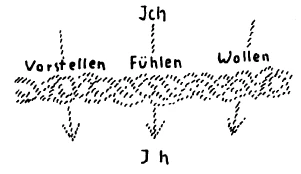
[ 13 ] Legal-dialectical elements have been drawn into reflections on the course of the world. This was entirely foreign to the Eastern way of thinking. There was no such thing as guilt and atonement, or even redemption as such. That is why the Greek might ask: What, then, is this redemption? — There was simply the conception of that metamorphosis through which the eternal is transformed through births and deaths; there was that which lived in the concept of karma. But then everything was drawn into a way of viewing things that is actually valid only for life between birth and death, which can encompass only this life between birth and death. But this very life between birth and death had once again eluded the Easterners. They focused much more on the core of the human being. They had less understanding of what took place between birth and death. And within this Western culture, a way of thinking came to predominate that primarily grasps what takes place between birth and death through those forces that human beings possess by virtue of having their spiritual-soul nature clothed in a body—a physical and etheric body. In this constitution, in the inner experience of the spiritual-soul aspect, and in the nature of this experience—which arises from the fact that one is immersed with the spiritual-soul aspect in a physical body—comes the clear, full grasp, the inner grasp of the “I.” This is why, in the West as well, human beings feel compelled to grasp precisely their “I,” to grasp their “I” as something divine. We see this urge to grasp the “I” as something divine emerge among the medieval mystics—Eckhart, Tauler, and others. This grasping of the “I” crystallizes with all its might in what constitutes the Middle Culture. Thus we can distinguish: the Eastern culture, the era in which the “I” is experienced only dimly; the Middle Culture, which is primarily the one in which the “I” is experienced. And we see how this “I” is experienced in the most manifold metamorphoses: first, I would say, in that twilight-like manner in which it appears in Eckhart, Tauler, and the other mystics; then ever more clearly and distinctly, as everything that can stem from this “I” culture develops.
[ 14 ] We then see how a different trend emerges within the “I” culture of the Middle Ages. At the end of the 18th century, something emerges in Kant that, in essence, cannot be explained by the continued flow of this “I” culture. For what is it that emerges through Kant? Kant examines the cognition of nature. He cannot come to terms with it. For him, the cognition of nature breaks down into subjectivities; he does not penetrate to the “I,” even though he constantly speaks of the “I”—and in some categories, such as the intuitions of space and time, which he seeks to make all of nature encompass, he even speaks from the “I” itself. Yet he does not penetrate to the actual experience of the “I.” He also constructs a practical philosophy with the categorical imperative, which is supposed to manifest itself from the unfathomable depths of the human soul. Yet again, the “I” does not appear here. It is strange in Kant’s philosophy: the full force of dialectics—of dialectical, logical, and juridical thinking—is present, in that everything tends toward the “I”; yet he cannot bring himself to truly fathom this “I” philosophically. There must be something preventing him from doing so. Then comes Fichte, who is still Kant’s student, and who wants to let his entire philosophy spring forth from this “I” with all its force; he presents as the highest principle of his philosophy the proposition—which, I might say, is striking in its simplicity—that “I am.” And from this “I am,” everything that is truly scientific is supposed to follow. One should, as it were, be able to deduce, to read out of the “I am,” the entire worldview. Kant cannot arrive at the “I am.” Fichte, right on his heels, still as Kant’s student, hurls the “I am” at him. And people are astonished: “This is a student of Kant’s, and he’s saying such things!” — And Fichte says: As far as he can understand, if Kant were able to think things through to their logical conclusion, he would have to think the same thing that Fichte thinks! — It is so inexplicable to Fichte that Kant thinks differently from him that he says: If Kant were only to think things through to the end, he would have to think exactly the same way; he, too, would have to arrive at the “I am.” — And Fichte expresses this even more clearly by saying: I would rather regard Kant’s entire Critique as a blind game of concepts randomly jumbled together than as the work of a mind, if my philosophy did not follow correctly from Kant’s. — Kant, of course, rejects this. He wants nothing to do with what Fichte has drawn as his conclusions.
[ 15 ] Now we see how what later blossomed as German idealist philosophy in Schelling and Hegel—and which gave rise to all the struggles I have discussed in part in my lectures on the limits of knowledge of nature—follows on from Fichte. But we do see something peculiar. We see how Hegel lives entirely within a crystal-clear elaboration of the juridical-dialectical-logical and derives a worldview from it—but only a worldview that is concerned with what unfolds between birth and death. For if you go through the entirety of Hegel’s philosophy, you will find nothing in it that goes beyond birth and death. It all concludes with world history, with religion, art, and science—with everything that falls within the experiences between birth and death.
[ 16 ] What was so remarkable about that? Well, what emerged in Fichte, Schelling, and Hegel—that most powerful flowering of the Middle Age, in which the “I” attained full consciousness and inner experience—was merely a reaction, a final response to something else. For one can only understand Kant if one properly grasps the following. Now I come back to a crucial point from which much can be derived. You see, Kant was still—as is clear from his earlier writings—a disciple of 18th-century rationalism, which lived on in Leibniz in a brilliant way and in Wolff in a pedantic way. And one sees: this rationalism was not actually concerned with truly arriving at a spiritual reality—Kant therefore rejected this “thing-in-itself,” as he called it—but rather, it was concerned with proving, with proving it beyond a doubt! Kant’s writings are also peculiar in this regard. He wrote his *Critique of Pure Reason*, in which he essentially asks: How must the world be so that one can prove things within it?—Not: What are the realities involved?—but rather, he actually asks: How must I conceive of the world so that I can prove things within it logically and dialectically? — That is all that matters to him, and in his “Prolegomena to Any Future Metaphysics That Will Be Able to Come Forward as a Science,” he seeks a metaphysics of that which can be proven in his sense: Everything else out! To hell with the reality of the world—just leave me the art of proof! What do I care what reality is; if I cannot prove it, then I won’t concern myself with it!
[ 17 ] Of course, those who wrote books such as Christian Wolff’s *Rational Thoughts on God, the World, and the Human Soul, as Well as on All Things in General*, for example, did not think in this way; rather, their concern was to have a clear, self-contained system of proofs, as they understood proof to be. Kant lived in this sphere; but there was, after all, something there that, while it was a deflated remnant of the middle worldview, still fit into that middle worldview. But Kant has something else that remains inexplicable—something that enabled him to become Fichte’s teacher. After all, he does inspire Fichte, and Fichte, in turn, counters him with a strong emphasis on the “I am”—though he does not counter him with mere proofs, for one would not look for those in Fichte, but rather with a fully developed inner spiritual life. What actually emerges in Fichte with all the power of inner spiritual life is precisely what one might find in a more superficial form among the Wolffians and the Leibnizians. Fichte constructs his philosophy from the “I am” using nothing but pure concepts; yet in his case, they are full of life. They are also present in Schelling, and they are also present in Hegel. But what actually happened there with regard to Kant? Well, one comes to the crux of the matter when one traces Kant’s development. A student of Wolff’s was transformed by the fact that the English philosopher David Hume, as Kant himself says, awakened him from a dull, apathetic slumber. What was it that entered into Kant that Fichte could no longer understand? What entered Kant—and it fit him only poorly, because he was too deeply entangled in Central European culture—was what is now Western culture. It came to him in the person of David Hume; that is when Western culture entered Kant. And where can we look for its distinctive character? In Eastern culture, we find that the “I” still lives on, dimly and as if in a dream, in the soul’s experiences that express themselves imaginatively and pictorially, spreading out. In Western culture, we find that the “I” is, so to speak, crushed by purely external facts. The “I” is certainly present there, but it is not merely present in a dull way; rather, it burrows into the facts. And there, for example, a peculiar psychology develops. There, people do not speak of the life of the soul as Fichte does—who seeks to work everything out from the single point of the “I”—but rather they speak of thought and thought and thought, and these associate with one another. One speaks of feelings, ideas, and sensations, and these associate with one another, and impulses of the will also associate with one another. One speaks of the inner life of the soul in the same way as one speaks of thoughts that associate with one another.
[ 18 ] Fichte speaks of the “I,” which radiates thoughts. In the West, the “I” disappears entirely because it is absorbed and subsumed by thoughts and sensations—which are treated as if they were independent—and which associate and separate again. And one observes the life of the soul as if ideas were constantly joining and separating. Read Spencer, read John Stuart Mill, read the American philosophers: wherever they turn to psychology, there is this peculiar view, which does not exclude the “I” as in the East—where it is developed only dimly—but rather fully engages the “I,” only to let it sink into the realm of the imagining, feeling, and willing life of the soul. One might say: For the Oriental, the “I” is still above imagination, feeling, and volition; it has not yet descended to the level of imagination, feeling, and volition. For the person of Western culture, the “I” is already beneath that sphere; it lies beneath the surface of thinking, feeling, and volition, so that at first it is no longer noticed, and one speaks of thinking, feeling, and volition as if they were independent powers. — This found its way into Kant in the form of David Hume’s philosophy. The middle phase of Western culture opposed this with all its might through Fichte, Schelling, and Hegel. Then, with Darwinism and Spencerism, Western culture flooded everything that was initially there.
[ 19 ] Only by examining these deeper forces will it be possible to gain an understanding of what is alive in the development of humanity. Then one discovers that something developed in the East in a natural way that was, in fact, purely spiritual life. In the central region, something developed that was dialectical-juridical in nature, which actually gave rise to the idea of the state, because it is applicable to it. It is precisely thinkers such as Fichte, Schelling, and Hegel who construct unified state structures with immense sympathy. But then a culture emerges in the West that stems from a state of mind in which the “I” is absorbed, operating below the level of thinking, feeling, and willing—a state where one speaks of associations in the life of the imagination and the emotions. One should apply this way of thinking solely to economic life! There it is in its proper place. One went completely astray when one first applied it to anything other than economic life. There it is grand, there it is brilliant, and if Spencer, if John Stuart Mill, if David Hume—if they had all applied what they squandered on philosophy to the institutions of economic life—it would have become magnificent. If the people living in Central Europe had limited what was their natural gift to the state alone, and had not sought at the same time to encompass both spiritual life and economic life, something magnificent could have come of it. For with what Hegel was capable of thinking, what Fichte was capable of thinking, one could have achieved something magnificent had one remained within the legal-state structure—which we wish to single out in the threefold organism as the state structure. But because these thinkers had in mind that they had to create a state structure that encompassed both economic life and spiritual life, the result was caricatures rather than genuine state structures. And spiritual life was regarded merely as a legacy of the ancient Orient. People simply did not realize that they were still living off this legacy of the ancient Orient. What, for example, are useful frameworks in Christian theology—indeed, what are useful frameworks even within our materialistic sciences? They are either an ancient Oriental legacy, or a changeling of legal-dialectical thinking, or they have already been adopted—as Spencer and Mill did—from Western culture, which is particularly suited to economic life.
[ 20 ] Thus, the spiritual thinking of the ancient Orient was spread across the earth, but in an instinctive way that is no longer of use today, since it has now fallen into decadence; dialectical-statist thinking, which experienced its dissolution precisely through the global catastrophe. For no one was less suited to economic thinking than the students of Fichte, Schelling, and Hegel. When they set out to establish an empire that sought to grow primarily through the economy, they were bound to fail, for such thinking was not naturally part of their gifts. According to the historical course of human development, intellectual thinking, state-political thinking, and economic thinking were distributed among the East, the Center, and the West. We have reached the point in human development where understanding—equal understanding—must spread throughout all of humanity. How can this happen?
[ 21 ] This can only come about through the culture of initiation, through the new spiritual science, which does not develop in a one-sided manner, but which—precisely in all areas—truly takes into account as a threefold structure in social life what has otherwise divided itself into three parts on its own, and which brings together what is spread across the Earth. However, this cannot be spread through natural aptitudes; it can only be spread by engaging with those who understand these things, who can truly experience the spiritual realm as a distinct sphere, the state or political realm as a distinct sphere, and the economic realm as a distinct sphere. Herein lies the unification of people across the earth: that which was distributed across three spheres is brought together within the human being, as he himself structures it within the social organism in such a way that it can exist in harmony before him, right before his eyes. But this can only come about through training in spiritual science. And here we stand at the point where we must say: In ancient times, we see individual personalities; we see them articulating what the spirit of the age is. But when we truly examine this—for example, specifically within Eastern culture—we find that, fundamentally, something of a soul disposition lived instinctively within the masses, which was in a remarkable, self-evident harmony with what the individuals articulated.
[ 22 ] However, this interaction is becoming weaker and weaker. In our time, we see the opposite extreme taking shape. We see the opposite instincts emerging among the masses from what is actually beneficial to humanity. We see the emergence of precisely what makes necessary that which can flow from the individual who is able to delve into spiritual science to its very depths. No salvation will come from instincts, but only from that understanding—which Dr. Unger has also spoken of here, and which is often emphasized—that every person can offer to the spiritual researcher if they only truly surrender to common sense. Thus a culture will emerge in which individuality—with its ever-deeper penetration into the inner depths of the spiritual worlds—is of particular importance, and in which those who penetrate the spiritual worlds in this way will be held in the same esteem as those who practice a craft. You don’t have a tailor make your boots, nor a cobbler shave you—so why should you seek what you need as a worldview from anyone other than the one who is initiated into it? But this is precisely what is currently needed in the most urgent sense for the salvation of humanity, even though there is a reaction against it that shows how humanity still resists what is beneficial to it. This is the terrible struggle, the gravity of the situation, in which we find ourselves.
[ 23 ] Never has there been a time when it has been more necessary to listen to what the individual knows in this or that field, and for those who possess knowledge in a particular area to be able to contribute to social life—not out of blind faith in authority, but based on reason and informed consent. But instincts initially resist this, and people believe that something beneficial can be achieved through general leveling. This is the serious struggle we are currently engaged in. Sympathy and antipathy are of no help here; living by slogans is of no help; only a clear view of the facts can help. For today is when the great questions are being decided—the questions of whether the individual or the masses have any significance. In other times, this was of little significance, for the masses were in harmony with individual personalities; the personalities were, in a sense, merely the exponents of the masses. We are moving ever closer to a time when the individual must seek within himself the source of what he has to find, and what he must then in turn contribute to social life; and this is merely the final resistance against the prevalence of individuality and an ever-increasing number of individualities. One can literally see how what spiritual science reveals is also proven everywhere at this crucial point. We are speaking of the necessary associations in economic life, which require a certain way of thinking. In Western culture, this has developed by allowing thoughts to associate with one another. If one could take what John Stuart Mill does with logic—if one could extract those ideas from there and apply them to economic life—they would fit perfectly; precisely those associations that do not fit into psychology would find their place there. Right down to what appears in the realm of human development, spiritual science pursues reality.
[ 24 ] Therefore, spiritual science stands fully conscious in the midst of the grave seriousness of the current world situation; it knows what a great struggle is taking place between the social impulses arising from spiritual science—which can lead to the threefold social order—and that which, as a Bolshevik wave that would lead to the ruin of humanity, opposes this threefold social order. And there is no third option besides these two. The struggle must take place between these two. One must recognize this. Everything else is already decadent. Anyone who looks impartially at the circumstances in which we find ourselves must conclude that it is necessary today to bring all forces together so that this terrible Ahrimanic force, which opposes spiritual culture, can be repelled.
[ 25 ] This project stands there, for the time being unfinished. Today, the central European countries cannot provide what has largely brought it to this point, in conjunction with what we have received from the neutral states. We must receive subsidies from the countries of the former Entente. We must develop an understanding of what is to become a unified culture that encompasses spirit, politics, and economics. For people must move beyond a one-sided mindset and follow those who also understand politics and economics—those who do not merely engage in dialectics, but who also grasp spiritual matters and are open to economic impulses, rather than seeking to establish states in which the state itself can already manage the economy. The Western peoples will have to realize that their particular future potential in the realm of economic association—which they have, in fact, applied at the wrong end, namely to psychology—must develop into a full understanding of the state-political element, which has sources other than economic life, and of the spiritual element. But the Central European nations are at the heart of this. People in Western regions will have to realize—for the East is out of the question, after all—what this edifice here is all about! Therefore, it is necessary to reflect on how to ensure that the culture which now seeks to reveal itself here—as a culture called to permeate the higher education system of the future and which, in the founding of the Waldorf School, has shown itself capable of shedding light on the elementary school system—is truly nurtured. But to achieve this, we need the understanding support of the broadest possible circles.
[ 26 ] Above all, we need the resources to do this. For everything that is called a school—in the broader or narrower sense—we need the spirit that I already put into practice back when the Waldorf School in Stuttgart was founded; I said this at the time, in my opening address: This one Waldorf School—yes, it’s wonderful that we have it, but on its own it is nothing; it will only amount to something if we were to establish ten such Waldorf Schools in the next quarter, and then more. The world did not understand this; it had no money for it. For it takes the stance: Oh, the ideals are too lofty and too pure for us to bring our dirty money near them; we’d rather keep it in our pockets—that’s where it belongs, that dirty money. The ideals—oh, they’re far too pure; one must not sully them with money! — However, such an embodiment of ideals cannot be achieved with the kind of purity that keeps “dirty money” at bay, and so we must bear in mind that, up until now, we have been stuck at the point of a single Waldorf school that actually cannot really move forward yet, because we were in serious financial trouble last fall. Those troubles have been temporarily resolved; by Easter, we’ll be facing them again. And here, here we will ask ourselves after a relatively short time: Should we stop? And we will have to stop unless we find, before then, a source of support that is willing to dig deep into its pockets.
[ 27 ] That is why it is important to foster understanding in this direction. I don’t believe much understanding would develop—as we’ve already seen—if we were to say that we want something for the building in Dornach or the like. But—and there is still understanding for this today—if one wants to establish sanatoriums or the like, one can get as much money as one wants! That is not exactly what we want; we do not want to establish nothing but sanatoriums—we fully agree with their establishment, insofar as they are necessary—but here the primary concern is the cultivation of that spiritual culture whose necessity will surely be demonstrated by what this University Course here has sought to achieve. That is why I tried to inspire what I summarized here a few days ago in the phrase: “World School Association.” Our German friends have left; they are not the focus of this World School Association. What matters are those who, for the most part, have come here as friends from all corners of the non-German world and are still seated here—that they understand this term “World School Association,” for it is necessary that we establish schools upon schools in all regions of the world, guided by the pedagogical and didactic spirit that prevails in the Waldorf School. It is necessary that we be able to expand this school until we connect with what we envision here as a system of higher education. For this, however, it is necessary that we be able to complete this building with all that belongs to it and continuously maintain what is necessary to work here, to create—to create in the further development of all the individual sciences from the spirit of spiritual science.
[ 28 ] People ask how much money one needs for all of this. It’s impossible to say how much is needed, because there’s absolutely no upper limit. Of course—we won’t establish a World School Association by creating a committee of twelve, fifteen, or thirty people who draft beautiful bylaws describing how such an association should function and operate. None of that serves any purpose. I place no value on programs, no value on bylaws, but rather on the work of living people who act with understanding. One day we will be able to found this World School Association—well, we certainly won’t be able to reach London for a long time yet; but from The Hague or a similar place—if, for instance, a foundation is laid through this, and through many other things as well—if those friends who are now going to Norway or Sweden or Holland or to any other countries, to England, France, America, and so on, if these friends everywhere, with every person they can reach, instill the conviction—the well-founded conviction—that there must be a World School Association! — That would have to spread like wildfire across the world: A World School Association must be established to procure the material resources for the spiritual culture referred to here. — After all, if an individual can convince hundreds and hundreds of people of all sorts of things, why shouldn’t one—in a short time, since the decline is happening so rapidly that we have only a short time at our disposal—be able to influence many people as a single individual, so that when one arrives in The Hague after a few weeks or so, one would see how widespread the conviction already is: The establishment of a World School Association is necessary; only the means for all this are lacking. What is sought from Dornach is a historical necessity. — Then we will be able to speak of the inauguration of this World School Association once the consensus regarding it is already in place. Establishing committees and resolving to form the World School Association is utopian; it serves no purpose at all. But working from person to person and spreading the well-founded opinion with the very speed that is necessary—that is what must precede its founding. Spiritual science lives in realities. That is why it does not engage in programmatic plans for founding organizations, but rather points to what must happen within realities—for people are, after all, reality—and among people, so that such an endeavor has a prospect of success.
[ 29 ] So what matters is that we finally learn from spiritual science how to stand firm in real life. I will never subscribe to a purely utopian justification for the World School Association; rather, I will always maintain that the World School Association can only come into being when a sufficiently large number of people are convinced of its necessity. And in order for what is necessary for humanity—as has surely been demonstrated in our university courses—to come to pass, this World School Association must be founded. So let the true meaning of this World School Association be recognized in the proper sense throughout international life! With this appeal, I would like to conclude today’s session—which, in a completely different way, has spoken to humanity through our entire course, precisely through those who have been here, and in whom we place our hope and desire that they may carry this message out into the world. The World School Association can be the world’s answer to that which is set before the world as a question—but a question drawn from the very forces of human becoming, that is, from the history of humanity. So, whatever can be done for the World School Association in accordance with the conviction you have been able to gain here over the past three weeks—let it be done! This sums up what I have wanted to say even today.