

The New Spirituality and the
Christ Experience of the Twentieth Century
GA 200
31 October 1920, Dornach
Translated by Steiner Online Library
Seventh Lecture
[ 1 ] Yesterday I tried to describe to you some aspects of the European situation as it is bound to unfold in the near future, and you have seen how European development—and indeed the development of modern civilization in general—must be accompanied by a certain decline in what people today still regard, in many areas, as something comfortable and valuable to them. From the way I had to describe things just yesterday, you can see that for many who would prefer to spend the coming times in a comfortable slumber—a slumber of the soul—there will be a far from pleasant awakening. I do not mean to say—as I already hinted at yesterday—that the prophecies of those who see the essence of future developments solely in such external matters as the discrepancy between Japan and America, for example, must come true down to the last detail. But what I have characterized for you—at least in broad strokes—as the great spiritual struggle between the East and the West, and between the West and the East, must be regarded as imminent; wedged between them will be what we have already come to know over the past few weeks as the true culture of central Europe. Precisely out of what has recently been active as the modern worldview based on the natural sciences—as strange as it may sound, it must be said—precisely out of this will the most intense need arise for what I have described as the Christ experience that lies ahead. We have been able to see, particularly through yesterday’s discussions, how little of this Christ experience is actually present today. Precisely what one might call the Christ experience has, since the Mystery of Golgotha, fallen into complete decadence through the course of human development, especially in recent centuries. And we have seen that, due to the impossible insistence on the old prohibition against reading the Gospels—a prohibition still theoretically upheld by the Catholic Church in the face of humanity’s demand to receive the Gospels and to be able to read them—a Christ experience cannot develop. And we have already pointed out how the particular state of the soul that is now emerging within modern civilization will in turn lead to the experience of Christ, just as that which remained of humanity’s old instinctive clairvoyance at the time of the Mystery of Golgotha was able to lead to such an experience. But one must be clear about the fact that, just as other significant, transformative events in human development occur in a different way than is expected in the circles of philistines and pedants, so too will what must be called the “Christ experience” of the first half of the 20th century come about in a different way. And this experience will have a relationship to the worldview based on modern natural science that can be very clearly defined.
[ 2 ] Just consider the following: The state of the human soul—as I have often described, even in recent days—has become quite different since the mid-15th century than it was before. External history does not take this into account, because external history remains stuck on the surface time and time again. But in particular, from the mid-19th century to the present day, the spiritual constitution of all humanity has undergone a fundamental change. This, too, is given far too little consideration, because people habitually cling to the things that were once instilled in them. At most, one can discern a break from this habitual clinging to what has been instilled by observing with an alert spirit the views emerging among the younger generation today and comparing them with the views held by today’s older generation during their youth. The discrepancy between today’s older generation and today’s youth has been depicted time and again, particularly by poets; and if people did not shut themselves off so completely within their habitual ideas—to the point of letting in nothing that contradicts their habitual ways of thinking—one would already notice what an enormous rift actually exists between today’s older generation and today’s youth.
[ 3 ] On the other hand, there is today an immensely reactionary-conservative element present in the development of humanity, and I already alluded to this yesterday. It is the blind faith in conventional science. And this is connected to the fact that this mainstream science has, in fact, conquered the general consciousness in giant strides. This is something that is thoroughly underestimated today. One need only observe the rapidity with which—especially in recent decades—the common notions of that science, which took shape in the 19th century, have taken hold of every soul, right down to the most uneducated classes of people. Certainly, some people still cling to a certain piety that refuses to acknowledge what is penetrating humanity through modern scientific concepts. But anchored within this piety is, for the most part, an immense insincerity—a refusal to see even what is spreading there, and which can be described as nothing other than the materialism of modern humanity brought about by the natural sciences. The spread of this materialism will not be curbed in the coming times, as some scientific dreamers believe, but on the contrary, the spread of this popular-scientific materialism will increase at a breakneck pace, and we will see that, out of the chaos of modern civilization, this materialistic mood will grow ever more and more. And out of this materialistic mood, if the groundwork is sufficiently laid—if spiritual science permeates society with its message, if, in other words, the proper impetus can be given for the appropriate development of even children in school— then, out of this chaos, individual souls may develop who will feel one thing particularly strongly—something I would now like to characterize, although this characterization has already been given in various ways on other occasions.
[ 4 ] Anyone who is even slightly familiar with the modern scientific worldview and observes it with the eyes of the soul will find it particularly characteristic that it is incapable of comprehending human beings in any way. In fact, human beings as such are completely absent from this modern scientific worldview. When our university course was held here, we had the opportunity to see, across the most diverse fields of the individual scientific disciplines, how these disciplines have nothing to say about the true nature of the human being. One need only extract a few characteristic examples from these sciences. Take, for example, the common Darwinian or Weismannian theory of evolution—or whatever its specific flavor may be; it traces the evolution of living beings from the most imperfect to the most perfect, and it supports the view that human beings, too, have emerged from this evolutionary current. But in reality, it considers only that aspect of human beings which is animal in nature. It considers human beings only to the extent that it can say: Some limb or some feature in humans arises from this limb or this feature of the animal lineage. To what extent the animal aspect in humans appears in a modified form, to what extent the animal aspect in humans is different from that in animals—this is something this science does not actually consider. On the other hand, truly taking human beings themselves into account—that is something this science has lost sight of. In a sense, the human being falls completely outside the scope of this science. This science has developed meticulous methods. It has established a certain discipline that is necessary if one wishes to have a say today in questions of worldview. But this science has been unable to elevate human understanding in any way to that which makes the human being itself comprehensible. Human beings fall outside the scope of what constitutes scientific understanding today, so that they must increasingly confront themselves as a mystery. Very few people sense this today; and those who do can certainly grasp it theoretically, but a unified sense of it does not yet exist. This sense will emerge with all its vitality from properly guided elementary schools. Children will emerge from properly led elementary schools in such a way that they will already feel: Yes, we have a science born of modern intellectuality; but the further we advance in this knowledge—the more we learn from nature—the less we can understand about ourselves, the less we can understand about human beings.
[ 5 ] This intellect, which has indeed been the primary evolving spiritual force of the past centuries—and which remains so even today—in a sense completely hollows out the human being with regard to his sense of self and his self-esteem. And on the other hand, there is once again the demand that human beings should stand firmly on the ground of their own being. This emerges, I would say, as an essential social demand. Alongside the fact that modern science has nothing to say about human beings, we see, on the other hand, demands arising everywhere—demands that do not stem from science but rise from the depths of human instincts; we see the demand that human beings must be able to rise to a life worthy of their dignity, that they must be able to sense what their true nature is. We see more and more practical demands emerging, and on the other hand, we see more and more the inability of science to tell human beings anything about their own nature. Such a discrepancy in human experience would have been entirely impossible in earlier periods of the development of the human worldview.
[ 6 ] If we once again picture the ancient Eastern worldview, we must conclude from what we have been able to suggest about it: In that worldview, human beings knew that they had descended from spiritual heights; before entering physical existence through conception or birth, they lived in a spiritual world. They bring with them from a spiritual world what is still within them—what emerges in childhood as a predisposition or an aspiration, and what remains with them throughout their entire life on earth. Every person in the East in earlier times knew that what emerges from their soul during childhood and youth is a gift from the spiritual worlds they had experienced before entering physical existence. Theoretically understanding that one has lived such a spiritual life prior to earthly life is not of great value. What is of great value is the living sense of this; it is of great value when one feels: What has grown within me since childhood in the course of my soul’s development comes from the spiritual world.
[ 7 ] But today, this feeling has actually given way to another. It has given way to another feeling within the individual, and especially in social life, it has given way to another feeling. And there is something important here that we must pay attention to. More and more, the feeling of one’s inherited traits weighs on people, almost unconsciously. Anyone who can look impartially today at what people feel will see this: In reality, a person feels that what they are is what they have become through their parents, grandparents, and so on. They do not feel, as people of the past did, that what flares up within them from childhood arises from those depths in which what they received from their spiritual experiences before their earthly life has become anchored; rather, they feel within themselves the characteristics inherited from their parents, grandparents, and so on. Even today, the first question people ask is: Where did the child get this or that? — And few people answer it by saying, “The child got that from this or that experience in the spiritual world”—instead, they investigate whether it comes from the grandmother, grandfather, or the like. But the more this arises in the individual not as a theoretical view but as a feeling—a feeling of dependence on merely earthly inherited traits—the more oppressive this feeling becomes, and the more dreadful it gradually grows. And this feeling will increase in intensity at a breakneck pace. It will have to intensify to the point of unbearability over the next decade, for this feeling is linked to another—a certain sense of the worthlessness of human existence. It will occur more and more frequently that people will feel the worthlessness of their existence when they can perceive this existence as nothing other than a synthesis of what is implanted in their blood and their other organs through physically inherited characteristics. Today, however, what is emerging is still, to a certain extent, merely a theory. Poets have already depicted it as an experience. But it will emerge as a feeling, as a sensation, and then it will be an oppressive characteristic of the emotional life of civilized humanity. This experience of oneself as merely the sum of inherited characteristics will weigh on the soul like a burden. Thus, what natural science cannot give to human beings—an understanding of humanity itself—manifests in its absence, in that human beings do not feel themselves to be children of the spiritual world, but merely children of the characteristics inherited in the course of earthly, physical existence.
[ 8 ] But this manifests itself with great vehemence in social life. Just think of the demands that arose as the outpouring of a colossal global political folly that has swept across the world in recent years! It has been slowly building up over the past few centuries and reached its climax when, in our own time, it became precisely this global political folly. The great crisis of the second decade of the 20th century arose when all those who knew nothing about human affairs—who now supposedly held the reins of the various nations and so on, or at least occupied positions where it was believed they held the reins of humanity—when all of them spoke of organizing humanity according to the will of individual nations. In the very worst sense, national chauvinism has been revived, especially in recent times. And national chauvinism resounds throughout the entire civilized world today. This is merely the social counterpart to that ultra-reactionary worldview that seeks to attribute everything to inherited traits. If one no longer strives to fathom one’s essence as a human being and to shape the social structure so that this human essence can thrive, but instead strives only to bring about a social structure that corresponds to what one is as a Czech, a Slovak, a Magyar, a Frenchman, an Englishman, a Pole, and so on, then one forgets all spirituality. Then one excludes all spirituality; then one seeks to organize the world solely according to characteristics inherited through blood, because one has come to have not the slightest substance in one’s concepts, because this 20th century had to provide proof that there can be a person who is marveled at by a large crowd as a world leader, yet who no longer has any concept whatsoever in his words—like Woodrow Wilson, who speaks only words that no longer contain any concepts at all. That is why people had to rely on something completely devoid of spirit—blood kinship, the blood-related characteristics of nations—which then led to nothing more than the conclusion of peace treaties—well, however they came about—in which people who know absolutely nothing about the conditions of life in this modern world have drawn up maps determining the shape of the modern civilized world. Perhaps nothing illustrates the materialism of the modern age—this denial of all that is spiritual—more clearly than the emergence of the national principle.
[ 9 ] This is, of course, a truth that many people find uncomfortable today. And this, in turn, is what causes so many lies to accumulate at the bottom of the soul. For if one does not honestly acknowledge that one is denying the spirit when one seeks to base a world order solely on blood kinship, then one is lying; one is lying when one then claims to be inclined toward some spiritual worldview.
[ 10 ] And now take a look at the course of today’s world developments. What wells up from humanity’s chaotic instincts denies the spirit everywhere. I gave you an example of this yesterday. To spare your delicate nerves—which I noticed to some extent yesterday—I do not wish to expand on this example, though it could easily be expanded. Thus, we see everywhere how the understanding of the human being has been lost to humanity. And now, from the perspective of spiritual science, let us consider the counter-image to what I had to describe as a rising feeling.
[ 11 ] As you know, the humanities reveal how our planet Earth—on which humanity must experience its present destiny—is the reincarnation of three preceding world bodies, and how we must look toward three subsequent world bodies; thus, schematically speaking, our Earth is the intermediate state.
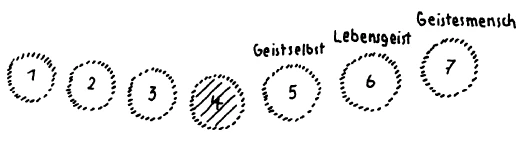
[ 12 ] We now also know from what has been presented in my *Outline of Esoteric Science* that, essentially, what human beings today possess as their physical body is a legacy of the first, second, third, and fourth states; that what human beings possess as their etheric body is a result of the second, third, and fourth states; what we call the astral body is the result of the third and fourth states, and the “I” is now emerging in our earthly evolution. Furthermore, once the Earth has entered its next stages of development, what is today only hinted at in a germinal form within the human being—the spiritual self, the life spirit, and the actual spiritual human being—will come to the fore. This must develop within the human being just as the physical body, the etheric body, and the astral body have developed within him, and just as the “I” is currently in the process of developing. But you know, if you reflect on what can be conveyed to you regarding this cosmic-earthly evolution: During the Earth’s development, only the seeds of the spiritual self, the life spirit, and the spiritual human can be developed, for we must await the Earth’s transformation into its next three states if these are to come to light. And from the description I have given in my *The Secret Science*, you will see that, in essence, the Spiritual Self signifies the transformation of the astral body to a higher stage, that the Life Spirit signifies the transformation of the etheric body to a higher stage, and that the Spiritual Man signifies the transformation of the physical body to a higher stage. But this transformation of the physical body to a higher level will, of course, take place only in the seventh state—and the transformation of the other members will follow accordingly. Yet people today can already recognize that this must take place; they can already grasp the idea that it must happen. Indeed, people today can understand even more if they direct their soul’s gaze impartially beyond the limitations of natural science to their own being. They must say to themselves: Certainly, I cannot attain the Spirit-Self in my astral body during my earthly existence; I cannot attain the Life Spirit in my etheric body or the Spiritual Human in my physical body during my earthly existence—but I must prefigure this in my soul. And by developing the consciousness soul now, I am preparing myself to receive the spiritual self into this consciousness soul in the next, the sixth, age. Although I cannot yet bring the spiritual self into my entire astral body, I must bring it into my consciousness soul. I must learn inwardly, as a human being, to live as I will one day live, when the Earth has passed into its next stage of development through a certain—naturally, cosmic—process. And I must, even during my earthly existence, at least take these future states into my inner being. I must prepare my inner being in a nascent way so that my outer being, too, can take shape in the future in the manner I must understand today.
[ 13 ] Now try to grasp intuitively what is actually happening here. As I have often explained, human beings are already growing into their spiritual self; they are growing into states of consciousness that, as they must acknowledge, are such that they cannot fully emerge during their earthly life. These states of consciousness actually seek to transform them—even with regard to their outer sheaths, that is, the astral body, the etheric body, and the physical body—but as an earthly human being, they cannot do so. Human beings must tell themselves: For the remainder of Earth’s evolution, I must pass through these states in such a way that I actually feel everywhere: I am preparing myself, through my inner being, for states that I cannot yet develop. — This must be the normal development of the future: that human beings tell themselves, “I regard the human being as something that, through its inner being, actually outgrows what I, as an earthly human being, can become.” As an earthly human being, I must, in a sense, feel like a dwarf compared to what the true human being is. And out of the sense of dissatisfaction that properly educated children will already experience in the very near future, this very feeling will grow. The children will sense: No amount of intellectual education can solve the mystery of the human being. Humanity falls outside the realm of what can be known intellectually, outside social structures. Everything that will develop under Wilson’s formulas of stupidity and under what is otherwise known as chauvinism throughout the world will, in fact, be nothing but impossibilities. Modern civilization is heading toward nothing but impossibilities through all these things. If you establish even more national empires within modern civilization, you will be sowing even more seeds of destruction—and from all that settles upon people’s souls, precisely that feeling will emerge which I have just described to you from another perspective. People will say to themselves: Yes, but the nature of the human being, which shines within me, is far higher than what I can realize externally. I must bring something entirely different into the world. I must bring something entirely different into the social structure—something perceived from spiritual heights. I cannot simply rely on what I can learn from the natural sciences for the social sciences and the like.—But human beings must feel this inner conflict between this dwarfed existence on Earth and what shines forth to them as a cosmic being, as which they will come to perceive themselves. Out of all that modern education—this education so highly praised and idolized today—can offer human beings, it will emerge that, on the one hand, they feel themselves to be earthly beings, and on the other hand, they say to themselves: But human beings are more than just earthly beings. The Earth cannot possibly fulfill human beings; if it is to do so, it must first transform itself into other states. — For in reality, human beings are not earthly beings at all; in reality, they are cosmic beings, beings that belong to the entire universe. On the one hand, human beings will be bound to the Earth; on the other hand, they will feel themselves to be cosmic beings. And this feeling will take root within them. Once this is no longer merely a theory but is actually felt by individual human beings—who, through their corresponding karma, transcend what is today a trivial sentiment—once humanity feels repulsed by this and thereby comes to a change of heart regarding the feeling of merely inherited traits and the feeling of chauvinism—only then will a kind of reversal occur. Human beings will feel themselves to be cosmic beings. They will reach out—as if with outstretched arms—to unravel their cosmic nature. This is what will happen in the coming decades: human beings will—I mean this symbolically, of course—ask, as if with outstretched arms: Who will unravel my nature as a cosmic being for me? Everything I can fathom on Earth, everything the Earth can give me, everything I can glean from modern science—which is so highly valued today—only unravels me as an earthly being; it makes the very essence of the human being appear to me as an unsolved mystery. I know I am a cosmic being, I am a super-earthly being; who will unravel my super-earthly nature for me?
[ 14 ] Living from the depths of the soul will be a matter of fundamental feeling. More important than anything else that may arise in the coming decades—even before the century reaches its midpoint—more important than any other feeling that may arise, will be precisely this feeling. And out of the expectation, out of the longing that there must surely be something that solves this human enigma—this enigma that human beings are, after all, cosmic beings—out of this attunement to the cosmos: what cannot come from the Earth must one day reveal itself from the cosmos—from this will arise the mood to which the cosmos responds. Just as the physical Christ appeared at the time of the Mystery of Golgotha, so will the spiritual Christ appear to humanity—the one who alone can provide an answer, because he is not merely somewhere out there, but must be characterized as a being who has united himself with earthly humanity from beyond the Earth. — One will have to understand: The question of the cosmic human being can be answered only when that which connects with earthly existence from the cosmos comes to humanity’s aid. Thus will be resolved the most significant disharmony that has ever arisen in earthly existence: the disharmony between the human being’s feeling as an earthly being and his realization that he is a super-earthly, a cosmic being. The fulfillment of this longing will prepare them to recognize how, from the gray depths of the spirit, this Christ-being will reveal itself to them—a being who will now speak to them spiritually, just as he spoke to them physically during the time of the Mystery of Golgotha. Christ will not come in the spiritual sense unless people are prepared for it. But they can only be prepared for this in the way I have just explained—by sensing the discrepancy I have described, by feeling the terrible weight of this conflict: I am, after all, first and foremost an earthly being. The intellectual development of the last few centuries has brought about everything that makes me appear to be an earthly being. But I am not an earthly being. I must feel connected to a being who is not of this Earth, who can truly—and not with theological hypocrisy—say: “My kingdom is not of this world.” For human beings will have to say to themselves: My kingdom is not of this world. — Therefore, they will have to be connected to a being whose kingdom is not of this world.
[ 15 ] It is precisely from the sciences—which, as I have described, will spread with breakneck speed into the popular consciousness—that what will lead humanity toward the reappearance of the Christ from the first half of the 20th century onward must develop. Of course, this could not have come about in the state of mind in which the civilized world found itself before 1914, when all talk of ideals, all talk of spirituality, was essentially a pretense. Adversity must make the pursuit of spirituality a reality for human beings. And the Christ will appear to none other than those who renounce all that spreads hypocrisy regarding earthly life. And no social issue will be resolved unless it is conceived in connection with this spiritual-scientific striving, which truly reveals human beings once again as supernatural beings. Our social solutions will emerge to the extent that people are able to perceive the Christ impulse in their souls. All other social solutions will lead only to destruction and chaos. For all other solutions are based on describing human beings as merely earthly beings. But human beings are growing out of—precisely in our age they are growing out of—that state of soul that, in their own consciousness, allows them to see themselves as merely earthly, physical beings. Out of the disposition of the human soul and out of necessity, the new experience of Christ will take shape.
[ 16 ] All the more, then, we must pay attention to everything that prevents this new experience of Christ from taking hold.
[ 17 ] Here, too, as we were forced to respond directly to attacks on our own cause, we have seen how people actually react to the emerging spiritual science—namely, by fighting it out of an inner falsehood.
[ 18 ] In this field, one is truly witnessing something today that must be viewed with complete objectivity. One might say that spiritual science is being beaten to death almost every day now. The latest of these attacks is the one carried out by a professor of theology, Karl Goetz, in collaboration with another doctor of theology, a certain Heinzelmann. I will completely set aside the fact that this Doctor of Theology, Karl Goetz, has launched an attack on spiritual science or, as he puts it—and as the newspaper report states, for example—on so-called spiritual science; one is gradually becoming more and more accustomed to such things today, especially here in Dornach. But one can also view the entire matter—what has been perpetrated by a Dr. theol. Goetz—from another perspective. One can view it from the perspective of just how ignorant this official scholarship is, which is responsible for the education of today’s youth. One can set aside the fact that an attack on spiritual science has taken place, but one can turn one’s attention to the following, and I would like to highlight a few characteristic points—admittedly based only on the newspaper report—that are said to appear specifically in this attack. Reference is thus made to the method of knowledge in spiritual science by a man whose profession is to speak about Christology, who earns his living by educating young people in Christology. This man speaks of the method of knowledge in anthroposophical science in such a way that he claims what is sought there—imagination and intuition—is based on the fact that the exercises artificially inhibit and suppress the activity of the imagination, and that the nervous energy thus conserved then generates those mental images which the anthroposophist calls imagination and intuition.
[ 19 ] Well, just take a look at this man: artificially inhibited and repressed imagination—and all that saved nervous energy! Quite apart from the fact that the man, of course, can only speak of “saved nervous energy” as a very vague hypothesis—since no one today can conceive of anything in science that involves “saved nervous energy”—he speaks of artificially inhibited and repressed imaginative activity. In his scientific conscientiousness—I must choose the right word here: “scientific conscientiousness”; I’m putting it in quotation marks now—has this man ever really engaged with, for example, the method of knowledge applied here to arrive at imaginations? Can one speak in this context of artificially inhibited or repressed imaginative activity? Well, the man could answer that for himself if he were to study the anthroposophical literature. Those images that he regards as his own normal ones are truly not repressed. If only the man had inquired a little as to whether repressed images prevailed here when our university course was held, then he could not speak of imaginative activity being suppressed here. There is still an abundance of unsuppressed imaginative life that—at least with regard to certain specialized sciences—is capable of grasping what this man is capable of grasping. So there can be no question of suppressed imaginative activity at all. And if, in his so-called “scientific rigor,” he had ever familiarized himself with what is described here as the path to the spiritual worlds, he would see: There is no artificial inhibition there at all; rather, the way is being cleared. The simple fact is that this man has not understood a single word of what is written in my book *How to Attain Knowledge of the Higher Worlds*. And he knows nothing about the methods of spiritual science other than what he can glean—based on his own state of mind—from the “meditation successes” of a few old ladies. He understands nothing of the rest. This is what passes today as “scientific rigor” within what is considered official science.
[ 20 ] What he goes on to say—that through the damming up of these inhibited ideas—one need only imagine this: the ideas are dammed up like water—that through this damming up, the imaginations now come to life, so that they appear like sensory perceptions; indeed, I would like to count the pages where, time and again, it is stated in my books that imaginations bear no resemblance to sensory representations or sensory perceptions. This is explained at great length throughout. So what prevails in this “scientific rigor”? The lie, which perhaps stems from powerlessness, from inability. But this lie is spreading with breakneck speed, particularly in theology, philosophy, history, law, and similar fields of study. Modern humanity should take note of this fact. For it is in these facts that the reasons for our descent into chaos lie, not in the empty rhetoric that Woodrow Wilsonism concocts from its hollow words and the like.
[ 21 ] Then there is another interesting passage—as I said, I can only discuss this based on the newspaper report: Because these imaginations, brought to life by the pent-up element of representation, arise involuntarily, they are described as experiences detached from the body—so he says. Once again, in his “scientific scrupulousness,” he has never turned his attention to how it is shown that nothing at all arises involuntarily, and how voluntary imagination is actually heightened in the context of spiritual scientific knowledge. Perhaps the man acquired his knowledge from childish circles of spiritualism or mediumship. In that case, let him deal with childish spiritualism and childish mediumship, but he should keep his hands off that which he neither understands nor wishes to understand.
[ 22 ] And he goes on to say: This split in consciousness gives rise to what the imagination then personifies. — This is an unscrupulous, mendacious distortion of everything presented in my books as the method of knowledge in spiritual science! In this way, the man prepares the ground so that, in his own way, he can ultimately claim that while this spiritual science does not oppose Christianity, it is nonetheless culturally worthless. And now comes something particularly “beautiful”: This spiritual science is culturally worthless, for telepathy will never replace the telegraph, mind reading will not replace the telephone, and magnetic healing will never replace medicine!
[ 23 ] So, while here at the Goetheanum, during this School of Spiritual Science course, we have been discussing medicine—truly excluding any form of dilettantism regarding magnetic healing powers—and while in reality we have been pointing to the very serious aspects of medicine, a doctor of theology is speaking right next door, after this course has ended, that the entire aim of spiritual science is to replace medicine with magnetic healing powers. And with such talk, a modern Doctor of Theology enjoys success with today’s audience! And he enjoys success when the little imp comes to his aid—a modern little imp—and finally adds that one cannot find Christ through spiritual science after all, but only through the Gospels. Now one should ask this little imp: Which of the Gospels? — One should ask this little helper: What have you done with the Gospels in your theology? — What you’ve done is ensure that the entire Christology has ultimately vanished from modern scholarship. And now, with this muddle in place, one hears people on this side say: What comes from spiritual science is unnecessary for Christianity, for there the simplicity of the Gospels must take effect. — Isn’t that the most profound hypocrisy of all? It is hypocrisy to know what modern Gospel criticism has produced, and then to stand there and say: “Salvation for time and eternity must come from the Gospels without spiritual science.”
[ 24 ] What comes from this side—what is it, then? It is a denial of Christ. And the strongest deniers of Christ today are the theologians. Those who refuse to allow any true idea of Christ to emerge—those are the theologians of today. And until it is recognized that this new experience of Christ in the 20th century must arise in such a way that, first of all, the theology of all denominations has denied Christ—until then, He will not come. He will appear to humanity again when those who are “of His own,” the modern scribes and Pharisees, have completely denied Him.
[ 25 ] It is not easy to see through these things in all their clarity, for one then always sees how little people today are inclined to expect such insight. The opponents are standing their ground. The opponents are waging the struggle with all their might. Our struggle—that which we are capable of—is weak, quite weak, and our understanding of anthroposophy is, in many respects, sluggish, quite sluggish. This is the great pain that weighs upon those who fully grasp these matters today. One feels it so often: when one speaks of what one believes to be in response to the demands of the times—what is spoken precisely for the social healing of our age—one is actually saying little more than what people accept as mere editorial commentary. One would like to call upon people to incorporate into every aspect of life that which can come from spiritual science, and one sees how people let life run its course, look to those who, out of hypocrisy, direct this life, and—out of a certain inner complacency—listen to what they take in as a spoken feature article on spiritual science. This is what still needs to come into being: the deep, sacred seriousness in receiving spiritual science, and the breaking of the habit that leads people to treat spiritual science—just like any other literary product—as something with which one amuses oneself in a somewhat more refined way, because it guarantees one’s longing for life after death. Even today, there remains a tremendous gap between what is necessary in the reception of spiritual science and what actually exists. You see, one can completely disregard what kind of attack on anthroposophy is found in the writings of someone like Goetz or Heinzelmann; one need only look at their abilities and ask oneself: How, then, did the selection process of humanity work that it placed these people in such leading positions? — But unless one is willing to ask oneself this question in the most intense way, unless one is willing to look at where the real shortcomings lie, one will not make any progress. All this declamation about social or similar ideals is of no use if one is unwilling to look at what is fundamentally alive in our present time. For the ills of our time stem from our distorted spiritual life, which has gradually sunk very deeply into untruth and is not even aware of how deeply it is immersed in untruth. How starkly the way what is spoken here is received contrasts with what is actually necessary! It is not meant to be a spoken feature article; it is meant to be a life force, and people will gradually have to come to terms with understanding it as such.
[ 26 ] That is what I wanted to tell you today, in both a positive and a negative sense, about—to use the trite term—the spirit of our age. This spirit of our age should be a spirit of anticipation; it should be a spirit that, out of this anticipation, develops an understanding of the great experience of the first half of the 20th century, born of necessity. But unless we truly look at everything that stands in the way, we will not be able to face this experience today. If, as is so often done out of convenience or inner complacency, one bows the knee before tradition today—and refuses to realize that this act of bowing reveals a profound untruth—then one will not prepare oneself for the experience of Christ in the 20th century. Yet everything depends on this preparation. Everything depends on our overcoming theological rhetoric about Christ in order to truly advance toward an understanding of Christ.