The Bridge Between the Spiritual and
Physical Realms of Human Beings
GA 202
26 November 1920, Dornach
Translated by Steiner Online Library
First Lecture
[ 1 ] I have often spoken about how the entire course of human life is already expressed in the human form. Anyone who can understand the human head correctly can recognize how the head’s unique structure and form are the result of past life contexts that the human being went through before descending to their present earthly existence. And when one considers the structure of the human limbs—which, of course, continues spatially inward into those organs with which the limbs are physically connected—one finds in this structure that which, after certain metamorphoses and transformations, will form the basis for the future structure of the human head, extending beyond death. At the same time, however, this points to a cosmic connection of the human being. As we currently perceive human beings, we can certainly say that their specific head structure—the structure of the head—is a metamorphosis of their earlier limb-body structure; but the very fact that human beings possess such a head structure as they do stems from what they underwent cosmically before entering the earthly world. The head form is essentially a result of the Saturn, Sun, and Moon phases of development, and what constitutes the “limb-human” is, in turn, the starting point for the Jupiter, Venus, and Vulcan phases of development. Only what constitutes the “chest-human”—which lies at the heart of the present rhythmic system—is truly the “earth-human.” Thus we can say the following: What we first encounter in the human head has been formed out of the three preceding planetary incarnations that preceded the Earth. What underlies today’s “limb-human” serves as the starting point for the Earth’s subsequent planetary incarnations. And as the human being passes through the life between death and a new birth, he in a certain sense relives in a spiritual way what he went through during the Saturn, Sun, and Moon periods. He transforms his Earth organism back into the Saturn, Sun, and Moon organisms. And in the same way, what is formed on Earth as the limb organism is further organized into the physical realm and reorganized during the Earth’s Jupiter, Venus, and Vulcan incarnations.
[ 2 ] These things, then, have both a human-earthly aspect and a cosmic aspect. We can therefore also view the formation of the human head in such a way that we take into account the relationship of the human being to the cosmos. However, what took place during the Saturn and Sun stages of development is, at first glance, somewhat beyond the scope of human perception. What took place then is even less amenable to judgment from an earthly perspective. On the other hand, one can thoroughly examine what occurred during the ancient lunar evolution, for this is repeated in a certain sense in the phenomena taking place between the Earth and the Moon—the present-day Moon. Therefore, one can also study the relationship of the human head to what takes place between the Earth and the Moon. And by considering these facts, one gains insight into certain mysteries of human formation. This can be done in the following way.
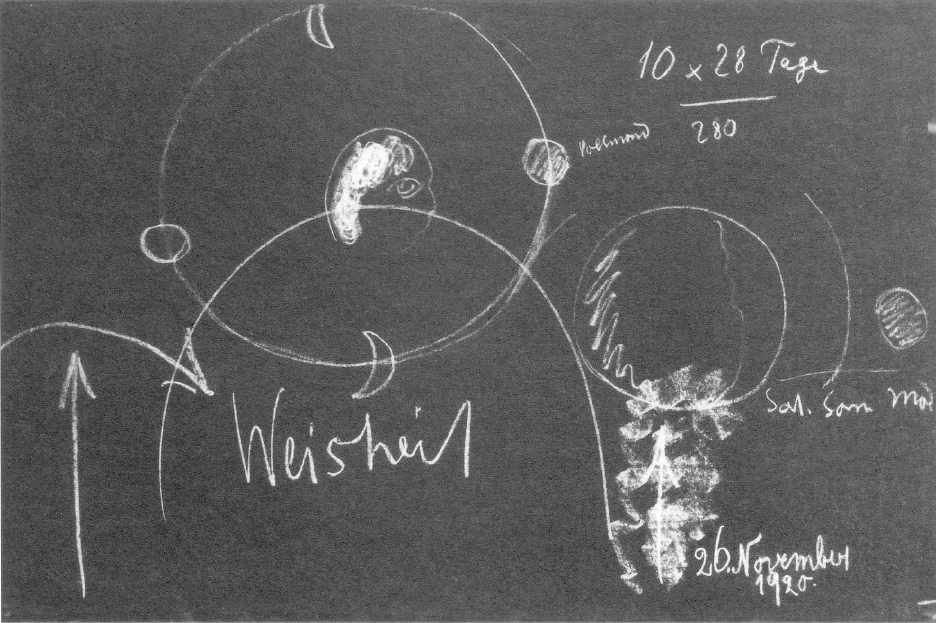
[ 3 ] Imagine, schematically, that a person is standing on Earth; that is, they are not at the center of the Earth, but at a distance from the center equal to the Earth’s radius. And if we conceptualize this schematically as the human head (see drawing on page 15), we can say: Just as the Moon orbits the Earth, so too does it orbit the human head. Drawn schematically, of course not to scale—that would look rather odd.
[ 4 ] Now suppose the moon were here and were full; then the light reflected from the sun, as is often said, shines upon the human being. Thus, the sunlight acts upon the human being. I should note that when I speak of “human beings,” I am always referring to the human head. On the opposite side, let there be a new moon. No light reaches the person; the person is, so to speak, left to their own devices from this side. They are less affected by the external light stimuli acting upon them. They are therefore more attuned to their inner development. And if you place the first quarter here and the last quarter here—the waxing and waning moon—you have fewer and fewer light stimuli acting upon the human being from both sides than there are from the full moon, and more stimuli than from the new moon. Furthermore, as the moon traces this path around the Earth, it passes through the zodiac. This determines the light in a special way and, I would say, differentiates it; for the moonlight is different when it comes from a point behind which, say, Aries is situated, and different when it comes from a point behind which Virgo is situated. The moonlight is differentiated as such, depending on whether the moon passes in front of this or that sign of the zodiac.
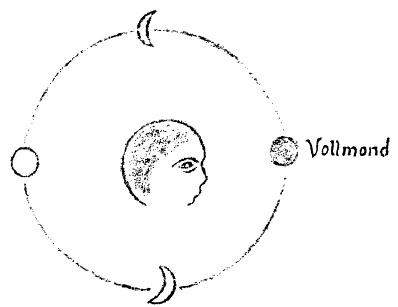
[ 5 ] Now imagine what I have drawn here schematically in the correct chronological context of human evolution—that is, imagine that, through certain processes, the spiritual seed of the human being, which initially comes from the period of development between death and a new birth, becomes firmly established in a mother’s womb. During this time, the Moon acts upon the seed. Then, initially through the influence of the Moon—naturally in conjunction with the other celestial bodies—the configuration of the human head is brought about from the cosmos within the mother’s womb. The configuration of the human head is brought about entirely by the Moon.
[ 6 ] Now you will say, and rightly so: It cannot always be assumed that the full moon shines its light precisely on the eyes or the nose, and that precisely the back of the head—whose inner development is to be left to itself, not to the outside world—is the spot that faces the new moon. Certainly, that need not necessarily be the case; essentially, it is true that the full moon is active somewhere opposite the face, and the new moon is active somewhere opposite the back of the head. The child also occupies a special position within the mother’s womb, and this position is entirely oriented toward the cosmos. But depending on whether the moon shines—to a greater or lesser extent—at an angle, so to speak, toward that part of the embryo that is to become the face, the human being will be endowed with certain inner abilities, insofar as these depend on the head. The child will be endowed with different physical abilities if, for example, the bright moonlight shines toward its mouth than if it shines toward its eyes. This is related to human abilities, insofar as they depend on the cosmos. But the essential point we wish to consider today is that during the embryonic development of the human being, the influences that essentially emanate from the Moon are what shape the human embryo, beginning with the formation of the head; for the first part of the human being to take shape is the head. And this emanates from the Moon—that is, from what remains of the ancient lunar movements and the influence of the ancient Moon, and indeed from the previous incarnations of our Earth. There you see the cosmic connection between the human head and the external world. You see how, during embryonic development, the human being is embedded in those cosmic relationships in which the Moon, with its influence, essentially sets the tone. But the process unfolds in such a way that the Moon is the one that moves—that is, it actually orbits the head. It orbits it ten times while the human being undergoes embryonic development. So first the Moon passes by, shaping the human face; then it leaves it undisturbed, allowing it to grow out. During this time, it moves backward around the head. After the formation of the face has been dormant for a while, the Moon reappears and revitalizes it. It does this ten times. And during these ten lunar months, the human head is rhythmically formed from the cosmos. Thus, the human being remains in the womb for ten cycles of twenty-eight days under the influence of the cosmic forces mediated by the Moon.
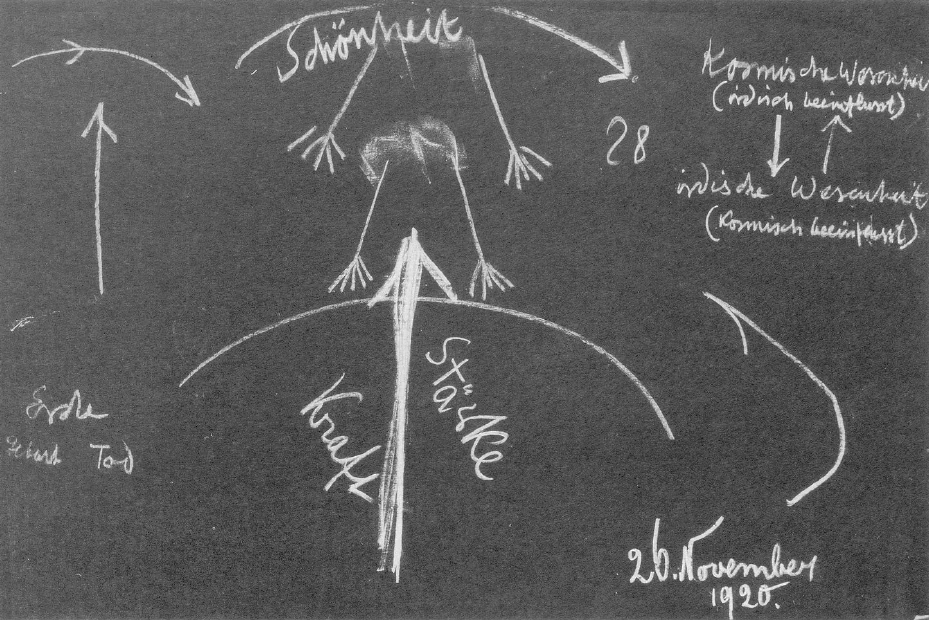
[ 7 ] What is actually happening there? Well, the human being first arrives as a spiritual-soul being with the personality whom he chooses from the universe as his mother. And from this point on, the Moon takes over the formation of the head. If the human being were to remain in the mother’s womb for twelve months—twelve lunar months—a completely closed cycle would result. However, the human being does not remain there for these twelve months, but only for ten lunar months. Therefore, a part of their development remains incomplete. This is what all the forces acting from the cosmos after birth are now concerned with. Before birth, ten-twelfths of the cosmic forces act upon the formation of the human head; the remaining two-twelfths are left to extrauterine development. But this extrauterine development also begins during the embryonic period. In addition to the cosmic forces, other forces act upon the human being, and these now emanate essentially from the Earth itself. These do not act on the head, but rather on the human being as a being of limbs. If you imagine the Earth here and, schematically drawn, the human being as a being of limbs, then the forces at work in these limbs—and their extension inward—are essentially earthly and telluric. The forces of the Earth are at work in the arms and hands, in the legs and feet. This interplay continues inward, becoming metabolism. But what is metabolism on the inside is a transformation of forces on the outside. When you move your arms, when you move your legs, the movement is not something so simple; rather, it also has to do with the forces of the Earth. Whenever you move your legs while walking, you must overcome the Earth’s gravity, and what results is a resultant force between the forces at work internally and the forces of gravity.
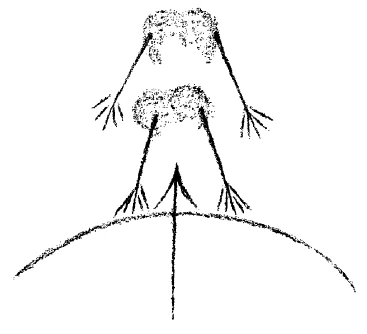
[ 8 ] While, in the process of metabolism, that which is at work within the human being enters into a state of interaction with the chemical properties of the earth’s substance, that which exists as strength in the arms and legs enters into an exchange of forces with the forces of the earth. What is formed there is now connected to different temporal relationships than what takes place in the mother’s womb. In the mother’s womb, we have ten times twenty-eight days, that is, ten moons. Underlying this is the course of the day repeated a certain number of times—the course of the day two hundred and eighty times. We are essentially dealing with the course of the day. In the development of the human limbs, we are dealing with what we might call the course of the year. Hence we also see how the human limbs become fully formed—admittedly at great speed in the early stages of development, but then more and more slowly. In fact, it takes a human being twenty-eight years—though the last seven years are not as visibly evident as those up to the age of twenty-one—to develop the human being with limbs outside the mother’s body—though this process already begins within the mother’s body.
[ 9 ] Just as what constitutes the “head-human” is connected to the past and to the development that can now take place—because the Moon’s relationship to the Earth repeats this past of Saturn, Sun, and Moon development—so too is what initially constitutes the “limb-human” connected to the Earth, but to that which is actually, within the Earth’s formation, a preparation for the Jupiter, Venus, and Vulcan states. That is why human beings cannot actually develop their heads so directly on Earth. The Earth is powerless when it comes to the formation of the human head. Only because the human being brings with them the forces from before birth, before conception, and is then protected within the mother’s womb from the external earthly environment—while the cosmos acts upon them through the Moon—can this head arise as a higher metamorphosis of the “limb-human” from the previous incarnation. And the limb-human, who arises under the influence of the Earth, cannot be completed through Earth’s formative process. He cannot develop a head. What the human being will be able to do during the Venusian stage of development, he cannot do during the Earth stage. Just as a deer sheds its antlers, he will lose his head; he will develop a different head from the rest of his human form. What an enviable state this Venusian human is in! But the fact is that this is something which, as a future state, appears quite clearly to the human being in spiritual vision. Yes, the things of reality seem grotesque compared to the limited things of the Earth, but what is reality goes beyond what is initially accessible to the limited Earthly mind. One must take seriously the fact that through mere earthly observation one can grasp only a part of reality, and that one actually knows nothing about human beings if one observes only earthly conditions.
[ 10 ] Thus, in the human being we have a cosmic being—which, however, is initially formed externally in the mother’s womb—and an earthly being that is shaped, configured, and differentiated under the influence of earthly conditions, as the Sun appears to revolve around the Earth and, in doing so, passes through the constellations of the zodiac. If you consider what we have discussed, you will see that there are actually two opposing states within the human being: a cosmic state, a cosmic being, and an earthly being. The cosmic being actually works in such a way that, if left to itself, the human being would develop a perfectly round head from the cosmos. It is only because the sunlight shines upon it through the Moon that the face is formed; when the sunlight turns away, the foundation for the back of the head is created. A distinction is made between what forms spherically from the cosmos. If it were not for the Moon, which shapes the human head, human beings would be born as completely unshaped spheres. And on the other hand, because the mother is on Earth, the Earth exerts its influence. The fact that a human being does not merely develop a head in an embryonic state stems from the fact that the Earth is already at work during the formation of the head. But it acts in such a way that if a human being were subject only to the Earth—if the cosmic influence were not present—he would become a pillar. Human beings are actually enclosed, caught between becoming a pillar or a radius—influenced by the Earth—and becoming a sphere—influenced by the cosmos. The formation of the human being is, in fact, based on a circle and a radius.
[ 11 ] The fact that human beings do not become pillars—and, above all, that they are not born with fused feet and fused hands—stems from the existence of the cycle of the year, from the spiritual influence of winter and summer, which points to various cosmic relationships between the Earth and its surroundings. The differentiation that occurs between winter and summer is similar to that between the full moon and the new moon. Just as the full moon and the new moon, in their difference, determine the front and back of the head, so do the cosmic forces expressed in winter and summer, spring and fall, determine the configuration of our limbs—that we have two legs and are not a pillar. So that in our head we are not entirely cosmic, but—I would say—a cosmic entity tempered by the earthly, and that in regard to our limbs we are not entirely earthly, but an earthly entity tempered by the cosmic. The Earth’s annual cycle is, after all, determined by cosmic forces. We therefore have a cosmic being influenced by the earthly, and an earthly being influenced by the cosmic. If we, as cosmic beings, were not influenced by the earthly, we would be spheres as human beings; if we, as human beings with limbs—as earthly human beings—were not influenced by the cosmic, we would be pillars.
[ 12 ] This interplay between the cosmic and the earthly—that is what finds expression in our human form. No one can understand the human form unless they are willing to grasp it as the result of the Earth’s interaction with the cosmos. It is truly marvelous how the human being is an expression of the entire universe, how he is an expression of the world of the stars—which manifests itself everywhere in his form—and how, at the same time, through this form, he is a reflection of those forces that flow forth from the Earth and give him his being. Imagine for a moment the earthly nature of the human being uninfluenced by the cosmic nature. We do not carry this earthly nature within us in that form, but it works within us; it is, as it were, the underlying foundation—that which radiates from the center of the Earth, that which draws its strength from the center of the Earth. What appears in our human power, and what also acts as will within our human power, has been referred to since ancient times by a single word that could be rendered in German as “Stärke” or “Kraft” . What shapes us from the cosmos—what we must therefore imagine as a circle, what primarily underlies the formation of our head but does not come to expression because it is tempered by the earthly—has been called “beauty” since ancient times. And so you see that, viewed in a broader sense, those things that work within the human being also possess a kind of value that transcends the physical and the moral—a value that encompasses both, the physical and the moral. For the strength that emanates from the earth, which works as a force within us, is at the same time moral strength and physical muscular strength. The beauty that radiates around us, that underlies our head—this is what appears in our head as the beauty of thought, both in a physical sense and in a moral sense.
[ 13 ] Between what we are as earthly beings, tempered by the cosmic, and what we are as cosmic beings, tempered by the earthly—between these two lies the “trunk human.” What is this “trunk human”? Essentially, he is the rhythmic human, who constantly allows the cosmic to swing down toward the earthly and the earthly to swing up toward the cosmic. We have a continuous circular flow within us that carries what is in the limbs, via the detour of breathing, up to the head, and what is in the head, via the detour of breathing, down to the limbs, so that a continuous wave motion, a back-and-forth undulation between the head and the limbs, arises. What mediates this wave motion is what we have within us in our rhythmic system—the lung and heart systems and the blood circulation. What, then, is the blood circulation? It is something caught between the straight line and the circle, shaped by the zodiac and the planets. What is at work here is that a force weaves out from the head, constantly seeking to guide our blood in a circular path, while a force constantly emanates from the limbs, seeking to guide our blood in a straight line. And from the interplay of these forces—the entire blood circulation’s constant striving to move in a circle, and the forces constantly striving to move in a straight line—arises within us the unique blood circulation, stimulated by our breathing. This rhythmic system mediates the cosmic and the earthly within the human being, so that a bond is woven within the human being between the cosmic—beauty—and the earth—strength. And this bond that is woven, which exists within the human being as a whole, has essentially been understood in spiritual and soul terms and has been called “wisdom” since ancient times.
[ 14 ] The beauty of the cosmos projected into human beings is the wisdom that lives in their thoughts. But the moral strength that derives, indirectly through the soul, from the power of the earth also becomes moral wisdom. In human beings, earthly and cosmic wisdom come together in the rhythmic system. Human beings are an expression of the entire cosmos, and one can, if one wishes, understand this configuration of the human being. One can, so to speak, look into the mysteries of the universe, insofar as human beings are shaped out of these mysteries. Indeed, one also sees—as we have already been able to observe this point from other perspectives—a certain connection within earthly life itself. Take what works its way into the human being as cosmic beauty via the head—this is the contribution of the feminine; take what manifests as earthly strength within the human being—this is the contribution of the masculine—and one can say: In the act of conception, a unification takes place between the cosmic and the terrestrial. One cannot gain insight into what the human being’s task on Earth is unless one looks into this particular configuration of the human being. For we see that what forms as the head comes into being because the earthly forces cannot initially act upon the human being at all; rather, the human being brings his pre-birth essence into the earthly realm, and in the womb, the non-earthly forces act to shape the human form via the Moon. The strength or power comes from the Earth. It forms the human being as a being of limbs. It cannot bring him to completion; he must pass through death. The forces lying within the human being as a being of limbs must become spiritualized and imbued with a soul. Then they continue in the non-earthly realm between death and new birth and are first transformed spiritually and soulfully into the formation of the head. On Earth, they were influenced by that which they cannot bring to completion, because the head will emerge from the human limbs only when the formations of Jupiter and Venus are present. What acts on Earth, therefore, does not determine the human being from birth to death. What previously acted on Saturn, the Sun, and the Moon has now become spiritual and must be developed spiritually before the new birth; and what passes through death must in turn be spiritualized, so that the future can be received from the past, and the human limb organism can once again become a head. One can therefore say: The human being dies so that, in the spiritual world, he may acquire the ability to express that form—partially tempered by earthly experience—which can be expressed by virtue of his having passed through the Saturn, Sun, and Moon states. Here on Earth, as a being of limbs, he can experience only what shapes his rhythmic system; that is his earthly nature. But in his limbs, he prefigures the future. They cannot come to an end; the human being must die and return once more to the head, which is first prefigured in the pre-earthly realm. Thus, the human form is connected to the repeated earthly lives. Because human beings are physically born as beings that have developed out of the Saturn, Sun, and Moon states, and because human beings—by receiving their predispositions from the spiritual world—must in turn express in their spherical form what they have experienced as the Saturn, Sun, and Moon states, they acquire a head on Earth that continually kills them, because it is not earthly.
[ 15 ] These things, which find expression in the human being’s repeated earthly lives, are intimately connected with what cosmic evolution is. It is not the case that these things—which we have touched upon today and which we intend to explore further tomorrow and the day after—cannot be understood by human beings. They can indeed be understood. They must be explored through spiritual science; anyone who simply allows their sound train of thought to take effect can understand them. Yet one hears time and again that human beings cannot immediately grasp the concepts of spiritual science. When one says, “Yes, the spiritual researcher gives me these things; I cannot grasp them myself”—one is essentially saying nothing other than if, after passing one’s high school graduation exam, one were to claim that one cannot solve differential equations. All people can learn what spiritual science teaches, just as all people can, in principle, learn to solve differential equations; it is simply that the latter is more difficult than the former. It is not the case that such excuses—that one is not clairvoyant, is not a clairvoyant, and therefore does not understand these things—can hold water. Just as one does not need to be clairvoyant to solve differential equations, one does not need to be clairvoyant to grasp such cosmic connections with the external world. One need only bring sound concepts to the table. But the opposite of what people very often say is also true. One person says: “This one has this worldview, that one has that worldview,” and people don’t know which one is the right one. — If one is consistent and follows everything through, taking into account everything that has been said, everything is unambiguous and not open to multiple interpretations. You cannot argue about beauty, wisdom, and power and their significance. Everything is unambiguous. That our mental formation contains a peripheral element, and that the element of strength in the rest of our being is contained in a radial form—these things are unambiguous. There is no room for this or that interpretation. One cannot beat around the bush about these things; in these matters, one arrives at very specific conclusions. This fact is what makes it difficult today to spread spiritual science as such, for nowadays it is the case that here and there, this or that association occasionally organizes lectures on anthroposophy or the threefold social order—which is, after all, merely a social outcome of spiritual science. People listen to one thing once, then listen to something else, and then to something else again; they do not want to arrive at a genuine inner resolve, at decisions. They treat spiritual science as something that can stand alongside other things. That does not work with spiritual science. The other worldviews that are emerging today can tolerate that. One is a little better, the other a little worse. One might say: You listen to all these things, you dabble here and there. — But that won’t work with spiritual science. There, you have to make a decision, because it goes right down to the very foundations. It truly requires this intense exertion of the will that leads to decisions—a will that does not simply stand alongside other things, but seeks to go right down to the very foundations. One cannot go down to the very foundations if one merely swings back and forth from one worldview to another, merely dabbling here and there. Spiritual science demands decisive action. That is why spiritual science has the spirit of the times against it; it has all the listlessness and all the weaknesses of the times against it, for it demands clear spiritual strength, and that is something people do not want in the present; it disturbs them, it is uncomfortable for them.
[ 16 ] In prehistoric times, human beings certainly had insights into these matters based on instinctive knowledge, and the ancient writings that our scholarship studies—but does not understand—contain numerous references indicating that this wisdom indeed included something akin to these relationships between human beings and the cosmos. Then this wisdom was lost. Humanity was cast back into chaos. But out of this chaos, humanity must save itself through its own powers of will; it must consciously rediscover its connection to the cosmos from within this chaos. And it can be found. I said at the beginning of today’s reflection that one cannot understand the head unless one can view it as a product of the cosmos; one cannot understand the human being as a collection of limbs unless one can view him as a product of earthly formation. And the balance between the two is the human being of the chest, the rhythmic organism that constantly seeks to make the straight line circular and the circle linear. Where you seek to contemplate the bloodstream, the straight line seeks to emerge, yet it also seeks to transform the circle into a straight line; how the bloodstream arises is connected to the movements of the stars and so on. The form is connected to the constellations, the movement to planetary motions. This has already been mentioned from other perspectives. But what happens in the human mind when one takes in such knowledge? One cannot help but say: These insights are as transparent as mathematical truths to those who take them in. — Mathematical truths are certainly transparent, but not to every fifteen-year-old boy. Yet these things are as transparent as mathematics.
[ 17 ] On the other hand, they have such a profound impact on what human beings can feel and experience. A sense of the divine arises from this wisdom. Only knowledge that remains on the surface can be irreligious; knowledge that reaches into the depths cannot be irreligious. When we look again at humanity’s connection to the cosmos—and perceive, above all, the beauty in the starry sky that envelops us as an imprint of a spiritual entity—we are led to imprint the beauty of things once more into art. Then it is not merely external nature, as perceived by the senses, that lives in art. Then, through a science that goes to the very foundations—such as spiritual science—what I said in the first introductory lecture to our courses is actually achieved: here at the Goetheanum, we seek the unity of science, art, and religion.
[ 18 ] As the person after whom the Goetheanum is named says:
Whoever possesses science and art,
Also possesses religion,
Whoever does not possess those two,
Let him have religion.
[ 19 ] That is, from the outside! But from the inside, it is possessed by those who have a deep, fundamental understanding of science and art—that is the Goethean spirit.
[ 20 ] Whoever possesses science and art also possesses religion—therefore, those who strive for the unity of religion, art, and science in the manner described may truly call the institution where they pursue this goal the “Goetheanum.” But even here, it seems that grasping what is presented here on such a foundation is no task for the superficiality of our time, which views everything only from above, merely skimming the surface. Spiritual science demands decisions. Decisions are necessary because this spirit seeks to penetrate the depths of the world. That is why this must also be understood from the depths of the human heart.