The Bridge Between the Spiritual and
Physical Realms of Human Beings
GA 202
26 November 1920, Dornach
Translate the original German text into any language:
Versions Available:
The Bridge Between the Spiritual and Physical Realms of Human Beings, tr. SOL
Erster Vortrag
First Lecture
[ 1 ] Ich habe oft davon gesprochen, wie sich bereits in der menschlichen Gestalt der menschliche Gesamtlebensvorgang ausdrückt. Wer das Haupt, den Kopf des Menschen in der richtigen Weise verstehen kann, der kann erkennen, wie die besondere Bildung, die besondere Gestaltung des Kopfes ein Ergebnis ist von früheren Lebenszusammenhängen, die der Mensch durchgemacht hat, bevor er zu dem gegenwärtigen Erdendasein herabgestiegen ist. Und wenn man ins Auge faßt, was die Gliedmaßenorganisation des Menschen ist, selbstverständlich diese Gliedmaßenorganisation räumlich nach innen fortgesetzt in diejenigen Organe hinein, mit denen die Gliedmaßen örtlich zusammenhängen, dann hat man in dieser Organisation dasjenige, was nach gewissen Metamorphosen, nach gewissen Umbildungen zugrunde liegen wird dem, was menschliche Hauptesbildung sein wird in der Zukunft, die über den Tod hinausliegt. Damit ist aber zu gleicher Zeit auf einen kosmischen Zusammenhang des Menschen hingewiesen. So wie wir den Menschen gegenwärtig vor uns haben, können wir allerdings sagen, daß seine besondere Hauptgestaltung, seine Kopfgestaltung eine Metamorphose ist seiner früheren Gliedmaßenleibgestaltung; aber daß der Mensch überhaupt eine solche Hauptesgestaltung hat, wie er sie eben an sich trägt, das rührt von dem her, was der Mensch kosmisch durchgemacht hat, bevor er die irdische Welt betreten hat. Die Kopfgestaltung, sie ist im wesentlichen ein Ergebnis der Saturn-, Sonnen- und Mondentwickelung, und dasjenige, was Gliedmaßenmensch ist, ist wiederum der Ausgangspunkt für Jupiter-, Venus- und VulkanentwickeJung. Nur das, was der Brustmensch ist, was im Wesen des gegenwärtigen rhythmischen Systems liegt, ist eigentlich Erdenmensch. So daß wir folgendes sagen können: Was wir im menschlichen Kopf zunächst vor uns haben, das ist herausgebildet aus den drei vorhergehenden, der Erde vorangehenden planetarischen Verkörperungen. Was den heutigen Gliedmaßen zugrunde liegt, ist Ausgangspunkt für die folgenden planetarischen Verkörperungen der Erde. Und indem der Mensch durchgeht durch das Leben zwischen dem Tod und einer neuen Geburt, macht er in einer gewissen Weise wiederum auf geistige Art durch, was er während der Saturn-, Sonnen- und Mondenzeit durchgemacht hat. Er bildet seinen Erdorganismus zurück zu dem Saturn-, Sonnen- und Mondorganismus. Und ebenso wird dasjenige, was auf der Erde als Gliedmaßenorganismus ausgebildet wird, weiter ins Physische hineinorganisiert, umorganisiert während der Jupiter-, Venus und Vulkanverkörperung der Erde.
[ 1 ] I have often spoken about how the entire course of human life is already expressed in the human form. Anyone who can understand the human head correctly can recognize how the head’s unique structure and form are the result of past life contexts that the human being went through before descending to their present earthly existence. And when one considers the structure of the human limbs—which, of course, continues spatially inward into those organs with which the limbs are physically connected—one finds in this structure that which, after certain metamorphoses and transformations, will form the basis for the future structure of the human head, extending beyond death. At the same time, however, this points to a cosmic connection of the human being. As we currently perceive human beings, we can certainly say that their specific head structure—the structure of the head—is a metamorphosis of their earlier limb-body structure; but the very fact that human beings possess such a head structure as they do stems from what they underwent cosmically before entering the earthly world. The head form is essentially a result of the Saturn, Sun, and Moon phases of development, and what constitutes the “limb-human” is, in turn, the starting point for the Jupiter, Venus, and Vulcan phases of development. Only what constitutes the “chest-human”—which lies at the heart of the present rhythmic system—is truly the “earth-human.” Thus we can say the following: What we first encounter in the human head has been formed out of the three preceding planetary incarnations that preceded the Earth. What underlies today’s “limb-human” serves as the starting point for the Earth’s subsequent planetary incarnations. And as the human being passes through the life between death and a new birth, he in a certain sense relives in a spiritual way what he went through during the Saturn, Sun, and Moon periods. He transforms his Earth organism back into the Saturn, Sun, and Moon organisms. And in the same way, what is formed on Earth as the limb organism is further organized into the physical realm and reorganized during the Earth’s Jupiter, Venus, and Vulcan incarnations.
[ 2 ] Diese Dinge haben also einen menschlich-irdischen Aspekt und einen kosmischen Aspekt. Wir können daher auch die menschliche Hauptesbildung so betrachten, daß wir die Beziehung der menschlichen Wesenheit zum Kosmos ins Auge fassen. Nun liegt allerdings der menschlichen Betrachtung zunächst etwas ferner, was sich während der Saturn- und Sonnenentwickelung zugetragen hat. Es ist dies, was sich da zugetragen hat, weniger noch von irdischem Gesichtspunkte aus zu beurteilen. Dagegen intensiv beurteilen kann man dasjenige, was sich während der alten Mondenentwickelung abgespielt hat, denn das wiederholt sich in einer gewissen Beziehung in den Tatsachen, die sich abspielen zwischen der Erde und dem Monde, dem gegenwärtigen Monde. Daher kann man auch die Beziehung des menschlichen Hauptes zu dem studieren, was sich abspielt zwischen der Erde und dem Monde. Und man kommt auf gewisse Geheimnisse der Menschenbildung dadurch, daß man diese Tatsachen ins Auge faßt. Das kann auf folgende Art geschehen.
[ 2 ] These things, then, have both a human-earthly aspect and a cosmic aspect. We can therefore also view the formation of the human head in such a way that we take into account the relationship of the human being to the cosmos. However, what took place during the Saturn and Sun stages of development is, at first glance, somewhat beyond the scope of human perception. What took place then is even less amenable to judgment from an earthly perspective. On the other hand, one can thoroughly examine what occurred during the ancient lunar evolution, for this is repeated in a certain sense in the phenomena taking place between the Earth and the Moon—the present-day Moon. Therefore, one can also study the relationship of the human head to what takes place between the Earth and the Moon. And by considering these facts, one gains insight into certain mysteries of human formation. This can be done in the following way.
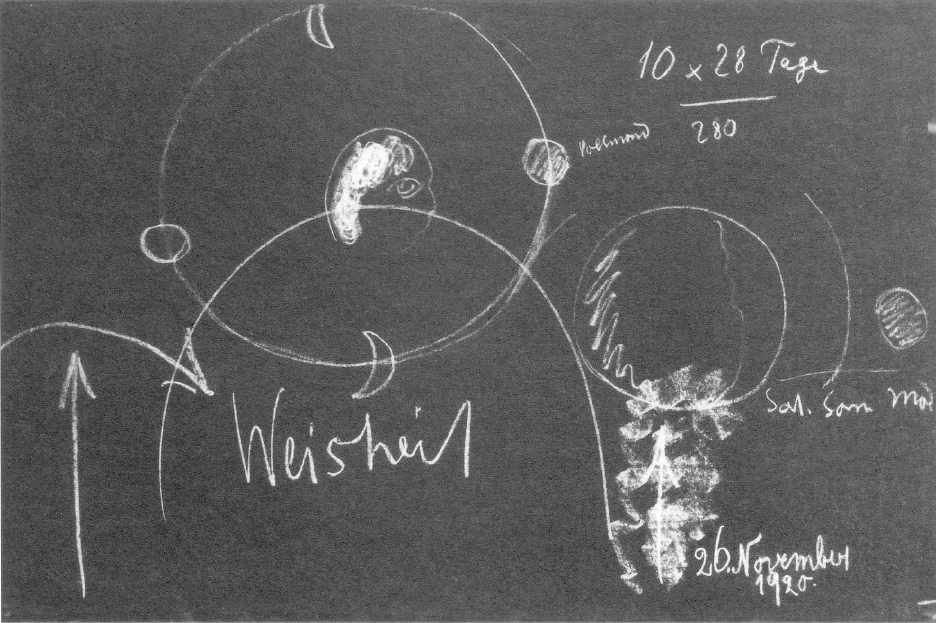
[ 3 ] Denken Sie sich einmal schematisch, der Mensch steht auf der Erde; also er befindet sich nicht im Mittelpunkt der Erde, sondern vom Mittelpunkt um den Erdradius entfernt. Und wenn wir dieses schematisch als das menschliche Haupt (siehe Zeichnung Seite 15) auffassen, so können wir sagen: Es bewegt sich wie um die Erde herum, so auch um das menschliche Haupt herum der Mond. Schematisch gezeichnet, selbstverständlich nicht in den Größenverhältnissen, das würde sich schlecht ausnehmen.
[ 3 ] Imagine, schematically, that a person is standing on Earth; that is, they are not at the center of the Earth, but at a distance from the center equal to the Earth’s radius. And if we conceptualize this schematically as the human head (see drawing on page 15), we can say: Just as the Moon orbits the Earth, so too does it orbit the human head. Drawn schematically, of course not to scale—that would look rather odd.
[ 4 ] Nehmen Sie nun einmal an, der Mond stünde hier und sei Vollmond, so strahlt das von der Sonne zurückgeworfene Licht, wie man immer sagt, dem Menschen zu. Es wirkt also das Sonnenlicht auf den Menschen. Ich bemerke, wenn ich vom Menschen spreche, meine ich jetzt immer das menschliche Haupt. Auf der entgegengesetzten Seite sei Neumond. Kein Licht trifft den Menschen; der Mensch ist gewissermaßen von dieser Seite her sich selbst überlassen. Er ist weniger in Anspruch genommen durch die äußeren Lichtreize, die auf ihn ausgeübt werden. Er ist daher mehr seiner inneren Entwickelung überlassen. Und wenn Sie hier das erste Viertel, hier das letzte Viertel setzen, zunehmender, abnehmender Mond, so haben Sie immer weniger Lichtreize von beiden Seiten her auf den Menschen ausgeübt als von seiten des Vollmondes, und mehr Reize als von seiten des Neumondes. Außerdem durchläuft ja der Mond, indem er diese Bahn um die Erde beschreibt, den Tierkreis. Dadurch wird das Licht noch in besonderer Weise bestimmt und, ich möchte sagen, differenziert; denn das Mondlicht ist ein anderes, wenn es von einem Orte kommt, hinter dem, sagen wir, der Widder steht, ein anderes, wenn es von einem Orte kommt, hinter dem die Jungfrau steht. Das Mondlicht wird als solches differenziert, je nachdem der Mond an diesem oder jenem Tierkreisbilde vorübergeht.
[ 4 ] Now suppose the moon were here and were full; then the light reflected from the sun, as is often said, shines upon the human being. Thus, the sunlight acts upon the human being. I should note that when I speak of “human beings,” I am always referring to the human head. On the opposite side, let there be a new moon. No light reaches the person; the person is, so to speak, left to their own devices from this side. They are less affected by the external light stimuli acting upon them. They are therefore more attuned to their inner development. And if you place the first quarter here and the last quarter here—the waxing and waning moon—you have fewer and fewer light stimuli acting upon the human being from both sides than there are from the full moon, and more stimuli than from the new moon. Furthermore, as the moon traces this path around the Earth, it passes through the zodiac. This determines the light in a special way and, I would say, differentiates it; for the moonlight is different when it comes from a point behind which, say, Aries is situated, and different when it comes from a point behind which Virgo is situated. The moonlight is differentiated as such, depending on whether the moon passes in front of this or that sign of the zodiac.
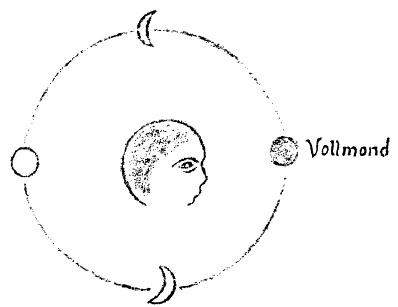
[ 5 ] Denken Sie sich nun, was ich hier schematisch gezeichnet habe, in der richtigen Zeitlage der menschlichen Entwickelung, das heißt, denken Sie sich, durch irgendwelche Vorgänge setze sich fest in einem mütterlichen Leibe der Geistkeim des Menschen, der zunächst herüberkommt aus der Entwickelung zwischen dem Tod und einer neuen Geburt. Während dieser Zeit wirkt der Mond auf den Keim. Dann haben Sie, zunächst durch die Wirkung des Mondes, natürlich im Zusammenhange mit den anderen Weltenkörpern, vom Kosmos hereinbewirkt die Konfiguration des menschlichen Kopfes im mütterlichen Leibe. Die Konfiguration des menschlichen Kopfes geschieht durchaus vom Monde her.
[ 5 ] Now imagine what I have drawn here schematically in the correct chronological context of human evolution—that is, imagine that, through certain processes, the spiritual seed of the human being, which initially comes from the period of development between death and a new birth, becomes firmly established in a mother’s womb. During this time, the Moon acts upon the seed. Then, initially through the influence of the Moon—naturally in conjunction with the other celestial bodies—the configuration of the human head is brought about from the cosmos within the mother’s womb. The configuration of the human head is brought about entirely by the Moon.
[ 6 ] Nun werden Sie sagen, und mit Recht: Es ist doch nicht immer anzunehmen, daß just der Vollmond sein Licht auf die Augen oder die Nase strahlt, und daß just auf den Hinterkopf, dessen innere Entwickelung sich überlassen sein soll, nicht der Außenwelt, daß da just diese Stelle dem Neumonde gegenübersteht. Gewiß, das braucht auch nicht unbedingt der Fall zu sein; im wesentlichen ist es schon so, daß irgendwo dem Antlitz gegenüber der Vollmond tätig ist, und irgendwo dem Hinterkopf gegenüber der Neumond tätig ist. Das Kind hat auch eine besondere Stellung im mütterlichen Leibe, und die ist durchaus nach dem Kosmos hin orientiert. Indem nun aber der Mond etwas mehr oder weniger, ich möchte sagen, schief strahlt nach demjenigen Teil des Keimes, der Antlitz werden soll, je nachdem wird der Mensch mit diesen oder jenen inneren Fähigkeiten, soferne diese vom Haupt abhängen, begabt werden. Er wird anders begabt, physisch begabt, wenn zum Beispiel das helle Mondlicht nach seinem Munde hinstrahlt, als wenn es nach seinen Augen hinstrahlt. Das hängt mit den menschlichen Begabungen zusammen, soferne sie vom Kosmos abhängig sind. Aber das Wesentliche, was wir heute ins Auge fassen wollen, ist, daß während der Embryonalentwickelung des Menschen die Einflüsse, die im wesentlichen von dem Monde ausgehen, dasjenige sind, was den menschlichen Keim formt, der von der Kopfesbildung ausgeht, denn das erste, was sich konfiguriert vom Menschen, ist der Kopf. Und das geht vom Monde aus, also von demjenigen, was als alte Mondenbewegung und Wirksamkeit vom alten Monde und überhaupt von den vorangehenden Verkörperungen unserer Erde zurückgeblieben ist. Da sehen Sie den kosmischen Zusammenhang des menschlichen Hauptes mit der Außenwelt. Sie sehen, wie der Mensch während der Embryonalentwickelung in diejenigen kosmischen Zusammenhänge eingespannt ist, für die im wesentlichen der Mond mit seiner Wirksamkeit den Ton angibt. Die Sache geschieht aber so, daß ja der Mond die Bewegung macht, also eigentlich das Haupt umläuft. Er umläuft es zehnmal, während der Mensch die Embryonalentwickelung durchmacht. Es ist also so, daß zunächst der Mond vorüberläuft, das menschliche Antlitz bildet, dann es in Ruhe läßt, es auswachsen läßt. Während der Zeit bewegt er sich rückwärts herum. Nachdem eine Zeitlang die Gesichtsbildung geschlafen hat, erscheint der Mond wiederum, frischt sie auf. Das macht er so zehnmal. Und während dieser zehn Mondmonate wird rhythmisch aus dem Kosmos heraus das menschliche Haupt geformt. So daß wir ein Zehnmal-achtundzwanzig-Tage-Verweilen haben des Menschen im Mutterleibe unter dem Einfluß der durch den Mond vermittelten kosmischen Kräfte.
[ 6 ] Now you will say, and rightly so: It cannot always be assumed that the full moon shines its light precisely on the eyes or the nose, and that precisely the back of the head—whose inner development is to be left to itself, not to the outside world—is the spot that faces the new moon. Certainly, that need not necessarily be the case; essentially, it is true that the full moon is active somewhere opposite the face, and the new moon is active somewhere opposite the back of the head. The child also occupies a special position within the mother’s womb, and this position is entirely oriented toward the cosmos. But depending on whether the moon shines—to a greater or lesser extent—at an angle, so to speak, toward that part of the embryo that is to become the face, the human being will be endowed with certain inner abilities, insofar as these depend on the head. The child will be endowed with different physical abilities if, for example, the bright moonlight shines toward its mouth than if it shines toward its eyes. This is related to human abilities, insofar as they depend on the cosmos. But the essential point we wish to consider today is that during the embryonic development of the human being, the influences that essentially emanate from the Moon are what shape the human embryo, beginning with the formation of the head; for the first part of the human being to take shape is the head. And this emanates from the Moon—that is, from what remains of the ancient lunar movements and the influence of the ancient Moon, and indeed from the previous incarnations of our Earth. There you see the cosmic connection between the human head and the external world. You see how, during embryonic development, the human being is embedded in those cosmic relationships in which the Moon, with its influence, essentially sets the tone. But the process unfolds in such a way that the Moon is the one that moves—that is, it actually orbits the head. It orbits it ten times while the human being undergoes embryonic development. So first the Moon passes by, shaping the human face; then it leaves it undisturbed, allowing it to grow out. During this time, it moves backward around the head. After the formation of the face has been dormant for a while, the Moon reappears and revitalizes it. It does this ten times. And during these ten lunar months, the human head is rhythmically formed from the cosmos. Thus, the human being remains in the womb for ten cycles of twenty-eight days under the influence of the cosmic forces mediated by the Moon.
[ 7 ] Das, was da geschieht, was ist es denn eigentlich? Nun, der Mensch kommt zunächst als geistig-seelisches Wesen bei derjenigen Persönlichkeit, die er sich aus dem Weltenall als seine Mutter wählt, an. Und nunmehr übernimmt der Mond seine Hauptesbildung. Würde der Mensch zwölf Monate im mütterlichen Leibe verweilen, zwölf Mondenmonate, so würde sich eine ganz abgeschlossene Kreisbildung ergeben. Er verweilt nicht diese zwölf Monate, sondern nur zehn Mondmonate dort. Daher bleibt noch von seiner Entwickelung etwas offen. Damit beschäftigt sich nun alles das, was einwirkt aus dem Kosmos nach der Geburt. Vor der Geburt wirken zehn Zwölftel der kosmischen Kräfte auf die menschliche Hauptesbildung, die übrigen zwei Zwölftel werden der außermütterlichen Bildung überlassen. Aber es beginnt auch schon diese außermütterliche Bildung während der Embryonalzeit. Außer den kosmischen Kräften wirken auf den Menschen noch andere Kräfte, und die gehen jetzt im wesentlichen von der Erde selbst aus. Die wirken nicht auf das Haupt, sondern die wirken auf den Gliedmaßenmenschen. Wenn Sie sich hier die Erde vorstellen und, schematisch gezeichnet, das als den Gliedmaßenmenschen, so sind dieKräfte, welche in diesen Gliedmaßen mit ihrer Fortsetzung nach innen spielen, im wesentlichen irdisch-tellurische. In den Armen und Händen, in den Beinen und Füßen spielen die Kräfte der Erde. Nach innen setzt sich dieses Spiel so fort, daß es zum Stoffwechsel wird. Aber was im Inneren Stoffwechsel ist, ist im Äußeren Kraftwechsel. Wenn Sie die Arme bewegen, wenn Sie die Beine bewegen, so ist die Bewegung nicht etwas so Einfaches, sondern das hat auch mit den Kräften der Erde zu tun. Sie haben immer, wenn Sie die Beine bewegen im Gehen, die Schwerkraft der Erde zu überwinden, und das, was entsteht, ist eine Resultierende zwischen den im Inneren spielenden Kräften und den Kräften der Schwere.
[ 7 ] What is actually happening there? Well, the human being first arrives as a spiritual-soul being with the personality whom he chooses from the universe as his mother. And from this point on, the Moon takes over the formation of the head. If the human being were to remain in the mother’s womb for twelve months—twelve lunar months—a completely closed cycle would result. However, the human being does not remain there for these twelve months, but only for ten lunar months. Therefore, a part of their development remains incomplete. This is what all the forces acting from the cosmos after birth are now concerned with. Before birth, ten-twelfths of the cosmic forces act upon the formation of the human head; the remaining two-twelfths are left to extrauterine development. But this extrauterine development also begins during the embryonic period. In addition to the cosmic forces, other forces act upon the human being, and these now emanate essentially from the Earth itself. These do not act on the head, but rather on the human being as a being of limbs. If you imagine the Earth here and, schematically drawn, the human being as a being of limbs, then the forces at work in these limbs—and their extension inward—are essentially earthly and telluric. The forces of the Earth are at work in the arms and hands, in the legs and feet. This interplay continues inward, becoming metabolism. But what is metabolism on the inside is a transformation of forces on the outside. When you move your arms, when you move your legs, the movement is not something so simple; rather, it also has to do with the forces of the Earth. Whenever you move your legs while walking, you must overcome the Earth’s gravity, and what results is a resultant force between the forces at work internally and the forces of gravity.
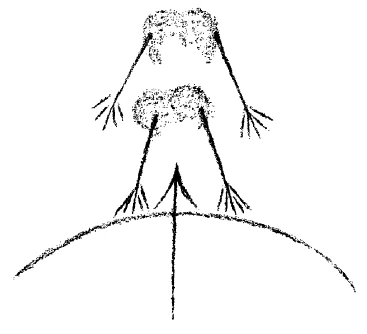
[ 8 ] Während beim Stoffwechsel das, was im Inneren des Menschen arbeitet, eben einen Wechselzustand eingeht mit den chemischen Eigenschaften der Erdsubstanz, geht das, was als Kraft in den Armen und Beinen ist, einen Kraftwechsel ein mit den Kräften der Erde. Was da ausgebildet wird, das hängt nun zusammen mit anderen Zeitverhältnissen als das, was im mütterlichen Leibe vor sich geht. Im mütterlichen Leibe haben wir zehnmal achtundzwanzig Tage, also zehn Monde. Da liegt zugrunde der Tageslauf in einer gewissen Anzahl, der Tageslauf zweihundertachtzigmal. Wir haben es im wesentlichen mit dem Tageslauf zu tun. Bei der Ausbildung des Gliedmaßenmenschen haben wir es mit dem zu tun, was wir als den Jahreslauf bezeichnen können. Daher sehen wir auch, wie die menschlichen Gliedmaßen, in der ersten Zeit der Entwickelung allerdings mitgroßer Geschwindigkeit, dann aber immer langsamer und langsamer voll ausgebildet werden. Eigentlich braucht der Mensch achtundzwanzig Jahre, wovon die letzten sieben Jahre allerdings nicht mehr so sichtbar als die bis zum einundzwanzigsten Jahre sind, um außer dem mütterlichen Leibe — aber es beginnt schon im mütterlichen Leibe — den Gliedmaßenmenschen auszubilden.
[ 8 ] While, in the process of metabolism, that which is at work within the human being enters into a state of interaction with the chemical properties of the earth’s substance, that which exists as strength in the arms and legs enters into an exchange of forces with the forces of the earth. What is formed there is now connected to different temporal relationships than what takes place in the mother’s womb. In the mother’s womb, we have ten times twenty-eight days, that is, ten moons. Underlying this is the course of the day repeated a certain number of times—the course of the day two hundred and eighty times. We are essentially dealing with the course of the day. In the development of the human limbs, we are dealing with what we might call the course of the year. Hence we also see how the human limbs become fully formed—admittedly at great speed in the early stages of development, but then more and more slowly. In fact, it takes a human being twenty-eight years—though the last seven years are not as visibly evident as those up to the age of twenty-one—to develop the human being with limbs outside the mother’s body—though this process already begins within the mother’s body.
[ 9 ] So wie zusammenhängt, was Kopfmensch ist, mit der Vergangenheit und die Entwickelung jetzt stattfinden kann, weil das Verhältnis des Mondes zur Erde diese Vergangenheit von Saturn-, Sonnen- und Mondentwickelung wiederholt, so hängt das, was zunächst der Gliedmaßenmensch ist, mit der Erde zusammen, aber mit dem, was eigentlich in der Erdenbildung Vorbereitung zum Jupiter-, Venus- und Vulkanzustand ist. Deshalb kann der Mensch eigentlich sein Haupt nicht so unmittelbar auf der Erde ausbilden. Die Erde ist ohnmächtig gegenüber der Bildung des menschlichen Hauptes. Nur dadurch, daß der Mensch die Kräfte sich mitbringt von vor der Geburt, vor der Empfängnis, und dann im mütterlichen Leibe beschützt wird vor der äußeren Erdenumgebung, der Kosmos durch den Mond auf ihn wirkt, dadurch kann dieser Kopf als eine höhere Metamorphose des Gliedmaßenmenschen der vorigen Inkarnation entstehen. Und der Gliedmaßenmensch, der unter dem Einfluß der Erde entsteht, kann nicht fertig werden durch die Erdbildung. Er kann es nicht zum Kopfe bringen. Der Mensch kann nicht während der Erdenentwickelung, was er können wird während der Venusentwickelung. Wie der Hirsch sein Geweih abwirft, wird er seinen Kopf verlieren; er wird aus seinem übrigen Menschen einen anderen Kopf entwickeln. Allerdings ein beneidenswerter Zustand dieses Venusmenschen! Aber es ist so, daß das etwas ist, was als zukünftiger Zustand durchaus vor dem Menschen erscheint in der geistigen Anschauung. Ja, die Dinge der Wirklichkeit nehmen sich gegenüber den beschränkten Erdendingen grotesk aus, aber das, was Wirklichkeit ist, geht über dasjenige hinaus, was dem beschränkten Erdenverstand zunächst zugänglich ist. Man muß ernst machen damit, daß man innerhalb der bloßen Erdenbeobachtung eben nur einen Teil der Wirklichkeit erhalten kann, daß man eigentlich vom Menschen nichts weiß, wenn man nur die Erdenverhältnisse beobachtet.
[ 9 ] Just as what constitutes the “head-human” is connected to the past and to the development that can now take place—because the Moon’s relationship to the Earth repeats this past of Saturn, Sun, and Moon development—so too is what initially constitutes the “limb-human” connected to the Earth, but to that which is actually, within the Earth’s formation, a preparation for the Jupiter, Venus, and Vulcan states. That is why human beings cannot actually develop their heads so directly on Earth. The Earth is powerless when it comes to the formation of the human head. Only because the human being brings with them the forces from before birth, before conception, and is then protected within the mother’s womb from the external earthly environment—while the cosmos acts upon them through the Moon—can this head arise as a higher metamorphosis of the “limb-human” from the previous incarnation. And the limb-human, who arises under the influence of the Earth, cannot be completed through Earth’s formative process. He cannot develop a head. What the human being will be able to do during the Venusian stage of development, he cannot do during the Earth stage. Just as a deer sheds its antlers, he will lose his head; he will develop a different head from the rest of his human form. What an enviable state this Venusian human is in! But the fact is that this is something which, as a future state, appears quite clearly to the human being in spiritual vision. Yes, the things of reality seem grotesque compared to the limited things of the Earth, but what is reality goes beyond what is initially accessible to the limited Earthly mind. One must take seriously the fact that through mere earthly observation one can grasp only a part of reality, and that one actually knows nothing about human beings if one observes only earthly conditions.
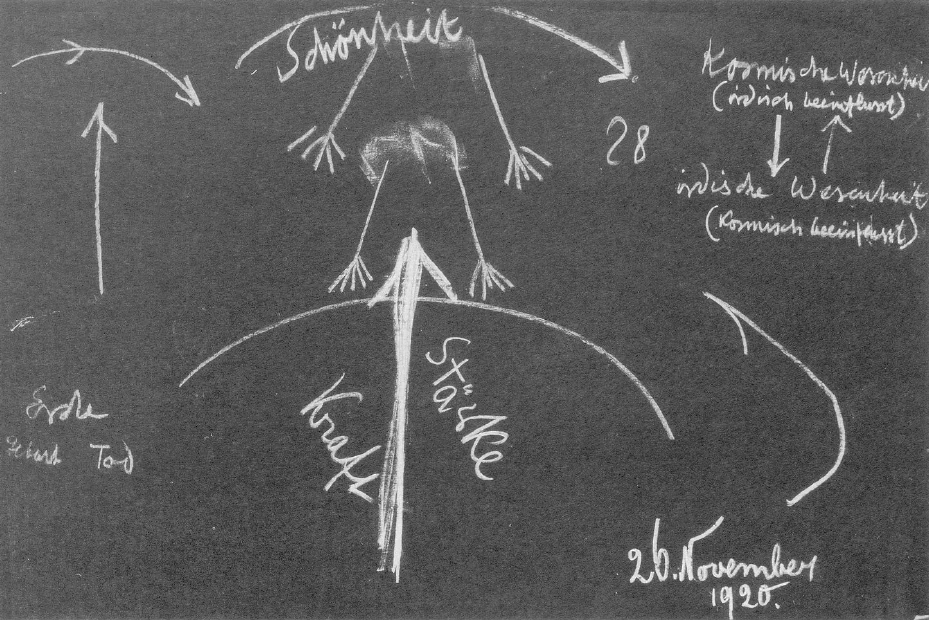
[ 10 ] So haben wir im Menschen ein kosmisches Wesen, das allerdings zunächst der Hauptsache nach im mütterlichen Leibe äußerlich herangebildet wird, und ein Erdenwesen, das unter dem Einfluß der Erdenverhältnisse gebildet wird, konfiguriert, differenziert wird, indem scheinbar die Sonne herumgeht um die Erde und dabei wiederum die Sternbilder des Tierkreises passiert. Wenn Sie dasjenige, was wir so besprochen haben, ins Auge fassen, haben Sie eigentlich im Menschen zwei einander entgegengesetzte Zustände: einen kosmischen Zustand, kosmische Wesenheit, und eine Erdenwesenheit. Die kosmische Wesenheit wirkt eigentlich so, daß der Mensch zunächst aus dem Kosmos heraus einen ganz runden Kopf kriegen würde. Nur dadurch, daß ihn einmal das Sonnenlicht durch den Mond anschaut, wird das Antlitz gebildet, dadurch, daß sich das Sonnenlicht abwendet, wird die Grundlage geschaffen für den Hinterkopf. Es wird differenziert, was sich kugelförmig aus dem Kosmos heraus bildet. Wenn der gute Mond nicht wäre und den menschlichen Kopf konfigurieren würde, würde der Mensch als ganz unkonfigurierte Kugel geboren werden. Und andererseits, weil die Mutter auf der Erde ist, wirkt die Erde. Daß der Mensch nicht bloß einen Kopf embryonal entwickelt, rührt davon her, daß die Erde schon während der Hauptesbildung wirkt. Aber sie wirkt so, daß der Mensch, wenn er bloß der Erde unterliegen würde, wenn nicht die kosmische Einwirkung da wäre, er eine Säule werden würde. Der Mensch ist eigentlich eingeschlossen, eingeklemmt zwischen dem Säulewerden, Radiuswerden von der Erde aus und dem Kugelwerden vom Kosmos aus. Der Bildung des Menschen liegt in der Tat Kreis und Radius zugrunde.
[ 10 ] Thus, in the human being we have a cosmic being—which, however, is initially formed externally in the mother’s womb—and an earthly being that is shaped, configured, and differentiated under the influence of earthly conditions, as the Sun appears to revolve around the Earth and, in doing so, passes through the constellations of the zodiac. If you consider what we have discussed, you will see that there are actually two opposing states within the human being: a cosmic state, a cosmic being, and an earthly being. The cosmic being actually works in such a way that, if left to itself, the human being would develop a perfectly round head from the cosmos. It is only because the sunlight shines upon it through the Moon that the face is formed; when the sunlight turns away, the foundation for the back of the head is created. A distinction is made between what forms spherically from the cosmos. If it were not for the Moon, which shapes the human head, human beings would be born as completely unshaped spheres. And on the other hand, because the mother is on Earth, the Earth exerts its influence. The fact that a human being does not merely develop a head in an embryonic state stems from the fact that the Earth is already at work during the formation of the head. But it acts in such a way that if a human being were subject only to the Earth—if the cosmic influence were not present—he would become a pillar. Human beings are actually enclosed, caught between becoming a pillar or a radius—influenced by the Earth—and becoming a sphere—influenced by the cosmos. The formation of the human being is, in fact, based on a circle and a radius.
[ 11 ] Daß der Mensch keine Säule wird, daß er vor allen Dingen nicht geboren wird mit zusammengewachsenen Füßen und zusammengewachsenen Händen, das rührt davon her, daß ja ein Jahreslauf da ist, daß Winter und Sommer geistig einwirken, was auf verschiedene kosmische Beziehungen der Erde und ihrer Umgebung hinweist. Die Differenzierung, die auftritt zwischen Winter und Sommer, ist ähnlich wie die zwischen Vollmond und Neumond. Wie Voll- und Neumond in ihrer Verschiedenheit Antlitz und Hinterkopf bedingen, so bedingen diejenigen kosmischen Kräfte, die in Winter und Sommer, Frühling und Herbst ausgedrückt sind, daß unsere Gliedmaßen konfiguriert sind, daß wir zwei Beine haben und nicht eine Säule sind. So daß wir im Haupt nicht ganz kosmisch sind, sondern, ich möchte sagen, ein Kosmisches, das irdisch gemildert ist, und daß wir in bezug auf unsere Gliedmaßen nicht ganz irdisch sind, sondern ein Irdisches, das kosmisch gemildert ist. Der Jahreslauf der Erde ist ja kosmisch bedingt. Wir haben also eine kosmische Wesenheit, irdisch beeinflußt, und eine irdische Wesenheit, kosmisch beeinflußt. Wären wir nicht als kosmische Wesen irdisch beeinflußt, so wären wir als Mensch eine Kugel; wären wir nicht als Gliedmaßenmensch, als irdischer Mensch kosmisch beeinflußt, so wären wir eine Säule.
[ 11 ] The fact that human beings do not become pillars—and, above all, that they are not born with fused feet and fused hands—stems from the existence of the cycle of the year, from the spiritual influence of winter and summer, which points to various cosmic relationships between the Earth and its surroundings. The differentiation that occurs between winter and summer is similar to that between the full moon and the new moon. Just as the full moon and the new moon, in their difference, determine the front and back of the head, so do the cosmic forces expressed in winter and summer, spring and fall, determine the configuration of our limbs—that we have two legs and are not a pillar. So that in our head we are not entirely cosmic, but—I would say—a cosmic entity tempered by the earthly, and that in regard to our limbs we are not entirely earthly, but an earthly entity tempered by the cosmic. The Earth’s annual cycle is, after all, determined by cosmic forces. We therefore have a cosmic being influenced by the earthly, and an earthly being influenced by the cosmic. If we, as cosmic beings, were not influenced by the earthly, we would be spheres as human beings; if we, as human beings with limbs—as earthly human beings—were not influenced by the cosmic, we would be pillars.
[ 12 ] Dieses Zusammenwirken von Kosmischem und Irdischem, das ist es, was in unserer menschlichen Form sich ausdrückt. Niemand versteht die menschliche Form, der sie nicht begreifen will aus dem Zusammenwirken der Erde mit dem Kosmos. Es ist ganz wunderbar, wie der Mensch ein Ausdruck ist des ganzen Weltalls, wie er ein Ausdruck ist der Sternenwelt, die sich in seiner Gestalt überall ausdrückt, und wie er zu gleicher Zeit mit dieser Gestalt ein Abbild ist derjenigen Kräfte, die aus der Erde herausströmen und die ihn bedingen. Denken Sie sich einmal die irdische Wesenheit des Menschen unbeeinflußt von der kosmischen Wesenheit. Wir tragen sie so nicht in uns, die irdische Wesenheit, aber sie wirkt in uns, sie ist gleichsam das Zugrundeliegende, das, was aus dem Mittelpunkt der Erde herausstrahlt, was vom Mittelpunkt der Erde heraus erkraftet. Was in unserer menschlichen Kraft erscheint, in unserer menschlichen Kraft auch als Wille wirkt, das nannte man seit alten Zeiten mit einem Worte, das man deutsch aussprechen könnte die «Stärke» oder die «Kraft». Was uns aus dem Kosmos heraus bildet, was wir also durch den Kreis uns vorstellen müssen, was unserer Hauptesbildung hauptsächlich zugrunde liegt, aber nicht zum Ausdrucke kommt, weil es irdisch gemildert ist, nannte man seit alten Zeiten die «Schönheit». Und so sehen Sie, daß im großen aufgefaßt diejenigen Dinge, die im Menschen wirken, auch eine Art über das Physische und über das Moralische hinausgehenden Wert haben, einen Wert, der beides zusammenfaßt, Physisches und Moralisches. Denn die Stärke, die von der Erde ausgeht, die als Kraft in uns wirkt, ist zu gleicher Zeit moralische Kraft und physische Muskelkraft. Diejenige Schönheit, die uns umstrahlt, die unserem Haupte zugrunde liegt, sie ist das, was in unserem Haupte als die Schönheit der Gedanken erscheint, sowohl in physischer Beziehung wie auch in sittlich-moralischer Beziehung.
[ 12 ] This interplay between the cosmic and the earthly—that is what finds expression in our human form. No one can understand the human form unless they are willing to grasp it as the result of the Earth’s interaction with the cosmos. It is truly marvelous how the human being is an expression of the entire universe, how he is an expression of the world of the stars—which manifests itself everywhere in his form—and how, at the same time, through this form, he is a reflection of those forces that flow forth from the Earth and give him his being. Imagine for a moment the earthly nature of the human being uninfluenced by the cosmic nature. We do not carry this earthly nature within us in that form, but it works within us; it is, as it were, the underlying foundation—that which radiates from the center of the Earth, that which draws its strength from the center of the Earth. What appears in our human power, and what also acts as will within our human power, has been referred to since ancient times by a single word that could be rendered in German as “Stärke” or “Kraft” . What shapes us from the cosmos—what we must therefore imagine as a circle, what primarily underlies the formation of our head but does not come to expression because it is tempered by the earthly—has been called “beauty” since ancient times. And so you see that, viewed in a broader sense, those things that work within the human being also possess a kind of value that transcends the physical and the moral—a value that encompasses both, the physical and the moral. For the strength that emanates from the earth, which works as a force within us, is at the same time moral strength and physical muscular strength. The beauty that radiates around us, that underlies our head—this is what appears in our head as the beauty of thought, both in a physical sense and in a moral sense.
[ 13 ] Zwischen dem, was wir sind als irdische Wesen, gemildert durch das Kosmische, was wir sind als kosmisches Wesen, gemildert durch das Irdische, zwischen beidem liegt der Rumpfesmensch. Was ist dieser Rumpfesmensch? Er ist im wesentlichen der rhythmische Mensch, der fortwährend das Kosmische nach dem Irdischen hinunterpendeln läßt und das Irdische nach dem Kosmischen heraufpendeln läßt. Wir haben eine fortwährende Kreisströmung in uns, die das, was in den Gliedmaßen liegt, auf dem Umwege durch das Atmen in den Kopf und das, was im Kopfe ist, auf dem Umwege durch das Atmen in die Gliedmaßen führt, so daß ein fortwährender Wellengang, ein Hin- und Herwellen zwischen Kopf und Gliedmaßen entsteht. Was diesen Wellenschlag vermittelt, ist dasjenige, was wir in unserem rhythmischen System, im Lungen- und Herzsystem, im Blutkreislauf in uns haben. Was wird der Blutkreislauf daher sein? Er ist etwas, was eingespannt ist zwischen dem Geradlinigen und dem Kreis, konfiguriert durch Tierkreis, durch Planeten. Was da wirkt, ist so, daß vom Kopfe aus eine Kraft webt, die fortwährend unser Blut kreisförmig leiten will, und von den Gliedmaßen aus fortwährend eine Kraft geht, die unser Blut geradlinig leiten will. Und aus dem Zusammenwirken der Kräfte das fortwährende Umkreis-werden-Wollen der gesamten Blutzirkulation, und die fortwährend zur Geraden werden wollenden Kräfte — daraus entsteht der besondere Blutkreislauf, von der Atmung angeregt, in uns. Dieses rhythmische System vermittelt Kosmisches und Irdisches innerhalb des Menschen, so daß im Menschen ein Band gewoben wird zwischen dem Kosmischen, der Schönheit, und der Erde, der Stärke. Und dieses Band, das da gewoben wird, das im Rumpfesmenschen ist, wird im wesentlichen, geistig-seelisch aufgefaßt, seit alten Zeiten « Weisheit» genannt.
[ 13 ] Between what we are as earthly beings, tempered by the cosmic, and what we are as cosmic beings, tempered by the earthly—between these two lies the “trunk human.” What is this “trunk human”? Essentially, he is the rhythmic human, who constantly allows the cosmic to swing down toward the earthly and the earthly to swing up toward the cosmic. We have a continuous circular flow within us that carries what is in the limbs, via the detour of breathing, up to the head, and what is in the head, via the detour of breathing, down to the limbs, so that a continuous wave motion, a back-and-forth undulation between the head and the limbs, arises. What mediates this wave motion is what we have within us in our rhythmic system—the lung and heart systems and the blood circulation. What, then, is the blood circulation? It is something caught between the straight line and the circle, shaped by the zodiac and the planets. What is at work here is that a force weaves out from the head, constantly seeking to guide our blood in a circular path, while a force constantly emanates from the limbs, seeking to guide our blood in a straight line. And from the interplay of these forces—the entire blood circulation’s constant striving to move in a circle, and the forces constantly striving to move in a straight line—arises within us the unique blood circulation, stimulated by our breathing. This rhythmic system mediates the cosmic and the earthly within the human being, so that a bond is woven within the human being between the cosmic—beauty—and the earth—strength. And this bond that is woven, which exists within the human being as a whole, has essentially been understood in spiritual and soul terms and has been called “wisdom” since ancient times.
[ 14 ] Die Schönheit des Kosmos in den Menschen hineinprojiziert ist die Weisheit, die in seinen Gedanken lebt. Aber auch die sittliche Kraft, die auf dem Umwege durch das Gemüt von der Stärke der Erde herrührt, wird zur sittlichen Weisheit. Im Menschen begegnen sich irdische und kosmische Weisheit im rhythmischen System. Der Mensch ist ein Ausdruck des ganzen Kosmos, und man kann, wenn man will, diese Konfiguration des Menschen verstehen. Man kann gewissermaßen hineinschauen in die Geheimnisse des Weltenalls, insofern der Mensch aus diesen Geheimnissen heraus gestaltet wird. Ja, man sieht auch — wir haben ja schon von anderen Gesichtspunkten aus nach diesem Punkte hinsehen können — einen gewissen Zusammenhang im irdischen Leben selbst. Nehmen Sie das, was als kosmische Schönheit auf dem Umwege durch das Haupt in den Menschen hineinwirkt, so haben Sie den Beitrag des Weiblichen; nehmen Sie das, was von irdischer Stärke in dem Menschen auftritt, so haben Sie den Beitrag des Männlichen, und Sie können sagen: Im Befruchtungsakt vollzieht sich ein Einigen zwischen dem Kosmischen und dem Terrestrischen. Man kann nicht in das hineinschauen, was Aufgabe des Menschen auf der Erde ist, wenn man nicht in diese besondere Konfiguration des Menschen hineinsieht. Denn wir sehen ja, daß das, was sich als Haupt bildet, sich dadurch bildet, daß eigentlich die Erdenkräfte zunächst gar nicht wirken können auf den Menschen, daß er sein Vorgeburtliches hineinbringt in das Irdische, und daß im Mutterleibe das Außerirdische auf dem Umwege des Mondes menschengestaltend wirkt. Von der Erde wirkt die Stärke oder die Kraft. Sie bildet den Gliedmaßenmenschen. Sie kann ihn nicht bis zu Ende führen, er muß durch den Tod gehen. Die Kräfte, die im Gliedmaßenmenschen liegen, müssen sich vergeistigen, verseelen. Dann gehen sie im Außerirdischen weiter zwischen Tod und neuer Geburt und gestalten sich zunächst geistig-seelisch zur Hauptesbildung um. Auf der Erde hat auf sie dasjenige gewirkt, was sie nicht zu Ende bringen kann, weil aus den menschlichen Gliedmaßen erst das Haupt hervorgehen wird, wenn Jupiter- und Venusbildung vorhanden sein wird. Was also auf der Erde wirkt, das bedingt nicht den Menschen von der Geburt bis zum Tode. Was vorher auf Saturn, Sonne, Mond gewirkt hat, das ist jetzt geistig geworden und muß geistig ausgebildet werden vor der neuen Geburt; und das, was durch den Tod geht, muß wiederum vergeistigt werden, dann kann die Zukunft von der Vergangenheit aufgenommen werden, und dann kann der menschliche Gliedmaßenorganismus wiederum Haupt werden. Man kann also sagen: Der Mensch stirbt, damit er in der geistigen Welt die Fähigkeit erlangt, jene Gestalt, teilweise irdisch gemildert, zum Ausdruck zu bringen, die zum Ausdruck gebracht werden kann vermöge dessen, daß er Saturn-, Sonnen- und Mondenzustand durchgemacht hat. Hier auf Erden kann er als Gliedmaßenmensch nur durchmachen, was sein rhythmisches System ausbildet, das ist irdisches Wesen. Aber in seinen Gliedmaßen bildet er die Zukunft vor. Sie können nicht zu Ende kommen, der Mensch muß sterben und wiederum zurückkehren zum Kopfe, der zunächst vorgebildet ist im Vorirdischen. So hängt die menschliche Gestalt zusammen mit den wiederholten Erdenleben. Weil der Mensch physisch geboren ist als ein Wesen, das sich aus Saturn-, Sonnen- und Mondenzustand herausgebildet hat, weil der Mensch, indem er aus der geistigen Welt die Anlagen bekommt, wiederum dasjenige zum Ausdruck zu bringen hat in der Kugelgestalt, was er als Saturn-, Sonnen- und Mondzustand durchgemacht hat, bekommt er ein Haupt auf der Erde, das ihn fortwährend tötet, weil es nicht irdisch ist.
[ 14 ] The beauty of the cosmos projected into human beings is the wisdom that lives in their thoughts. But the moral strength that derives, indirectly through the soul, from the power of the earth also becomes moral wisdom. In human beings, earthly and cosmic wisdom come together in the rhythmic system. Human beings are an expression of the entire cosmos, and one can, if one wishes, understand this configuration of the human being. One can, so to speak, look into the mysteries of the universe, insofar as human beings are shaped out of these mysteries. Indeed, one also sees—as we have already been able to observe this point from other perspectives—a certain connection within earthly life itself. Take what works its way into the human being as cosmic beauty via the head—this is the contribution of the feminine; take what manifests as earthly strength within the human being—this is the contribution of the masculine—and one can say: In the act of conception, a unification takes place between the cosmic and the terrestrial. One cannot gain insight into what the human being’s task on Earth is unless one looks into this particular configuration of the human being. For we see that what forms as the head comes into being because the earthly forces cannot initially act upon the human being at all; rather, the human being brings his pre-birth essence into the earthly realm, and in the womb, the non-earthly forces act to shape the human form via the Moon. The strength or power comes from the Earth. It forms the human being as a being of limbs. It cannot bring him to completion; he must pass through death. The forces lying within the human being as a being of limbs must become spiritualized and imbued with a soul. Then they continue in the non-earthly realm between death and new birth and are first transformed spiritually and soulfully into the formation of the head. On Earth, they were influenced by that which they cannot bring to completion, because the head will emerge from the human limbs only when the formations of Jupiter and Venus are present. What acts on Earth, therefore, does not determine the human being from birth to death. What previously acted on Saturn, the Sun, and the Moon has now become spiritual and must be developed spiritually before the new birth; and what passes through death must in turn be spiritualized, so that the future can be received from the past, and the human limb organism can once again become a head. One can therefore say: The human being dies so that, in the spiritual world, he may acquire the ability to express that form—partially tempered by earthly experience—which can be expressed by virtue of his having passed through the Saturn, Sun, and Moon states. Here on Earth, as a being of limbs, he can experience only what shapes his rhythmic system; that is his earthly nature. But in his limbs, he prefigures the future. They cannot come to an end; the human being must die and return once more to the head, which is first prefigured in the pre-earthly realm. Thus, the human form is connected to the repeated earthly lives. Because human beings are physically born as beings that have developed out of the Saturn, Sun, and Moon states, and because human beings—by receiving their predispositions from the spiritual world—must in turn express in their spherical form what they have experienced as the Saturn, Sun, and Moon states, they acquire a head on Earth that continually kills them, because it is not earthly.
[ 15 ] Diese Dinge, die sich im menschlichen wiederholten Erdenleben ausdrücken, sind innig zusammenhängend mit dem, was kosmische Entwickelung ist. Es ist nicht so, daß diese Dinge, die wir heute berührt haben und die wir morgen und übermorgen weiter ausführen wollen, vom Menschen nicht eingesehen werden können. Sie können schon eingesehen werden. Erforscht müssen sie werden durch die Geisteswissenschaft; einsehen kann sie jeder, der seinen gesunden Ideenzusammenhang einfach wirken läßt. Aber man hört doch immer wieder und wiederum, daß der Mensch nicht die Dinge der Geisteswissenschaft unmittelbar einsehen könne. Wenn man sagt: Ja, der Geistesforscher gibt mir diese Dinge, ich kann sie nicht selber einsehen — sagt man im Grunde genommen nichts anderes, als wenn man sagen würde, nachdem man sein Abiturientenexamen gemacht hat, man könne keine Differentialrechnung lösen. Alle Menschen können lernen, was Geisteswissenschaft sagt, wie alle Menschen im Prinzip lernen können, Differentialgleichungen zu lösen; nur ist das letztere schwieriger als das erstere. Es ist nicht so, daß dergleichen Ausreden gelten können, man sei nicht hellsehend, sei nicht Hellseher und sehe deshalb die Dinge nicht ein. Ebensowenig wie man nicht heilsehend zu sein braucht, um Differentialgleichungen zu lösen, ebensowenig braucht man hellsehend zu sein, um solche kosmischen Zusammenhänge mit der Außenwelt zu durchschauen. Man braucht nur die gesunden Begriffe mitzubringen. Aber es ist auch das Entgegengesetzte von dem der Fall, was sehr häufig von den Leuten gesagt wird. Es wird gesagt von dem einen: der hat die, der andere hat jene Weltanschauung, und man kennt sich nicht aus, welche die richtige ist. — Wenn man konsequent ist und alles verfolgt, alles zusammennimmt, was gesagt worden ist, ist alles eindeutig und nicht vieldeutig. Sie können sich nicht streiten über Schönheit, Weisheit und Kraft und deren Bedeutung. Alles ist eindeutig. Daß in unserer Kopfbildung ein Peripherisches, daß in unserem übrigen Menschen das Stärkeelement in Radiusgestalt enthalten ist, diese Dinge sind eindeutig. Da kann man nicht auf dieses oder jenes kommen. Über diese Dinge kann man nicht herumreden; in diesen Dingen kommt man zu ganz bestimmten Ergebnissen. In dieser Tatsache liegt in der Gegenwart das Schwierige in der Ausbreitung der Geisteswissenschaft als solcher, denn heute ist es ja so, daß sich da oder dort dieser oder jener Verein auch einmal über Anthroposophie oder Dreigliederung, die ja nur ein soziales Ergebnis der Geisteswissenschaft ist, Vorträge halten läßt. Die Leute hören es einmal an, nachher hören sie wieder anderes an, und nachher wieder etwas anderes; zu einer wirklichen inneren Entschlußkraft, zu Entscheidungen wollen sie nicht kommen. Sie nehmen das, was Geisteswissenschaft ist, als etwas, was neben anderen Dingen stehen kann. Das geht gegenüber der Geisteswissenschaft nicht. Die anderen Weltanschauungen, die in der Gegenwart auftreten, die können sich das gefallen lassen. Die eine ist ein bißchen besser, die andere schlechter. Man kann sagen: Man hört sich alle diese Dinge an, man nippt da oder dort. — Gegenüber Geisteswissenschaft geht das nicht. Da muß man sich entscheiden, denn die geht bis in die Fundamente. Da ist wirklich dieses starke Anspannen des Willens nötig, das zu Entscheidungen führt, das sich nicht neben anderes hinstellt, sondern das bis in die Fundamente gehen will. Bis in die Fundamente gehen kann man nicht, wenn man nur hin und her pendelt von einer Weltanschauung zur anderen, überall nur nippt. Geisteswissenschaft fordert ein energisches Durchgreifen. Daher hat Geisteswissenschaft gegen sich den Geist der Zeit, sie hat gegen sich alle Schlappheit und alle Schwächen der Zeit, denn sie fordert helle Geistesstärke, und die will man nicht in der Gegenwart; sie stört einen, ist einem unbequem.
[ 15 ] These things, which find expression in the human being’s repeated earthly lives, are intimately connected with what cosmic evolution is. It is not the case that these things—which we have touched upon today and which we intend to explore further tomorrow and the day after—cannot be understood by human beings. They can indeed be understood. They must be explored through spiritual science; anyone who simply allows their sound train of thought to take effect can understand them. Yet one hears time and again that human beings cannot immediately grasp the concepts of spiritual science. When one says, “Yes, the spiritual researcher gives me these things; I cannot grasp them myself”—one is essentially saying nothing other than if, after passing one’s high school graduation exam, one were to claim that one cannot solve differential equations. All people can learn what spiritual science teaches, just as all people can, in principle, learn to solve differential equations; it is simply that the latter is more difficult than the former. It is not the case that such excuses—that one is not clairvoyant, is not a clairvoyant, and therefore does not understand these things—can hold water. Just as one does not need to be clairvoyant to solve differential equations, one does not need to be clairvoyant to grasp such cosmic connections with the external world. One need only bring sound concepts to the table. But the opposite of what people very often say is also true. One person says: “This one has this worldview, that one has that worldview,” and people don’t know which one is the right one. — If one is consistent and follows everything through, taking into account everything that has been said, everything is unambiguous and not open to multiple interpretations. You cannot argue about beauty, wisdom, and power and their significance. Everything is unambiguous. That our mental formation contains a peripheral element, and that the element of strength in the rest of our being is contained in a radial form—these things are unambiguous. There is no room for this or that interpretation. One cannot beat around the bush about these things; in these matters, one arrives at very specific conclusions. This fact is what makes it difficult today to spread spiritual science as such, for nowadays it is the case that here and there, this or that association occasionally organizes lectures on anthroposophy or the threefold social order—which is, after all, merely a social outcome of spiritual science. People listen to one thing once, then listen to something else, and then to something else again; they do not want to arrive at a genuine inner resolve, at decisions. They treat spiritual science as something that can stand alongside other things. That does not work with spiritual science. The other worldviews that are emerging today can tolerate that. One is a little better, the other a little worse. One might say: You listen to all these things, you dabble here and there. — But that won’t work with spiritual science. There, you have to make a decision, because it goes right down to the very foundations. It truly requires this intense exertion of the will that leads to decisions—a will that does not simply stand alongside other things, but seeks to go right down to the very foundations. One cannot go down to the very foundations if one merely swings back and forth from one worldview to another, merely dabbling here and there. Spiritual science demands decisive action. That is why spiritual science has the spirit of the times against it; it has all the listlessness and all the weaknesses of the times against it, for it demands clear spiritual strength, and that is something people do not want in the present; it disturbs them, it is uncomfortable for them.
[ 16 ] Der Mensch hat durchaus einmal in der Urzeit aus einem instinktiven Wissen heraus über diese Dinge Gesichtspunkte gehabt, und die alten Schriften, mit denen sich unsere Gelehrsamkeit befaßt, die sie aber nicht versteht, enthalten überall Hinweise darauf, daß in dieser Weisheit durchaus so etwas vorhanden war wie diese Beziehungen des Menschen zum Kosmos. Dann ist diese Weisheit verlorengegangen. Der Mensch wurde zurückgeworfen in das Chaos. Aber aus diesem Chaos muß er sich durch seine eigenen Willenskräfte retten, er muß aus diesem Chaos bewußt seinen Zusammenhang mit dem Kosmos wiederfinden. Und man kann ihn finden. Ich sagte am Anfange der heutigen Betrachtung, man verstehe das Haupt nicht, wenn man es nicht als ein Ergebnis des Kosmos ansehen kann; man versteht den Gliedmaßenmenschen nicht, wenn man ihn nicht ansehen kann als Ergebnis der irdischen Bildung. Und der Ausgleich zwischen beiden ist der Brustmensch, der rhythmische Organismus, der fortwährend die Gerade kreisförmig und den Kreis geradlinig machen will. Wo Sie die Blutbahn ins Auge fassen wollen, will die Gerade entstehen, aber auch den Kreis zur Geraden umformen; wie die Blutbahn entsteht, das hängt zusammen mit den Sternbewegungen und so weiter. Die Form hängt mit der Sternkonstellation, die Bewegung mit planetarischen Bewegungen zusammen. Das ist auch schon erwähnt worden von anderen Gesichtspunkten aus. Aber was wird im menschlichen Gemüte, wenn man solche Erkenntnis aufnimmt? Man kann ja nicht anders, als sagen: Diese Erkenntnisse sind für den, der sie in sich aufnimmt, so durchsichtig wie die mathematischen Wahrheiten. — Mathematische Wahrheiten sind gewiß durchsichtig, aber nicht für jeden fünfzehnjährigen Knaben. Aber diese Dinge sind durchsichtig wie die Mathematik.
[ 16 ] In prehistoric times, human beings certainly had insights into these matters based on instinctive knowledge, and the ancient writings that our scholarship studies—but does not understand—contain numerous references indicating that this wisdom indeed included something akin to these relationships between human beings and the cosmos. Then this wisdom was lost. Humanity was cast back into chaos. But out of this chaos, humanity must save itself through its own powers of will; it must consciously rediscover its connection to the cosmos from within this chaos. And it can be found. I said at the beginning of today’s reflection that one cannot understand the head unless one can view it as a product of the cosmos; one cannot understand the human being as a collection of limbs unless one can view him as a product of earthly formation. And the balance between the two is the human being of the chest, the rhythmic organism that constantly seeks to make the straight line circular and the circle linear. Where you seek to contemplate the bloodstream, the straight line seeks to emerge, yet it also seeks to transform the circle into a straight line; how the bloodstream arises is connected to the movements of the stars and so on. The form is connected to the constellations, the movement to planetary motions. This has already been mentioned from other perspectives. But what happens in the human mind when one takes in such knowledge? One cannot help but say: These insights are as transparent as mathematical truths to those who take them in. — Mathematical truths are certainly transparent, but not to every fifteen-year-old boy. Yet these things are as transparent as mathematics.
[ 17 ] Auf der anderen Seite sind sie so einschneidend in dasjenige, was der Mensch fühlen und empfinden kann. Es entsteht aus dieser Weisheit ein Gefühl des Göttlichen. Nur ein Wissen, das an der Oberfläche bleibt, kann irreligiös sein; ein Wissen, das bis in die Tiefen geht, kann nicht irreligiös sein. Sieht man wieder auf den Zusammenhang des Menschen mit dem Kosmos, bemerkt man vor allen Dingen in dem uns einhüllenden Sternenhimmel die Schönheit als einen Abdruck geistiger Entität, dann kommt man dazu, die Schönheit der Dinge wiederum einzuprägen in die Kunst. Dann lebt in der Kunst nicht bloß die äußere Natur, wie sie sinnlich geschaut wird. Dann wird tatsächlich das erreicht durch eine solche, zu den Fundamenten gehende Wissenschaft, wie es Geisteswissenschaft ist, es wird das erreicht, was ich im ersten einleitenden Eröffnungsvortrag zu unseren Kursen gesagt habe: Gesucht wird hier am Goetheanum die Einheit von Wissenschaft, Kunst und Religion.
[ 17 ] On the other hand, they have such a profound impact on what human beings can feel and experience. A sense of the divine arises from this wisdom. Only knowledge that remains on the surface can be irreligious; knowledge that reaches into the depths cannot be irreligious. When we look again at humanity’s connection to the cosmos—and perceive, above all, the beauty in the starry sky that envelops us as an imprint of a spiritual entity—we are led to imprint the beauty of things once more into art. Then it is not merely external nature, as perceived by the senses, that lives in art. Then, through a science that goes to the very foundations—such as spiritual science—what I said in the first introductory lecture to our courses is actually achieved: here at the Goetheanum, we seek the unity of science, art, and religion.
[ 18 ] Wie sagt doch derjenige, nach dem das Goetheanum seinen Namen hat:
[ 18 ] As the person after whom the Goetheanum is named says:
Wer Wissenschaft und Kunst besitzt,
Hat auch Religion,
Wer jene beiden nicht besitzt,
Der habe Religion.
Whoever possesses science and art,
Also possesses religion,
Whoever does not possess those two,
Let him have religion.
[ 19 ] Das heißt, von außen! Aber von innen hat sie derjenige, der Wissenschaft und Kunst aus den Fundamenten heraus besitzt — das ist Goethesche Gesinnung.
[ 19 ] That is, from the outside! But from the inside, it is possessed by those who have a deep, fundamental understanding of science and art—that is the Goethean spirit.
[ 20 ] Wer Wissenschaft und Kunst besitzt, der hat auch Religion —, daher dürfen diejenigen, welche in der angedeuteten Art die Einheit von Religion, Kunst und Wissenschaft anstreben, die Institution, an der sie sie anstreben, wahrhaftig «Goetheanum» nennen. Aber auch da ist das Einsehen desjenigen, was so begründet hier auftritt, eben, wie es scheint, keine Aufgabe für die Oberflächlichkeit unserer Zeit, die alles nur von oben herab, alles nippend betrachtet. Geisteswissenschaft fordert Entscheidungen. Entscheidungen sind nötig, weil dieser Geist in die Tiefen der Welt eindringen will. Deshalb muß das auch begriffen werden aus den Tiefen des menschlichen Herzens heraus.
[ 20 ] Whoever possesses science and art also possesses religion—therefore, those who strive for the unity of religion, art, and science in the manner described may truly call the institution where they pursue this goal the “Goetheanum.” But even here, it seems that grasping what is presented here on such a foundation is no task for the superficiality of our time, which views everything only from above, merely skimming the surface. Spiritual science demands decisions. Decisions are necessary because this spirit seeks to penetrate the depths of the world. That is why this must also be understood from the depths of the human heart.