Human Responsibility for Global Development
GA 203
30 January 1921, Stuttgart
Translated by Steiner Online Library
Ninth Lecture
[ 1 ] The ideas we have developed from various sources regarding the human tendency, on the one hand, toward the Luciferic nature and, on the other hand, toward the Ahrimanic nature, have led us to recognize the necessity for human beings to find a balance between these two tendencies—which represent paths of deviation for them—an equilibrium, so to speak, between the Luciferic and the Ahrimanic. Now the question may arise—and it is a profound question of knowledge and conscience, especially for modern humanity: How does one find this equilibrium, this state of balance, so that one need not succumb to the danger of the Luciferic on the one hand, nor to the danger of the Ahrimanic on the other?
[ 2 ] This question is answered in different ways for the various stages of human development, and answering it always requires an understanding of what draws people in that particular stage especially toward one side or the other. In general, we have come to understand what draws people toward the Luciferic and toward the Ahrimanic; but for our particular age, this must also be considered specifically.
[ 3 ] Since the dawn of the fifth post-Atlantic period—that is, since the 15th century—both intellectual and social life within civilized humanity have changed significantly compared to earlier times. Intellectual life has gradually evolved to the point where human beings themselves are effectively excluded from contemplating the world. Human beings observe nature, and it is indeed in the understanding of nature that modern humanity has made the greatest progress. But this is precisely the defining feature: not only has the actual understanding of human nature made no progress through this understanding of nature, but the conception of the essence of the human being has, in a certain sense, been cast out of human knowledge. Human beings know everything else in the world very well, but they no longer know themselves. Humanity has come to know the animal kingdom; it has established a theory of evolution for the animal kingdom and believes it understands how the beings of the animal kingdom have developed from the lowest to the most perfect, and then, in a sense, places humanity at the top of this hierarchy. People take everything they have learned from animals and apply it, in turn, to humanity. One arrives at nothing new that would explain human existence; instead, one seeks the elements needed to explain human existence within the animal kingdom and simply says: Human beings are simply the highest stage. — One does not actually say anything specific about human beings; rather, one says that they are simply the highest stage. One does this with regard to every detail of human beings, and one does it with an instinctive matter-of-factness. The consequence of this is that there is, in fact, no real understanding of human beings at all.
[ 4 ] This particular kind of knowledge is not limited to the individual sciences; it has already become something that dominates the widest circles of the world today. It has become something that people, so to speak, absorb every day as they read the newspaper. And if they do not absorb it by reading the newspaper, then they do so in other ways; for, after all, it is something that is instilled in children as early as school. This modern scientific mindset has become something that is increasingly part of the common consciousness, and it fills people, so to speak, with ideas and concepts that shape their state of mind. Through this, they arrive at a certain awareness of the world, but they themselves are not included in this awareness. That is one thing.
[ 5 ] The other aspect is modern social life. You need only study social life as it existed in times prior to the 15th century. The world was, so to speak, full of judgments that constituted a time-honored body of social wisdom shared by all people. People did not know for themselves what was good or evil. Nor did they have any doubts about it, for they grew up in a social order that embodied good and evil as a general judgment—be it folk-based or more religiously tinged. And drawing on this collective body of judgment—that is, on something that, in a sense, hovered authoritatively over the social order—people would decide for themselves whether they should do this or that.
[ 6 ] Much of what was once far more deeply rooted in the social order of humanity exists today only in language, and since our language has become clichéd in many respects, we find it precisely in those clichés. Just consider how often and to what extent people today are accustomed to using the word, the little word “one”—“one” thinks this way, “one” does this, “one” says that, and so on—even though in most cases today it is merely a phrase and has no meaning at all. The little word “one,” the pronoun “one,” actually has meaning only in a language that still belongs to a people in which the individual has not yet become as strongly individualized as in our time, when the individual still, with a certain right, expresses a general judgment when speaking. What modern scientific thinking is gradually filling people’s souls with—what has led people to lose sight of themselves in their worldview—is leading to the Ahrimanization of humanity in our age. And what in social life liberates people from bondage—what, for example, in the external economic sphere has led them from the old, rigid guild system to the modern free market—that leads to the Luciferization of humanity. Both, however, are absolutely necessary. Both had to emerge in the course of human development. For in the earlier insights that humanity has gained—and which have shaped its spiritual constitution—humanity itself is always present. In the past, for example, one could not gain knowledge of nature without also gaining knowledge of humanity. One could not gain knowledge about Mars without simultaneously gaining knowledge about the significance Mars holds for human life. One could not gain knowledge about gold without also gaining certain insights into human nature.
[ 7 ] Everything that was human at that time was cast aside. This led to a pure view of nature, free from any human conception of being. This view of nature then had to serve as the foundation for modern technology.
[ 8 ] This modern technology delivers what has led to the great triumphs of recent times only if it consists solely of what human beings can comprehend with their pure intellect. Consider any machine, or even just any device of modern technical life—provided we exclude the truly social aspect—and you will see: everything is arranged in such a way that human beings are excluded from what is actually being done. That is why modern technology has had to resort to using—even if people are not aware of it—nothing but the corpse of nature.
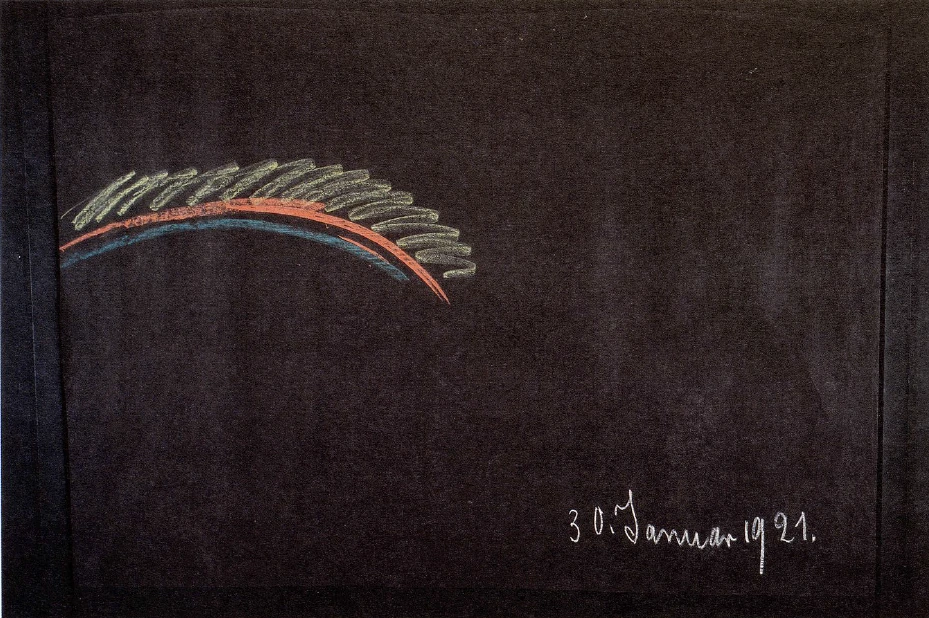
[ 9 ] When we construct a machine, we tear apart the materials from which the machine is made, just as nature tears apart a human being when it transforms his still-living organism into a corpse. Everywhere in our mechanisms we find the corpses of natural existence. But human beings were not born from this corpse of nature—the very substance of which our mechanical world, which we have gradually developed into technology, is composed. Human beings were born from that nature which is alive, which is alive even down into the mineral kingdom. In modern technology, we have added to this nature another nature—a corpse of nature. In a sense, after all the geological layers in the earth had been formed (see diagram, blue, orange), we have superimposed a topmost geological layer (green) consisting of our machines, which contains nothing of nature’s vitality. We work within the dead body of nature by adding modern technology to what was there before.

[ 10 ] This is something that makes a profound impression on people when they consider it in its full scope, especially when they realize just how detached modern human beings have made life—not only through external mechanical technology, but also through the technological way of thinking.
[ 11 ] Just consider something like the end of the war that took place between China and Japan toward the end of the 19th century. What happened there after the peace treaty was signed—how was the peace treaty implemented? — The Chinese minister wrote a check for an enormous sum in the millions. He had this check taken to a bank. Some low-level official took this check, and this check simply served as the basis for the bank to transfer—in a purely banking sense—that enormous sum in the millions that the Chinese minister had written on the check to the Japanese envoy in China. Something took place there in a cadaverous—externally, of course—I would say shadowy, cadaverous manner. And the only effect this had was that the millions in credit that the Chinese Empire had held up to that point in the banks of England were transferred to Japan through this writing on the check and the handing over of the check. If one had wanted to pay what was transferred from China to Japan as a sum of millions in war reparations—simply by endorsement via a check—through the credit system, using traditional methods—and I’ll assume the mildest scenario, that one would have wanted to pay it in cash— what would that have meant if one had had to send all that money from China to Japan in the same way that Chinese currency still exists today—or existed until relatively recently? —So, where one is still dealing with realities, even the mildest form reveals what modern life has become relatively quickly in the last third of the 19th century. The entire human way of thinking has been gripped by such things, and it has found its way into this reality quite naturally. The intellectualism that is currently Ahrimanizing humanity has become a matter of course.
[ 12 ] On the other hand, it is true that human beings have also had to go through what they have gone through in social life. Just as they would not have arrived at a pure understanding of nature without intellectualism, so too would they not have arrived at an awareness of their freedom without what they have gone through in social life. Human beings have been hollowed out by modern scientific thinking. They no longer know anything about themselves. They cannot grasp the essence of the human being. But on the other hand, the highest human tension has arisen within them—the highest demand placed on this human being to act out of the primal impulses of this being itself, in that human beings are to act as free beings.
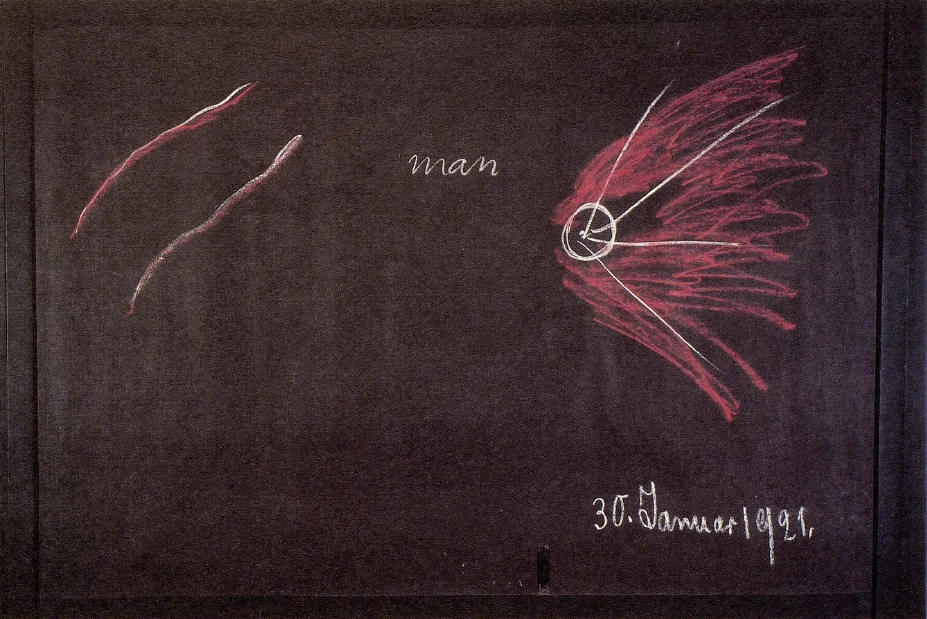
[ 13 ] If one were to seek a symbol for what actually took place there, one could say nothing other than this: Human beings increasingly lost the fullness of their being and became utterly nothing in their own eyes. For modern natural science contains nothing about human beings. Humanity gradually became nothing at all. And it is from this nothingness that the impulse of freedom is now to radiate (see drawing).

[ 14 ] This is the ambivalence of modern man. He is meant to be free—that is, to find within himself the impulses of his being, the impulses of his actions; but when he tries to penetrate that inner self with his understanding to discover the source of the impulses for his actions, he finds a void; he is an inwardly hollow being. It was inevitable that things would turn out this way; but it is equally inevitable that modern humanity will move beyond this. For within freedom, one becomes “Luciferized” if one does not achieve equilibrium; and within modern scientific thinking, one becomes “Ahrimanized” if one does not achieve equilibrium, a state of balance.
[ 15 ] How does one achieve a state of balance? — Here one must point to something that could be called the “Golden Rule of modern anthroposophically oriented spiritual science.” Science is good. Science had to emerge in the course of recent development. But this science needs to be supplemented. It needs an understanding of the human being. And this understanding of the human being can be provided solely by spiritual science. It is not an understanding of the human being if one dissects the human being and examines the brain, the liver, the stomach, and the heart; for then one merely obtains, in a slightly different form, what one also finds in the animal kingdom. None of this actually has any value for the understanding of the human being as such. The only thing of value for the understanding of the human being is what one gains about the human being through spiritual science. The moment one realizes that the human being is rooted in the will through his true “I,” that he, through his will-filled “I,” first and foremost embodies his true earthly spirituality, and that this spirituality, in the earthly realm, takes hold of metabolism as such—one then has a starting point for studying this metabolism in the human being and, subsequently, its specific manifestation throughout the human organism. One proceeds from the spiritual to grasp the physical in the human being. When one learns to recognize the rhythmic system as it manifests in the pattern of respiration and blood circulation, one breaks with the superstition that the heart is a pump that drives blood through the organism like any other fluid. Then one learns to recognize that Plate 4
[ 16 ] The spiritual intervenes in the blood circulation, so that the rhythm takes hold of the metabolism, brings about the blood circulation, and then, in the course of human development—even during embryonic development—the heart is formed from the blood circulation itself, so that the heart is formed out of the blood circulation, that is, out of the spiritual. If one then learns to recognize how, in the nervous-sensory system, the life of imagination in turn shapes the metabolic process, one learns to recognize the nerve as something left behind by the life of imagination. Then one gains insight into the human being in a way that one cannot gain insight into the animal, for in the animal, things are still quite different!
[ 17 ] This is roughly how a materialist imagines it (see drawing): here is a nerve (red), and this nerve brings about something as a mental image. — No, that is not how it is in reality; rather, in reality, the life of the imagination unfolds, and as it unfolds, it destroys the organic matter, creating, so to speak, a trail of waste along the length of the nerve (light). What the life of the imagination creates is a deposit—something that is an excretion from the organism. And the nerve is the excretory organ for the life of imagination.

[ 18 ] In this materialistic age, people have resorted to a materialistic analogy, claiming that the brain “sweats out” thoughts, just as the liver, for example, secretes bile. — This is nonsense, for the opposite is true: namely, that the brain is constantly being shed by thoughts—naturally, it is always being shed anew—because it is continually being replaced by the metabolic organism. Today’s scientific-minded person will, of course, initially be unable to make any proper sense of this at all, for he will say that this is also the case with animals, which also have a brain, these and those organs, and so on. — But this precisely shows that man does not recognize himself; for anyone who speaks of humans and animals in this way commits the very same error as someone who, as a legislator, might order all razors in the possession of every barber in any given place to be confiscated and taken to the taverns—simply because he associates the knife solely with the idea of eating and concludes that an instrument shaped in a certain way must serve only that one purpose. — The important thing is to recognize that what appears as an organ in humans serves a completely different purpose than in animals, and that the entire way of looking at things—as I have now outlined in its most elementary form—simply does not make sense in the case of animals. It is precisely the recognition of what human beings possess as material organs arising from the spiritual realm that is so immensely important; for it is this concrete self-knowledge that matters most. All the rambling and chatter about various forms of mysticism—which are still being constructed today on the premise that human beings must grasp themselves inwardly—all this daydreaming is meaningless; for it does not lead to a true self-knowledge of the human being, but only to an inner sense of well-being. Human beings must, with persistent diligence, observe how their individual organs take on a three-dimensional form emerging from the spiritual realm. True science must be built up from the spiritual realm. One must, so to speak, recreate the human being—as he stands before us—from the spiritual realm. That is one thing.
[ 19 ] One can therefore say: While humanity today lives as it does—allowing the sciences to be presented to it authoritatively by various institutions—there already exists in the spiritual worlds a sacred commandment: that external science must be supplemented by the science of human knowledge. — And humanity is bound to become unhappy if it receives only external science. In ancient times, the mysteries served to prevent people from being exposed to what was harmful to them. But this is incompatible with the spirit of modern humanity; therefore, the conscious members of this humanity must take upon themselves what was formerly provided by external powers. Humanity must ensure—through those individuals who come to understand these matters—that the individual sciences cannot cast their shadows; this must be achieved by countering the casting of these shadows—which would darken humanity—with the light of genuine, true, and concrete self-knowledge of the human being. Sciences without human self-knowledge are harmful, for they Ahrimanize humanity. Sciences that are counterbalanced by human self-knowledge are a blessing for humanity, for they truly lead humanity toward what it is meant to achieve in the near future. There must be no science that is not brought into some relationship with the human being. There must be no science that is not pursued all the way into the innermost depths of the human being, where—if one pursues it there—it first acquires its true meaning.
[ 20 ] This is how one arrives, through this genuine, concrete self-knowledge, at equilibrium—the balance from which the sciences have led us astray. People today are usually not at all interested in what kind of being they are in this world. However, when they want to be particularly profound, they allow themselves to be talked into believing that they are some kind of little god or the like—though, again, they have no real conception of God; but they care little about how their individual human form is shaped out of the entire universe.
[ 21 ] Social life becomes “Luciferized” when, in a sense, it leads only to the demand for freedom within that which has become nothing. Human beings will not become nothing in and of themselves if they attain true self-knowledge; for they will then know how, within what lies beneath their skin, the entire structure of the world creates a reflection of itself, how every human being carries within themselves, beneath their skin, a reflection of the whole world. In social life, the impulse toward freedom is brought into equilibrium by our coming to know that which underlies the world as the spiritual, by our moving beyond a mere material view of the world—which is precisely what has become characteristic of the development of knowledge in recent centuries.
[ 22 ] We have lost sight of the human being. The external world has become devoid of humanity. In external astronomy, we observe the Sun, the planets, the fixed stars, and the comets; to us, they appear as mere objective bodies moving through space. We seek the laws governing their motion. There is nothing human in all of this. Read my Outline of Esoteric Science and try to bring before your soul what is presented there as a description of world evolution. Even when you read about ancient Saturn, you are not reading something described to you by a modern astronomer, but rather you are reading directly about what appears as the first seed of humanity. The description of Saturn simultaneously contains everything that was present as the first human potential during Saturn’s development. And through this history of world evolution, you are also tracing the entire course of human development. Nowhere in it do you find a world devoid of humanity. What you yourselves are, you will find described step by step in the course of world evolution itself.
[ 23 ] What is the result? If you go through what modern science tells you about some ancient, nebulous states that coalesced and so on—from which our present world is said to have emerged, but in which human beings cannot be found—you actually find nothing human; it all remains merely intellectual. You learn something that may interest your mind, but it does not engage your whole being. Your whole being can only be engaged by a realization that already encompasses your whole being. And, fundamentally, it is simply the inertia of modern human beings, who are not at all accustomed to developing feelings and impulses of will when they take anything in. — It is inertia when a person, while reading about this evolution from Saturn, the Sun, the Moon, and so on down to Earth, and then reading about the prospects for the future—this life—even though everything is presented in pure concepts, does not find it stirring to their feelings, when they do not feel: There you stand within the world, there you are together with this whole world, there you know yourself to be one with this whole world!
[ 24 ] This sense of oneness with the world is what distinguishes this understanding of the world—which stems from anthroposophical spiritual science—from the worldview that is common today. But let this sink into the hearts of people today, who lack it; let them be filled with this awareness of belonging to the whole world, and then those social attitudes will arise that can lead humanity forward. — Whereas what has emerged—which, admittedly, could lead to the demand for freedom, but which gives people no sense of responsibility—has only led people to bring about the very chaos in which we are now living. Luciferization can only be prevented if people recognize their place in the universe, if they perceive not only the physical aspect of the universe—the sensory reality of the universe—but also its spiritual aspect, and feel themselves to be spirit within the spirit of the universe. From this sense of being filled with humanity’s connection to the spiritual world springs true social feeling; from it flows what is needed so that human beings on Earth can also enrich social life.
[ 25 ] Once again, one can say: What modern social life has brought people—the sense of freedom—leads, at first, to Luciferization. People today may not be aware of this. But in the spiritual world—in which we are, after all, always immersed—there stands a sacred commandment that speaks to humanity: “You shall not allow the impulse of freedom to continue without cosmic feeling!” —Just as human knowledge must be complemented by the external sciences, so too must cosmic feeling be integrated into what has developed in social life in recent times.
[ 26 ] These two things—knowledge of humanity and a sense of connection with the entire universe—are what give a person balance. But they can find this if they truly grasp the Christ Mystery in the most modern sense—grasping it as anthroposophical spiritual knowledge can reveal it to them. For here we speak of Christ as a cosmic being who has descended to Earth from cosmic infinities. We learn to feel cosmically and need only try to give this cosmic feeling a content. We can do this only through anthroposophical spiritual science; otherwise, even the concept of Christ remains empty for us. The concept of Christ becomes a mere phrase if it does not lead us to understand the cosmos itself in human terms.
[ 27 ] Just consider the description of that universe in which the sun exists—the one described by modern astronomy, in which spectral analysis applies, as described by modern physics—Christ could not have descended to Earth from such a universe! Anyone who clings solely to this description of the universe as knowledge cannot associate any meaning with any true, real Christ-being. Such a Christ remains empty, or he becomes “Harnackian” or the like. If one wishes today to get to know the Christ as a cosmic being, to learn to sense him, one needs that history of evolution which traces humanity through the Saturn, Sun, and Moon epochs. Where the human element is present within the cosmos, there also springs forth the understanding of that which can bring Christ forth from the cosmos. And if one comes to know the human being to the point of understanding where his material body—created from the spiritual within his skin—comes from, then one comes to know him in such a way that one comes to understand the Mystery of Golgotha, the incarnation of the cosmic Christ into the individual human being. For the kind of human being that modern science—from mathematics all the way up to psychology—can describe, there is no way to imagine that the Christ could have incarnated within him in any way. For a person to grasp this, he must attain true self-knowledge. There is no Christianity today that modern human beings can reconcile with their state of mind, except through the self-knowledge provided by spiritual science and through the cosmic understanding of humanity provided by spiritual science.
[ 28 ] These connections are evident throughout our anthroposophical literature. And the fact is that these connections should be compared everywhere with what is necessary today for the progress of humanity. What people have often gleaned from their previous education and from their past habits of life, they would like, on the one hand, to have—as it were—as an insubstantial, abstract insight for Sunday, but then they would like to regard the rest of their lives as separate from this insight, not wanting to touch it. For what is a deeper spiritual need, there is Sunday in the pulpit; for what is an external human need, there is the state. Both are traditionally accepted without any thought given to where we are headed if this traditional acceptance were to continue.
[ 29 ] I have, after all, repeatedly drawn attention from a wide variety of perspectives to just how grave the situation of our time is. Today I wanted to point out that, fundamentally, the entire course of scientific life cannot be pursued further without all the individual sciences being examined in the light of self-knowledge, and that we must not observe social development without infusing it with a cosmic sensibility—one that can arise only from a worldview that already perceives the human being within the very elements of that worldview itself. This is what is distinctive: that when we engage in anthroposophically oriented spiritual science, we perceive the entire world within the individual human being, and that in the world, as we observe it, we find the human being present everywhere within it.
[ 30 ] Certainly, such things are reminiscent of the ancient inspirations and imaginings that humanity has had; but they are not renewals of an external nature—rather, they are drawn from the consciousness to which humanity is now being called—truly from the spiritual world itself. After all, it is not only those things that take place which human beings see around them in this physical world. Just as human beings exist within the physical world as physical organisms, so too do they exist within the spiritual world. And in this spiritual world in which they exist, something happens; something takes place. Human beings, by virtue of being who they are, have significance for the processes of this spiritual world.
[ 31 ] Suppose a person were to consider only what is happening here in the physical world around him; at most, he might be told something about a traditional religious creed, but that has no connection to this world because it speaks only of something abstract, and this person would be willing today to accept traditional science. They can cultivate this science, which is devoid of humanity; they can fill their soul with this science, just as millions upon millions today have filled their souls with this science, more or less consciously or unconsciously. But through this, people also stand within a world of the spirit; for it does indeed have significance for the spiritual world that we fill ourselves with this science. And what significance does this have for the spiritual world? — If this continues, then Ahriman will get his way; for this is the spirit that greedily prowls around modern educational institutions and wants to keep them as they are; for in this he finds his advantage. The Ahrimanic entity, this cold, ossified, bald-headed Ahriman—if I may speak figuratively—lurks around our modern educational institutions; he wants them to remain as they are. He will certainly lend a hand when it comes to destroying something like this Goetheanum.
[ 32 ] On the other hand, in social life—where people, lacking any sense of the cosmos, set forth their earthly demands—it is precisely there, as people merely speak of these earthly demands without being permeated, purified, and transformed by cosmic consciousness, that the Luciferic beings find their opportunity. There we see how Lucifer lives. I cannot use that image—an image that is, however, truly born of the correct Ahrimanic conceptions—the image of the ossified, creeping, bald Ahriman who prowls around educational institutions and wants them to remain as they are. That image would not be accurate for the Luciferic being. But another image is apt: Let good will and well-intentioned social desires find expression everywhere—even when they spring from mere selfishness, from the absence of a cosmic feeling—and then the Luciferic being will emerge from what is being spoken. Through these social demands, which are stirred up in the world without a sense of the cosmos, human beings expel from themselves that which then becomes the beautiful Lucifer. He lives within human beings themselves, in their stomachs corrupted by social misinstincts—but understood spiritually—and in their corrupted lungs; there lies the Luciferic source. It breaks free; the human being spews it out from his entire being, and as a result, our spiritual atmosphere is filled with this Luciferic being, filled with social instincts that are not felt through a sense of the human being’s connection to the cosmos. On the one hand, the bald Ahriman lurking around our abstract education—tall, skeletal, gaunt—and on the other, that which at first writhes out of the human being itself in a slimy form, takes on the appearance of beauty, and thereby beguiles humanity: these are images, but they are realities of our time. And only through self-knowledge and only through a sense of humanity’s connection to the cosmos can a person find the balance between the ossified and the semblance of beauty, between the bony being and the slimy being, between that which creeps around them and that which seeks to wriggle free from within themselves. And this equilibrium, this balance—they must find it. What has become of our culture, of the civilization of recent times, is, in essence, nothing other than what one might describe as the marriage between the bony and the slimy. In this life, human beings are so deeply immersed in it that civilization is entering Spengler’s era of decline. For, fundamentally speaking, Spengler could only describe his world as he does because he has before him a world that arose from the marriage of the ossified and the slimy. But human beings must find this equilibrium.
[ 33 ] These are serious times, for human beings must become truly human. They must learn to cast off both the bony and the slimy aspects and must become human—become human in such a way that the intellect is warmed by the heart, and the heart is permeated by the intellect. Then they will find equilibrium. And indeed, the human being will then fall prey—if one may speak in spiritual terms—neither to slimy mysticism nor to bare-headed science, but will open himself to what is human, and to what I may perhaps call, after having characterized it, the anthroposophical. It stands right in the middle—that which is truly human, the anthroposophical—it truly stands right in the middle between these opposites into which civilization has gradually drifted. In truth, when the anthropos truly reveals his nature, he is neither the ossified nor the slimy one, but rather the one who maintains the equilibrium between the intellect and the heart. This is what must be sought.
[ 34 ] You will understand what must be grasped today from the very depths of human and worldly being if you reflect on the two images I have presented to you today—merely as images. They are meant to be images, but images that point to true realities.
[ 35 ] Let's talk more about that later.