Human Responsibility for Global Development
Through Its Spiritual Connection
to the Earth and the Celestial Realm
GA 203
30 January 1921, Stuttgart
Translate the original German text into any language:
Versions Available:
Human Responsibility for Global Development, tr. SOL
Neunter Vortrag
Ninth Lecture
[ 1 ] Die Ideen, die wir aus verschiedenen Untergründen heraus entwickelt haben über des Menschen Hinneigen auf der einen Seite zur luziferischen, auf der anderen Seite zur ahrimanischen Natur, haben dazu geführt, die Notwendigkeiten anzuerkennen, daß der Mensch ein Gleichgewicht findet zwischen den beiden Neigungen, die für ihn Abwege bedeuten, ein Äquilibrium gewissermaßen zwischen dem Luziferischen und dem Ahrimanischen. Nun kann ja die Frage entstehen, und sie ist eine schwere Erkenntnis- und Gewissensfrage namentlich für die moderne Menschheit: Wie findet man denn dieses Äquilibrium, diesen Gleichgewichtszustand, so daß man auf der einen Seite nicht der Gefahr des Luziferischen, auf der anderen Seite nicht der Gefahr des Ahrimanischen zu unterliegen braucht?
[ 1 ] The ideas we have developed from various sources regarding the human tendency, on the one hand, toward the Luciferic nature and, on the other hand, toward the Ahrimanic nature, have led us to recognize the necessity for human beings to find a balance between these two tendencies—which represent paths of deviation for them—an equilibrium, so to speak, between the Luciferic and the Ahrimanic. Now the question may arise—and it is a profound question of knowledge and conscience, especially for modern humanity: How does one find this equilibrium, this state of balance, so that one need not succumb to the danger of the Luciferic on the one hand, nor to the danger of the Ahrimanic on the other?
[ 2 ] Diese Frage beantwortet sich für die verschiedenen Zeitalter der menschlichen Entwickelung in verschiedener Weise, und immer ist zur Beantwortung nötig eine Erkenntnis desjenigen, was den Menschen in diesem entsprechenden Zeitalter ganz besonders nach der einen oder nach der anderen Seite hinzieht. Im allgemeinen haben wir ja das kennengelernt, was den Menschen nach dem Luziferischen, nach dem Ahrimanischen hinzieht; aber für unser besonderes Zeitalter muß das doch auch wiederum besonders ins Auge gefaßt werden.
[ 2 ] This question is answered in different ways for the various stages of human development, and answering it always requires an understanding of what draws people in that particular stage especially toward one side or the other. In general, we have come to understand what draws people toward the Luciferic and toward the Ahrimanic; but for our particular age, this must also be considered specifically.
[ 3 ] Seit dem Aufgang der fünften nachatlantischen Periode, also seit dem 15. Jahrhundert, hat sich innerhalb der zivilisierten Menschheit sowohl das intellektuelle Leben wie auch das soziale Leben gegenüber früheren Zeiten wesentlich geändert. Das intellektuelle Leben ist allmählich immer mehr so geworden, daß der Mensch selber eigentlich von der Weltbetrachtung ausgeschlossen ist. Der Mensch betrachtet die Natur, und innerhalb der Naturerkenntnis hat ja die neuere Menschheit die größten Fortschritte gemacht. Aber gerade das ist ja das Charakteristische, daß die eigentliche Menschenkenntnis durch diese Naturerkenntnis nicht nur keinen Fortschritt gemacht hat, sondern daß die Anschauung von der Wesenheit des Menschen in einem gewissen Sinne herausgeworfen worden ist aus der menschlichen Erkenntnis. Der Mensch kennt sehr gut alles andere in der Welt, aber er kennt nicht mehr sich selbst. Der Mensch hat die Tierreihe kennengelernt, er hat sich eine Entwickelungstheorie der Tierreihe begründet und glaubt zu verstehen, wie sich die Wesen der Tierreihe von den untergeordnetsten bis zu den vollkommeneren entfaltet haben, und dann reiht man gewissermaßen den Menschen an. Man nimmt das alles, was man an den Tieren gelernt hat und wendet es dann auch wiederum auf den Menschen an. Man kommt zu nichts Neuem, das die Menschenwesenheit erklären sollte, sondern man sucht die Elemente zu dem, was die Menschenwesenheit erklären soll, innerhalb der Tierwelt und sagt nur: Der Mensch ist eben die oberste Stufe. — Man sagt eigentlich nichts Besonderes über den Menschen aus, sondern man sagt, er sei eben die oberste Stufe. Man tut das ja in bezug auf alle Einzelheiten des Menschen, und man tut es mit einer instinktiven Selbstverständlichkeit. Die Folge davon ist, daß eben über den Menschen eine wirkliche Erkenntnis gar nicht vorliegt.
[ 3 ] Since the dawn of the fifth post-Atlantic period—that is, since the 15th century—both intellectual and social life within civilized humanity have changed significantly compared to earlier times. Intellectual life has gradually evolved to the point where human beings themselves are effectively excluded from contemplating the world. Human beings observe nature, and it is indeed in the understanding of nature that modern humanity has made the greatest progress. But this is precisely the defining feature: not only has the actual understanding of human nature made no progress through this understanding of nature, but the conception of the essence of the human being has, in a certain sense, been cast out of human knowledge. Human beings know everything else in the world very well, but they no longer know themselves. Humanity has come to know the animal kingdom; it has established a theory of evolution for the animal kingdom and believes it understands how the beings of the animal kingdom have developed from the lowest to the most perfect, and then, in a sense, places humanity at the top of this hierarchy. People take everything they have learned from animals and apply it, in turn, to humanity. One arrives at nothing new that would explain human existence; instead, one seeks the elements needed to explain human existence within the animal kingdom and simply says: Human beings are simply the highest stage. — One does not actually say anything specific about human beings; rather, one says that they are simply the highest stage. One does this with regard to every detail of human beings, and one does it with an instinctive matter-of-factness. The consequence of this is that there is, in fact, no real understanding of human beings at all.
[ 4 ] Diese besondere Art von Erkenntnis ist ja nicht etwa nur in den einzelnen Wissenschaften da; sie ist schon durchaus etwas geworden, was heute die weitesten Kreise der Welt beherrscht. Sie ist etwas geworden, was der Mensch sozusagen jeden Tag mit seiner Zeitungslektüre in sich saugt. Und wenn er es nicht mit der Zeitungslektüre in sich saugt, dann auf andere Weise; denn es ist ja schließlich etwas, was schon den Kindern in der Schule eingeimpft wird. Diese moderne Wissenschaftlichkeit ist zu etwas geworden, was immer mehr und mehr Allgemeingut wird, und sie füllt gewissermaßen den Menschen mit Ideen und Begriffen aus, die seine Seelenverfassung ausmachen. Er kommt dadurch zu einem gewissen Bewußtsein über die Welt, aber in diesem Bewußtsein ist er selbst nicht enthalten. Das ist das eine.
[ 4 ] This particular kind of knowledge is not limited to the individual sciences; it has already become something that dominates the widest circles of the world today. It has become something that people, so to speak, absorb every day as they read the newspaper. And if they do not absorb it by reading the newspaper, then they do so in other ways; for, after all, it is something that is instilled in children as early as school. This modern scientific mindset has become something that is increasingly part of the common consciousness, and it fills people, so to speak, with ideas and concepts that shape their state of mind. Through this, they arrive at a certain awareness of the world, but they themselves are not included in this awareness. That is one thing.
[ 5 ] Das andere ist das moderne soziale Leben. Dieses soziale Leben brauchen Sie ja nur zu studieren, wie es in Zeiten war, die hinter dem 15. Jahrhundert zurückliegen. Die Welt war ja gewissermaßen voll von Urteilen, die ein altehrwürdiges, soziales Weisheitsgut waren, welches die Menschen miteinander gemeinsam hatten. Man wußte nicht für sich, was gut oder böse sei. Man hatte auch gar keinen Zweifel darüber, denn man wuchs in einer sozialen Ordnung auf, welche das Gute und Böse als allgemeines, sei es volkstümliches, sei es mehr religiös gefärbtes Urteil in sich trug. Und aus dieser gemeinschaftlichen Urteilssubstanz heraus, also aus etwas, was gewissermaßen doch autoritativ durch die soziale Ordnung schwebte, urteilte der Mensch, wenn er selber dies oder jenes tun sollte.
[ 5 ] The other aspect is modern social life. You need only study social life as it existed in times prior to the 15th century. The world was, so to speak, full of judgments that constituted a time-honored body of social wisdom shared by all people. People did not know for themselves what was good or evil. Nor did they have any doubts about it, for they grew up in a social order that embodied good and evil as a general judgment—be it folk-based or more religiously tinged. And drawing on this collective body of judgment—that is, on something that, in a sense, hovered authoritatively over the social order—people would decide for themselves whether they should do this or that.
[ 6 ] Wir haben vieles von dem, was einstmals viel intensiver begründet war in der sozialen Ordnung der Menschheit, heute nur in der Sprache, und da unsere Sprache in vieler Beziehung phrasenhaft geworden ist, so haben wir es eben in der Phrase. Bedenken Sie nur, in wie vielen Fällen und in welcher Ausdehnung heute der Mensch gewohnt ist, das Wort, das Wörtchen «man» zu gebrauchen — «man» denkt so, «man» tut dieses, «man» sagt dieses und so weiter —, obwohl es in den meisten Fällen heute nur eine Phrase ist, gar keinen Sinn hat. Das Wörtchen «man», das Fürwort «man», das Pronomen, hat eigentlich nur einen Sinn in der Sprache, die noch einem Volke angehört, in dem tatsächlich der einzelne nicht so stark Individualität geworden ist wie in unserer Zeit, wo der einzelne noch mit einem gewissen Rechte, wenn er spricht, ein allgemeines Urteil ausspricht. Was aus der modernen Wissenschaftlichkeit allmählich die Seelen ausfüllt, was dazu geführt hat, daß der Mensch sich selbst vergißt in der Weltauffassung, das führt zur Ahrimanisierung des Menschen in unserem Zeitalter. Und was im sozialen Leben den Menschen herausführt aus der Gebundenheit, was ihn zum Beispiel im äußeren wirtschaftlichen Leben von dem alten gebundenen Zunftwesen zu der modernen freien Wirtschaft geführt hat, das führt zur Luziferisierung des Menschen. Beides aber ist durchaus notwendig. Beides mußte in der Entwickelung der Menschheit heraufkommen. Denn in den früheren Erkenntnissen, die der Mensch gewonnen hat und die seine Seelenverfassung gebildet haben, steckt immer der Mensch selber drinnen. Man konnte früher zum Beispiel nicht Naturerkenntnis haben, ohne Menschenerkenntnis mitzugewinnen. Man konnte nicht über den Mars Erkenntnisse gewinnen, ohne zu gleicher Zeit über das, was der Mars für das Menschenleben als Bedeutung in sich trägt, Erkenntnisse mitzugewinnen. Man konnte nicht über Gold Erkenntnisse gewinnen, ohne daß man gewisse Erkenntnisse über den Menschen gewann.
[ 6 ] Much of what was once far more deeply rooted in the social order of humanity exists today only in language, and since our language has become clichéd in many respects, we find it precisely in those clichés. Just consider how often and to what extent people today are accustomed to using the word, the little word “one”—“one” thinks this way, “one” does this, “one” says that, and so on—even though in most cases today it is merely a phrase and has no meaning at all. The little word “one,” the pronoun “one,” actually has meaning only in a language that still belongs to a people in which the individual has not yet become as strongly individualized as in our time, when the individual still, with a certain right, expresses a general judgment when speaking. What modern scientific thinking is gradually filling people’s souls with—what has led people to lose sight of themselves in their worldview—is leading to the Ahrimanization of humanity in our age. And what in social life liberates people from bondage—what, for example, in the external economic sphere has led them from the old, rigid guild system to the modern free market—that leads to the Luciferization of humanity. Both, however, are absolutely necessary. Both had to emerge in the course of human development. For in the earlier insights that humanity has gained—and which have shaped its spiritual constitution—humanity itself is always present. In the past, for example, one could not gain knowledge of nature without also gaining knowledge of humanity. One could not gain knowledge about Mars without simultaneously gaining knowledge about the significance Mars holds for human life. One could not gain knowledge about gold without also gaining certain insights into human nature.
[ 7 ] Alles, was damals menschlich war, ist herausgeworfen worden. Dadurch kam man zu einer reinen, von aller menschlichen Wesensanschauung befreiten Naturanschauung. Diese Naturanschauung mußte dann die Grundlage sein für die moderne Technik.
[ 7 ] Everything that was human at that time was cast aside. This led to a pure view of nature, free from any human conception of being. This view of nature then had to serve as the foundation for modern technology.
[ 8 ] Diese moderne Technik liefert das, was in der neueren Zeit zu den großen Triumphen geführt hat, nur dann, wenn sie nur enthält, was der Mensch mit seinem reinen Intellekt überschauen kann. Betrachten Sie irgendeine Maschine, betrachten Sie auch nur irgendeine Einrichtung des modernen technischen Lebens, insofern wir das eigentlich Soziale ausschließen, so werden Sie sehen: alles ist in einer gewissen Weise so eingerichtet, daß der Mensch von dem, was eigentlich vorgenommen wird, ausgeschlossen ist. Daher mußte die moderne Technik auch zu dem Mittel greifen, obwohl man sich dessen nicht bewußt ist, nur den Leichnam der Natur zu verwenden.
[ 8 ] This modern technology delivers what has led to the great triumphs of recent times only if it consists solely of what human beings can comprehend with their pure intellect. Consider any machine, or even just any device of modern technical life—provided we exclude the truly social aspect—and you will see: everything is arranged in such a way that human beings are excluded from what is actually being done. That is why modern technology has had to resort to using—even if people are not aware of it—nothing but the corpse of nature.
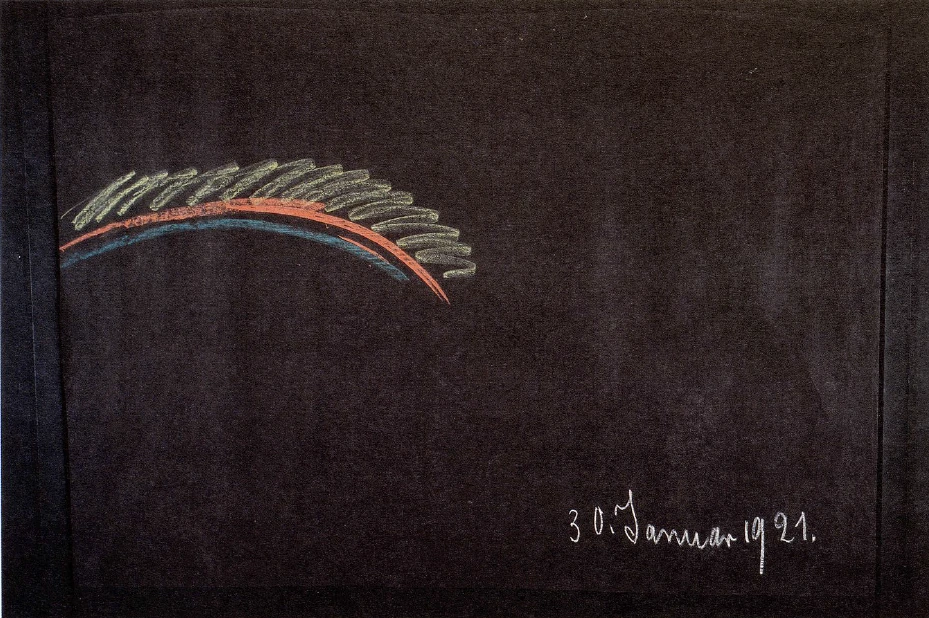
[ 9 ] Wenn wir eine Maschine konstruieren, so zerreißen wir die Materialien, aus denen die Maschine konstruiert ist, so, wie die Natur den Menschen zerreißt, wenn sie aus seinem noch belebten Organismus den Leichnam macht. Wir haben überall in unseren Mechanismen die Leichname des natürlichen Daseins. Aber der Mensch ist nicht aus diesem Leichnam der Natur heraus geboren, aus dem unsere mechanische Welt besteht, die wir allmählich als Technik heraufgebracht haben. Der Mensch ist aus derjenigen Natur heraus geboren, die lebendig ist, die bis ins Mineralreich hinein lebendig ist. Wir haben in der modernen Technik zu dieser Natur hinzugefügt eine andere Natur, einen Leichnam der Natur. Wir haben gewissermaßen, nachdem alle geologischen Schichten in der Erde gebildet worden waren (siehe Zeichnung, blau, orange), eine oberste geologische Schicht darübergestülpt (grün), die aus unseren Maschinen besteht und die nichts mehr von der Lebendigkeit der Natur enthält. In dem Toten der Natur arbeiten wir, indem wir die moderne Technik hinzugefügt haben zu demjenigen, was früher da war.
[ 9 ] When we construct a machine, we tear apart the materials from which the machine is made, just as nature tears apart a human being when it transforms his still-living organism into a corpse. Everywhere in our mechanisms we find the corpses of natural existence. But human beings were not born from this corpse of nature—the very substance of which our mechanical world, which we have gradually developed into technology, is composed. Human beings were born from that nature which is alive, which is alive even down into the mineral kingdom. In modern technology, we have added to this nature another nature—a corpse of nature. In a sense, after all the geological layers in the earth had been formed (see diagram, blue, orange), we have superimposed a topmost geological layer (green) consisting of our machines, which contains nothing of nature’s vitality. We work within the dead body of nature by adding modern technology to what was there before.

[ 10 ] Es ist dies etwas, was einen erschütternden Eindruck auf den Menschen macht, wenn er es in seiner vollen Ausdehnung betrachtet, wenn er namentlich ins Auge faßt, wie losgelöst der moderne Mensch das Leben nicht nur durch die äußere mechanische Technik, sondern durch die technische Denkweise gemacht hat.
[ 10 ] This is something that makes a profound impression on people when they consider it in its full scope, especially when they realize just how detached modern human beings have made life—not only through external mechanical technology, but also through the technological way of thinking.
[ 11 ] Bedenken Sie nur so etwas, wie etwa die Beendigung jenes Krieges, der zwischen China und Japan stattgefunden hat gegen Ende des 19. Jahrhunderts. Was hat sich da zugetragen nach dem Friedensschluß, als die Austragung des Friedensschlusses? — Eine ungeheure Millionensumme hat der chinesische Minister auf einen Scheck geschrieben. Diesen Scheck hat er auf eine Bank tragen lassen. Irgendein untergeordneter Beamter hat diesen Scheck genommen, und dieser Scheck wurde einfach die Ursache, daß man rein bankmäßig jene ungeheure Millionensumme, die der chinesische Minister auf den Scheck geschrieben hatte, übertragen hat auf den japanischen Gesandten in China. Es hat sich da etwas abgespielt in einer leichenhaften, selbstverständlich äußeren, ich möchte sagen schattenhaften-leichenhaften Art. Und nichts anderes ist dadurch bewirkt worden, als daß die Millionenkredite, die bis dahin das chinesische Reich auf den Banken von England gehabt hat, durch dieses Hinschreiben auf den Scheck, durch das Übergeben des Schecks, an Japan übergegangen sind. Wenn man das, was da als eine Millionensumme von Kriegsentschädigungen einfach durch Überschreibung mit Hilfe eines Schecks von China auf Japan übergegangen ist auf dem Kreditwege, in alten Formen hätte zahlen wollen — ich will selbst die mildeste Form annehmen, daß man es hätte in Geld bezahlen wollen —, was hätte das bedeutet, wenn man dieses ganze Geld auch nur so, wie das chinesische Geld heute noch ist oder war vor verhältnismäßig kurzer Zeit, hätte hinübersenden müssen von China nach Japan? — Also da, wo man es noch zu tun hat mit Realitäten, zeigt einem schon die mildeste Form, was dieses moderne Leben verhältnismäßig schnell im letzten Drittel des 19. Jahrhunderts geworden ist. Die ganze menschliche Denkweise ist von solchen Dingen erfaßt worden und sie hat sich ganz selbstverständlich hineingefunden. Der Intellektualismus, der die Menschheit eben ahrimanisiert, der ist eine Selbstverständlichkeit geworden.
[ 11 ] Just consider something like the end of the war that took place between China and Japan toward the end of the 19th century. What happened there after the peace treaty was signed—how was the peace treaty implemented? — The Chinese minister wrote a check for an enormous sum in the millions. He had this check taken to a bank. Some low-level official took this check, and this check simply served as the basis for the bank to transfer—in a purely banking sense—that enormous sum in the millions that the Chinese minister had written on the check to the Japanese envoy in China. Something took place there in a cadaverous—externally, of course—I would say shadowy, cadaverous manner. And the only effect this had was that the millions in credit that the Chinese Empire had held up to that point in the banks of England were transferred to Japan through this writing on the check and the handing over of the check. If one had wanted to pay what was transferred from China to Japan as a sum of millions in war reparations—simply by endorsement via a check—through the credit system, using traditional methods—and I’ll assume the mildest scenario, that one would have wanted to pay it in cash— what would that have meant if one had had to send all that money from China to Japan in the same way that Chinese currency still exists today—or existed until relatively recently? —So, where one is still dealing with realities, even the mildest form reveals what modern life has become relatively quickly in the last third of the 19th century. The entire human way of thinking has been gripped by such things, and it has found its way into this reality quite naturally. The intellectualism that is currently Ahrimanizing humanity has become a matter of course.
[ 12 ] Auf der anderen Seite ist es ja so, daß der Mensch im sozialen Leben auch das durchmachen mußte, was durchgemacht worden ist. Geradeso wie er ohne den Intellektualismus nicht zur reinen Naturerkenntnis gekommen wäre, so wäre er ohne das, was er durchgemacht hat im sozialen Leben, nicht zum Bewußtsein seiner Freiheit gekommen. Der Mensch ist ausgehöhlt worden durch die moderne Wissenschaftlichkeit. Er weiß nichts mehr von sich. Er kann nicht das Wesen des Menschen erfassen. Aber auf der anderen Seite entstand in ihm die höchste menschliche Spannung, die höchste Anforderung an dieses Menschenwesen, zu handeln aus den Urimpulsen dieses Wesens selber heraus, indem der Mensch als freies Wesen handeln soll.
[ 12 ] On the other hand, it is true that human beings have also had to go through what they have gone through in social life. Just as they would not have arrived at a pure understanding of nature without intellectualism, so too would they not have arrived at an awareness of their freedom without what they have gone through in social life. Human beings have been hollowed out by modern scientific thinking. They no longer know anything about themselves. They cannot grasp the essence of the human being. But on the other hand, the highest human tension has arisen within them—the highest demand placed on this human being to act out of the primal impulses of this being itself, in that human beings are to act as free beings.
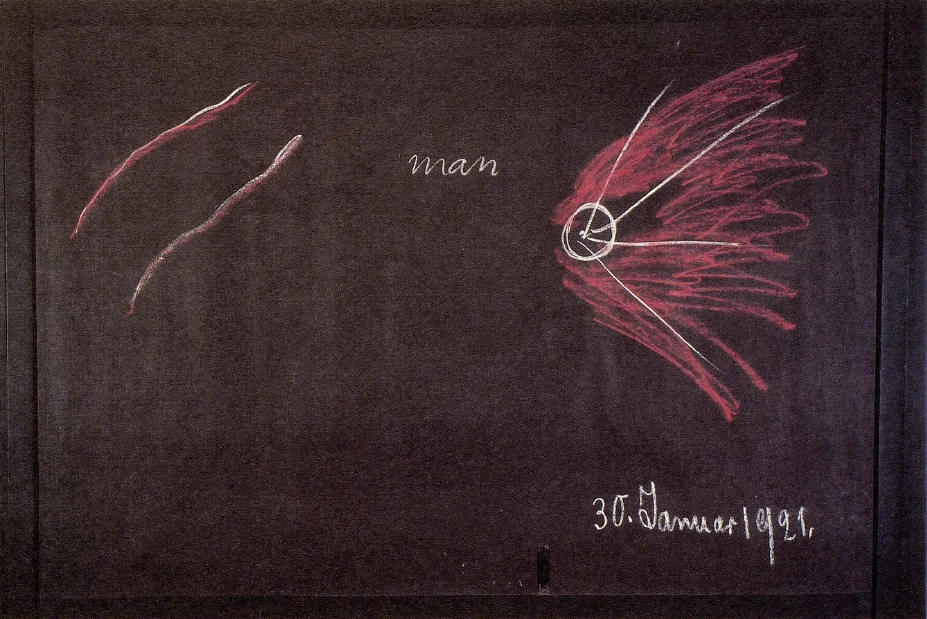
[ 13 ] Will man ein Symbol für das, was da eigentlich stattgefunden hat, so kann man nichts anderes sagen als: Der Mensch verlor immer mehr und mehr die Fülle seines Wesens und wurde ganz und gar Null vor seiner eigenen Anschauung. Denn das, was moderne Naturwissenschaft ist, enthält nichts über den Menschen. Der Mensch wurde nach und nach ganz und gar Null. Und in der Null soll jetzt der Impuls der Freiheit ausstrahlen (siehe Zeichnung).
[ 13 ] If one were to seek a symbol for what actually took place there, one could say nothing other than this: Human beings increasingly lost the fullness of their being and became utterly nothing in their own eyes. For modern natural science contains nothing about human beings. Humanity gradually became nothing at all. And it is from this nothingness that the impulse of freedom is now to radiate (see drawing).

[ 14 ] Das ist die Zwiespältigkeit des modernen Menschen. Er soll frei sein, das heißt, die Impulse seines Wesens, die Impulse seines Handelns in sich selber finden; aber wenn er dorthinein will mit seinem Erkennen, woraus die Impulse seines Handelns werden sollen, so findet er eine Null, ist er ein innerlich hohles Wesen. Es ist eine Notwendigkeit, daß es so gekommen ist; aber es ist ebenso eine Notwendigkeit, daß die moderne Menschheit darüber wieder hinauskommt. Denn innerhalb der Freiheit luziferisiert man sich, wenn man nicht zum Äquilibrium kommt; und innerhalb der modernen Wissenschaftlichkeit ahrimanisiert man sich, wenn man nicht zum Äquilibrium, zum Gleichgewichtszustandekommt.
[ 14 ] This is the ambivalence of modern man. He is meant to be free—that is, to find within himself the impulses of his being, the impulses of his actions; but when he tries to penetrate that inner self with his understanding to discover the source of the impulses for his actions, he finds a void; he is an inwardly hollow being. It was inevitable that things would turn out this way; but it is equally inevitable that modern humanity will move beyond this. For within freedom, one becomes “Luciferized” if one does not achieve equilibrium; and within modern scientific thinking, one becomes “Ahrimanized” if one does not achieve equilibrium, a state of balance.
[ 15 ] Wie kommt man zum Gleichgewichtszustande? — Da muß man eben auf etwas hinweisen, was man nennen könnte die «Goldene Regel der modernen anthroposophisch orientierten Geisteswissenschaft». Wissenschaft, sie ist gut. Wissenschaft mußte heraufkommen in der neueren Entwickelung. Aber diese Wissenschaft braucht eine Ergänzung. Sie braucht die Erkenntnis des Menschen. Und diese Erkenntnis des Menschen kann allein gebracht werden durch die Geisteswissenschaft. Es ist keine Erkenntnis des Menschen, wenn man den Menschen seziert und das Hirn nimmt und die Leber nimmt und den Magen nimmt und das Herz nimmt, denn da bekommt man eben, nur in einer etwas anderen Form, was man in der Tierwelt auch bekommt. Das hat alles tatsächlich keinen Wert für die Menschenerkenntnis als solche. Einen Wert für die Menschenerkenntnis hat nur dasjenige, was man aus der Geisteswissenschaft heraus über den Menschen gewinnt. In dem Augenblicke, in dem man weiß, daß der Mensch mit seinem eigentlichen Ich im Willen wurzelt, daß er mit seinem willenserfüllten Ich zunächst seine eigentliche irdische Geistigkeit darstellt, daß diese im Irdischen ergreift den Stoffwechsel als solchen, hat man zunächst einen Anhaltspunkt, diesen Stoffwechsel im Menschen zu studieren und dann dessen Spezifizierung durch den menschlichen Organismus hindurch. Man kommt vom Geistigen aus zum Ergreifen des Leiblichen im Menschen. Lernt man erkennen das rhythmische System, wie es sich ausprägt in der Gestaltung des Atmungsverlaufes, des Blutsverlaufes, so bricht man mit dem Aberglauben, daß das Herz eine Pumpe ist, die das Blut wie irgendein Gewässer durch den Organismus treibt. Dann lernt man erkennen, daß Tafel 4
[ 15 ] How does one achieve a state of balance? — Here one must point to something that could be called the “Golden Rule of modern anthroposophically oriented spiritual science.” Science is good. Science had to emerge in the course of recent development. But this science needs to be supplemented. It needs an understanding of the human being. And this understanding of the human being can be provided solely by spiritual science. It is not an understanding of the human being if one dissects the human being and examines the brain, the liver, the stomach, and the heart; for then one merely obtains, in a slightly different form, what one also finds in the animal kingdom. None of this actually has any value for the understanding of the human being as such. The only thing of value for the understanding of the human being is what one gains about the human being through spiritual science. The moment one realizes that the human being is rooted in the will through his true “I,” that he, through his will-filled “I,” first and foremost embodies his true earthly spirituality, and that this spirituality, in the earthly realm, takes hold of metabolism as such—one then has a starting point for studying this metabolism in the human being and, subsequently, its specific manifestation throughout the human organism. One proceeds from the spiritual to grasp the physical in the human being. When one learns to recognize the rhythmic system as it manifests in the pattern of respiration and blood circulation, one breaks with the superstition that the heart is a pump that drives blood through the organism like any other fluid. Then one learns to recognize that Plate 4
[ 16 ] das Geistige eingreift in die Blutzirkulation, daß also da der Rhythmus den Stoffwechsel ergreift, die Blutzirkulation bewirkt und dann im Verlaufe der menschlichen Entwickelung, schon in der Embryonalentwickelung, das Herz herausplastiziert aus dem, was der Blutkreislauf ist, so daß das Herz aus dem Blutkreislauf heraus, also aus dem Geistigen heraus gebildet ist. Lernt man dann erkennen, wie im NervenSinnessystem das Vorstellungsleben wiederum abträgt den Stoffwechselprozeß, so lernt man den Nerv erkennen als etwas, was zurückgelassen wird vom Vorstellungsleben. Dann durchschaut man den Menschen so, wie man das Tier nicht durchschauen kann, denn beim Tier sind die Dinge noch ganz anders!
[ 16 ] The spiritual intervenes in the blood circulation, so that the rhythm takes hold of the metabolism, brings about the blood circulation, and then, in the course of human development—even during embryonic development—the heart is formed from the blood circulation itself, so that the heart is formed out of the blood circulation, that is, out of the spiritual. If one then learns to recognize how, in the nervous-sensory system, the life of imagination in turn shapes the metabolic process, one learns to recognize the nerve as something left behind by the life of imagination. Then one gains insight into the human being in a way that one cannot gain insight into the animal, for in the animal, things are still quite different!
[ 17 ] So stellt es sich ungefähr der Materialist vor (siehe Zeichnung), hier sei ein Nerv (rot) und dieser Nerv bewirke irgend etwas als Vorstellung. — Nein, so ist es nicht in Wirklichkeit; sondern in Wirklichkeit ist es so, daß das Vorstellungsleben verläuft, und während das Vorstellungsleben verläuft, zerstört es die organische Materie, schafft gewissermaßen eine Bahn des Unrates in der Ausdehnung des Nervs (hell).Das ist Ablagerung, was das Vorstellungsleben schafft, etwas, was Ausscheidung aus dem Organismus ist. Und der Nerv ist Ausscheidungsorgan für das Vorstellungsleben.
[ 17 ] This is roughly how a materialist imagines it (see drawing): here is a nerve (red), and this nerve brings about something as a mental image. — No, that is not how it is in reality; rather, in reality, the life of the imagination unfolds, and as it unfolds, it destroys the organic matter, creating, so to speak, a trail of waste along the length of the nerve (light). What the life of the imagination creates is a deposit—something that is an excretion from the organism. And the nerve is the excretory organ for the life of imagination.

[ 18 ] In der materialistischen Zeit hat man einen materialistischen Vergleich gebraucht, daß das Gehirn Gedanken ausschwitze, wie die Leber etwa die Galle. — Es ist Unsinn, denn das Umgekehrte ist richtig, daß nämlich von den Gedanken das Gehirn abgeschieden wird, natürlich immer neu abgeschieden wird, weil es immer wiederum vom Stoffwechselorganismus aus ersetzt wird. Der heutige Mensch, der wissenschaftlich ist, wird ja zunächst damit überhaupt noch gar nichts Rechtes anfangen können, denn er wird sagen, das sei doch beim Tier auch alles der Fall, das habe auch ein Gehirn, diese und jene Organe und so weiter. — Darin zeigt sich aber gerade, daß der Mensch sich nicht selbst erkennt; denn wer so vom Menschen und von dem Tiere spricht, begeht eben den Fehler, den der begehen würde, der als Gesetzgeber etwa alle Rasiermesser, die sich bei sämtlichen Raseuren irgendeines Ortes befinden, in die Wirtshäuser tragen ließe, weil er mit dem Messer nur die Vorstellung des Essens verbindet und daraus schließt, daß ein Instrument, das in einer bestimmten Weise geformt ist, eben nur dem einen Zweck zugehören müsse. — Das Wichtige ist, zu erkennen, daß dasjenige, was beim Menschen auftritt als Organ, in einem ganz anderen Dienste steht als bei den Tieren, und daß die ganze Betrachtungsweise, wie ich sie jetzt erst in ihrem allerelementarsten Elemente dargelegt habe, eben für die Tiere einen solchen Sinn nicht hat. Gerade die Erkenntnis dessen, was der Mensch aus dem Geistigen heraus als materielle Organe hat, ist so ungeheuer wichtig; denn diese konkrete Selbsterkenntnis ist es, worauf es ankommt. Alles Geschwafel und Geschwatze von irgendwelchen Mystizismen, die heute noch aufgebaut werden darauf, daß man sagt, der Mensch müsse sich innerlich selber erfassen, all dieses Geträume ist nichts; denn das führt nicht zu einer wirklichen Selbsterkenntnis des Menschen, sondern nur zu einem innerlichen Wohlgefühl. Der Mensch muß mit ausdauerndem Fleiße verfolgen, wie aus dem Geiste heraus sich plastisch gestalten seine einzelnen Organe. Es muß wirkliche Wissenschaft aus dem Geistigen heraus aufgebaut werden. Man muß gewissermaßen nachplastizieren den Menschen, so wie er vor uns steht, aus dem Geiste heraus. Das ist das eine.
[ 18 ] In this materialistic age, people have resorted to a materialistic analogy, claiming that the brain “sweats out” thoughts, just as the liver, for example, secretes bile. — This is nonsense, for the opposite is true: namely, that the brain is constantly being shed by thoughts—naturally, it is always being shed anew—because it is continually being replaced by the metabolic organism. Today’s scientific-minded person will, of course, initially be unable to make any proper sense of this at all, for he will say that this is also the case with animals, which also have a brain, these and those organs, and so on. — But this precisely shows that man does not recognize himself; for anyone who speaks of humans and animals in this way commits the very same error as someone who, as a legislator, might order all razors in the possession of every barber in any given place to be confiscated and taken to the taverns—simply because he associates the knife solely with the idea of eating and concludes that an instrument shaped in a certain way must serve only that one purpose. — The important thing is to recognize that what appears as an organ in humans serves a completely different purpose than in animals, and that the entire way of looking at things—as I have now outlined in its most elementary form—simply does not make sense in the case of animals. It is precisely the recognition of what human beings possess as material organs arising from the spiritual realm that is so immensely important; for it is this concrete self-knowledge that matters most. All the rambling and chatter about various forms of mysticism—which are still being constructed today on the premise that human beings must grasp themselves inwardly—all this daydreaming is meaningless; for it does not lead to a true self-knowledge of the human being, but only to an inner sense of well-being. Human beings must, with persistent diligence, observe how their individual organs take on a three-dimensional form emerging from the spiritual realm. True science must be built up from the spiritual realm. One must, so to speak, recreate the human being—as he stands before us—from the spiritual realm. That is one thing.
[ 19 ] Man kann also sagen: Während heute die Menschheit so lebt, wie sie eben lebt, daß sie sich autoritativ die Wissenschaften von den verschiedenen Anstalten aus vorbringen läßt, besteht schon in den geistigen Welten ein heiliges Gebot: Daß ergänzt werden muß die äußere Wissenschaft durch die Wissenschaft von der Erkenntnis des Menschen. — Und unglücklich muß die Menschheit werden, wenn sie nur äußere Wissenschaft empfängt. In den alten Zeiten waren die Mysterien dazu da, daß man an die Menschen das nicht hat herankornmen lassen, was den Menschen schädlich war. Das ist aber mit dem Geiste der modernen Menschheit nicht verträglich, daher muß diese Menschheit in ihren bewußten Exemplaren das besorgen, was früher von äußeren Gewalten besorgt worden ist. Die Menschheit muß durch diejenigen Persönlichkeiten, die etwas von diesen Dingen verstehen lernen, besorgen, daß die einzelnen Wissenschaften ihre Schatten nicht werfen können, indem diesem Schattenwerfen, durch das die Menschheit verfinstert werden würde, entgegengebracht wird das Licht wirklicher, wahrer, konkreter Selbsterkenntnis des Menschen. Wissenschaften ohne menschliche Selbsterkenntnis sind schädlich, denn sie verahrimanisieren die Menschheit. Wissenschaften mit dem Gegenbilde menschlicher Selbsterkenntnis sind eine Wohltat für die Menschheit, denn sie führen die Menschheit wirklich zu dem, wozu diese Menschheit kommen soll in der nächsten Zeit. Keine Wissenschaft darf es geben, die nicht in irgendeine Beziehung zum Menschen gerückt wird. Keine Wissenschaft darf es geben, die nicht verfolgt wird bis in das Innerste des Menschen hinein, wo sie, wenn man sie dahinein verfolgt, erst ihren rechten Sinn erhält.
[ 19 ] One can therefore say: While humanity today lives as it does—allowing the sciences to be presented to it authoritatively by various institutions—there already exists in the spiritual worlds a sacred commandment: that external science must be supplemented by the science of human knowledge. — And humanity is bound to become unhappy if it receives only external science. In ancient times, the mysteries served to prevent people from being exposed to what was harmful to them. But this is incompatible with the spirit of modern humanity; therefore, the conscious members of this humanity must take upon themselves what was formerly provided by external powers. Humanity must ensure—through those individuals who come to understand these matters—that the individual sciences cannot cast their shadows; this must be achieved by countering the casting of these shadows—which would darken humanity—with the light of genuine, true, and concrete self-knowledge of the human being. Sciences without human self-knowledge are harmful, for they Ahrimanize humanity. Sciences that are counterbalanced by human self-knowledge are a blessing for humanity, for they truly lead humanity toward what it is meant to achieve in the near future. There must be no science that is not brought into some relationship with the human being. There must be no science that is not pursued all the way into the innermost depths of the human being, where—if one pursues it there—it first acquires its true meaning.
[ 20 ] So kommt man durch diese wirkliche, konkrete Selbsterkenntnis hin zum Äquilibrium, zum Gleichgewicht, aus dem einen die Wissenschaften herausgebracht haben. Den heutigen Menschen interessiert es meistens gar nicht, was er da in der Welt für ein Wesen ist. Er läßt sich allerdings, wenn er besonders tief sein will, vorschwafeln, daß er irgendein kleiner Gott ist oder dergleichen, wobei nur wiederum von dem Gotte keine rechte Vorstellung vorliegt; aber es interessiert ihn wenig, wie aus dem ganzen Weltenall heraus seine einzelne menschliche Gestalt gebildet ist.
[ 20 ] This is how one arrives, through this genuine, concrete self-knowledge, at equilibrium—the balance from which the sciences have led us astray. People today are usually not at all interested in what kind of being they are in this world. However, when they want to be particularly profound, they allow themselves to be talked into believing that they are some kind of little god or the like—though, again, they have no real conception of God; but they care little about how their individual human form is shaped out of the entire universe.
[ 21 ] Das soziale Leben verluziferisiert, wenn es gewissermaßen nur hinführt zu der Forderung der Freiheit innerhalb dessen, was Null geworden ist. Null wird der Mensch sich selber nicht sein, wenn er zu einer wirklichen Selbsterkenntnis gelangt; denn er wird dann wissen, wie sich in dem, was innerhalb seiner Haut ist, das ganze Weltengebäude ein Abbild schafft, wie jeder Mensch ein Ergebnis der ganzen Welt in sich trägt innerhalb seiner Haut. Im sozialen Leben wird der Impuls der Freiheit dadurch zum Äquilibrium hingetragen, daß wir kennenlernen dasjenige, was als Geistiges der Welt zugrunde liegt, daß wir hinauskommen über die bloße materielle Weltenbetrachtung, die ja gerade das ist, was charakteristisch geworden ist für die Erkenntnisentwickelung der letzten Jahrhunderte.
[ 21 ] Social life becomes “Luciferized” when, in a sense, it leads only to the demand for freedom within that which has become nothing. Human beings will not become nothing in and of themselves if they attain true self-knowledge; for they will then know how, within what lies beneath their skin, the entire structure of the world creates a reflection of itself, how every human being carries within themselves, beneath their skin, a reflection of the whole world. In social life, the impulse toward freedom is brought into equilibrium by our coming to know that which underlies the world as the spiritual, by our moving beyond a mere material view of the world—which is precisely what has become characteristic of the development of knowledge in recent centuries.
[ 22 ] Den Menschen hat man verloren. Die äußere Welt ist menschenleer geworden. Wir betrachten in der äußeren Astronomie die Sonne, die Planeten, die Fixsterne, die Kometen; die gehen für uns als irgendwelche objektive Körper durch den Raum. Wir suchen ihre Bewegungsgesetze. Da ist nichts drinnen vom Menschen. Lesen Sie meine «Geheimwissenschaft im Umriß» und versuchen Sie, das sich vor die Seele zu führen, was da als eine Beschreibung der Weltevolution auftritt. Gleich wenn Sie da lesen vom alten Saturn, dann lesen Sie nicht etwas, was Ihnen der heutige Astronom schildert, sondern dann lesen Sie gleich von dem, was als erste Anlage des Menschen erscheint. Da ist in der Saturnschilderung zugleich alles das drinnen, was eben als erste Menschheitsanlage während der Saturnentwickelung vorhanden war. Und mit dieser Weltevolutionsgeschichte verfolgen Sie zugleich die ganze menschliche Entwickelung. Nirgends haben Sie da eine menschenleere Welt. Das was Sie selber sind, finden Sie von Stufengang zu Stufengang in der Weltentwickelung selber geschildert.
[ 22 ] We have lost sight of the human being. The external world has become devoid of humanity. In external astronomy, we observe the Sun, the planets, the fixed stars, and the comets; to us, they appear as mere objective bodies moving through space. We seek the laws governing their motion. There is nothing human in all of this. Read my Outline of Esoteric Science and try to bring before your soul what is presented there as a description of world evolution. Even when you read about ancient Saturn, you are not reading something described to you by a modern astronomer, but rather you are reading directly about what appears as the first seed of humanity. The description of Saturn simultaneously contains everything that was present as the first human potential during Saturn’s development. And through this history of world evolution, you are also tracing the entire course of human development. Nowhere in it do you find a world devoid of humanity. What you yourselves are, you will find described step by step in the course of world evolution itself.
[ 23 ] Was ist die Folge? Wenn Sie dasjenige, was Ihnen die moderne Wissenschaft gibt von irgendwelchen alten Nebelzuständen, die sich ballen und so weiter, aus denen dann unsere jetzige Welt entstanden sein soll, in der aber der Mensch nicht gefunden werden kann, durchgehen, haben Sie in Wirklichkeit nichts Menschliches, das bleibt alles bloß intellektualistisch. Da erfahren Sie etwas, was Ihren Kopf interessieren kann, aber es ergreift nicht Ihren ganzen Menschen. Ihr ganzer Mensch kann nur ergriffen werden von einer Erkenntnis, die diesen ganzen Menschen schon enthält. Und es ist im Grunde genommen nur die Trägheit des modernen Menschen, der gar nicht gewöhnt ist, wenn er irgend etwas in sich aufnimmt, auch Gefühle und Willensimpulse zu entwickeln. — Es ist Trägheit, wenn der Mensch, indem er diese Evolution von Saturn, Sonne, Mond und so weiter bis zur Erde hin liest, dann wiederum liest die Perspektive für die Zukunft, dieses Leben, trotzdem alles in reinen Begriffen gegeben ist, nicht seine Gefühle anregend findet, wenn er nicht fühlt: Da stehst du drinnen in der Welt, da bist du zusammen mit dieser ganzen Welt, da weißt du dich eins mit dieser ganzen Welt!
[ 23 ] What is the result? If you go through what modern science tells you about some ancient, nebulous states that coalesced and so on—from which our present world is said to have emerged, but in which human beings cannot be found—you actually find nothing human; it all remains merely intellectual. You learn something that may interest your mind, but it does not engage your whole being. Your whole being can only be engaged by a realization that already encompasses your whole being. And, fundamentally, it is simply the inertia of modern human beings, who are not at all accustomed to developing feelings and impulses of will when they take anything in. — It is inertia when a person, while reading about this evolution from Saturn, the Sun, the Moon, and so on down to Earth, and then reading about the prospects for the future—this life—even though everything is presented in pure concepts, does not find it stirring to their feelings, when they do not feel: There you stand within the world, there you are together with this whole world, there you know yourself to be one with this whole world!
[ 24 ] Dieses Sich-eins-Wissen mit der Welt, das unterscheidet diese Welterkenntnis, die aus anthroposophischer Geisteswissenschaft kommt, von derjenigen Weltansicht, die heute die gewöhnliche ist. Aber lassen Sie das sich hineinergießen in die Menschen der heutigen Zeit, denen das fehlt, lassen Sie die Menschen erfüllt sein von diesem Bewußtsein der Zugehörigkeit zu der ganzen Welt, dann werden jene sozialen Stimmungen entstehen können, die die Menschheit weiterführen können. — Währenddem das, was heraufgekommen ist, was ja allerdings zu der Forderung der Freiheit führen konnte, aber dem Menschen kein Verantwortungsgefühl gibt, die Menschen nur dazu gebracht hat, jenes Chaos herbeizuführen, in dem wir eben jetzt darinnenleben. Die Luziferisierung kann nur verhindert werden dadurch, daß die Menschen ihre Stellung im Weltenall erkennen, daß sie nicht nur das Physische des Weltenalls, das sinnlich Gegebene des Weltenalls, sondern das Geistige des Weltenalls durchschauen, sich als Geist im Geist des Weltenalls fühlen. Von diesem Erfülltsein vom Zusammenhange des Menschen mit der geistigen Welt geht auch wirkliches soziales Fühlen aus, strömt dasjenige aus, was gebraucht wird, damit der Mensch auf Erden auch das soziale Leben befruchten kann.
[ 24 ] This sense of oneness with the world is what distinguishes this understanding of the world—which stems from anthroposophical spiritual science—from the worldview that is common today. But let this sink into the hearts of people today, who lack it; let them be filled with this awareness of belonging to the whole world, and then those social attitudes will arise that can lead humanity forward. — Whereas what has emerged—which, admittedly, could lead to the demand for freedom, but which gives people no sense of responsibility—has only led people to bring about the very chaos in which we are now living. Luciferization can only be prevented if people recognize their place in the universe, if they perceive not only the physical aspect of the universe—the sensory reality of the universe—but also its spiritual aspect, and feel themselves to be spirit within the spirit of the universe. From this sense of being filled with humanity’s connection to the spiritual world springs true social feeling; from it flows what is needed so that human beings on Earth can also enrich social life.
[ 25 ] Wiederum ist es so, daß man sagen kann: Was als modernes soziales Leben den Menschen die Freiheitsempfindung gebracht hat, führt zunächst zur Luziferisierung. Die Menschen der Gegenwart mögen davon nichts empfinden. Aber in der geistigen Welt, in der wir ja immer auch drinnenstehen, steht wiederum ein heiliges Gebot, und das spricht zu dem Menschen: Ihr sollt nicht weiter sein lassen den Impuls der Freiheit ohne kosmisches Fühlen! — So wie Menschenerkenntnis zu den äußeren Wissenschaften hinzutreten muß, so kosmisches Fühlen zu demjenigen, was sich im sozialen Leben in der neueren Zeit heraufentwickelt hat.
[ 25 ] Once again, one can say: What modern social life has brought people—the sense of freedom—leads, at first, to Luciferization. People today may not be aware of this. But in the spiritual world—in which we are, after all, always immersed—there stands a sacred commandment that speaks to humanity: “You shall not allow the impulse of freedom to continue without cosmic feeling!” —Just as human knowledge must be complemented by the external sciences, so too must cosmic feeling be integrated into what has developed in social life in recent times.
[ 26 ] Diese zwei Dinge, Menschheitserkenntnis und Fühlen mit dem ganzen Weltenall, das ist es, was dem Menschen das Äquilibrium gibt. Das kann er aber finden, wenn er im neuzeitlichsten Sinne das Christus-Mysterium wirklich begreift, es so begreift, wie es anthroposophische Geist-Erkenntnis ihm geben kann. Denn da sprechen wir von dem Christus als einem kosmischen Wesen, das aus kosmischen Unendlichkeiten zur Erde sich heruntergesenkt hat. Wir lernen kosmisch fühlen und müssen nur versuchen, diesem kosmischen Fühlen einen Inhalt zu geben. Das können wir nur durch anthroposophische Geisteswissenschaft, sonst bleibt uns auch der Christus-Begriff leer. Der ChristusBegriff wird Phrase, wenn er nicht so wird, daß wir den Kosmos selber menschlich begreifen.
[ 26 ] These two things—knowledge of humanity and a sense of connection with the entire universe—are what give a person balance. But they can find this if they truly grasp the Christ Mystery in the most modern sense—grasping it as anthroposophical spiritual knowledge can reveal it to them. For here we speak of Christ as a cosmic being who has descended to Earth from cosmic infinities. We learn to feel cosmically and need only try to give this cosmic feeling a content. We can do this only through anthroposophical spiritual science; otherwise, even the concept of Christ remains empty for us. The concept of Christ becomes a mere phrase if it does not lead us to understand the cosmos itself in human terms.
[ 27 ] Fühlen Sie es doch aus der Beschreibung desjenigen Weltenalls, in dem die Sonne ist, die die heutige Astronomie beschreibt, in dem die Spektralanalyse gilt, die die heutige Physik beschreibt, aus diesem Weltenall konnte der Christus nicht auf die Erde herabgestiegen sein! Wer nur an dieser Beschreibung des Weltalls als Erkenntnis festhält, der kann keinen Sinn verbinden mit irgendeiner wahren, realen ChristusWesenheit. Solch ein Christus bleibt leer oder er wird «Harnackisch» oder dergleichen. Will man heute den Christus als kosmisches Wesen kennenlernen, erfühlen lernen, so braucht man jene Evolutionsgeschichte, welche den Menschen sucht durch die Saturn-, Sonnen- und Mondenzeit hindurch. Da wo das Menschliche im Weltenall drinnen ist, da ersprießt einem auch die Erkenntnis desjenigen, was den Christus hervorgehen lassen kann aus dem Weltenall. Und lernt man den Menschen kennen bis dahin, wo sein Materielles, das innerhalb seiner Haut aus dem Geistigen heraus geschaffen ist, herkommt, dann lernt man ihn so kennen, daß man das Mysterium von Golgatha, die Einkörperung des kosmischen Christus in den einzelnen Menschen kennenlernt. Denn für denjenigen Menschen, den die heutige Wissenschaft von der Mathematik bis hinauf zu der Psychologie in ihrer Beschreibung geben kann, für den gibt es keine Möglichkeit, sich vorzustellen, daß der Christus irgendwie sich in ihn hineinverkörpert hätte. Damit der Mensch dieses begreifen kann, muß er in wirkliche Selbsterkenntnis kommen. Es gibt heute kein Christentum, das der moderne Mensch mit seiner Seelenverfassung vereinen kann, es sei denn durch diejenige Selbsterkenntnis, welche Geisteswissenschaft gibt, und durch diejenige kosmische Menschenerkenntnis, welche Geisteswissenschaft gibt.
[ 27 ] Just consider the description of that universe in which the sun exists—the one described by modern astronomy, in which spectral analysis applies, as described by modern physics—Christ could not have descended to Earth from such a universe! Anyone who clings solely to this description of the universe as knowledge cannot associate any meaning with any true, real Christ-being. Such a Christ remains empty, or he becomes “Harnackian” or the like. If one wishes today to get to know the Christ as a cosmic being, to learn to sense him, one needs that history of evolution which traces humanity through the Saturn, Sun, and Moon epochs. Where the human element is present within the cosmos, there also springs forth the understanding of that which can bring Christ forth from the cosmos. And if one comes to know the human being to the point of understanding where his material body—created from the spiritual within his skin—comes from, then one comes to know him in such a way that one comes to understand the Mystery of Golgotha, the incarnation of the cosmic Christ into the individual human being. For the kind of human being that modern science—from mathematics all the way up to psychology—can describe, there is no way to imagine that the Christ could have incarnated within him in any way. For a person to grasp this, he must attain true self-knowledge. There is no Christianity today that modern human beings can reconcile with their state of mind, except through the self-knowledge provided by spiritual science and through the cosmic understanding of humanity provided by spiritual science.
[ 28 ] Es ist überall in unserer anthroposophischen Literatur erkennbar, wie diese Zusammenhänge sind. Und es ist eben so, daß diese Zusammenhänge überall verglichen werden sollten mit dem, was in der Gegenwart für den Fortschritt der Menschheit notwendig ist. Was die Menschen vielfach aus der bisherigen Erziehung und aus den bisherigen Lebensgewohnheiten entnommen haben, möchten sie auf der einen Seite als eine wesenlose abstrakte Erkenntnis gewissermaßen für den Sonntag haben, möchten aber dann dieses ganze übrige Leben fern von dieser Erkenntnis betrachten, nicht daran rühren wollen. Für das, was tieferes Seelenbedürfnis ist, ist der Sonntag auf der Kanzel, für das, was äußeres Menschheitsbedürfnis ist, der Staat, beides wird traditionell hingenommen, ohne daß irgendwie daran gedacht wird, wohin wir kommen müssen, wenn es mit diesem traditionellen Hinnehmen so weitergehen sollte.
[ 28 ] These connections are evident throughout our anthroposophical literature. And the fact is that these connections should be compared everywhere with what is necessary today for the progress of humanity. What people have often gleaned from their previous education and from their past habits of life, they would like, on the one hand, to have—as it were—as an insubstantial, abstract insight for Sunday, but then they would like to regard the rest of their lives as separate from this insight, not wanting to touch it. For what is a deeper spiritual need, there is Sunday in the pulpit; for what is an external human need, there is the state. Both are traditionally accepted without any thought given to where we are headed if this traditional acceptance were to continue.
[ 29 ] Ich habe ja von den verschiedensten Seiten her immer wieder darauf aufmerksam gemacht, wie groß der Ernst unserer Zeit ist. Ich wollte heute darauf hinweisen, wie im Grunde genommen der ganze Gang des wissenschaftlichen Lebens nicht weitergetrieben werden darf, ohne daß alle einzelnen Wissenschaften von Selbsterkenntnis durchleuchtet werden, und daß nicht zugesehen werden dürfe der sozialen Entwickelung, ohne daß hineingetragen werde in diese soziale Entwickelung ein kosmisches Empfinden, wie es sich nur ergeben kann aus einer solchen Weltenbetrachtung, die den Menschen schon in den Elementen dieser Weltenbetrachtung selber erblickt. Das ist das Eigentümliche, daß, wenn wir anthroposophisch orientierte Geisteswissenschaft treiben, wir im einzelnen Menschen die ganze Welt erblicken und daß wir in der Welt, indem wir sie betrachten, den Menschen überall drinnen haben.
[ 29 ] I have, after all, repeatedly drawn attention from a wide variety of perspectives to just how grave the situation of our time is. Today I wanted to point out that, fundamentally, the entire course of scientific life cannot be pursued further without all the individual sciences being examined in the light of self-knowledge, and that we must not observe social development without infusing it with a cosmic sensibility—one that can arise only from a worldview that already perceives the human being within the very elements of that worldview itself. This is what is distinctive: that when we engage in anthroposophically oriented spiritual science, we perceive the entire world within the individual human being, and that in the world, as we observe it, we find the human being present everywhere within it.
[ 30 ] Gewiß, solche Dinge erinnern an alte Inspirationen und Imaginationen, die die Menschheit gehabt hat; aber sie sind nicht Erneuerungen äußerlicher Art, sondern sie sind herausgeholt aus dem Bewußtsein, zu dem die Menschheit heute eben aufgefordert wird wirklich aus der geistigen Welt selber heraus. Es gehen ja nicht bloß diejenigen Dinge vor sich, welche der Mensch in dieser physischen Welt um sich herum sieht. Der Mensch steht ebenso, wie er als physische Organisation in der physischen Welt drinnensteht, in der geistigen Welt darinnen. Und in dieser geistigen Welt, in der er darinnensteht, in der geschieht etwas, in der geht etwas vor. Der Mensch, indem er so oder so ist, hat eine Bedeutung für die Vorgänge dieser geistigen Welt.
[ 30 ] Certainly, such things are reminiscent of the ancient inspirations and imaginings that humanity has had; but they are not renewals of an external nature—rather, they are drawn from the consciousness to which humanity is now being called—truly from the spiritual world itself. After all, it is not only those things that take place which human beings see around them in this physical world. Just as human beings exist within the physical world as physical organisms, so too do they exist within the spiritual world. And in this spiritual world in which they exist, something happens; something takes place. Human beings, by virtue of being who they are, have significance for the processes of this spiritual world.
[ 31 ] Nehmen Sie einmal an, ein Mensch betrachte nur das, was hier in der physischen Welt um ihn herum vorgeht, er ließe sich höchstens irgend etwas sagen von einem traditionellen Religionsbekenntnis, das aber keinen Bezug hat zu dieser Welt, weil es nur von irgend etwas Abstraktem redet, und dieser Mensch ließe sich heute darauf ein, hinzunehmen die traditionelle Wissenschaft. Er kann diese Wissenschaft, die menschenleer ist, ausbilden, er kann seine Seele mit dieser Wissenschaft anfüllen, wie Millionen und Millionen heute ihre Seele mit dieser Wissenschaft mehr oder weniger bewußt oder unbewußt angefüllt haben. Dadurch aber stehen die Menschen auch in einer Welt des Geistes; denn es hat ja auch für die geistige Welt eine Bedeutung, daß wir uns mit dieser Wissenschaft anfüllen. Und welche Bedeutung hat es für die geistige Welt? — Wenn das so fortgeht, dann kommt Ahriman zu seiner Rechnung; denn das ist der Geist, der gierig die modernen Bildungsanstalten umschleicht und sie so erhalten will, wie sie sind; denn dabei findet er seine Rechnung. Die ahrimanische Wesenheit, dieser kalte, verknöcherte, glatzköpfige Ahriman — wenn ich mich bildlich ausdrücken darf — umschleicht unsere modernen Bildungsanstalten, er möchte, daß sie so bleiben, wie sie sind. Er wird schon seine Hilfe leisten, wenn es sich darum handelt, so etwas wie dieses Goetheanum zu zerstören.
[ 31 ] Suppose a person were to consider only what is happening here in the physical world around him; at most, he might be told something about a traditional religious creed, but that has no connection to this world because it speaks only of something abstract, and this person would be willing today to accept traditional science. They can cultivate this science, which is devoid of humanity; they can fill their soul with this science, just as millions upon millions today have filled their souls with this science, more or less consciously or unconsciously. But through this, people also stand within a world of the spirit; for it does indeed have significance for the spiritual world that we fill ourselves with this science. And what significance does this have for the spiritual world? — If this continues, then Ahriman will get his way; for this is the spirit that greedily prowls around modern educational institutions and wants to keep them as they are; for in this he finds his advantage. The Ahrimanic entity, this cold, ossified, bald-headed Ahriman—if I may speak figuratively—lurks around our modern educational institutions; he wants them to remain as they are. He will certainly lend a hand when it comes to destroying something like this Goetheanum.
[ 32 ] Auf der anderen Seite, im sozialen Leben, in dem die Menschen ohne kosmisches Gefühl hier ihre Erdenforderungen aufstellen, da finden tatsächlich, indem die Menschen nur reden von diesen ihren Erdenforderungen, ohne daß sie sich durchdringen, durchglühen, durchfeuern mit dem kosmischen Bewußtsein, da finden die luziferischen Wesenheiten ihre Rechnung. Da sehen wir, wie Luzifer lebt. Da kann ich nicht dieses Bild gebrauchen, das ein Bild ist, das aber als Bild tatsächlich aus den richtigen ahrimanischen Vorstellungen herausgeboren ist, das Bild des verknöcherten, schleichenden, glatzköpfigen Ahriman, der die Bildungsanstalten umschleicht und will, daß sie so bleiben. Dieses Bild würde für das luziferische Wesen nicht treffend sein. Aber ein anderes Bild ist treffend: Lassen Sie überall aus dem bloßen Egoismus heraus, aus dem Nichtvorhandensein eines kosmischen Gefühles heraus, lassen Sie da noch guten Willen und gutgeglaubte soziale Begierden sich aussprechen, dann entringt sich dem, was da redet, das luziferische Wesen. Mit diesen sozialen Forderungen, die ohne kosmisches Gefühl in der Welt erregt werden, speit der Mensch das aus sich aus, was dann zum schönen Luzifer wird. In den Menschen selber lebt er, in ihren durch die sozialen Mißinstinkte verdorbenen Mägen — das aber geistig gefaßt —, in ihren verdorbenen Lungen, da lebt der luziferische Quell. Er ringt sich los, der Mensch speit ihn aus aus seinem ganzen Wesen, und dadurch ist angefüllt mit diesem luziferischen Wesen unsere geistige Luft, angefüllt mit nicht vom Gefühl des Zusammenhanges des Menschen mit dem Kosmos erfühlten sozialen Instinkten. Der um unsere abstrakte Bildung herumschleichende kahle Ahriman, der lange, der skeletthafte, der hagere auf der einen Seite, auf der anderen Seite das, was sich aus dem Menschen selber zunächst schleimig herauswindet und den Schein der Schönheit annimmt und damit den Menschen betört, es sind Bilder, aber es sind Realitäten unserer Zeit. Und nur durch Selbsterkenntnis und nur durch ein Gefühl des Zusammenhanges des Menschen mit dem Kosmos findet der Mensch das Gleichgewicht zwischen dem Verknöcherten und dem Schein des Schönen, zwischen dem Knochenwesen und dem Schleimwesen, zwischen dem, was ihn umschleicht und dem, was aus ihm selber heraus sich entringen will. Und dieses Äquilibrium, dieses Gleichgewicht, er muß es finden. Was uns aus der Kultur, aus der Zivilisation der letzten Zeiten geworden ist, das ist im Grunde genommen nichts anderes als das, was man ansprechen könnte als die Ehe zwischen dem Knöchernen und dem Schleimigen. In diesem Leben lebt der Mensch so drinnen, daß die Zivilisation Ins Spenglersche, in den Niedergang hineingeht. Denn im Grunde genommen konnte Spengler seine Welt nur so schildern, wie er sie schildert, weil er die Welt vor sich hat, die aus der Ehe entstanden ist des Verknöcherten mit dem Verschleimten. Aber der Mensch muß das Äquilibrium finden.
[ 32 ] On the other hand, in social life—where people, lacking any sense of the cosmos, set forth their earthly demands—it is precisely there, as people merely speak of these earthly demands without being permeated, purified, and transformed by cosmic consciousness, that the Luciferic beings find their opportunity. There we see how Lucifer lives. I cannot use that image—an image that is, however, truly born of the correct Ahrimanic conceptions—the image of the ossified, creeping, bald Ahriman who prowls around educational institutions and wants them to remain as they are. That image would not be accurate for the Luciferic being. But another image is apt: Let good will and well-intentioned social desires find expression everywhere—even when they spring from mere selfishness, from the absence of a cosmic feeling—and then the Luciferic being will emerge from what is being spoken. Through these social demands, which are stirred up in the world without a sense of the cosmos, human beings expel from themselves that which then becomes the beautiful Lucifer. He lives within human beings themselves, in their stomachs corrupted by social misinstincts—but understood spiritually—and in their corrupted lungs; there lies the Luciferic source. It breaks free; the human being spews it out from his entire being, and as a result, our spiritual atmosphere is filled with this Luciferic being, filled with social instincts that are not felt through a sense of the human being’s connection to the cosmos. On the one hand, the bald Ahriman lurking around our abstract education—tall, skeletal, gaunt—and on the other, that which at first writhes out of the human being itself in a slimy form, takes on the appearance of beauty, and thereby beguiles humanity: these are images, but they are realities of our time. And only through self-knowledge and only through a sense of humanity’s connection to the cosmos can a person find the balance between the ossified and the semblance of beauty, between the bony being and the slimy being, between that which creeps around them and that which seeks to wriggle free from within themselves. And this equilibrium, this balance—they must find it. What has become of our culture, of the civilization of recent times, is, in essence, nothing other than what one might describe as the marriage between the bony and the slimy. In this life, human beings are so deeply immersed in it that civilization is entering Spengler’s era of decline. For, fundamentally speaking, Spengler could only describe his world as he does because he has before him a world that arose from the marriage of the ossified and the slimy. But human beings must find this equilibrium.
[ 33 ] Ernst sind die Zeiten, denn der Mensch muß Mensch werden. Er muß lernen abzutun sowohl den Knöchernen wie den Schleimigen und muß Mensch werden, Mensch werden so, daß der Intellekt durchwärmt werde vom Herzen, das Herz durchzogen werde vom Intellekt. Dann wird er das Äquilibrium finden. Und in der Tat wird dann der Mensch weder verfallen — wenn man geistig sprechen will — schleimiger Mystik noch kahlköpfiger Wissenschaft, sondern dem wird er sich öffnen, was Mensch ist, und was ich vielleicht nennen darf, nachdem ich es charakterisiert habe, das Anthroposophische. Das steht mitten drinnen, das wirklich Menschliche, das Anthroposophische, es steht wirklich mitten drinnen zwischen diesen Gegensätzen, in welche die Zivilisation allmählich hineingekommen ist. Der Anthropos ist in Wahrheit, wenn er sein Wesen wirklich offenbart, weder der Verknöcherte noch der Schleimige, sondern er ist derjenige, der das Äquilibrium zwischen dem Intellekt und dem Herzen hält. Das muß gesucht werden.
[ 33 ] These are serious times, for human beings must become truly human. They must learn to cast off both the bony and the slimy aspects and must become human—become human in such a way that the intellect is warmed by the heart, and the heart is permeated by the intellect. Then they will find equilibrium. And indeed, the human being will then fall prey—if one may speak in spiritual terms—neither to slimy mysticism nor to bare-headed science, but will open himself to what is human, and to what I may perhaps call, after having characterized it, the anthroposophical. It stands right in the middle—that which is truly human, the anthroposophical—it truly stands right in the middle between these opposites into which civilization has gradually drifted. In truth, when the anthropos truly reveals his nature, he is neither the ossified nor the slimy one, but rather the one who maintains the equilibrium between the intellect and the heart. This is what must be sought.
[ 34 ] Sie werden verstehen, was heute gerade aus dem tiefsten menschlichen und weltlichen Wesen heraus begriffen werden muß, wenn Sie nachdenken über die beiden Bilder, die ich heute nur als Bilder vor Sie hingestellt habe. Als Bilder sind sie gemeint, aber als Bilder, die auf wahre Wirklichkeiten hinweisen.
[ 34 ] You will understand what must be grasped today from the very depths of human and worldly being if you reflect on the two images I have presented to you today—merely as images. They are meant to be images, but images that point to true realities.
[ 35 ] Davon wollen wir dann weiter sprechen.
[ 35 ] Let's talk more about that later.