Human Responsibility for Global Development
GA 203
11 March 1921, Stuttgart
Translated by Steiner Online Library
Fourteenth Lecture
[ 1 ] Since we last saw each other here, our anthroposophical movement has made some significant progress. After I left here, we had prepared a lengthy series of lectures in Stuttgart, which were initially intended to be given within Germany. My activities in mid-February were devoted to preparing for this lecture series. And then, starting around mid-February, a somewhat more extensive series of lectures began in the major cities of Germany, organized by a large number of our friends—led by the teachers at the Waldorf School and our colleagues in Stuttgart, but also including a number of younger friends who have only recently joined the anthroposophical movement—a series that will not be completed until the Stuttgart College Course begins on March 12.
[ 2 ] This lecturing activity arose from the realization that it is necessary to take decisive action on behalf of the anthroposophical movement and everything that results from it—or at least should result from it—and everything connected with it. It is, of course, extremely difficult to fill halls to any significant extent in those cities where only small groups of our friends are working for our cause. Yet in these difficult times, everything that is in any way possible must be done.
[ 3 ] The lectures were specifically intended, on the one hand, to show how anthroposophical spiritual science must engage with the major cultural and civilizational issues of the present, and then to demonstrate the consequences for social life that must flow from this fundamental anthroposophical perspective, The tenor of the lectures—which have just been held and are still being held in a large number of German cities—was precisely along these lines. From here, Dr. Boos has contributed to this lecture series and will continue to do so in various German cities, and we will see whether, in a sense, this bold initiative we have attempted to undertake will meet with understanding in our present time—the very understanding that our present time so desperately needs.
[ 4 ] Once the preparatory lectures for this speaking tour were completed on February 17, I was able to travel to the Netherlands to give a series of lectures for the anthroposophical spiritual movement. The lectures I gave there were essentially aimed at showing how anthroposophical spiritual science arises from all the demands of contemporary civilization, and how this anthroposophical spiritual science can be something essential and important precisely for those souls of the present who are truly serious seekers today. I gave lectures in a number of Dutch cities on two topics: first, “Anthroposophical Spiritual Science in Its Essence and in Its Relationship to the Great Questions of Contemporary Civilization,” and then “Questions of Education, Instruction, and Practical Life from the Perspective of Anthroposophically Oriented Spiritual Science.”
[ 5 ] I spoke about these issues on February 19 in Amsterdam, on the 20th in Hilversum, and on the 21st in Utrecht; on the afternoon of February 22, I was then able to give a slide presentation on our building in Dornach. On the 23rd, I gave a lecture in The Hague; on the 24th, again in Utrecht; and on the 25th, I gave a lecture at the Technical University in Delft on economic design influenced by the threefold social order. The lecture scheduled for the 26th had been announced but was canceled because I had to rest my voice at that time; on the morning of the 27th, I was to give a follow-up lecture to our university friends in The Hague, and that same evening I was to give another public lecture in The Hague on questions of education and teaching from the perspective of spiritual science. On the afternoon of the 28th, I gave a slide presentation in The Hague on our building in Dornach, and that same evening I gave my second public lecture in Amsterdam. On March 1, I gave a lecture in the university auditorium in Amsterdam on the topic “Anthroposophy and Philosophy.” On March 2, I gave a public lecture in Rotterdam. On March 3, I gave a public lecture in Hengelo, Holland. This is a place that is particularly interesting because it is, in essence, what I would call an artificially created town. In the 1960s and 1970s, industrialists there initially established special social welfare institutions, and Hengelo gradually took shape out of what was essentially an industrial-social vision. This becomes particularly evident when one visits the preschool there. I only had a short time there, but I observed the classes, and what became particularly apparent was that these young children are different from, for example, those who today, let’s say, enter the first grade of a Waldorf school. Those children are simply drawn from the general population, as today’s civilization has shaped it. It’s different in Hengelo. In Hengelo, certain industrial-style welfare institutions had initially been established, and the people who settled there worked there in the 1870s; their children now work in the extensive industrial establishments there, and the children of these working people—that is, the next-but-one generation—were now in the preschool. You could see it very clearly in them; they are not exactly children plucked from the streets, but rather—if I may put it that way—have been artificially nurtured over several generations by a civilization that, in a certain sense, emerged from the mindset of that era; naturally for their own benefit, but thoroughly artificially nurtured nonetheless, and they bear the mark of an artificial civilization. Of course, it is difficult everywhere to counter the prejudice that is so prevalent in the world today, especially when one, I would say, places oneself in such an environment. I have, after all, hinted to you in various lectures how, just as the last third of the 19th century began, we experienced a wave of liberalism sweeping across Europe—a wave of free spirituality—which, had it been able to find a continuation on the spiritual side, could probably have achieved something extraordinarily significant. Instead, we were driven back into reaction because, no longer in keeping with the liberal aspirations of that time, we had adopted a materialistic, scientific mindset. It is remarkable how karmic forces at work.
[ 6 ] For example, just recently—that is, in the last few days—I gave this lecture in Hengelo to the local industrialists and those connected with that field, and I saw just how what has actually had its pinnacle broken off—and lacks only its spiritual continuation—still exerts an influence on the present. When I came back here, I happened to pull a book off my bookshelf that is of some interest in connection with these matters. This book, which is not particularly significant as a work—it is a book that deals with philosophical questions—was written by Jürgen Bona Meyer, a former philosophy professor at the University of Bonn; but it is the copy that belonged to the well-known materialist Arnold Dodel, who, of course, was active in Zurich. In this book, one can see how far he had read it. It goes up to—I believe—page 114; it has, let’s say, 460 pages, is filled with his pencil marks and annotations, and from these annotations one can see how, back then, materialism fought with sheer “bull-like” ferocity against whatever remnants of old philosophy—even if expressed in the clumsy manner of the Bonn University philosopher Bona Meyer—still sought to assert themselves; how materialism fought back there, how materialism bickered there, and how materialism, moreover, presented itself with incredible arrogance. That, you see, my dear friends, is precisely what stifled any better aspirations back then and what demonstrates that a deepening into a spiritual life is absolutely necessary if we wish to make progress in civilization, if we do not want to plunge into the decline that is so clearly perceptible everywhere—especially in the economic sphere— I would say, a decline that is glaringly obvious everywhere—if we do not want to hurtle headlong into that decline. For the fact that the 1960s and 1970s did not allow a spiritual life to emerge is precisely what has actually caused all the misfortune of recent times.
[ 7 ] In addition to these lectures, which I gave in a wide variety of locations, we also held eurythmy performances: on February 20 in Hilversum, on February 22 in Amsterdam, on February 26 in Rotterdam, and on February 27 in The Hague. So there were three events in The Hague on February 27: a branch meeting in the morning, a eurythmy performance in the afternoon, and the public lecture in the evening. There was also a eurythmy event on March 2 in Amsterdam, which I was unable to attend; Mr. Stuten gave the opening remarks because I had to give my public lecture in Rotterdam that day.
[ 8 ] What needs to be said here is simply that everywhere there is a distinct longing among people for nourishment for the soul—for that which can help the soul move forward. Eurythmy performances have since been planned—some have already taken place in Cologne and Essen, and others will be held in Mannheim, Karlsruhe, Freiburg, and Stuttgart. The other matters I would like to mention are those that have often had to be discussed here—matters that accompany our movement like a shadow; the more our movement proves its inner necessity, the more crude the opposition becomes. This opposition has the peculiar characteristic that, as it spreads and grows in scale, it simultaneously becomes ever more vulgar and base. For example, on February 28 in Amsterdam, when I entered the concert hall, a man was standing there distributing leaflets that contained, in a very sleazy manner, roughly the same things that are also spread here through Pastor Kully’s newspaper and other similar publications.
[ 9 ] So you see, these things are not confined to a specific location but are spread throughout the world, and every effort is being made to spread them. The opposition—and I must mention this again and again—is simply much better organized and much more active than the Anthroposophical Society is in this regard or in terms of carrying out organized activities. On the contrary, whenever an initiative is launched here or there, there are numerous friends of ours who don’t like it, who want us to let ourselves be beaten up and walk around with bruises without defending ourselves in any way.
[ 10 ] One comes across some charming things there, for example, when looking at Count Hermann Keyserling’s “School of Wisdom” in Darmstadt, which, one might say, stands out in a peculiar way. It has published a kind of brochure—though it’s actually a rather thick booklet—titled The Path to Perfection, which came out with the familiar so-called “banner” that promotes upcoming books, and in it they boast that my attacks have been “dealt with”: “Dealing with Steiner’s Attacks.” — First of all, there is actually something extraordinarily comical about this pamphlet. It’s almost true what someone who had read a bit of it told me a few days ago—namely, that its actual content is this: Anyone who hasn’t been part of the inner circle of the School of Wisdom in Darmstadt is, in fact, a fool in this world! — That is, in fact, more or less the content of this “Path to Perfection.” But the following, for example, is also quite amusing. As you know, I quite deliberately called Count Hermann Keyserling a liar in a public lecture in Stuttgart because he really did lie, and he took that badly; whereas he says that the other assessments I have made of his philosophy may stand—he lets them stand! —, he takes issue with this accusation, and does so with an extraordinarily significant line of reasoning: He says: If I had simply said that what he claimed was not true, then he would understand that; but since he has no time for a special study of Steiner, one must therefore understand that he might also spread incorrect information. — Well, you see, that is so characteristic of all these ignorant people of the present day, who, in addition to being ignorant, are also lazy—terribly lazy, in fact—and who, out of their laziness, even derive a certain right not to know certain things. So when you accuse them of lying, they say they don’t have time to do research on Steiner—which means they don’t have time to verify the things they claim. Of course, they don’t need to do research on Steiner, but they should then—to put it politely—keep their mouths shut about what they don’t know. If they keep their mouths shut, no one will reproach them; but if they go around trumpeting falsehoods and then say they don’t have time to learn the truth, then that is indeed a clear symptom of the appalling moral and intellectual decay of today’s so-called intellectuals, particularly a “parlor intellectual” such as Count Hermann Keyserling.
[ 11 ] What is truly remarkable about this is that it is already clear today: scientifically speaking, these people are incapable of doing anything; they are incapable of doing anything scientifically simply because they are far too complacent—insofar as they hold academic or literary positions—to seriously engage with the science of the spirit. People like Professor Fuchs in Göttingen, in particular, find themselves in this situation. Because these people do not know how to approach the science of the spirit from a scholarly standpoint, they resort to other means, and these other means consist of bringing about the destruction of the movement in some questionable way. When I returned to Stuttgart from Holland, I was surprised to find the article in the Frankfurter Zeitung—which, of course, had since been published—headlined “Traitors to Germanhood” in reference to our measures regarding the Upper Silesian question, and which speaks of treason and all sorts of things. It is, of course, very characteristic that such things are used to destroy this cause from behind the scenes.
[ 12 ] Well, these things are merely proof of the low tactics to which our representatives of contemporary intellectual life resort, and you can see from them that not a single word spoken here has been unwarranted, that I was compelled to characterize our educational institutions—namely, the universities—in this manner. That we need a thorough metamorphosis here, that we need a thorough restructuring of our universities in particular—this is what must be recognized more and more. And from this perspective, it is certainly a cause for joy to welcome the fact that, despite the fierce opposition that inevitably arises from the other side, a small circle of university students is now coming together to work on introducing anthroposophically oriented spiritual science into the university system. This is evident in the preparations for initiatives such as the Stuttgart university course and the university course to be held here, which begins on April 3.
[ 13 ] That, my dear friends, is what I wanted to share with you to give you a picture of what has been happening over the past few weeks.
[ 14 ] What I would like to discuss with you today is a kind of summary of truths that we already know from one perspective or another, but which must continually come to the forefront of our consciousness if we are to draw inspiration from the full depth of spiritual scientific knowledge for what is necessary for human activity in the present.
[ 15 ] I have often spoken to you about how various currents interact to form our overall world, within which human beings are placed, and we are familiar with the terminology: the Luciferic, the Ahrimanic, and that which is, so to speak, the state of equilibrium between the two currents—and which is best expressed for us by speaking of the Christ current. As you know, the central group of our building is intended precisely to give expression to the mystery of this trinity of the Luciferic, the Ahrimanic, and the Christic.
[ 16 ] When we look at the human being—who, after all, is the confluence of the forces of the cosmos—we can see exactly how these three currents, one might say, work through him. We know, of course, that we must clearly distinguish in the human being what is, in the main—you know how to understand this—the head organization, which is essentially also the bearer of the nervous-sensory system. We know that we must then distinguish the rhythmic system, which, as its most significant part, encompasses the respiratory rhythm and the circulation of the blood—in other words, everything that proceeds rhythmically—and that the third component of the outer human being is the metabolic system, which is, of course, intimately connected with the development of the limb system. But we also know that we can perceive this trinity of the human being on a soul level. For the nervous-sensory organization—the head organization—is essentially the vehicle for everything that constitutes imagination and the life of thought. The rhythmic organization is the vehicle for everything that constitutes the life of feeling, and the metabolic organization is the vehicle for the life of the will.
[ 17 ] But let us be clear about the following: We have true daytime consciousness—a consciousness permeated by full light—only through our nervous-sensory system, through the life of imagination that develops within this nervous-sensory system. The rhythmic system—or, as we might also say, the chest system—is the vehicle of the emotional life. It is here, in the middle part of the soul, that emotions develop. And that which provides the physical counterpart to these emotions is the rhythmic system. This emotional life—as we have often discussed—is not permeated by clear, bright consciousness in the same way as the life of imagination. If we approach human soul life with an open mind, we cannot help but say: The emotional life has no greater clarity of consciousness than the dream life. The dream life—which, admittedly, unfolds in images—and the emotional life are equally conscious and equally unconscious. They only appear different because the emotional life is not experienced in images, but rather in something soul-essential that does not take on the contours of an image. Dreams play out in images. This is what distinguishes the emotional life from the dream life. But in terms of the intensity of consciousness, the two do not differ.
[ 18 ] The life of the will is then completely shrouded in unconsciousness, just as a person normally is while asleep—from the moment of falling asleep until waking up—and its physical counterpart is the metabolic and limb system. With regard to the life of the will, a person who is awake is, in fact, a sleeping being. When a person sees through their will, they actually see only what comes about through their will; they then imagine this just as they imagine anything else. But what is actually at work in the will—the inner soul experience of willing—is, in fact, slept through, just as the life of feeling is dreamt away.

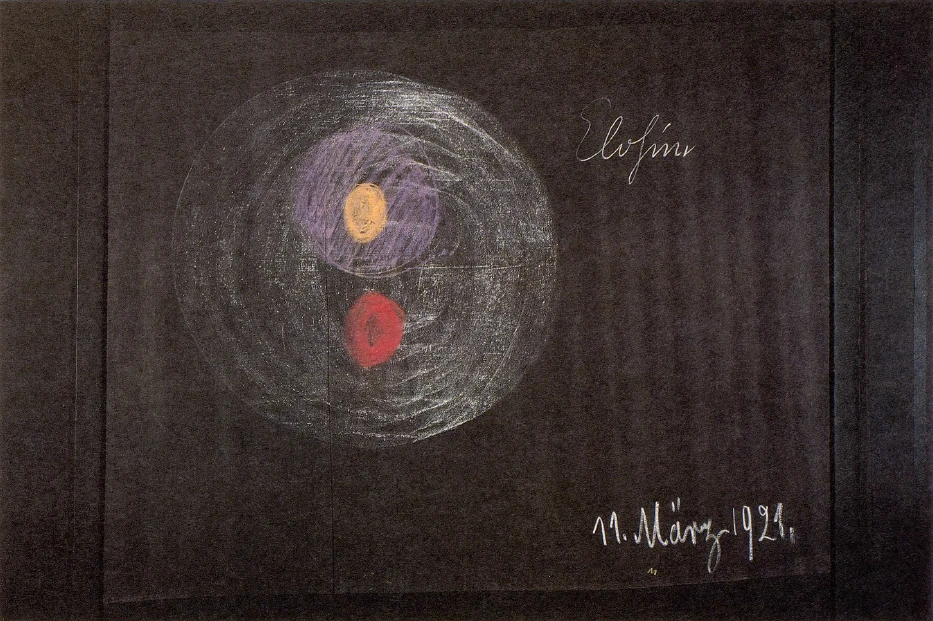
[ 19 ] But let us now nevertheless consider this dormant life of the will—or rather, its physical counterpart—this dormant metabolic and limb life. After all, the human being stands within the physical, natural environment not merely with his entire being, but also within a spiritual world. He stands within the spiritual cosmos with his entire being, regardless of the level of consciousness at which this being manifests. Now let us consider the will. We might say something like this: If this is the spiritual cosmos (see diagram, light-colored), which I do not wish to characterize further for the time being—you know, “spiritual cosmos” is, after all, a very universal term; one can only ever single out a part of it—then this here (red) would be a certain part of the spiritual cosmos, namely the one to which our life of will, or rather our metabolic and limb life, primarily belongs. So, if you think of the life of the will as belonging to the soul and the life of metabolism and the limbs as belonging to the body—separate from the human being—and then ask yourself: How is this integrated into a spiritual cosmos?—then this entire relationship to a spiritual cosmos is to be represented, for the time being, by this diagram. And the question arises for us: What is the white part here? — We know that the red part represents the human life of the will, viewed from the soul’s perspective, or the human metabolic and limb life, viewed from the body’s perspective; but what is that to which this life, so to speak, belongs? — I would like to put it another way. If you consider any part of the human organism—let’s say, for example, the liver—you will say to yourself: This liver belongs to the entire organism and has a significance within the entire organism. — Similarly, within a large organism—a world organism, depicted here in white—we can regard the entire human system of metabolism and limb function, as well as the system of will, as a limb. And then the question arises: What, then, is this great cosmic organism into which, so to speak, the human experience of will and the experience of metabolism and limb function are embedded?
[ 20 ] You see, what human beings are embedded in—with regard to their third member—is the cosmic life of those spiritual beings whom the Bible calls Elohim. In fact, just as we live in the outer nature that we perceive through our senses, so too do we live the life of the Elohim with that part of our being whose activity we are actually unaware of.
[ 21 ] Well, we will discuss these things in more detail later; for now, I just want to give you a general idea of them. Let us consider the life of the Elohim throughout the entire course of cosmic evolution. If you look it up in my Outline of Esoteric Science, you will find that these are the spirits of form; they ascended from earlier stages of development. If we go back, we come to the earlier stage of development of the cosmic lunar existence. There, these Spirits of Form were Archai, primal forces, primordial beginnings. If we go back to the Solar stage, they were archangels; if we go back to the Saturn stage, they were angels. So since that time, they have ascended and entered into the existence of the Elohim, into the existence of the Spirits of Form.
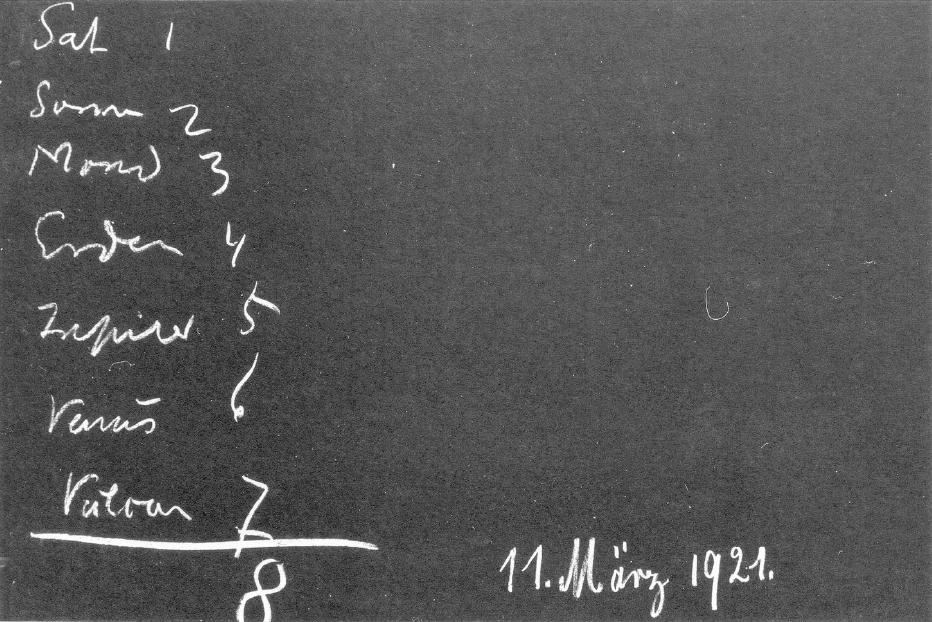
[ 22 ] When we consider our human evolution, we must ask ourselves: We, too, are evolving; when will we reach the level that these spirits are now at? — We will reach that level when we have gone through the stages of Jupiter, Venus, and Vulcan, and have entered the stage that follows. If you add up what I have described in my Occult Science, you have seven successive stages of development—seven successive, one might also say, spheres of development. And the spirits of form, the Elohim, have entered the eighth sphere of development.

[ 23 ] That is precisely what, I would say, characterizes the situation of the Elohim. When the Earth came into being, they were at that stage which we, as human beings, must characterize as a volcanic existence. They ascended into the eighth sphere. Now the great question, the great cosmic question, was: What is the situation—or what was the situation—regarding human beings during this earthly existence? — You see, human beings were in a position to remain a link in the development of the Elohim, just as they had been previously. The Elohim developed through their Saturn, Sun, and Moon phases up to the stage I have just described to you. There, they carried humanity, so to speak, in their bosom, just as you will find it described in my Occult Science. But everything I have described there rested, as it were, within the bosom of the Elohim. It is described in the same way as if I were to describe the liver to you in its development. When one describes its various stages, it remains within the human being. In the same way, the entire development of humankind that I have described rested within the bosom of the Elohim.
[ 24 ] When the Earth came into being, the question arose: Will human beings simply remain a dependent part of the great organism that ascended to its eighth sphere—the great cosmic organism of the Elohim—or will they evolve toward freedom and become independent? — This question—Will human beings become independent?—was decided by a very specific cosmic fact. In terms of our system of will (spiritually) and our system of metabolic limbs (physically), we are, after all, parts of the Elohim; there we are, as it were, asleep. There we are not set apart. We are set apart in terms of our head system.
[ 25 ] And how did this separation come about? — This separation occurred because certain spiritual beings—who, had they progressed properly in evolution, would also have become Elohim—did not become Elohim but remained behind, remaining at the level of the Archai or Archangeloi. We can therefore say that these are beings who, had they progressed properly, could actually have become Elohim. But they did not progress properly; they remained behind. If we view them from an occult perspective today, they belong to the same sphere as the angels and the archangels; but they are not of the same nature as the Angeloi, Archangeloi, or Archai; rather, they are actually of the same nature as the Elohim, as the Spirits of Form, only they have lagged behind in their development and have therefore found themselves among the ranks of the angels and archangels, manifesting themselves in the same sphere, and their activity has consequently had to be limited to not to act upon the whole human being or upon that which has been acquired by human beings primarily on Earth—the metabolic-limb system—but rather they act upon the human head system. So we say: With regard to the human head system—if I depict this here as the opposite pole of the will system and the metabolic-limb system (see diagram on p. 257, pink)—it is not this great cosmic organism of the Elohim that acts there, but rather the lagging Elohim, whom I will depict as such (yellow). Within this sphere, Angeloi, Archangeloi, and Archai also act. These beings, who are the remaining Elohim, are in fact the adversaries of the other Elohim. The other Elohim have cut humanity off from themselves; but they could not have given humanity freedom, because they exert their influence over the whole human being. In contrast, the lingering spirits of form confine themselves to the head, and through this they gave human beings reason and intellect. These are essentially the Luciferic spirits. As you can now see from the illustration, they are givers of will on a lower level. The Elohim give will to the whole human being, but these spirits give the head its will. Otherwise, the head would be filled only with will-less ideas. Ideas become rational only when, imbued with will, they develop into the power of judgment. This stems from these spirits.

[ 26 ] Perhaps you can see from this description—again, from a certain point of view—how one must not apply philistine concepts when one wishes to grasp cosmic opposites. One must not, if I may put it this way, simply shrug off the Luciferic spirits, but must be clear about this: these are spirits of a far higher order than human beings themselves. They are not, strictly speaking, enemies of humanity; they are enemies of the Elohim because they have fallen behind, and they confine themselves to the human head. That is what we must keep in mind.
[ 27 ] If you now imagine what these spirits would actually accomplish if they had complete freedom over human evolution, you will arrive at the following conclusion. You will say to yourself: Well, when the Earth came into being, the Elohim rose to their rightful place, while the others remained behind at earlier stages of development; they are thus the bearers of that which is primarily imprinted upon human beings from the past—from the Saturn, Sun, and Moon stages of existence—the bearers of that which is to be instilled in human beings from the sublime past we have undergone in the three previous metamorphoses of evolution.
[ 28 ] Because they have fallen behind—in a sense, resisting what the Elohim had planned for the people of Earth—we can also characterize them in relation to humankind by saying: These spirits, who are actually spirits of form but who oppose us in the spiritual world among the hosts of the Angeloi, Archangeloi, and Archai, instill in human beings everything that seeks to prevent them from descending into a full earthly existence. They actually wish to keep humanity above the mineral kingdom. They would prefer that humanity experience only what is found in the sprouting plant world, what lives in the animal world, and what exists in the human world itself. But they do not want to let humanity descend into the lifeless mineral world. And in particular, these spirits have absolutely no inclination to allow humanity to gain any understanding of anything related to our technology. In a sense, they are furious about this. They wish to keep humanity in a spiritual sphere; they do not want humanity to descend into the earthly realm. That is why they are also opponents of the Elohim, because the Elohim—who, as the Bible puts it, “formed humanity from the dust of the earth”—have drawn humanity down into the mineral kingdom. Yet it is to this that humanity owes its freedom. But freedom—the freedom that humans are meant to experience in the earthly realm—is not actually what matters to the spirits who want to keep humans free from the earthly realm.
[ 29 ] Now, in a sense, human beings have been placed by the Elohim into the mineral-earthly world. As a result, however, other spirits have in turn gained access. Now pay attention to the difference between the spirits I have just spoken of and the spirits I am about to speak of. Those I have just spoken of are in the sphere where the Angeloi, Archangeloi, and Archai dwell. We find them among the hosts of these spirits, and it is they who bring into the human mind agility, flexible reasoning, imaginative activity, artistic activity, and so on. But because human beings have been pushed down into the mineral kingdom—because the Elohim have granted them a degree of independence, though this independence is not yet full independence, since they experience it in a dormant state within their will and their metabolic-limb system—other spirits have gained access. These other spirits, so to speak, creep into the course of evolution. The spirits I have spoken of were present during evolution; they have simply been left behind. They were unable to participate in it, but they are Elohim who have been left behind; they were present in the cosmos alongside the Elohim and simply do not want to let humanity descend fully to Earth. Yet humanity has now descended to Earth through the Elohim. Now other spirits are coming from outside. We find them when we direct our occult gaze toward the hosts of cherubim, seraphim, and thrones. Of these spirits, who actually belong to this order, some individuals have also been left behind. They did not enter into these hosts; they have merely become spirits of wisdom. These spiritual beings manifest themselves in such a way that one can say of them: they actually wish to begin a completely new creation within the Earth; they wish to truly preserve the earthly human being. Just as he is embodied in the mineral kingdom through the Elohim, so they wish to take him as a starting point, and from this starting point they wish to continue his development. They wish to erase all of the past: “Oh, the past,” they say, “that doesn’t concern us any further; humanity once descended into the mineral kingdom—well, let’s tear them away from the Elohim, for the Elohim have no need of them; let’s tear them away from the Elohim and begin a new evolution. Let them be the first link, so that they may then live on and on!”
[ 30 ] These are the Ahrimanic beings. These Ahrimanic beings all want to erase the past and leave human beings with only what they have directly achieved on Earth.
[ 31 ] You can see how the Elohim stand right in the middle of it all. The Elohim wish to link the past with the future. The spirits I described earlier wish to permeate humanity with its sublime past. The other spirits wish to erase the entire past, to take away from the Elohim that which humanity is—made from the dust of the earth—and to make a new beginning, to start the process of evolution from the earth itself. Away with this “balloon” of the cosmos—with Saturn, the Sun, and the Moon—none of that is to have any significance for humankind. A new evolution is to begin with the Earth; it is to be a new Saturn, then the Sun will come, and so on. That is the ideal of these other beings. They storm into the human unconscious, into the life of the will, the life of metabolism and the limbs—that is where they storm in. They are the group among the spiritual beings who want to instill in humanity a special interest in all that is mineral and material, who want to instill in humanity an interest in everything that is, for example, external, machine-like, and mechanical. They would most like to destroy everything that the Earth has brought with it from the ancient Moon; they want the animal world to disappear, the physical human world to disappear, the plant world to disappear, so that only the physical laws of the mineral kingdom remain—but above all, they want human beings to be removed from the Earth; and they want to create a new Saturn out of machines, a new world consisting entirely of machines. That is how the world is then to continue. That is, in fact, their ideal. In the external realm of science, their ideal is to turn everything into matter, to mechanize it. In the religious realm, these two opposites are clearly discernible.
[ 32 ] In earlier times—as you know from other lectures I have given here—people were more exposed to spirits of the former kind, which act on the head. You can still find in Plato that, especially when speaking of the eternity of the human soul, people spoke of pre-birth existence—of what a person actually remembers from their previous life. This practice then ceased as we moved further into the Middle Ages, until the Church completely prohibited belief in pre-existence; and today, belief in the pre-existence of the human being is considered heresy by the Church. So on the one hand, there is a tendency toward the knowledge of pre-existence; on the other hand, there is the Ahrimanized Church, which continues human life only beyond death and then allows it to be merely a result of what a person is here on Earth.
[ 33 ] There you have it as a creed: What a person experiences here in the physical body, they carry with them through death. Their soul always looks back on that. — In fact, the entire life that follows is merely a continuation of what existed here between birth and death. This is precisely what the Ahrimanic spirits want. These are precisely the important questions facing humanity today: Should the Ahrimanic belief continue to spread, as if there were only one life after death, or should the awareness of pre-existence be reawakened, leading to the unification of pre-existence and post-existence through that which is the middle balance?
[ 34 ] This is what spiritual science must seek: this Christ principle, this equilibrium, this balance between the Luciferic-Ahrimanic—on the one hand, pre-existence—and post-existence on the other. These are the important questions of our time: that, after humanity has for a time devoted itself to the Ahrimanic belief in mere post-existence, we may once again add to this the awareness and recognition of pre-existence, thereby arriving at an understanding of the fullness of humanity.