

Faculty Meetings with Rudolf Steiner
GA 300c
29 April 1924, Stuttgart
Sixty-Fifth Meeting
Dr. Steiner: The classes are overfilled in the first, fifth, sixth, and seventh grades. In the eighth grade and above, there are still some openings. We are limited by law in grades one through four; however, we will petition to be allowed to increase the number of students. We have had a number of new enrollments due to the conference. There are enough rooms.
They make a list of class teachers for the coming school year.
Dr. Steiner: You should telegraph Dr. Erich Gabert in Wilhelmshaven that he is to take over the 5c class, but he should first visit us for three weeks. The children should remain in the 5a and 5b classes until, but we will have to put sixty in each class. We will need to do that until he has settled in.
By Thursday we should hire Miss Verena Gildemeister to teach Latin and Greek.
The next question is what we do in the upper grades, nine through twelve. We can divide the ninth grade.
They divide the main lesson blocks for the upper grades among the teachers. They also assign teachers for foreign languages, religion, and eurythmy.
Dr. Steiner: Now we have the question of what to do about the final examinations for this coming year. Do we want to continue as in the past or keep the twelve grades pure and then add a thirteenth year? In that event, the question will not arise this year. For now, we need to know what the students want. A large number want to take the final examination.
The students from the first grade will come tomorrow at 9:00, and the opening ceremony will be at 10:00. I will meet with the students of the present twelfth grade at 12:00 in one of the classrooms. I will find out to what extent they want to take the final examination. The teachers should also attend the meeting. If the students expect to take their final examinations this year, we will have to swallow the bitter pill. That would ruin the twelfth grade. If possible, we should try to avoid the final examination this year and create a cramming class for next year.
A teacher asks about the physics curriculum for the twelfth grade.
Dr. Steiner: We need to develop the twelfth-grade curriculum. We still need to discuss that.
We teach the following in physics: In the ninth grade, the telephone and steam engine; the theory of heat and acoustics. In the tenth grade, mechanics as such. In the eleventh grade, modern electrical theory. So now in the twelfth grade, we should teach optics.
Use pictures instead of rays. We need to emphasize the qualitative. Light fields and light-filled spaces. Do not talk about refraction, but about how a light field is compressed. We need to remove discussions about rays. When you discuss a lens, you should not show a cross section of a lens and this fantastic cross section of rays. Instead, you need to present a lens as something that draws a picture together and compresses or expands it. Thus, you should remain with what can be directly shown through vision. Leave rays out entirely. That is what you should do in optics. Other things need to be considered in other areas, but what is important is to remain within the qualitative. I do not mean the theory of color, but simply the objective facts. Don’t go into some thought-up picture, remain with the facts.
Concerning optics in the broadest sense, it is important to present:
1. Light as such, that is the first thing. Then the expansion of light and how the intensity decreases in relation to the expansion, that is, photometry.
2. Light and matter, what is often called refraction. Enlargement and reduction of pictures and distortions.
3. How colors are created.
4. Polarization.
5. Double refractions, as they are called. That is, things associated with incoherence and the way light expands.
In the first section on how light expands, you should include mirrors and reflections.
Optics is very important because so much of it is connected with spiritual life. You can certainly see why there is so little understanding of the spiritual. That understanding could exist. There is so little understanding of the spiritual because there is no real epistemology. Instead, there are only abstract, crazy ideas. But why is there no genuine cognitive theory? It is because since Berkeley wrote his book about vision, no one has properly made the connection between seeing and knowing.
If you were to seek the connections, you would not explain what occurs in a mirror reflection by saying, “Here is a mirror and a light ray falls upon it perpendicularly.” Instead, you would say, “Here is the eye,” and then you would explain that when the eye looks in a straight line, nothing happens other than that it looks in a straight line. You need to present a picture that shows that a mirror basically “draws” a picture of the object for the eye.
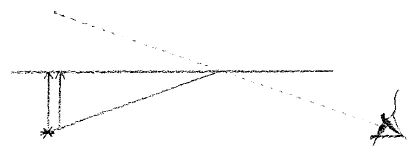
You therefore have a subjective attraction. You need to begin with vision, and then all optics will present itself to you differently. If you look straight at something, then your view is in balance. However, if you look at something in the mirror, your view is no longer balanced, but one-sided in the direction of the object. The minute you have a mirror, your vision is polarized. One aspect of the spatial dimension disappears when you look into a mirror. I discussed this to an extent in my lectures on optics.
A teacher asks about history for the twelfth grade.
Dr. Steiner: Well, you have already gone through everything, so now the twelfth grade needs to gain an overview of the connections within history. As you know, I discuss in my pedagogy that at about age twelve, children should begin to understand causal concepts. Instruction in causal relationships would then continue until the twelfth grade, but you must enliven it and make it personal. In the twelfth grade, it is important to go a little below the surface, to try to explain some of the inner workings of history.
By presenting the entire picture of history in outline, you can show, for example, how the Middle Ages and more recent history are contained within ancient Greece, in a certain way. Thus, the Homeric period contains aspects of the time of the major tragedies of the Middle Ages, and the time of Plato and Aristotle relates to more recent times. The same is true for the Age of Rome. Thus, you should use individual peoples and cultures to treat history such that you show how things come together. You can show that ancient periods contained a Middle Ages and a more recent period. Therefore, show an ancient period, a middle period, and a recent period in each culture. The beginning of the Middle Ages is just as much an ancient period as the one in Greek history beginning with the ancient Greek myths.
Then you could also bring in broken cultures or incomplete cultures, like that of America which has no beginning, or the Chinese, which has no end, which ends in petrifaction, but is actually only the ancient period. Present the life of a cultural group in that way. Spengler was a little aware of this. Begin from the perspective that it is not just a sketch of historical events, but that different interwoven pieces have a beginning, middle, and end.
A teacher asks about twelfth-grade art class.
Dr. Steiner: The most proper thing to do would be to take Hegel’s aesthetic structure, symbolic art, classical art, romantic art. Symbolic art is the first, the art of revelation. Classical art goes more into external forms, and romantic art deepens that further. This can be seen in the art of various peoples. We find symbolic art with the Egyptians. We find all three in Greece, though symbolic and romantic art come up short. In more recent times, we find more classical and romantic art, and symbolic art comes up short.
Hegel’s Aesthetics is interesting even in the details. It is really a classic on aesthetics. That would be something for the twelfth grade. Symbolic art is typified in Egyptian art, where the other two were very rudimentary. Classical art is developed in Greece, where the forms that came before and after come up short. More modern art is classical and romantic, as Hegel describes. The most modern is actually romantic.
We begin instruction in the arts in the ninth grade, don’t we?
A teacher reports on how they have taught art in the past. In the ninth grade, specific areas of painting and sculpting; in the tenth grade, some things about German classical poetry; in the eleventh grade, how the poetic and musical elements are interwoven. One theme was to see how poetry and music since Goethe’s time move together under the surface.
Dr. Steiner: Work toward what I said for the twelfth grade; otherwise, what you have done until now is quite good. You should introduce them to the basics of architecture. If someone is teaching about architecture and construction in the twelfth grade, you could continue that discussion into architectural styles. We begin technology class in the tenth grade. We have weaving in the tenth grade, and you should show them how to make simple woven cloth. A sample is sufficient for that. In the eleventh grade, we have the steam turbine. They should have two hours a week in the tenth grade and one hour in the eleventh and twelfth grades.
A teacher asks about the ascidians as one of the twelve categories of animals.
Dr. Steiner: Those are the tunicates and salpas. Until now people have not seen them as being a separate genus.
A teacher asks about a student, B.K.
Dr. Steiner: I do not think it is really so terrible if such a boy is simply there. That will not pass by without a trace. The subconscious hears it. You will have to wait until he is fourteen. He should be unburdened as far as possible, so give him only a little bit to learn, but that should have a strong effect. His mother lies terribly. He should be required to paint at home.
A teacher asks about P.Z. in the sixth grade.
Dr. Steiner: Pay no attention to him. Let him play his tricks until he becomes tired of them. You should also see that the others pay no attention to him, so that he does his things alone.
A teacher: How should we seat the children in language class?
Dr. Steiner: In foreign languages, you could arrange the seating so that those who are interested in the sound sit together, and those who are interested in the content of the language sit together. In that way you would have groups of children you can treat differently and balance against one another.
Fünfundsechzigste Konferenz
Nach drei Wochen Ferien gingen die Kinder wieder zur Schule, jedoch in die nächsthöhere Klasse. Mit dem Auto war Steiner am 29, April aus Dornach angereist, abends war Konferenz„ Am nächsten Morgen begrüßte er die neuen Erstklässler, wonach er eine Ansprache zur Schuleröffnung hielt. Er sprach zuerst zu den Eltern, dann zu den Erstklässlern, dann zu den übrigen Schülern und zum Schluss zu den Lehrern. Der letzte Satz lautete: «Vorwärts, meine lieben Kinder, und meine heben Lehrer, vorwärts!» (CA 298, S. 177) Es sollte seine letzte Ansprache in der Schule sein.
Danach besprach er sich mit den kommenden Zwölftklässlern, ob sie ein Abitur in oder nach der 12. Klasse wollten. Danach folgte die Konferenz.
Themen [65. und 66. Konferenz]: Überfüllung der Unterstufe. Martha Haebler hatte im Vorjahr eine 5c eröffnet, dieses Jahr muss wieder eine 5c eröffnet werden. Berufung Dr, Erich Gaberts. Klassenverteilungen. Lehrplananweisungen für das 12. Schuljahr in Physik, Geschichte, Kunstunterricht. Ausführliche Anweisungen für Literaturunterricht, Mathematik, Chemie, Geografie und Religion.
Bemerkungen: Im fünften Jahr hatte der Lehrplan der 12, Klasse im Zeichen des Abiturs gestanden; der Waldorflehrplan war diesem Ziel weitgehend geopfert worden. Dessen Ausarbeitung wurde nun nachgeholt. In großen> bedeutenden Zügen wurde der Lehrplan für das 12. Jahr dargestellt. Hinweise zur pädagogischen Behandlung einzelner Schüler.
Neben Erich Gabert wurde Verena Gildenleister für den altsprachlichen Unterricht berufen. Die 47 Lehrer bewältigten nun im sechsten Schuljahr einen Organismus mit 23 Klassen und fast 800 Schülern, immer noch in beengten Raumverhältnissen.
RUDOLF STEINER: [Die 1. bis 7. Klasse sind überfüllt. Von der 8. Klasse ab sind noch Plätze frei. Bei der 1. bis 4. Klasse sind wir durch das Gesetz limitiert, Da wird eine Eingabe wegen einer höheren Schülerquote an die Behörde gemacht. Wir haben viele Anmeldungen durch die Tagung. Die Räume wären da.]
Es wird die Liste der Klassenlehrer für das kommende Schuljahr aufgestellt.
RUDOLF STEINER: [Für 5c sollten Sie telegrafieren an Dr. Erich] Gabert, [Wilhelmshaven, er] soll hospitieren durch drei Wochen. [So lange sollen alle Kinder noch in der 5a und 5h beisammenbleiben]; 118 : 120; in jede müssen wir sechzig Schüler tun. Das müssen wir so lange machen, bis er sich eingelebt hat. [Für den lateinischen und griechischen Unterricht sollten wir berufen Fräulein Verena Gildemeister, bis Donnerstag.] Dann würde es darauf ankommen, wie wir es machen in den vier oberen Klassen.
10a: Naturwissenschaft anfangen,
10b: mit Kunstunterricht anfangen,
11: [beginnt mit] Mathematik,
12: mit Geschichte,
9.: Stockmeyer Mathematik,
10a, 10b, 12.: Mathematik Baravalle.
9., 10a, 10b, 11., 12. Naturwissenschaft: Dr. Lehrs.
Ja, Dr. Lehrs, Sie wollen nun selbstständig die 9. Klasse übernehmen? Dann hilft er [zu Dr. Kolisko] Ihnen in der 10a, 10b, 11. und 12. Physik mit Mathematik zusammen.
Geschichte: 9. (vorläufig), 10., [Klassen] 11 und 12: Stein.
Kunstunterrieht: 10a, b, 11. und 12.: Schwebsch. 9. [Klasse] hat später Kunstunterricht.Baravalle: mit Mathematik in der 12. Klasse beginnen. 9, beginnt mit Geschichte, [Stein]. Lehrs wird 10a Naturwissenschaften nehmen, 10b: Schwebsch [Kunstunterricht].
11. [Klasse]: Botanik Kolisko,
12. [Klasse] Baravalle Mathematik.
Feldmessen 10a und 10b: Stockmeyer.
Technologie: Strakosch.
Technologie 10. Klasse 2 Stunden, 11. bis 12. je eine Stunde. Stra-kosch in der 9. Naturwissenschaften. Dann hat Kolisko nicht so Lehrs: 10a, Kolisko: 10b, 11 und 12. Strakosch: 9. Mathematik, Stockmeer: 11. Feldmessunterricht und Ihre Schraubenlehre.
Naturkundliches:
9 Strakosch
10a Lars
10b Kolisko (Lehrs)
11 Kolisko (Lehrs)
12 Kolisko (Lehrs)
Geschichte:
9 Stein
10a Felicia Schwebsch
10b Felicia Schwebsch
11 Stein
12 Stein
Frau Dr. Schwebsch vorläufig unbesetzt; sie soll die Fächer von Fräulein Dr. leise: hl übernehmen.
Hiernach werden der Sprachunterricht, der Religionsunterricht und der Eurythmieunterricht verteilt.
[Sprachunterricht:]
la Französisch und Englisch: Bernhardi
1b Französisch und Englisch: Hofmann
2a Französisch und Englisch: Heydebrand
2b Französisch und Englisch: Tilliss
3a Französisch: Geyer Englisch: Rutz
3b Französisch und Englisch: Mellinger
4a Französisch und Englisch: Düberg
4b Französisch und Englisch: Michels
5a Französisch und Englisch: Uhland
5b Französisch: Killian Englisch: Uhland
5c Französisch und Englisch: Gabert
6a Französisch: Hahn Englisch: Tittmann
6b Französisch: Naegelin und Englisch: Rutz
6c Französisch: Naegelin und Englisch: Haebler
7a Französisch: Geyer Englisch.: Treichler
7b Französisch und Englisch: Treichler
8a Französisch und Englisch: Boy
8b Französisch: Ruhtenberg/Tittmann und Englisch: Treichler, Sie sind ein starker Mann.
9a Französisch: Tittmann und Englisch: Düberg bis auf Weiteres, Gabert
9b Französisch: Englisch:
10a Französisch: Hahn ind Englisch: Schwebsch
10b Französisch: Hahn und Englisch: Boy
11 Französisch: Tittmann und Englisch: Boy
12 Französisch: Haebler und Englisch: Baravalle
Lateinisch und Griechisch:
5 noch offen
6. Lehrs
7. Schubert
8., 9. Tittmann
10a, b, 11., 12. Frau Schwebsch
Religionsunterricht: Hahn, Ruhtenberg, Uehli, Baumann, Hofmann, Schubert, Wolffhügel.
la, b Hofmann
2a, b, 3a, b Wolffhügel
4a, b, 5a, b, c Schubert
6 a, b, c Hahn
7a, b Ruhtenberg
8a, b Ruhtenberg
9 Baumann
10a, b Uehli
11, 12 Hahn
Handwerk: Wolffhügel, Handarbeit auch in Ordnung.
Eurythrnie muss aufgestiegen werden von unten angefangen:
la Dähnhard
lb Röhrte
2a Nora Stein
2b Röhrle
3a Dähnhard
3b Stein
4a Röhrle
4b Dähnhard
5a Röhrle
5b Stein
5c — (später)
6a Stein
6b Wilke
6c Röhrle
7a Wilke
7b Wilke
8a Stein
8b Stein
9 Dähnhard
10a Röhrle
10b Fels
11 Stein
12 Röhrle
5c müssen wir dann noch besetzen. Die 9. Klasse kann man trennen.
RUDOLF STEINER: [Jetzt] ist das eine große Frage, wie wir es mit dem Abitur halten [wollen im kommenden Jahr]; ob wir die Sache so fortsetzen [wie bisher], oder ob wir die zwölf Klassen rein halten und dann eine daraufgesetzte 13. Klasse haben. Dann würde die Sache für dieses Jahr wegfallen. Nun liegt die Sache so, [dass wir wissen müssen], wie es mit den Schülern sein wird. Es [will] eine große Anzahl Abitur machen.
[Morgen] um neun Uhr werden die Schüler [der 1. Klasse] auf-genommen, um zehn ist die Eröffnungsfeier. Dann würde ich vorgeführt bekommen die Schüler der jetzigen 12. Klasse [morgen] um zwölf Uhr, in einer Klasse der Schule. Davon werde ich [es] abhängig machen, inwieweit diese das Abiturium machen wollen. Die Lehrer sollen bei der Besprechung dabei sein. Wenn die Schüler erwarten, jetzt Abiturium zu machen, werden wir in den sauren Apfel beißen müssen. Erst ist die 12. Klasse ruiniert worden dadurch. Wenn es geht, werden wir dieses Jahr auf das Abiturium verzichten und im nächsten Jahre eine Abituriumspresse einrichten.
ERNST LEHRS [vermutlich] fragt nach dem Lehrplan für Physik in der 12. Klasse.
RUDOLF STEINER: Der Lehrplan der 12. Klasse [soll ausgearbeitet werden. Das] wäre zu besprechen.
[In der Physik] haben wir also von der 9. [Klasse]: Telefon und Dampfmaschine, Wärmelehre, Akustik. — 10. [Klasse] Mechanik als solche. — 11. [Klasse] moderne Elektrizitätslehre. — [jetzt müsste in der] 12. Klasse [eigentlich] Optik [kommen].
Bilder statt Strahlen. Auf das Qualitative müssen wir gehen. Lichtfelder und Lichträume. Nicht reden vom Brechen, sondern vorn Zusammendrücken des Lichtfeldes. Diese Ausdrücke [wie Strahlen und so weiter] müssen wir dann weghaben. [Wenn wir besprechen], was eine Linse ist, müssten wir nicht den Querschnitt der Linse, zeichnen und dann einen phantastischen Querschnitt von Strahlen, sondern wir müssten dabei bleiben, die Linse aufzufassen als «das Bild zusammenziehend», verdichtend oder auseinandergehend. Also nur tatsächlich stehen bleiben bei dem, was sich unmittelbar im Sehfeld zeigt. Also ganz überwinden die «Strahlen». Das muss in der Optik gemacht werden. Bei anderen Dingen kommt anderes in Betracht. [Vor allen Dingen] sollte man ins Qualitative übergehen. Ich meine nicht Farbenlehre, sondern einfach den Tatbestand. Nicht ein ausgedachtes Bild, sondern einen Tatbestand.
Optik im weitesten Umfang. Dahinein kommt zunächst:
1. das Licht als solches; [zunächst das Licht als solches]! Die Ausbreitung, [die mit der Ausbreitung abnehmende Intensität, Fotometrie, Spiegelreflexion. — Dann
2. Licht und Materie, was man so Brechung nennt. Vergrößerung und Verkleinerung des Bildes, Verschiebungen. — Dann
3. Entstehung der Farben.
4. Polarisationserscheinungen [und so weiter].
5. Wesen der Doppelbrechung, wie man das nennt, die Erscheinungen der Inkohärenz [in der Lichtausbreitung].
Ins erste Kapitel, Ausbreitung, gehören die Spiegel, die Reflexion.
Optik ist sehr wichtig, weil im Geistesleben die einzelnen Teile sehr viel zusammenhängen. Sehen Sie, nicht wahr, warum gibt es so wenig Verständnis für das Spirituelle? Das könnte da sein. Es ist nicht da, es gibt so wenig Verständnis für [das] Spirituelle, weil eine wirkliche Erkenntnistheorie nicht besteht, sondern nur abstrakte Spintisierereien. Warum ist keine wirkliche Erkenntnistheorie da? Weil, seit Berkeley sein Buch über das Sehen geschrieben hat, keiner mehr [richtig] das Sehen mit dem Erkennen zusammengebracht hat.
Wenn Sie so Zusammenhänge suchen, werden Sie die Spiegelerscheinungen nicht mehr so erklären, dass Sie sagen: Da ist ein Spiegel, da fällt ein Lichtstrahl senkrecht auf, sondern Sie werden hier das Auge haben und werden zu erklären haben, wenn das Auge gerade sieht, warum nichts weiter entsteht, als dass es gerade sieht. Sie müssen dahin kommen, dass der Spiegel im Grunde genommen das Bild des Gegenstandes zeigt [oder: «zieht»1 für das Auge.
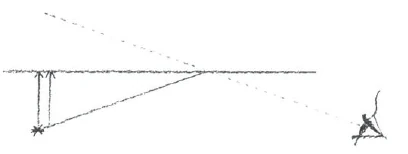
Sie bekommen subjektive Anziehungskräfte. Sie müssen ausgehen vorn Sehen. Die ganze Optik wird sich Ihnen anders darstellen. Wenn Sie gerade hinsehen, sehen Sie ungestört. Sehen Sie aber durch [einen] Spiegel, so sehen Sie nicht ungestört, sondern Sie sehen eigentlich [einseitig?] in der Richtung zum Gegenstande hin. In dem Augenblick, wo Sie Spiegel haben, wird zugleich polarisiert. Es verschwindet die eine Raumdimension durch das Sehen durch den Spiegel. Dazu haben Sie Anhaltspunkte in den von mir gegebenen optischen Vorträgen.
Englisch lb würde entfallen.
WALTER JOHANNES STEIN fragt wegen der Geschichte in der 12. Klasse.
RUDOLF STEINER: In der 12. Klasse [die] ganze Geschichte. Nicht wahr, Sie haben ja alles durchgenommen. Nun würde es sich darum handeln, [in der 12. Klasse] einen Überblick zu geben im Zusammenhang über die ganze Geschichte. Sie -wissen, dass ich in meiner Pädagogik ausführe, dass in dem Alter von zwölf Jahren ab Kausal-begriffe aufgefasst werden. Nun würde dann der Kausalunterricht weitergehen [bis zur 12. Klasse]. Er muss belebt, individualisiert wer-den. in der 12. handelt es sich darum, dass [der Unterricht] etwas unter die Oberfläche heruntergeht, dass man versucht, Inneres in der Geschichte zu erläutern.
Man zeigt durch das ganze Bild der Geschichte im Abriss, wie, sagen wir, im Griechentum Altertum, Mittelalter und Neuzeit in gewisser Weise vorhanden ist, sodass die älteste Zeit, die homerische Zeit, das Altertum ist, die Zeit der großen Tragiker das Mittelalter wäre, und die Zeit des Platonismus und Aristotelismus wäre die Neuzeit. So auch für das Römertum [und so weiter]. So die Geschichte behandeln, dass [man] nun [an] den einzelnen Völkern oder Kulturkreisen [zeigt, wie] die Dinge so [zusammenkommen]. Was ein Altertum als solches ist, [ein Mittelalter, eine Neuzeit. Also Altertum, Mittelalter, Neuzeit in jeder Kultur zeigen]. Dasjenige, womit wir das Mittelalter anfangen, ist ein ebensolches Altertum wie [in] der griechischen Geschichte, als wenn wir da mit der alten griechischen Mythologie anfangen.
Dann würden gebrochene Kulturen kommen, unvollständige Kulturen, wie die amerikanische Kultur, die keinen Anfang hat, [oder] die chinesische, die kein Ende hat, die in Erstarrung übergeht, [aber nur Altertum ist]. In dieser Weise [den Lebensgang eines Kulturkreises darstellen]. Etwas ist ja Spengler davon aufgefallen. Es ist von dem Gesichtspunkt auszugehen, dass in der Wirklichkeit nicht eine Skizze der geschichtlichen Ereignisse vorliegt, sondern ineinanderlaufende Kreise.
ERICH SCHWEBSCH fragt nach dem Kunstunterricht in der 12. Klasse.
RUDOLF STEINER: Da ist eigentlich außerordentlich richtig Hegels ästhetischer Aufbau, symbolische Kunst, klassische Kunst, romantische Kunst. [Die] symbolische Kunst ist [die] erste, [die Kunst der Offenbarung, die] klassische geht in die äußere Form, [die] romantische vertieft das wieder. [Das ist bei den einzelnen Völkern nachzuweisen. Bei den Ägyptern finden wir die symbolische Kunst.] Im Griechentum finden wir wieder alle drei, wenn auch [die symbolische und die romantische Kunst] etwas zu kurz kommen. In der neueren Zeit finden wir [mehr] klassische und romantische, und die symbolische kommt zu kurz.
[Einzelheiten bei] Hegels Ästhetik; [das] ist ein wirklich klassisches Buch der Ästhetik. Das für die 12. [Klasse]. Symbolische Kunst [ist die], die ihren Grundcharakter in der ägyptischen Kunst hatte, da sind die beiden anderen ganz rudimentär. In der griechischen Kunst ist das Klassische ausgebildet, das vorher und das nachher kommt zu kurz. Die Neueren sind klassische und romantische Kunst, wie Hegel da ausführt. Die Neuesten sind eigentlich immer romantisch.
Wir fangen mit dem Kunstunterricht [doch ] in der 9. an?
ERICH SCHWEBSCH gibt die bisherige Verteilung an: In der 9. einzelne Gebiete aus der Malerei und Plastik. — 10. Klasse etwas aus der dem-schen klassischen Dichtung. — 11. Klasse das Zusammenströmen von Dichterischem und Musikalischem. [Da war] als Thema angegeben, [zu verfolgen], wie Dichtung und Musikalisches sich seit Goethe unter der Oberfläche fortsetzen.
RUDOLF STEINER: In der 12. hinarbeiten auf das, was ich gesagt habe. Sonst ist es ganz gut, was bisher gemacht worden ist. [Die Elemente der Baukunst. Baukunst sollte hineinkommen.] Wenn in der 12. Klasse jemand gesprochen hat über Baukunst und Bautechnik, dann kann sich daran anschließen eine Besprechung der Baustile.
Technologie hatten wir von der 10. ab. [In der 10. hatten wir] Weben. Man müsste in der einfachsten Weise Gewebe machen lassen. [Es] genügt am Modell. [In der 11. Klasse] Dampfturbinen.
EUGEN KOLISKO [vermutlich] fragt nach den Manteltieren als einer der zwölf Tierklassen.
RUDOLF STEINER: [Das sind die] Tunikaten, [die] Salpen. [Die hat man bisher nicht als eigene Klasse angesehen.]
[...] [Besprechung der Dozenten des Eurythmeums.]
RUDOLF TREICHLER fragt wegen des Schülers A. D.
RUDOLF STEINER: Nervenstärkungsmittel. Ich kann nicht einsehen, dass es so furchtbar schlimm sein soll, wenn so ein Junge einfach da ist. Ganz [spurlos] geht es nicht vorüber. Der üble Einfluss ist nur der, wenn er bei einem anderen Gegenstand dasitzt. Das Unbewusste hört die Sache.
Bei S. B. müsste man warten, bis er vierzehn Jahre alt ist. Er sollte möglichst entlastet werden; wenig Unterrichtsstoff, und [der sollte] stark [wirksam sein]. Die Mutter hat furchtbar gelogen. Er müsste zu Hause zum Malen angehalten werden. [Kein Latein und Griechisch.]
ERNST LEHMS fragt wegen des Schülers P. Z. in der 6. Klasse.
RUDOLF STEINER: Nicht Rücksicht nehmen auf ihn, [ihn] so lange Faxen machen lassen, bis es ihm selber langweilig wird. Man muss erreichen, dass die [anderen] nicht aufmerksam sind auf ihn und er in aller Einsamkeit die Dinge macht.
[Auf eine Frage von Ernst Lehrs nach der Sitzordnung im Lateinunterricht] [Im Sprachlichen kann man die Schüler setzen nach solchen, die für das Lautliche, und solchen, die für das Sinnvolle, Inhaltliche der Sprache Interesse haben, So hat man Blocks, die man verschieden behandeln und gegeneinander übersichtlich verarbeiten kann.]
Sixty-fifth Conference
After three weeks of vacation, the children returned to school, but in the next grade up. Steiner arrived by car from Dornach on April 29, and in the evening there was a conference. The next morning, he welcomed the new first graders, after which he gave a speech to mark the opening of the school. He spoke first to the parents, then to the first graders, then to the other students, and finally to the teachers. His last sentence was: “Forward, my dear children, and my dear teachers, forward!” (CA 298, p. 177) It was to be his last speech at the school.
Afterwards, he discussed with the upcoming twelfth graders whether they wanted to take their Abitur exams in or after the 12th grade. This was followed by the conference.
Topics [65th and 66th conferences]: Overcrowding in the lower grades. Martha Haebler had opened a 5c class the previous year, and another 5c class had to be opened this year. Appointment of Dr. Erich Gaberts. Class distributions. Curriculum instructions for the 12th school year in physics, history, and art. Detailed instructions for literature, mathematics, chemistry, geography, and religion.
Comments: In the fifth year, the curriculum for the 12th grade had been dominated by the Abitur (German university entrance qualification); the Waldorf curriculum had been largely sacrificed to this goal. Its development was now being made up for. The curriculum for the 12th grade was presented in broad strokes. Notes on the pedagogical treatment of individual students.
In addition to Erich Gabert, Verena Gildenleister was appointed to teach classical languages. In their sixth school year, the 47 teachers now managed an organism with 23 classes and almost 800 students, still in cramped conditions.
RUDOLF STEINER: [Grades 1 to 7 are overcrowded. There are still places available from grade 8 onwards. In grades 1 to 4, we are limited by law. A request for a higher student quota will be submitted to the authorities. We have received many registrations as a result of the conference. The rooms would be available.]
The list of class teachers for the coming school year is being drawn up.
RUDOLF STEINER: [For 5c, you should telegraph Dr. Erich] Gabert, [Wilhelmshaven, he] should observe for three weeks. [All children should remain together in 5a and 5h for that long]; 118 : 120; we have to put sixty students in each. We have to do this until he has settled in. [For Latin and Greek lessons, we should call Miss Verena Gildemeister by Thursday.] Then it would depend on how we do it in the four upper classes.
10a: Start science,
10b: start with art lessons,
11: [start with] mathematics,
12: with history,
9.: Stockmeyer mathematics,
10a, 10b, 12.: Baravalle mathematics.
9., 10a, 10b, 11, 12. Natural sciences: Dr. Lehrs.
Yes, Dr. Lehrs, you want to take over the 9th grade on your own? Then he [to Dr. Kolisko] will help you in 10a, 10b, 11, and 12 with physics and mathematics.
History: 9th (provisional), 10th, [classes] 11th and 12th: Stein.
Art: 10a, b, 11th and 12th: Schwebsch. 9th [class] will have art lessons later.Baravalle: start with mathematics in 12th grade. 9th grade starts with history, [Stein]. Lehrs will take 10a natural sciences, 10b: Schwebsch [art lessons].
11th [grade]: Botany Kolisko,
12th [grade] Baravalle Mathematics.
Field measurements 10a and 10b: Stockmeyer.
Technology: Strakosch.
Technology 10th grade 2 hours, 11th to 12th one hour each. Stra-kosch in 9th grade science. Then Kolisko doesn't teach: 10a, Kolisko: 10b, 11 and 12. Strakosch: 9th grade math, Stockmeer: 11th grade field measurement lessons and your screw theory.
Natural history:
9 Strakosch
10a Lars
10b Kolisko (Lehrs)
11 Kolisko (Lehrs)
12 Kolisko (Lehrs)
History:
9 Stein
10a Felicia Schwebsch
10b Felicia Schwebsch
11 Stein
12 Stein
Dr. Schwebsch provisionally vacant; she is to take over the subjects of Dr. Leise: hl.
After this, language lessons, religious education, and eurythmy lessons will be distributed.
[Language lessons:]
French and English: Bernhardi
1b French and English: Hofmann
2a French and English: Heydebrand
2b French and English: Tilliss
3a French: Geyer English: Rutz
3b French and English: Mellinger
4a French and English: Düberg
4b French and English: Michels
5a French and English: Uhland
5b French: Killian English: Uhland
5c French and English: Gabert
6a French: Hahn English: Tittmann
6b French: Naegelin and English: Rutz
6c French: Naegelin and English: Haebler
7a French: Geyer English: Treichler
7b French and English: Treichler
8a French and English: Boy
8b French: Ruhtenberg/Tittmann and English: Treichler, you are a strong man.
9a French: Tittmann and English: Düberg until further notice, Gabert
9b French: English:
10a French: Hahn and English: Schwebsch
10b French: Hahn and English: Boy
11 French: Tittmann and English: Boy
12 French: Haebler and English: Baravalle
Latin and Greek:
5 still open
6. Lehrs
7. Schubert
8., 9. Tittmann
10a, b, 11., 12. Ms. Schwebsch
Religious education: Hahn, Ruhtenberg, Uehli, Baumann, Hofmann, Schubert, Wolffhügel.
la, b Hofmann
2a, b, 3a, b Wolffhügel
4a, b, 5a, b, c Schubert
6 a, b, c Hahn
7a, b Ruhtenberg
8a, b Ruhtenberg
9 Baumann
10a, b Uehli
11, 12 Hahn
Craftsmanship: Wolffhügel, handiwork also acceptable.
Eurythmy must be ascended starting from the bottom:
la Dähnhard
lb Röhrte
2a Nora Stein
2b Röhrle
3a Dähnhard
3b Stein
4a Röhrle
4b Dähnhard
5a Röhrle
5b Stein
5c — (later)
6a Stein
6b Wilke
6c Röhrle
7a Wilke
7b Wilke
8a Stein
8b Stein
9 Dähnhard
10a Röhrle
10b Fels
11 Stein
12 Röhrle
We still have to fill 5c. The 9th grade can be separated.
RUDOLF STEINER: [Now] the big question is what we [want to do] with the Abitur [next year]; whether we continue [as before], or whether we keep the twelve grades and then have a 13th grade on top of that. Then the matter would be dropped for this year. Now the situation is such [that we need to know] what will happen with the students. A large number of them [want] to take the Abitur.
[Tomorrow] at nine o'clock, the students [of the 1st grade] will be admitted, and at ten o'clock there will be an opening ceremony. Then I would be introduced to the students of the current 12th grade [tomorrow] at twelve o'clock, in a classroom at the school. I will make [it] dependent on the extent to which they want to take the Abitur. The teachers should be present at the meeting. If the students expect to take the Abitur now, we will have to bite the bullet. First, the 12th grade has been ruined by this. If possible, we will forego the Abitur this year and set up an Abitur press next year.
ERNST LEHRS [presumably] asks about the physics curriculum for the 12th grade.
RUDOLF STEINER: The curriculum for the 12th grade [is to be worked out. That] would have to be discussed.
[In physics] we have from the 9th [grade]: telephone and steam engine, thermodynamics, acoustics. — 10th [grade] mechanics as such. — 11th [grade] modern electricity. — [now in the] 12th grade [actually] optics [should come].
Images instead of rays. We have to focus on the qualitative. Light fields and light spaces. Don't talk about refraction, but about the compression of the light field. We then have to get rid of these terms [such as rays and so on]. [When we discuss] what a lens is, we should not draw the cross-section of the lens and then a fantastical cross-section of rays, but we should stick to understanding the lens as “contracting the image,” condensing or diverging. In other words, we should only actually stick to what is immediately apparent in the field of vision. In other words, completely overcome the “rays.” This must be done in optics. Other things come into consideration for other things. [Above all], one should move on to the qualitative. I don't mean color theory, but simply the facts. Not an imagined image, but a fact.
Optics in the broadest sense. First of all, this includes:
1. Light as such; [first of all, light as such]! Its propagation, [its decreasing intensity with propagation, photometry, mirror reflection. — Then
2. Light and matter, what is called refraction. Enlargement and reduction of the image, shifts. — Then
3. The origin of colors.
4. Polarization phenomena [and so on].
5. The nature of double refraction, as it is called, the phenomena of incoherence [in the propagation of light].
The first chapter, propagation, deals with mirrors and reflection.
Optics is very important because in spiritual life the individual parts are very much interrelated. You see, don't you, why there is so little understanding of the spiritual? That could be the reason. There is so little understanding of [the] spiritual because there is no real theory of knowledge, only abstract speculations. Why is there no real theory of knowledge? Because, since Berkeley wrote his book on seeing, no one has [properly] linked seeing with cognition.
If you look for connections in this way, you will no longer explain mirror phenomena by saying: there is a mirror, a ray of light falls vertically on it, but you will have the eye here and will have to explain why, when the eye sees straight ahead, nothing else happens but that it sees straight ahead. You must come to the conclusion that the mirror basically shows [or: “draws”1] the image of the object for the eye.
You get subjective forces of attraction. You must go out in front of seeing. The whole optics will appear differently to you. When you look straight ahead, you see undisturbed. But when you look through [a] mirror, you do not see undisturbed, but you actually see [one-sidedly?] in the direction of the object. The moment you have a mirror, polarization occurs at the same time. One spatial dimension disappears when you look through the mirror. You will find references to this in the lectures on optics that I have given.
English lb would be omitted.
WALTER JOHANNES STEIN asks about the story in the 12th grade.
RUDOLF STEINER: The whole story in the 12th grade. You have gone through everything, haven't you? Now it would be a matter of giving an overview [in the 12th grade] in connection with the whole story. You know that in my pedagogy I explain that at the age of twelve, causal concepts can be understood. Now, causal teaching would then continue [until the 12th grade]. It must be enlivened and individualized. In the 12th grade, the aim is for [the teaching] to go a little deeper, to try to explain the inner workings of history.
The whole picture of history is presented in outline, showing how, for example, in Greek culture, antiquity, the Middle Ages, and modern times are present in a certain way, so that the oldest period, the Homeric period, is antiquity, the time of the great tragedians would be the Middle Ages, and the time of Platonism and Aristotelianism would be modern times. The same applies to Roman culture [and so on]. Treat history in such a way that [you] now [show] the individual peoples or cultural circles [how] things [come together] in this way. What antiquity as such is, [the Middle Ages, modern times. So show antiquity, the Middle Ages, and modern times in every culture]. What we begin the Middle Ages with is just as much antiquity as [in] Greek history, as when we begin with ancient Greek mythology.
Then there would be broken cultures, incomplete cultures, such as American culture, which has no beginning, [or] Chinese culture, which has no end, which is turning into stagnation, [but is only antiquity]. In this way [depict the course of life of a cultural circle]. Spengler noticed something of this. The starting point is that in reality there is no sketch of historical events, but rather intertwining circles.
ERICH SCHWEBSCH asks about art lessons in 12th grade.
RUDOLF STEINER: Hegel's aesthetic structure is actually extremely accurate: symbolic art, classical art, romantic art. Symbolic art is the first [the art of revelation], classical art goes into the outer form, and romantic art deepens this again. This can be seen in individual peoples. We find symbolic art in the Egyptians. ] In Greek culture, we find all three again, even if [symbolic and romantic art] are somewhat neglected. In more recent times, we find [more] classical and romantic art, and symbolic art is neglected.
[Details in] Hegel's Aesthetics; [this] is a truly classical book on aesthetics. The one for the 12th Symbolic art [is that] which had its basic character in Egyptian art, where the other two are very rudimentary. In Greek art, the classical is developed, while what came before and after is neglected. The more recent ones are classical and romantic art, as Hegel explains there. The most recent ones are actually always romantic.
We start with art lessons [after all ] in the 9th grade?
ERICH SCHWEBSCH gives the previous distribution: In the 9th grade, individual areas of painting and sculpture. — 10th grade, something from the same classical poetry. — 11th grade: the convergence of poetry and music. [The] theme [to be pursued] was how poetry and music have continued beneath the surface since Goethe.
RUDOLF STEINER: In the 12th grade, work toward what I have said. Otherwise, what has been done so far is quite good. [The elements of architecture. Architecture should be included.] If someone in the 12th grade has talked about architecture and building technology, then this can be followed by a discussion of architectural styles.
We had technology from the 10th grade onwards. [In the 10th grade we had] weaving. Weaving should be taught in the simplest way possible. [It] is sufficient to use a model. [In 11th grade] steam turbines.
EUGEN KOLISKO [presumably] asks about tunicates as one of the twelve animal classes.
RUDOLF STEINER: [These are] tunicates, [the] salps. [They have not been considered a separate class until now.]
[...] [Discussion among the teachers at the Eurythmeum.]
RUDOLF TREICHLER asks about the student A. D.
RUDOLF STEINER: Nerve tonic. I cannot see that it should be so terribly bad if such a boy is simply there. It does not pass without leaving a trace. The bad influence is only when he sits there with another object. The unconscious hears the matter.
With S. B., one would have to wait until he is fourteen years old. He should be relieved as much as possible; little teaching material, and [it should] be highly [effective]. The mother lied terribly. He should be encouraged to paint at home. [No Latin and Greek.]
ERNST LEHMS asks about the student P. Z. in the 6th grade.
RUDOLF STEINER: Don't pay any attention to him, let him fool around until he gets bored himself. You have to make sure that the [others] don't pay attention to him and that he does things all by himself.
[In response to a question from Ernst Lehrs about the seating arrangement in Latin class] [In language classes, you can seat students according to those who are interested in the phonetics of the language and those who are interested in the meaning and content of the language. This way, you have blocks that you can treat differently and work with clearly in contrast to each other.]